
MARAGS: A Multi-Adapter System for Multi-Task

Description: MARAGS: A Multi-Adapter System for Multi-Task Retrieval Augmented Generation Question Answering Mitchell DeHaven Outline CRAG Dataset MARAGS Overview Document Processing HTML API JSON Retrieval System Experiments Llama 3 Adapters Dataset
Related Topics
Download Presentation
"MARAGS: A Multi-Adapter System for Multi-Task" is the property of its rightful owner. Permission is granted to download and print the materials on this website for personal, non-commercial use only, and to display it on your personal computer provided you do not modify the materials and that you retain all copyright notices contained in the materials. By downloading content from our website, you accept the terms of this agreement.
Presentation Transcript
slide1. MARAGS: A Multi-Adapter System for Multi-Task Retrieval Augmented Generation Question Answering Mitchell DeHaven<br>
slide2. Outline CRAG Dataset
MARAGS Overview
Document Processing
HTML
API JSON
Retrieval System
Experiments
Llama 3 Adapters
Dataset Creation
Training Setup
Experiments
Results
Future Work<br>
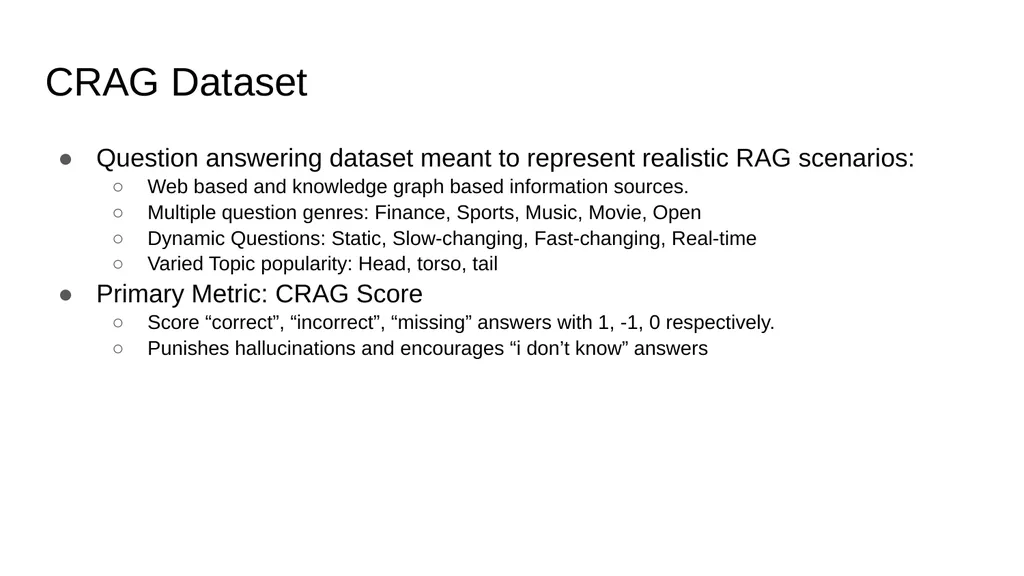
slide3. CRAG Dataset Question answering dataset meant to represent realistic RAG scenarios:
Web based and knowledge graph based information sources.
Multiple question genres: Finance, Sports, Music, Movie, Open
Dynamic Questions: Static, Slow-changing, Fast-changing, Real-time
Varied Topic popularity: Head, torso, tail
Primary Metric: CRAG Score
Score “correct”, “incorrect”, “missing” answers with 1, -1, 0 respectively.
Punishes hallucinations and encourages “i don’t know” answers<br>
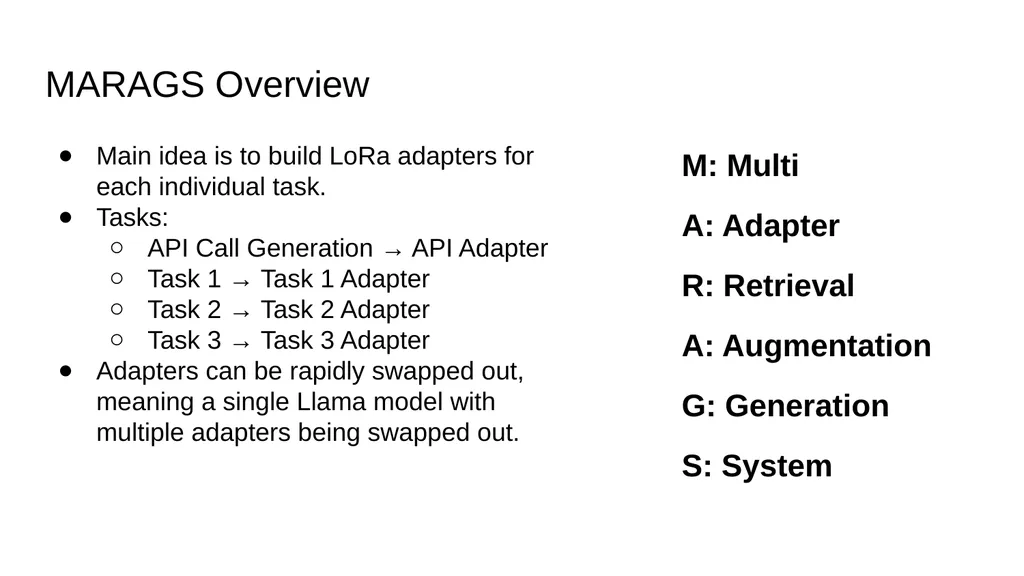
slide4. MARAGS Overview M: Multi
A: Adapter
R: Retrieval
A: Augmentation
G: Generation
S: System Main idea is to build LoRa adapters for each individual task.
Tasks:
API Call Generation → API Adapter
Task 1 → Task 1 Adapter
Task 2 → Task 2 Adapter
Task 3 → Task 3 Adapter
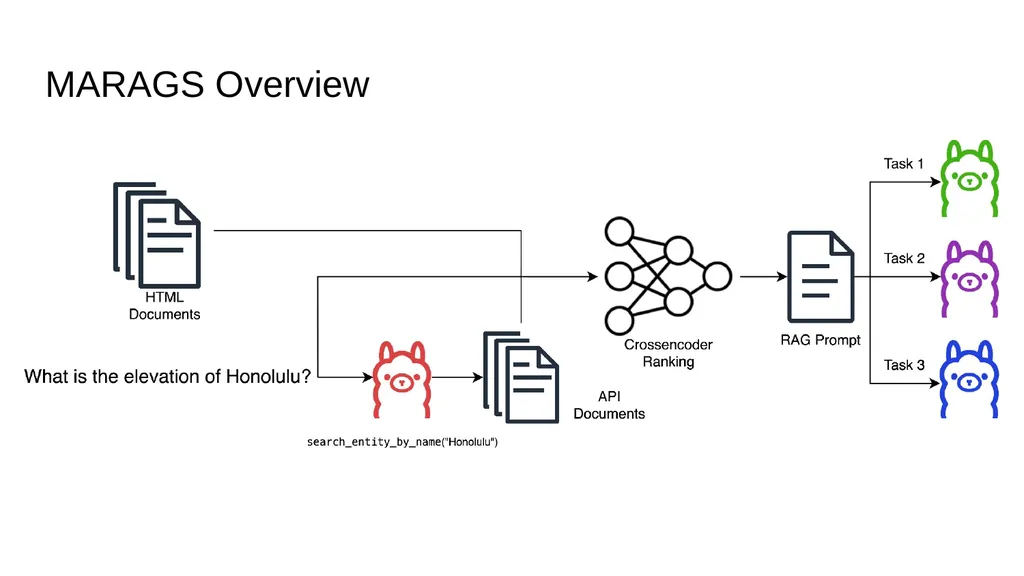
Adapters can be rapidly swapped out, meaning a single Llama model with multiple adapters being swapped out.<br>
slide5. MARAGS Overview<br>
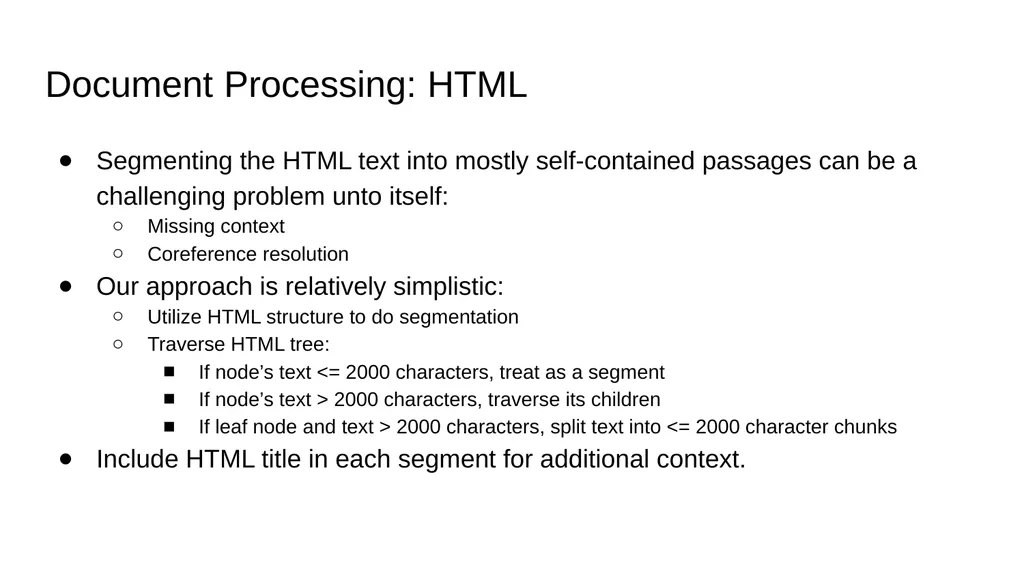
slide6. Document Processing: HTML Segmenting the HTML text into mostly self-contained passages can be a challenging problem unto itself:
Missing context
Coreference resolution
Our approach is relatively simplistic:
Utilize HTML structure to do segmentation
Traverse HTML tree:
If node’s text <= 2000 characters, treat as a segment
If node’s text > 2000 characters, traverse its children
If leaf node and text > 2000 characters, split text into <= 2000 character chunks
Include HTML title in each segment for additional context.<br>
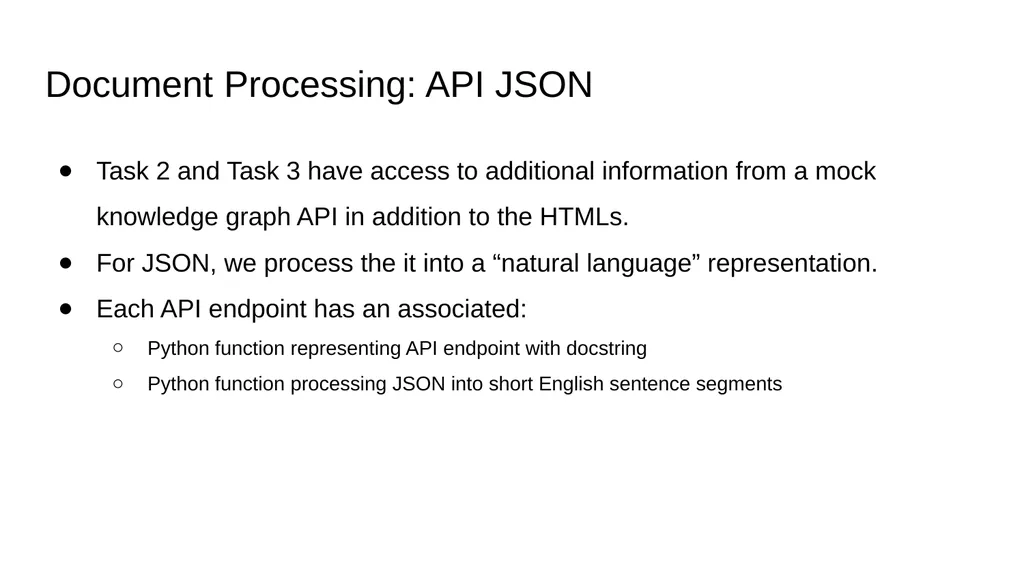
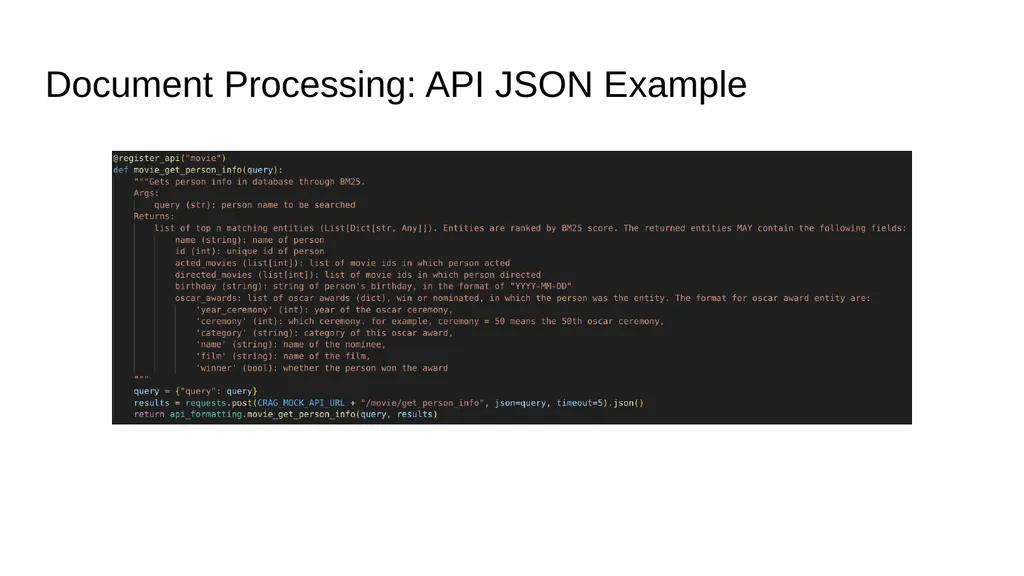
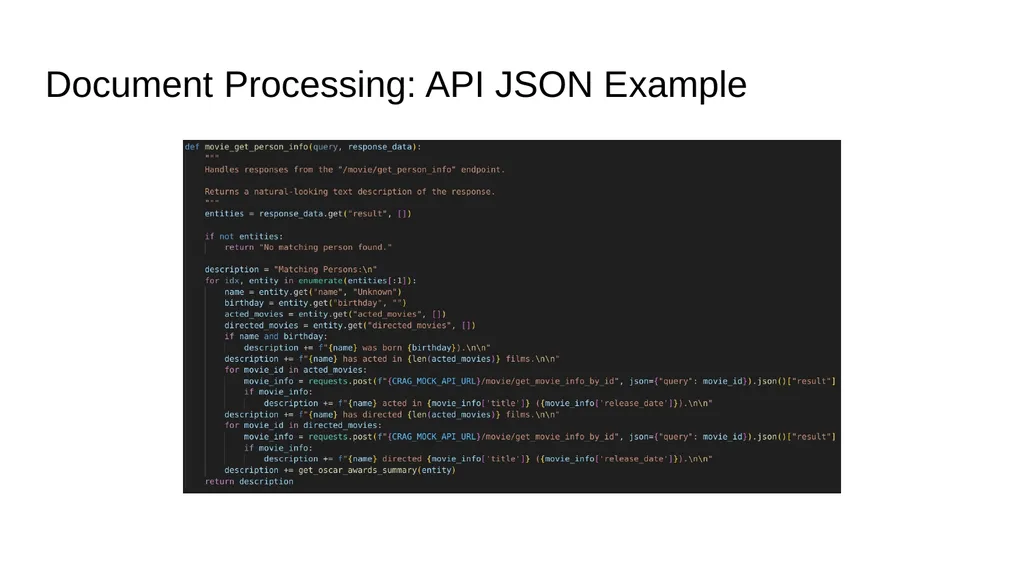
slide7. Document Processing: API JSON Task 2 and Task 3 have access to additional information from a mock knowledge graph API in addition to the HTMLs.
For JSON, we process the it into a “natural language” representation.
Each API endpoint has an associated:
Python function representing API endpoint with docstring
Python function processing JSON into short English sentence segments<br>
slide8. Document Processing: API JSON Example<br>
slide9. Document Processing: API JSON Example<br>
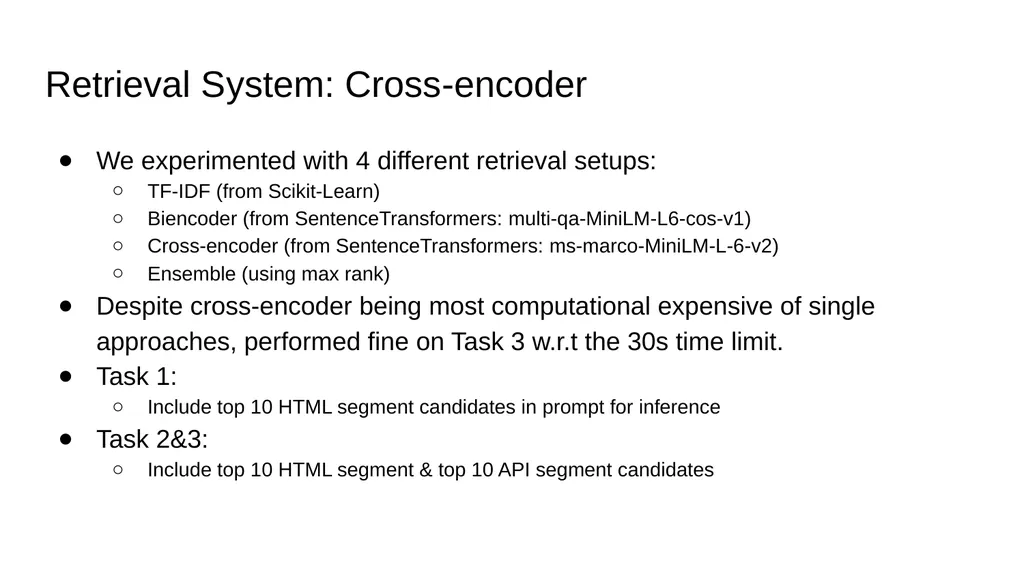
slide10. Retrieval System: Cross-encoder We experimented with 4 different retrieval setups:
TF-IDF (from Scikit-Learn)
Biencoder (from SentenceTransformers: multi-qa-MiniLM-L6-cos-v1)
Cross-encoder (from SentenceTransformers: ms-marco-MiniLM-L-6-v2)
Ensemble (using max rank)
Despite cross-encoder being most computational expensive of single approaches, performed fine on Task 3 w.r.t the 30s time limit.
Task 1:
Include top 10 HTML segment candidates in prompt for inference
Task 2&3:
Include top 10 HTML segment & top 10 API segment candidates<br>
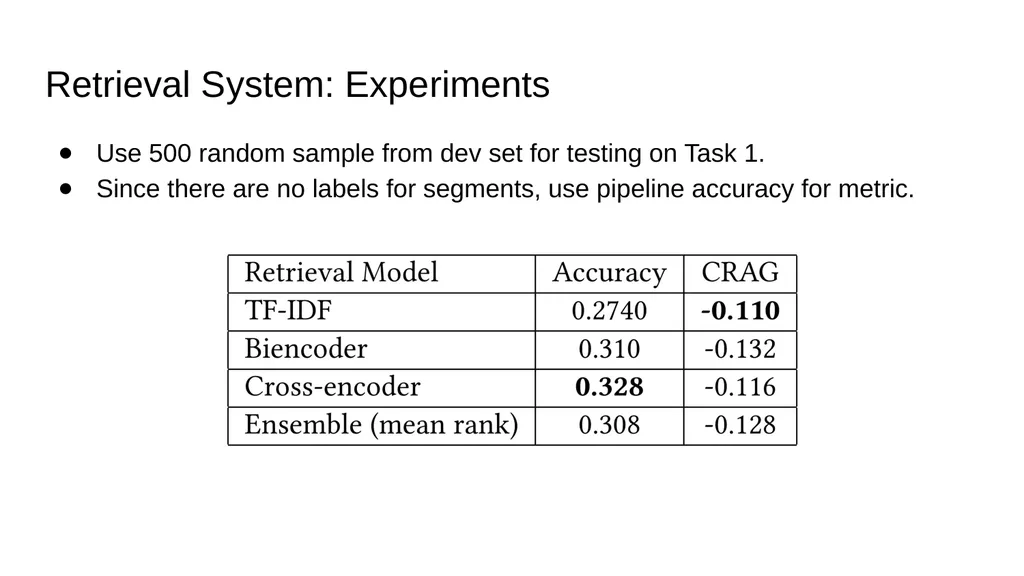
slide11. Retrieval System: Experiments Use 500 random sample from dev set for testing on Task 1.
Since there are no labels for segments, use pipeline accuracy for metric.<br>
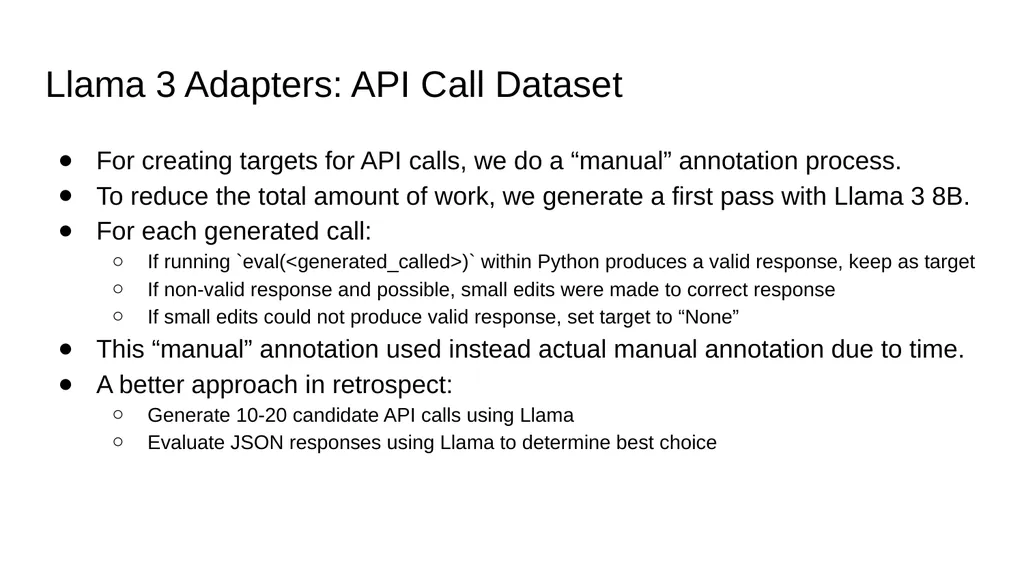
slide12. Llama 3 Adapters: API Call Dataset For creating targets for API calls, we do a “manual” annotation process.
To reduce the total amount of work, we generate a first pass with Llama 3 8B.
For each generated call:
If running `eval(<generated_called>)` within Python produces a valid response, keep as target
If non-valid response and possible, small edits were made to correct response
If small edits could not produce valid response, set target to “None”
This “manual” annotation used instead actual manual annotation due to time.
A better approach in retrospect:
Generate 10-20 candidate API calls using Llama
Evaluate JSON responses using Llama to determine best choice<br>
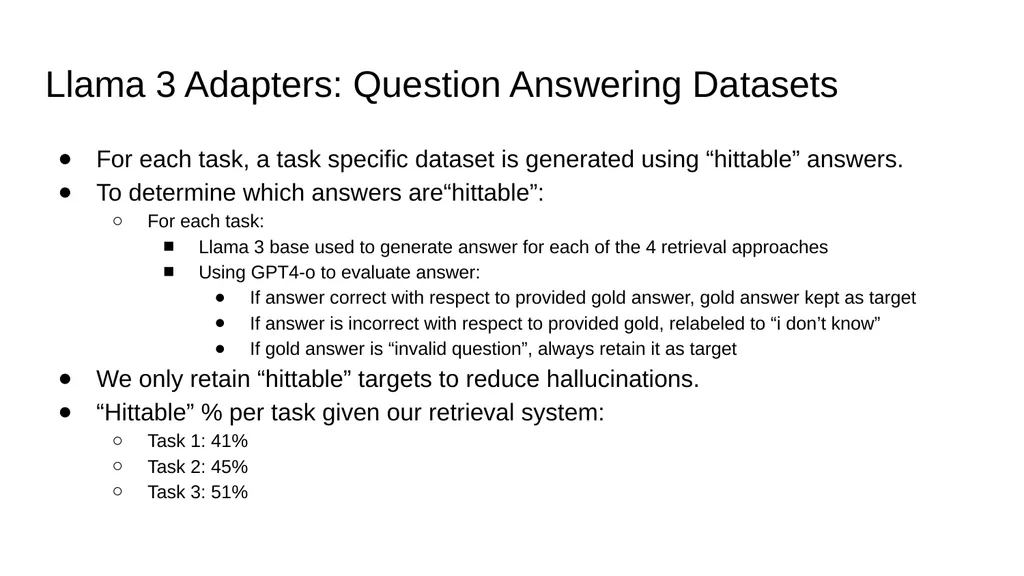
slide13. Llama 3 Adapters: Question Answering Datasets For each task, a task specific dataset is generated using “hittable” answers.
To determine which answers are“hittable”:
For each task:
Llama 3 base used to generate answer for each of the 4 retrieval approaches
Using GPT4-o to evaluate answer:
If answer correct with respect to provided gold answer, gold answer kept as target
If answer is incorrect with respect to provided gold, relabeled to “i don’t know”
If gold answer is “invalid question”, always retain it as target
We only retain “hittable” targets to reduce hallucinations.
“Hittable” % per task given our retrieval system:
Task 1: 41%
Task 2: 45%
Task 3: 51%<br>
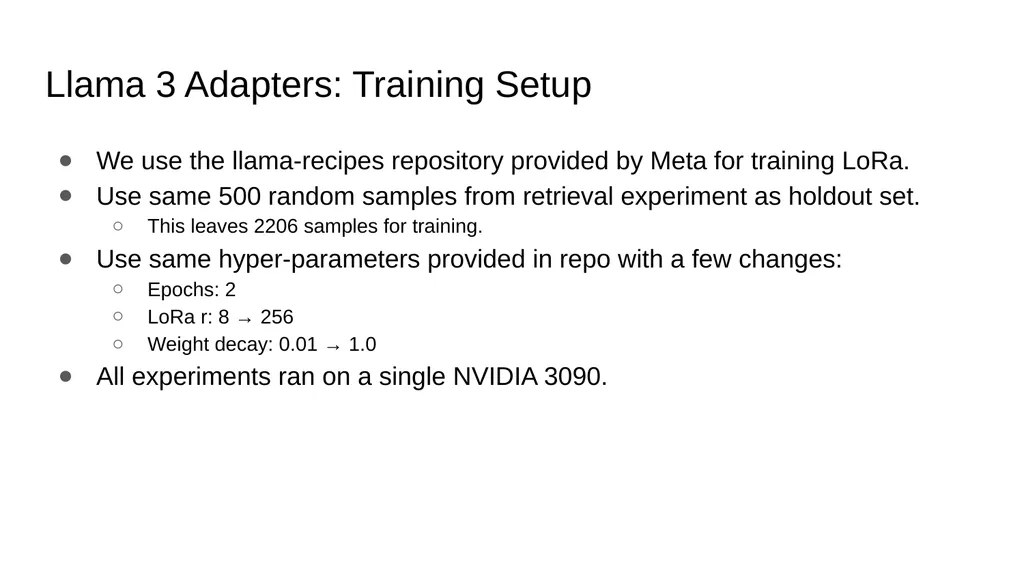
slide14. Llama 3 Adapters: Training Setup We use the llama-recipes repository provided by Meta for training LoRa.
Use same 500 random samples from retrieval experiment as holdout set.
This leaves 2206 samples for training.
Use same hyper-parameters provided in repo with a few changes:
Epochs: 2
LoRa r: 8 → 256
Weight decay: 0.01 → 1.0
All experiments ran on a single NVIDIA 3090.<br>
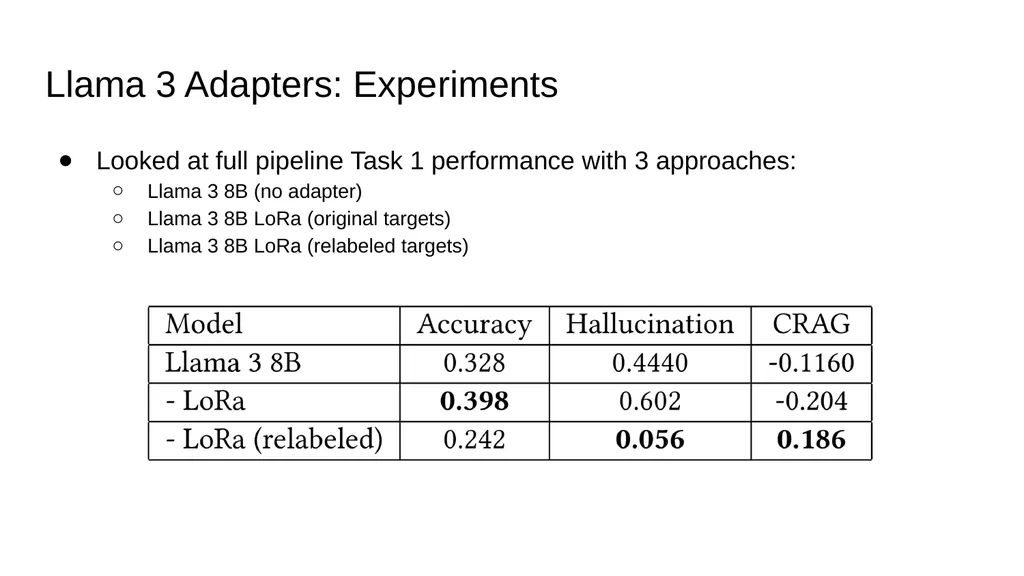
slide15. Llama 3 Adapters: Experiments Looked at full pipeline Task 1 performance with 3 approaches:
Llama 3 8B (no adapter)
Llama 3 8B LoRa (original targets)
Llama 3 8B LoRa (relabeled targets)<br>
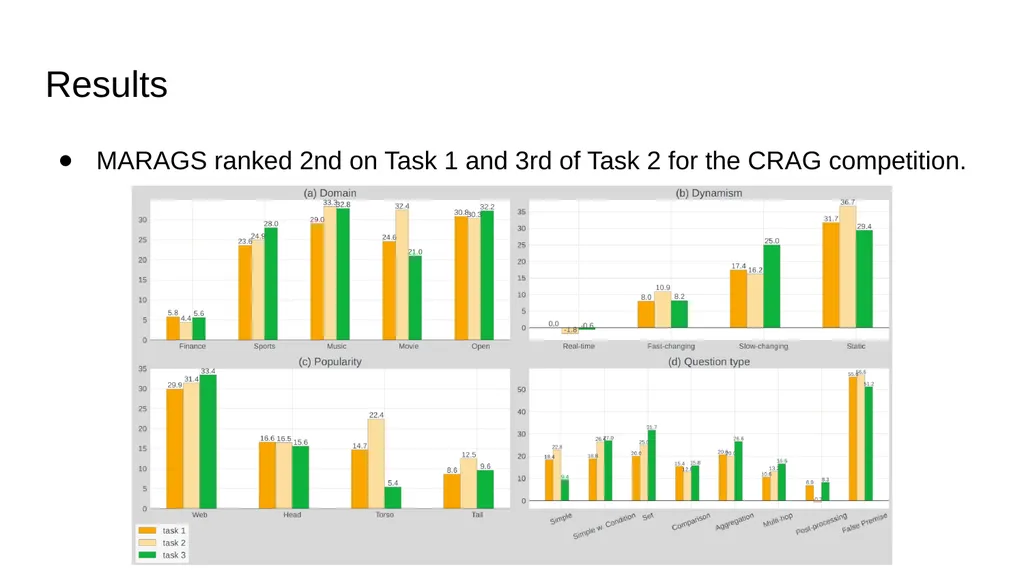
slide16. Results MARAGS ranked 2nd on Task 1 and 3rd of Task 2 for the CRAG competition.<br>
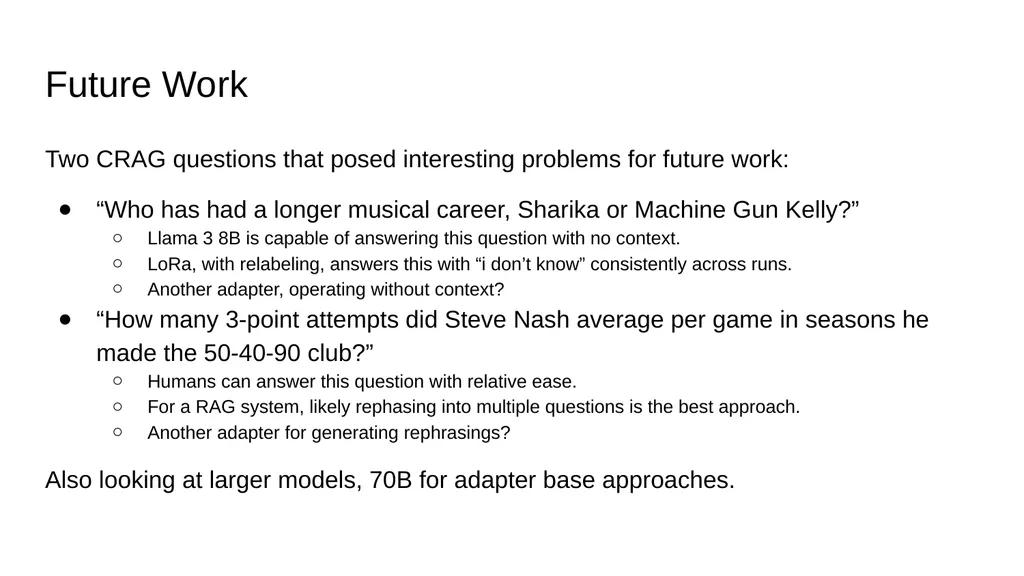
slide17. Future Work Two CRAG questions that posed interesting problems for future work:
“Who has had a longer musical career, Sharika or Machine Gun Kelly?”
Llama 3 8B is capable of answering this question with no context.
LoRa, with relabeling, answers this with “i don’t know” consistently across runs.
Another adapter, operating without context?
“How many 3-point attempts did Steve Nash average per game in seasons he made the 50-40-90 club?”
Humans can answer this question with relative ease.
For a RAG system, likely rephasing into multiple questions is the best approach.
Another adapter for generating rephrasings?
Also looking at larger models, 70B for adapter base approaches.<br>
slide2. Outline CRAG Dataset
MARAGS Overview
Document Processing
HTML
API JSON
Retrieval System
Experiments
Llama 3 Adapters
Dataset Creation
Training Setup
Experiments
Results
Future Work<br>
slide3. CRAG Dataset Question answering dataset meant to represent realistic RAG scenarios:
Web based and knowledge graph based information sources.
Multiple question genres: Finance, Sports, Music, Movie, Open
Dynamic Questions: Static, Slow-changing, Fast-changing, Real-time
Varied Topic popularity: Head, torso, tail
Primary Metric: CRAG Score
Score “correct”, “incorrect”, “missing” answers with 1, -1, 0 respectively.
Punishes hallucinations and encourages “i don’t know” answers<br>
slide4. MARAGS Overview M: Multi
A: Adapter
R: Retrieval
A: Augmentation
G: Generation
S: System Main idea is to build LoRa adapters for each individual task.
Tasks:
API Call Generation → API Adapter
Task 1 → Task 1 Adapter
Task 2 → Task 2 Adapter
Task 3 → Task 3 Adapter
Adapters can be rapidly swapped out, meaning a single Llama model with multiple adapters being swapped out.<br>
slide5. MARAGS Overview<br>
slide6. Document Processing: HTML Segmenting the HTML text into mostly self-contained passages can be a challenging problem unto itself:
Missing context
Coreference resolution
Our approach is relatively simplistic:
Utilize HTML structure to do segmentation
Traverse HTML tree:
If node’s text <= 2000 characters, treat as a segment
If node’s text > 2000 characters, traverse its children
If leaf node and text > 2000 characters, split text into <= 2000 character chunks
Include HTML title in each segment for additional context.<br>
slide7. Document Processing: API JSON Task 2 and Task 3 have access to additional information from a mock knowledge graph API in addition to the HTMLs.
For JSON, we process the it into a “natural language” representation.
Each API endpoint has an associated:
Python function representing API endpoint with docstring
Python function processing JSON into short English sentence segments<br>
slide8. Document Processing: API JSON Example<br>
slide9. Document Processing: API JSON Example<br>
slide10. Retrieval System: Cross-encoder We experimented with 4 different retrieval setups:
TF-IDF (from Scikit-Learn)
Biencoder (from SentenceTransformers: multi-qa-MiniLM-L6-cos-v1)
Cross-encoder (from SentenceTransformers: ms-marco-MiniLM-L-6-v2)
Ensemble (using max rank)
Despite cross-encoder being most computational expensive of single approaches, performed fine on Task 3 w.r.t the 30s time limit.
Task 1:
Include top 10 HTML segment candidates in prompt for inference
Task 2&3:
Include top 10 HTML segment & top 10 API segment candidates<br>
slide11. Retrieval System: Experiments Use 500 random sample from dev set for testing on Task 1.
Since there are no labels for segments, use pipeline accuracy for metric.<br>
slide12. Llama 3 Adapters: API Call Dataset For creating targets for API calls, we do a “manual” annotation process.
To reduce the total amount of work, we generate a first pass with Llama 3 8B.
For each generated call:
If running `eval(<generated_called>)` within Python produces a valid response, keep as target
If non-valid response and possible, small edits were made to correct response
If small edits could not produce valid response, set target to “None”
This “manual” annotation used instead actual manual annotation due to time.
A better approach in retrospect:
Generate 10-20 candidate API calls using Llama
Evaluate JSON responses using Llama to determine best choice<br>
slide13. Llama 3 Adapters: Question Answering Datasets For each task, a task specific dataset is generated using “hittable” answers.
To determine which answers are“hittable”:
For each task:
Llama 3 base used to generate answer for each of the 4 retrieval approaches
Using GPT4-o to evaluate answer:
If answer correct with respect to provided gold answer, gold answer kept as target
If answer is incorrect with respect to provided gold, relabeled to “i don’t know”
If gold answer is “invalid question”, always retain it as target
We only retain “hittable” targets to reduce hallucinations.
“Hittable” % per task given our retrieval system:
Task 1: 41%
Task 2: 45%
Task 3: 51%<br>
slide14. Llama 3 Adapters: Training Setup We use the llama-recipes repository provided by Meta for training LoRa.
Use same 500 random samples from retrieval experiment as holdout set.
This leaves 2206 samples for training.
Use same hyper-parameters provided in repo with a few changes:
Epochs: 2
LoRa r: 8 → 256
Weight decay: 0.01 → 1.0
All experiments ran on a single NVIDIA 3090.<br>
slide15. Llama 3 Adapters: Experiments Looked at full pipeline Task 1 performance with 3 approaches:
Llama 3 8B (no adapter)
Llama 3 8B LoRa (original targets)
Llama 3 8B LoRa (relabeled targets)<br>
slide16. Results MARAGS ranked 2nd on Task 1 and 3rd of Task 2 for the CRAG competition.<br>
slide17. Future Work Two CRAG questions that posed interesting problems for future work:
“Who has had a longer musical career, Sharika or Machine Gun Kelly?”
Llama 3 8B is capable of answering this question with no context.
LoRa, with relabeling, answers this with “i don’t know” consistently across runs.
Another adapter, operating without context?
“How many 3-point attempts did Steve Nash average per game in seasons he made the 50-40-90 club?”
Humans can answer this question with relative ease.
For a RAG system, likely rephasing into multiple questions is the best approach.
Another adapter for generating rephrasings?
Also looking at larger models, 70B for adapter base approaches.<br>