
Mary Shelley’s Frankenstein Massive Revision
LO
Published · 28 slides · 0 views

1 / 1




Description
Mary Shelleys Frankenstein Massive Revision PowerPoint The Premise Creation of Man In her novel, Mary Shelley is silent on just how Victor Frankenstein breathes life into his creation, saying only that success crowned days and nights of
Related Topics
Share
Embed code
Download this presentation From Below
"Mary Shelley’s Frankenstein Massive Revision" is the property of its rightful owner. Permission is granted to download and print the materials on this website for personal, non-commercial use only, and to display it on your personal computer provided you do not modify the materials and that you retain all copyright notices contained in the materials. By downloading content from our website, you accept the terms of this agreement.
Presentation Transcript
01
Mary Shelley’s Frankenstein Massive Revision
PowerPoint<br>
PowerPoint<br>
02
The Premise – Creation of Man In her novel, Mary Shelley is silent on just how Victor Frankenstein breathes life into his creation, saying only that success crowned "days and nights of incredible labor and fatigue;" Frankenstein offers no monster-making recipes.
But Shelley's story did not arise from the void. Scientists and physicians of her time, tantalized by the elusive boundary between life and death, probed it through experiments with lower organisms, human anatomical studies, attempts to resuscitate drowning victims, and experiments using electricity to restore life to the recently dead.<br>
But Shelley's story did not arise from the void. Scientists and physicians of her time, tantalized by the elusive boundary between life and death, probed it through experiments with lower organisms, human anatomical studies, attempts to resuscitate drowning victims, and experiments using electricity to restore life to the recently dead.<br>
03
LITERARY PARALLELS<br>
04
The Myth of Prometheus Subtitle: The Modern Prometheus
Prometheus was one of the Titans
Prometheus = ‘forethought’
As a reward for being the only Titan to not rebel against him, Zeus assigned Prometheus the task of forming man
Prometheus became fond of his creation: he stole the secret of fire from Zeus and deprived humans of their knowledge of the future, giving them hope instead
Prometheus is often seen as a benefactor of human kind<br>
Prometheus was one of the Titans
Prometheus = ‘forethought’
As a reward for being the only Titan to not rebel against him, Zeus assigned Prometheus the task of forming man
Prometheus became fond of his creation: he stole the secret of fire from Zeus and deprived humans of their knowledge of the future, giving them hope instead
Prometheus is often seen as a benefactor of human kind<br>
05
Modern Prometheus In response to his betrayal, Zeus chained Prometheus to a rock where a vulture (or an eagle) pecked out his liver (or heart), which regenerated itself each night so that the punishment was eternal
Early in the 18th century, Prometheus had become an accepted image of the creative artist
Shelley created a radical shift by transferring the metaphor of Prometheus as artist to Prometheus as scientist. By creating her ‘modern Prometheus’ as a scientist, Shelley is suggesting science is creative<br>
Early in the 18th century, Prometheus had become an accepted image of the creative artist
Shelley created a radical shift by transferring the metaphor of Prometheus as artist to Prometheus as scientist. By creating her ‘modern Prometheus’ as a scientist, Shelley is suggesting science is creative<br>
06
Paradise Lost Paradise Lost is Milton’s account of ‘Genesis’
Frankenstein – attempting to take on the role of God; defies God in a similar way to Satan; punished for his defiance in a similar way to Satan
Where is Eve? – the monster wants Frankenstein (God) to create Eve but he refuses
The monster’s narrative parallels the story of Eve
The description of Victor and Elizabeth’s childhood is like the innocence of the Garden of Eden
The monster’s awakening is a parody of it – beautiful but harsh is the world that he finds.<br>
Frankenstein – attempting to take on the role of God; defies God in a similar way to Satan; punished for his defiance in a similar way to Satan
Where is Eve? – the monster wants Frankenstein (God) to create Eve but he refuses
The monster’s narrative parallels the story of Eve
The description of Victor and Elizabeth’s childhood is like the innocence of the Garden of Eden
The monster’s awakening is a parody of it – beautiful but harsh is the world that he finds.<br>
07
The Structure The three concentric layers of the text are presented in three volumes: The text has been described as a ‘Chinese Box’
Captain Robert Walton’s letters home to his sister bookend the story
The narrative related by Victor Frankenstein
The monster’s story<br>
Captain Robert Walton’s letters home to his sister bookend the story
The narrative related by Victor Frankenstein
The monster’s story<br>
08
Walton Shows us the Moral Walton’s story of his voyage to the Pole is a buffer for the reader confronting the more marvellous story of Frankenstein
Parallel situation between Walton and Frankenstein – each has a solitary nature, feels largely self-educated, is obsessed with their ‘quest’ and ‘suffers’ from hubris
Frankenstein’s narrative warns Walton of the price payable for egocentric obsessions<br>
Parallel situation between Walton and Frankenstein – each has a solitary nature, feels largely self-educated, is obsessed with their ‘quest’ and ‘suffers’ from hubris
Frankenstein’s narrative warns Walton of the price payable for egocentric obsessions<br>
09
The Monster’s Story This communicates a number of views and values
Plays with the idea that man is essentially good – the creature is like Satan, the fallen angel
His passionate responses to nature are typically Romantic
Isolation and loneliness are no good (much like when Frankenstein isolates himself with his science)
Literature has much to teach us about the world<br>
Plays with the idea that man is essentially good – the creature is like Satan, the fallen angel
His passionate responses to nature are typically Romantic
Isolation and loneliness are no good (much like when Frankenstein isolates himself with his science)
Literature has much to teach us about the world<br>
10
Evidentiary Narrative Technique This occurs when the story is told from a number of different perspectives – who all view the same events differently.
We have three narrators – but also letters and so on from other characters<br>
We have three narrators – but also letters and so on from other characters<br>
11
KEY IDEAS<br>
12
KNOWLEDGE Victor seeks knowledge for his own reasons
Does not consider the ramifications (Very Romantic view of the age)
Walton also does this
Victor focused on Alchemy before going to university and learning about new science
Rime of the Ancient Mariner links in to this, as it suggests the violation/disrespect of nature is a sin.<br>
Does not consider the ramifications (Very Romantic view of the age)
Walton also does this
Victor focused on Alchemy before going to university and learning about new science
Rime of the Ancient Mariner links in to this, as it suggests the violation/disrespect of nature is a sin.<br>
13
EDUCATION Romantics favoured a ‘natural’ education through reading, rather than a formal one, with adventures providing self-growth. (Critique?)
Walton self educated “my education was neglected, yet I was passionately fond of reading.”
The creature learns from the DeLacey’s
Typical Romantic reading list
No- one to guide him in his learning<br>
Walton self educated “my education was neglected, yet I was passionately fond of reading.”
The creature learns from the DeLacey’s
Typical Romantic reading list
No- one to guide him in his learning<br>
14
PARENTHOOD/FAMILY Shelley loses her mother early
Elizabeth’s mother died early during childbirth
Victor does not care for the creature he ‘parented’
Victor is the real monster – he neglects his own ‘child’
Critiques the cult of the individual, of solitariness and introversion of the time<br>
Elizabeth’s mother died early during childbirth
Victor does not care for the creature he ‘parented’
Victor is the real monster – he neglects his own ‘child’
Critiques the cult of the individual, of solitariness and introversion of the time<br>
15
GENRE<br>
16
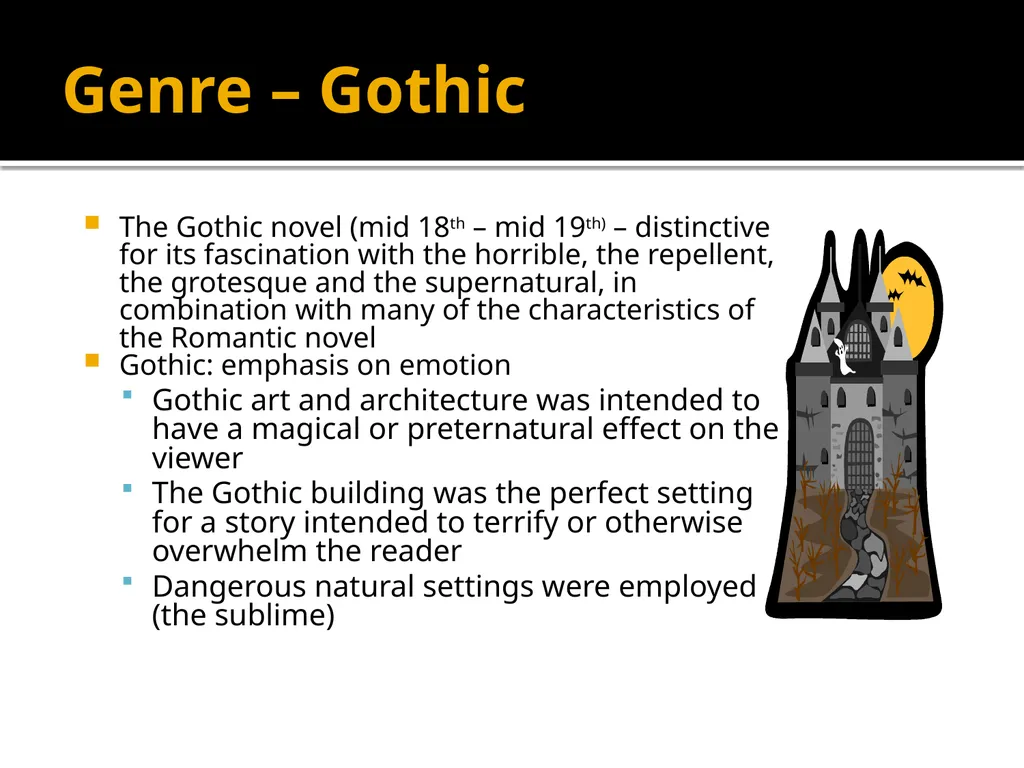
Genre – Gothic The Gothic novel (mid 18th – mid 19th) – distinctive for its fascination with the horrible, the repellent, the grotesque and the supernatural, in combination with many of the characteristics of the Romantic novel
Gothic: emphasis on emotion
Gothic art and architecture was intended to have a magical or preternatural effect on the viewer
The Gothic building was the perfect setting for a story intended to terrify or otherwise overwhelm the reader
Dangerous natural settings were employed (the sublime)<br>
Gothic: emphasis on emotion
Gothic art and architecture was intended to have a magical or preternatural effect on the viewer
The Gothic building was the perfect setting for a story intended to terrify or otherwise overwhelm the reader
Dangerous natural settings were employed (the sublime)<br>
17
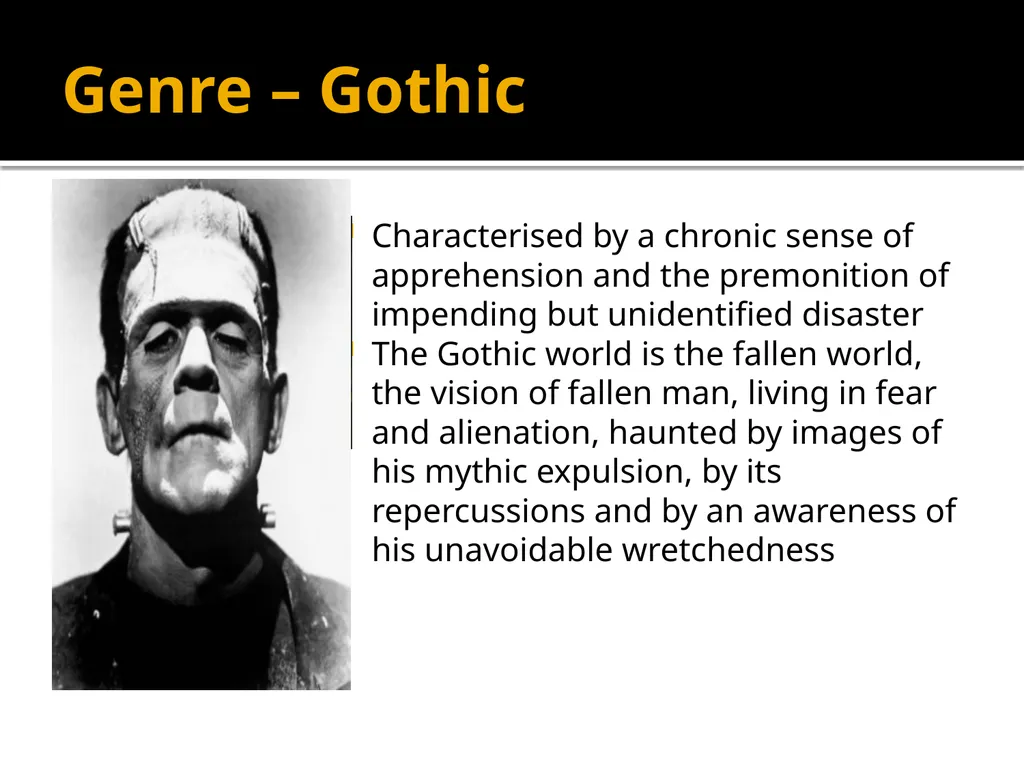
Genre – Gothic Characterised by a chronic sense of apprehension and the premonition of impending but unidentified disaster
The Gothic world is the fallen world, the vision of fallen man, living in fear and alienation, haunted by images of his mythic expulsion, by its repercussions and by an awareness of his unavoidable wretchedness<br>
The Gothic world is the fallen world, the vision of fallen man, living in fear and alienation, haunted by images of his mythic expulsion, by its repercussions and by an awareness of his unavoidable wretchedness<br>
18
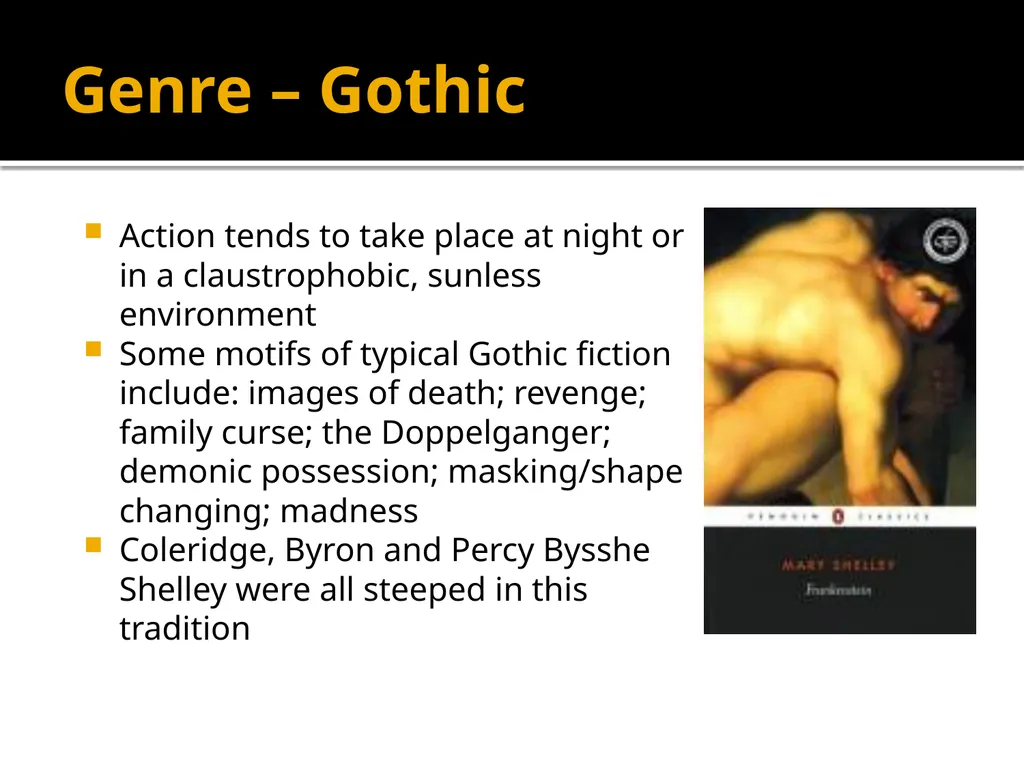
Genre – Gothic Action tends to take place at night or in a claustrophobic, sunless environment
Some motifs of typical Gothic fiction include: images of death; revenge; family curse; the Doppelganger; demonic possession; masking/shape changing; madness
Coleridge, Byron and Percy Bysshe Shelley were all steeped in this tradition<br>
Some motifs of typical Gothic fiction include: images of death; revenge; family curse; the Doppelganger; demonic possession; masking/shape changing; madness
Coleridge, Byron and Percy Bysshe Shelley were all steeped in this tradition<br>
19
Genre – Gothic Psychologically, the Gothic novel is generally understood to serve a fundamental human need:
Can be called ‘the strange human
need for feeling afraid’
The need to retain links to the past<br>
Can be called ‘the strange human
need for feeling afraid’
The need to retain links to the past<br>
20
Genre - Gothic Frankenstein centred around:
Thirst for knowledge
A scientific over-reacher
Forbidden knowledge and the mysteries of life
The emphasis in Frankenstein is on psychological terror
The scientific experiment can be seen as proving that the masculinist arts of civilisation can only reanimate the dead and deaden the living. It is the feminine and naturing aspect of reproduction that would have saved the creature from his lonely life.<br>
Thirst for knowledge
A scientific over-reacher
Forbidden knowledge and the mysteries of life
The emphasis in Frankenstein is on psychological terror
The scientific experiment can be seen as proving that the masculinist arts of civilisation can only reanimate the dead and deaden the living. It is the feminine and naturing aspect of reproduction that would have saved the creature from his lonely life.<br>
21
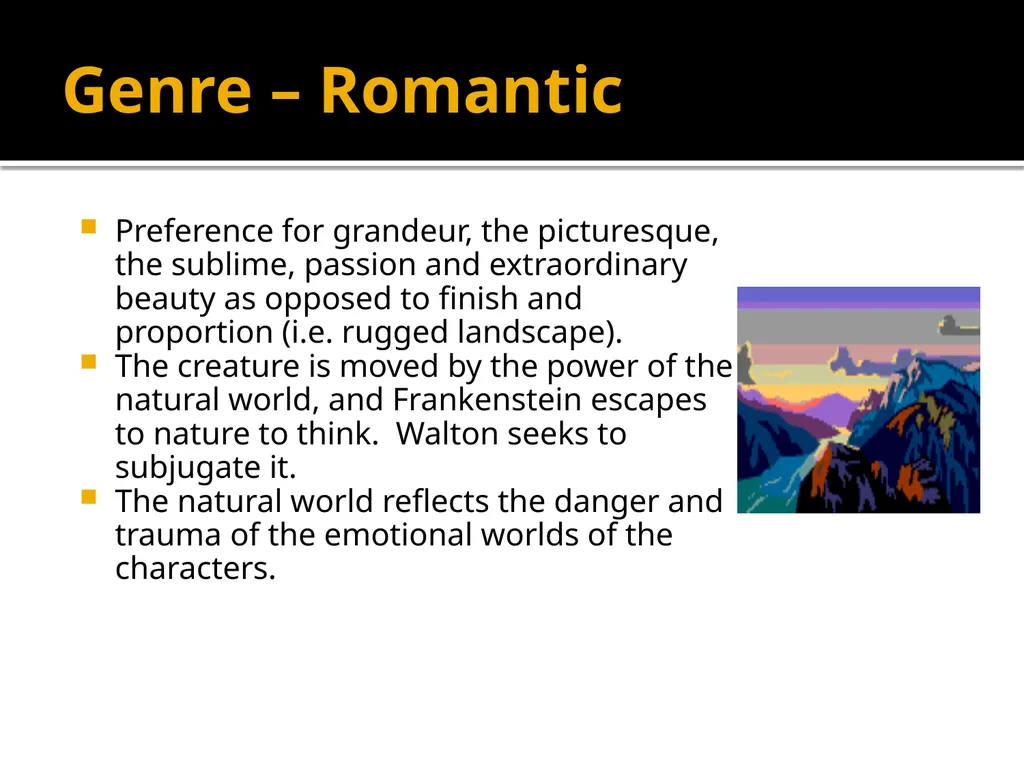
Genre – Romantic Preference for grandeur, the picturesque, the sublime, passion and extraordinary beauty as opposed to finish and proportion (i.e. rugged landscape).
The creature is moved by the power of the natural world, and Frankenstein escapes to nature to think. Walton seeks to subjugate it.
The natural world reflects the danger and trauma of the emotional worlds of the characters.<br>
The creature is moved by the power of the natural world, and Frankenstein escapes to nature to think. Walton seeks to subjugate it.
The natural world reflects the danger and trauma of the emotional worlds of the characters.<br>
22
Genre - Romantic Explored the emotional directness of personal experience:
Extremes of rapture, nostalgia (for childhood or the past), horror, melancholy or sentimentality
Cultivation of the exotic, the bizarre or the macabre
Interest in the irrational realms of dream and delirium<br>
Extremes of rapture, nostalgia (for childhood or the past), horror, melancholy or sentimentality
Cultivation of the exotic, the bizarre or the macabre
Interest in the irrational realms of dream and delirium<br>
23
Genre – Romantic Frankenstein as a Romantic novel
The growth of the individual mind is enabled through knowledge of, and closeness to, nature and not from man
A moral fable on the self-destructive consequences of idealism and solitary obsession in a quest for passionately knowing<br>
The growth of the individual mind is enabled through knowledge of, and closeness to, nature and not from man
A moral fable on the self-destructive consequences of idealism and solitary obsession in a quest for passionately knowing<br>
24
Genre – Romantic Self-consciousness in the Romantic period is only a state which must be passed through so that it may be transcended
Frankenstein’s creature moves through the layers of self-awareness to develop into the ‘modern man’
However, while he finds his own self, he does not develop into the next ‘stage’ – he stays ego-centric and unable to truly understand what is beyond himself, his own passions and his own need for vengeance
Are we to recognise that knowledge needs to be dispensed simultaneously with moral instruction? (perhaps this is the feminine again?)<br>
Frankenstein’s creature moves through the layers of self-awareness to develop into the ‘modern man’
However, while he finds his own self, he does not develop into the next ‘stage’ – he stays ego-centric and unable to truly understand what is beyond himself, his own passions and his own need for vengeance
Are we to recognise that knowledge needs to be dispensed simultaneously with moral instruction? (perhaps this is the feminine again?)<br>
25
Genre – Romantic Shelley’s protagonist is so completely engrossed in his own ego that he must create a being to reassure himself of his own existence:
Frankenstein’s consciousness alienates him from life, causing him to become a solitary figure
He creates another being, who stands as a double (doppelganger) or subconscious element of himself
This grotesque usurpation of women’s bodies essentially deepens his own crisis of self-consciousness, for, in embodying his alter-ego he cannot now go beyond it and return to a state of former innocence<br>
Frankenstein’s consciousness alienates him from life, causing him to become a solitary figure
He creates another being, who stands as a double (doppelganger) or subconscious element of himself
This grotesque usurpation of women’s bodies essentially deepens his own crisis of self-consciousness, for, in embodying his alter-ego he cannot now go beyond it and return to a state of former innocence<br>
26
Genre – Romantic There is the sense of the Doppelganger in Frankenstein’s creature
Frankenstein’s monster is a magnified image of the self of the creator, indicative of Victor’s profound narcissism
This monster represents a larger than life super-ego of his creator (remember its size)
Frankenstein concedes that the monster he created is in essence a part of his spirit, his mirror: “my own vampire, my own spirit let loose from the grave, and forced to destroy all that was dear to me”<br>
Frankenstein’s monster is a magnified image of the self of the creator, indicative of Victor’s profound narcissism
This monster represents a larger than life super-ego of his creator (remember its size)
Frankenstein concedes that the monster he created is in essence a part of his spirit, his mirror: “my own vampire, my own spirit let loose from the grave, and forced to destroy all that was dear to me”<br>
27
Genre – Romantic Frankenstein becomes the epitome of egotism and self-consciousness:
To Walton, Frankenstein confessed that his “eyes [became] insensible to the charms of nature. And the same feelings … caused me also to forget those friends who were so many miles absent”
The wounded deer Frankenstein comes across in the Alpine valley he sees as ‘a type of me’
Frankenstein was so self-obsessed that he cannot consider the possibility that it may be Elizabeth who dies at the hand of the monster on their wedding night
When he does consider the scenario of his own death he is self-gratifyingly morbid: “yet when I thought of my beloved Elizabeth – of her tears and endless sorrow, when she would find her lover so barbarously snatched from her – tears, the first I had shed for months, streamed from my eyes”<br>
To Walton, Frankenstein confessed that his “eyes [became] insensible to the charms of nature. And the same feelings … caused me also to forget those friends who were so many miles absent”
The wounded deer Frankenstein comes across in the Alpine valley he sees as ‘a type of me’
Frankenstein was so self-obsessed that he cannot consider the possibility that it may be Elizabeth who dies at the hand of the monster on their wedding night
When he does consider the scenario of his own death he is self-gratifyingly morbid: “yet when I thought of my beloved Elizabeth – of her tears and endless sorrow, when she would find her lover so barbarously snatched from her – tears, the first I had shed for months, streamed from my eyes”<br>
28
Freudian Interpretation Victor as the id, who acts out his sexual and aggressive natures by seeking to become God.
The creature then, represents the ego which must work with the demands of the real world and come to terms with societal rejection.
Walton becomes the superego or the conscience that relates the acceptable and unacceptable behaviour.
These three characters represent the struggle of man and his conscience with the good and the bad, the learned and the ignorant.<br>
The creature then, represents the ego which must work with the demands of the real world and come to terms with societal rejection.
Walton becomes the superego or the conscience that relates the acceptable and unacceptable behaviour.
These three characters represent the struggle of man and his conscience with the good and the bad, the learned and the ignorant.<br>