Masoud.hamedsu.edu.krd Lec.1 - Class MSc.. 2023-2024 Salahaddin University- Erbil College of Science Earth Sciences and Petroleum Department Advance Hydrogeology Read the textbook FETTER, C. W. (2001). Applied hydrogeology. Upper
"Masoud.hamed@su.edu.krd Lec.1 - Class MSc.." is the property of its rightful owner. Permission is granted to
download and print the materials on this website for personal, non-commercial use only, and to display it
on your personal computer provided you do not modify the materials and that you retain all copyright
notices contained in the materials. By downloading content from our website, you accept the terms of this
agreement.
Presentation Transcript
01
Masoud.hamed@su.edu.krd Lec.1 - Class MSc..
2023-2024 Salahaddin University- Erbil / College of Science /
Earth Sciences and Petroleum Department Advance Hydrogeology<br>
02
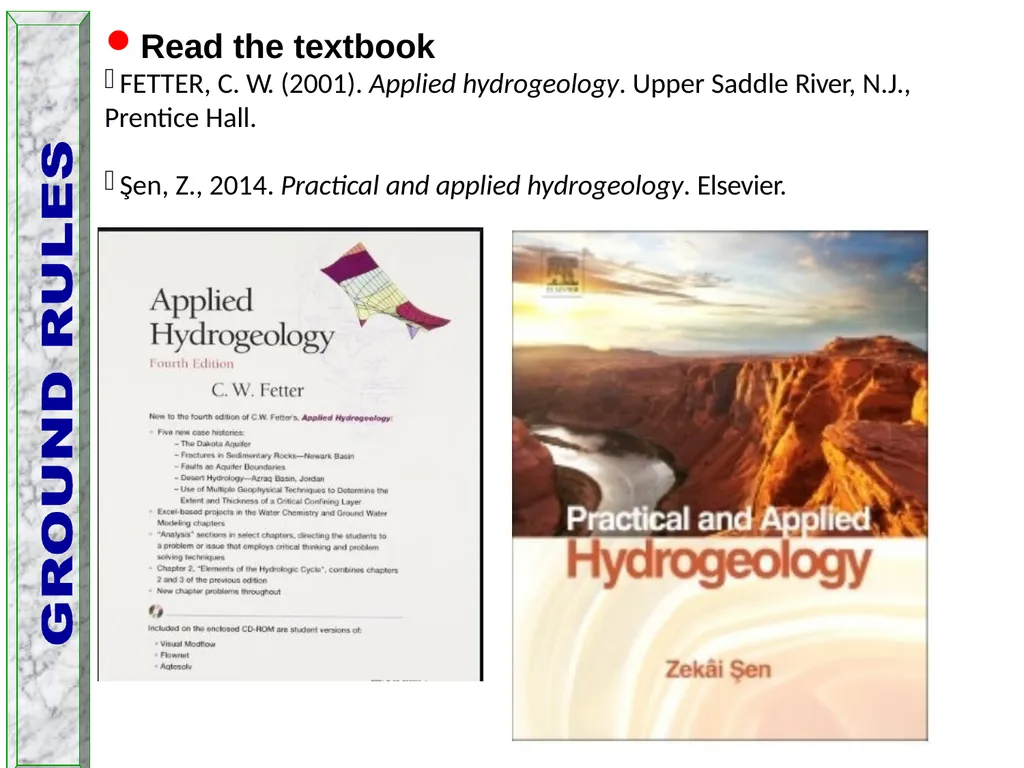
Read the textbook
FETTER, C. W. (2001). Applied hydrogeology. Upper Saddle River, N.J.,
Prentice Hall.
Şen, Z., 2014. Practical and applied hydrogeology. Elsevier.<br>
03
Attend lectures
Hear topical overviews & ask questions
Do in-class assignments & turn in & pick up HW
Exams, quizzes & extra credit opportunities
In-class exercises and homework assignments (depend on your status!!!)
Exercises weekly & homework every other week<br>
04
Required by all students
While in lecture, please DO NOT:
Forget to turn off cell phones
read different documents instead of course notes
Talk and have conversations
While in the lecture, please DO:
Ask questions when anything is not clear
Engage in the discussions
Fully participate in in-class exercises<br>
05
What is hydrogeology
What is the hydrologic cycle
What is the hydrologic equation
Gaining and losing streams
Origin and age of groundwater An Introduction to Hydrogeology<br>
06
Hydrogeology (hydro- meaning water, and - geology meaning the study of the Earth) is the area of geology that deals with the distribution and movement of groundwater in the soil and rocks of the Earth's crust (commonly in aquifers).
The terms groundwater hydrology, geohydrology, and hydrogeology are often used interchangeably. What is Hydrogeology<br>
07
Groundwater is one of the most precious natural
resource.
It is the most important source of drinking water and supplies water for irrigation, agricultural and domestic usage.
Of the total water available on earth, less than 2.5 % is fresh water of which 68.7% is found in the ice caps and glaciers (frozen state).
Approximately 30% is groundwater and less than 1.2% is surface water (lakes, streams, permafrost, soil moisture etc.) Introduction<br>
08
9 No beginning, no end. We can start in the ocean but that is not the origin of the water molecule.
Evaporation vs Condensation vs Precipitation
Runoff- ice/rain/snow – Overland flow
Infliltration – seepage into the ground
Vadose zone – soil pores, air and water
Transpiration – soil water taken up by plant roots, released into the atmosphere.
Interflow – vadose zone water movement.
Capillary fringe – intermediate belt – pores filled with capillary water, saturation approaches 100%, water is held by capillary forces.
Zone of saturation – water table – groundwater
Baseflow - groundwater contribution to a stream – Throughflow- Water that infiltrates
into the soil on a slope moves down slope as lateral unsaturated flow in the soil zone
Evapotranspiration (ET)- transpiration by plants, evaporation from land surfaces
Magmatic water – Could be origin of water molecules. Contained within magmas deep in the crust. The Hydrologic cycle<br>
09
10 The hydrologic cycle<br>
10
11<br>
11
12<br>
12
Interaction between groundwater and streams
The interaction between the groundwater system and streams is a basic link in the hydrologic cycle.
It can take place in one of three ways.
1) Streams may gain water from the inflow of groundwater
through the streambed. Such streams are called gaining streams.
For this to occur, the elevation of the water table must be higher than the level of the surface of the stream.
2)Streams may lose water to the groundwater system by outflow through the streambed. The term losing stream is applied to this situation
When this happens, the elevation of the water table is lower than the surface of the stream. Losing streams can be connected or disconnected
3) The third possibility is a combination of the first two—a stream gains in some sections and loses in others.<br>
13
14<br>
14
Origin and Age of Groundwater
Almost all groundwater is a part of the hydrologic cylce, including surface and atmospheric waters.
However minor amount of groundwater may be derived from other origins.
Water that has been out of contact with atmosphere for an appreciable part of geologic period is termed as connate water. This water may have been derived from ocean or fresh water sources and is highly mineralized.
Magmatic water is derived from magma. Where the separation is deep, it is known as plutonic water, while volcanic water indicates water from relatively shallow depths.<br>
15
Origin and Age of Groundwater
New water of magmatic or cosmic origin that has not previously been a part of the hydrosphere is referred to as juvenile water.
Metamorphic water is the water that has been associated with the rocks during their metamorphism.
Radioactive isotopes are helpful in determining the age of groundwater.
Two most useful radioactive isotopes for determining the age of water are Hydrogen-3 (Tritium) and Carbon-14.
Tritium (half life years) is used for estimating groundwater ages upto 50 years.
Whereas Carbon-14 (half life-5730 years) is used for dating groundwater ranging from a few hundred years to about 50,000 years.<br>