Mastering Literature Reviews The Writing CenterJasmine Ochoa Literature Review A discussion of relevant information on a given topic that defines and clarifies the problem; shows a progression; interprets material; highlights
"Mastering Literature Reviews The Writing" is the property of its rightful owner. Permission is granted to
download and print the materials on this website for personal, non-commercial use only, and to display it
on your personal computer provided you do not modify the materials and that you retain all copyright
notices contained in the materials. By downloading content from our website, you accept the terms of this
agreement.
Presentation Transcript
01
Mastering Literature Reviews The Writing Center/Jasmine Ochoa<br>
02
Literature Review A discussion of relevant information on a given topic that defines and clarifies the problem; shows a progression; interprets material; highlights contradictions, gaps, or inconsistencies in current research; suggests further research and investigation.<br>
03
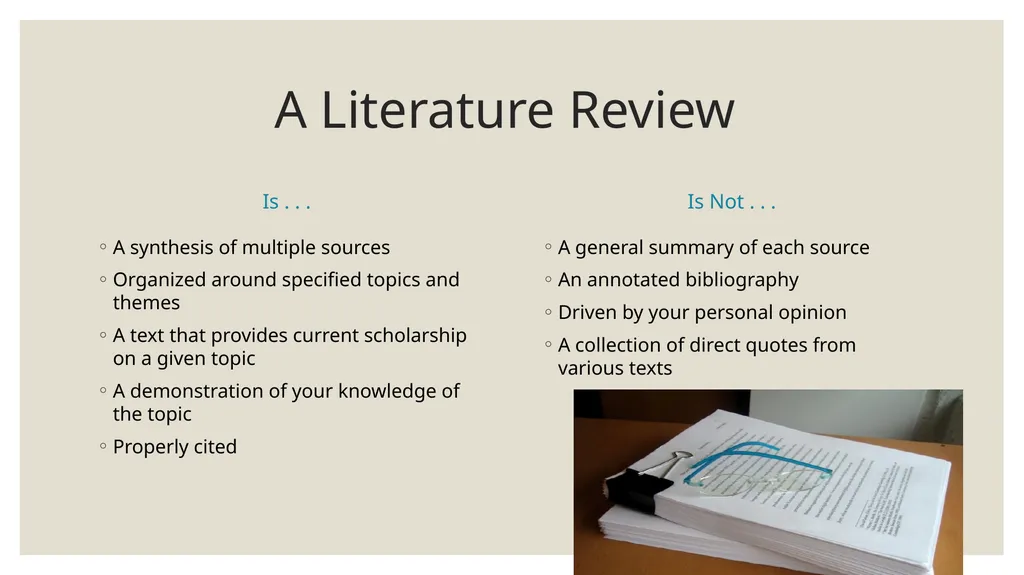
A Literature Review Is . . . A synthesis of multiple sources
Organized around specified topics and themes
A text that provides current scholarship on a given topic
A demonstration of your knowledge of the topic
Properly cited Is Not . . . A general summary of each source
An annotated bibliography
Driven by your personal opinion
A collection of direct quotes from various texts<br>
04
STAND ALONE Some summarizing
Analysis
Connecting it to a main focus/subject
How does the literature (typically more than one piece of literature) connect to your focus? How is it or is it not relevant to your focus? WITHIN ANOTHER ASSIGNMENT Some summarizing
Analysis
Connecting the literature to your research topic
How does the literature fit into your research topic? How is the literature assisting your topic?
Be sure to include a transition leading into the next section of your writing assignment<br>
05
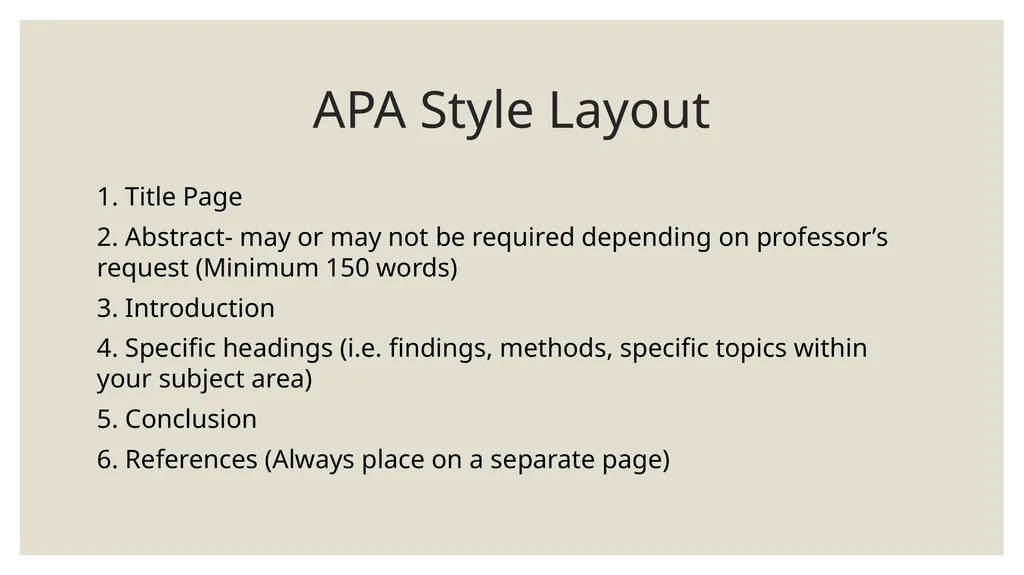
APA Style Layout 1. Title Page
2. Abstract- may or may not be required depending on professor’s request (Minimum 150 words)
3. Introduction
4. Specific headings (i.e. findings, methods, specific topics within your subject area)
5. Conclusion
6. References (Always place on a separate page)<br>
06
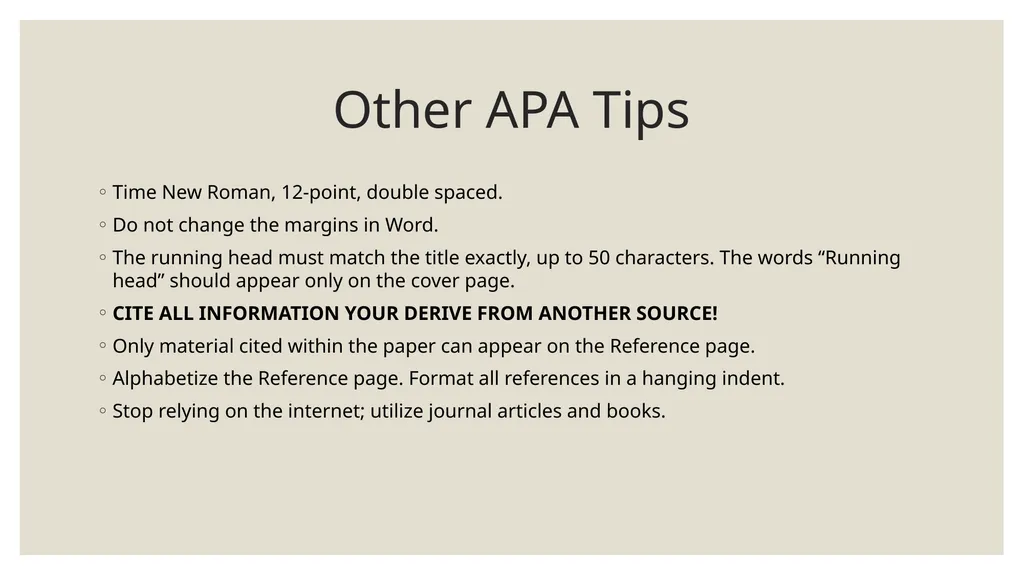
Other APA Tips Time New Roman, 12-point, double spaced.
Do not change the margins in Word.
The running head must match the title exactly, up to 50 characters. The words “Running head” should appear only on the cover page.
CITE ALL INFORMATION YOUR DERIVE FROM ANOTHER SOURCE!
Only material cited within the paper can appear on the Reference page.
Alphabetize the Reference page. Format all references in a hanging indent.
Stop relying on the internet; utilize journal articles and books.<br>
07
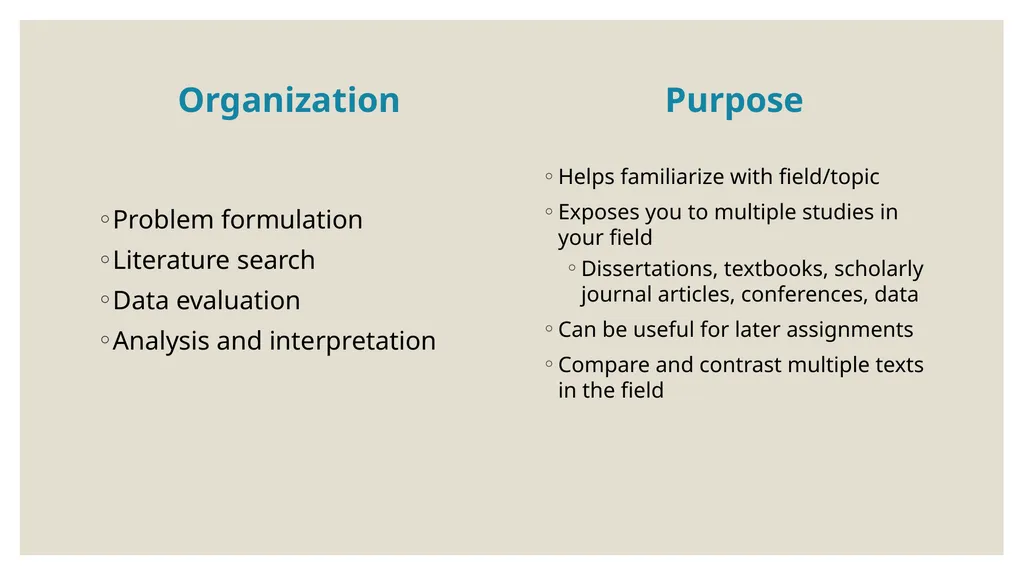
Organization Problem formulation
Literature search
Data evaluation
Analysis and interpretation Purpose Helps familiarize with field/topic
Exposes you to multiple studies in your field
Dissertations, textbooks, scholarly journal articles, conferences, data
Can be useful for later assignments
Compare and contrast multiple texts in the field<br>
08
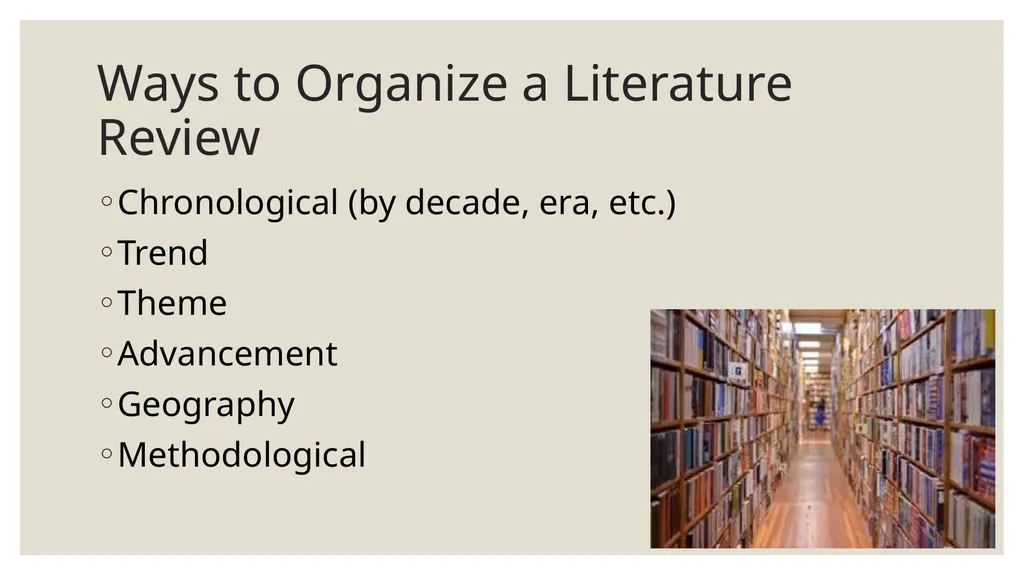
Ways to Organize a Literature Review Chronological (by decade, era, etc.)
Trend
Theme
Advancement
Geography
Methodological<br>
09
Process Collect articles from databases. (Don’t neglect books!)
Analyze each source. Skim their abstracts and other major sections.
Take notes. Locate the author’s/authors’ main idea.
Arrange the sources into their proper order based on your outline.
Provide transitions between each section.<br>
10
A literature review should Define and clarify a problem
Summarize previous investigations to inform the reader of the state of research
Identify relations, contradictions, gaps, and inconsistencies in the literature
Suggest the next step or steps in solving the problem
(Publication Manual of the American Psychological Association, 2010, p. 10)<br>
11
Inform readers of the key concepts and ideas.
Bring readers up to date about the history of this topic.
Narrow your focus as much as you can.<br>
12
Video https://www.youtube.com/watch?v=-ny_EUJXHHs<br>
13
*Reminders Stay focused on your chosen topic- connect each text to that topic
If you are using the review within a larger assignment be sure to have it lead into your own research
It will be helpful to first choose your topic and then search for related literature
After finding related literature it may be helpful to create an outline or a list of bullet points within that specific piece of literature to stay organized<br>
14
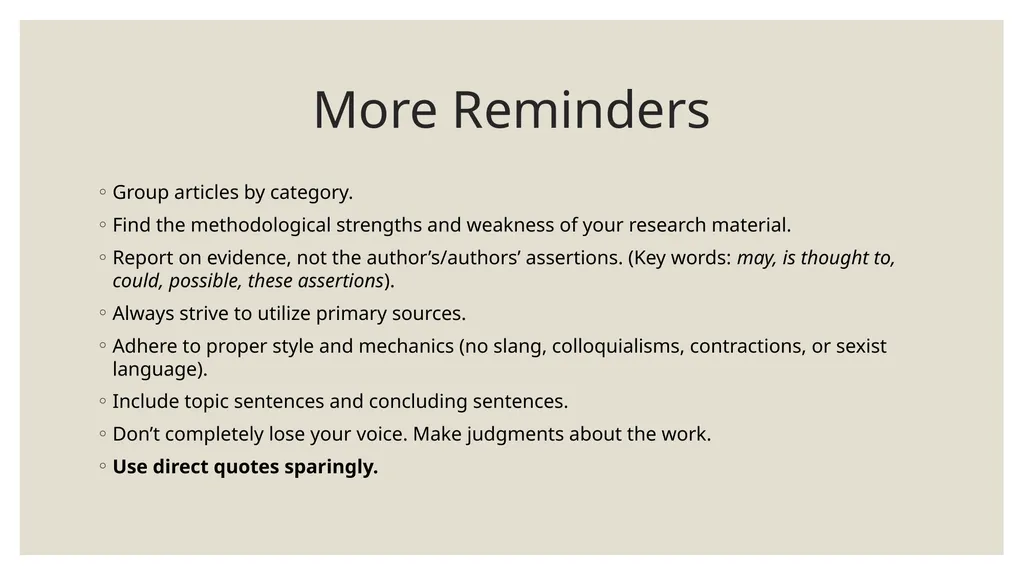
More Reminders Group articles by category.
Find the methodological strengths and weakness of your research material.
Report on evidence, not the author’s/authors’ assertions. (Key words: may, is thought to, could, possible, these assertions).
Always strive to utilize primary sources.
Adhere to proper style and mechanics (no slang, colloquialisms, contractions, or sexist language).
Include topic sentences and concluding sentences.
Don’t completely lose your voice. Make judgments about the work.
Use direct quotes sparingly.<br>
15
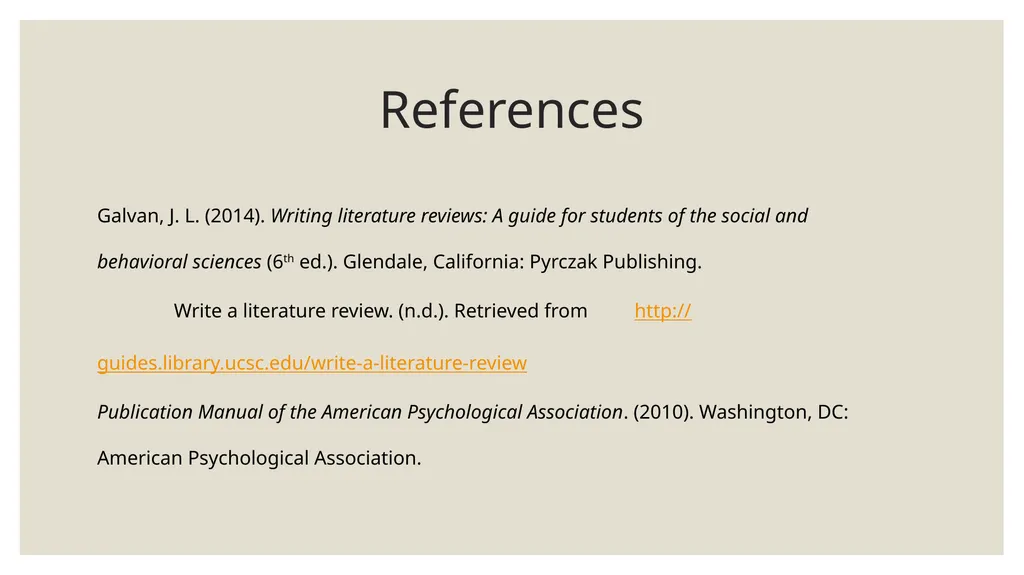
References Galvan, J. L. (2014). Writing literature reviews: A guide for students of the social and behavioral sciences (6th ed.). Glendale, California: Pyrczak Publishing.
Write a literature review. (n.d.). Retrieved from http://guides.library.ucsc.edu/write-a-literature-review
Publication Manual of the American Psychological Association. (2010). Washington, DC: American Psychological Association.<br>