
Masters of Science in Software Engineering Masters

Description: Masters of Science in Software Engineering Masters of Science in Data Science Academia Day Session Fall 2020 Recording Note: this meeting is being recorded Agenda 9:00-9:15 Fill out paperwork 9:15-9:30 Class introductions 9:30-10:30 Program
Related Topics
Download Presentation
"Masters of Science in Software Engineering Masters" is the property of its rightful owner. Permission is granted to download and print the materials on this website for personal, non-commercial use only, and to display it on your personal computer provided you do not modify the materials and that you retain all copyright notices contained in the materials. By downloading content from our website, you accept the terms of this agreement.
Presentation Transcript
slide1. Masters of Science in
Software Engineering
Masters of Science in
Data Science Academia Day Session
Fall 2020<br>
slide2. Recording Note: this meeting is being recorded<br>
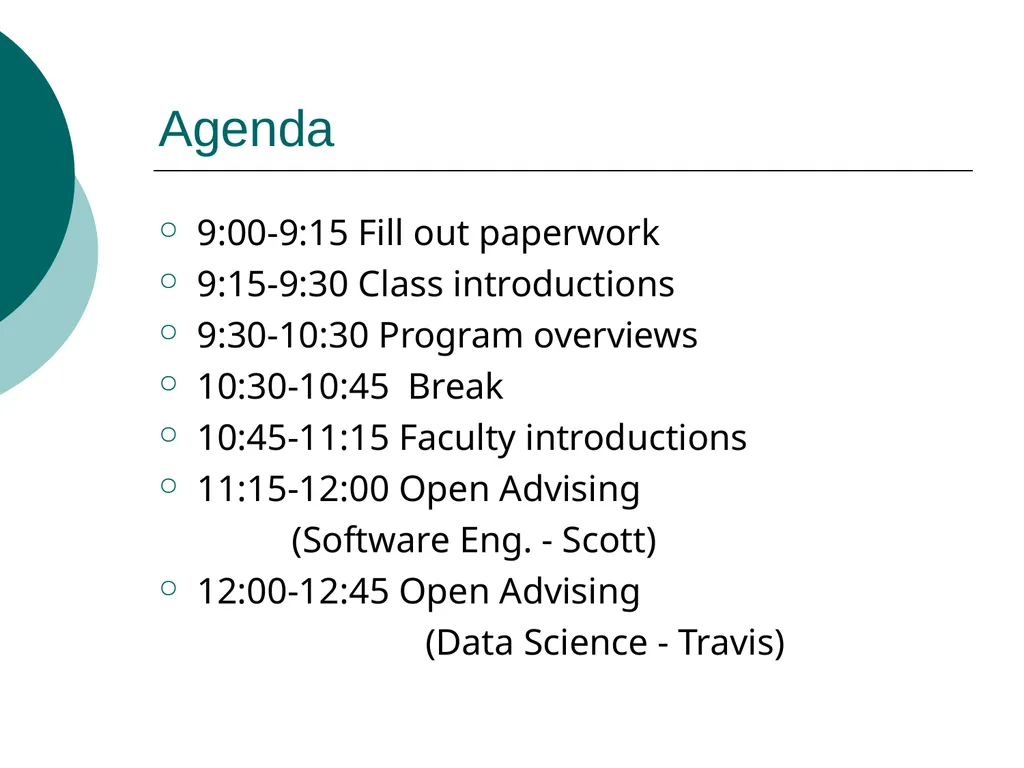
slide3. Agenda 9:00-9:15 Fill out paperwork
9:15-9:30 Class introductions
9:30-10:30 Program overviews
10:30-10:45 Break
10:45-11:15 Faculty introductions
11:15-12:00 Open Advising
(Software Eng. - Scott)
12:00-12:45 Open Advising
(Data Science - Travis)<br>
slide4. Student Introductions What is your name?
Where you are from?
Affiliated program (Software Engineering or Data Science)
Why Software Engineering or Data Science at RIT?<br>
slide5. Software Engineering Program Overview RIT was the first US university to offer the baccalaureate software engineering degree.
Building on our leadership position in undergraduate software engineering education, we implemented the Master of Science degree in Software Eng.
The program's core content ensures that graduates will possess both breadth and depth of SE knowledge.<br>
slide6. Data Science Program Overview The MSDS is an interdisciplinary program, housed in the SE Department, but supported by GCCIS and the College of Science.
The program's core content ensures that graduates will possess core DS skills such as statistics and machine learning, and the SE skills to be successful in modern companies.
The on campus (albeit temporarily online) program has more focus on gaining applied data science knowledge and experience across a variety, as well as participation in research; as compared to the online version.<br>
slide7. What Does it Mean to Engineer Software?<br>
slide8. The software engineer’s daily job is to answer questions about the software system. How can I help the customer? What is required to solve the customer’s problem?
How will the user interact with the system?
What operating system, language, hardware is going to be used?
What is the overall software system structure and how do different components interact with each other?
What code do I have to write?
How do I organize my team so we are effective?
Can we finish the software in time to support our publication deadline?<br>
slide9. Engineering Disciplines Traditional engineering disciplines:
Civil Engineering
Mechanical Engineering
Industrial Engineering
Chemical Engineering
Electrical Engineering
More Specialized:
Nuclear, Biomedical, Aerospace, Aeronautical, Environmental, Computer, Software<br>
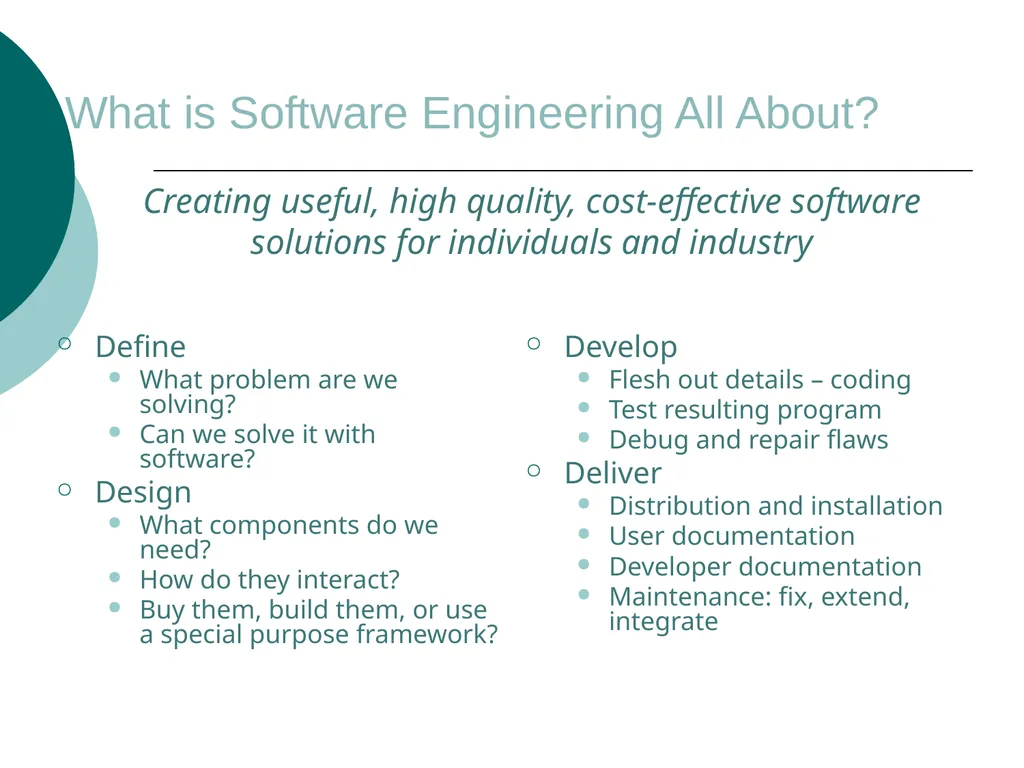
slide10. What is Software Engineering All About? Define
What problem are we solving?
Can we solve it with software?
Design
What components do we need?
How do they interact?
Buy them, build them, or use a special purpose framework? Develop
Flesh out details – coding
Test resulting program
Debug and repair flaws
Deliver
Distribution and installation
User documentation
Developer documentation
Maintenance: fix, extend, integrate Creating useful, high quality, cost-effective software solutions for individuals and industry<br>
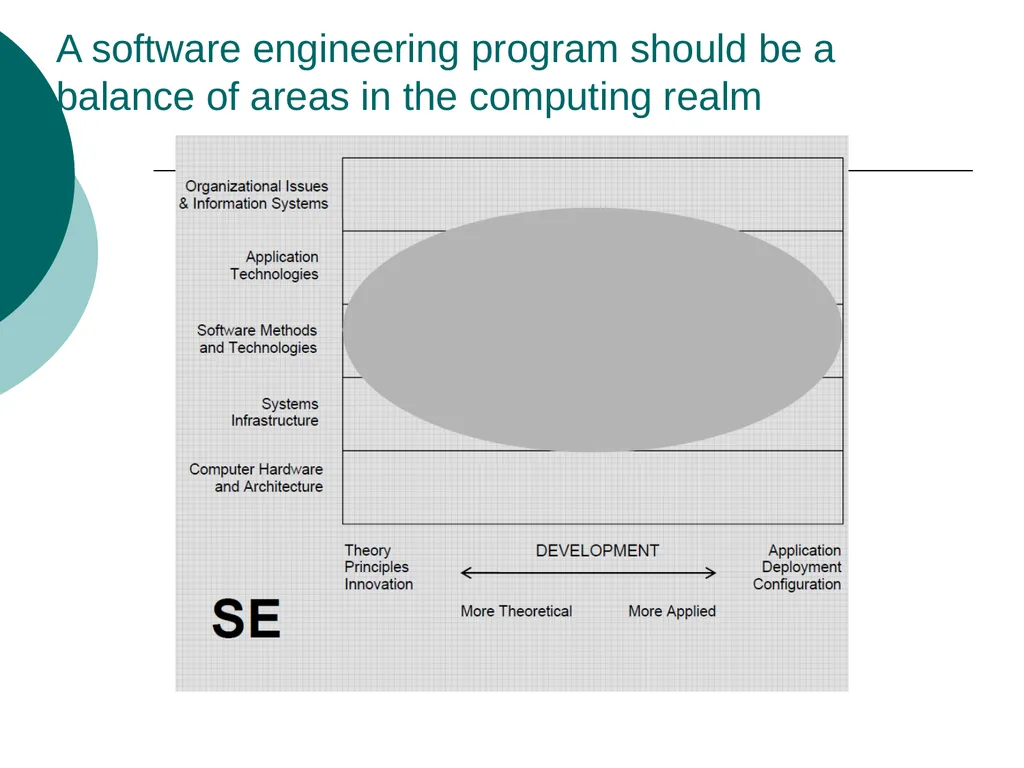
slide11. A software engineering program should be a balance of areas in the computing realm<br>
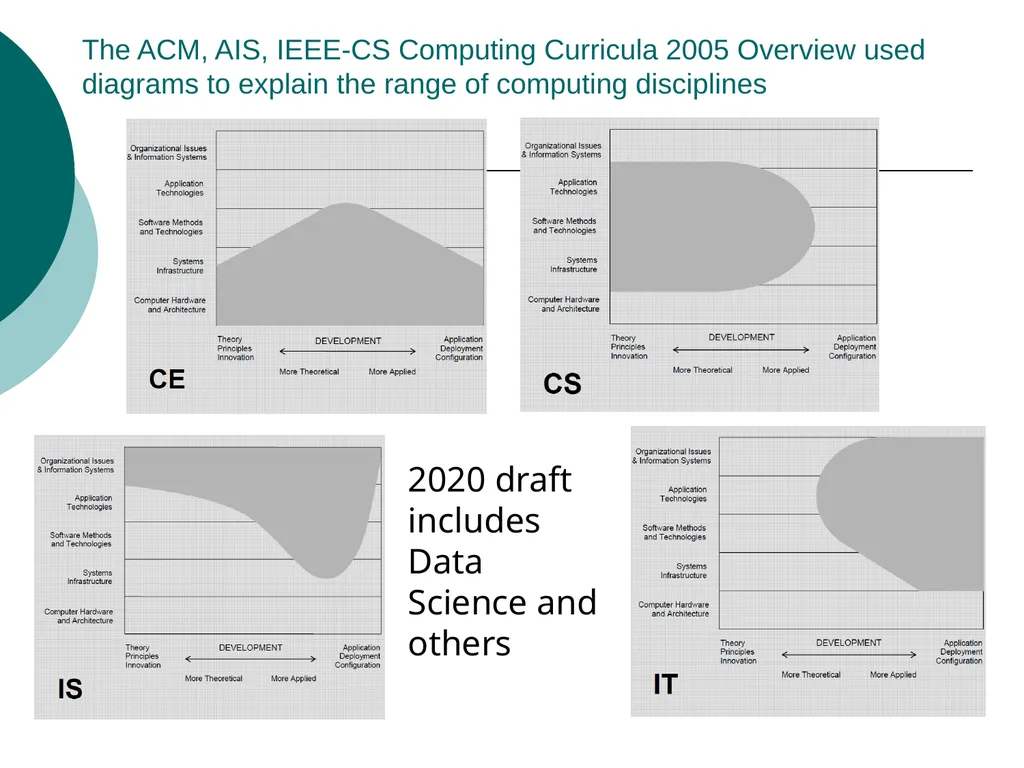
slide12. The ACM, AIS, IEEE-CS Computing Curricula 2005 Overview used diagrams to explain the range of computing disciplines 2020 draft includes Data Science and others<br>
slide13. What Does it Mean to Be A Data Scientist?<br>
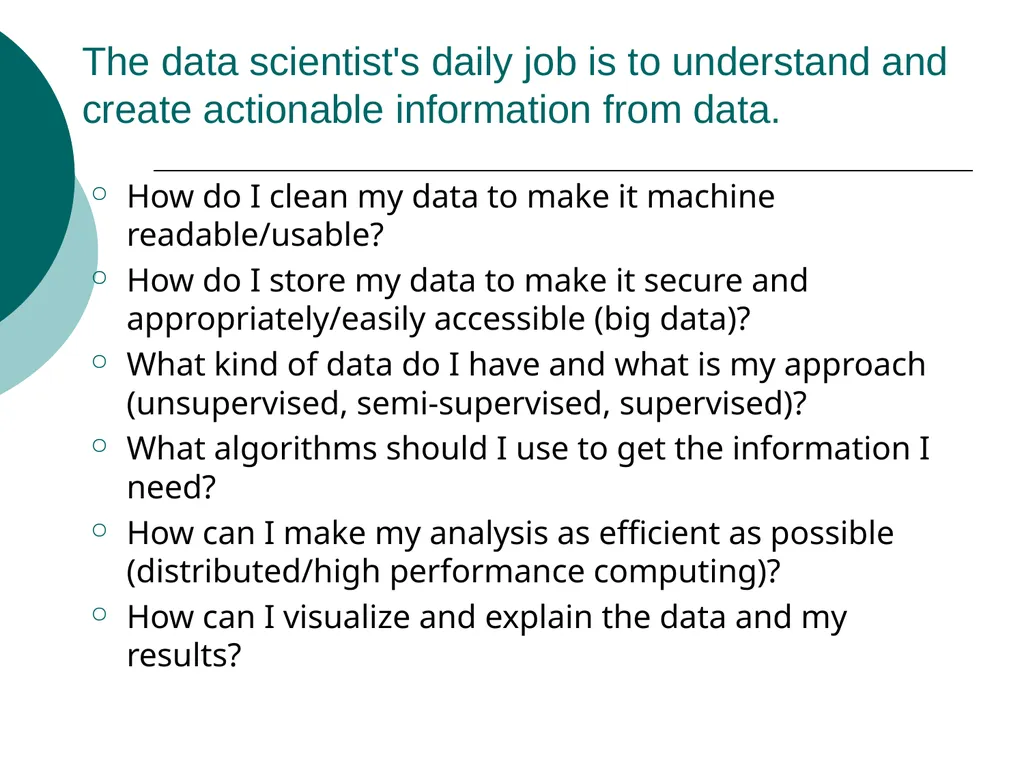
slide14. The data scientist's daily job is to understand and create actionable information from data. How do I clean my data to make it machine readable/usable?
How do I store my data to make it secure and appropriately/easily accessible (big data)?
What kind of data do I have and what is my approach (unsupervised, semi-supervised, supervised)?
What algorithms should I use to get the information I need?
How can I make my analysis as efficient as possible (distributed/high performance computing)?
How can I visualize and explain the data and my results?<br>
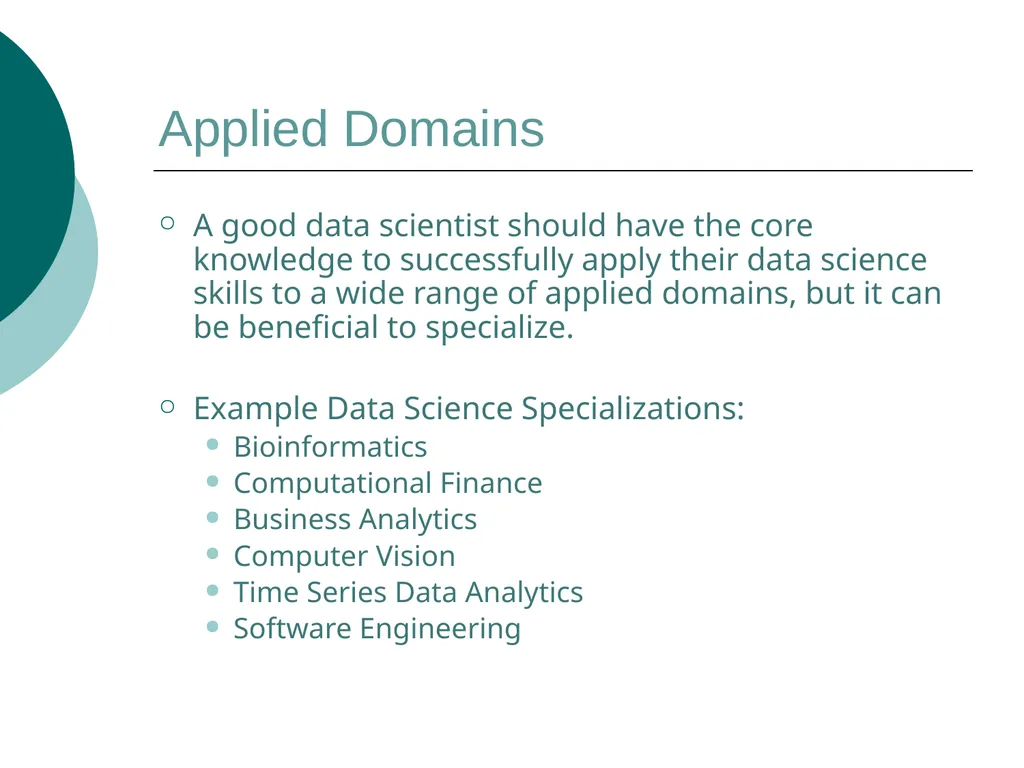
slide15. Applied Domains A good data scientist should have the core knowledge to successfully apply their data science skills to a wide range of applied domains, but it can be beneficial to specialize.
Example Data Science Specializations:
Bioinformatics
Computational Finance
Business Analytics
Computer Vision
Time Series Data Analytics
Software Engineering<br>
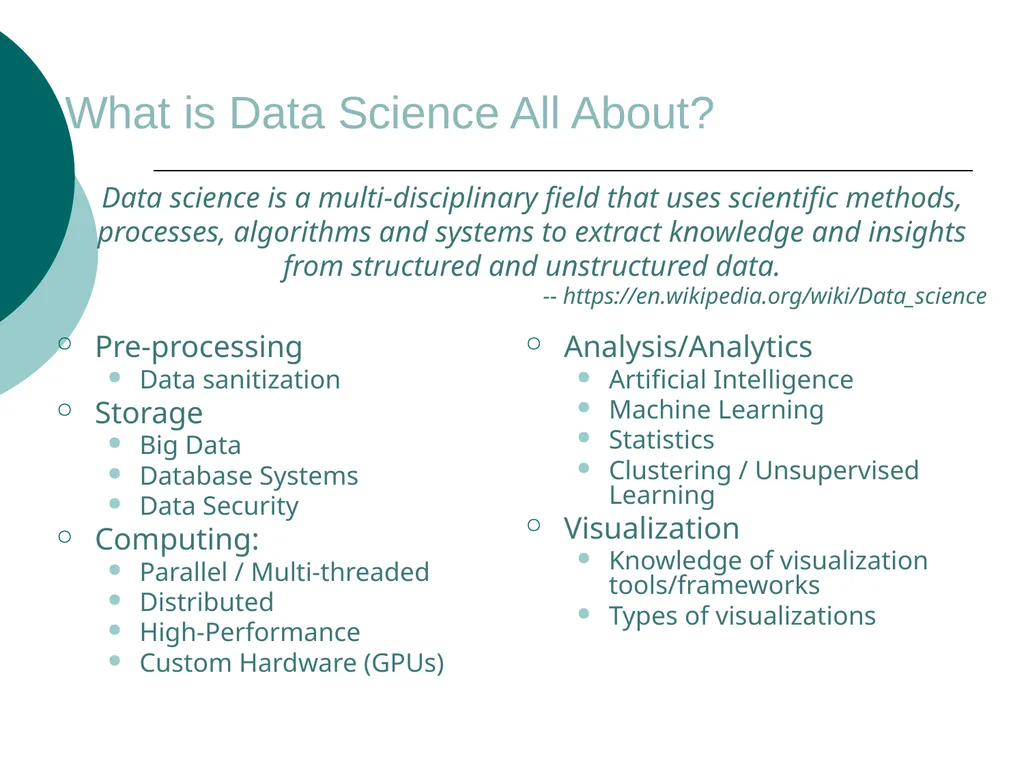
slide16. What is Data Science All About? Pre-processing
Data sanitization
Storage
Big Data
Database Systems
Data Security
Computing:
Parallel / Multi-threaded
Distributed
High-Performance
Custom Hardware (GPUs) Analysis/Analytics
Artificial Intelligence
Machine Learning
Statistics
Clustering / Unsupervised Learning
Visualization
Knowledge of visualization tools/frameworks
Types of visualizations Data science is a multi-disciplinary field that uses scientific methods, processes, algorithms and systems to extract knowledge and insights from structured and unstructured data.
-- https://en.wikipedia.org/wiki/Data_science<br>
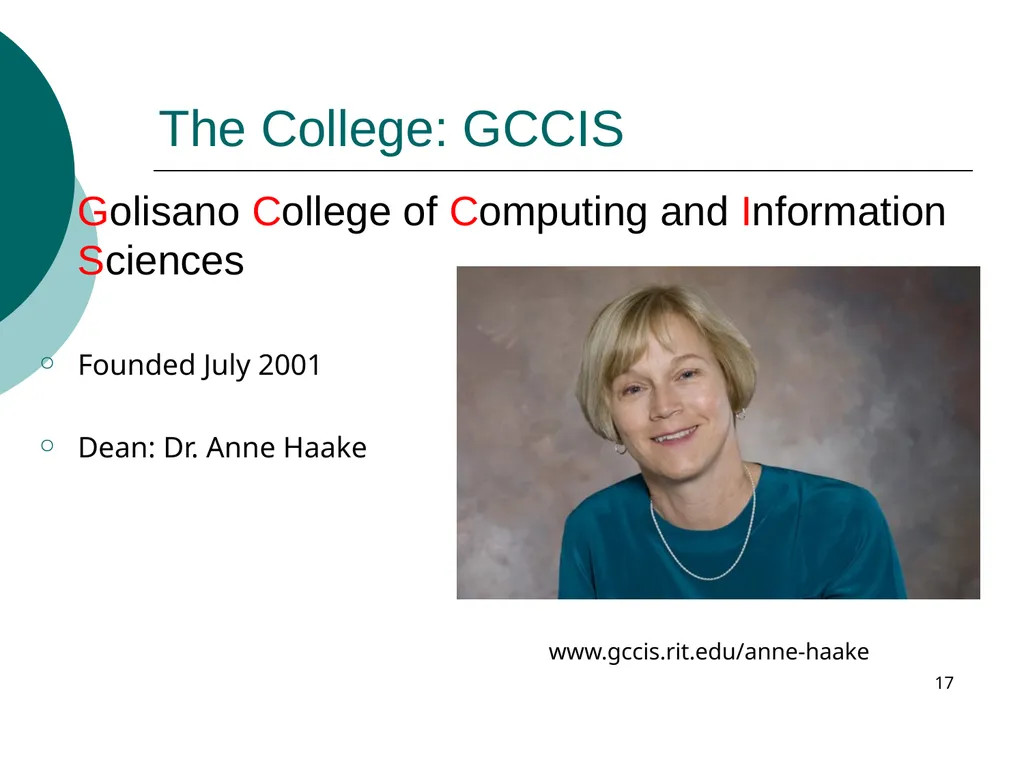
slide17. The College: GCCIS Golisano College of Computing and Information Sciences
Founded July 2001
Dean: Dr. Anne Haake www.gccis.rit.edu/anne-haake 17<br>
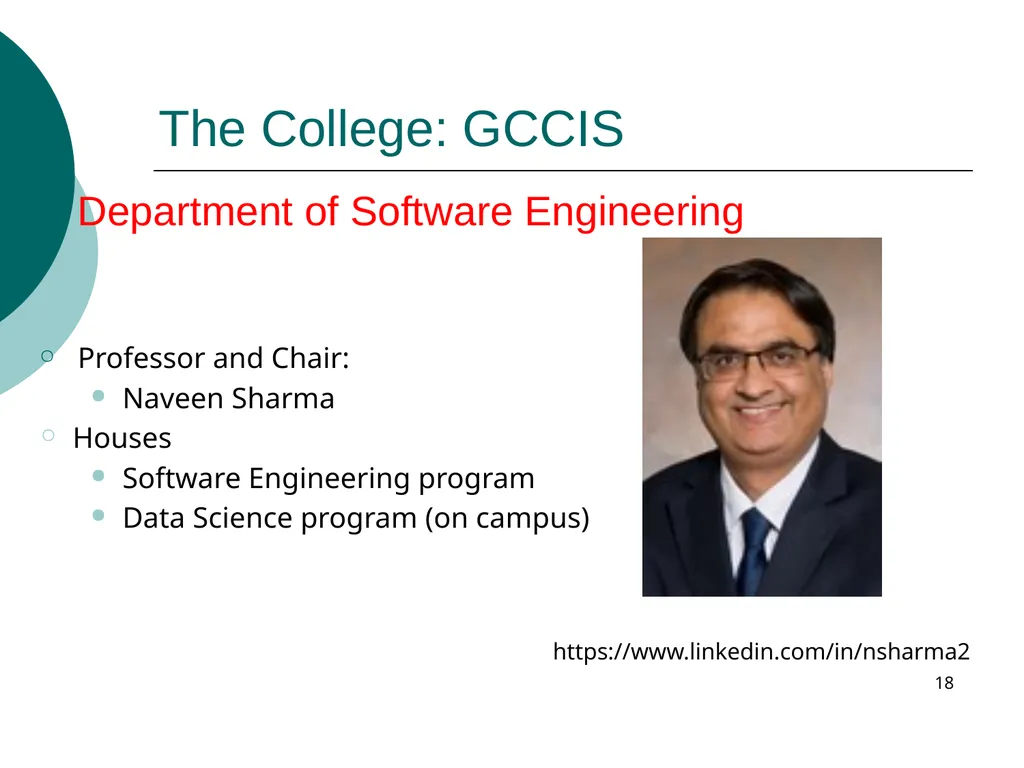
slide18. The College: GCCIS Department of Software Engineering
Professor and Chair:
Naveen Sharma
Houses
Software Engineering program
Data Science program (on campus) https://www.linkedin.com/in/nsharma2 18<br>
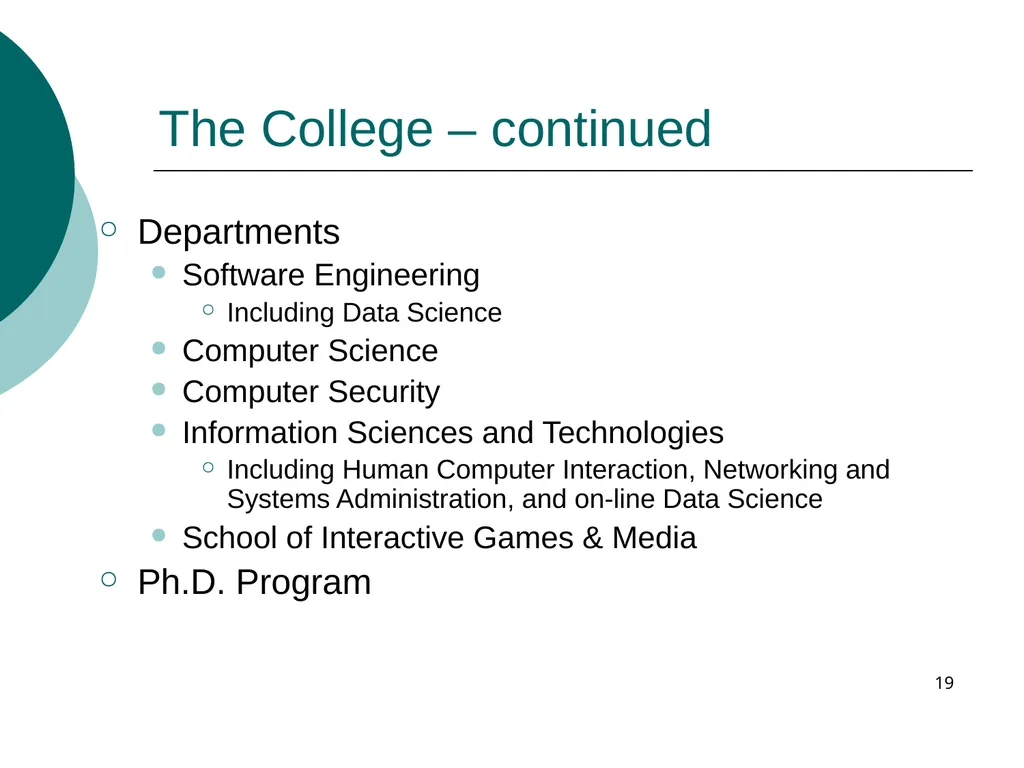
slide19. The College – continued Departments
Software Engineering
Including Data Science
Computer Science
Computer Security
Information Sciences and Technologies
Including Human Computer Interaction, Networking and Systems Administration, and on-line Data Science
School of Interactive Games & Media
Ph.D. Program 19<br>
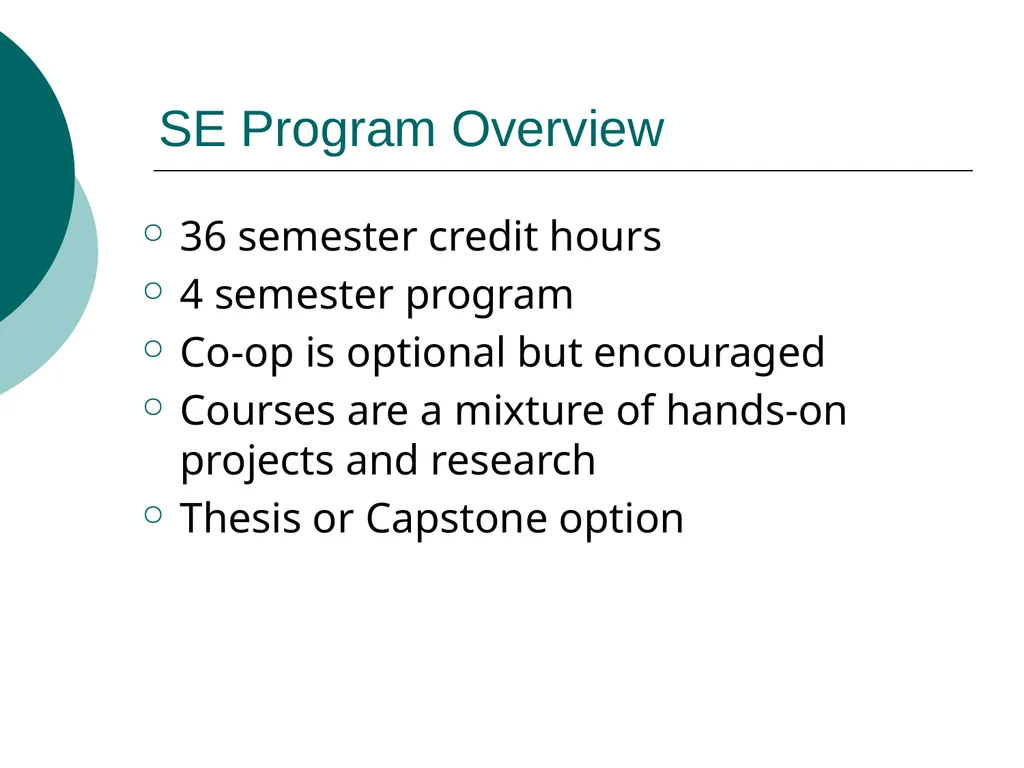
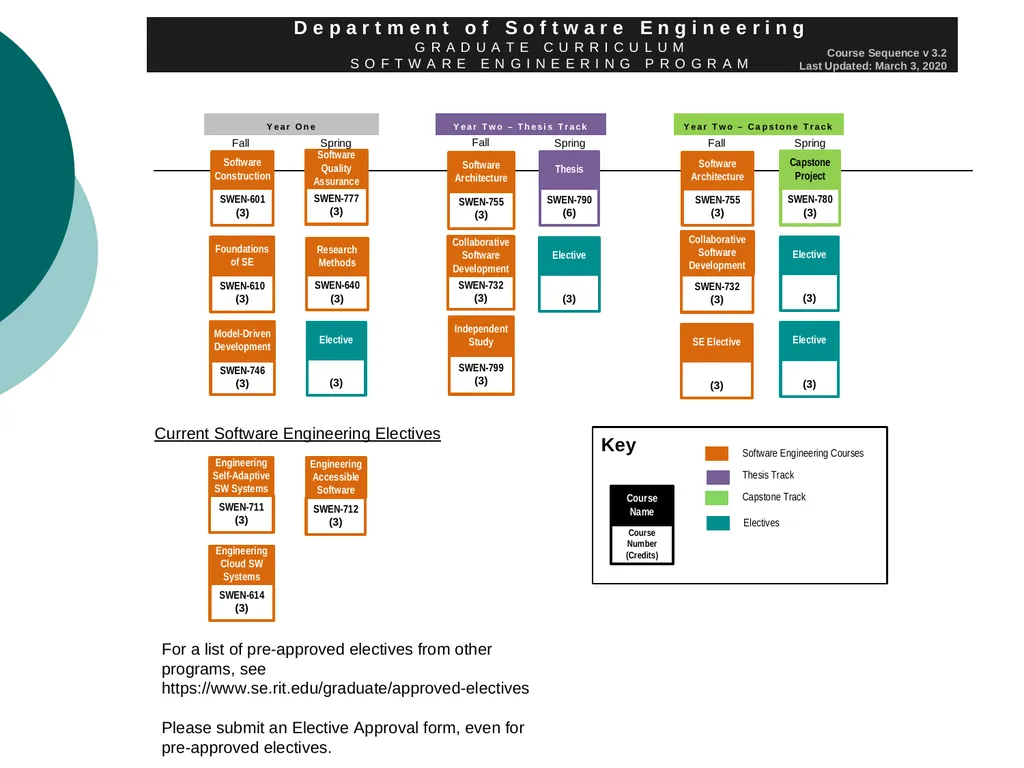
slide20. SE Program Overview 36 semester credit hours
4 semester program
Co-op is optional but encouraged
Courses are a mixture of hands-on projects and research
Thesis or Capstone option<br>
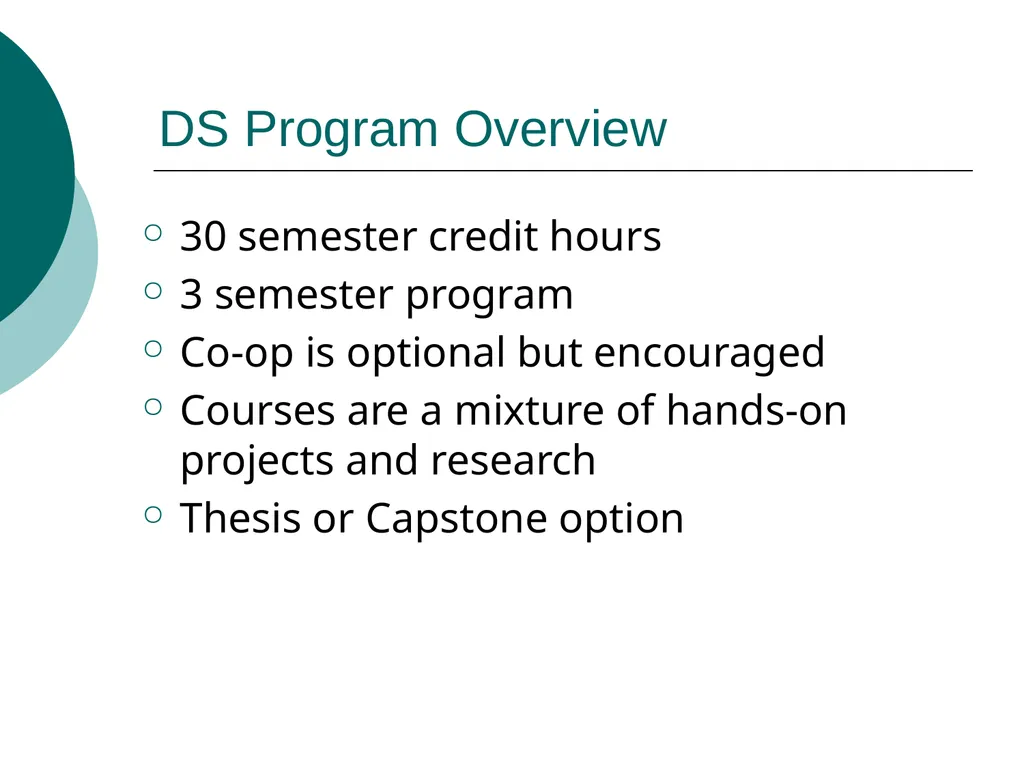
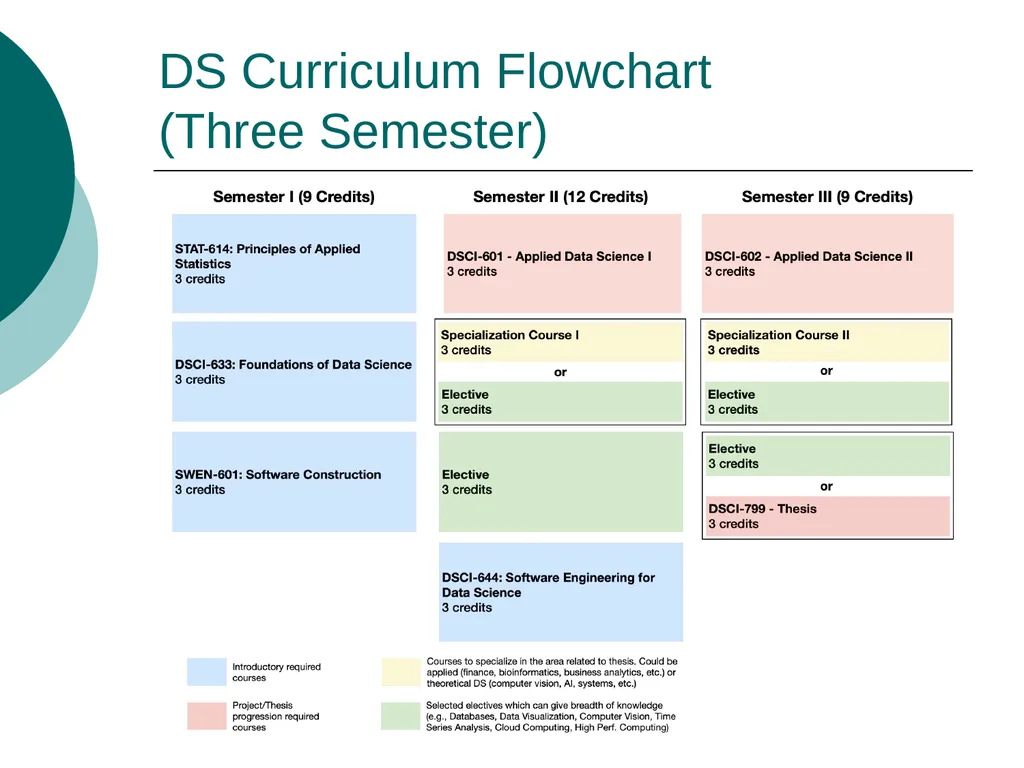
slide22. DS Program Overview 30 semester credit hours
3 semester program
Co-op is optional but encouraged
Courses are a mixture of hands-on projects and research
Thesis or Capstone option<br>
slide23. DS Curriculum Flowchart (Three Semester)<br>
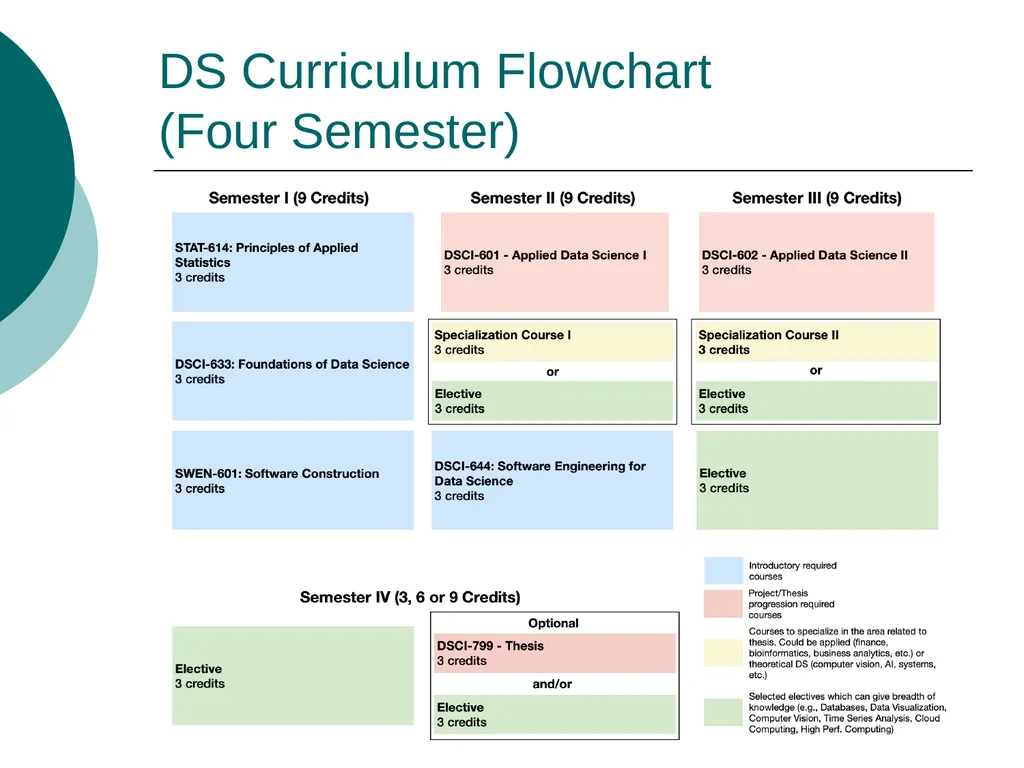
slide24. DS Curriculum Flowchart
(Four Semester)<br>
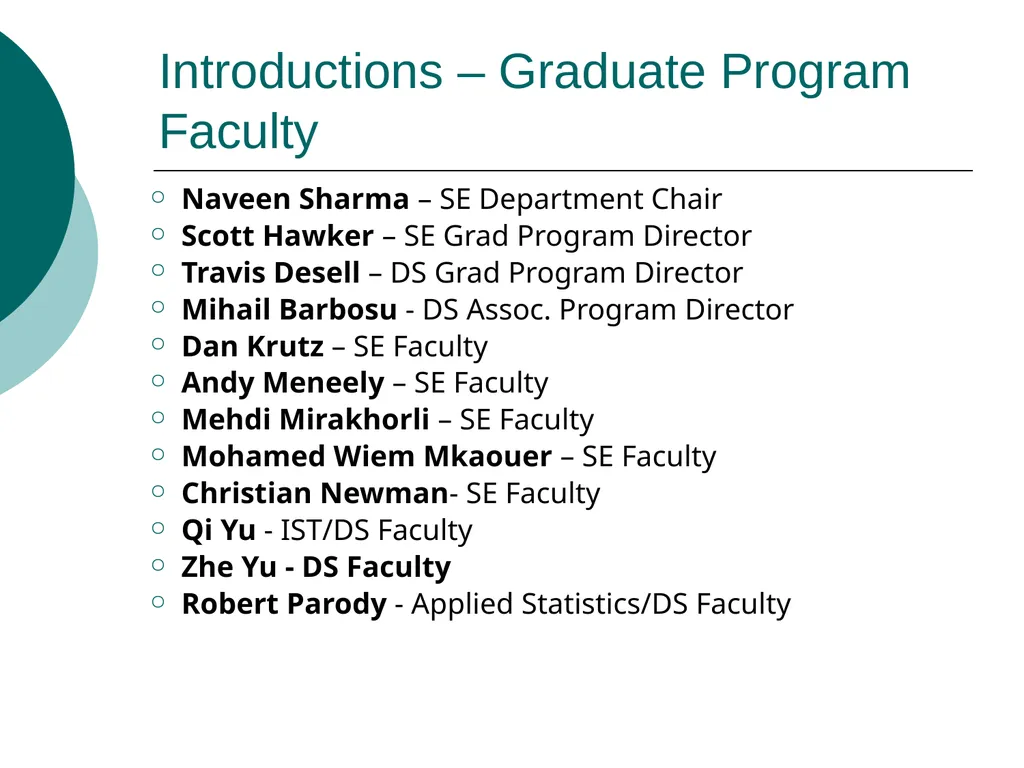
slide25. Introductions – Graduate Program Faculty Naveen Sharma – SE Department Chair
Scott Hawker – SE Grad Program Director
Travis Desell – DS Grad Program Director
Mihail Barbosu - DS Assoc. Program Director
Dan Krutz – SE Faculty
Andy Meneely – SE Faculty
Mehdi Mirakhorli – SE Faculty
Mohamed Wiem Mkaouer – SE Faculty
Christian Newman- SE Faculty
Qi Yu - IST/DS Faculty
Zhe Yu - DS Faculty
Robert Parody - Applied Statistics/DS Faculty<br>
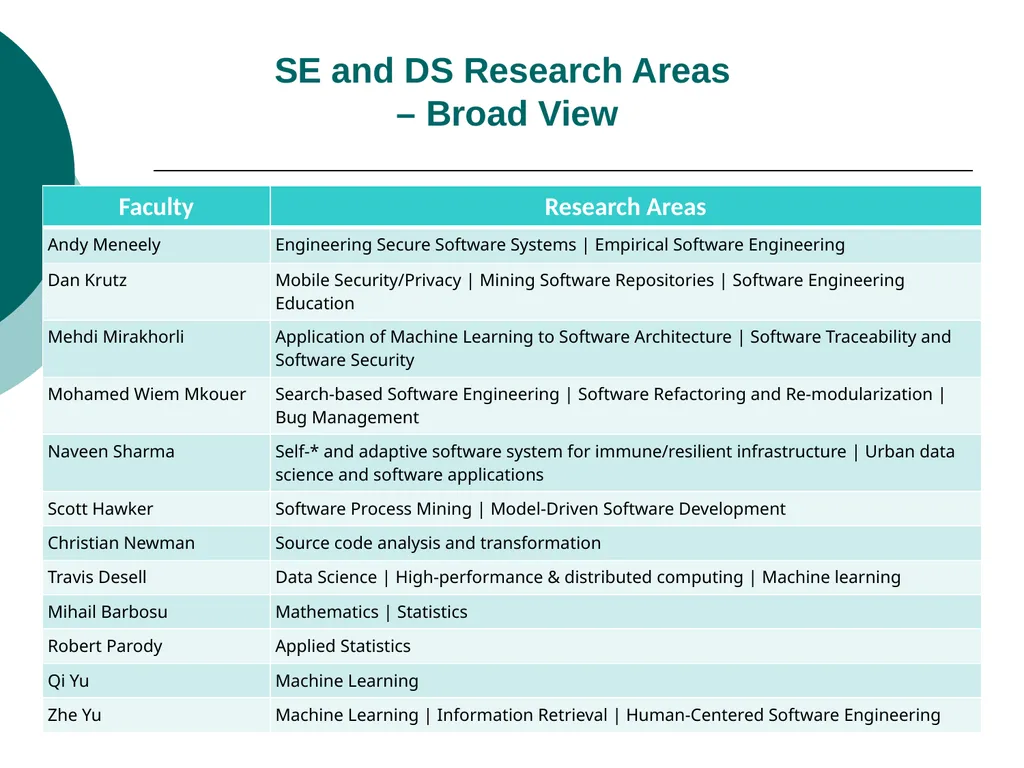
slide26. SE and DS Research Areas – Broad View<br>
slide27. SE Computer Account GCCIS has consolidated its system administration support (gccsit@rit.edu)
You will be assigned a departmental account
Can use it in SE classrooms, labs, team rooms
Print Quota
Storage Quota
Team Room Access<br>
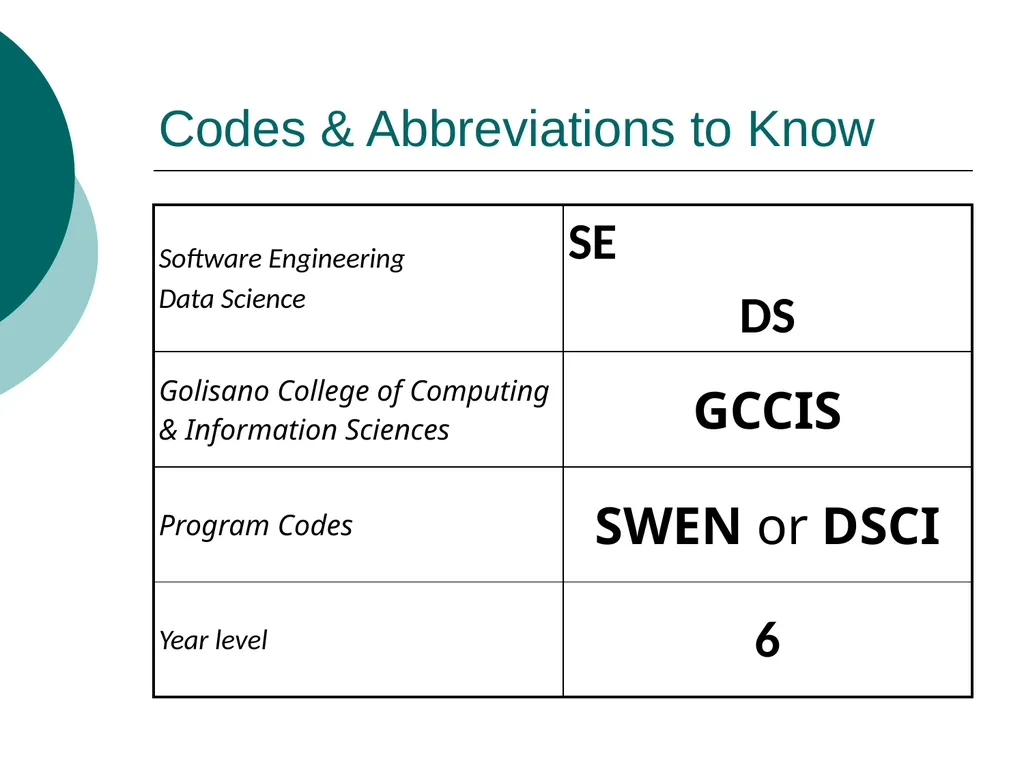
slide28. Codes & Abbreviations to Know<br>
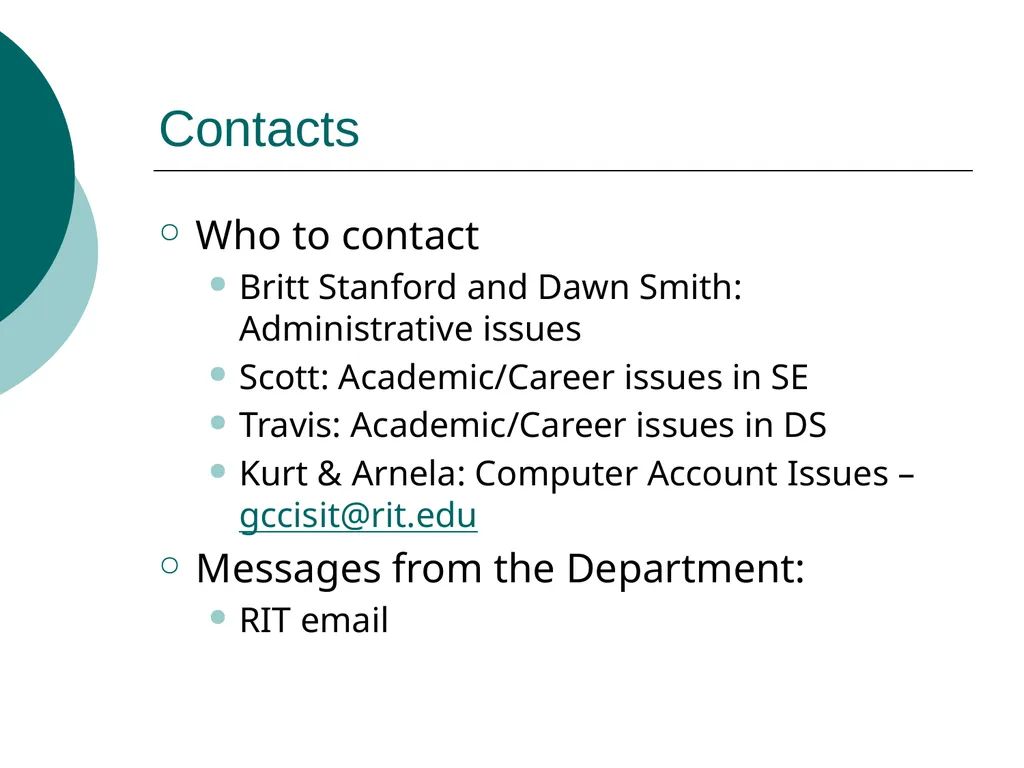
slide29. Contacts Who to contact
Britt Stanford and Dawn Smith: Administrative issues
Scott: Academic/Career issues in SE
Travis: Academic/Career issues in DS
Kurt & Arnela: Computer Account Issues – gccisit@rit.edu
Messages from the Department:
RIT email<br>
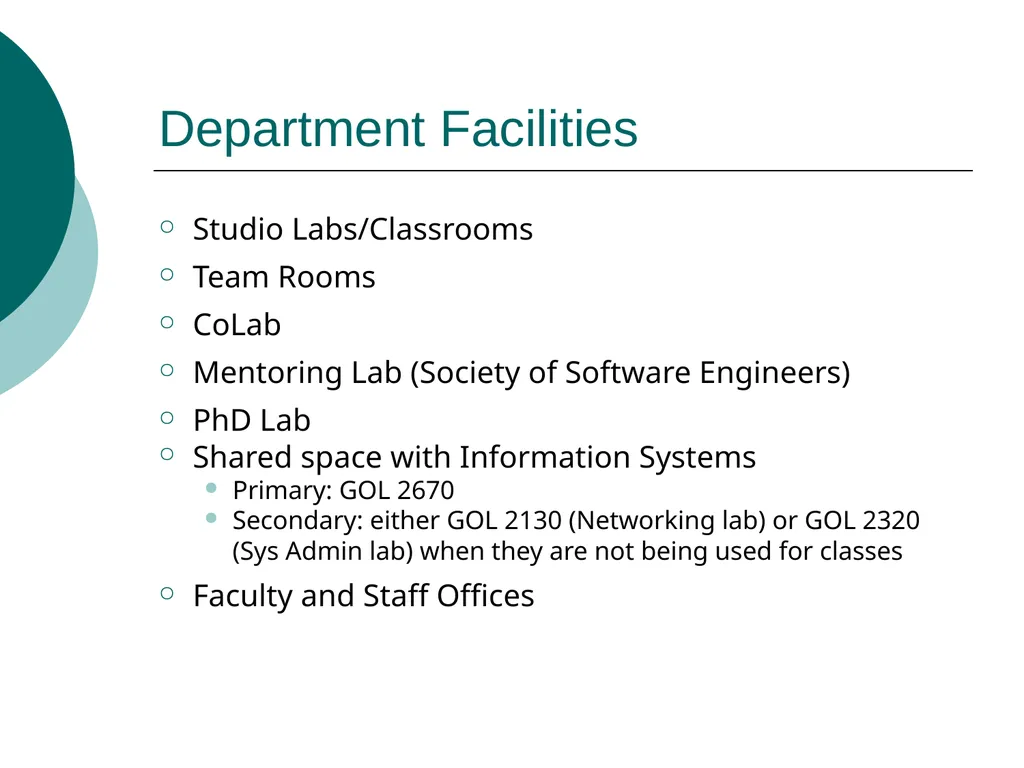
slide30. Department Facilities Studio Labs/Classrooms
Team Rooms
CoLab
Mentoring Lab (Society of Software Engineers)
PhD Lab
Shared space with Information Systems
Primary: GOL 2670
Secondary: either GOL 2130 (Networking lab) or GOL 2320 (Sys Admin lab) when they are not being used for classes
Faculty and Staff Offices<br>
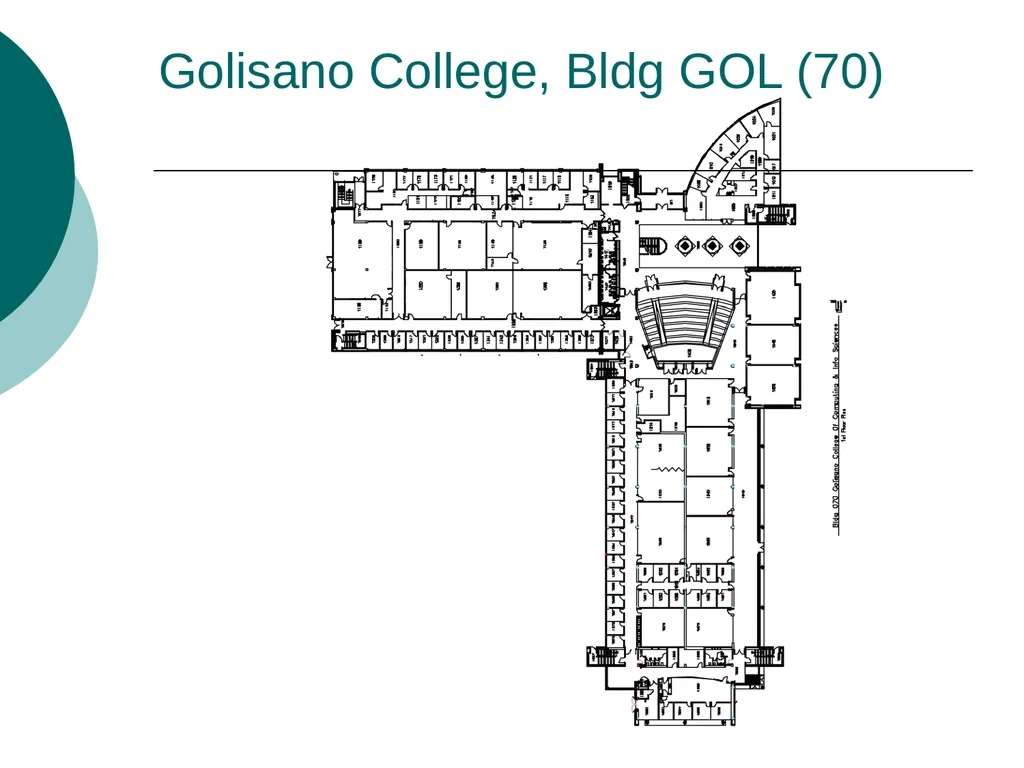
slide31. Golisano College, Bldg GOL (70)<br>
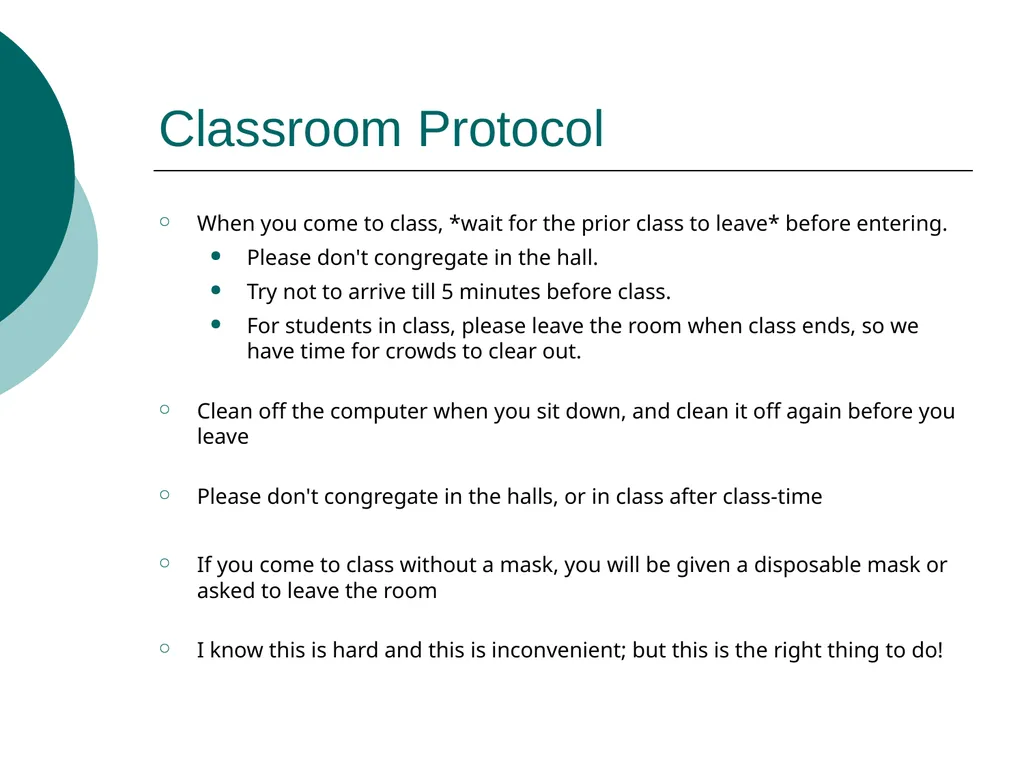
slide32. Classroom Protocol When you come to class, *wait for the prior class to leave* before entering.
Please don't congregate in the hall.
Try not to arrive till 5 minutes before class.
For students in class, please leave the room when class ends, so we have time for crowds to clear out.
Clean off the computer when you sit down, and clean it off again before you leave
Please don't congregate in the halls, or in class after class-time
If you come to class without a mask, you will be given a disposable mask or asked to leave the room
I know this is hard and this is inconvenient; but this is the right thing to do!<br>
slide33. Curriculum Plan of Study
Follow the curriculum flow chart
Meet with Dr. Hawker or Dr. Desell to discuss your goals and determine your courses
You can revise your selections
Within constraints<br>
slide34. Recent Electives More graduate faculty results in more elective opportunities
Software Engineering Methods in Data Science
Engineering Self-Adaptive Software Systems
Engineering Cloud Software Systems<br>
slide35. New DS Electives DSCI-789: Neural Networks for Data Science
DSCI-650: High Performance Data Science<br>
slide36. Curriculum – Electives Must be approved
Course number 600 or greater to count
Grade must be a ‘C’ or greater to count
‘C-’ is not a ‘C’
Elective courses typically from SE, DS, CS, CE, HCI, IST, Management (BUSI)
DS Elective courses can also include specializations from applied domains.
Pre-approved list is on-line
You can lobby for courses not on the pre-approved list
Either way, fill out an Elective Approval form<br>
slide37. Curriculum Optional Co-op
Can be after 18 on-campus credits
What is a co-op? When can I take it?
How do I find one?<br>
slide38. Grading You must maintain a grade point average >= 3.0
You must obtain at least a ‘C’ in every graduate course
A ‘C-’ is a failing grade
The GPA is calculated on ALL courses, including bridge; 36 (SE) or 30 (DS) credits used for certification
Repeating a graduate course does not replace the grade<br>
slide39. SE Curriculum: Capstone or Thesis Taken at the end of your program
Thesis: 6 credit-hour research experience with a faculty advisor and committee
Capstone: 3 credit-hour hands-on experience with a faculty advisor
Process starts the second semester with SWEN 640 Research Methods
Topic proposal, with literature review
Locate advisor and committee*
Refer to Graduate Student Handbook for further details<br>
slide40. DS Curriculum: Capstone or Thesis Can decide before third semester.
Capstone: Is developed as part of the Applied Data Science Project course sequence (ADS I, II, III and directed study) with a faculty advisor - begins your first semester.
Thesis: An additional 3 credit-hours of thesis credit can be taken in place of an elective in the last semester to extend your applied data science project into a full MS thesis.
Refer to Graduate Student Handbook for further details.<br>
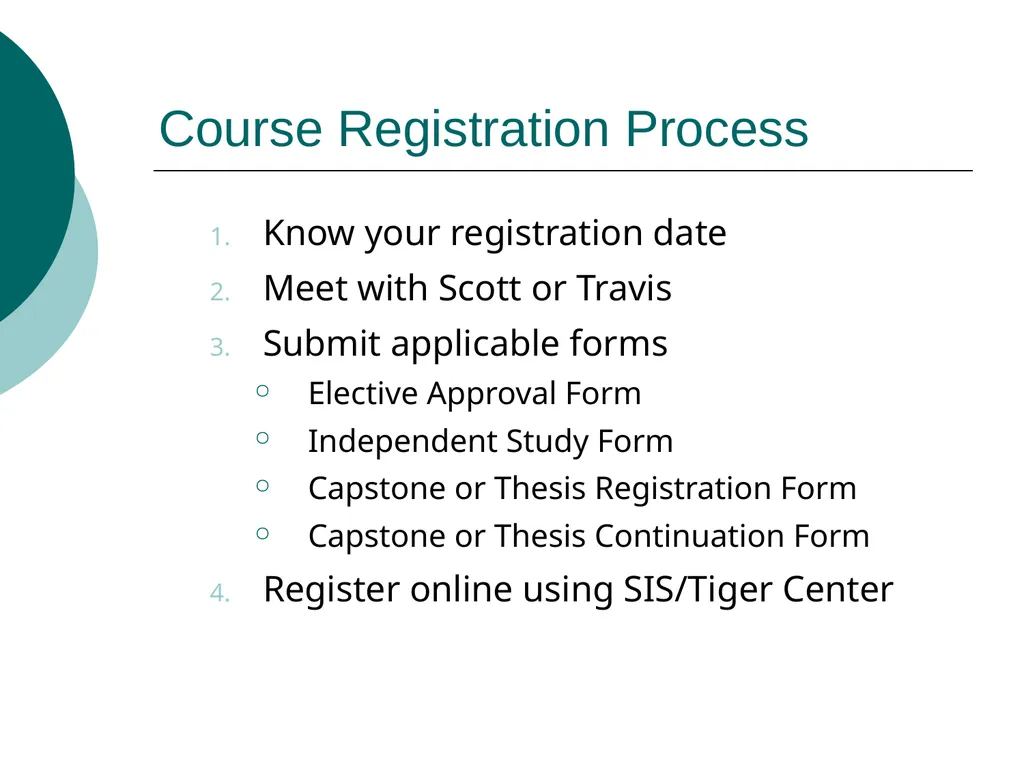
slide41. Course Registration Process Know your registration date
Meet with Scott or Travis
Submit applicable forms
Elective Approval Form
Independent Study Form
Capstone or Thesis Registration Form
Capstone or Thesis Continuation Form
Register online using SIS/Tiger Center<br>
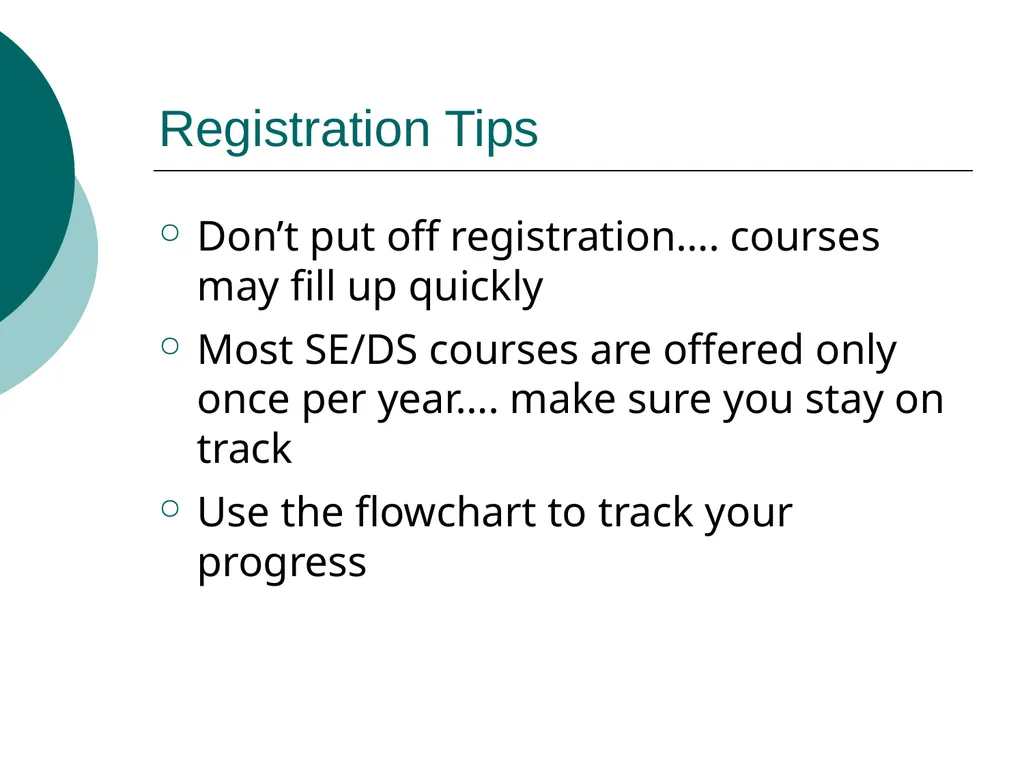
slide42. Registration Tips Don’t put off registration…. courses may fill up quickly
Most SE/DS courses are offered only once per year…. make sure you stay on track
Use the flowchart to track your progress<br>
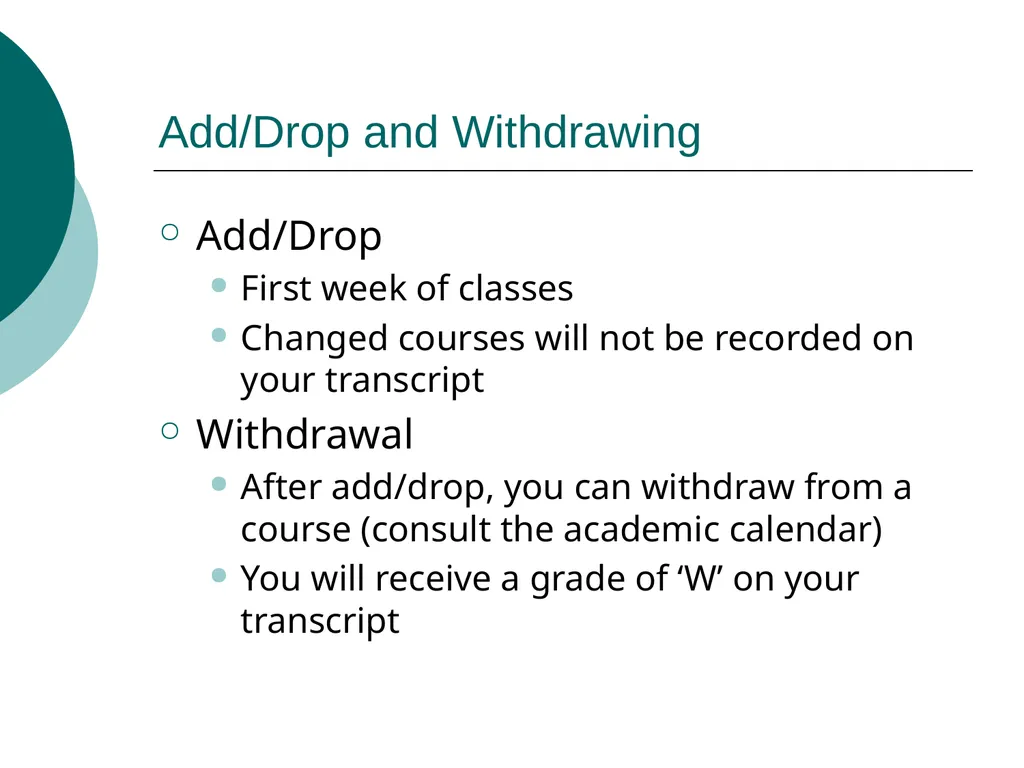
slide43. Add/Drop and Withdrawing Add/Drop
First week of classes
Changed courses will not be recorded on your transcript
Withdrawal
After add/drop, you can withdraw from a course (consult the academic calendar)
You will receive a grade of ‘W’ on your transcript<br>
slide44. Other Policies & Procedures Academic Probation
Academic Honesty
7-Year Rule<br>
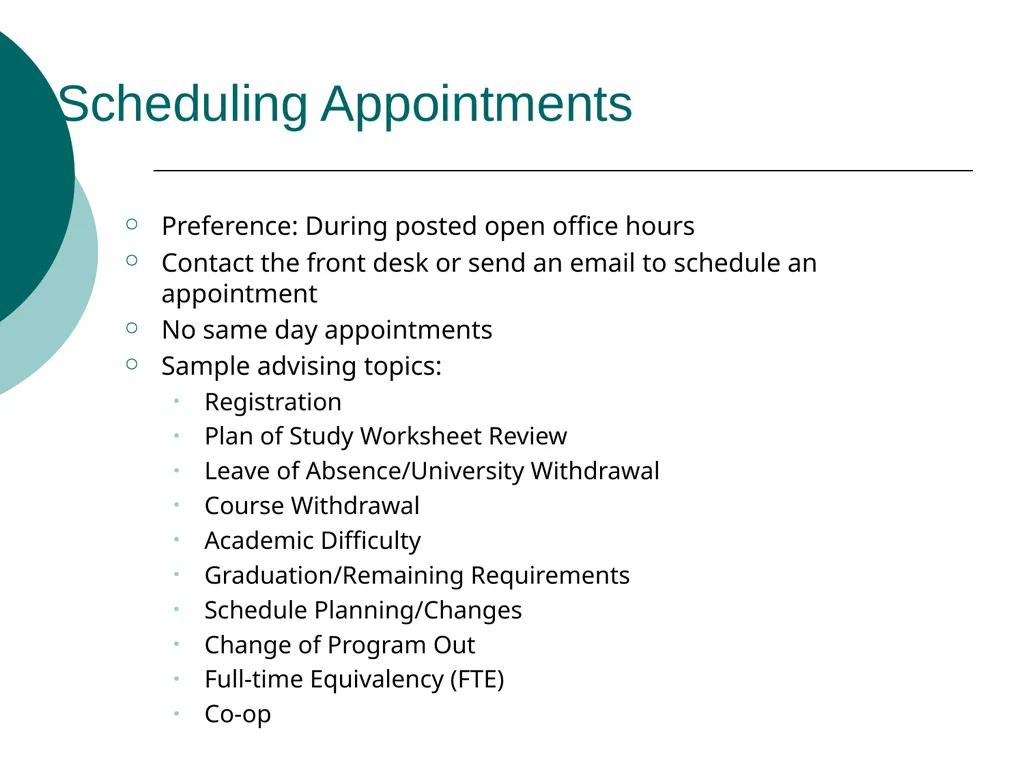
slide45. Scheduling Appointments Preference: During posted open office hours
Contact the front desk or send an email to schedule an appointment
No same day appointments
Sample advising topics:
Registration
Plan of Study Worksheet Review
Leave of Absence/University Withdrawal
Course Withdrawal
Academic Difficulty
Graduation/Remaining Requirements
Schedule Planning/Changes
Change of Program Out
Full-time Equivalency (FTE)
Co-op<br>
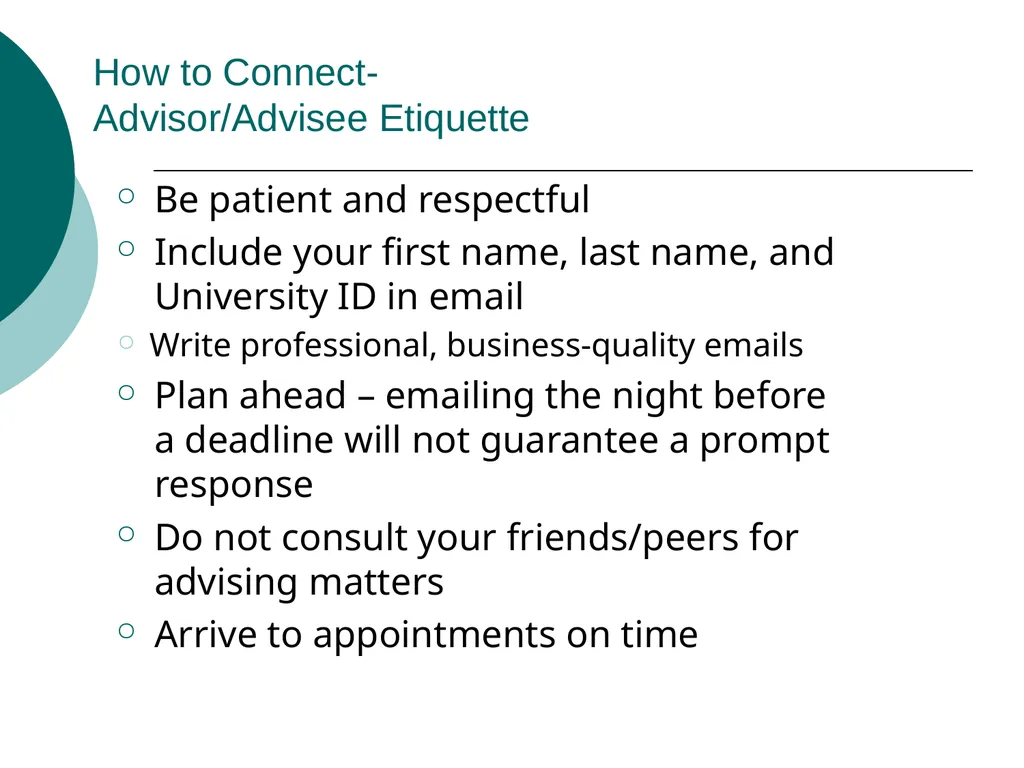
slide46. How to Connect- Advisor/Advisee Etiquette Be patient and respectful
Include your first name, last name, and University ID in email
Write professional, business-quality emails
Plan ahead – emailing the night before a deadline will not guarantee a prompt response
Do not consult your friends/peers for advising matters
Arrive to appointments on time<br>
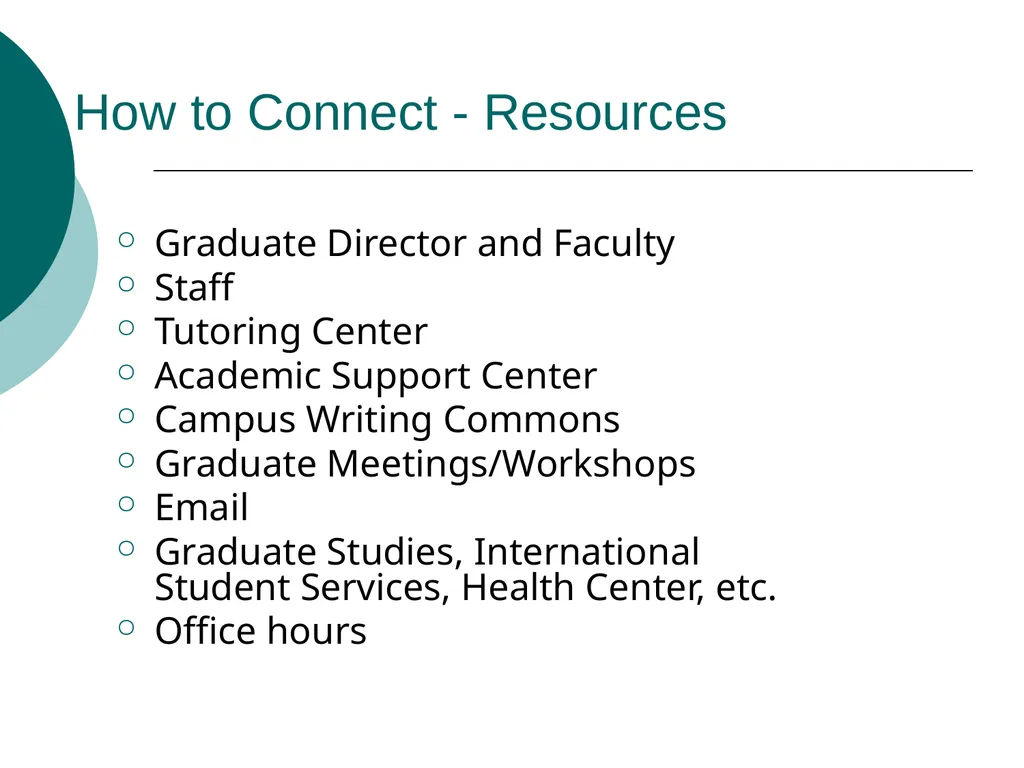
slide47. How to Connect - Resources Graduate Director and Faculty
Staff
Tutoring Center
Academic Support Center
Campus Writing Commons
Graduate Meetings/Workshops
Email
Graduate Studies, International Student Services, Health Center, etc.
Office hours<br>
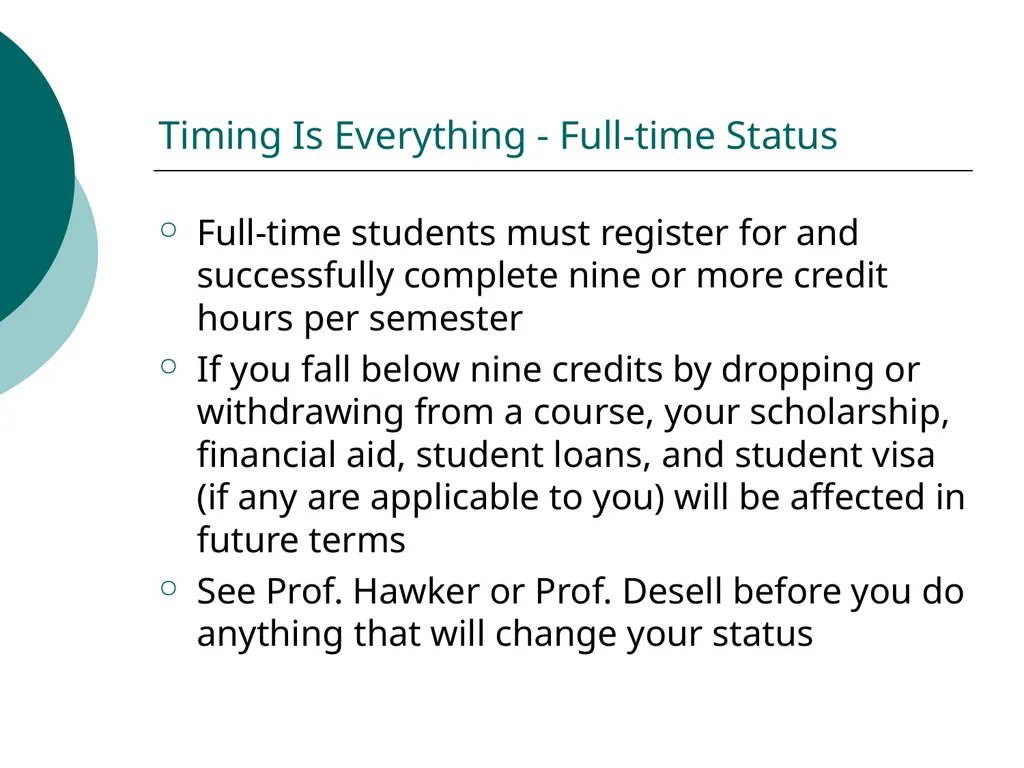
slide48. Timing Is Everything - Full-time Status Full-time students must register for and successfully complete nine or more credit hours per semester
If you fall below nine credits by dropping or withdrawing from a course, your scholarship, financial aid, student loans, and student visa (if any are applicable to you) will be affected in future terms
See Prof. Hawker or Prof. Desell before you do anything that will change your status<br>
slide49. Withdrawing/Dropping a course is NOT always possible
Full-time equivalency: course load credit for graduate work, such as a paid graduate assistantship or a paid research assistantship
You may use only two. It is important you use them wisely so you will have ample time to complete your degree
Intersession and summer terms are considered breaks in which you are not required to be enrolled
Can be less than full-time during last semester Helpful Hints – Full-time Status<br>
slide50. Timing Is Everything- Application For Graduation Registrar emails all grad students beginning their first semester inviting them to Apply for Graduation on the system
Apply TWO TERMS before you complete the program<br>
slide51. Advisor and Program Directors Britt, Dawn, Travis, and Scott work closely together
Do not ‘shop around’ for answers<br>
slide52. Plagiarism and Cheating Plagiarism and cheating will not be tolerated at RIT
Copying another person’s homework or models and code
Giving another student’s models, code, or answers on assignments
Copying from the Web
Copying text/writing that is not your own
Working with peers when not given permission
etc.
It is your responsibility to obtain a good understanding of what plagiarism is
The library is a good source of information
Plagiarism or cheating can result in an “F” for an assignment or an “F” in the course
Scholarship will be taken away
I-20 Program Extension may not be granted
Suspension is possible
THIS IS SERIOUS<br>
slide53. Academic Dishonesty - Consequences First offense:
Scholarship will be removed for the term it happens
This means you have to pay more money
Second offense:
Suspension or ‘not renewing of I-20’<br>
slide54. Probation and Suspension You must maintain a 3.0 semester and cumulative GPA
You will be placed on probation if your semester and/or cumulative GPA fall below 3.0
If your cumulative GPA is below 3.0, you will be placed on probation
You must raise GPA to a minimum of 3.0 the next academic semester or face suspension
Suspended students must leave the university for one year and then MUST reapply to obtain an RIT degree. Re-admission is not guaranteed.
Talk to Travis or Scott as soon as possible if this may happen to you<br>
slide55. Co-Op Co-op is a privilege
Full-time students and GPA >= 3.0
Completed >= 18 on-campus credits of the MS 8/16/2019 55<br>
slide56. Co-Op – Bad Things If you are found responsible for academic dishonesty
Future co-op will most likely not be granted
Scholarship will be removed
If co-op report from your employer is very bad
Future co-op will most likely not be granted
If you renege a co-op
Future co-op will not be granted
Scholarship will be removed<br>
slide57. Etiquette Behave as a Professional
Politeness
Humility
Honesty
Patience
Personal hygiene
Mindful of others<br>
slide58. RIT SE Web Presence Software Engineering at RIT
Data Science at RIT
SE Facebook
SE WhatsApp
DS WhatsApp<br>
slide59. Wrap-up Any questions?
Any comments?
Any concerns?
Any Excitement?!<br>
Fall 2020<br>
slide2. Recording Note: this meeting is being recorded<br>
slide3. Agenda 9:00-9:15 Fill out paperwork
9:15-9:30 Class introductions
9:30-10:30 Program overviews
10:30-10:45 Break
10:45-11:15 Faculty introductions
11:15-12:00 Open Advising
(Software Eng. - Scott)
12:00-12:45 Open Advising
(Data Science - Travis)<br>
slide4. Student Introductions What is your name?
Where you are from?
Affiliated program (Software Engineering or Data Science)
Why Software Engineering or Data Science at RIT?<br>
slide5. Software Engineering Program Overview RIT was the first US university to offer the baccalaureate software engineering degree.
Building on our leadership position in undergraduate software engineering education, we implemented the Master of Science degree in Software Eng.
The program's core content ensures that graduates will possess both breadth and depth of SE knowledge.<br>
slide6. Data Science Program Overview The MSDS is an interdisciplinary program, housed in the SE Department, but supported by GCCIS and the College of Science.
The program's core content ensures that graduates will possess core DS skills such as statistics and machine learning, and the SE skills to be successful in modern companies.
The on campus (albeit temporarily online) program has more focus on gaining applied data science knowledge and experience across a variety, as well as participation in research; as compared to the online version.<br>
slide7. What Does it Mean to Engineer Software?<br>
slide8. The software engineer’s daily job is to answer questions about the software system. How can I help the customer? What is required to solve the customer’s problem?
How will the user interact with the system?
What operating system, language, hardware is going to be used?
What is the overall software system structure and how do different components interact with each other?
What code do I have to write?
How do I organize my team so we are effective?
Can we finish the software in time to support our publication deadline?<br>
slide9. Engineering Disciplines Traditional engineering disciplines:
Civil Engineering
Mechanical Engineering
Industrial Engineering
Chemical Engineering
Electrical Engineering
More Specialized:
Nuclear, Biomedical, Aerospace, Aeronautical, Environmental, Computer, Software<br>
slide10. What is Software Engineering All About? Define
What problem are we solving?
Can we solve it with software?
Design
What components do we need?
How do they interact?
Buy them, build them, or use a special purpose framework? Develop
Flesh out details – coding
Test resulting program
Debug and repair flaws
Deliver
Distribution and installation
User documentation
Developer documentation
Maintenance: fix, extend, integrate Creating useful, high quality, cost-effective software solutions for individuals and industry<br>
slide11. A software engineering program should be a balance of areas in the computing realm<br>
slide12. The ACM, AIS, IEEE-CS Computing Curricula 2005 Overview used diagrams to explain the range of computing disciplines 2020 draft includes Data Science and others<br>
slide13. What Does it Mean to Be A Data Scientist?<br>
slide14. The data scientist's daily job is to understand and create actionable information from data. How do I clean my data to make it machine readable/usable?
How do I store my data to make it secure and appropriately/easily accessible (big data)?
What kind of data do I have and what is my approach (unsupervised, semi-supervised, supervised)?
What algorithms should I use to get the information I need?
How can I make my analysis as efficient as possible (distributed/high performance computing)?
How can I visualize and explain the data and my results?<br>
slide15. Applied Domains A good data scientist should have the core knowledge to successfully apply their data science skills to a wide range of applied domains, but it can be beneficial to specialize.
Example Data Science Specializations:
Bioinformatics
Computational Finance
Business Analytics
Computer Vision
Time Series Data Analytics
Software Engineering<br>
slide16. What is Data Science All About? Pre-processing
Data sanitization
Storage
Big Data
Database Systems
Data Security
Computing:
Parallel / Multi-threaded
Distributed
High-Performance
Custom Hardware (GPUs) Analysis/Analytics
Artificial Intelligence
Machine Learning
Statistics
Clustering / Unsupervised Learning
Visualization
Knowledge of visualization tools/frameworks
Types of visualizations Data science is a multi-disciplinary field that uses scientific methods, processes, algorithms and systems to extract knowledge and insights from structured and unstructured data.
-- https://en.wikipedia.org/wiki/Data_science<br>
slide17. The College: GCCIS Golisano College of Computing and Information Sciences
Founded July 2001
Dean: Dr. Anne Haake www.gccis.rit.edu/anne-haake 17<br>
slide18. The College: GCCIS Department of Software Engineering
Professor and Chair:
Naveen Sharma
Houses
Software Engineering program
Data Science program (on campus) https://www.linkedin.com/in/nsharma2 18<br>
slide19. The College – continued Departments
Software Engineering
Including Data Science
Computer Science
Computer Security
Information Sciences and Technologies
Including Human Computer Interaction, Networking and Systems Administration, and on-line Data Science
School of Interactive Games & Media
Ph.D. Program 19<br>
slide20. SE Program Overview 36 semester credit hours
4 semester program
Co-op is optional but encouraged
Courses are a mixture of hands-on projects and research
Thesis or Capstone option<br>
slide22. DS Program Overview 30 semester credit hours
3 semester program
Co-op is optional but encouraged
Courses are a mixture of hands-on projects and research
Thesis or Capstone option<br>
slide23. DS Curriculum Flowchart (Three Semester)<br>
slide24. DS Curriculum Flowchart
(Four Semester)<br>
slide25. Introductions – Graduate Program Faculty Naveen Sharma – SE Department Chair
Scott Hawker – SE Grad Program Director
Travis Desell – DS Grad Program Director
Mihail Barbosu - DS Assoc. Program Director
Dan Krutz – SE Faculty
Andy Meneely – SE Faculty
Mehdi Mirakhorli – SE Faculty
Mohamed Wiem Mkaouer – SE Faculty
Christian Newman- SE Faculty
Qi Yu - IST/DS Faculty
Zhe Yu - DS Faculty
Robert Parody - Applied Statistics/DS Faculty<br>
slide26. SE and DS Research Areas – Broad View<br>
slide27. SE Computer Account GCCIS has consolidated its system administration support (gccsit@rit.edu)
You will be assigned a departmental account
Can use it in SE classrooms, labs, team rooms
Print Quota
Storage Quota
Team Room Access<br>
slide28. Codes & Abbreviations to Know<br>
slide29. Contacts Who to contact
Britt Stanford and Dawn Smith: Administrative issues
Scott: Academic/Career issues in SE
Travis: Academic/Career issues in DS
Kurt & Arnela: Computer Account Issues – gccisit@rit.edu
Messages from the Department:
RIT email<br>
slide30. Department Facilities Studio Labs/Classrooms
Team Rooms
CoLab
Mentoring Lab (Society of Software Engineers)
PhD Lab
Shared space with Information Systems
Primary: GOL 2670
Secondary: either GOL 2130 (Networking lab) or GOL 2320 (Sys Admin lab) when they are not being used for classes
Faculty and Staff Offices<br>
slide31. Golisano College, Bldg GOL (70)<br>
slide32. Classroom Protocol When you come to class, *wait for the prior class to leave* before entering.
Please don't congregate in the hall.
Try not to arrive till 5 minutes before class.
For students in class, please leave the room when class ends, so we have time for crowds to clear out.
Clean off the computer when you sit down, and clean it off again before you leave
Please don't congregate in the halls, or in class after class-time
If you come to class without a mask, you will be given a disposable mask or asked to leave the room
I know this is hard and this is inconvenient; but this is the right thing to do!<br>
slide33. Curriculum Plan of Study
Follow the curriculum flow chart
Meet with Dr. Hawker or Dr. Desell to discuss your goals and determine your courses
You can revise your selections
Within constraints<br>
slide34. Recent Electives More graduate faculty results in more elective opportunities
Software Engineering Methods in Data Science
Engineering Self-Adaptive Software Systems
Engineering Cloud Software Systems<br>
slide35. New DS Electives DSCI-789: Neural Networks for Data Science
DSCI-650: High Performance Data Science<br>
slide36. Curriculum – Electives Must be approved
Course number 600 or greater to count
Grade must be a ‘C’ or greater to count
‘C-’ is not a ‘C’
Elective courses typically from SE, DS, CS, CE, HCI, IST, Management (BUSI)
DS Elective courses can also include specializations from applied domains.
Pre-approved list is on-line
You can lobby for courses not on the pre-approved list
Either way, fill out an Elective Approval form<br>
slide37. Curriculum Optional Co-op
Can be after 18 on-campus credits
What is a co-op? When can I take it?
How do I find one?<br>
slide38. Grading You must maintain a grade point average >= 3.0
You must obtain at least a ‘C’ in every graduate course
A ‘C-’ is a failing grade
The GPA is calculated on ALL courses, including bridge; 36 (SE) or 30 (DS) credits used for certification
Repeating a graduate course does not replace the grade<br>
slide39. SE Curriculum: Capstone or Thesis Taken at the end of your program
Thesis: 6 credit-hour research experience with a faculty advisor and committee
Capstone: 3 credit-hour hands-on experience with a faculty advisor
Process starts the second semester with SWEN 640 Research Methods
Topic proposal, with literature review
Locate advisor and committee*
Refer to Graduate Student Handbook for further details<br>
slide40. DS Curriculum: Capstone or Thesis Can decide before third semester.
Capstone: Is developed as part of the Applied Data Science Project course sequence (ADS I, II, III and directed study) with a faculty advisor - begins your first semester.
Thesis: An additional 3 credit-hours of thesis credit can be taken in place of an elective in the last semester to extend your applied data science project into a full MS thesis.
Refer to Graduate Student Handbook for further details.<br>
slide41. Course Registration Process Know your registration date
Meet with Scott or Travis
Submit applicable forms
Elective Approval Form
Independent Study Form
Capstone or Thesis Registration Form
Capstone or Thesis Continuation Form
Register online using SIS/Tiger Center<br>
slide42. Registration Tips Don’t put off registration…. courses may fill up quickly
Most SE/DS courses are offered only once per year…. make sure you stay on track
Use the flowchart to track your progress<br>
slide43. Add/Drop and Withdrawing Add/Drop
First week of classes
Changed courses will not be recorded on your transcript
Withdrawal
After add/drop, you can withdraw from a course (consult the academic calendar)
You will receive a grade of ‘W’ on your transcript<br>
slide44. Other Policies & Procedures Academic Probation
Academic Honesty
7-Year Rule<br>
slide45. Scheduling Appointments Preference: During posted open office hours
Contact the front desk or send an email to schedule an appointment
No same day appointments
Sample advising topics:
Registration
Plan of Study Worksheet Review
Leave of Absence/University Withdrawal
Course Withdrawal
Academic Difficulty
Graduation/Remaining Requirements
Schedule Planning/Changes
Change of Program Out
Full-time Equivalency (FTE)
Co-op<br>
slide46. How to Connect- Advisor/Advisee Etiquette Be patient and respectful
Include your first name, last name, and University ID in email
Write professional, business-quality emails
Plan ahead – emailing the night before a deadline will not guarantee a prompt response
Do not consult your friends/peers for advising matters
Arrive to appointments on time<br>
slide47. How to Connect - Resources Graduate Director and Faculty
Staff
Tutoring Center
Academic Support Center
Campus Writing Commons
Graduate Meetings/Workshops
Graduate Studies, International Student Services, Health Center, etc.
Office hours<br>
slide48. Timing Is Everything - Full-time Status Full-time students must register for and successfully complete nine or more credit hours per semester
If you fall below nine credits by dropping or withdrawing from a course, your scholarship, financial aid, student loans, and student visa (if any are applicable to you) will be affected in future terms
See Prof. Hawker or Prof. Desell before you do anything that will change your status<br>
slide49. Withdrawing/Dropping a course is NOT always possible
Full-time equivalency: course load credit for graduate work, such as a paid graduate assistantship or a paid research assistantship
You may use only two. It is important you use them wisely so you will have ample time to complete your degree
Intersession and summer terms are considered breaks in which you are not required to be enrolled
Can be less than full-time during last semester Helpful Hints – Full-time Status<br>
slide50. Timing Is Everything- Application For Graduation Registrar emails all grad students beginning their first semester inviting them to Apply for Graduation on the system
Apply TWO TERMS before you complete the program<br>
slide51. Advisor and Program Directors Britt, Dawn, Travis, and Scott work closely together
Do not ‘shop around’ for answers<br>
slide52. Plagiarism and Cheating Plagiarism and cheating will not be tolerated at RIT
Copying another person’s homework or models and code
Giving another student’s models, code, or answers on assignments
Copying from the Web
Copying text/writing that is not your own
Working with peers when not given permission
etc.
It is your responsibility to obtain a good understanding of what plagiarism is
The library is a good source of information
Plagiarism or cheating can result in an “F” for an assignment or an “F” in the course
Scholarship will be taken away
I-20 Program Extension may not be granted
Suspension is possible
THIS IS SERIOUS<br>
slide53. Academic Dishonesty - Consequences First offense:
Scholarship will be removed for the term it happens
This means you have to pay more money
Second offense:
Suspension or ‘not renewing of I-20’<br>
slide54. Probation and Suspension You must maintain a 3.0 semester and cumulative GPA
You will be placed on probation if your semester and/or cumulative GPA fall below 3.0
If your cumulative GPA is below 3.0, you will be placed on probation
You must raise GPA to a minimum of 3.0 the next academic semester or face suspension
Suspended students must leave the university for one year and then MUST reapply to obtain an RIT degree. Re-admission is not guaranteed.
Talk to Travis or Scott as soon as possible if this may happen to you<br>
slide55. Co-Op Co-op is a privilege
Full-time students and GPA >= 3.0
Completed >= 18 on-campus credits of the MS 8/16/2019 55<br>
slide56. Co-Op – Bad Things If you are found responsible for academic dishonesty
Future co-op will most likely not be granted
Scholarship will be removed
If co-op report from your employer is very bad
Future co-op will most likely not be granted
If you renege a co-op
Future co-op will not be granted
Scholarship will be removed<br>
slide57. Etiquette Behave as a Professional
Politeness
Humility
Honesty
Patience
Personal hygiene
Mindful of others<br>
slide58. RIT SE Web Presence Software Engineering at RIT
Data Science at RIT
SE Facebook
SE WhatsApp
DS WhatsApp<br>
slide59. Wrap-up Any questions?
Any comments?
Any concerns?
Any Excitement?!<br>