04
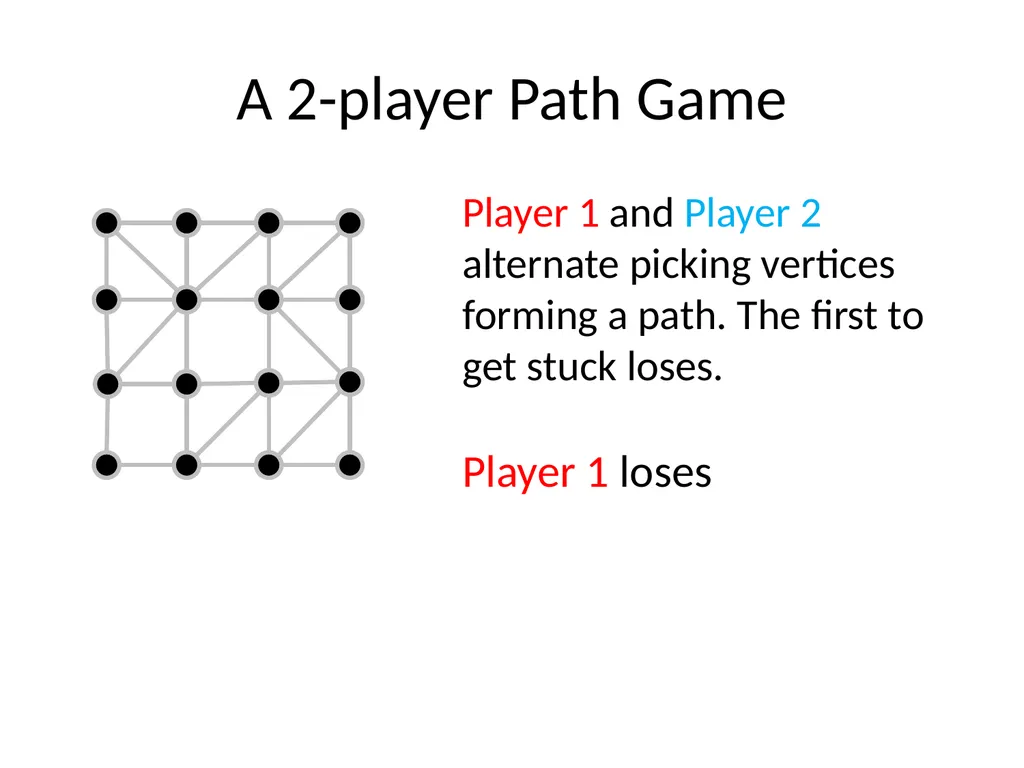
A 2-player Path Game Player 1 and Player 2 alternate picking vertices forming a path. The first to get stuck loses. Player 1 loses<br>
05
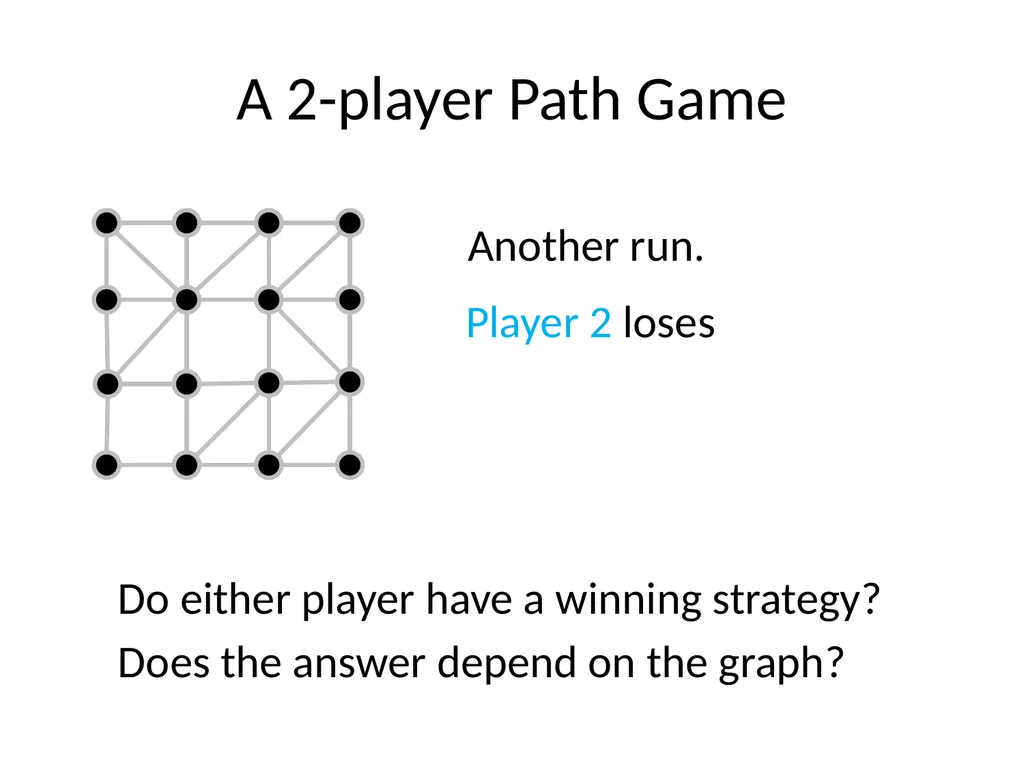
A 2-player Path Game Another run. Player 2 loses Do either player have a winning strategy?
Does the answer depend on the graph?<br>
06
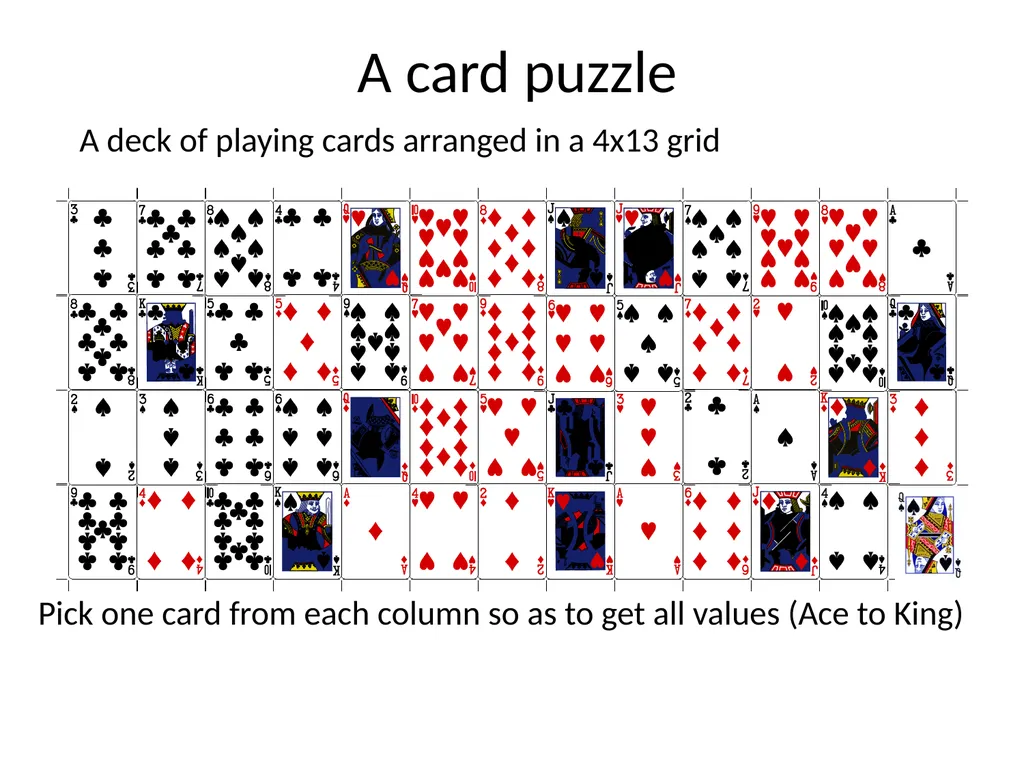
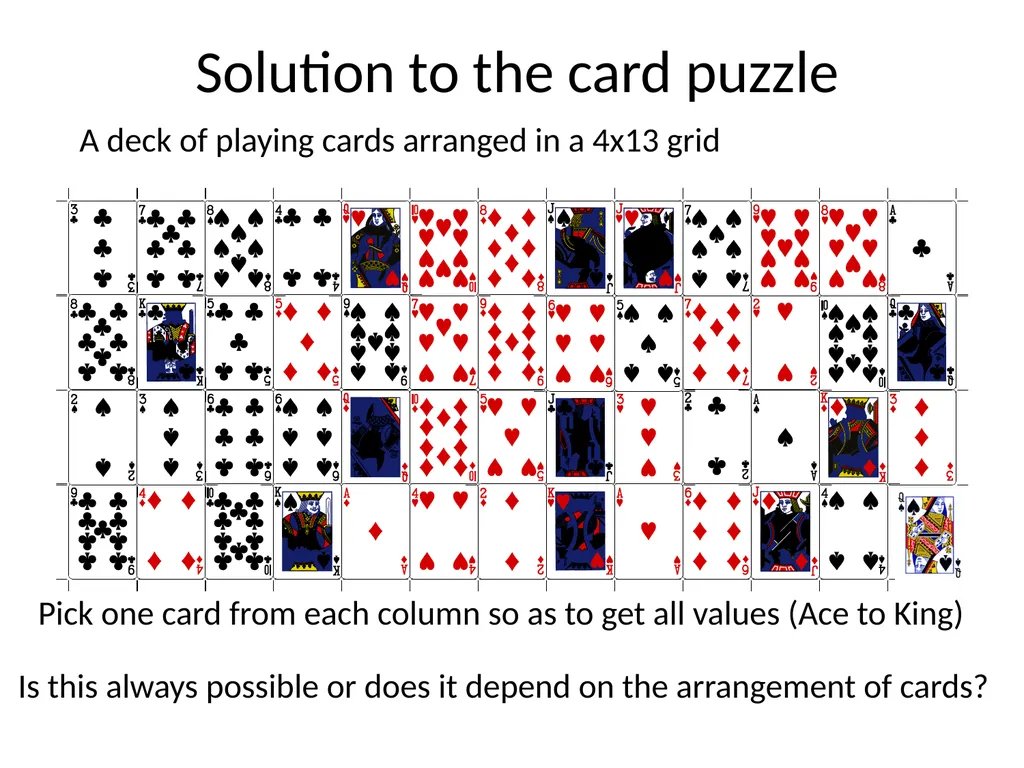
A card puzzle A deck of playing cards arranged in a 4x13 grid Pick one card from each column so as to get all values (Ace to King)<br>
07
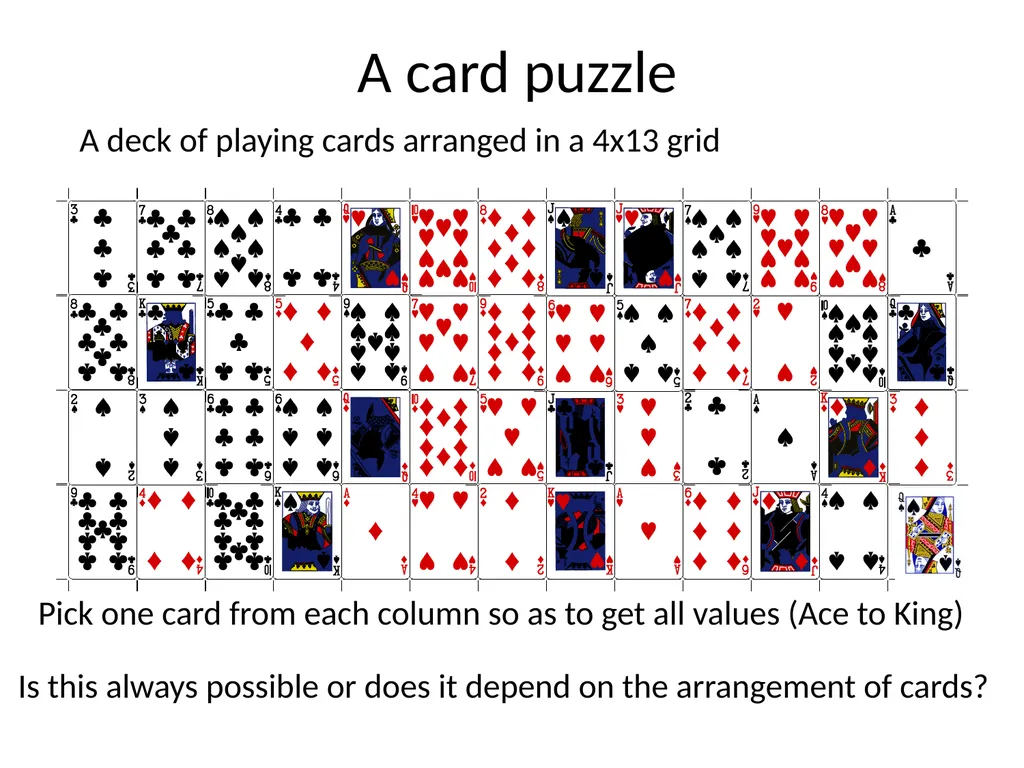
A card puzzle A deck of playing cards arranged in a 4x13 grid Pick one card from each column so as to get all values (Ace to King) Is this always possible or does it depend on the arrangement of cards?<br>
08
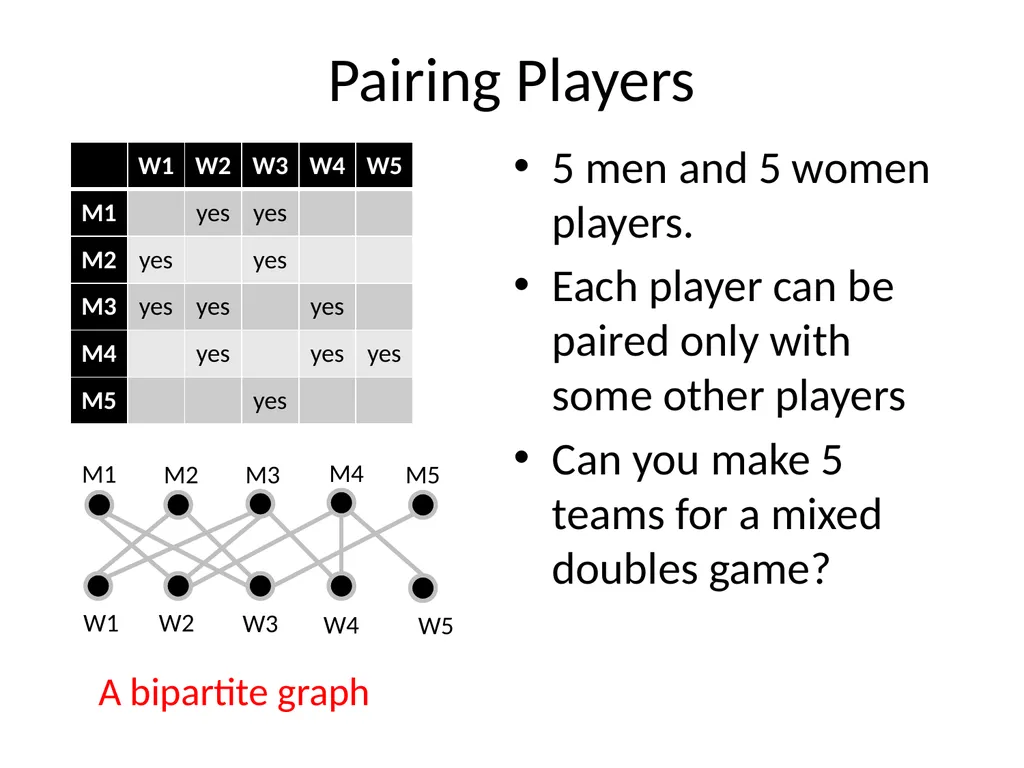
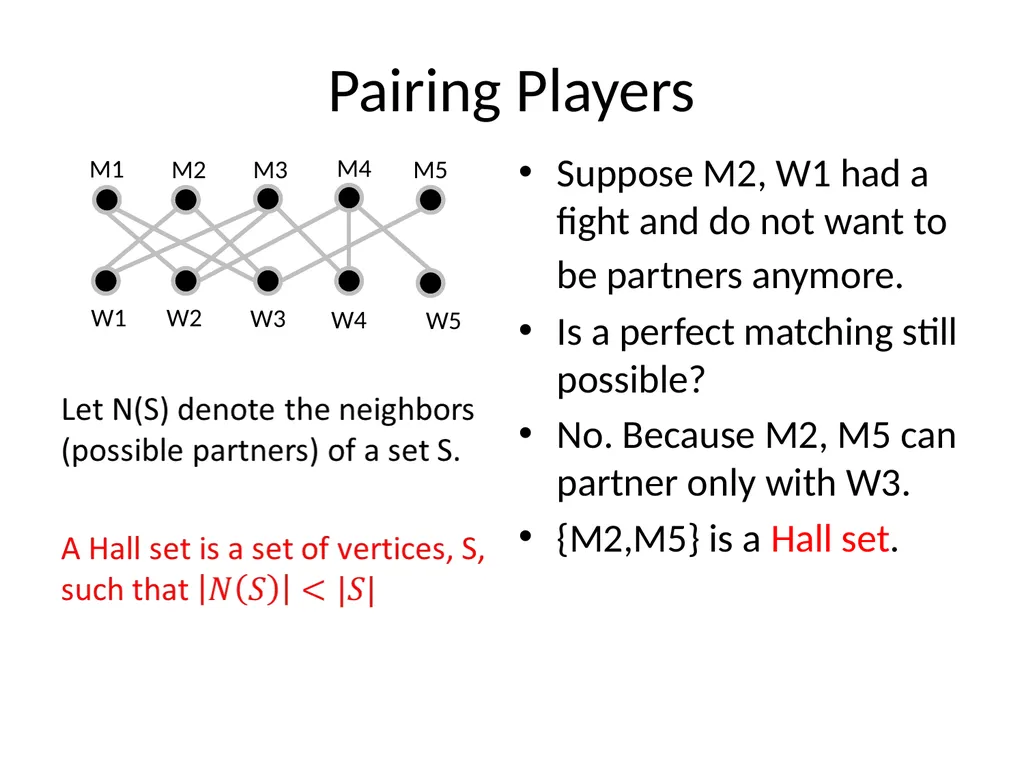
Pairing Players 5 men and 5 women players.
Each player can be paired only with some other players
Can you make 5 teams for a mixed doubles game? A bipartite graph<br>
09
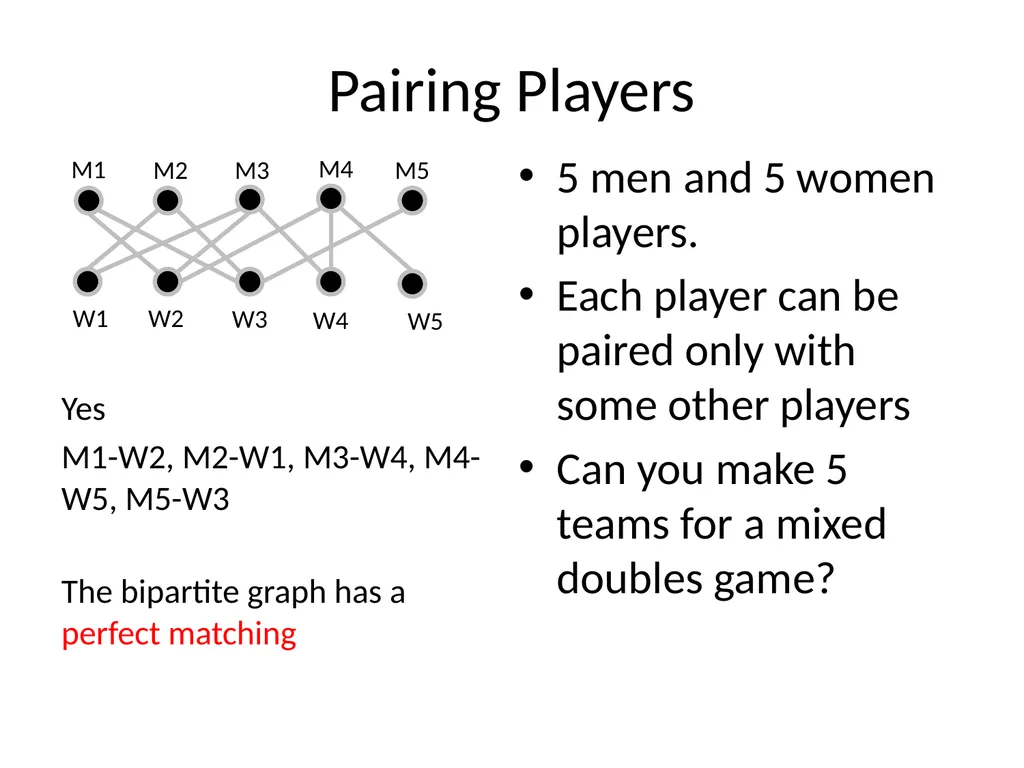
Pairing Players 5 men and 5 women players.
Each player can be paired only with some other players
Can you make 5 teams for a mixed doubles game? Yes
M1-W2, M2-W1, M3-W4, M4-W5, M5-W3 The bipartite graph has a perfect matching W5 M1 M5 W1 M2 M3 M4 W2 W3 W4<br>
10
Pairing Players Suppose M2, W1 had a fight and do not want to be partners anymore.
Is a perfect matching still possible?
No. Because M2, M5 can partner only with W3.
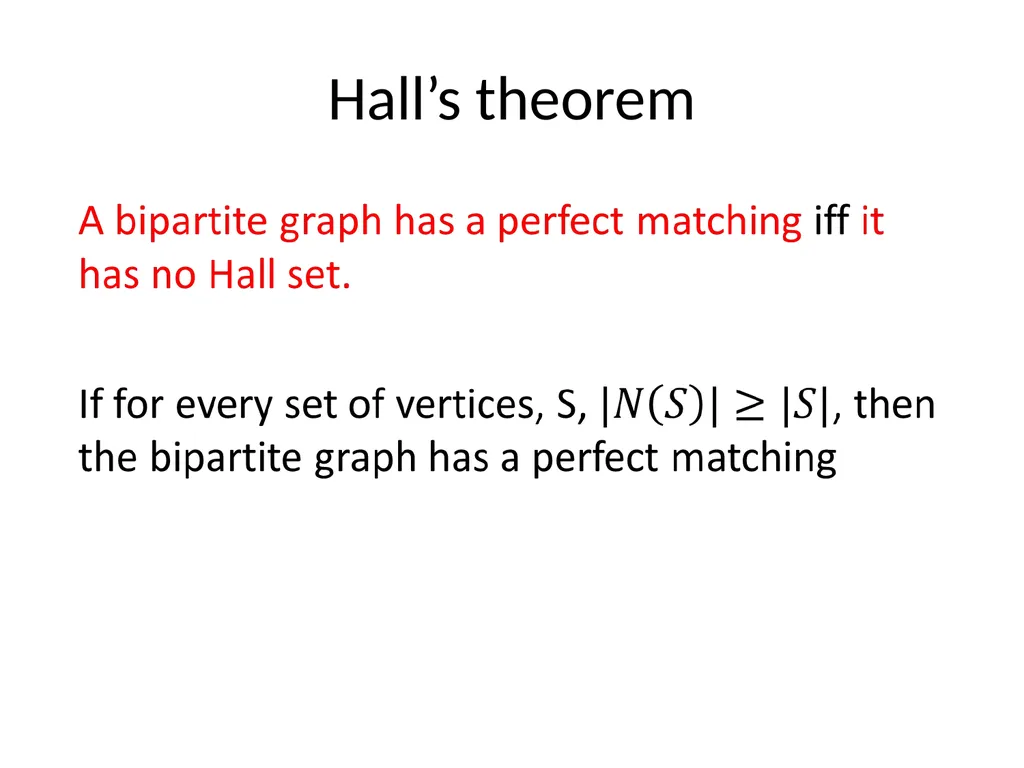
{M2,M5} is a Hall set. W5 M1 M5 W1 M2 M3 M4 W2 W3 W4<br>
12
Solution to the card puzzle A deck of playing cards arranged in a 4x13 grid Pick one card from each column so as to get all values (Ace to King) Is this always possible or does it depend on the arrangement of cards?<br>
13
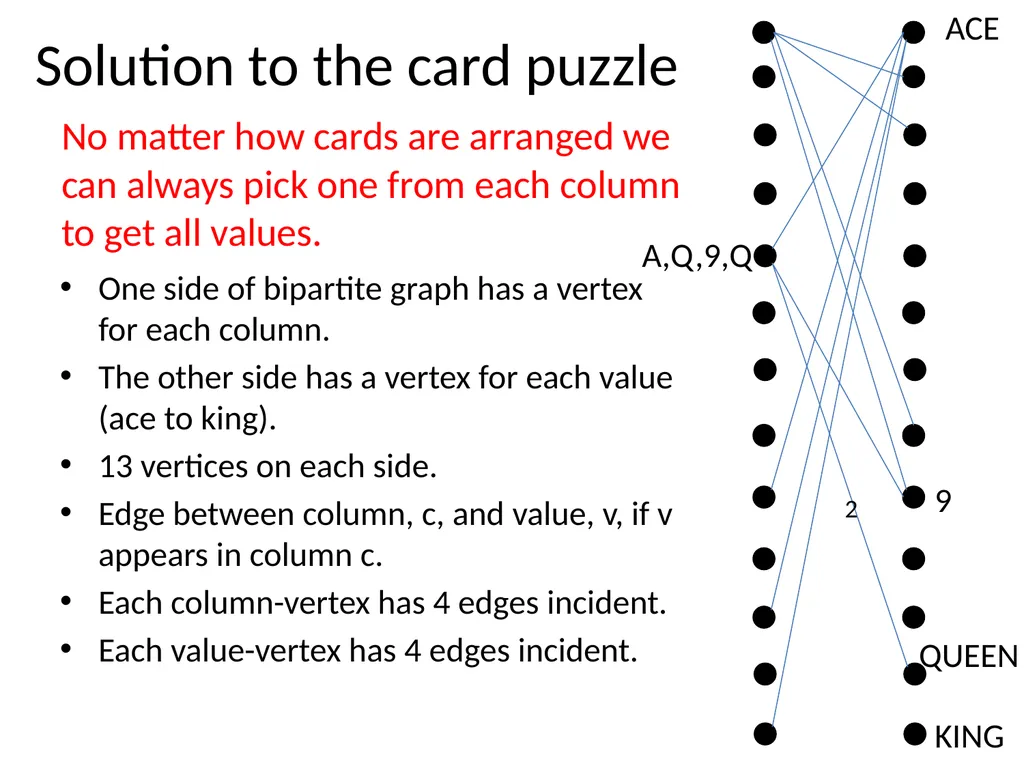
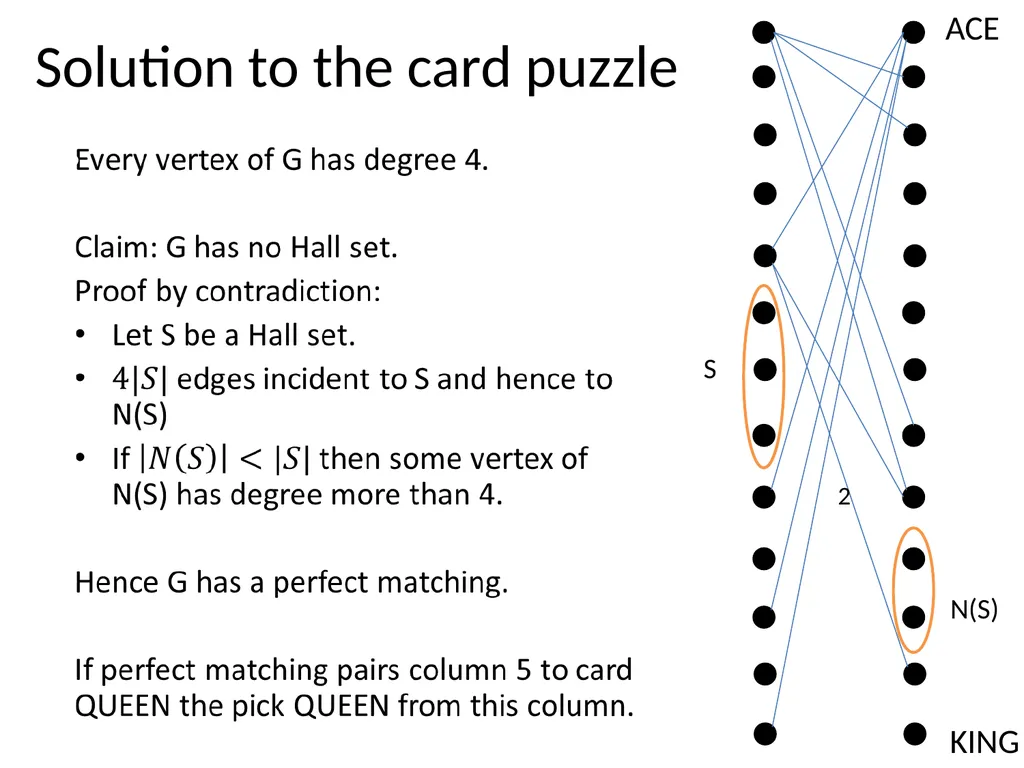
Solution to the card puzzle No matter how cards are arranged we can always pick one from each column to get all values. ACE KING 2 One side of bipartite graph has a vertex for each column.
The other side has a vertex for each value (ace to king).
13 vertices on each side.
Edge between column, c, and value, v, if v appears in column c.
Each column-vertex has 4 edges incident.
Each value-vertex has 4 edges incident. 9 QUEEN A,Q,9,Q<br>
14
Solution to the card puzzle ACE KING 2 S N(S)<br>
15
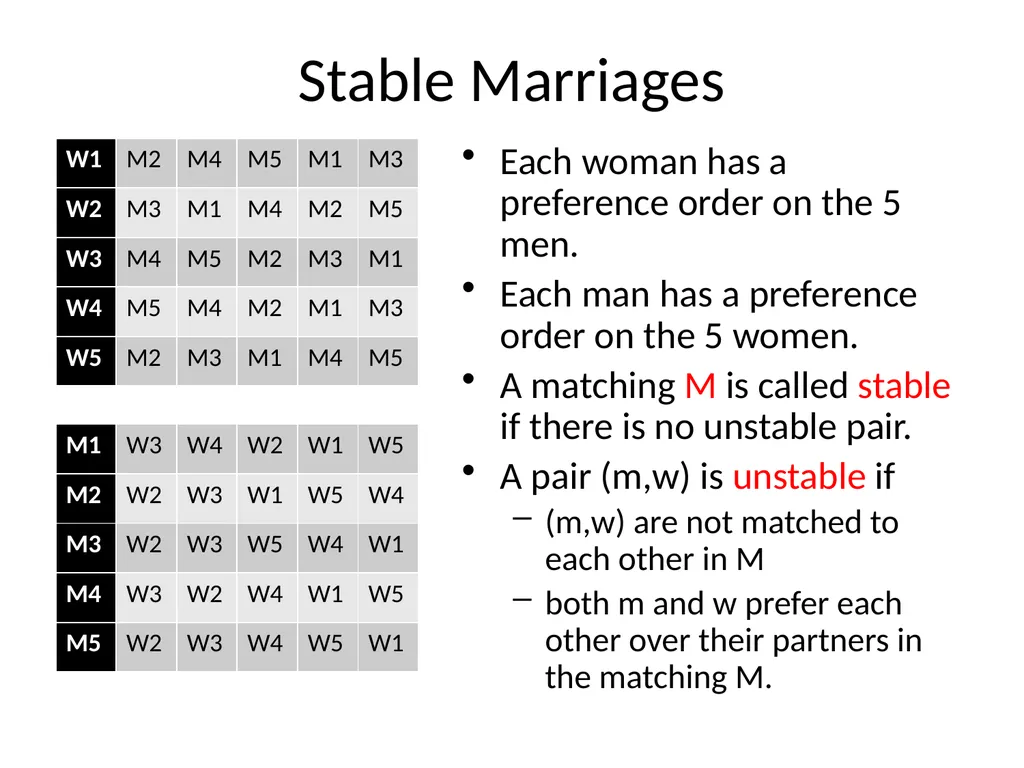
Stable Marriages Each woman has a preference order on the 5 men.
Each man has a preference order on the 5 women.
A matching M is called stable if there is no unstable pair.
A pair (m,w) is unstable if
(m,w) are not matched to each other in M
both m and w prefer each other over their partners in the matching M.<br>
16
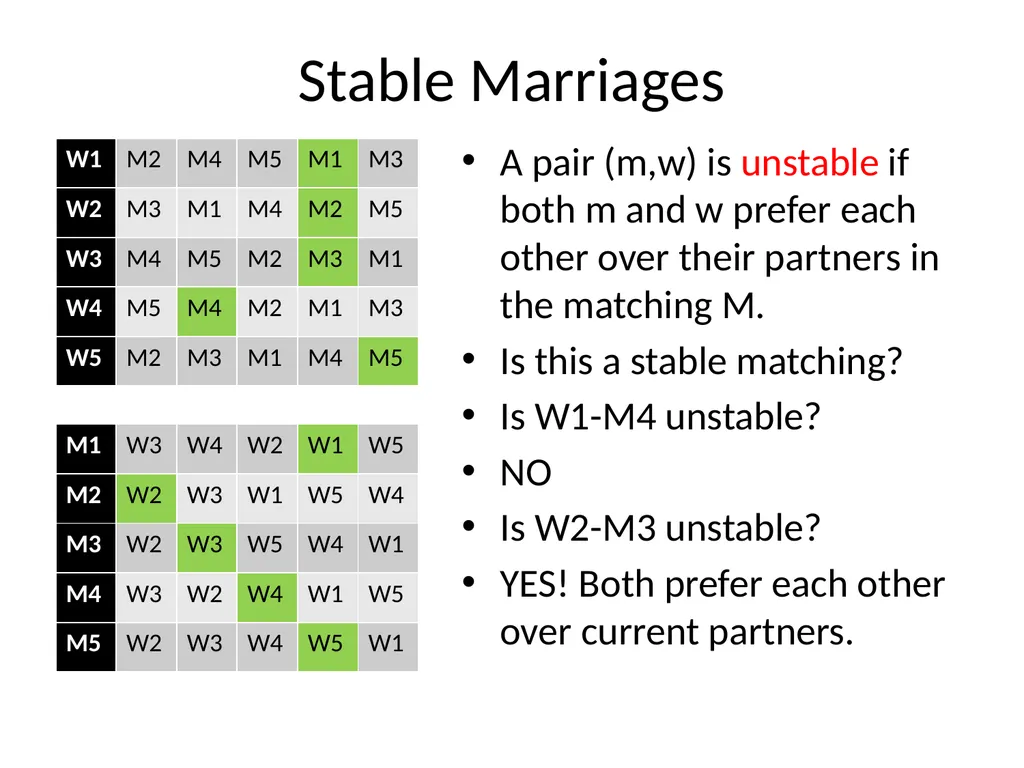
Stable Marriages A pair (m,w) is unstable if both m and w prefer each other over their partners in the matching M.
Is this a stable matching?
Is W1-M4 unstable?
NO
Is W2-M3 unstable?
YES! Both prefer each other over current partners.<br>
17
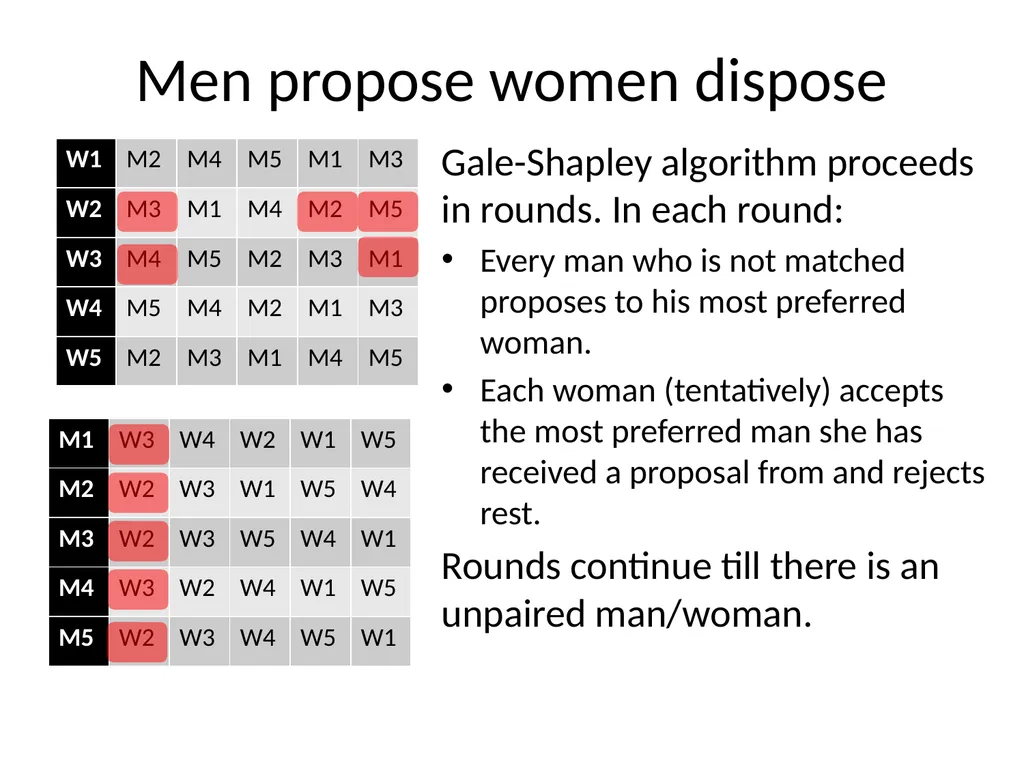
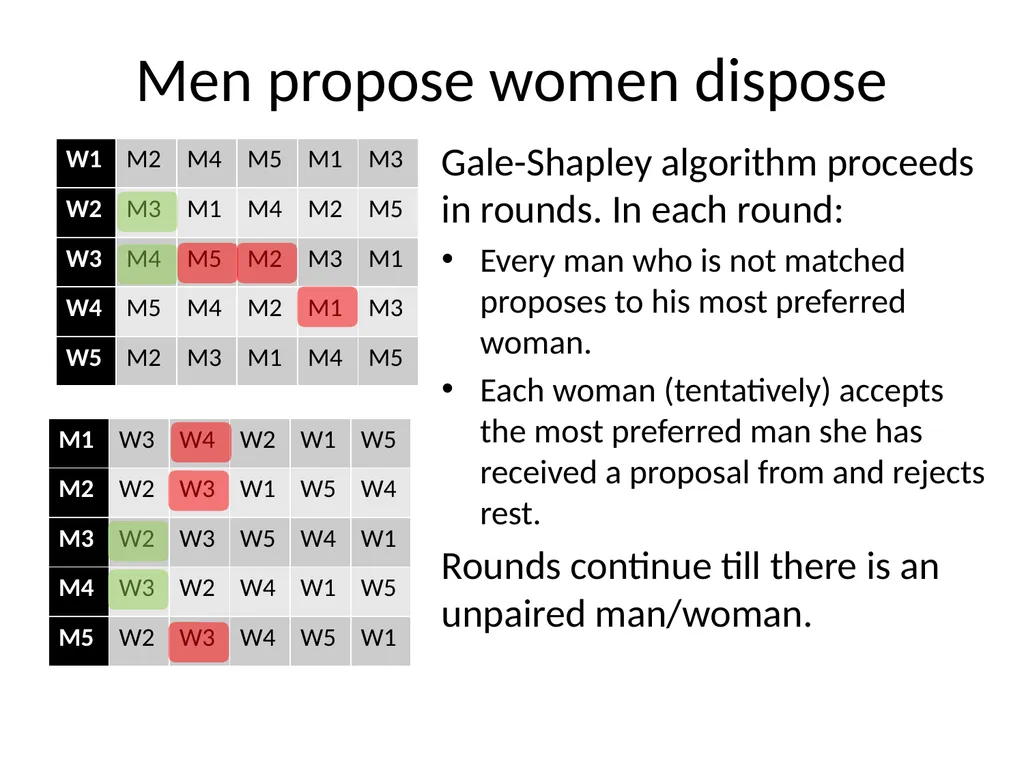
Men propose women dispose Gale-Shapley algorithm proceeds in rounds. In each round:
Every man who is not matched proposes to his most preferred woman.
Each woman (tentatively) accepts the most preferred man she has received a proposal from and rejects rest.
Rounds continue till there is an unpaired man/woman.<br>
18
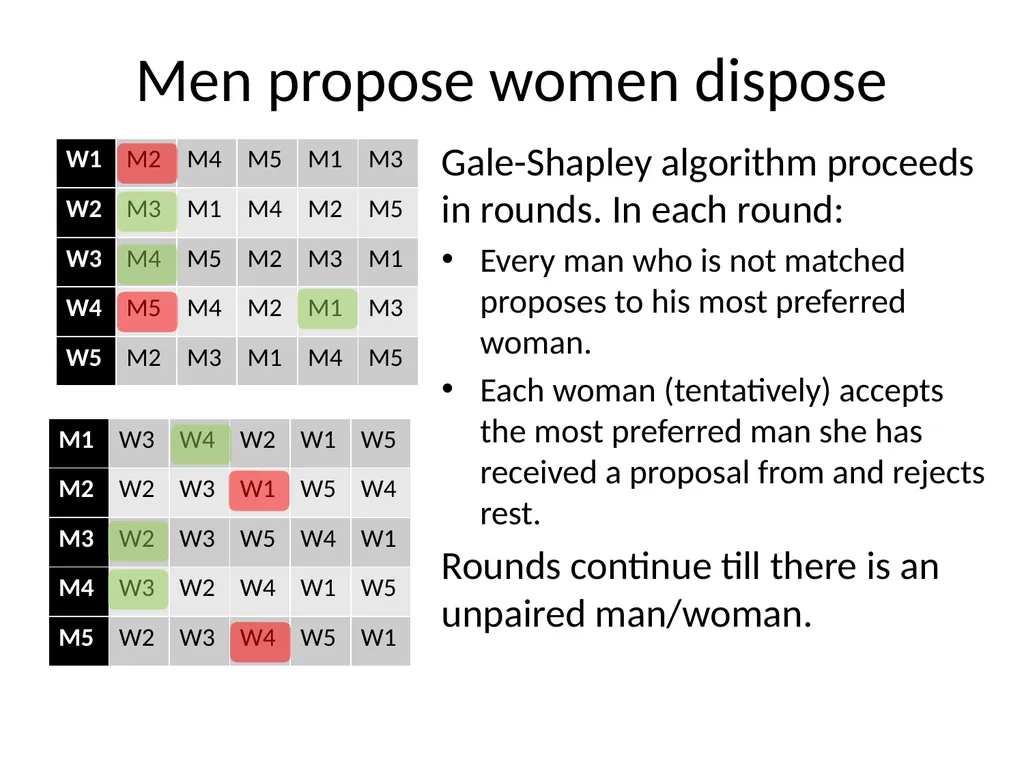
Men propose women dispose Gale-Shapley algorithm proceeds in rounds. In each round:
Every man who is not matched proposes to his most preferred woman.
Each woman (tentatively) accepts the most preferred man she has received a proposal from and rejects rest.
Rounds continue till there is an unpaired man/woman.<br>
19
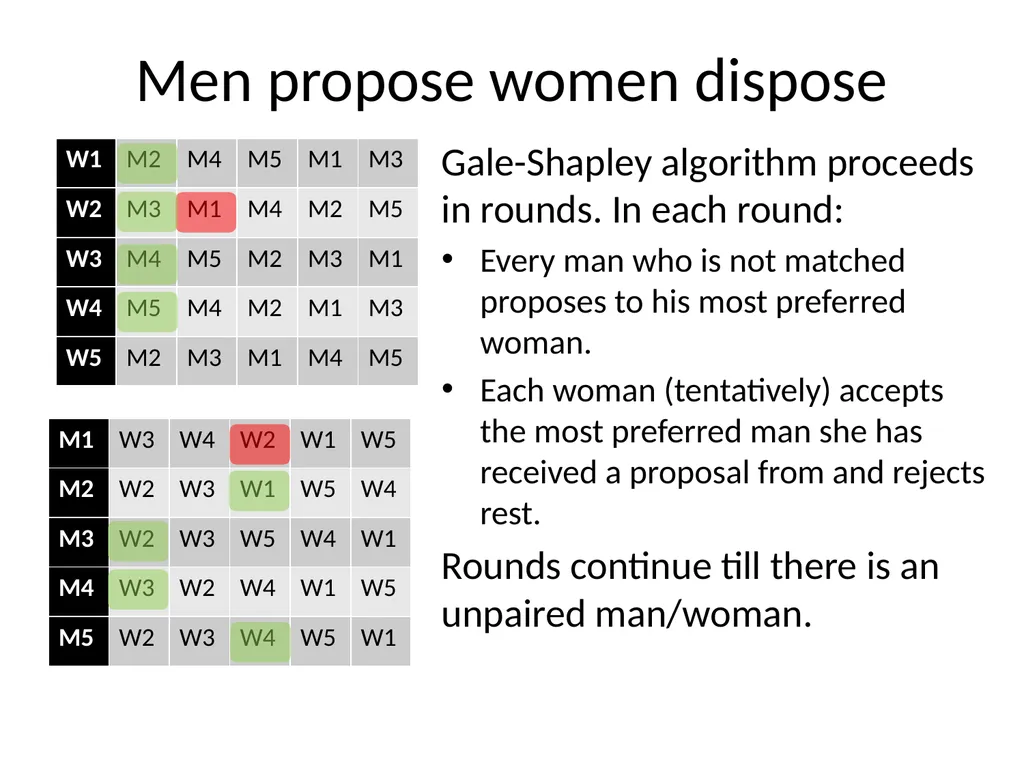
Men propose women dispose Gale-Shapley algorithm proceeds in rounds. In each round:
Every man who is not matched proposes to his most preferred woman.
Each woman (tentatively) accepts the most preferred man she has received a proposal from and rejects rest.
Rounds continue till there is an unpaired man/woman.<br>
20
Men propose women dispose Gale-Shapley algorithm proceeds in rounds. In each round:
Every man who is not matched proposes to his most preferred woman.
Each woman (tentatively) accepts the most preferred man she has received a proposal from and rejects rest.
Rounds continue till there is an unpaired man/woman.<br>
21
Is this any use? The Gale-Shapley algorithm always finds a stable matching.
GS and variants are used for matching interns to hospitals, students to high schools, kidneys to patients…
The Gale-Shapley algorithm was cited by the Nobel Prize committee, awarding the Nobel Economics Prize 2012 to Lloyd Shapley and Alvin Roth.<br>
22
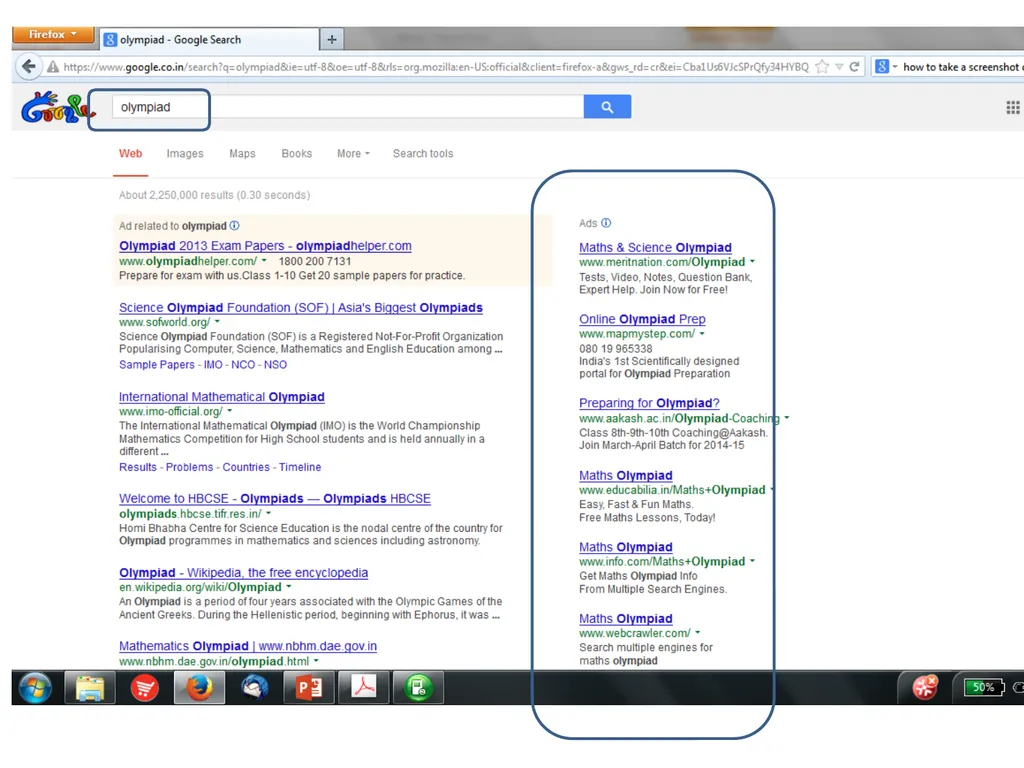
Google Adwords Search engines like Google, Bing, Yahoo make the bulk of their revenue by showing ads.
Merchants bid for keywords related to their business.
When you search for the keyword Google shows the ad(s) of the merchants who bid for this keyword.
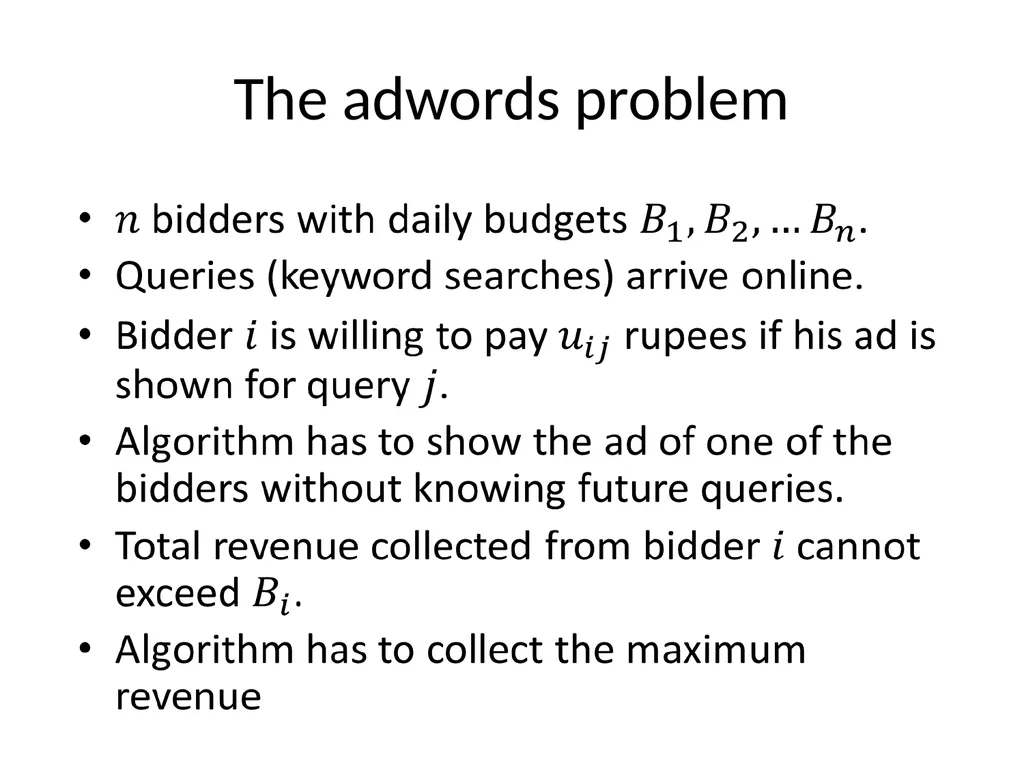
If a merchant’s ad appears he pays google the bid value.
Each merchant specifies a daily budget and that is the maximum he pays google in a day.<br>
23
The adwords problem<br>
24
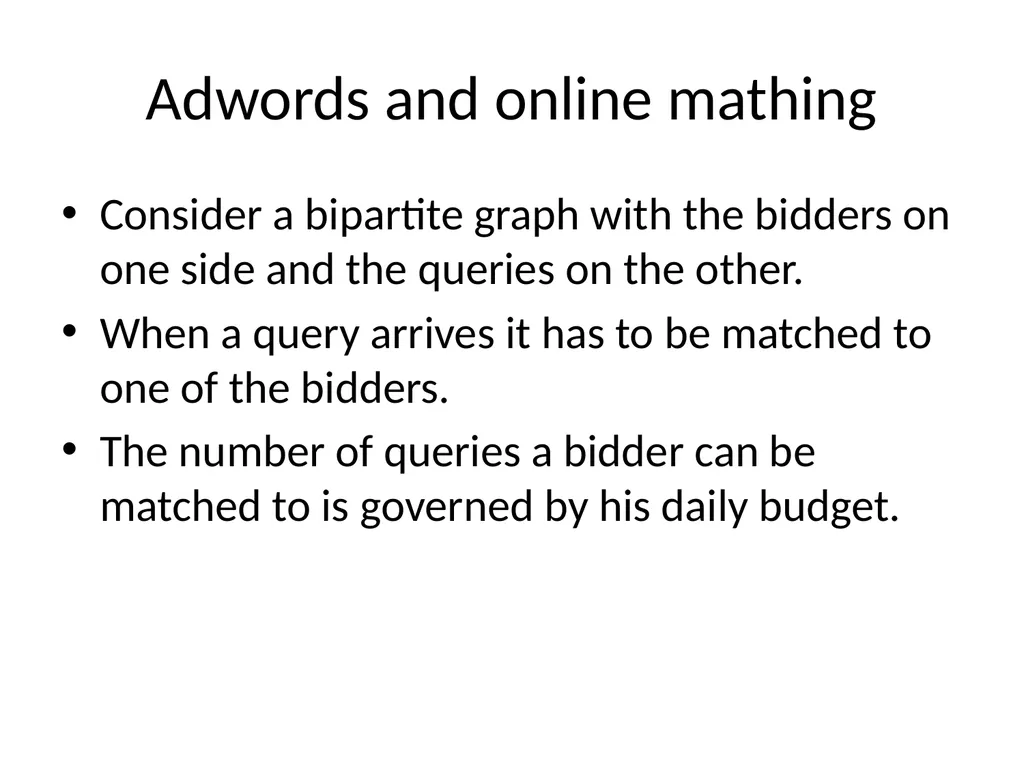
Adwords and online mathing Consider a bipartite graph with the bidders on one side and the queries on the other.
When a query arrives it has to be matched to one of the bidders.
The number of queries a bidder can be matched to is governed by his daily budget.<br>
25
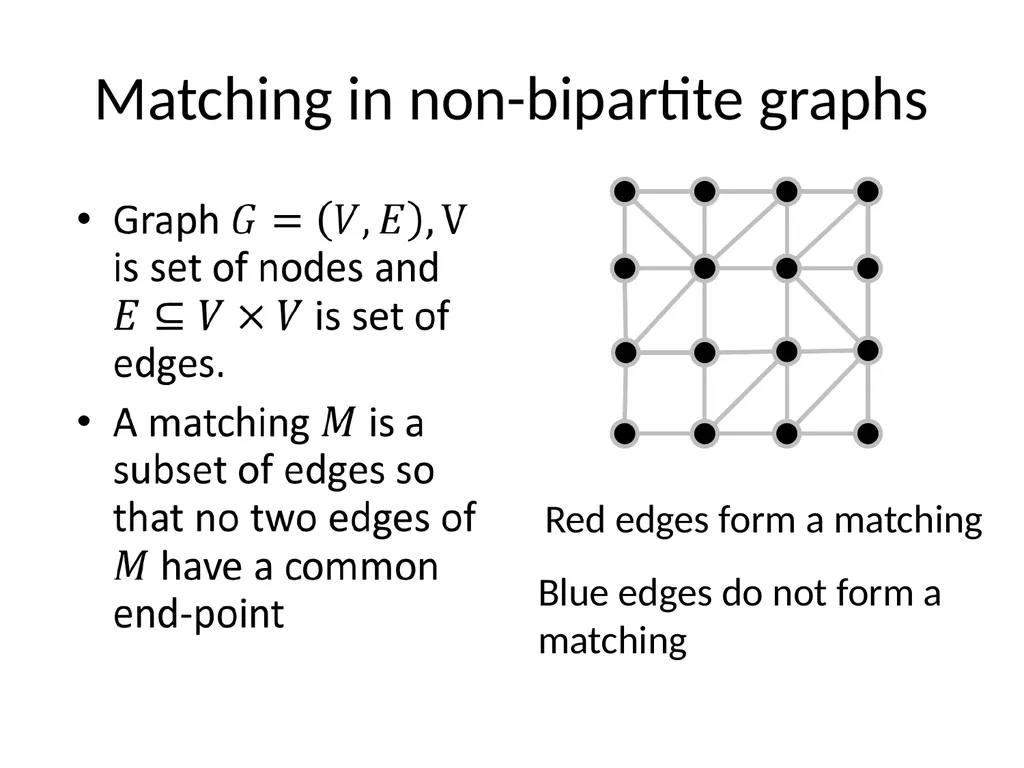
Matching in non-bipartite graphs Red edges form a matching Blue edges do not form a matching<br>
26
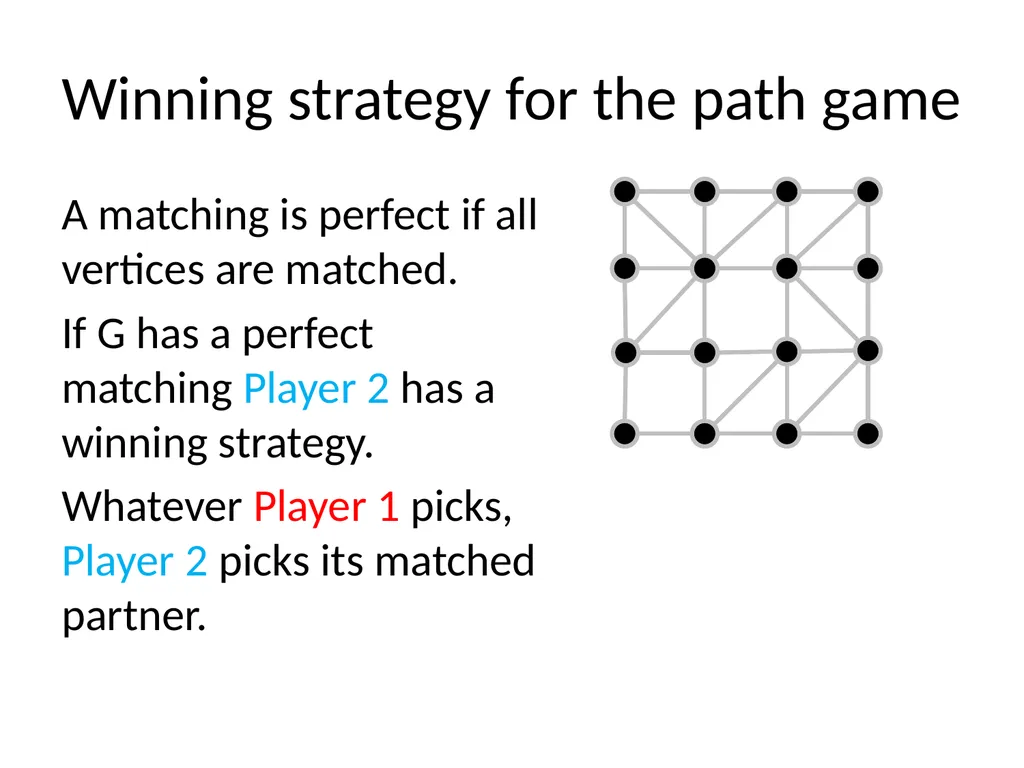
Winning strategy for the path game A matching is perfect if all vertices are matched.
If G has a perfect matching Player 2 has a winning strategy.
Whatever Player 1 picks, Player 2 picks its matched partner.<br>
27
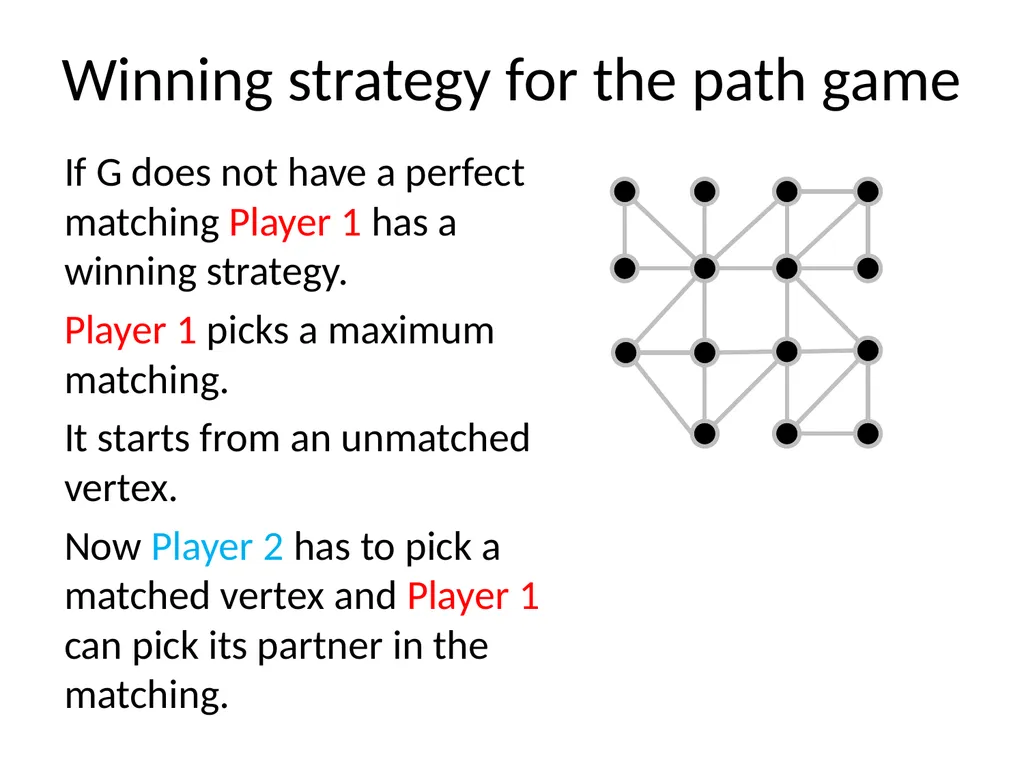
Winning strategy for the path game If G does not have a perfect matching Player 1 has a winning strategy.
Player 1 picks a maximum matching.
It starts from an unmatched vertex.
Now Player 2 has to pick a matched vertex and Player 1 can pick its partner in the matching.<br>
28
Finally, the secret of the card trick Amongst the 5 cards you chose, two have to be of the same suit, say club.
If the two clubs were 5C and 10C, then the assistant returns 10C to the audience.
The first card the assistant shows me is 5C. So that I know the suit of the hidden card.
There are 6 permutations of the remaining 3 cards. Using these the assistant generates a number from 1 to 6 which I then add to 5 to get the value of the hidden card.<br>
29
What does this have to do with matchings?<br>
30
Using matchings to get to the upperbound Make a bipartite graph where vertices on left are all subsets of 5 cards.
Vertices on right are all possible 4 card sequences.
There is an edge between two vertices if the 4 cards on the right are a subset of the 5 cards on the left.
Note each vertex has degree 120 and so graph has a perfect matching.
This matching tells the assistant what sequence to give when presented with a certain set of 5 cards. Ditto for magician.<br>