
Math 340L - CS What’s this all about? What Shall
LO
Published · 55 slides · 0 views

1 / 1











Description
Math 340L - CS Whats this all about? What Shall We Do Today? What Shall We Do Today? Option 1: Get an Introduction to the course. What Shall We Do Today? Option 2: Sing some of your favorite campfire songs. Important Stuff Course: Math
Related Topics
Share
Embed code
Download this presentation From Below
"Math 340L - CS What’s this all about? What Shall" is the property of its rightful owner. Permission is granted to download and print the materials on this website for personal, non-commercial use only, and to display it on your personal computer provided you do not modify the materials and that you retain all copyright notices contained in the materials. By downloading content from our website, you accept the terms of this agreement.
Presentation Transcript
01
Math 340L - CS What’s this all about?<br>
02
What Shall We Do Today?<br>
03
What Shall We Do Today? Option 1:
Get an Introduction to the course.<br>
Get an Introduction to the course.<br>
04
What Shall We Do Today? Option 2:
Sing some of your favorite campfire songs.<br>
Sing some of your favorite campfire songs.<br>
05
Important Stuff Course: Math 340LMatrices and Matrix Calculations
Time: T-TH 9:30-11:00 in WAG 201
Instructor: A. K. Cline
Office: GDH 5.808
Office Hours: Tu 11-12, W 11-12, F 1-2, and by appointment
Web Site: http://www.cs.utexas.edu/users/cline/M340L/
Email: cline@cs.utexas.edu
Assistant: Jillian Fisher
Office: TBD
Office Hours: TBD
Email: fisherjillian@ymail.com<br>
Time: T-TH 9:30-11:00 in WAG 201
Instructor: A. K. Cline
Office: GDH 5.808
Office Hours: Tu 11-12, W 11-12, F 1-2, and by appointment
Web Site: http://www.cs.utexas.edu/users/cline/M340L/
Email: cline@cs.utexas.edu
Assistant: Jillian Fisher
Office: TBD
Office Hours: TBD
Email: fisherjillian@ymail.com<br>
06
Text and Video Lectures Text: Linear Algebra and its Applications, 4th or 5th ed., by David C. Lay.
Gilbert Strang’s lectures based upon his book may be found at http://ocw.mit.edu/courses/mathematics/18-06-linear-algebra-spring-2010/<br>
Gilbert Strang’s lectures based upon his book may be found at http://ocw.mit.edu/courses/mathematics/18-06-linear-algebra-spring-2010/<br>
07
Comments 1. Good homework cannot make up for poor exams nor good exams for poor homework. To do well in the course grade, students must have good homework and exams.
2. There will be approximately one set of homework problems assigned each week. These will be submitted electronically due at 9:30, the beginning of the following class. Solutions for each problem set will be distributed.
3. An excellent summary of expectations is found at http://www.cs.utexas.edu/users/ear/CodeOfConduct.html<br>
2. There will be approximately one set of homework problems assigned each week. These will be submitted electronically due at 9:30, the beginning of the following class. Solutions for each problem set will be distributed.
3. An excellent summary of expectations is found at http://www.cs.utexas.edu/users/ear/CodeOfConduct.html<br>
08
Homework Specifications 1. Your solutions must be legible. If your writing is not legible, use a word processor.
2. Every sentence - even those using mathematical notation - must be readable. There must be clear subjects and verbs - not just random phrases.
3. Criticize your own solutions. You should be learning not only how to create solutions but how to recognize correct ones. If you wonder about having too much or too little detail, err always on the side of too much detail.
4. If you realize that your solution has gaps or errors, admit that. Put comments about such omissions or possible errors in boxes.
5. Test your computations whenever possible.<br>
2. Every sentence - even those using mathematical notation - must be readable. There must be clear subjects and verbs - not just random phrases.
3. Criticize your own solutions. You should be learning not only how to create solutions but how to recognize correct ones. If you wonder about having too much or too little detail, err always on the side of too much detail.
4. If you realize that your solution has gaps or errors, admit that. Put comments about such omissions or possible errors in boxes.
5. Test your computations whenever possible.<br>
09
Tutoring Sessions Every Monday evening from 6 to 8 PM, there will be a session in GDC 2.502 to answer questions. The questions may arise from homework assignments or otherwise. Please realize this will not be a repeat of lectures. The TA and a tutor will be present to respond to questions.
More fundamental assistance should be obtained from the TA or me.<br>
More fundamental assistance should be obtained from the TA or me.<br>
10
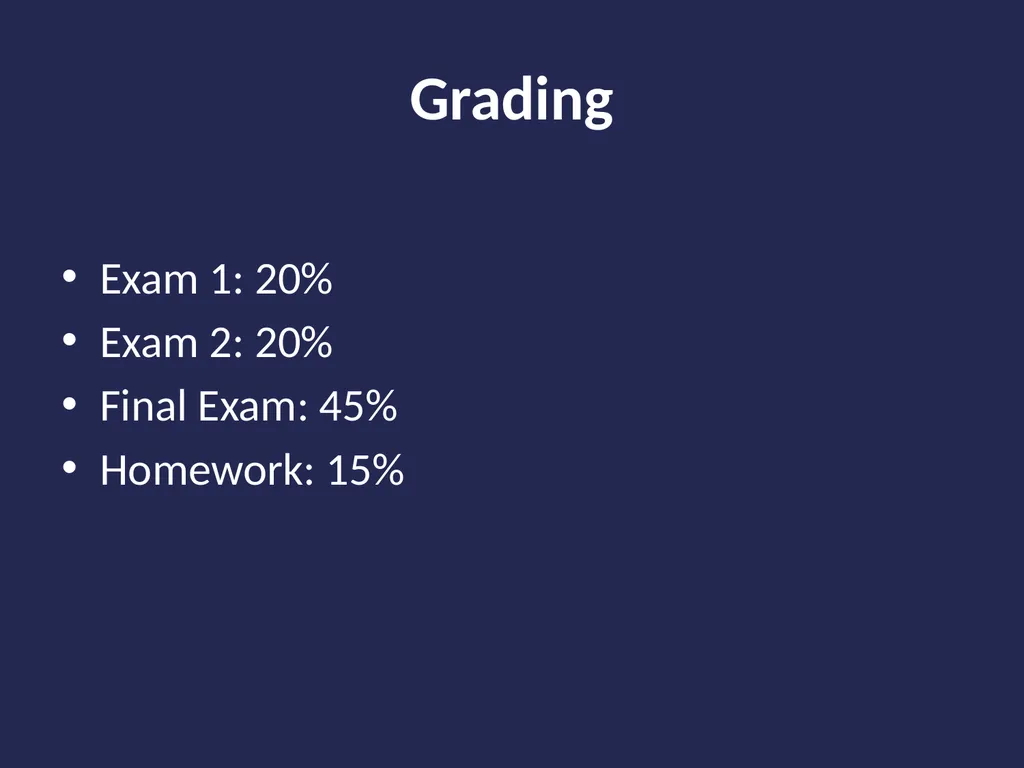
Grading Exam 1: 20%
Exam 2: 20%
Final Exam: 45%
Homework: 15%<br>
Exam 2: 20%
Final Exam: 45%
Homework: 15%<br>
11
New Stuff for You No dedicated TA – we share<br>
12
New Stuff for You No dedicated TA – we share
Undergraduate grader<br>
Undergraduate grader<br>
13
New Stuff for You No dedicated TA – we share
Undergraduate grader
Electronic submission of homework<br>
Undergraduate grader
Electronic submission of homework<br>
14
New Stuff for You No dedicated TA – we share
Undergraduate grader
Electronic submission of homework
Tutoring sessions<br>
Undergraduate grader
Electronic submission of homework
Tutoring sessions<br>
15
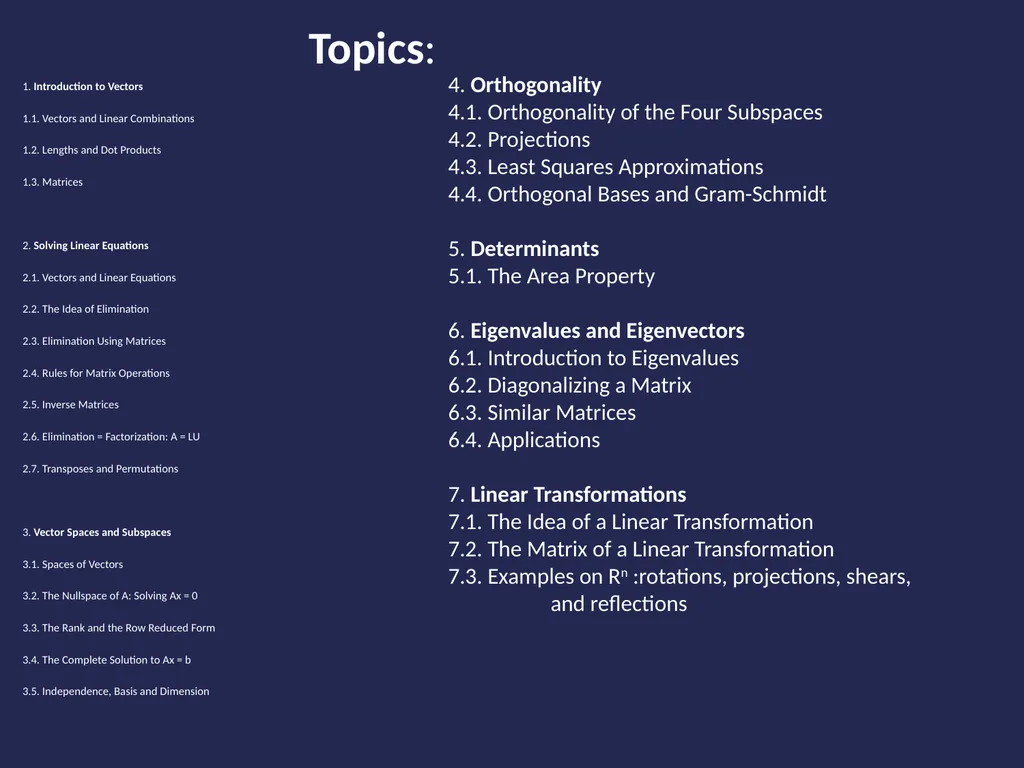
Topics: 1. Introduction to Vectors
1.1. Vectors and Linear Combinations
1.2. Lengths and Dot Products
1.3. Matrices
2. Solving Linear Equations
2.1. Vectors and Linear Equations
2.2. The Idea of Elimination
2.3. Elimination Using Matrices
2.4. Rules for Matrix Operations
2.5. Inverse Matrices
2.6. Elimination = Factorization: A = LU
2.7. Transposes and Permutations
3. Vector Spaces and Subspaces
3.1. Spaces of Vectors
3.2. The Nullspace of A: Solving Ax = 0
3.3. The Rank and the Row Reduced Form
3.4. The Complete Solution to Ax = b
3.5. Independence, Basis and Dimension 4. Orthogonality
4.1. Orthogonality of the Four Subspaces
4.2. Projections
4.3. Least Squares Approximations
4.4. Orthogonal Bases and Gram-Schmidt
5. Determinants
5.1. The Area Property
6. Eigenvalues and Eigenvectors
6.1. Introduction to Eigenvalues
6.2. Diagonalizing a Matrix
6.3. Similar Matrices
6.4. Applications
7. Linear Transformations
7.1. The Idea of a Linear Transformation
7.2. The Matrix of a Linear Transformation
7.3. Examples on Rn :rotations, projections, shears,
and reflections<br>
1.1. Vectors and Linear Combinations
1.2. Lengths and Dot Products
1.3. Matrices
2. Solving Linear Equations
2.1. Vectors and Linear Equations
2.2. The Idea of Elimination
2.3. Elimination Using Matrices
2.4. Rules for Matrix Operations
2.5. Inverse Matrices
2.6. Elimination = Factorization: A = LU
2.7. Transposes and Permutations
3. Vector Spaces and Subspaces
3.1. Spaces of Vectors
3.2. The Nullspace of A: Solving Ax = 0
3.3. The Rank and the Row Reduced Form
3.4. The Complete Solution to Ax = b
3.5. Independence, Basis and Dimension 4. Orthogonality
4.1. Orthogonality of the Four Subspaces
4.2. Projections
4.3. Least Squares Approximations
4.4. Orthogonal Bases and Gram-Schmidt
5. Determinants
5.1. The Area Property
6. Eigenvalues and Eigenvectors
6.1. Introduction to Eigenvalues
6.2. Diagonalizing a Matrix
6.3. Similar Matrices
6.4. Applications
7. Linear Transformations
7.1. The Idea of a Linear Transformation
7.2. The Matrix of a Linear Transformation
7.3. Examples on Rn :rotations, projections, shears,
and reflections<br>
16
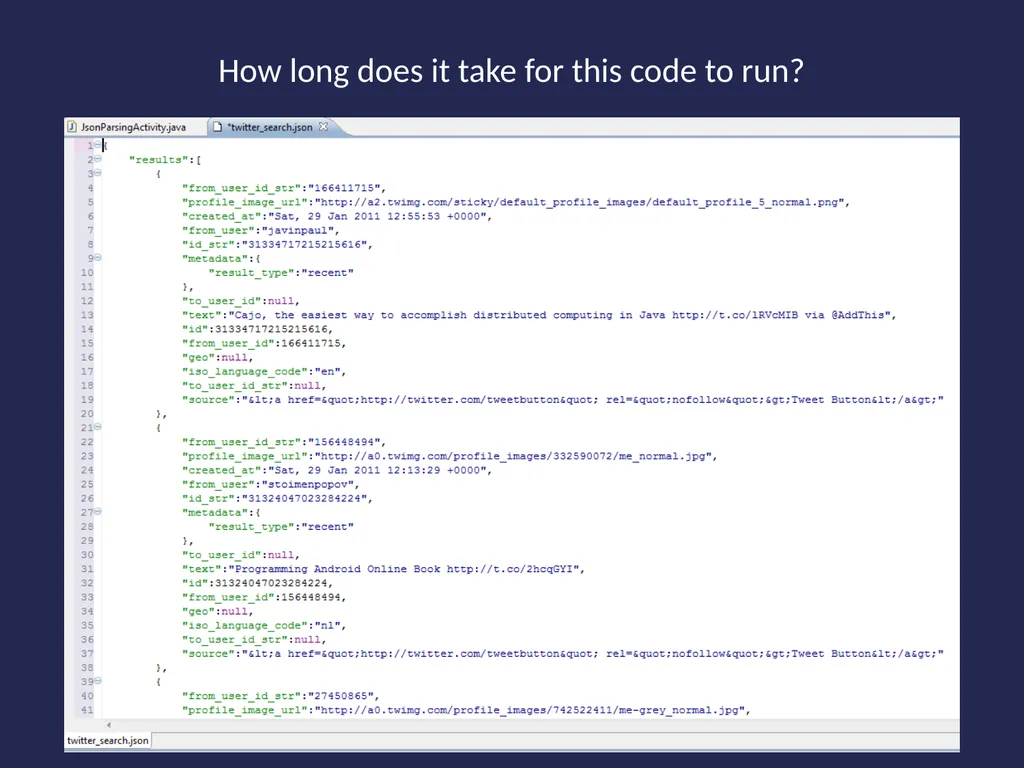
How long does it take for this code to run?<br>
17
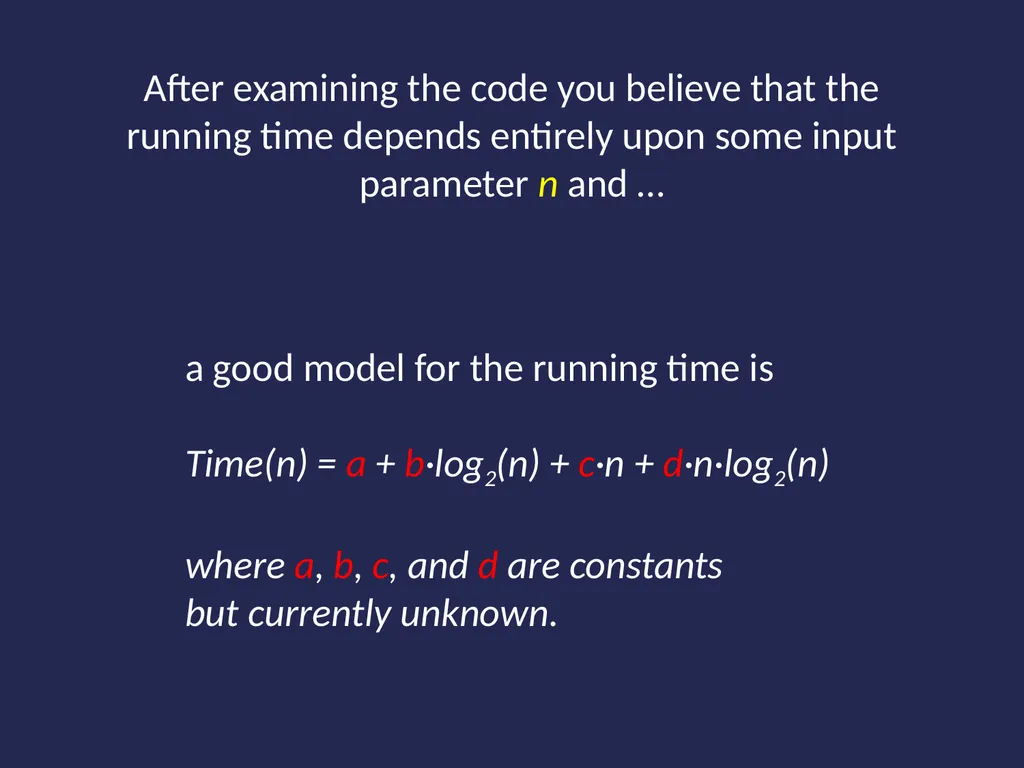
After examining the code you believe that the running time depends entirely upon some input parameter n and …<br>
18
After examining the code you believe that the running time depends entirely upon some input parameter n and … a good model for the running time is
Time(n) = a + b·log2(n) + c·n + d·n·log2(n)
where a, b, c, and d are constants
but currently unknown.<br>
Time(n) = a + b·log2(n) + c·n + d·n·log2(n)
where a, b, c, and d are constants
but currently unknown.<br>
19
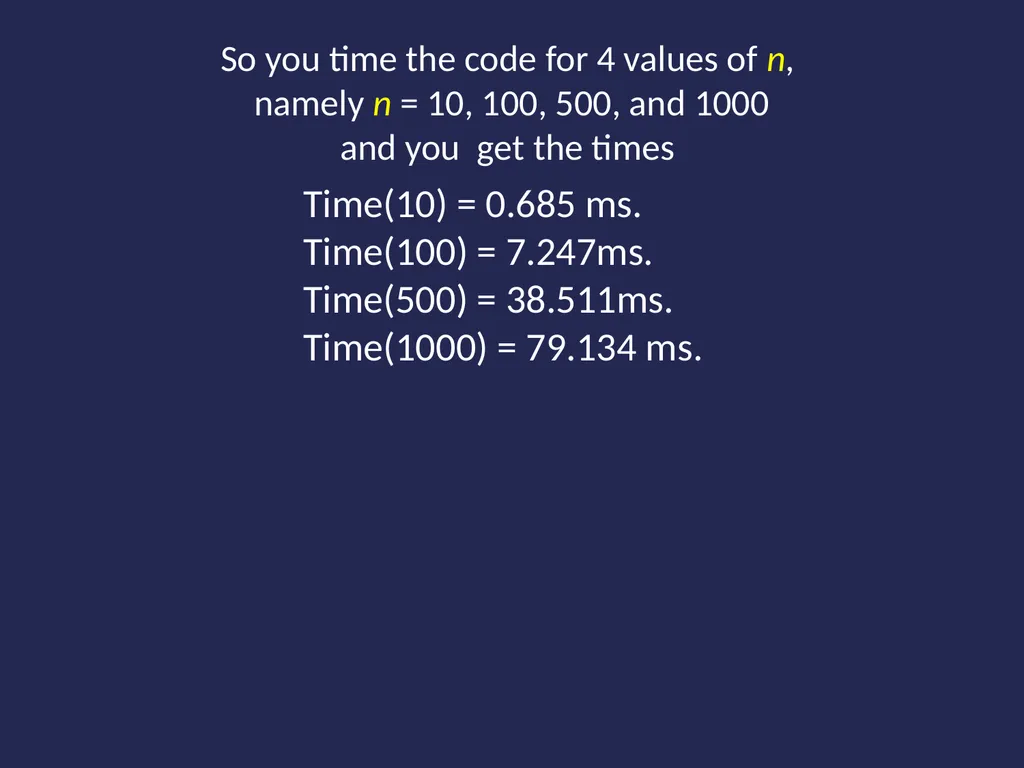
So you time the code for 4 values of n,
namely n = 10, 100, 500, and 1000
and you get the times Time(10) = 0.685 ms.
Time(100) = 7.247ms.
Time(500) = 38.511ms.
Time(1000) = 79.134 ms.<br>
20
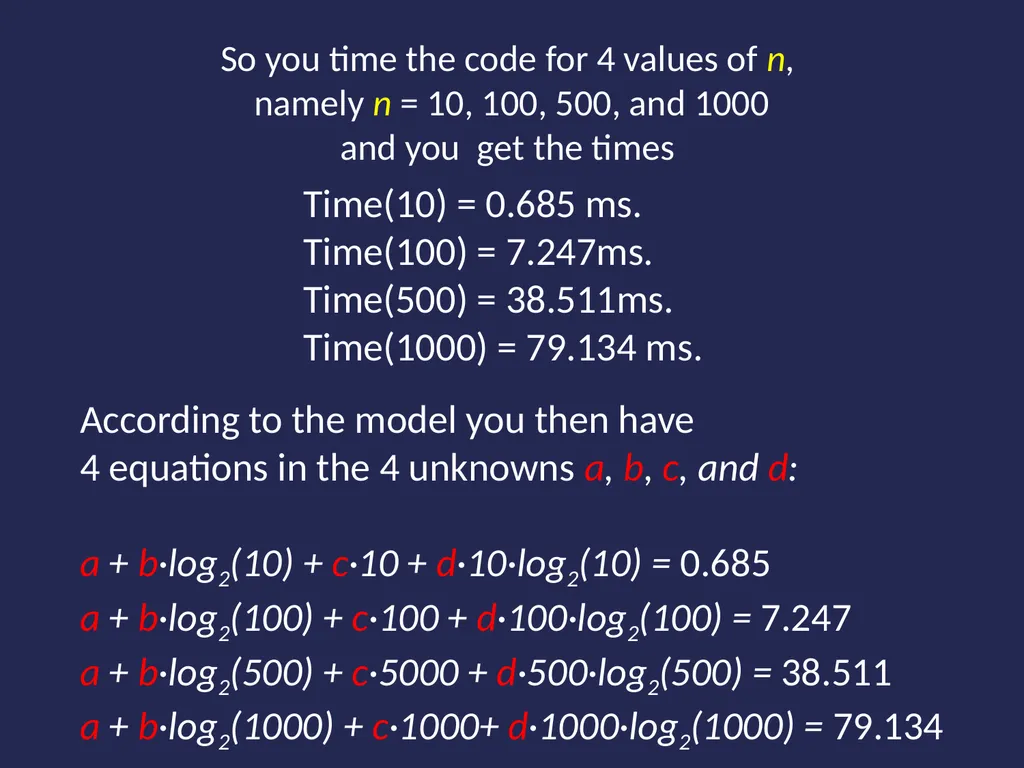
So you time the code for 4 values of n,
namely n = 10, 100, 500, and 1000
and you get the times According to the model you then have
4 equations in the 4 unknowns a, b, c, and d:
a + b·log2(10) + c·10 + d·10·log2(10) = 0.685
a + b·log2(100) + c·100 + d·100·log2(100) = 7.247
a + b·log2(500) + c·5000 + d·500·log2(500) = 38.511
a + b·log2(1000) + c·1000+ d·1000·log2(1000) = 79.134 Time(10) = 0.685 ms. Time(100) = 7.247ms. Time(500) = 38.511ms. Time(1000) = 79.134 ms.<br>
4 equations in the 4 unknowns a, b, c, and d:
a + b·log2(10) + c·10 + d·10·log2(10) = 0.685
a + b·log2(100) + c·100 + d·100·log2(100) = 7.247
a + b·log2(500) + c·5000 + d·500·log2(500) = 38.511
a + b·log2(1000) + c·1000+ d·1000·log2(1000) = 79.134 Time(10) = 0.685 ms. Time(100) = 7.247ms. Time(500) = 38.511ms. Time(1000) = 79.134 ms.<br>
21
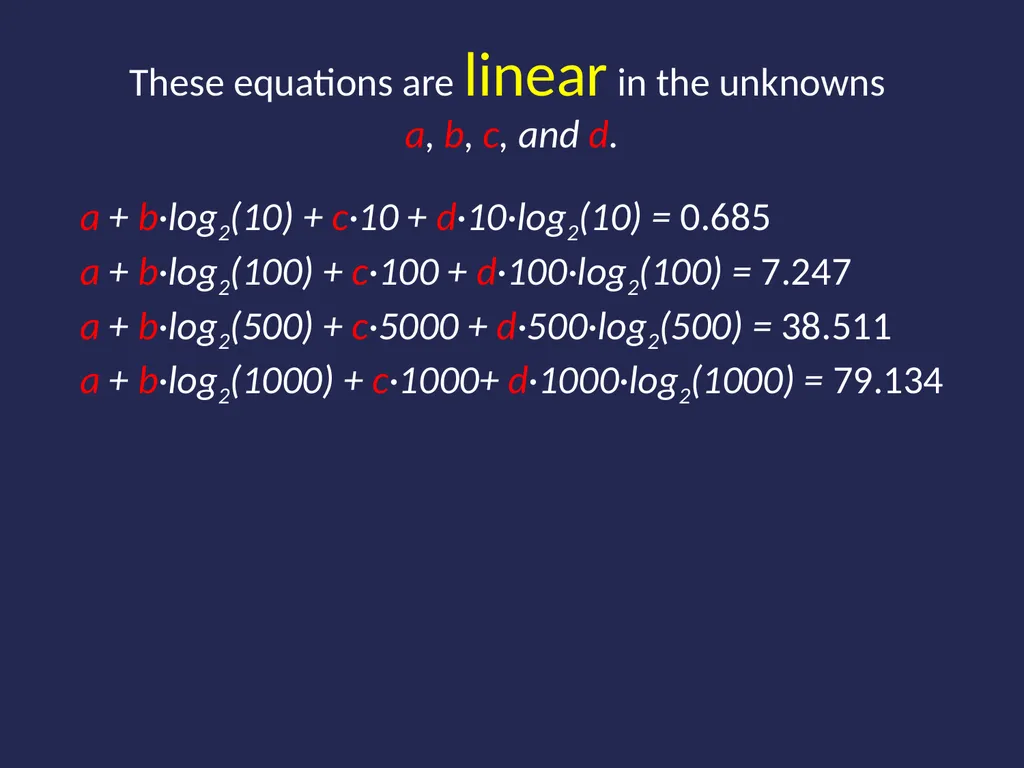
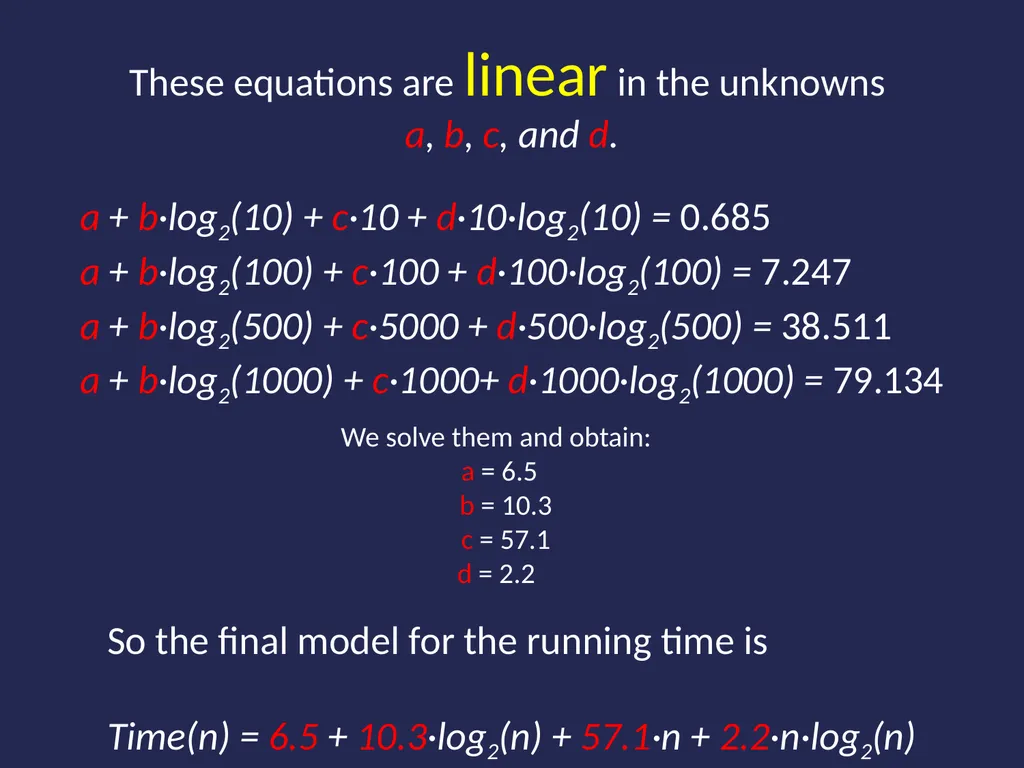
These equations are linear in the unknowns
a, b, c, and d. a + b·log2(10) + c·10 + d·10·log2(10) = 0.685
a + b·log2(100) + c·100 + d·100·log2(100) = 7.247
a + b·log2(500) + c·5000 + d·500·log2(500) = 38.511
a + b·log2(1000) + c·1000+ d·1000·log2(1000) = 79.134<br>
a + b·log2(100) + c·100 + d·100·log2(100) = 7.247
a + b·log2(500) + c·5000 + d·500·log2(500) = 38.511
a + b·log2(1000) + c·1000+ d·1000·log2(1000) = 79.134<br>
22
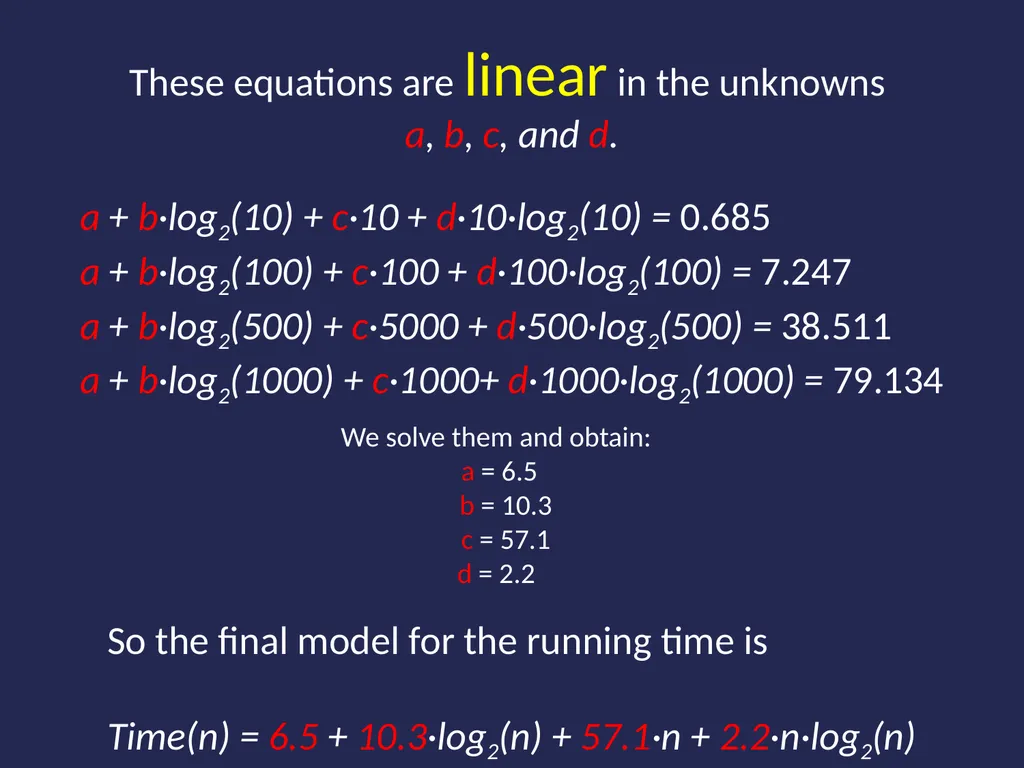
These equations are linear in the unknowns
a, b, c, and d. a + b·log2(10) + c·10 + d·10·log2(10) = 0.685
a + b·log2(100) + c·100 + d·100·log2(100) = 7.247
a + b·log2(500) + c·5000 + d·500·log2(500) = 38.511
a + b·log2(1000) + c·1000+ d·1000·log2(1000) = 79.134 We solve them and obtain:
a = 6.5
b = 10.3
c = 57.1
d = 2.2 So the final model for the running time is
Time(n) = 6.5 + 10.3·log2(n) + 57.1·n + 2.2·n·log2(n)<br>
a + b·log2(100) + c·100 + d·100·log2(100) = 7.247
a + b·log2(500) + c·5000 + d·500·log2(500) = 38.511
a + b·log2(1000) + c·1000+ d·1000·log2(1000) = 79.134 We solve them and obtain:
a = 6.5
b = 10.3
c = 57.1
d = 2.2 So the final model for the running time is
Time(n) = 6.5 + 10.3·log2(n) + 57.1·n + 2.2·n·log2(n)<br>
23
These equations are linear in the unknowns
a, b, c, and d. a + b·log2(10) + c·10 + d·10·log2(10) = 0.685
a + b·log2(100) + c·100 + d·100·log2(100) = 7.247
a + b·log2(500) + c·5000 + d·500·log2(500) = 38.511
a + b·log2(1000) + c·1000+ d·1000·log2(1000) = 79.134 We solve them and obtain:
a = 6.5
b = 10.3
c = 57.1
d = 2.2 So the final model for the running time is
Time(n) = 6.5 + 10.3·log2(n) + 57.1·n + 2.2·n·log2(n)<br>
a + b·log2(100) + c·100 + d·100·log2(100) = 7.247
a + b·log2(500) + c·5000 + d·500·log2(500) = 38.511
a + b·log2(1000) + c·1000+ d·1000·log2(1000) = 79.134 We solve them and obtain:
a = 6.5
b = 10.3
c = 57.1
d = 2.2 So the final model for the running time is
Time(n) = 6.5 + 10.3·log2(n) + 57.1·n + 2.2·n·log2(n)<br>
24
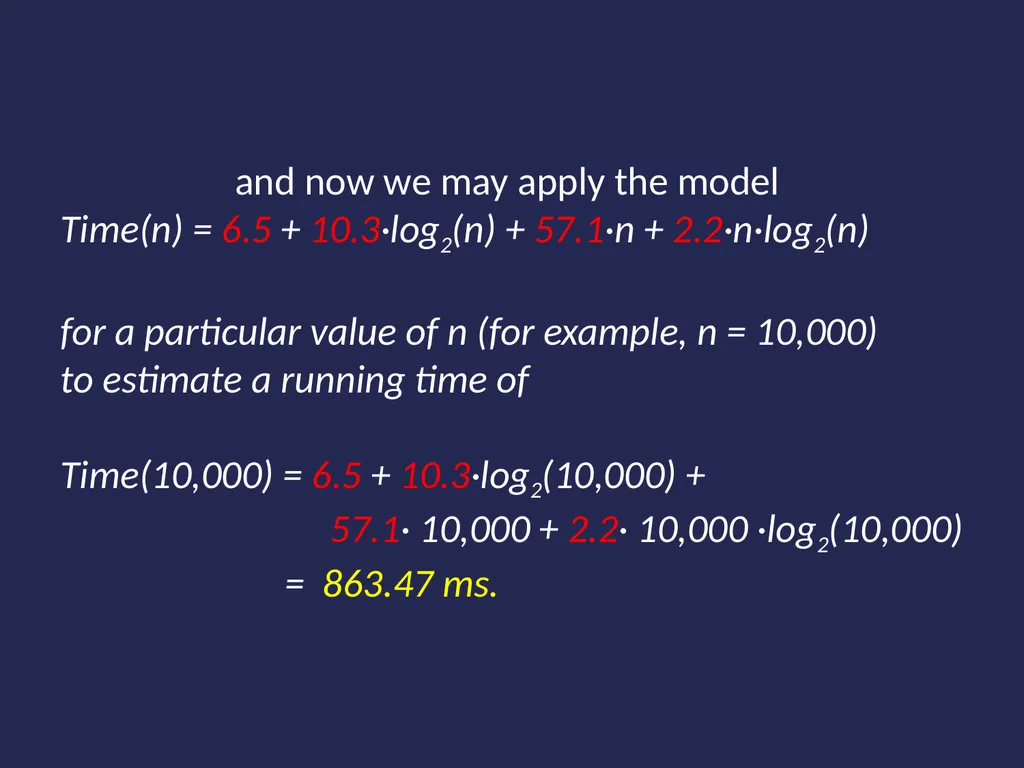
and now we may apply the model
Time(n) = 6.5 + 10.3·log2(n) + 57.1·n + 2.2·n·log2(n)
for a particular value of n (for example, n = 10,000)
to estimate a running time of
Time(10,000) = 6.5 + 10.3·log2(10,000) +
57.1· 10,000 + 2.2· 10,000 ·log2(10,000)
= 863.47 ms.<br>
Time(n) = 6.5 + 10.3·log2(n) + 57.1·n + 2.2·n·log2(n)
for a particular value of n (for example, n = 10,000)
to estimate a running time of
Time(10,000) = 6.5 + 10.3·log2(10,000) +
57.1· 10,000 + 2.2· 10,000 ·log2(10,000)
= 863.47 ms.<br>
25
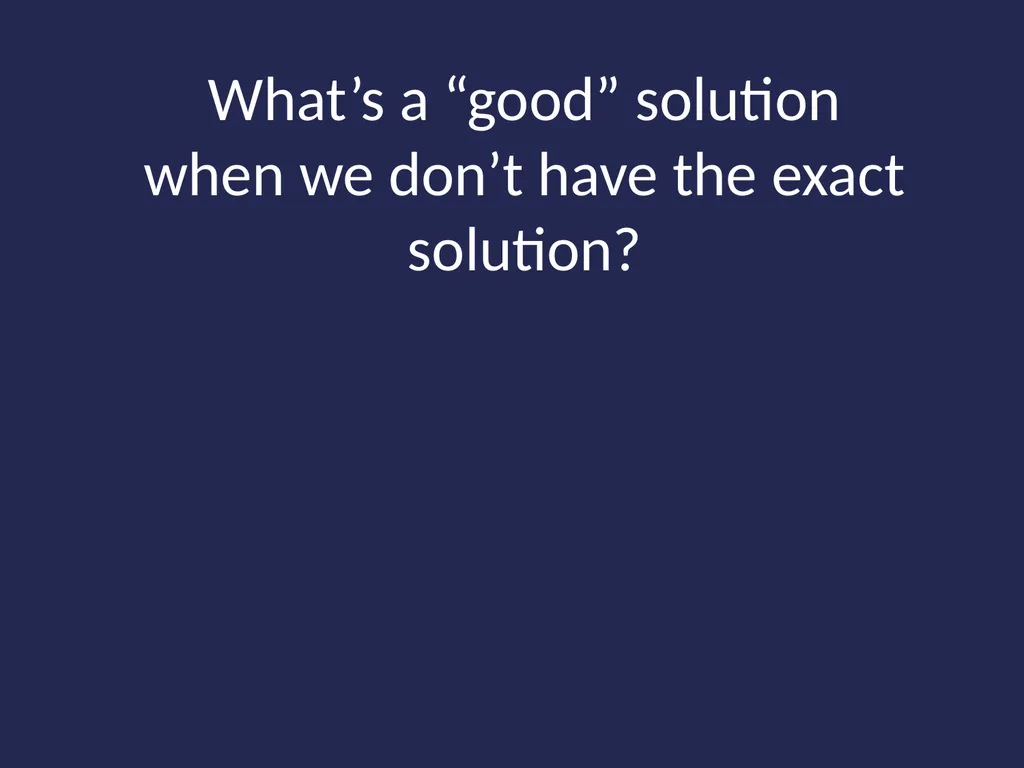
What’s a “good” solution
when we don’t have the exact solution?<br>
26
What’s a “good” solution
when we don’t have the exact solution? “Hey. That’s not a question that was
discussed in other math classes.”<br>
discussed in other math classes.”<br>
27
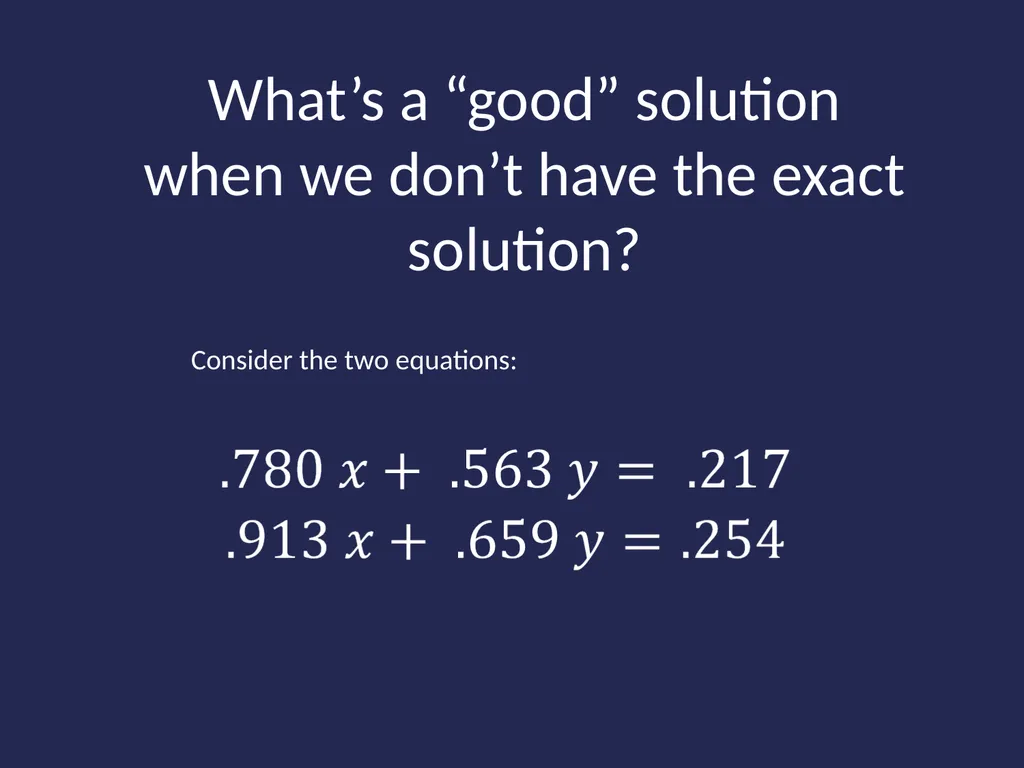
What’s a “good” solution
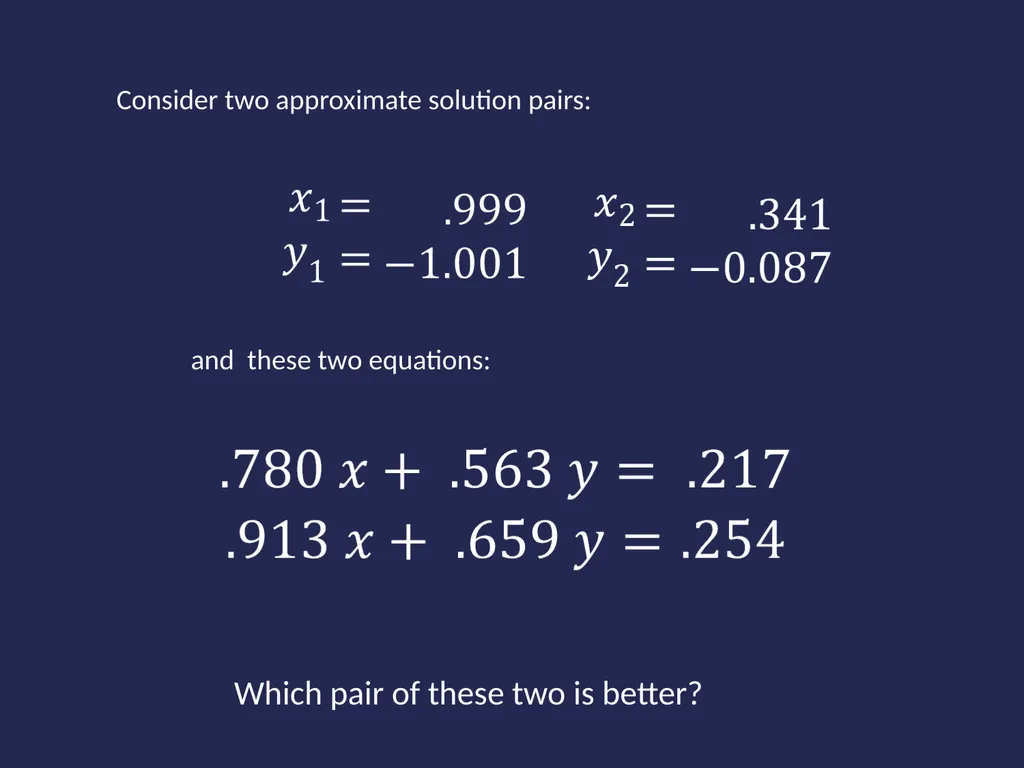
when we don’t have the exact solution? Consider the two equations:<br>
28
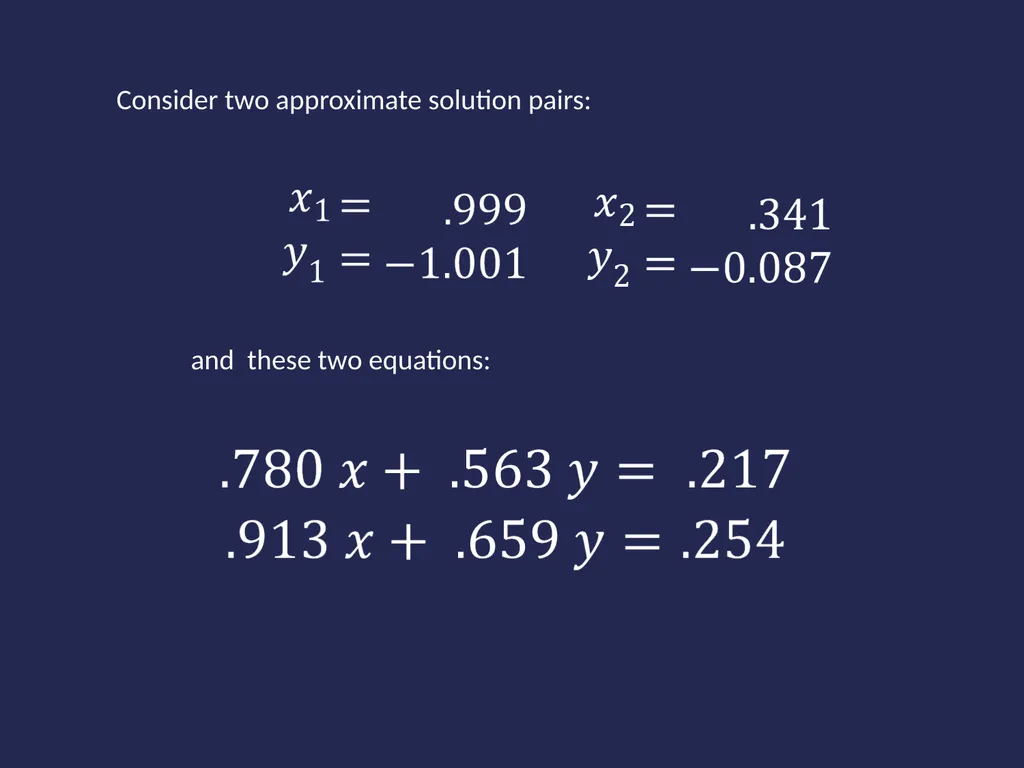
Consider two approximate solution pairs: and these two equations:<br>
29
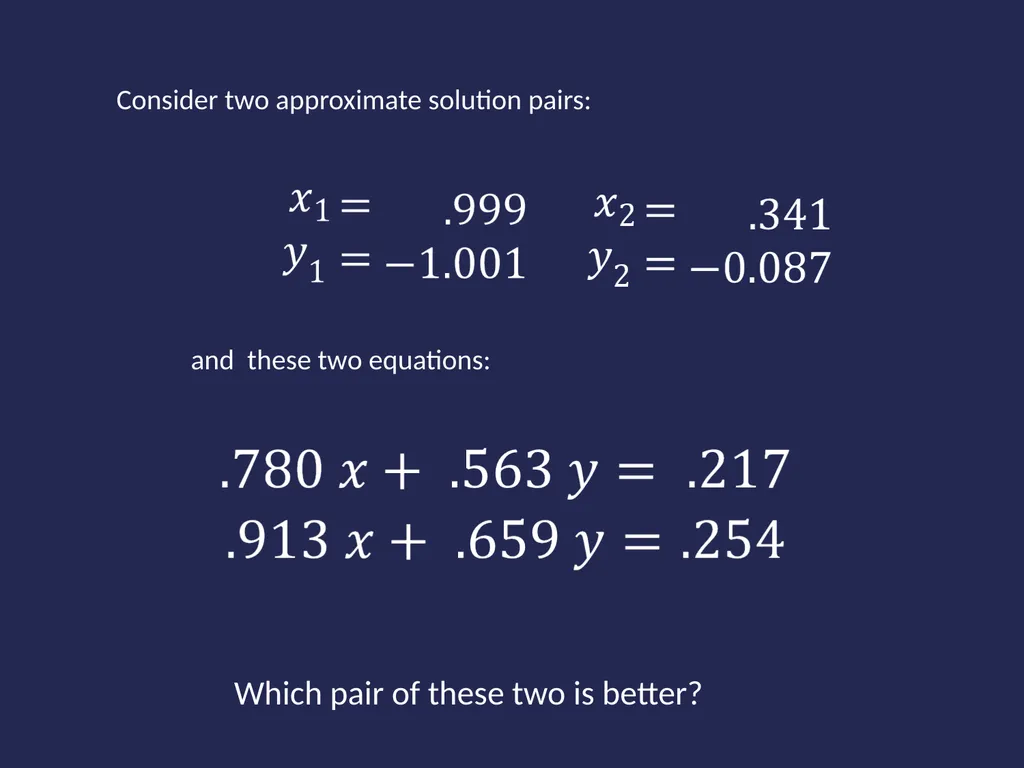
Consider two approximate solution pairs: and these two equations: Which pair of these two is better?<br>
30
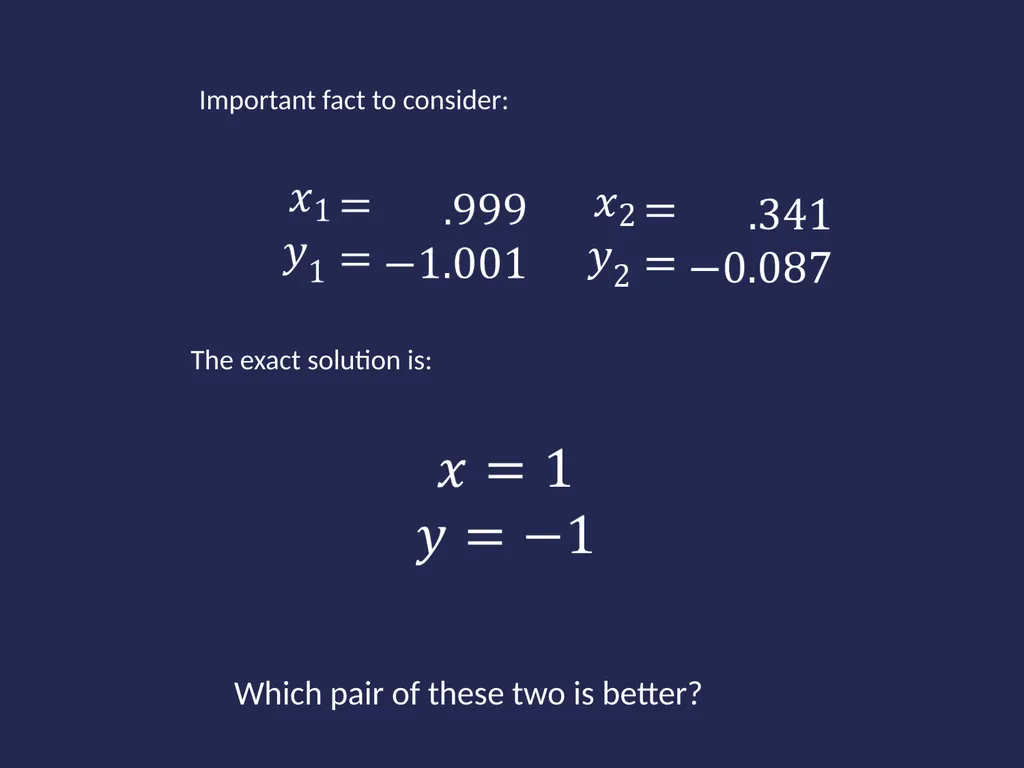
Important fact to consider: The exact solution is: Which pair of these two is better?<br>
31
Consider two approximate solution pairs: and these two equations: Which pair of these two is better?<br>
32
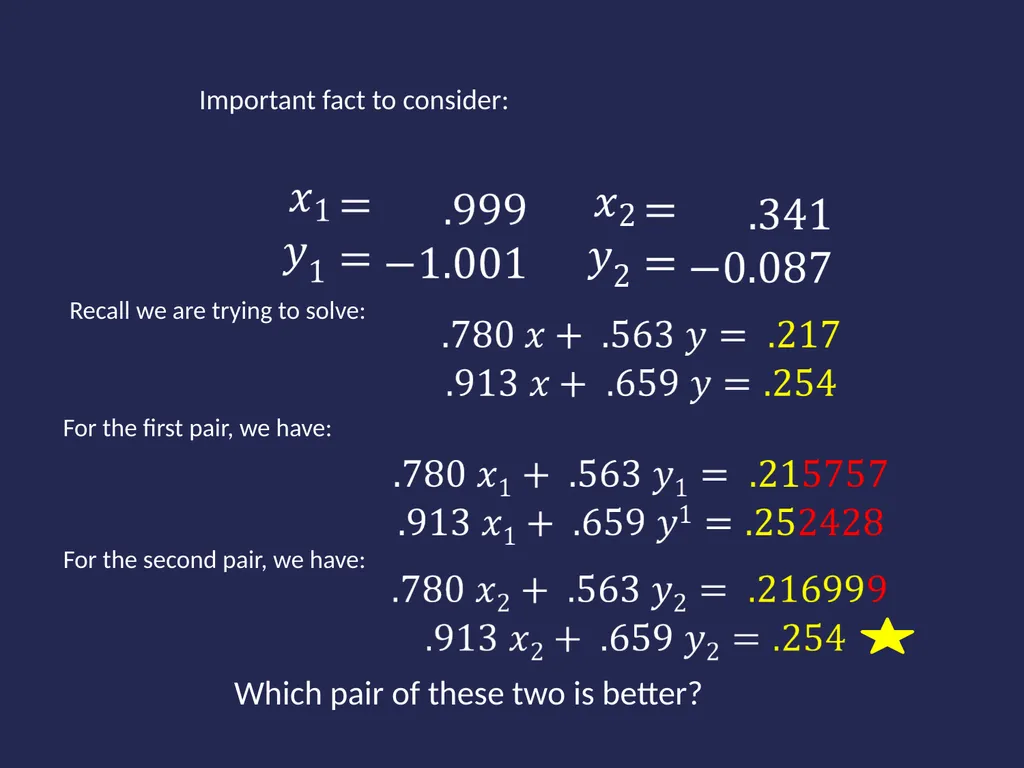
Important fact to consider: Which pair of these two is better? Recall we are trying to solve: For the first pair, we have: For the second pair, we have:<br>
33
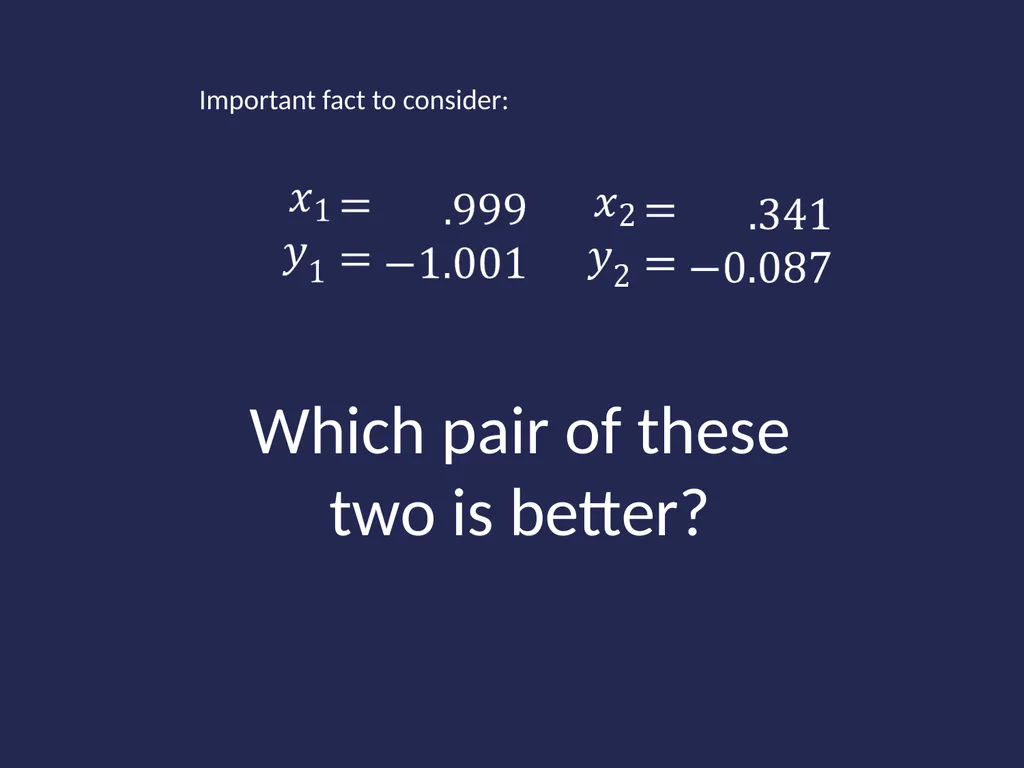
Important fact to consider: Which pair of these two is better?<br>
34
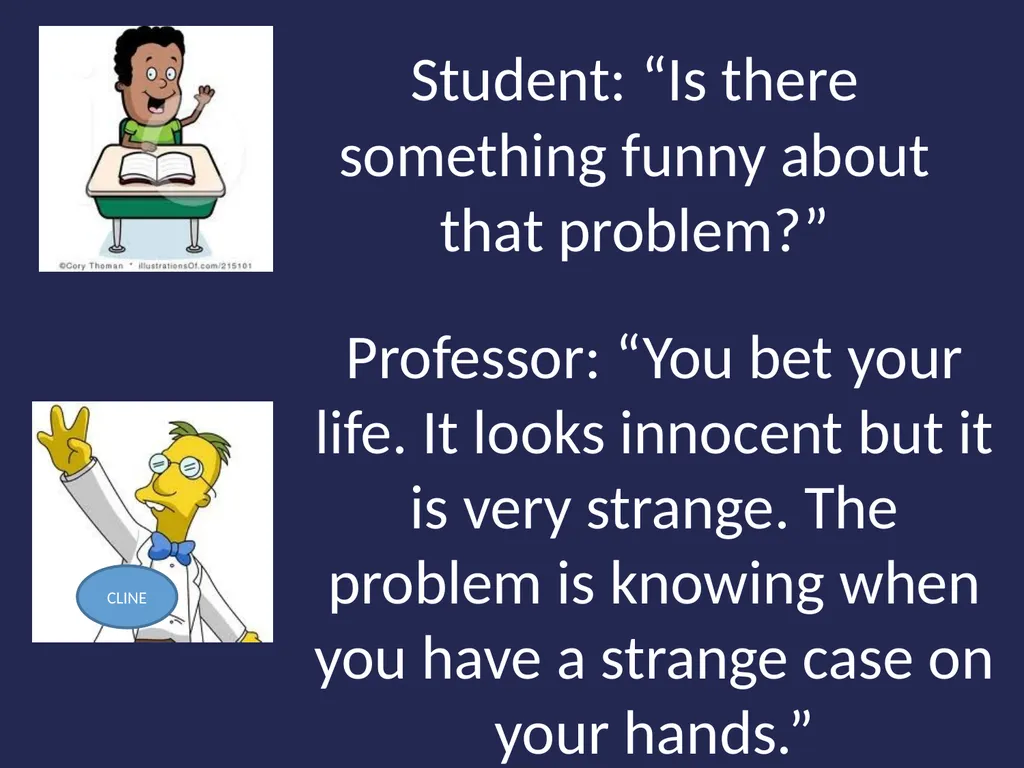
Student: “Is there something funny about that problem?”<br>
35
Student: “Is there something funny about that problem?” Professor: “You bet your life. It looks innocent but it is very strange. The problem is knowing when you have a strange case on your hands.” CLINE<br>
36
Professor: “Geometrically, solving equations is like finding the intersections of lines.” CLINE<br>
37
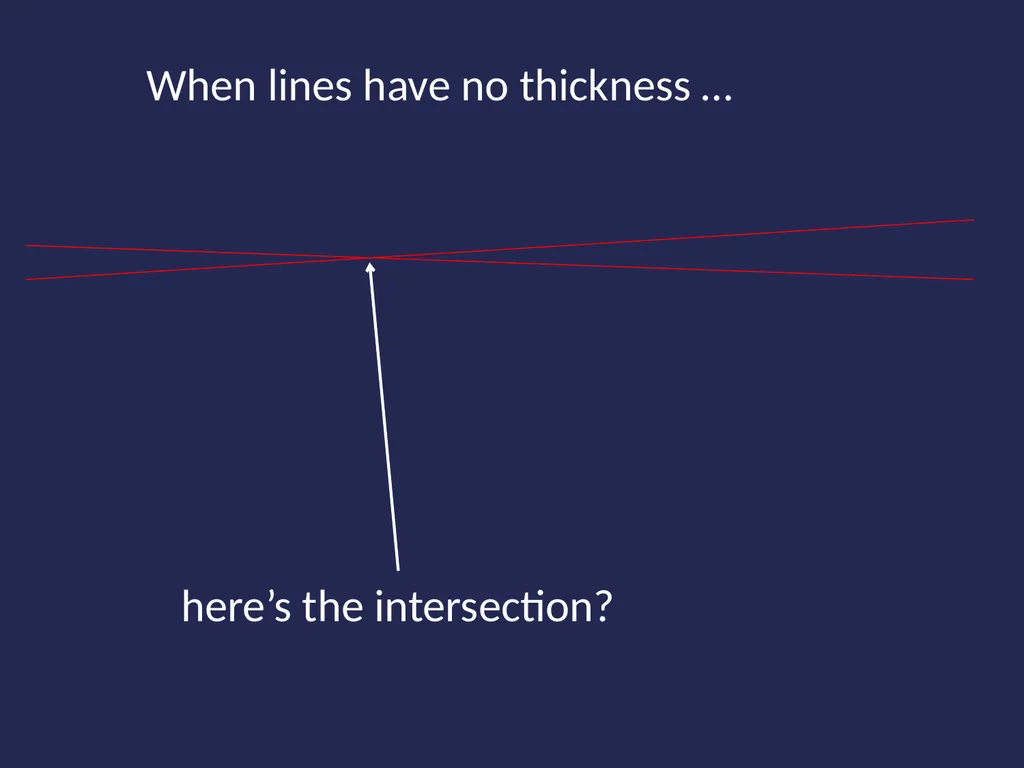
here’s the intersection? When lines have no thickness …<br>
38
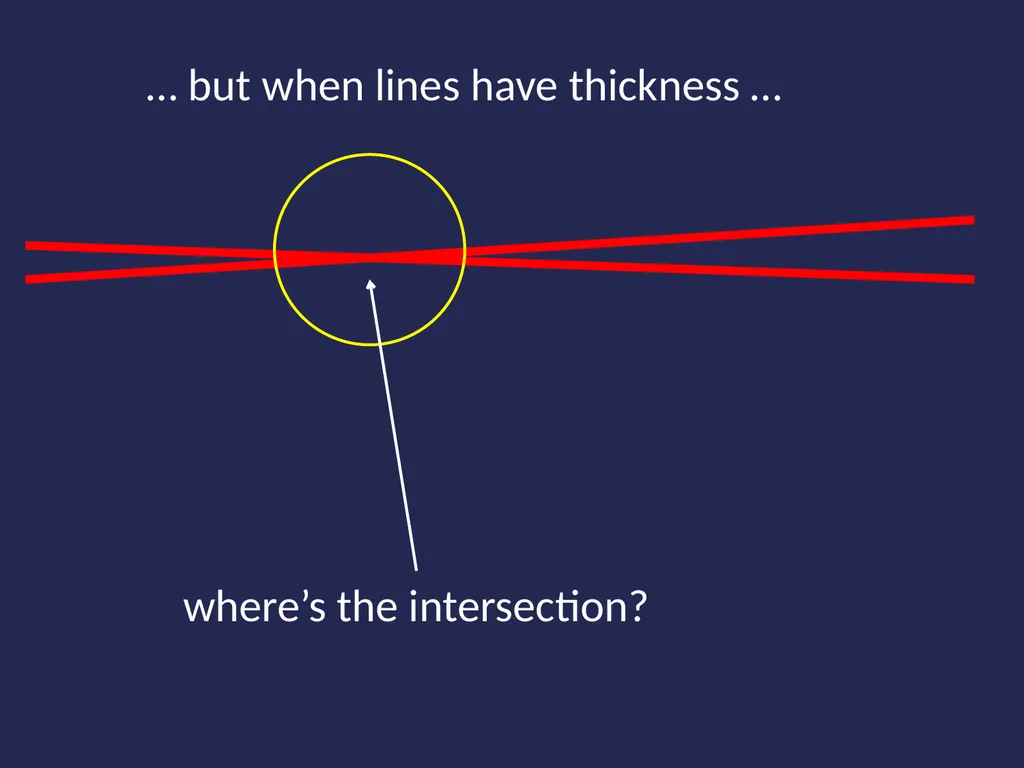
where’s the intersection? … but when lines have thickness …<br>
39
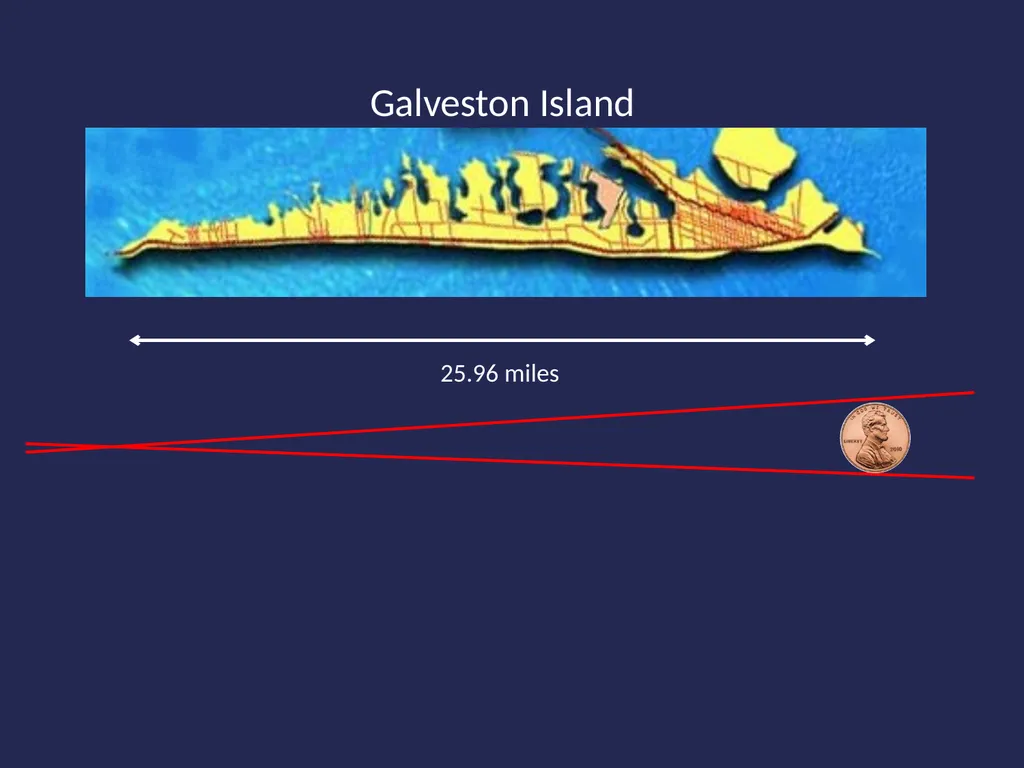
25.96 miles Galveston Island<br>
40
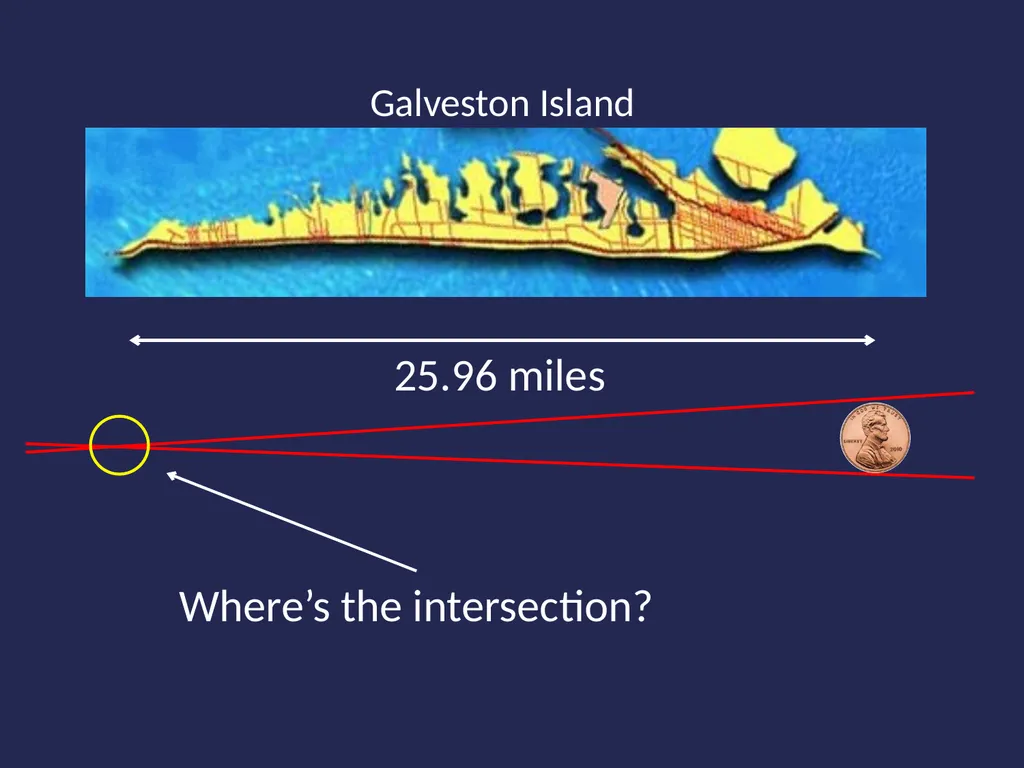
25.96 miles Galveston Island Where’s the intersection?<br>
41
London Olympics Swimming http://www.youtube.com/watch?v=fFiV4ymEDfY&feature=related
1:19<br>
1:19<br>
42
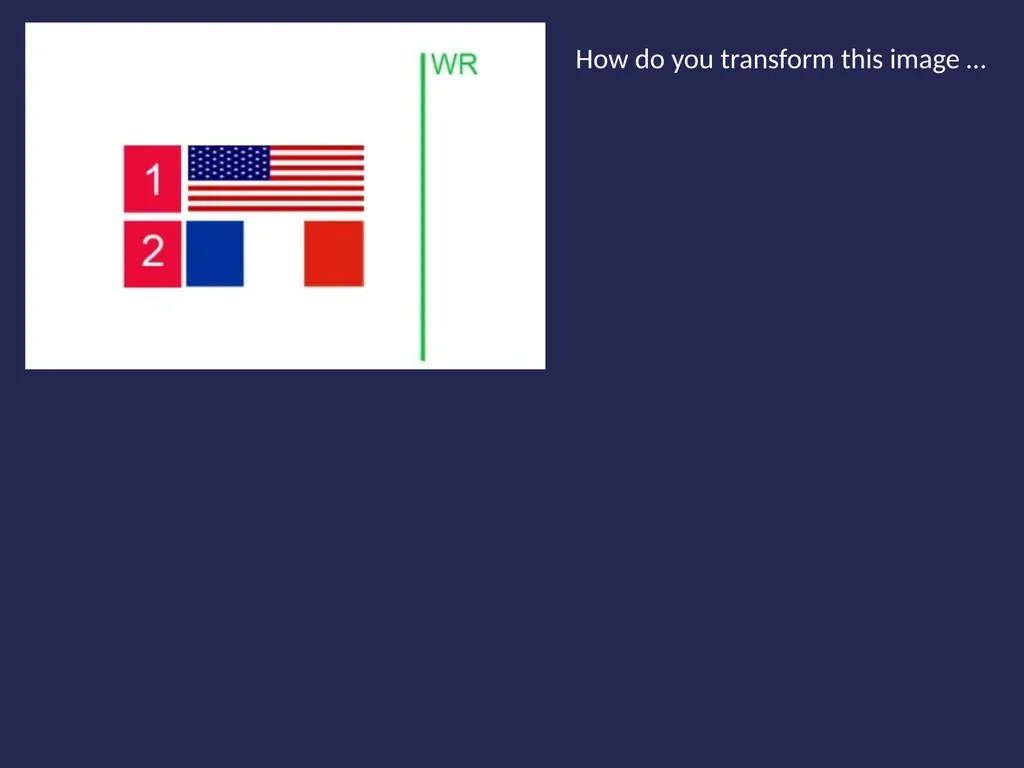
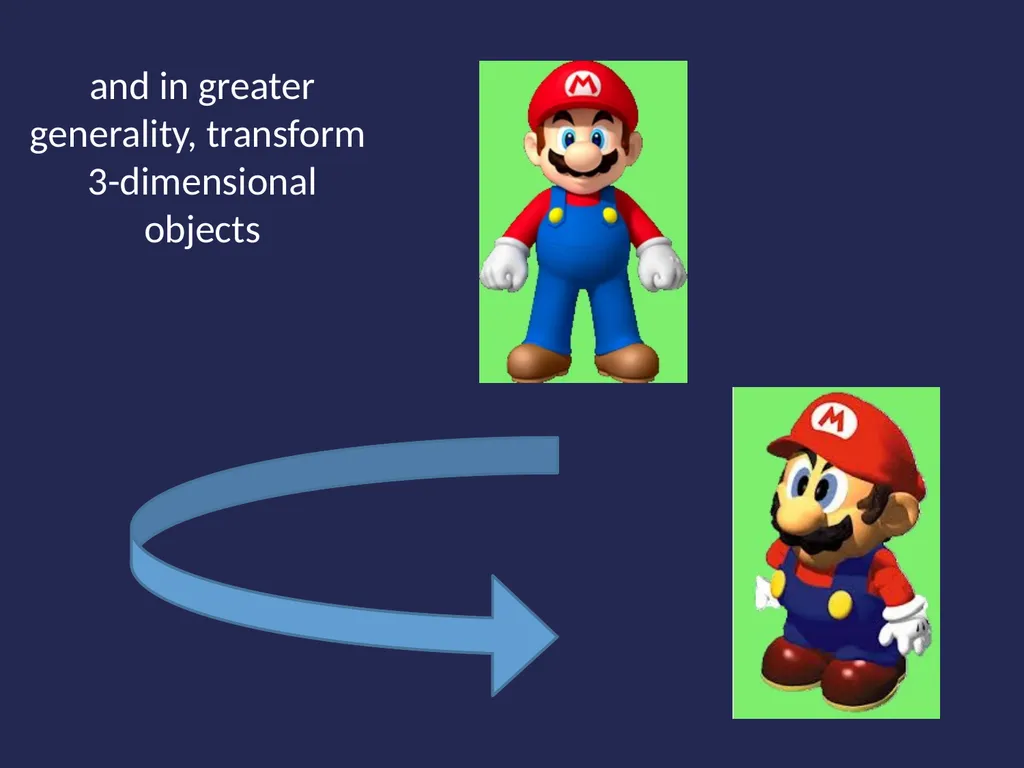
How do you transform this image …<br>
43
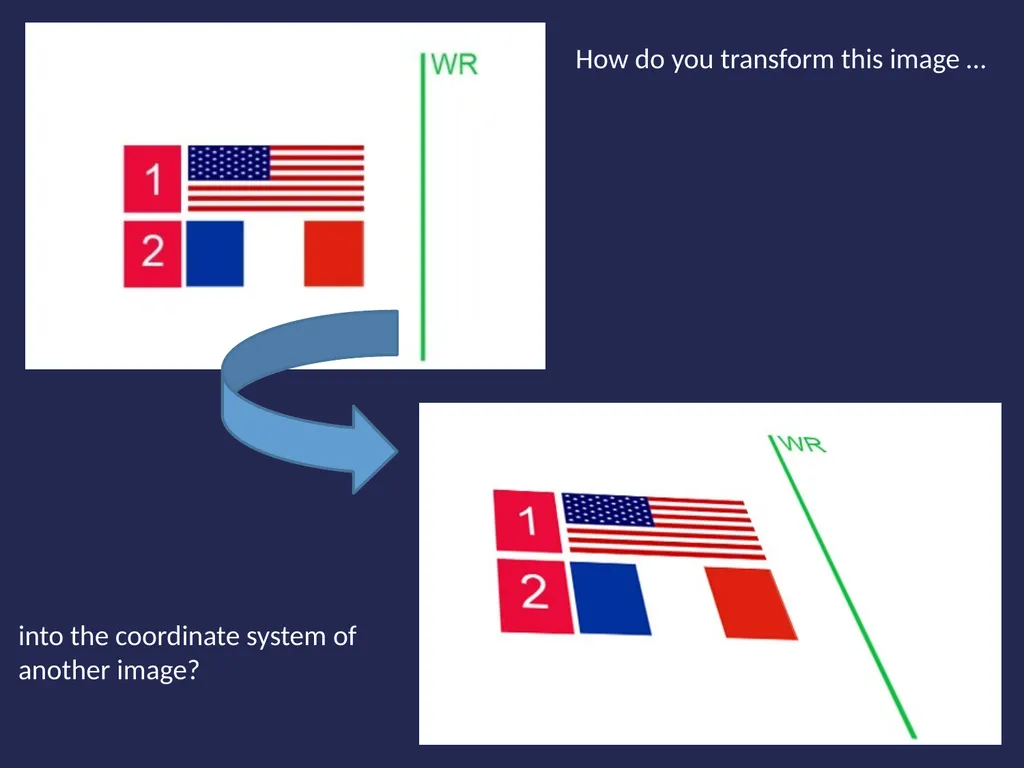
How do you transform this image … into the coordinate system of another image?<br>
44
and in greater generality, transform
3-dimensional objects<br>
3-dimensional objects<br>
45
The $25 Billion Eigenvector How does Google do Pagerank?<br>
46
The Imaginary Web Surfer: Starts at any page,
Randomly goes to a page linked from the current page,
Randomly goes to any web page from a dangling page,
… except sometimes (e.g. 15% of the time) go to a purely random page.<br>
Randomly goes to a page linked from the current page,
Randomly goes to any web page from a dangling page,
… except sometimes (e.g. 15% of the time) go to a purely random page.<br>
47
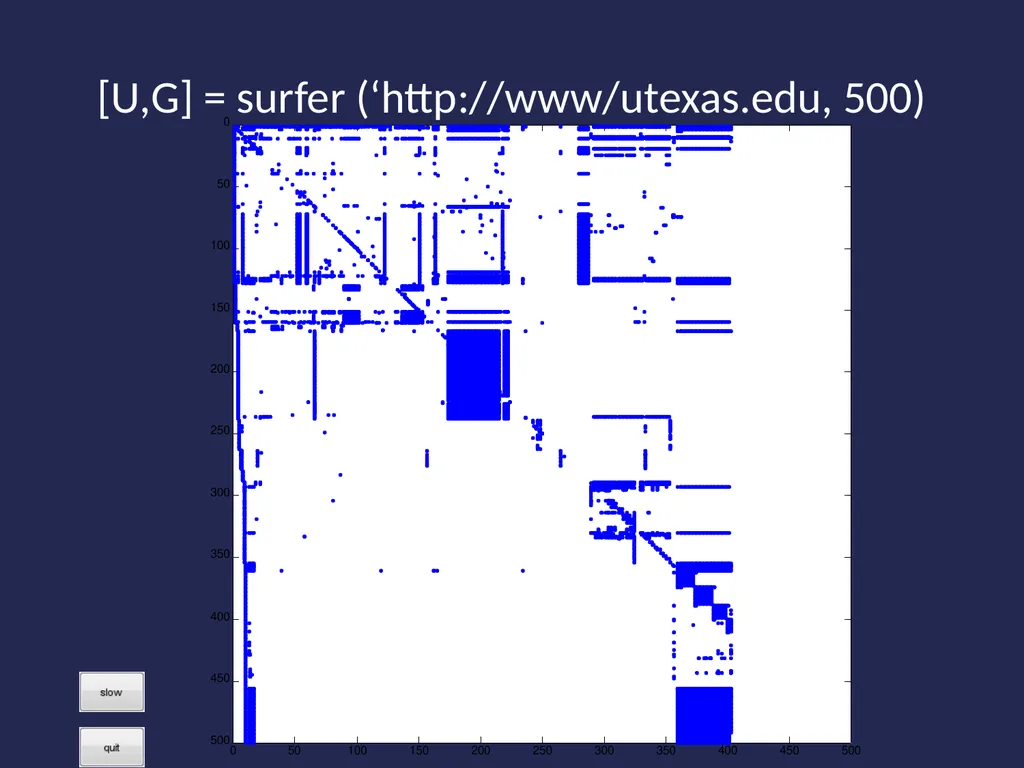
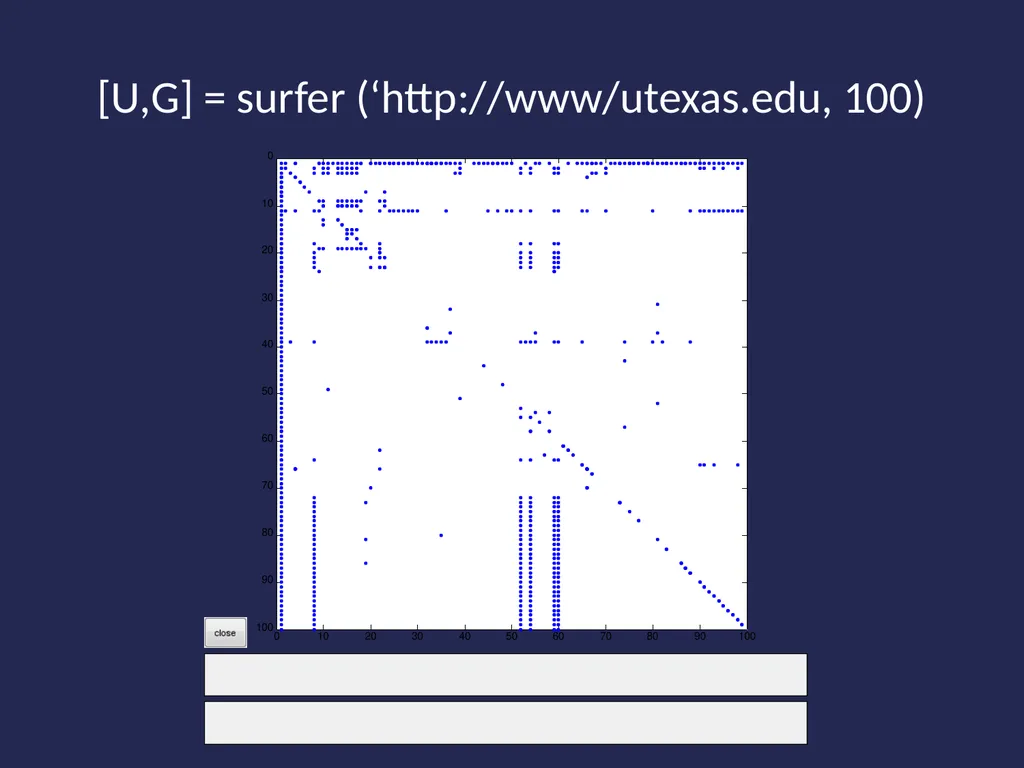
[U,G] = surfer (‘http://www/utexas.edu, 500)<br>
48
[U,G] = surfer (‘http://www/utexas.edu, 100)<br>
49
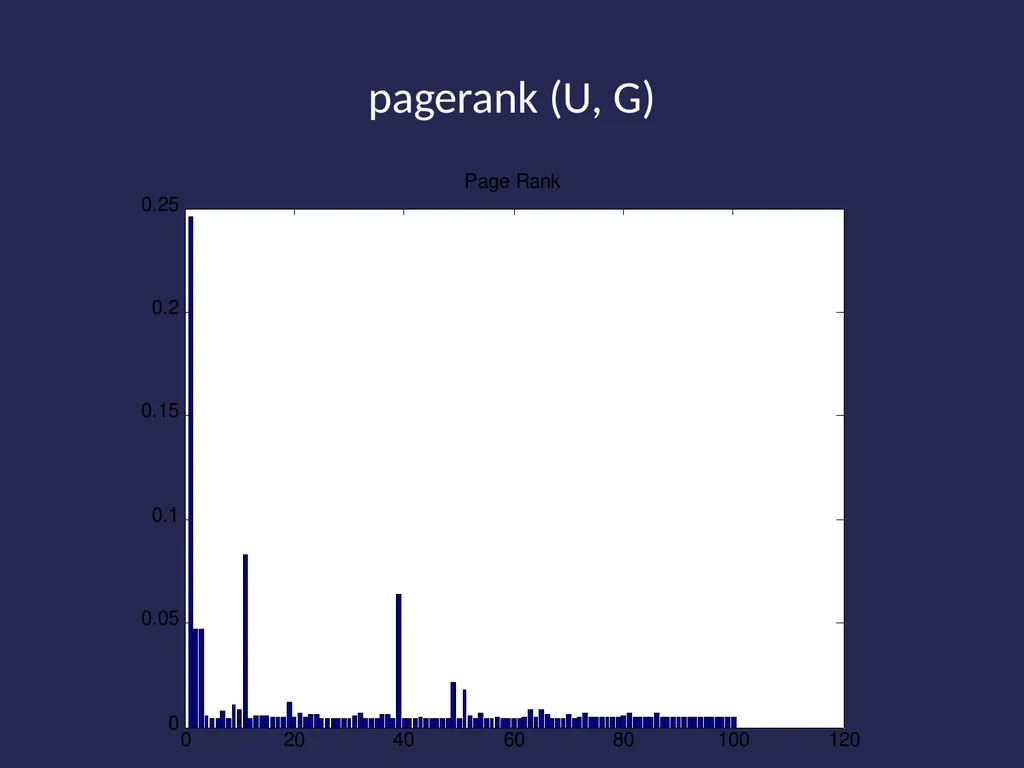
pagerank (U, G)<br>
50
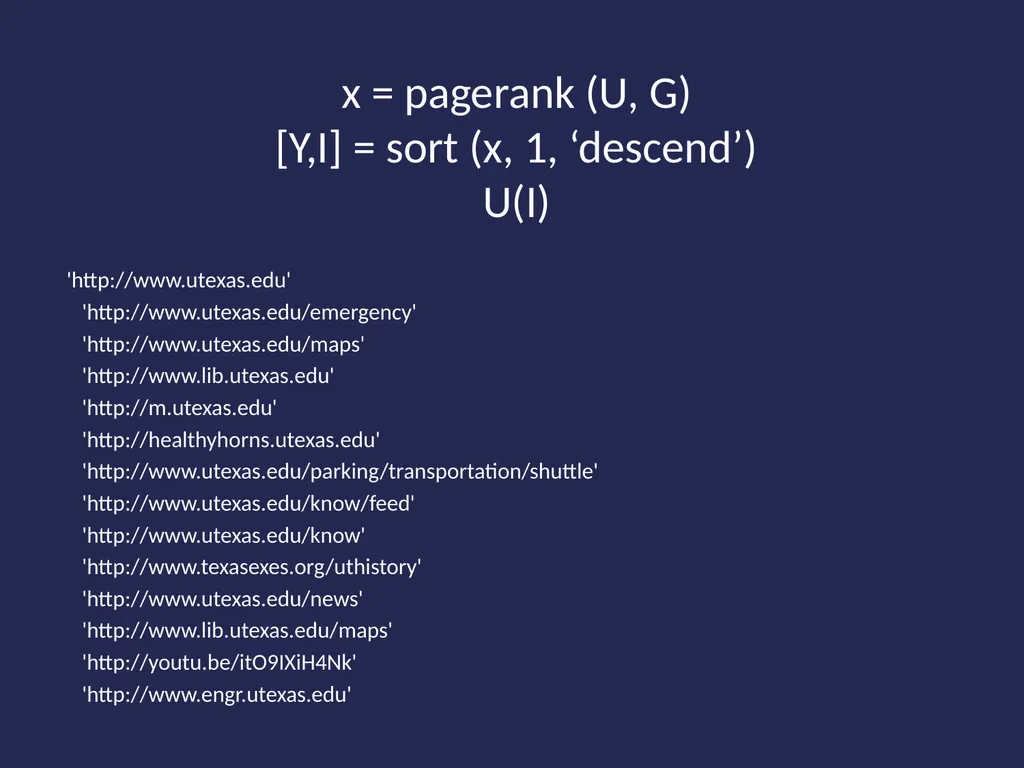
x = pagerank (U, G)
[Y,I] = sort (x, 1, ‘descend’)
U(I) 'http://www.utexas.edu'
'http://www.utexas.edu/emergency'
'http://www.utexas.edu/maps'
'http://www.lib.utexas.edu'
'http://m.utexas.edu'
'http://healthyhorns.utexas.edu'
'http://www.utexas.edu/parking/transportation/shuttle'
'http://www.utexas.edu/know/feed'
'http://www.utexas.edu/know'
'http://www.texasexes.org/uthistory'
'http://www.utexas.edu/news'
'http://www.lib.utexas.edu/maps'
'http://youtu.be/itO9IXiH4Nk'
'http://www.engr.utexas.edu'<br>
'http://www.utexas.edu/emergency'
'http://www.utexas.edu/maps'
'http://www.lib.utexas.edu'
'http://m.utexas.edu'
'http://healthyhorns.utexas.edu'
'http://www.utexas.edu/parking/transportation/shuttle'
'http://www.utexas.edu/know/feed'
'http://www.utexas.edu/know'
'http://www.texasexes.org/uthistory'
'http://www.utexas.edu/news'
'http://www.lib.utexas.edu/maps'
'http://youtu.be/itO9IXiH4Nk'
'http://www.engr.utexas.edu'<br>
51
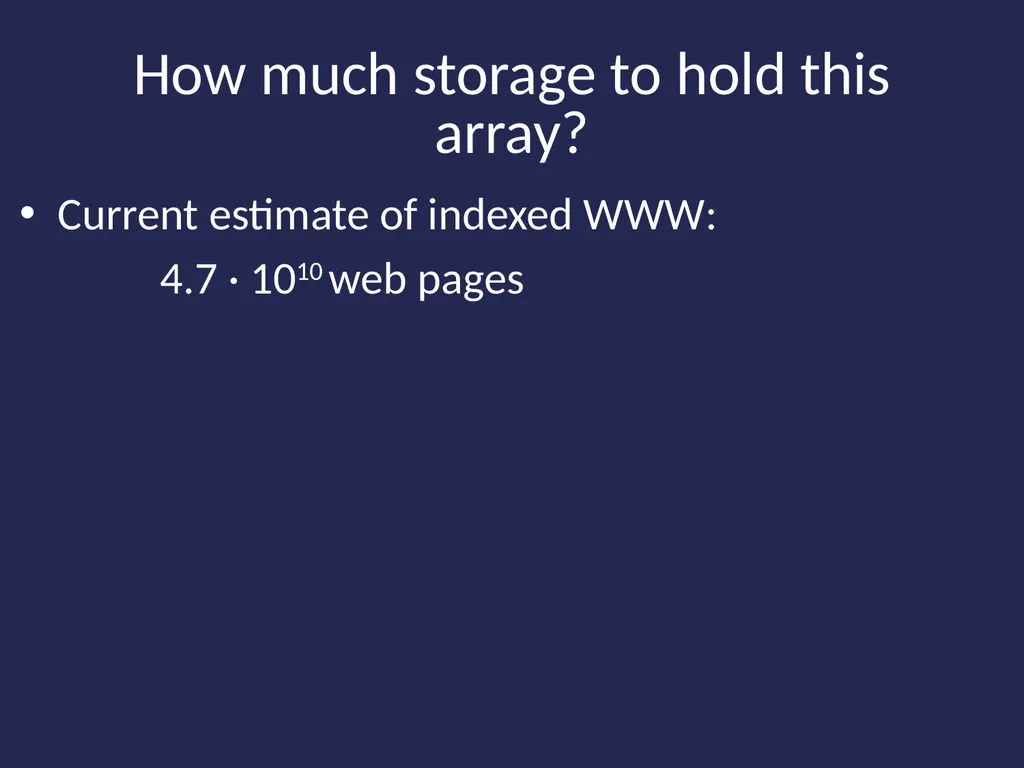
How much storage to hold this array?<br>
52
How much storage to hold this array? Current estimate of indexed WWW:
4.7 · 1010 web pages<br>
4.7 · 1010 web pages<br>
53
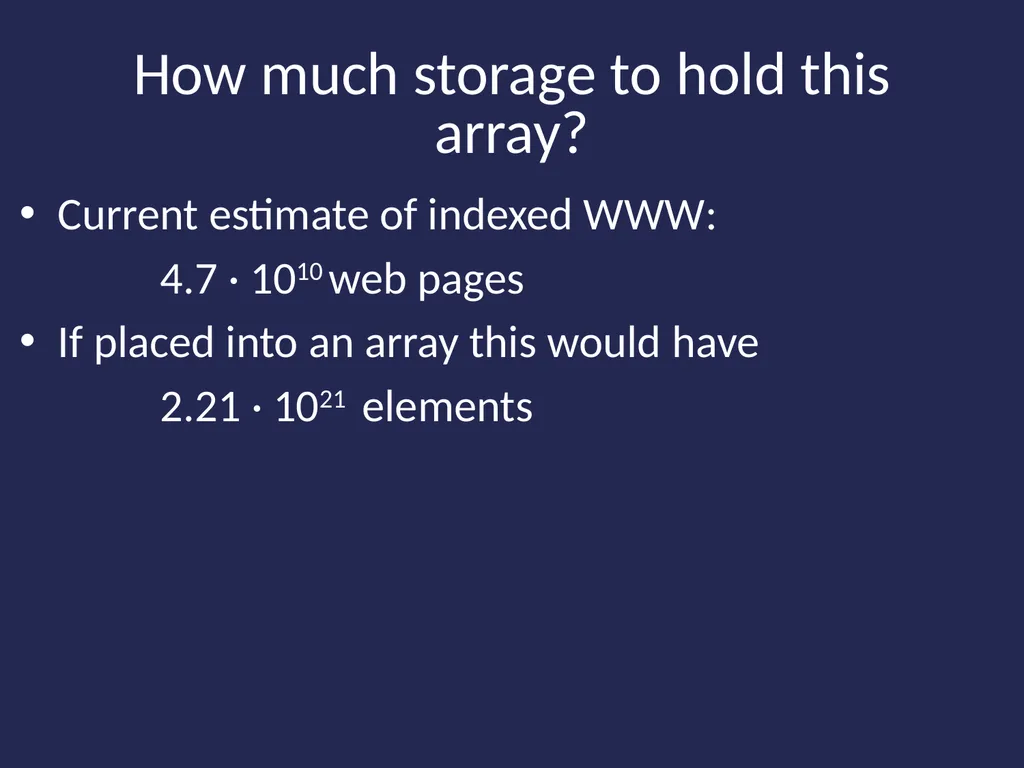
How much storage to hold this array? Current estimate of indexed WWW:
4.7 · 1010 web pages
If placed into an array this would have
2.21 · 1021 elements<br>
4.7 · 1010 web pages
If placed into an array this would have
2.21 · 1021 elements<br>
54
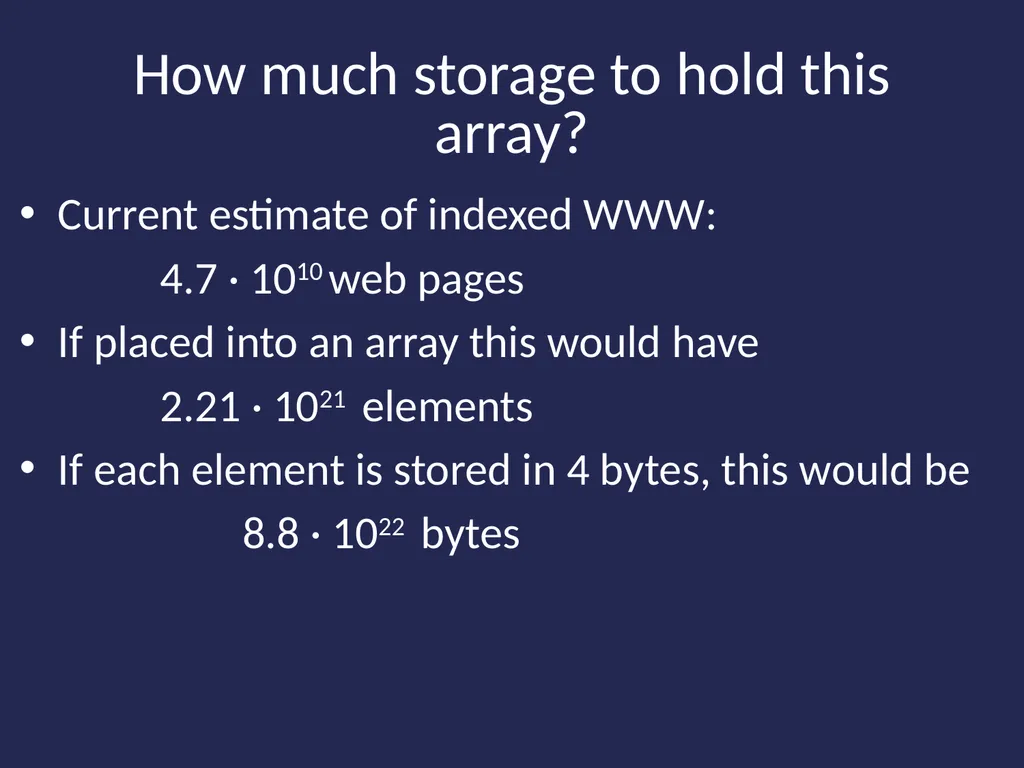
How much storage to hold this array? Current estimate of indexed WWW:
4.7 · 1010 web pages
If placed into an array this would have
2.21 · 1021 elements
If each element is stored in 4 bytes, this would be
8.8 · 1022 bytes<br>
4.7 · 1010 web pages
If placed into an array this would have
2.21 · 1021 elements
If each element is stored in 4 bytes, this would be
8.8 · 1022 bytes<br>
55
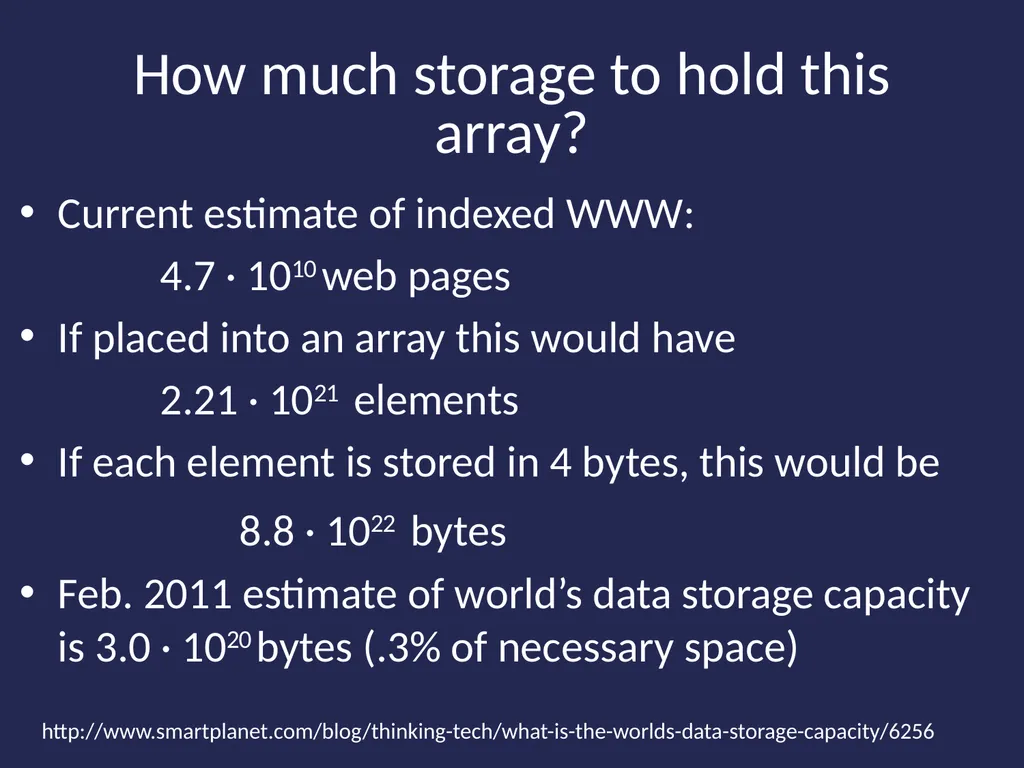
How much storage to hold this array? Current estimate of indexed WWW:
4.7 · 1010 web pages
If placed into an array this would have
2.21 · 1021 elements
If each element is stored in 4 bytes, this would be
8.8 · 1022 bytes
Feb. 2011 estimate of world’s data storage capacity is 3.0 · 1020 bytes (.3% of necessary space) http://www.smartplanet.com/blog/thinking-tech/what-is-the-worlds-data-storage-capacity/6256<br>
4.7 · 1010 web pages
If placed into an array this would have
2.21 · 1021 elements
If each element is stored in 4 bytes, this would be
8.8 · 1022 bytes
Feb. 2011 estimate of world’s data storage capacity is 3.0 · 1020 bytes (.3% of necessary space) http://www.smartplanet.com/blog/thinking-tech/what-is-the-worlds-data-storage-capacity/6256<br>