
Maximum Expenditures for the nineteenth Financial
Description: Maximum Expenditures for the nineteenth Financial Period (2024-2027) 76th Session of the Executive Council EC-76Doc. 5 and EC-76INF. 5 27 February 2023 WMO Strategic Plan 2030 2 WMO STRATEGIC PLAN OVERARCHING PRIORITIES 20202023: LAYING
Related Topics
Download Presentation
"Maximum Expenditures for the nineteenth Financial" is the property of its rightful owner. Permission is granted to download and print the materials on this website for personal, non-commercial use only, and to display it on your personal computer provided you do not modify the materials and that you retain all copyright notices contained in the materials. By downloading content from our website, you accept the terms of this agreement.
Presentation Transcript
slide1. Maximum Expenditures for the nineteenth Financial Period (2024-2027) 76th Session of the Executive Council
EC-76/Doc. 5 and EC-76/INF. 5
27 February 2023<br>
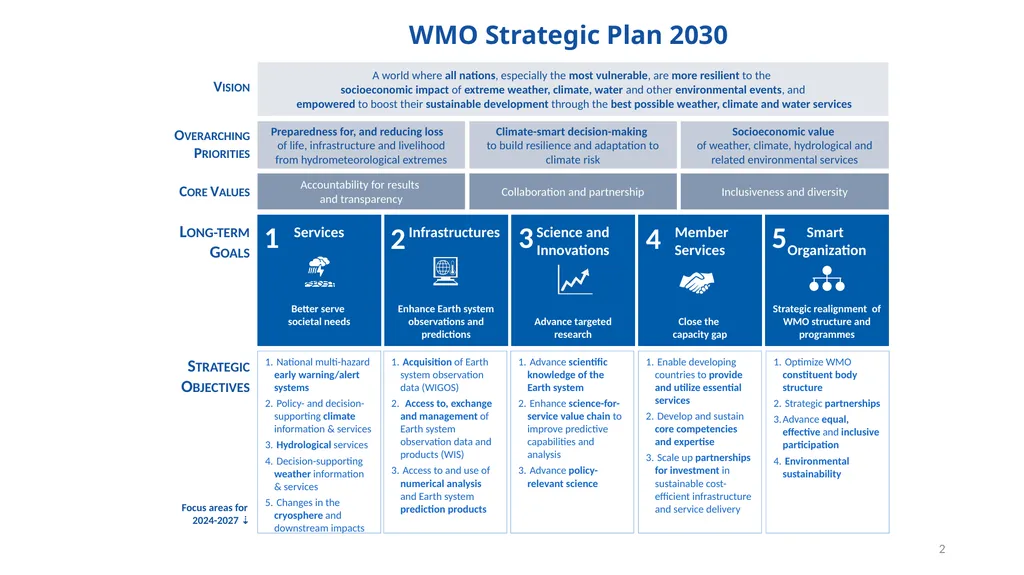
slide2. WMO Strategic Plan 2030 2<br>
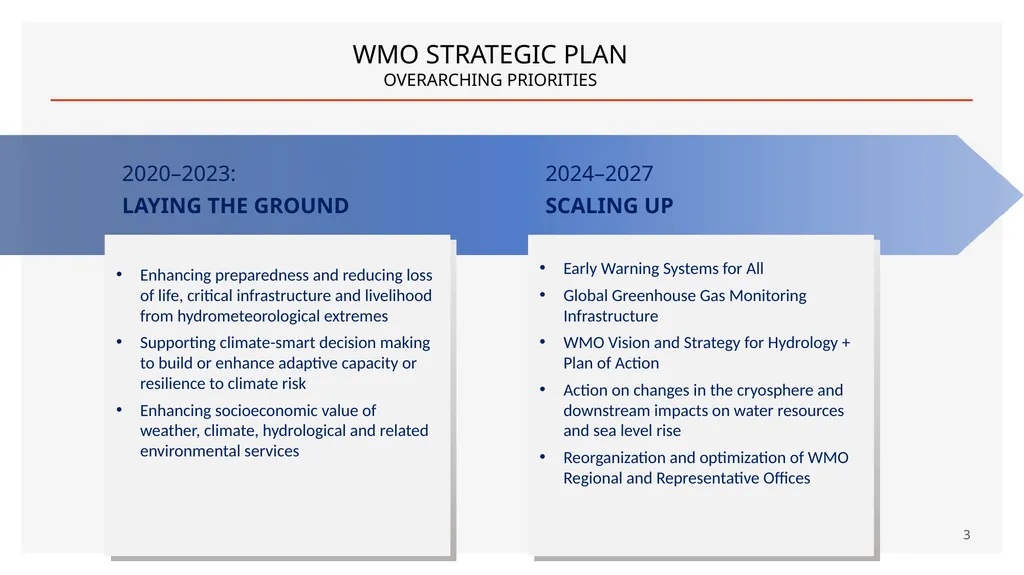
slide3. WMO STRATEGIC PLAN
OVERARCHING PRIORITIES 2020–2023:
LAYING THE GROUND 2024–2027
SCALING UP Enhancing preparedness and reducing loss of life, critical infrastructure and livelihood from hydrometeorological extremes
Supporting climate-smart decision making to build or enhance adaptive capacity or resilience to climate risk
Enhancing socioeconomic value of weather, climate, hydrological and related environmental services Early Warning Systems for All
Global Greenhouse Gas Monitoring Infrastructure
WMO Vision and Strategy for Hydrology + Plan of Action
Action on changes in the cryosphere and downstream impacts on water resources and sea level rise
Reorganization and optimization of WMO Regional and Representative Offices 3<br>
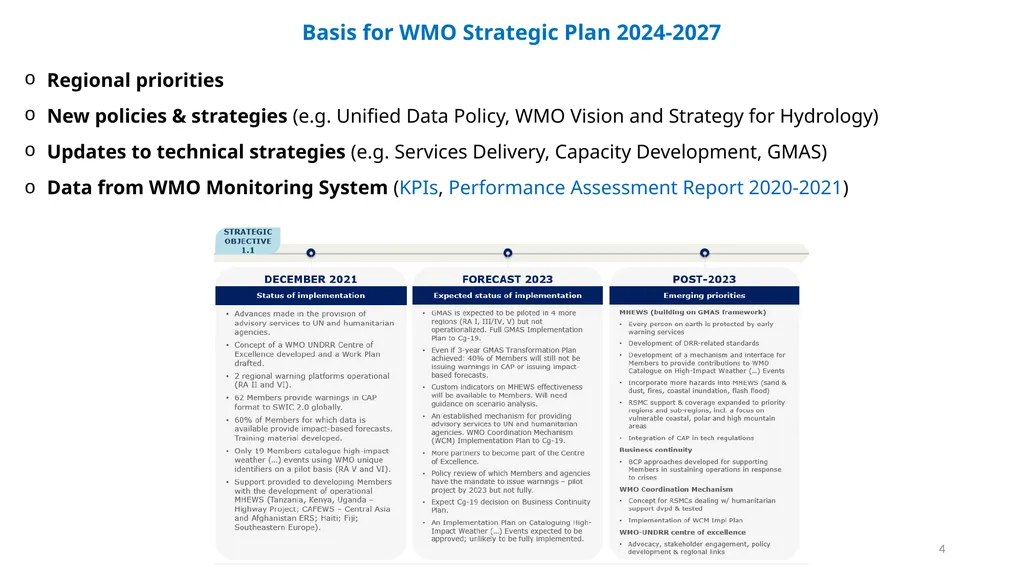
slide4. Regional priorities
New policies & strategies (e.g. Unified Data Policy, WMO Vision and Strategy for Hydrology)
Updates to technical strategies (e.g. Services Delivery, Capacity Development, GMAS)
Data from WMO Monitoring System (KPIs, Performance Assessment Report 2020-2021) Basis for WMO Strategic Plan 2024-2027 4<br>
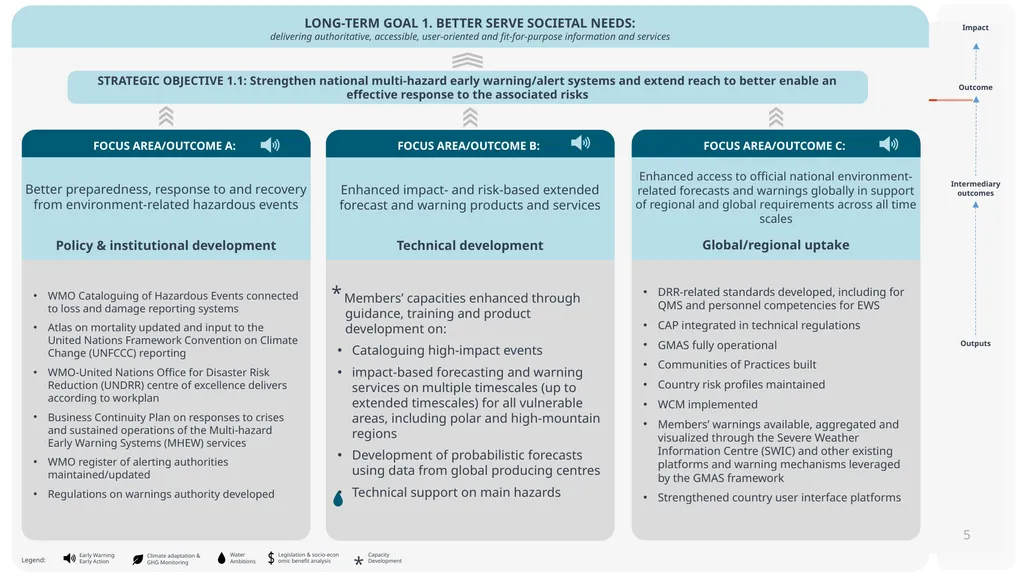
slide5. LONG-TERM GOAL 1. BETTER SERVE SOCIETAL NEEDS:
delivering authoritative, accessible, user-oriented and fit-for-purpose information and services STRATEGIC OBJECTIVE 1.1: Strengthen national multi-hazard early warning/alert systems and extend reach to better enable an effective response to the associated risks * 5<br>
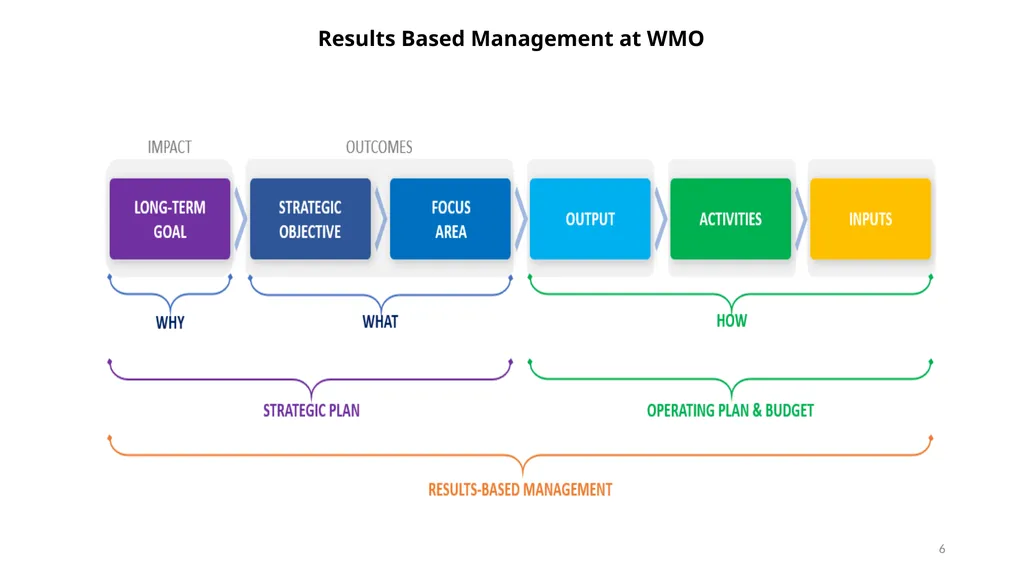
slide6. Results Based Management at WMO 6<br>
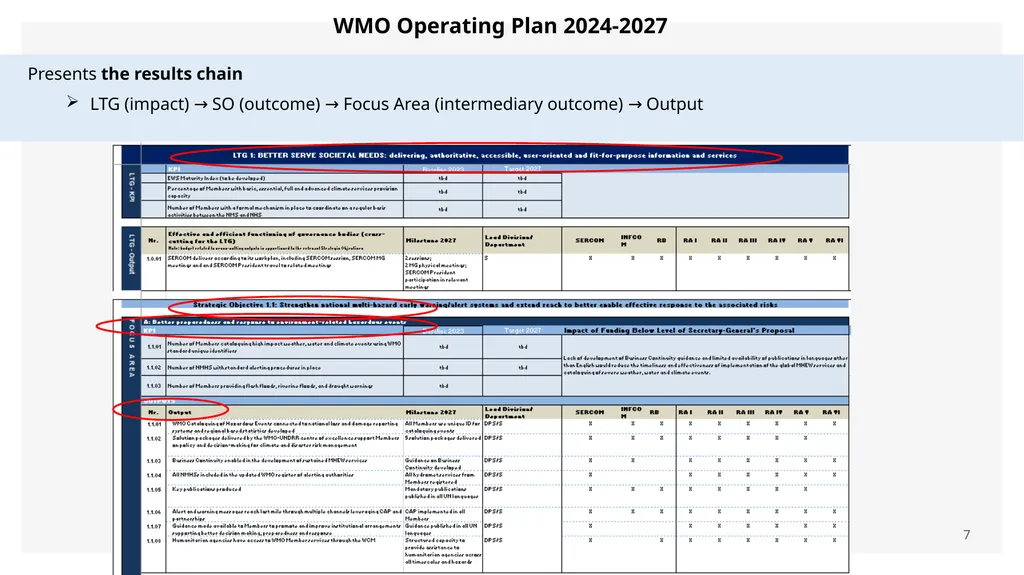
slide7. Presents the results chain
LTG (impact) → SO (outcome) → Focus Area (intermediary outcome) → Output WMO Operating Plan 2024-2027 7<br>
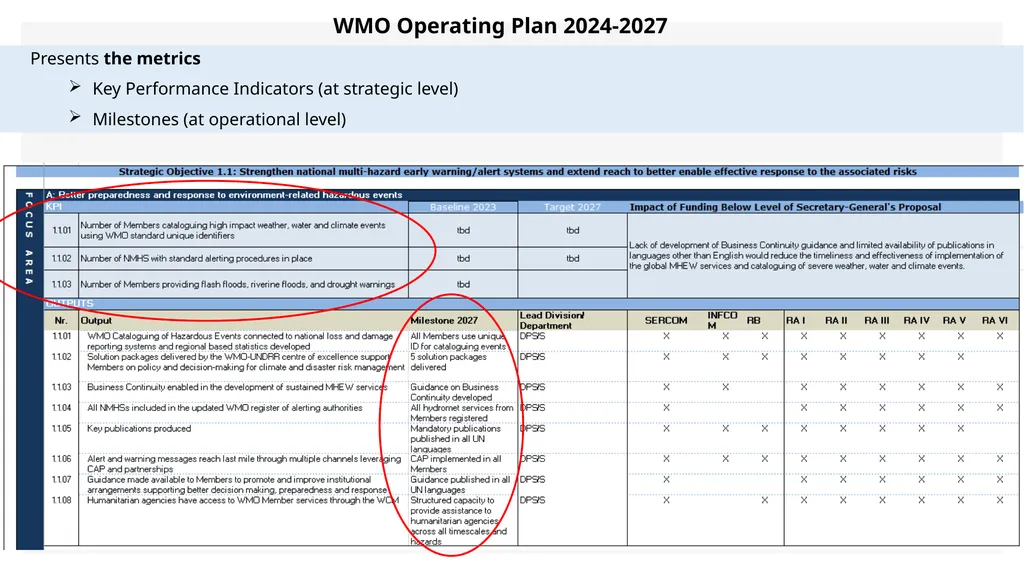
slide8. Presents the metrics
Key Performance Indicators (at strategic level)
Milestones (at operational level) WMO Operating Plan 2024-2027 8<br>
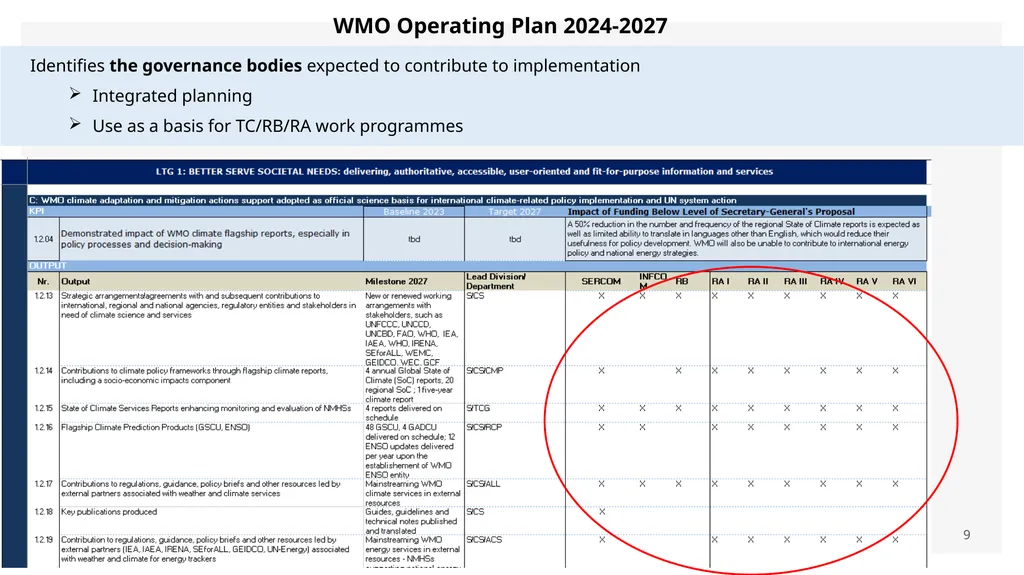
slide9. WMO Operating Plan 2024-2027 Identifies the governance bodies expected to contribute to implementation
Integrated planning
Use as a basis for TC/RB/RA work programmes 9<br>
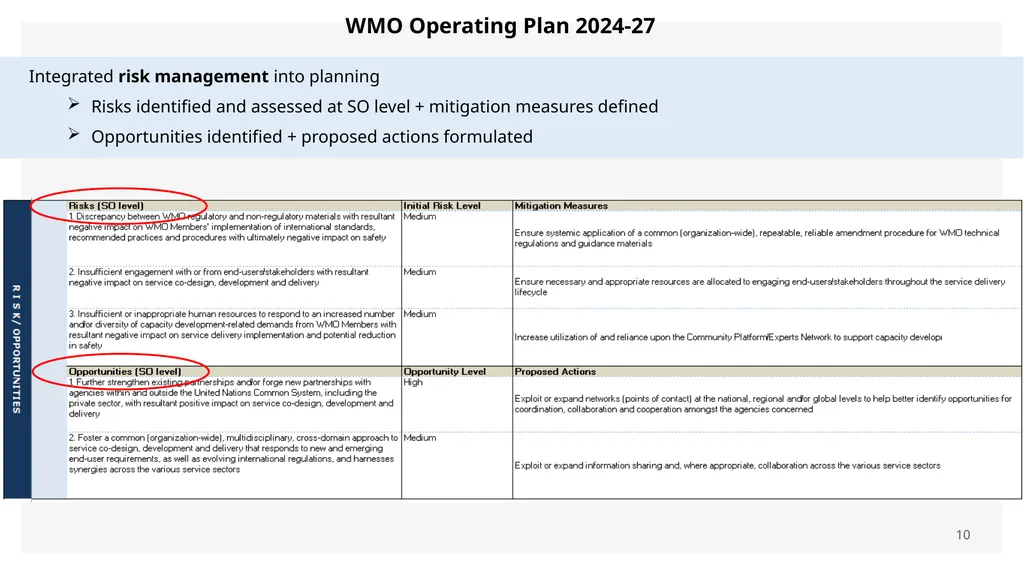
slide10. Integrated risk management into planning
Integrated planning
Use as a basis for TC/RB/RA work programmes WMO Operating Plan 2024-27 Integrated risk management into planning
Risks identified and assessed at SO level + mitigation measures defined
Opportunities identified + proposed actions formulated 10<br>
slide11. Integrated risk management into planning
Integrated planning
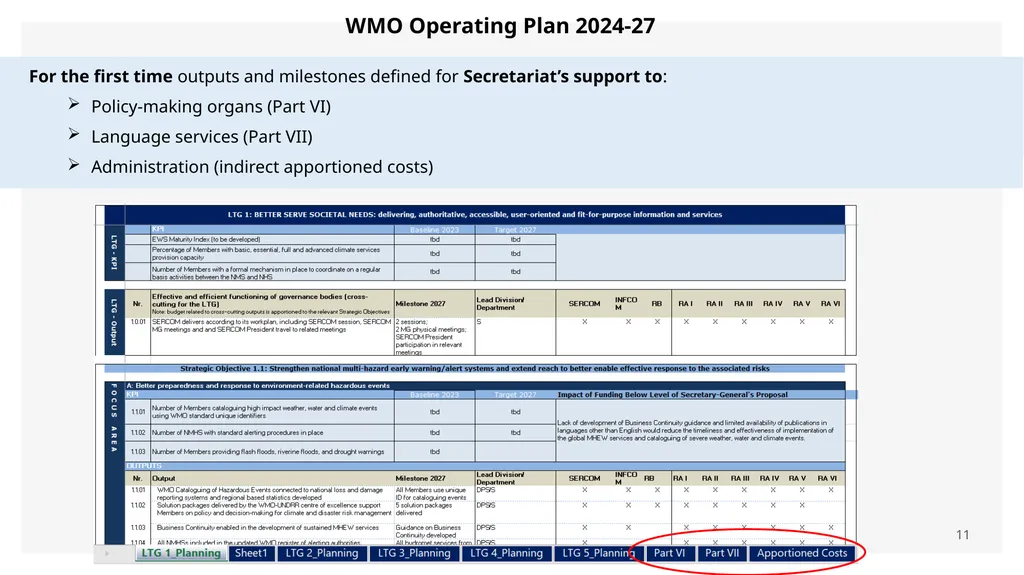
Use as a basis for TC/RB/RA work programmes WMO Operating Plan 2024-27 For the first time outputs and milestones defined for Secretariat’s support to:
Policy-making organs (Part VI)
Language services (Part VII)
Administration (indirect apportioned costs) 11<br>
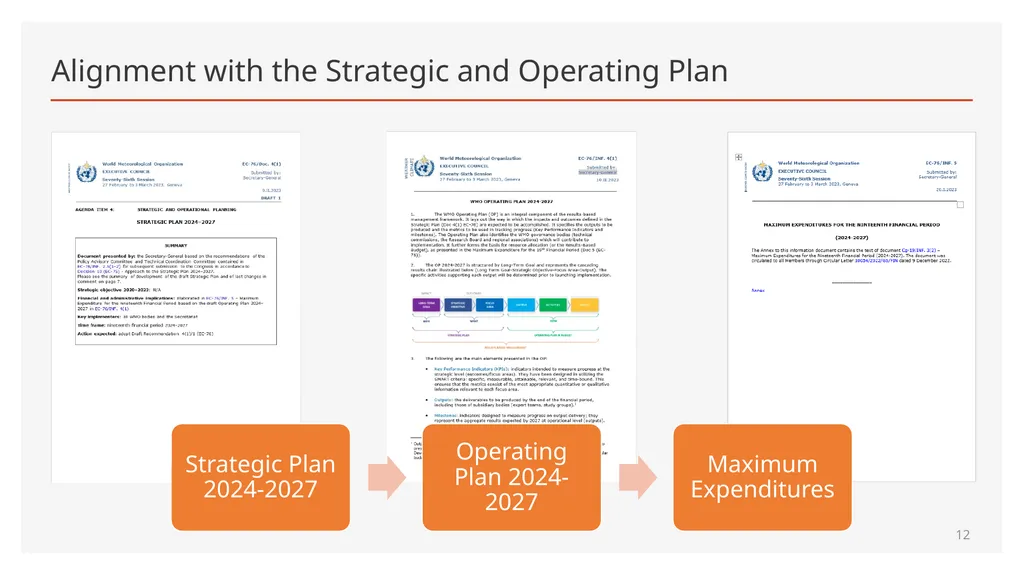
slide12. Alignment with the Strategic and Operating Plan 12<br>
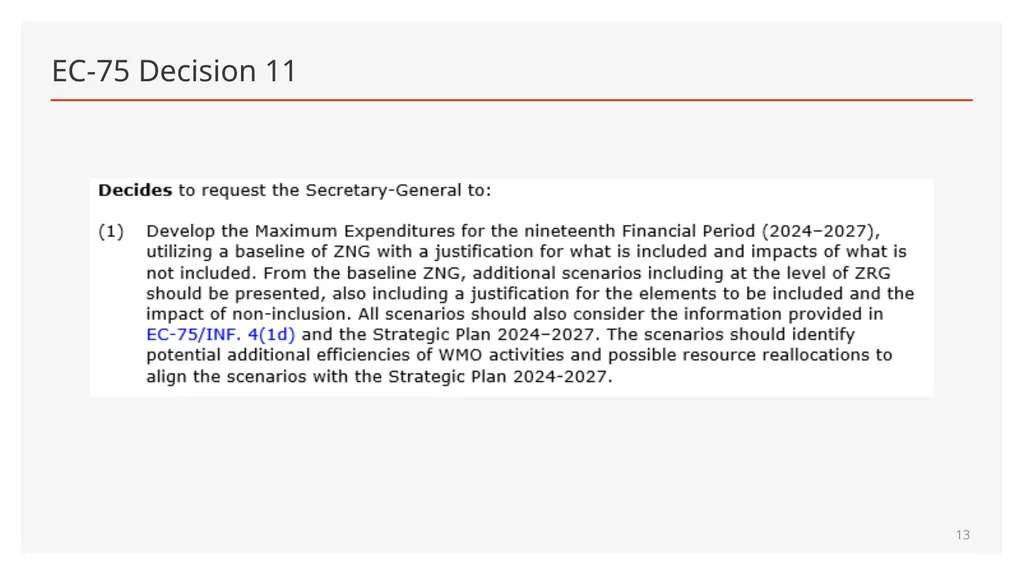
slide13. EC-75 Decision 11 13<br>
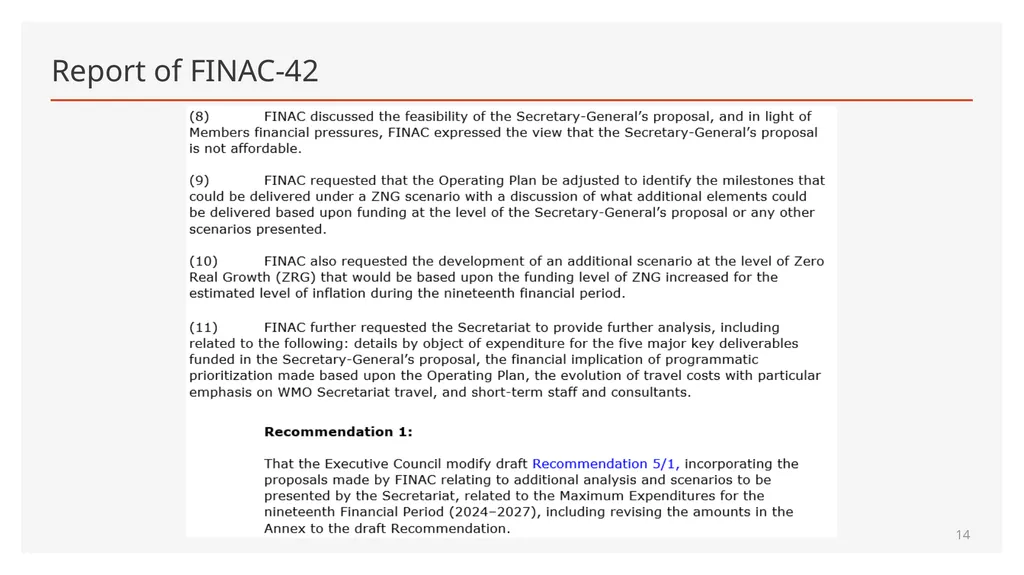
slide14. Report of FINAC-42 14<br>
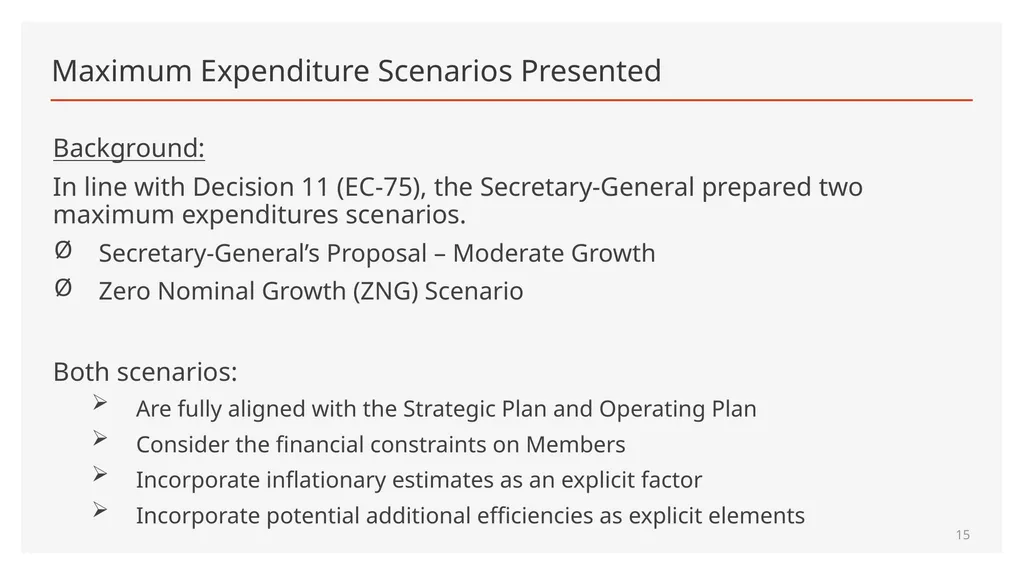
slide15. Maximum Expenditure Scenarios Presented Background:
In line with Decision 11 (EC-75), the Secretary-General prepared two maximum expenditures scenarios.
Secretary-General’s Proposal – Moderate Growth
Zero Nominal Growth (ZNG) Scenario
Both scenarios:
Are fully aligned with the Strategic Plan and Operating Plan
Consider the financial constraints on Members
Incorporate inflationary estimates as an explicit factor
Incorporate potential additional efficiencies as explicit elements 15<br>
slide16. Factors Common to both Scenarios 16<br>
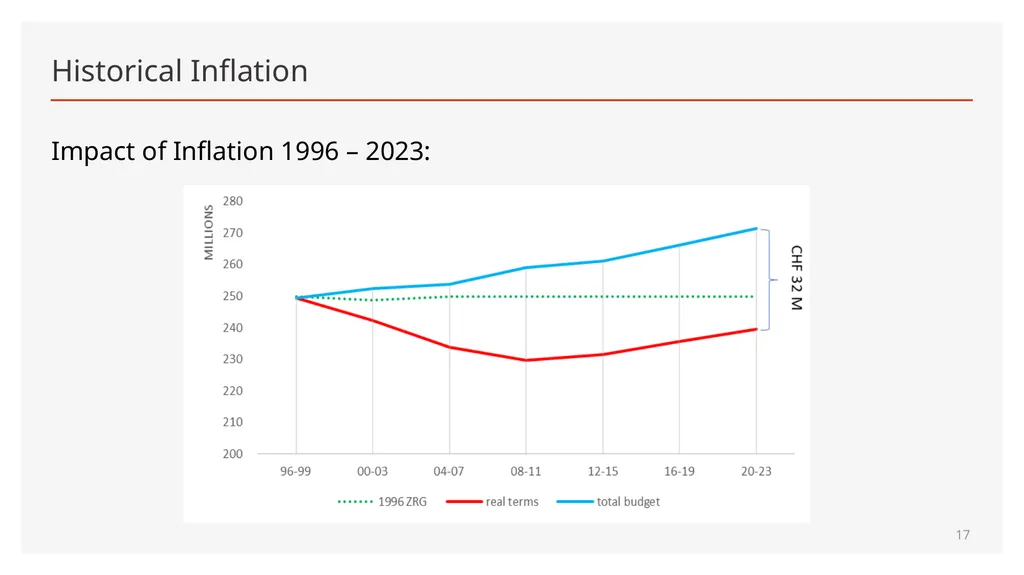
slide17. Historical Inflation Impact of Inflation 1996 – 2023: 17<br>
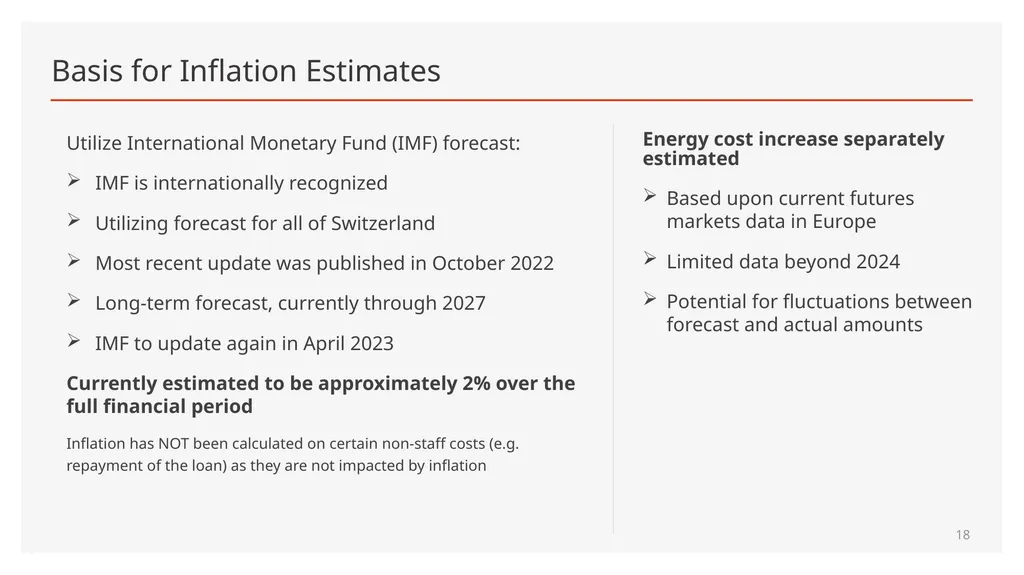
slide18. Basis for Inflation Estimates Energy cost increase separately estimated
Based upon current futures markets data in Europe
Limited data beyond 2024
Potential for fluctuations between forecast and actual amounts Utilize International Monetary Fund (IMF) forecast:
IMF is internationally recognized
Utilizing forecast for all of Switzerland
Most recent update was published in October 2022
Long-term forecast, currently through 2027
IMF to update again in April 2023
Currently estimated to be approximately 2% over the full financial period
Inflation has NOT been calculated on certain non-staff costs (e.g. repayment of the loan) as they are not impacted by inflation 18<br>
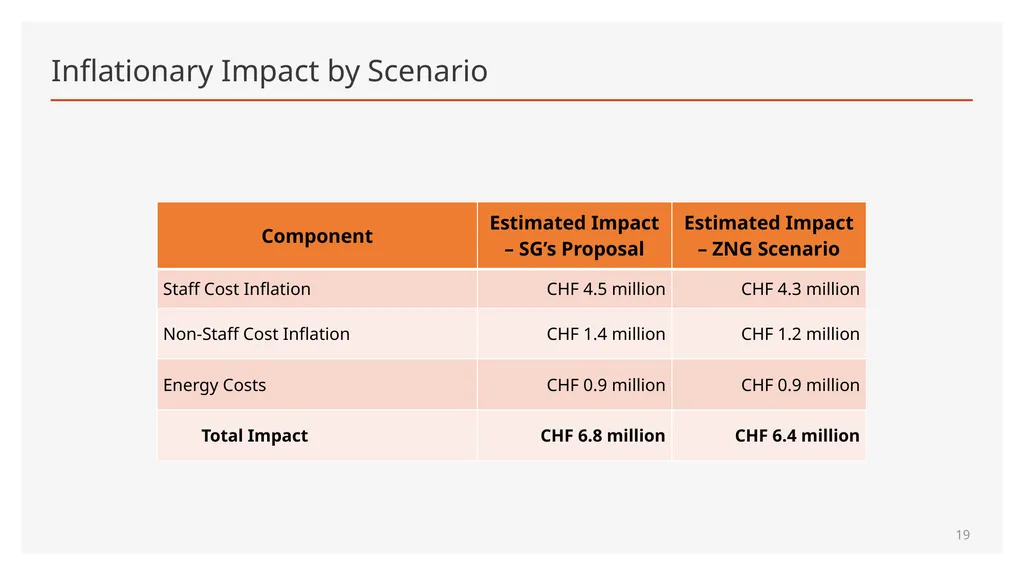
slide19. Inflationary Impact by Scenario 19<br>
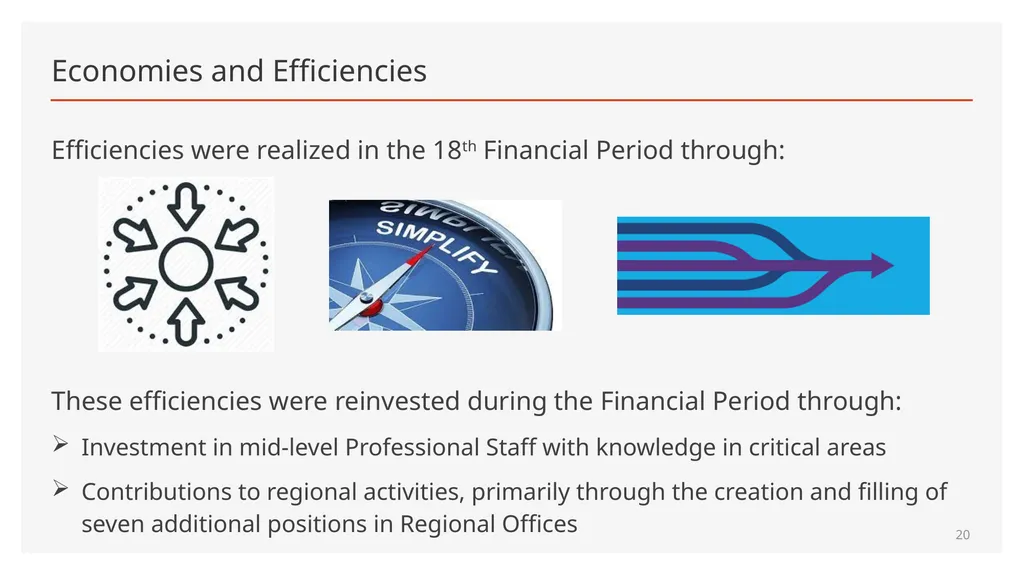
slide20. Economies and Efficiencies Efficiencies were realized in the 18th Financial Period through:
These efficiencies were reinvested during the Financial Period through:
Investment in mid-level Professional Staff with knowledge in critical areas
Contributions to regional activities, primarily through the creation and filling of seven additional positions in Regional Offices 20<br>
slide21. Economies and Efficiencies Additional efficiencies planned for the 19th Financial Period:
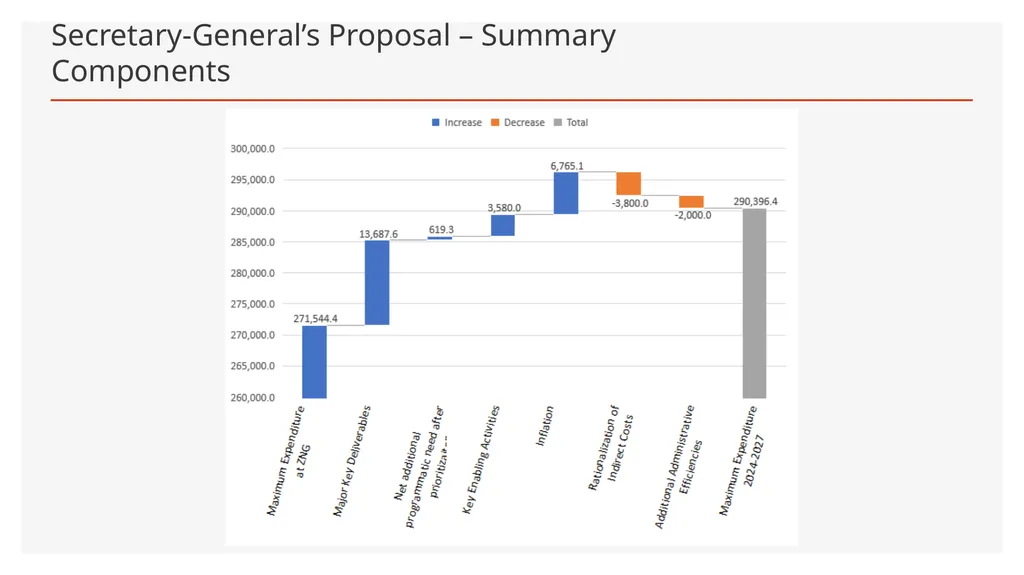
Rationalization of Indirect Costs – CHF 3.8 million
Reviewed administrative services support to extrabudgetary activities
Reassignment of costs to be funded by Programme Support Cost Special Account (rather than Regular Budget)
Additional administrative savings – CHF 2.0 million
Additional reprofiling of administrative positions toward programmatic activities 21<br>
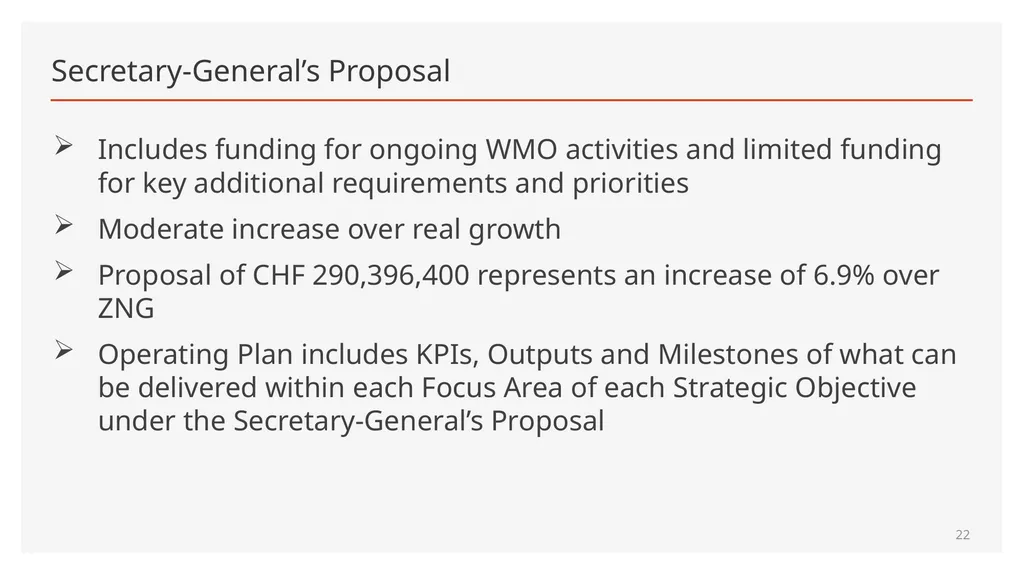
slide22. Secretary-General’s Proposal Includes funding for ongoing WMO activities and limited funding for key additional requirements and priorities
Moderate increase over real growth
Proposal of CHF 290,396,400 represents an increase of 6.9% over ZNG
Operating Plan includes KPIs, Outputs and Milestones of what can be delivered within each Focus Area of each Strategic Objective under the Secretary-General’s Proposal 22<br>
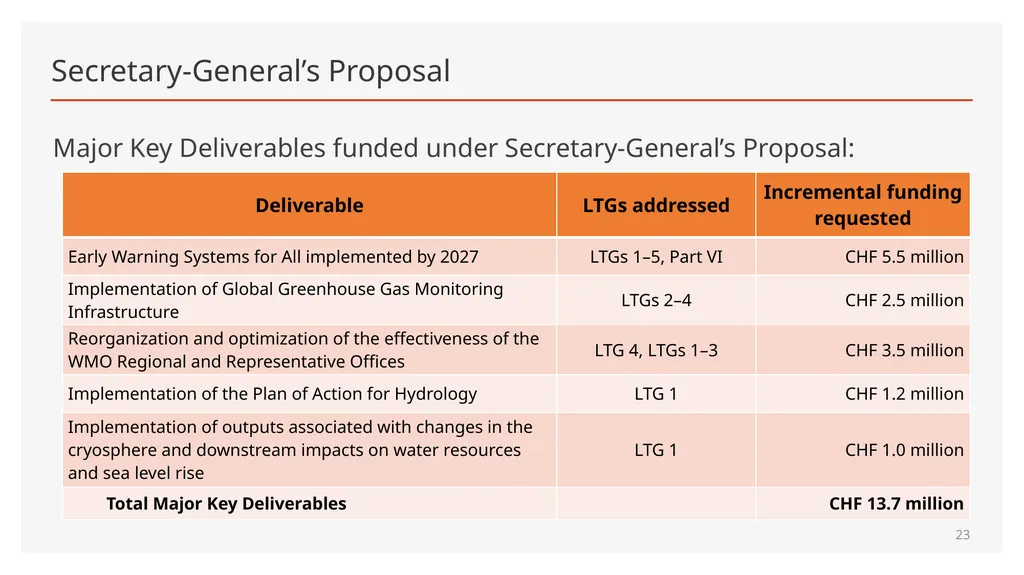
slide23. Secretary-General’s Proposal Major Key Deliverables funded under Secretary-General’s Proposal: 23<br>
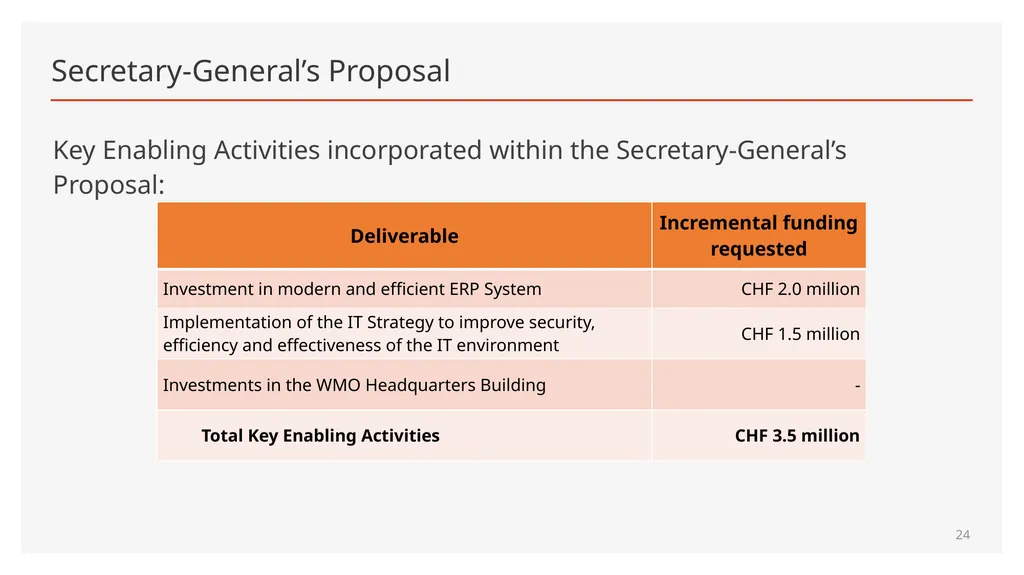
slide24. Secretary-General’s Proposal Key Enabling Activities incorporated within the Secretary-General’s Proposal: 24<br>
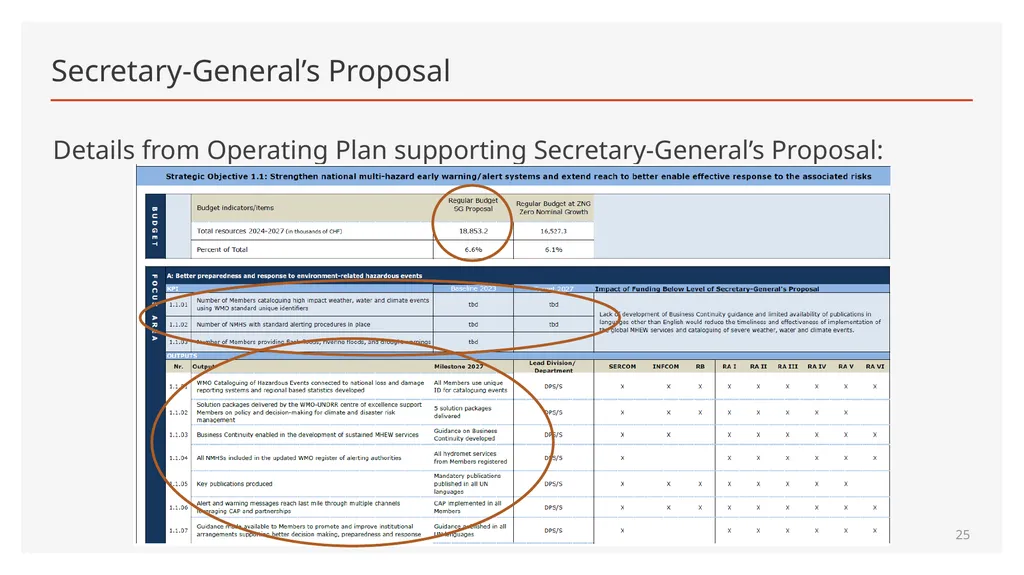
slide25. Secretary-General’s Proposal Details from Operating Plan supporting Secretary-General’s Proposal: 25<br>
slide26. Secretary-General’s Proposal – Summary Components<br>
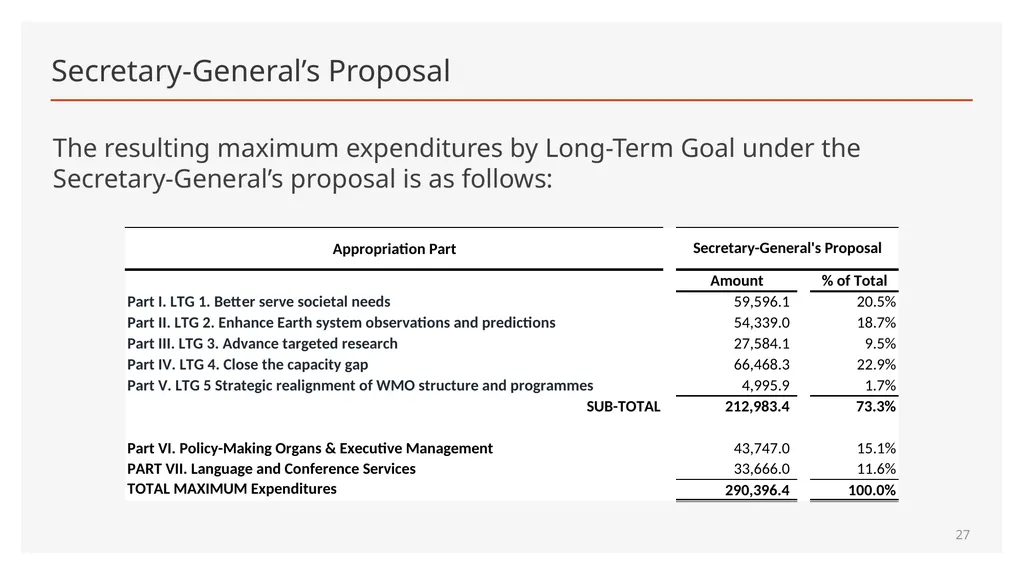
slide27. Secretary-General’s Proposal The resulting maximum expenditures by Long-Term Goal under the Secretary-General’s proposal is as follows: 27<br>
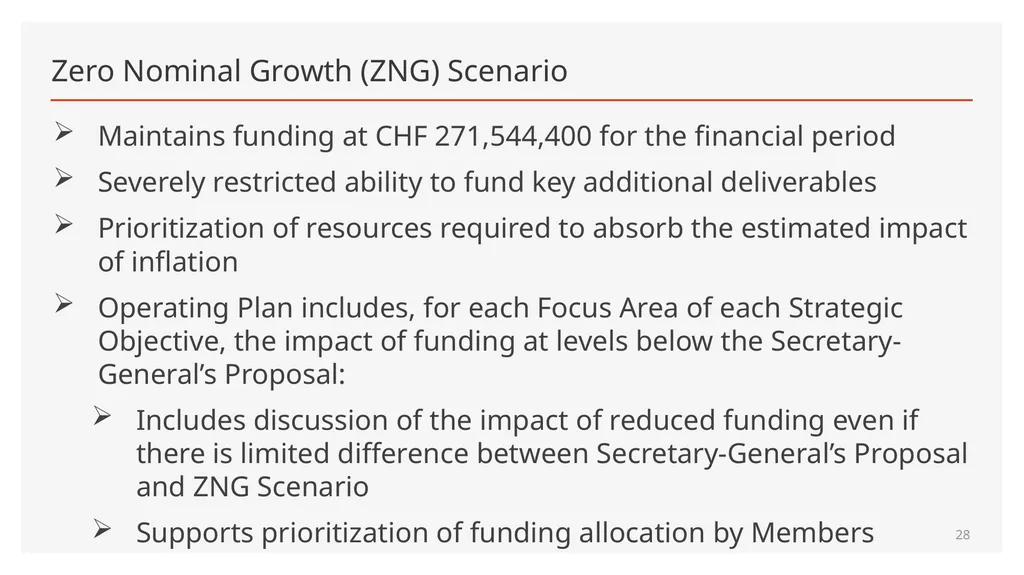
slide28. Zero Nominal Growth (ZNG) Scenario Maintains funding at CHF 271,544,400 for the financial period
Severely restricted ability to fund key additional deliverables
Prioritization of resources required to absorb the estimated impact of inflation
Operating Plan includes, for each Focus Area of each Strategic Objective, the impact of funding at levels below the Secretary-General’s Proposal:
Includes discussion of the impact of reduced funding even if there is limited difference between Secretary-General’s Proposal and ZNG Scenario
Supports prioritization of funding allocation by Members 28<br>
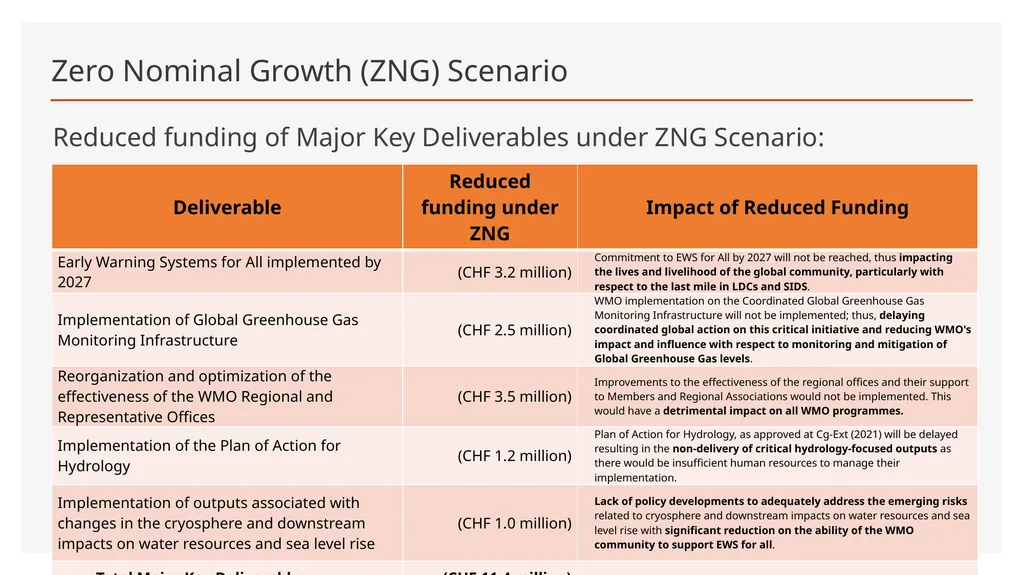
slide29. Zero Nominal Growth (ZNG) Scenario Reduced funding of Major Key Deliverables under ZNG Scenario: 29<br>
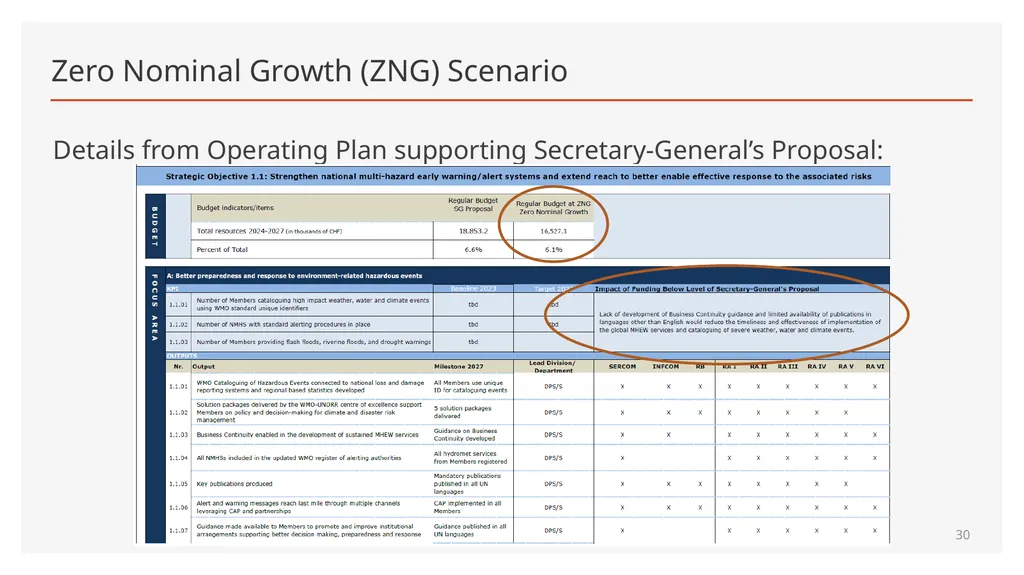
slide30. Zero Nominal Growth (ZNG) Scenario Details from Operating Plan supporting Secretary-General’s Proposal: 30<br>
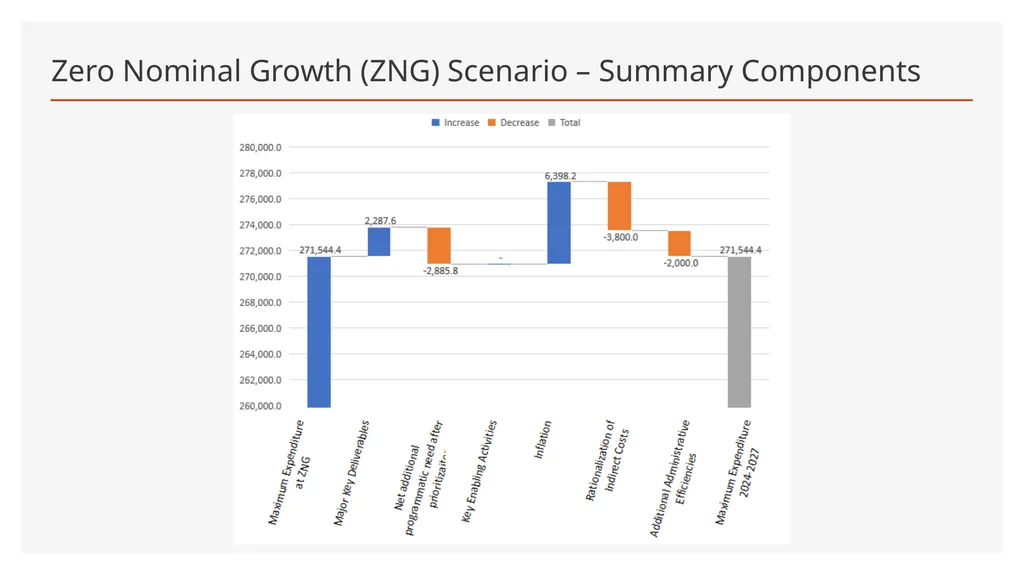
slide31. Zero Nominal Growth (ZNG) Scenario – Summary Components<br>
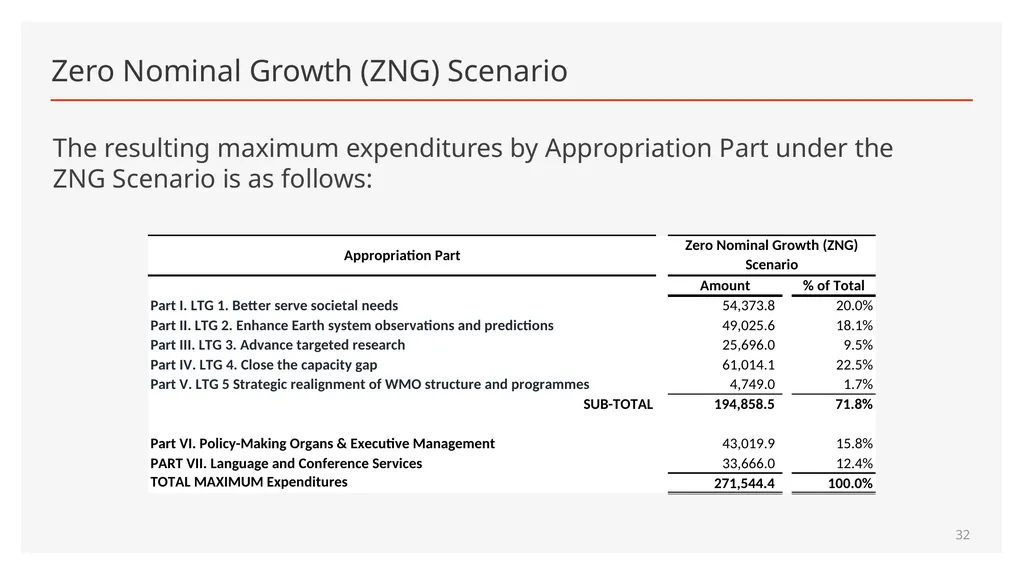
slide32. Zero Nominal Growth (ZNG) Scenario The resulting maximum expenditures by Appropriation Part under the ZNG Scenario is as follows: 32<br>
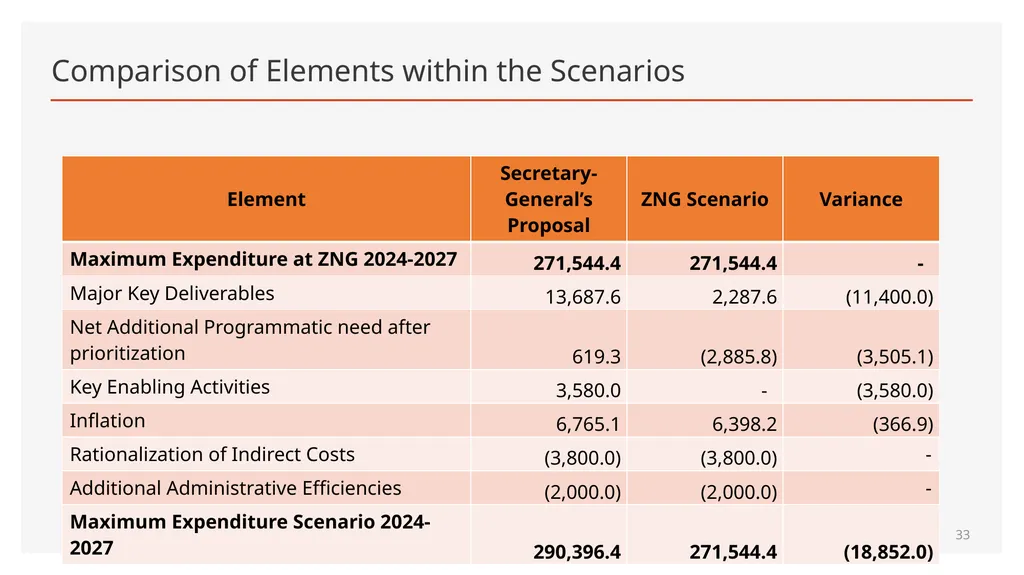
slide33. Comparison of Elements within the Scenarios 33<br>
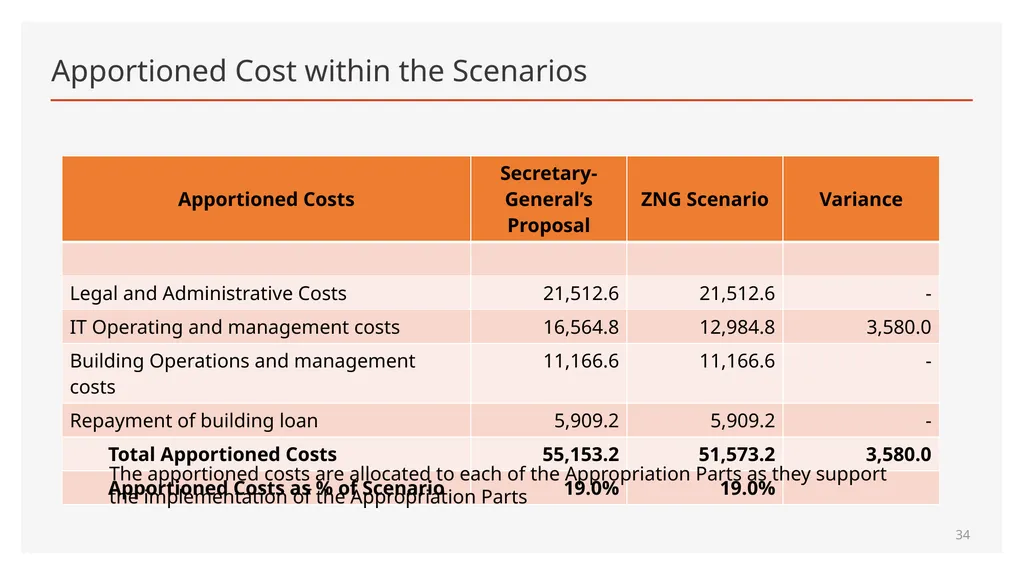
slide34. Apportioned Cost within the Scenarios The apportioned costs are allocated to each of the Appropriation Parts as they support the implementation of the Appropriation Parts 34<br>
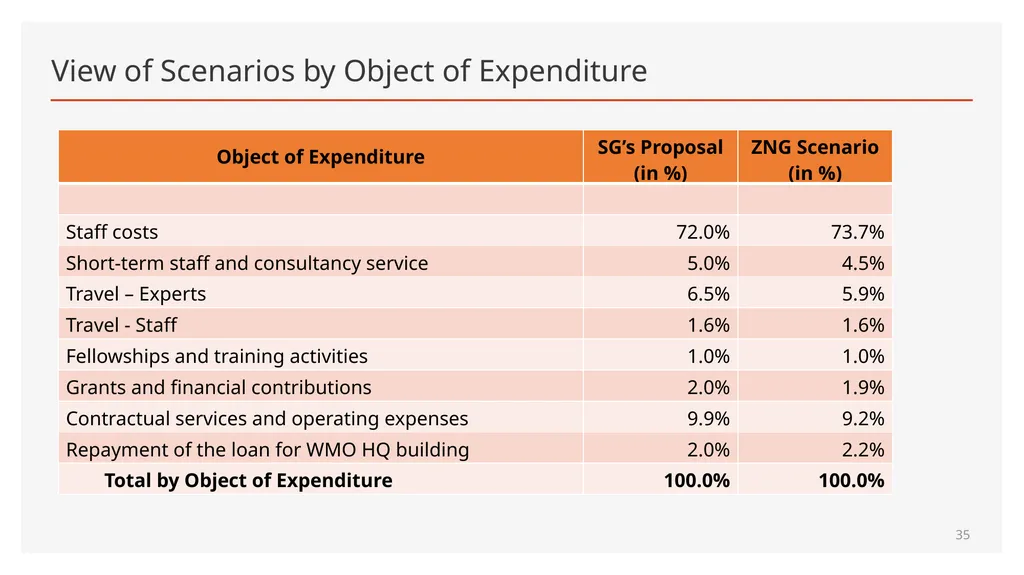
slide35. View of Scenarios by Object of Expenditure INSERT TABLE OF RESULTS WORK IN PROGRESS 35<br>
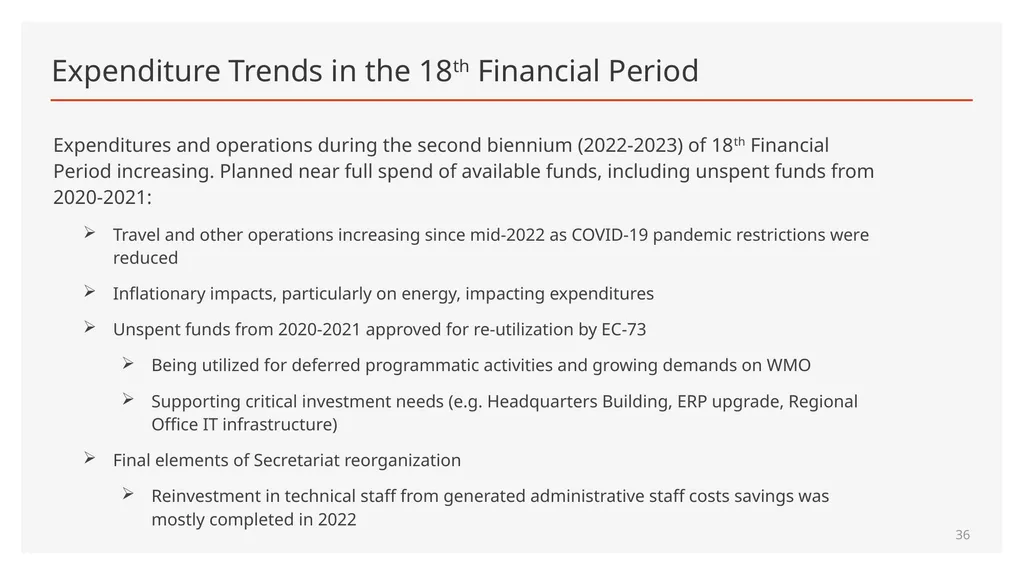
slide36. Expenditure Trends in the 18th Financial Period Expenditures and operations during the second biennium (2022-2023) of 18th Financial Period increasing. Planned near full spend of available funds, including unspent funds from 2020-2021:
Travel and other operations increasing since mid-2022 as COVID-19 pandemic restrictions were reduced
Inflationary impacts, particularly on energy, impacting expenditures
Unspent funds from 2020-2021 approved for re-utilization by EC-73
Being utilized for deferred programmatic activities and growing demands on WMO
Supporting critical investment needs (e.g. Headquarters Building, ERP upgrade, Regional Office IT infrastructure)
Final elements of Secretariat reorganization
Reinvestment in technical staff from generated administrative staff costs savings was mostly completed in 2022 36<br>
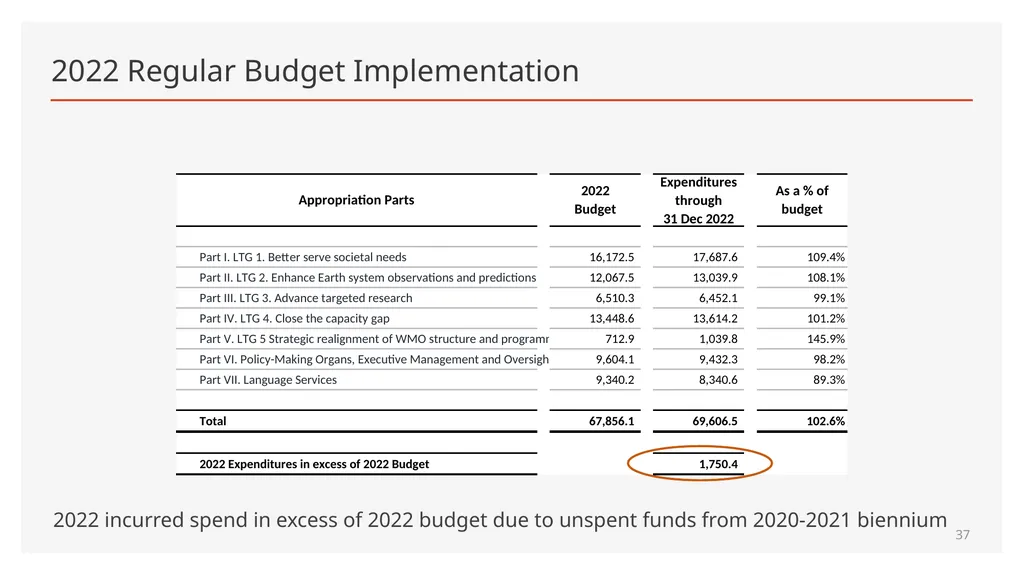
slide37. 2022 Regular Budget Implementation 2022 incurred spend in excess of 2022 budget due to unspent funds from 2020-2021 biennium 37<br>
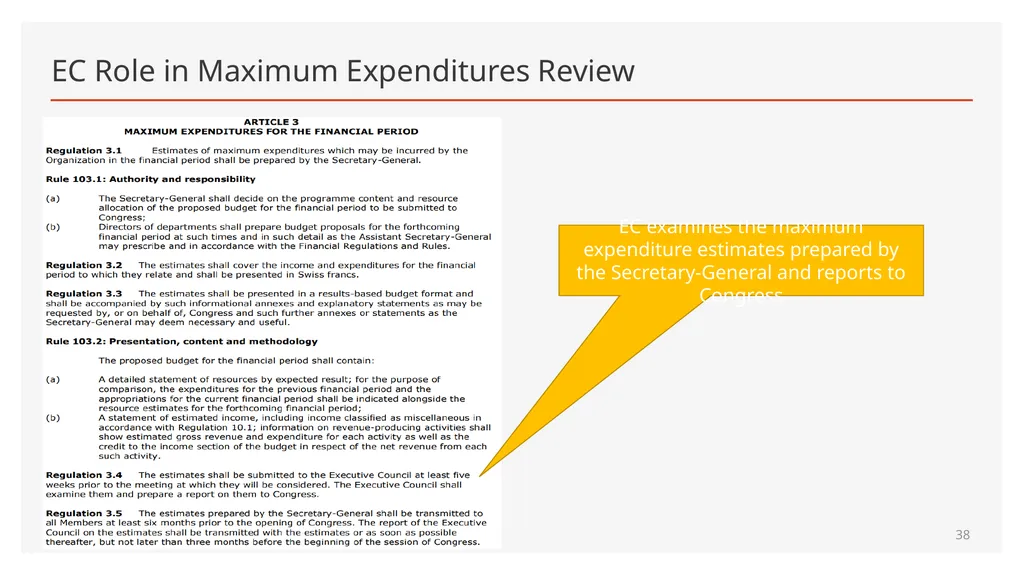
slide38. EC Role in Maximum Expenditures Review EC examines the maximum expenditure estimates prepared by the Secretary-General and reports to Congress 38<br>
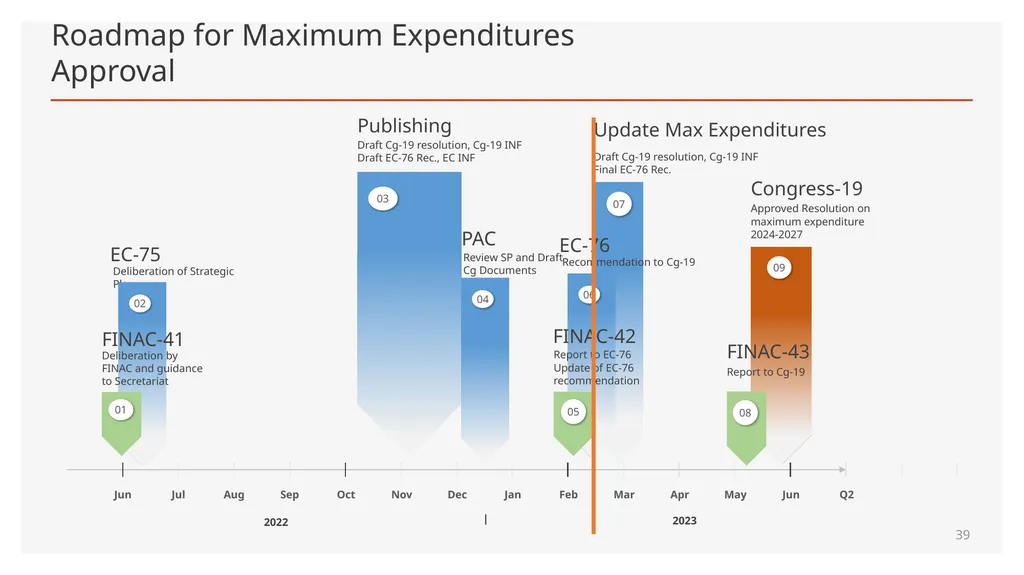
slide39. Roadmap for Maximum Expenditures Approval 39<br>
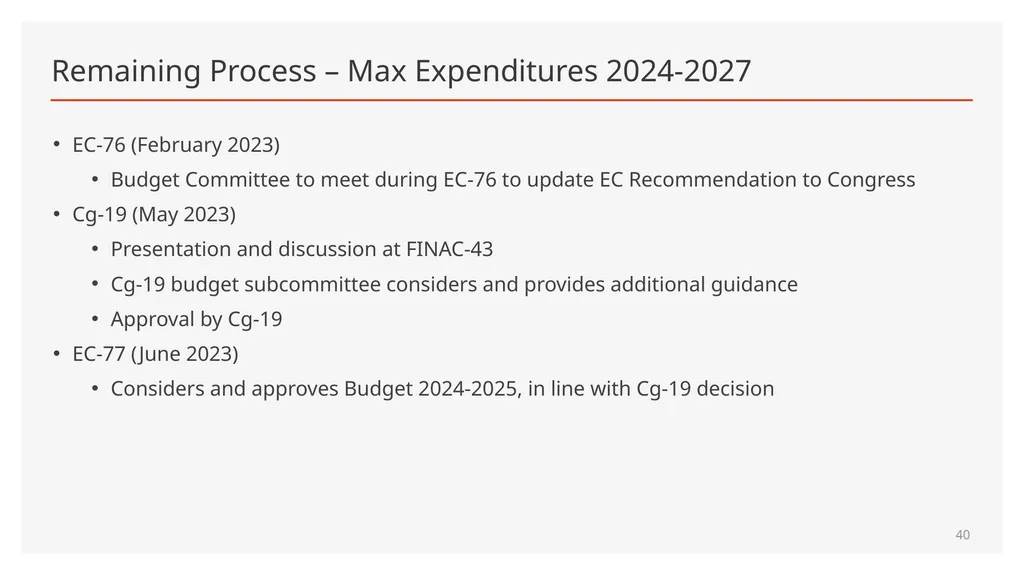
slide40. Remaining Process – Max Expenditures 2024-2027 EC-76 (February 2023)
Budget Committee to meet during EC-76 to update EC Recommendation to Congress
Cg-19 (May 2023)
Presentation and discussion at FINAC-43
Cg-19 budget subcommittee considers and provides additional guidance
Approval by Cg-19
EC-77 (June 2023)
Considers and approves Budget 2024-2025, in line with Cg-19 decision 40<br>
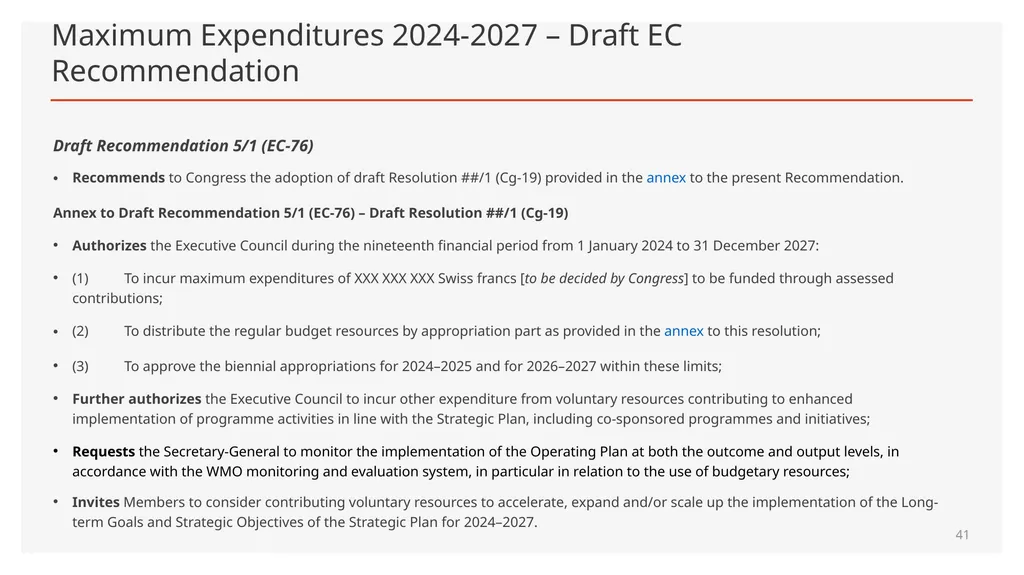
slide41. Maximum Expenditures 2024-2027 – Draft EC Recommendation Draft Recommendation 5/1 (EC-76)
Recommends to Congress the adoption of draft Resolution ##/1 (Cg-19) provided in the annex to the present Recommendation.
Annex to Draft Recommendation 5/1 (EC-76) – Draft Resolution ##/1 (Cg-19)
Authorizes the Executive Council during the nineteenth financial period from 1 January 2024 to 31 December 2027:
(1) To incur maximum expenditures of XXX XXX XXX Swiss francs [to be decided by Congress] to be funded through assessed contributions;
(2) To distribute the regular budget resources by appropriation part as provided in the annex to this resolution;
(3) To approve the biennial appropriations for 2024–2025 and for 2026–2027 within these limits;
Further authorizes the Executive Council to incur other expenditure from voluntary resources contributing to enhanced implementation of programme activities in line with the Strategic Plan, including co-sponsored programmes and initiatives;
Requests the Secretary-General to monitor the implementation of the Operating Plan at both the outcome and output levels, in accordance with the WMO monitoring and evaluation system, in particular in relation to the use of budgetary resources;
Invites Members to consider contributing voluntary resources to accelerate, expand and/or scale up the implementation of the Long-term Goals and Strategic Objectives of the Strategic Plan for 2024–2027. 41<br>
EC-76/Doc. 5 and EC-76/INF. 5
27 February 2023<br>
slide2. WMO Strategic Plan 2030 2<br>
slide3. WMO STRATEGIC PLAN
OVERARCHING PRIORITIES 2020–2023:
LAYING THE GROUND 2024–2027
SCALING UP Enhancing preparedness and reducing loss of life, critical infrastructure and livelihood from hydrometeorological extremes
Supporting climate-smart decision making to build or enhance adaptive capacity or resilience to climate risk
Enhancing socioeconomic value of weather, climate, hydrological and related environmental services Early Warning Systems for All
Global Greenhouse Gas Monitoring Infrastructure
WMO Vision and Strategy for Hydrology + Plan of Action
Action on changes in the cryosphere and downstream impacts on water resources and sea level rise
Reorganization and optimization of WMO Regional and Representative Offices 3<br>
slide4. Regional priorities
New policies & strategies (e.g. Unified Data Policy, WMO Vision and Strategy for Hydrology)
Updates to technical strategies (e.g. Services Delivery, Capacity Development, GMAS)
Data from WMO Monitoring System (KPIs, Performance Assessment Report 2020-2021) Basis for WMO Strategic Plan 2024-2027 4<br>
slide5. LONG-TERM GOAL 1. BETTER SERVE SOCIETAL NEEDS:
delivering authoritative, accessible, user-oriented and fit-for-purpose information and services STRATEGIC OBJECTIVE 1.1: Strengthen national multi-hazard early warning/alert systems and extend reach to better enable an effective response to the associated risks * 5<br>
slide6. Results Based Management at WMO 6<br>
slide7. Presents the results chain
LTG (impact) → SO (outcome) → Focus Area (intermediary outcome) → Output WMO Operating Plan 2024-2027 7<br>
slide8. Presents the metrics
Key Performance Indicators (at strategic level)
Milestones (at operational level) WMO Operating Plan 2024-2027 8<br>
slide9. WMO Operating Plan 2024-2027 Identifies the governance bodies expected to contribute to implementation
Integrated planning
Use as a basis for TC/RB/RA work programmes 9<br>
slide10. Integrated risk management into planning
Integrated planning
Use as a basis for TC/RB/RA work programmes WMO Operating Plan 2024-27 Integrated risk management into planning
Risks identified and assessed at SO level + mitigation measures defined
Opportunities identified + proposed actions formulated 10<br>
slide11. Integrated risk management into planning
Integrated planning
Use as a basis for TC/RB/RA work programmes WMO Operating Plan 2024-27 For the first time outputs and milestones defined for Secretariat’s support to:
Policy-making organs (Part VI)
Language services (Part VII)
Administration (indirect apportioned costs) 11<br>
slide12. Alignment with the Strategic and Operating Plan 12<br>
slide13. EC-75 Decision 11 13<br>
slide14. Report of FINAC-42 14<br>
slide15. Maximum Expenditure Scenarios Presented Background:
In line with Decision 11 (EC-75), the Secretary-General prepared two maximum expenditures scenarios.
Secretary-General’s Proposal – Moderate Growth
Zero Nominal Growth (ZNG) Scenario
Both scenarios:
Are fully aligned with the Strategic Plan and Operating Plan
Consider the financial constraints on Members
Incorporate inflationary estimates as an explicit factor
Incorporate potential additional efficiencies as explicit elements 15<br>
slide16. Factors Common to both Scenarios 16<br>
slide17. Historical Inflation Impact of Inflation 1996 – 2023: 17<br>
slide18. Basis for Inflation Estimates Energy cost increase separately estimated
Based upon current futures markets data in Europe
Limited data beyond 2024
Potential for fluctuations between forecast and actual amounts Utilize International Monetary Fund (IMF) forecast:
IMF is internationally recognized
Utilizing forecast for all of Switzerland
Most recent update was published in October 2022
Long-term forecast, currently through 2027
IMF to update again in April 2023
Currently estimated to be approximately 2% over the full financial period
Inflation has NOT been calculated on certain non-staff costs (e.g. repayment of the loan) as they are not impacted by inflation 18<br>
slide19. Inflationary Impact by Scenario 19<br>
slide20. Economies and Efficiencies Efficiencies were realized in the 18th Financial Period through:
These efficiencies were reinvested during the Financial Period through:
Investment in mid-level Professional Staff with knowledge in critical areas
Contributions to regional activities, primarily through the creation and filling of seven additional positions in Regional Offices 20<br>
slide21. Economies and Efficiencies Additional efficiencies planned for the 19th Financial Period:
Rationalization of Indirect Costs – CHF 3.8 million
Reviewed administrative services support to extrabudgetary activities
Reassignment of costs to be funded by Programme Support Cost Special Account (rather than Regular Budget)
Additional administrative savings – CHF 2.0 million
Additional reprofiling of administrative positions toward programmatic activities 21<br>
slide22. Secretary-General’s Proposal Includes funding for ongoing WMO activities and limited funding for key additional requirements and priorities
Moderate increase over real growth
Proposal of CHF 290,396,400 represents an increase of 6.9% over ZNG
Operating Plan includes KPIs, Outputs and Milestones of what can be delivered within each Focus Area of each Strategic Objective under the Secretary-General’s Proposal 22<br>
slide23. Secretary-General’s Proposal Major Key Deliverables funded under Secretary-General’s Proposal: 23<br>
slide24. Secretary-General’s Proposal Key Enabling Activities incorporated within the Secretary-General’s Proposal: 24<br>
slide25. Secretary-General’s Proposal Details from Operating Plan supporting Secretary-General’s Proposal: 25<br>
slide26. Secretary-General’s Proposal – Summary Components<br>
slide27. Secretary-General’s Proposal The resulting maximum expenditures by Long-Term Goal under the Secretary-General’s proposal is as follows: 27<br>
slide28. Zero Nominal Growth (ZNG) Scenario Maintains funding at CHF 271,544,400 for the financial period
Severely restricted ability to fund key additional deliverables
Prioritization of resources required to absorb the estimated impact of inflation
Operating Plan includes, for each Focus Area of each Strategic Objective, the impact of funding at levels below the Secretary-General’s Proposal:
Includes discussion of the impact of reduced funding even if there is limited difference between Secretary-General’s Proposal and ZNG Scenario
Supports prioritization of funding allocation by Members 28<br>
slide29. Zero Nominal Growth (ZNG) Scenario Reduced funding of Major Key Deliverables under ZNG Scenario: 29<br>
slide30. Zero Nominal Growth (ZNG) Scenario Details from Operating Plan supporting Secretary-General’s Proposal: 30<br>
slide31. Zero Nominal Growth (ZNG) Scenario – Summary Components<br>
slide32. Zero Nominal Growth (ZNG) Scenario The resulting maximum expenditures by Appropriation Part under the ZNG Scenario is as follows: 32<br>
slide33. Comparison of Elements within the Scenarios 33<br>
slide34. Apportioned Cost within the Scenarios The apportioned costs are allocated to each of the Appropriation Parts as they support the implementation of the Appropriation Parts 34<br>
slide35. View of Scenarios by Object of Expenditure INSERT TABLE OF RESULTS WORK IN PROGRESS 35<br>
slide36. Expenditure Trends in the 18th Financial Period Expenditures and operations during the second biennium (2022-2023) of 18th Financial Period increasing. Planned near full spend of available funds, including unspent funds from 2020-2021:
Travel and other operations increasing since mid-2022 as COVID-19 pandemic restrictions were reduced
Inflationary impacts, particularly on energy, impacting expenditures
Unspent funds from 2020-2021 approved for re-utilization by EC-73
Being utilized for deferred programmatic activities and growing demands on WMO
Supporting critical investment needs (e.g. Headquarters Building, ERP upgrade, Regional Office IT infrastructure)
Final elements of Secretariat reorganization
Reinvestment in technical staff from generated administrative staff costs savings was mostly completed in 2022 36<br>
slide37. 2022 Regular Budget Implementation 2022 incurred spend in excess of 2022 budget due to unspent funds from 2020-2021 biennium 37<br>
slide38. EC Role in Maximum Expenditures Review EC examines the maximum expenditure estimates prepared by the Secretary-General and reports to Congress 38<br>
slide39. Roadmap for Maximum Expenditures Approval 39<br>
slide40. Remaining Process – Max Expenditures 2024-2027 EC-76 (February 2023)
Budget Committee to meet during EC-76 to update EC Recommendation to Congress
Cg-19 (May 2023)
Presentation and discussion at FINAC-43
Cg-19 budget subcommittee considers and provides additional guidance
Approval by Cg-19
EC-77 (June 2023)
Considers and approves Budget 2024-2025, in line with Cg-19 decision 40<br>
slide41. Maximum Expenditures 2024-2027 – Draft EC Recommendation Draft Recommendation 5/1 (EC-76)
Recommends to Congress the adoption of draft Resolution ##/1 (Cg-19) provided in the annex to the present Recommendation.
Annex to Draft Recommendation 5/1 (EC-76) – Draft Resolution ##/1 (Cg-19)
Authorizes the Executive Council during the nineteenth financial period from 1 January 2024 to 31 December 2027:
(1) To incur maximum expenditures of XXX XXX XXX Swiss francs [to be decided by Congress] to be funded through assessed contributions;
(2) To distribute the regular budget resources by appropriation part as provided in the annex to this resolution;
(3) To approve the biennial appropriations for 2024–2025 and for 2026–2027 within these limits;
Further authorizes the Executive Council to incur other expenditure from voluntary resources contributing to enhanced implementation of programme activities in line with the Strategic Plan, including co-sponsored programmes and initiatives;
Requests the Secretary-General to monitor the implementation of the Operating Plan at both the outcome and output levels, in accordance with the WMO monitoring and evaluation system, in particular in relation to the use of budgetary resources;
Invites Members to consider contributing voluntary resources to accelerate, expand and/or scale up the implementation of the Long-term Goals and Strategic Objectives of the Strategic Plan for 2024–2027. 41<br>