
ME 355 Introduction to Manufacturing Processes

Description: ME 355 Introduction to Manufacturing Processes Junlan Wang Winter 2015 42 1 ME355 Spring 2014 General Terminology Manufacturing Concurrent Engineering Design for Manufacturing, Assembly, Disassembly, Service Green Design, Sustainable
Related Topics
Download Presentation
"ME 355 Introduction to Manufacturing Processes" is the property of its rightful owner. Permission is granted to download and print the materials on this website for personal, non-commercial use only, and to display it on your personal computer provided you do not modify the materials and that you retain all copyright notices contained in the materials. By downloading content from our website, you accept the terms of this agreement.
Presentation Transcript
slide1. ME 355
Introduction to
Manufacturing Processes Junlan Wang
Winter 2015 4/2 1 ME355 Spring 2014<br>
slide2. General Terminology Manufacturing
Concurrent Engineering
Design for Manufacturing, Assembly, Disassembly, Service
Green Design, Sustainable Manufacturing, Product Life Cycle
Materials Selection, Process Selection
Computer Integrated Manufacturing
Lean Production, Agile Manufacturing
Quality Control, Total Quality Assurance
Manufacturing Cost, Global Competitiveness 4/2 2 ME355 Spring 2014<br>
slide3. Manufacturing 4/2 3 ME355 Spring 2014 The process of converting raw materials into products; encompasses the deign and manufacturing of goods using various production methods and techniques.
~ came from Latin “manu factus” – made by hand
Interchangeably used with “production”
Manufactured item has monetary worth (added value) than raw materials
Manufacturing is closely linked to national and global economy<br>
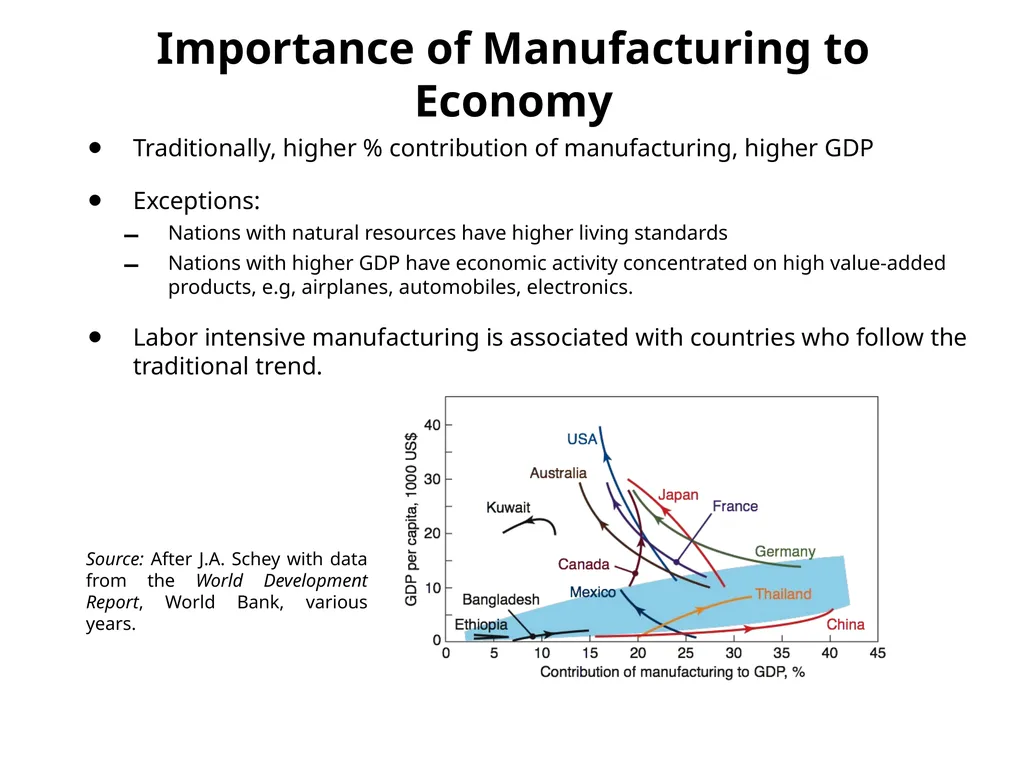
slide4. Importance of Manufacturing to Economy Traditionally, higher % contribution of manufacturing, higher GDP
Exceptions:
Nations with natural resources have higher living standards
Nations with higher GDP have economic activity concentrated on high value-added products, e.g, airplanes, automobiles, electronics.
Labor intensive manufacturing is associated with countries who follow the traditional trend. 4/2 4 ME355 Spring 2014 Source: After J.A. Schey with data from the World Development Report, World Bank, various years.<br>
slide5. Concurrent Engineering ~ Simultaneous Engineering
A systematic approach integrating the design and manufacture of the products with the view toward optimizing all elements involved in the life cycle of the product
Basic goal
Minimize design and manufacture changes
Minimize time and cost in taking the product from conceptual design to production and introduction of the product to market
Key to success:
Full support of an organization’s top management
Multifunctional and interacting work team, including support groups
Utilization of all available state-of-the-art technologies 4/2 5 ME355 Spring 2014<br>
slide6. Design for Manufacture, Assembly, Disassembly, and Service Each part or component of a product must be designed to not only meets design requirements and specifications, but also to be manufactured economically and with relative ease.
Product must be designed that individual parts can be assembled together with ease, speed, and minimum cost.
Product must also be designed so that disassembly is possible with relative ease and require little time, enabling the product to be taken apart for maintenance, servicing, or recycling of their components.
Product must be designed so that individual parts are easy to reach and service. 4/2 6 ME355 Spring 2014<br>
slide7. Green Design, Sustainable Manufacturing, and Product Life Cycle Green Design - Design for Recycling (DFR) - Design for Environment (DFE)
Sustainable Manufacturing
Reducing waste of materials at their source by refinement in product design and the amount of materials used
Reducing the use of hazardous materials in products and processes
Ensuring proper handling and disposal of all waste
Improving waste treatment and recycling and reuse of materials
Product Life Cycle (PLC)
Product development
Market Introduction
Growth
Maturation
Decline 4/2 7 ME355 Spring 2014<br>
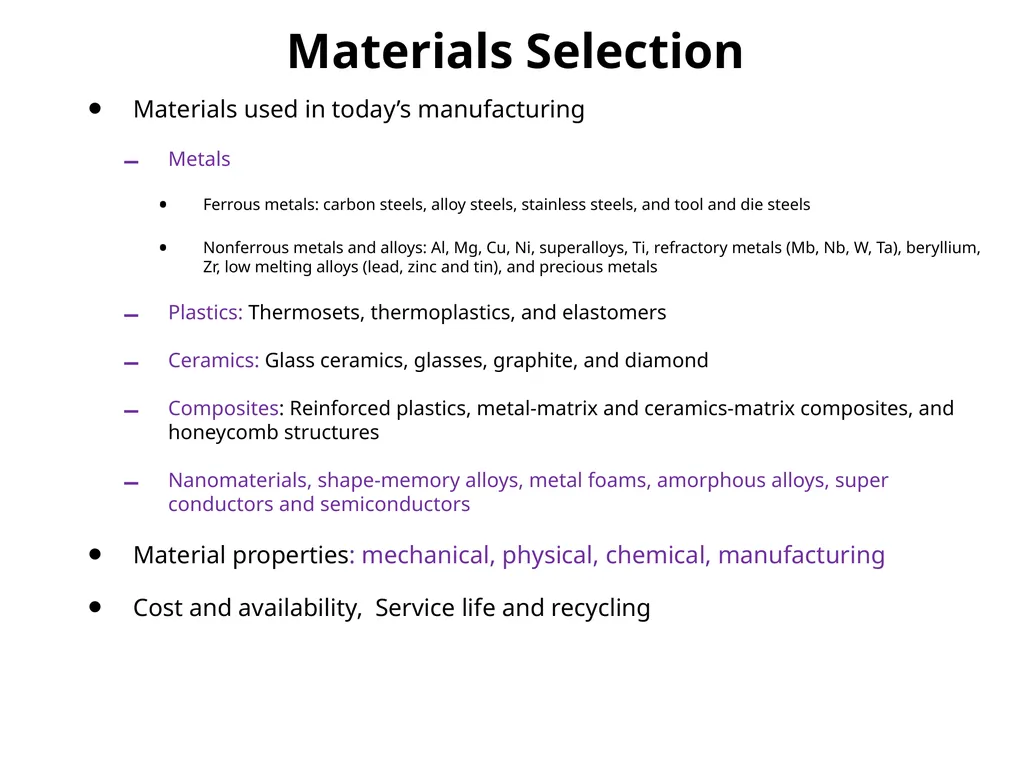
slide8. Materials Selection Materials used in today’s manufacturing
Metals
Ferrous metals: carbon steels, alloy steels, stainless steels, and tool and die steels
Nonferrous metals and alloys: Al, Mg, Cu, Ni, superalloys, Ti, refractory metals (Mb, Nb, W, Ta), beryllium, Zr, low melting alloys (lead, zinc and tin), and precious metals
Plastics: Thermosets, thermoplastics, and elastomers
Ceramics: Glass ceramics, glasses, graphite, and diamond
Composites: Reinforced plastics, metal-matrix and ceramics-matrix composites, and honeycomb structures
Nanomaterials, shape-memory alloys, metal foams, amorphous alloys, super conductors and semiconductors
Material properties: mechanical, physical, chemical, manufacturing
Cost and availability, Service life and recycling 4/2 8 ME355 Spring 2014<br>
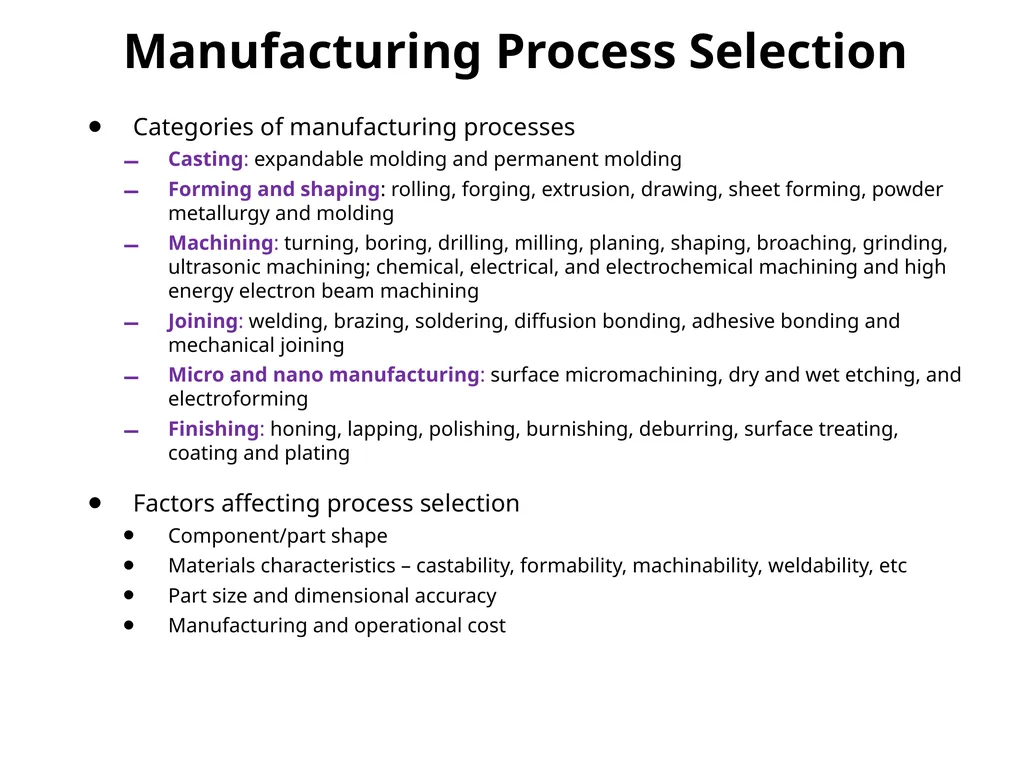
slide9. Manufacturing Process Selection Categories of manufacturing processes
Casting: expandable molding and permanent molding
Forming and shaping: rolling, forging, extrusion, drawing, sheet forming, powder metallurgy and molding
Machining: turning, boring, drilling, milling, planing, shaping, broaching, grinding, ultrasonic machining; chemical, electrical, and electrochemical machining and high energy electron beam machining
Joining: welding, brazing, soldering, diffusion bonding, adhesive bonding and mechanical joining
Micro and nano manufacturing: surface micromachining, dry and wet etching, and electroforming
Finishing: honing, lapping, polishing, burnishing, deburring, surface treating, coating and plating
Factors affecting process selection
Component/part shape
Materials characteristics – castability, formability, machinability, weldability, etc
Part size and dimensional accuracy
Manufacturing and operational cost 4/2 9 ME355 Spring 2014<br>
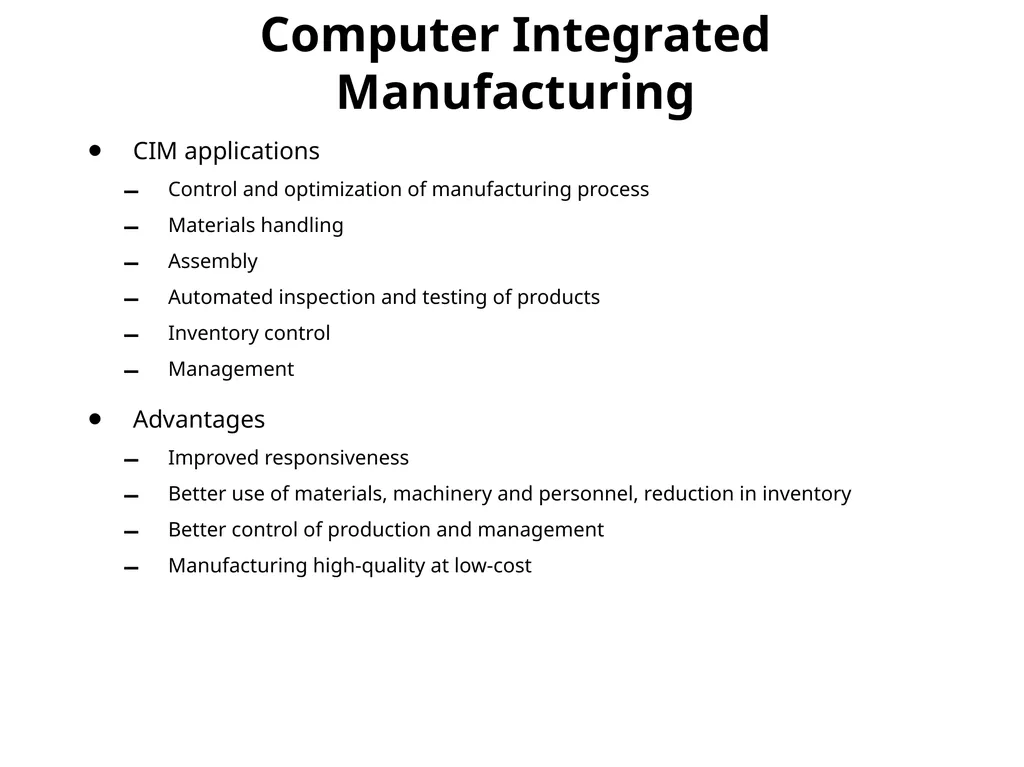
slide10. Computer Integrated Manufacturing CIM applications
Control and optimization of manufacturing process
Materials handling
Assembly
Automated inspection and testing of products
Inventory control
Management
Advantages
Improved responsiveness
Better use of materials, machinery and personnel, reduction in inventory
Better control of production and management
Manufacturing high-quality at low-cost 4/2 10 ME355 Spring 2014<br>
slide11. Lean Production and Agile Manufacturing Lean Production (~lean manufacturing): a manufacturing practice that considers the expenditure of resources for any goals other than creating values for the end customer as wasteful, thus a target for elimination
A major assessment of each activity of a company regarding the efficiency and effectiveness of its operations (company operation)
The efficiency of the machinery and equipment used in the operation while maintaining and improving quality (equipment)
The number of personnel involved in a particular operation (personnel)
A thorough analysis in order to reduce the cost of each activity, including both productive and nonproductive labor (activity cost effectiveness)
Goal: continuously improving the efficiency and profitability by reducing all types of waste from its operation (“0”-base waste) and dealing with problems asap.
Agile Manufacturing
Ensuring flexibility (agility) in the manufacturing enterprise so that it can quickly respond to changes in product variety and demand, and customer needs
To be achieved through
Machines and equipment with Built-in flexibility (reconfigurable machines) using modular components that can be arranged and rearranged in different ways
Advanced computer hardware and software
Reduced changeover time and implementing advanced communication systems. 4/2 11 ME355 Spring 2014<br>
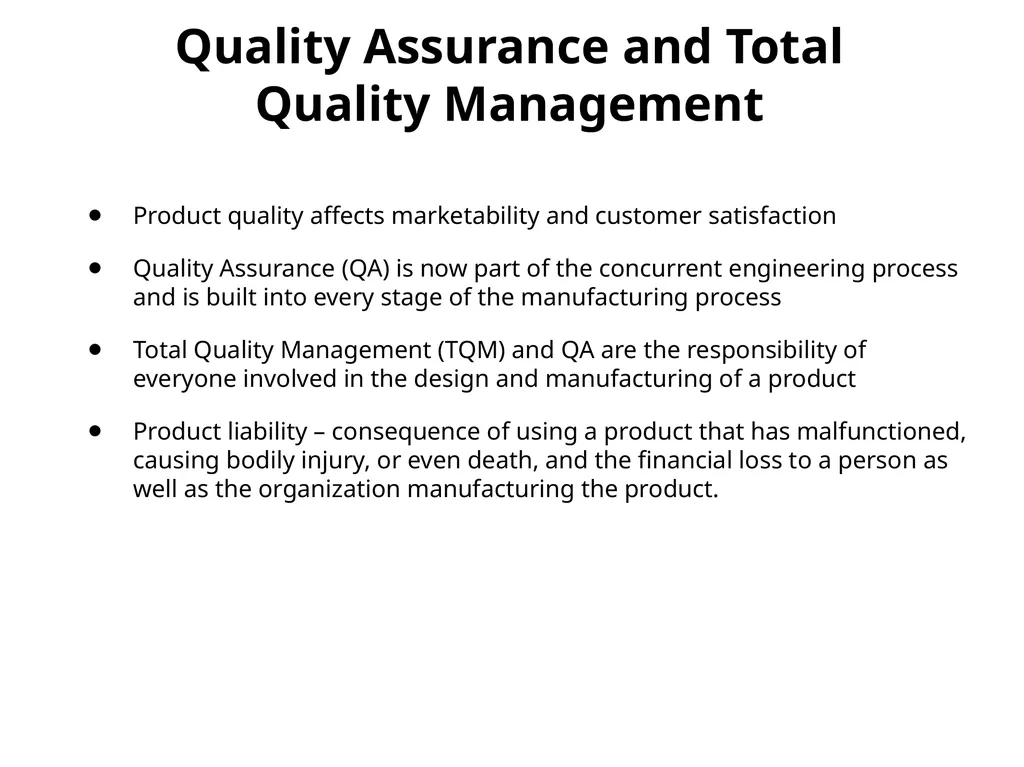
slide12. Quality Assurance and Total Quality Management Product quality affects marketability and customer satisfaction
Quality Assurance (QA) is now part of the concurrent engineering process and is built into every stage of the manufacturing process
Total Quality Management (TQM) and QA are the responsibility of everyone involved in the design and manufacturing of a product
Product liability – consequence of using a product that has malfunctioned, causing bodily injury, or even death, and the financial loss to a person as well as the organization manufacturing the product. 4/2 12 ME355 Spring 2014<br>
slide13. Manufacturing Cost and Global Competitiveness Manufacturing cost
~40% of product selling price
Includes cost of materials, tooling and labor, as well fixed and capital costs
Can be minimized by optimizing design, least cost material, while maintaining the intended function and characteristics, and materials substitution.
Global competitiveness impacts manufacturing
Markets become multinational and dynamic
Demand for high-quality, low-cost and timely delivery
Increased product variety, complexity and shorter product life cycle
Wide disparity in manufacturing labor cost leads to outsourcing
Outsourcing – a practice of taking internal company activities and paying outside firm to perform them. 4/2 13 ME355 Spring 2014<br>
slide14. General Trend in Manufacturing Better Materials
Better control of composition, purity, and defects to enhance their overall properties, manufacturing characteristics, reliability, and service life while keeping cost low
Better recyclability, and higher strength-, stiffness-to-weight ratio materials due to concerns over energy and material saving
Better tool, die and mold materials with better resistance to process variable, thus higher efficiency and economics of manufacturing processes
Improved efficiency and reliability of all manufacturing processes, equipment and systems due to continuing development in computers, controls, industrial robots, automated inspection, handling and assembly, and sensor technology 4/2 14 ME355 Spring 2014<br>
slide15. Summary Manufacturing and its importance to economy
Concurrent Engineering
Design for Manufacturing, Assembly, Disassembly, Service
Green Design, Sustainable Manufacturing, Product Life Cycle
Materials Selection, Process Selection
Computer Integrated Manufacturing
Lean Production, Agile Manufacturing
Quality Control, Total Quality Assurance
Manufacturing Cost, Global Competitiveness, Outsourcing 4/2 15 ME355 Spring 2014<br>
slide16. Pop Quiz One one-plot, draw engineering stress-strain curve and true stress- strain curve of a ductile metal (e.g., Al)
Label Young’s modulus, ultimate tensile strength, toughness, yield strength
Answer:
How does temperature affect the strength of a metal?
How does the strain rate affect the strength of a metal? 4/2 16 ME355 Spring 2014<br>
slide17. Factors affecting Process Selection Component/part shape
Materials characteristics – castability, formability, machinability, weldability, etc
Part size and dimensional accuracy
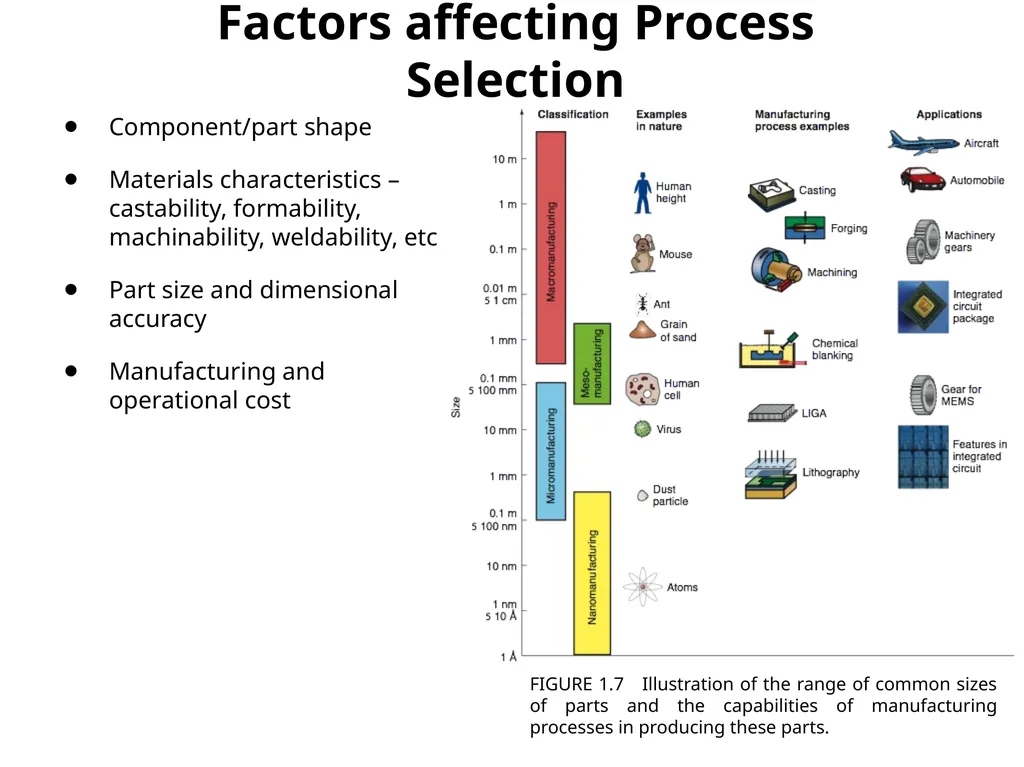
Manufacturing and operational cost FIGURE 1.7 Illustration of the range of common sizes of parts and the capabilities of manufacturing processes in producing these parts. 4/2 17 ME355 Spring 2014<br>
slide18. Concurrent Engineering Sequential Process
Design ->Manufacturing
Waste resource, waste time
Concurrent Process
All disciplines are involved in the earliest stages of product design
Progress concurrently so iterations results in less wasted effort and time
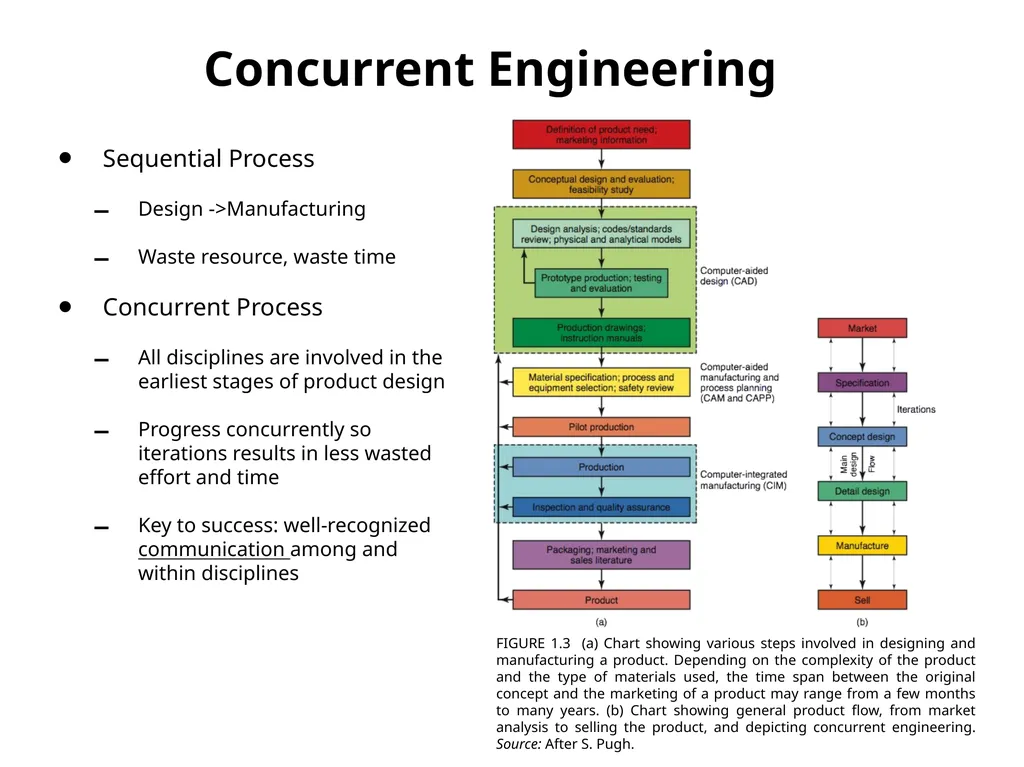
Key to success: well-recognized communication among and within disciplines FIGURE 1.3 (a) Chart showing various steps involved in designing and manufacturing a product. Depending on the complexity of the product and the type of materials used, the time span between the original concept and the marketing of a product may range from a few months to many years. (b) Chart showing general product flow, from market analysis to selling the product, and depicting concurrent engineering. Source: After S. Pugh. 4/2 18 ME355 Spring 2014<br>
slide19. Survey Results on Prior Manufacturing Experience 15 students – good amount of experience
Processes: casting/molding, CNC machining, Welding, cutting, drilling, waterjet …
Jobs/interns at industry
School teams/home projects: FSAE, UWHPS, high school robotics ….
Materials: wood, metals, composites, plastics…
…..
20 students – some limited machine shop experience
7 students – some experience with wood working
20 students – no experience 4/2 19 ME355 Spring 2014<br>
Winter 2015 4/2 1 ME355 Spring 2014<br>
slide2. General Terminology Manufacturing
Concurrent Engineering
Design for Manufacturing, Assembly, Disassembly, Service
Green Design, Sustainable Manufacturing, Product Life Cycle
Materials Selection, Process Selection
Computer Integrated Manufacturing
Lean Production, Agile Manufacturing
Quality Control, Total Quality Assurance
Manufacturing Cost, Global Competitiveness 4/2 2 ME355 Spring 2014<br>
slide3. Manufacturing 4/2 3 ME355 Spring 2014 The process of converting raw materials into products; encompasses the deign and manufacturing of goods using various production methods and techniques.
~ came from Latin “manu factus” – made by hand
Interchangeably used with “production”
Manufactured item has monetary worth (added value) than raw materials
Manufacturing is closely linked to national and global economy<br>
slide4. Importance of Manufacturing to Economy Traditionally, higher % contribution of manufacturing, higher GDP
Exceptions:
Nations with natural resources have higher living standards
Nations with higher GDP have economic activity concentrated on high value-added products, e.g, airplanes, automobiles, electronics.
Labor intensive manufacturing is associated with countries who follow the traditional trend. 4/2 4 ME355 Spring 2014 Source: After J.A. Schey with data from the World Development Report, World Bank, various years.<br>
slide5. Concurrent Engineering ~ Simultaneous Engineering
A systematic approach integrating the design and manufacture of the products with the view toward optimizing all elements involved in the life cycle of the product
Basic goal
Minimize design and manufacture changes
Minimize time and cost in taking the product from conceptual design to production and introduction of the product to market
Key to success:
Full support of an organization’s top management
Multifunctional and interacting work team, including support groups
Utilization of all available state-of-the-art technologies 4/2 5 ME355 Spring 2014<br>
slide6. Design for Manufacture, Assembly, Disassembly, and Service Each part or component of a product must be designed to not only meets design requirements and specifications, but also to be manufactured economically and with relative ease.
Product must be designed that individual parts can be assembled together with ease, speed, and minimum cost.
Product must also be designed so that disassembly is possible with relative ease and require little time, enabling the product to be taken apart for maintenance, servicing, or recycling of their components.
Product must be designed so that individual parts are easy to reach and service. 4/2 6 ME355 Spring 2014<br>
slide7. Green Design, Sustainable Manufacturing, and Product Life Cycle Green Design - Design for Recycling (DFR) - Design for Environment (DFE)
Sustainable Manufacturing
Reducing waste of materials at their source by refinement in product design and the amount of materials used
Reducing the use of hazardous materials in products and processes
Ensuring proper handling and disposal of all waste
Improving waste treatment and recycling and reuse of materials
Product Life Cycle (PLC)
Product development
Market Introduction
Growth
Maturation
Decline 4/2 7 ME355 Spring 2014<br>
slide8. Materials Selection Materials used in today’s manufacturing
Metals
Ferrous metals: carbon steels, alloy steels, stainless steels, and tool and die steels
Nonferrous metals and alloys: Al, Mg, Cu, Ni, superalloys, Ti, refractory metals (Mb, Nb, W, Ta), beryllium, Zr, low melting alloys (lead, zinc and tin), and precious metals
Plastics: Thermosets, thermoplastics, and elastomers
Ceramics: Glass ceramics, glasses, graphite, and diamond
Composites: Reinforced plastics, metal-matrix and ceramics-matrix composites, and honeycomb structures
Nanomaterials, shape-memory alloys, metal foams, amorphous alloys, super conductors and semiconductors
Material properties: mechanical, physical, chemical, manufacturing
Cost and availability, Service life and recycling 4/2 8 ME355 Spring 2014<br>
slide9. Manufacturing Process Selection Categories of manufacturing processes
Casting: expandable molding and permanent molding
Forming and shaping: rolling, forging, extrusion, drawing, sheet forming, powder metallurgy and molding
Machining: turning, boring, drilling, milling, planing, shaping, broaching, grinding, ultrasonic machining; chemical, electrical, and electrochemical machining and high energy electron beam machining
Joining: welding, brazing, soldering, diffusion bonding, adhesive bonding and mechanical joining
Micro and nano manufacturing: surface micromachining, dry and wet etching, and electroforming
Finishing: honing, lapping, polishing, burnishing, deburring, surface treating, coating and plating
Factors affecting process selection
Component/part shape
Materials characteristics – castability, formability, machinability, weldability, etc
Part size and dimensional accuracy
Manufacturing and operational cost 4/2 9 ME355 Spring 2014<br>
slide10. Computer Integrated Manufacturing CIM applications
Control and optimization of manufacturing process
Materials handling
Assembly
Automated inspection and testing of products
Inventory control
Management
Advantages
Improved responsiveness
Better use of materials, machinery and personnel, reduction in inventory
Better control of production and management
Manufacturing high-quality at low-cost 4/2 10 ME355 Spring 2014<br>
slide11. Lean Production and Agile Manufacturing Lean Production (~lean manufacturing): a manufacturing practice that considers the expenditure of resources for any goals other than creating values for the end customer as wasteful, thus a target for elimination
A major assessment of each activity of a company regarding the efficiency and effectiveness of its operations (company operation)
The efficiency of the machinery and equipment used in the operation while maintaining and improving quality (equipment)
The number of personnel involved in a particular operation (personnel)
A thorough analysis in order to reduce the cost of each activity, including both productive and nonproductive labor (activity cost effectiveness)
Goal: continuously improving the efficiency and profitability by reducing all types of waste from its operation (“0”-base waste) and dealing with problems asap.
Agile Manufacturing
Ensuring flexibility (agility) in the manufacturing enterprise so that it can quickly respond to changes in product variety and demand, and customer needs
To be achieved through
Machines and equipment with Built-in flexibility (reconfigurable machines) using modular components that can be arranged and rearranged in different ways
Advanced computer hardware and software
Reduced changeover time and implementing advanced communication systems. 4/2 11 ME355 Spring 2014<br>
slide12. Quality Assurance and Total Quality Management Product quality affects marketability and customer satisfaction
Quality Assurance (QA) is now part of the concurrent engineering process and is built into every stage of the manufacturing process
Total Quality Management (TQM) and QA are the responsibility of everyone involved in the design and manufacturing of a product
Product liability – consequence of using a product that has malfunctioned, causing bodily injury, or even death, and the financial loss to a person as well as the organization manufacturing the product. 4/2 12 ME355 Spring 2014<br>
slide13. Manufacturing Cost and Global Competitiveness Manufacturing cost
~40% of product selling price
Includes cost of materials, tooling and labor, as well fixed and capital costs
Can be minimized by optimizing design, least cost material, while maintaining the intended function and characteristics, and materials substitution.
Global competitiveness impacts manufacturing
Markets become multinational and dynamic
Demand for high-quality, low-cost and timely delivery
Increased product variety, complexity and shorter product life cycle
Wide disparity in manufacturing labor cost leads to outsourcing
Outsourcing – a practice of taking internal company activities and paying outside firm to perform them. 4/2 13 ME355 Spring 2014<br>
slide14. General Trend in Manufacturing Better Materials
Better control of composition, purity, and defects to enhance their overall properties, manufacturing characteristics, reliability, and service life while keeping cost low
Better recyclability, and higher strength-, stiffness-to-weight ratio materials due to concerns over energy and material saving
Better tool, die and mold materials with better resistance to process variable, thus higher efficiency and economics of manufacturing processes
Improved efficiency and reliability of all manufacturing processes, equipment and systems due to continuing development in computers, controls, industrial robots, automated inspection, handling and assembly, and sensor technology 4/2 14 ME355 Spring 2014<br>
slide15. Summary Manufacturing and its importance to economy
Concurrent Engineering
Design for Manufacturing, Assembly, Disassembly, Service
Green Design, Sustainable Manufacturing, Product Life Cycle
Materials Selection, Process Selection
Computer Integrated Manufacturing
Lean Production, Agile Manufacturing
Quality Control, Total Quality Assurance
Manufacturing Cost, Global Competitiveness, Outsourcing 4/2 15 ME355 Spring 2014<br>
slide16. Pop Quiz One one-plot, draw engineering stress-strain curve and true stress- strain curve of a ductile metal (e.g., Al)
Label Young’s modulus, ultimate tensile strength, toughness, yield strength
Answer:
How does temperature affect the strength of a metal?
How does the strain rate affect the strength of a metal? 4/2 16 ME355 Spring 2014<br>
slide17. Factors affecting Process Selection Component/part shape
Materials characteristics – castability, formability, machinability, weldability, etc
Part size and dimensional accuracy
Manufacturing and operational cost FIGURE 1.7 Illustration of the range of common sizes of parts and the capabilities of manufacturing processes in producing these parts. 4/2 17 ME355 Spring 2014<br>
slide18. Concurrent Engineering Sequential Process
Design ->Manufacturing
Waste resource, waste time
Concurrent Process
All disciplines are involved in the earliest stages of product design
Progress concurrently so iterations results in less wasted effort and time
Key to success: well-recognized communication among and within disciplines FIGURE 1.3 (a) Chart showing various steps involved in designing and manufacturing a product. Depending on the complexity of the product and the type of materials used, the time span between the original concept and the marketing of a product may range from a few months to many years. (b) Chart showing general product flow, from market analysis to selling the product, and depicting concurrent engineering. Source: After S. Pugh. 4/2 18 ME355 Spring 2014<br>
slide19. Survey Results on Prior Manufacturing Experience 15 students – good amount of experience
Processes: casting/molding, CNC machining, Welding, cutting, drilling, waterjet …
Jobs/interns at industry
School teams/home projects: FSAE, UWHPS, high school robotics ….
Materials: wood, metals, composites, plastics…
…..
20 students – some limited machine shop experience
7 students – some experience with wood working
20 students – no experience 4/2 19 ME355 Spring 2014<br>