04
THE JOINT COMMISSION: PATIENT SAFETY SYSTEMS’ CORE VALUES Enhance Quality of Care
Ensure Safety of Patients<br>
05
SAFETY BASIS IN QUALITY Patient Safety: The prevention of errors and adverse effects to patients that are associated with healthcare.
Patient safety events may not be completely eliminated.
Harm to patients can be reduced, and the goal is always zero harm.<br>
06
GUIDING PRINCIPLES TOWARDS CORE VALUES Align exist standards with the daily work system to integrate staff and patient activities in spatial and temporal scales.
Promote updated knowledge, skill and competence by recommending better methods that will improve quality and safety of health care.
Encourage and recommend proactive quality and patient safety methods to increase accountability, trust, and knowledge while reducing the impact of fear and blame.<br>
07
QUALITY OF HEALTH CARE AS AN ESSENCE TO SAFETY Components Of A Quality Management System
Enhances reliability of the process
Decreases variation and defects (waste)
Focuses on achieving better outcomes
Use of evidence to ensure that a service is satisfactory. See appendix: 1<br>
08
HEALTH CARE AS A COMPLEX ENVIRONMENT Health care centres aims to increase the reliability of their complex systems by:
Making risk of patient harm apparent
Eliminating the risk<br>
09
RISK FACTOR Joint Commission–accredited organizations continually focuses on eliminating :
Systems failures
Human errors
They cause Harm to Patients, Families, and Staff. See appendix: 1<br>
10
JOINT COMMISSION’S ACCREDITATION PROCESS ROLE Role: Enhance quality of care and patient safety through an integrated approach.
Motive: To reduce Variation, Risk, and Improve Quality.<br>
11
INTEGRATED APPROACH Focuses on:
Meeting requirements or standards for health care.
Constant analysis through survey processes of health care systems.
Involves the Sentinel Event Policy in occurrence of harm.
Joint Commission initiatives.
To meet the Motives of the Joint Commission’s Accreditation Process.<br>
12
ROLE OF LEADERSHIP IN THE HEALTH CARE INTEGRATED APPROACH Health Care as a complex environment depend on strong leadership to support an integrated patient safety system.
This is done through:
Developing a safety culture in health care centres.
Involving Valid innovative methods to improve processes and systems.
Adopting and integrating Safe technologies in health care.
Creating Standards for ways for interdisciplinary teams communication and collaboration.<br>
13
LEADERSHIP ACTION ON THE WORK SYSTEM Leaders build the foundation for an effective patient safety system by:
Promoting learning.
Motivating staff to uphold a fair and just safety culture.
Providing a transparent environment in which quality measures and patient harms are freely communicated amongst staff.
Modelling professional behaviour.
Removing intimidating behaviour that might prevent safe behaviours.
Providing the resources and training necessary to take on improvement initiatives and innovation.<br>
14
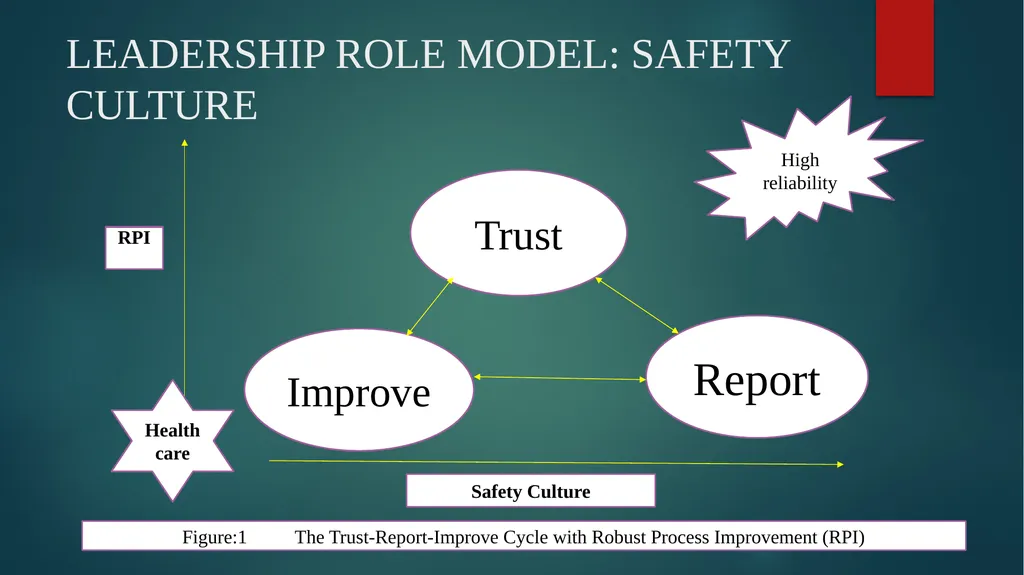
LEADERSHIP ROLE MODEL: SAFETY CULTURE Trust Improve Report RPI Safety Culture Health care High reliability Figure:1 The Trust-Report-Improve Cycle with Robust Process Improvement (RPI)<br>
15
SUCCESS OF INTEGRATED APPROACH An integrated patient safety system demands that staff and leaders work together to:
Eliminate complacency.
Promote collective mindfulness in meeting the health care goal.
Cooperate with respect and compassion for a favourable health care environment.
Learn from their patient safety events, including close calls and other system failures in the current and future situations.<br>
16
SAFETY CULTURE A strong safety culture is a crucial starting point for health care centres striving to become learning centres.
Attributes:
Transparency, accountability, and mutual respect amongst staff and leaders.
Safety is prioritised by all stakeholders.
Reporting threats to safety at every stakeholder level.
Collective mindfulness in improving safety level.
Eliminating blame at all stakeholder levels.
A learning centre develops under these basis of Trust (Figure: 1). See appendix: 1<br>
17
INVESTIGATING SENTINEL EVENTS An effective culture of safety pertains to a robust reporting system and use of measurement to improve.
There should be:
A non-punitive approach for safety reporting.
Education to enable staff to identify safety elements worth reporting.
This is so as to:
Provide timely feedback on every action taking in enhancing safety in health care centres.<br>
18
COLLECTING DATA This is the primary step in attempting to improve safety level.
An evidence-based process is initiated in:
Identifying problems, prioritising issues, developing solutions and following up to evaluate success.
Objective data can be used to:
Support decisions making.
Influence people to change their behaviours.
Enable compliance with evidence-based care guidelines.<br>
19
DATA ANALYSIS It is the diagnosis of the health care issues with the data collected to generate information.
It requires critical competency: To collect relevant data and apply relevant analysis tools. See appendix: 1<br>
20
TOOLS IN DATA ANALYSIS Statistical Process Control Chart
Capability Chart
Run Chart<br>
21
PREVENTING HARM: PROACTIVE APPROACH Harm is prevented before reaching patients, the approach:
Enable correction of issues in the processes.
Evaluate potential failure and success of process.
Increases understanding about complexities in process design and management.
Prioritize High-risk, High-frequency Areas. See appendix :1<br>
22
BENEFITS OF A PROACTIVE APPROACH Identifies actionable common causes.
Avoids unintended consequences.
Identifies commonalities across departments/services/units.
Identifies system solutions.<br>
23
TOOLS FOR PROACTIVE APPROACH In addressing proactive approach question: What if?
The Tool:
The Failure Modes and Effects Analysis (FMEA).
Contingency Diagram<br>
24
CONTROLLING SENTINEL EVENTS Inclusivity and cooperation of stakeholders in PATIENT ACTIVATION, (See appendix: 1).
Grounds: Information sharing and support in decision making about health care.
Stakeholders: Patients, their families, staff and leaders.
Patient Activation meets Patient Safety Goal<br>
25
A PATIENT CENTRED APPROACH Principles:
Patient safety guides all decision making.
Patient- and family-centred care is verifiable, rewarded, and celebrated.
Staffing levels are sufficient, and staff has the necessary tools and skills.
The organization has a focus on measurement, learning, and improvement.<br>
26
APPENDICES References
Abe, K. H. C., & Tuppal, C. P. (2018). Patient Safety Goals’ Level of Attainment
in Selected Tertiary Hospitals in Manila, Philippines: A Preliminary Study. Nurse Media Journal of Nursing, 8(1), 1-12.
Makar, A., Kodera, A., & Bhayani, S. B. (2015). Never events in surgery.
European urology, 68(6), 919-920.
Mascioli, S., & Carrico, C. B. (2016). Spotlight on the 2016 national patient safety
goals for hospitals. Nursing2018 Critical Care, 11(6), 19-22.
Pettker, C. M. (2017, April). Systematic approaches to adverse events in
obstetrics, Part I:Event identification and classification. In Seminars in perinatology (Vol. 41, No. 3, pp. 151-155). WB Saunders.
Lee, L. M., & Henderson, D. K. (2017). Identifying, Understanding, and Managing
PatientSafety and Clinical Risks in the Clinical Research Environment. In Principles and Practice of Clinical Research (Fourth Edition) (pp. 633-644).<br>