MEASURING UNCERTAINTY IN THE FINANCIAL SECTOR AYTAÇ ERDOĞAN Statistics Department EU Workshop on Recent Developments in Business and Consumer Surveys November 13-14, 2014 Brussels, Belgium Corresponding author. aytac.erdogantcmb.gov.tr
"MEASURING UNCERTAINTY IN THE FINANCIAL SECTOR" is the property of its rightful owner. Permission is granted to
download and print the materials on this website for personal, non-commercial use only, and to display it
on your personal computer provided you do not modify the materials and that you retain all copyright
notices contained in the materials. By downloading content from our website, you accept the terms of this
agreement.
Presentation Transcript
01
MEASURING UNCERTAINTY IN THE FINANCIAL SECTOR AYTAÇ ERDOĞAN Statistics Department EU Workshop on Recent Developments in Business and Consumer Surveys
November 13-14, 2014
Brussels, Belgium
Outline What is Uncertainty?
Aim of the Paper
Summary of Literature About Measuring Uncertainty
Financial Services Survey
Methodology
Results
Conclusion<br>
03
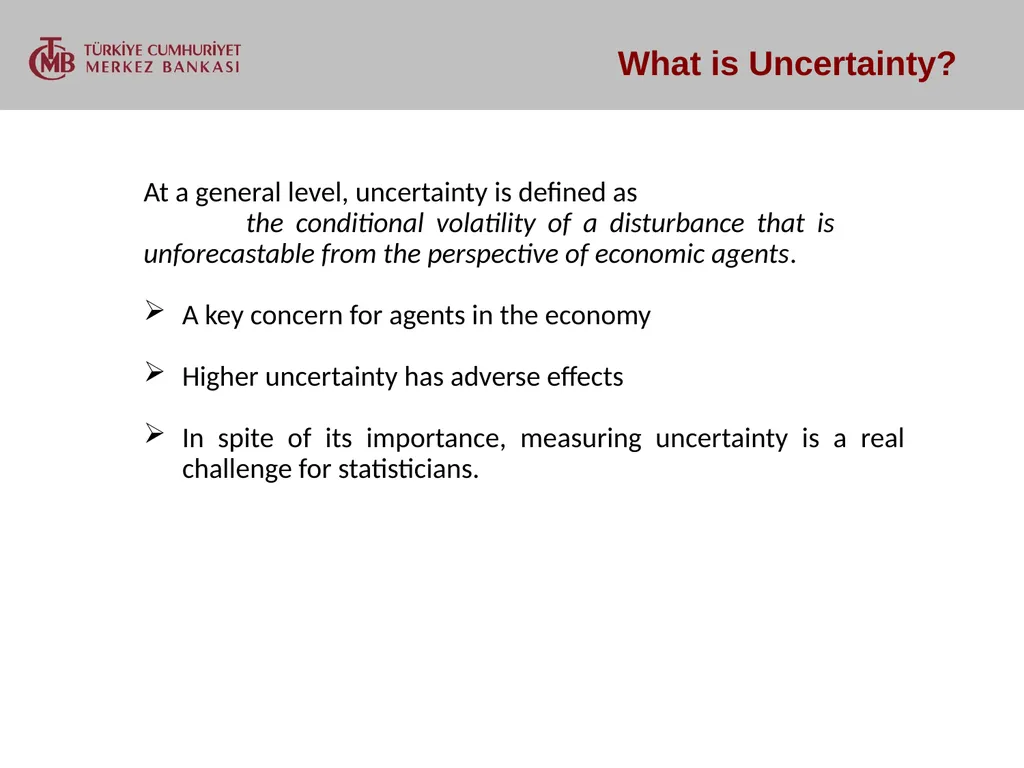
What is Uncertainty? At a general level, uncertainty is defined as
the conditional volatility of a disturbance that is unforecastable from the perspective of economic agents.
A key concern for agents in the economy
Higher uncertainty has adverse effects
In spite of its importance, measuring uncertainty is a real challenge for statisticians.<br>
04
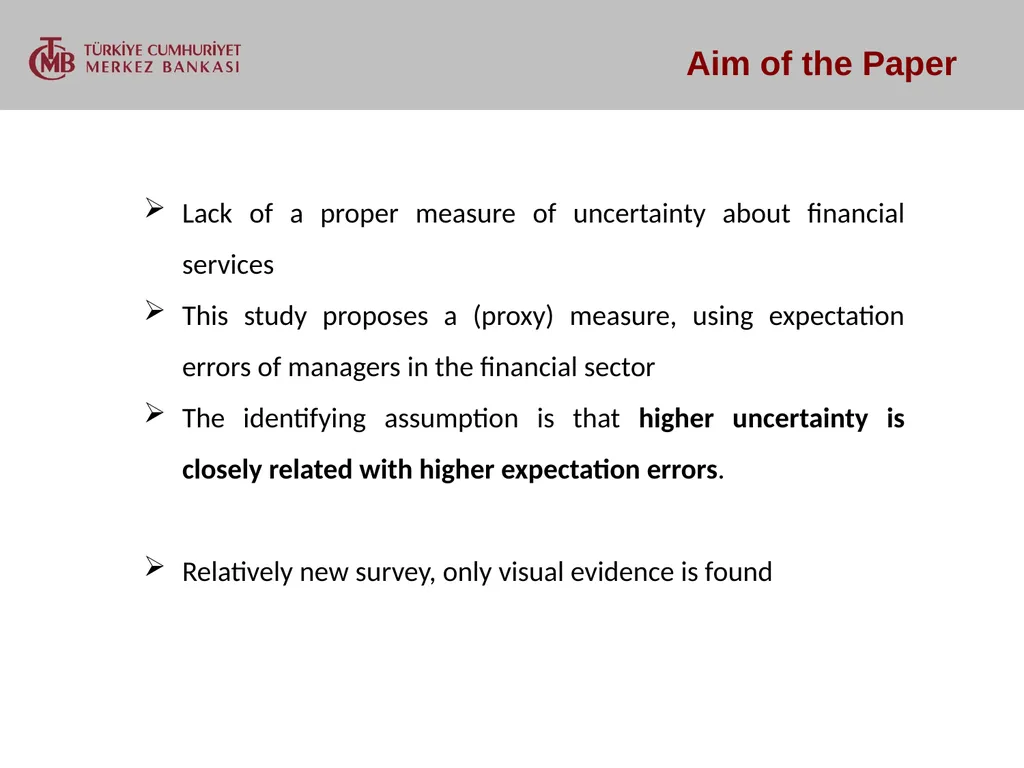
Aim of the Paper Lack of a proper measure of uncertainty about financial services
This study proposes a (proxy) measure, using expectation errors of managers in the financial sector
The identifying assumption is that higher uncertainty is closely related with higher expectation errors.
Relatively new survey, only visual evidence is found<br>
05
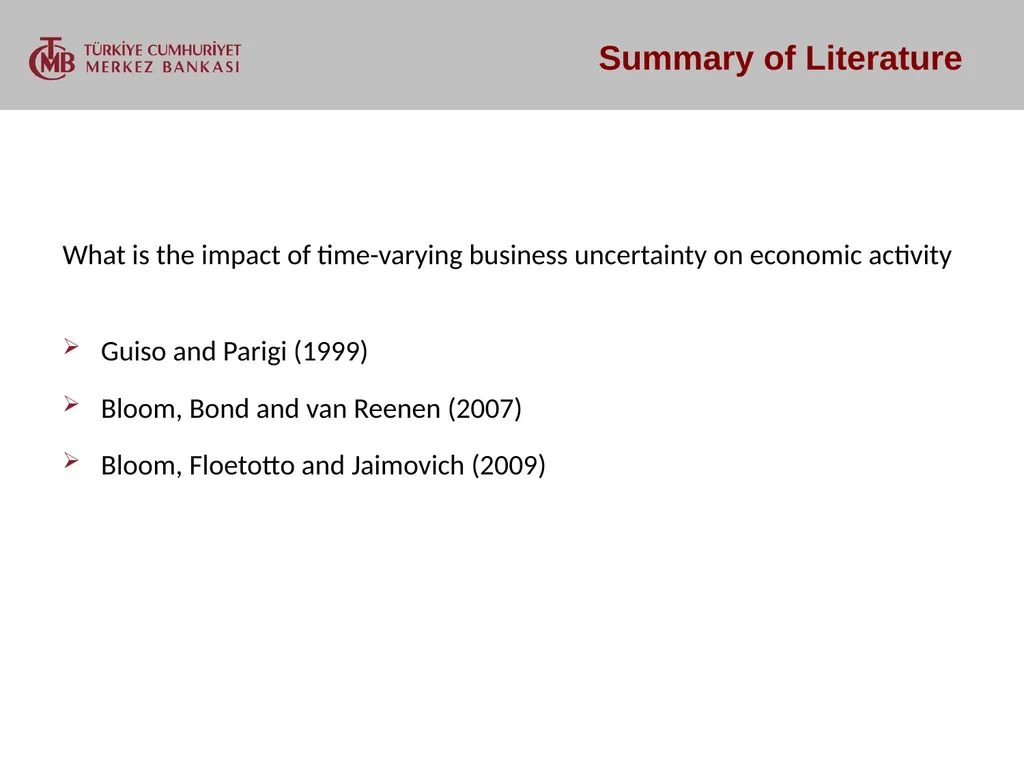
Summary of Literature What is the impact of time-varying business uncertainty on economic activity
Guiso and Parigi (1999)
Bloom, Bond and van Reenen (2007)
Bloom, Floetotto and Jaimovich (2009)<br>
06
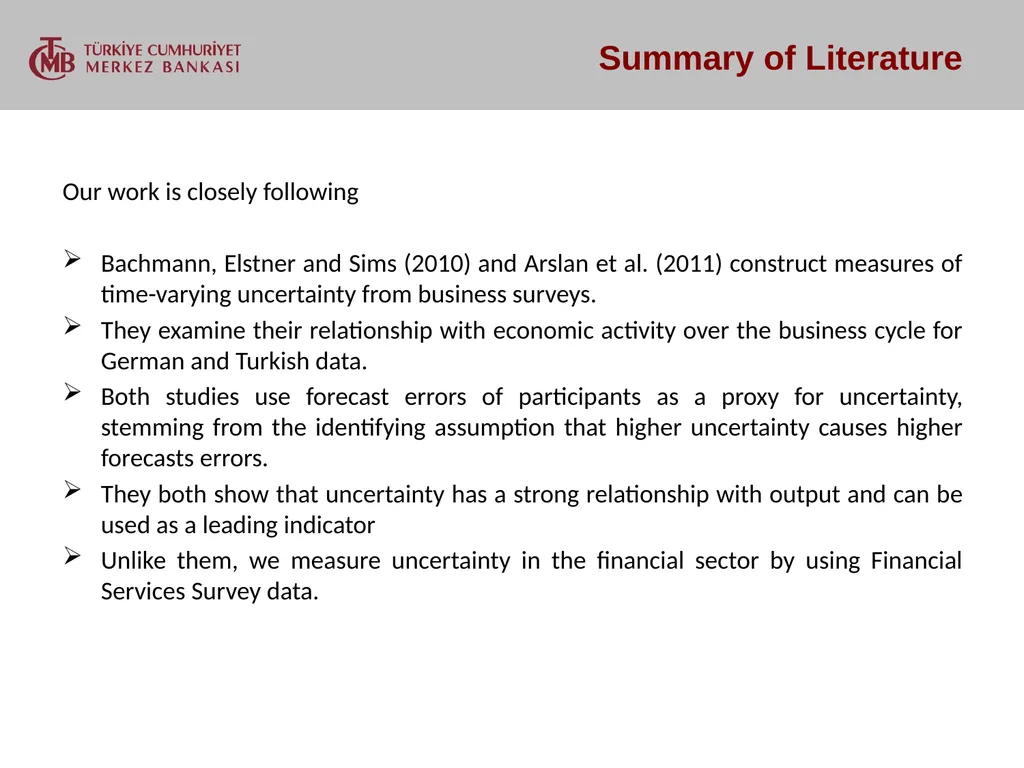
Summary of Literature Our work is closely following
Bachmann, Elstner and Sims (2010) and Arslan et al. (2011) construct measures of time-varying uncertainty from business surveys.
They examine their relationship with economic activity over the business cycle for German and Turkish data.
Both studies use forecast errors of participants as a proxy for uncertainty, stemming from the identifying assumption that higher uncertainty causes higher forecasts errors.
They both show that uncertainty has a strong relationship with output and can be used as a leading indicator
Unlike them, we measure uncertainty in the financial sector by using Financial Services Survey data.<br>
07
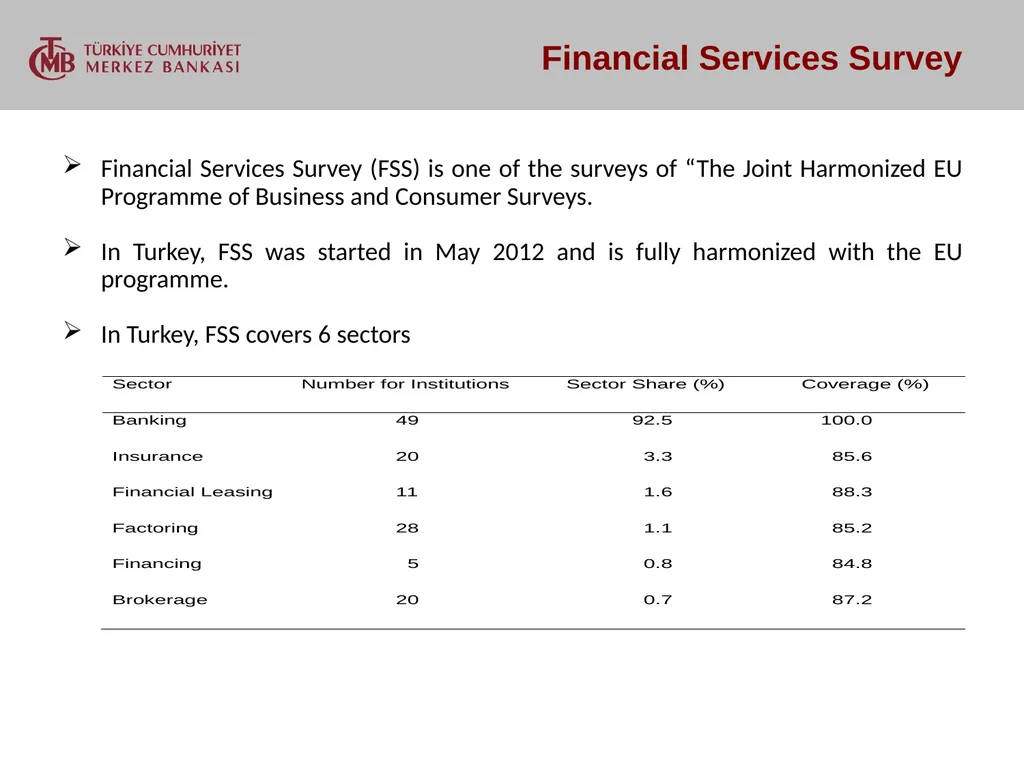
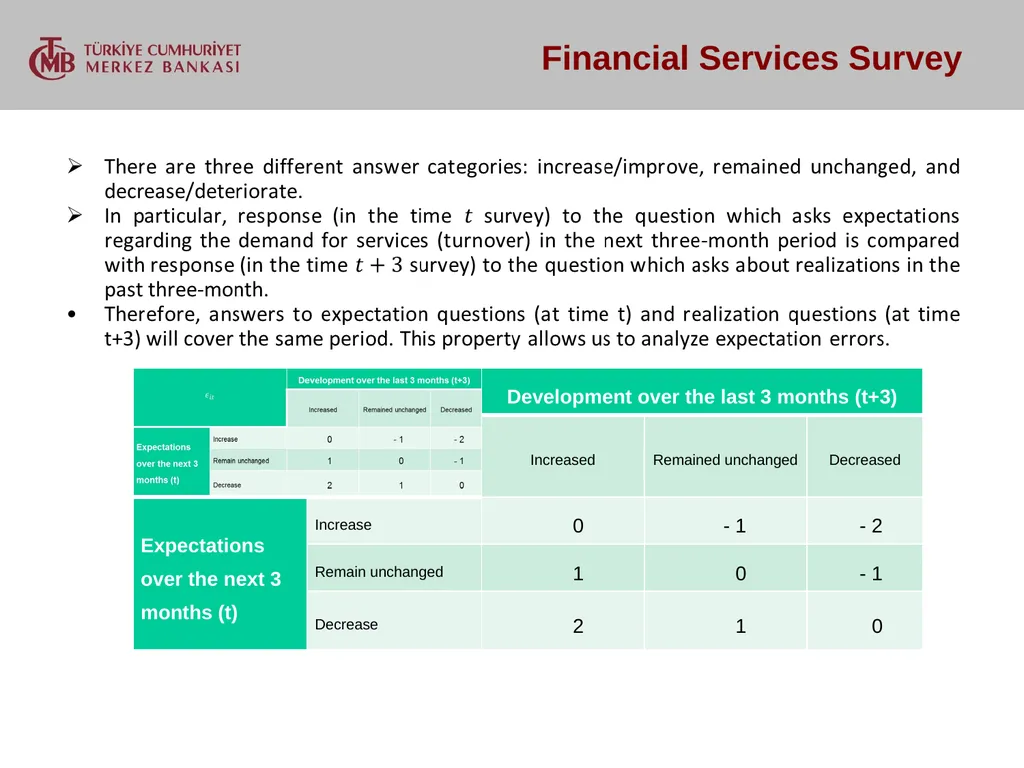
Financial Services Survey Financial Services Survey (FSS) is one of the surveys of “The Joint Harmonized EU Programme of Business and Consumer Surveys.
In Turkey, FSS was started in May 2012 and is fully harmonized with the EU programme.
In Turkey, FSS covers 6 sectors<br>
08
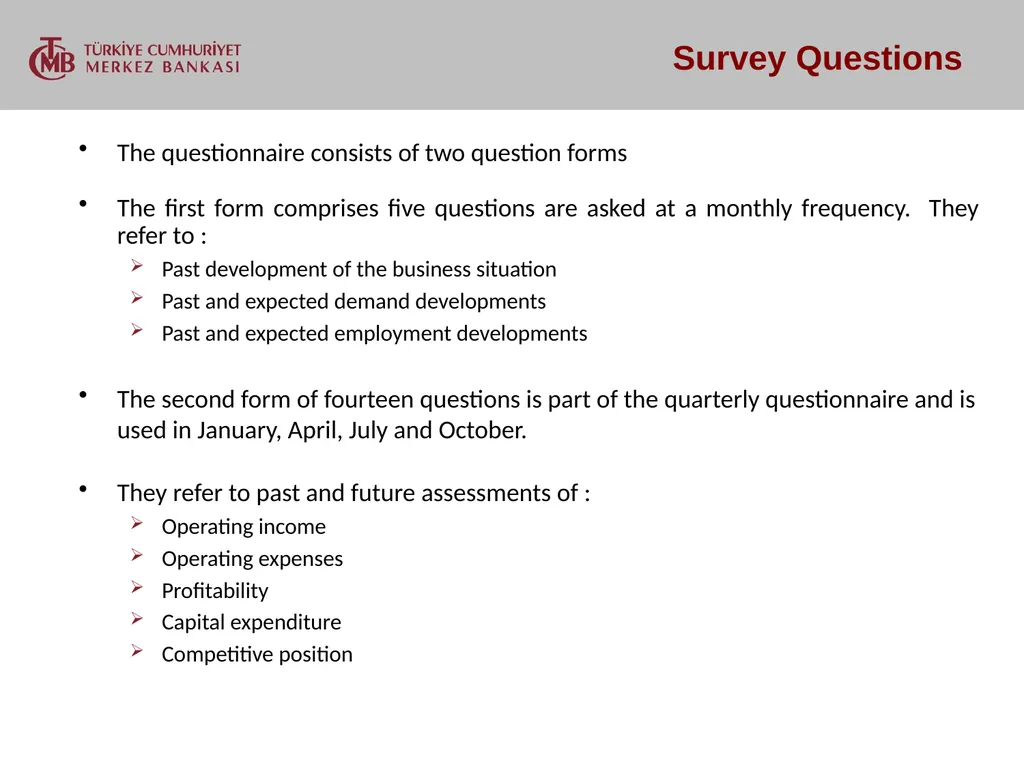
Survey Questions The questionnaire consists of two question forms
The first form comprises five questions are asked at a monthly frequency. They refer to :
Past development of the business situation
Past and expected demand developments
Past and expected employment developments
The second form of fourteen questions is part of the quarterly questionnaire and is used in January, April, July and October.
They refer to past and future assessments of :
Operating income
Operating expenses
Profitability
Capital expenditure
Competitive position<br>
09
Financial Services Survey<br>
10
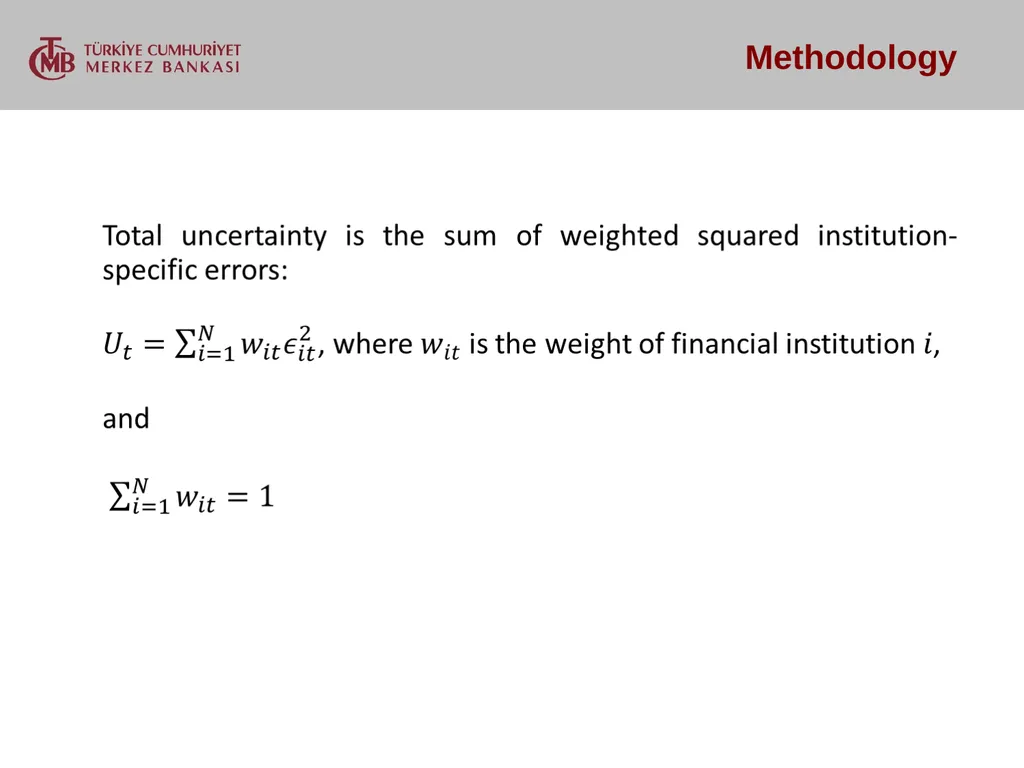
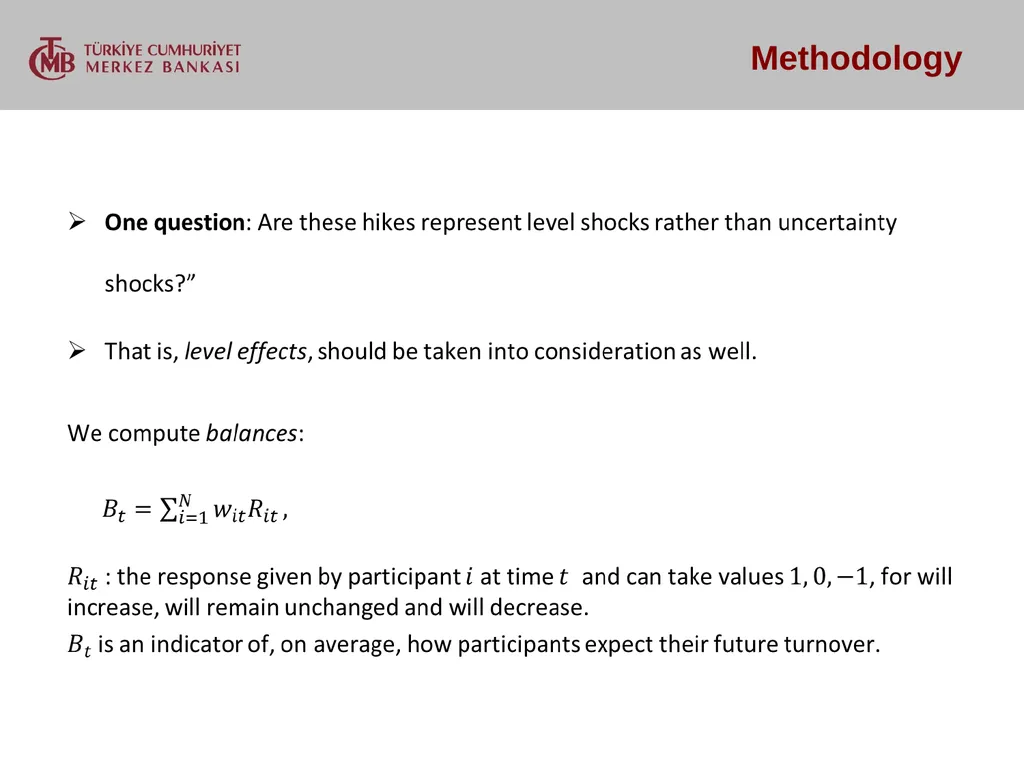
Methodology<br>
11
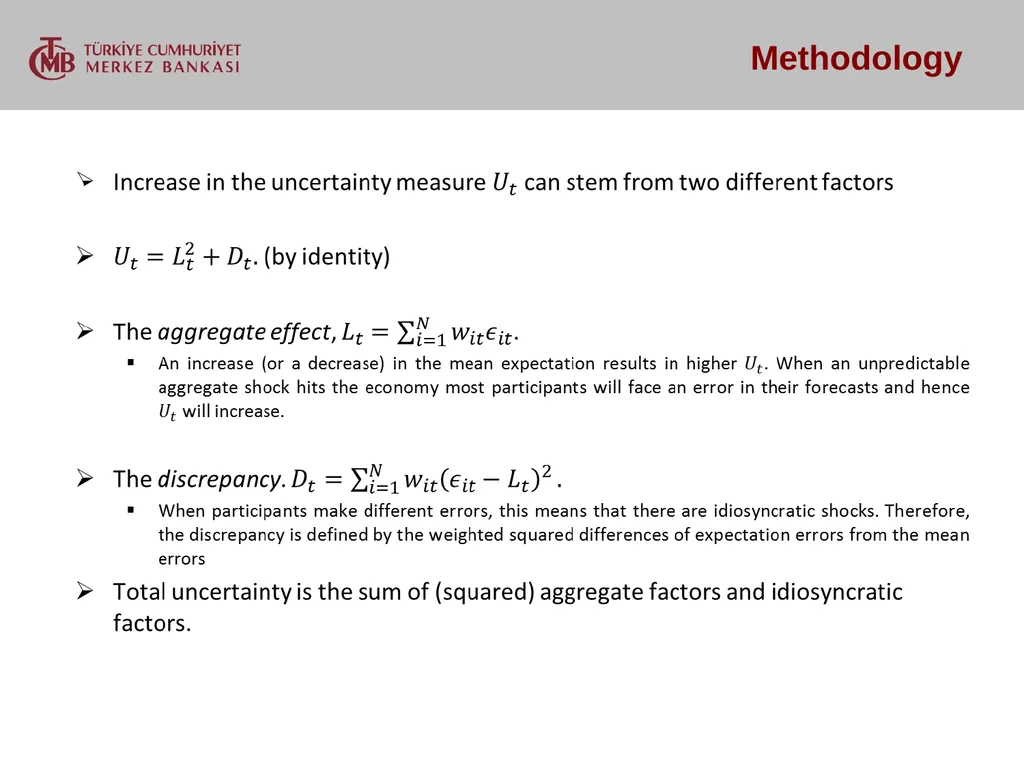
Methodology<br>
12
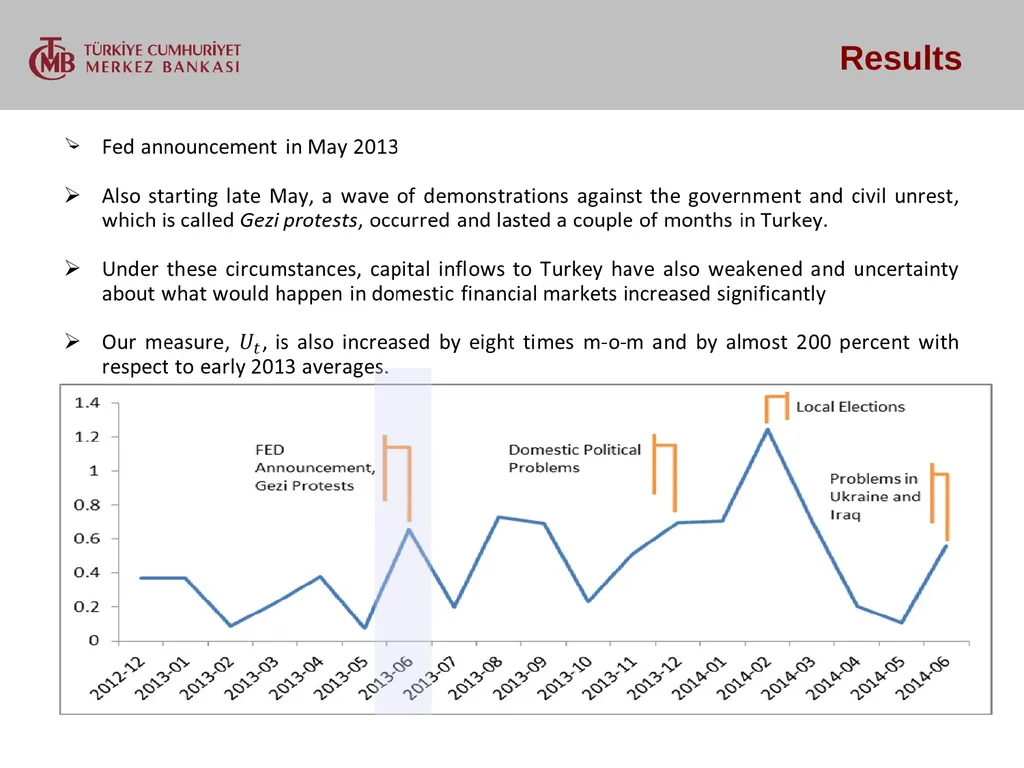
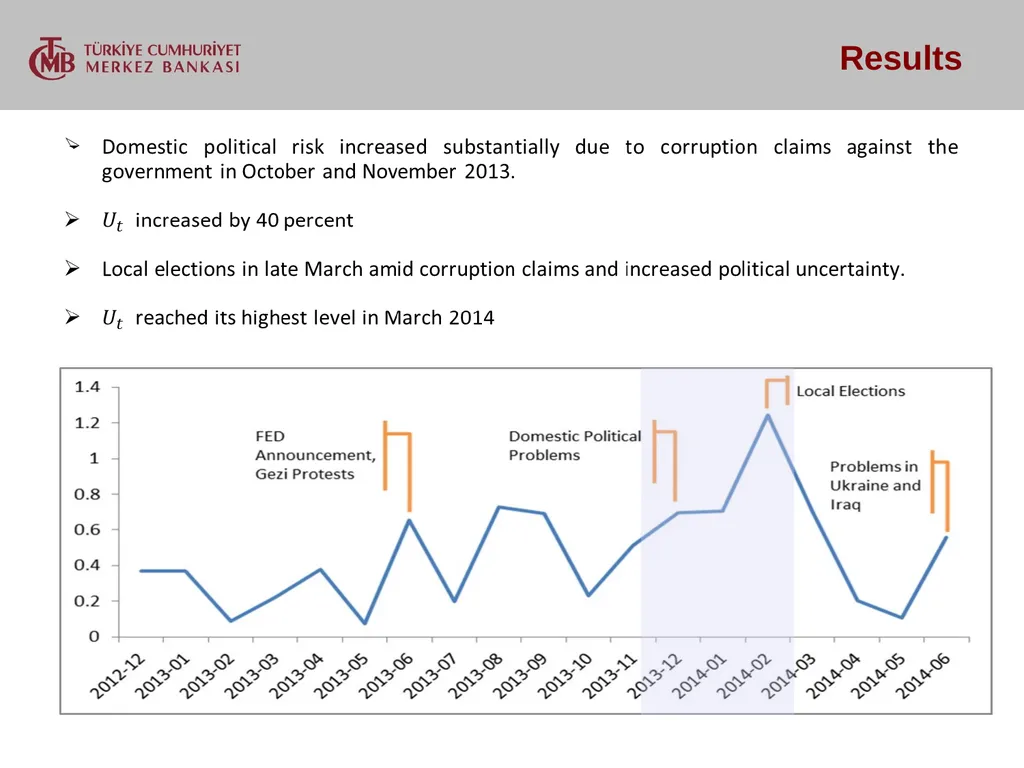
Results<br>
13
Results<br>
14
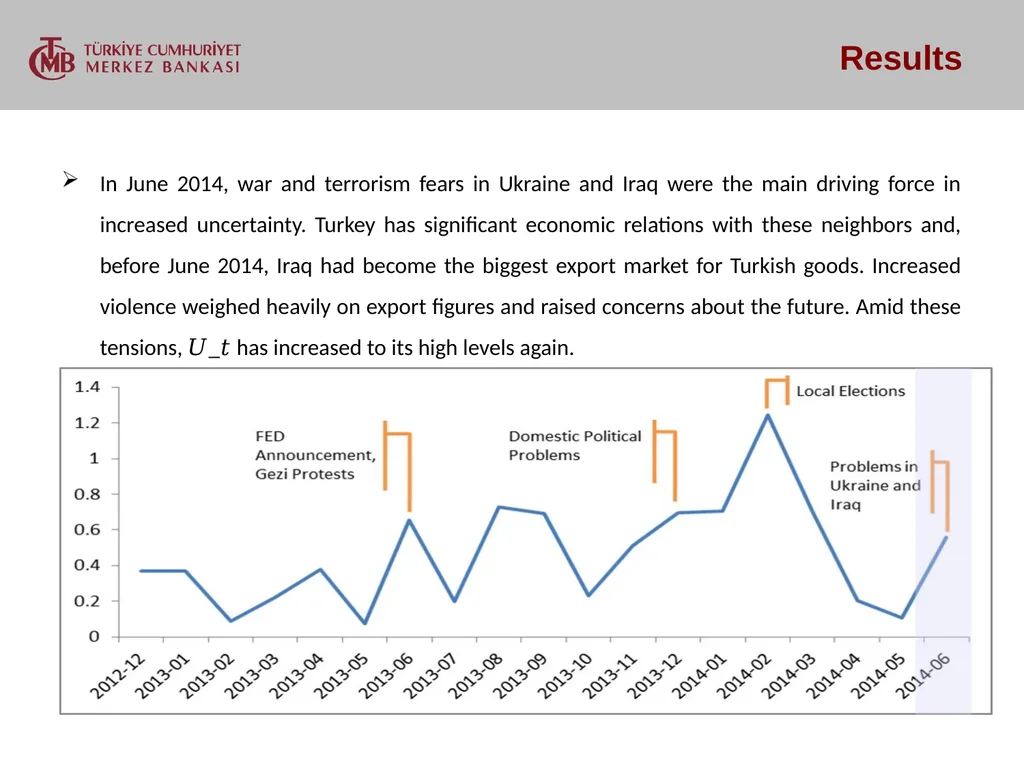
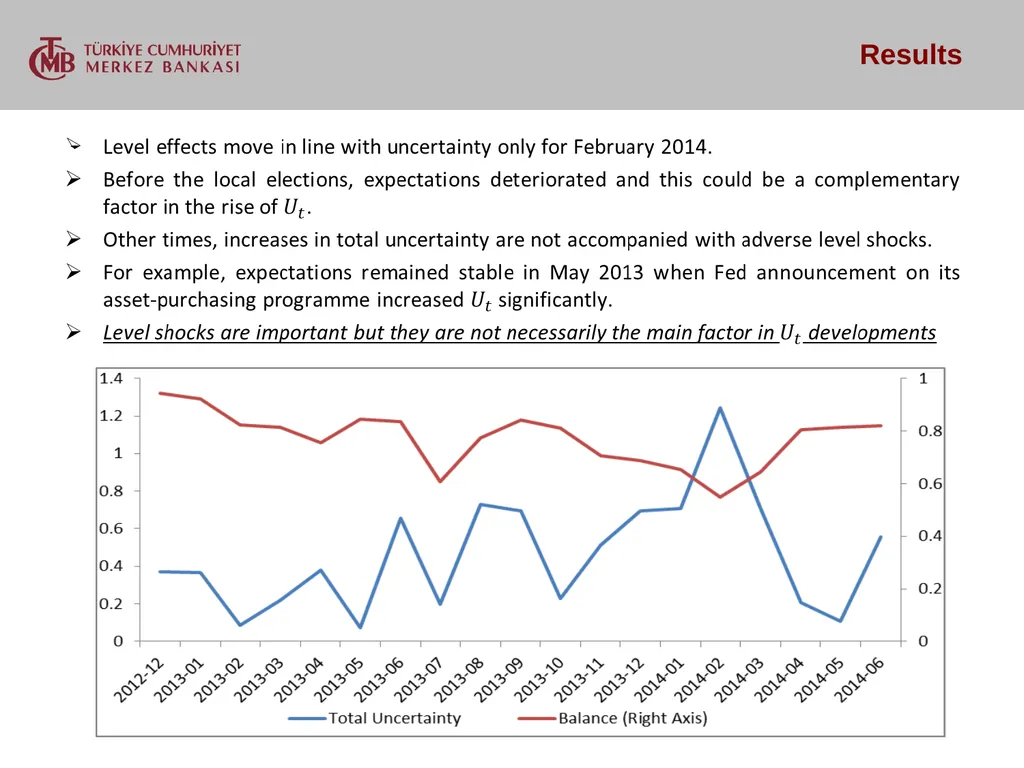
Results In June 2014, war and terrorism fears in Ukraine and Iraq were the main driving force in increased uncertainty. Turkey has significant economic relations with these neighbors and, before June 2014, Iraq had become the biggest export market for Turkish goods. Increased violence weighed heavily on export figures and raised concerns about the future. Amid these tensions, 𝑈_𝑡 has increased to its high levels again.<br>
15
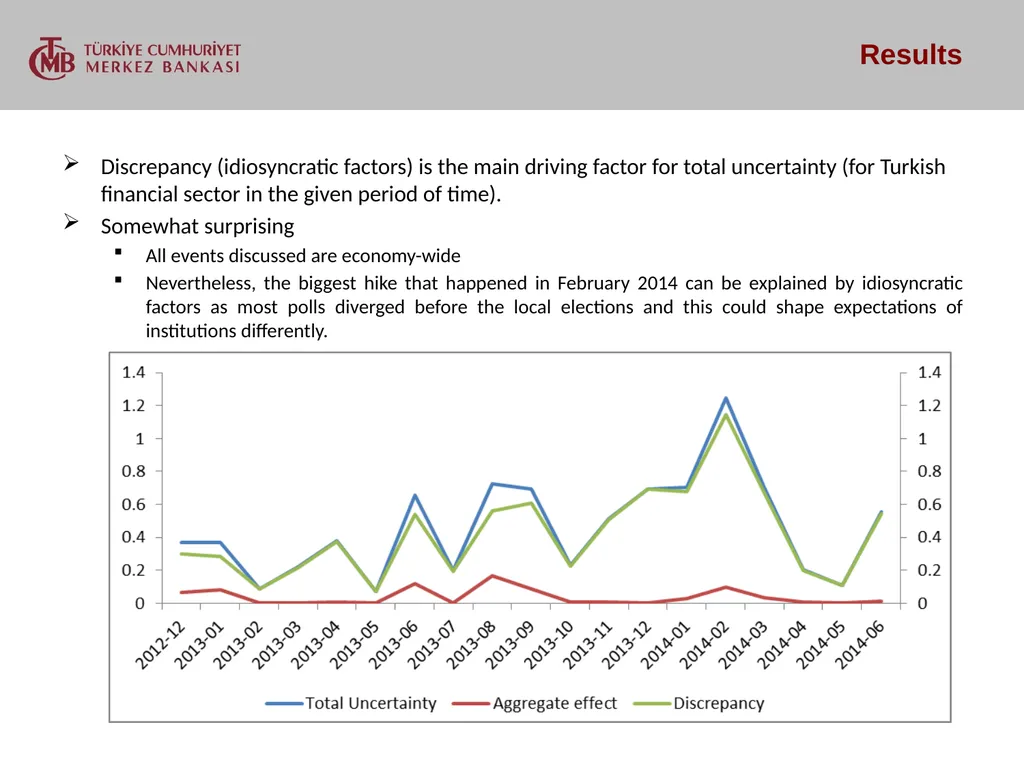
Results Discrepancy (idiosyncratic factors) is the main driving factor for total uncertainty (for Turkish financial sector in the given period of time).
Somewhat surprising
All events discussed are economy-wide
Nevertheless, the biggest hike that happened in February 2014 can be explained by idiosyncratic factors as most polls diverged before the local elections and this could shape expectations of institutions differently.<br>
16
Methodology<br>
17
Results<br>
18
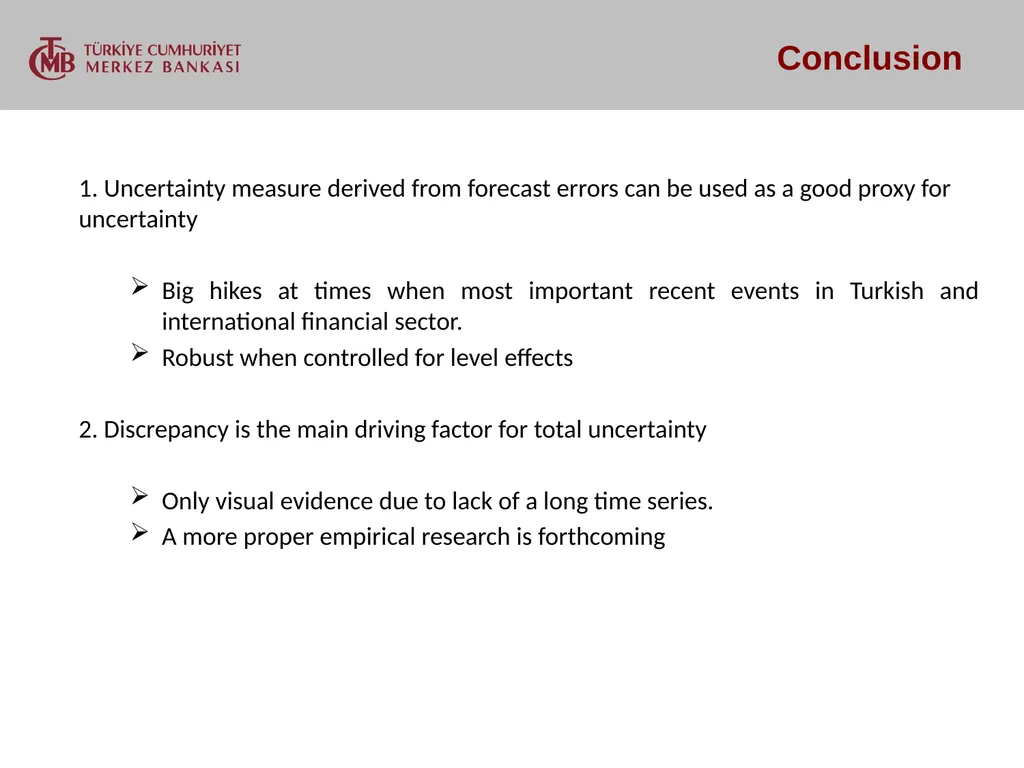
Conclusion 1. Uncertainty measure derived from forecast errors can be used as a good proxy for uncertainty
Big hikes at times when most important recent events in Turkish and international financial sector.
Robust when controlled for level effects
2. Discrepancy is the main driving factor for total uncertainty
Only visual evidence due to lack of a long time series.
A more proper empirical research is forthcoming<br>
19
CENTRAL BANK OF THE REPUBLIC OF TURKEY aytac.erdogan@tcmb.gov.tr<br>