
Media and Information Literacy Education Unit 2:
TF
Published · 15 slides · 0 views

1 / 1
Description
Media and Information Literacy Education Unit 2: Identify the authenticity of information Education Bureau and Journalism Education Foundation 2022 1 Importance of Verifying and Screening Information Information overload in the post-truth
Related Topics
Share
Embed code
Download this presentation From Below
"Media and Information Literacy Education Unit 2:" is the property of its rightful owner. Permission is granted to download and print the materials on this website for personal, non-commercial use only, and to display it on your personal computer provided you do not modify the materials and that you retain all copyright notices contained in the materials. By downloading content from our website, you accept the terms of this agreement.
Presentation Transcript
01
Media and Information Literacy Education
Unit 2:
Identify the authenticity of information Education Bureau and Journalism Education Foundation
2022 1<br>
2022 1<br>
02
Importance of Verifying and Screening Information Information overload in the “post-truth era” makes misinformation and disinformation prevalent.
The popularity of social media allows individuals to express their opinions freely and subjectively. Some people who manipulate public opinions may take the chance to lie and spread rumours.
We should equip ourselves with the abilities to verify the authenticity of information. We cannot jump to conclusion based on our first impression of media messages and information. 2<br>
The popularity of social media allows individuals to express their opinions freely and subjectively. Some people who manipulate public opinions may take the chance to lie and spread rumours.
We should equip ourselves with the abilities to verify the authenticity of information. We cannot jump to conclusion based on our first impression of media messages and information. 2<br>
03
What is Fake News? Fake news: disinformation deliberately fabricated to advertise or mislead the public for certain benefits
Five types of fake news: (1) 100% false information, (2) skewed and biased information, (3) pure propaganda, (4) misuse of data, (5) inaccurate and sloppy information or reporting
They contain different levels of falsehood and are presented in different ways, but can all mislead the public. 3<br>
Five types of fake news: (1) 100% false information, (2) skewed and biased information, (3) pure propaganda, (4) misuse of data, (5) inaccurate and sloppy information or reporting
They contain different levels of falsehood and are presented in different ways, but can all mislead the public. 3<br>
04
What is Fake News? (cont.) In the Internet Era, it is easy to receive different kinds of news and information in large volume, which places people in a situation of “information overload”. People lack time to consider and verify the authenticity and quality of information.
Fake news has a higher chance to spread around. People are more likely to believe this information and this can lead to negative consequences to individuals and society. 4<br>
Fake news has a higher chance to spread around. People are more likely to believe this information and this can lead to negative consequences to individuals and society. 4<br>
05
Impact of Fake News Example of fake news:
A message circulated among WeChat groups titled “WHO announced a new list of secrets for longevity” .
Among the 20 items, “alcohol consumption” ranked first.
It said that “drinking alcohol could have massaging effect on the circulatory system which could not be imitated by any exercise or diet”.
World Health Organisation (WHO) never announced such list of secrets for longevity. It had in fact listed alcoholic drinks and ethanol therein as carcinogens in 2007
Source: HKBU FactCheck Service (8 December 2021) https://comd.hkbu.edu.hk/factcheckservice/2021/12/08/drinking-alcohol/ 5<br>
A message circulated among WeChat groups titled “WHO announced a new list of secrets for longevity” .
Among the 20 items, “alcohol consumption” ranked first.
It said that “drinking alcohol could have massaging effect on the circulatory system which could not be imitated by any exercise or diet”.
World Health Organisation (WHO) never announced such list of secrets for longevity. It had in fact listed alcoholic drinks and ethanol therein as carcinogens in 2007
Source: HKBU FactCheck Service (8 December 2021) https://comd.hkbu.edu.hk/factcheckservice/2021/12/08/drinking-alcohol/ 5<br>
06
Impact of Fake News (cont.) Undermines the credibility of journalism, even causes rumours and jeopardises the normal function of society.
The above fake news report can lead to serious adverse consequences.
If alcohol consumption is misunderstood as a secret for longevity, people may be indirectly encouraged to drink more and lead to deterioration of health. This is contrary to WHO’s stance against alcohol consumption. 6<br>
The above fake news report can lead to serious adverse consequences.
If alcohol consumption is misunderstood as a secret for longevity, people may be indirectly encouraged to drink more and lead to deterioration of health. This is contrary to WHO’s stance against alcohol consumption. 6<br>
07
How to identify “Deepfake”? Deepfake: the synthesis or superimposition of existing videos and images on a target image by using the “deep learning” algorithm of AI to forge the dynamic facial expressions of an individual. This is also known as the “face swap technique”
Apart from its application as special effects in entertainment production, deepfake technology has also been used for fraud. 7<br>
Apart from its application as special effects in entertainment production, deepfake technology has also been used for fraud. 7<br>
08
How to identify “Deepfake”? (cont.) To identify deepfake videos, the audience can pay attention to the inconsistencies and unnatural parts in the video
For example, the character’s pupil colour, “spatial distortion” on or near the character’s face and discrepancies in light and shadow, etc.
Deepfake technology is becoming more mature, and it is more difficult to spot with naked eyes.
It is necessary to rely on other fact-checking methods in verifying the authenticity of a video. 8<br>
For example, the character’s pupil colour, “spatial distortion” on or near the character’s face and discrepancies in light and shadow, etc.
Deepfake technology is becoming more mature, and it is more difficult to spot with naked eyes.
It is necessary to rely on other fact-checking methods in verifying the authenticity of a video. 8<br>
09
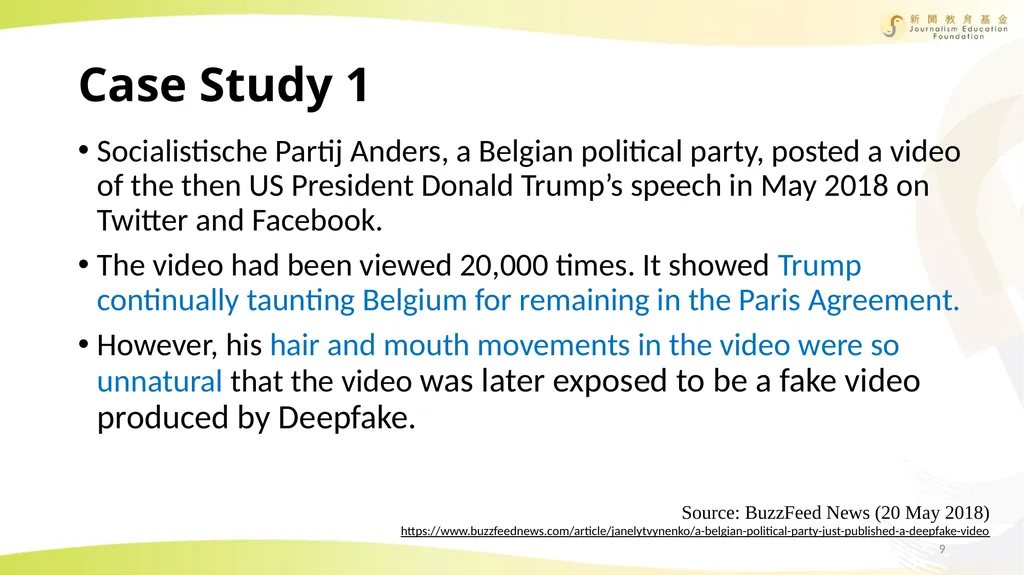
Case Study 1 Socialistische Partij Anders, a Belgian political party, posted a video of the then US President Donald Trump’s speech in May 2018 on Twitter and Facebook.
The video had been viewed 20,000 times. It showed Trump continually taunting Belgium for remaining in the Paris Agreement.
However, his hair and mouth movements in the video were so unnatural that the video was later exposed to be a fake video produced by Deepfake. 9 Source: BuzzFeed News (20 May 2018)
https://www.buzzfeednews.com/article/janelytvynenko/a-belgian-political-party-just-published-a-deepfake-video<br>
The video had been viewed 20,000 times. It showed Trump continually taunting Belgium for remaining in the Paris Agreement.
However, his hair and mouth movements in the video were so unnatural that the video was later exposed to be a fake video produced by Deepfake. 9 Source: BuzzFeed News (20 May 2018)
https://www.buzzfeednews.com/article/janelytvynenko/a-belgian-political-party-just-published-a-deepfake-video<br>
10
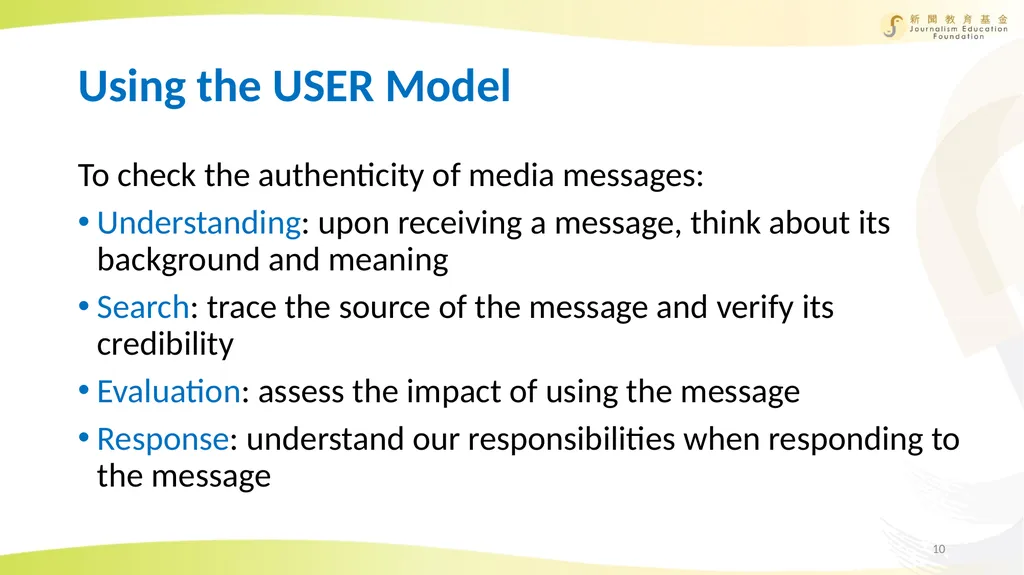
Using the USER Model To check the authenticity of media messages:
Understanding: upon receiving a message, think about its background and meaning
Search: trace the source of the message and verify its credibility
Evaluation: assess the impact of using the message
Response: understand our responsibilities when responding to the message 10<br>
Understanding: upon receiving a message, think about its background and meaning
Search: trace the source of the message and verify its credibility
Evaluation: assess the impact of using the message
Response: understand our responsibilities when responding to the message 10<br>
11
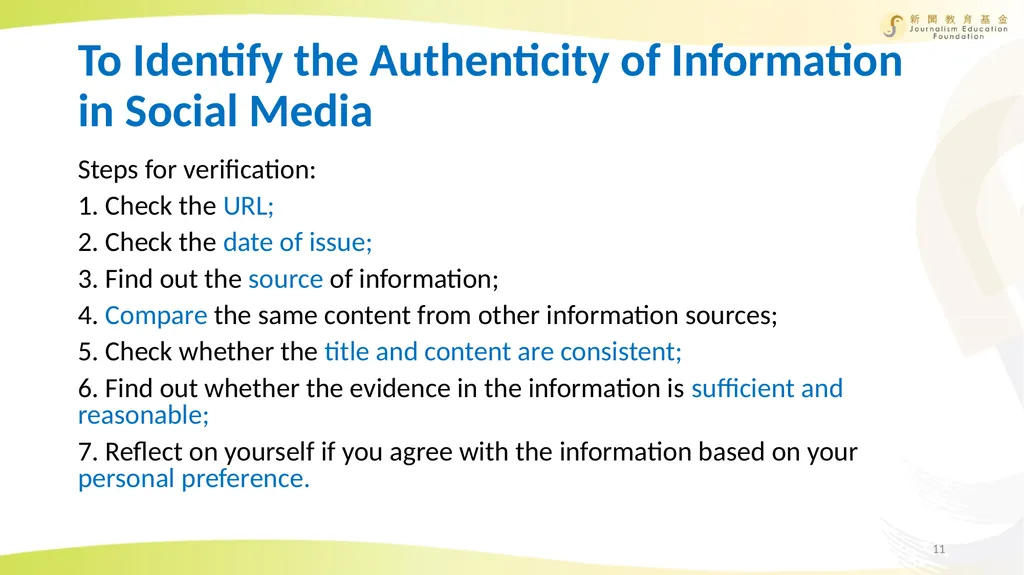
To Identify the Authenticity of Information in Social Media Steps for verification:
1. Check the URL;
2. Check the date of issue;
3. Find out the source of information;
4. Compare the same content from other information sources;
5. Check whether the title and content are consistent;
6. Find out whether the evidence in the information is sufficient and reasonable;
7. Reflect on yourself if you agree with the information based on your personal preference. 11<br>
1. Check the URL;
2. Check the date of issue;
3. Find out the source of information;
4. Compare the same content from other information sources;
5. Check whether the title and content are consistent;
6. Find out whether the evidence in the information is sufficient and reasonable;
7. Reflect on yourself if you agree with the information based on your personal preference. 11<br>
12
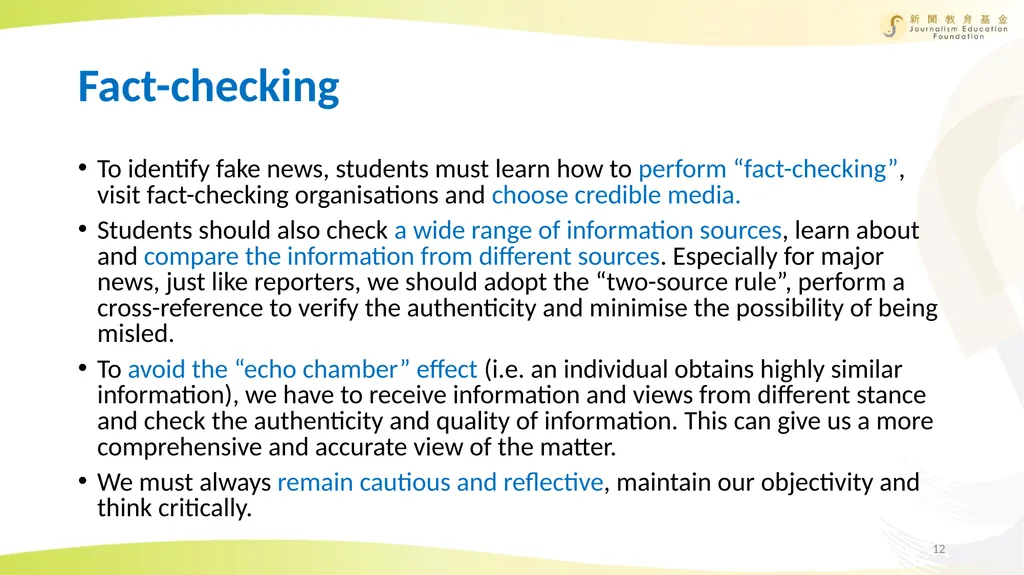
Fact-checking To identify fake news, students must learn how to perform “fact-checking”, visit fact-checking organisations and choose credible media.
Students should also check a wide range of information sources, learn about and compare the information from different sources. Especially for major news, just like reporters, we should adopt the “two-source rule”, perform a cross-reference to verify the authenticity and minimise the possibility of being misled.
To avoid the “echo chamber” effect (i.e. an individual obtains highly similar information), we have to receive information and views from different stance and check the authenticity and quality of information. This can give us a more comprehensive and accurate view of the matter.
We must always remain cautious and reflective, maintain our objectivity and think critically. 12<br>
Students should also check a wide range of information sources, learn about and compare the information from different sources. Especially for major news, just like reporters, we should adopt the “two-source rule”, perform a cross-reference to verify the authenticity and minimise the possibility of being misled.
To avoid the “echo chamber” effect (i.e. an individual obtains highly similar information), we have to receive information and views from different stance and check the authenticity and quality of information. This can give us a more comprehensive and accurate view of the matter.
We must always remain cautious and reflective, maintain our objectivity and think critically. 12<br>
13
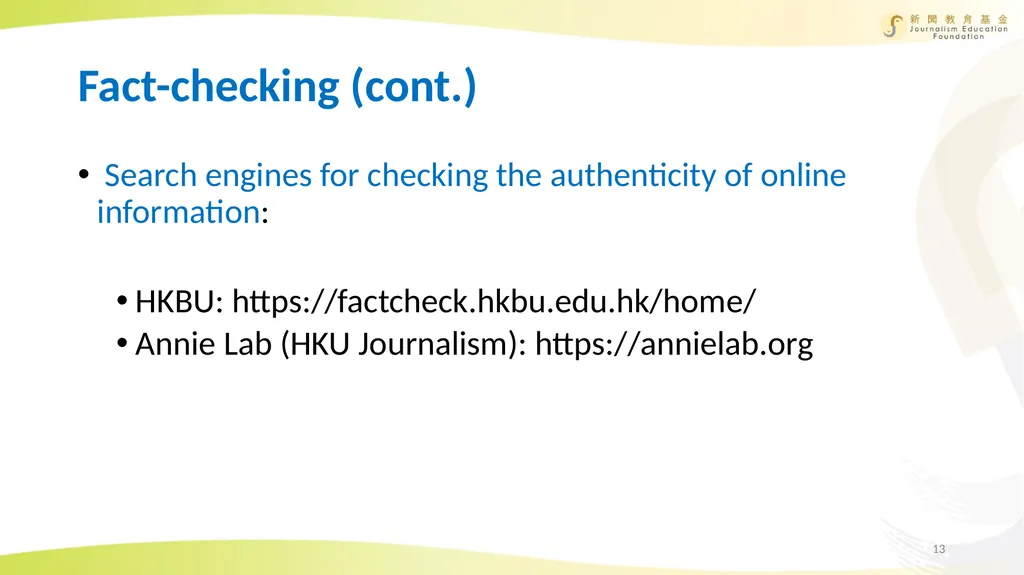
Fact-checking (cont.) Search engines for checking the authenticity of online information:
HKBU: https://factcheck.hkbu.edu.hk/home/
Annie Lab (HKU Journalism): https://annielab.org 13<br>
HKBU: https://factcheck.hkbu.edu.hk/home/
Annie Lab (HKU Journalism): https://annielab.org 13<br>
14
Case study 2:
Did the Government install face recognition machines to penalise people who do not follow traffic light instructions? 14 Source: HKBU FactCheck Service (9 April 2021)
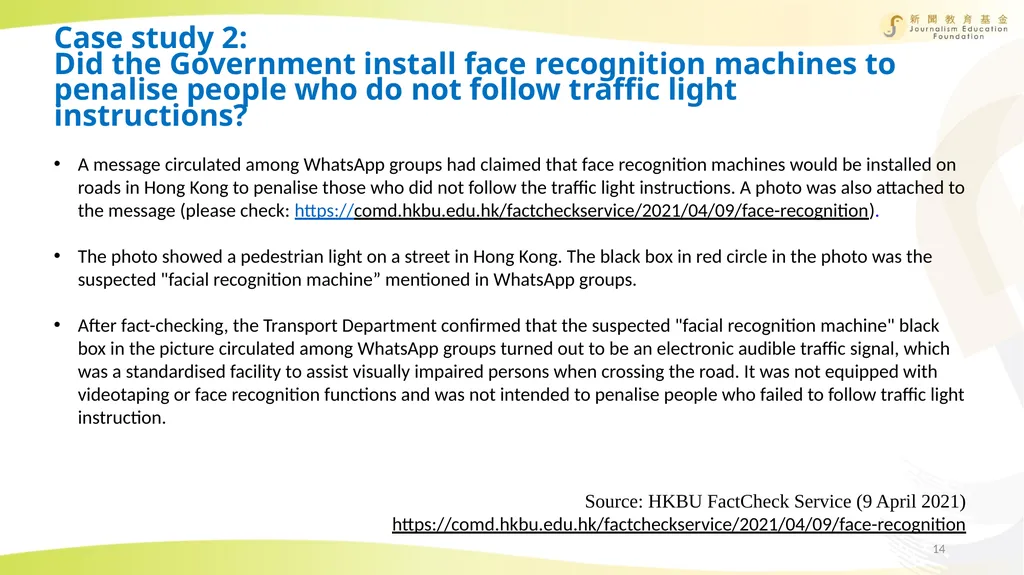
https://comd.hkbu.edu.hk/factcheckservice/2021/04/09/face-recognition A message circulated among WhatsApp groups had claimed that face recognition machines would be installed on roads in Hong Kong to penalise those who did not follow the traffic light instructions. A photo was also attached to the message (please check: https://comd.hkbu.edu.hk/factcheckservice/2021/04/09/face-recognition).
The photo showed a pedestrian light on a street in Hong Kong. The black box in red circle in the photo was the suspected "facial recognition machine” mentioned in WhatsApp groups.
After fact-checking, the Transport Department confirmed that the suspected "facial recognition machine" black box in the picture circulated among WhatsApp groups turned out to be an electronic audible traffic signal, which was a standardised facility to assist visually impaired persons when crossing the road. It was not equipped with videotaping or face recognition functions and was not intended to penalise people who failed to follow traffic light instruction.<br>
https://comd.hkbu.edu.hk/factcheckservice/2021/04/09/face-recognition A message circulated among WhatsApp groups had claimed that face recognition machines would be installed on roads in Hong Kong to penalise those who did not follow the traffic light instructions. A photo was also attached to the message (please check: https://comd.hkbu.edu.hk/factcheckservice/2021/04/09/face-recognition).
The photo showed a pedestrian light on a street in Hong Kong. The black box in red circle in the photo was the suspected "facial recognition machine” mentioned in WhatsApp groups.
After fact-checking, the Transport Department confirmed that the suspected "facial recognition machine" black box in the picture circulated among WhatsApp groups turned out to be an electronic audible traffic signal, which was a standardised facility to assist visually impaired persons when crossing the road. It was not equipped with videotaping or face recognition functions and was not intended to penalise people who failed to follow traffic light instruction.<br>
15
References 香港青年協會 (2017)。《新媒體素養教材資源套》。香港:香港青年協會。
浸大事實查核中心 (2021年4月9日) 。〈【錯誤】政府安裝人面識別機,用以處罰不依交通指示過路人士?〉。擷取自網頁
https://comd.hkbu.edu.hk/factcheckservice/2021/04/09/face-recognition/
浸大事實查核中心 (2021年12月8日) 。〈【錯誤】世衞2021年10月公開的長壽秘訣中,飲酒排第一?〉。擷取自網頁
https://comd.hkbu.edu.hk/factcheckservice/2021/12/08/drinking-alcohol/
BuzzFeed News. (2018, May 20). A Belgian political party is circulating a Trump deepfake video. Retrieved from https://www.buzzfeednews.com/article/janelytvynenko/a-belgian-political-party-just-published-a-deepfake-video
Johnson, J. (2017, December 14). The five types of fake news. HuffPost. Retrieved from https://www.huffpost.com/entry/the-five-types-of-fake-ne_b_13609562
Loyola Marymount University Library Workshop (2017). Keepin’ it real: tips & strategies for evaluating fake news. Retrieved from https://libguides.lmu.edu/c.php?g=595781&p=4121899
Clackamas Community College Library. (n.d.). Disinformation, misinformation, and fake news. Retrieved from https://libguides.clackamas.edu/c.php?g=652128&p=4608563
College of the Redwoods Library. (n.d.). Bias, fake news, hoaxes, & lies. Retrieved from https://redwoods.libguides.com/fakenews/checklists 15<br>
浸大事實查核中心 (2021年4月9日) 。〈【錯誤】政府安裝人面識別機,用以處罰不依交通指示過路人士?〉。擷取自網頁
https://comd.hkbu.edu.hk/factcheckservice/2021/04/09/face-recognition/
浸大事實查核中心 (2021年12月8日) 。〈【錯誤】世衞2021年10月公開的長壽秘訣中,飲酒排第一?〉。擷取自網頁
https://comd.hkbu.edu.hk/factcheckservice/2021/12/08/drinking-alcohol/
BuzzFeed News. (2018, May 20). A Belgian political party is circulating a Trump deepfake video. Retrieved from https://www.buzzfeednews.com/article/janelytvynenko/a-belgian-political-party-just-published-a-deepfake-video
Johnson, J. (2017, December 14). The five types of fake news. HuffPost. Retrieved from https://www.huffpost.com/entry/the-five-types-of-fake-ne_b_13609562
Loyola Marymount University Library Workshop (2017). Keepin’ it real: tips & strategies for evaluating fake news. Retrieved from https://libguides.lmu.edu/c.php?g=595781&p=4121899
Clackamas Community College Library. (n.d.). Disinformation, misinformation, and fake news. Retrieved from https://libguides.clackamas.edu/c.php?g=652128&p=4608563
College of the Redwoods Library. (n.d.). Bias, fake news, hoaxes, & lies. Retrieved from https://redwoods.libguides.com/fakenews/checklists 15<br>