
Medicine presentation and administration Lec. Dr.
CS
Published · 31 slides · 0 views
1 / 1
Description
Medicine presentation and administration Lec. Dr. Abeer A. Rashid Definition of a medicinal product A medicinal product is any product used for the prophylaxis or management of diseases that brings about the purpose of affecting body
Related Topics
Share
Embed code
Download this presentation From Below
"Medicine presentation and administration Lec. Dr." is the property of its rightful owner. Permission is granted to download and print the materials on this website for personal, non-commercial use only, and to display it on your personal computer provided you do not modify the materials and that you retain all copyright notices contained in the materials. By downloading content from our website, you accept the terms of this agreement.
Presentation Transcript
01
Medicine presentation and administration Lec. Dr. Abeer A. Rashid<br>
02
Definition of a medicinal product A medicinal product is any product used for the prophylaxis or management of diseases that brings about the purpose of affecting body function or is used to make a medical diagnosis.
earlier times, plants were the primary source of substances intended for a medicinal effect. Minerals and substances of animal origin started to be used later on.<br>
earlier times, plants were the primary source of substances intended for a medicinal effect. Minerals and substances of animal origin started to be used later on.<br>
03
As the purity and potency of drugs or ‘active ingredients’ have increased, the dose required has decreased
When introduced into the body, all drugs cause cellular changes, described as drug action, followed by physiological changes that are described as the drug effect<br>
When introduced into the body, all drugs cause cellular changes, described as drug action, followed by physiological changes that are described as the drug effect<br>
04
The ‘rights’of medicine administration When administering medicines, it is important to ensure that the right medicine at the right dose, in the right form is administered to the right patient, at the right time, by the right route, using the right technique, and that the right documentation is kept.<br>
05
Pharmaceutical development Drugs have to undergo pre-formulation studies and formulation development to present the drug in an appropriate dosage form.
This is a complex, time-consuming and expensive process.<br>
This is a complex, time-consuming and expensive process.<br>
06
Pre-formulation studies These are carried out to investigate the physical and chemical properties of a drug including:
solubility and dissolution rates
chemical stability
lipophilicity
melting point
particle morphology.<br>
solubility and dissolution rates
chemical stability
lipophilicity
melting point
particle morphology.<br>
07
Formulation development Aims to develop formulations of the drug while overcoming shortcomings of the compound (e.g. low solubility in water for omeprazole, taste)
Takes into account properties of drug substance and desired final dosage form.<br>
Takes into account properties of drug substance and desired final dosage form.<br>
08
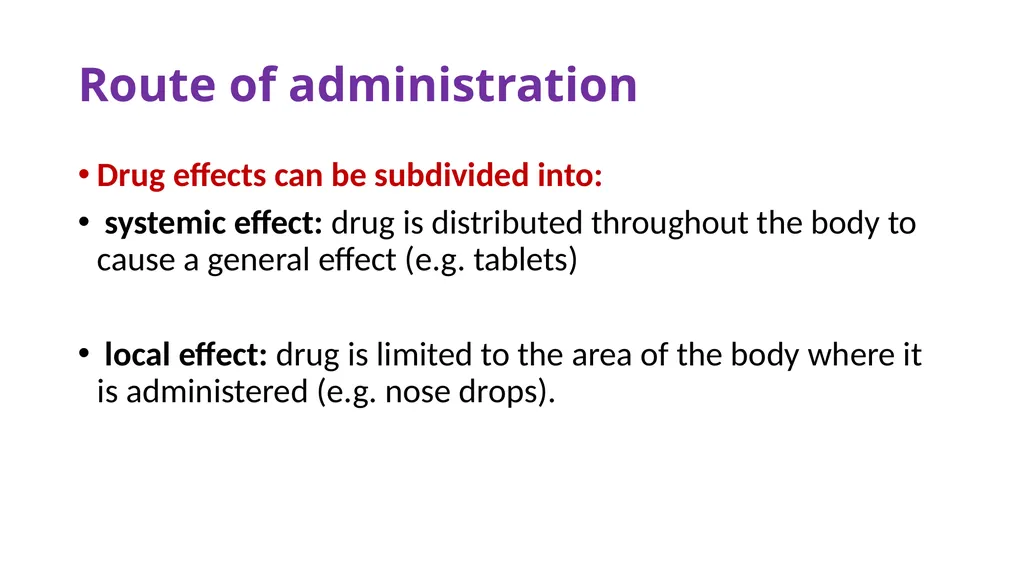
Route of administration Drug effects can be subdivided into:
systemic effect: drug is distributed throughout the body to cause a general effect (e.g. tablets)
local effect: drug is limited to the area of the body where it is administered (e.g. nose drops).<br>
systemic effect: drug is distributed throughout the body to cause a general effect (e.g. tablets)
local effect: drug is limited to the area of the body where it is administered (e.g. nose drops).<br>
09
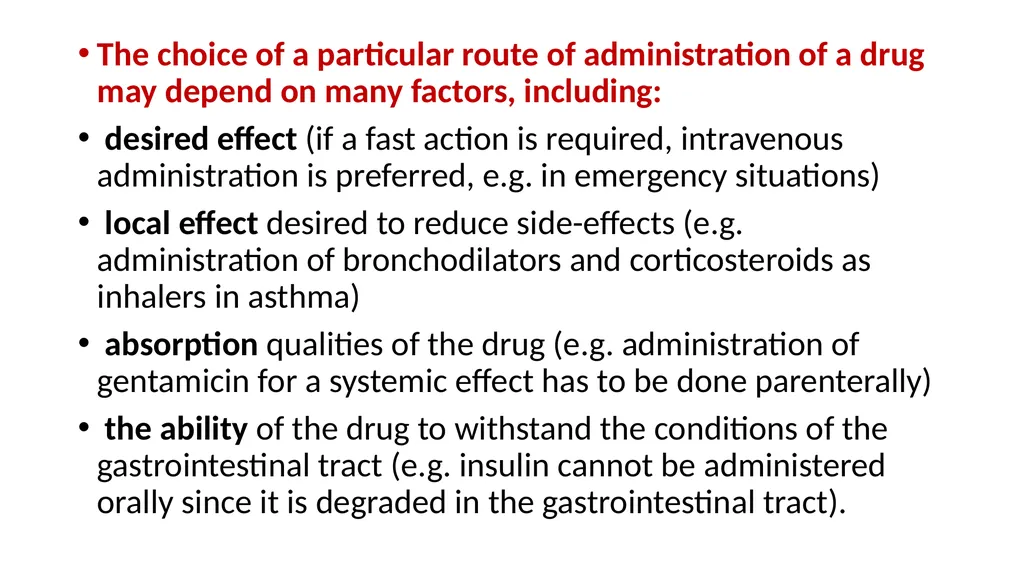
The choice of a particular route of administration of a drug may depend on many factors, including:
desired effect (if a fast action is required, intravenous administration is preferred, e.g. in emergency situations)
local effect desired to reduce side-effects (e.g. administration of bronchodilators and corticosteroids as inhalers in asthma)
absorption qualities of the drug (e.g. administration of gentamicin for a systemic effect has to be done parenterally)
the ability of the drug to withstand the conditions of the gastrointestinal tract (e.g. insulin cannot be administered orally since it is degraded in the gastrointestinal tract).<br>
desired effect (if a fast action is required, intravenous administration is preferred, e.g. in emergency situations)
local effect desired to reduce side-effects (e.g. administration of bronchodilators and corticosteroids as inhalers in asthma)
absorption qualities of the drug (e.g. administration of gentamicin for a systemic effect has to be done parenterally)
the ability of the drug to withstand the conditions of the gastrointestinal tract (e.g. insulin cannot be administered orally since it is degraded in the gastrointestinal tract).<br>
10
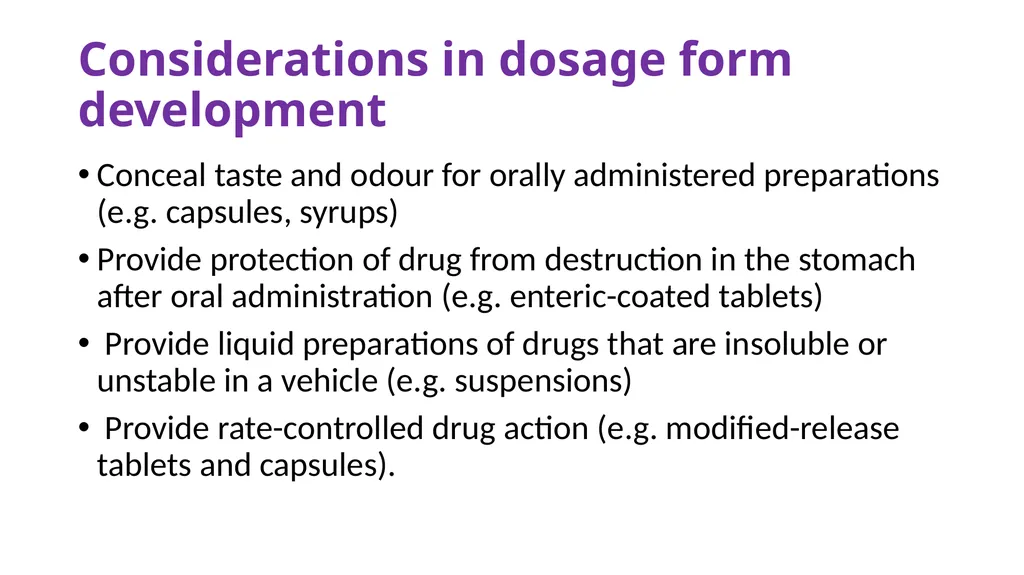
Considerations in dosage form development Conceal taste and odour for orally administered preparations (e.g. capsules, syrups)
Provide protection of drug from destruction in the stomach after oral administration (e.g. enteric-coated tablets)
Provide liquid preparations of drugs that are insoluble or unstable in a vehicle (e.g. suspensions)
Provide rate-controlled drug action (e.g. modified-release tablets and capsules).<br>
Provide protection of drug from destruction in the stomach after oral administration (e.g. enteric-coated tablets)
Provide liquid preparations of drugs that are insoluble or unstable in a vehicle (e.g. suspensions)
Provide rate-controlled drug action (e.g. modified-release tablets and capsules).<br>
11
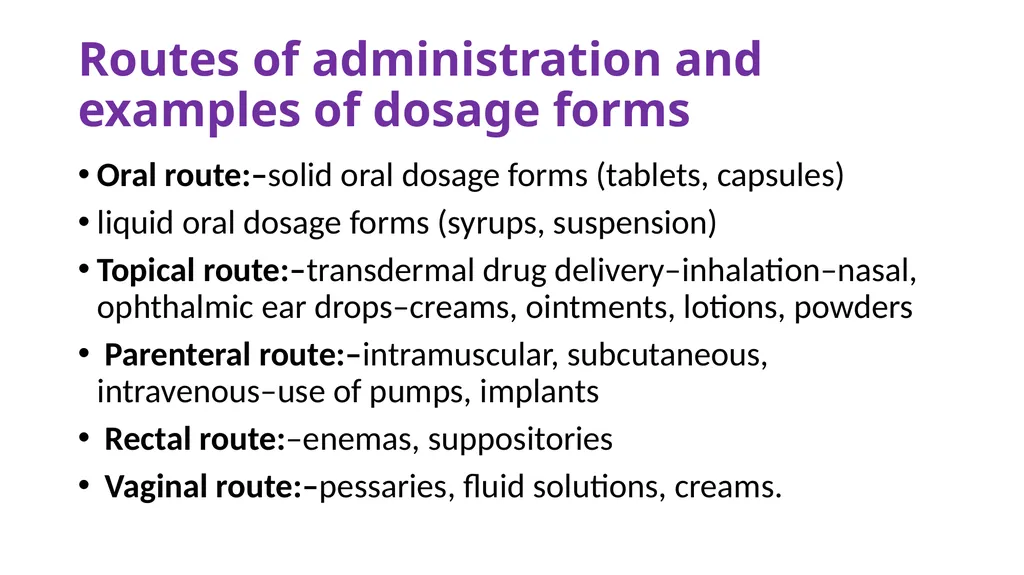
Routes of administration and examples of dosage forms Oral route:–solid oral dosage forms (tablets, capsules)
liquid oral dosage forms (syrups, suspension)
Topical route:–transdermal drug delivery–inhalation–nasal, ophthalmic ear drops–creams, ointments, lotions, powders
Parenteral route:–intramuscular, subcutaneous, intravenous–use of pumps, implants
Rectal route:–enemas, suppositories
Vaginal route:–pessaries, fluid solutions, creams.<br>
liquid oral dosage forms (syrups, suspension)
Topical route:–transdermal drug delivery–inhalation–nasal, ophthalmic ear drops–creams, ointments, lotions, powders
Parenteral route:–intramuscular, subcutaneous, intravenous–use of pumps, implants
Rectal route:–enemas, suppositories
Vaginal route:–pessaries, fluid solutions, creams.<br>
12
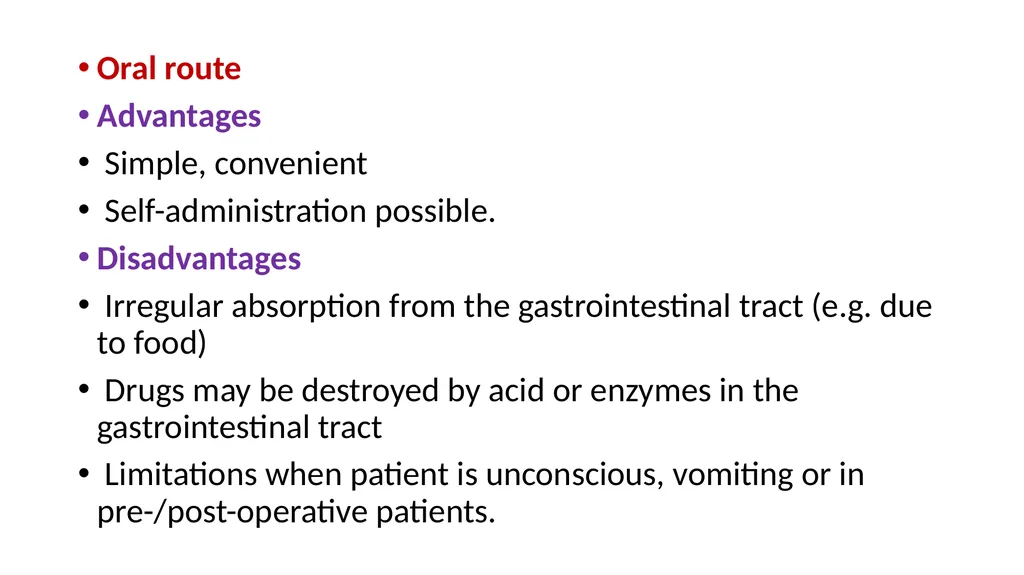
Oral route
Advantages
Simple, convenient
Self-administration possible.
Disadvantages
Irregular absorption from the gastrointestinal tract (e.g. due to food)
Drugs may be destroyed by acid or enzymes in the gastrointestinal tract
Limitations when patient is unconscious, vomiting or in pre-/post-operative patients.<br>
Advantages
Simple, convenient
Self-administration possible.
Disadvantages
Irregular absorption from the gastrointestinal tract (e.g. due to food)
Drugs may be destroyed by acid or enzymes in the gastrointestinal tract
Limitations when patient is unconscious, vomiting or in pre-/post-operative patients.<br>
13
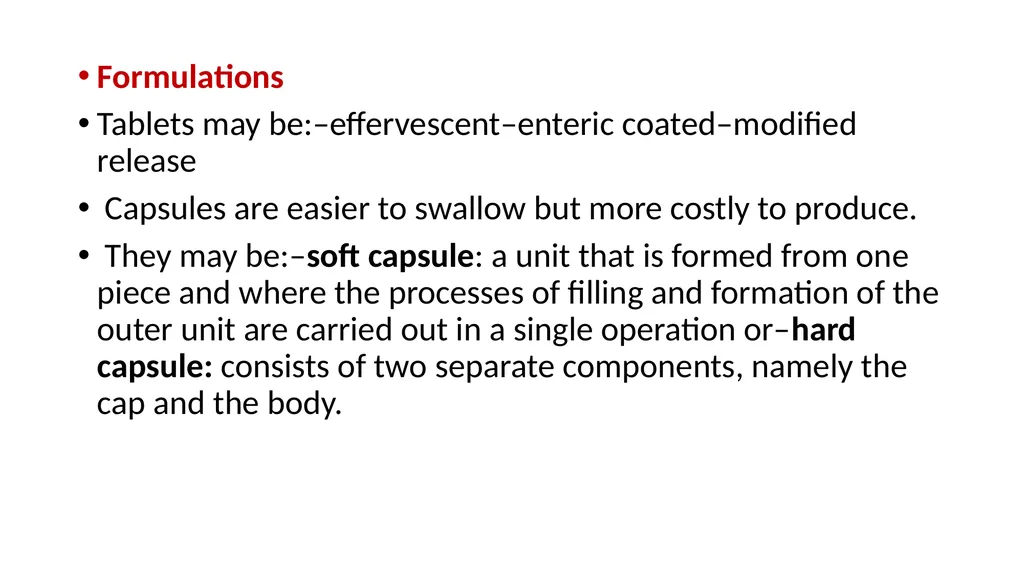
Formulations
Tablets may be:–effervescent–enteric coated–modified release
Capsules are easier to swallow but more costly to produce.
They may be:–soft capsule: a unit that is formed from one piece and where the processes of filling and formation of the outer unit are carried out in a single operation or–hard capsule: consists of two separate components, namely the cap and the body.<br>
Tablets may be:–effervescent–enteric coated–modified release
Capsules are easier to swallow but more costly to produce.
They may be:–soft capsule: a unit that is formed from one piece and where the processes of filling and formation of the outer unit are carried out in a single operation or–hard capsule: consists of two separate components, namely the cap and the body.<br>
14
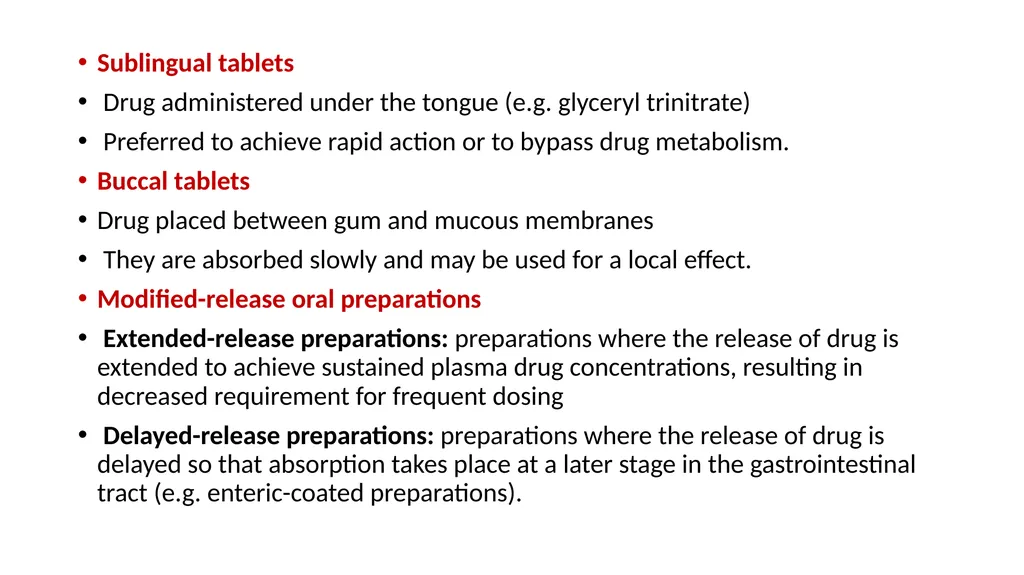
Sublingual tablets
Drug administered under the tongue (e.g. glyceryl trinitrate)
Preferred to achieve rapid action or to bypass drug metabolism.
Buccal tablets
Drug placed between gum and mucous membranes
They are absorbed slowly and may be used for a local effect.
Modified-release oral preparations
Extended-release preparations: preparations where the release of drug is extended to achieve sustained plasma drug concentrations, resulting in decreased requirement for frequent dosing
Delayed-release preparations: preparations where the release of drug is delayed so that absorption takes place at a later stage in the gastrointestinal tract (e.g. enteric-coated preparations).<br>
Drug administered under the tongue (e.g. glyceryl trinitrate)
Preferred to achieve rapid action or to bypass drug metabolism.
Buccal tablets
Drug placed between gum and mucous membranes
They are absorbed slowly and may be used for a local effect.
Modified-release oral preparations
Extended-release preparations: preparations where the release of drug is extended to achieve sustained plasma drug concentrations, resulting in decreased requirement for frequent dosing
Delayed-release preparations: preparations where the release of drug is delayed so that absorption takes place at a later stage in the gastrointestinal tract (e.g. enteric-coated preparations).<br>
15
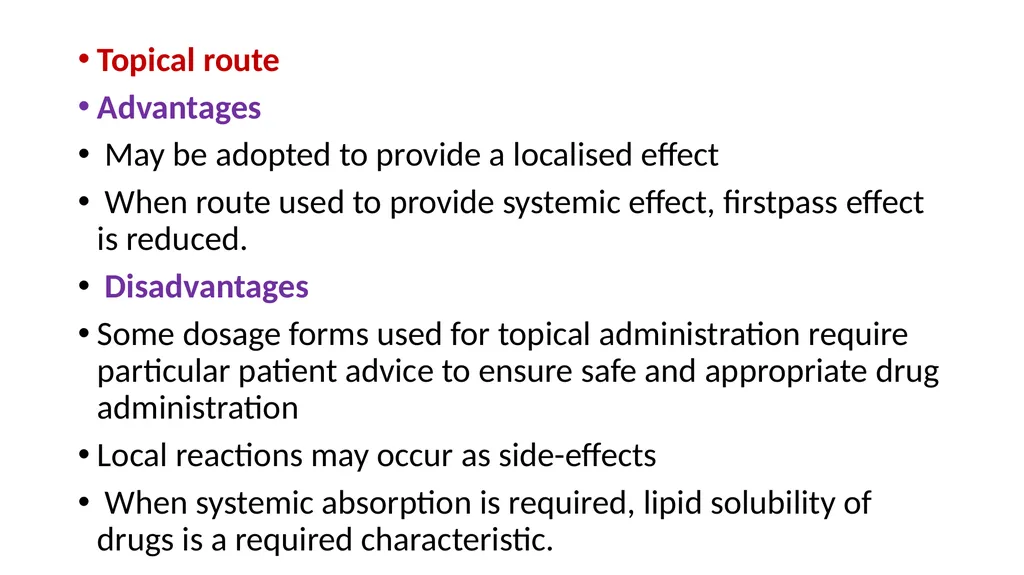
Topical route
Advantages
May be adopted to provide a localised effect
When route used to provide systemic effect, firstpass effect is reduced.
Disadvantages
Some dosage forms used for topical administration require particular patient advice to ensure safe and appropriate drug administration
Local reactions may occur as side-effects
When systemic absorption is required, lipid solubility of drugs is a required characteristic.<br>
Advantages
May be adopted to provide a localised effect
When route used to provide systemic effect, firstpass effect is reduced.
Disadvantages
Some dosage forms used for topical administration require particular patient advice to ensure safe and appropriate drug administration
Local reactions may occur as side-effects
When systemic absorption is required, lipid solubility of drugs is a required characteristic.<br>
16
Transdermal drug delivery
This is a system of drug delivery where drug molecules are presented in a variety of sizes and shapes that allow for absorption through the skin and into the bloodstream at various rates.
Advantages
Ease of application
Effectiveness for a long period of time allowing for retention of patch for a number of hours
Consistent blood drug level of drug is achieved.
Examples include nicotine patches and glyceryl trinitrate patches.<br>
This is a system of drug delivery where drug molecules are presented in a variety of sizes and shapes that allow for absorption through the skin and into the bloodstream at various rates.
Advantages
Ease of application
Effectiveness for a long period of time allowing for retention of patch for a number of hours
Consistent blood drug level of drug is achieved.
Examples include nicotine patches and glyceryl trinitrate patches.<br>
17
Metered-dose inhalers
Inhalers present the drug as an aerosol, usually as liquid, sometimes as a powder formulation, and are intended for topical application in the respiratory tract (see also Chapter 25).
Used in the management of respiratory disease, e.g. asthma.
Proper technique is required.
Provide rapid onset of action and minimal sideeffects due to topical action.
Examples include salbutamol, salmeterol and budesonide.<br>
Inhalers present the drug as an aerosol, usually as liquid, sometimes as a powder formulation, and are intended for topical application in the respiratory tract (see also Chapter 25).
Used in the management of respiratory disease, e.g. asthma.
Proper technique is required.
Provide rapid onset of action and minimal sideeffects due to topical action.
Examples include salbutamol, salmeterol and budesonide.<br>
18
Inhalation of oxygen
Oxygen therapy is by inhalation and it is prescribed by specifying the flow rate, concentration, method of delivery and length of time of administration.
Note that 100% oxygen may result in oxygen toxicity, presenting with symptoms such as alveolar collapse, intra-alveolar haemorrhage and disturbance of the central nervous system
Masks are required to administer oxygen to the patient.
Patients may require domiciliary use of oxygen and therefore access to oxygen cylinders<br>
Oxygen therapy is by inhalation and it is prescribed by specifying the flow rate, concentration, method of delivery and length of time of administration.
Note that 100% oxygen may result in oxygen toxicity, presenting with symptoms such as alveolar collapse, intra-alveolar haemorrhage and disturbance of the central nervous system
Masks are required to administer oxygen to the patient.
Patients may require domiciliary use of oxygen and therefore access to oxygen cylinders<br>
19
Ophthalmic administration
Preparation must be sterile and patient should be advised that once opened product should be discarded within 4 weeks.
Good practice requires that the opening date is documented on the pack to ensure that products that have been opened more than 4 weeks previously are not used
Patients or their carers require knowledge of the proper technique for application of the product to avoid touching the container against the eye or anything else to avoid contamination of the containers
Ophthalmic preparations include:–eye drops–eye lotions–eye ointments.<br>
Preparation must be sterile and patient should be advised that once opened product should be discarded within 4 weeks.
Good practice requires that the opening date is documented on the pack to ensure that products that have been opened more than 4 weeks previously are not used
Patients or their carers require knowledge of the proper technique for application of the product to avoid touching the container against the eye or anything else to avoid contamination of the containers
Ophthalmic preparations include:–eye drops–eye lotions–eye ointments.<br>
20
Otic administration • Patient must remain on his or her side for about 5 minutes to allow formulation to reach inner ear canal.
Caution when using ear drops if patency of eardrum is not ensured
Nasal administration
Nasal drops: preferred in infants due to better spread as opposed to spray
Nasal spray: preferred since they are less likely to be associated with postnasal drip of the drug leading to an aftertaste.<br>
Caution when using ear drops if patency of eardrum is not ensured
Nasal administration
Nasal drops: preferred in infants due to better spread as opposed to spray
Nasal spray: preferred since they are less likely to be associated with postnasal drip of the drug leading to an aftertaste.<br>
21
Rectal route
Advantages
Bypasses the oral route and so is useful when when patient is nauseated or vomiting, postoperative and not able to take medicines orally.
May be used for a local effect in the colon (e.g. in constipation).
Disadvantages
Inconvenient and not well accepted by patients
Erratic absorption.<br>
Advantages
Bypasses the oral route and so is useful when when patient is nauseated or vomiting, postoperative and not able to take medicines orally.
May be used for a local effect in the colon (e.g. in constipation).
Disadvantages
Inconvenient and not well accepted by patients
Erratic absorption.<br>
22
Vaginal route
Advantages
May be used to treat local infections
Allows for local application of hormone replacement therapy.
Disadvantage
Inconvenient and not well accepted by patients.
Examples of dosage forms available include douches, creams and pessaries.<br>
Advantages
May be used to treat local infections
Allows for local application of hormone replacement therapy.
Disadvantage
Inconvenient and not well accepted by patients.
Examples of dosage forms available include douches, creams and pessaries.<br>
23
Parenteral route
Advantages • Allows for administration of drugs intended for a systemic effect that cannot be presented through other routes because of erratic absorption or first-pass effects
Depending on the formulation used and the dosage form, may be used to provide a fast onset of action or a prolonged action
Useful when patient is not cooperative.<br>
Advantages • Allows for administration of drugs intended for a systemic effect that cannot be presented through other routes because of erratic absorption or first-pass effects
Depending on the formulation used and the dosage form, may be used to provide a fast onset of action or a prolonged action
Useful when patient is not cooperative.<br>
24
Disadvantages
Formulation has to be sterile
More expensive to manufacture
Usually requires administration by a healthcare professional
May not be well accepted by patients.<br>
Formulation has to be sterile
More expensive to manufacture
Usually requires administration by a healthcare professional
May not be well accepted by patients.<br>
25
Subcutaneous injection
Given just below the skin and the layer of fatty tissue usually in the arm or thigh
Not for oily fluids
A small volume (2 mL) can be administered
Example is insulin.<br>
Given just below the skin and the layer of fatty tissue usually in the arm or thigh
Not for oily fluids
A small volume (2 mL) can be administered
Example is insulin.<br>
26
Intramuscular injection
Administered into a large muscle usually in buttocks or anterior lateral thigh
Used for aqueous and oily suspensions with the latter presenting a prolonged action
Larger amount can be administered than subcutaneous injection (up to 5 mL)
Absorption more rapid than subcutaneous injection but can be modified by the addition of adrenaline or hyaluronidase
Used, for example, for immunisation.<br>
Administered into a large muscle usually in buttocks or anterior lateral thigh
Used for aqueous and oily suspensions with the latter presenting a prolonged action
Larger amount can be administered than subcutaneous injection (up to 5 mL)
Absorption more rapid than subcutaneous injection but can be modified by the addition of adrenaline or hyaluronidase
Used, for example, for immunisation.<br>
27
Intravenous drug administration
Administered usually on internal flexure of elbow, but other sites may be used.
Aqueous solutions are administered.
Volume varies from 1 mL to 3000 mL where the fluid is administered as an infusion.
Used in emergency, when immediate effect is required, when drug is not available in other routes, or when large volumes of fluid are required (infusion).
Examples include antibacterials, corticosteroids and replacement fluids (e.g. saline).<br>
Administered usually on internal flexure of elbow, but other sites may be used.
Aqueous solutions are administered.
Volume varies from 1 mL to 3000 mL where the fluid is administered as an infusion.
Used in emergency, when immediate effect is required, when drug is not available in other routes, or when large volumes of fluid are required (infusion).
Examples include antibacterials, corticosteroids and replacement fluids (e.g. saline).<br>
28
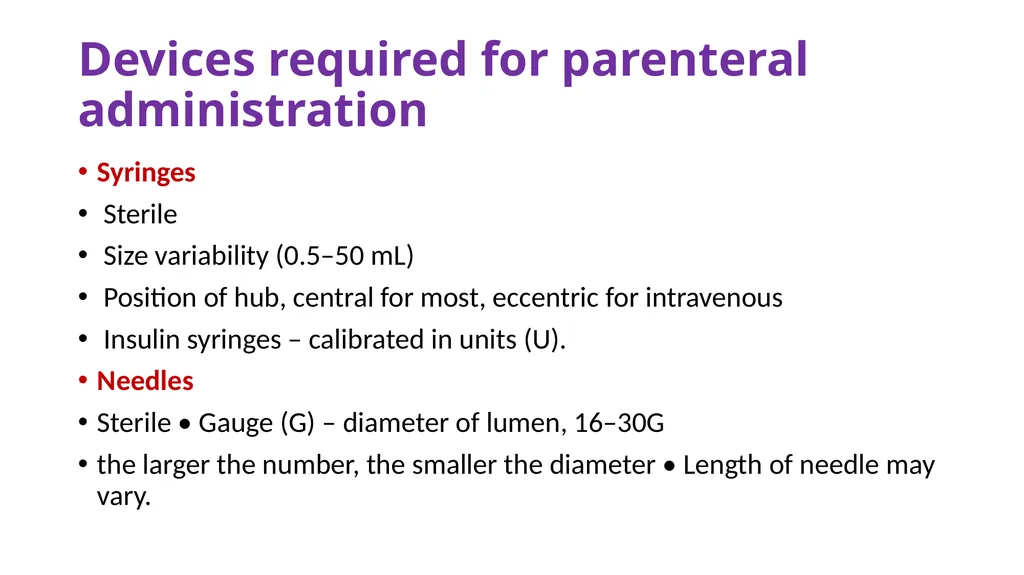
Devices required for parenteral administration Syringes
Sterile
Size variability (0.5–50 mL)
Position of hub, central for most, eccentric for intravenous
Insulin syringes – calibrated in units (U).
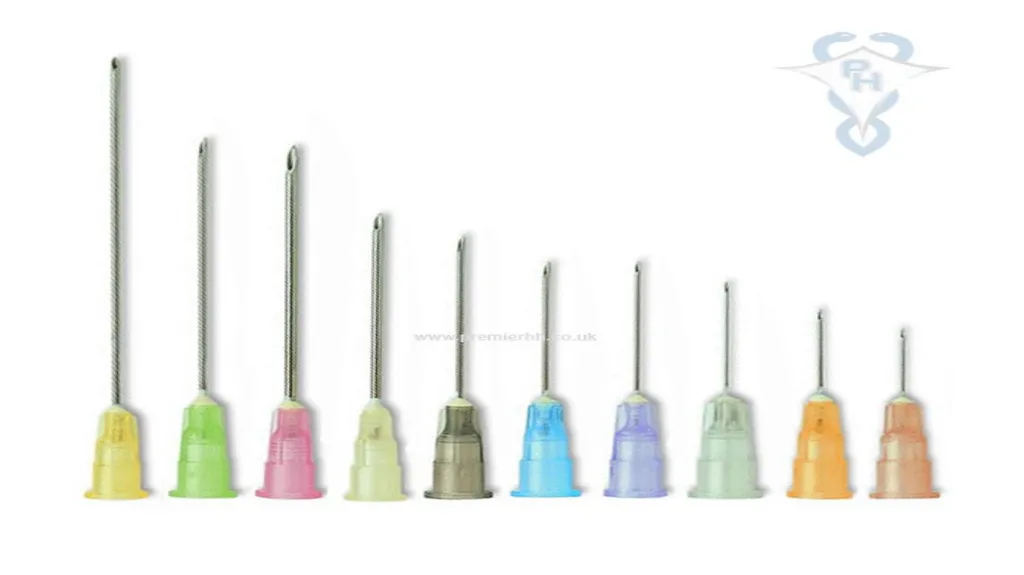
Needles
Sterile • Gauge (G) – diameter of lumen, 16–30G
the larger the number, the smaller the diameter • Length of needle may vary.<br>
Sterile
Size variability (0.5–50 mL)
Position of hub, central for most, eccentric for intravenous
Insulin syringes – calibrated in units (U).
Needles
Sterile • Gauge (G) – diameter of lumen, 16–30G
the larger the number, the smaller the diameter • Length of needle may vary.<br>
29
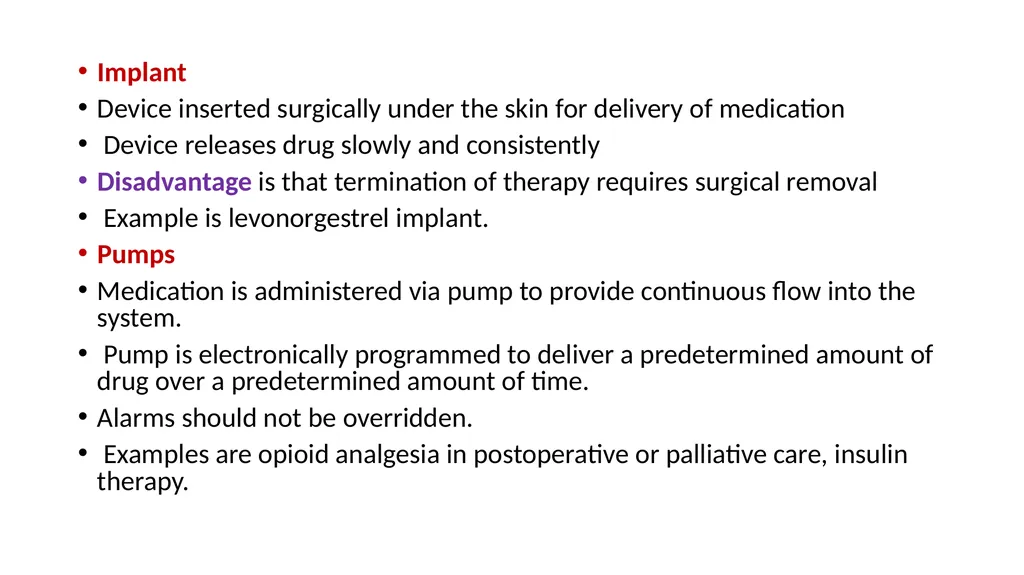
Implant
Device inserted surgically under the skin for delivery of medication
Device releases drug slowly and consistently
Disadvantage is that termination of therapy requires surgical removal
Example is levonorgestrel implant.
Pumps
Medication is administered via pump to provide continuous flow into the system.
Pump is electronically programmed to deliver a predetermined amount of drug over a predetermined amount of time.
Alarms should not be overridden.
Examples are opioid analgesia in postoperative or palliative care, insulin therapy.<br>
Device inserted surgically under the skin for delivery of medication
Device releases drug slowly and consistently
Disadvantage is that termination of therapy requires surgical removal
Example is levonorgestrel implant.
Pumps
Medication is administered via pump to provide continuous flow into the system.
Pump is electronically programmed to deliver a predetermined amount of drug over a predetermined amount of time.
Alarms should not be overridden.
Examples are opioid analgesia in postoperative or palliative care, insulin therapy.<br>
30
Questions
1. Explain the differences between the intravenous route of drug administration and the intramuscular route of drug administration.
2 .What are the advantages of transdermal drug delivery and give an example of a drug that is presented in this way?
3. Name two advantages for using the rectal route of drug administration.
4 .What are the limitations to the use of eye drops?<br>
1. Explain the differences between the intravenous route of drug administration and the intramuscular route of drug administration.
2 .What are the advantages of transdermal drug delivery and give an example of a drug that is presented in this way?
3. Name two advantages for using the rectal route of drug administration.
4 .What are the limitations to the use of eye drops?<br>