
Medium-term strategy (2022-2025) About the












Description: Medium-term strategy (2022-2025) About the Organization The previous strategys summary and evaluation TI Hungarys current state of affairs and main results (2022) TI Hungarys strategy for 2022-2025 Content of the presentation I. About
Related Topics
Download Presentation
"Medium-term strategy (2022-2025) About the" is the property of its rightful owner. Permission is granted to download and print the materials on this website for personal, non-commercial use only, and to display it on your personal computer provided you do not modify the materials and that you retain all copyright notices contained in the materials. By downloading content from our website, you accept the terms of this agreement.
Presentation Transcript
slide1. Medium-term strategy
(2022-2025)<br>
slide2. About the Organization
The previous strategy’s summary and evaluation
TI Hungary’s current state of affairs and main results (2022)
TI Hungary’s strategy for 2022-2025 Content of the presentation<br>
slide3. I. About the Organization<br>
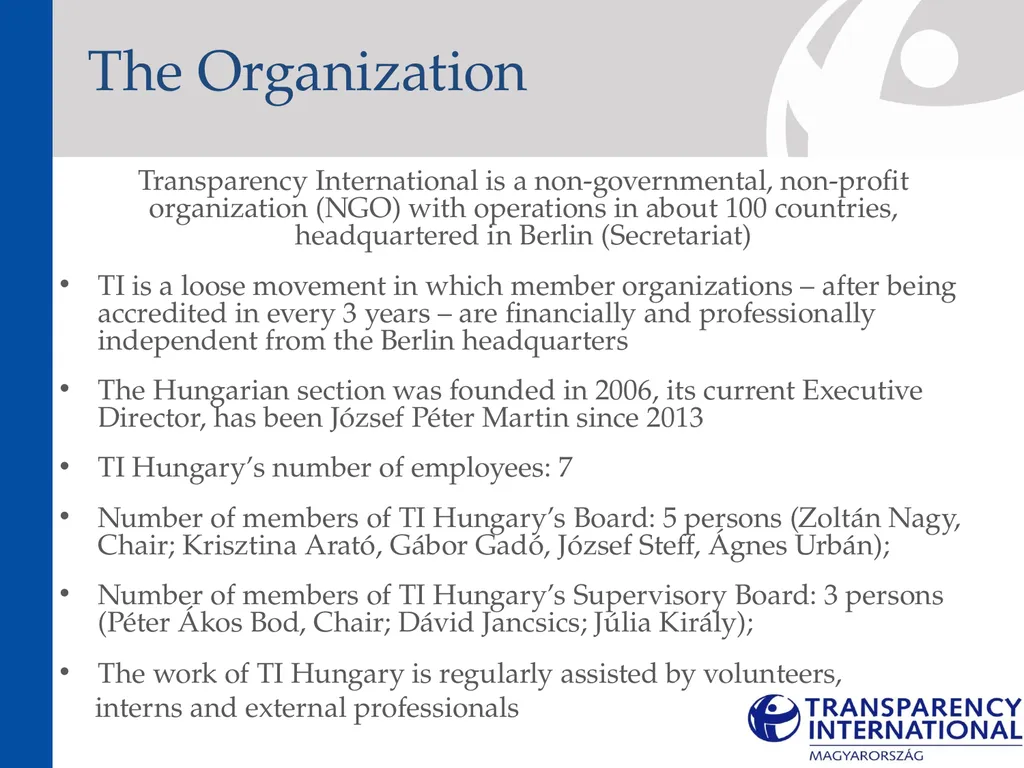
slide4. Transparency International is a non-governmental, non-profit organization (NGO) with operations in about 100 countries, headquartered in Berlin (Secretariat)
TI is a loose movement in which member organizations – after being accredited in every 3 years – are financially and professionally independent from the Berlin headquarters
The Hungarian section was founded in 2006, its current Executive Director, has been József Péter Martin since 2013
TI Hungary’s number of employees: 7
Number of members of TI Hungary’s Board: 5 persons (Zoltán Nagy, Chair; Krisztina Arató, Gábor Gadó, József Steff, Ágnes Urbán);
Number of members of TI Hungary’s Supervisory Board: 3 persons (Péter Ákos Bod, Chair; Dávid Jancsics; Júlia Király);
The work of TI Hungary is regularly assisted by volunteers,
interns and external professionals The Organization<br>
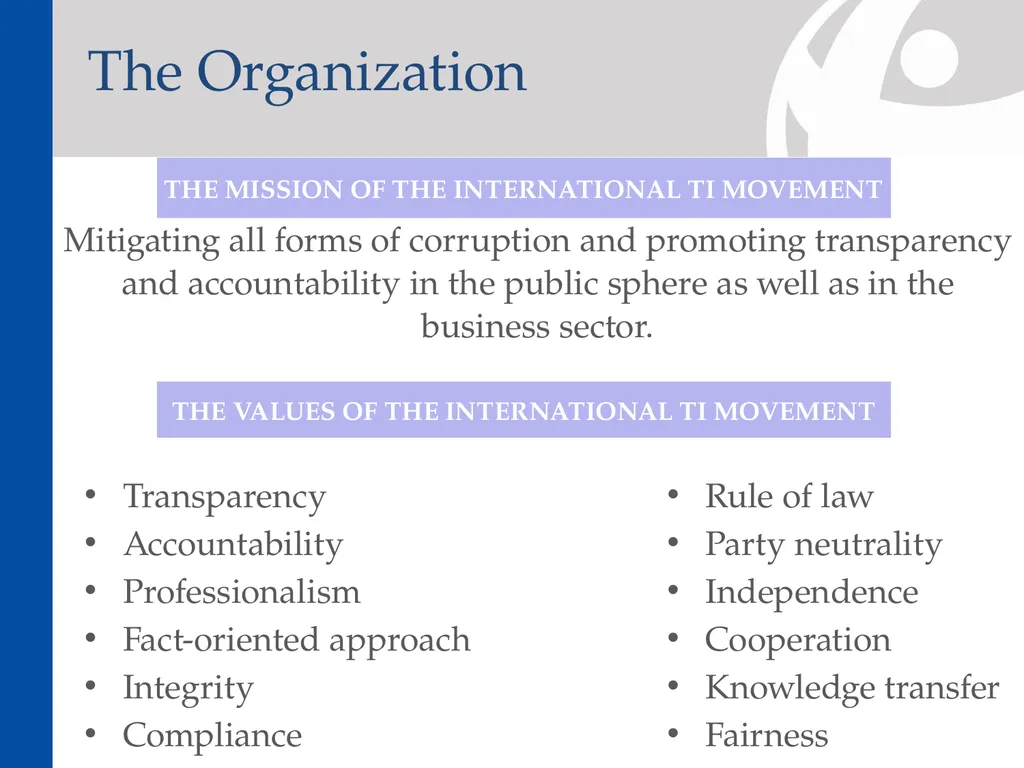
slide5. Mitigating all forms of corruption and promoting transparency and accountability in the public sphere as well as in the business sector. The Organization THE MISSION OF THE INTERNATIONAL TI MOVEMENT THE VALUES OF THE INTERNATIONAL TI MOVEMENT Rule of law
Party neutrality
Independence
Cooperation
Knowledge transfer
Fairness Transparency
Accountability
Professionalism
Fact-oriented approach
Integrity
Compliance<br>
slide6. Summary of the previous strategy (2019-2021) and evaluating its implementation<br>
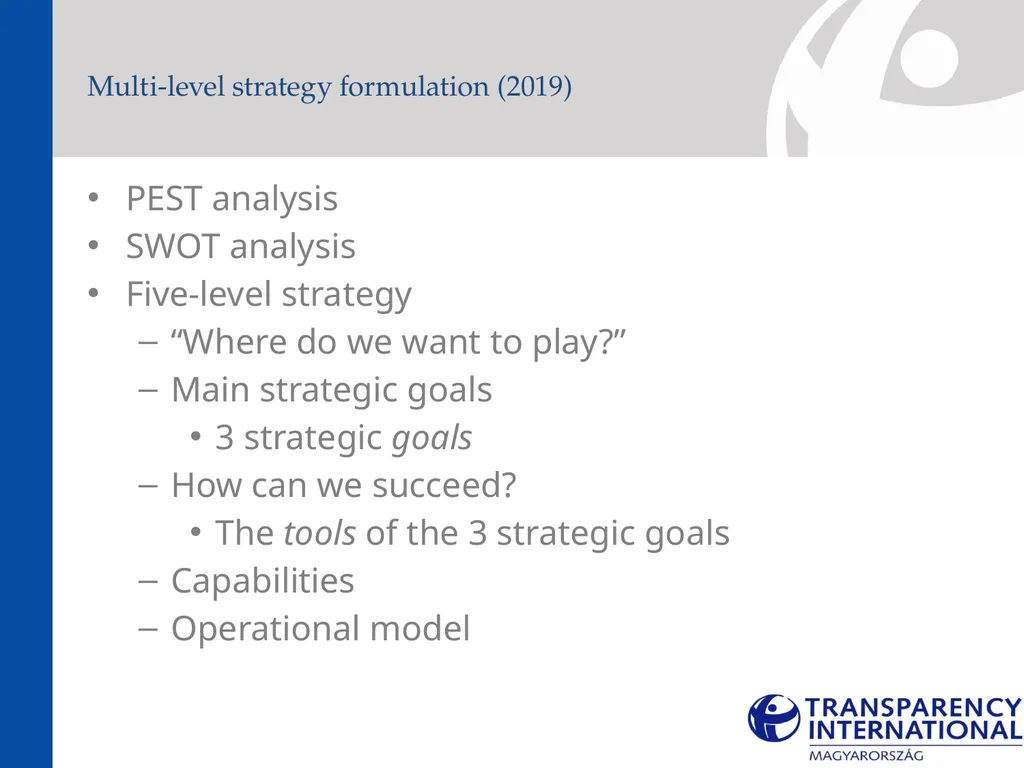
slide7. PEST analysis
SWOT analysis
Five-level strategy
“Where do we want to play?”
Main strategic goals
3 strategic goals
How can we succeed?
The tools of the 3 strategic goals
Capabilities
Operational model Multi-level strategy formulation (2019)<br>
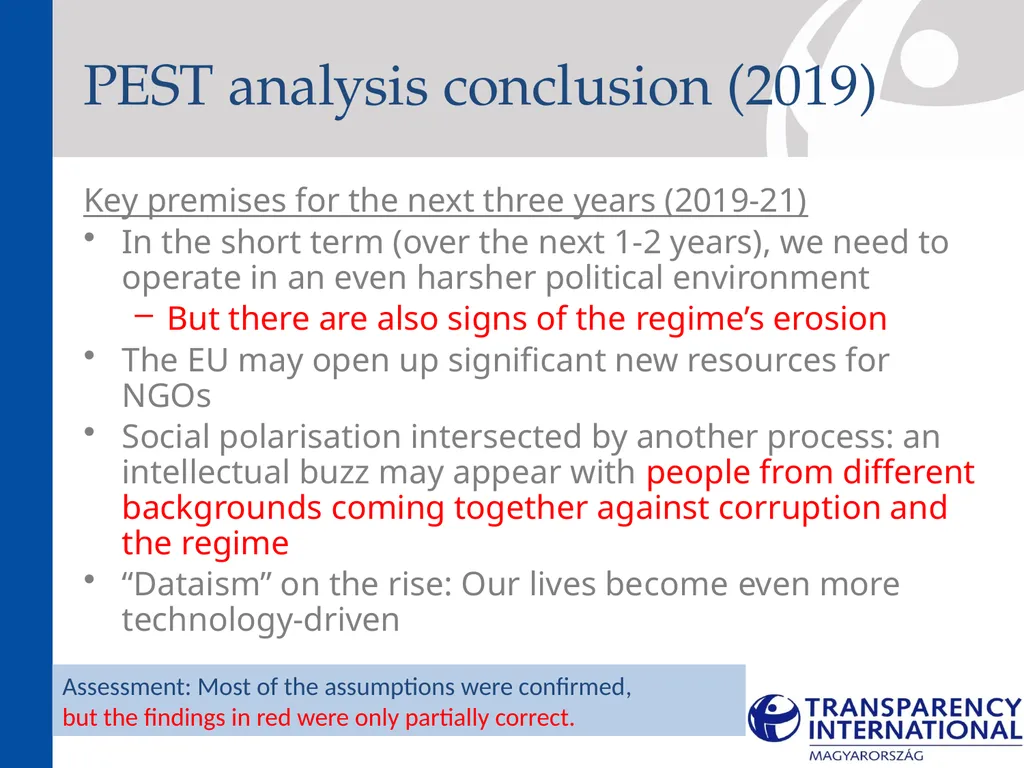
slide8. Key premises for the next three years (2019-21)
In the short term (over the next 1-2 years), we need to operate in an even harsher political environment
But there are also signs of the regime’s erosion
The EU may open up significant new resources for NGOs
Social polarisation intersected by another process: an intellectual buzz may appear with people from different backgrounds coming together against corruption and the regime
“Dataism” on the rise: Our lives become even more technology-driven PEST analysis conclusion (2019) Assessment: Most of the assumptions were confirmed,
but the findings in red were only partially correct.<br>
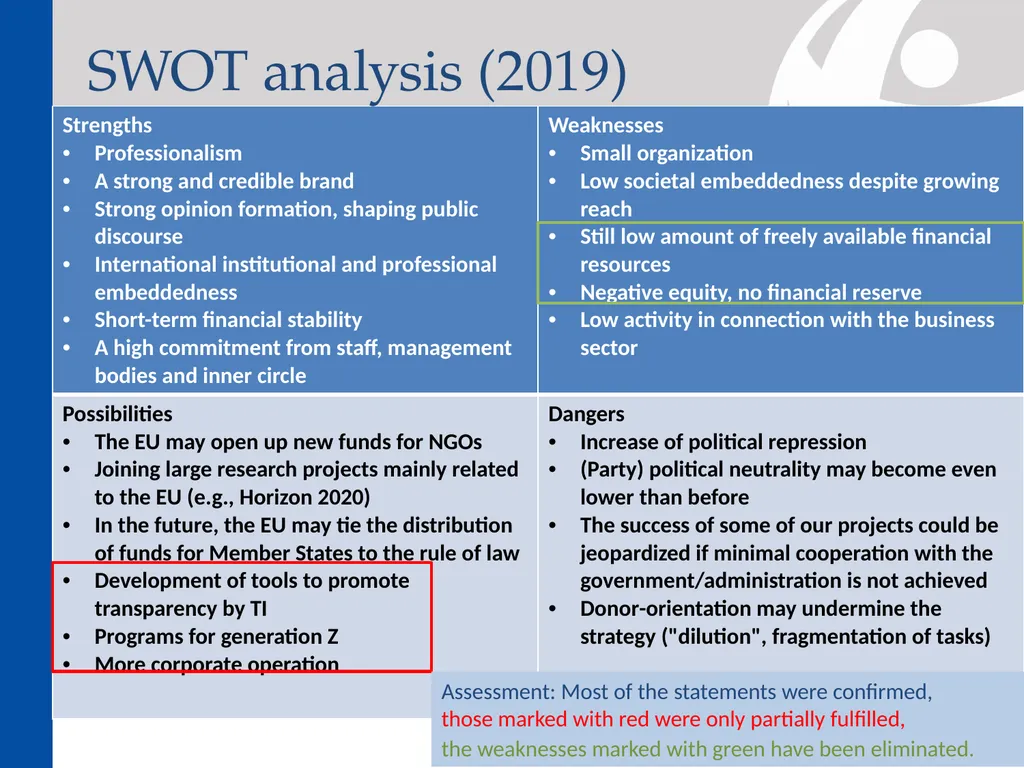
slide9. SWOT analysis (2019) Assessment: Most of the statements were confirmed,
those marked with red were only partially fulfilled,
the weaknesses marked with green have been eliminated.<br>
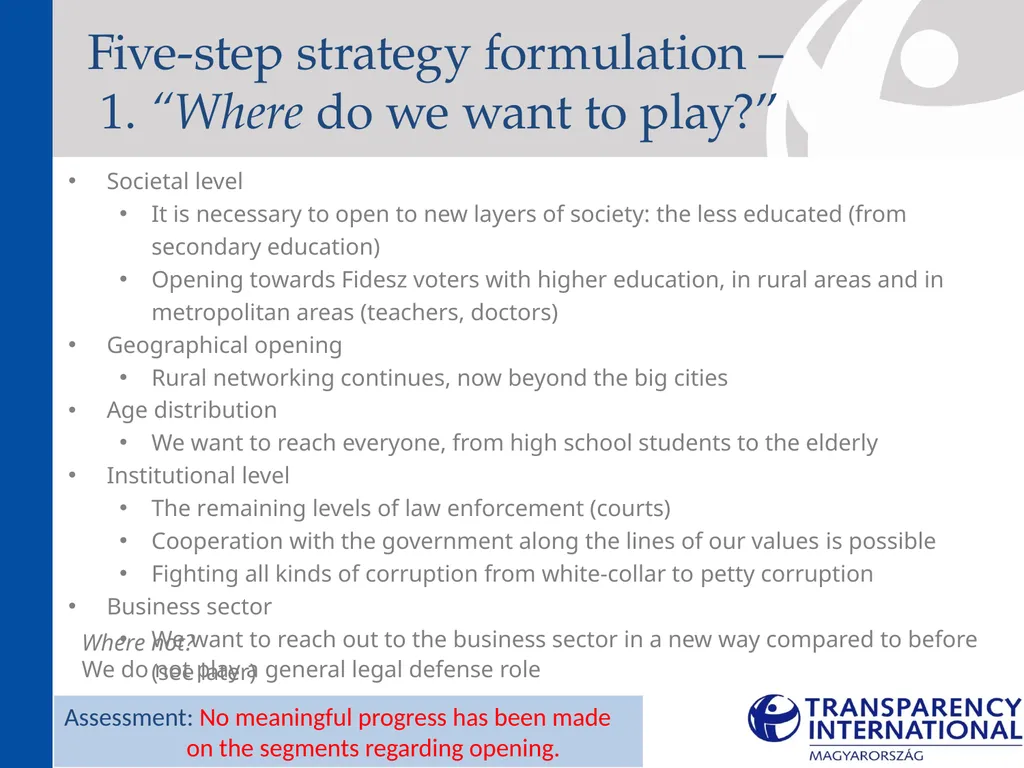
slide10. Societal level
It is necessary to open to new layers of society: the less educated (from secondary education)
Opening towards Fidesz voters with higher education, in rural areas and in metropolitan areas (teachers, doctors)
Geographical opening
Rural networking continues, now beyond the big cities
Age distribution
We want to reach everyone, from high school students to the elderly
Institutional level
The remaining levels of law enforcement (courts)
Cooperation with the government along the lines of our values is possible
Fighting all kinds of corruption from white-collar to petty corruption
Business sector
We want to reach out to the business sector in a new way compared to before (see later) Five-step strategy formulation – 1. “Where do we want to play?” Where not?
We do not play a general legal defense role Assessment: No meaningful progress has been made on the segments regarding opening.<br>
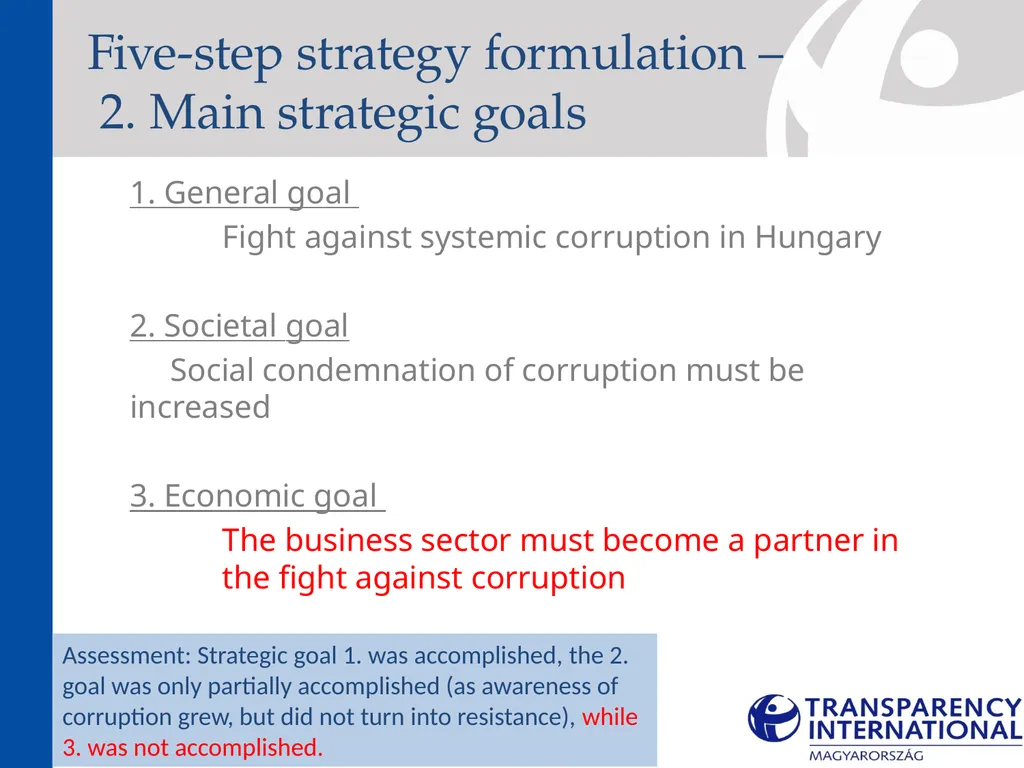
slide11. 1. General goal
Fight against systemic corruption in Hungary
2. Societal goal
Social condemnation of corruption must be increased
3. Economic goal
The business sector must become a partner in the fight against corruption Five-step strategy formulation – 2. Main strategic goals Assessment: Strategic goal 1. was accomplished, the 2. goal was only partially accomplished (as awareness of corruption grew, but did not turn into resistance), while 3. was not accomplished.<br>
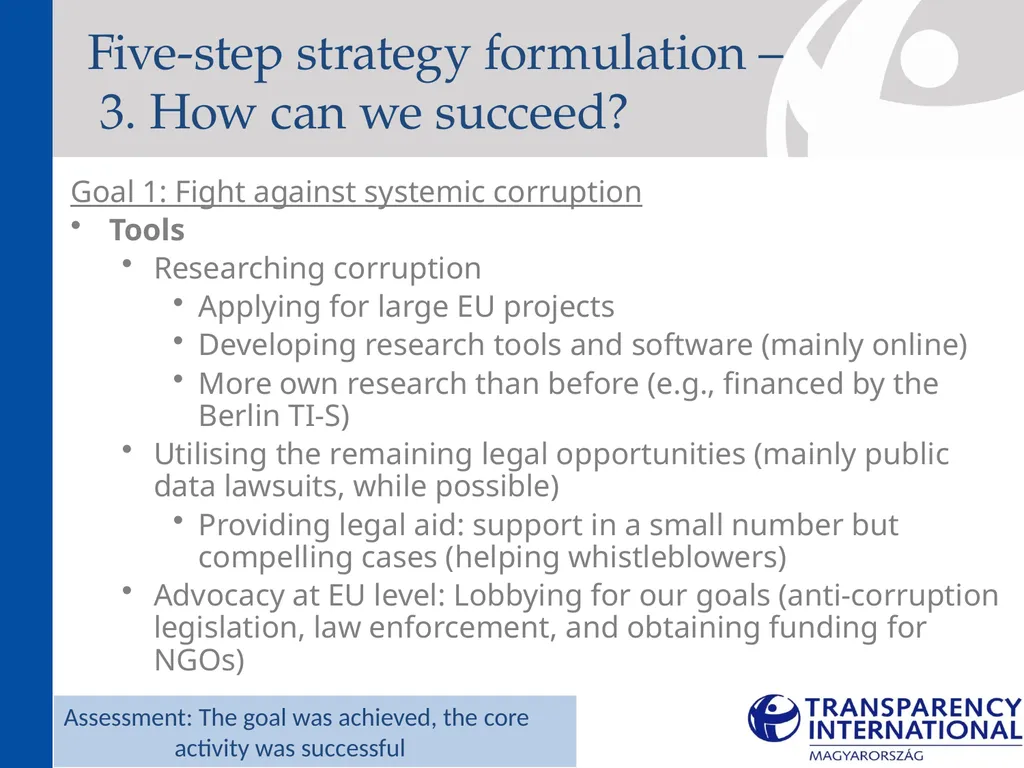
slide12. Goal 1: Fight against systemic corruption
Tools
Researching corruption
Applying for large EU projects
Developing research tools and software (mainly online)
More own research than before (e.g., financed by the Berlin TI-S)
Utilising the remaining legal opportunities (mainly public data lawsuits, while possible)
Providing legal aid: support in a small number but compelling cases (helping whistleblowers)
Advocacy at EU level: Lobbying for our goals (anti-corruption legislation, law enforcement, and obtaining funding for NGOs) Five-step strategy formulation – 3. How can we succeed? Assessment: The goal was achieved, the core activity was successful<br>
slide13. Goal 2: Social condemnation of corruption must be increased
Tool: Extend social base and impact
Communication
Launch a new communication product (newsletter and/or blog)
Proactive instead of reactive communication
Special communication strategy for Fidesz voters (rural intellectuals)
Simpler, more straight-forward communication, which does not come at the expense of professionalism
Using innovative tools
Building our societal base
Building and expanding the existing rural base towards residents of smaller cities
Helping victims of corruption: support in a small number but compelling cases
Starting educational programs – from high school to university – or developing already existing ones (e.g., curriculum) Five-step strategy formulation – 3. How can we succeed? Assessment: The strategic goal was only partially accomplished, there was no meaningful progress in the areas in red<br>
slide14. Goal 3: The business sector must become a partner in the fight against corruption
Tools
Organising business galas / breakfasts / luncheons with the aim of i) networking, increasing embeddedness ii) exchanging information and iii) fundraising
Neither the former Corporate Supporters Forum (addressing big corporations to support our mission) nor business consultancy is considered to be a tool that can meaningfully contribute to goal 3. under the current circumstances Five-step strategy formulation – 3. How can we succeed? Assessment: There has been no meaningful progress in achieving the stated goal<br>
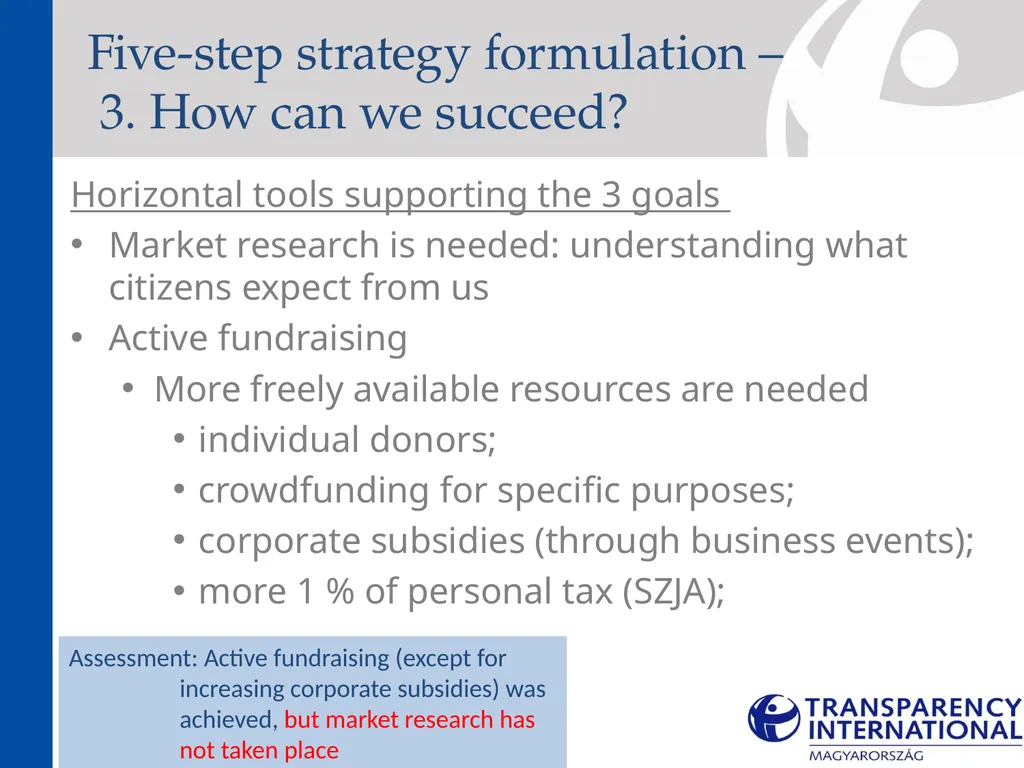
slide15. Horizontal tools supporting the 3 goals
Market research is needed: understanding what citizens expect from us
Active fundraising
More freely available resources are needed
individual donors;
crowdfunding for specific purposes;
corporate subsidies (through business events);
more 1 % of personal tax (SZJA); Five-step strategy formulation – 3. How can we succeed? Assessment: Active fundraising (except for increasing corporate subsidies) was achieved, but market research has not taken place<br>
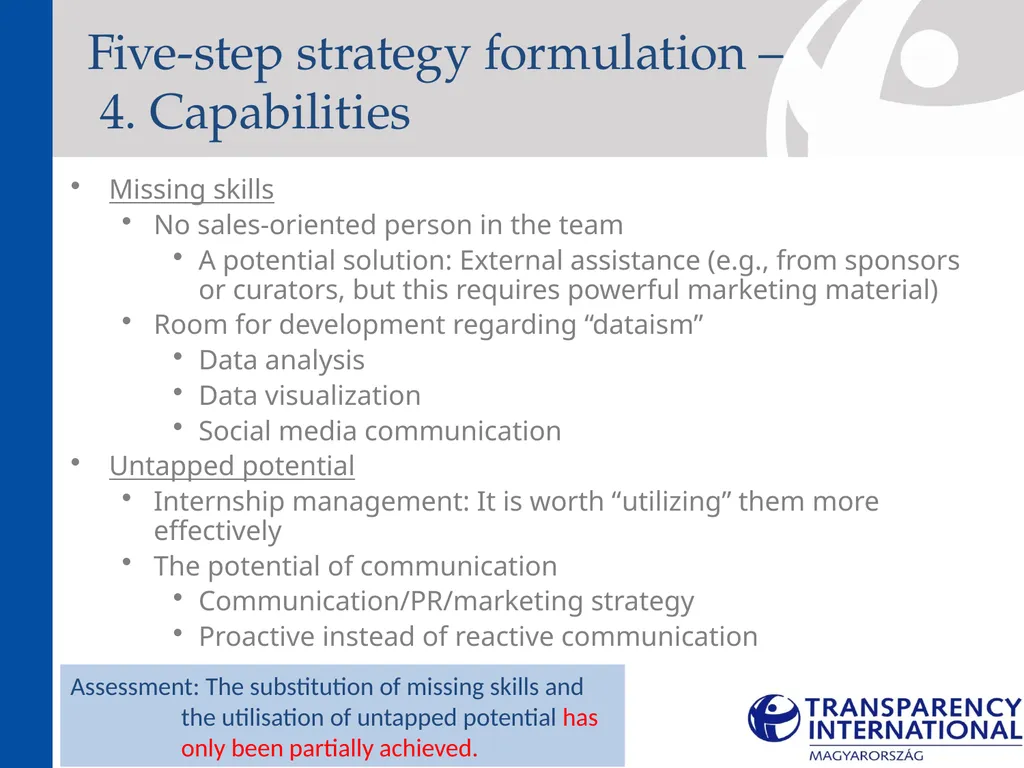
slide16. Missing skills
No sales-oriented person in the team
A potential solution: External assistance (e.g., from sponsors or curators, but this requires powerful marketing material)
Room for development regarding “dataism”
Data analysis
Data visualization
Social media communication
Untapped potential
Internship management: It is worth “utilizing” them more effectively
The potential of communication
Communication/PR/marketing strategy
Proactive instead of reactive communication Five-step strategy formulation – 4. Capabilities Assessment: The substitution of missing skills and the utilisation of untapped potential has only been partially achieved.<br>
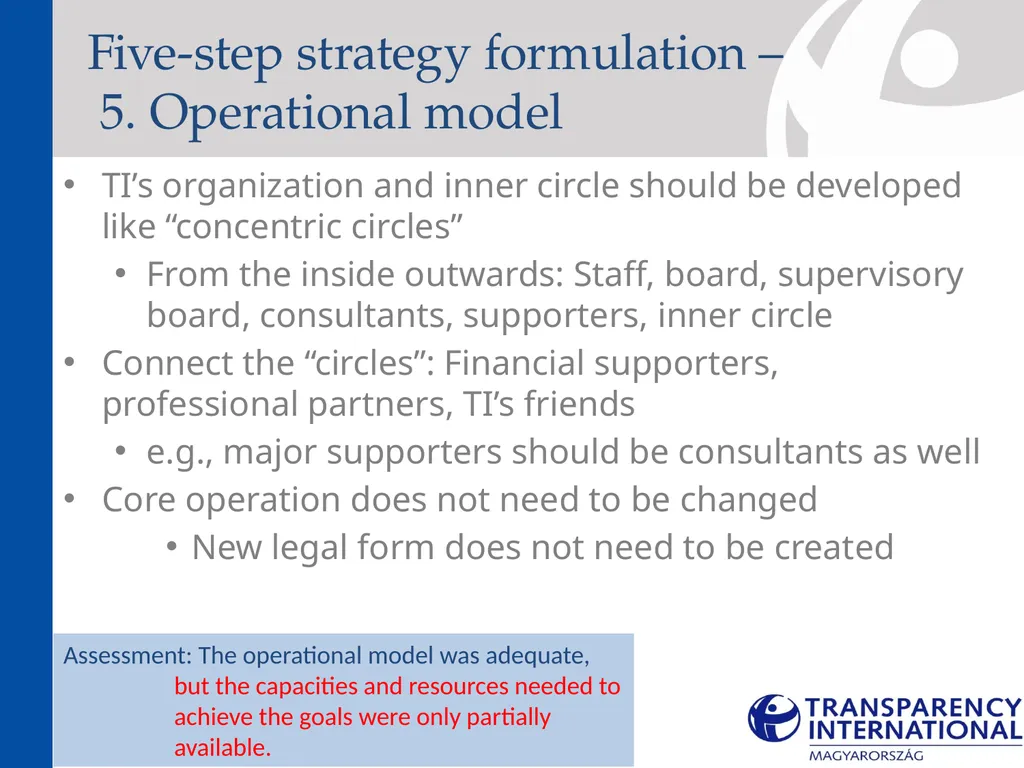
slide17. TI’s organization and inner circle should be developed like “concentric circles”
From the inside outwards: Staff, board, supervisory board, consultants, supporters, inner circle
Connect the “circles”: Financial supporters, professional partners, TI’s friends
e.g., major supporters should be consultants as well
Core operation does not need to be changed
New legal form does not need to be created Five-step strategy formulation – 5. Operational model Assessment: The operational model was adequate, but the capacities and resources needed to achieve the goals were only partially available.<br>
slide18. Strong political headwind, more permanent than previously estimated
Several constraining factors
no meaningful dialogue on the part of government agencies
public prosecutor’s office and institutions in charge of controlling government agencies are not independent
a divided society, "cold civil war" situation
Current revenue streams (EU, international foundation resources, in a small proportion embassies) are developed and seem sustainable
Small organization
Appearance and visibility of organizations with similar profiles
Some results receive significant attention: there remains a need for TI’s activity A summary assessment of TI’s environment, external and internal operating conditions<br>
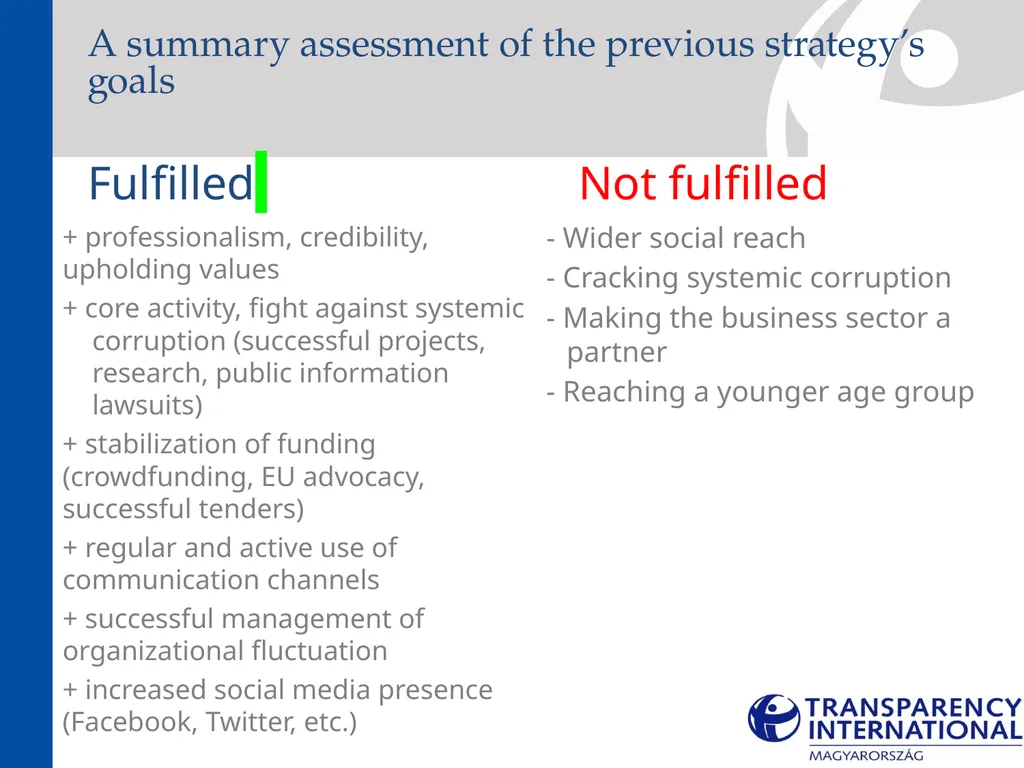
slide19. A summary assessment of the previous strategy’s goals + professionalism, credibility, upholding values
+ core activity, fight against systemic corruption (successful projects, research, public information lawsuits)
+ stabilization of funding (crowdfunding, EU advocacy, successful tenders)
+ regular and active use of communication channels
+ successful management of organizational fluctuation
+ increased social media presence (Facebook, Twitter, etc.) - Wider social reach
- Cracking systemic corruption
- Making the business sector a partner
- Reaching a younger age group Fulfilled Not fulfilled<br>
slide20. Mission, principles
The strengths of the organization are professionalism; credibility; opinion-forming; international institutional and professional embeddedness; high commitment
Delivering projects at a high quality, to the satisfaction of donors
Active presence in the media ("outreach")
Strategic goal: Fighting against systemic corruption in Hungary
Public information lawsuits Goal categories 1. Achieved goals: "Business as usual"<br>
slide21. Financial affairs: Equity surplus, increasing cashflow, more freely available resources, crowdfunding
Communication: New communication products (newsletter, blog reactivation); development of communication strategy
Freedom of information litigation (number, effectiveness)
EU advocacy
Internship management Goal categories 2. Achieved goals: Development<br>
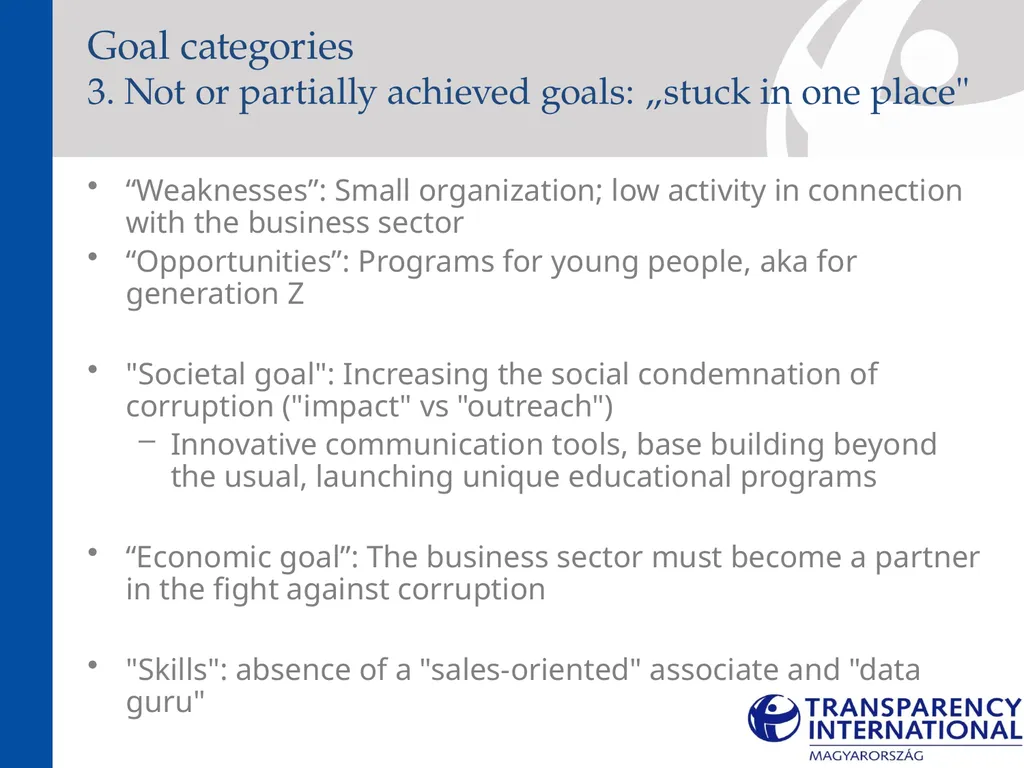
slide22. “Weaknesses”: Small organization; low activity in connection with the business sector
“Opportunities”: Programs for young people, aka for generation Z
"Societal goal": Increasing the social condemnation of corruption ("impact" vs "outreach")
Innovative communication tools, base building beyond the usual, launching unique educational programs
“Economic goal”: The business sector must become a partner in the fight against corruption
"Skills": absence of a "sales-oriented" associate and "data guru" Goal categories 3. Not or partially achieved goals: „stuck in one place"<br>
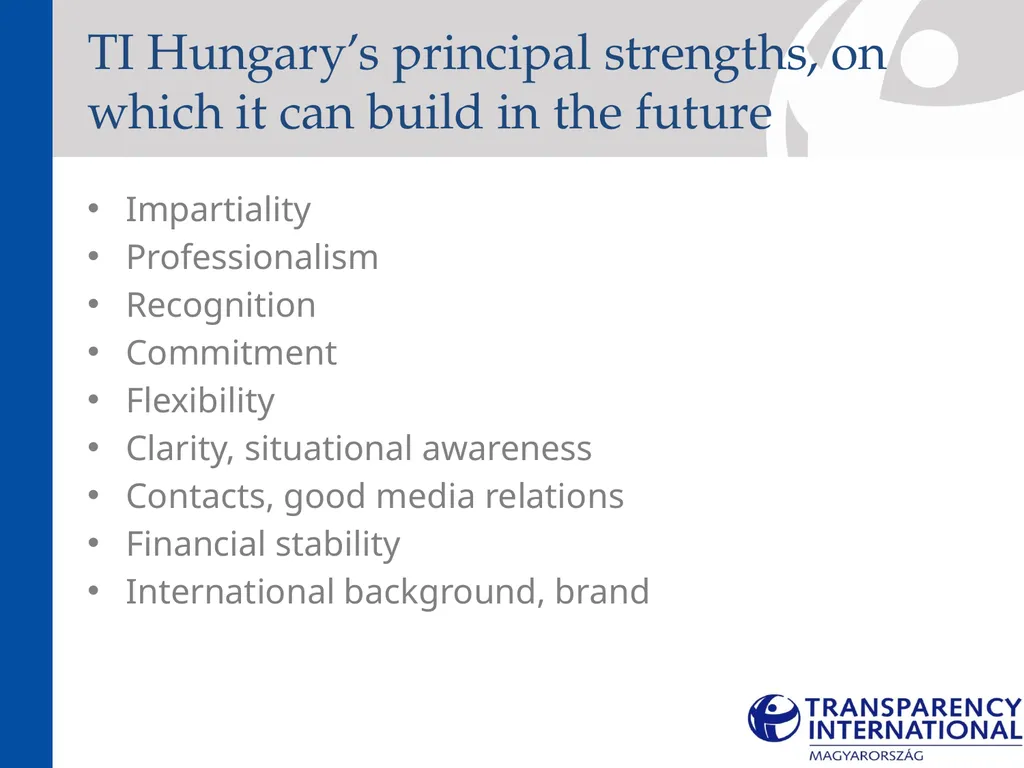
slide23. Impartiality
Professionalism
Recognition
Commitment
Flexibility
Clarity, situational awareness
Contacts, good media relations
Financial stability
International background, brand TI Hungary’s principal strengths, on which it can build in the future<br>
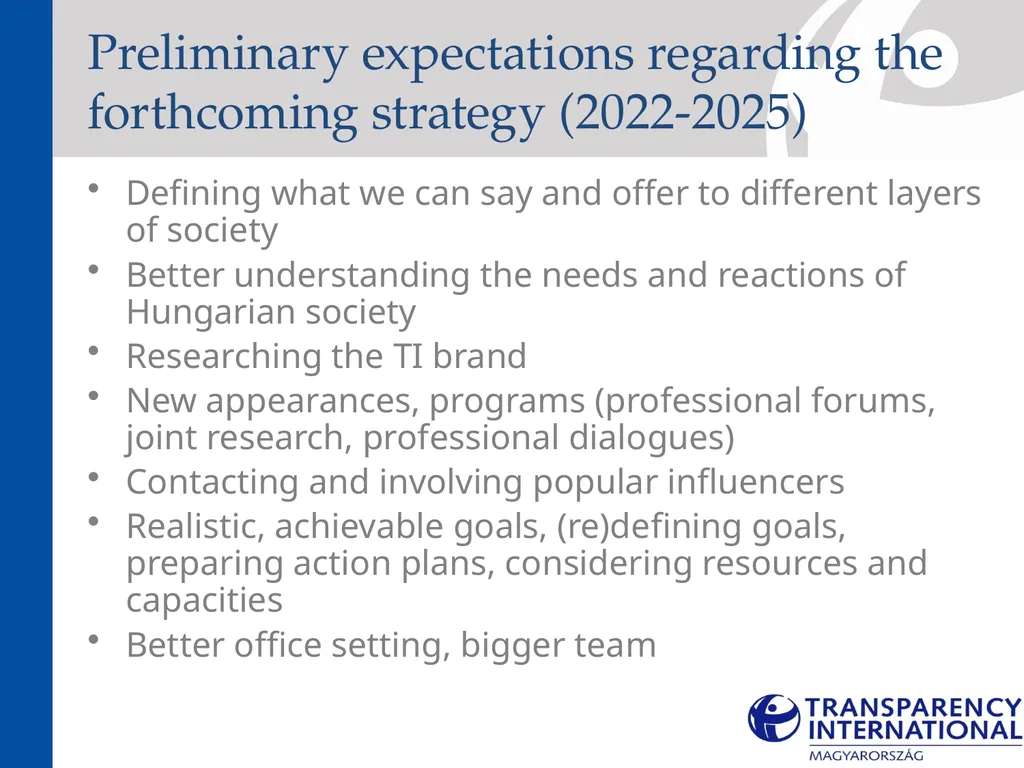
slide24. Defining what we can say and offer to different layers of society
Better understanding the needs and reactions of Hungarian society
Researching the TI brand
New appearances, programs (professional forums, joint research, professional dialogues)
Contacting and involving popular influencers
Realistic, achievable goals, (re)defining goals, preparing action plans, considering resources and capacities
Better office setting, bigger team Preliminary expectations regarding the forthcoming strategy (2022-2025)<br>
slide25. III. TI Hungary’s current state of affairs and main results (2022)<br>
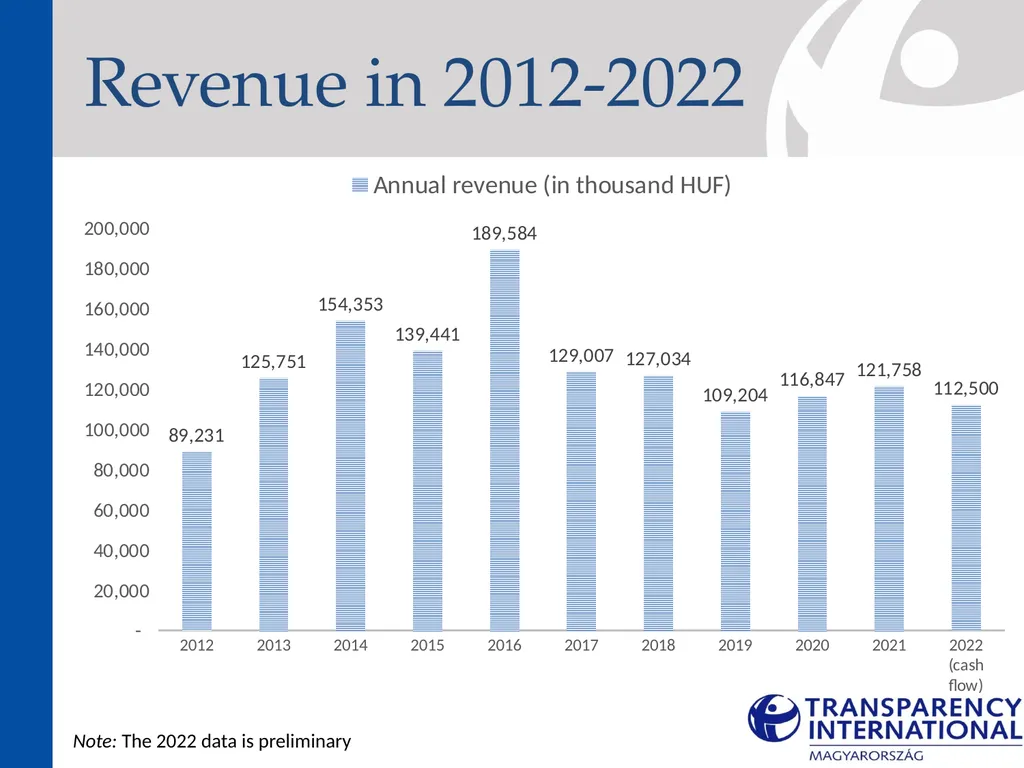
slide26. Revenue in 2012-2022 Note: The 2022 data is preliminary<br>
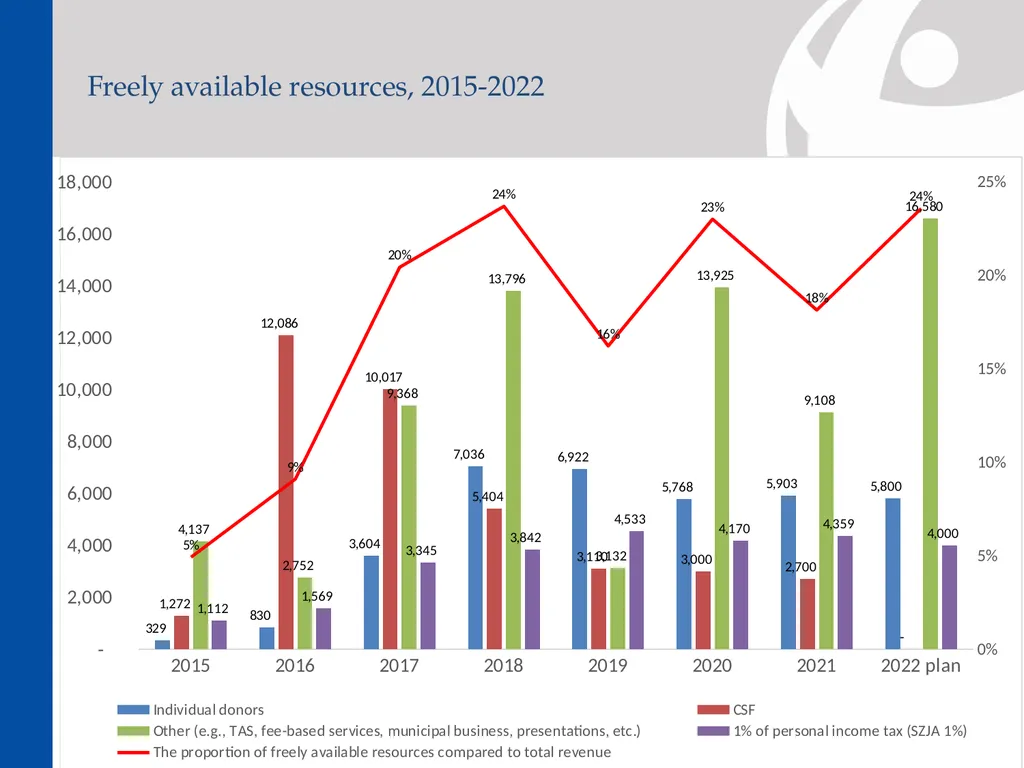
slide27. Freely available resources, 2015-2022<br>
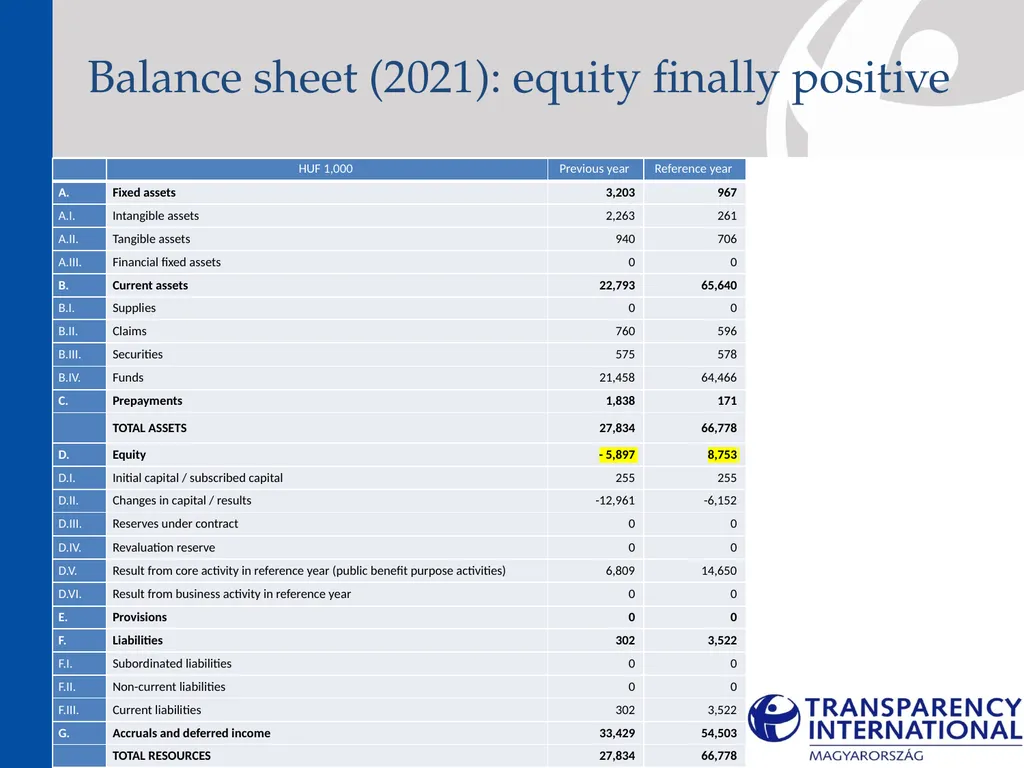
slide28. Balance sheet (2021): equity finally positive<br>
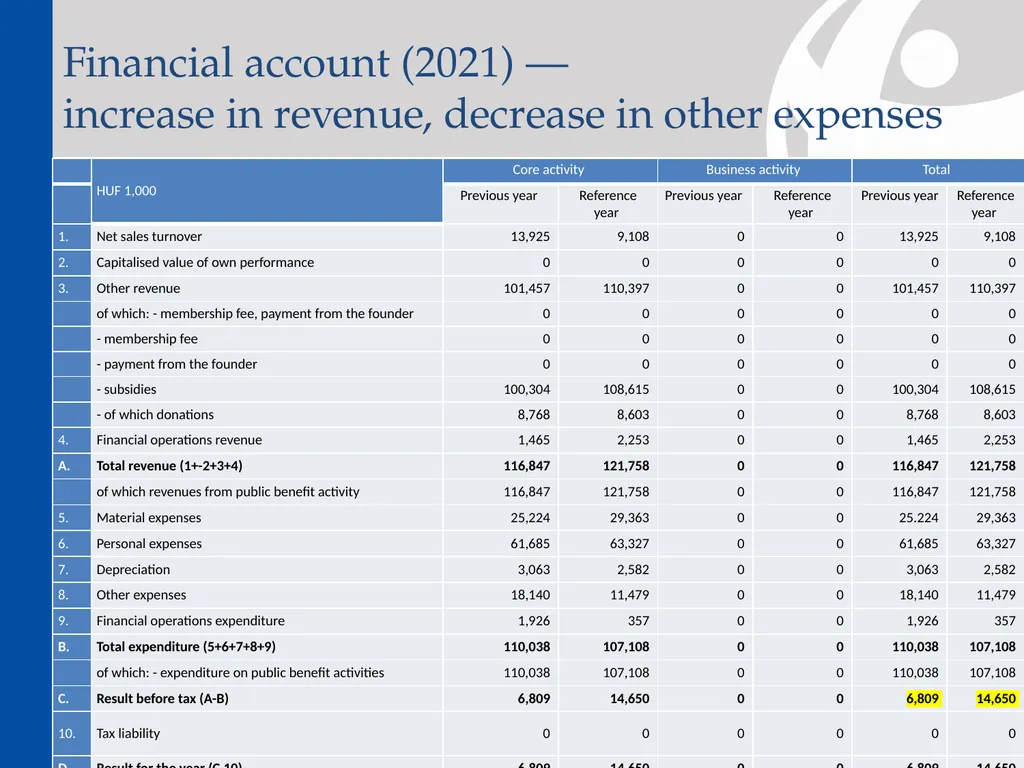
slide29. Financial account (2021) — increase in revenue, decrease in other expenses<br>
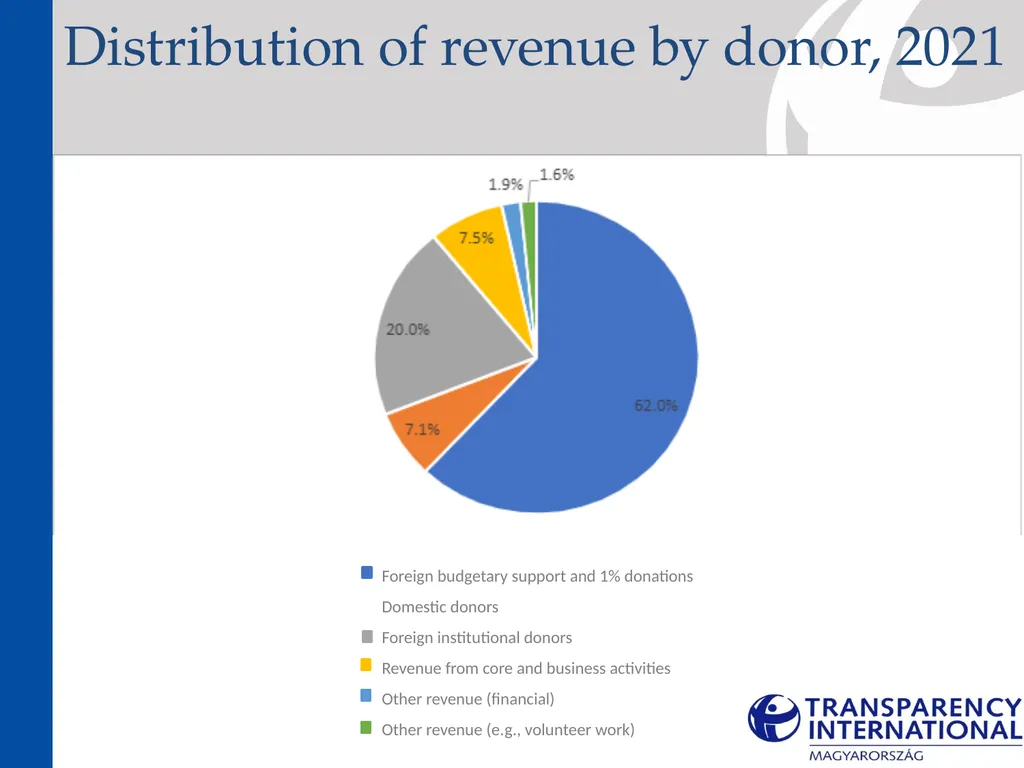
slide30. Distribution of revenue by donor, 2021 Foreign budgetary support and 1% donations
Domestic donors
Foreign institutional donors
Revenue from core and business activities
Other revenue (financial)
Other revenue (e.g., volunteer work)<br>
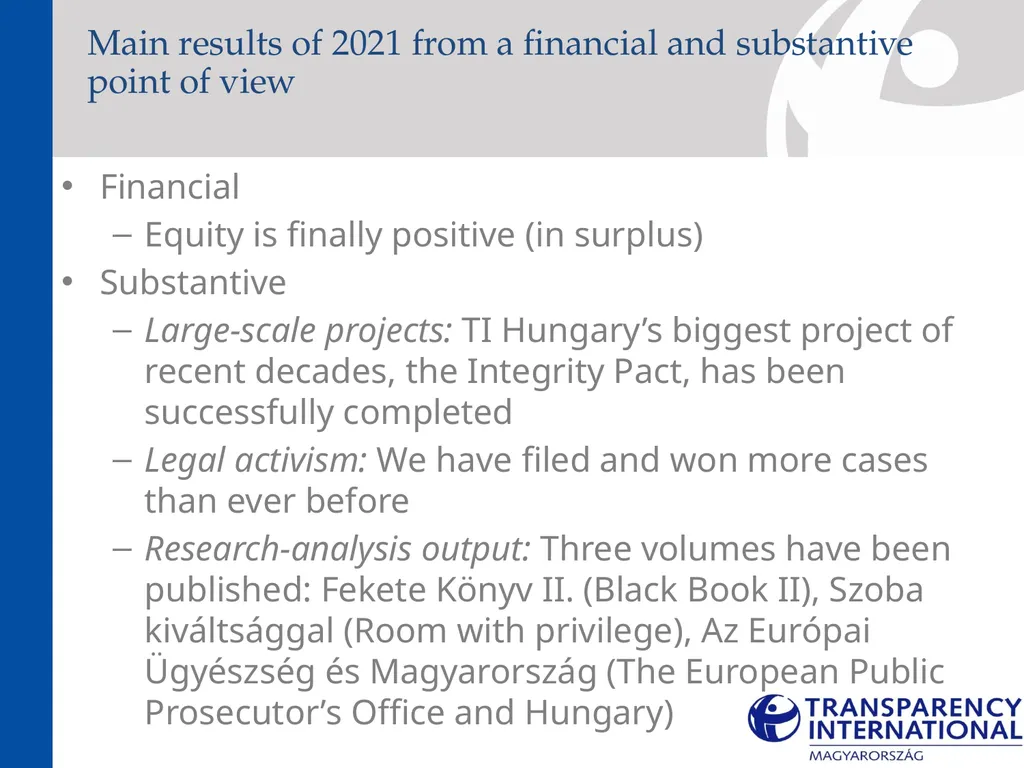
slide31. Financial
Equity is finally positive (in surplus)
Substantive
Large-scale projects: TI Hungary’s biggest project of recent decades, the Integrity Pact, has been successfully completed
Legal activism: We have filed and won more cases than ever before
Research-analysis output: Three volumes have been published: Fekete Könyv II. (Black Book II), Szoba kiváltsággal (Room with privilege), Az Európai Ügyészség és Magyarország (The European Public Prosecutor’s Office and Hungary) Main results of 2021 from a financial and substantive point of view<br>
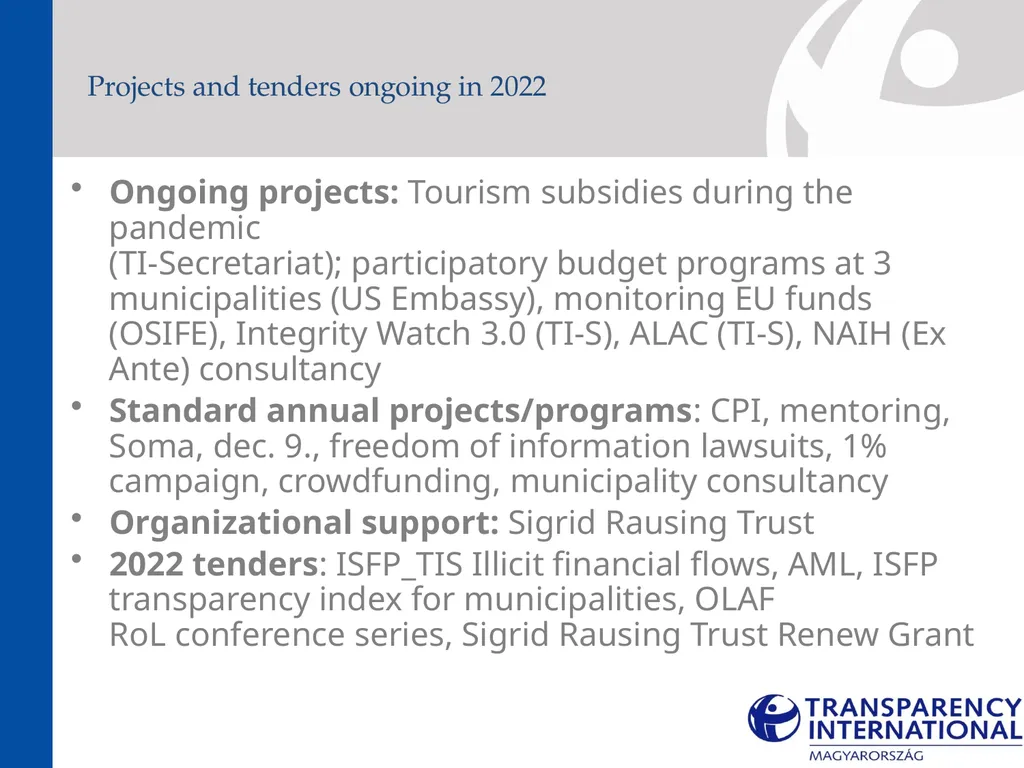
slide32. Ongoing projects: Tourism subsidies during the pandemic (TI-Secretariat); participatory budget programs at 3 municipalities (US Embassy), monitoring EU funds (OSIFE), Integrity Watch 3.0 (TI-S), ALAC (TI-S), NAIH (Ex Ante) consultancy
Standard annual projects/programs: CPI, mentoring, Soma, dec. 9., freedom of information lawsuits, 1% campaign, crowdfunding, municipality consultancy
Organizational support: Sigrid Rausing Trust
2022 tenders: ISFP_TIS Illicit financial flows, AML, ISFP transparency index for municipalities, OLAF RoL conference series, Sigrid Rausing Trust Renew Grant Projects and tenders ongoing in 2022<br>
slide33. TI Hungary’s social reach (2022)<br>
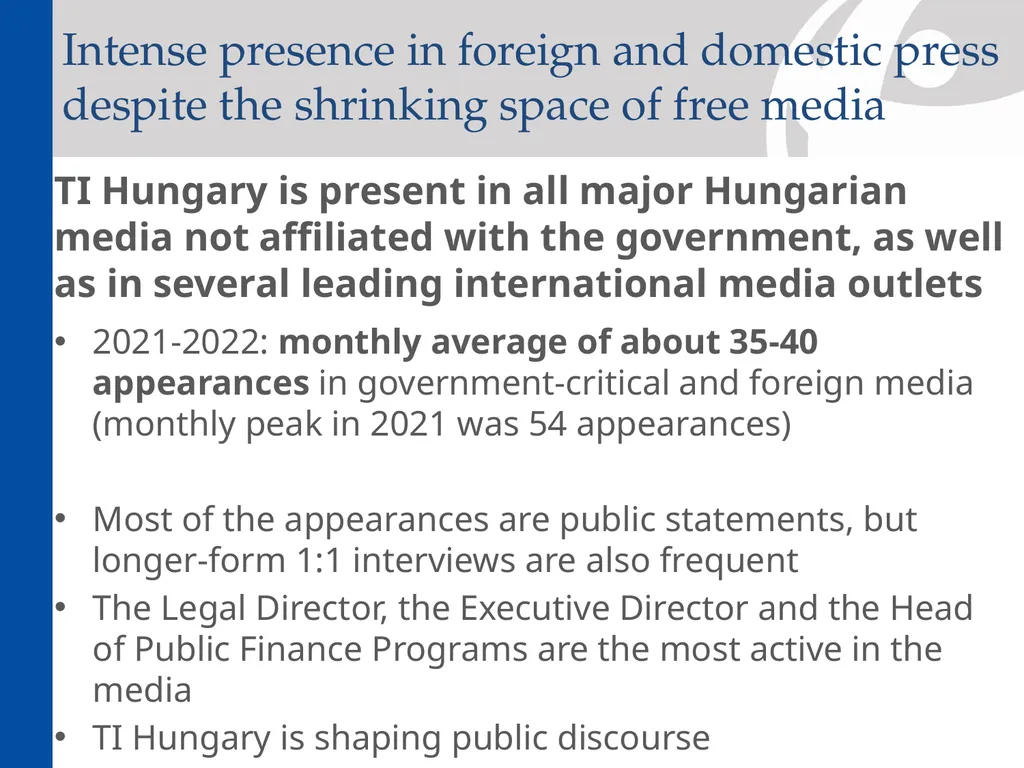
slide34. TI Hungary is present in all major Hungarian media not affiliated with the government, as well as in several leading international media outlets
2021-2022: monthly average of about 35-40 appearances in government-critical and foreign media (monthly peak in 2021 was 54 appearances)
Most of the appearances are public statements, but longer-form 1:1 interviews are also frequent
The Legal Director, the Executive Director and the Head of Public Finance Programs are the most active in the media
TI Hungary is shaping public discourse Intense presence in foreign and domestic press despite the shrinking space of free media<br>
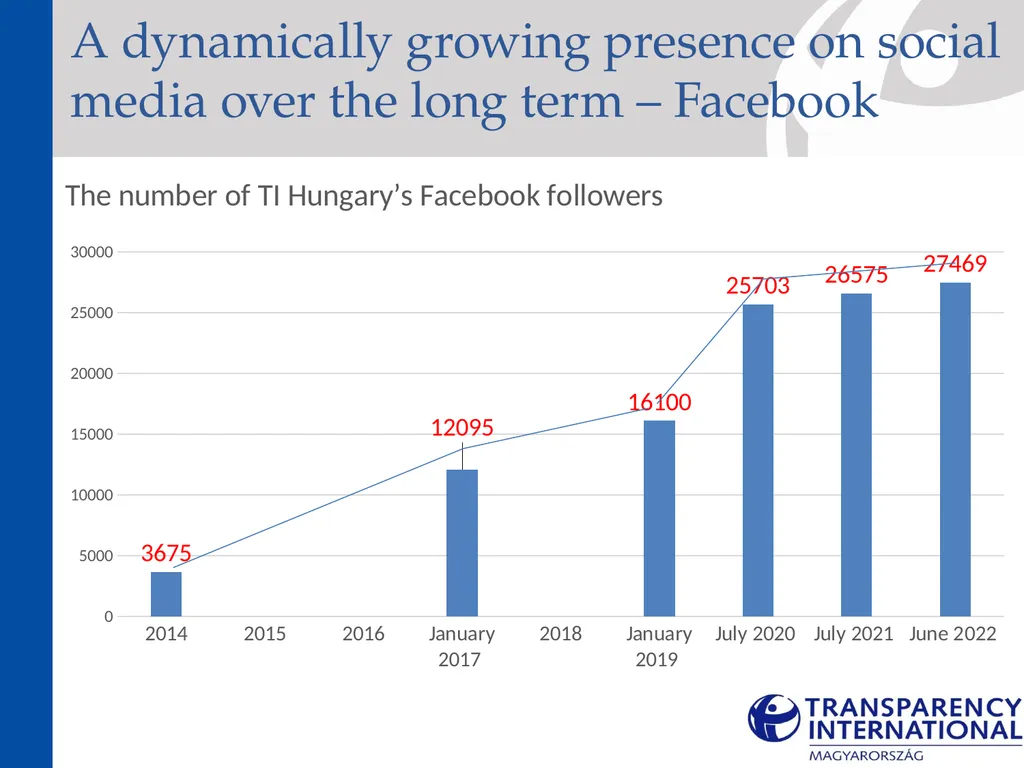
slide35. A dynamically growing presence on social media over the long term – Facebook<br>
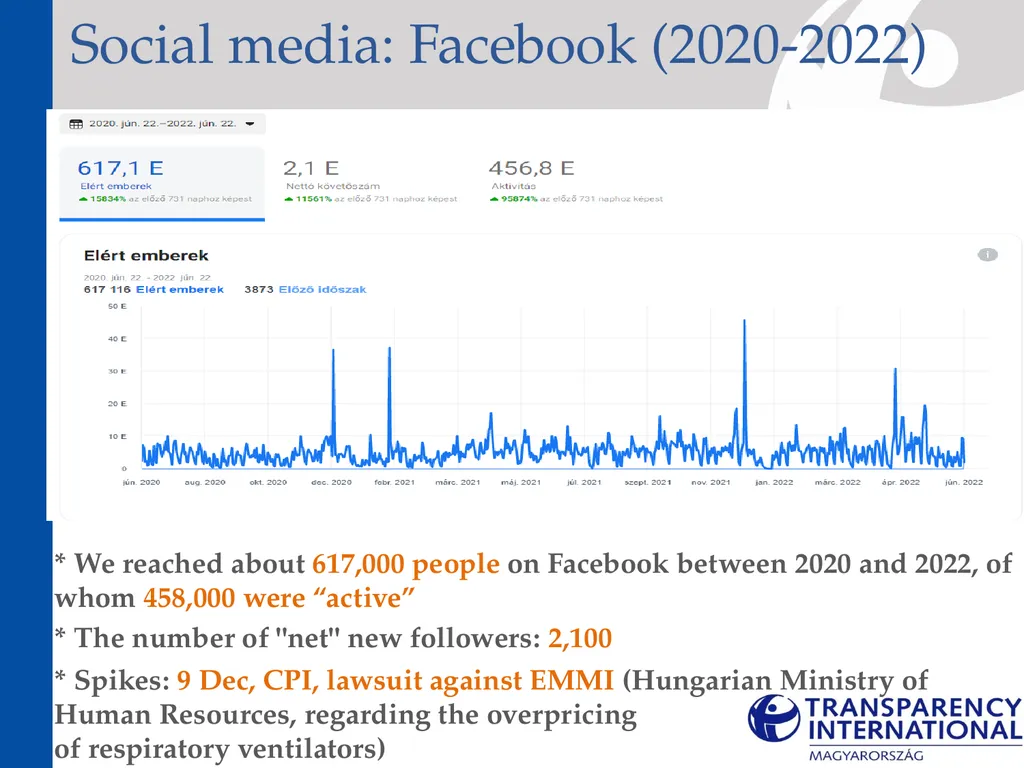
slide36. * We reached about 617,000 people on Facebook between 2020 and 2022, of whom 458,000 were “active”
* The number of "net" new followers: 2,100
* Spikes: 9 Dec, CPI, lawsuit against EMMI (Hungarian Ministry of Human Resources, regarding the overpricing
of respiratory ventilators) Social media: Facebook (2020-2022)<br>
slide37. Twitter: 1,785 followers (in 2019: 1,135)
Instagram: 972 followers (in 2019: 251)
Youtube 205,000 minutes of videos watched on our page between 2018 and June 2022 (spikes: 9 Dec, CPI, online events during the pandemic)
Almost half (44%) of the total watch time has occurred in the last 3 years, and 42% of subscribers have been gained in the last year
The most viewed video remains: Shocking clichés for HUF 135 millions of public funds (Gálvölgyi, 2018), so far: 205,675 views Organic growth is showing on other platforms as well over the past three years<br>
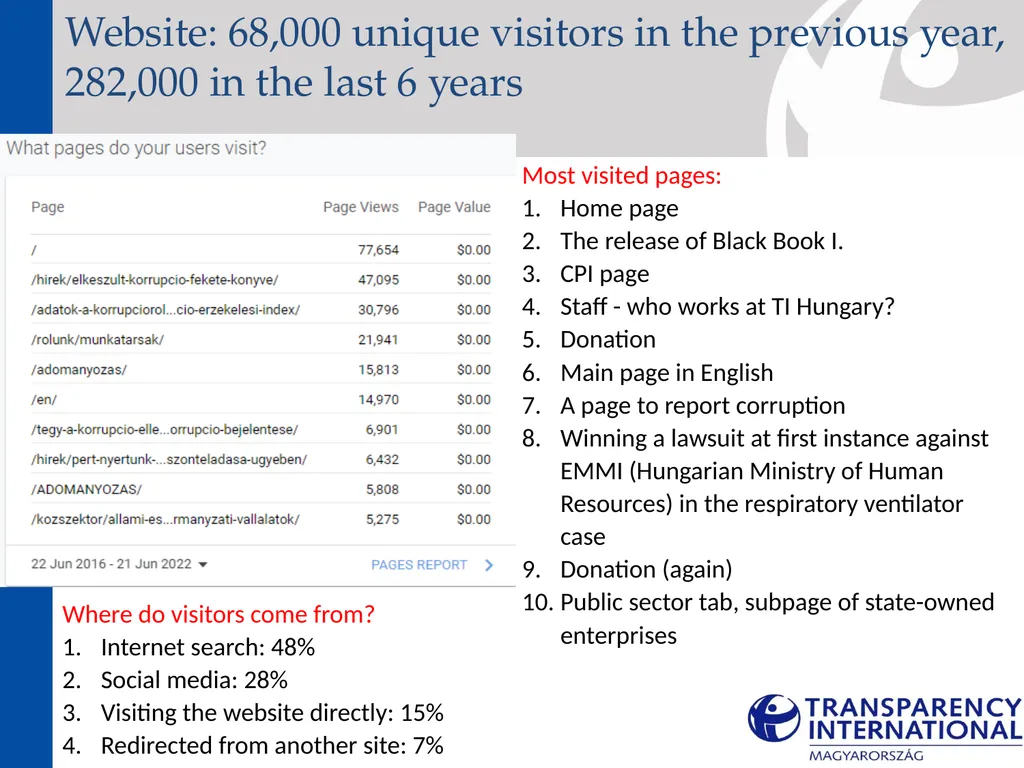
slide38. Website: 68,000 unique visitors in the previous year, 282,000 in the last 6 years Most visited pages:
Home page
The release of Black Book I.
CPI page
Staff - who works at TI Hungary?
Donation
Main page in English
A page to report corruption
Winning a lawsuit at first instance against EMMI (Hungarian Ministry of Human Resources) in the respiratory ventilator case
Donation (again)
Public sector tab, subpage of state-owned enterprises Where do visitors come from?
Internet search: 48%
Social media: 28%
Visiting the website directly: 15%
Redirected from another site: 7%<br>
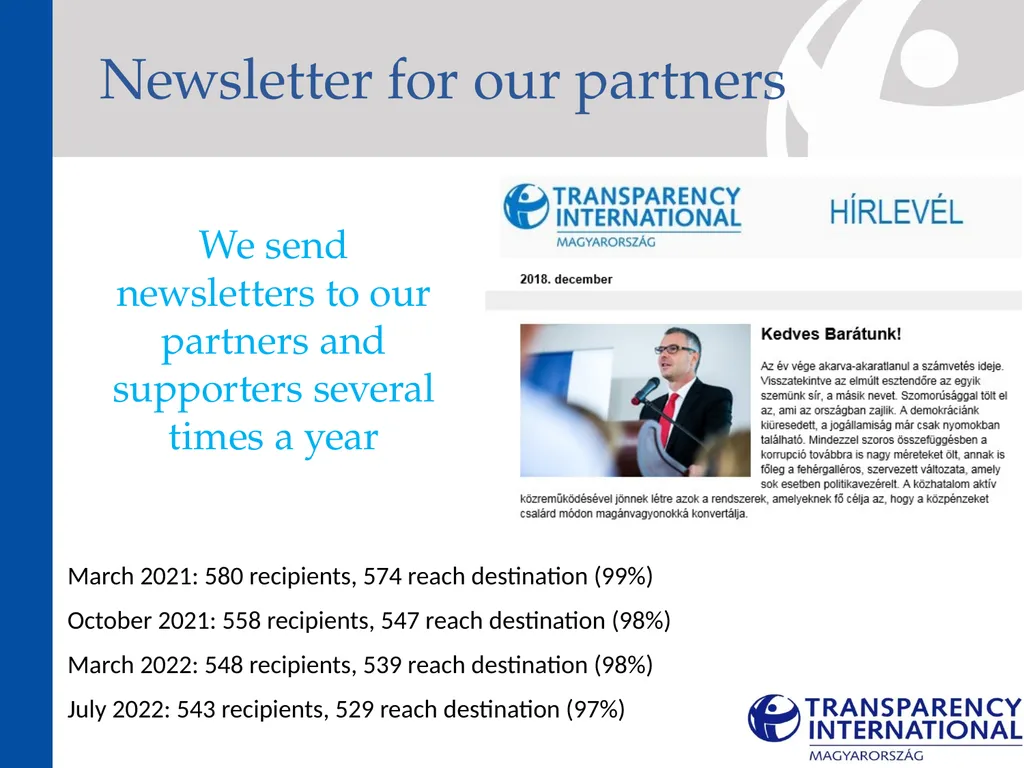
slide39. Newsletter for our partners We send newsletters to our partners and supporters several times a year March 2021: 580 recipients, 574 reach destination (99%)
October 2021: 558 recipients, 547 reach destination (98%)
March 2022: 548 recipients, 539 reach destination (98%)
July 2022: 543 recipients, 529 reach destination (97%)<br>
slide40. IV. TI Hungary’s
strategy for 2022-2025<br>
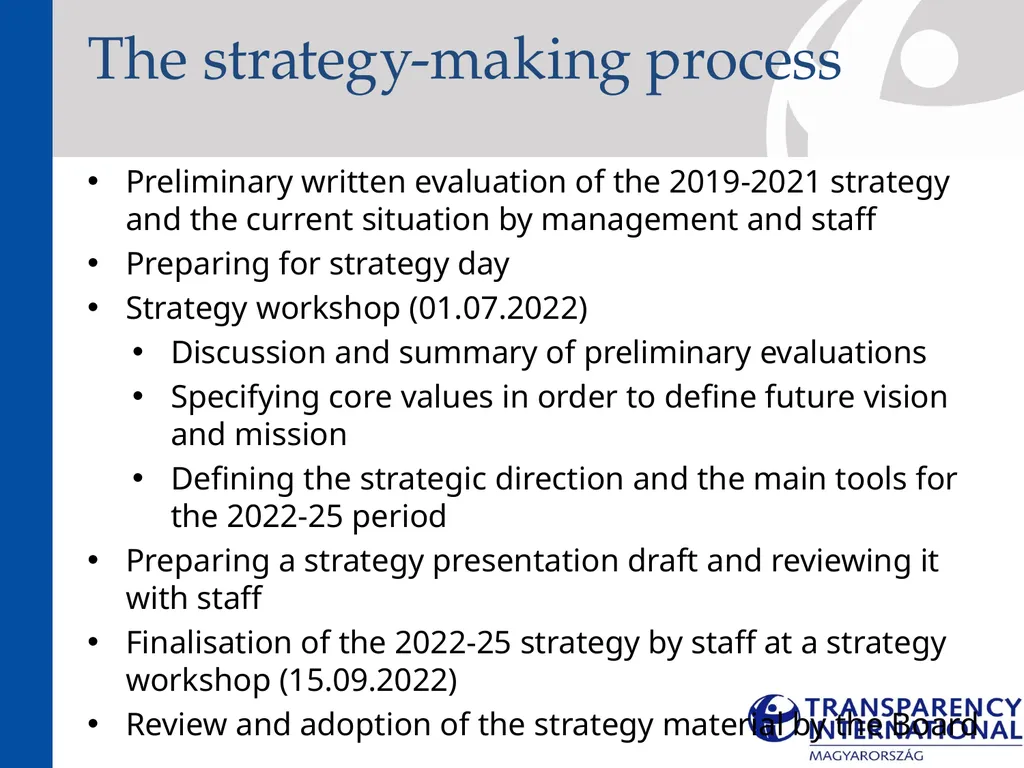
slide41. Preliminary written evaluation of the 2019-2021 strategy and the current situation by management and staff
Preparing for strategy day
Strategy workshop (01.07.2022)
Discussion and summary of preliminary evaluations
Specifying core values in order to define future vision and mission
Defining the strategic direction and the main tools for the 2022-25 period
Preparing a strategy presentation draft and reviewing it with staff
Finalisation of the 2022-25 strategy by staff at a strategy workshop (15.09.2022)
Review and adoption of the strategy material by the Board The strategy-making process<br>
slide42. Political and economic situation
The domestic political situation has been much more difficult since the April elections
Corruption has been deeply incorporated into the system
At the same time, the worse economic, foreign and domestic political situation increases sensitivity to messages about the underlying processes worsening the situation
Outcome of negotiations between the Hungarian government and the EU Strategic challenges and fixes (brainstorming)<br>
slide43. The position of TI Hungary
TI is and remains stigmatized, while there is a need for its activity and messages
Simple, clear, easily understandable messages are needed (incomplex, interesting, memorable, educational and emotion-evoking stories)
Instead of negative messages, positive content and awareness-raising may be necessary
In addition to traditional, corruption-related messages, new content is needed (e.g., truth versus lies)
In places where TI cannot appear under its own “brand” currently (schools, companies, etc.), it has a chance to appear through a network of allies and cooperating partners
The business sector is in question, a decision must be made whether to "let it go" or to re-target it with new methods, different activities or an intermediary Strategic challenges and fixes (brainstorming)<br>
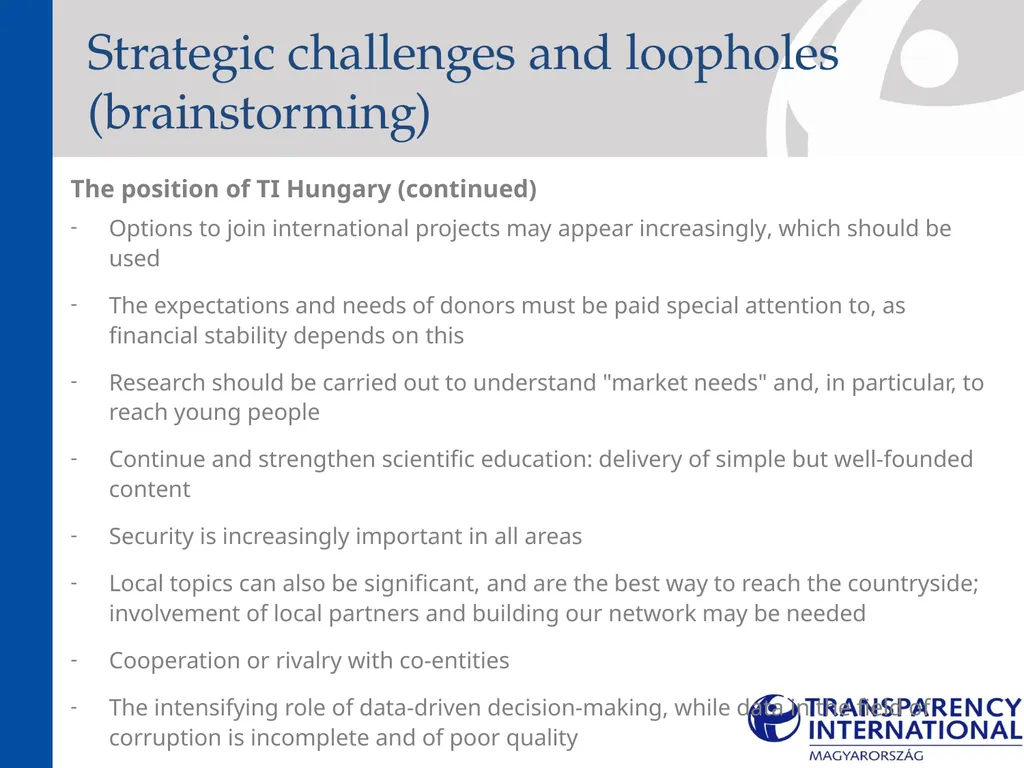
slide44. The position of TI Hungary (continued)
Options to join international projects may appear increasingly, which should be used
The expectations and needs of donors must be paid special attention to, as financial stability depends on this
Research should be carried out to understand "market needs" and, in particular, to reach young people
Continue and strengthen scientific education: delivery of simple but well-founded content
Security is increasingly important in all areas
Local topics can also be significant, and are the best way to reach the countryside; involvement of local partners and building our network may be needed
Cooperation or rivalry with co-entities
The intensifying role of data-driven decision-making, while data in the field of corruption is incomplete and of poor quality Strategic challenges and loopholes (brainstorming)<br>
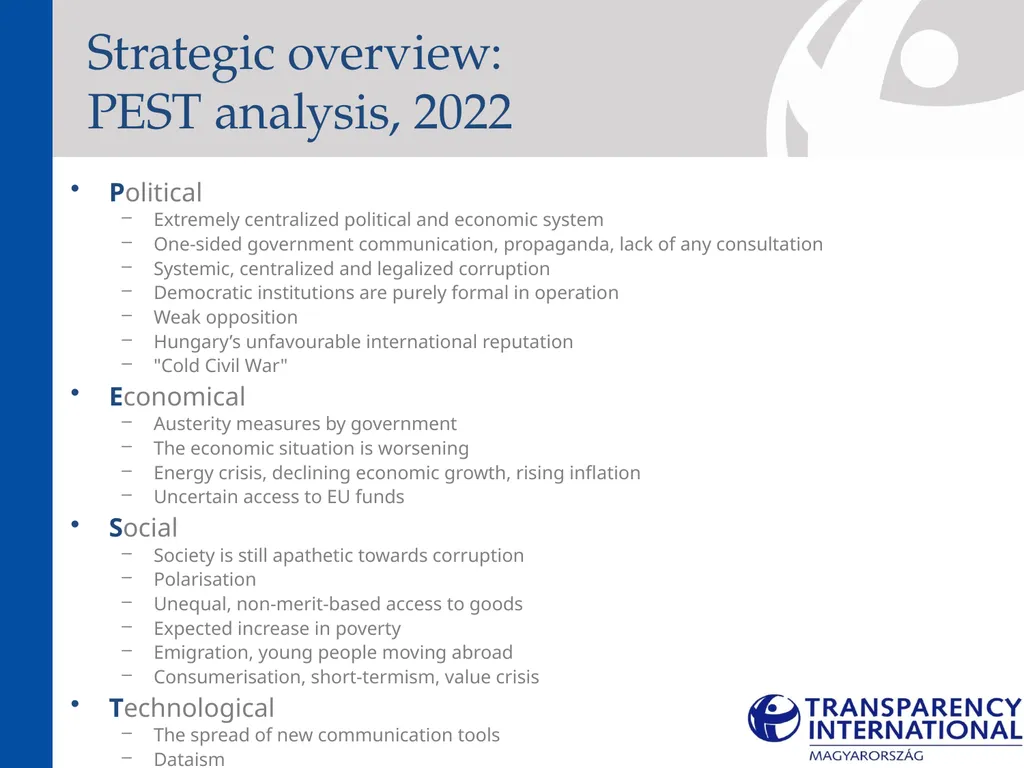
slide45. Political
Extremely centralized political and economic system
One-sided government communication, propaganda, lack of any consultation
Systemic, centralized and legalized corruption
Democratic institutions are purely formal in operation
Weak opposition
Hungary’s unfavourable international reputation
"Cold Civil War"
Economical
Austerity measures by government
The economic situation is worsening
Energy crisis, declining economic growth, rising inflation
Uncertain access to EU funds
Social
Society is still apathetic towards corruption
Polarisation
Unequal, non-merit-based access to goods
Expected increase in poverty
Emigration, young people moving abroad
Consumerisation, short-termism, value crisis
Technological
The spread of new communication tools
Dataism Strategic overview: PEST analysis, 2022<br>
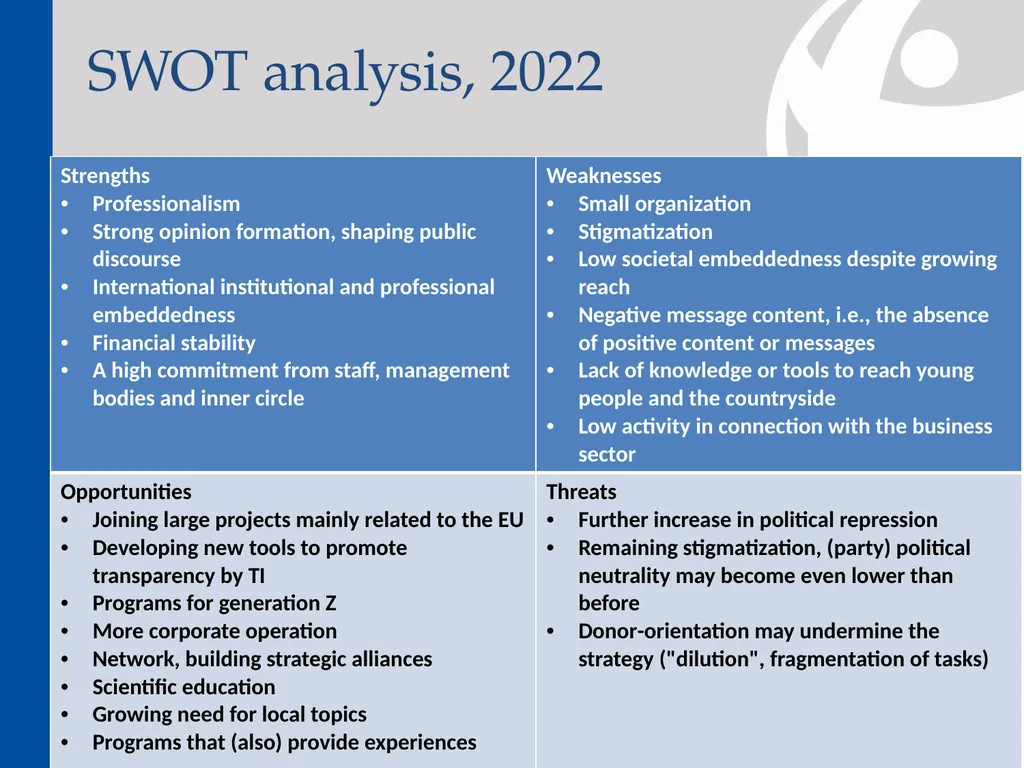
slide46. SWOT analysis, 2022<br>
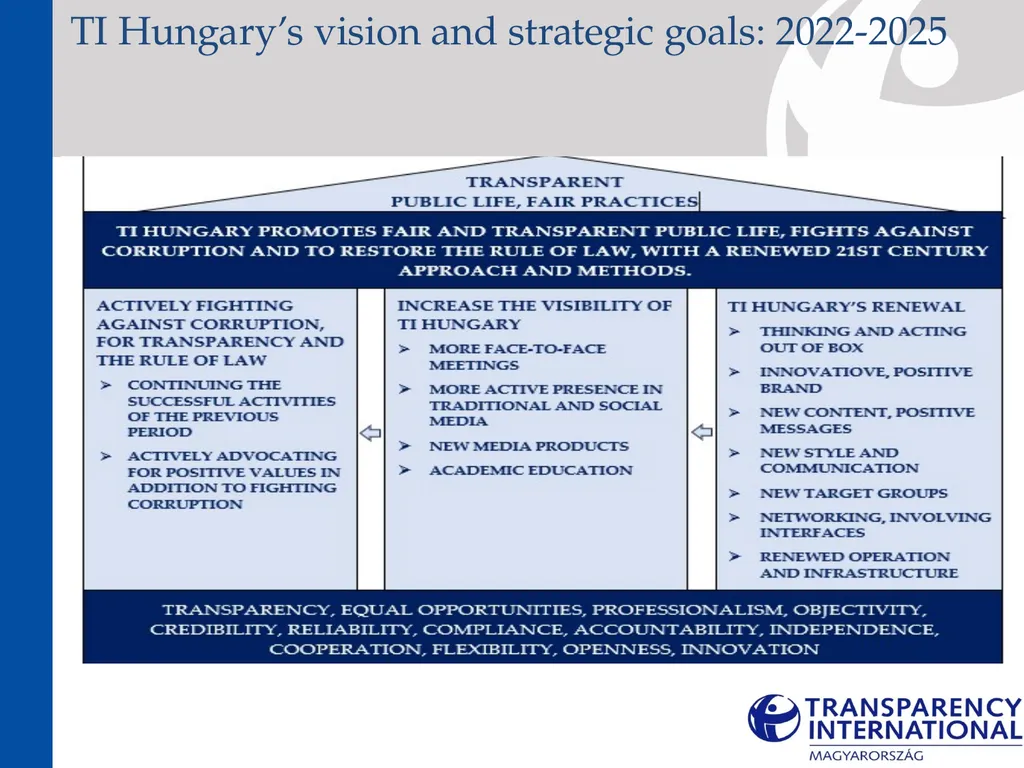
slide47. TI Hungary, as a leading Hungarian NGO, promotes fair and transparent public life, fights against corruption and does its utmost to restore the rule of law, with a renewed 21st century approach and methods. Vision<br>
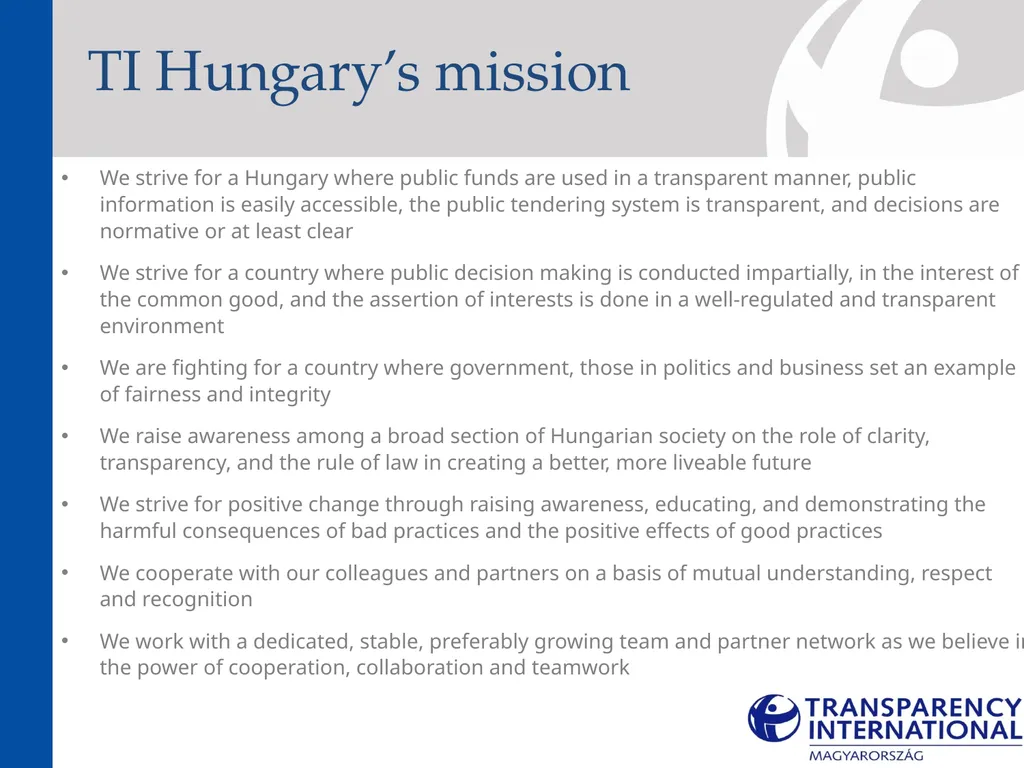
slide48. We strive for a Hungary where public funds are used in a transparent manner, public information is easily accessible, the public tendering system is transparent, and decisions are normative or at least clear
We strive for a country where public decision making is conducted impartially, in the interest of the common good, and the assertion of interests is done in a well-regulated and transparent environment
We are fighting for a country where government, those in politics and business set an example of fairness and integrity
We raise awareness among a broad section of Hungarian society on the role of clarity, transparency, and the rule of law in creating a better, more liveable future
We strive for positive change through raising awareness, educating, and demonstrating the harmful consequences of bad practices and the positive effects of good practices
We cooperate with our colleagues and partners on a basis of mutual understanding, respect and recognition
We work with a dedicated, stable, preferably growing team and partner network as we believe in the power of cooperation, collaboration and teamwork TI Hungary’s mission<br>
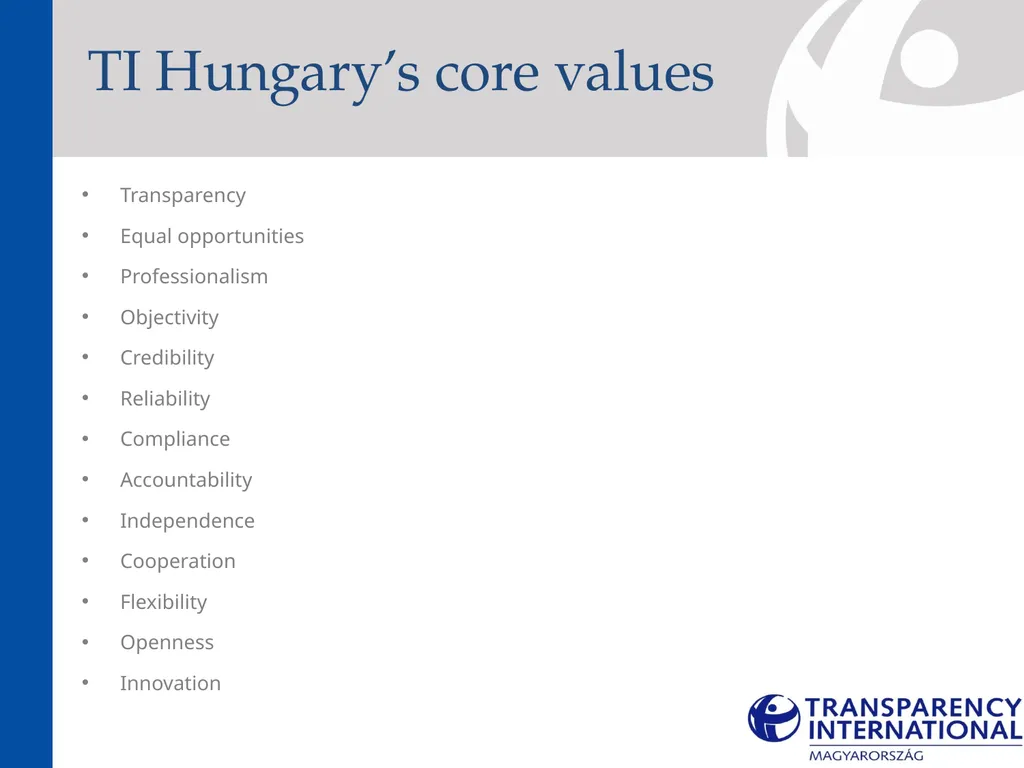
slide49. Transparency
Equal opportunities
Professionalism
Objectivity
Credibility
Reliability
Compliance
Accountability
Independence
Cooperation
Flexibility
Openness
Innovation TI Hungary’s core values<br>
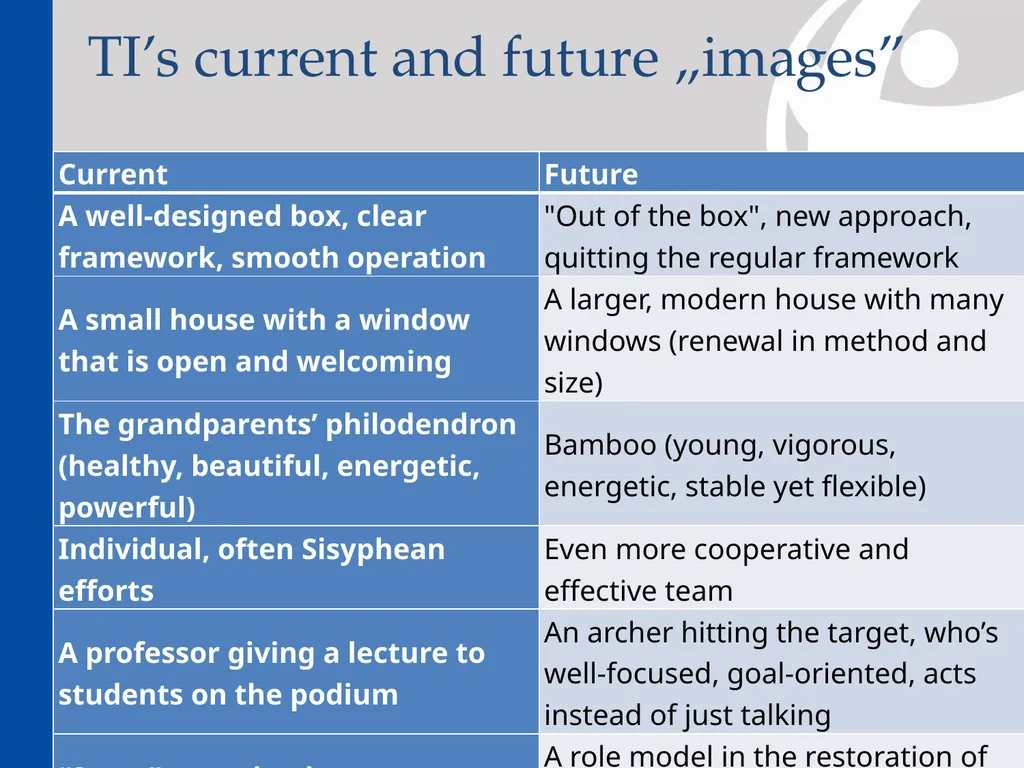
slide50. TI’s current and future „images”<br>
slide51. Existing target group
The layer of Hungarian society that accepts and supports the values of TI, that wants and is open to receiving TI's opinions and "services" – this is and will remain a main target group
Donors (stakeholders)
Areas to be developed or built:
Younger generation
Business sector, corporations
Related areas of uncertainty:
The case of apolitical people, those living day-to-day – can we deliver simple, clear, understandable messages to them?
The rural, increasingly impoverished strata – can we deliver simple, clear, understandable messages to them?
Groups that are not included in the above target groups or potentially even hinder the implementation of the strategy:
Those committed to the current government policy, who reject and stigmatize TI – they are expected to keep rejecting TI’s messages, and winning them over is not part of the strategic goals The main target groups and stakeholders of TI Hungary’s new strategy<br>
slide52. Younger generation: In recent years, the reach of young people (those under 30 years of age) has fallen short of the desired level. Currently, TI’s messages are not delivered adequately to members of the younger generation. However, the youth is crucial for shaping our future and should be a key focus in the strategy and in future operations.
Corporations: Although there has been little success in this area so far, corporations should be targeted, just through different methods and content in the future. This is relevant to TI in terms of economic embeddedness and business ethics, with a positive financial impact. TI Hungary’s new strategy aims to address two target groups in particular<br>
slide53. Many of those who are interested in public life:
feel that life is worse here than elsewhere
leave the country
have heard that they should move abroad for a better life
are concerned about the future, and critical of the government
want a free country, free university
Many of those who are not interested in public life:
are indifferent, characterized by apathy
want a carefree / happy-go-lucky life
think public life is not their issue and does not affect them
are seeking the joys of the material world
are looking for hedonic well-being
Market research is needed to better understand the exact needs of young people. Perceived characteristics and needs of young people (16-29 years of age)<br>
slide54. For those interested in public life:
Strengthening faith in a better future
Fostering critical thinking, responsibility and sustainability
Cooperating with student organizations and teachers in both higher and lower educations
Experience-oriented approach
Providing knowledge that can be used in their personal/professional life
Using humor, memes, short or visual messages
For those not interested in public life:
Raising interest and a sense of responsibility
Providing easily understandable and interesting scientific information
Entertainment, experience-oriented approach
Using humor, memes, short or visual messages Action plan to reach young people<br>
slide55. Key features
On a company-level: restraint, resistance and minimal contact
On an individual, managerial level: many recognize TI’s values, there are existing personal relationships
Action plan
Cooperating with the business sector through intermediary organizations and interfaces (NGOs, think tanks)
Potentially creating a separate organization for this purpose
Possible topics and activities: ESG (Environment, Social, Governance), business ethics, implementation of internationally applied TI products and practice into domestic practice, consulting, rankings, awards Low activity in the business sector Characteristics of the business sector and TI’s action plan<br>
slide56. Maintaining a high level of tendering activity and an intensive relationship with current donors
Active tender monitoring and application
Finding and reaching out to new donors
Gaining more individual donors, continuing to crowdfund Strategic goals related to donors<br>
slide57. Actively standing up against corruption, and in favour for transparency and the rule of law
Increasing the visibility of TI Hungary
TI Hungary’s renewal Core strategic goals<br>
slide58. TI Hungary’s vision and strategic goals: 2022-2025<br>
slide59. Goal 1: Actively standing up against corruption, and in favour of transparency and the rule of law Old tools: resuming of the successful activities from the previous period - Researching and analysing corruption - Using the remaining legal possibilities (mainly public data lawsuits) - Providing legal aid: support in a small number but compelling cases (helping whistleblowers) - “Advocacy”, especially at EU level New tools and aspects - Fighting for not just against something - What happens if courts lose their independence too and we lose access to data of public interest?<br>
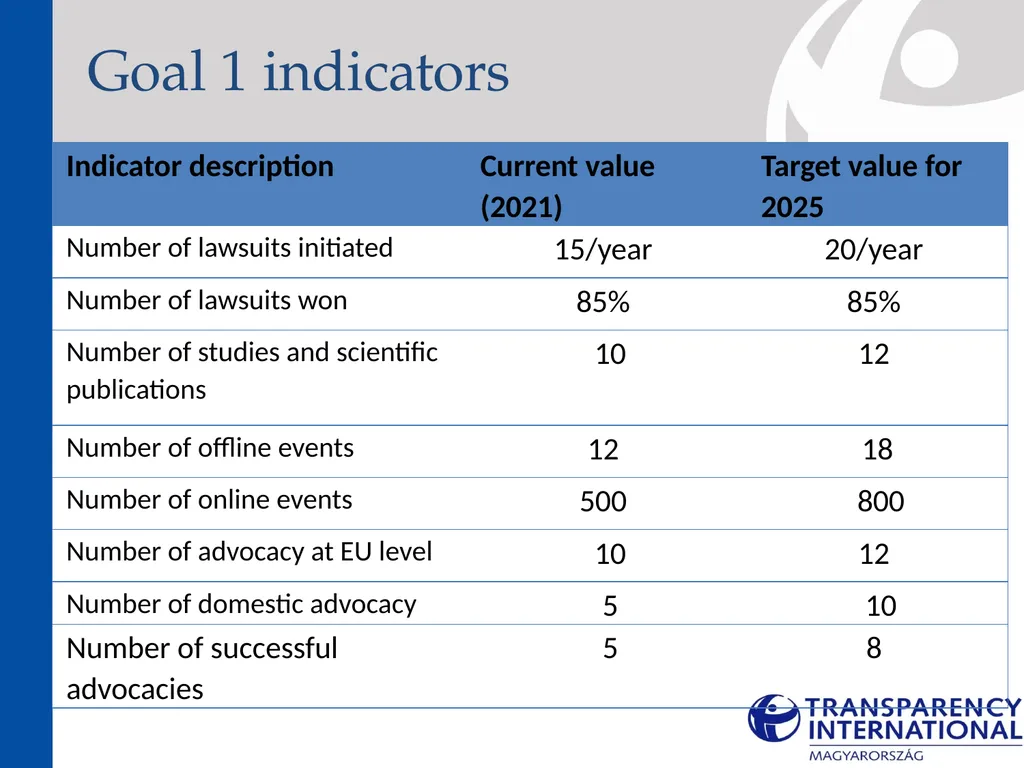
slide60. Goal 1 indicators<br>
slide61. We want to increase TI Hungary's presence on all channels
Face-to-face meetings with citizens and stakeholders
Increased activity on social media
Creating new media products (podcast)
Building platforms for scientific education
Customization of newsletters
Maintaining activity in traditional media
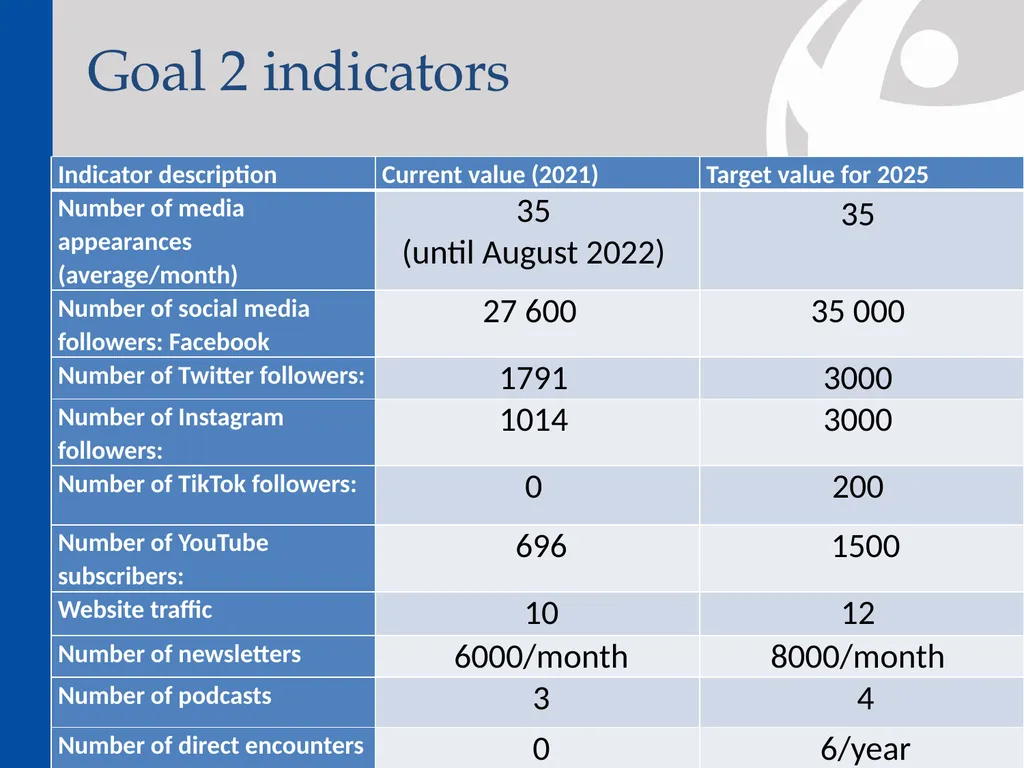
Renewing the website, increasing the number of visitors 2. Increasing the visibility of TI Hungary<br>
slide62. Goal 2 indicators<br>
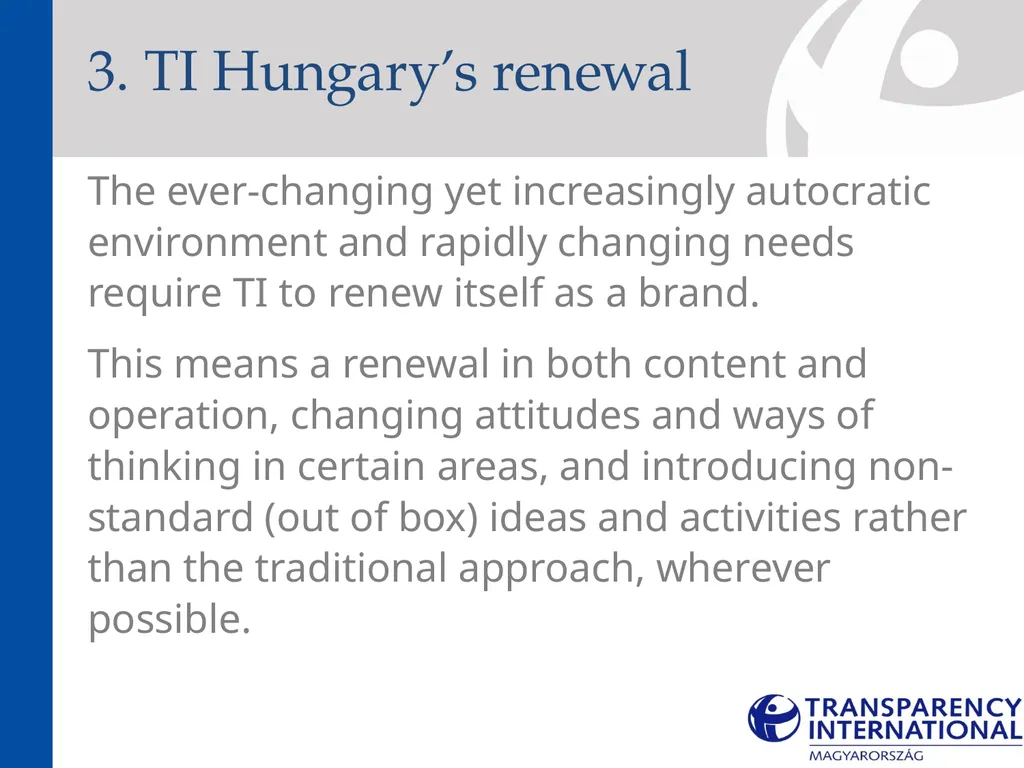
slide63. The ever-changing yet increasingly autocratic environment and rapidly changing needs require TI to renew itself as a brand.
This means a renewal in both content and operation, changing attitudes and ways of thinking in certain areas, and introducing non-standard (out of box) ideas and activities rather than the traditional approach, wherever possible. 3. TI Hungary’s renewal<br>
slide64. A new, more positive brand than the current one
Presenting positive examples
New topics and content
Green topics, sustainability, ESG
Local issues
Topics affecting individual citizens personally (private life, work)
New style
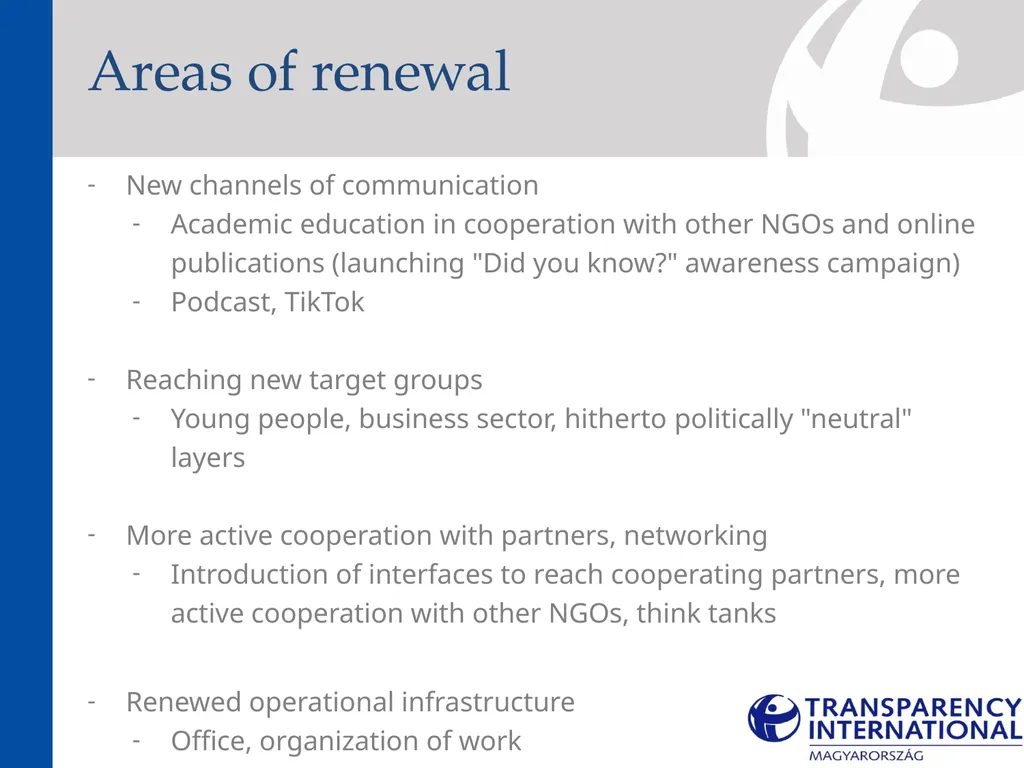
Easily understandable messages (e.g., the cost of corruption), using humor, more positive content Areas of renewal<br>
slide65. New channels of communication
Academic education in cooperation with other NGOs and online publications (launching "Did you know?" awareness campaign)
Podcast, TikTok
Reaching new target groups
Young people, business sector, hitherto politically "neutral" layers
More active cooperation with partners, networking
Introduction of interfaces to reach cooperating partners, more active cooperation with other NGOs, think tanks
Renewed operational infrastructure
Office, organization of work Areas of renewal<br>
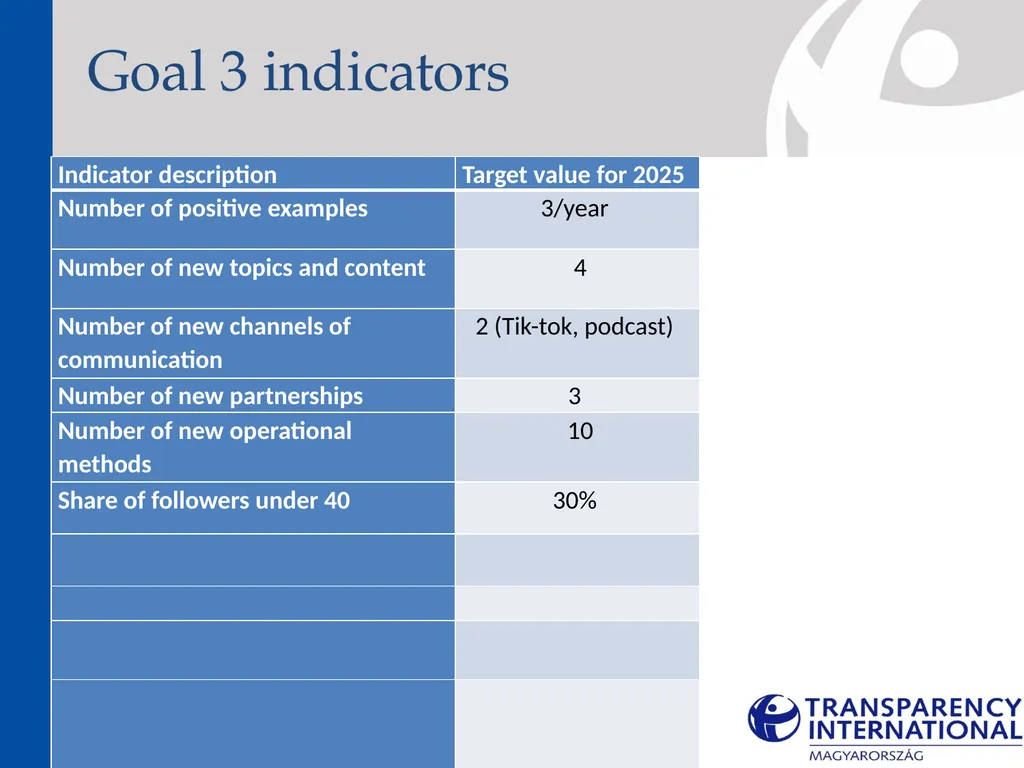
slide66. Goal 3 indicators<br>
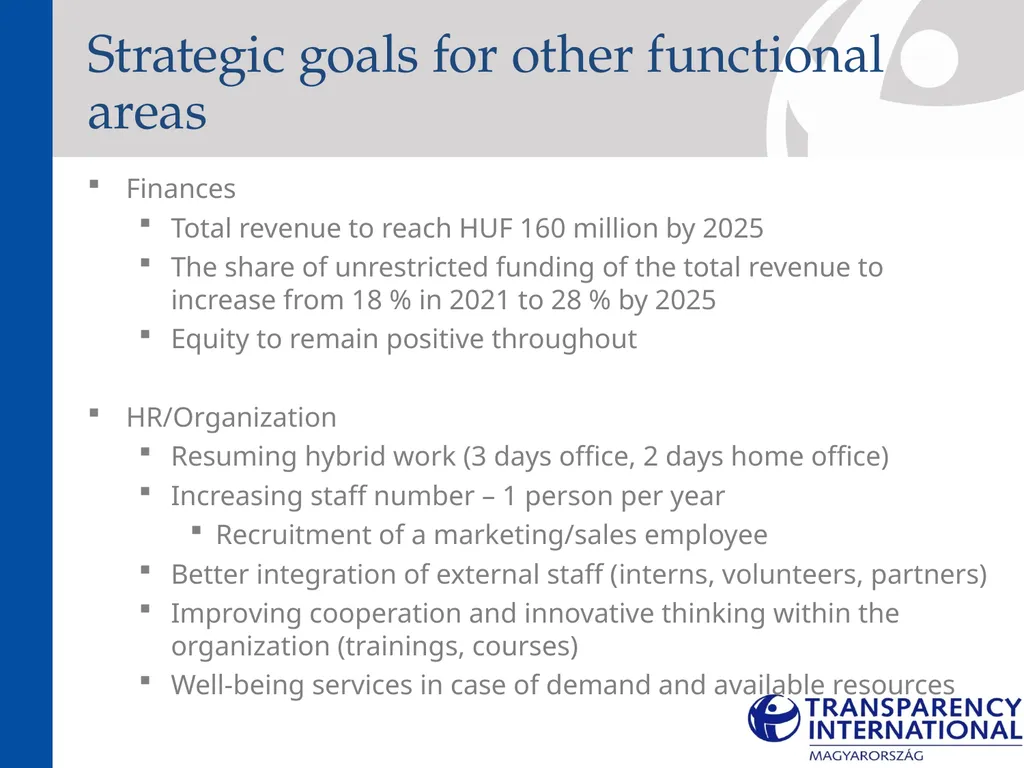
slide67. Finances
Total revenue to reach HUF 160 million by 2025
The share of unrestricted funding of the total revenue to increase from 18 % in 2021 to 28 % by 2025
Equity to remain positive throughout
HR/Organization
Resuming hybrid work (3 days office, 2 days home office)
Increasing staff number – 1 person per year
Recruitment of a marketing/sales employee
Better integration of external staff (interns, volunteers, partners)
Improving cooperation and innovative thinking within the organization (trainings, courses)
Well-being services in case of demand and available resources Strategic goals for other functional areas<br>
slide68. Marketing
2022: New market research on TI’s brand and potential new target groups
Continuous “maintenance” of the brand, quantification (PMEL) and promotion of results
Asset management
2022-2023: modernising the office or moving to a new office Strategic goals for other functional areas<br>
slide69. 1. Strong political pressure, attacks
Probability: High
Impact: Significant
Approach: Transparent operation, compliance with all laws and regulations
2. The public institutional system continues to deteriorate, and the independence of the courts erodes severely
Probability: High
Impact: Significant
Approach: Involvement of the EU and other international institutions
3. Social apathy becomes permanent
Probability: High
Impact: Significant
Approach: Cooperating with other NGOs; out of box communication Risks<br>
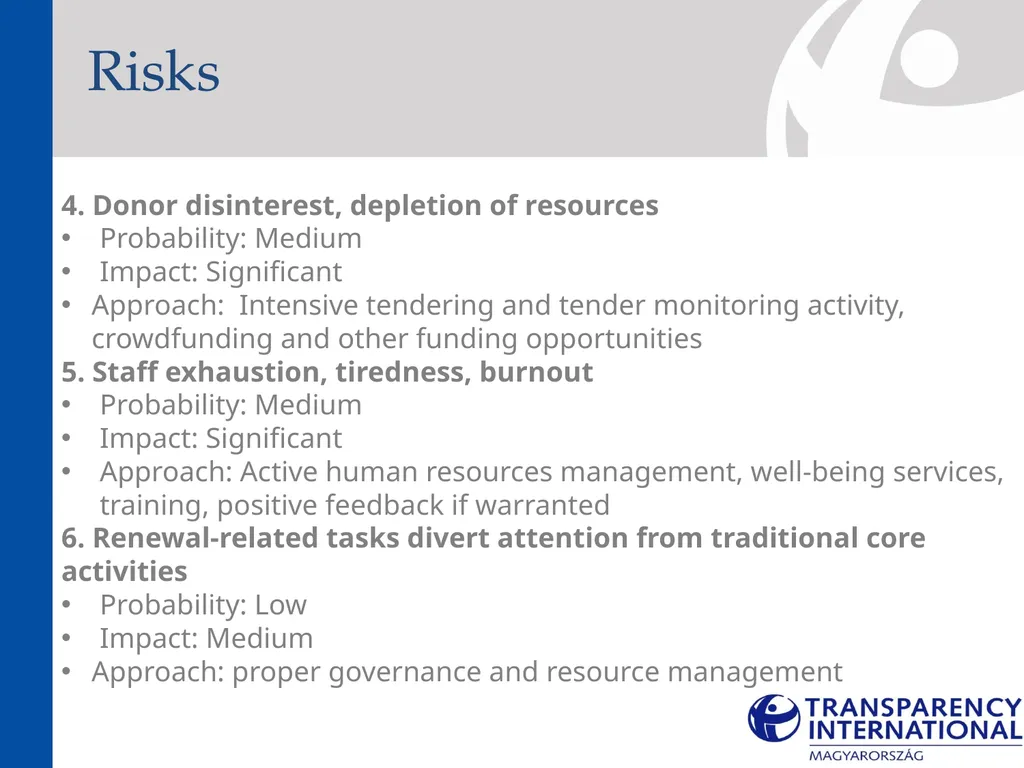
slide70. 4. Donor disinterest, depletion of resources
Probability: Medium
Impact: Significant
Approach: Intensive tendering and tender monitoring activity, crowdfunding and other funding opportunities
5. Staff exhaustion, tiredness, burnout
Probability: Medium
Impact: Significant
Approach: Active human resources management, well-being services, training, positive feedback if warranted
6. Renewal-related tasks divert attention from traditional core activities
Probability: Low
Impact: Medium
Approach: proper governance and resource management Risks<br>
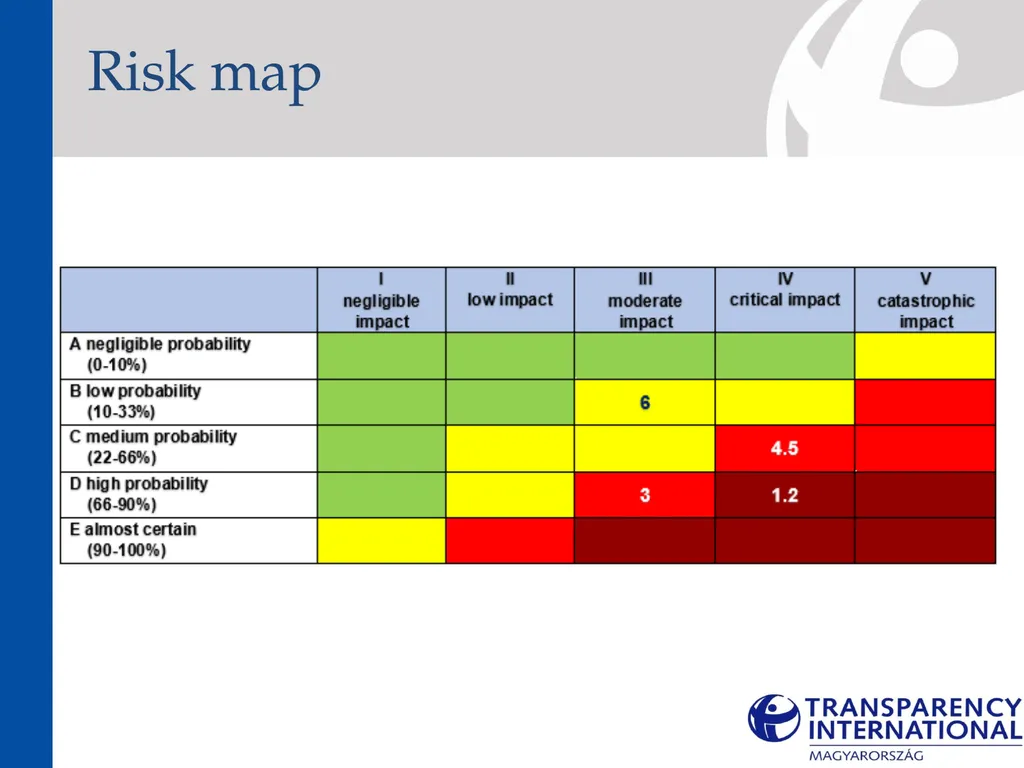
slide71. Risk map<br>
slide72. Let's unite against corruption!<br>
(2022-2025)<br>
slide2. About the Organization
The previous strategy’s summary and evaluation
TI Hungary’s current state of affairs and main results (2022)
TI Hungary’s strategy for 2022-2025 Content of the presentation<br>
slide3. I. About the Organization<br>
slide4. Transparency International is a non-governmental, non-profit organization (NGO) with operations in about 100 countries, headquartered in Berlin (Secretariat)
TI is a loose movement in which member organizations – after being accredited in every 3 years – are financially and professionally independent from the Berlin headquarters
The Hungarian section was founded in 2006, its current Executive Director, has been József Péter Martin since 2013
TI Hungary’s number of employees: 7
Number of members of TI Hungary’s Board: 5 persons (Zoltán Nagy, Chair; Krisztina Arató, Gábor Gadó, József Steff, Ágnes Urbán);
Number of members of TI Hungary’s Supervisory Board: 3 persons (Péter Ákos Bod, Chair; Dávid Jancsics; Júlia Király);
The work of TI Hungary is regularly assisted by volunteers,
interns and external professionals The Organization<br>
slide5. Mitigating all forms of corruption and promoting transparency and accountability in the public sphere as well as in the business sector. The Organization THE MISSION OF THE INTERNATIONAL TI MOVEMENT THE VALUES OF THE INTERNATIONAL TI MOVEMENT Rule of law
Party neutrality
Independence
Cooperation
Knowledge transfer
Fairness Transparency
Accountability
Professionalism
Fact-oriented approach
Integrity
Compliance<br>
slide6. Summary of the previous strategy (2019-2021) and evaluating its implementation<br>
slide7. PEST analysis
SWOT analysis
Five-level strategy
“Where do we want to play?”
Main strategic goals
3 strategic goals
How can we succeed?
The tools of the 3 strategic goals
Capabilities
Operational model Multi-level strategy formulation (2019)<br>
slide8. Key premises for the next three years (2019-21)
In the short term (over the next 1-2 years), we need to operate in an even harsher political environment
But there are also signs of the regime’s erosion
The EU may open up significant new resources for NGOs
Social polarisation intersected by another process: an intellectual buzz may appear with people from different backgrounds coming together against corruption and the regime
“Dataism” on the rise: Our lives become even more technology-driven PEST analysis conclusion (2019) Assessment: Most of the assumptions were confirmed,
but the findings in red were only partially correct.<br>
slide9. SWOT analysis (2019) Assessment: Most of the statements were confirmed,
those marked with red were only partially fulfilled,
the weaknesses marked with green have been eliminated.<br>
slide10. Societal level
It is necessary to open to new layers of society: the less educated (from secondary education)
Opening towards Fidesz voters with higher education, in rural areas and in metropolitan areas (teachers, doctors)
Geographical opening
Rural networking continues, now beyond the big cities
Age distribution
We want to reach everyone, from high school students to the elderly
Institutional level
The remaining levels of law enforcement (courts)
Cooperation with the government along the lines of our values is possible
Fighting all kinds of corruption from white-collar to petty corruption
Business sector
We want to reach out to the business sector in a new way compared to before (see later) Five-step strategy formulation – 1. “Where do we want to play?” Where not?
We do not play a general legal defense role Assessment: No meaningful progress has been made on the segments regarding opening.<br>
slide11. 1. General goal
Fight against systemic corruption in Hungary
2. Societal goal
Social condemnation of corruption must be increased
3. Economic goal
The business sector must become a partner in the fight against corruption Five-step strategy formulation – 2. Main strategic goals Assessment: Strategic goal 1. was accomplished, the 2. goal was only partially accomplished (as awareness of corruption grew, but did not turn into resistance), while 3. was not accomplished.<br>
slide12. Goal 1: Fight against systemic corruption
Tools
Researching corruption
Applying for large EU projects
Developing research tools and software (mainly online)
More own research than before (e.g., financed by the Berlin TI-S)
Utilising the remaining legal opportunities (mainly public data lawsuits, while possible)
Providing legal aid: support in a small number but compelling cases (helping whistleblowers)
Advocacy at EU level: Lobbying for our goals (anti-corruption legislation, law enforcement, and obtaining funding for NGOs) Five-step strategy formulation – 3. How can we succeed? Assessment: The goal was achieved, the core activity was successful<br>
slide13. Goal 2: Social condemnation of corruption must be increased
Tool: Extend social base and impact
Communication
Launch a new communication product (newsletter and/or blog)
Proactive instead of reactive communication
Special communication strategy for Fidesz voters (rural intellectuals)
Simpler, more straight-forward communication, which does not come at the expense of professionalism
Using innovative tools
Building our societal base
Building and expanding the existing rural base towards residents of smaller cities
Helping victims of corruption: support in a small number but compelling cases
Starting educational programs – from high school to university – or developing already existing ones (e.g., curriculum) Five-step strategy formulation – 3. How can we succeed? Assessment: The strategic goal was only partially accomplished, there was no meaningful progress in the areas in red<br>
slide14. Goal 3: The business sector must become a partner in the fight against corruption
Tools
Organising business galas / breakfasts / luncheons with the aim of i) networking, increasing embeddedness ii) exchanging information and iii) fundraising
Neither the former Corporate Supporters Forum (addressing big corporations to support our mission) nor business consultancy is considered to be a tool that can meaningfully contribute to goal 3. under the current circumstances Five-step strategy formulation – 3. How can we succeed? Assessment: There has been no meaningful progress in achieving the stated goal<br>
slide15. Horizontal tools supporting the 3 goals
Market research is needed: understanding what citizens expect from us
Active fundraising
More freely available resources are needed
individual donors;
crowdfunding for specific purposes;
corporate subsidies (through business events);
more 1 % of personal tax (SZJA); Five-step strategy formulation – 3. How can we succeed? Assessment: Active fundraising (except for increasing corporate subsidies) was achieved, but market research has not taken place<br>
slide16. Missing skills
No sales-oriented person in the team
A potential solution: External assistance (e.g., from sponsors or curators, but this requires powerful marketing material)
Room for development regarding “dataism”
Data analysis
Data visualization
Social media communication
Untapped potential
Internship management: It is worth “utilizing” them more effectively
The potential of communication
Communication/PR/marketing strategy
Proactive instead of reactive communication Five-step strategy formulation – 4. Capabilities Assessment: The substitution of missing skills and the utilisation of untapped potential has only been partially achieved.<br>
slide17. TI’s organization and inner circle should be developed like “concentric circles”
From the inside outwards: Staff, board, supervisory board, consultants, supporters, inner circle
Connect the “circles”: Financial supporters, professional partners, TI’s friends
e.g., major supporters should be consultants as well
Core operation does not need to be changed
New legal form does not need to be created Five-step strategy formulation – 5. Operational model Assessment: The operational model was adequate, but the capacities and resources needed to achieve the goals were only partially available.<br>
slide18. Strong political headwind, more permanent than previously estimated
Several constraining factors
no meaningful dialogue on the part of government agencies
public prosecutor’s office and institutions in charge of controlling government agencies are not independent
a divided society, "cold civil war" situation
Current revenue streams (EU, international foundation resources, in a small proportion embassies) are developed and seem sustainable
Small organization
Appearance and visibility of organizations with similar profiles
Some results receive significant attention: there remains a need for TI’s activity A summary assessment of TI’s environment, external and internal operating conditions<br>
slide19. A summary assessment of the previous strategy’s goals + professionalism, credibility, upholding values
+ core activity, fight against systemic corruption (successful projects, research, public information lawsuits)
+ stabilization of funding (crowdfunding, EU advocacy, successful tenders)
+ regular and active use of communication channels
+ successful management of organizational fluctuation
+ increased social media presence (Facebook, Twitter, etc.) - Wider social reach
- Cracking systemic corruption
- Making the business sector a partner
- Reaching a younger age group Fulfilled Not fulfilled<br>
slide20. Mission, principles
The strengths of the organization are professionalism; credibility; opinion-forming; international institutional and professional embeddedness; high commitment
Delivering projects at a high quality, to the satisfaction of donors
Active presence in the media ("outreach")
Strategic goal: Fighting against systemic corruption in Hungary
Public information lawsuits Goal categories 1. Achieved goals: "Business as usual"<br>
slide21. Financial affairs: Equity surplus, increasing cashflow, more freely available resources, crowdfunding
Communication: New communication products (newsletter, blog reactivation); development of communication strategy
Freedom of information litigation (number, effectiveness)
EU advocacy
Internship management Goal categories 2. Achieved goals: Development<br>
slide22. “Weaknesses”: Small organization; low activity in connection with the business sector
“Opportunities”: Programs for young people, aka for generation Z
"Societal goal": Increasing the social condemnation of corruption ("impact" vs "outreach")
Innovative communication tools, base building beyond the usual, launching unique educational programs
“Economic goal”: The business sector must become a partner in the fight against corruption
"Skills": absence of a "sales-oriented" associate and "data guru" Goal categories 3. Not or partially achieved goals: „stuck in one place"<br>
slide23. Impartiality
Professionalism
Recognition
Commitment
Flexibility
Clarity, situational awareness
Contacts, good media relations
Financial stability
International background, brand TI Hungary’s principal strengths, on which it can build in the future<br>
slide24. Defining what we can say and offer to different layers of society
Better understanding the needs and reactions of Hungarian society
Researching the TI brand
New appearances, programs (professional forums, joint research, professional dialogues)
Contacting and involving popular influencers
Realistic, achievable goals, (re)defining goals, preparing action plans, considering resources and capacities
Better office setting, bigger team Preliminary expectations regarding the forthcoming strategy (2022-2025)<br>
slide25. III. TI Hungary’s current state of affairs and main results (2022)<br>
slide26. Revenue in 2012-2022 Note: The 2022 data is preliminary<br>
slide27. Freely available resources, 2015-2022<br>
slide28. Balance sheet (2021): equity finally positive<br>
slide29. Financial account (2021) — increase in revenue, decrease in other expenses<br>
slide30. Distribution of revenue by donor, 2021 Foreign budgetary support and 1% donations
Domestic donors
Foreign institutional donors
Revenue from core and business activities
Other revenue (financial)
Other revenue (e.g., volunteer work)<br>
slide31. Financial
Equity is finally positive (in surplus)
Substantive
Large-scale projects: TI Hungary’s biggest project of recent decades, the Integrity Pact, has been successfully completed
Legal activism: We have filed and won more cases than ever before
Research-analysis output: Three volumes have been published: Fekete Könyv II. (Black Book II), Szoba kiváltsággal (Room with privilege), Az Európai Ügyészség és Magyarország (The European Public Prosecutor’s Office and Hungary) Main results of 2021 from a financial and substantive point of view<br>
slide32. Ongoing projects: Tourism subsidies during the pandemic (TI-Secretariat); participatory budget programs at 3 municipalities (US Embassy), monitoring EU funds (OSIFE), Integrity Watch 3.0 (TI-S), ALAC (TI-S), NAIH (Ex Ante) consultancy
Standard annual projects/programs: CPI, mentoring, Soma, dec. 9., freedom of information lawsuits, 1% campaign, crowdfunding, municipality consultancy
Organizational support: Sigrid Rausing Trust
2022 tenders: ISFP_TIS Illicit financial flows, AML, ISFP transparency index for municipalities, OLAF RoL conference series, Sigrid Rausing Trust Renew Grant Projects and tenders ongoing in 2022<br>
slide33. TI Hungary’s social reach (2022)<br>
slide34. TI Hungary is present in all major Hungarian media not affiliated with the government, as well as in several leading international media outlets
2021-2022: monthly average of about 35-40 appearances in government-critical and foreign media (monthly peak in 2021 was 54 appearances)
Most of the appearances are public statements, but longer-form 1:1 interviews are also frequent
The Legal Director, the Executive Director and the Head of Public Finance Programs are the most active in the media
TI Hungary is shaping public discourse Intense presence in foreign and domestic press despite the shrinking space of free media<br>
slide35. A dynamically growing presence on social media over the long term – Facebook<br>
slide36. * We reached about 617,000 people on Facebook between 2020 and 2022, of whom 458,000 were “active”
* The number of "net" new followers: 2,100
* Spikes: 9 Dec, CPI, lawsuit against EMMI (Hungarian Ministry of Human Resources, regarding the overpricing
of respiratory ventilators) Social media: Facebook (2020-2022)<br>
slide37. Twitter: 1,785 followers (in 2019: 1,135)
Instagram: 972 followers (in 2019: 251)
Youtube 205,000 minutes of videos watched on our page between 2018 and June 2022 (spikes: 9 Dec, CPI, online events during the pandemic)
Almost half (44%) of the total watch time has occurred in the last 3 years, and 42% of subscribers have been gained in the last year
The most viewed video remains: Shocking clichés for HUF 135 millions of public funds (Gálvölgyi, 2018), so far: 205,675 views Organic growth is showing on other platforms as well over the past three years<br>
slide38. Website: 68,000 unique visitors in the previous year, 282,000 in the last 6 years Most visited pages:
Home page
The release of Black Book I.
CPI page
Staff - who works at TI Hungary?
Donation
Main page in English
A page to report corruption
Winning a lawsuit at first instance against EMMI (Hungarian Ministry of Human Resources) in the respiratory ventilator case
Donation (again)
Public sector tab, subpage of state-owned enterprises Where do visitors come from?
Internet search: 48%
Social media: 28%
Visiting the website directly: 15%
Redirected from another site: 7%<br>
slide39. Newsletter for our partners We send newsletters to our partners and supporters several times a year March 2021: 580 recipients, 574 reach destination (99%)
October 2021: 558 recipients, 547 reach destination (98%)
March 2022: 548 recipients, 539 reach destination (98%)
July 2022: 543 recipients, 529 reach destination (97%)<br>
slide40. IV. TI Hungary’s
strategy for 2022-2025<br>
slide41. Preliminary written evaluation of the 2019-2021 strategy and the current situation by management and staff
Preparing for strategy day
Strategy workshop (01.07.2022)
Discussion and summary of preliminary evaluations
Specifying core values in order to define future vision and mission
Defining the strategic direction and the main tools for the 2022-25 period
Preparing a strategy presentation draft and reviewing it with staff
Finalisation of the 2022-25 strategy by staff at a strategy workshop (15.09.2022)
Review and adoption of the strategy material by the Board The strategy-making process<br>
slide42. Political and economic situation
The domestic political situation has been much more difficult since the April elections
Corruption has been deeply incorporated into the system
At the same time, the worse economic, foreign and domestic political situation increases sensitivity to messages about the underlying processes worsening the situation
Outcome of negotiations between the Hungarian government and the EU Strategic challenges and fixes (brainstorming)<br>
slide43. The position of TI Hungary
TI is and remains stigmatized, while there is a need for its activity and messages
Simple, clear, easily understandable messages are needed (incomplex, interesting, memorable, educational and emotion-evoking stories)
Instead of negative messages, positive content and awareness-raising may be necessary
In addition to traditional, corruption-related messages, new content is needed (e.g., truth versus lies)
In places where TI cannot appear under its own “brand” currently (schools, companies, etc.), it has a chance to appear through a network of allies and cooperating partners
The business sector is in question, a decision must be made whether to "let it go" or to re-target it with new methods, different activities or an intermediary Strategic challenges and fixes (brainstorming)<br>
slide44. The position of TI Hungary (continued)
Options to join international projects may appear increasingly, which should be used
The expectations and needs of donors must be paid special attention to, as financial stability depends on this
Research should be carried out to understand "market needs" and, in particular, to reach young people
Continue and strengthen scientific education: delivery of simple but well-founded content
Security is increasingly important in all areas
Local topics can also be significant, and are the best way to reach the countryside; involvement of local partners and building our network may be needed
Cooperation or rivalry with co-entities
The intensifying role of data-driven decision-making, while data in the field of corruption is incomplete and of poor quality Strategic challenges and loopholes (brainstorming)<br>
slide45. Political
Extremely centralized political and economic system
One-sided government communication, propaganda, lack of any consultation
Systemic, centralized and legalized corruption
Democratic institutions are purely formal in operation
Weak opposition
Hungary’s unfavourable international reputation
"Cold Civil War"
Economical
Austerity measures by government
The economic situation is worsening
Energy crisis, declining economic growth, rising inflation
Uncertain access to EU funds
Social
Society is still apathetic towards corruption
Polarisation
Unequal, non-merit-based access to goods
Expected increase in poverty
Emigration, young people moving abroad
Consumerisation, short-termism, value crisis
Technological
The spread of new communication tools
Dataism Strategic overview: PEST analysis, 2022<br>
slide46. SWOT analysis, 2022<br>
slide47. TI Hungary, as a leading Hungarian NGO, promotes fair and transparent public life, fights against corruption and does its utmost to restore the rule of law, with a renewed 21st century approach and methods. Vision<br>
slide48. We strive for a Hungary where public funds are used in a transparent manner, public information is easily accessible, the public tendering system is transparent, and decisions are normative or at least clear
We strive for a country where public decision making is conducted impartially, in the interest of the common good, and the assertion of interests is done in a well-regulated and transparent environment
We are fighting for a country where government, those in politics and business set an example of fairness and integrity
We raise awareness among a broad section of Hungarian society on the role of clarity, transparency, and the rule of law in creating a better, more liveable future
We strive for positive change through raising awareness, educating, and demonstrating the harmful consequences of bad practices and the positive effects of good practices
We cooperate with our colleagues and partners on a basis of mutual understanding, respect and recognition
We work with a dedicated, stable, preferably growing team and partner network as we believe in the power of cooperation, collaboration and teamwork TI Hungary’s mission<br>
slide49. Transparency
Equal opportunities
Professionalism
Objectivity
Credibility
Reliability
Compliance
Accountability
Independence
Cooperation
Flexibility
Openness
Innovation TI Hungary’s core values<br>
slide50. TI’s current and future „images”<br>
slide51. Existing target group
The layer of Hungarian society that accepts and supports the values of TI, that wants and is open to receiving TI's opinions and "services" – this is and will remain a main target group
Donors (stakeholders)
Areas to be developed or built:
Younger generation
Business sector, corporations
Related areas of uncertainty:
The case of apolitical people, those living day-to-day – can we deliver simple, clear, understandable messages to them?
The rural, increasingly impoverished strata – can we deliver simple, clear, understandable messages to them?
Groups that are not included in the above target groups or potentially even hinder the implementation of the strategy:
Those committed to the current government policy, who reject and stigmatize TI – they are expected to keep rejecting TI’s messages, and winning them over is not part of the strategic goals The main target groups and stakeholders of TI Hungary’s new strategy<br>
slide52. Younger generation: In recent years, the reach of young people (those under 30 years of age) has fallen short of the desired level. Currently, TI’s messages are not delivered adequately to members of the younger generation. However, the youth is crucial for shaping our future and should be a key focus in the strategy and in future operations.
Corporations: Although there has been little success in this area so far, corporations should be targeted, just through different methods and content in the future. This is relevant to TI in terms of economic embeddedness and business ethics, with a positive financial impact. TI Hungary’s new strategy aims to address two target groups in particular<br>
slide53. Many of those who are interested in public life:
feel that life is worse here than elsewhere
leave the country
have heard that they should move abroad for a better life
are concerned about the future, and critical of the government
want a free country, free university
Many of those who are not interested in public life:
are indifferent, characterized by apathy
want a carefree / happy-go-lucky life
think public life is not their issue and does not affect them
are seeking the joys of the material world
are looking for hedonic well-being
Market research is needed to better understand the exact needs of young people. Perceived characteristics and needs of young people (16-29 years of age)<br>
slide54. For those interested in public life:
Strengthening faith in a better future
Fostering critical thinking, responsibility and sustainability
Cooperating with student organizations and teachers in both higher and lower educations
Experience-oriented approach
Providing knowledge that can be used in their personal/professional life
Using humor, memes, short or visual messages
For those not interested in public life:
Raising interest and a sense of responsibility
Providing easily understandable and interesting scientific information
Entertainment, experience-oriented approach
Using humor, memes, short or visual messages Action plan to reach young people<br>
slide55. Key features
On a company-level: restraint, resistance and minimal contact
On an individual, managerial level: many recognize TI’s values, there are existing personal relationships
Action plan
Cooperating with the business sector through intermediary organizations and interfaces (NGOs, think tanks)
Potentially creating a separate organization for this purpose
Possible topics and activities: ESG (Environment, Social, Governance), business ethics, implementation of internationally applied TI products and practice into domestic practice, consulting, rankings, awards Low activity in the business sector Characteristics of the business sector and TI’s action plan<br>
slide56. Maintaining a high level of tendering activity and an intensive relationship with current donors
Active tender monitoring and application
Finding and reaching out to new donors
Gaining more individual donors, continuing to crowdfund Strategic goals related to donors<br>
slide57. Actively standing up against corruption, and in favour for transparency and the rule of law
Increasing the visibility of TI Hungary
TI Hungary’s renewal Core strategic goals<br>
slide58. TI Hungary’s vision and strategic goals: 2022-2025<br>
slide59. Goal 1: Actively standing up against corruption, and in favour of transparency and the rule of law Old tools: resuming of the successful activities from the previous period - Researching and analysing corruption - Using the remaining legal possibilities (mainly public data lawsuits) - Providing legal aid: support in a small number but compelling cases (helping whistleblowers) - “Advocacy”, especially at EU level New tools and aspects - Fighting for not just against something - What happens if courts lose their independence too and we lose access to data of public interest?<br>
slide60. Goal 1 indicators<br>
slide61. We want to increase TI Hungary's presence on all channels
Face-to-face meetings with citizens and stakeholders
Increased activity on social media
Creating new media products (podcast)
Building platforms for scientific education
Customization of newsletters
Maintaining activity in traditional media
Renewing the website, increasing the number of visitors 2. Increasing the visibility of TI Hungary<br>
slide62. Goal 2 indicators<br>
slide63. The ever-changing yet increasingly autocratic environment and rapidly changing needs require TI to renew itself as a brand.
This means a renewal in both content and operation, changing attitudes and ways of thinking in certain areas, and introducing non-standard (out of box) ideas and activities rather than the traditional approach, wherever possible. 3. TI Hungary’s renewal<br>
slide64. A new, more positive brand than the current one
Presenting positive examples
New topics and content
Green topics, sustainability, ESG
Local issues
Topics affecting individual citizens personally (private life, work)
New style
Easily understandable messages (e.g., the cost of corruption), using humor, more positive content Areas of renewal<br>
slide65. New channels of communication
Academic education in cooperation with other NGOs and online publications (launching "Did you know?" awareness campaign)
Podcast, TikTok
Reaching new target groups
Young people, business sector, hitherto politically "neutral" layers
More active cooperation with partners, networking
Introduction of interfaces to reach cooperating partners, more active cooperation with other NGOs, think tanks
Renewed operational infrastructure
Office, organization of work Areas of renewal<br>
slide66. Goal 3 indicators<br>
slide67. Finances
Total revenue to reach HUF 160 million by 2025
The share of unrestricted funding of the total revenue to increase from 18 % in 2021 to 28 % by 2025
Equity to remain positive throughout
HR/Organization
Resuming hybrid work (3 days office, 2 days home office)
Increasing staff number – 1 person per year
Recruitment of a marketing/sales employee
Better integration of external staff (interns, volunteers, partners)
Improving cooperation and innovative thinking within the organization (trainings, courses)
Well-being services in case of demand and available resources Strategic goals for other functional areas<br>
slide68. Marketing
2022: New market research on TI’s brand and potential new target groups
Continuous “maintenance” of the brand, quantification (PMEL) and promotion of results
Asset management
2022-2023: modernising the office or moving to a new office Strategic goals for other functional areas<br>
slide69. 1. Strong political pressure, attacks
Probability: High
Impact: Significant
Approach: Transparent operation, compliance with all laws and regulations
2. The public institutional system continues to deteriorate, and the independence of the courts erodes severely
Probability: High
Impact: Significant
Approach: Involvement of the EU and other international institutions
3. Social apathy becomes permanent
Probability: High
Impact: Significant
Approach: Cooperating with other NGOs; out of box communication Risks<br>
slide70. 4. Donor disinterest, depletion of resources
Probability: Medium
Impact: Significant
Approach: Intensive tendering and tender monitoring activity, crowdfunding and other funding opportunities
5. Staff exhaustion, tiredness, burnout
Probability: Medium
Impact: Significant
Approach: Active human resources management, well-being services, training, positive feedback if warranted
6. Renewal-related tasks divert attention from traditional core activities
Probability: Low
Impact: Medium
Approach: proper governance and resource management Risks<br>
slide71. Risk map<br>
slide72. Let's unite against corruption!<br>