
Medtech marketing plan template This template
OM
Published · 47 slides · 0 views
1 / 1


Description
Medtech marketing plan template This template provided by Definitive Healthcare is intended to support your annual marketing planning efforts. With examples of core marketing plan components, this template provides a framework for alignment
Related Topics
Share
Embed code
Download this presentation From Below
"Medtech marketing plan template This template" is the property of its rightful owner. Permission is granted to download and print the materials on this website for personal, non-commercial use only, and to display it on your personal computer provided you do not modify the materials and that you retain all copyright notices contained in the materials. By downloading content from our website, you accept the terms of this agreement.
Presentation Transcript
01
Medtech marketing
plan template This template provided by Definitive Healthcare is intended to support your annual marketing planning efforts. With examples of core marketing plan components, this template provides a framework for alignment and understanding, as well as communicating key initiatives, programs, and messages.<br>
02
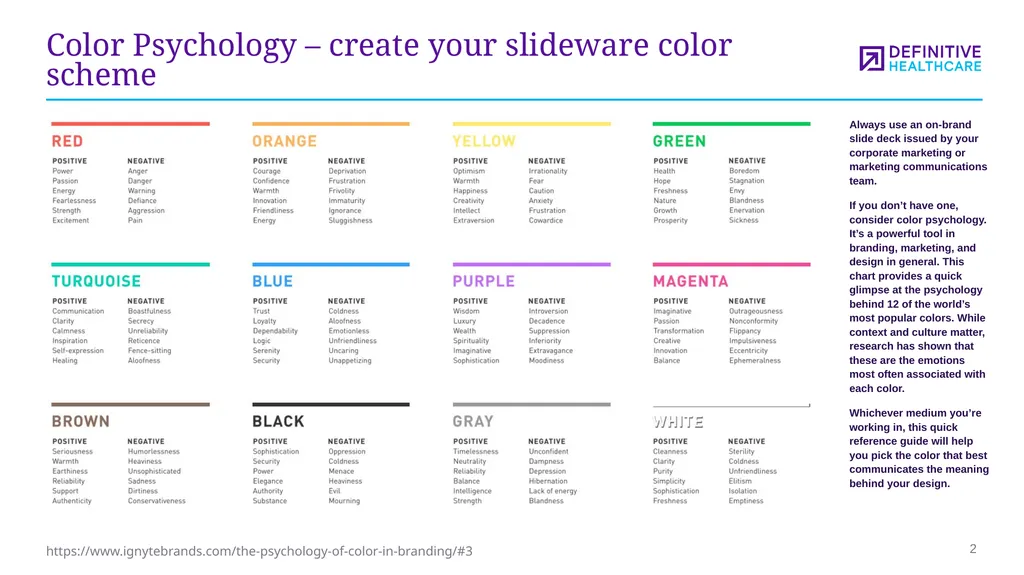
Color Psychology – create your slideware color scheme Always use an on-brand slide deck issued by your corporate marketing or marketing communications team.
If you don’t have one, consider color psychology. It’s a powerful tool in branding, marketing, and design in general. This chart provides a quick glimpse at the psychology behind 12 of the world’s most popular colors. While context and culture matter, research has shown that these are the emotions most often associated with each color.
Whichever medium you’re working in, this quick reference guide will help you pick the color that best communicates the meaning behind your design. https://www.ignytebrands.com/the-psychology-of-color-in-branding/#3 2<br>
If you don’t have one, consider color psychology. It’s a powerful tool in branding, marketing, and design in general. This chart provides a quick glimpse at the psychology behind 12 of the world’s most popular colors. While context and culture matter, research has shown that these are the emotions most often associated with each color.
Whichever medium you’re working in, this quick reference guide will help you pick the color that best communicates the meaning behind your design. https://www.ignytebrands.com/the-psychology-of-color-in-branding/#3 2<br>
03
[Year] [Portfolio name]
Marketing plan Your name<br>
04
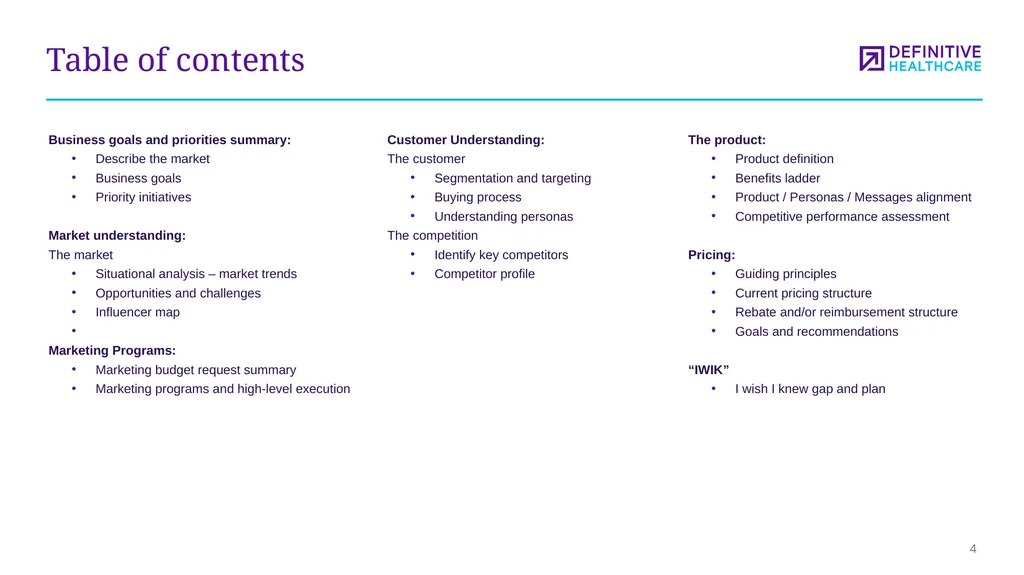
Business goals and priorities summary:
Describe the market
Business goals
Priority initiatives
Market understanding:
The market
Situational analysis – market trends
Opportunities and challenges
Influencer map
Marketing Programs:
Marketing budget request summary
Marketing programs and high-level execution The product:
Product definition
Benefits ladder
Product / Personas / Messages alignment
Competitive performance assessment
Pricing:
Guiding principles
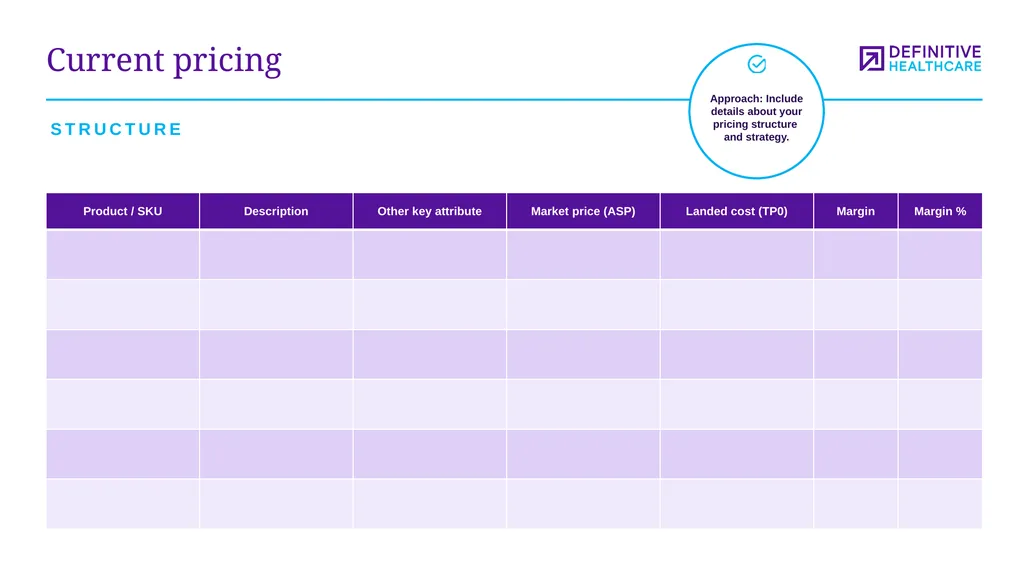
Current pricing structure
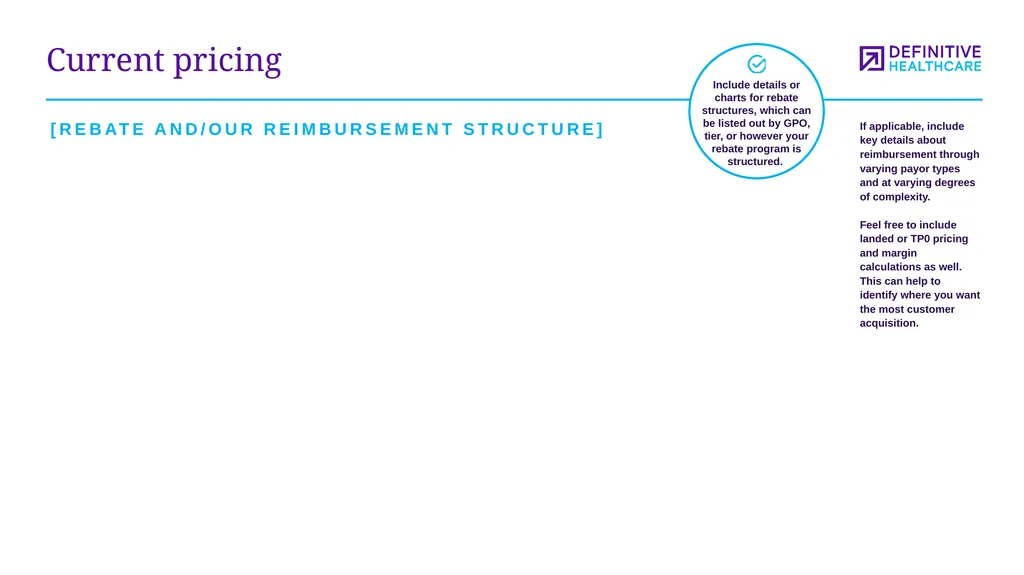
Rebate and/or reimbursement structure
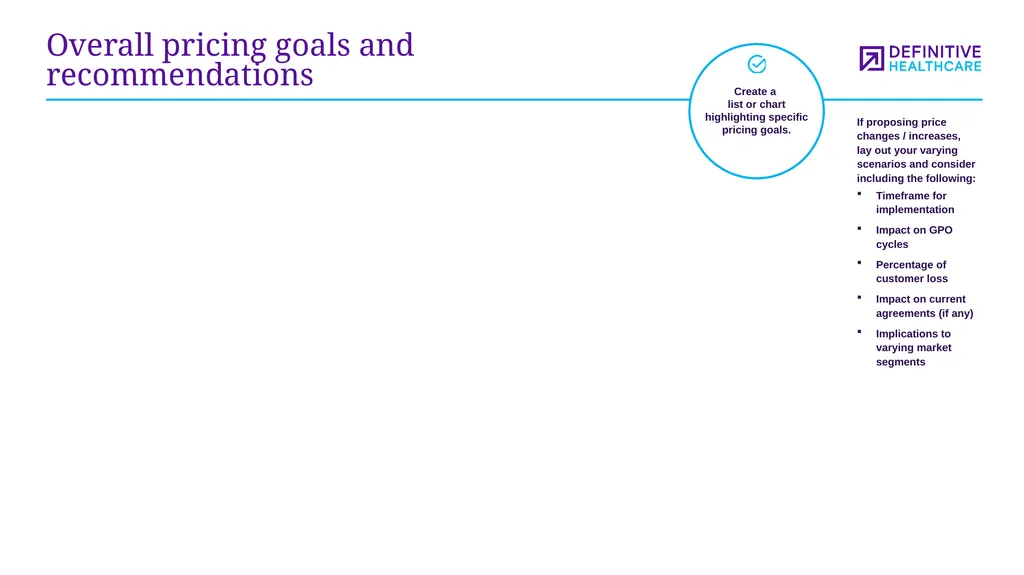
Goals and recommendations
“IWIK”
I wish I knew gap and plan Table of contents 4 Customer Understanding:
The customer
Segmentation and targeting
Buying process
Understanding personas
The competition
Identify key competitors
Competitor profile<br>
Describe the market
Business goals
Priority initiatives
Market understanding:
The market
Situational analysis – market trends
Opportunities and challenges
Influencer map
Marketing Programs:
Marketing budget request summary
Marketing programs and high-level execution The product:
Product definition
Benefits ladder
Product / Personas / Messages alignment
Competitive performance assessment
Pricing:
Guiding principles
Current pricing structure
Rebate and/or reimbursement structure
Goals and recommendations
“IWIK”
I wish I knew gap and plan Table of contents 4 Customer Understanding:
The customer
Segmentation and targeting
Buying process
Understanding personas
The competition
Identify key competitors
Competitor profile<br>
05
Top macro external theme / trend Macro external themes Image or icon
placeholder 2nd macro external theme / trend Image or icon
placeholder 3rd macro external theme / trend 5<br>
placeholder 2nd macro external theme / trend Image or icon
placeholder 3rd macro external theme / trend 5<br>
06
Image or icon
placeholder Top macro internal theme / trend Macro internal themes Image or icon
placeholder 2nd macro internal theme / trend Image or icon
placeholder 3rd macro internal theme / trend 6 Identify several external and internal concepts to help give purpose to your proposal.<br>
placeholder Top macro internal theme / trend Macro internal themes Image or icon
placeholder 2nd macro internal theme / trend Image or icon
placeholder 3rd macro internal theme / trend 6 Identify several external and internal concepts to help give purpose to your proposal.<br>
07
Business goals
and priorities<br>
08
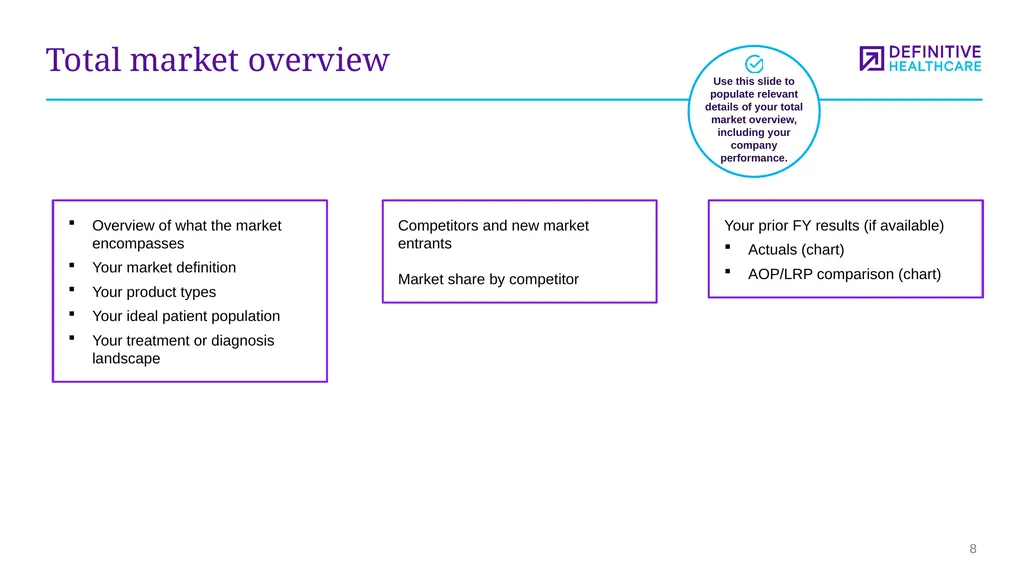
Overview of what the market encompasses
Your market definition
Your product types
Your ideal patient population
Your treatment or diagnosis landscape 8 Total market overview Competitors and new market entrants
Market share by competitor Your prior FY results (if available)
Actuals (chart)
AOP/LRP comparison (chart)<br>
Your market definition
Your product types
Your ideal patient population
Your treatment or diagnosis landscape 8 Total market overview Competitors and new market entrants
Market share by competitor Your prior FY results (if available)
Actuals (chart)
AOP/LRP comparison (chart)<br>
09
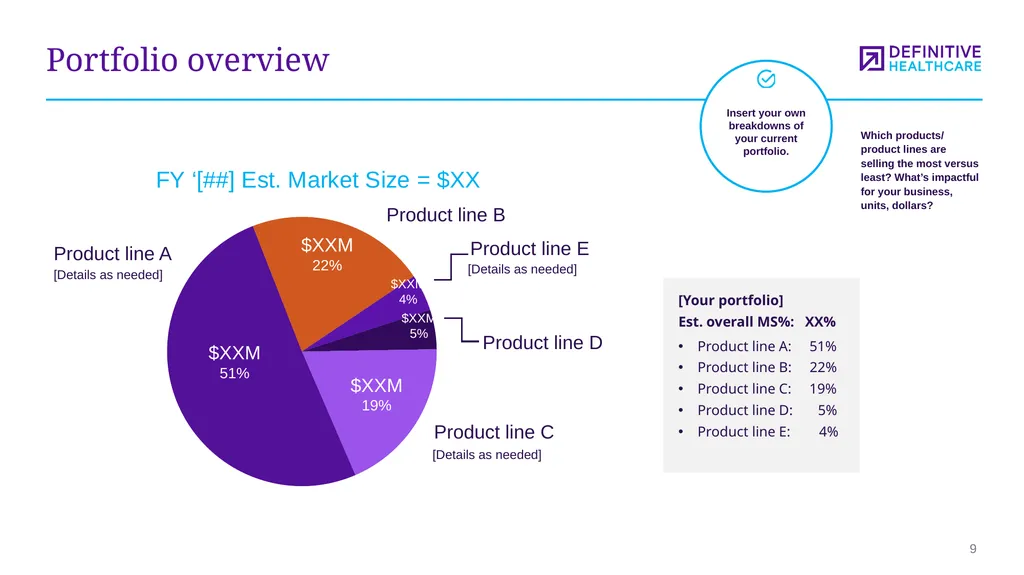
[Your portfolio]
Est. overall MS%: XX%
Product line A: 51%
Product line B: 22%
Product line C: 19%
Product line D: 5%
Product line E: 4% Portfolio overview 9 Which products/ product lines are selling the most versus least? What’s impactful for your business, units, dollars?<br>
Est. overall MS%: XX%
Product line A: 51%
Product line B: 22%
Product line C: 19%
Product line D: 5%
Product line E: 4% Portfolio overview 9 Which products/ product lines are selling the most versus least? What’s impactful for your business, units, dollars?<br>
10
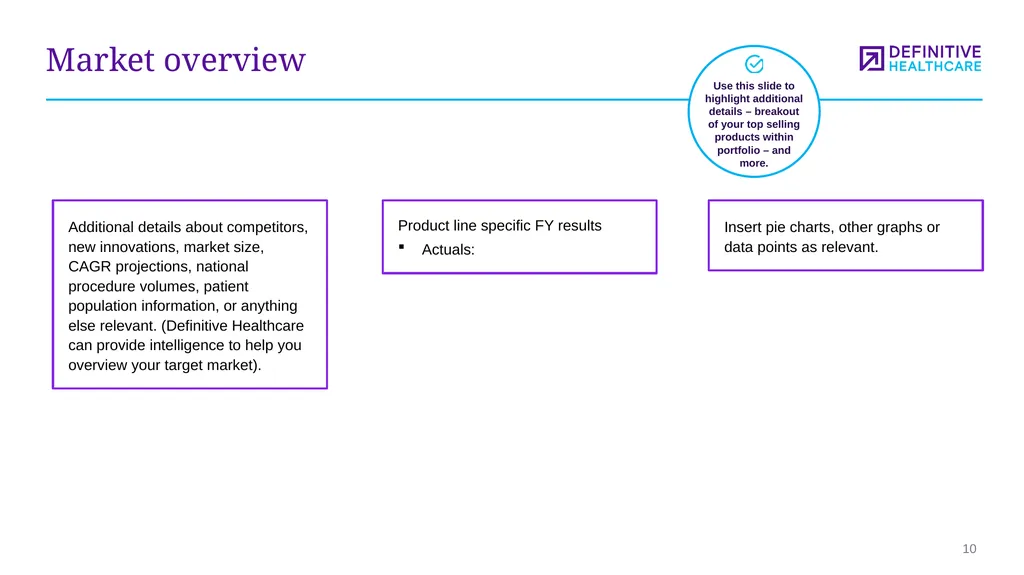
Additional details about competitors, new innovations, market size, CAGR projections, national procedure volumes, patient population information, or anything else relevant. (Definitive Healthcare can provide intelligence to help you overview your target market). 10 Market overview Product line specific FY results
Actuals: Insert pie charts, other graphs or data points as relevant.<br>
Actuals: Insert pie charts, other graphs or data points as relevant.<br>
11
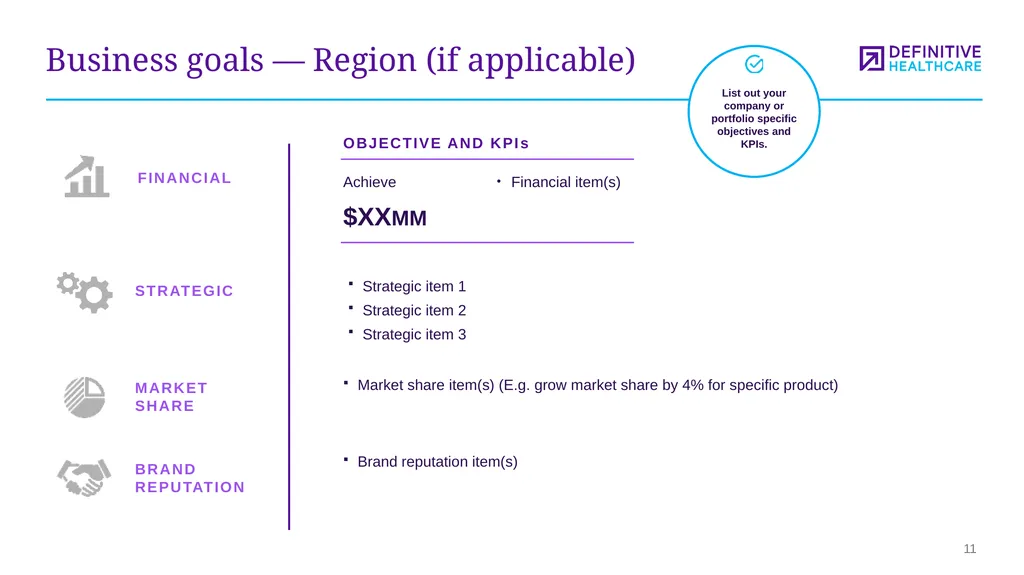
oBJECTIVE AND KPIs $XXMM Achieve Strategic item 1
Strategic item 2
Strategic item 3 Financial item(s) Market share item(s) (E.g. grow market share by 4% for specific product) Brand reputation item(s) Business goals — Region (if applicable) 11<br>
Strategic item 2
Strategic item 3 Financial item(s) Market share item(s) (E.g. grow market share by 4% for specific product) Brand reputation item(s) Business goals — Region (if applicable) 11<br>
12
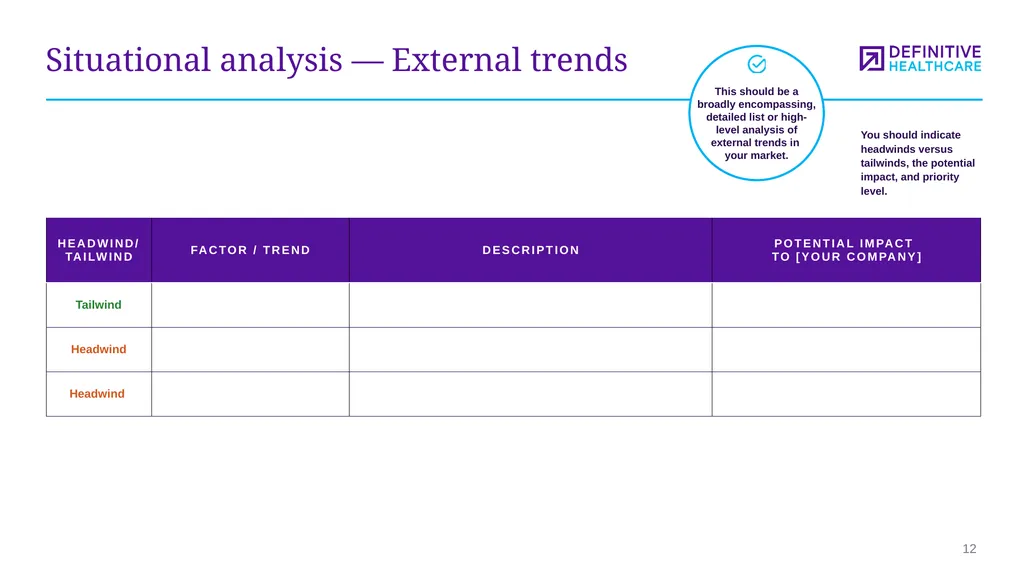
12 Situational analysis — External trends This should be a broadly encompassing, detailed list or high-level analysis of external trends in
your market. You should indicate headwinds versus tailwinds, the potential impact, and priority level.<br>
your market. You should indicate headwinds versus tailwinds, the potential impact, and priority level.<br>
13
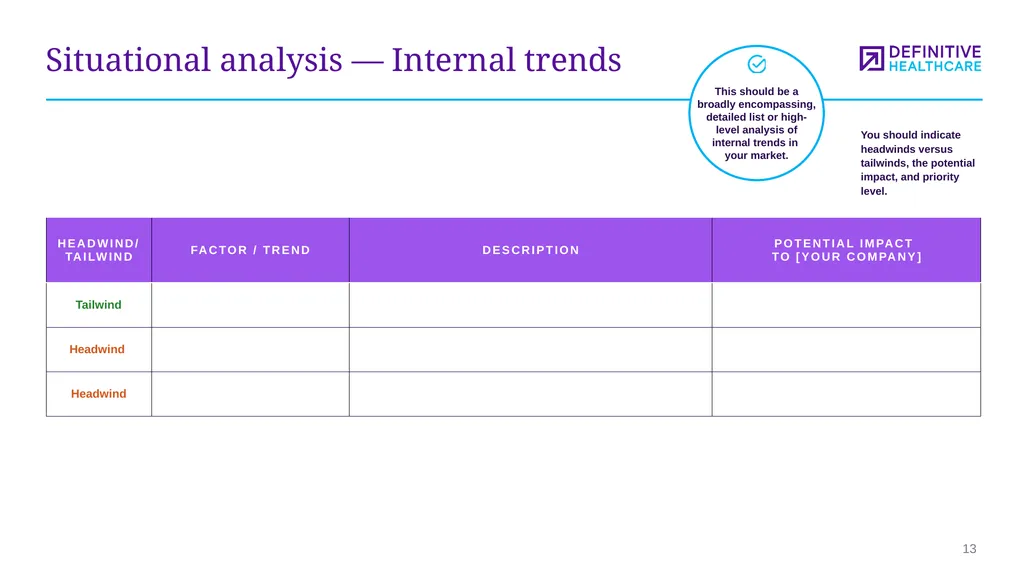
13 Situational analysis — Internal trends This should be a broadly encompassing, detailed list or high-level analysis of internal trends in
your market. You should indicate headwinds versus tailwinds, the potential impact, and priority level.<br>
your market. You should indicate headwinds versus tailwinds, the potential impact, and priority level.<br>
14
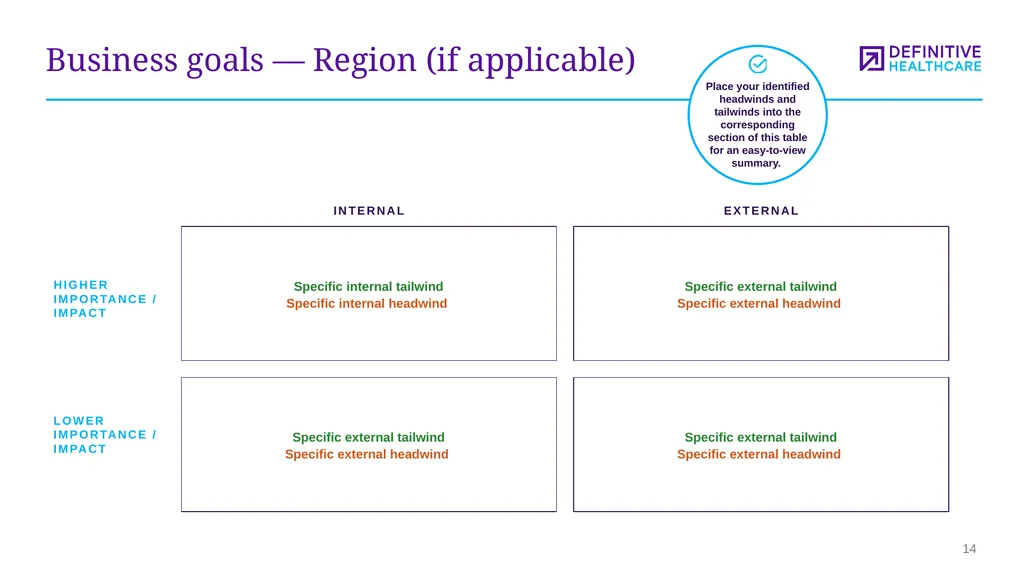
Business goals — Region (if applicable) 14 Higher Importance / Impact Lower Importance / Impact Specific internal tailwind
Specific internal headwind internal External Specific external tailwind
Specific external headwind Specific external tailwind
Specific external headwind Specific external tailwind
Specific external headwind<br>
Specific internal headwind internal External Specific external tailwind
Specific external headwind Specific external tailwind
Specific external headwind Specific external tailwind
Specific external headwind<br>
15
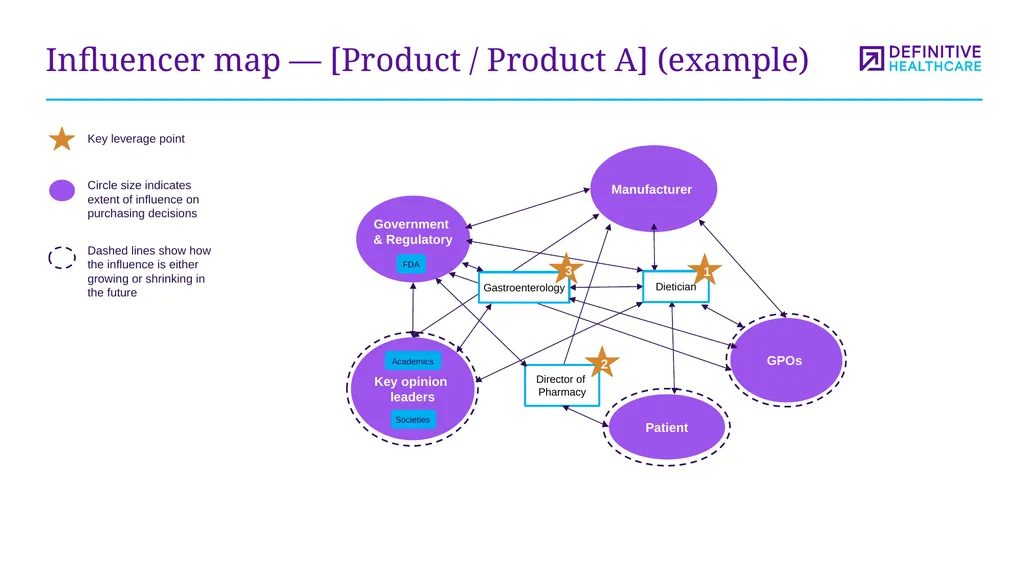
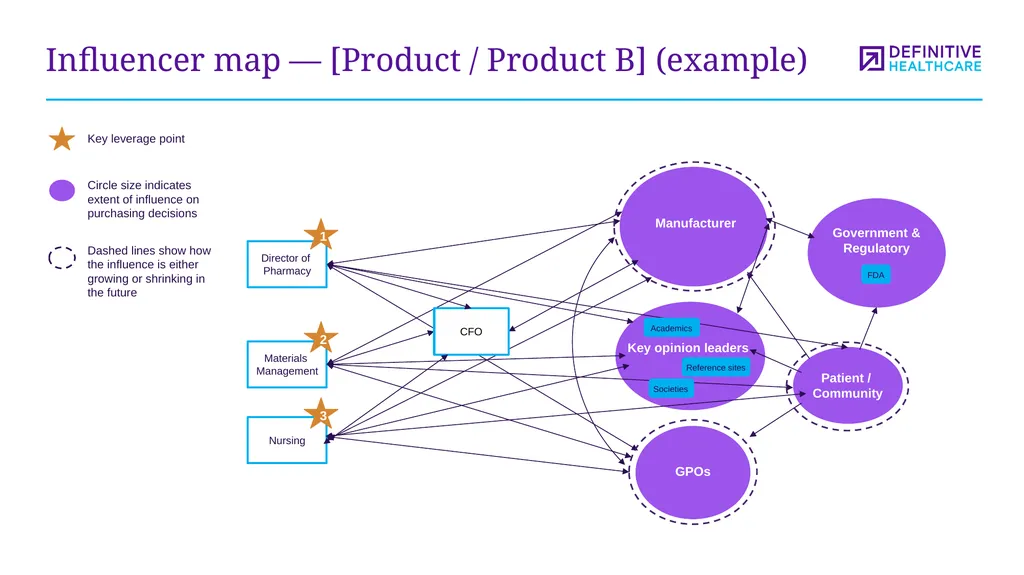
Influencer maps can be messy, so play around with your formatting to find the right layout. This should include all areas of influence that may impact the buying process.
Think through specific surgical departments, physician groups, personas, GPOs, KOLs, patient impact, government and regulatory agencies, your organization, and your competitors as the manufacturers. Your connecting lines should tie together each area of influence. In the provided examples, there are reciprocating influence lines because the sample environment is connected and has mutual influences. You’ll also notice that ‘entities’ are presented in different shapes than individual influencers.
Examples are included in the following slides. Influencer map — [Product / Product A] (example)<br>
Think through specific surgical departments, physician groups, personas, GPOs, KOLs, patient impact, government and regulatory agencies, your organization, and your competitors as the manufacturers. Your connecting lines should tie together each area of influence. In the provided examples, there are reciprocating influence lines because the sample environment is connected and has mutual influences. You’ll also notice that ‘entities’ are presented in different shapes than individual influencers.
Examples are included in the following slides. Influencer map — [Product / Product A] (example)<br>
16
Patient Manufacturer Key opinion
leaders Government
& Regulatory GPOs Gastroenterology Director of
Pharmacy 2 Dietician Influencer map — [Product / Product A] (example) 3 1<br>
leaders Government
& Regulatory GPOs Gastroenterology Director of
Pharmacy 2 Dietician Influencer map — [Product / Product A] (example) 3 1<br>
17
Nursing Influencer map — [Product / Product B] (example) Materials
Management Key opinion leaders GPOs Government & Regulatory Patient /
Community CFO Director of
Pharmacy 2 3 1<br>
Management Key opinion leaders GPOs Government & Regulatory Patient /
Community CFO Director of
Pharmacy 2 3 1<br>
18
Marketing programs<br>
19
Marketing program (template details)<br>
20
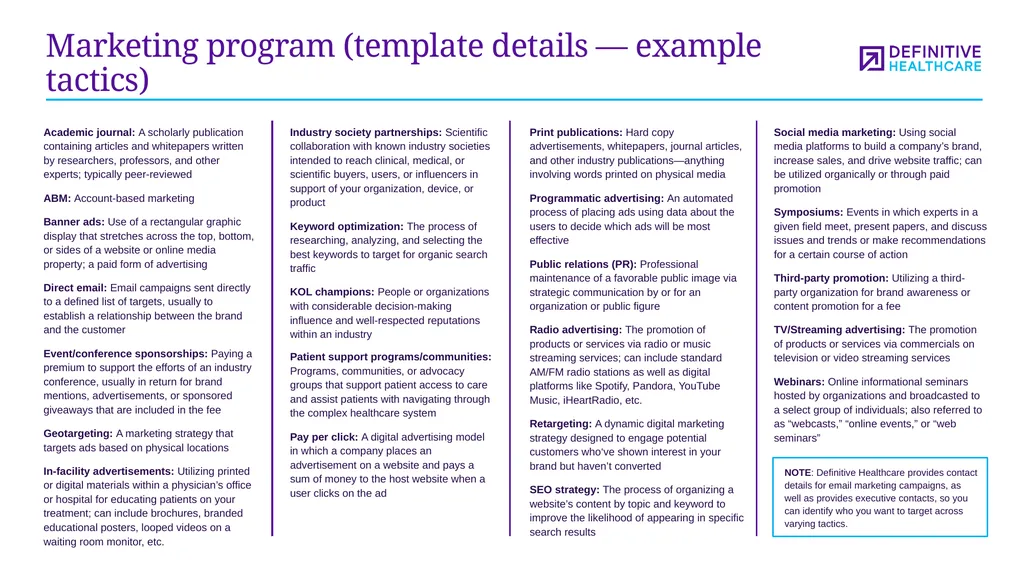
Academic journal: A scholarly publication containing articles and whitepapers written by researchers, professors, and other experts; typically peer-reviewed
ABM: Account-based marketing
Banner ads: Use of a rectangular graphic display that stretches across the top, bottom, or sides of a website or online media property; a paid form of advertising
Direct email: Email campaigns sent directly to a defined list of targets, usually to establish a relationship between the brand and the customer
Event/conference sponsorships: Paying a premium to support the efforts of an industry conference, usually in return for brand mentions, advertisements, or sponsored giveaways that are included in the fee
Geotargeting: A marketing strategy that targets ads based on physical locations
In-facility advertisements: Utilizing printed or digital materials within a physician’s office or hospital for educating patients on your treatment; can include brochures, branded educational posters, looped videos on a waiting room monitor, etc. Print publications: Hard copy advertisements, whitepapers, journal articles, and other industry publications—anything involving words printed on physical media
Programmatic advertising: An automated process of placing ads using data about the users to decide which ads will be most effective
Public relations (PR): Professional maintenance of a favorable public image via strategic communication by or for an organization or public figure
Radio advertising: The promotion of products or services via radio or music streaming services; can include standard AM/FM radio stations as well as digital platforms like Spotify, Pandora, YouTube Music, iHeartRadio, etc.
Retargeting: A dynamic digital marketing strategy designed to engage potential customers who‘ve shown interest in your brand but haven’t converted
SEO strategy: The process of organizing a website’s content by topic and keyword to improve the likelihood of appearing in specific search results Industry society partnerships: Scientific collaboration with known industry societies intended to reach clinical, medical, or scientific buyers, users, or influencers in support of your organization, device, or product
Keyword optimization: The process of researching, analyzing, and selecting the best keywords to target for organic search traffic
KOL champions: People or organizations with considerable decision-making influence and well-respected reputations within an industry
Patient support programs/communities: Programs, communities, or advocacy groups that support patient access to care and assist patients with navigating through the complex healthcare system
Pay per click: A digital advertising model in which a company places an advertisement on a website and pays a sum of money to the host website when a user clicks on the ad Social media marketing: Using social media platforms to build a company’s brand, increase sales, and drive website traffic; can be utilized organically or through paid promotion
Symposiums: Events in which experts in a given field meet, present papers, and discuss issues and trends or make recommendations for a certain course of action
Third-party promotion: Utilizing a third-party organization for brand awareness or content promotion for a fee
TV/Streaming advertising: The promotion of products or services via commercials on television or video streaming services
Webinars: Online informational seminars hosted by organizations and broadcasted to a select group of individuals; also referred to as “webcasts,” “online events,” or “web seminars” Marketing program (template details — example tactics) NOTE: Definitive Healthcare provides contact details for email marketing campaigns, as well as provides executive contacts, so you can identify who you want to target across varying tactics.<br>
ABM: Account-based marketing
Banner ads: Use of a rectangular graphic display that stretches across the top, bottom, or sides of a website or online media property; a paid form of advertising
Direct email: Email campaigns sent directly to a defined list of targets, usually to establish a relationship between the brand and the customer
Event/conference sponsorships: Paying a premium to support the efforts of an industry conference, usually in return for brand mentions, advertisements, or sponsored giveaways that are included in the fee
Geotargeting: A marketing strategy that targets ads based on physical locations
In-facility advertisements: Utilizing printed or digital materials within a physician’s office or hospital for educating patients on your treatment; can include brochures, branded educational posters, looped videos on a waiting room monitor, etc. Print publications: Hard copy advertisements, whitepapers, journal articles, and other industry publications—anything involving words printed on physical media
Programmatic advertising: An automated process of placing ads using data about the users to decide which ads will be most effective
Public relations (PR): Professional maintenance of a favorable public image via strategic communication by or for an organization or public figure
Radio advertising: The promotion of products or services via radio or music streaming services; can include standard AM/FM radio stations as well as digital platforms like Spotify, Pandora, YouTube Music, iHeartRadio, etc.
Retargeting: A dynamic digital marketing strategy designed to engage potential customers who‘ve shown interest in your brand but haven’t converted
SEO strategy: The process of organizing a website’s content by topic and keyword to improve the likelihood of appearing in specific search results Industry society partnerships: Scientific collaboration with known industry societies intended to reach clinical, medical, or scientific buyers, users, or influencers in support of your organization, device, or product
Keyword optimization: The process of researching, analyzing, and selecting the best keywords to target for organic search traffic
KOL champions: People or organizations with considerable decision-making influence and well-respected reputations within an industry
Patient support programs/communities: Programs, communities, or advocacy groups that support patient access to care and assist patients with navigating through the complex healthcare system
Pay per click: A digital advertising model in which a company places an advertisement on a website and pays a sum of money to the host website when a user clicks on the ad Social media marketing: Using social media platforms to build a company’s brand, increase sales, and drive website traffic; can be utilized organically or through paid promotion
Symposiums: Events in which experts in a given field meet, present papers, and discuss issues and trends or make recommendations for a certain course of action
Third-party promotion: Utilizing a third-party organization for brand awareness or content promotion for a fee
TV/Streaming advertising: The promotion of products or services via commercials on television or video streaming services
Webinars: Online informational seminars hosted by organizations and broadcasted to a select group of individuals; also referred to as “webcasts,” “online events,” or “web seminars” Marketing program (template details — example tactics) NOTE: Definitive Healthcare provides contact details for email marketing campaigns, as well as provides executive contacts, so you can identify who you want to target across varying tactics.<br>
21
Marketing programs summary Summarize key outcomes you are hoping to achieve as well as your total requested annual budget.<br>
22
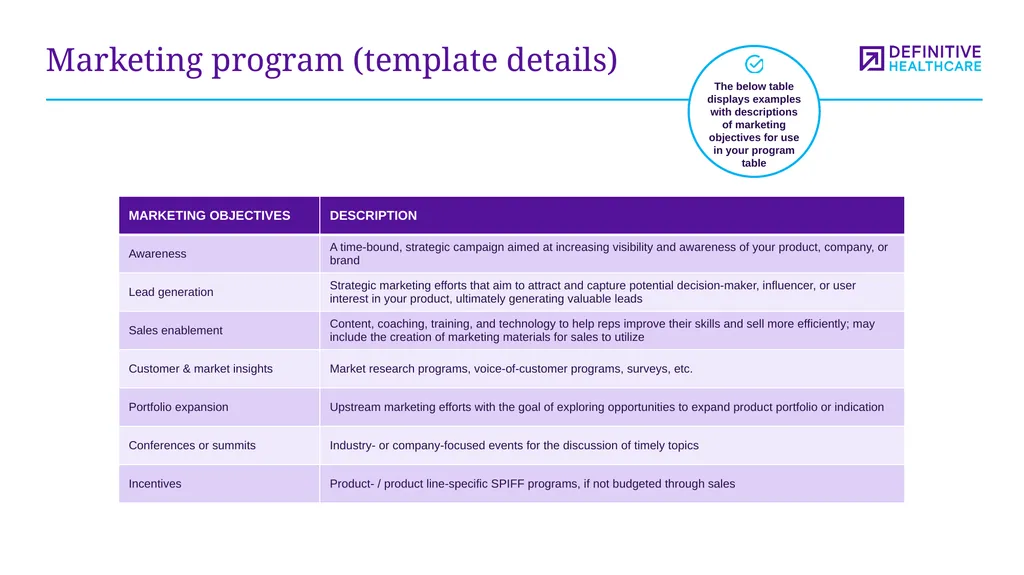
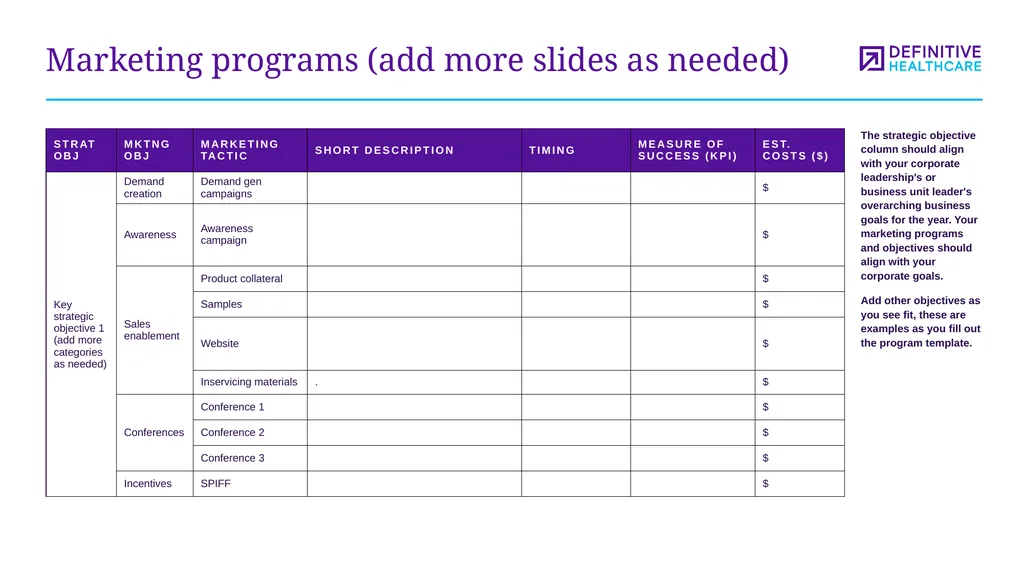
Marketing programs (add more slides as needed) The strategic objective column should align with your corporate leadership's or business unit leader's overarching business goals for the year. Your marketing programs and objectives should align with your corporate goals.
Add other objectives as you see fit, these are examples as you fill out the program template.<br>
Add other objectives as you see fit, these are examples as you fill out the program template.<br>
23
The customer<br>
24
Commitment to
existing portfolio Hospital type Account size
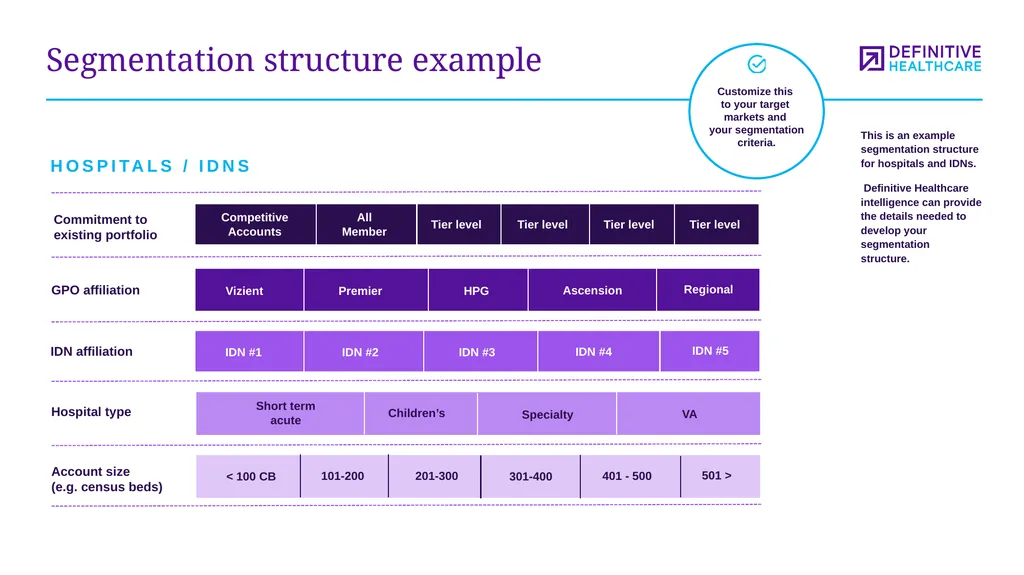
(e.g. census beds) Short term acute Children’s Specialty VA < 100 CB 101-200 501 > All Member Tier level Tier level Tier level Tier level Competitive Accounts 201-300 301-400 401 - 500 GPO affiliation Premier HPG Vizient Regional Ascension IDN affiliation IDN #2 IDN #3 IDN #1 IDN #5 IDN #4 This is an example segmentation structure for hospitals and IDNs.
Definitive Healthcare intelligence can provide the details needed to develop your segmentation structure. HOSPITALS / IDNS Segmentation structure example<br>
existing portfolio Hospital type Account size
(e.g. census beds) Short term acute Children’s Specialty VA < 100 CB 101-200 501 > All Member Tier level Tier level Tier level Tier level Competitive Accounts 201-300 301-400 401 - 500 GPO affiliation Premier HPG Vizient Regional Ascension IDN affiliation IDN #2 IDN #3 IDN #1 IDN #5 IDN #4 This is an example segmentation structure for hospitals and IDNs.
Definitive Healthcare intelligence can provide the details needed to develop your segmentation structure. HOSPITALS / IDNS Segmentation structure example<br>
25
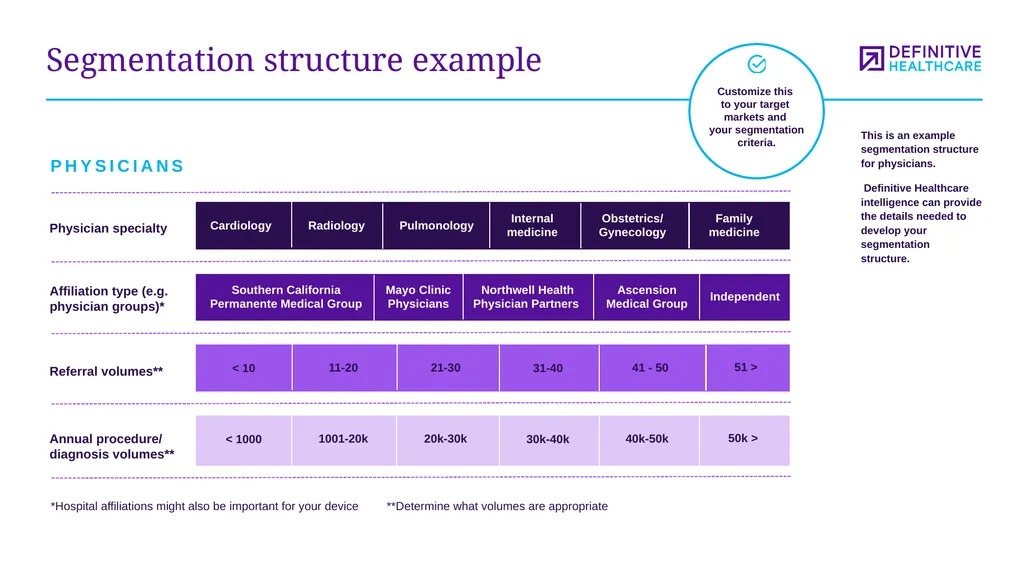
Physician specialty Affiliation type (e.g. physician groups)* Referral volumes** Southern California Permanente Medical Group Mayo Clinic Physicians Northwell Health Physician Partners Independent < 10 11-20 51 > Radiology Pulmonology Internal medicine Obstetrics/ Gynecology Family medicine Cardiology 21-30 31-40 41 - 50 Ascension Medical Group Annual procedure/ diagnosis volumes** < 1000 1001-20k 50k > 20k-30k 30k-40k 40k-50k *Hospital affiliations might also be important for your device **Determine what volumes are appropriate This is an example segmentation structure for physicians.
Definitive Healthcare intelligence can provide the details needed to develop your segmentation structure. PHYSICIANS Segmentation structure example<br>
Definitive Healthcare intelligence can provide the details needed to develop your segmentation structure. PHYSICIANS Segmentation structure example<br>
26
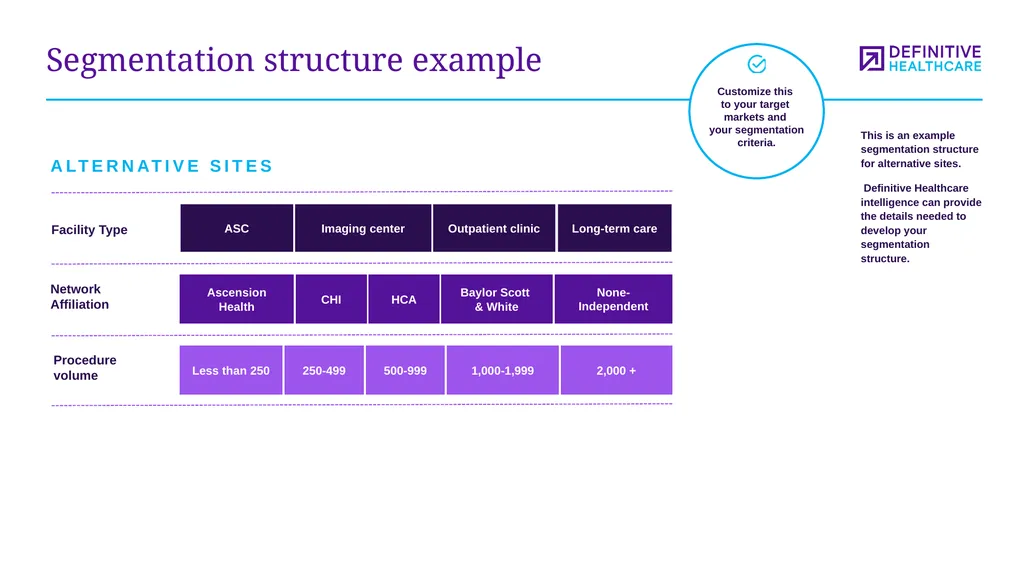
Facility Type Network Affiliation Imaging center Outpatient clinic CHI HCA Ascension Health Baylor Scott
& White ASC Long-term care Procedure volume 250-499 500-999 Less than 250 1,000-1,999 2,000 + None-Independent This is an example segmentation structure for alternative sites.
Definitive Healthcare intelligence can provide the details needed to develop your segmentation structure. ALTERNATIVE SITES Segmentation structure example<br>
& White ASC Long-term care Procedure volume 250-499 500-999 Less than 250 1,000-1,999 2,000 + None-Independent This is an example segmentation structure for alternative sites.
Definitive Healthcare intelligence can provide the details needed to develop your segmentation structure. ALTERNATIVE SITES Segmentation structure example<br>
27
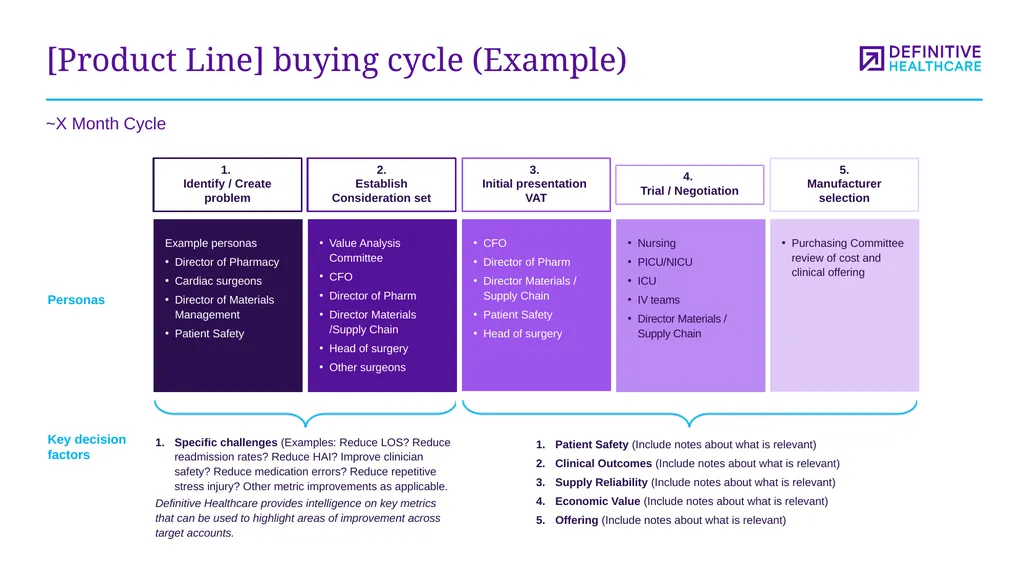
Specific challenges (Examples: Reduce LOS? Reduce readmission rates? Reduce HAI? Improve clinician safety? Reduce medication errors? Reduce repetitive stress injury? Other metric improvements as applicable.
Definitive Healthcare provides intelligence on key metrics that can be used to highlight areas of improvement across target accounts. Example personas
Director of Pharmacy
Cardiac surgeons
Director of Materials Management
Patient Safety Value Analysis Committee
CFO
Director of Pharm
Director Materials /Supply Chain
Head of surgery
Other surgeons CFO
Director of Pharm
Director Materials / Supply Chain
Patient Safety
Head of surgery Nursing
PICU/NICU
ICU
IV teams
Director Materials / Supply Chain Purchasing Committee review of cost and clinical offering ~X Month Cycle Patient Safety (Include notes about what is relevant)
Clinical Outcomes (Include notes about what is relevant)
Supply Reliability (Include notes about what is relevant)
Economic Value (Include notes about what is relevant)
Offering (Include notes about what is relevant) [Product Line] buying cycle (Example) Personas Key decision factors 1.
Identify / Create problem 2.
Establish
Consideration set 3.
Initial presentation
VAT 4.
Trial / Negotiation 5.
Manufacturer
selection<br>
Definitive Healthcare provides intelligence on key metrics that can be used to highlight areas of improvement across target accounts. Example personas
Director of Pharmacy
Cardiac surgeons
Director of Materials Management
Patient Safety Value Analysis Committee
CFO
Director of Pharm
Director Materials /Supply Chain
Head of surgery
Other surgeons CFO
Director of Pharm
Director Materials / Supply Chain
Patient Safety
Head of surgery Nursing
PICU/NICU
ICU
IV teams
Director Materials / Supply Chain Purchasing Committee review of cost and clinical offering ~X Month Cycle Patient Safety (Include notes about what is relevant)
Clinical Outcomes (Include notes about what is relevant)
Supply Reliability (Include notes about what is relevant)
Economic Value (Include notes about what is relevant)
Offering (Include notes about what is relevant) [Product Line] buying cycle (Example) Personas Key decision factors 1.
Identify / Create problem 2.
Establish
Consideration set 3.
Initial presentation
VAT 4.
Trial / Negotiation 5.
Manufacturer
selection<br>
28
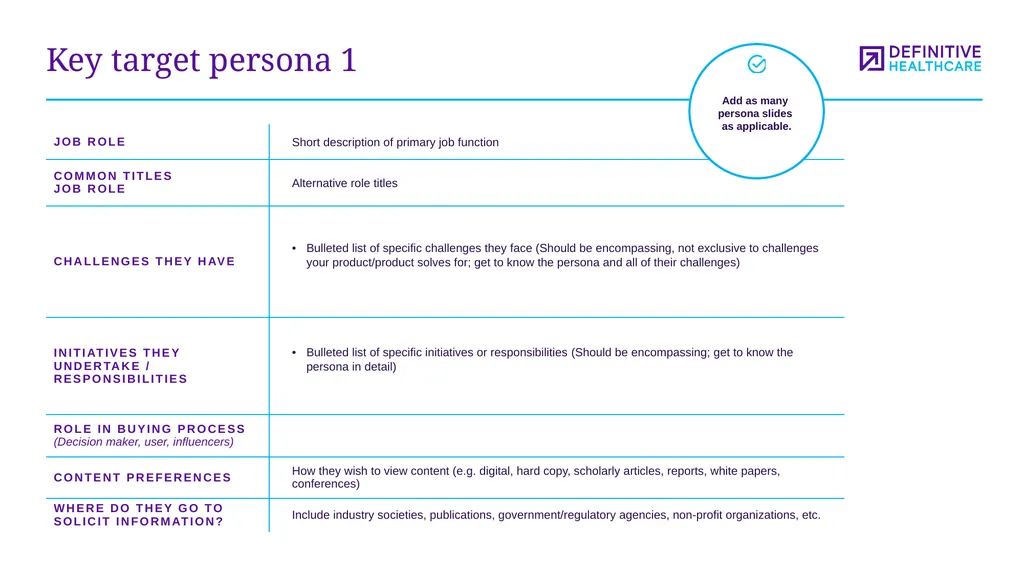
Key target persona 1<br>
29
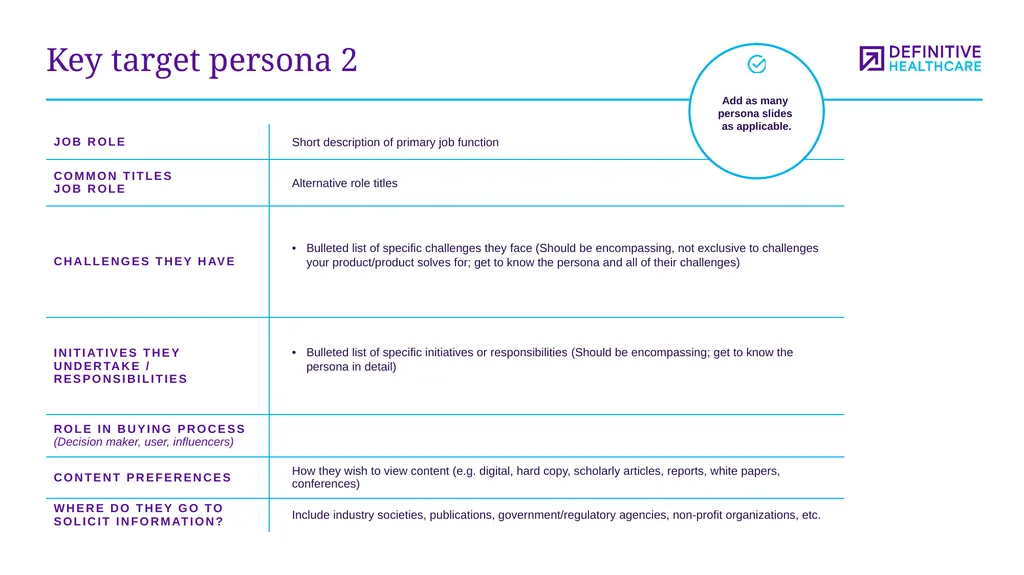
Key target persona 2<br>
30
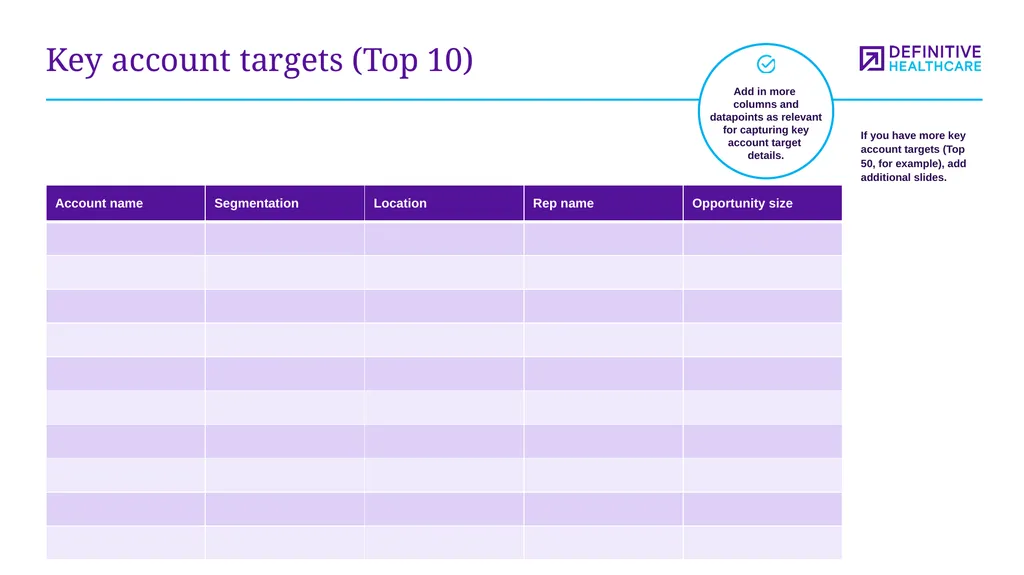
If you have more key account targets (Top 50, for example), add additional slides. Key account targets (Top 10)<br>
31
The competition<br>
32
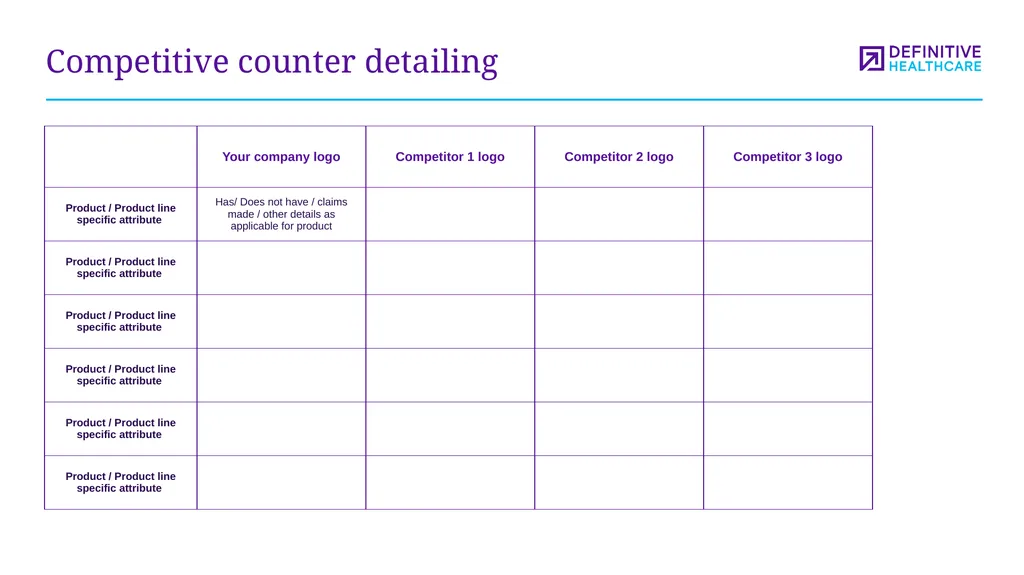
Competitive counter detailing<br>
33
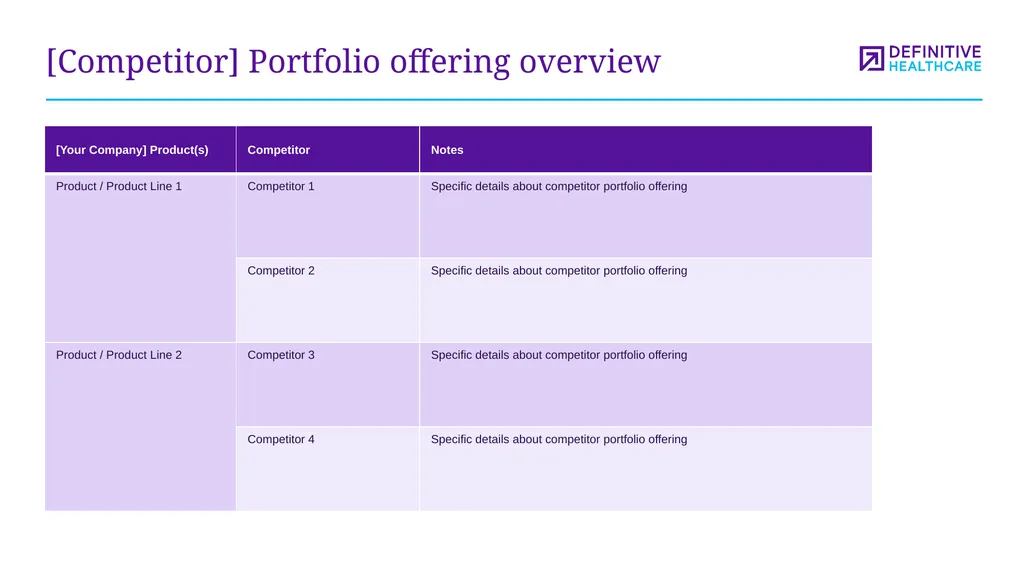
[Competitor] Portfolio offering overview<br>
34
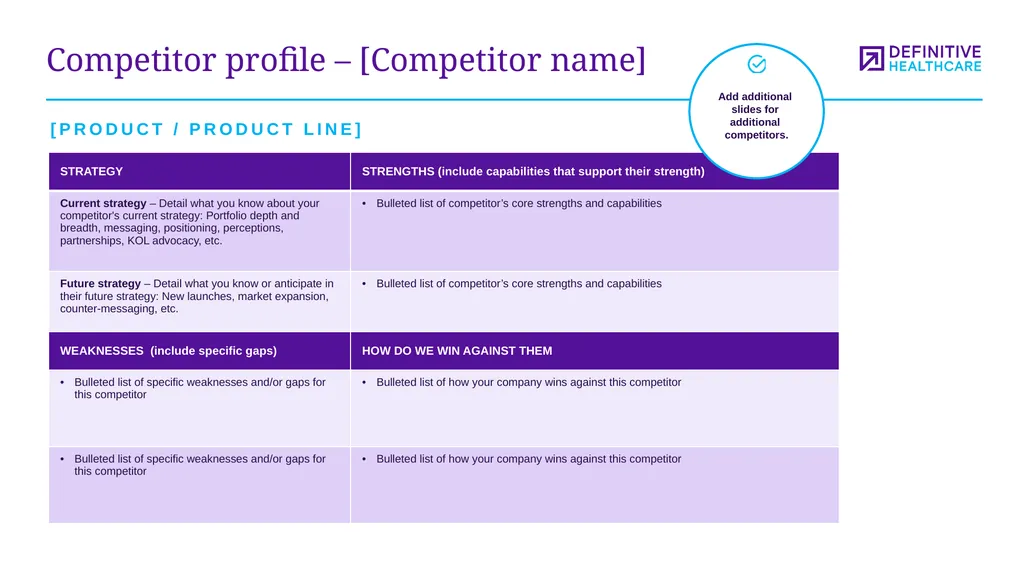
[PRODUCT / PRODUCT LINE] Competitor profile – [Competitor name]<br>
35
The portfolio<br>
36
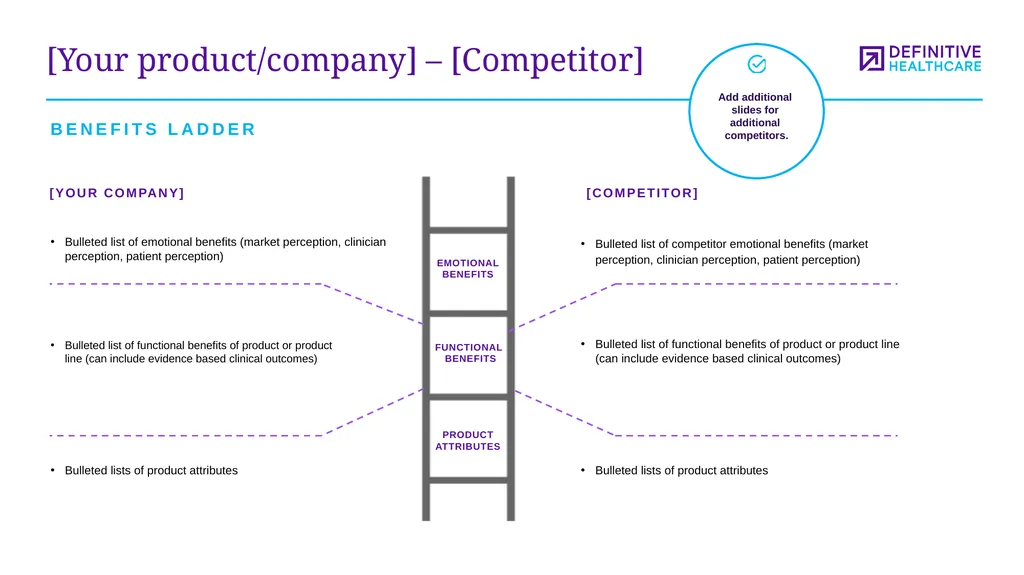
[Your Company] Bulleted list of emotional benefits (market perception, clinician perception, patient perception) Bulleted list of functional benefits of product or product line (can include evidence based clinical outcomes) Bulleted lists of product attributes Emotional
benefits Functional benefits Product
attributes [Competitor] Bulleted list of competitor emotional benefits (market perception, clinician perception, patient perception) Bulleted list of functional benefits of product or product line (can include evidence based clinical outcomes) Bulleted lists of product attributes [Your product/company] – [Competitor] BENEFITS LADDER<br>
benefits Functional benefits Product
attributes [Competitor] Bulleted list of competitor emotional benefits (market perception, clinician perception, patient perception) Bulleted list of functional benefits of product or product line (can include evidence based clinical outcomes) Bulleted lists of product attributes [Your product/company] – [Competitor] BENEFITS LADDER<br>
37
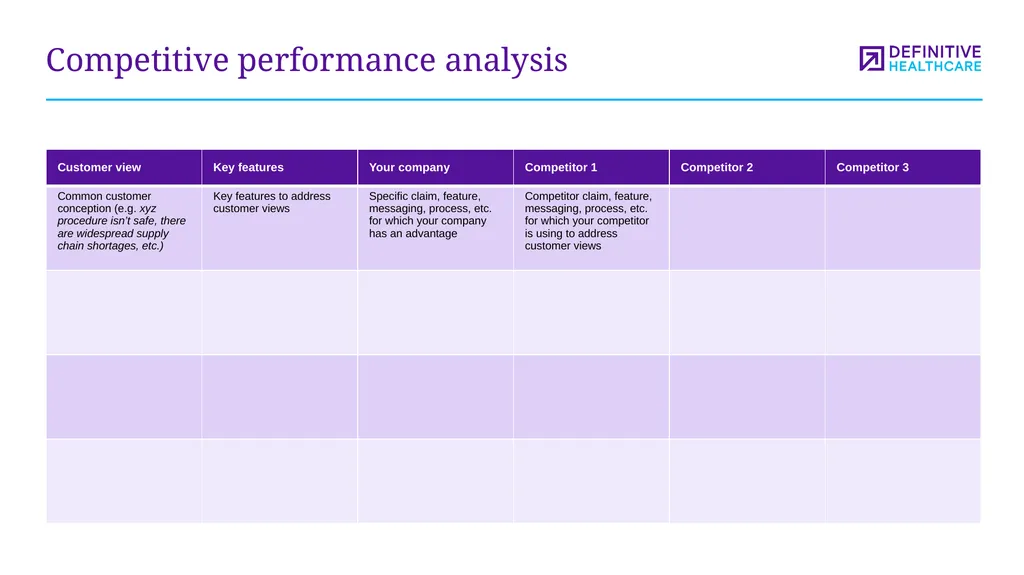
Competitive performance analysis<br>
38
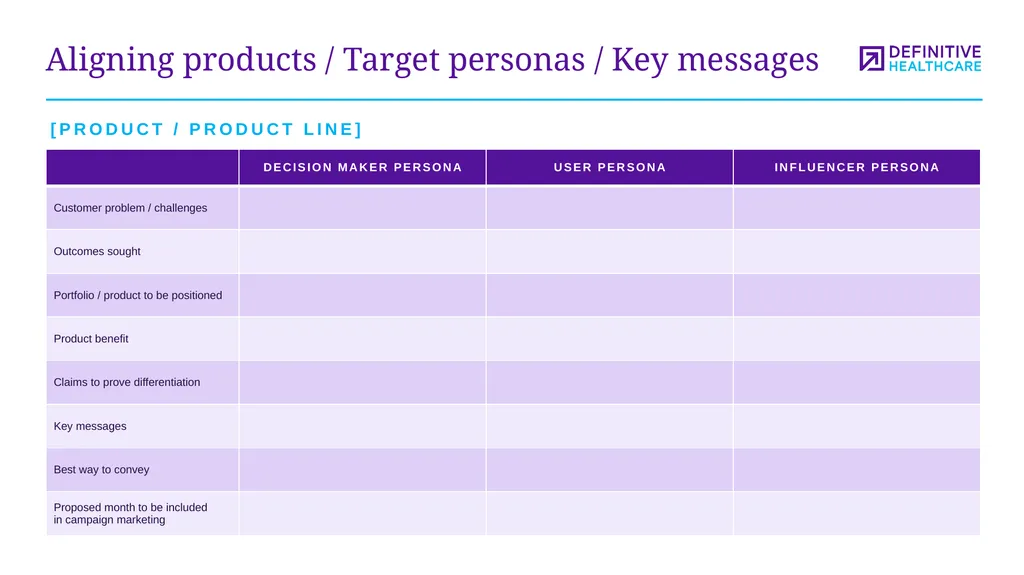
Aligning products / Target personas / Key messages [PRODUCT / PRODUCT LINE]<br>
39
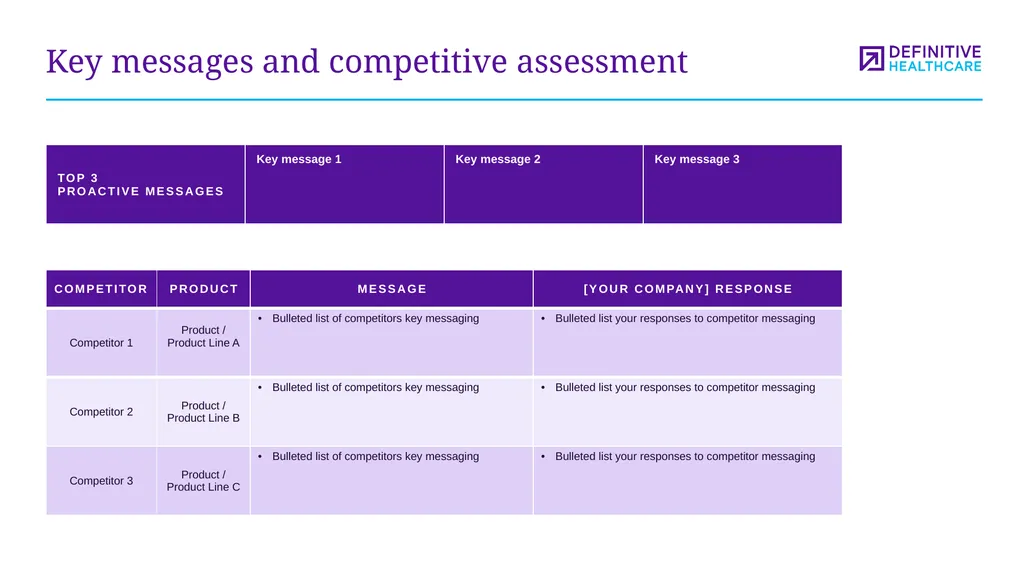
Key messages and competitive assessment<br>
40
Pricing<br>
41
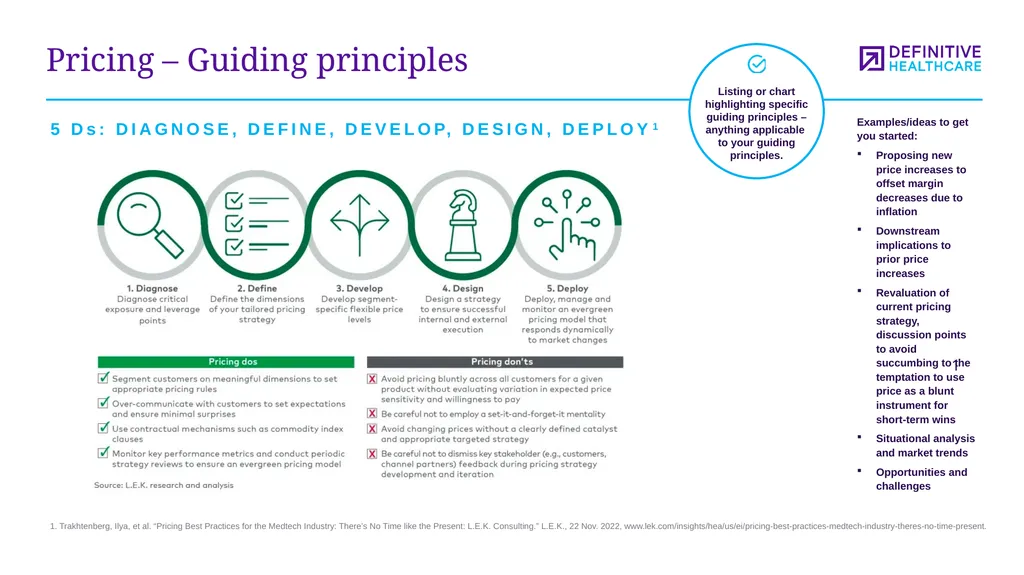
Examples/ideas to get you started:
Proposing new price increases to offset margin decreases due to inflation
Downstream implications to prior price increases
Revaluation of current pricing strategy, discussion points to avoid succumbing to the temptation to use price as a blunt instrument for short-term wins
Situational analysis and market trends
Opportunities and challenges 1. Trakhtenberg, Ilya, et al. “Pricing Best Practices for the Medtech Industry: There’s No Time like the Present: L.E.K. Consulting.” L.E.K., 22 Nov. 2022, www.lek.com/insights/hea/us/ei/pricing-best-practices-medtech-industry-theres-no-time-present. 1 Pricing – Guiding principles 5 Ds: DIAGNOSE, DEFINE, DEVELOP, DESIGN, DEPLOY1<br>
Proposing new price increases to offset margin decreases due to inflation
Downstream implications to prior price increases
Revaluation of current pricing strategy, discussion points to avoid succumbing to the temptation to use price as a blunt instrument for short-term wins
Situational analysis and market trends
Opportunities and challenges 1. Trakhtenberg, Ilya, et al. “Pricing Best Practices for the Medtech Industry: There’s No Time like the Present: L.E.K. Consulting.” L.E.K., 22 Nov. 2022, www.lek.com/insights/hea/us/ei/pricing-best-practices-medtech-industry-theres-no-time-present. 1 Pricing – Guiding principles 5 Ds: DIAGNOSE, DEFINE, DEVELOP, DESIGN, DEPLOY1<br>
42
Current pricing STRUCTURE<br>
43
If applicable, include key details about reimbursement through varying payor types and at varying degrees of complexity.
Feel free to include landed or TP0 pricing and margin calculations as well. This can help to identify where you want the most customer acquisition. Current pricing [REBATE AND/OUR REIMBURSEMENT STRUCTURE]<br>
Feel free to include landed or TP0 pricing and margin calculations as well. This can help to identify where you want the most customer acquisition. Current pricing [REBATE AND/OUR REIMBURSEMENT STRUCTURE]<br>
44
If proposing price changes / increases, lay out your varying scenarios and consider including the following:
Timeframe for implementation
Impact on GPO cycles
Percentage of customer loss
Impact on current agreements (if any)
Implications to varying market segments Overall pricing goals and recommendations<br>
Timeframe for implementation
Impact on GPO cycles
Percentage of customer loss
Impact on current agreements (if any)
Implications to varying market segments Overall pricing goals and recommendations<br>
45
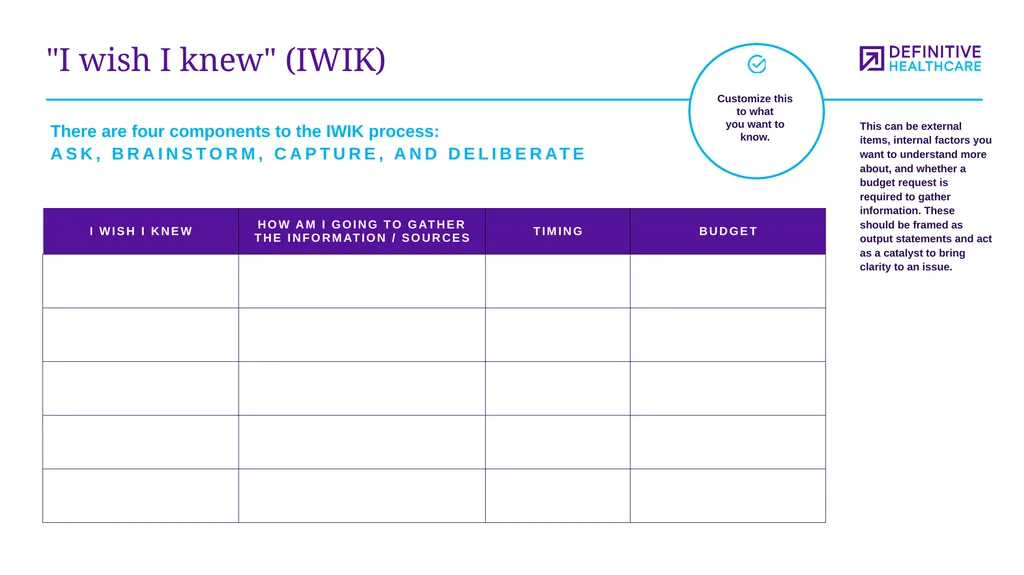
I wish I knew (IWIK)<br>
46
This can be external items, internal factors you want to understand more about, and whether a budget request is required to gather information. These should be framed as output statements and act as a catalyst to bring clarity to an issue. "I wish I knew" (IWIK) There are four components to the IWIK process:
ASK, BRAINSTORM, CAPTURE, AND DELIBERATE<br>
ASK, BRAINSTORM, CAPTURE, AND DELIBERATE<br>
47
Appendix<br>