
Men’s learning & well-being What do we know about
PT
Published · 22 slides · 0 views
1 / 1


Description
Mens learning well-being What do we know about mens sheds? Dr. Lucia Carragher, the Netwell Centre, School of Health Science, DkIT Clare Age Expo 2016, Health Wellness Centre, Carrigoran House Friday April 15th 2016 Contextual
Related Topics
Share
Embed code
Download this presentation From Below
"Men’s learning & well-being What do we know about" is the property of its rightful owner. Permission is granted to download and print the materials on this website for personal, non-commercial use only, and to display it on your personal computer provided you do not modify the materials and that you retain all copyright notices contained in the materials. By downloading content from our website, you accept the terms of this agreement.
Presentation Transcript
01
Men’s learning & well-being
What do we know about men’s sheds? Dr. Lucia Carragher, the Netwell Centre,
School of Health & Science, DkIT
Clare Age Expo 2016, Health & Wellness Centre, Carrigoran House
Friday April 15th 2016<br>
School of Health & Science, DkIT
Clare Age Expo 2016, Health & Wellness Centre, Carrigoran House
Friday April 15th 2016<br>
02
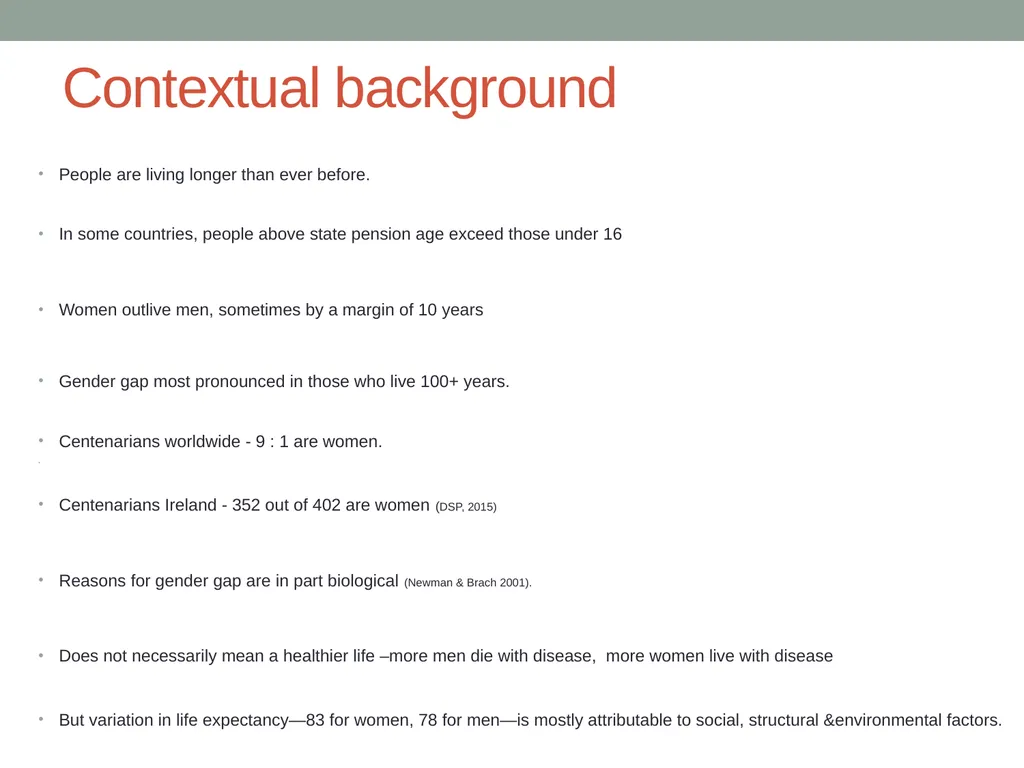
Contextual background People are living longer than ever before.
In some countries, people above state pension age exceed those under 16
Women outlive men, sometimes by a margin of 10 years
Gender gap most pronounced in those who live 100+ years.
Centenarians worldwide - 9 : 1 are women.
Centenarians Ireland - 352 out of 402 are women (DSP, 2015)
Reasons for gender gap are in part biological (Newman & Brach 2001).
Does not necessarily mean a healthier life –more men die with disease, more women live with disease
But variation in life expectancy—83 for women, 78 for men—is mostly attributable to social, structural &environmental factors.<br>
03
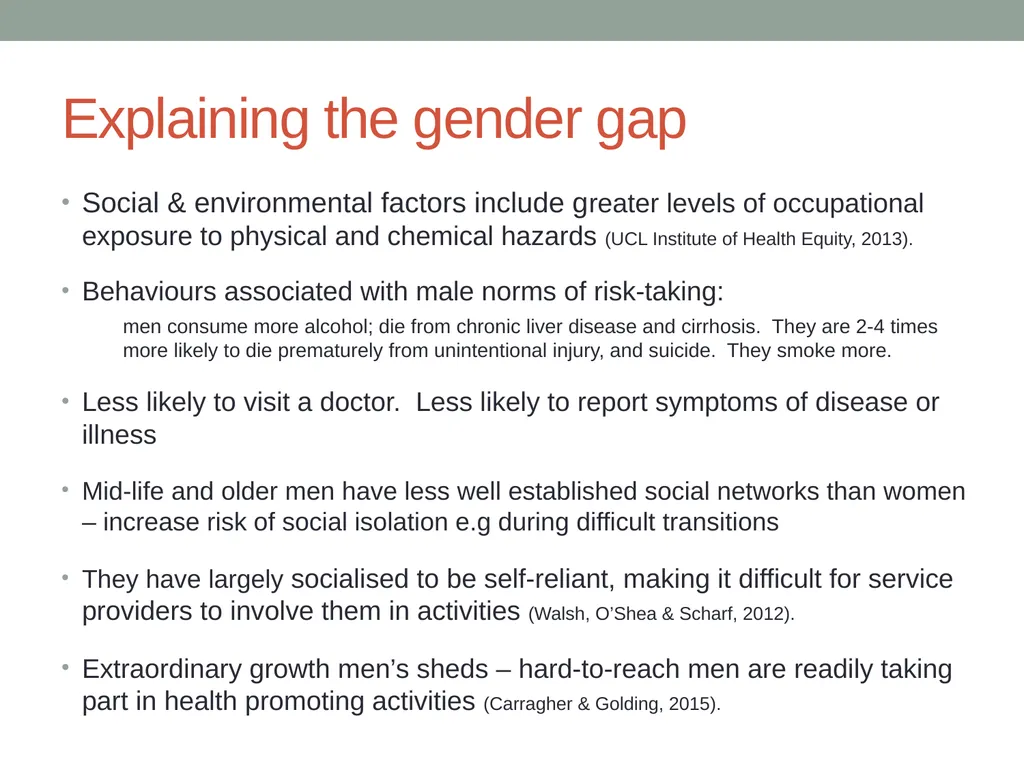
Explaining the gender gap Social & environmental factors include greater levels of occupational exposure to physical and chemical hazards (UCL Institute of Health Equity, 2013).
Behaviours associated with male norms of risk-taking:
men consume more alcohol; die from chronic liver disease and cirrhosis. They are 2-4 times more likely to die prematurely from unintentional injury, and suicide. They smoke more.
Less likely to visit a doctor. Less likely to report symptoms of disease or illness
Mid-life and older men have less well established social networks than women – increase risk of social isolation e.g during difficult transitions
They have largely socialised to be self-reliant, making it difficult for service providers to involve them in activities (Walsh, O’Shea & Scharf, 2012).
Extraordinary growth men’s sheds – hard-to-reach men are readily taking part in health promoting activities (Carragher & Golding, 2015).<br>
04
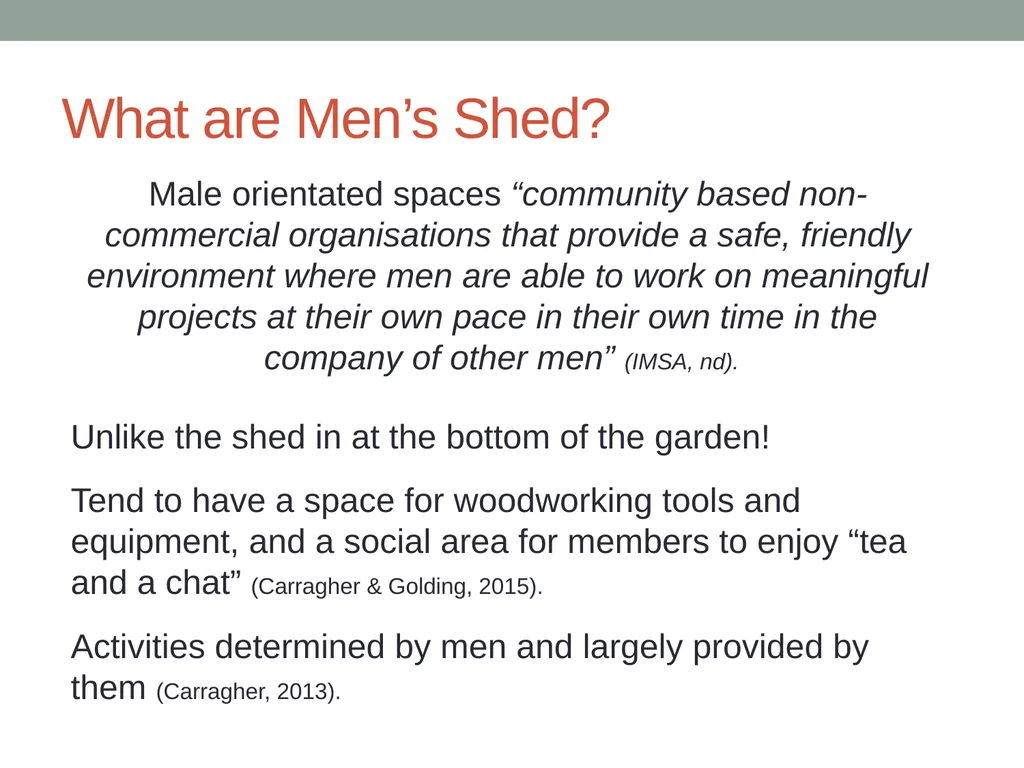
What are Men’s Shed? Male orientated spaces “community based non-commercial organisations that provide a safe, friendly environment where men are able to work on meaningful projects at their own pace in their own time in the company of other men” (IMSA, nd).
Unlike the shed in at the bottom of the garden!
Tend to have a space for woodworking tools and equipment, and a social area for members to enjoy “tea and a chat” (Carragher & Golding, 2015).
Activities determined by men and largely provided by them (Carragher, 2013).<br>
Unlike the shed in at the bottom of the garden!
Tend to have a space for woodworking tools and equipment, and a social area for members to enjoy “tea and a chat” (Carragher & Golding, 2015).
Activities determined by men and largely provided by them (Carragher, 2013).<br>
05
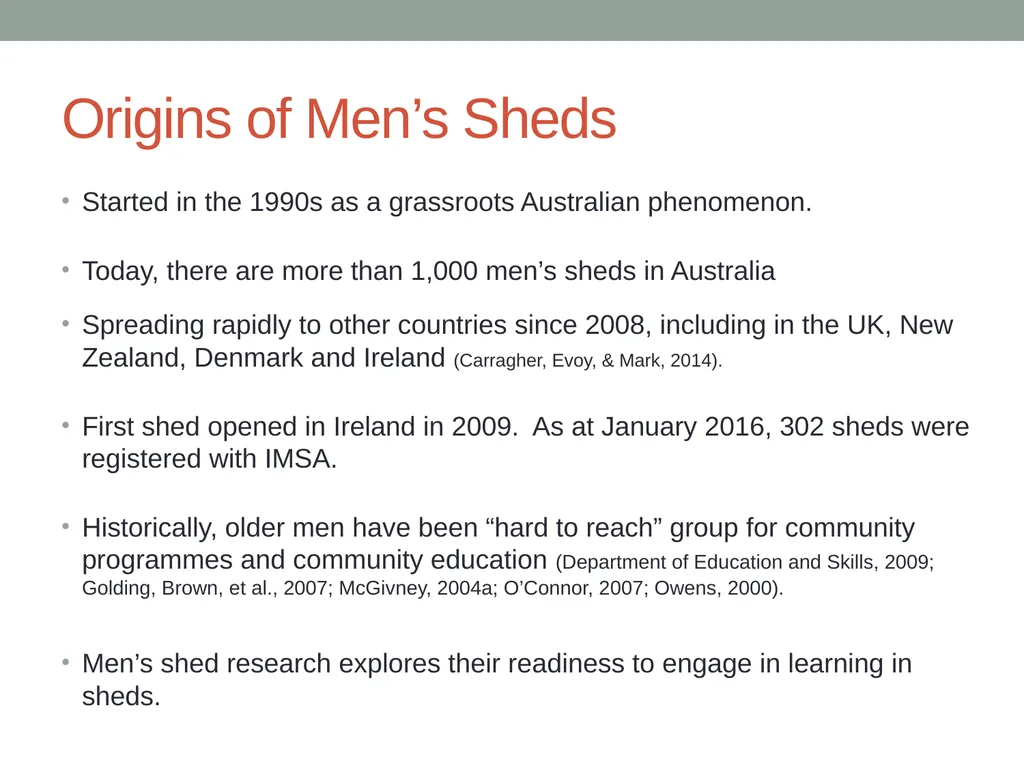
Origins of Men’s Sheds Started in the 1990s as a grassroots Australian phenomenon.
Today, there are more than 1,000 men’s sheds in Australia
Spreading rapidly to other countries since 2008, including in the UK, New Zealand, Denmark and Ireland (Carragher, Evoy, & Mark, 2014).
First shed opened in Ireland in 2009. As at January 2016, 302 sheds were registered with IMSA.
Historically, older men have been “hard to reach” group for community programmes and community education (Department of Education and Skills, 2009; Golding, Brown, et al., 2007; McGivney, 2004a; O’Connor, 2007; Owens, 2000).
Men’s shed research explores their readiness to engage in learning in sheds.<br>
06
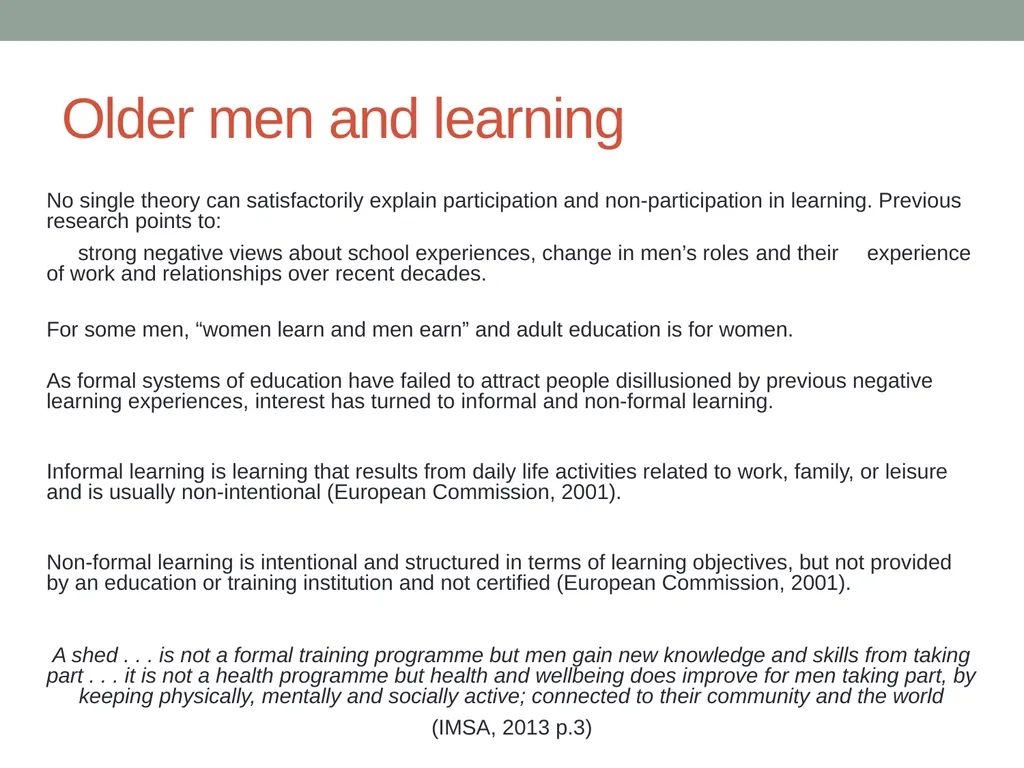
Older men and learning No single theory can satisfactorily explain participation and non-participation in learning. Previous research points to:
strong negative views about school experiences, change in men’s roles and their experience of work and relationships over recent decades.
For some men, “women learn and men earn” and adult education is for women.
As formal systems of education have failed to attract people disillusioned by previous negative learning experiences, interest has turned to informal and non-formal learning.
Informal learning is learning that results from daily life activities related to work, family, or leisure and is usually non-intentional (European Commission, 2001).
Non-formal learning is intentional and structured in terms of learning objectives, but not provided by an education or training institution and not certified (European Commission, 2001).
A shed . . . is not a formal training programme but men gain new knowledge and skills from taking part . . . it is not a health programme but health and wellbeing does improve for men taking part, by keeping physically, mentally and socially active; connected to their community and the world
(IMSA, 2013 p.3)<br>
07
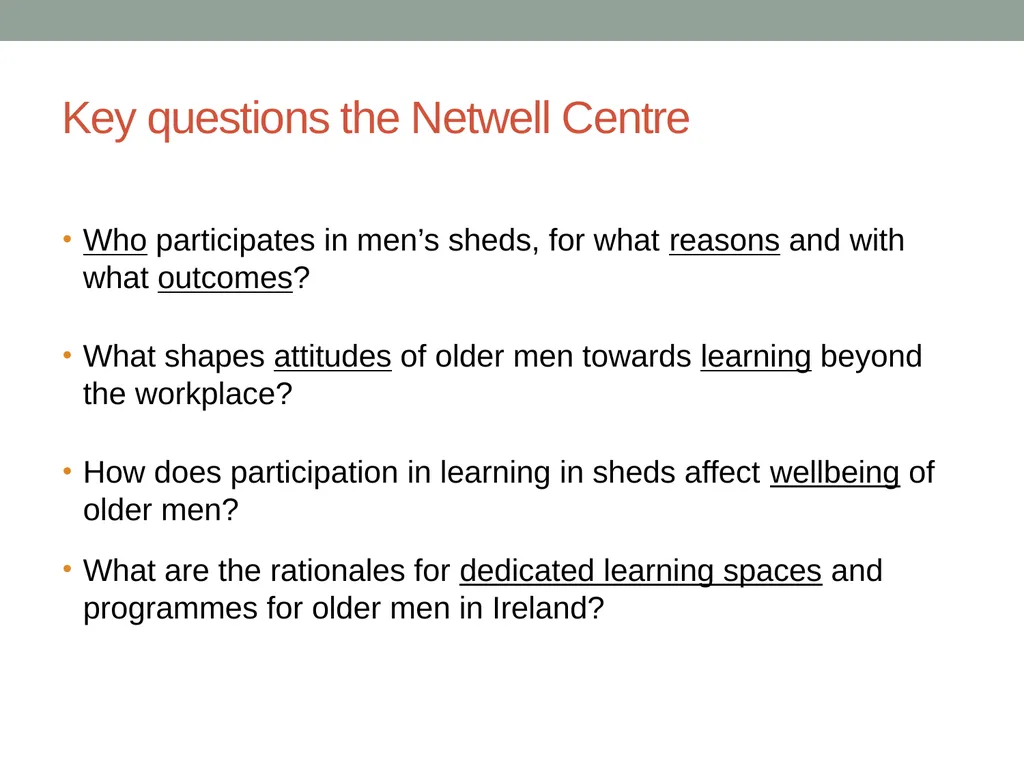
Key questions the Netwell Centre Who participates in men’s sheds, for what reasons and with what outcomes?
What shapes attitudes of older men towards learning beyond the workplace?
How does participation in learning in sheds affect wellbeing of older men?
What are the rationales for dedicated learning spaces and programmes for older men in Ireland?<br>
What shapes attitudes of older men towards learning beyond the workplace?
How does participation in learning in sheds affect wellbeing of older men?
What are the rationales for dedicated learning spaces and programmes for older men in Ireland?<br>
08
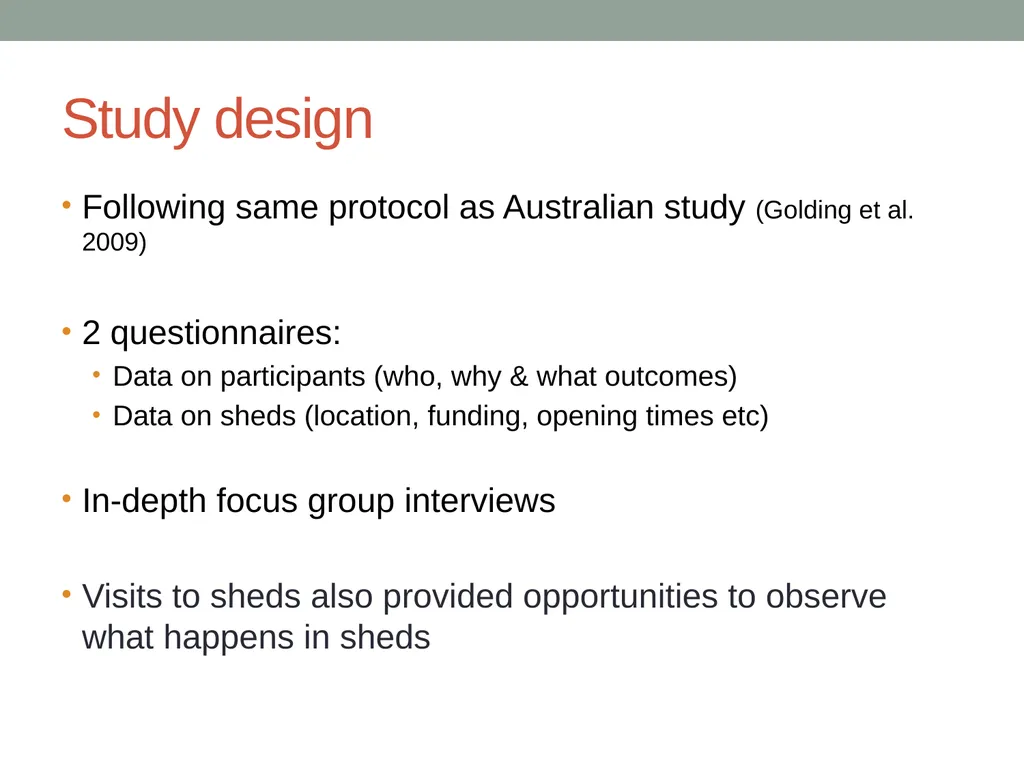
Study design Following same protocol as Australian study (Golding et al. 2009)
2 questionnaires:
Data on participants (who, why & what outcomes)
Data on sheds (location, funding, opening times etc)
In-depth focus group interviews
Visits to sheds also provided opportunities to observe what happens in sheds<br>
2 questionnaires:
Data on participants (who, why & what outcomes)
Data on sheds (location, funding, opening times etc)
In-depth focus group interviews
Visits to sheds also provided opportunities to observe what happens in sheds<br>
09
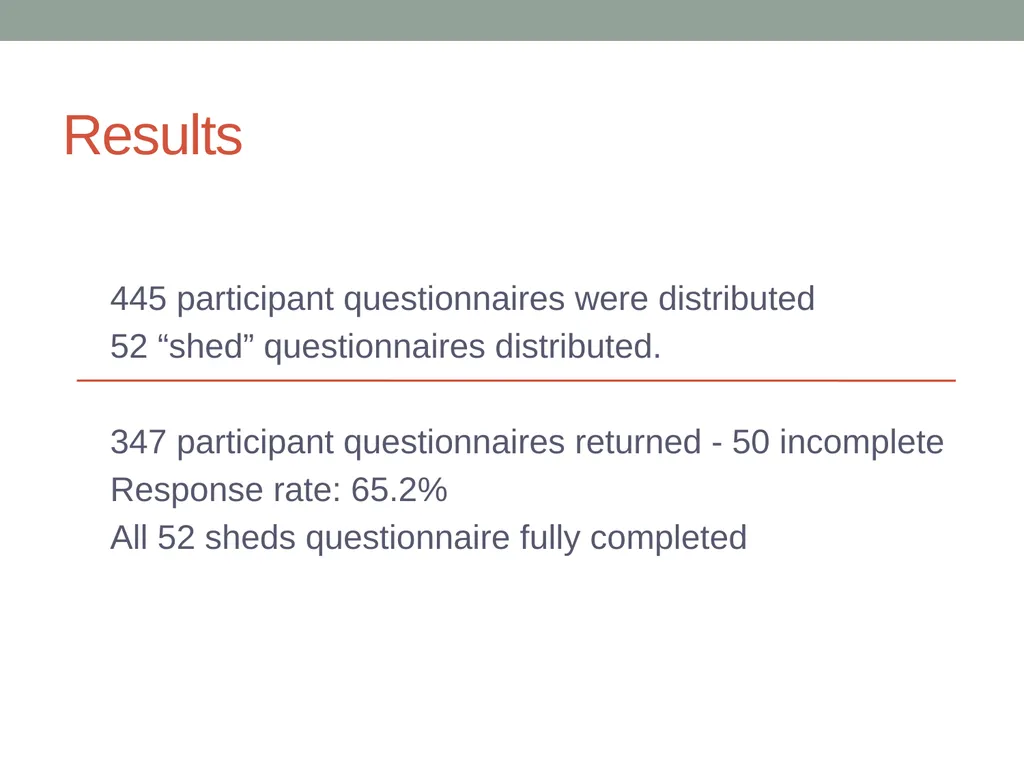
Results 445 participant questionnaires were distributed
52 “shed” questionnaires distributed.
347 participant questionnaires returned - 50 incomplete
Response rate: 65.2%
All 52 sheds questionnaire fully completed<br>
52 “shed” questionnaires distributed.
347 participant questionnaires returned - 50 incomplete
Response rate: 65.2%
All 52 sheds questionnaire fully completed<br>
10
Profile of men’s sheds in Ireland Men’s Sheds are largely for men;
53% are available only to men, and 40% are available mainly to men, just over one quarter (27%) said they welcomed for both men and women.
The majority of sheds engage in diverse activities, but woodwork and crafts are most popular.
Average number of different participants who access sheds each week is 25.
Less than half (41%) of respondents belonged to sheds that were fully funded, nearly a quarter (24%) were members of sheds that were partially funded and over a third (35%) attended sheds that were underfunded.
Shed managers and co-ordinators are mainly men, but nearly a quarter (23%) are managed by women.<br>
11
Who participates in men’s sheds? Age
70% aged 50 or over
18% aged 30 -49 years
10% under 30 years of age
Employment
53% are retired and in receipt of pension
15% are employed
Almost one third are not employed and not retired.<br>
70% aged 50 or over
18% aged 30 -49 years
10% under 30 years of age
Employment
53% are retired and in receipt of pension
15% are employed
Almost one third are not employed and not retired.<br>
12
Who participates in men’s sheds? Education:
primary school (21%)
lower secondary (18%)
upper secondary & technical (9%)
technical qualification (20%)
degree or above (15%)
diploma or equivalent (15%)
45% are current or former qualified tradesmen<br>
primary school (21%)
lower secondary (18%)
upper secondary & technical (9%)
technical qualification (20%)
degree or above (15%)
diploma or equivalent (15%)
45% are current or former qualified tradesmen<br>
13
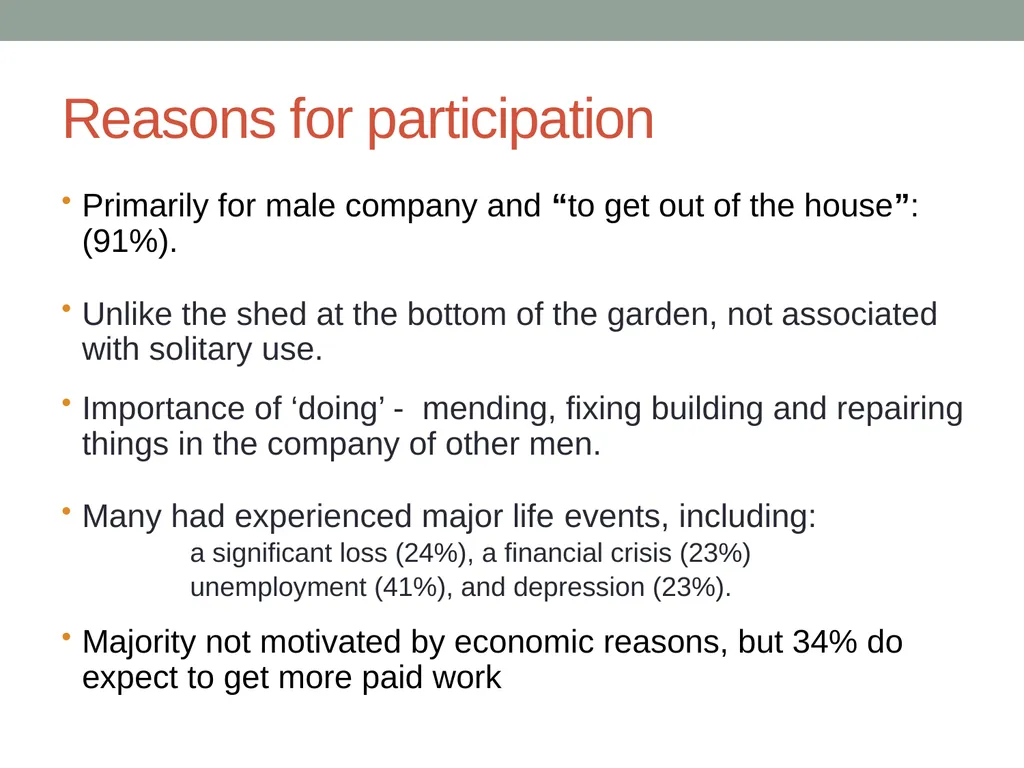
Reasons for participation Primarily for male company and “to get out of the house”: (91%).
Unlike the shed at the bottom of the garden, not associated with solitary use.
Importance of ‘doing’ - mending, fixing building and repairing things in the company of other men.
Many had experienced major life events, including:
a significant loss (24%), a financial crisis (23%)
unemployment (41%), and depression (23%).
Majority not motivated by economic reasons, but 34% do expect to get more paid work<br>
14
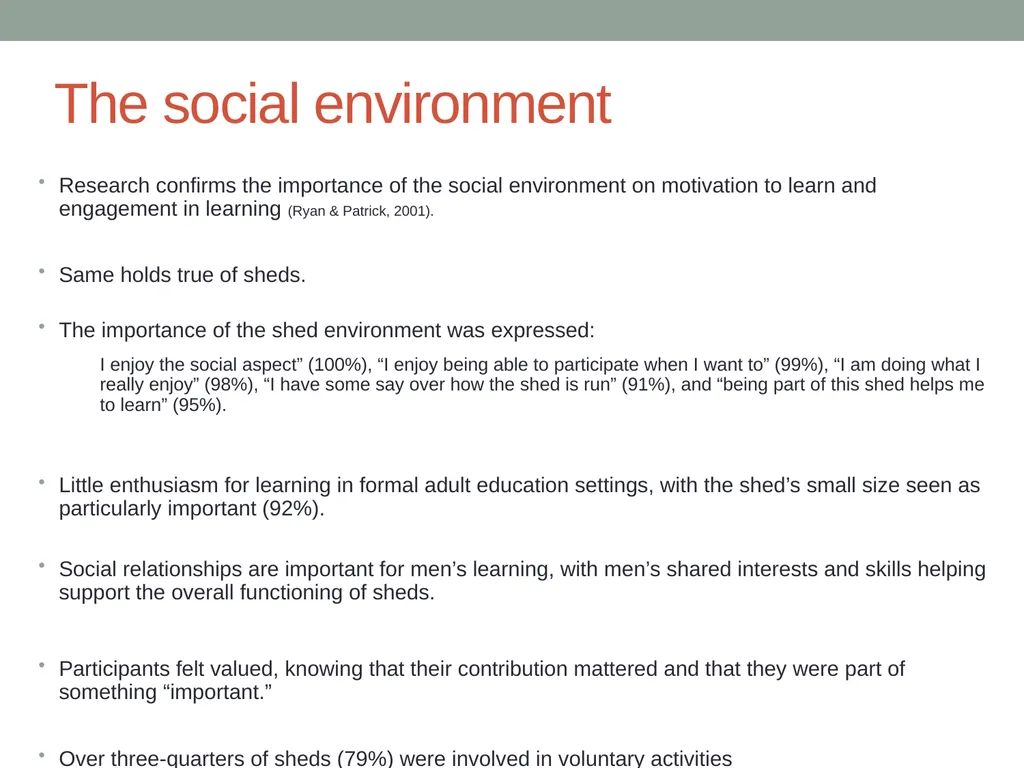
The social environment Research confirms the importance of the social environment on motivation to learn and engagement in learning (Ryan & Patrick, 2001).
Same holds true of sheds.
The importance of the shed environment was expressed:
I enjoy the social aspect” (100%), “I enjoy being able to participate when I want to” (99%), “I am doing what I really enjoy” (98%), “I have some say over how the shed is run” (91%), and “being part of this shed helps me to learn” (95%).
Little enthusiasm for learning in formal adult education settings, with the shed’s small size seen as particularly important (92%).
Social relationships are important for men’s learning, with men’s shared interests and skills helping support the overall functioning of sheds.
Participants felt valued, knowing that their contribution mattered and that they were part of something “important.”
Over three-quarters of sheds (79%) were involved in voluntary activities<br>
15
The social environment 83% said the shed was an important source of men’s health information. Important finding given historical difficulties of getting older men to engage with health information to encourage behaviour changes.
91% said there well-being had improved.
Nearly ¾ felt happier at home, suggesting sheds are more than short time mood enhancer
Shed environment facilitates men to open up and talk about health.
“you’ll get a man who’ll say I’m taking a tablet, and you say I’m taking the same. And he’ll say what are you taking it for. Once one starts....” [it paves the way for sensitive conversations].
This is really important because many of these men would not otherwise have talked to anyone about these issues.<br>
16
Motivation and persistence in learning Few participants reported having a positive experience at school
But most (75%) were engaged in learning activities in sheds and eager to access “more learning in sheds” (97%)
Significant finding given what we know about the entrenched attitudes of older men towards learning.
Motivated by opportunity to take part in meaningful activities to “improve skills” (94%) and to peer support.
Expressed as a need “to get out of the house” (95%), “to be with other men” (95%), and a preference for “hands-on learning” (71%) as opposed to “learning in classroom situations” (29%).
The importance of peer relationships and men’s sensitivity:
“I got diagnosed with a health condition . . . so I told them [the men] individually and I found people very helpful and without being intrusive they look out for me, but at the same time they don’t go overboard or aren’t overbearing. I found it easy to tell them, but I found it hard to reach the stage where I could tell them and I hope I didn’t over-tell it.”<br>
17
Noncognitive attributes and learning Noncognitive attributes – attitudes, behaviours, and learning strategies – are important for learning outcomes (Gutman & Schoon, 2013; Heckman & Rubinstein, 2001).
Students who are motivated have positive beliefs in their capabilities and feel a sense of belonging to their class or other desired social group (Ryan & Patrick, 2001).
More likely to be high achievers (McCoach & Siegle, 2001; Pintrich, 2003).
Similarly, older learners must be motivated to participate in learning, and maintain motivation over time to persist until activity is completed (McGivney, 2004b).
As this study demonstrates, for this to happen, learning activities must be meaningful.<br>
18
Summary Men’s sheds predominately used by older men who are recently retired or have lost their jobs.
They come to sheds to get out of the house, doing meaningful voluntary work in the company of other men.
Within sheds, they readily engage in a wide range of hands-on learning activities and are eager to carry on learning.
Previous hard-to-reach to engage in learning, so what is different about men’s sheds?
Male learning space important. No sheds had women members!<br>
19
Summary Older men have limited experiences of socializing in community groups, not surprising they are more comfortable with people of similar age and gender.
Gender-matched peer groups allows for easier bonding and peer social networks – can help older men with the difficult life events e.g. transition from paid work to retirement.
Older men’s lives and experiences post-work largely ignored in the literature
Much attention given to young men and negative working-class masculinity - discourses focus on male pathologies and conceptualize men as not interested in their health.
Men’s sheds have important implications for our understanding of masculinity in later life.
Within sheds, men are accessing health information.
Have important personal conversations.
Men’s sensitivity is revealed as they actively engage in constructing masculine behaviours and identities for later life.<br>
20
Concluding remarks Transition and change are an inevitable part of human lives
Older men adhere to traditional notions of gender that emphasize independence and self-reliance.
Construct meaning and identity around paid work.
Transition to retirement can have a negative impact on well-being.
Social determinants of health extend beyond material conditions (Wilkinson & Marmot, 2003).
To enjoy good health, older men need friends, they need to feel useful, and they need to exercise a degree of control over meaningful work.
Without these, they are more prone to depression, anxiety, and a sense of hopelessness (Wilkinson & Marmot, 2003).
Men’s sheds are conductive to men’s learning, they can also provide the context for future targeted interventions to improve their quality of life.<br>
21
References Newman A.B, and Brach J.S. (2001). Gender gap in longevity and disability in older persons. Epidemiol Rev 2001;23:343-50.
Carragher, L & Golding, Barry (2015). Older Men as Learners: Irish Men’s Sheds as an Intervention Adult Education Quarterly 1–17. doi: 10.1177/0741713615570894.
Carragher, L (2013). Men’s sheds in Ireland, learning through community contexts. Irish Men’s Sheds Association.
Carragher, L., Evoy, J., & Mark, R. (2014). Men’s learning in Ireland. In B. Golding, R. Mark, & A. Foley (Eds.), Men learning through life (pp. 148-163). Leicester, England: National Institute of Adult Continuing Education.
Central Statistics Office (2015). Measuring Ireland’s Progress 2013 [online] http://www.cso.ie/en/newsandevents/pressreleases/2015pressreleases/pressreleasemeasuringirelandsprogress2013/ [accessed 10 Feb 2016).
Cordier, L., Wilson, N.J (2013). Community-based Men's Sheds: promoting male health, wellbeing and social inclusion in an international contextHealth Promot. Int. (2013) doi: 10.1093/heapro/dat033
Department of Social Protection (2015) Centenarians in Ireland [online] pophttp://www.irishtimes.com/news/ireland/irish-news/location-location-longevity-ireland-s-centenarians-mapped-1.2098762 [accessed 1 March 2016].
Golding, B., Brown, M., Foley, A., & Harvey, J. (2009). Men’s learning and wellbeing through community organisations in Western Australia. Report to Western Australia Department of Education and Training. Ballarat: University of Ballarat.
Irish Men’s Sheds Association. (2013). Moving forward, shoulder to shoulder. Strategic plan 2013–2016. Retrieved from http://menssheds.ie/wp-content/uploads/2014/01/IMSA-Strategic-Plan-2013-16.pdf
Ryan, A. M., & Patrick, H. (2001). The classroom social environment and changes in adolescents’ motivation and engagement during middle school. Journal of American Educational Research, 38, 437-460.
UCL Institute of Health Equity (2013). Review of social determinants and the health divide in the WHO European Region: final report. Copenhagen: World Health Organization, Regional Office for Europe; 2013.
Walsh, K., O’Shea, E., & Scharf, T. (2012). Social exclusion and ageing in diverse rural communities: Findings of a crossborder study in Ireland and Northern Ireland. Galway, Ireland: Irish Centre for Social Gerontology.<br>
22
Thank You National report available:
Men’s sheds in Ireland: Learning through community context (2013)
Email:
Lucia.Carragher@netwellcentre.org<br>
Men’s sheds in Ireland: Learning through community context (2013)
Email:
Lucia.Carragher@netwellcentre.org<br>