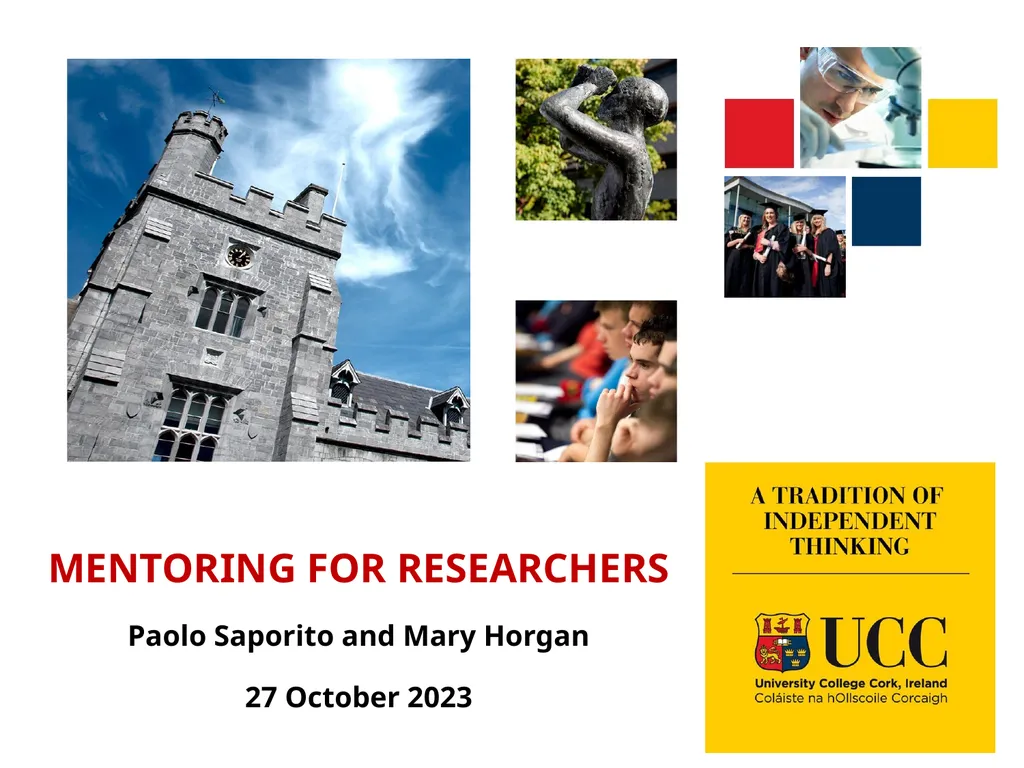
MENTORING FOR RESEARCHERS Paolo Saporito and Mary

Published  . 0 views
↓ Download
MENTORING FOR RESEARCHERS Paolo Saporito and Mary
1 / 1
MENTORING FOR RESEARCHERS Paolo Saporito and Mary - slide 1 of 27 MENTORING FOR RESEARCHERS Paolo Saporito and Mary - slide 2 of 27 MENTORING FOR RESEARCHERS Paolo Saporito and Mary - slide 3 of 27 MENTORING FOR RESEARCHERS Paolo Saporito and Mary - slide 4 of 27 MENTORING FOR RESEARCHERS Paolo Saporito and Mary - slide 5 of 27 MENTORING FOR RESEARCHERS Paolo Saporito and Mary - slide 6 of 27 MENTORING FOR RESEARCHERS Paolo Saporito and Mary - slide 7 of 27 MENTORING FOR RESEARCHERS Paolo Saporito and Mary - slide 8 of 27 MENTORING FOR RESEARCHERS Paolo Saporito and Mary - slide 9 of 27 MENTORING FOR RESEARCHERS Paolo Saporito and Mary - slide 10 of 27 MENTORING FOR RESEARCHERS Paolo Saporito and Mary - slide 11 of 27 MENTORING FOR RESEARCHERS Paolo Saporito and Mary - slide 12 of 27 MENTORING FOR RESEARCHERS Paolo Saporito and Mary - slide 13 of 27 MENTORING FOR RESEARCHERS Paolo Saporito and Mary - slide 14 of 27 MENTORING FOR RESEARCHERS Paolo Saporito and Mary - slide 15 of 27 MENTORING FOR RESEARCHERS Paolo Saporito and Mary - slide 16 of 27 MENTORING FOR RESEARCHERS Paolo Saporito and Mary - slide 17 of 27 MENTORING FOR RESEARCHERS Paolo Saporito and Mary - slide 18 of 27 MENTORING FOR RESEARCHERS Paolo Saporito and Mary - slide 19 of 27 MENTORING FOR RESEARCHERS Paolo Saporito and Mary - slide 20 of 27 MENTORING FOR RESEARCHERS Paolo Saporito and Mary - slide 21 of 27 MENTORING FOR RESEARCHERS Paolo Saporito and Mary - slide 22 of 27 MENTORING FOR RESEARCHERS Paolo Saporito and Mary - slide 23 of 27 MENTORING FOR RESEARCHERS Paolo Saporito and Mary - slide 24 of 27 MENTORING FOR RESEARCHERS Paolo Saporito and Mary - slide 25 of 27 MENTORING FOR RESEARCHERS Paolo Saporito and Mary - slide 26 of 27 MENTORING FOR RESEARCHERS Paolo Saporito and Mary - slide 27 of 27
Description: MENTORING FOR RESEARCHERS Paolo Saporito and Mary Horgan 27 October 2023 Lets get the most out of this morning Email: Switch it off be present Microphone: When not speaking, please keep it on mute Camera: If possible, please do have your

Related Topics

Download Presentation

"MENTORING FOR RESEARCHERS Paolo Saporito and Mary" is the property of its rightful owner. Permission is granted to download and print the materials on this website for personal, non-commercial use only, and to display it on your personal computer provided you do not modify the materials and that you retain all copyright notices contained in the materials. By downloading content from our website, you accept the terms of this agreement.

Presentation Transcript

slide1. MENTORING FOR RESEARCHERS Paolo Saporito and Mary Horgan 27 October 2023<br>
slide2. Let’s get the most out of this morning Email: Switch it off & be present

Microphone: When not speaking, please keep it on mute

Camera:  If possible, please do have your camera on

Participate:  Just use the ‘raise hand’ function if you have a question or wish to comment & click to take it down afterwards.  The more interactive, the better!

Confidentiality: Everything we discuss is confidential<br>
slide3. Briefing Objectives Clarify what mentoring is & is not
Examine purpose & benefits of mentoring
Review roles of mentee & mentor
Confidentiality
Understand Mentoring Schemes in UCC

Examine how working with a mentor can support you to navigate and advance your research career
Consider your personal objectives for mentoring, and the type of mentor you want to work with
Describe the characteristics of an effective mentor, and good mentoring practice<br>
slide4. What does mentoring mean to you? Structured process where experienced individual (mentor) helps another person (mentee) to develop his/her goals & skills through time limited, confidential one to one conversations

Supportive relationship - role of the mentor to help, advise & provide information & guidance to mentee.

May work in similar areas or share similar experiences
Relationship based upon mutual trust & respect
No line management relationship between mentee & mentor<br>
slide5. Principles Mentee led

Goal oriented (concrete goals)

Environment of openness, trust & mutual support

Both parties respectful of each other’s time, experience & difference

Partnership approach

No hidden agendas & non judgemental

Confidential process<br>
slide6. Mentoring vs. Training<br>
slide7. Mentoring Is Not About.. Taking on mentees problems or work

Dealing with personal issues or performance

Giving answers or solutions<br>
slide8. ‘Expectations’ Mentors:
‘Expectations of your mentee’

Mentees:
‘Expectations of your mentor’<br>
slide9. Role of Mentee Actively engage with mentoring process & appointed mentor

Drive the process - take responsibility for managing mentoring relationship including meeting commitments, arranging meetings etc.

Set clear objectives and goals & realistic expectations around delivering on development needs

Communicate directly, honestly & openly, be curious, pose questions, share ideas

Be willing to listen & take on board constructive feedback & advice

Retain responsibility for own learning<br>
slide10. Role of Mentor Provide guidance & support in addressing identified development needs

Act as sounding board, providing encouragement & source of knowledge, stimulating insight

Create new perspectives & different ways of thinking

A figure with whom mentees can discuss their aspirations and concerns; who will listen; provide constructive feedback, challenge as appropriate

See positives in mentee that they may be unaware of

Support & encourage mentee to take positive action

Help mentee to understand how things operate in UCC including the unspoken norms & values

Introduce mentee to peers & colleagues as relevant to assist them become familiar with & integrate into the wider University

Mentor has no responsibility for actions & decisions of mentee<br>
slide11. What does confidentiality mean to you and your mentor/mentee?

In what circumstances would confidentiality need to be broken and how would this happen? Confidentiality<br>
slide12. 1st Meeting - Some suggestions ‘Coffee & Chemistry’ & then…..

Getting to know each other

Discuss & clarify expectations & goals

Boundaries – what is in & out

Confidentiality

In between contact?

Post meeting follow up?

Mentee led process<br>
slide13. What is ‘New Appointee Mentoring’ in UCC? Selection Committee assigns all new appointees in UCC a mentor

For academic appointees - mentoring process included as part of formal Probationary & Establishment procedures

Match based on (amongst other things)
experience
personal styles
mentee development needs identified at interview

Informal & supportive relationship between experienced staff member & new colleague

Assist mentee become comfortable in new role & provide guidance & support

Mentor will not be mentee’s line manager<br>
slide14. Mentoring Schemes in UCC (Formal mentoring) All similar principles & goals

Career Development Mentoring
Mentoring For Women
Mentoring For Newly Appointed Staff
Aurora Mentoring Scheme
Mentoring & Researchers

Match based on (amongst other things) 
- mentee needs / goals
- experience of mentee & mentor
- personal styles<br>
slide15. Mentoring and Research Mentoring conversations are not limited to a mentoring programme and can take place with a range of supporting players, and in a range of different ways

Everybody needs a Mentor…but its horses for courses (= what is suitable for one person or situation might be unsuitable for another)<br>
slide16. Mentoring and Research Informal mentoring PI or Supervisor (back in a minute)

Peer networks and communities
- Insights into research careers
- Updates on discipline developments in institutions relevant to your research area
- Support, critical feedback
- Also available through professional bodies and societies

“Institutional” mentor
- Norms or working cultures within your department/school/college/university
- Awareness of key contacts (i.e. HR, Finance, Research Office)
- Usually pairing managed by institution
- Confidential space if outside of own department<br>
slide17. Mentoring and Research Informal mentoring Research Career Development Professionals (i.e. HR Research, Careers Services)
- Support in career and skill development
- Directions to relevant training (including FORMAL mentoring programmes)
- Knowledge of your rights, roles and responsibilities as a researcher (employment/contract side)

Research Officers
- Guidance and feedback on funding strategies
- Knowledge of your rights, roles and responsibilities as a researcher (research side)
- Fit/eligibility for funding calls<br>
slide18. Mentoring and Research Informal mentoring Sponsors
- Specific role in career development  career advocate acting on your behalf
- Use their reputation to help you
- Give you access to opportunities and resources<br>
slide19. Mentoring and Research Informal mentoring Sponsors (examples)
- Link to research fellowships (i.e. John Smith Foundation, charitable organisations)
- Talent Development Programmes
- Prestigious PI in your field<br>
slide20. Mentoring and Research Career Gains Increased confidence and self-awareness
Knowledge of role responsibilities and future career options
Setting goals
Contacts with networks
Organisational tools and techniques
Publication plans
Work/life balance strategies
Improved workplace relationships<br>
slide21. Mentoring and Supervision The Supervisor/PI as an informal mentor

Pros:
Professional advice
Access to career opportunities (i.e. funding)
Advice on skill and idea development

Cons:
Hierarchical relationship (i.e. line manager)
Stakeholder in your research progress and success = guidance influenced by their interest<br>
slide22. Mentoring and Supervision Supervising and mentoring are two different practices.

Supervision (or line management)
It is a legal requirement
It involves directing actions and overseeing tasks
Setting KPIs, assessing, evaluating
Goal: accomplish organizational or educational objectives
Outcomes are required, not necessarily desired

Mentoring
It is a voluntary, mentee-led initiative
No assessment or evaluation, only constructive feedback
Goal: discuss objectives set by the mentee
Outcomes are desired and willingly pursued, not required<br>
slide23. Mentoring and Supervision Vitae Researcher Development Framework<br>
slide24. Mentoring and Supervision Vitae Researcher Development Framework Phase 2<br>
slide25. Mentoring and Supervision Vitae Researcher Development Framework Phase 3, 4 and 5<br>
slide26. Questions and Answers<br>