
Meristmatic and permanent tissue Contains . Root
LV
Published · 10 slides · 0 views

1 / 1


Description
Meristmatic and permanent tissue Contains . Root and shoot apical meristems . Simple tissue Permanent tissue. . Plant Tissues Plants are stationary or fixed they dont move. Most of the tissues they have are supportive, which provides
Related Topics
Share
Embed code
Download this presentation From Below
"Meristmatic and permanent tissue Contains . Root" is the property of its rightful owner. Permission is granted to download and print the materials on this website for personal, non-commercial use only, and to display it on your personal computer provided you do not modify the materials and that you retain all copyright notices contained in the materials. By downloading content from our website, you accept the terms of this agreement.
Presentation Transcript
01
Meristmatic and
permanent tissue Contains .
Root and shoot apical meristems .
Simple tissue
Permanent tissue.
.<br>
Root and shoot apical meristems .
Simple tissue
Permanent tissue.
.<br>
02
Plant Tissues Plants are stationary or fixed – they don’t move. Most of the tissues they have are supportive, which provides them with structural strength.
Most of the plant tissues are dead, since dead cells can provide mechanical strength as easily as live ones, and need less maintenance.
Animals on the other hand move around in search of food, mates and shelter. They consume more energy as compared to plants. Most of the tissues they contain are living.
Another difference between animals and plants is in the pattern of growth.
The growth in plants is limited to certain regions, while this is not so in animals.
There are some tissues in plants that divide throughout their life. These
tissues are localised in certain regions.
Based on the dividing capacity of the tissues, various plant tissues can be classified as growing or meristematic tissue and permanent tissue.
Cell growth in animals is more uniform. So, there is no such demarcation
of dividing and non-dividing regions in animals.
The structural organisation of organs and organ systems is far more specialised and localised in complex animals than even in very complex plants. This fundamental difference reflects the different modes of life pursued by these two major groups of organisms, particularly in their different feeding methods.
Also, they are differently adapted for a sedentary existence on one hand (plants) and active locomotion on the other (animals), contributing to this difference in organ system design. Meristematic Tissue The growth of plants occurs only in certain specific regions. This is because the dividing tissue, also known as meristematic tissue, is located only at these points.
Depending on the region where they are present, meristematic tissues are classified as apical, lateral and intercalary.
New cells produced by meristem are initially like those of meristem itself,
but as they grow and mature, their characteristics slowly change and they become differentiated as components of other tissues.<br>
Most of the plant tissues are dead, since dead cells can provide mechanical strength as easily as live ones, and need less maintenance.
Animals on the other hand move around in search of food, mates and shelter. They consume more energy as compared to plants. Most of the tissues they contain are living.
Another difference between animals and plants is in the pattern of growth.
The growth in plants is limited to certain regions, while this is not so in animals.
There are some tissues in plants that divide throughout their life. These
tissues are localised in certain regions.
Based on the dividing capacity of the tissues, various plant tissues can be classified as growing or meristematic tissue and permanent tissue.
Cell growth in animals is more uniform. So, there is no such demarcation
of dividing and non-dividing regions in animals.
The structural organisation of organs and organ systems is far more specialised and localised in complex animals than even in very complex plants. This fundamental difference reflects the different modes of life pursued by these two major groups of organisms, particularly in their different feeding methods.
Also, they are differently adapted for a sedentary existence on one hand (plants) and active locomotion on the other (animals), contributing to this difference in organ system design. Meristematic Tissue The growth of plants occurs only in certain specific regions. This is because the dividing tissue, also known as meristematic tissue, is located only at these points.
Depending on the region where they are present, meristematic tissues are classified as apical, lateral and intercalary.
New cells produced by meristem are initially like those of meristem itself,
but as they grow and mature, their characteristics slowly change and they become differentiated as components of other tissues.<br>
03
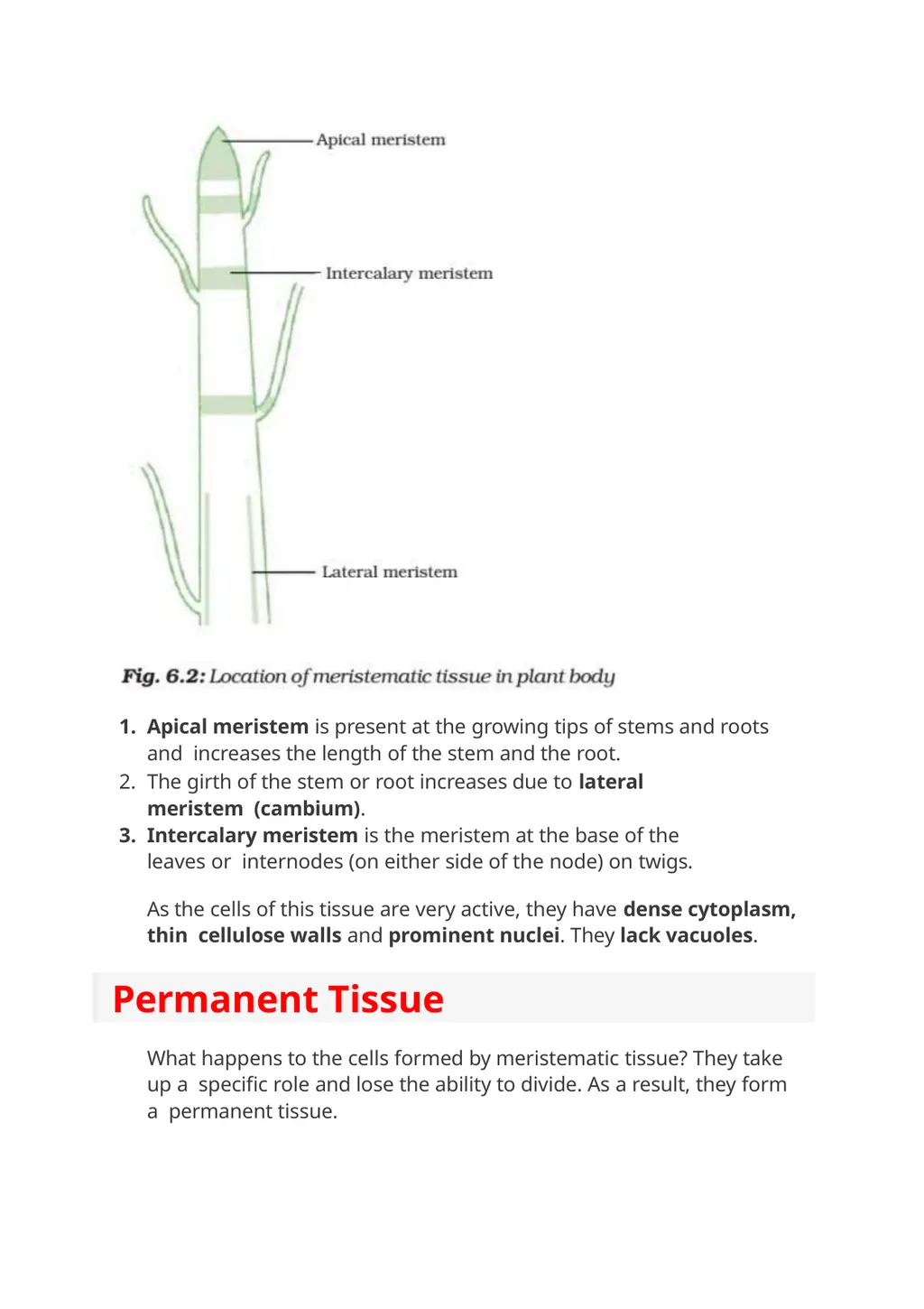
Apical meristem is present at the growing tips of stems and roots and increases the length of the stem and the root.
The girth of the stem or root increases due to lateral meristem (cambium).
Intercalary meristem is the meristem at the base of the leaves or internodes (on either side of the node) on twigs.
As the cells of this tissue are very active, they have dense cytoplasm, thin cellulose walls and prominent nuclei. They lack vacuoles. Permanent Tissue What happens to the cells formed by meristematic tissue? They take up a specific role and lose the ability to divide. As a result, they form a permanent tissue.<br>
The girth of the stem or root increases due to lateral meristem (cambium).
Intercalary meristem is the meristem at the base of the leaves or internodes (on either side of the node) on twigs.
As the cells of this tissue are very active, they have dense cytoplasm, thin cellulose walls and prominent nuclei. They lack vacuoles. Permanent Tissue What happens to the cells formed by meristematic tissue? They take up a specific role and lose the ability to divide. As a result, they form a permanent tissue.<br>
04
This process of taking up a permanent shape, size, and a function is called differentiation. Cells of meristematic tissue differentiate to form different types of permanent tissue.
Simple Permanent Tissue Parenchyma<br>
Simple Permanent Tissue Parenchyma<br>
05
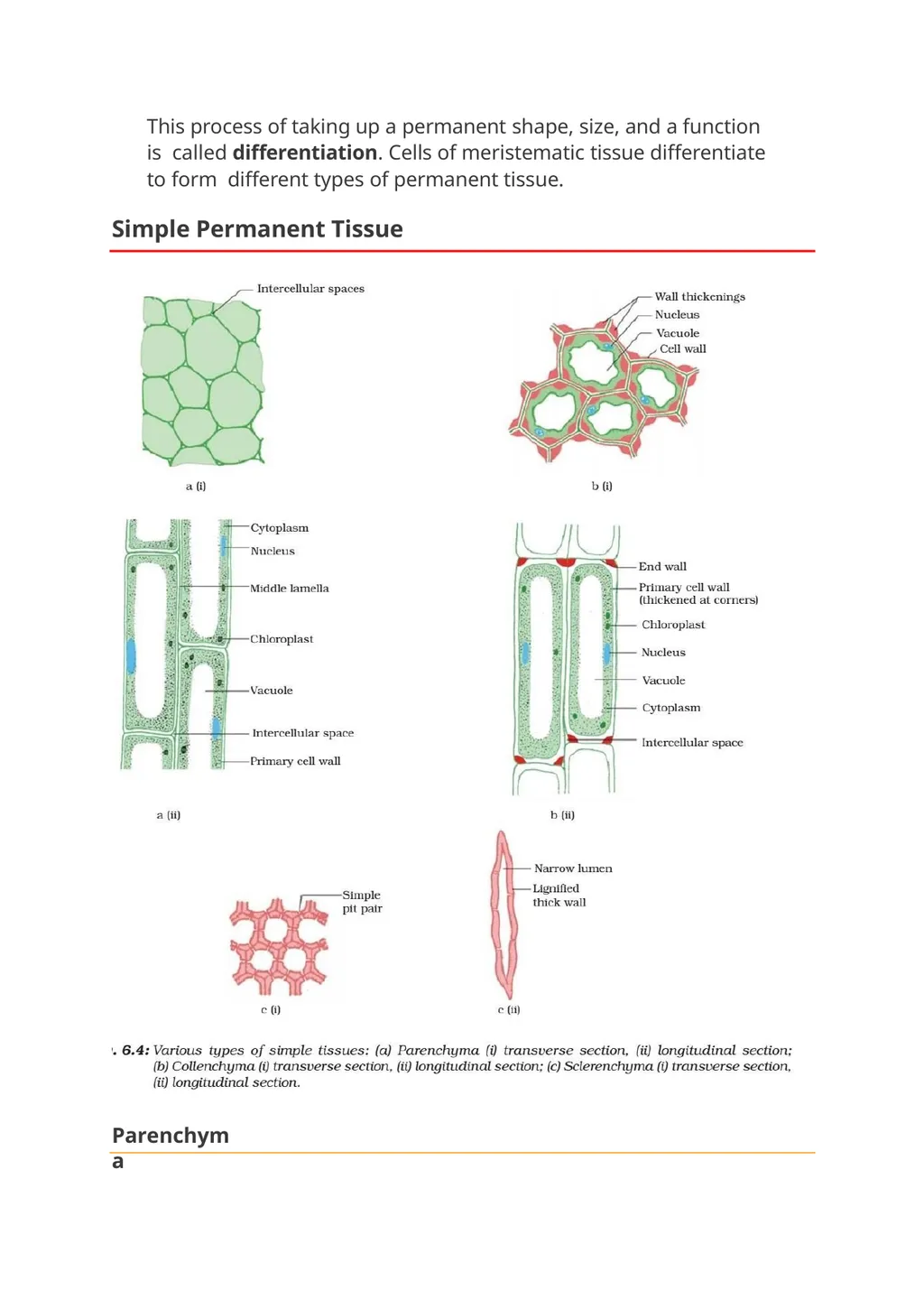
A few layers of cells form the basic packing tissue. This tissue is parenchyma, a type of permanent tissue. It consists of
relatively unspecialised cells with thin cell walls.
They are live cells. They are usually loosely packed, so that large spaces between cells (intercellular spaces) are found in this tissue.
Chlorenchyma
This tissue provides support to plants and also stores food. In some situations, it contains chlorophyll and performs photosynthesis, and then it is called chlorenchyma.
Aerenchyma
In aquatic plants, large air cavities are present in parenchyma to
give buoyancy to the plants to help them float. Such a parenchyma type is called aerenchyma. The parenchyma of stems and roots also stores nutrients and water.
Collenchyma
The flexibility in plants is due to another permanent tissue, collenchyma. It allows easy bending in various parts of a plant (leaf, stem) without breaking. It also provides mechanical support to plants. We can find this tissue in leaf stalks below the epidermis. The cells of this tissue are living, elongated and irregularly thickened at the corners. There is very little intercellular space.
Sclerenchyma
Yet another type of permanent tissue is sclerenchyma. It is the tissue which makes the plant hard and stiff. We have seen the husk of a coconut. It is made of sclerenchymatous tissue. The cells of this tissue are dead. They are long and narrow as the walls are thickened due to lignin (a chemical substance which acts as cement and hardens them). Often these walls are so thick that there is no internal space inside the cell. This tissue is present in stems, around vascular bundles, in the veins of leaves and in the hard covering of seeds and nuts. It provides strength to the plant parts.
Epidermis<br>
relatively unspecialised cells with thin cell walls.
They are live cells. They are usually loosely packed, so that large spaces between cells (intercellular spaces) are found in this tissue.
Chlorenchyma
This tissue provides support to plants and also stores food. In some situations, it contains chlorophyll and performs photosynthesis, and then it is called chlorenchyma.
Aerenchyma
In aquatic plants, large air cavities are present in parenchyma to
give buoyancy to the plants to help them float. Such a parenchyma type is called aerenchyma. The parenchyma of stems and roots also stores nutrients and water.
Collenchyma
The flexibility in plants is due to another permanent tissue, collenchyma. It allows easy bending in various parts of a plant (leaf, stem) without breaking. It also provides mechanical support to plants. We can find this tissue in leaf stalks below the epidermis. The cells of this tissue are living, elongated and irregularly thickened at the corners. There is very little intercellular space.
Sclerenchyma
Yet another type of permanent tissue is sclerenchyma. It is the tissue which makes the plant hard and stiff. We have seen the husk of a coconut. It is made of sclerenchymatous tissue. The cells of this tissue are dead. They are long and narrow as the walls are thickened due to lignin (a chemical substance which acts as cement and hardens them). Often these walls are so thick that there is no internal space inside the cell. This tissue is present in stems, around vascular bundles, in the veins of leaves and in the hard covering of seeds and nuts. It provides strength to the plant parts.
Epidermis<br>
06
What you observe is the outermost layer of cells, called epidermis. The epidermis is usually made of a single layer of cells.
In some plants living in very dry habitats, the Epidermis may be thicker since protection against water loss is critical.
The entire surface of a plant has this outer covering of epidermis. It
protects all the parts of the plant.
Epidermal cells on the aerial parts of the plant often secrete a waxy, water-
resistant layer on their outer surface. This aids in protection against loss of water, mechanical injury and invasion by parasitic fungi.
Since it has a protective role to play, cells of epidermal tissue form a continuous layer without intercellular spaces.
Most epidermal cells are relatively flat. Often their outer and side walls are
thicker than the inner wall.
Small pores in the epidermis of the leaf are called stomata. Stomata are enclosed by two kidney-shaped cells called guard cells. They are necessary for exchanging gases with the atmosphere.
Transpiration (loss of water in the form of water vapour) also takes place through stomata
Epidermal cells of the roots, whose function is water absorption,
commonly bear long hair-like parts that greatly increase the total absorptive surface area.
In some plants like desert plants, epidermis has a thick waxy coating
of cutin (chemical substance with waterproof quality) on its outer surface.
As plants grow older, the outer protective tissue undergoes certain changes. A strip of secondary meristem replaces the epidermis of the stem. Cells on the outside are cut off from this layer. This forms the several-layer thick cork or the bark of the tree. Cells of cork are dead and
compactly arranged without intercellular spaces. They also have a chemical called suberin in their walls that makes them impervious to gases and water
Complex Permanent Tissue
The different types of tissues we have discussed until now are all made of one type of cells, which look like each other. Such tissues are called
simple permanent tissue. Yet another type of permanent tissue is complex tissue.
Complex tissues are made of more than one type of cells. All these cells coordinate to perform a common function.<br>
In some plants living in very dry habitats, the Epidermis may be thicker since protection against water loss is critical.
The entire surface of a plant has this outer covering of epidermis. It
protects all the parts of the plant.
Epidermal cells on the aerial parts of the plant often secrete a waxy, water-
resistant layer on their outer surface. This aids in protection against loss of water, mechanical injury and invasion by parasitic fungi.
Since it has a protective role to play, cells of epidermal tissue form a continuous layer without intercellular spaces.
Most epidermal cells are relatively flat. Often their outer and side walls are
thicker than the inner wall.
Small pores in the epidermis of the leaf are called stomata. Stomata are enclosed by two kidney-shaped cells called guard cells. They are necessary for exchanging gases with the atmosphere.
Transpiration (loss of water in the form of water vapour) also takes place through stomata
Epidermal cells of the roots, whose function is water absorption,
commonly bear long hair-like parts that greatly increase the total absorptive surface area.
In some plants like desert plants, epidermis has a thick waxy coating
of cutin (chemical substance with waterproof quality) on its outer surface.
As plants grow older, the outer protective tissue undergoes certain changes. A strip of secondary meristem replaces the epidermis of the stem. Cells on the outside are cut off from this layer. This forms the several-layer thick cork or the bark of the tree. Cells of cork are dead and
compactly arranged without intercellular spaces. They also have a chemical called suberin in their walls that makes them impervious to gases and water
Complex Permanent Tissue
The different types of tissues we have discussed until now are all made of one type of cells, which look like each other. Such tissues are called
simple permanent tissue. Yet another type of permanent tissue is complex tissue.
Complex tissues are made of more than one type of cells. All these cells coordinate to perform a common function.<br>
07
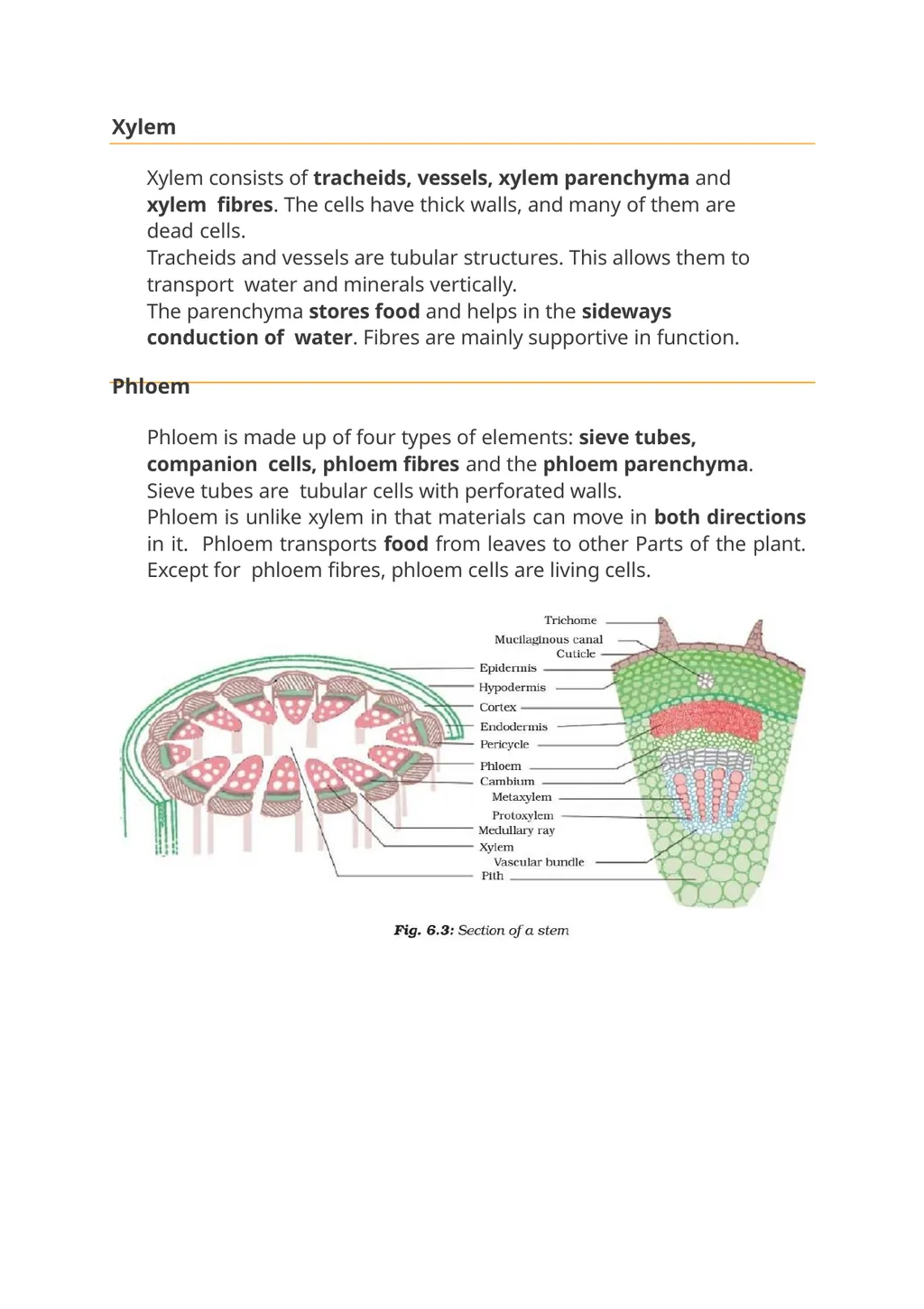
Xylem and phloem are examples of such complex tissues. They are both conducting tissues and constitute a vascular bundle.
Vascular or conductive tissue is a distinctive feature of the complex plants, one that has made possible their survival in the terrestrial environment.<br>
Vascular or conductive tissue is a distinctive feature of the complex plants, one that has made possible their survival in the terrestrial environment.<br>
08
Xylem
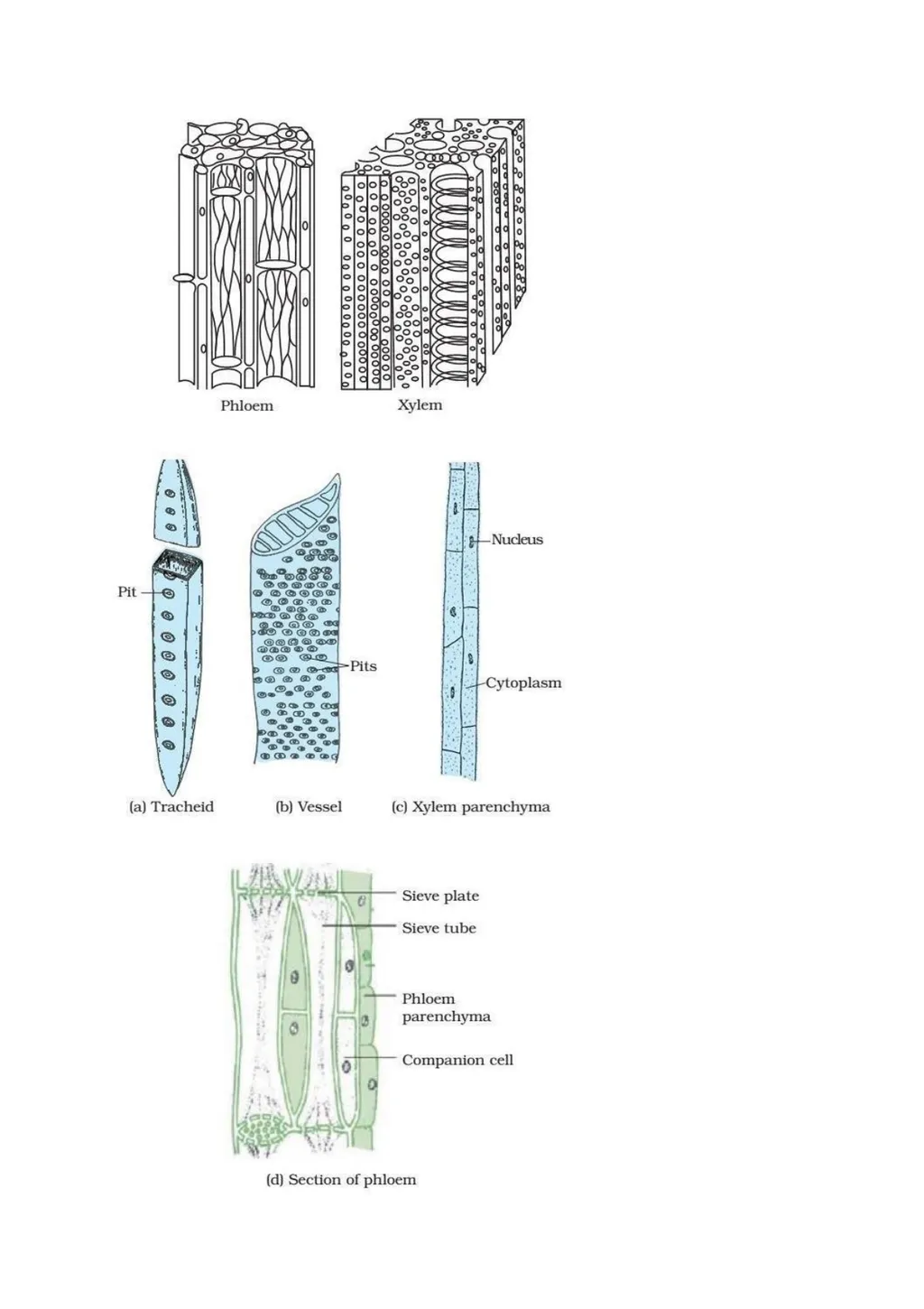
Xylem consists of tracheids, vessels, xylem parenchyma and xylem fibres. The cells have thick walls, and many of them are dead cells.
Tracheids and vessels are tubular structures. This allows them to transport water and minerals vertically.
The parenchyma stores food and helps in the sideways conduction of water. Fibres are mainly supportive in function.
Phloem
Phloem is made up of four types of elements: sieve tubes, companion cells, phloem fibres and the phloem parenchyma. Sieve tubes are tubular cells with perforated walls.
Phloem is unlike xylem in that materials can move in both directions in it. Phloem transports food from leaves to other Parts of the plant. Except for phloem fibres, phloem cells are living cells.<br>
Xylem consists of tracheids, vessels, xylem parenchyma and xylem fibres. The cells have thick walls, and many of them are dead cells.
Tracheids and vessels are tubular structures. This allows them to transport water and minerals vertically.
The parenchyma stores food and helps in the sideways conduction of water. Fibres are mainly supportive in function.
Phloem
Phloem is made up of four types of elements: sieve tubes, companion cells, phloem fibres and the phloem parenchyma. Sieve tubes are tubular cells with perforated walls.
Phloem is unlike xylem in that materials can move in both directions in it. Phloem transports food from leaves to other Parts of the plant. Except for phloem fibres, phloem cells are living cells.<br>
09
Thanks for being patient ….<br>