Merkle Trees A Merkle tree is a binary hash tree. It is named after its inventor Ralph Merkle. Merkle trees are constructed by hashing paired data (usually transactions at the leaf level), then again hashing the hashed outputs all the way
"Merkle Trees A Merkle tree is a binary hash tree." is the property of its rightful owner. Permission is granted to
download and print the materials on this website for personal, non-commercial use only, and to display it
on your personal computer provided you do not modify the materials and that you retain all copyright
notices contained in the materials. By downloading content from our website, you accept the terms of this
agreement.
Presentation Transcript
01
Merkle Trees A Merkle tree is a binary hash tree. It is named after its inventor Ralph Merkle.
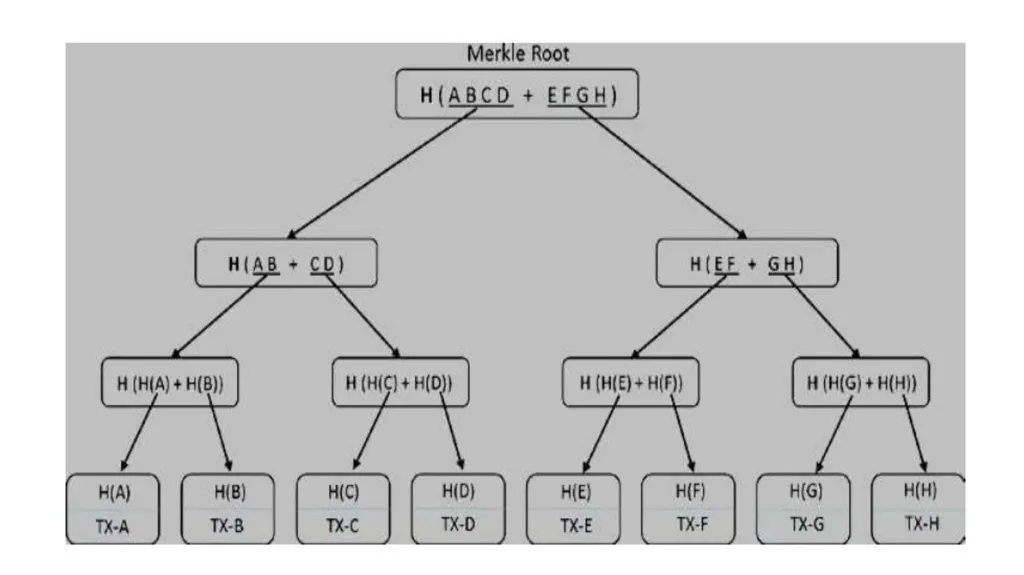
Merkle trees are constructed by hashing paired data (usually transactions at the leaf level), then again hashing the hashed outputs all the way up to the root node, called the Merkle roots.
It is constructed bottom-up.
The Merkle tree is tamper-proof. A slight change in data at any level in the tree, the hash will not mash the hash stored one level up until the root node.
The hashes in the tree change even if the order of the transactions is changed.
Merkle is a binary tree so if the number of transactions in a block is odd then the last transaction is duplicated to make it even.
Merkle trees are used to verify if a specific transaction belongs to a particular block.<br>
02
Distributed Consensus: The biggest challenge in a decentralized system is achieving consensus about which node will propose the new block.
The best strategy is that only one node should propose a block at a time and the rest of the nodes should validate the transactions in the block and add to their blockchains if transactions are valid.
If any one node proposes a block and the rest of the nodes agree on it, then all those nodes add that block to their respective blockchains.
The agreement about who proposes a block is called consensus.
The system is designed in such a manner that players are rewarded for playing by the rules and penalized for bad behavior. Hence, the reward becomes a reason for everyone playing by the rules.
The goal of consensus is to ensure that the network is robust enough to sustain various types of attacks.<br>
03
LIFE OF BLOCKCHAIN APPLICATIONS: Blockchain can be implemented fully for creating a decentralized system or partially by using blockchain as a backend.
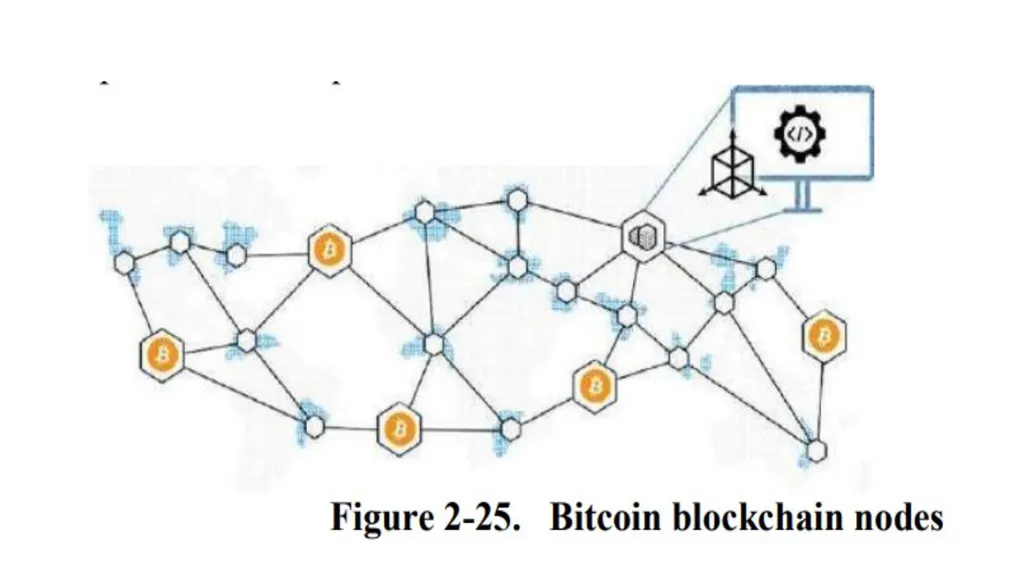
Bitcoin blockchain is an example of a decentralized blockchain application where every transaction is broadcast to the entire network.
A web application is built and hosted in a centralized web server that makes Bitcoin blockchain updates when required.
Every node is self-sufficient and maintains its own copies of the blockchain database.
Blockchain applications with no centralized servers are the purest decentralized applications; they are usually public blockchains.
Public blockchains rarely use the infrastructure from cloud service providers whereas private blockchains use cloud.<br>
04
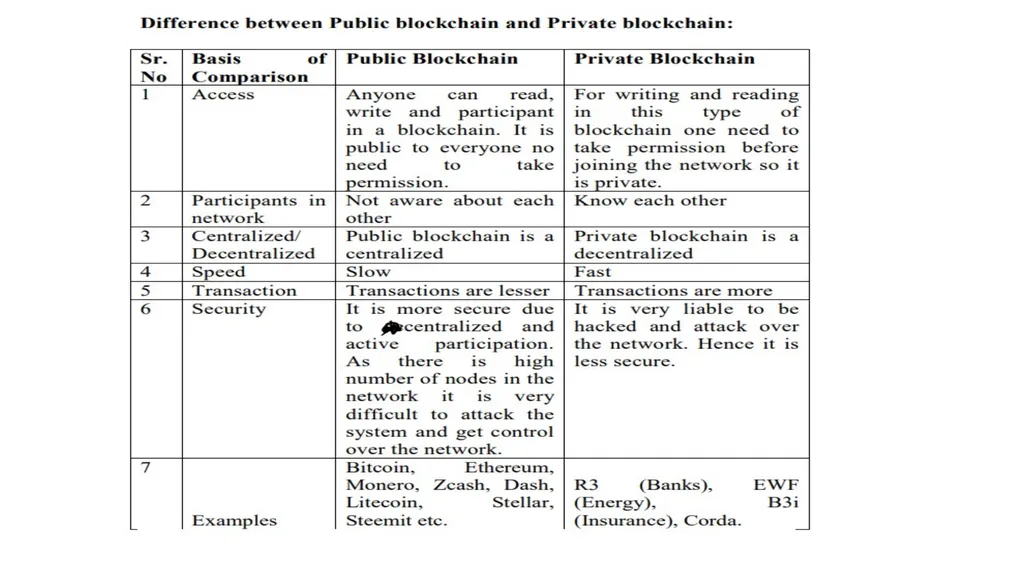
PUBLIC AND PRIVATE BLOCKCHAIN: Public blockchain- is open networks that allow anyone to participate without any prior permission.
In this type of blockchain anyone can join the network and read, write, or participate within the blockchain.
A public blockchain is decentralized and does not have a single entity which controls the network.
Data on a public blockchain are secure as it is not possible to modify or alter data once they have been validated on the blockchain.<br>
05
Some features of public blockchain are: High Security – It is secure due to Mining.
Open Environment – The public blockchain is open for all.
Anonymous Nature – In public blockchain everyone is anonymous. There is no need to use your real name or real identity, therefore everything would stay hidden, and no one can track you based on that.
No Regulations – Public blockchain doesn’t have any regulations that the nodes have to follow. So, there is no limit to how one can use this platform for their betterment
Full Transparency – Public blockchain allow you to see the ledger anytime you want. There is no scope for any corruption or any discrepancies and everyone has to maintain the ledger and participate in consensus.<br>
06
True Decentralization – In this type of blockchain, there isn’t a centralized entity. Thus, the responsibility of maintaining the network is solely on the nodes.
Full User Empowerment – Typically, in any network user has to follow a lot of rules and regulations. In many cases, the rules might not even be a fair one. But not in public blockchain networks. Here, all of the users are empowered as there is no central authority to look over their every move.
Immutable – When something is written to the blockchain, it cannot be changed.
Distributed –The database is not centralized like in a client-server approach, and all nodes in the blockchain participate in the transaction validation.<br>
07
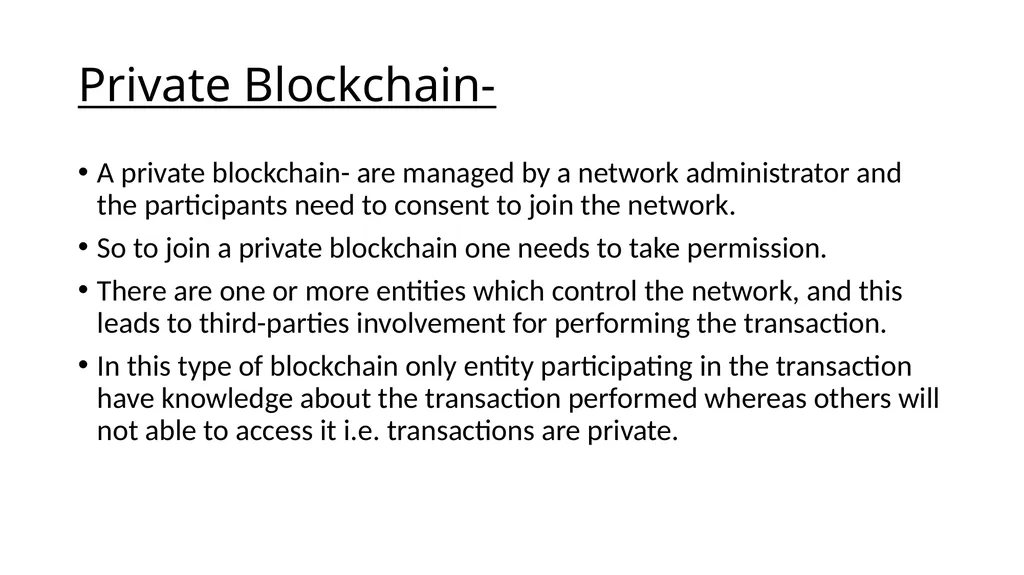
Private Blockchain- A private blockchain- are managed by a network administrator and the participants need to consent to join the network.
So to join a private blockchain one needs to take permission.
There are one or more entities which control the network, and this leads to third-parties involvement for performing the transaction.
In this type of blockchain only entity participating in the transaction have knowledge about the transaction performed whereas others will not able to access it i.e. transactions are private.<br>
08
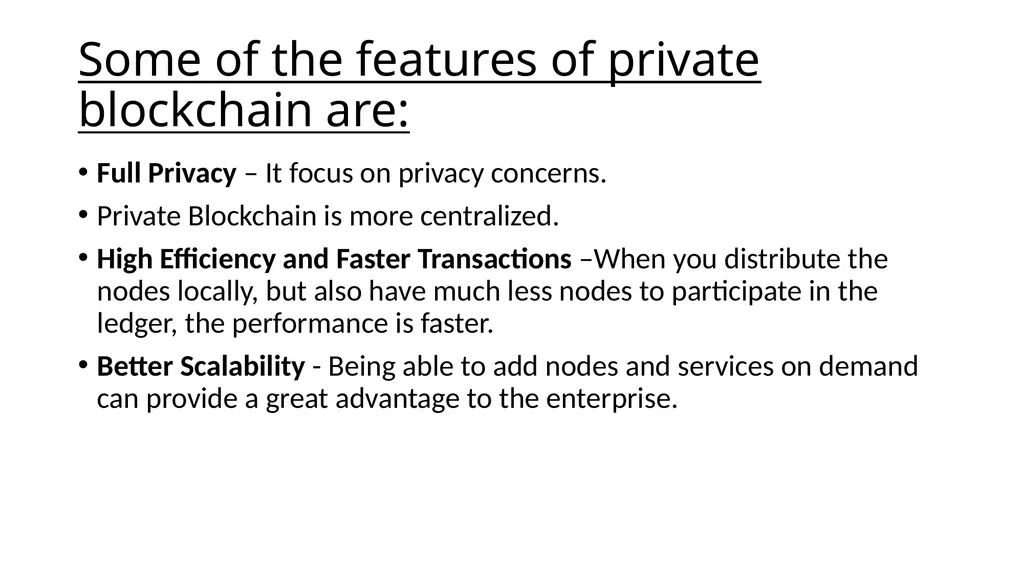
Some of the features of private blockchain are: Full Privacy – It focus on privacy concerns.
Private Blockchain is more centralized.
High Efficiency and Faster Transactions –When you distribute the nodes locally, but also have much less nodes to participate in the ledger, the performance is faster.
Better Scalability - Being able to add nodes and services on demand can provide a great advantage to the enterprise.<br>