01
Method:
You will need:
4 x large plastic plates
1 x packet of skittles
1 x packet of m&m’s
Water at different temperatures
Stopwatch
Thermometer.
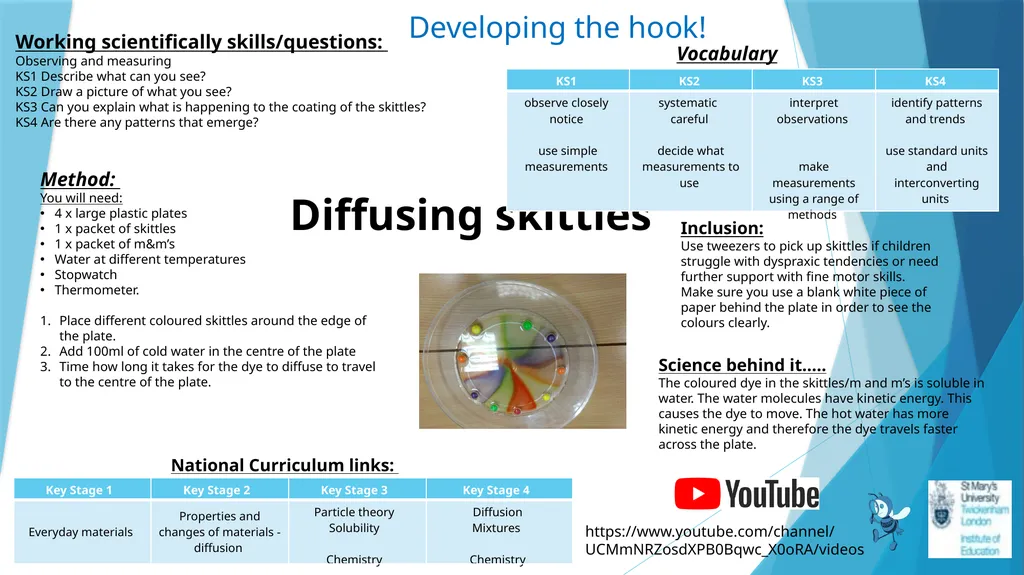
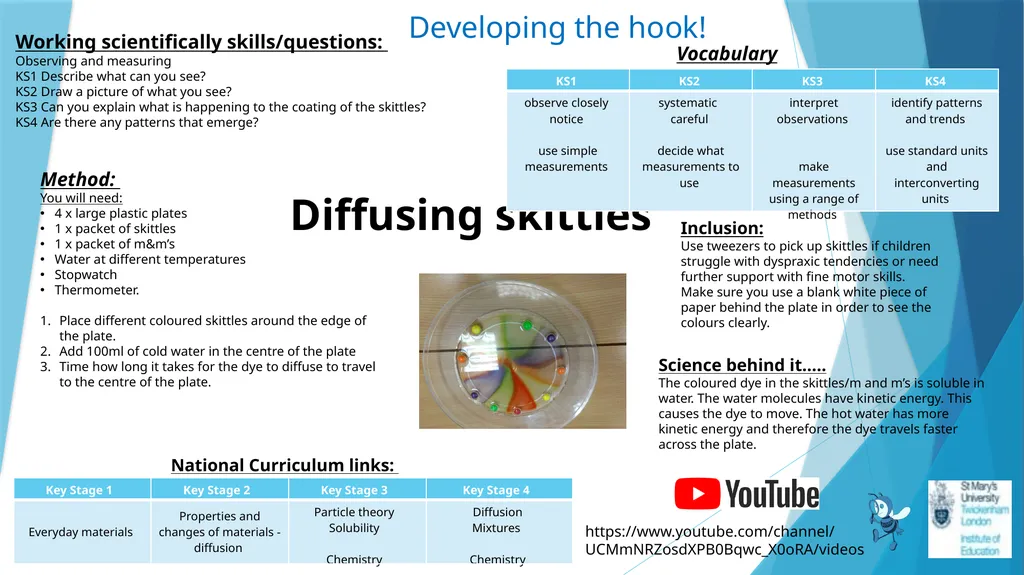
Place different coloured skittles around the edge of the plate.
Add 100ml of cold water in the centre of the plate
Time how long it takes for the dye to diffuse to travel to the centre of the plate. Working scientifically skills/questions:
Observing and measuring
KS1 Describe what can you see?
KS2 Draw a picture of what you see?
KS3 Can you explain what is happening to the coating of the skittles?
KS4 Are there any patterns that emerge? National Curriculum links: Inclusion:
Use tweezers to pick up skittles if children struggle with dyspraxic tendencies or need further support with fine motor skills.
Make sure you use a blank white piece of paper behind the plate in order to see the colours clearly. Vocabulary Diffusing skittles Science behind it.....
The coloured dye in the skittles/m and m’s is soluble in water. The water molecules have kinetic energy. This causes the dye to move. The hot water has more kinetic energy and therefore the dye travels faster across the plate. https://www.youtube.com/channel/UCMmNRZosdXPB0Bqwc_X0oRA/videos Developing the hook! @TeachStMarys
@stmaryssecsci @TeachStMarys
@stmaryssecsci @TeachStMarys
@stmaryssecsci<br>
02
Additional working scientific skills covered Reporting, presenting and communicating data/
findings - Analysing results KS1
Can you tell your partner what you saw? What did you find out?
KS2
Can you capture what happened using a video recorder? What happened and why do you think this?
KS3
Did you gain the same results as your peers? What does this tell you about the reliability of the method?
KS4
Did one colour spread more than the others? Why was this?
Adapted method
None needed Planning and setting up different types of enquiries - Prediction KS1
What do you think will happen if we use warm water?
KS2
What might we change which will affect how fast the dyes spread? Why do you think this?
KS3
How will using coloured skittles impact the speed at which the coloured dye travels?
KS4
M and M's contain less sugar than skittles. How will this affect the rate of diffusion?
Adapted method
Repeat the experiment using skittles in place of m&m's<br>