
Methodologies and approaches useful for Cyber

Description: Methodologies and approaches useful for Cyber Threat Assessment and Cyber DBT along side with classical DBT methodology as stated in NSS-10 Document S.K. Parulkar, India parulkarskgmail.com S K Parulkar THREAT ASSESSMENT DBT 2 The threat
Related Topics
Download Presentation
"Methodologies and approaches useful for Cyber" is the property of its rightful owner. Permission is granted to download and print the materials on this website for personal, non-commercial use only, and to display it on your personal computer provided you do not modify the materials and that you retain all copyright notices contained in the materials. By downloading content from our website, you accept the terms of this agreement.
Presentation Transcript
slide1. Methodologies and approaches useful for Cyber Threat Assessment and Cyber DBT along side with classical DBT methodology as stated in NSS-10 Document
S.K. Parulkar, India
parulkarsk@gmail.com<br>
slide2. S K Parulkar THREAT ASSESSMENT & DBT 2 The threat assessment is a comprehensive compilation of information about all potential adversaries along with their motivation, intentions and capabilities.
To evaluate the DBT the threat assessment document is processed through screening and decision-making. The main purpose of the processing is to make threats in threat assessment document more realistic and credible for nuclear facilities. In other words to find out more likelihood threats for nuclear facilities that can be used for calculating risk and then developing security protection systems for highest security assurance using graded approach.<br>
slide3. S K Parulkar PHYSICAL V/s CYBER THREATS 3 Cyber threats are a global phenomenon not only local.
It is not possible to know all the cyber adversaries, as they are spread all over the globe and hidden in cyber space and not open or known in public as in physical adversaries.
No intelligent agencies can find out all the characteristics of threats, like capabilities and intensions, as they are not open or known.
Cyber adversaries are location independent as they can attack from any where in the globe, which makes the task of intelligent agencies further difficult.
Cyber threats are more technology intensive than physical threats so as the technology advances, cyber threats are also becoming more advance.
Cyber threats are more dynamic as compare to physical threats, which are more constant without much advancement in weapon technologies<br>
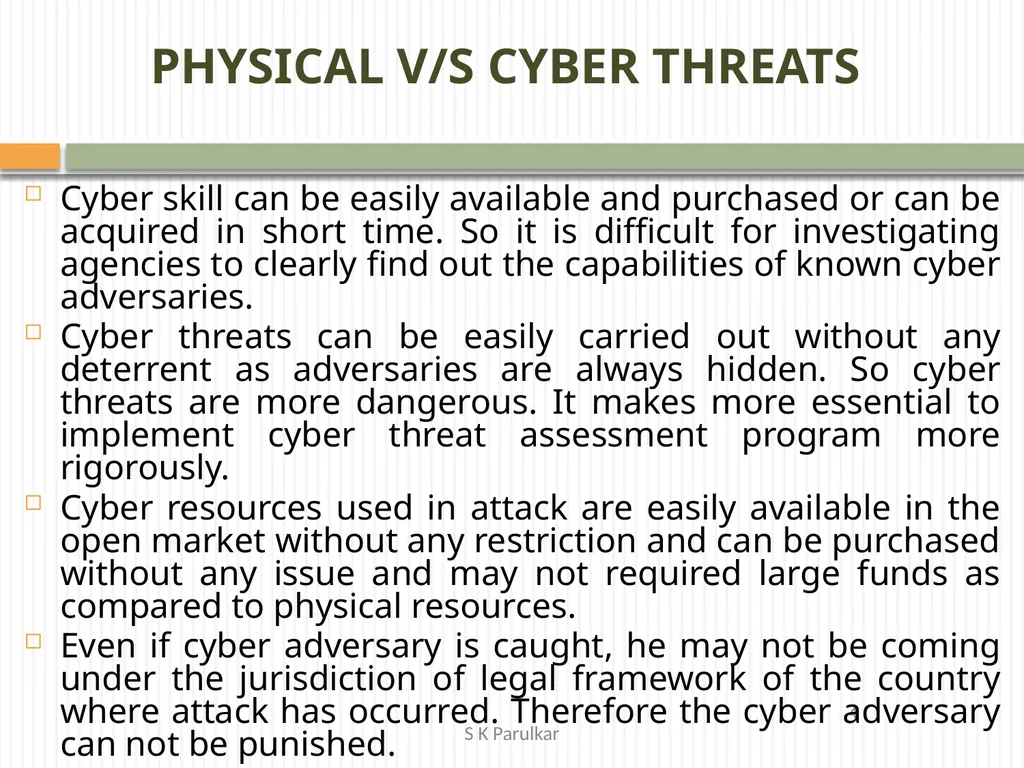
slide4. S K Parulkar 4 Cyber skill can be easily available and purchased or can be acquired in short time. So it is difficult for investigating agencies to clearly find out the capabilities of known cyber adversaries.
Cyber threats can be easily carried out without any deterrent as adversaries are always hidden. So cyber threats are more dangerous. It makes more essential to implement cyber threat assessment program more rigorously.
Cyber resources used in attack are easily available in the open market without any restriction and can be purchased without any issue and may not required large funds as compared to physical resources.
Even if cyber adversary is caught, he may not be coming under the jurisdiction of legal framework of the country where attack has occurred. Therefore the cyber adversary can not be punished. PHYSICAL V/s CYBER THREATS<br>
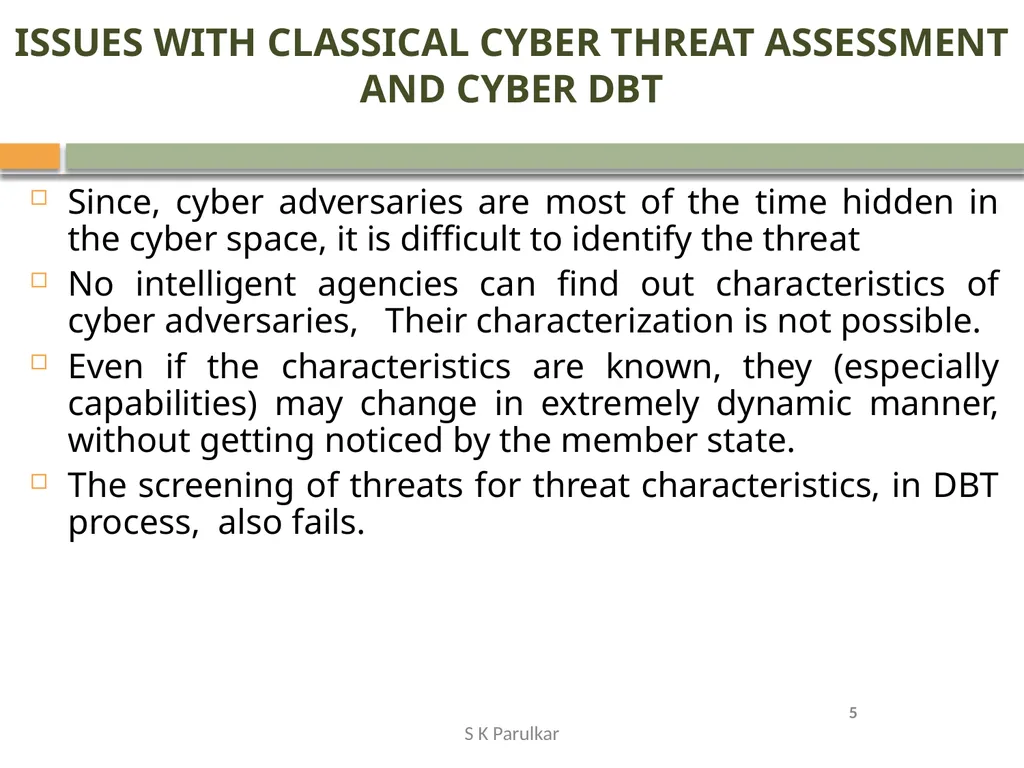
slide5. S K Parulkar ISSUES WITH CLASSICAL CYBER THREAT ASSESSMENT AND CYBER DBT 5 Since, cyber adversaries are most of the time hidden in the cyber space, it is difficult to identify the threat
No intelligent agencies can find out characteristics of cyber adversaries, Their characterization is not possible.
Even if the characteristics are known, they (especially capabilities) may change in extremely dynamic manner, without getting noticed by the member state.
The screening of threats for threat characteristics, in DBT process, also fails.<br>
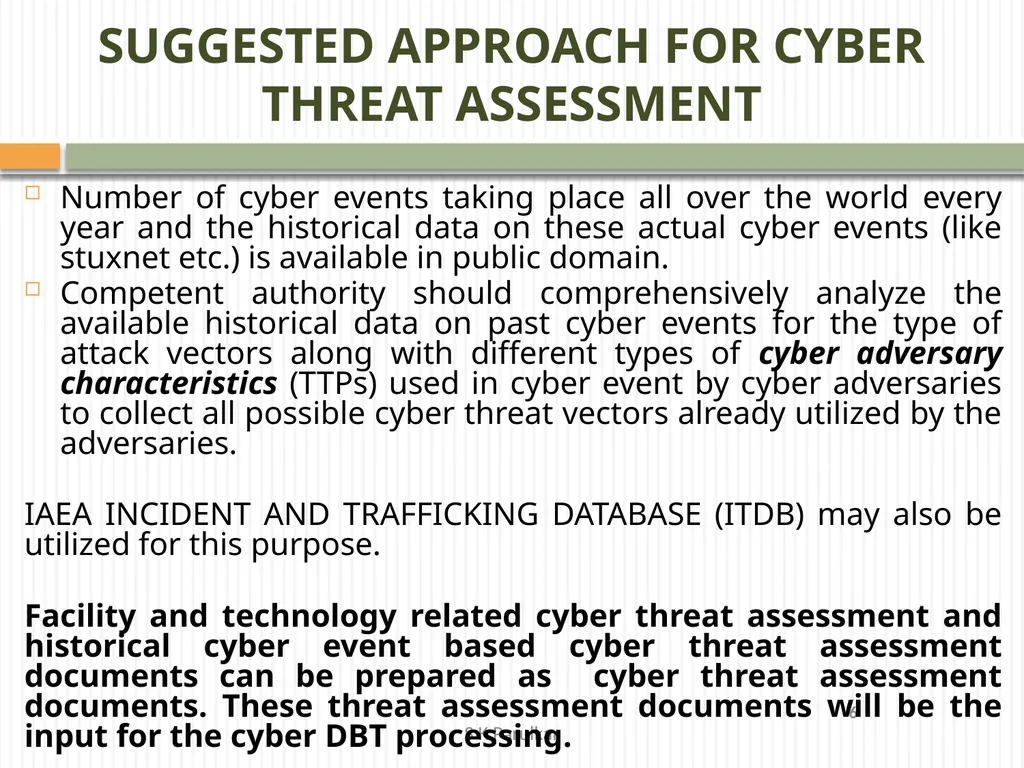
slide6. S K Parulkar SUGGESTED APPROACH FOR CYBER THREAT ASSESSMENT 6 Number of cyber events taking place all over the world every year and the historical data on these actual cyber events (like stuxnet etc.) is available in public domain.
Competent authority should comprehensively analyze the available historical data on past cyber events for the type of attack vectors along with different types of cyber adversary characteristics (TTPs) used in cyber event by cyber adversaries to collect all possible cyber threat vectors already utilized by the adversaries.
IAEA INCIDENT AND TRAFFICKING DATABASE (ITDB) may also be utilized for this purpose.
Facility and technology related cyber threat assessment and historical cyber event based cyber threat assessment documents can be prepared as cyber threat assessment documents. These threat assessment documents will be the input for the cyber DBT processing.<br>
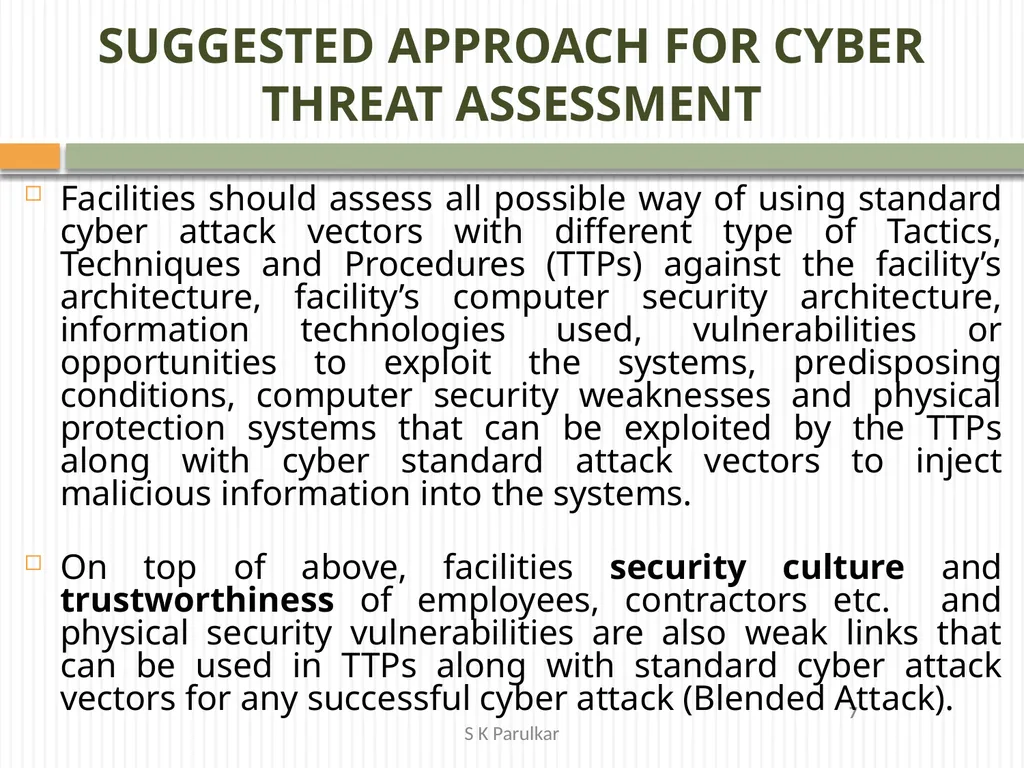
slide7. S K Parulkar 7 Facilities should assess all possible way of using standard cyber attack vectors with different type of Tactics, Techniques and Procedures (TTPs) against the facility’s architecture, facility’s computer security architecture, information technologies used, vulnerabilities or opportunities to exploit the systems, predisposing conditions, computer security weaknesses and physical protection systems that can be exploited by the TTPs along with cyber standard attack vectors to inject malicious information into the systems.
On top of above, facilities security culture and trustworthiness of employees, contractors etc. and physical security vulnerabilities are also weak links that can be used in TTPs along with standard cyber attack vectors for any successful cyber attack (Blended Attack). SUGGESTED APPROACH FOR CYBER THREAT ASSESSMENT<br>
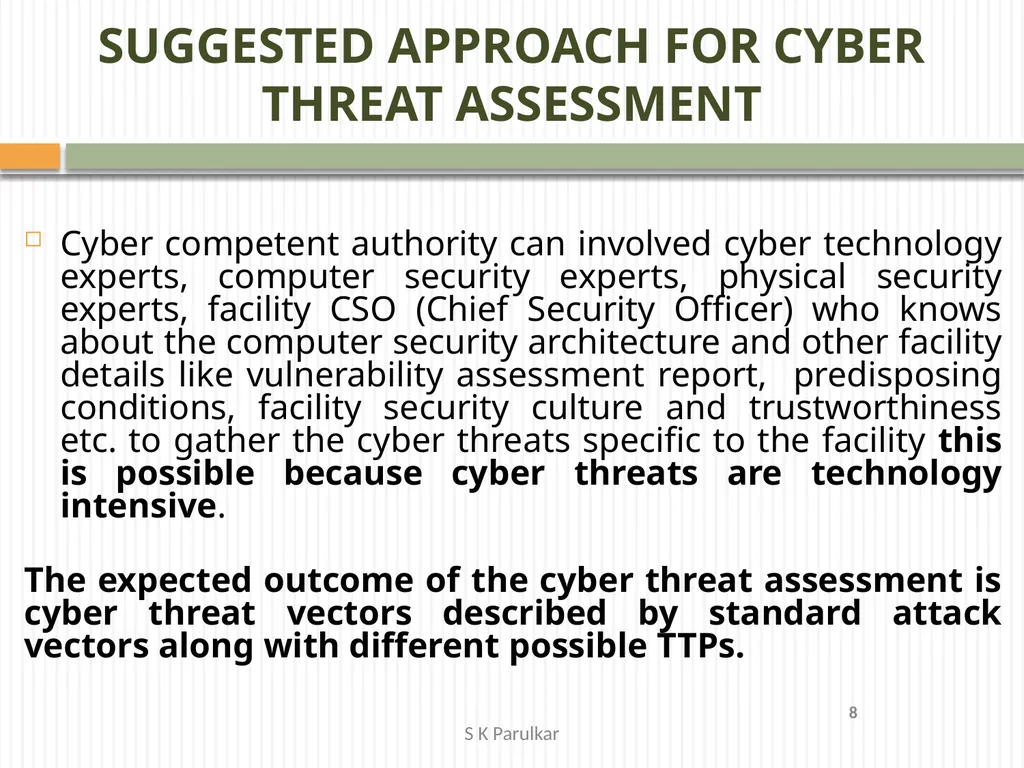
slide8. S K Parulkar 8 Cyber competent authority can involved cyber technology experts, computer security experts, physical security experts, facility CSO (Chief Security Officer) who knows about the computer security architecture and other facility details like vulnerability assessment report, predisposing conditions, facility security culture and trustworthiness etc. to gather the cyber threats specific to the facility this is possible because cyber threats are technology intensive.
The expected outcome of the cyber threat assessment is cyber threat vectors described by standard attack vectors along with different possible TTPs. SUGGESTED APPROACH FOR CYBER THREAT ASSESSMENT<br>
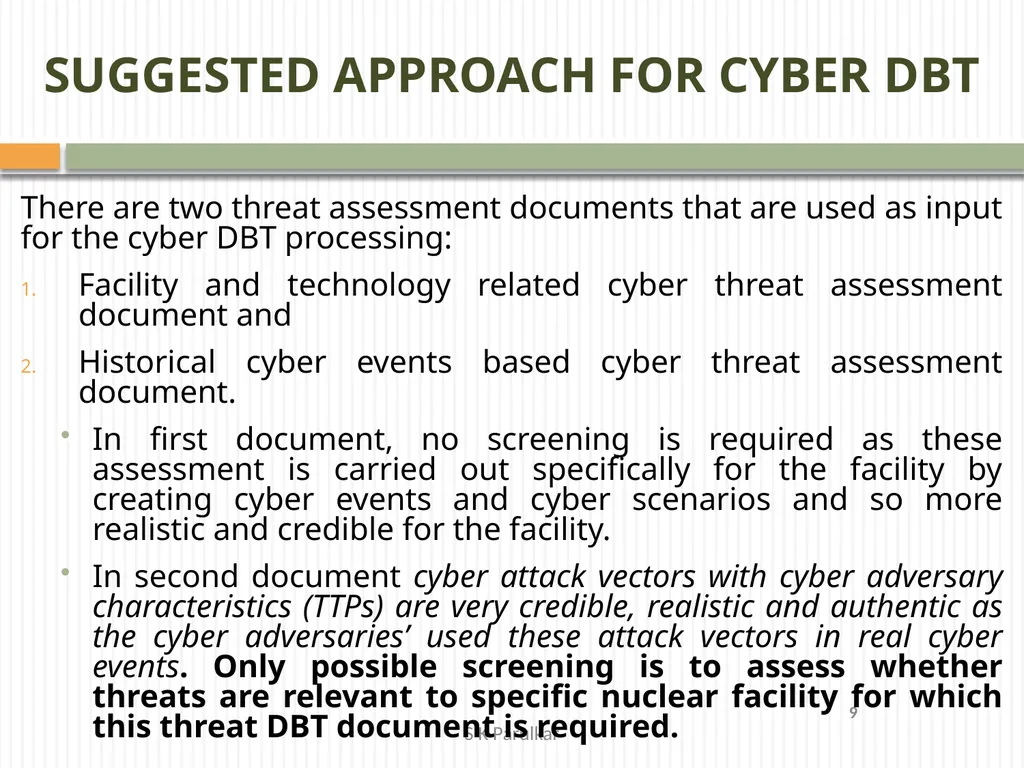
slide9. S K Parulkar SUGGESTED APPROACH FOR CYBER DBT 9 There are two threat assessment documents that are used as input for the cyber DBT processing:
Facility and technology related cyber threat assessment document and
Historical cyber events based cyber threat assessment document.
In first document, no screening is required as these assessment is carried out specifically for the facility by creating cyber events and cyber scenarios and so more realistic and credible for the facility.
In second document cyber attack vectors with cyber adversary characteristics (TTPs) are very credible, realistic and authentic as the cyber adversaries’ used these attack vectors in real cyber events. Only possible screening is to assess whether threats are relevant to specific nuclear facility for which this threat DBT document is required.<br>
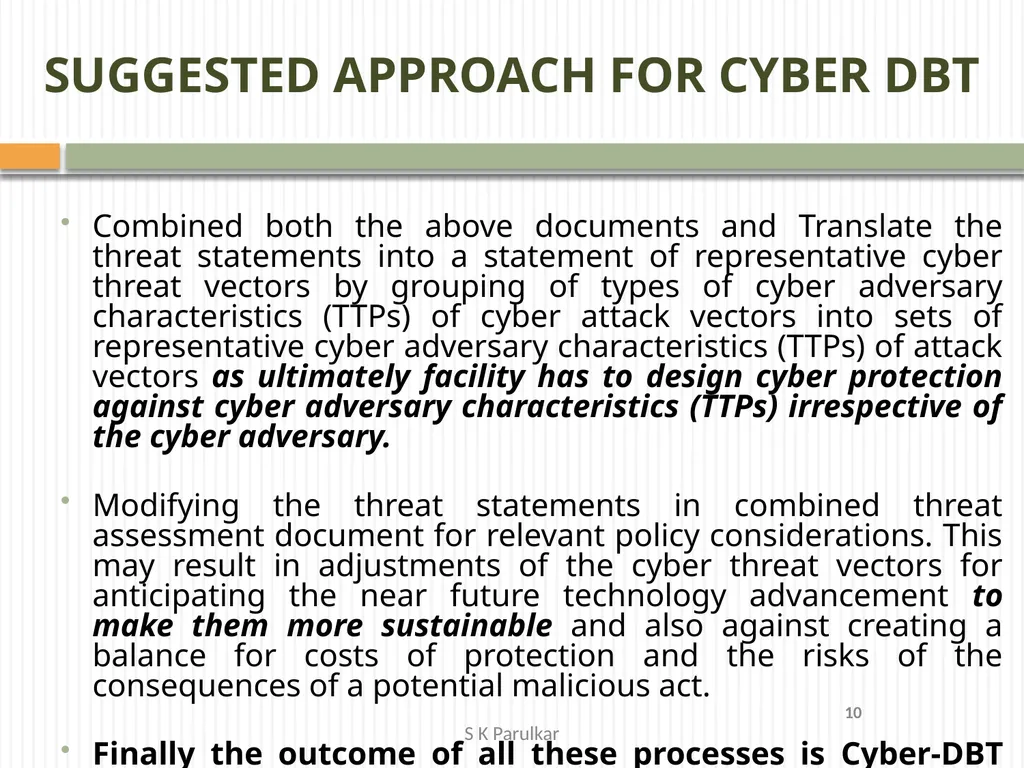
slide10. S K Parulkar SUGGESTED APPROACH FOR CYBER DBT 10 Combined both the above documents and Translate the threat statements into a statement of representative cyber threat vectors by grouping of types of cyber adversary characteristics (TTPs) of cyber attack vectors into sets of representative cyber adversary characteristics (TTPs) of attack vectors as ultimately facility has to design cyber protection against cyber adversary characteristics (TTPs) irrespective of the cyber adversary.
Modifying the threat statements in combined threat assessment document for relevant policy considerations. This may result in adjustments of the cyber threat vectors for anticipating the near future technology advancement to make them more sustainable and also against creating a balance for costs of protection and the risks of the consequences of a potential malicious act.
Finally the outcome of all these processes is Cyber-DBT document.<br>
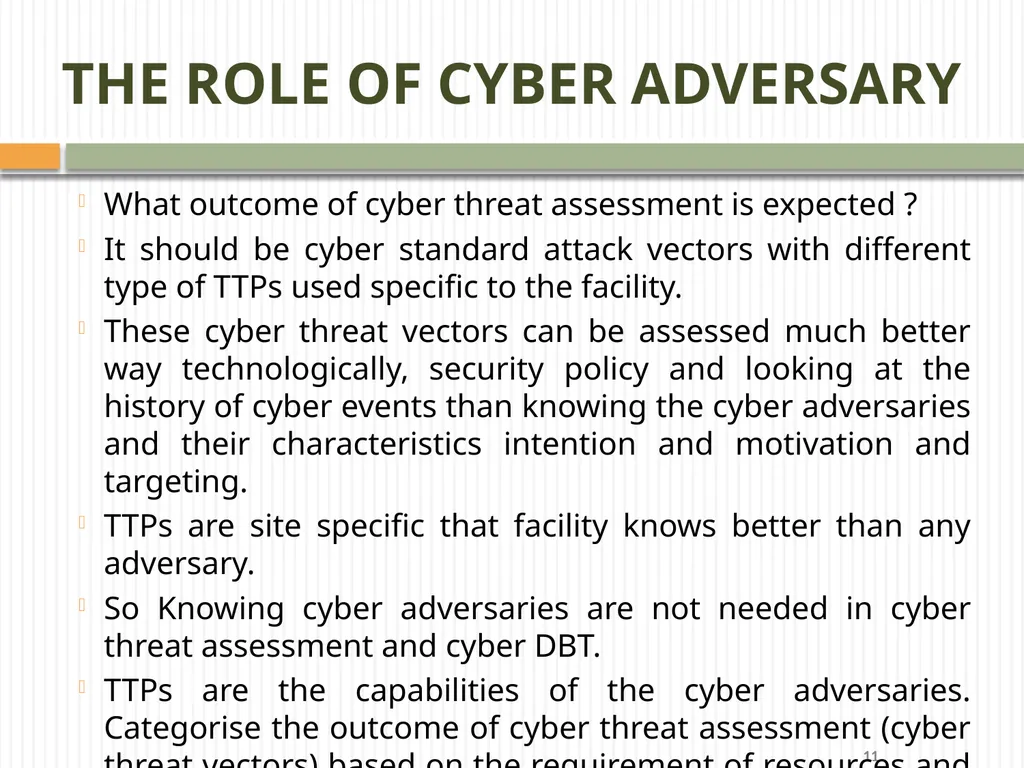
slide11. THE ROLE OF CYBER ADVERSARY 11 What outcome of cyber threat assessment is expected ?
It should be cyber standard attack vectors with different type of TTPs used specific to the facility.
These cyber threat vectors can be assessed much better way technologically, security policy and looking at the history of cyber events than knowing the cyber adversaries and their characteristics intention and motivation and targeting.
TTPs are site specific that facility knows better than any adversary.
So Knowing cyber adversaries are not needed in cyber threat assessment and cyber DBT.
TTPs are the capabilities of the cyber adversaries. Categorise the outcome of cyber threat assessment (cyber threat vectors) based on the requirement of resources and skill that will provide the list of adversaries of different possible categories.<br>
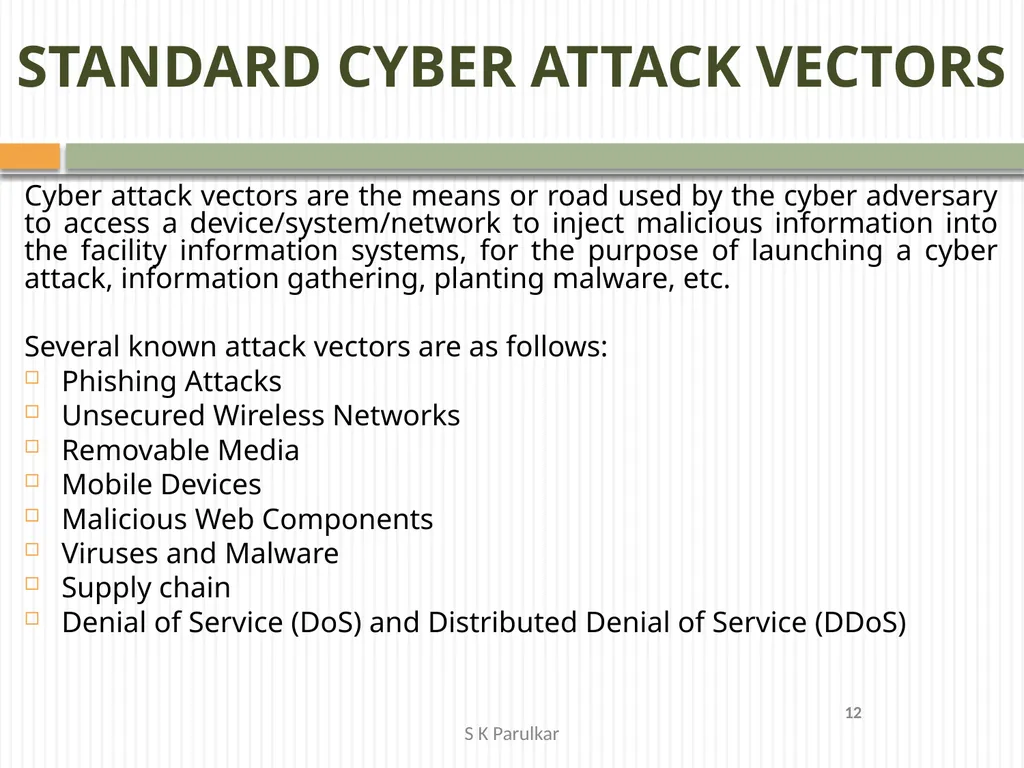
slide12. S K Parulkar STANDARD CYBER ATTACK VECTORS 12 Cyber attack vectors are the means or road used by the cyber adversary to access a device/system/network to inject malicious information into the facility information systems, for the purpose of launching a cyber attack, information gathering, planting malware, etc.
Several known attack vectors are as follows:
Phishing Attacks
Unsecured Wireless Networks
Removable Media
Mobile Devices
Malicious Web Components
Viruses and Malware
Supply chain
Denial of Service (DoS) and Distributed Denial of Service (DDoS)<br>
slide13. S K Parulkar BEYOND CYBER DBT 13 The following threats are the candidate for the Beyond Cyber DBT:
1. In cyber DBT document, competent authority may analyze threat vectors for which no protection can be designed or planned by the operator due to facility and information security architectures, technological constrained or any other limitations.
2. Due to uncertainty of TTPs used in Advanced Persistent Threat (APT), it is difficult to predict and assess them. Therefore APTs are the candidate for Beyond DBT category.
These threat vectors against which no protection is possible by the operator can be listed as beyond DBT cyber threat vectors.
Though the protection against these threat vectors will be the responsibility of the state however operator has to help state in possible response and recovery of the information systems affected by the cyber events.
In very high risk situations operator may make some arrangements with a few cyber expert teams who can help in response and recovery process.
State can also help to operator by providing help on international level experts in very serious situations or very high risk.<br>
slide14. S K Parulkar RESPONDING TO NEW AND EMERGING THREATS 14 As cyber threats are more technology intensive and cyber technology is changing at very fast rate, new TTPs are also emerging at fast rate. In cyber threat assessment and cyber DBT, there should be some provision to accommodate these new emerging TTPs, due to technology up gradation, into threat assessment and DBT document.
Subsequently these TTPs can be merged into threat assessment and DBT document during schedule revision of the respective documents.<br>
slide15. S K Parulkar 15 The most of the nuclear facilities provide traditional cyber security protections against standard cyber attack vectors, without going through the systematic assessment of these cyber standard attack vectors and cyber DBT process. It does not provide the level of security assurance required for high risk values.
Tactics, Techniques and Procedures (TTPs) in utilizing standard cyber attack vectors plays an important role. TTPs indicate, indirectly, the capability of the cyber adversaries. TTPs enhance the power of standard attack vectors that enhance the capability of the adversary in multiple folds.
The challenge is the required skill of cyber adversaries for adapting different types of cyber adversary characteristics (TTPs) along with single standard cyber attack vector or combination of standard cyber attack vectors or sometimes even with the combination of physical attack vectors that measures the capability of cyber adversaries that has to be addressed by safeguards and countermeasures (security protections) by the facility.
This should include cyber attack vectors launched from outside through networks and from direct physical access to computer system by insider.
These characteristics are the metrics to measure the capability of cyber adversary. CONCLUSION<br>
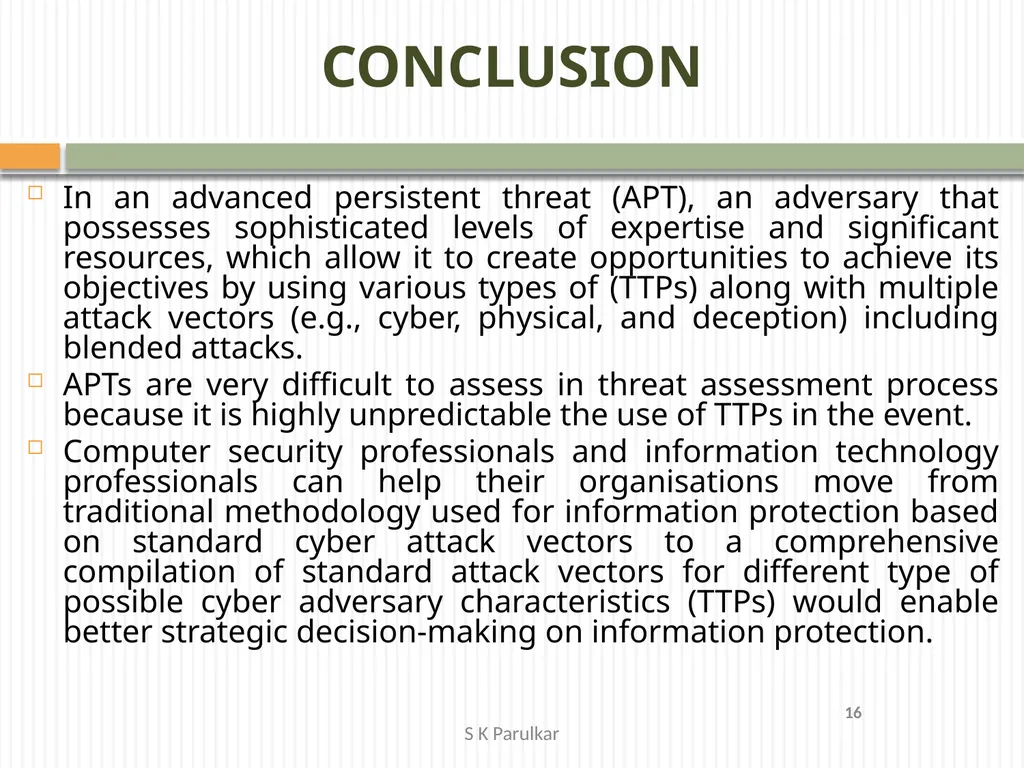
slide16. S K Parulkar CONCLUSION 16 In an advanced persistent threat (APT), an adversary that possesses sophisticated levels of expertise and significant resources, which allow it to create opportunities to achieve its objectives by using various types of (TTPs) along with multiple attack vectors (e.g., cyber, physical, and deception) including blended attacks.
APTs are very difficult to assess in threat assessment process because it is highly unpredictable the use of TTPs in the event.
Computer security professionals and information technology professionals can help their organisations move from traditional methodology used for information protection based on standard cyber attack vectors to a comprehensive compilation of standard attack vectors for different type of possible cyber adversary characteristics (TTPs) would enable better strategic decision-making on information protection.<br>
slide17. Thank You..!
S.K. Parulkar, India
parulkarsk@gmail.com<br>
S.K. Parulkar, India
parulkarsk@gmail.com<br>
slide2. S K Parulkar THREAT ASSESSMENT & DBT 2 The threat assessment is a comprehensive compilation of information about all potential adversaries along with their motivation, intentions and capabilities.
To evaluate the DBT the threat assessment document is processed through screening and decision-making. The main purpose of the processing is to make threats in threat assessment document more realistic and credible for nuclear facilities. In other words to find out more likelihood threats for nuclear facilities that can be used for calculating risk and then developing security protection systems for highest security assurance using graded approach.<br>
slide3. S K Parulkar PHYSICAL V/s CYBER THREATS 3 Cyber threats are a global phenomenon not only local.
It is not possible to know all the cyber adversaries, as they are spread all over the globe and hidden in cyber space and not open or known in public as in physical adversaries.
No intelligent agencies can find out all the characteristics of threats, like capabilities and intensions, as they are not open or known.
Cyber adversaries are location independent as they can attack from any where in the globe, which makes the task of intelligent agencies further difficult.
Cyber threats are more technology intensive than physical threats so as the technology advances, cyber threats are also becoming more advance.
Cyber threats are more dynamic as compare to physical threats, which are more constant without much advancement in weapon technologies<br>
slide4. S K Parulkar 4 Cyber skill can be easily available and purchased or can be acquired in short time. So it is difficult for investigating agencies to clearly find out the capabilities of known cyber adversaries.
Cyber threats can be easily carried out without any deterrent as adversaries are always hidden. So cyber threats are more dangerous. It makes more essential to implement cyber threat assessment program more rigorously.
Cyber resources used in attack are easily available in the open market without any restriction and can be purchased without any issue and may not required large funds as compared to physical resources.
Even if cyber adversary is caught, he may not be coming under the jurisdiction of legal framework of the country where attack has occurred. Therefore the cyber adversary can not be punished. PHYSICAL V/s CYBER THREATS<br>
slide5. S K Parulkar ISSUES WITH CLASSICAL CYBER THREAT ASSESSMENT AND CYBER DBT 5 Since, cyber adversaries are most of the time hidden in the cyber space, it is difficult to identify the threat
No intelligent agencies can find out characteristics of cyber adversaries, Their characterization is not possible.
Even if the characteristics are known, they (especially capabilities) may change in extremely dynamic manner, without getting noticed by the member state.
The screening of threats for threat characteristics, in DBT process, also fails.<br>
slide6. S K Parulkar SUGGESTED APPROACH FOR CYBER THREAT ASSESSMENT 6 Number of cyber events taking place all over the world every year and the historical data on these actual cyber events (like stuxnet etc.) is available in public domain.
Competent authority should comprehensively analyze the available historical data on past cyber events for the type of attack vectors along with different types of cyber adversary characteristics (TTPs) used in cyber event by cyber adversaries to collect all possible cyber threat vectors already utilized by the adversaries.
IAEA INCIDENT AND TRAFFICKING DATABASE (ITDB) may also be utilized for this purpose.
Facility and technology related cyber threat assessment and historical cyber event based cyber threat assessment documents can be prepared as cyber threat assessment documents. These threat assessment documents will be the input for the cyber DBT processing.<br>
slide7. S K Parulkar 7 Facilities should assess all possible way of using standard cyber attack vectors with different type of Tactics, Techniques and Procedures (TTPs) against the facility’s architecture, facility’s computer security architecture, information technologies used, vulnerabilities or opportunities to exploit the systems, predisposing conditions, computer security weaknesses and physical protection systems that can be exploited by the TTPs along with cyber standard attack vectors to inject malicious information into the systems.
On top of above, facilities security culture and trustworthiness of employees, contractors etc. and physical security vulnerabilities are also weak links that can be used in TTPs along with standard cyber attack vectors for any successful cyber attack (Blended Attack). SUGGESTED APPROACH FOR CYBER THREAT ASSESSMENT<br>
slide8. S K Parulkar 8 Cyber competent authority can involved cyber technology experts, computer security experts, physical security experts, facility CSO (Chief Security Officer) who knows about the computer security architecture and other facility details like vulnerability assessment report, predisposing conditions, facility security culture and trustworthiness etc. to gather the cyber threats specific to the facility this is possible because cyber threats are technology intensive.
The expected outcome of the cyber threat assessment is cyber threat vectors described by standard attack vectors along with different possible TTPs. SUGGESTED APPROACH FOR CYBER THREAT ASSESSMENT<br>
slide9. S K Parulkar SUGGESTED APPROACH FOR CYBER DBT 9 There are two threat assessment documents that are used as input for the cyber DBT processing:
Facility and technology related cyber threat assessment document and
Historical cyber events based cyber threat assessment document.
In first document, no screening is required as these assessment is carried out specifically for the facility by creating cyber events and cyber scenarios and so more realistic and credible for the facility.
In second document cyber attack vectors with cyber adversary characteristics (TTPs) are very credible, realistic and authentic as the cyber adversaries’ used these attack vectors in real cyber events. Only possible screening is to assess whether threats are relevant to specific nuclear facility for which this threat DBT document is required.<br>
slide10. S K Parulkar SUGGESTED APPROACH FOR CYBER DBT 10 Combined both the above documents and Translate the threat statements into a statement of representative cyber threat vectors by grouping of types of cyber adversary characteristics (TTPs) of cyber attack vectors into sets of representative cyber adversary characteristics (TTPs) of attack vectors as ultimately facility has to design cyber protection against cyber adversary characteristics (TTPs) irrespective of the cyber adversary.
Modifying the threat statements in combined threat assessment document for relevant policy considerations. This may result in adjustments of the cyber threat vectors for anticipating the near future technology advancement to make them more sustainable and also against creating a balance for costs of protection and the risks of the consequences of a potential malicious act.
Finally the outcome of all these processes is Cyber-DBT document.<br>
slide11. THE ROLE OF CYBER ADVERSARY 11 What outcome of cyber threat assessment is expected ?
It should be cyber standard attack vectors with different type of TTPs used specific to the facility.
These cyber threat vectors can be assessed much better way technologically, security policy and looking at the history of cyber events than knowing the cyber adversaries and their characteristics intention and motivation and targeting.
TTPs are site specific that facility knows better than any adversary.
So Knowing cyber adversaries are not needed in cyber threat assessment and cyber DBT.
TTPs are the capabilities of the cyber adversaries. Categorise the outcome of cyber threat assessment (cyber threat vectors) based on the requirement of resources and skill that will provide the list of adversaries of different possible categories.<br>
slide12. S K Parulkar STANDARD CYBER ATTACK VECTORS 12 Cyber attack vectors are the means or road used by the cyber adversary to access a device/system/network to inject malicious information into the facility information systems, for the purpose of launching a cyber attack, information gathering, planting malware, etc.
Several known attack vectors are as follows:
Phishing Attacks
Unsecured Wireless Networks
Removable Media
Mobile Devices
Malicious Web Components
Viruses and Malware
Supply chain
Denial of Service (DoS) and Distributed Denial of Service (DDoS)<br>
slide13. S K Parulkar BEYOND CYBER DBT 13 The following threats are the candidate for the Beyond Cyber DBT:
1. In cyber DBT document, competent authority may analyze threat vectors for which no protection can be designed or planned by the operator due to facility and information security architectures, technological constrained or any other limitations.
2. Due to uncertainty of TTPs used in Advanced Persistent Threat (APT), it is difficult to predict and assess them. Therefore APTs are the candidate for Beyond DBT category.
These threat vectors against which no protection is possible by the operator can be listed as beyond DBT cyber threat vectors.
Though the protection against these threat vectors will be the responsibility of the state however operator has to help state in possible response and recovery of the information systems affected by the cyber events.
In very high risk situations operator may make some arrangements with a few cyber expert teams who can help in response and recovery process.
State can also help to operator by providing help on international level experts in very serious situations or very high risk.<br>
slide14. S K Parulkar RESPONDING TO NEW AND EMERGING THREATS 14 As cyber threats are more technology intensive and cyber technology is changing at very fast rate, new TTPs are also emerging at fast rate. In cyber threat assessment and cyber DBT, there should be some provision to accommodate these new emerging TTPs, due to technology up gradation, into threat assessment and DBT document.
Subsequently these TTPs can be merged into threat assessment and DBT document during schedule revision of the respective documents.<br>
slide15. S K Parulkar 15 The most of the nuclear facilities provide traditional cyber security protections against standard cyber attack vectors, without going through the systematic assessment of these cyber standard attack vectors and cyber DBT process. It does not provide the level of security assurance required for high risk values.
Tactics, Techniques and Procedures (TTPs) in utilizing standard cyber attack vectors plays an important role. TTPs indicate, indirectly, the capability of the cyber adversaries. TTPs enhance the power of standard attack vectors that enhance the capability of the adversary in multiple folds.
The challenge is the required skill of cyber adversaries for adapting different types of cyber adversary characteristics (TTPs) along with single standard cyber attack vector or combination of standard cyber attack vectors or sometimes even with the combination of physical attack vectors that measures the capability of cyber adversaries that has to be addressed by safeguards and countermeasures (security protections) by the facility.
This should include cyber attack vectors launched from outside through networks and from direct physical access to computer system by insider.
These characteristics are the metrics to measure the capability of cyber adversary. CONCLUSION<br>
slide16. S K Parulkar CONCLUSION 16 In an advanced persistent threat (APT), an adversary that possesses sophisticated levels of expertise and significant resources, which allow it to create opportunities to achieve its objectives by using various types of (TTPs) along with multiple attack vectors (e.g., cyber, physical, and deception) including blended attacks.
APTs are very difficult to assess in threat assessment process because it is highly unpredictable the use of TTPs in the event.
Computer security professionals and information technology professionals can help their organisations move from traditional methodology used for information protection based on standard cyber attack vectors to a comprehensive compilation of standard attack vectors for different type of possible cyber adversary characteristics (TTPs) would enable better strategic decision-making on information protection.<br>
slide17. Thank You..!
S.K. Parulkar, India
parulkarsk@gmail.com<br>