Methods Design Analysis of routine patient data
Description: Methods Design Analysis of routine patient data and survey data Study Population All HIV-positive adults screened for HCV antibodies Between 2014 and 2016 Study Settings Kenya: Kibera (Nairobi) and Homa Bay Malawi: Chiradzulu Fig 1: Map of
Related Topics
Download Presentation
"Methods Design Analysis of routine patient data" is the property of its rightful owner. Permission is granted to download and print the materials on this website for personal, non-commercial use only, and to display it on your personal computer provided you do not modify the materials and that you retain all copyright notices contained in the materials. By downloading content from our website, you accept the terms of this agreement.
Presentation Transcript
slide1. Methods
Design
Analysis of routine patient data and survey data
Study Population
All HIV-positive adults screened for HCV antibodies
Between 2014 and 2016
Study Settings
Kenya: Kibera (Nairobi) and Homa Bay
Malawi: Chiradzulu Fig 1: Map of study sites
Mozambique: Maputo
Uganda: Mbarara
Procedures
Site-specific screening strategy implemented in collaboration with MoH or partners
Laboratory Procedures
Serology screening: OraQuick HCV Rapid Antibody Test (OraSure Technologies, Bethlehem, USA)
HCV Viral Load (q-PCR): Laboratory platforms Background
According to WHO estimates, 80 million people globally are chronically infected by hepatitis C virus (HCV ) and 2.3 million people living with HIV are co-infected with HIV and HCV. HIV and HCV infections share common risk factors (ex, unscreened blood transfusion, unsafe injection).
As new drugs with better efficacy and tolerability become widely available, data on the burden of HCV among HIV patients in sub-Saharan Africa is lacking.
We present the results of screening activities among HIV positive cohorts at 5 MSF-supported sites in 4 countries in Eastern and Southern Africa. Discussion
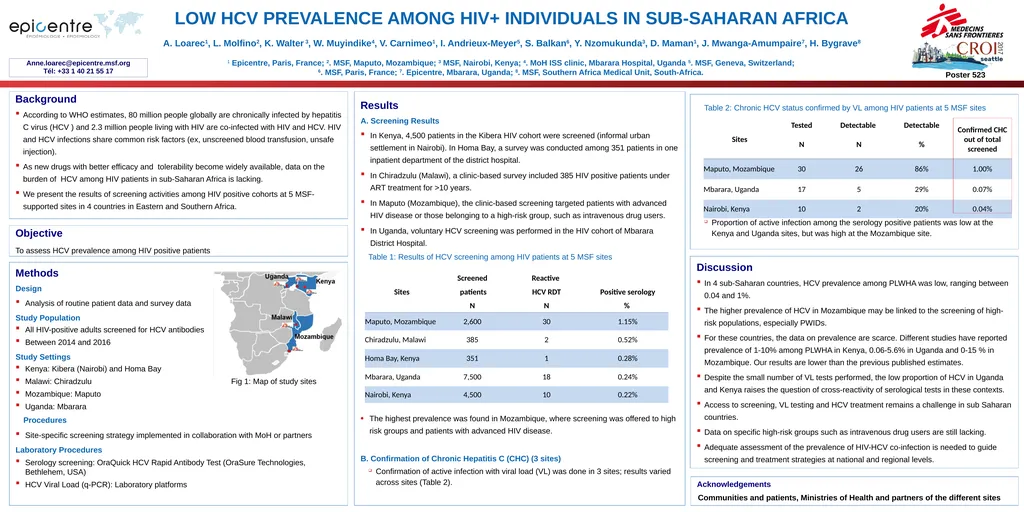
In 4 sub-Saharan countries, HCV prevalence among PLWHA was low, ranging between 0.04 and 1%.
The higher prevalence of HCV in Mozambique may be linked to the screening of high-risk populations, especially PWIDs.
For these countries, the data on prevalence are scarce. Different studies have reported prevalence of 1-10% among PLWHA in Kenya, 0.06-5.6% in Uganda and 0-15 % in Mozambique. Our results are lower than the previous published estimates.
Despite the small number of VL tests performed, the low proportion of HCV in Uganda and Kenya raises the question of cross-reactivity of serological tests in these contexts.
Access to screening, VL testing and HCV treatment remains a challenge in sub Saharan countries.
Data on specific high-risk groups such as intravenous drug users are still lacking.
Adequate assessment of the prevalence of HIV-HCV co-infection is needed to guide screening and treatment strategies at national and regional levels. LOW HCV PREVALENCE AMONG HIV+ INDIVIDUALS IN SUB-SAHARAN AFRICA A. Loarec1, L. Molfino2, K. Walter 3, W. Muyindike4, V. Carnimeo1, I. Andrieux-Meyer5, S. Balkan6, Y. Nzomukunda3, D. Maman1, J. Mwanga-Amumpaire7, H. Bygrave8
1 Epicentre, Paris, France; 2. MSF, Maputo, Mozambique; 3 MSF, Nairobi, Kenya; 4. MoH ISS clinic, Mbarara Hospital, Uganda 5. MSF, Geneva, Switzerland;
6. MSF, Paris, France; 7. Epicentre, Mbarara, Uganda; 8. MSF, Southern Africa Medical Unit, South-Africa. Table 2: Chronic HCV status confirmed by VL among HIV patients at 5 MSF sites
Proportion of active infection among the serology positive patients was low at the Kenya and Uganda sites, but was high at the Mozambique site. Acknowledgements
Communities and patients, Ministries of Health and partners of the different sites Objective
To assess HCV prevalence among HIV positive patients Anne.loarec@epicentre.msf.org
Tél: +33 1 40 21 55 17 Results
A. Screening Results
In Kenya, 4,500 patients in the Kibera HIV cohort were screened (informal urban settlement in Nairobi). In Homa Bay, a survey was conducted among 351 patients in one inpatient department of the district hospital.
In Chiradzulu (Malawi), a clinic-based survey included 385 HIV positive patients under ART treatment for >10 years.
In Maputo (Mozambique), the clinic-based screening targeted patients with advanced HIV disease or those belonging to a high-risk group, such as intravenous drug users.
In Uganda, voluntary HCV screening was performed in the HIV cohort of Mbarara District Hospital.
Table 1: Results of HCV screening among HIV patients at 5 MSF sites
The highest prevalence was found in Mozambique, where screening was offered to high risk groups and patients with advanced HIV disease.
B. Confirmation of Chronic Hepatitis C (CHC) (3 sites)
Confirmation of active infection with viral load (VL) was done in 3 sites; results varied across sites (Table 2). Poster 523<br>

Design
Analysis of routine patient data and survey data
Study Population
All HIV-positive adults screened for HCV antibodies
Between 2014 and 2016
Study Settings
Kenya: Kibera (Nairobi) and Homa Bay
Malawi: Chiradzulu Fig 1: Map of study sites
Mozambique: Maputo
Uganda: Mbarara
Procedures
Site-specific screening strategy implemented in collaboration with MoH or partners
Laboratory Procedures
Serology screening: OraQuick HCV Rapid Antibody Test (OraSure Technologies, Bethlehem, USA)
HCV Viral Load (q-PCR): Laboratory platforms Background
According to WHO estimates, 80 million people globally are chronically infected by hepatitis C virus (HCV ) and 2.3 million people living with HIV are co-infected with HIV and HCV. HIV and HCV infections share common risk factors (ex, unscreened blood transfusion, unsafe injection).
As new drugs with better efficacy and tolerability become widely available, data on the burden of HCV among HIV patients in sub-Saharan Africa is lacking.
We present the results of screening activities among HIV positive cohorts at 5 MSF-supported sites in 4 countries in Eastern and Southern Africa. Discussion
In 4 sub-Saharan countries, HCV prevalence among PLWHA was low, ranging between 0.04 and 1%.
The higher prevalence of HCV in Mozambique may be linked to the screening of high-risk populations, especially PWIDs.
For these countries, the data on prevalence are scarce. Different studies have reported prevalence of 1-10% among PLWHA in Kenya, 0.06-5.6% in Uganda and 0-15 % in Mozambique. Our results are lower than the previous published estimates.
Despite the small number of VL tests performed, the low proportion of HCV in Uganda and Kenya raises the question of cross-reactivity of serological tests in these contexts.
Access to screening, VL testing and HCV treatment remains a challenge in sub Saharan countries.
Data on specific high-risk groups such as intravenous drug users are still lacking.
Adequate assessment of the prevalence of HIV-HCV co-infection is needed to guide screening and treatment strategies at national and regional levels. LOW HCV PREVALENCE AMONG HIV+ INDIVIDUALS IN SUB-SAHARAN AFRICA A. Loarec1, L. Molfino2, K. Walter 3, W. Muyindike4, V. Carnimeo1, I. Andrieux-Meyer5, S. Balkan6, Y. Nzomukunda3, D. Maman1, J. Mwanga-Amumpaire7, H. Bygrave8
1 Epicentre, Paris, France; 2. MSF, Maputo, Mozambique; 3 MSF, Nairobi, Kenya; 4. MoH ISS clinic, Mbarara Hospital, Uganda 5. MSF, Geneva, Switzerland;
6. MSF, Paris, France; 7. Epicentre, Mbarara, Uganda; 8. MSF, Southern Africa Medical Unit, South-Africa. Table 2: Chronic HCV status confirmed by VL among HIV patients at 5 MSF sites
Proportion of active infection among the serology positive patients was low at the Kenya and Uganda sites, but was high at the Mozambique site. Acknowledgements
Communities and patients, Ministries of Health and partners of the different sites Objective
To assess HCV prevalence among HIV positive patients Anne.loarec@epicentre.msf.org
Tél: +33 1 40 21 55 17 Results
A. Screening Results
In Kenya, 4,500 patients in the Kibera HIV cohort were screened (informal urban settlement in Nairobi). In Homa Bay, a survey was conducted among 351 patients in one inpatient department of the district hospital.
In Chiradzulu (Malawi), a clinic-based survey included 385 HIV positive patients under ART treatment for >10 years.
In Maputo (Mozambique), the clinic-based screening targeted patients with advanced HIV disease or those belonging to a high-risk group, such as intravenous drug users.
In Uganda, voluntary HCV screening was performed in the HIV cohort of Mbarara District Hospital.
Table 1: Results of HCV screening among HIV patients at 5 MSF sites
The highest prevalence was found in Mozambique, where screening was offered to high risk groups and patients with advanced HIV disease.
B. Confirmation of Chronic Hepatitis C (CHC) (3 sites)
Confirmation of active infection with viral load (VL) was done in 3 sites; results varied across sites (Table 2). Poster 523<br>