
Microarchitectural Performance Characterization of

Description: Microarchitectural Performance Characterization of Irregular GPU Kernels Molly A. ONeil and Martin Burtscher Department of Computer Science Introduction GPUs as general-purpose accelerators Ubiquitous in high performance computing
Related Topics
Download Presentation
"Microarchitectural Performance Characterization of" is the property of its rightful owner. Permission is granted to download and print the materials on this website for personal, non-commercial use only, and to display it on your personal computer provided you do not modify the materials and that you retain all copyright notices contained in the materials. By downloading content from our website, you accept the terms of this agreement.
Presentation Transcript
slide1. Microarchitectural
Performance Characterization of
Irregular GPU Kernels Molly A. O’Neil and Martin Burtscher
Department of Computer Science<br>
slide2. Introduction GPUs as general-purpose accelerators
Ubiquitous in high performance computing
Spreading in PCs and mobile devices
Performance and energy efficiency benefits…
…when code is well-suited!
Regular (input independent) vs. irregular (input determines control flow and memory accesses)
Lots of important irregular algorithms
More difficult to parallelize, map less intuitively to GPUs Microarchitectural Performance Characterization of Irregular GPU Kernels 2<br>
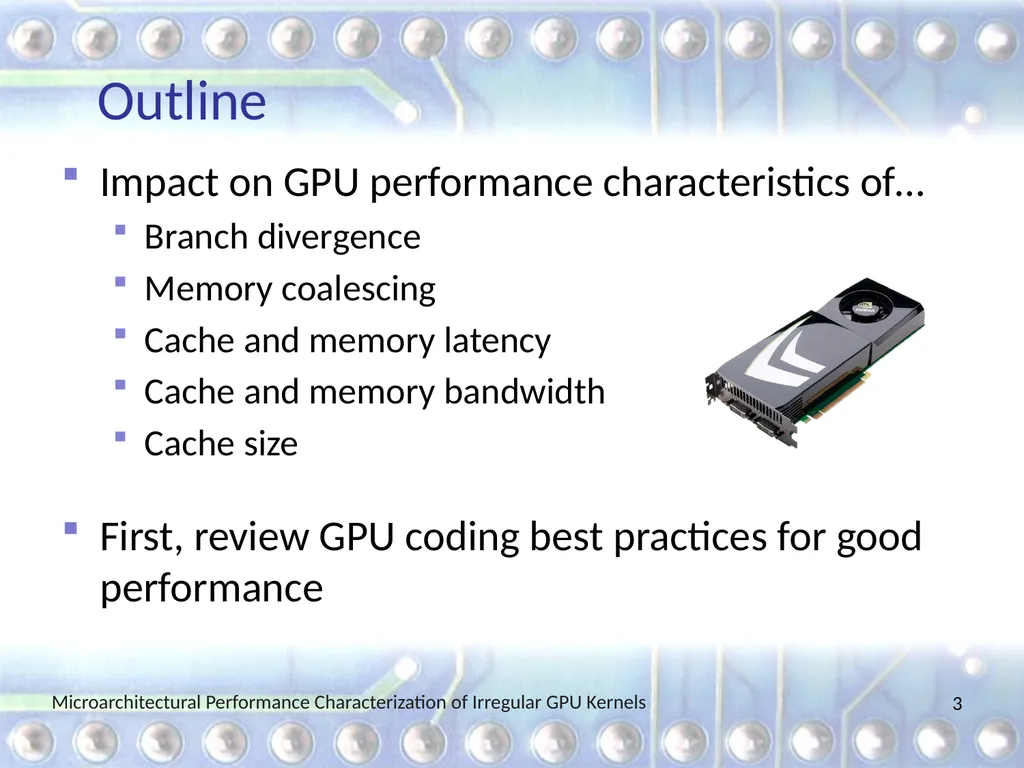
slide3. Outline Impact on GPU performance characteristics of…
Branch divergence
Memory coalescing
Cache and memory latency
Cache and memory bandwidth
Cache size
First, review GPU coding best practices for good performance Microarchitectural Performance Characterization of Irregular GPU Kernels 3<br>
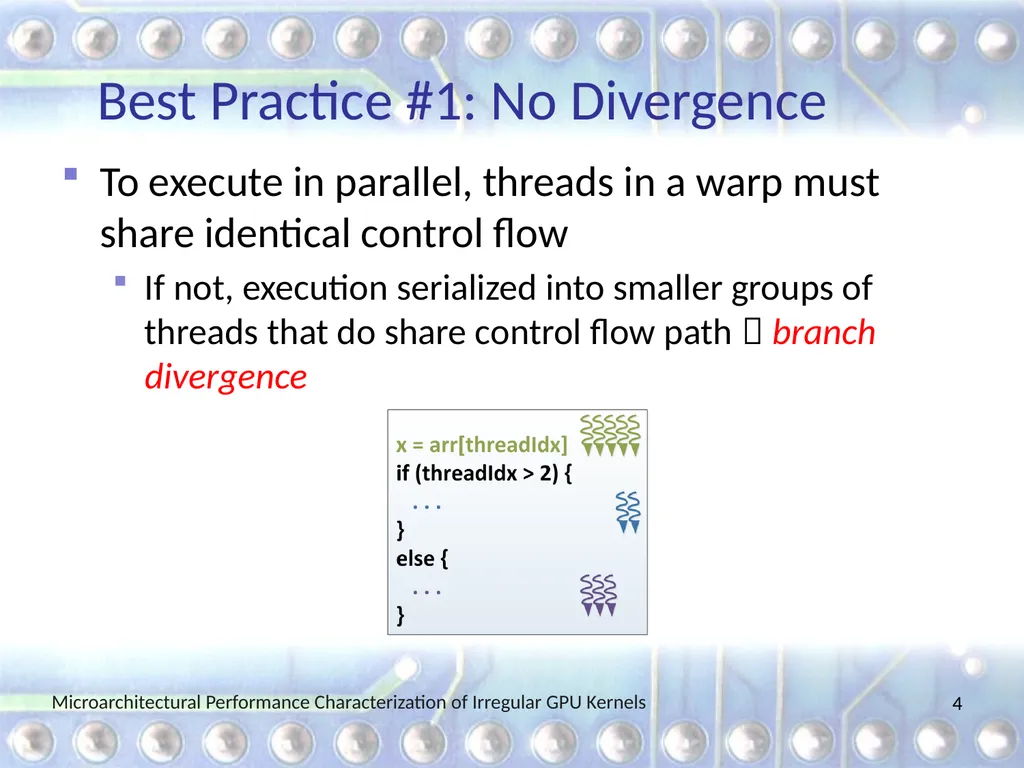
slide4. Best Practice #1: No Divergence Microarchitectural Performance Characterization of Irregular GPU Kernels 4 To execute in parallel, threads in a warp must share identical control flow
If not, execution serialized into smaller groups of threads that do share control flow path branch divergence<br>
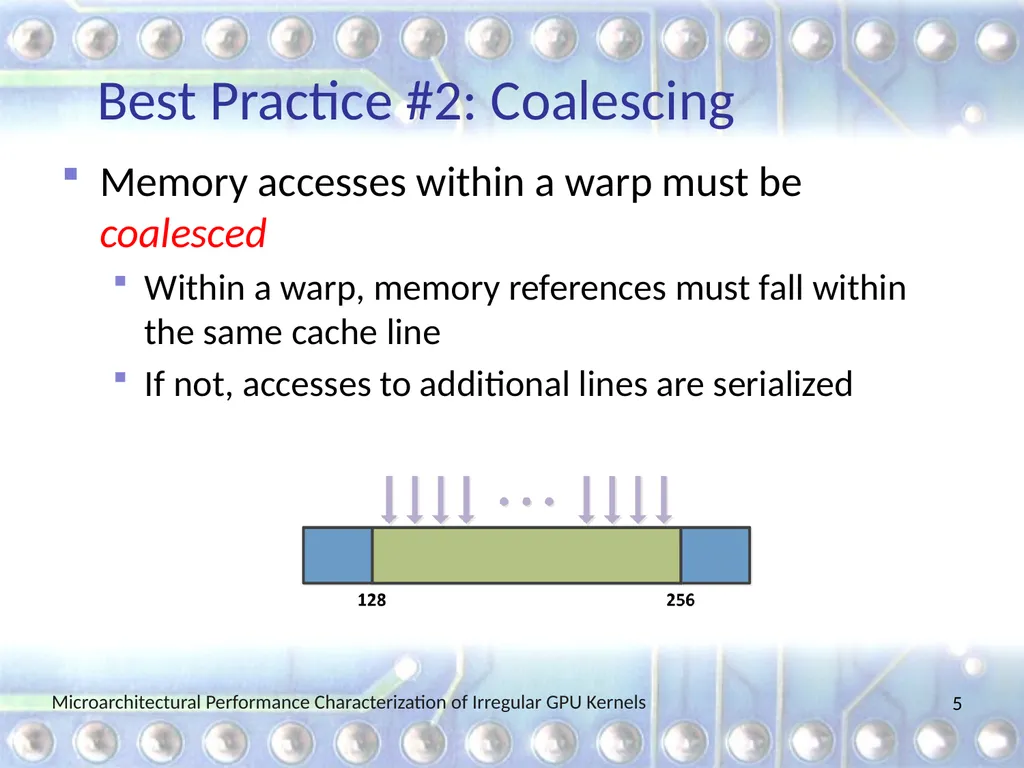
slide5. Best Practice #2: Coalescing Microarchitectural Performance Characterization of Irregular GPU Kernels 5 Memory accesses within a warp must be coalesced
Within a warp, memory references must fall within the same cache line
If not, accesses to additional lines are serialized<br>
slide6. Best Practice #3: Load Balance Microarchitectural Performance Characterization of Irregular GPU Kernels 6 Balance work between warps, threads, and thread blocks All 3 difficult for irregular codes
Data-dependent behavior makes it difficult to assign works to threads to achieve coalescing, identical control flow, load balance
Very different from CPU code considerations<br>
slide7. Simulation Study Want to better understand irregular apps’ specific demands on GPU hardware
To help software developers optimize irregular codes
As a baseline for exploring hardware support for broader classes of codes
GPGPU-Sim v3.2.1 + a few extra perf. counters
GTX 480 (Fermi) configuration
Added configuration variants to scale latency, bandwidth, cache size, etc. Microarchitectural Performance Characterization of Irregular GPU Kernels 7<br>
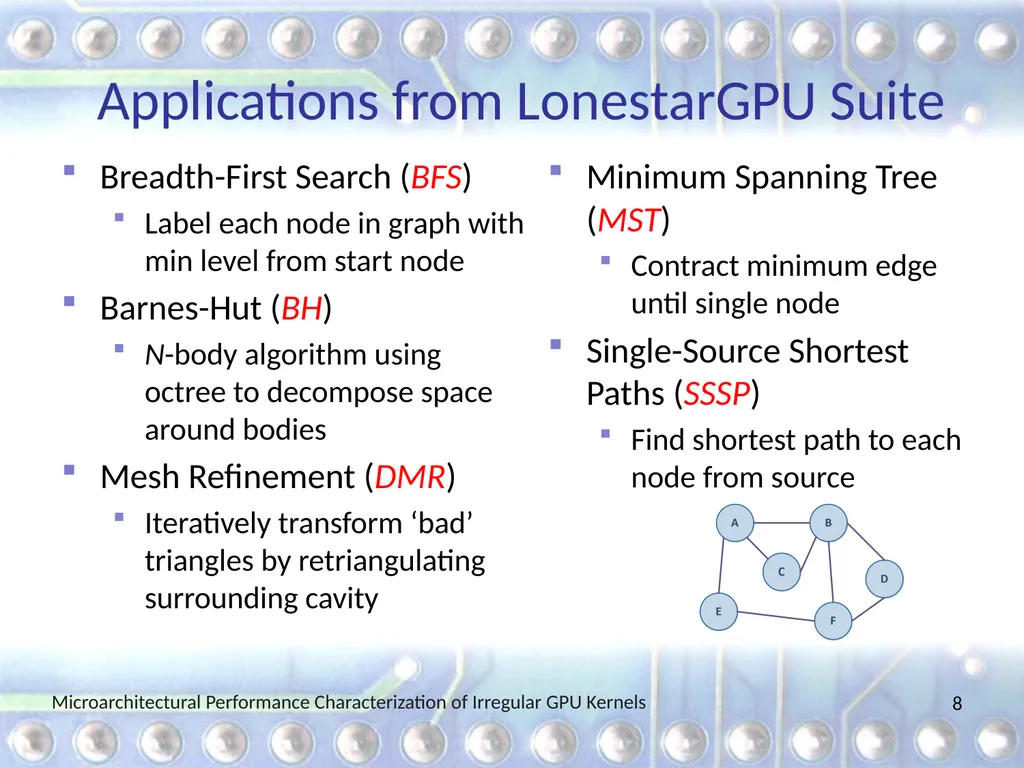
slide8. Applications from LonestarGPU Suite Breadth-First Search (BFS)
Label each node in graph with min level from start node
Barnes-Hut (BH)
N-body algorithm using octree to decompose space around bodies
Mesh Refinement (DMR)
Iteratively transform ‘bad’ triangles by retriangulating surrounding cavity Minimum Spanning Tree (MST)
Contract minimum edge until single node
Single-Source Shortest Paths (SSSP)
Find shortest path to each node from source 8 Microarchitectural Performance Characterization of Irregular GPU Kernels<br>
slide9. Semi-Regular FP Compression (FPC)
Lossless data compression for DP floating-point values
Irregular control flow
Traveling Salesman (TSP)
Find minimal tour in graph using iterative hill climbing
Irregular memory accesses Regular N-Body (NB)
N-body algorithm using all-to-all force calculation
Monte Carlo (MC)
Evaluates fair call price for set of options
CUDA SDK version Microarchitectural Performance Characterization of Irregular GPU Kernels 9 Applications from Other Sources Inputs result in working set ≥5 times default L2 size<br>
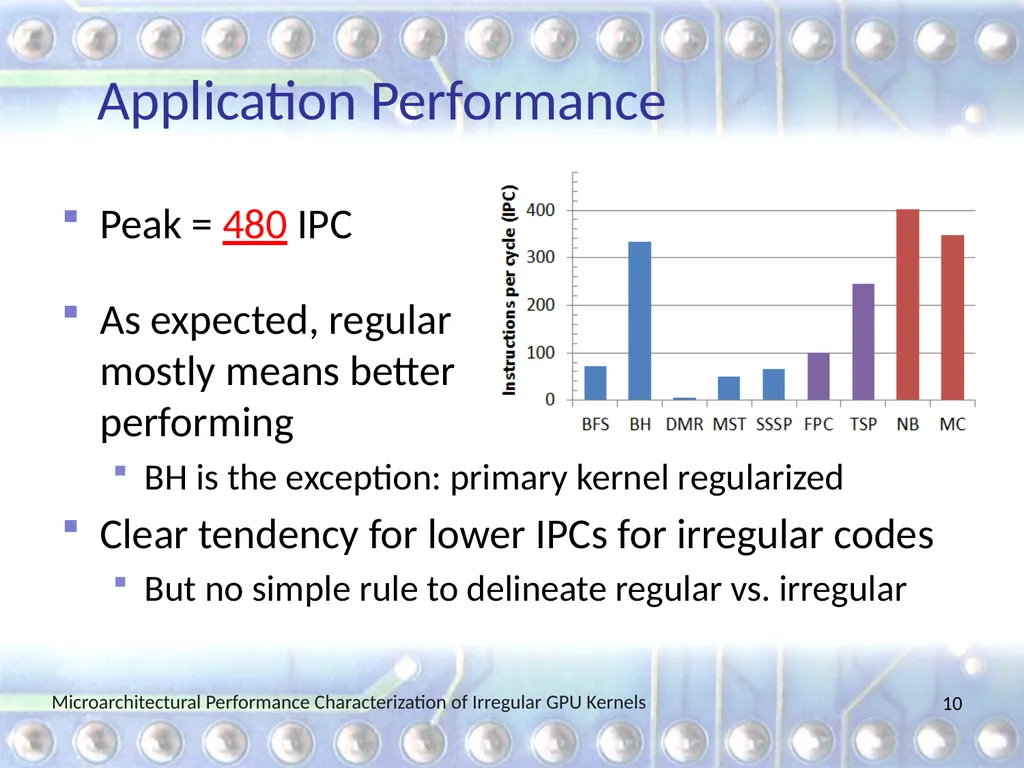
slide10. Application Performance Peak = 480 IPC
As expected, regular mostly means better performing
BH is the exception: primary kernel regularized
Clear tendency for lower IPCs for irregular codes
But no simple rule to delineate regular vs. irregular Microarchitectural Performance Characterization of Irregular GPU Kernels 10<br>
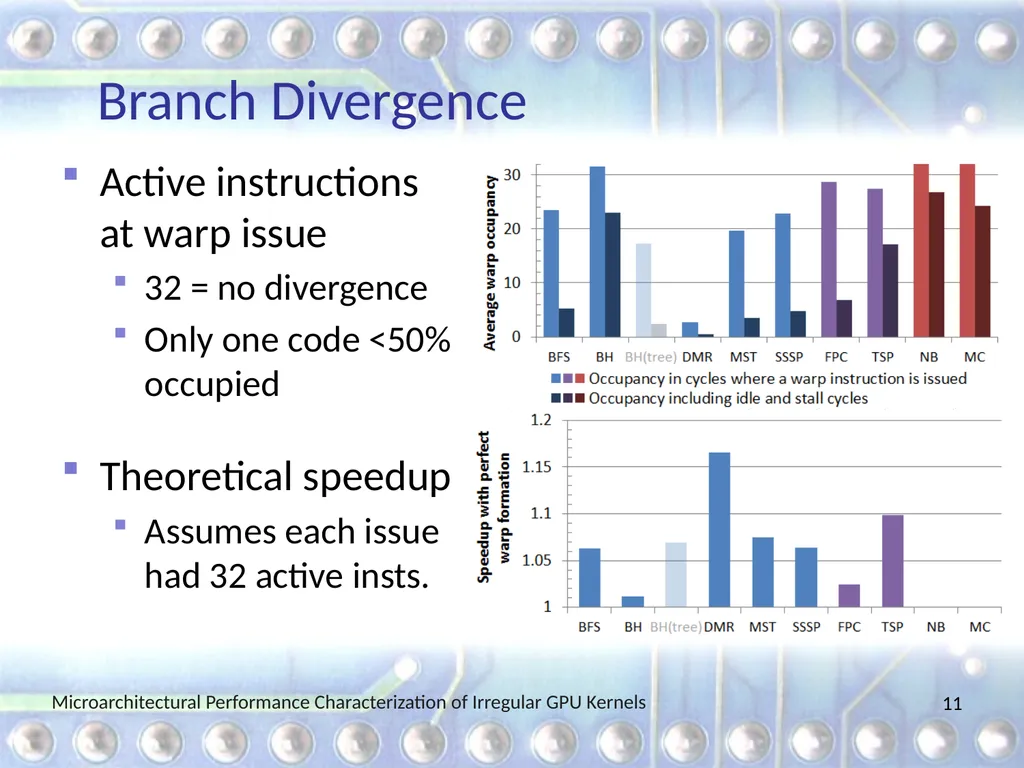
slide11. Branch Divergence Microarchitectural Performance Characterization of Irregular GPU Kernels 11 Active instructions at warp issue
32 = no divergence
Only one code <50% occupied
Theoretical speedup
Assumes each issue had 32 active insts.<br>
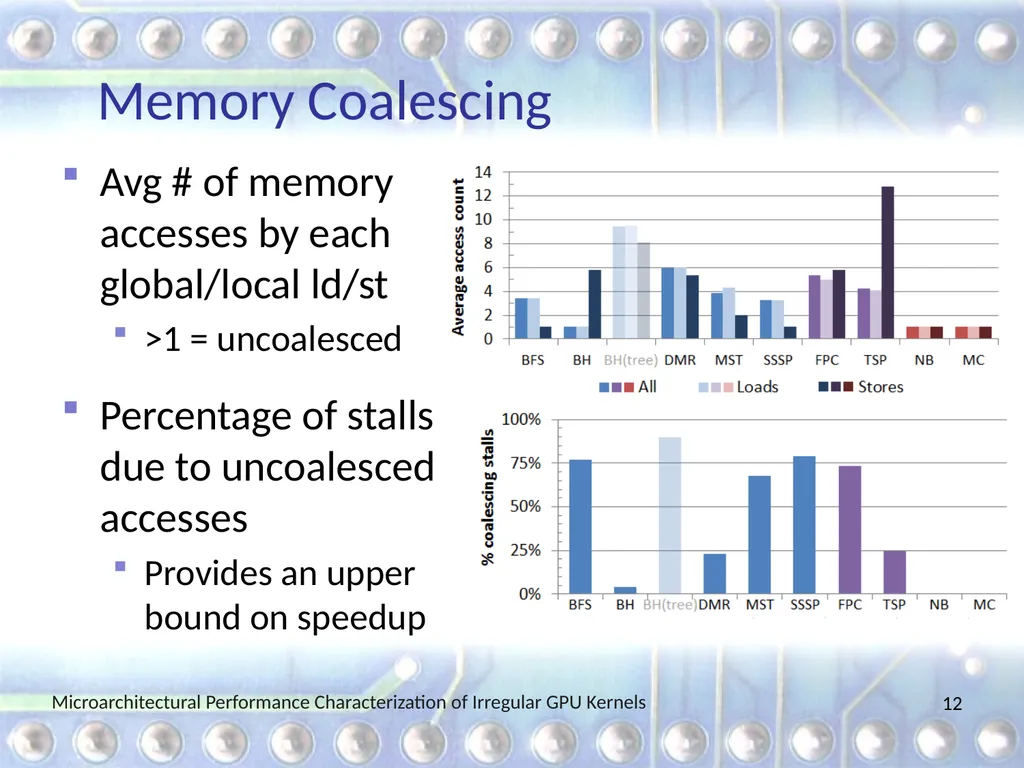
slide12. Memory Coalescing Microarchitectural Performance Characterization of Irregular GPU Kernels 12 Avg # of memory accesses by each global/local ld/st
>1 = uncoalesced
Percentage of stalls due to uncoalesced accesses
Provides an upper bound on speedup<br>
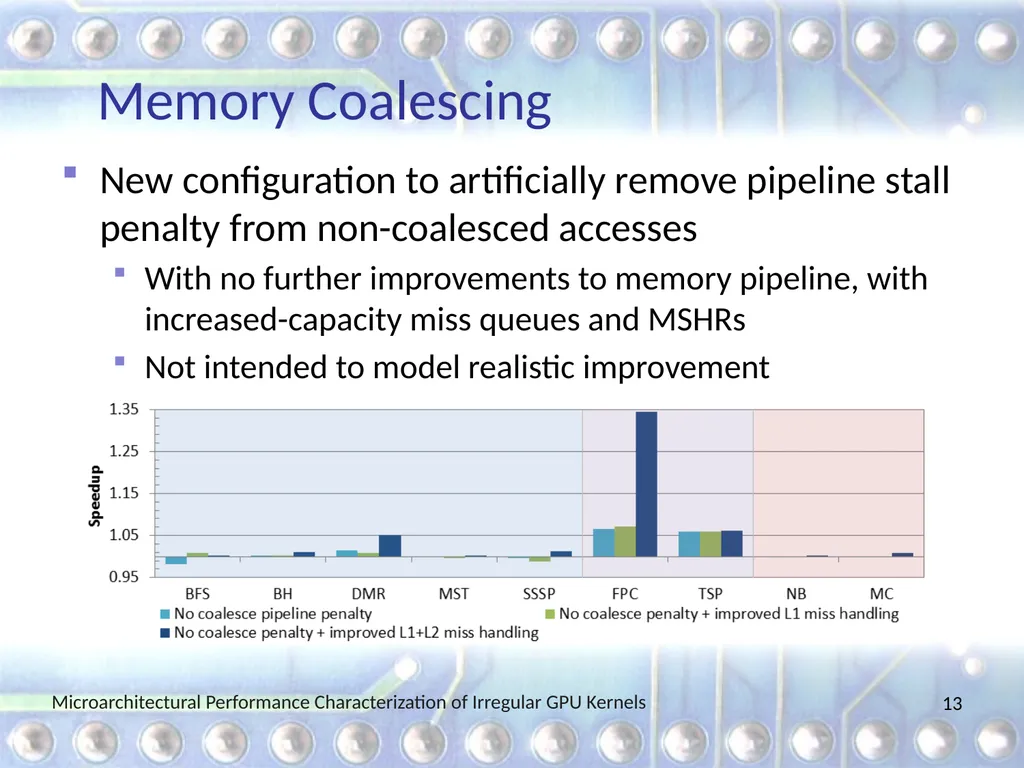
slide13. Memory Coalescing Microarchitectural Performance Characterization of Irregular GPU Kernels 13 New configuration to artificially remove pipeline stall penalty from non-coalesced accesses
With no further improvements to memory pipeline, with increased-capacity miss queues and MSHRs
Not intended to model realistic improvement<br>
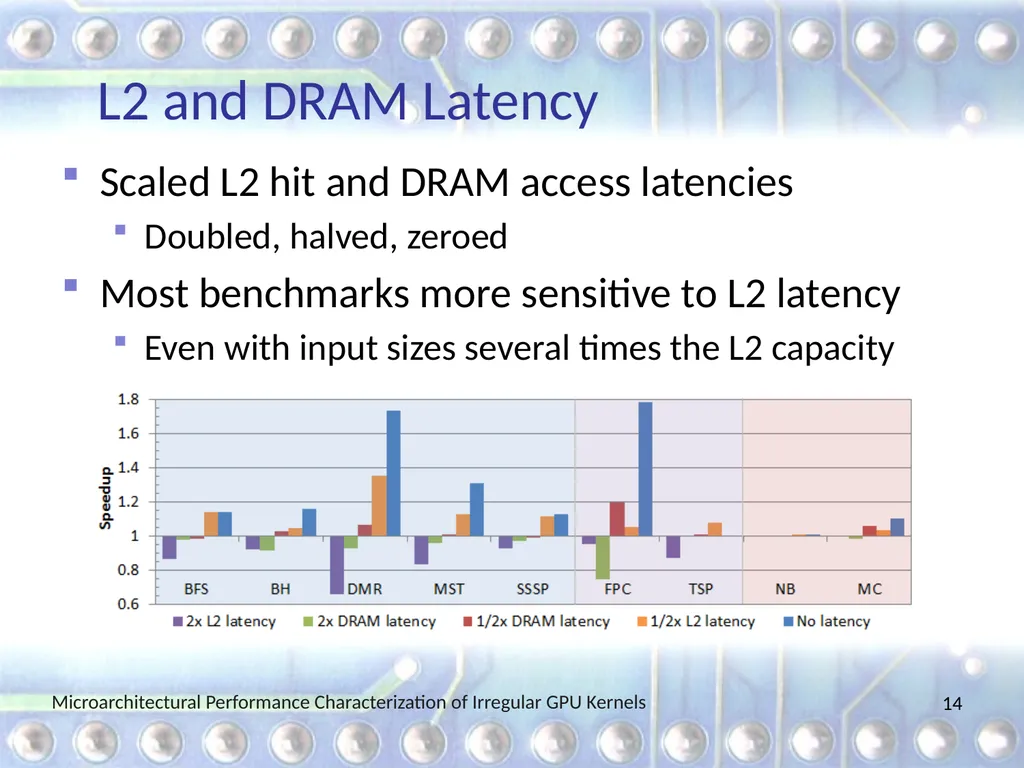
slide14. L2 and DRAM Latency Microarchitectural Performance Characterization of Irregular GPU Kernels 14 Scaled L2 hit and DRAM access latencies
Doubled, halved, zeroed
Most benchmarks more sensitive to L2 latency
Even with input sizes several times the L2 capacity<br>
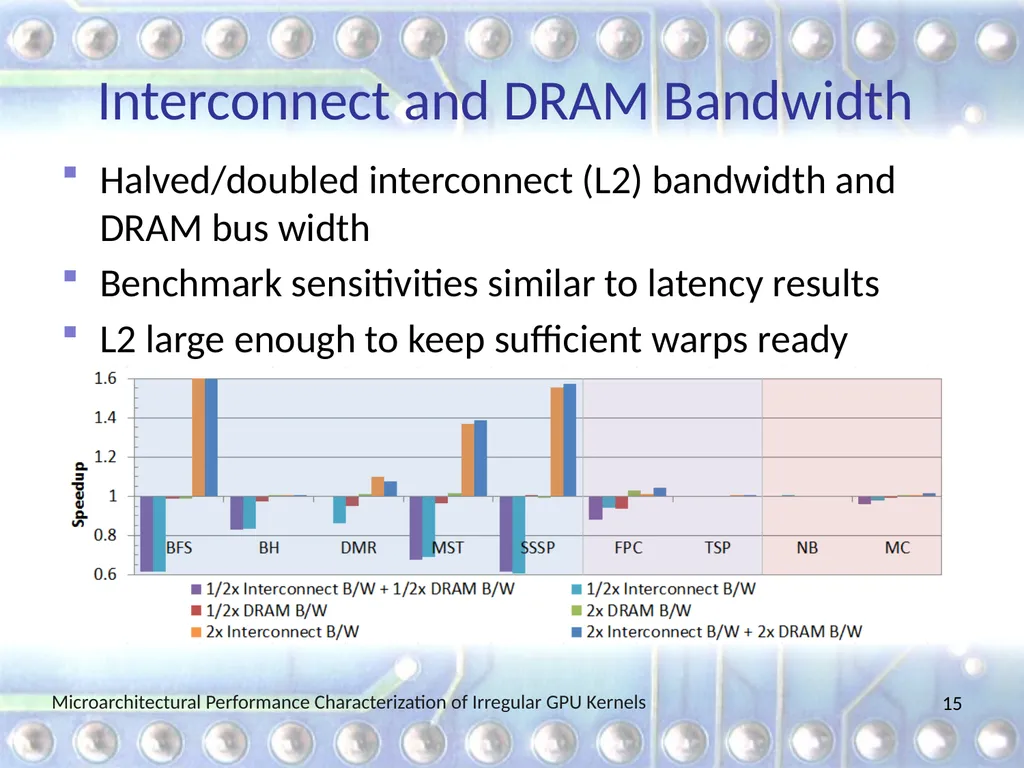
slide15. Interconnect and DRAM Bandwidth Microarchitectural Performance Characterization of Irregular GPU Kernels 15 Halved/doubled interconnect (L2) bandwidth and DRAM bus width
Benchmark sensitivities similar to latency results
L2 large enough to keep sufficient warps ready<br>
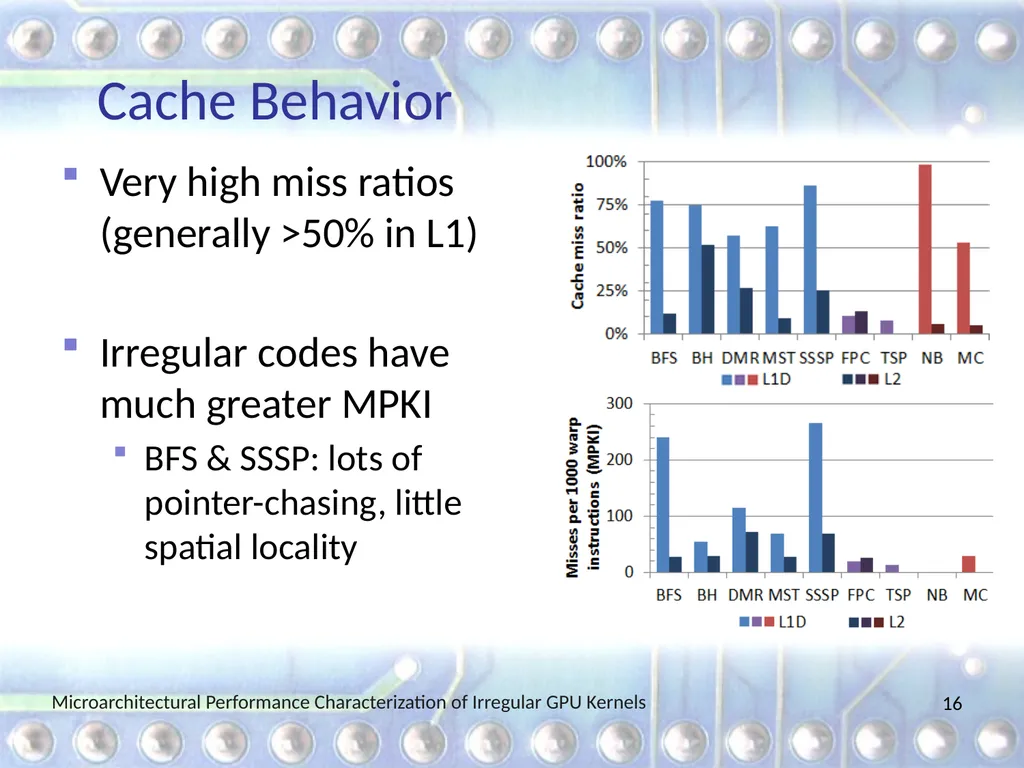
slide16. Cache Behavior Microarchitectural Performance Characterization of Irregular GPU Kernels 16 Very high miss ratios (generally >50% in L1)
Irregular codes have much greater MPKI
BFS & SSSP: lots of pointer-chasing, little spatial locality<br>
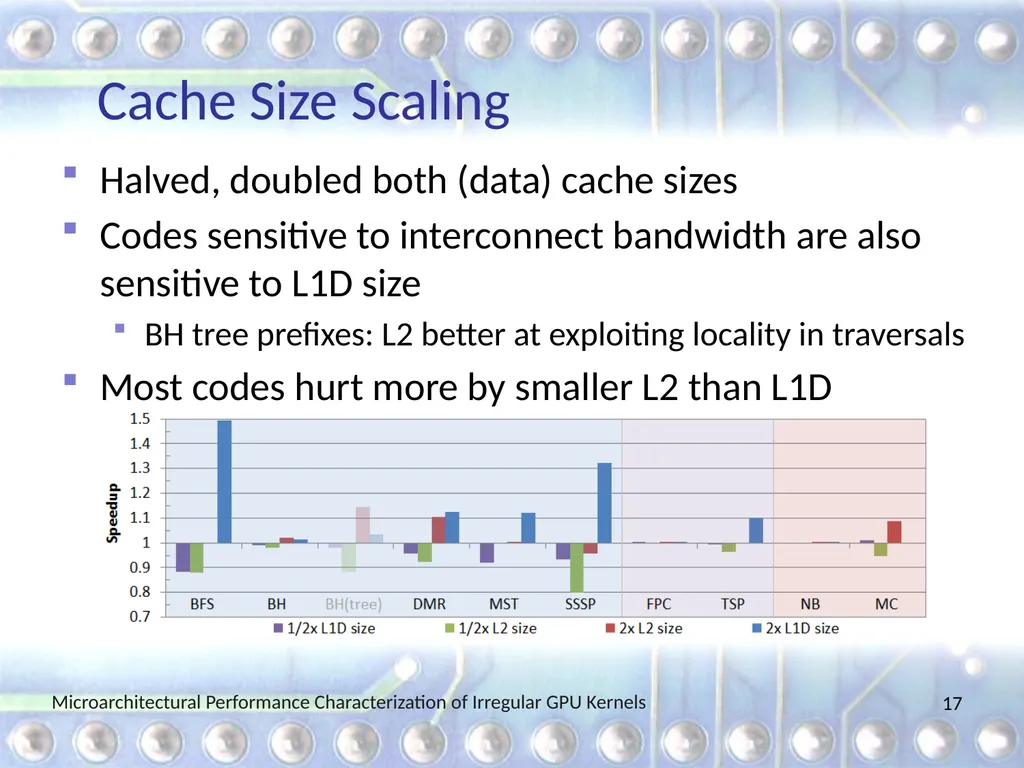
slide17. Cache Size Scaling Microarchitectural Performance Characterization of Irregular GPU Kernels 17 Halved, doubled both (data) cache sizes
Codes sensitive to interconnect bandwidth are also sensitive to L1D size
BH tree prefixes: L2 better at exploiting locality in traversals
Most codes hurt more by smaller L2 than L1D<br>
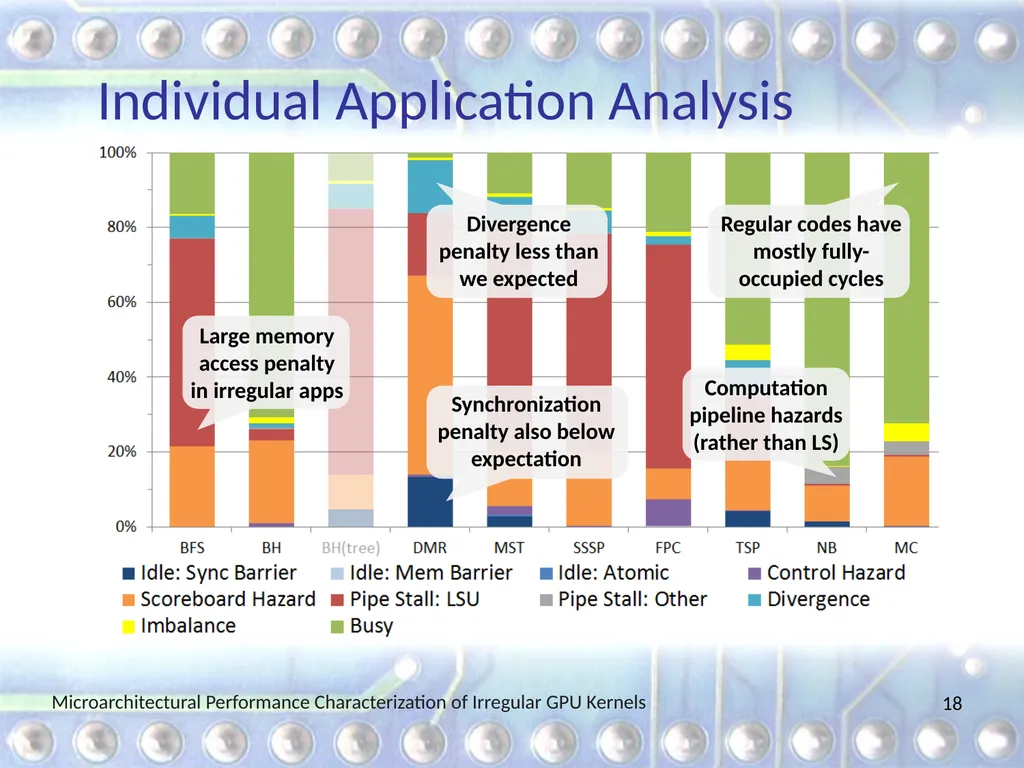
slide18. Individual Application Analysis Microarchitectural Performance Characterization of Irregular GPU Kernels 18 Large memory access penalty in irregular apps Divergence penalty less than we expected Synchronization penalty also below expectation Regular codes have mostly fully-occupied cycles Computation pipeline hazards (rather than LS)<br>
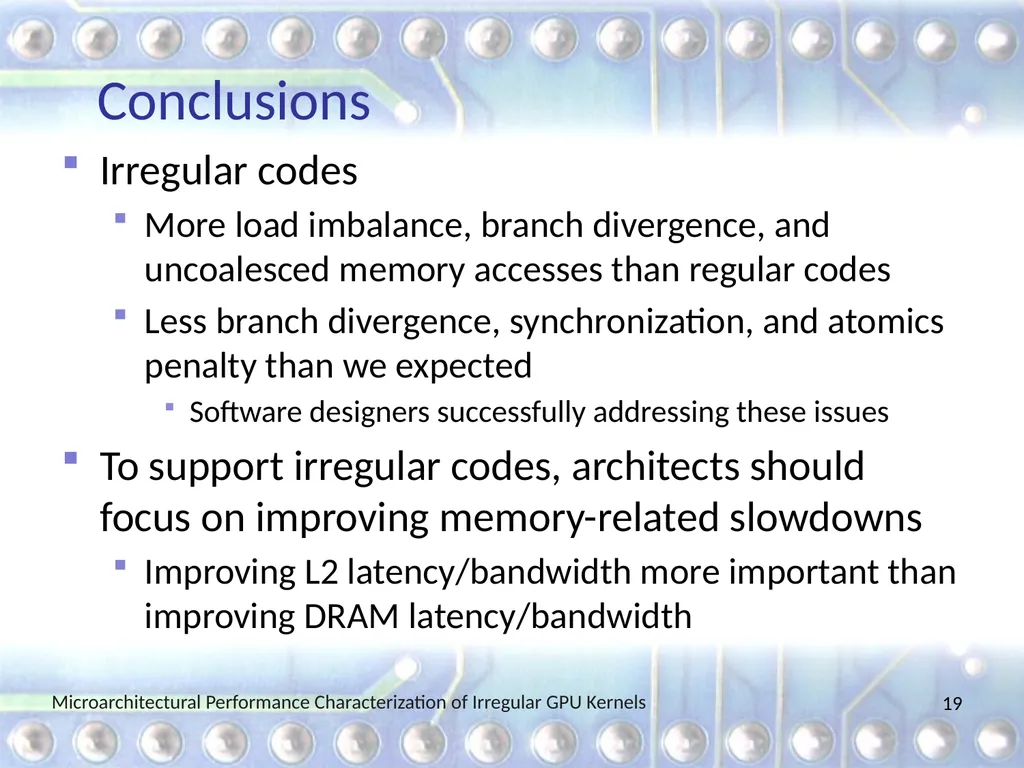
slide19. Conclusions Irregular codes
More load imbalance, branch divergence, and uncoalesced memory accesses than regular codes
Less branch divergence, synchronization, and atomics penalty than we expected
Software designers successfully addressing these issues
To support irregular codes, architects should focus on improving memory-related slowdowns
Improving L2 latency/bandwidth more important than improving DRAM latency/bandwidth Microarchitectural Performance Characterization of Irregular GPU Kernels 19<br>
slide20. Questions? Acknowledgments
NSF Graduate Research Fellowship grant 1144466
NSF grants 1141022, 1217231, and 1438963
Grants and gifts from NVIDIA Corporation Microarchitectural Performance Characterization of Irregular GPU Kernels 20<br>
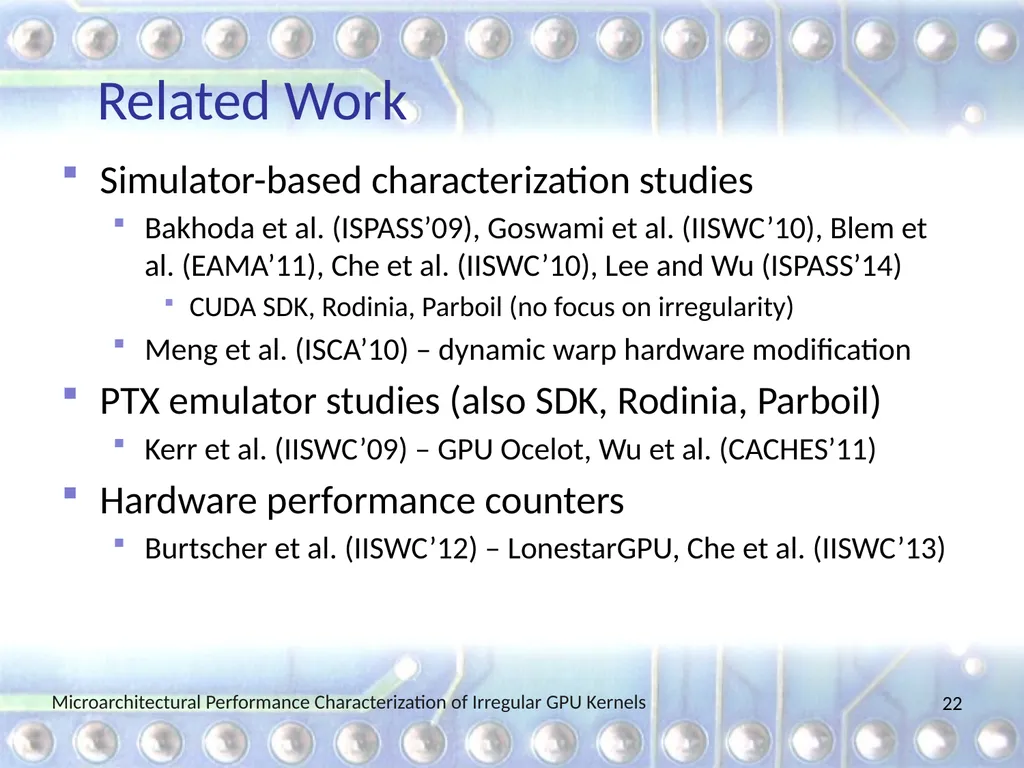
slide22. Related Work Simulator-based characterization studies
Bakhoda et al. (ISPASS’09), Goswami et al. (IISWC’10), Blem et al. (EAMA’11), Che et al. (IISWC’10), Lee and Wu (ISPASS’14)
CUDA SDK, Rodinia, Parboil (no focus on irregularity)
Meng et al. (ISCA’10) – dynamic warp hardware modification
PTX emulator studies (also SDK, Rodinia, Parboil)
Kerr et al. (IISWC’09) – GPU Ocelot, Wu et al. (CACHES’11)
Hardware performance counters
Burtscher et al. (IISWC’12) – LonestarGPU, Che et al. (IISWC’13) Microarchitectural Performance Characterization of Irregular GPU Kernels 22<br>
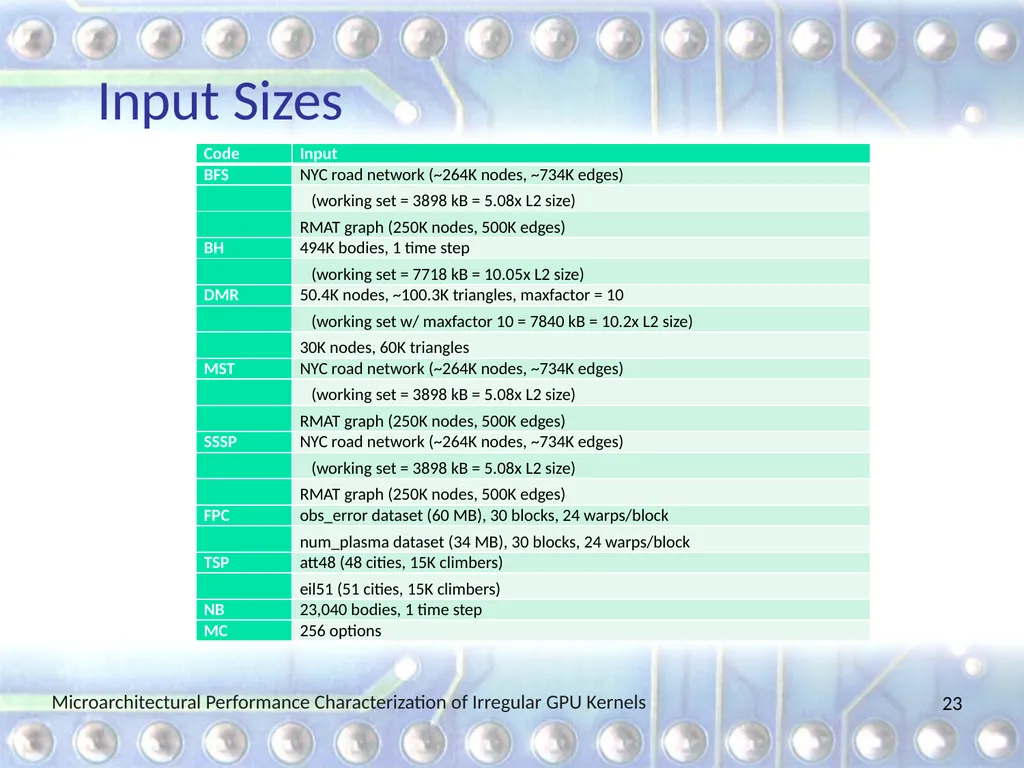
slide23. Input Sizes Microarchitectural Performance Characterization of Irregular GPU Kernels 23<br>
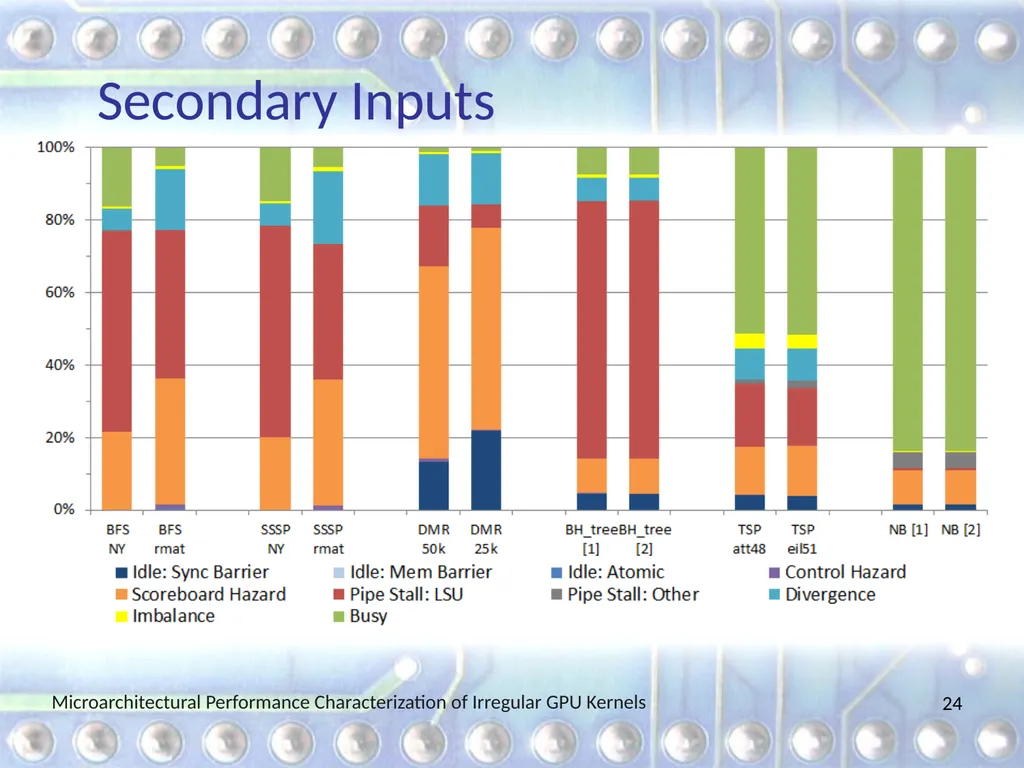
slide24. Secondary Inputs Microarchitectural Performance Characterization of Irregular GPU Kernels 24<br>
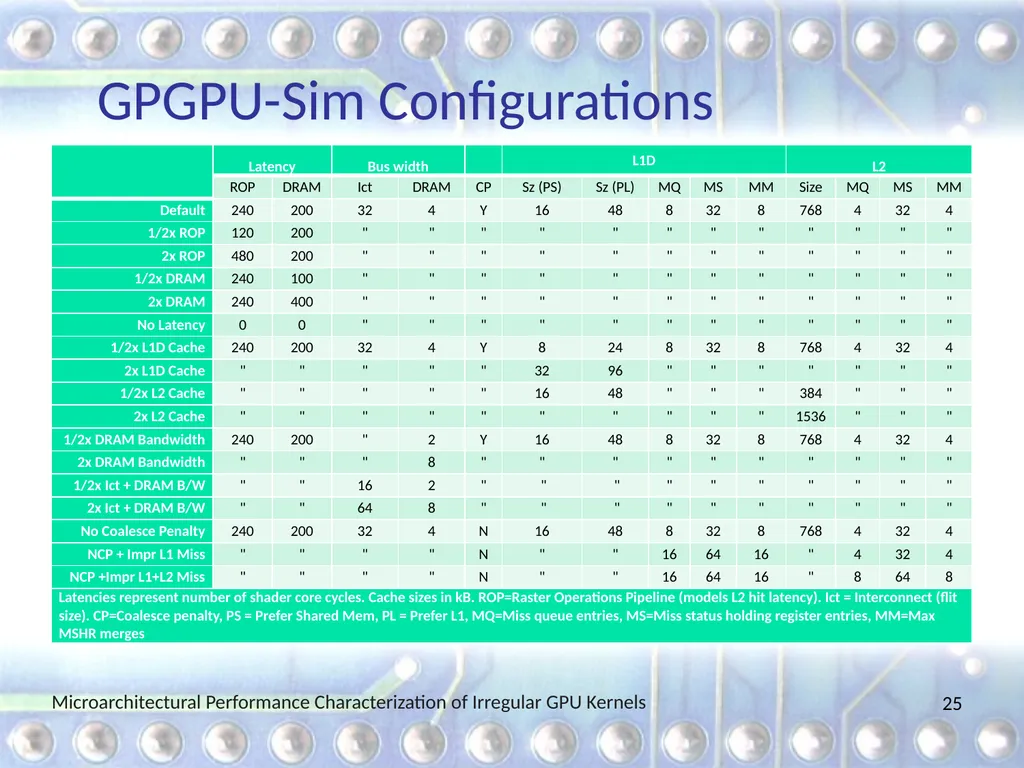
slide25. GPGPU-Sim Configurations Microarchitectural Performance Characterization of Irregular GPU Kernels 25<br>
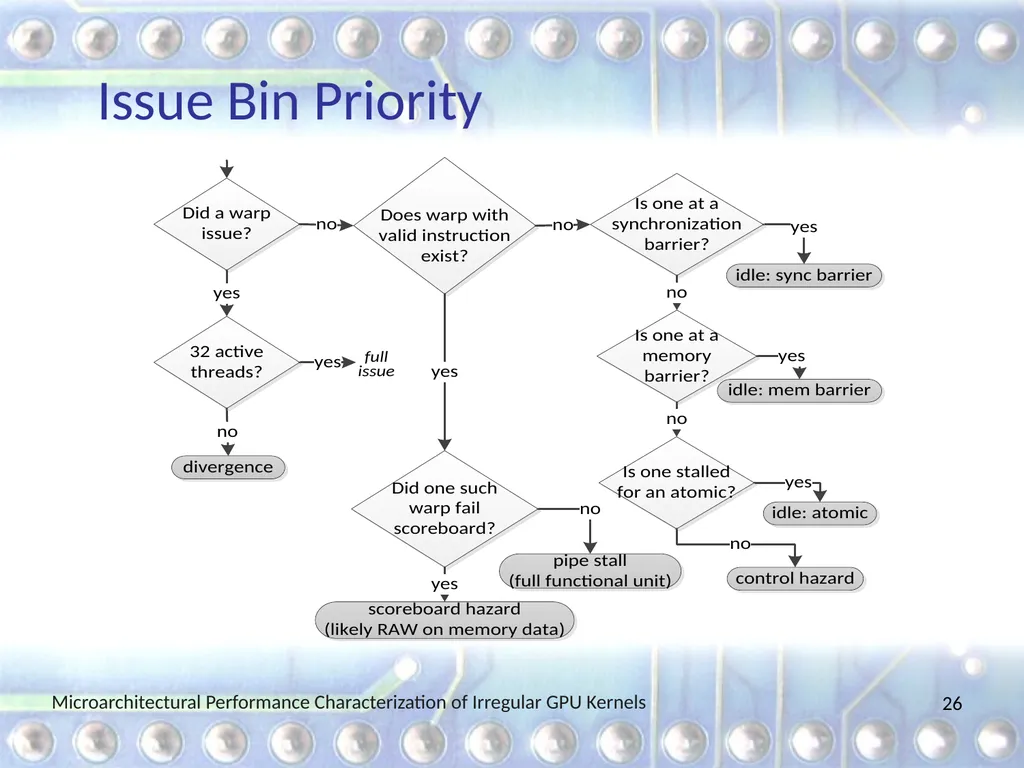
slide26. Issue Bin Priority Microarchitectural Performance Characterization of Irregular GPU Kernels 26<br>
Department of Computer Science<br>
slide2. Introduction GPUs as general-purpose accelerators
Ubiquitous in high performance computing
Spreading in PCs and mobile devices
Performance and energy efficiency benefits…
…when code is well-suited!
Regular (input independent) vs. irregular (input determines control flow and memory accesses)
Lots of important irregular algorithms
More difficult to parallelize, map less intuitively to GPUs Microarchitectural Performance Characterization of Irregular GPU Kernels 2<br>
slide3. Outline Impact on GPU performance characteristics of…
Branch divergence
Memory coalescing
Cache and memory latency
Cache and memory bandwidth
Cache size
First, review GPU coding best practices for good performance Microarchitectural Performance Characterization of Irregular GPU Kernels 3<br>
slide4. Best Practice #1: No Divergence Microarchitectural Performance Characterization of Irregular GPU Kernels 4 To execute in parallel, threads in a warp must share identical control flow
If not, execution serialized into smaller groups of threads that do share control flow path branch divergence<br>
slide5. Best Practice #2: Coalescing Microarchitectural Performance Characterization of Irregular GPU Kernels 5 Memory accesses within a warp must be coalesced
Within a warp, memory references must fall within the same cache line
If not, accesses to additional lines are serialized<br>
slide6. Best Practice #3: Load Balance Microarchitectural Performance Characterization of Irregular GPU Kernels 6 Balance work between warps, threads, and thread blocks All 3 difficult for irregular codes
Data-dependent behavior makes it difficult to assign works to threads to achieve coalescing, identical control flow, load balance
Very different from CPU code considerations<br>
slide7. Simulation Study Want to better understand irregular apps’ specific demands on GPU hardware
To help software developers optimize irregular codes
As a baseline for exploring hardware support for broader classes of codes
GPGPU-Sim v3.2.1 + a few extra perf. counters
GTX 480 (Fermi) configuration
Added configuration variants to scale latency, bandwidth, cache size, etc. Microarchitectural Performance Characterization of Irregular GPU Kernels 7<br>
slide8. Applications from LonestarGPU Suite Breadth-First Search (BFS)
Label each node in graph with min level from start node
Barnes-Hut (BH)
N-body algorithm using octree to decompose space around bodies
Mesh Refinement (DMR)
Iteratively transform ‘bad’ triangles by retriangulating surrounding cavity Minimum Spanning Tree (MST)
Contract minimum edge until single node
Single-Source Shortest Paths (SSSP)
Find shortest path to each node from source 8 Microarchitectural Performance Characterization of Irregular GPU Kernels<br>
slide9. Semi-Regular FP Compression (FPC)
Lossless data compression for DP floating-point values
Irregular control flow
Traveling Salesman (TSP)
Find minimal tour in graph using iterative hill climbing
Irregular memory accesses Regular N-Body (NB)
N-body algorithm using all-to-all force calculation
Monte Carlo (MC)
Evaluates fair call price for set of options
CUDA SDK version Microarchitectural Performance Characterization of Irregular GPU Kernels 9 Applications from Other Sources Inputs result in working set ≥5 times default L2 size<br>
slide10. Application Performance Peak = 480 IPC
As expected, regular mostly means better performing
BH is the exception: primary kernel regularized
Clear tendency for lower IPCs for irregular codes
But no simple rule to delineate regular vs. irregular Microarchitectural Performance Characterization of Irregular GPU Kernels 10<br>
slide11. Branch Divergence Microarchitectural Performance Characterization of Irregular GPU Kernels 11 Active instructions at warp issue
32 = no divergence
Only one code <50% occupied
Theoretical speedup
Assumes each issue had 32 active insts.<br>
slide12. Memory Coalescing Microarchitectural Performance Characterization of Irregular GPU Kernels 12 Avg # of memory accesses by each global/local ld/st
>1 = uncoalesced
Percentage of stalls due to uncoalesced accesses
Provides an upper bound on speedup<br>
slide13. Memory Coalescing Microarchitectural Performance Characterization of Irregular GPU Kernels 13 New configuration to artificially remove pipeline stall penalty from non-coalesced accesses
With no further improvements to memory pipeline, with increased-capacity miss queues and MSHRs
Not intended to model realistic improvement<br>
slide14. L2 and DRAM Latency Microarchitectural Performance Characterization of Irregular GPU Kernels 14 Scaled L2 hit and DRAM access latencies
Doubled, halved, zeroed
Most benchmarks more sensitive to L2 latency
Even with input sizes several times the L2 capacity<br>
slide15. Interconnect and DRAM Bandwidth Microarchitectural Performance Characterization of Irregular GPU Kernels 15 Halved/doubled interconnect (L2) bandwidth and DRAM bus width
Benchmark sensitivities similar to latency results
L2 large enough to keep sufficient warps ready<br>
slide16. Cache Behavior Microarchitectural Performance Characterization of Irregular GPU Kernels 16 Very high miss ratios (generally >50% in L1)
Irregular codes have much greater MPKI
BFS & SSSP: lots of pointer-chasing, little spatial locality<br>
slide17. Cache Size Scaling Microarchitectural Performance Characterization of Irregular GPU Kernels 17 Halved, doubled both (data) cache sizes
Codes sensitive to interconnect bandwidth are also sensitive to L1D size
BH tree prefixes: L2 better at exploiting locality in traversals
Most codes hurt more by smaller L2 than L1D<br>
slide18. Individual Application Analysis Microarchitectural Performance Characterization of Irregular GPU Kernels 18 Large memory access penalty in irregular apps Divergence penalty less than we expected Synchronization penalty also below expectation Regular codes have mostly fully-occupied cycles Computation pipeline hazards (rather than LS)<br>
slide19. Conclusions Irregular codes
More load imbalance, branch divergence, and uncoalesced memory accesses than regular codes
Less branch divergence, synchronization, and atomics penalty than we expected
Software designers successfully addressing these issues
To support irregular codes, architects should focus on improving memory-related slowdowns
Improving L2 latency/bandwidth more important than improving DRAM latency/bandwidth Microarchitectural Performance Characterization of Irregular GPU Kernels 19<br>
slide20. Questions? Acknowledgments
NSF Graduate Research Fellowship grant 1144466
NSF grants 1141022, 1217231, and 1438963
Grants and gifts from NVIDIA Corporation Microarchitectural Performance Characterization of Irregular GPU Kernels 20<br>
slide22. Related Work Simulator-based characterization studies
Bakhoda et al. (ISPASS’09), Goswami et al. (IISWC’10), Blem et al. (EAMA’11), Che et al. (IISWC’10), Lee and Wu (ISPASS’14)
CUDA SDK, Rodinia, Parboil (no focus on irregularity)
Meng et al. (ISCA’10) – dynamic warp hardware modification
PTX emulator studies (also SDK, Rodinia, Parboil)
Kerr et al. (IISWC’09) – GPU Ocelot, Wu et al. (CACHES’11)
Hardware performance counters
Burtscher et al. (IISWC’12) – LonestarGPU, Che et al. (IISWC’13) Microarchitectural Performance Characterization of Irregular GPU Kernels 22<br>
slide23. Input Sizes Microarchitectural Performance Characterization of Irregular GPU Kernels 23<br>
slide24. Secondary Inputs Microarchitectural Performance Characterization of Irregular GPU Kernels 24<br>
slide25. GPGPU-Sim Configurations Microarchitectural Performance Characterization of Irregular GPU Kernels 25<br>
slide26. Issue Bin Priority Microarchitectural Performance Characterization of Irregular GPU Kernels 26<br>