
MICROBIOLOGY FOR ANALYSTS- Validation of
JO
Published · 59 slides · 0 views
1 / 1








Description
MICROBIOLOGY FOR ANALYSTS- Validation of Analytical methods in Microbiology A paper presented at the two-day mandatory training By: Dr. (Mrs) O.M. Buraimoh Department of Microbiology, Faculty of Science University of Lagos, Akoka. Tuesday
Related Topics
Share
Embed code
Download this presentation From Below
"MICROBIOLOGY FOR ANALYSTS- Validation of" is the property of its rightful owner. Permission is granted to download and print the materials on this website for personal, non-commercial use only, and to display it on your personal computer provided you do not modify the materials and that you retain all copyright notices contained in the materials. By downloading content from our website, you accept the terms of this agreement.
Presentation Transcript
01
MICROBIOLOGY FOR ANALYSTS- Validation of Analytical methods in Microbiology A paper presented at the two-day mandatory training
By:
Dr. (Mrs) O.M. Buraimoh
Department of Microbiology,
Faculty of Science
University of Lagos, Akoka.
Tuesday 21st and Wednesday 22nd April, 2015.<br>
By:
Dr. (Mrs) O.M. Buraimoh
Department of Microbiology,
Faculty of Science
University of Lagos, Akoka.
Tuesday 21st and Wednesday 22nd April, 2015.<br>
02
PRESENTATION OUTLINE Introduction and background information
Verification vs. validation
Key performance attributes/ characteristics of verification
Validation process components
Method of analysis in microbiology
Verification of selected methods of analysis
Documentation
Practical Analytical methods in microbiology(selected examples)
Benefits of method validation<br>
Verification vs. validation
Key performance attributes/ characteristics of verification
Validation process components
Method of analysis in microbiology
Verification of selected methods of analysis
Documentation
Practical Analytical methods in microbiology(selected examples)
Benefits of method validation<br>
03
INTRODUCTION AND BACKGROUND INFORMATION
Why the need for validation of methods in microbiology?
1.Every laboratory, organization or institution aspires to be of world class in terms of generating and delivering rapid quality/ reliable results . To achieve this, such organization must be prepared to go through the "rigours" of auditing carried out by the approved official bodies nationally and /internationally.<br>
Why the need for validation of methods in microbiology?
1.Every laboratory, organization or institution aspires to be of world class in terms of generating and delivering rapid quality/ reliable results . To achieve this, such organization must be prepared to go through the "rigours" of auditing carried out by the approved official bodies nationally and /internationally.<br>
04
2. Because of the roles they play (+ve and –ve)
a. Biodeterioration
- Pharmaceutical products (Pathogens and oppotunistic microorganisms
- Leather (Aspergillus, Micrococcus)
- Cosmetics (Aspergillus)
- Toiletries
- Textiles (Bacillus sp.)
- Paints (Aspergillus, Fusarium)
- Wood (Lignocellulose)
- Rubber and plastics (Pseudomonas, Norcadia)
b. Food spoilage by proteolytic, lipolytic and cellulolytic microorganisms,
c. Causes desease - Food (e.g Aflatoxins causes cancer), water, airborne diseases
4. Beneficial Roles
- Food preservation e.g bacteriocin from Bacillus sp.
- Pharmaceuticals e.g. streptomycin from Streptomyces sp.
- Fermented foods e.g. Lactobacillus in yoghurt
- Probiotic microorganisms e.g. Lactobacillus
- Bioremediation- e.g. Pseudomonas, Streptomyces spp
- Lignocellulose biotechnology for production of biofuels, vitamins, surfactants e.g. Streptomyces, Bacillus spp and some fungi<br>
a. Biodeterioration
- Pharmaceutical products (Pathogens and oppotunistic microorganisms
- Leather (Aspergillus, Micrococcus)
- Cosmetics (Aspergillus)
- Toiletries
- Textiles (Bacillus sp.)
- Paints (Aspergillus, Fusarium)
- Wood (Lignocellulose)
- Rubber and plastics (Pseudomonas, Norcadia)
b. Food spoilage by proteolytic, lipolytic and cellulolytic microorganisms,
c. Causes desease - Food (e.g Aflatoxins causes cancer), water, airborne diseases
4. Beneficial Roles
- Food preservation e.g bacteriocin from Bacillus sp.
- Pharmaceuticals e.g. streptomycin from Streptomyces sp.
- Fermented foods e.g. Lactobacillus in yoghurt
- Probiotic microorganisms e.g. Lactobacillus
- Bioremediation- e.g. Pseudomonas, Streptomyces spp
- Lignocellulose biotechnology for production of biofuels, vitamins, surfactants e.g. Streptomyces, Bacillus spp and some fungi<br>
05
Major areas of audit in the microbiological laboratory (All are interwoven) include :
1. Reagents and Media
2. Reference Standards
3. Equipment and Instruments
4. Method Validation
5. Laboratory Controls
6. Recordkeeping and Documentation
7. Employee Training
8. Sample Control<br>
1. Reagents and Media
2. Reference Standards
3. Equipment and Instruments
4. Method Validation
5. Laboratory Controls
6. Recordkeeping and Documentation
7. Employee Training
8. Sample Control<br>
06
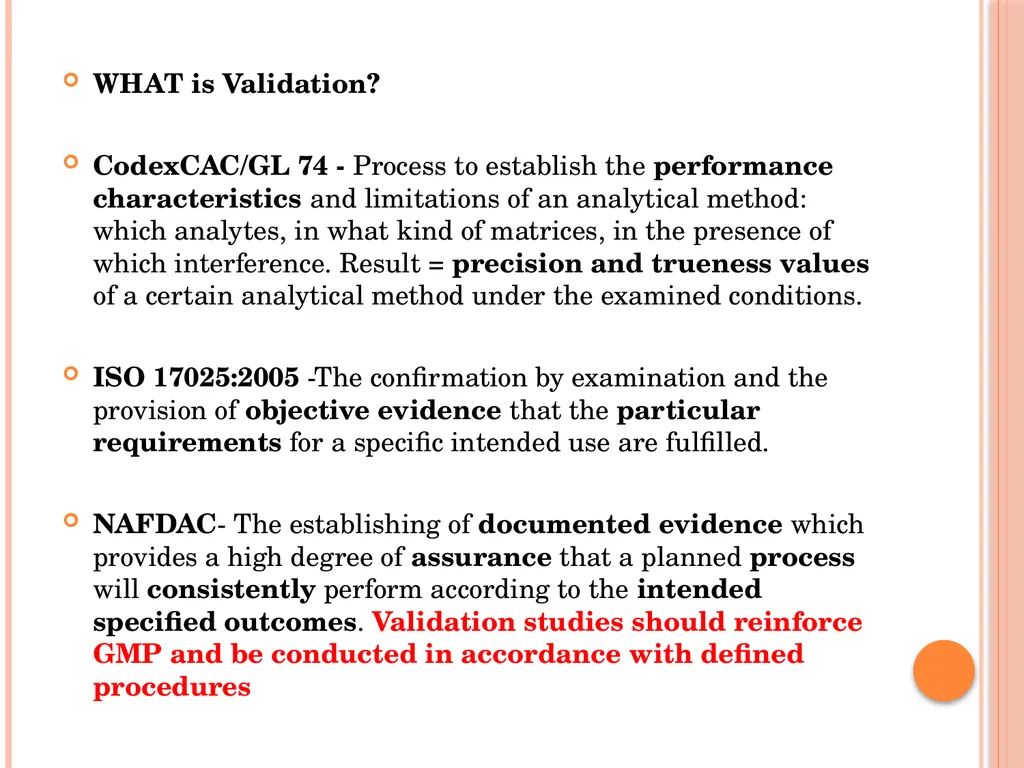
WHAT is Validation?
CodexCAC/GL 74 - Process to establish the performance characteristics and limitations of an analytical method: which analytes, in what kind of matrices, in the presence of which interference. Result = precision and trueness values of a certain analytical method under the examined conditions.
ISO 17025:2005 -The confirmation by examination and the provision of objective evidence that the particular requirements for a specific intended use are fulfilled.
NAFDAC- The establishing of documented evidence which provides a high degree of assurance that a planned process will consistently perform according to the intended specified outcomes. Validation studies should reinforce GMP and be conducted in accordance with defined procedures<br>
CodexCAC/GL 74 - Process to establish the performance characteristics and limitations of an analytical method: which analytes, in what kind of matrices, in the presence of which interference. Result = precision and trueness values of a certain analytical method under the examined conditions.
ISO 17025:2005 -The confirmation by examination and the provision of objective evidence that the particular requirements for a specific intended use are fulfilled.
NAFDAC- The establishing of documented evidence which provides a high degree of assurance that a planned process will consistently perform according to the intended specified outcomes. Validation studies should reinforce GMP and be conducted in accordance with defined procedures<br>
07
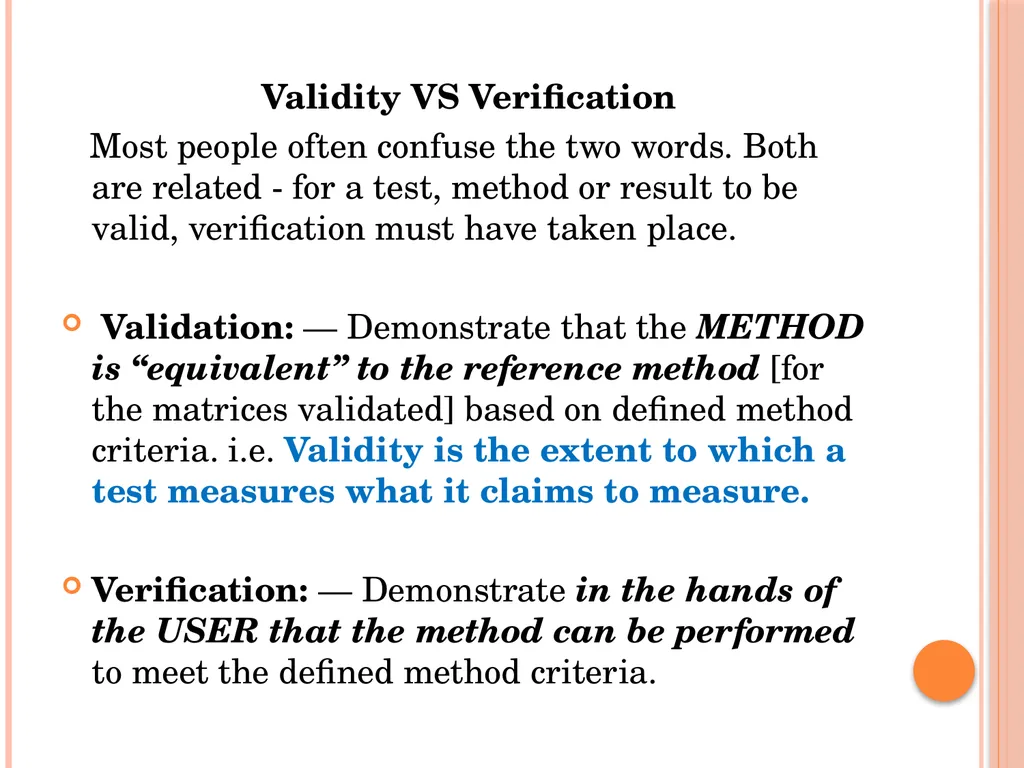
Validity VS Verification
Most people often confuse the two words. Both are related - for a test, method or result to be valid, verification must have taken place.
Validation: ― Demonstrate that the METHOD is “equivalent” to the reference method [for the matrices validated] based on defined method criteria. i.e. Validity is the extent to which a test measures what it claims to measure.
Verification: ― Demonstrate in the hands of the USER that the method can be performed to meet the defined method criteria.<br>
Most people often confuse the two words. Both are related - for a test, method or result to be valid, verification must have taken place.
Validation: ― Demonstrate that the METHOD is “equivalent” to the reference method [for the matrices validated] based on defined method criteria. i.e. Validity is the extent to which a test measures what it claims to measure.
Verification: ― Demonstrate in the hands of the USER that the method can be performed to meet the defined method criteria.<br>
08
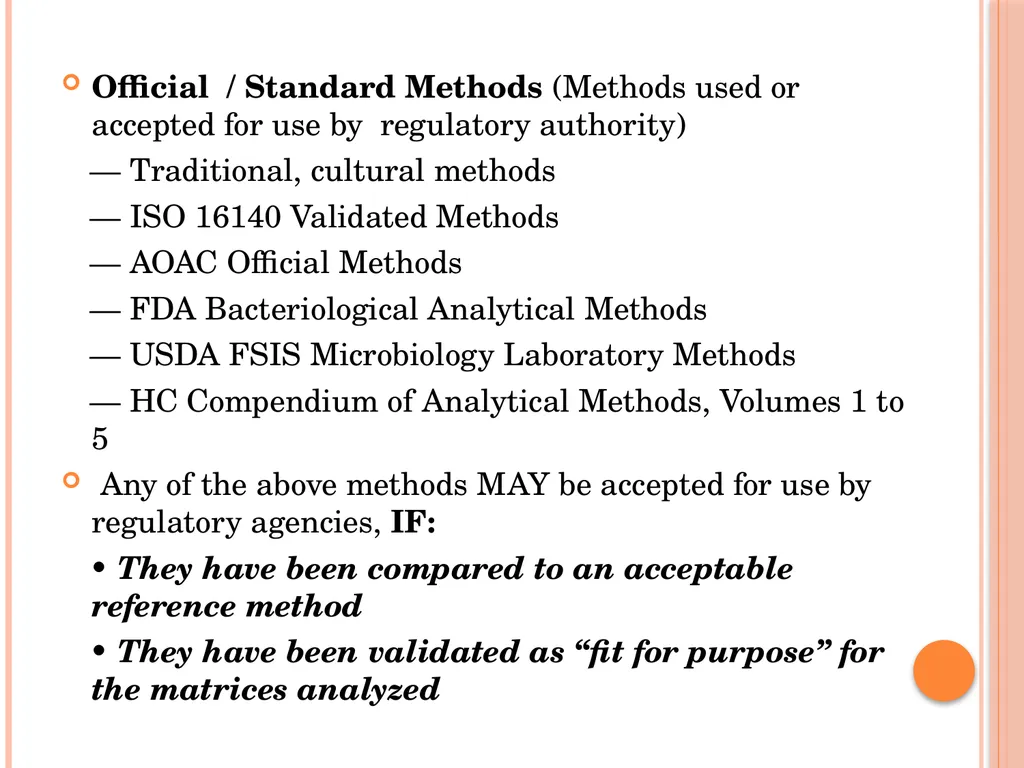
Official / Standard Methods (Methods used or accepted for use by regulatory authority)
― Traditional, cultural methods
― ISO 16140 Validated Methods
― AOAC Official Methods
― FDA Bacteriological Analytical Methods
― USDA FSIS Microbiology Laboratory Methods
― HC Compendium of Analytical Methods, Volumes 1 to 5
Any of the above methods MAY be accepted for use by regulatory agencies, IF:
• They have been compared to an acceptable reference method
• They have been validated as “fit for purpose” for the matrices analyzed<br>
― Traditional, cultural methods
― ISO 16140 Validated Methods
― AOAC Official Methods
― FDA Bacteriological Analytical Methods
― USDA FSIS Microbiology Laboratory Methods
― HC Compendium of Analytical Methods, Volumes 1 to 5
Any of the above methods MAY be accepted for use by regulatory agencies, IF:
• They have been compared to an acceptable reference method
• They have been validated as “fit for purpose” for the matrices analyzed<br>
09
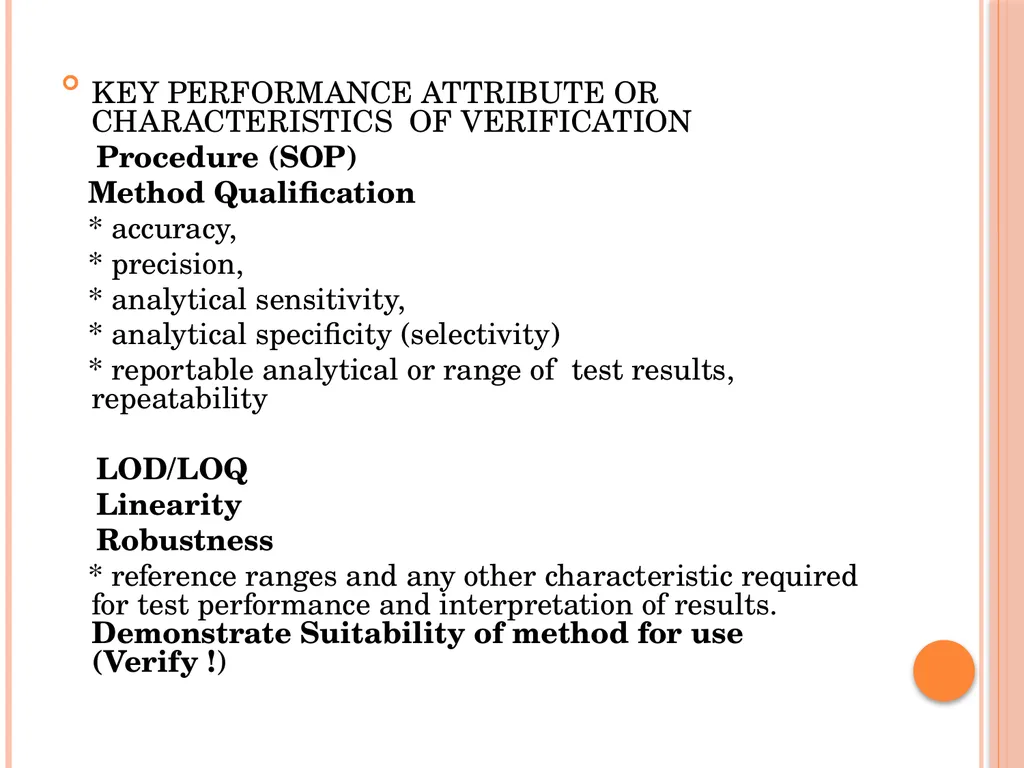
KEY PERFORMANCE ATTRIBUTE OR CHARACTERISTICS OF VERIFICATION
Procedure (SOP)
Method Qualification
* accuracy,
* precision,
* analytical sensitivity,
* analytical specificity (selectivity)
* reportable analytical or range of test results, repeatability
LOD/LOQ
Linearity
Robustness
* reference ranges and any other characteristic required for test performance and interpretation of results. Demonstrate Suitability of method for use (Verify !)<br>
Procedure (SOP)
Method Qualification
* accuracy,
* precision,
* analytical sensitivity,
* analytical specificity (selectivity)
* reportable analytical or range of test results, repeatability
LOD/LOQ
Linearity
Robustness
* reference ranges and any other characteristic required for test performance and interpretation of results. Demonstrate Suitability of method for use (Verify !)<br>
10
Validation Process Components
There are essential components that comprise the validation process. They include:
1. QC organisms –
(These QC organisms may come from a variety of sources).
- How, when and where obtained must be known
- Storage conditions
- Number of passages
- Proper documentation about the organism must be done<br>
There are essential components that comprise the validation process. They include:
1. QC organisms –
(These QC organisms may come from a variety of sources).
- How, when and where obtained must be known
- Storage conditions
- Number of passages
- Proper documentation about the organism must be done<br>
11
Reference Standards
Microbial cultures are delicate standards. Procedures should specify careful handling instructions.
Preparation and resuscitation of cultures should follow the instructions of the supplier or a validated, established method.
"Seed-Lot" technique for storage of stock cultures, i.e., using working cultures and never returning unused passages back to original stock.
There should be an established maximum number of passages (5 or less), and maximum storage time for working cultures.
Cultures for use in compendial tests should be acquired from a national culture collection, in frozen, freeze-dried, on slants, or in ready-to-use forms.
Confirmation of the purity and the identity should be performed prior to its use in quality control testing.
Ready-to-use cultures may require additional confirmation of inoculums size.<br>
Microbial cultures are delicate standards. Procedures should specify careful handling instructions.
Preparation and resuscitation of cultures should follow the instructions of the supplier or a validated, established method.
"Seed-Lot" technique for storage of stock cultures, i.e., using working cultures and never returning unused passages back to original stock.
There should be an established maximum number of passages (5 or less), and maximum storage time for working cultures.
Cultures for use in compendial tests should be acquired from a national culture collection, in frozen, freeze-dried, on slants, or in ready-to-use forms.
Confirmation of the purity and the identity should be performed prior to its use in quality control testing.
Ready-to-use cultures may require additional confirmation of inoculums size.<br>
12
Purchased Cell Cultures
1. When purchasing microorganisms from a national culture collection, what incoming QC tests are run for identity and purity? Is the ID done via genotypic analysis?
2.How are the number of passages of working cultures tracked, and what is the maximum number permitted (not more than 5 passages for cutures used in +ve. controls of sterility tests)
3.There must be a record of sub-culturing a purchased organism.
4.How long can a working culture be used (<= 1 wk)?<br>
1. When purchasing microorganisms from a national culture collection, what incoming QC tests are run for identity and purity? Is the ID done via genotypic analysis?
2.How are the number of passages of working cultures tracked, and what is the maximum number permitted (not more than 5 passages for cutures used in +ve. controls of sterility tests)
3.There must be a record of sub-culturing a purchased organism.
4.How long can a working culture be used (<= 1 wk)?<br>
13
2. Sample Validation (validated preparatory steps prior to moving into the common steps)
Bacteriostasis/Fungistasis(sterility, bioburden)
Inhibition/Enhancement (endotoxin)
Prep. Test (microbial limit)
Neutralization
SOP
Acceptance Criteria
An analyte can be a metabolic product, nucleic acid, enzyme, antigen, etc. Commercial kits have the QC analytes provided.
The analyte should be identified with a lot number, its concentration, titre (where appropriate), date of preparation, how it is to be used and storage information.
For a QC analyte developed by the laboratory, the above information needs to be available as well as a clear history of its development
Frequency of QC testing should follow the recommendation set forth by the manufacturer.
For home-brew tests, positive, negative and other appropriate controls should be determined from the appropriate reference sources such as the NCCLS, Wayne, PA, Manual of Clinical Microbiology and/or Clinical Microbiology Procedures Handbook.<br>
Bacteriostasis/Fungistasis(sterility, bioburden)
Inhibition/Enhancement (endotoxin)
Prep. Test (microbial limit)
Neutralization
SOP
Acceptance Criteria
An analyte can be a metabolic product, nucleic acid, enzyme, antigen, etc. Commercial kits have the QC analytes provided.
The analyte should be identified with a lot number, its concentration, titre (where appropriate), date of preparation, how it is to be used and storage information.
For a QC analyte developed by the laboratory, the above information needs to be available as well as a clear history of its development
Frequency of QC testing should follow the recommendation set forth by the manufacturer.
For home-brew tests, positive, negative and other appropriate controls should be determined from the appropriate reference sources such as the NCCLS, Wayne, PA, Manual of Clinical Microbiology and/or Clinical Microbiology Procedures Handbook.<br>
14
3. Proficiency test (PT) - To maintain certification, every laboratory needs to participate in an approved PT program. An internal blinded PT program may supplement the external PT program when deemed necessary. (can also be use to check the efficiency of the analyst)
4.Equipment and Instrument calibration - Every instrument in the microbiology laboratory needs to be calibrated on a regular basis. The manufacturer's instruction and schedule for calibration must be followed ( there should be a calibration sticker /label indicating date of calibration, due date.<br>
4.Equipment and Instrument calibration - Every instrument in the microbiology laboratory needs to be calibrated on a regular basis. The manufacturer's instruction and schedule for calibration must be followed ( there should be a calibration sticker /label indicating date of calibration, due date.<br>
15
Equipments and Instruments commonly used in athemicrobiology lab
Equipment
-Microscope
-Incubators
-Refrigerators
-Water baths
-Autoclave
- Centrifuge
Instrument
-KQCL machine
-pH meter
-Weighing balance
-Spectrophotometers
-Air sampler (viable, none-viable)
Validation- Approved Protocols –Equipment should be qualified with intended application
IQ
OQ
PQ
Calibration
Execution
Report
Verification<br>
Equipment
-Microscope
-Incubators
-Refrigerators
-Water baths
-Autoclave
- Centrifuge
Instrument
-KQCL machine
-pH meter
-Weighing balance
-Spectrophotometers
-Air sampler (viable, none-viable)
Validation- Approved Protocols –Equipment should be qualified with intended application
IQ
OQ
PQ
Calibration
Execution
Report
Verification<br>
16
5. Personnel competency. –The quality of a product ultimately depends on the quality of those producing it”….- Sir Dereck Dunlop (1971) “If you don't train them, dont blame them”.
Personnel performance, therefore, must be consistently evaluated (Train them as science is dynamic).
Individual responsibilities and job descriptions should be clearly defined and understood.
Personnel should be aware of the principles of GMP that affect them and receive initial and continuing training, including hygiene instructions, relevant to their need (Sharp, 2005).
The quality professional should have a very high level of knowledge, skills, and experience.<br>
Personnel performance, therefore, must be consistently evaluated (Train them as science is dynamic).
Individual responsibilities and job descriptions should be clearly defined and understood.
Personnel should be aware of the principles of GMP that affect them and receive initial and continuing training, including hygiene instructions, relevant to their need (Sharp, 2005).
The quality professional should have a very high level of knowledge, skills, and experience.<br>
17
Training of Personnel Using a qualified-trained trainers
Company
Department
General Microbiological
On the job (function)performance based evaluation
Demonstrated proficiency
Maintain the proficiency
-Has cross-training created sufficient designated back-ups for critical activities in the Lab (or even for reviewing analysts’ results)?<br>
Company
Department
General Microbiological
On the job (function)performance based evaluation
Demonstrated proficiency
Maintain the proficiency
-Has cross-training created sufficient designated back-ups for critical activities in the Lab (or even for reviewing analysts’ results)?<br>
18
Personnel Trainning Cont.
- Have the training curricula for each unique Lab position.
-Determine the most recent effective date for a change to a Micro SOP (if need be), then examine training records for updated training on the new revision.
5. Have the Microbiology OOS procedure.<br>
- Have the training curricula for each unique Lab position.
-Determine the most recent effective date for a change to a Micro SOP (if need be), then examine training records for updated training on the new revision.
5. Have the Microbiology OOS procedure.<br>
19
6. QC reagents must be available
- Storage conditions
- Lot number should be documented
- Expiry date should be noted
- Follow the principle of FIFO
-Follow manufacturers instructions for use
- Avoid contamination of reagents
- Verify reagents use<br>
- Storage conditions
- Lot number should be documented
- Expiry date should be noted
- Follow the principle of FIFO
-Follow manufacturers instructions for use
- Avoid contamination of reagents
- Verify reagents use<br>
20
Laboratory Operations/Housekeeping
Safety first - The Micro Lab should practice aseptic techniques to avoid microbial contamination of personnel, environment and assay, and also prevent false positives
In the Micro Lab, areas where EM, water, or product samples are handled/incubated must be adequately separated from areas where there are tests that involve live cultures or sub-culturing, microbial ID, or investigations
Housekeeping must be properly maintained to prevent use of expired or contaminated testing materials.
Verify cleanliness of work stations, cleared of extraneous or previous test materials prompt removal of refuse, and clean utensils and equipment<br>
Safety first - The Micro Lab should practice aseptic techniques to avoid microbial contamination of personnel, environment and assay, and also prevent false positives
In the Micro Lab, areas where EM, water, or product samples are handled/incubated must be adequately separated from areas where there are tests that involve live cultures or sub-culturing, microbial ID, or investigations
Housekeeping must be properly maintained to prevent use of expired or contaminated testing materials.
Verify cleanliness of work stations, cleared of extraneous or previous test materials prompt removal of refuse, and clean utensils and equipment<br>
21
VALIDATION OF ANALYTICAL METHODS IN MICROBIOLOGY.
Method validation is the process used to confirm that the analytical procedure employed for a specific test is suitable for its intended use. Results from method validation can be used to judge the quality, reliability and consistency of analytical results; it is an integral part of any good analytical practice. Analytical methods need to be validated or revalidated before their introduction into routine use. It involves the following:
-Antimicrobial Effectiveness Testing
-Biological Indicators
-Microbiological Examination of Non-sterile Products: Microbial Enumeration Tests (Bioburden)
-Microbiological Examination of Non sterile Products : Tests for Specified Microorganisms (Microbial Limits)
-Sterility
-Endotoxin<br>
Method validation is the process used to confirm that the analytical procedure employed for a specific test is suitable for its intended use. Results from method validation can be used to judge the quality, reliability and consistency of analytical results; it is an integral part of any good analytical practice. Analytical methods need to be validated or revalidated before their introduction into routine use. It involves the following:
-Antimicrobial Effectiveness Testing
-Biological Indicators
-Microbiological Examination of Non-sterile Products: Microbial Enumeration Tests (Bioburden)
-Microbiological Examination of Non sterile Products : Tests for Specified Microorganisms (Microbial Limits)
-Sterility
-Endotoxin<br>
22
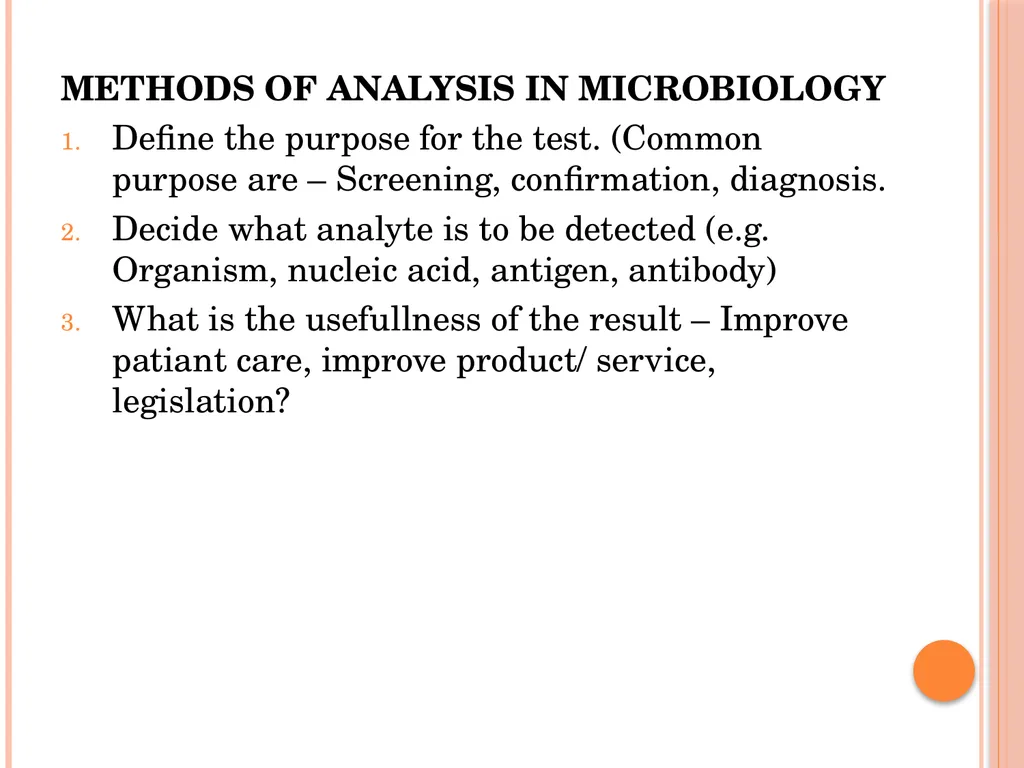
METHODS OF ANALYSIS IN MICROBIOLOGY
Define the purpose for the test. (Common purpose are – Screening, confirmation, diagnosis.
Decide what analyte is to be detected (e.g. Organism, nucleic acid, antigen, antibody)
What is the usefullness of the result – Improve patiant care, improve product/ service, legislation?<br>
Define the purpose for the test. (Common purpose are – Screening, confirmation, diagnosis.
Decide what analyte is to be detected (e.g. Organism, nucleic acid, antigen, antibody)
What is the usefullness of the result – Improve patiant care, improve product/ service, legislation?<br>
23
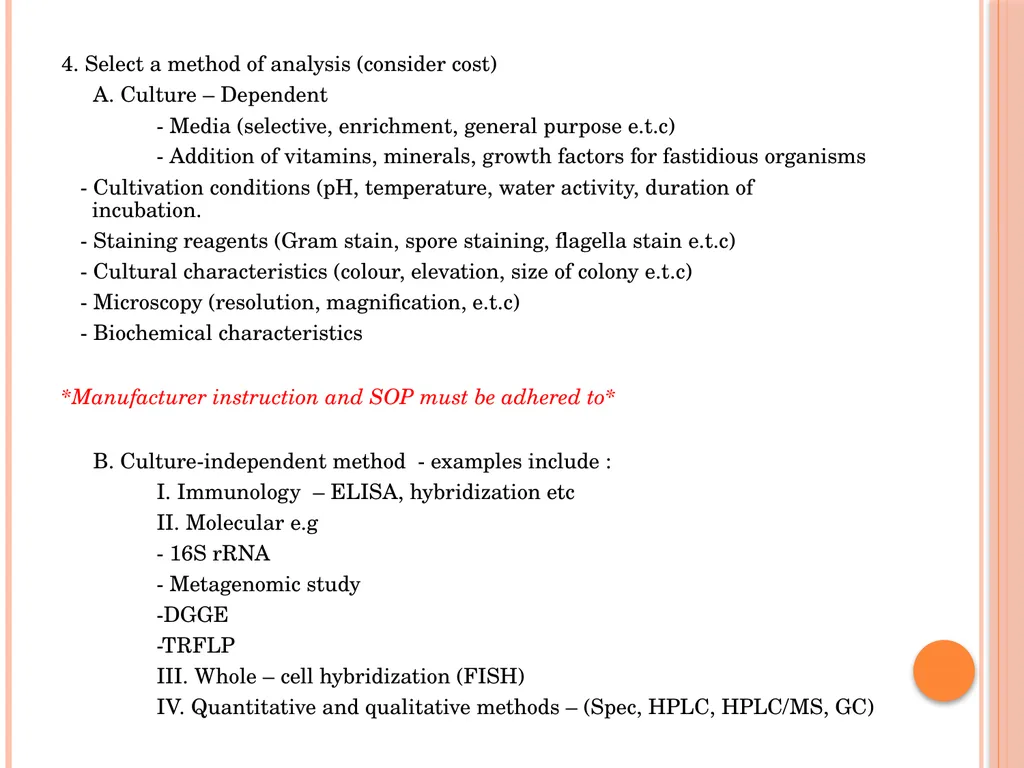
4. Select a method of analysis (consider cost)
A. Culture – Dependent
- Media (selective, enrichment, general purpose e.t.c)
- Addition of vitamins, minerals, growth factors for fastidious organisms
- Cultivation conditions (pH, temperature, water activity, duration of incubation.
- Staining reagents (Gram stain, spore staining, flagella stain e.t.c)
- Cultural characteristics (colour, elevation, size of colony e.t.c)
- Microscopy (resolution, magnification, e.t.c)
- Biochemical characteristics
*Manufacturer instruction and SOP must be adhered to*
B. Culture-independent method - examples include :
I. Immunology – ELISA, hybridization etc
II. Molecular e.g
- 16S rRNA
- Metagenomic study
-DGGE
-TRFLP
III. Whole – cell hybridization (FISH)
IV. Quantitative and qualitative methods – (Spec, HPLC, HPLC/MS, GC)<br>
A. Culture – Dependent
- Media (selective, enrichment, general purpose e.t.c)
- Addition of vitamins, minerals, growth factors for fastidious organisms
- Cultivation conditions (pH, temperature, water activity, duration of incubation.
- Staining reagents (Gram stain, spore staining, flagella stain e.t.c)
- Cultural characteristics (colour, elevation, size of colony e.t.c)
- Microscopy (resolution, magnification, e.t.c)
- Biochemical characteristics
*Manufacturer instruction and SOP must be adhered to*
B. Culture-independent method - examples include :
I. Immunology – ELISA, hybridization etc
II. Molecular e.g
- 16S rRNA
- Metagenomic study
-DGGE
-TRFLP
III. Whole – cell hybridization (FISH)
IV. Quantitative and qualitative methods – (Spec, HPLC, HPLC/MS, GC)<br>
24
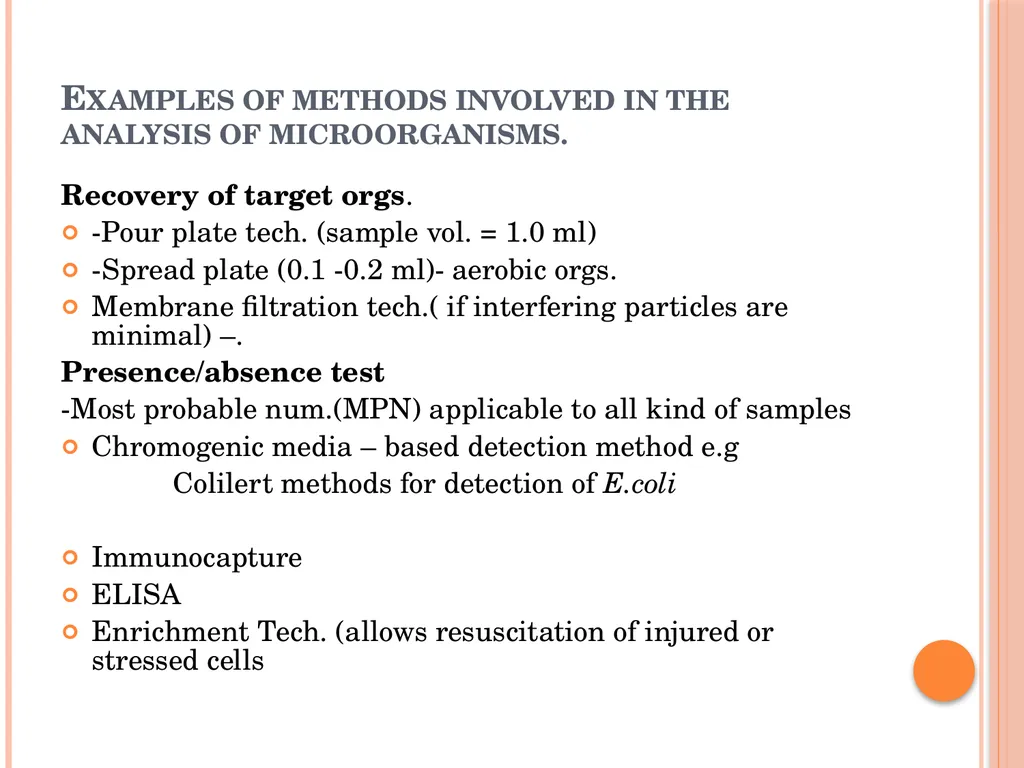
Examples of methods involved in the analysis of microorganisms. Recovery of target orgs.
-Pour plate tech. (sample vol. = 1.0 ml)
-Spread plate (0.1 -0.2 ml)- aerobic orgs.
Membrane filtration tech.( if interfering particles are minimal) –.
Presence/absence test
-Most probable num.(MPN) applicable to all kind of samples
Chromogenic media – based detection method e.g
Colilert methods for detection of E.coli
Immunocapture
ELISA
Enrichment Tech. (allows resuscitation of injured or stressed cells<br>
-Pour plate tech. (sample vol. = 1.0 ml)
-Spread plate (0.1 -0.2 ml)- aerobic orgs.
Membrane filtration tech.( if interfering particles are minimal) –.
Presence/absence test
-Most probable num.(MPN) applicable to all kind of samples
Chromogenic media – based detection method e.g
Colilert methods for detection of E.coli
Immunocapture
ELISA
Enrichment Tech. (allows resuscitation of injured or stressed cells<br>
25
Examples Cont’d Cultivation of Viruses
- Monolayer plague assay
-Liquid overlay assays
-Immunological techniques.
Molecular (PCR, Hybridization)
Cultivation of Protozoa( Use of artificial media for medical diagnosis of of Entamoeba histolytical and Giardia lamblia
Established standard method are available, E.g. American Public Health Association (APHA), as listed earlier.<br>
- Monolayer plague assay
-Liquid overlay assays
-Immunological techniques.
Molecular (PCR, Hybridization)
Cultivation of Protozoa( Use of artificial media for medical diagnosis of of Entamoeba histolytical and Giardia lamblia
Established standard method are available, E.g. American Public Health Association (APHA), as listed earlier.<br>
26
Detection of Toxins Pathogens or their toxins can also be detected from food and medical samples such as sputum, pus urine etc.
Culture method is carried out by centrifuging the sample, sediments used as inoculums. Faeces samples may be dispersed in Ringer’s solutn, an aliquot is then used as inoculum. (choice of media, condition of incubation etc depends on the nature of sample and the suspected pathogen.
Immunology method may also be used where carrier proteins are used and antibodies have been raised to a wide range of mycotoxins e.g aflatoxins, ochratoxin etc.<br>
Culture method is carried out by centrifuging the sample, sediments used as inoculums. Faeces samples may be dispersed in Ringer’s solutn, an aliquot is then used as inoculum. (choice of media, condition of incubation etc depends on the nature of sample and the suspected pathogen.
Immunology method may also be used where carrier proteins are used and antibodies have been raised to a wide range of mycotoxins e.g aflatoxins, ochratoxin etc.<br>
27
Blood Culture Blood culture for detecting bacterial diseases e.g. typhoid. Patient’s blood (5-10 ml aseptically taken is added to 50 -100 ml of medium (e.g. trypticase soy broth containing anticoagulant and enzyme to inactivate antibiotics.
Other methods<br>
Other methods<br>
28
Antibiotic assay An analyst in the microbiology lab may also be requested to assess the concentration of antibiotics in the body fluid :
Tube dilution assay method
Large plate assay
Standard reference organisms are recommended for the assay of different antibiotics. E.g. Bacillus substilis NCTC8236 for penicillin, Staphylococcus aureus NCTC for cephalosporins.<br>
Tube dilution assay method
Large plate assay
Standard reference organisms are recommended for the assay of different antibiotics. E.g. Bacillus substilis NCTC8236 for penicillin, Staphylococcus aureus NCTC for cephalosporins.<br>
29
5. Perform in-house verification. Verification of a test serves to establish that the performance parameters of the test are satisfactory.
Parameters
Specimen (sample)
The quality of results generated by microbiology methods depends on the quality of the specimen received by the laboratory. It's critical, therefore, that sample collection and transport devices be evaluated for their performance
Re-evaluation time scales should be
developed from historical data, where possible.<br>
Parameters
Specimen (sample)
The quality of results generated by microbiology methods depends on the quality of the specimen received by the laboratory. It's critical, therefore, that sample collection and transport devices be evaluated for their performance
Re-evaluation time scales should be
developed from historical data, where possible.<br>
30
VERIFICATION (CONT’D)
1. Method of sample collection (appropriate, done by an experienced and skilled staff)
2. Method of preparation (Procedure) - Must be handled aseptically and in line with GLP. - Avoid cross contamination by using sterile containers, dilution water, be well kitted and protected etc.<br>
1. Method of sample collection (appropriate, done by an experienced and skilled staff)
2. Method of preparation (Procedure) - Must be handled aseptically and in line with GLP. - Avoid cross contamination by using sterile containers, dilution water, be well kitted and protected etc.<br>
31
VERIFICATION (CONT’D)
3. Sample Control (Traceability)
- Retain quality of specimen ( storage pre/post analysis, time, shelf life, conditions, packaging, traceability etc).
-How Micro samples are logged in and stored.
-Does the sample log book (or other record) provide spaces for who delivered the sample and who then took it for testing (i.e. chain of custody)?
-What type of samples might be temporarily stored while awaiting testing?
-What method validation or compendial reference supports the sample storage conditions (e.g., water, blood etc)?
-What site SOP governs what happens when a water or an EM sample time point is missed? ( there should be a deviation).
-If LIMS is used for tracking all samples and activities, check if pen raw data precedes computer and whether the former is properly retained.<br>
3. Sample Control (Traceability)
- Retain quality of specimen ( storage pre/post analysis, time, shelf life, conditions, packaging, traceability etc).
-How Micro samples are logged in and stored.
-Does the sample log book (or other record) provide spaces for who delivered the sample and who then took it for testing (i.e. chain of custody)?
-What type of samples might be temporarily stored while awaiting testing?
-What method validation or compendial reference supports the sample storage conditions (e.g., water, blood etc)?
-What site SOP governs what happens when a water or an EM sample time point is missed? ( there should be a deviation).
-If LIMS is used for tracking all samples and activities, check if pen raw data precedes computer and whether the former is properly retained.<br>
32
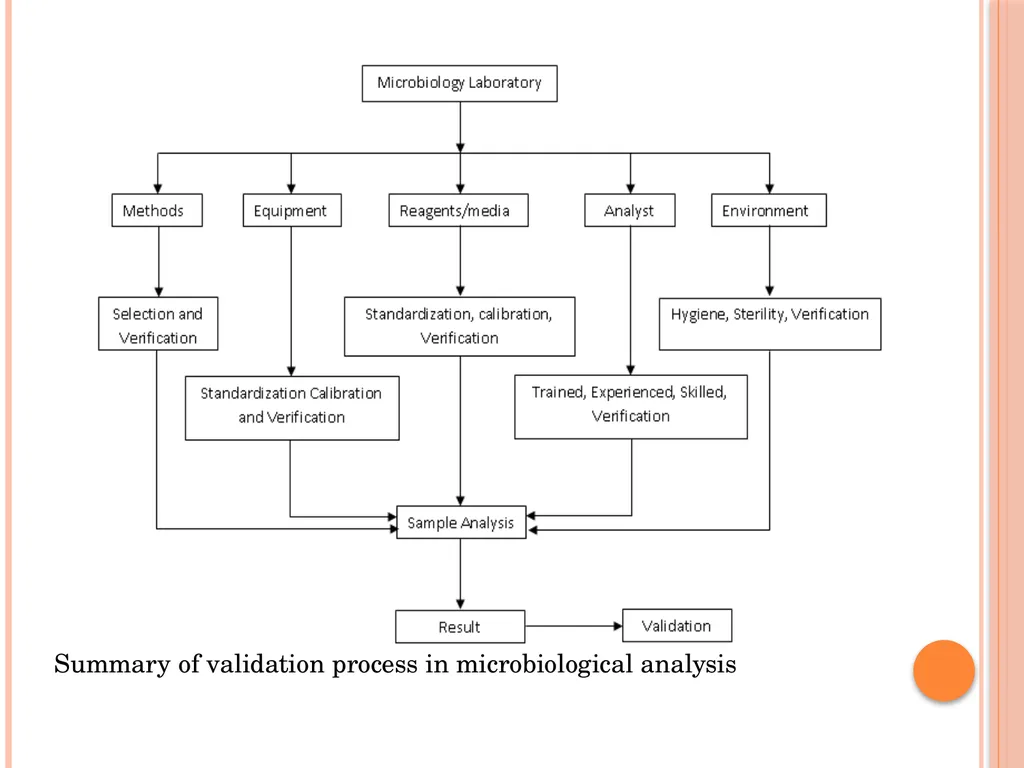
Summary of validation process in microbiological analysis<br>
33
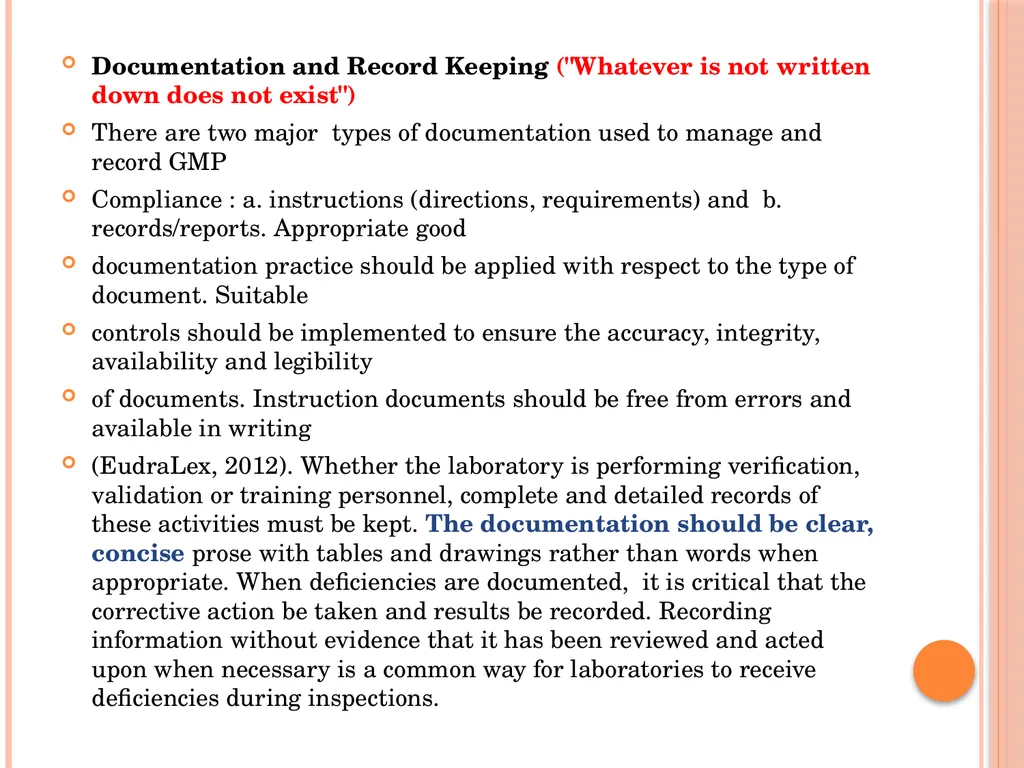
Documentation and Record Keeping ("Whatever is not written down does not exist")
There are two major types of documentation used to manage and record GMP
Compliance : a. instructions (directions, requirements) and b. records/reports. Appropriate good
documentation practice should be applied with respect to the type of document. Suitable
controls should be implemented to ensure the accuracy, integrity, availability and legibility
of documents. Instruction documents should be free from errors and available in writing
(EudraLex, 2012). Whether the laboratory is performing verification, validation or training personnel, complete and detailed records of these activities must be kept. The documentation should be clear, concise prose with tables and drawings rather than words when appropriate. When deficiencies are documented, it is critical that the corrective action be taken and results be recorded. Recording information without evidence that it has been reviewed and acted upon when necessary is a common way for laboratories to receive deficiencies during inspections.<br>
There are two major types of documentation used to manage and record GMP
Compliance : a. instructions (directions, requirements) and b. records/reports. Appropriate good
documentation practice should be applied with respect to the type of document. Suitable
controls should be implemented to ensure the accuracy, integrity, availability and legibility
of documents. Instruction documents should be free from errors and available in writing
(EudraLex, 2012). Whether the laboratory is performing verification, validation or training personnel, complete and detailed records of these activities must be kept. The documentation should be clear, concise prose with tables and drawings rather than words when appropriate. When deficiencies are documented, it is critical that the corrective action be taken and results be recorded. Recording information without evidence that it has been reviewed and acted upon when necessary is a common way for laboratories to receive deficiencies during inspections.<br>
34
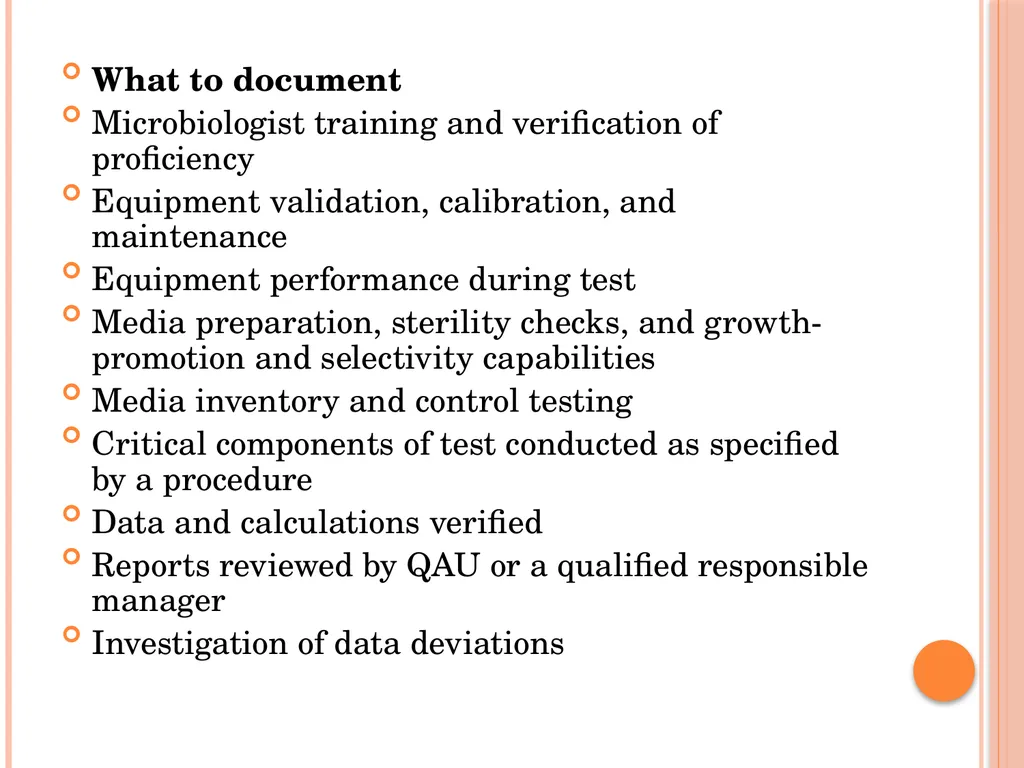
What to document
Microbiologist training and verification of proficiency
Equipment validation, calibration, and maintenance
Equipment performance during test
Media preparation, sterility checks, and growth-promotion and selectivity capabilities
Media inventory and control testing
Critical components of test conducted as specified by a procedure
Data and calculations verified
Reports reviewed by QAU or a qualified responsible manager
Investigation of data deviations<br>
Microbiologist training and verification of proficiency
Equipment validation, calibration, and maintenance
Equipment performance during test
Media preparation, sterility checks, and growth-promotion and selectivity capabilities
Media inventory and control testing
Critical components of test conducted as specified by a procedure
Data and calculations verified
Reports reviewed by QAU or a qualified responsible manager
Investigation of data deviations<br>
35
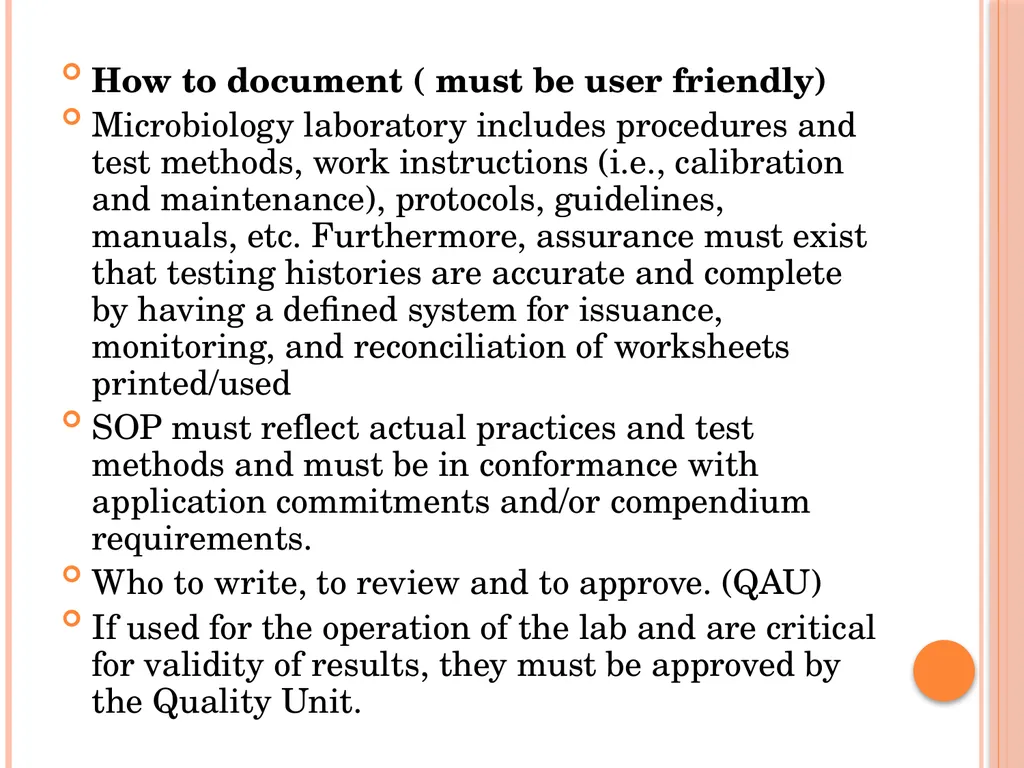
How to document ( must be user friendly)
Microbiology laboratory includes procedures and test methods, work instructions (i.e., calibration and maintenance), protocols, guidelines, manuals, etc. Furthermore, assurance must exist that testing histories are accurate and complete by having a defined system for issuance, monitoring, and reconciliation of worksheets printed/used
SOP must reflect actual practices and test methods and must be in conformance with application commitments and/or compendium requirements.
Who to write, to review and to approve. (QAU)
If used for the operation of the lab and are critical for validity of results, they must be approved by the Quality Unit.<br>
Microbiology laboratory includes procedures and test methods, work instructions (i.e., calibration and maintenance), protocols, guidelines, manuals, etc. Furthermore, assurance must exist that testing histories are accurate and complete by having a defined system for issuance, monitoring, and reconciliation of worksheets printed/used
SOP must reflect actual practices and test methods and must be in conformance with application commitments and/or compendium requirements.
Who to write, to review and to approve. (QAU)
If used for the operation of the lab and are critical for validity of results, they must be approved by the Quality Unit.<br>
36
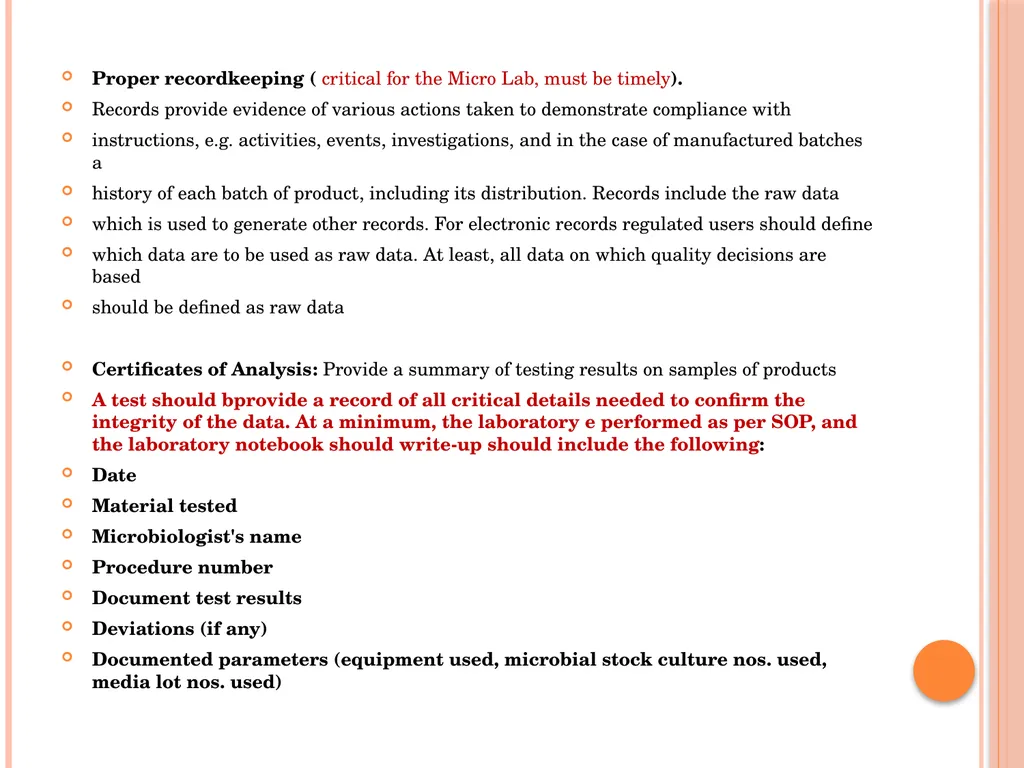
Proper recordkeeping ( critical for the Micro Lab, must be timely).
Records provide evidence of various actions taken to demonstrate compliance with
instructions, e.g. activities, events, investigations, and in the case of manufactured batches a
history of each batch of product, including its distribution. Records include the raw data
which is used to generate other records. For electronic records regulated users should define
which data are to be used as raw data. At least, all data on which quality decisions are based
should be defined as raw data
Certificates of Analysis: Provide a summary of testing results on samples of products
A test should bprovide a record of all critical details needed to confirm the integrity of the data. At a minimum, the laboratory e performed as per SOP, and the laboratory notebook should write-up should include the following:
Date
Material tested
Microbiologist's name
Procedure number
Document test results
Deviations (if any)
Documented parameters (equipment used, microbial stock culture nos. used, media lot nos. used)<br>
Records provide evidence of various actions taken to demonstrate compliance with
instructions, e.g. activities, events, investigations, and in the case of manufactured batches a
history of each batch of product, including its distribution. Records include the raw data
which is used to generate other records. For electronic records regulated users should define
which data are to be used as raw data. At least, all data on which quality decisions are based
should be defined as raw data
Certificates of Analysis: Provide a summary of testing results on samples of products
A test should bprovide a record of all critical details needed to confirm the integrity of the data. At a minimum, the laboratory e performed as per SOP, and the laboratory notebook should write-up should include the following:
Date
Material tested
Microbiologist's name
Procedure number
Document test results
Deviations (if any)
Documented parameters (equipment used, microbial stock culture nos. used, media lot nos. used)<br>
37
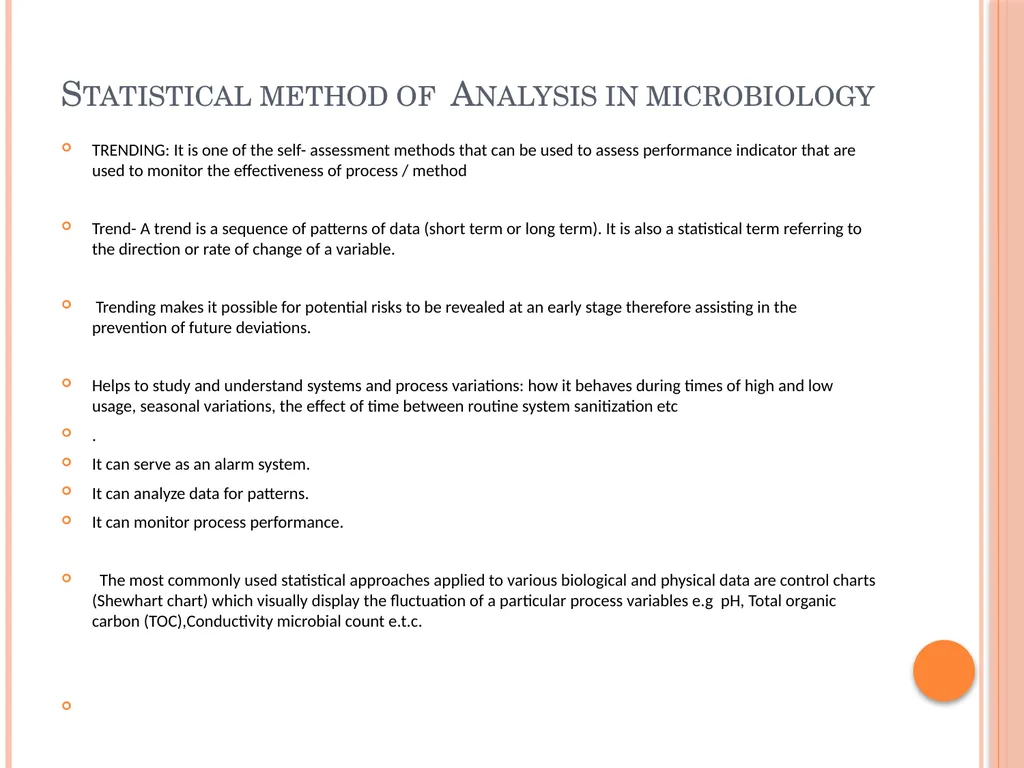
Statistical method of Analysis in microbiology TRENDING: It is one of the self- assessment methods that can be used to assess performance indicator that are used to monitor the effectiveness of process / method
Trend- A trend is a sequence of patterns of data (short term or long term). It is also a statistical term referring to the direction or rate of change of a variable.
Trending makes it possible for potential risks to be revealed at an early stage therefore assisting in the prevention of future deviations.
Helps to study and understand systems and process variations: how it behaves during times of high and low usage, seasonal variations, the effect of time between routine system sanitization etc
.
It can serve as an alarm system.
It can analyze data for patterns.
It can monitor process performance.
The most commonly used statistical approaches applied to various biological and physical data are control charts (Shewhart chart) which visually display the fluctuation of a particular process variables e.g pH, Total organic carbon (TOC),Conductivity microbial count e.t.c.<br>
Trend- A trend is a sequence of patterns of data (short term or long term). It is also a statistical term referring to the direction or rate of change of a variable.
Trending makes it possible for potential risks to be revealed at an early stage therefore assisting in the prevention of future deviations.
Helps to study and understand systems and process variations: how it behaves during times of high and low usage, seasonal variations, the effect of time between routine system sanitization etc
.
It can serve as an alarm system.
It can analyze data for patterns.
It can monitor process performance.
The most commonly used statistical approaches applied to various biological and physical data are control charts (Shewhart chart) which visually display the fluctuation of a particular process variables e.g pH, Total organic carbon (TOC),Conductivity microbial count e.t.c.<br>
38
Management/Second review signature
The objectives are :
1. To state clearly, in advance and in writing, what is to be done
2. To do it — in accordance with those instructions
3. To record what was done and the results of doing it<br>
The objectives are :
1. To state clearly, in advance and in writing, what is to be done
2. To do it — in accordance with those instructions
3. To record what was done and the results of doing it<br>
39
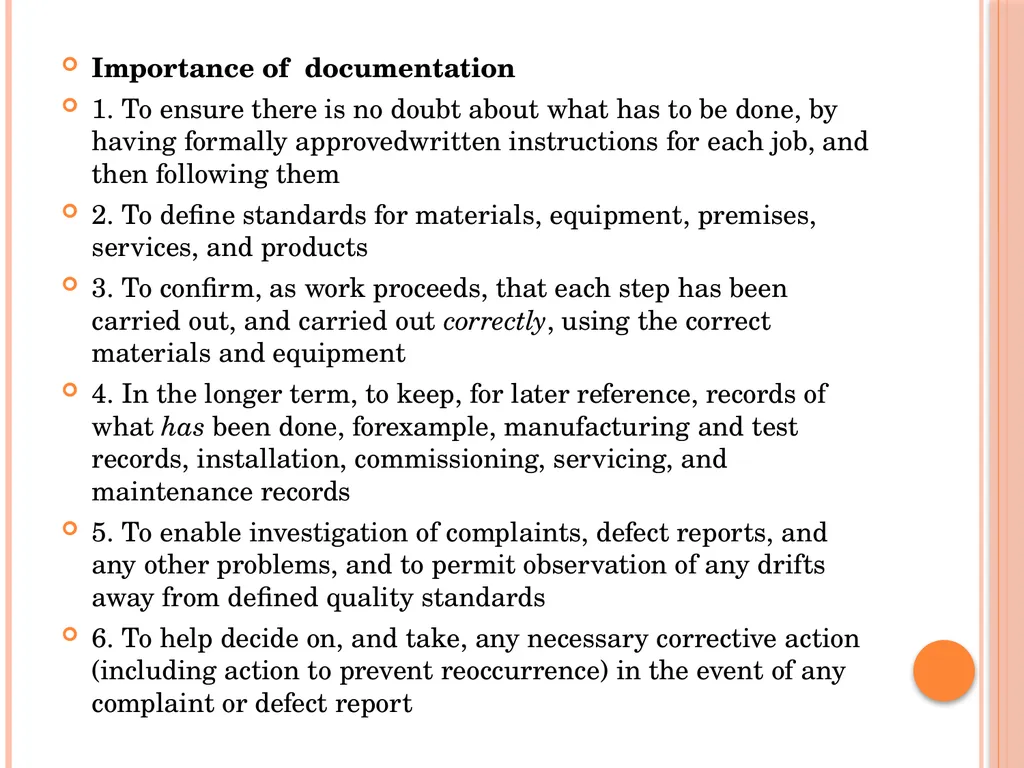
Importance of documentation
1. To ensure there is no doubt about what has to be done, by having formally approvedwritten instructions for each job, and then following them
2. To define standards for materials, equipment, premises, services, and products
3. To confirm, as work proceeds, that each step has been carried out, and carried out correctly, using the correct materials and equipment
4. In the longer term, to keep, for later reference, records of what has been done, forexample, manufacturing and test records, installation, commissioning, servicing, and maintenance records
5. To enable investigation of complaints, defect reports, and any other problems, and to permit observation of any drifts away from defined quality standards
6. To help decide on, and take, any necessary corrective action (including action to prevent reoccurrence) in the event of any complaint or defect report<br>
1. To ensure there is no doubt about what has to be done, by having formally approvedwritten instructions for each job, and then following them
2. To define standards for materials, equipment, premises, services, and products
3. To confirm, as work proceeds, that each step has been carried out, and carried out correctly, using the correct materials and equipment
4. In the longer term, to keep, for later reference, records of what has been done, forexample, manufacturing and test records, installation, commissioning, servicing, and maintenance records
5. To enable investigation of complaints, defect reports, and any other problems, and to permit observation of any drifts away from defined quality standards
6. To help decide on, and take, any necessary corrective action (including action to prevent reoccurrence) in the event of any complaint or defect report<br>
40
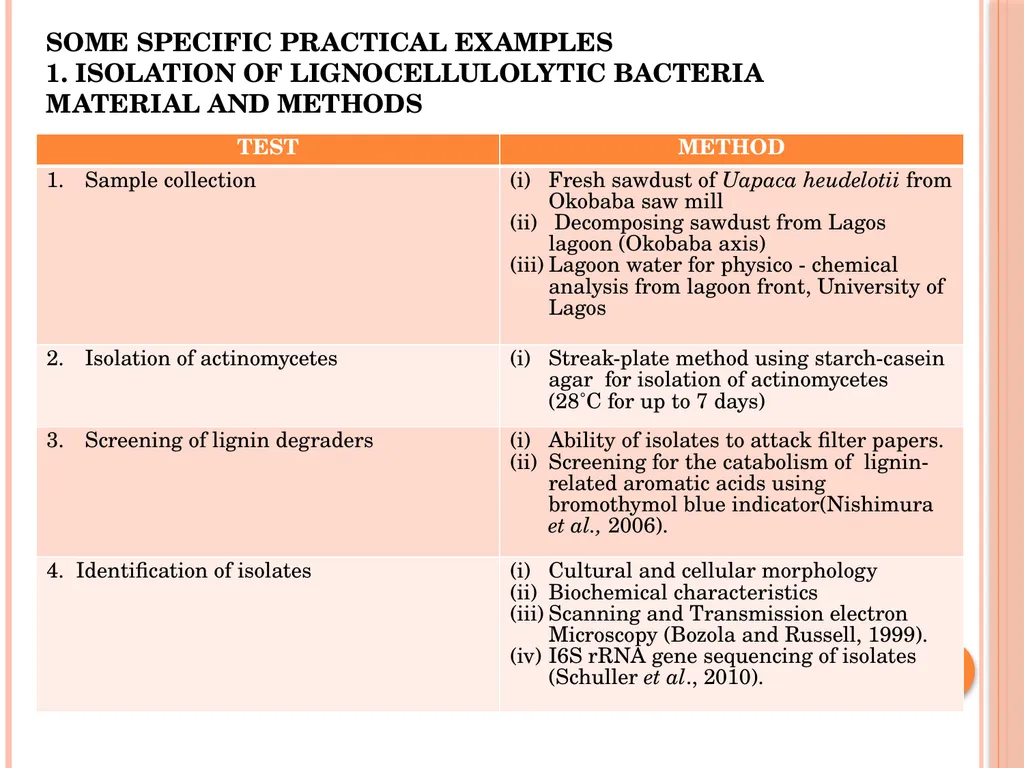
SOME SPECIFIC PRACTICAL EXAMPLES
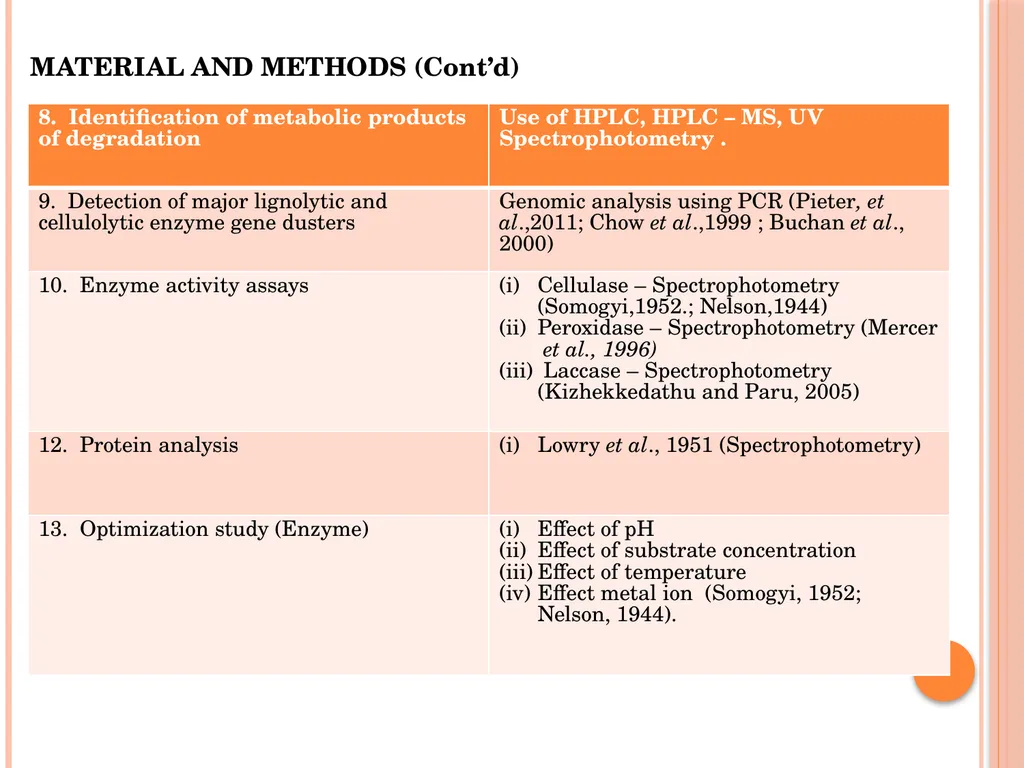
1. ISOLATION OF LIGNOCELLULOLYTIC BACTERIA
MATERIAL AND METHODS<br>
1. ISOLATION OF LIGNOCELLULOLYTIC BACTERIA
MATERIAL AND METHODS<br>
41
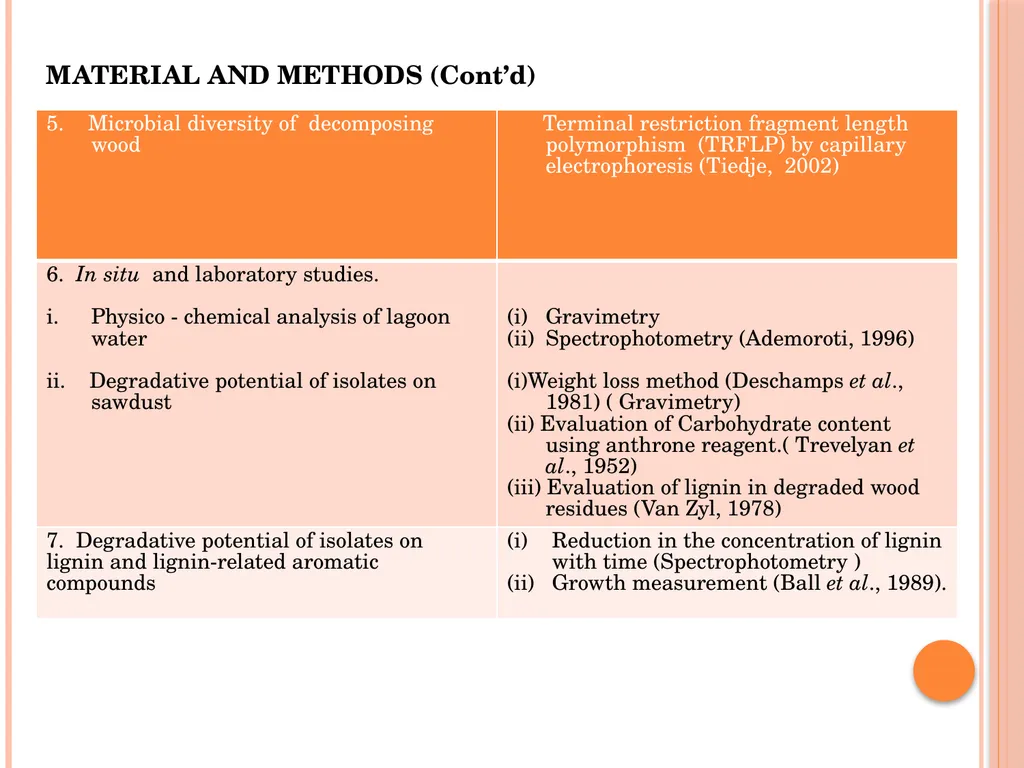
MATERIAL AND METHODS (Cont’d)<br>
42
MATERIAL AND METHODS (Cont’d)<br>
43
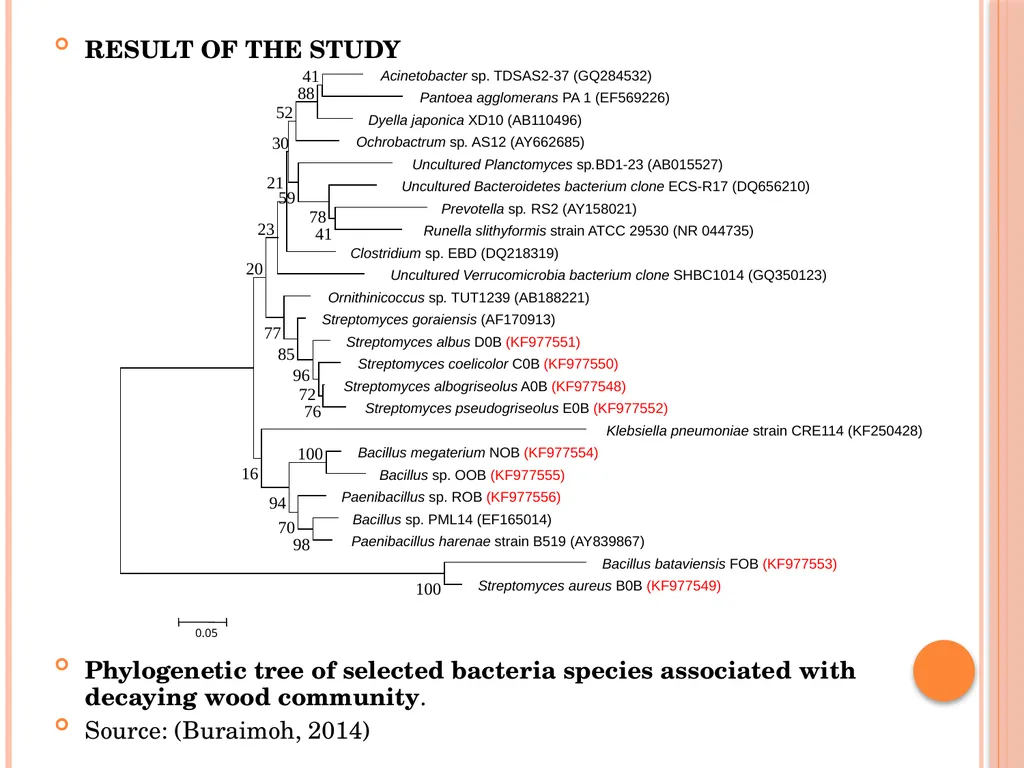
RESULT OF THE STUDY
Phylogenetic tree of selected bacteria species associated with decaying wood community.
Source: (Buraimoh, 2014)<br>
Phylogenetic tree of selected bacteria species associated with decaying wood community.
Source: (Buraimoh, 2014)<br>
44
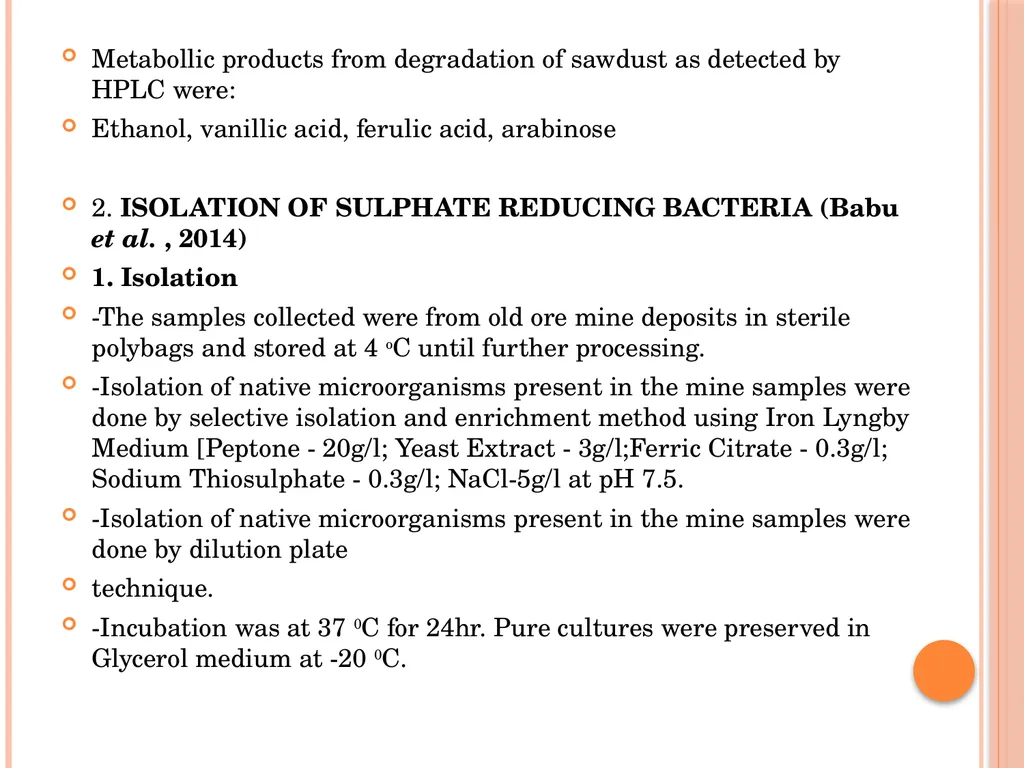
Metabollic products from degradation of sawdust as detected by HPLC were:
Ethanol, vanillic acid, ferulic acid, arabinose
2. ISOLATION OF SULPHATE REDUCING BACTERIA (Babu et al. , 2014)
1. Isolation
-The samples collected were from old ore mine deposits in sterile polybags and stored at 4 oC until further processing.
-Isolation of native microorganisms present in the mine samples were done by selective isolation and enrichment method using Iron Lyngby Medium [Peptone - 20g/l; Yeast Extract - 3g/l;Ferric Citrate - 0.3g/l; Sodium Thiosulphate - 0.3g/l; NaCl-5g/l at pH 7.5.
-Isolation of native microorganisms present in the mine samples were done by dilution plate
technique.
-Incubation was at 37 0C for 24hr. Pure cultures were preserved in Glycerol medium at -20 0C.<br>
Ethanol, vanillic acid, ferulic acid, arabinose
2. ISOLATION OF SULPHATE REDUCING BACTERIA (Babu et al. , 2014)
1. Isolation
-The samples collected were from old ore mine deposits in sterile polybags and stored at 4 oC until further processing.
-Isolation of native microorganisms present in the mine samples were done by selective isolation and enrichment method using Iron Lyngby Medium [Peptone - 20g/l; Yeast Extract - 3g/l;Ferric Citrate - 0.3g/l; Sodium Thiosulphate - 0.3g/l; NaCl-5g/l at pH 7.5.
-Isolation of native microorganisms present in the mine samples were done by dilution plate
technique.
-Incubation was at 37 0C for 24hr. Pure cultures were preserved in Glycerol medium at -20 0C.<br>
45
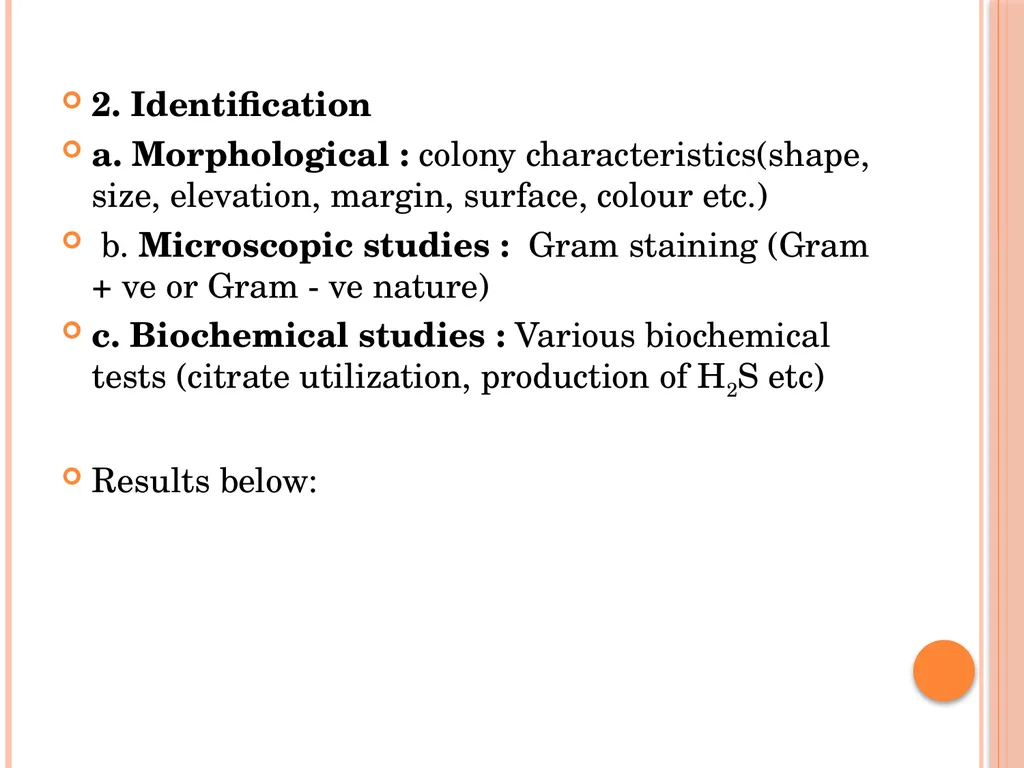
2. Identification
a. Morphological : colony characteristics(shape, size, elevation, margin, surface, colour etc.)
b. Microscopic studies : Gram staining (Gram + ve or Gram - ve nature)
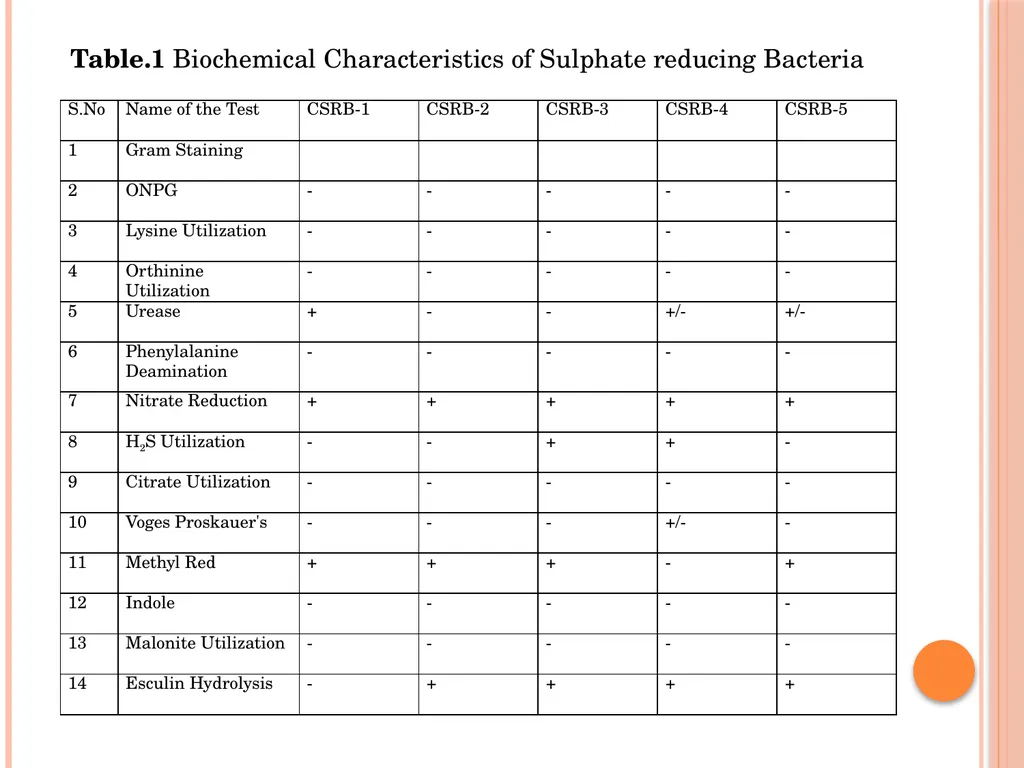
c. Biochemical studies : Various biochemical tests (citrate utilization, production of H2S etc)
Results below:<br>
a. Morphological : colony characteristics(shape, size, elevation, margin, surface, colour etc.)
b. Microscopic studies : Gram staining (Gram + ve or Gram - ve nature)
c. Biochemical studies : Various biochemical tests (citrate utilization, production of H2S etc)
Results below:<br>
46
Table.1 Biochemical Characteristics of Sulphate reducing Bacteria<br>
47
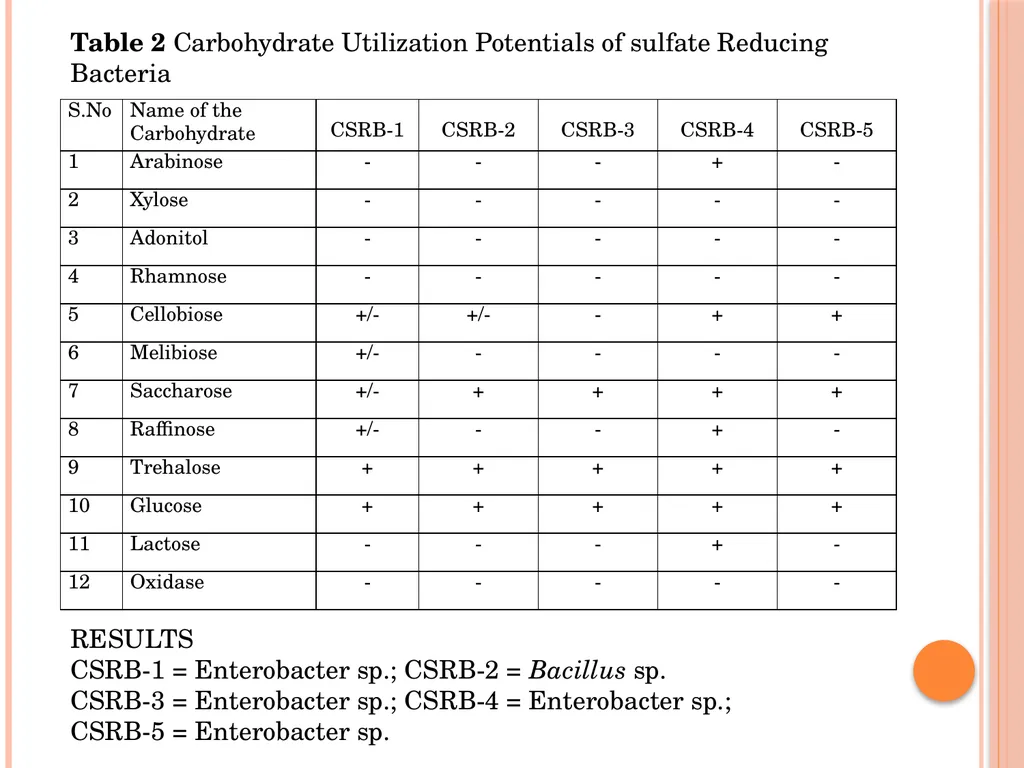
Table 2 Carbohydrate Utilization Potentials of sulfate Reducing Bacteria RESULTS
CSRB-1 = Enterobacter sp.; CSRB-2 = Bacillus sp.
CSRB-3 = Enterobacter sp.; CSRB-4 = Enterobacter sp.;
CSRB-5 = Enterobacter sp.<br>
CSRB-1 = Enterobacter sp.; CSRB-2 = Bacillus sp.
CSRB-3 = Enterobacter sp.; CSRB-4 = Enterobacter sp.;
CSRB-5 = Enterobacter sp.<br>
48
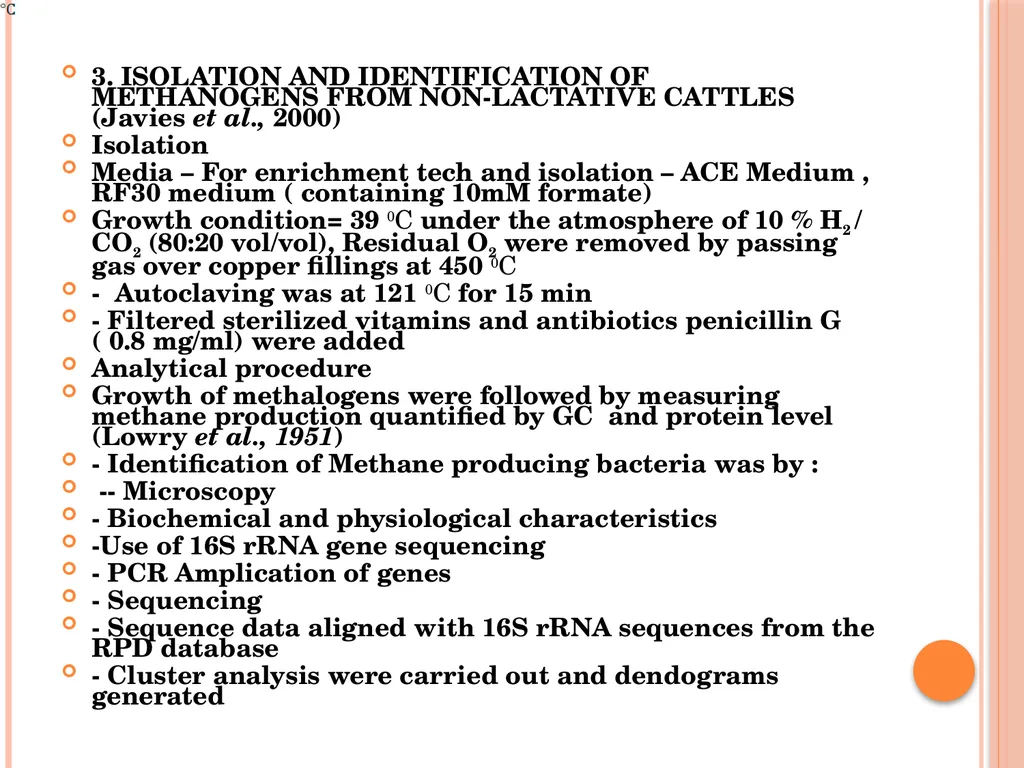
3. ISOLATION AND IDENTIFICATION OF METHANOGENS FROM NON-LACTATIVE CATTLES (Javies et al., 2000)
Isolation
Media – For enrichment tech and isolation – ACE Medium , RF30 medium ( containing 10mM formate)
Growth condition= 39 0C under the atmosphere of 10 % H2 / CO2 (80:20 vol/vol), Residual O2 were removed by passing gas over copper fillings at 450 0C
- Autoclaving was at 121 0C for 15 min
- Filtered sterilized vitamins and antibiotics penicillin G ( 0.8 mg/ml) were added
Analytical procedure
Growth of methalogens were followed by measuring methane production quantified by GC and protein level (Lowry et al., 1951)
- Identification of Methane producing bacteria was by :
-- Microscopy
- Biochemical and physiological characteristics
-Use of 16S rRNA gene sequencing
- PCR Amplication of genes
- Sequencing
- Sequence data aligned with 16S rRNA sequences from the RPD database
- Cluster analysis were carried out and dendograms generated<br>
Isolation
Media – For enrichment tech and isolation – ACE Medium , RF30 medium ( containing 10mM formate)
Growth condition= 39 0C under the atmosphere of 10 % H2 / CO2 (80:20 vol/vol), Residual O2 were removed by passing gas over copper fillings at 450 0C
- Autoclaving was at 121 0C for 15 min
- Filtered sterilized vitamins and antibiotics penicillin G ( 0.8 mg/ml) were added
Analytical procedure
Growth of methalogens were followed by measuring methane production quantified by GC and protein level (Lowry et al., 1951)
- Identification of Methane producing bacteria was by :
-- Microscopy
- Biochemical and physiological characteristics
-Use of 16S rRNA gene sequencing
- PCR Amplication of genes
- Sequencing
- Sequence data aligned with 16S rRNA sequences from the RPD database
- Cluster analysis were carried out and dendograms generated<br>
49
RESULTS
- Methanosarcinates barkeri
- Methanobacterium fornicium
Methanobrevibacter ruminantium
Methane producing microorganisms can also be isolated from sewage systems<br>
- Methanosarcinates barkeri
- Methanobacterium fornicium
Methanobrevibacter ruminantium
Methane producing microorganisms can also be isolated from sewage systems<br>
50
BENEFITS OF GOOD VERIFICATION AND VALIDATION PROCEDURES * Reduction in rejection, reworks, resample and retest.
* Reduction in costs
* Increased throughput
* Fewer complaints
* Improved employee awareness<br>
* Reduction in costs
* Increased throughput
* Fewer complaints
* Improved employee awareness<br>
51
Conclusion Validated method is one of the key issues that contribute to Good Microbiological Laboratory Practice(GMLP). The compliance to QA/GMP does not happen by accident, but compliance can be achieved as the result of careful planning and installation of quality. Although microorganisms are “silent” and “sleepy”, however, in the hands of an analyst, the resilience and ubiquity of these “unwanted guests” could be harnessed for biotechnological purposes.<br>
52
DEFINITIONS AND ABBREVIATIONS
LOD - limit of detection
LOQ - limit of quantification
IQ- Installation Qualification (IQ)
OQ- Operational Qualification (OQ)
PQ- Performance Qualification (PQ)
Linearity- can be defined as the ability of the method, when used with a given matrix, to give results that are in proportion to the amount of analyte present in the sample; that is, an increase in analyte corresponds to a proportional increase in the result.
Robustness-Robustness is the quality of any relational object (biological or otherwise) to maintain its components, its structure, and its function despite both external changes and endogenous fluctuations.
Bioburden: defined as the number of bacteria living on a surface that has not been sterilized.<br>
LOD - limit of detection
LOQ - limit of quantification
IQ- Installation Qualification (IQ)
OQ- Operational Qualification (OQ)
PQ- Performance Qualification (PQ)
Linearity- can be defined as the ability of the method, when used with a given matrix, to give results that are in proportion to the amount of analyte present in the sample; that is, an increase in analyte corresponds to a proportional increase in the result.
Robustness-Robustness is the quality of any relational object (biological or otherwise) to maintain its components, its structure, and its function despite both external changes and endogenous fluctuations.
Bioburden: defined as the number of bacteria living on a surface that has not been sterilized.<br>
53
* Accuracy:
Technical: The degree of conformity of a measurement to a standard or true value; a measure of analytical capability.
Clinical: The ability of a method to rule in or out a specific disease or analyte. Accuracy and test efficiency are synonymous and can be expressed mathematically as a percent:
number of correct results \ total number of results x 100
* Gold standard:
The best available approximation of the truth. The accuracy of the test is accepted as reasonable but not 100 percent accurate. In situations where the true disease status of a patient is not known and there's a discrepancy between the results of the test being evaluated and the gold standard test (reference test), it may be appropriate to display the agreement and disagreement between the two methods in graphic or tabular form. The disagreement between the methods may be further investigated by performing another test or following the patient's condition over an appropriate amount of time. When it cannot be clearly determined whether the new test is better than the gold standard, it may be appropriate to use a cost-benefit analysis to pick the appropriate test.1-4<br>
Technical: The degree of conformity of a measurement to a standard or true value; a measure of analytical capability.
Clinical: The ability of a method to rule in or out a specific disease or analyte. Accuracy and test efficiency are synonymous and can be expressed mathematically as a percent:
number of correct results \ total number of results x 100
* Gold standard:
The best available approximation of the truth. The accuracy of the test is accepted as reasonable but not 100 percent accurate. In situations where the true disease status of a patient is not known and there's a discrepancy between the results of the test being evaluated and the gold standard test (reference test), it may be appropriate to display the agreement and disagreement between the two methods in graphic or tabular form. The disagreement between the methods may be further investigated by performing another test or following the patient's condition over an appropriate amount of time. When it cannot be clearly determined whether the new test is better than the gold standard, it may be appropriate to use a cost-benefit analysis to pick the appropriate test.1-4<br>
54
* Home-brew method:
A method developed in house or any method that incorporates modifications of the manufacturer's package insert instructions.
* New method:
Any method not previously offered by a laboratory.
* Old method:
A method that has been in use prior to Sept. 1, 1992, the effective date of the Clinical Laboratory Improvement Amendments of 1988 (CLIA '88).
* Precision:
The degree of agreement among individual test results when the same procedural steps and reagents are used to test the same sample. Mathematically, precision can be expressed as a percent: number of repeated results in agreement \ total number of results x 100<br>
A method developed in house or any method that incorporates modifications of the manufacturer's package insert instructions.
* New method:
Any method not previously offered by a laboratory.
* Old method:
A method that has been in use prior to Sept. 1, 1992, the effective date of the Clinical Laboratory Improvement Amendments of 1988 (CLIA '88).
* Precision:
The degree of agreement among individual test results when the same procedural steps and reagents are used to test the same sample. Mathematically, precision can be expressed as a percent: number of repeated results in agreement \ total number of results x 100<br>
55
* Predictive value:
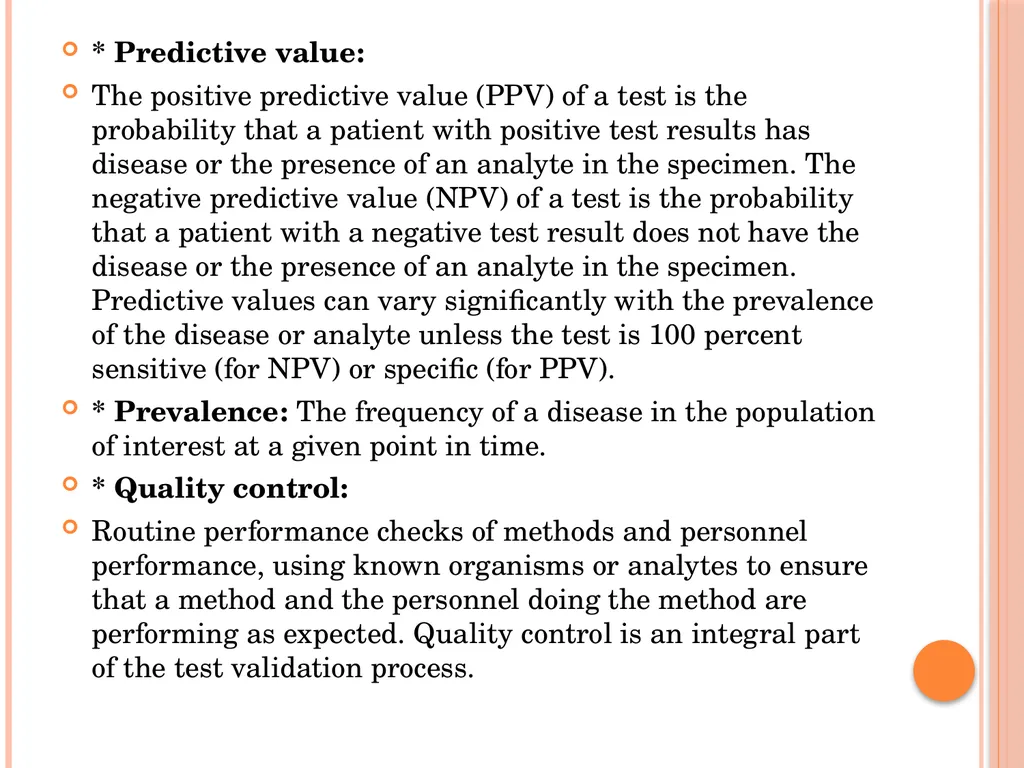
The positive predictive value (PPV) of a test is the probability that a patient with positive test results has disease or the presence of an analyte in the specimen. The negative predictive value (NPV) of a test is the probability that a patient with a negative test result does not have the disease or the presence of an analyte in the specimen. Predictive values can vary significantly with the prevalence of the disease or analyte unless the test is 100 percent sensitive (for NPV) or specific (for PPV).
* Prevalence: The frequency of a disease in the population of interest at a given point in time.
* Quality control:
Routine performance checks of methods and personnel performance, using known organisms or analytes to ensure that a method and the personnel doing the method are performing as expected. Quality control is an integral part of the test validation process.<br>
The positive predictive value (PPV) of a test is the probability that a patient with positive test results has disease or the presence of an analyte in the specimen. The negative predictive value (NPV) of a test is the probability that a patient with a negative test result does not have the disease or the presence of an analyte in the specimen. Predictive values can vary significantly with the prevalence of the disease or analyte unless the test is 100 percent sensitive (for NPV) or specific (for PPV).
* Prevalence: The frequency of a disease in the population of interest at a given point in time.
* Quality control:
Routine performance checks of methods and personnel performance, using known organisms or analytes to ensure that a method and the personnel doing the method are performing as expected. Quality control is an integral part of the test validation process.<br>
56
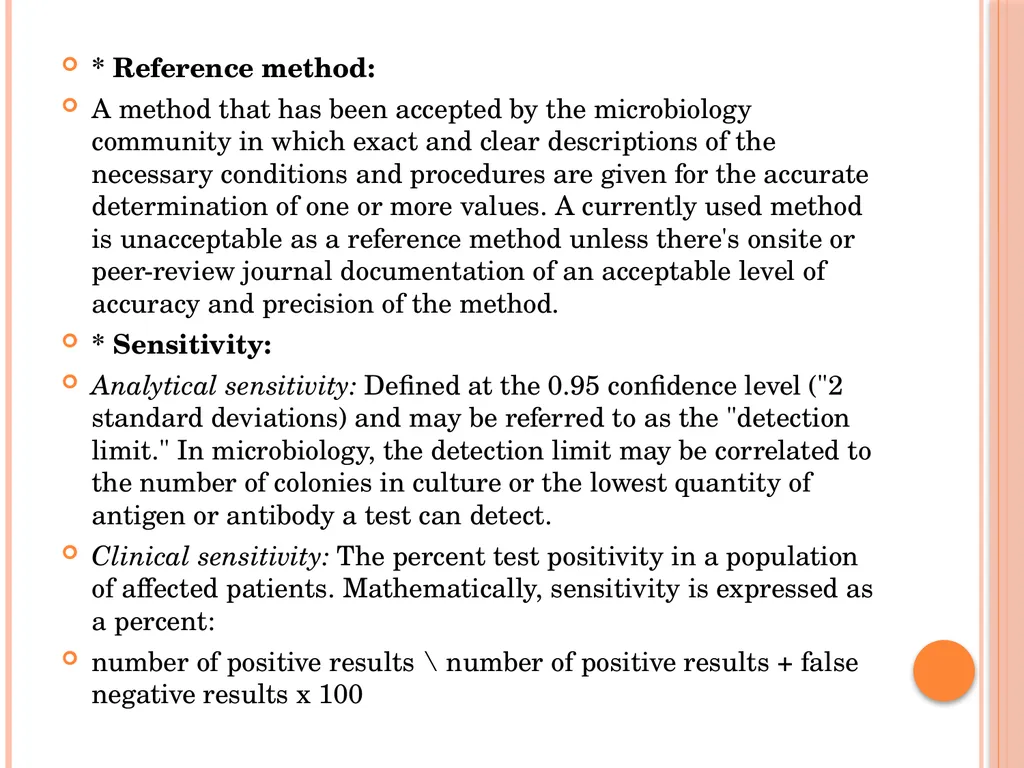
* Reference method:
A method that has been accepted by the microbiology community in which exact and clear descriptions of the necessary conditions and procedures are given for the accurate determination of one or more values. A currently used method is unacceptable as a reference method unless there's onsite or peer-review journal documentation of an acceptable level of accuracy and precision of the method.
* Sensitivity:
Analytical sensitivity: Defined at the 0.95 confidence level ("2 standard deviations) and may be referred to as the "detection limit." In microbiology, the detection limit may be correlated to the number of colonies in culture or the lowest quantity of antigen or antibody a test can detect.
Clinical sensitivity: The percent test positivity in a population of affected patients. Mathematically, sensitivity is expressed as a percent:
number of positive results \ number of positive results + false negative results x 100<br>
A method that has been accepted by the microbiology community in which exact and clear descriptions of the necessary conditions and procedures are given for the accurate determination of one or more values. A currently used method is unacceptable as a reference method unless there's onsite or peer-review journal documentation of an acceptable level of accuracy and precision of the method.
* Sensitivity:
Analytical sensitivity: Defined at the 0.95 confidence level ("2 standard deviations) and may be referred to as the "detection limit." In microbiology, the detection limit may be correlated to the number of colonies in culture or the lowest quantity of antigen or antibody a test can detect.
Clinical sensitivity: The percent test positivity in a population of affected patients. Mathematically, sensitivity is expressed as a percent:
number of positive results \ number of positive results + false negative results x 100<br>
57
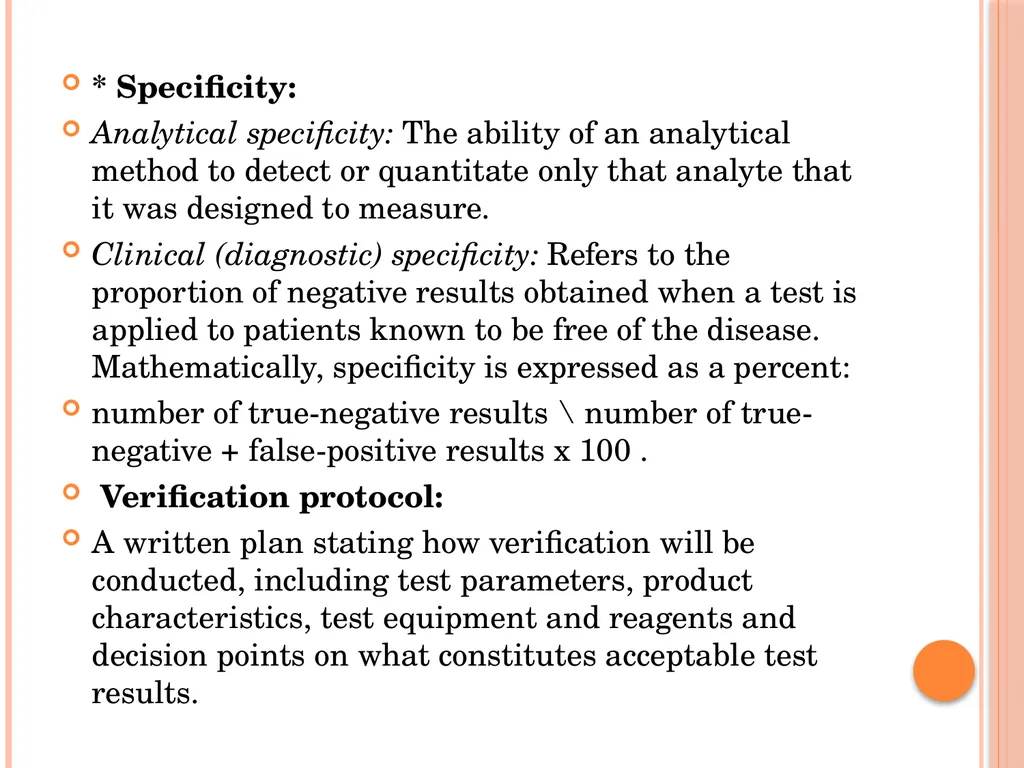
* Specificity:
Analytical specificity: The ability of an analytical method to detect or quantitate only that analyte that it was designed to measure.
Clinical (diagnostic) specificity: Refers to the proportion of negative results obtained when a test is applied to patients known to be free of the disease. Mathematically, specificity is expressed as a percent:
number of true-negative results \ number of true-negative + false-positive results x 100 .
Verification protocol:
A written plan stating how verification will be conducted, including test parameters, product characteristics, test equipment and reagents and decision points on what constitutes acceptable test results.<br>
Analytical specificity: The ability of an analytical method to detect or quantitate only that analyte that it was designed to measure.
Clinical (diagnostic) specificity: Refers to the proportion of negative results obtained when a test is applied to patients known to be free of the disease. Mathematically, specificity is expressed as a percent:
number of true-negative results \ number of true-negative + false-positive results x 100 .
Verification protocol:
A written plan stating how verification will be conducted, including test parameters, product characteristics, test equipment and reagents and decision points on what constitutes acceptable test results.<br>
58
THANK YOU FOR LISTENING.<br>