MICROBIOLOGY Introduction: Micro small, bio life and logo study study of microorganisms and their activities. distribution in nature, their relationship to each other and to other living organisms. Micorbiologists - specialize to work
"MICROBIOLOGY Introduction: Micro = small, bio =" is the property of its rightful owner. Permission is granted to
download and print the materials on this website for personal, non-commercial use only, and to display it
on your personal computer provided you do not modify the materials and that you retain all copyright
notices contained in the materials. By downloading content from our website, you accept the terms of this
agreement.
Presentation Transcript
01
MICROBIOLOGY Introduction:
Micro = small, bio = life and logo = study
study of microorganisms and their activities.
distribution in nature, their relationship to each other and to other living organisms.
Micorbiologists - specialize to work with the microorganisms
useful microorganisms and the harmful ones<br>
02
Groups of Microorganisms Bacteriology – is the study of bacteria;
Mycology – is the study of fungi;
Phycology – is the study of algae;
Protozoology – is the study of protozoa and
Virology – is the study of viruses.<br>
03
History of Microbiology Kircher who first recognized the importance of microorganisms in disease development.
Antony van Leeuwenhoek (1632-1723) first person to report descriptions of microorganisms in detail
Louis Pasteur (1822-1895) through this series of experiments proved his germ theory
He also founded that fermentation of fruits and grain, resulting in alcohol, was brought about by microbes<br>
04
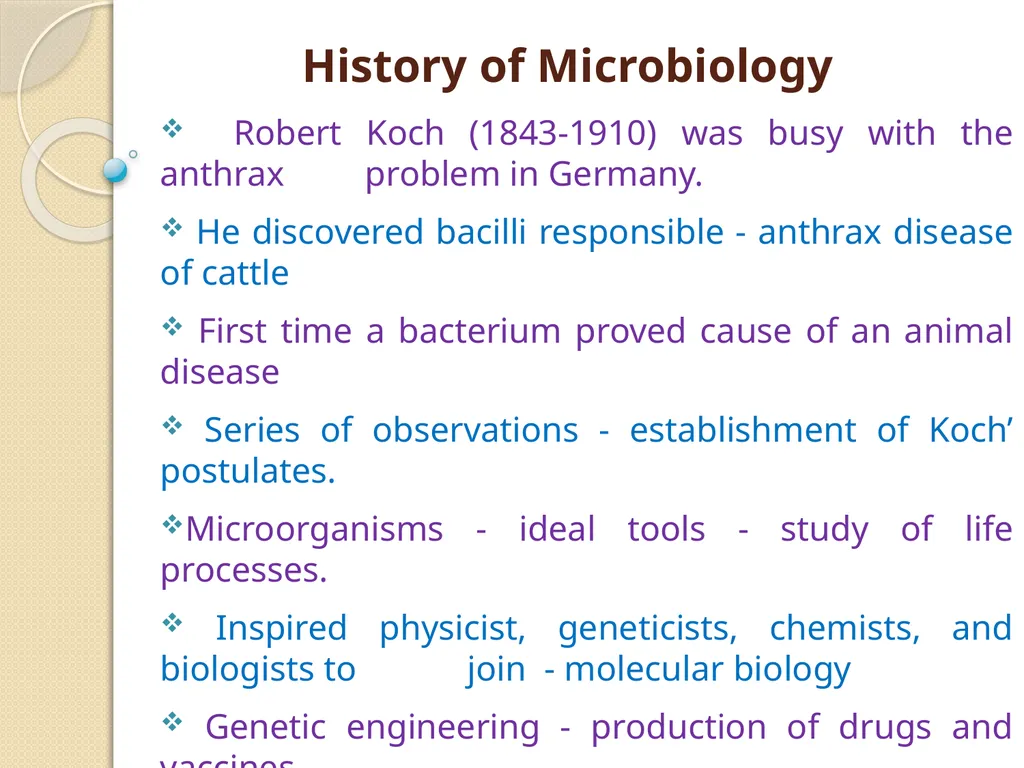
History of Microbiology Robert Koch (1843-1910) was busy with the anthrax problem in Germany.
He discovered bacilli responsible - anthrax disease of cattle
First time a bacterium proved cause of an animal disease
Series of observations - establishment of Koch’ postulates.
Microorganisms - ideal tools - study of life processes.
Inspired physicist, geneticists, chemists, and biologists to join - molecular biology
Genetic engineering - production of drugs and vaccines
Improvement of agricultural crops, and various other areas.<br>
05
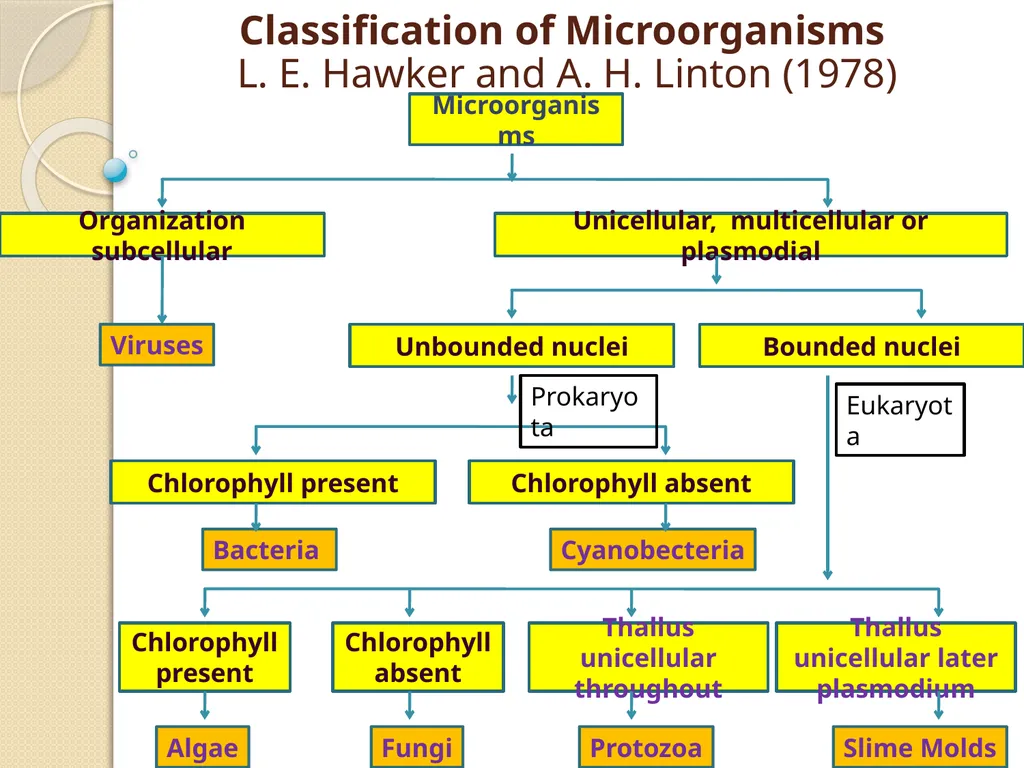
Classification of Microorganisms L. E. Hawker and A. H. Linton (1978) Microorganisms Organization subcellular Unicellular, multicellular or plasmodial Unbounded nuclei Bounded nuclei Chlorophyll present Chlorophyll absent Chlorophyll present Chlorophyll absent Thallus unicellular throughout Thallus unicellular later plasmodium Prokaryota Eukaryota Bacteria Viruses Cyanobecteria Algae Fungi Protozoa Slime Molds<br>
06
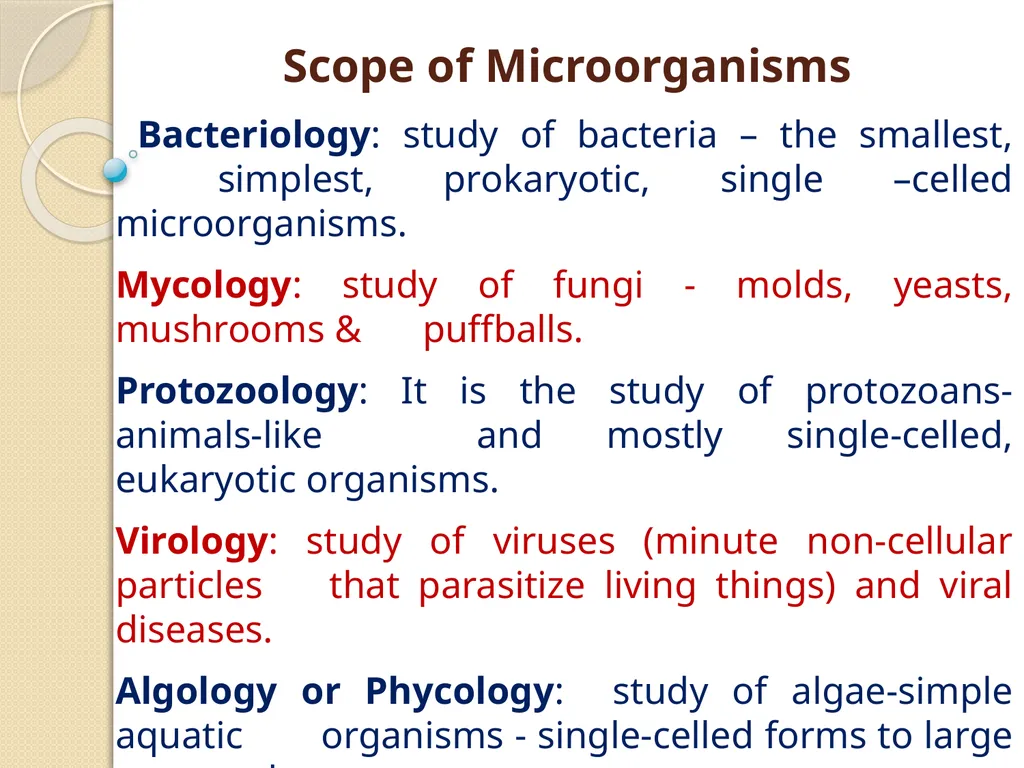
Scope of Microorganisms Bacteriology: study of bacteria – the smallest, simplest, prokaryotic, single –celled microorganisms.
Mycology: study of fungi - molds, yeasts, mushrooms & puffballs.
Protozoology: It is the study of protozoans-animals-like and mostly single-celled, eukaryotic organisms.
Virology: study of viruses (minute non-cellular particles that parasitize living things) and viral diseases.
Algology or Phycology: study of algae-simple aquatic organisms - single-celled forms to large sea weeds.
Parasitology: study of parasitism and parasites – pathogenic protozoa, helminth worms and insects.<br>
07
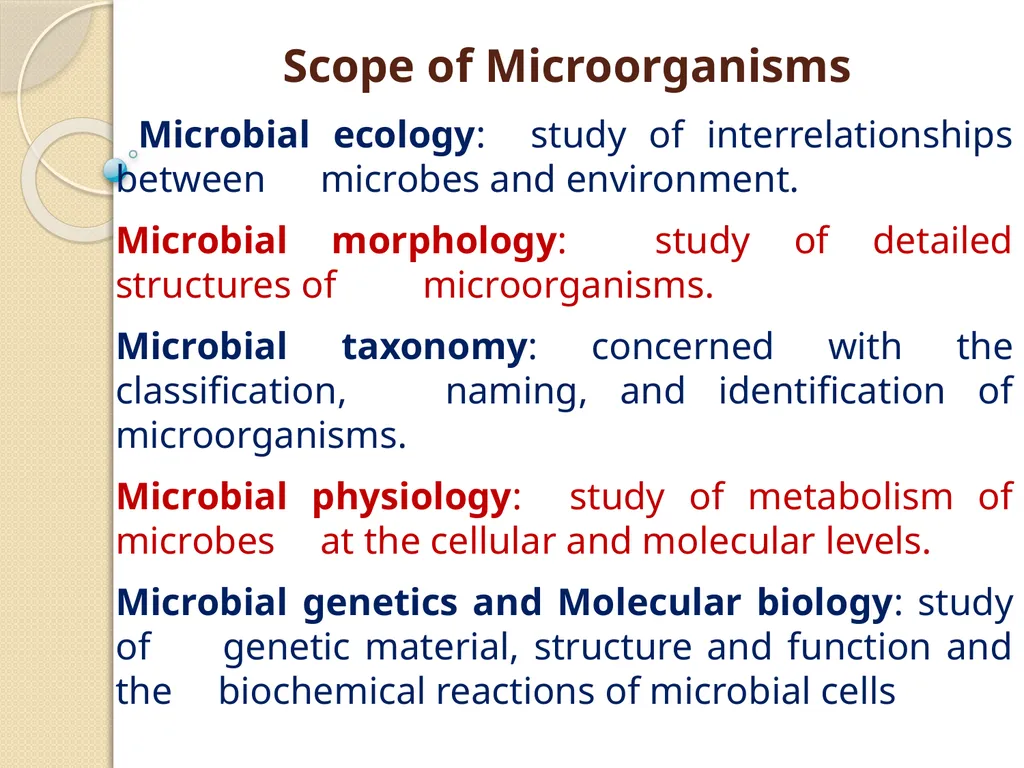
Scope of Microorganisms Microbial ecology: study of interrelationships between microbes and environment.
Microbial morphology: study of detailed structures of microorganisms.
Microbial taxonomy: concerned with the classification, naming, and identification of microorganisms.
Microbial physiology: study of metabolism of microbes at the cellular and molecular levels.
Microbial genetics and Molecular biology: study of genetic material, structure and function and the biochemical reactions of microbial cells<br>
08
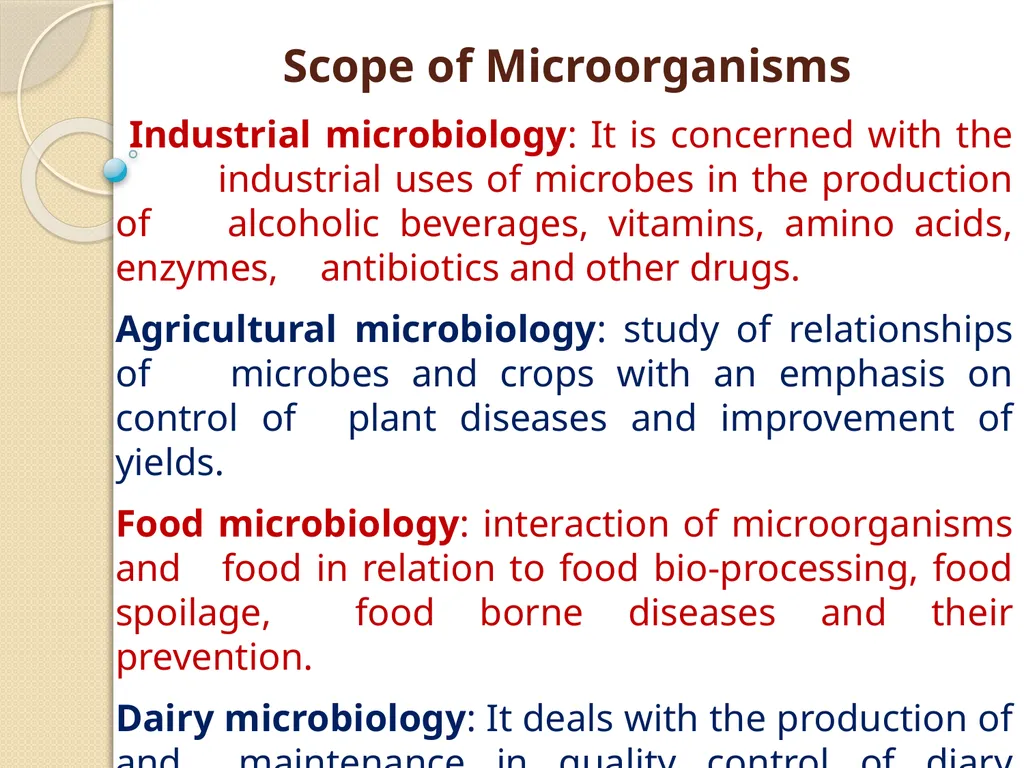
Scope of Microorganisms Industrial microbiology: It is concerned with the industrial uses of microbes in the production of alcoholic beverages, vitamins, amino acids, enzymes, antibiotics and other drugs.
Agricultural microbiology: study of relationships of microbes and crops with an emphasis on control of plant diseases and improvement of yields.
Food microbiology: interaction of microorganisms and food in relation to food bio-processing, food spoilage, food borne diseases and their prevention.
Dairy microbiology: It deals with the production of and maintenance in quality control of diary products.<br>
09
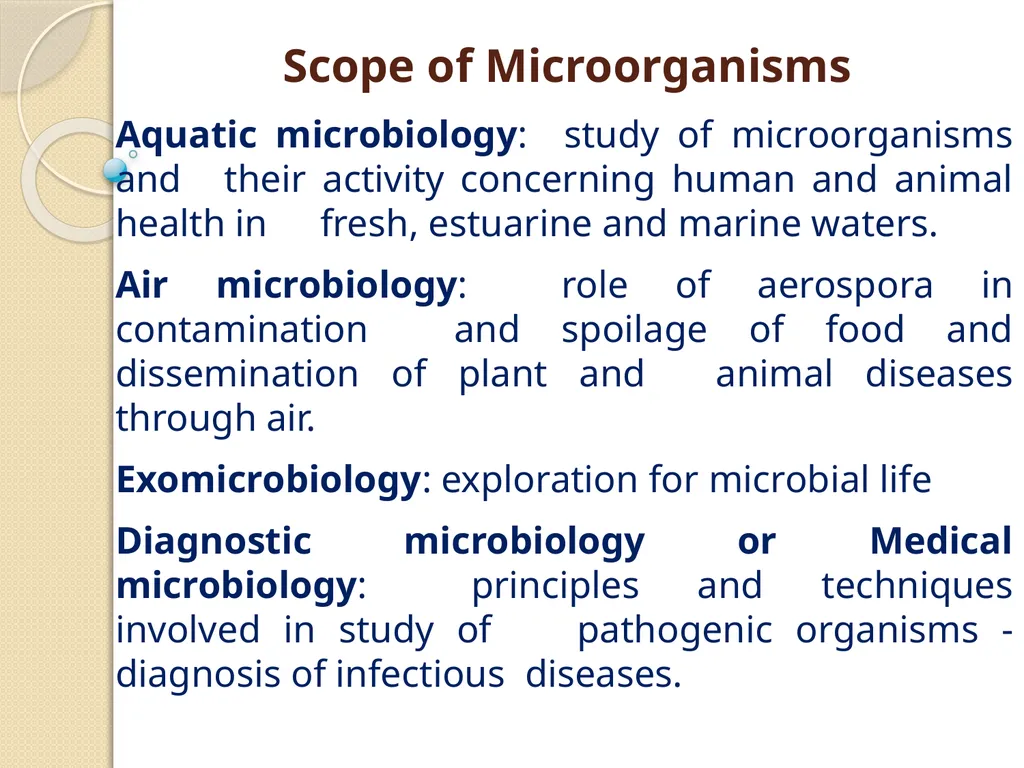
Scope of Microorganisms Aquatic microbiology: study of microorganisms and their activity concerning human and animal health in fresh, estuarine and marine waters.
Air microbiology: role of aerospora in contamination and spoilage of food and dissemination of plant and animal diseases through air.
Exomicrobiology: exploration for microbial life
Diagnostic microbiology or Medical microbiology: principles and techniques involved in study of pathogenic organisms - diagnosis of infectious diseases.<br>
10
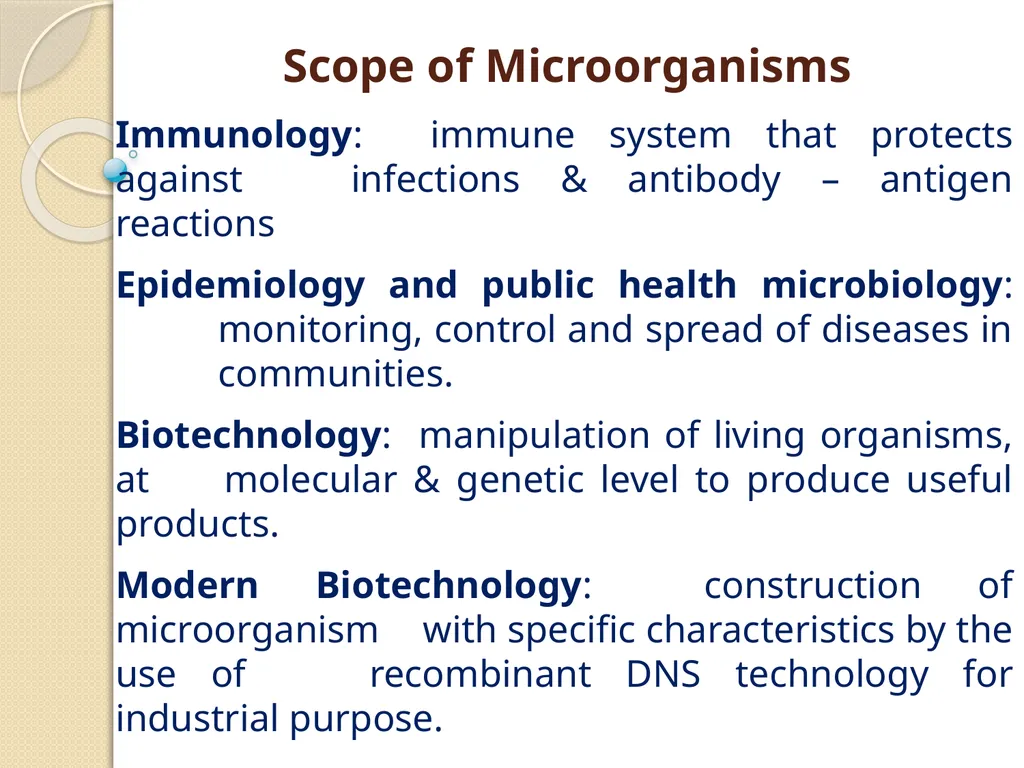
Scope of Microorganisms Immunology: immune system that protects against infections & antibody – antigen reactions
Epidemiology and public health microbiology: monitoring, control and spread of diseases in communities.
Biotechnology: manipulation of living organisms, at molecular & genetic level to produce useful products.
Modern Biotechnology: construction of microorganism with specific characteristics by the use of recombinant DNS technology for industrial purpose.<br>