
Microcontroller and Embedded system Embedded
Description: Microcontroller and Embedded system Embedded System Electronics Communication Engineering EC-VI Technocrats Institute of Technology (Excellence), Bhopal www.technocratsgroup.edu.in 2 Subject Name Unit-No Session-No Embedded
Related Topics
Download Presentation
"Microcontroller and Embedded system Embedded" is the property of its rightful owner. Permission is granted to download and print the materials on this website for personal, non-commercial use only, and to display it on your personal computer provided you do not modify the materials and that you retain all copyright notices contained in the materials. By downloading content from our website, you accept the terms of this agreement.
Presentation Transcript
slide1. Microcontroller and Embedded system
Embedded System Electronics & Communication Engineering
EC-VI Technocrats Institute of Technology (Excellence), Bhopal<br>
slide2. www.technocratsgroup.edu.in 2 <Subject Name> | <Unit-No> | <Session-No> Embedded System
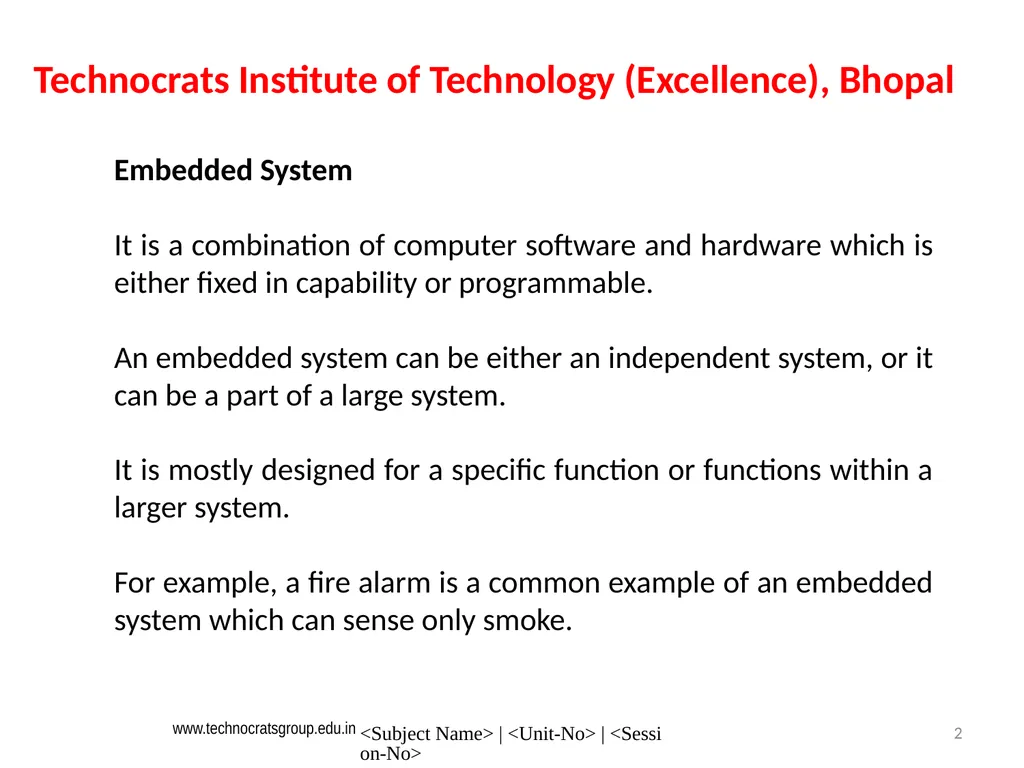
It is a combination of computer software and hardware which is either fixed in capability or programmable.
An embedded system can be either an independent system, or it can be a part of a large system.
It is mostly designed for a specific function or functions within a larger system.
For example, a fire alarm is a common example of an embedded system which can sense only smoke. Technocrats Institute of Technology (Excellence), Bhopal<br>
slide3. www.technocratsgroup.edu.in 3 <Subject Name> | <Unit-No> | <Session-No> Following are important characteristics of an embedded system:
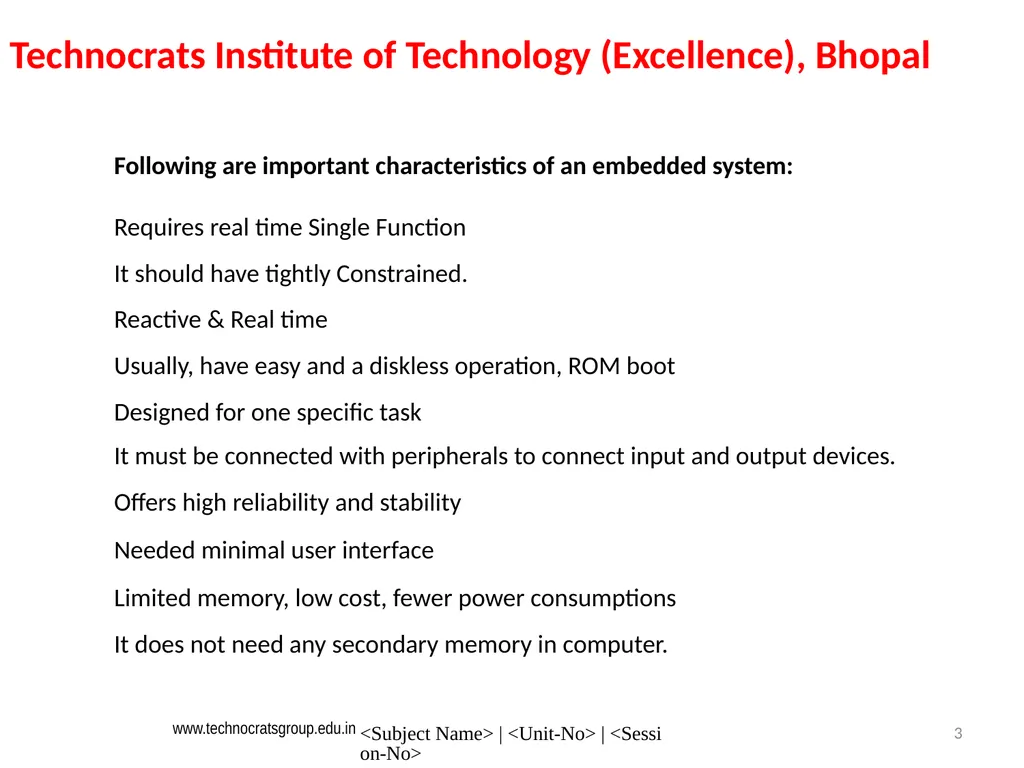
Requires real time Single Function
It should have tightly Constrained.
Reactive & Real time
Usually, have easy and a diskless operation, ROM boot
Designed for one specific task
It must be connected with peripherals to connect input and output devices.
Offers high reliability and stability
Needed minimal user interface
Limited memory, low cost, fewer power consumptions
It does not need any secondary memory in computer. Technocrats Institute of Technology (Excellence), Bhopal<br>
slide4. www.technocratsgroup.edu.in 4 <Subject Name> | <Unit-No> | <Session-No> Technocrats Institute of Technology (Excellence), Bhopal<br>
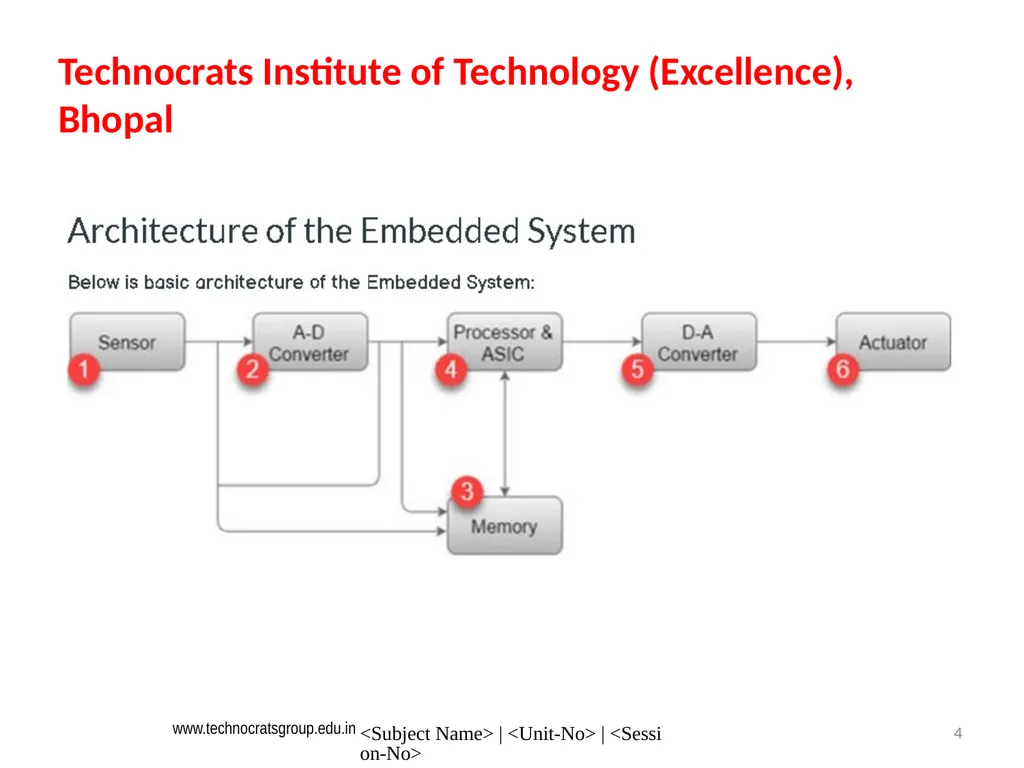
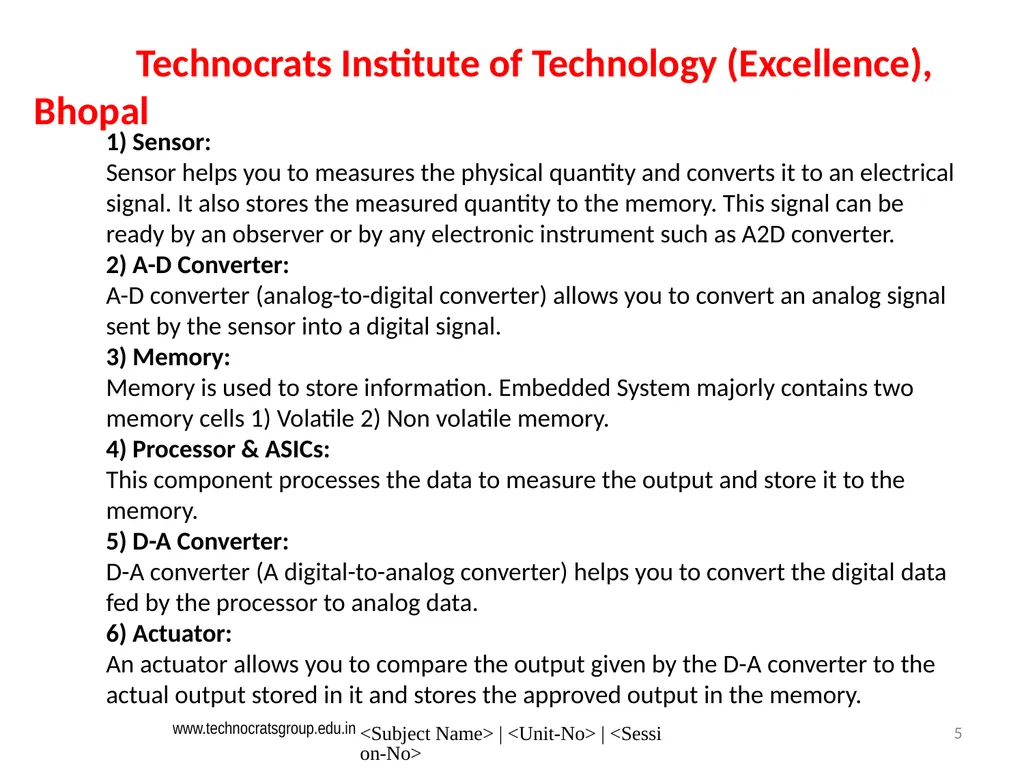
slide5. www.technocratsgroup.edu.in 5 <Subject Name> | <Unit-No> | <Session-No> 1) Sensor:
Sensor helps you to measures the physical quantity and converts it to an electrical signal. It also stores the measured quantity to the memory. This signal can be ready by an observer or by any electronic instrument such as A2D converter.
2) A-D Converter:
A-D converter (analog-to-digital converter) allows you to convert an analog signal sent by the sensor into a digital signal.
3) Memory:
Memory is used to store information. Embedded System majorly contains two memory cells 1) Volatile 2) Non volatile memory.
4) Processor & ASICs:
This component processes the data to measure the output and store it to the memory.
5) D-A Converter:
D-A converter (A digital-to-analog converter) helps you to convert the digital data fed by the processor to analog data.
6) Actuator:
An actuator allows you to compare the output given by the D-A converter to the actual output stored in it and stores the approved output in the memory. Technocrats Institute of Technology (Excellence), Bhopal<br>
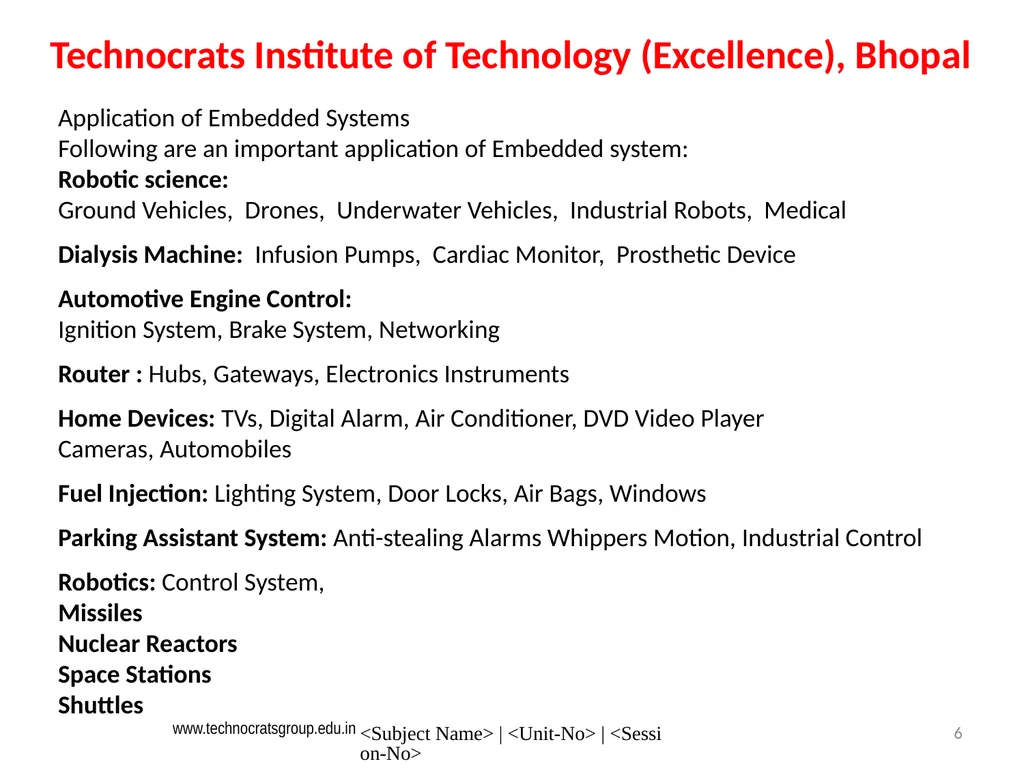
slide6. www.technocratsgroup.edu.in 6 <Subject Name> | <Unit-No> | <Session-No> Application of Embedded Systems
Following are an important application of Embedded system:
Robotic science:
Ground Vehicles, Drones, Underwater Vehicles, Industrial Robots, Medical
Dialysis Machine: Infusion Pumps, Cardiac Monitor, Prosthetic Device
Automotive Engine Control:
Ignition System, Brake System, Networking
Router : Hubs, Gateways, Electronics Instruments
Home Devices: TVs, Digital Alarm, Air Conditioner, DVD Video Player
Cameras, Automobiles
Fuel Injection: Lighting System, Door Locks, Air Bags, Windows
Parking Assistant System: Anti-stealing Alarms Whippers Motion, Industrial Control
Robotics: Control System,
Missiles
Nuclear Reactors
Space Stations
Shuttles Technocrats Institute of Technology (Excellence), Bhopal<br>
slide7. www.technocratsgroup.edu.in 7 <Subject Name> | <Unit-No> | <Session-No> Technocrats Institute of Technology (Excellence), Bhopal<br>
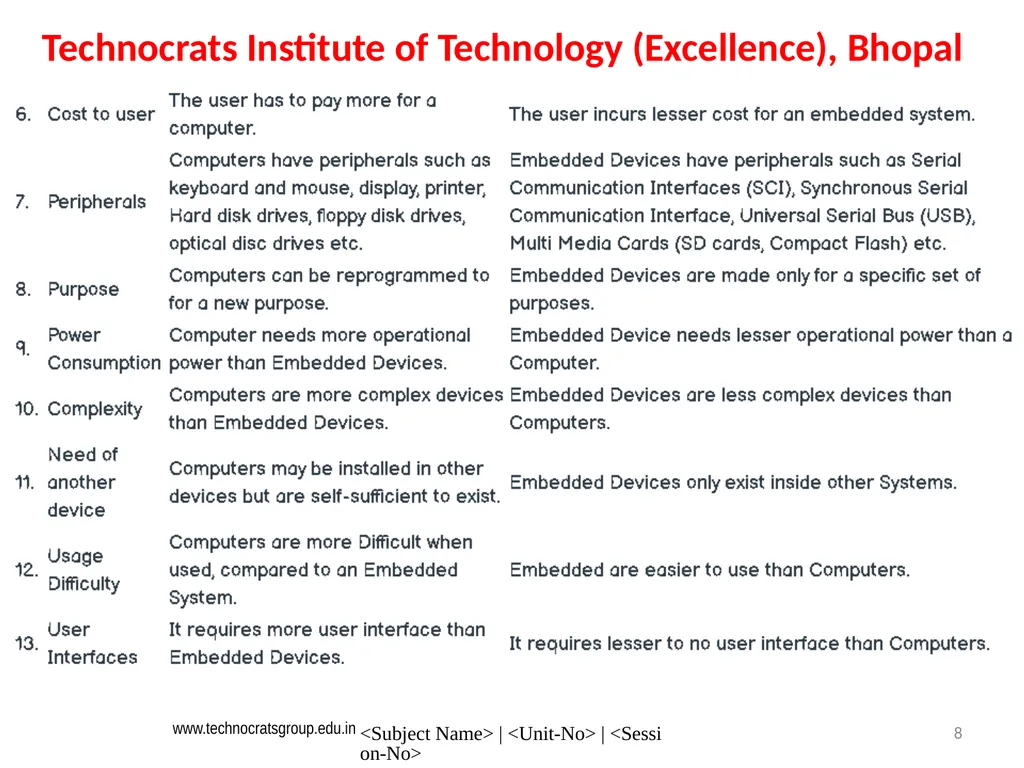
slide8. www.technocratsgroup.edu.in 8 <Subject Name> | <Unit-No> | <Session-No> Technocrats Institute of Technology (Excellence), Bhopal<br>
slide9. www.technocratsgroup.edu.in 9 <Subject Name> | <Unit-No> | <Session-No> Classification, Major application areas, purpose of embedded systems Technocrats Institute of Technology (Excellence), Bhopal<br>
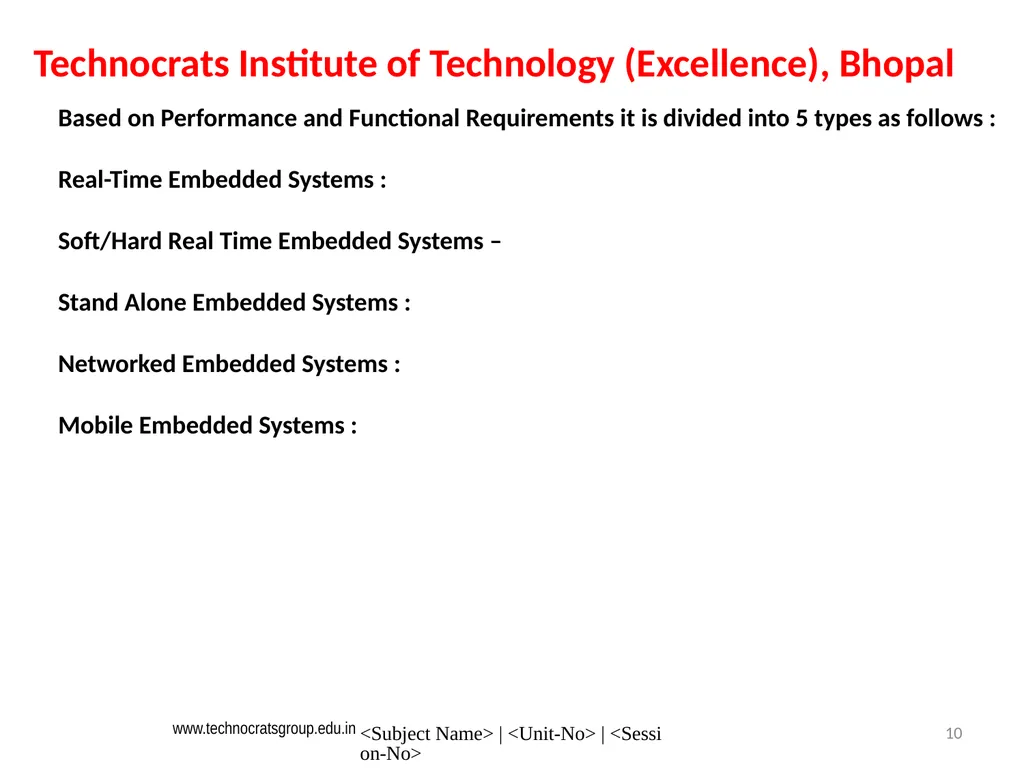
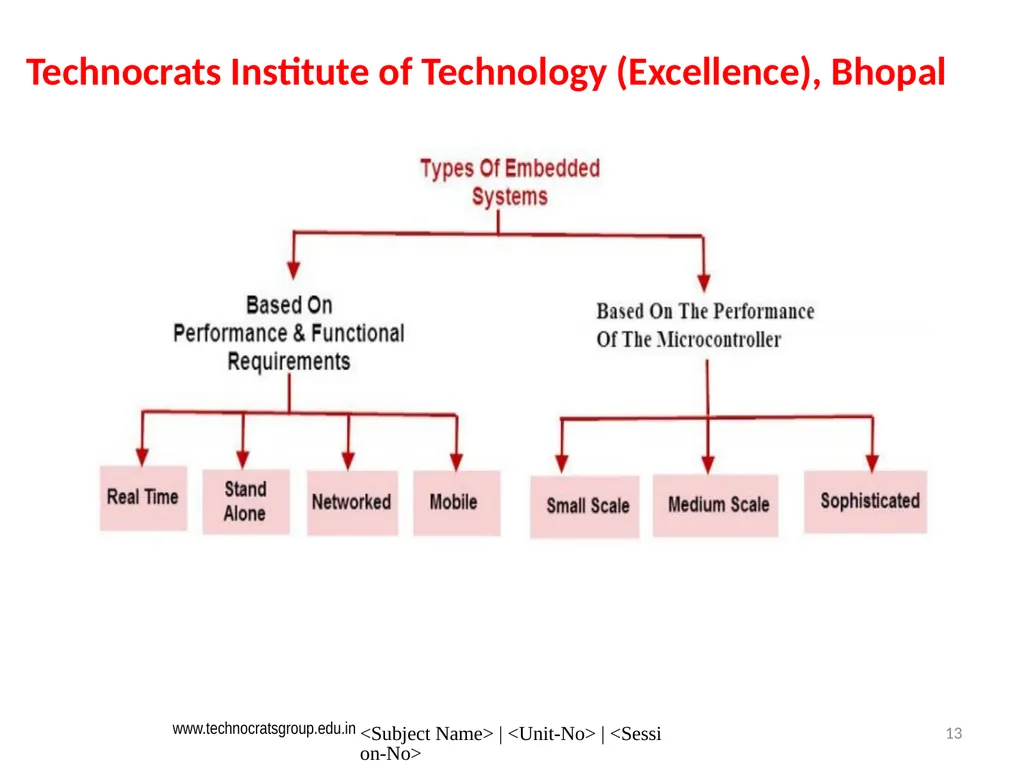
slide10. www.technocratsgroup.edu.in 10 <Subject Name> | <Unit-No> | <Session-No> Based on Performance and Functional Requirements it is divided into 5 types as follows :
Real-Time Embedded Systems :
Soft/Hard Real Time Embedded Systems –
Stand Alone Embedded Systems :
Networked Embedded Systems :
Mobile Embedded Systems : Technocrats Institute of Technology (Excellence), Bhopal<br>
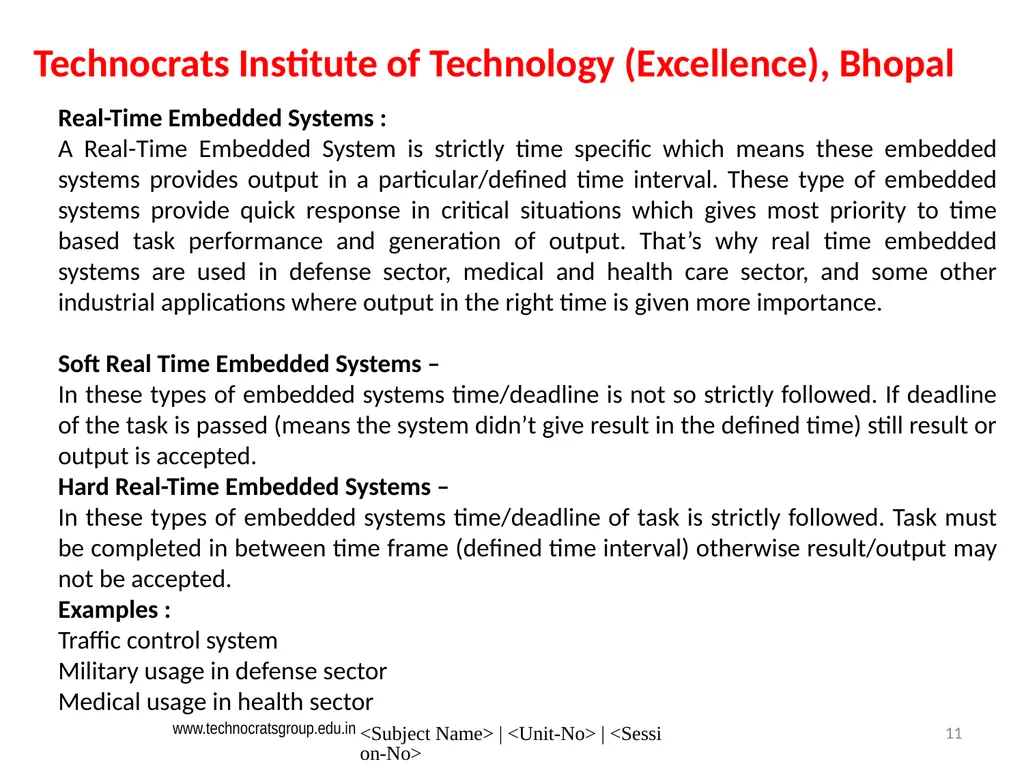
slide11. www.technocratsgroup.edu.in 11 <Subject Name> | <Unit-No> | <Session-No> Real-Time Embedded Systems :
A Real-Time Embedded System is strictly time specific which means these embedded systems provides output in a particular/defined time interval. These type of embedded systems provide quick response in critical situations which gives most priority to time based task performance and generation of output. That’s why real time embedded systems are used in defense sector, medical and health care sector, and some other industrial applications where output in the right time is given more importance.
Soft Real Time Embedded Systems –
In these types of embedded systems time/deadline is not so strictly followed. If deadline of the task is passed (means the system didn’t give result in the defined time) still result or output is accepted.
Hard Real-Time Embedded Systems –
In these types of embedded systems time/deadline of task is strictly followed. Task must be completed in between time frame (defined time interval) otherwise result/output may not be accepted.
Examples :
Traffic control system
Military usage in defense sector
Medical usage in health sector Technocrats Institute of Technology (Excellence), Bhopal<br>
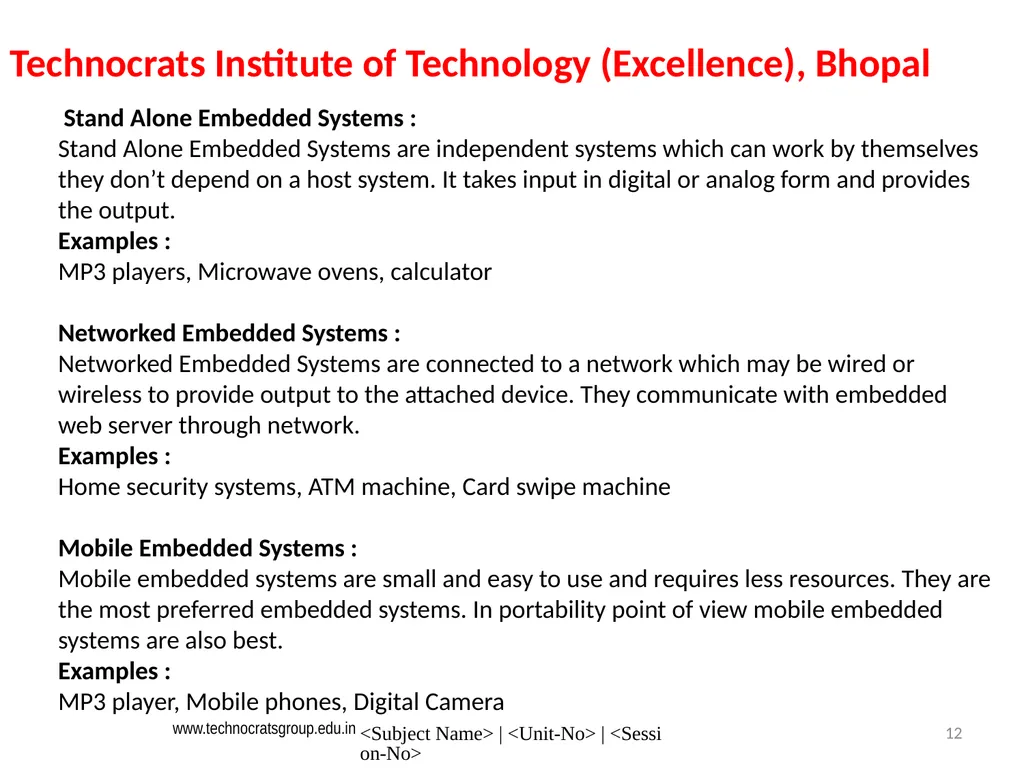
slide12. www.technocratsgroup.edu.in 12 <Subject Name> | <Unit-No> | <Session-No> Stand Alone Embedded Systems :
Stand Alone Embedded Systems are independent systems which can work by themselves they don’t depend on a host system. It takes input in digital or analog form and provides the output.
Examples :
MP3 players, Microwave ovens, calculator
Networked Embedded Systems :
Networked Embedded Systems are connected to a network which may be wired or wireless to provide output to the attached device. They communicate with embedded web server through network.
Examples :
Home security systems, ATM machine, Card swipe machine
Mobile Embedded Systems :
Mobile embedded systems are small and easy to use and requires less resources. They are the most preferred embedded systems. In portability point of view mobile embedded systems are also best.
Examples :
MP3 player, Mobile phones, Digital Camera Technocrats Institute of Technology (Excellence), Bhopal<br>
slide13. www.technocratsgroup.edu.in 13 <Subject Name> | <Unit-No> | <Session-No> Technocrats Institute of Technology (Excellence), Bhopal<br>
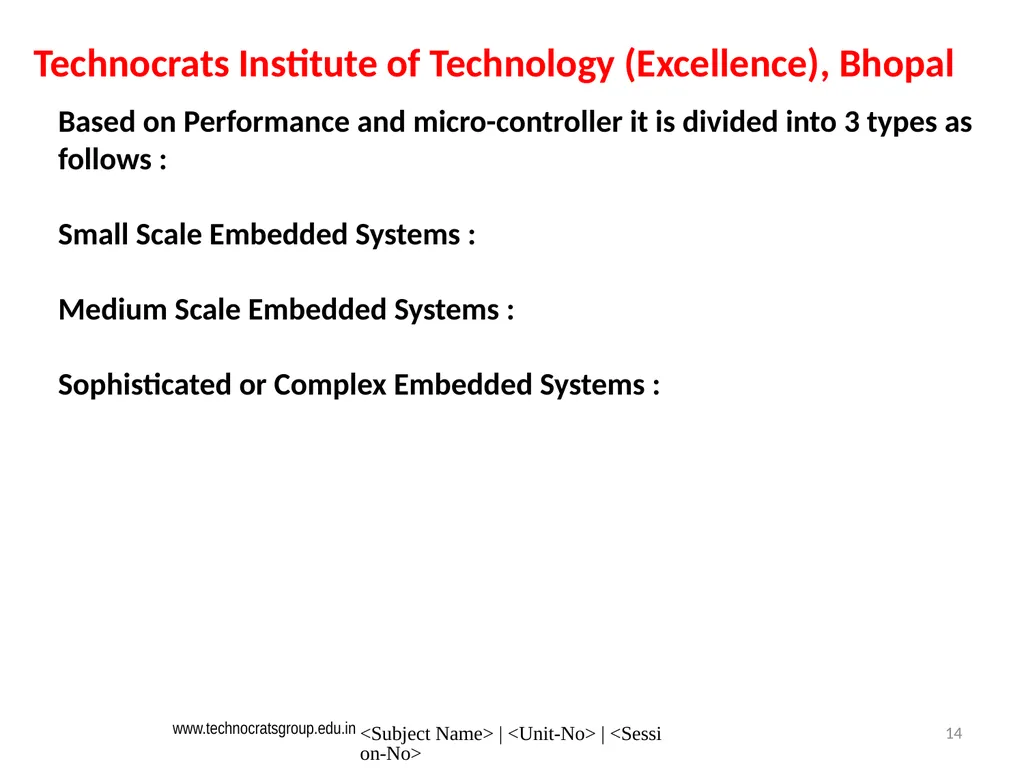
slide14. www.technocratsgroup.edu.in 14 <Subject Name> | <Unit-No> | <Session-No> Based on Performance and micro-controller it is divided into 3 types as follows :
Small Scale Embedded Systems :
Medium Scale Embedded Systems :
Sophisticated or Complex Embedded Systems : Technocrats Institute of Technology (Excellence), Bhopal<br>
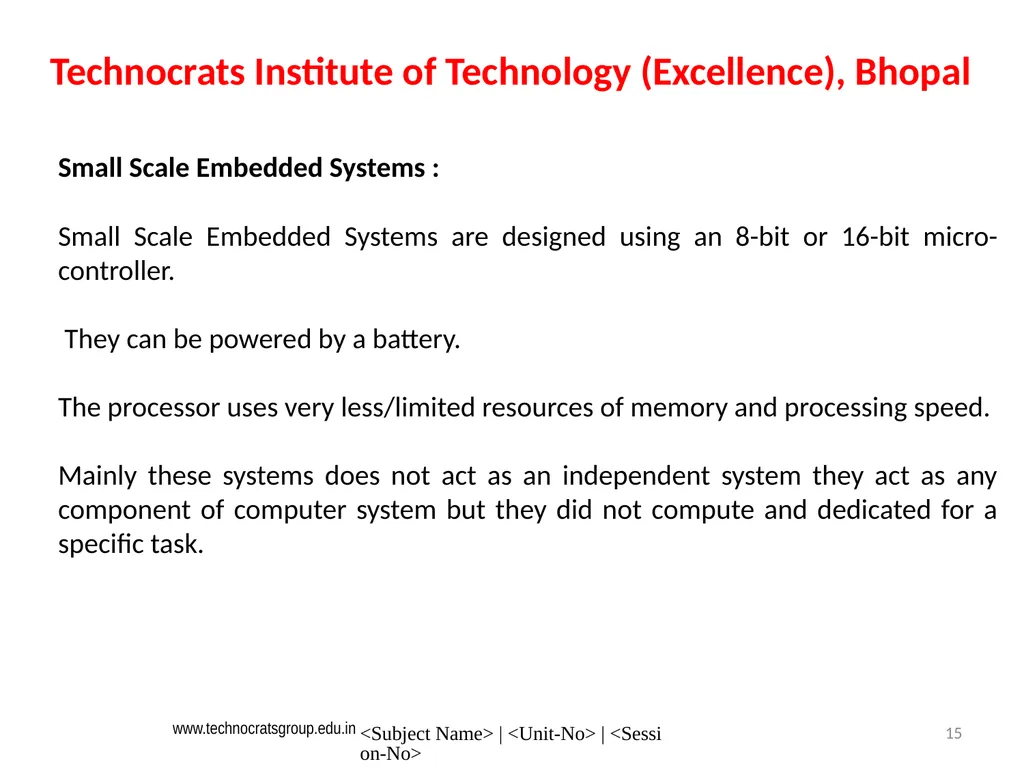
slide15. www.technocratsgroup.edu.in 15 <Subject Name> | <Unit-No> | <Session-No> Small Scale Embedded Systems :
Small Scale Embedded Systems are designed using an 8-bit or 16-bit micro-controller.
They can be powered by a battery.
The processor uses very less/limited resources of memory and processing speed.
Mainly these systems does not act as an independent system they act as any component of computer system but they did not compute and dedicated for a specific task. Technocrats Institute of Technology (Excellence), Bhopal<br>
slide16. www.technocratsgroup.edu.in 16 <Subject Name> | <Unit-No> | <Session-No> Medium Scale Embedded Systems :
Medium Scale Embedded Systems are designed using an 16-bit or 32-bit micro-controller.
These medium Scale Embedded Systems are faster than that of small Scale Embedded Systems.
Integration of hardware and software is complex in these systems. Java (Links to an external site.), C (Links to an external site.), C++ (Links to an external site.) are the programming languages are used to develop medium scale embedded systems.
Different type of software tools like compiler, debugger, simulator etc are used to develop these type of systems. Technocrats Institute of Technology (Excellence), Bhopal<br>
slide17. www.technocratsgroup.edu.in 17 <Subject Name> | <Unit-No> | <Session-No> Sophisticated or Complex Embedded Systems :
Sophisticated or Complex Embedded Systems are designed using multiple 32-bit or 64-bit micro-controller.
These systems are developed to perform large scale complex functions. These systems have high hardware and software complexities.
We use both hardware and software components to design final systems or hardware products.
Maximum Mode of operation Technocrats Institute of Technology (Excellence), Bhopal<br>
slide18. www.technocratsgroup.edu.in 18 <Subject Name> | <Unit-No> | <Session-No> DESIGN METRICS OF EMBEDDED SYSTEMS
A Design Metric is a measurable feature of the system’s performance, cost, time for implementation and safety etc. Most of these are conflicting requirements i.e. optimizing one shall not optimize the other: e.g. a cheaper processor may have a lousy performance as far as speed and throughput is concerned.
1. NRE cost (nonrecurring engineering cost)
It is one-time cost of designing the system. Once the system is designed, any number of units can be manufactured without incurring any additional design cost; hence the term nonrecurring.
2. Unit cost
The monetary cost of manufacturing each copy of the system, excluding NRE cost.
3. Size
The physical space required by the system, often measured in bytes for software, and gates or transistors for hardware. Technocrats Institute of Technology (Excellence), Bhopal<br>
slide19. www.technocratsgroup.edu.in 19 <Subject Name> | <Unit-No> | <Session-No> 4. Performance
The execution time of the system
5. Power Consumption
It is the amount of power consumed by the system, which may determine the lifetime of a battery, or the cooling requirements of the IC, since more power means more heat.
6. Flexibility
The ability to change the functionality of the system without incurring heavy NRE cost. Software is typically considered very flexible.
7. Time-to-prototype
The time needed to build a working version of the system, which may be bigger or more expensive than the final system implementation, but it can be used to verify the system’s usefulness and correctness and to refine the system’s functionality. Technocrats Institute of Technology (Excellence), Bhopal<br>
slide20. www.technocratsgroup.edu.in 20 <Subject Name> | <Unit-No> | <Session-No> 8. Time-to-market
The time required to develop a system to the point that it can be released and sold to customers. The main contributors are design time, manufacturing time, and testing time. This metric has become especially demanding in recent years. Introducing an embedded system to the marketplace early can make a big difference in the system’s profitability.
9. Maintainability
It is the ability to modify the system after its initial release, especially by designers who did not originally design the system.
10. Correctness
This is the measure of the confidence that we have implemented the system’s functionality correctly. We can check the functionality throughout the process of designing the system, and we can insert test circuitry to check that manufacturing was correct. Technocrats Institute of Technology (Excellence), Bhopal<br>
slide21. www.technocratsgroup.edu.in 21 <Subject Name> | <Unit-No> | <Session-No> Processor technology:
General purpose processor,
Application specific processor,
Single purpose processor. Technocrats Institute of Technology (Excellence), Bhopal<br>
slide22. www.technocratsgroup.edu.in 22 <Subject Name> | <Unit-No> | <Session-No> General purpose processor:
The system designer only needs to program the processor’s memory to carry out the required functionality: software portion.
These types are created to produce large numbers for a variety of applications.
Usually they are used to put in a product the first time it goes to the market, because of their cheap design cost and ease to use.
Because of the use of code, a designer usually strives to minimize compiled code size, rather than maximize performance. Technocrats Institute of Technology (Excellence), Bhopal<br>
slide23. www.technocratsgroup.edu.in 23 <Subject Name> | <Unit-No> | <Session-No> Single purpose processor:
This type of processor is designed to execute exactly one program.
An embedded designer creates a single-purpose processor by designing a custom digital circuit.
They are designed to fit the specific requirements of an end product. In the design process they will be optimised for both power and performance.
An ASIC is introduced for a product usually after a product is stabilised on the market (with non-ASIC solution), because of the higher development time and cost.
After the stabilisation the producer can look for extra margin by making the processor as good as possible for his application.
A disadvantage is that when you make a mistake, you will need to make a whole new chip, but for a general-purpose processor you just change the code and recompile.
You can use an ASIC in a stable market where technology and requirements aren't going to change rapidly. Technocrats Institute of Technology (Excellence), Bhopal<br>
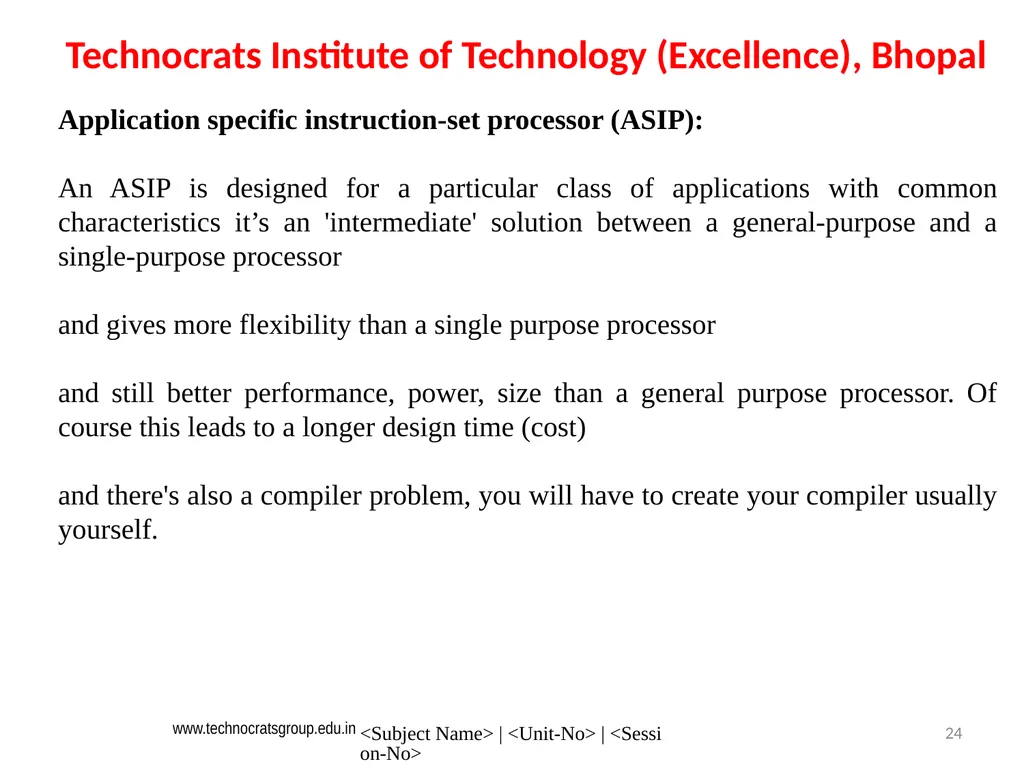
slide24. www.technocratsgroup.edu.in 24 <Subject Name> | <Unit-No> | <Session-No> Application specific instruction-set processor (ASIP):
An ASIP is designed for a particular class of applications with common characteristics it’s an 'intermediate' solution between a general-purpose and a single-purpose processor
and gives more flexibility than a single purpose processor
and still better performance, power, size than a general purpose processor. Of course this leads to a longer design time (cost)
and there's also a compiler problem, you will have to create your compiler usually yourself. Technocrats Institute of Technology (Excellence), Bhopal<br>
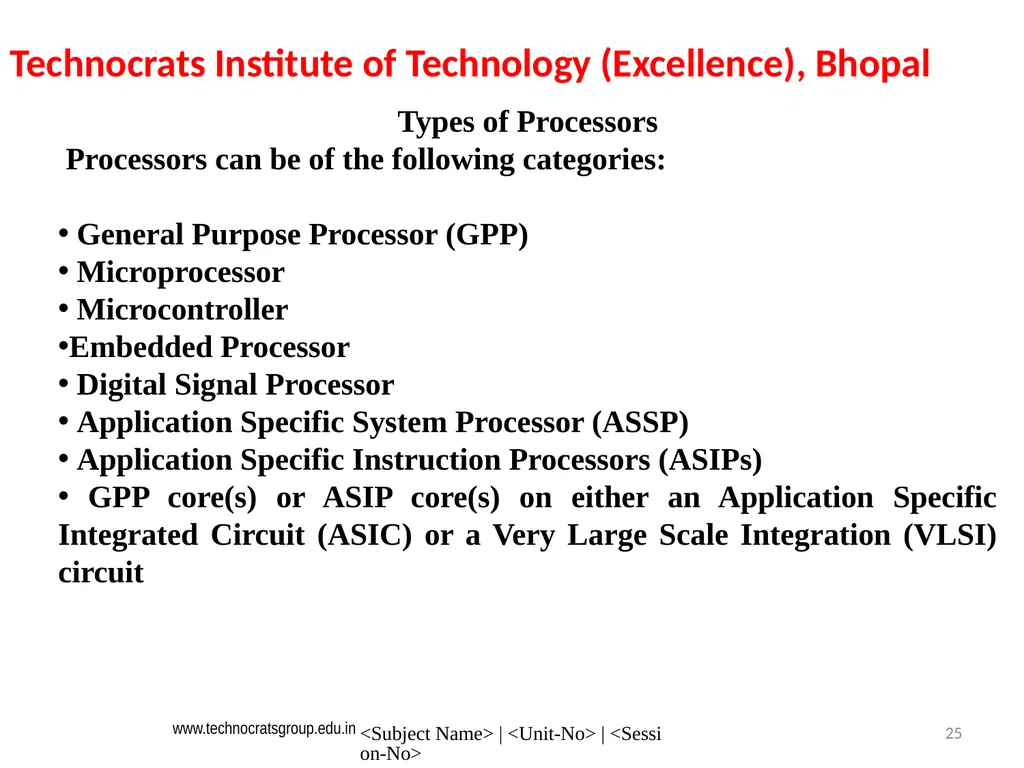
slide25. www.technocratsgroup.edu.in 25 <Subject Name> | <Unit-No> | <Session-No> Types of Processors
Processors can be of the following categories:
General Purpose Processor (GPP)
Microprocessor
Microcontroller
Embedded Processor
Digital Signal Processor
Application Specific System Processor (ASSP)
Application Specific Instruction Processors (ASIPs)
GPP core(s) or ASIP core(s) on either an Application Specific Integrated Circuit (ASIC) or a Very Large Scale Integration (VLSI) circuit Technocrats Institute of Technology (Excellence), Bhopal<br>
Embedded System Electronics & Communication Engineering
EC-VI Technocrats Institute of Technology (Excellence), Bhopal<br>
slide2. www.technocratsgroup.edu.in 2 <Subject Name> | <Unit-No> | <Session-No> Embedded System
It is a combination of computer software and hardware which is either fixed in capability or programmable.
An embedded system can be either an independent system, or it can be a part of a large system.
It is mostly designed for a specific function or functions within a larger system.
For example, a fire alarm is a common example of an embedded system which can sense only smoke. Technocrats Institute of Technology (Excellence), Bhopal<br>
slide3. www.technocratsgroup.edu.in 3 <Subject Name> | <Unit-No> | <Session-No> Following are important characteristics of an embedded system:
Requires real time Single Function
It should have tightly Constrained.
Reactive & Real time
Usually, have easy and a diskless operation, ROM boot
Designed for one specific task
It must be connected with peripherals to connect input and output devices.
Offers high reliability and stability
Needed minimal user interface
Limited memory, low cost, fewer power consumptions
It does not need any secondary memory in computer. Technocrats Institute of Technology (Excellence), Bhopal<br>
slide4. www.technocratsgroup.edu.in 4 <Subject Name> | <Unit-No> | <Session-No> Technocrats Institute of Technology (Excellence), Bhopal<br>
slide5. www.technocratsgroup.edu.in 5 <Subject Name> | <Unit-No> | <Session-No> 1) Sensor:
Sensor helps you to measures the physical quantity and converts it to an electrical signal. It also stores the measured quantity to the memory. This signal can be ready by an observer or by any electronic instrument such as A2D converter.
2) A-D Converter:
A-D converter (analog-to-digital converter) allows you to convert an analog signal sent by the sensor into a digital signal.
3) Memory:
Memory is used to store information. Embedded System majorly contains two memory cells 1) Volatile 2) Non volatile memory.
4) Processor & ASICs:
This component processes the data to measure the output and store it to the memory.
5) D-A Converter:
D-A converter (A digital-to-analog converter) helps you to convert the digital data fed by the processor to analog data.
6) Actuator:
An actuator allows you to compare the output given by the D-A converter to the actual output stored in it and stores the approved output in the memory. Technocrats Institute of Technology (Excellence), Bhopal<br>
slide6. www.technocratsgroup.edu.in 6 <Subject Name> | <Unit-No> | <Session-No> Application of Embedded Systems
Following are an important application of Embedded system:
Robotic science:
Ground Vehicles, Drones, Underwater Vehicles, Industrial Robots, Medical
Dialysis Machine: Infusion Pumps, Cardiac Monitor, Prosthetic Device
Automotive Engine Control:
Ignition System, Brake System, Networking
Router : Hubs, Gateways, Electronics Instruments
Home Devices: TVs, Digital Alarm, Air Conditioner, DVD Video Player
Cameras, Automobiles
Fuel Injection: Lighting System, Door Locks, Air Bags, Windows
Parking Assistant System: Anti-stealing Alarms Whippers Motion, Industrial Control
Robotics: Control System,
Missiles
Nuclear Reactors
Space Stations
Shuttles Technocrats Institute of Technology (Excellence), Bhopal<br>
slide7. www.technocratsgroup.edu.in 7 <Subject Name> | <Unit-No> | <Session-No> Technocrats Institute of Technology (Excellence), Bhopal<br>
slide8. www.technocratsgroup.edu.in 8 <Subject Name> | <Unit-No> | <Session-No> Technocrats Institute of Technology (Excellence), Bhopal<br>
slide9. www.technocratsgroup.edu.in 9 <Subject Name> | <Unit-No> | <Session-No> Classification, Major application areas, purpose of embedded systems Technocrats Institute of Technology (Excellence), Bhopal<br>
slide10. www.technocratsgroup.edu.in 10 <Subject Name> | <Unit-No> | <Session-No> Based on Performance and Functional Requirements it is divided into 5 types as follows :
Real-Time Embedded Systems :
Soft/Hard Real Time Embedded Systems –
Stand Alone Embedded Systems :
Networked Embedded Systems :
Mobile Embedded Systems : Technocrats Institute of Technology (Excellence), Bhopal<br>
slide11. www.technocratsgroup.edu.in 11 <Subject Name> | <Unit-No> | <Session-No> Real-Time Embedded Systems :
A Real-Time Embedded System is strictly time specific which means these embedded systems provides output in a particular/defined time interval. These type of embedded systems provide quick response in critical situations which gives most priority to time based task performance and generation of output. That’s why real time embedded systems are used in defense sector, medical and health care sector, and some other industrial applications where output in the right time is given more importance.
Soft Real Time Embedded Systems –
In these types of embedded systems time/deadline is not so strictly followed. If deadline of the task is passed (means the system didn’t give result in the defined time) still result or output is accepted.
Hard Real-Time Embedded Systems –
In these types of embedded systems time/deadline of task is strictly followed. Task must be completed in between time frame (defined time interval) otherwise result/output may not be accepted.
Examples :
Traffic control system
Military usage in defense sector
Medical usage in health sector Technocrats Institute of Technology (Excellence), Bhopal<br>
slide12. www.technocratsgroup.edu.in 12 <Subject Name> | <Unit-No> | <Session-No> Stand Alone Embedded Systems :
Stand Alone Embedded Systems are independent systems which can work by themselves they don’t depend on a host system. It takes input in digital or analog form and provides the output.
Examples :
MP3 players, Microwave ovens, calculator
Networked Embedded Systems :
Networked Embedded Systems are connected to a network which may be wired or wireless to provide output to the attached device. They communicate with embedded web server through network.
Examples :
Home security systems, ATM machine, Card swipe machine
Mobile Embedded Systems :
Mobile embedded systems are small and easy to use and requires less resources. They are the most preferred embedded systems. In portability point of view mobile embedded systems are also best.
Examples :
MP3 player, Mobile phones, Digital Camera Technocrats Institute of Technology (Excellence), Bhopal<br>
slide13. www.technocratsgroup.edu.in 13 <Subject Name> | <Unit-No> | <Session-No> Technocrats Institute of Technology (Excellence), Bhopal<br>
slide14. www.technocratsgroup.edu.in 14 <Subject Name> | <Unit-No> | <Session-No> Based on Performance and micro-controller it is divided into 3 types as follows :
Small Scale Embedded Systems :
Medium Scale Embedded Systems :
Sophisticated or Complex Embedded Systems : Technocrats Institute of Technology (Excellence), Bhopal<br>
slide15. www.technocratsgroup.edu.in 15 <Subject Name> | <Unit-No> | <Session-No> Small Scale Embedded Systems :
Small Scale Embedded Systems are designed using an 8-bit or 16-bit micro-controller.
They can be powered by a battery.
The processor uses very less/limited resources of memory and processing speed.
Mainly these systems does not act as an independent system they act as any component of computer system but they did not compute and dedicated for a specific task. Technocrats Institute of Technology (Excellence), Bhopal<br>
slide16. www.technocratsgroup.edu.in 16 <Subject Name> | <Unit-No> | <Session-No> Medium Scale Embedded Systems :
Medium Scale Embedded Systems are designed using an 16-bit or 32-bit micro-controller.
These medium Scale Embedded Systems are faster than that of small Scale Embedded Systems.
Integration of hardware and software is complex in these systems. Java (Links to an external site.), C (Links to an external site.), C++ (Links to an external site.) are the programming languages are used to develop medium scale embedded systems.
Different type of software tools like compiler, debugger, simulator etc are used to develop these type of systems. Technocrats Institute of Technology (Excellence), Bhopal<br>
slide17. www.technocratsgroup.edu.in 17 <Subject Name> | <Unit-No> | <Session-No> Sophisticated or Complex Embedded Systems :
Sophisticated or Complex Embedded Systems are designed using multiple 32-bit or 64-bit micro-controller.
These systems are developed to perform large scale complex functions. These systems have high hardware and software complexities.
We use both hardware and software components to design final systems or hardware products.
Maximum Mode of operation Technocrats Institute of Technology (Excellence), Bhopal<br>
slide18. www.technocratsgroup.edu.in 18 <Subject Name> | <Unit-No> | <Session-No> DESIGN METRICS OF EMBEDDED SYSTEMS
A Design Metric is a measurable feature of the system’s performance, cost, time for implementation and safety etc. Most of these are conflicting requirements i.e. optimizing one shall not optimize the other: e.g. a cheaper processor may have a lousy performance as far as speed and throughput is concerned.
1. NRE cost (nonrecurring engineering cost)
It is one-time cost of designing the system. Once the system is designed, any number of units can be manufactured without incurring any additional design cost; hence the term nonrecurring.
2. Unit cost
The monetary cost of manufacturing each copy of the system, excluding NRE cost.
3. Size
The physical space required by the system, often measured in bytes for software, and gates or transistors for hardware. Technocrats Institute of Technology (Excellence), Bhopal<br>
slide19. www.technocratsgroup.edu.in 19 <Subject Name> | <Unit-No> | <Session-No> 4. Performance
The execution time of the system
5. Power Consumption
It is the amount of power consumed by the system, which may determine the lifetime of a battery, or the cooling requirements of the IC, since more power means more heat.
6. Flexibility
The ability to change the functionality of the system without incurring heavy NRE cost. Software is typically considered very flexible.
7. Time-to-prototype
The time needed to build a working version of the system, which may be bigger or more expensive than the final system implementation, but it can be used to verify the system’s usefulness and correctness and to refine the system’s functionality. Technocrats Institute of Technology (Excellence), Bhopal<br>
slide20. www.technocratsgroup.edu.in 20 <Subject Name> | <Unit-No> | <Session-No> 8. Time-to-market
The time required to develop a system to the point that it can be released and sold to customers. The main contributors are design time, manufacturing time, and testing time. This metric has become especially demanding in recent years. Introducing an embedded system to the marketplace early can make a big difference in the system’s profitability.
9. Maintainability
It is the ability to modify the system after its initial release, especially by designers who did not originally design the system.
10. Correctness
This is the measure of the confidence that we have implemented the system’s functionality correctly. We can check the functionality throughout the process of designing the system, and we can insert test circuitry to check that manufacturing was correct. Technocrats Institute of Technology (Excellence), Bhopal<br>
slide21. www.technocratsgroup.edu.in 21 <Subject Name> | <Unit-No> | <Session-No> Processor technology:
General purpose processor,
Application specific processor,
Single purpose processor. Technocrats Institute of Technology (Excellence), Bhopal<br>
slide22. www.technocratsgroup.edu.in 22 <Subject Name> | <Unit-No> | <Session-No> General purpose processor:
The system designer only needs to program the processor’s memory to carry out the required functionality: software portion.
These types are created to produce large numbers for a variety of applications.
Usually they are used to put in a product the first time it goes to the market, because of their cheap design cost and ease to use.
Because of the use of code, a designer usually strives to minimize compiled code size, rather than maximize performance. Technocrats Institute of Technology (Excellence), Bhopal<br>
slide23. www.technocratsgroup.edu.in 23 <Subject Name> | <Unit-No> | <Session-No> Single purpose processor:
This type of processor is designed to execute exactly one program.
An embedded designer creates a single-purpose processor by designing a custom digital circuit.
They are designed to fit the specific requirements of an end product. In the design process they will be optimised for both power and performance.
An ASIC is introduced for a product usually after a product is stabilised on the market (with non-ASIC solution), because of the higher development time and cost.
After the stabilisation the producer can look for extra margin by making the processor as good as possible for his application.
A disadvantage is that when you make a mistake, you will need to make a whole new chip, but for a general-purpose processor you just change the code and recompile.
You can use an ASIC in a stable market where technology and requirements aren't going to change rapidly. Technocrats Institute of Technology (Excellence), Bhopal<br>
slide24. www.technocratsgroup.edu.in 24 <Subject Name> | <Unit-No> | <Session-No> Application specific instruction-set processor (ASIP):
An ASIP is designed for a particular class of applications with common characteristics it’s an 'intermediate' solution between a general-purpose and a single-purpose processor
and gives more flexibility than a single purpose processor
and still better performance, power, size than a general purpose processor. Of course this leads to a longer design time (cost)
and there's also a compiler problem, you will have to create your compiler usually yourself. Technocrats Institute of Technology (Excellence), Bhopal<br>
slide25. www.technocratsgroup.edu.in 25 <Subject Name> | <Unit-No> | <Session-No> Types of Processors
Processors can be of the following categories:
General Purpose Processor (GPP)
Microprocessor
Microcontroller
Embedded Processor
Digital Signal Processor
Application Specific System Processor (ASSP)
Application Specific Instruction Processors (ASIPs)
GPP core(s) or ASIP core(s) on either an Application Specific Integrated Circuit (ASIC) or a Very Large Scale Integration (VLSI) circuit Technocrats Institute of Technology (Excellence), Bhopal<br>