Midterm Review Mission 16-24 September 2023 Statistical Non Statistical Directorates Presentations Population and Social Statistics Directorate Statistical programs Services covered under this domain Demographic Statistics Department
"Midterm Review Mission 16-24 September 2023" is the property of its rightful owner. Permission is granted to
download and print the materials on this website for personal, non-commercial use only, and to display it
on your personal computer provided you do not modify the materials and that you retain all copyright
notices contained in the materials. By downloading content from our website, you accept the terms of this
agreement.
Presentation Transcript
01
Midterm Review Mission
16-24 September 2023 Statistical / Non Statistical Directorates Presentations Population and Social Statistics Directorate<br>
02
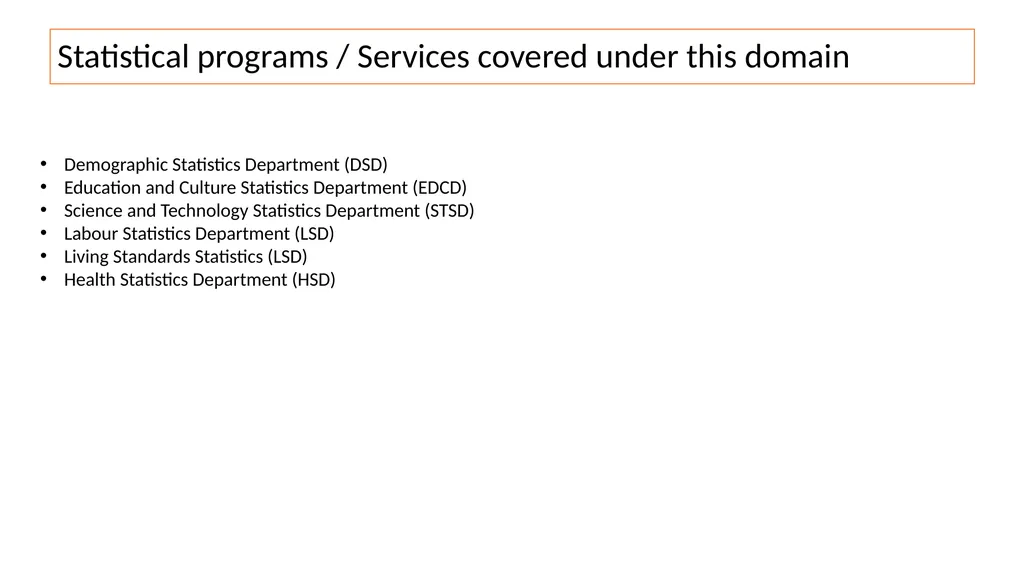
Statistical programs / Services covered under this domain Demographic Statistics Department (DSD)
Education and Culture Statistics Department (EDCD)
Science and Technology Statistics Department (STSD)
Labour Statistics Department (LSD)
Living Standards Statistics (LSD)
Health Statistics Department (HSD)<br>
03
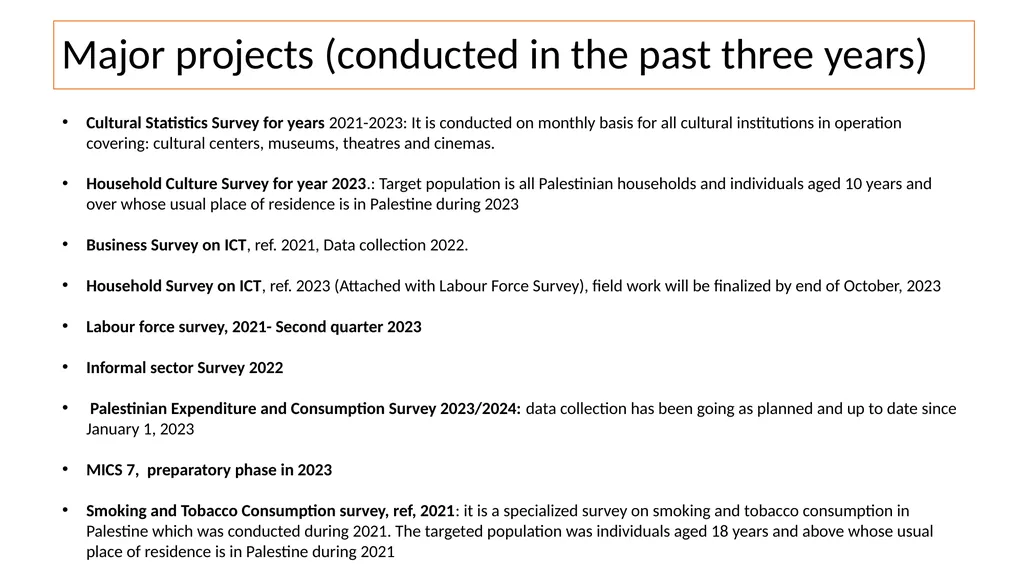
Major projects (conducted in the past three years) Cultural Statistics Survey for years 2021-2023: It is conducted on monthly basis for all cultural institutions in operation covering: cultural centers, museums, theatres and cinemas.
Household Culture Survey for year 2023.: Target population is all Palestinian households and individuals aged 10 years and over whose usual place of residence is in Palestine during 2023
Business Survey on ICT, ref. 2021, Data collection 2022.
Household Survey on ICT, ref. 2023 (Attached with Labour Force Survey), field work will be finalized by end of October, 2023
Labour force survey, 2021- Second quarter 2023
Informal sector Survey 2022
Palestinian Expenditure and Consumption Survey 2023/2024: data collection has been going as planned and up to date since January 1, 2023
MICS 7, preparatory phase in 2023
Smoking and Tobacco Consumption survey, ref, 2021: it is a specialized survey on smoking and tobacco consumption in Palestine which was conducted during 2021. The targeted population was individuals aged 18 years and above whose usual place of residence is in Palestine during 2021<br>
04
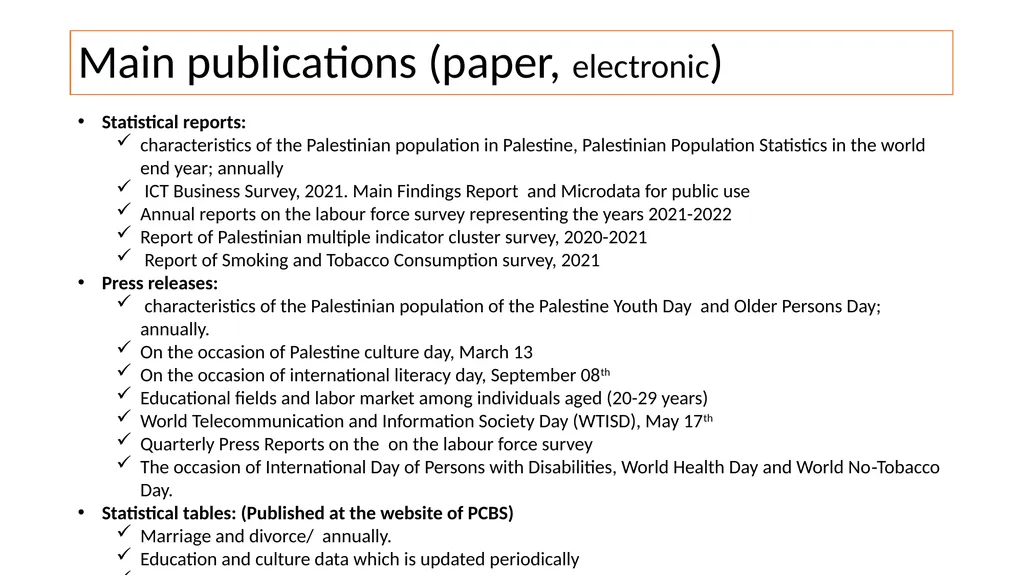
Main publications (paper, electronic) Statistical reports:
characteristics of the Palestinian population in Palestine, Palestinian Population Statistics in the world end year; annually
ICT Business Survey, 2021. Main Findings Report and Microdata for public use
Annual reports on the labour force survey representing the years 2021-2022
Report of Palestinian multiple indicator cluster survey, 2020-2021
Report of Smoking and Tobacco Consumption survey, 2021
Press releases:
characteristics of the Palestinian population of the Palestine Youth Day and Older Persons Day; annually.
On the occasion of Palestine culture day, March 13
On the occasion of international literacy day, September 08th
Educational fields and labor market among individuals aged (20-29 years)
World Telecommunication and Information Society Day (WTISD), May 17th
Quarterly Press Reports on the on the labour force survey
The occasion of International Day of Persons with Disabilities, World Health Day and World No‑Tobacco Day.
Statistical tables: (Published at the website of PCBS)
Marriage and divorce/ annually.
Education and culture data which is updated periodically
Health Statistic administrative records tables.<br>
05
Main publications (paper, electronic) (Cont.) Other Publications:
Fact sheets for MICS6 survey and Smoking and Tobacco Consumption survey, 2021
Animated video based on Smoking and Tobacco Consumption survey.<br>
06
Data sources (list of data sources with reference to periodicity, readiness, quality where necessary) with focus on –nontraditional sources (Statistical programs ONLY) Census: Population, Housing and Establishments Census, 2017.
Administrative records AR : Sharia courts and Churches, Ministry of Education, Ministry of Higher Education & Scientific Research, Ministry of Telecom and Information Technology, Ministry of Health, Ministry of Social Affairs
Note: GSBPM Followed in all projects.<br>
07
Main partners (users, producers, joint publications, joint projects) including partners with MoU/agreements Producers:
All institutions in the National Statistical System in addition to international organizations.
Users:
Line Ministries
International organizations
National and International Institutions
Joint Publications:
Press release On the occasion of Palestine Culture Day published jointly with Ministry of Culture
Press release on the occasion World Telecommunication and Information Society Day (WTISD),
MOU with ministry of Labour and General Personal Council<br>
08
Representation in national / international committees/task force Medstat (Migration(
EGRISS
National Qualification Frame Technical Team
Working group of informal sector and informal employment which organized by ILO since 2019
National committee of employed women
Member of the Committee of Experts on food security, agricultural and rural statistics (UN-CEAG) working group on Methodological improvement of food consumption and food security statistics.
The national committee of the SDG’s Goal 1 “End Poverty”, The national committee of the Goal 2 “End hunger”: Food and nutrition security in Palestine
Washington Group for Disability
Research Priorities Committee - Social and Economic Sector<br>
09
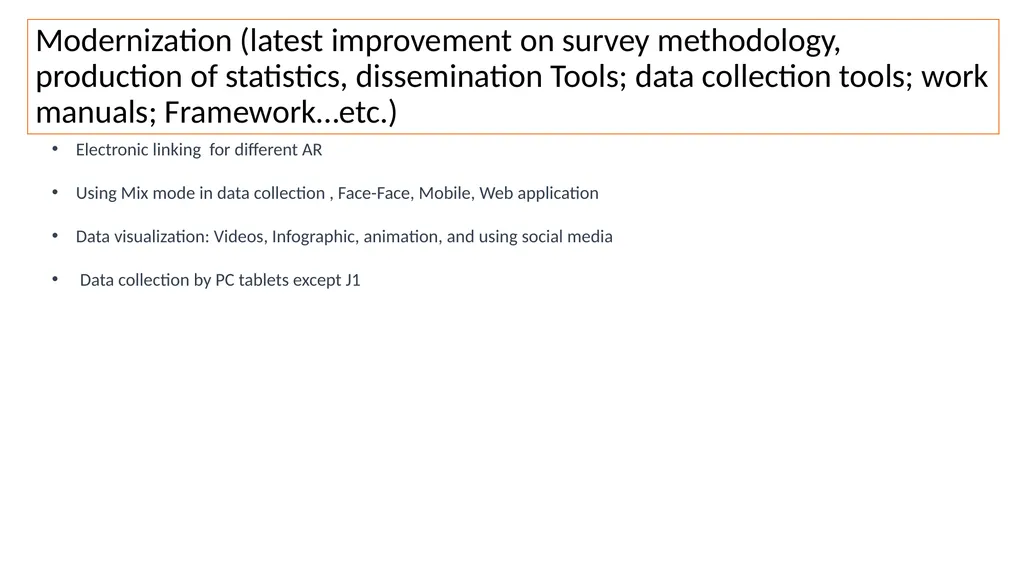
Modernization (latest improvement on survey methodology, production of statistics, dissemination Tools; data collection tools; work manuals; Framework…etc.) Electronic linking for different AR
Using Mix mode in data collection , Face-Face, Mobile, Web application
Data visualization: Videos, Infographic, animation, and using social media
Data collection by PC tablets except J1<br>
10
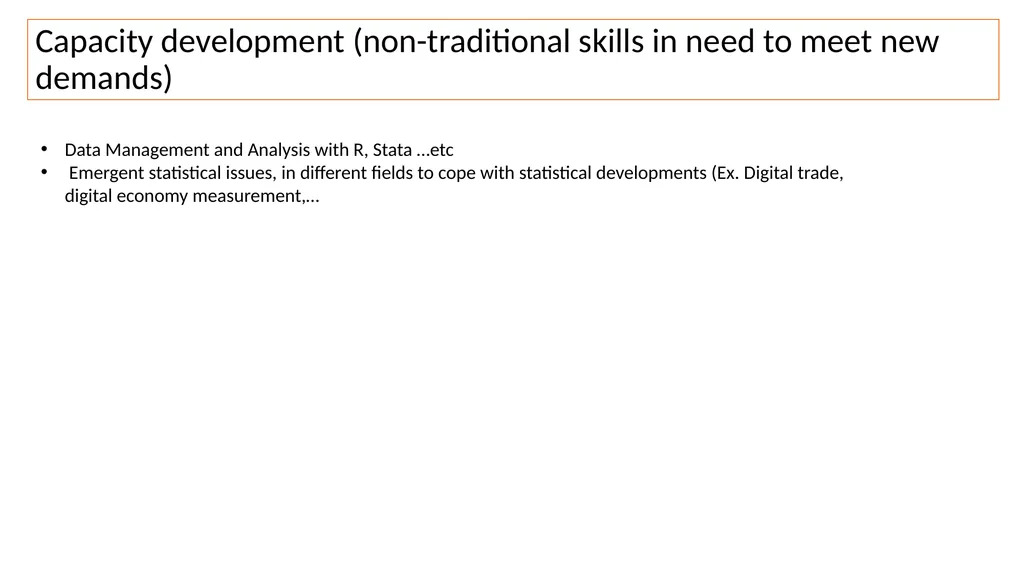
Capacity development (non-traditional skills in need to meet new demands) Data Management and Analysis with R, Stata …etc
Emergent statistical issues, in different fields to cope with statistical developments (Ex. Digital trade, digital economy measurement,…<br>
11
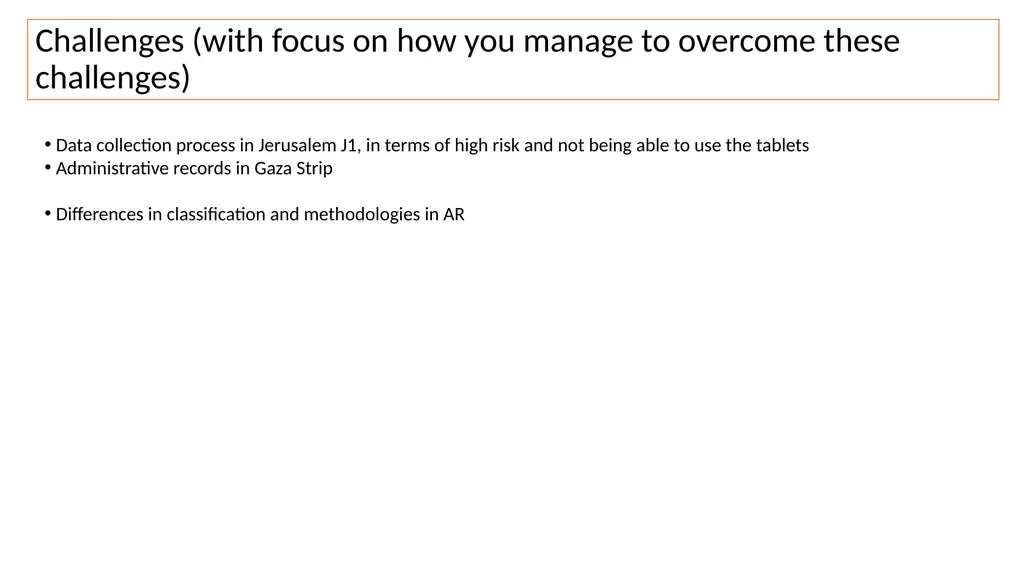
Challenges (with focus on how you manage to overcome these challenges) Data collection process in Jerusalem J1, in terms of high risk and not being able to use the tablets
Administrative records in Gaza Strip
Differences in classification and methodologies in AR<br>
12
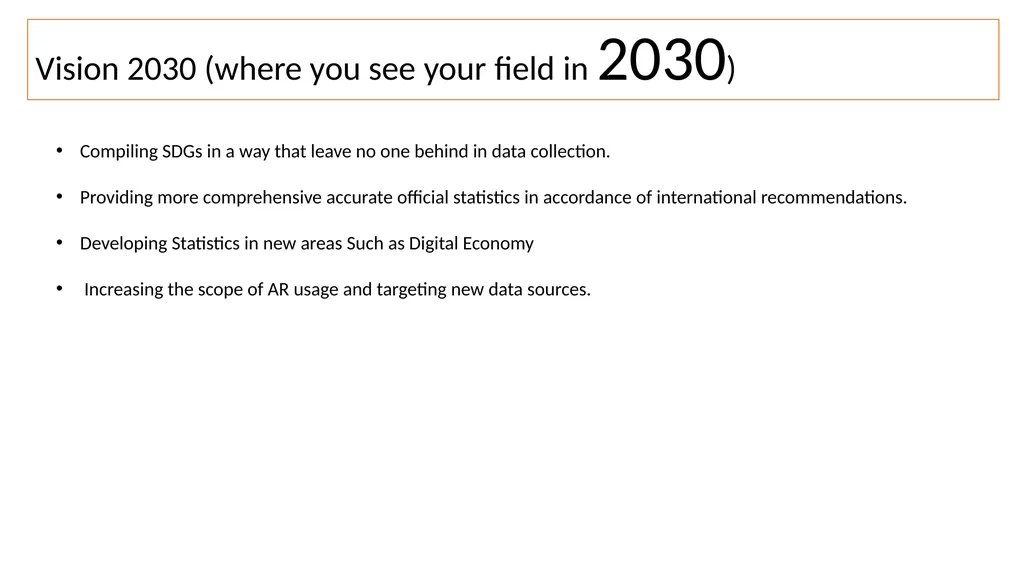
Vision 2030 (where you see your field in 2030) Compiling SDGs in a way that leave no one behind in data collection.
Providing more comprehensive accurate official statistics in accordance of international recommendations.
Developing Statistics in new areas Such as Digital Economy
Increasing the scope of AR usage and targeting new data sources.<br>