Millikans Oil Drop Experiment Motivation After the discovery of the electron and calculation of the em ratio by J.J. Thomson in 1897, Millikan sought a way to measure the charge of an electron. If the charge could be found, the electron
"Millikan's Oil Drop Experiment Motivation After" is the property of its rightful owner. Permission is granted to
download and print the materials on this website for personal, non-commercial use only, and to display it
on your personal computer provided you do not modify the materials and that you retain all copyright
notices contained in the materials. By downloading content from our website, you accept the terms of this
agreement.
Presentation Transcript
01
Millikan's Oil Drop Experiment<br>
02
Motivation After the discovery of the electron and calculation of the e/m ratio by J.J. Thomson in 1897, Millikan sought a way to measure the charge of an electron. If the charge could be found, the electron mass could also be calculated using e/m. He assumed (correctly) at the time that all electrons carried the same charge.
Millikan conducted an experiment that allowed him to determine the charge of an oil drop. According to his assumption all charges on oil drops must be a multiple of the electron charge.
Today you will conduct the same experiment and ultimately try to determine the value of e.<br>
03
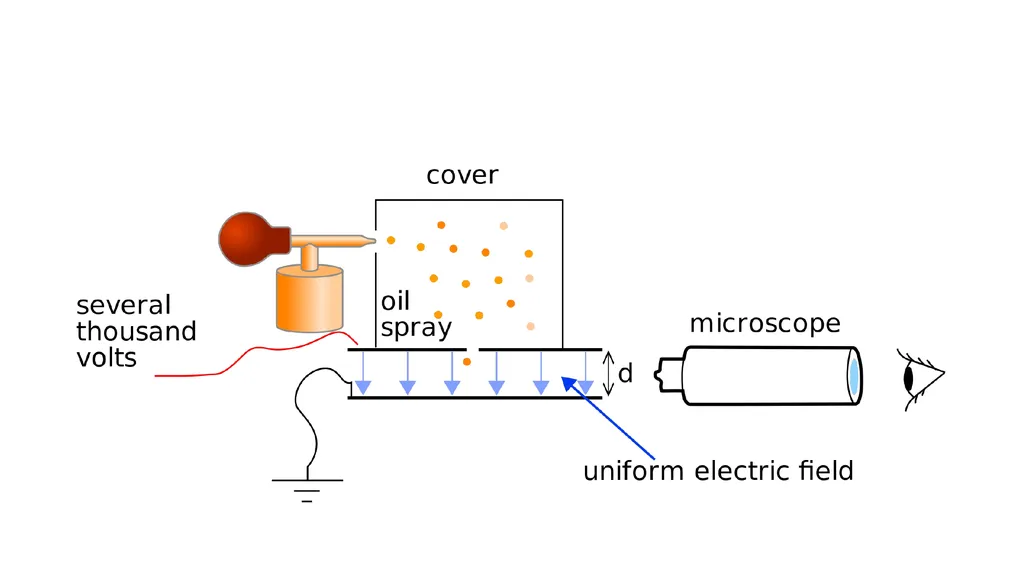
A Look at the Apparatus In the box you will find:
A device containing two plates that are to be connected to a power source so a voltage can be applied between them, producing a uniform electric field
A nozzle containing oil, so that small, charged oil drops can be sprayed between the plates
A camera connected to a screen that displays a live feed of the area between the plates
A light to be shone between the plates so you can see what’s going on<br>
04
Question! How do the oil drops become charged?<br>
05
Answer: Frictional effects between the sides of the nozzle an the oil
(In other variants of the experiment the oil drops are ionised using X-rays)<br>
06
Procedure Oil drops are sprayed in between the plates. You will notice with no applied voltage (therefore no electric field) the oil drops fall due to gravity.
Once a voltage is applied between the plates, you will notice some drops will slow down but keep moving down, a few will stop moving and others will start moving upwards.<br>
07
Questions! 1. Why do some droplets move up and others down?
2. Why have some of the droplets stopped moving?<br>
08
Answers Oil drops that are moving up either contain many electrons or have a low mass (or both), as the force they experience due to the electric field is greater than their weight.
Drops that are moving down either contain a small amount of electrons or have a large mass (or both), as their weight is larger than the electric force.
2. The stationary drops are in equilibrium – the electric force is equal to the weight.<br>
09
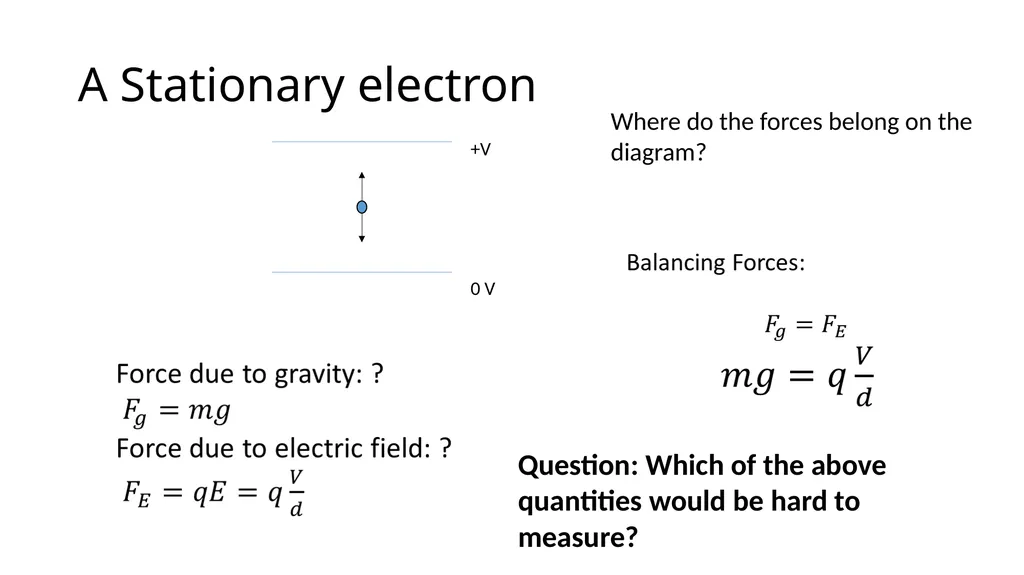
A Stationary electron +V 0 V Where do the forces belong on the diagram? Question: Which of the above quantities would be hard to measure?<br>
10
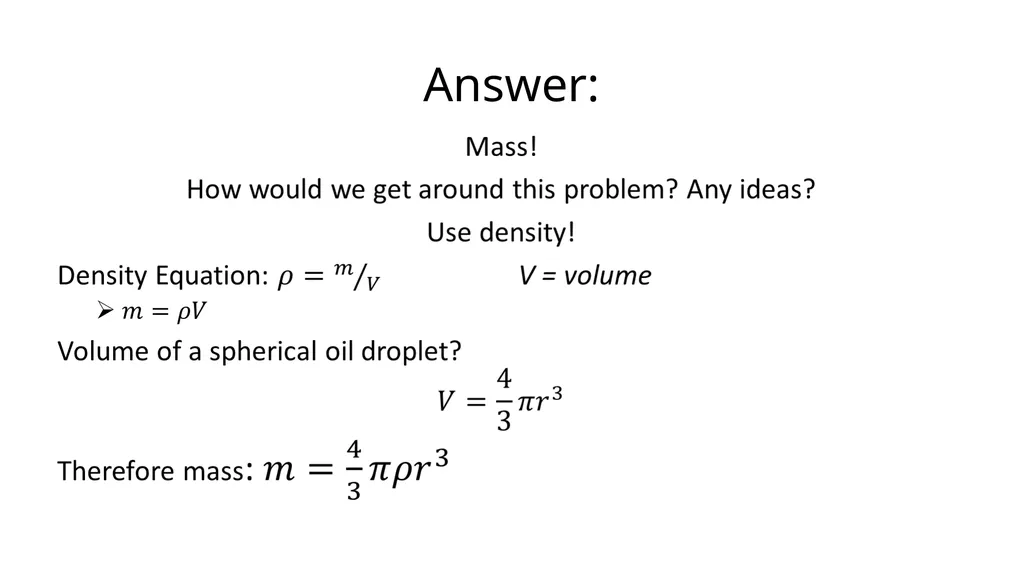
Answer:<br>
11
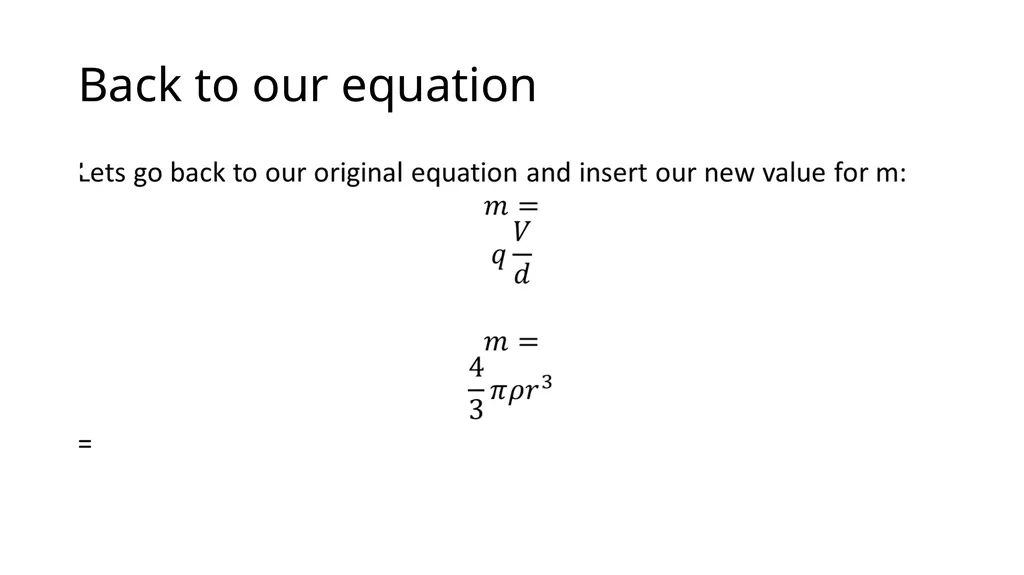
Back to our equation<br>
12
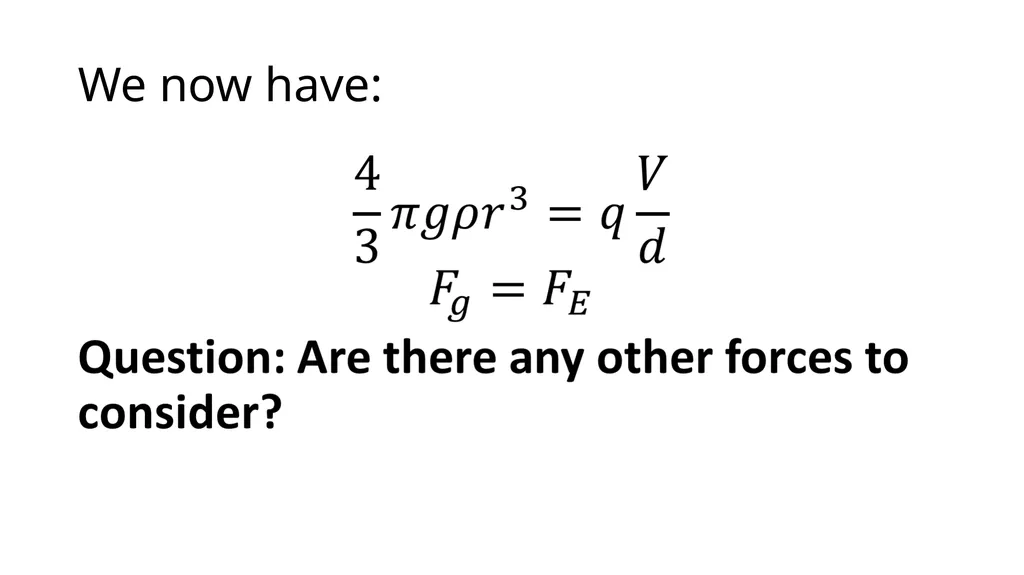
We now have:<br>
13
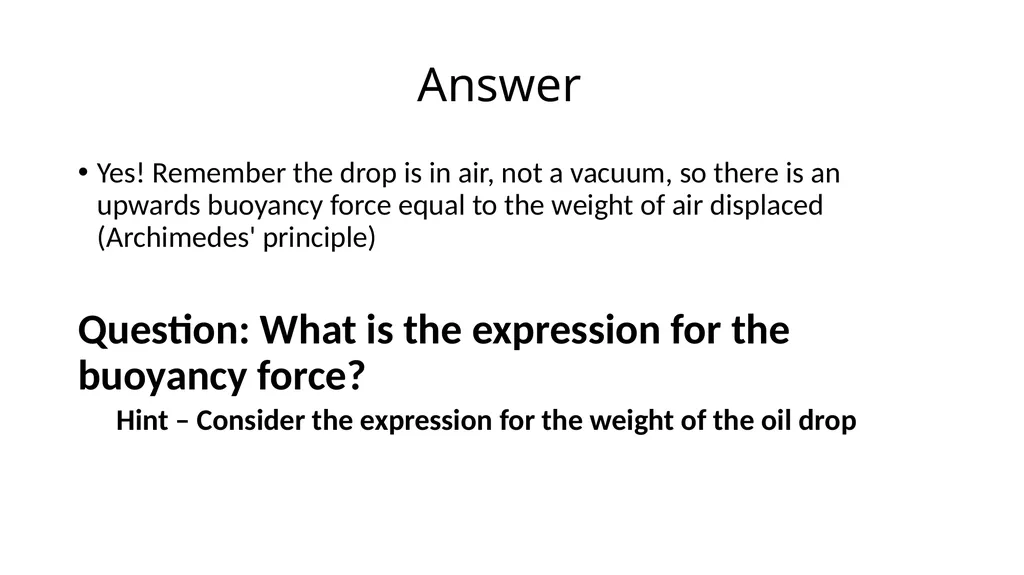
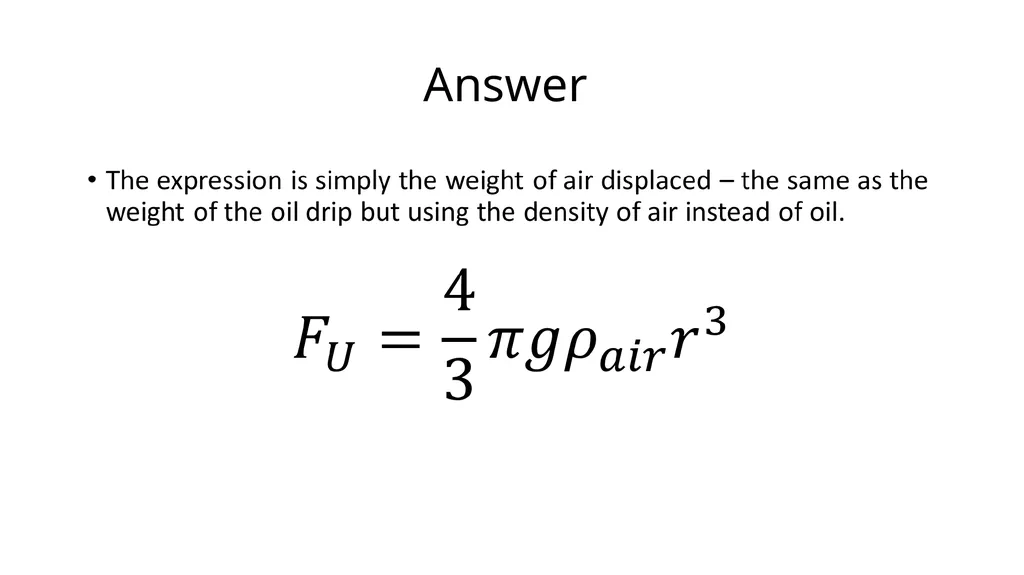
Answer Yes! Remember the drop is in air, not a vacuum, so there is an upwards buoyancy force equal to the weight of air displaced (Archimedes' principle)
Question: What is the expression for the buoyancy force?
Hint – Consider the expression for the weight of the oil drop<br>
14
Answer<br>
15
Back to our equation<br>
16
Answer<br>
17
Procedure Open the provided EXCEL table
Illuminate the oil chamber with the lamp and angle the camera towards the screen so you get a good, clear image and can read the scale
Give the bulb one or two squirts and observe the oil droplets on the screen
Turn on the voltage supply and vary the voltage. You should see the drops move up and down.
Pick an easy-to-see oil drop and find the voltage required to hold it steady and record this voltage<br>
18
Turn the power supply off and measure the time taken for the drop to travel a given distance (the larger the better)
Record these values and add them to the table
EXCEL should now calculate all required quantities and return the charge of the selected oil drop
Repeat this process five more times if you can
Question: Which measuremeant gives the largest uncertainty?<br>
19
Answer The distance the drop falls as it is the hardest to see<br>
20
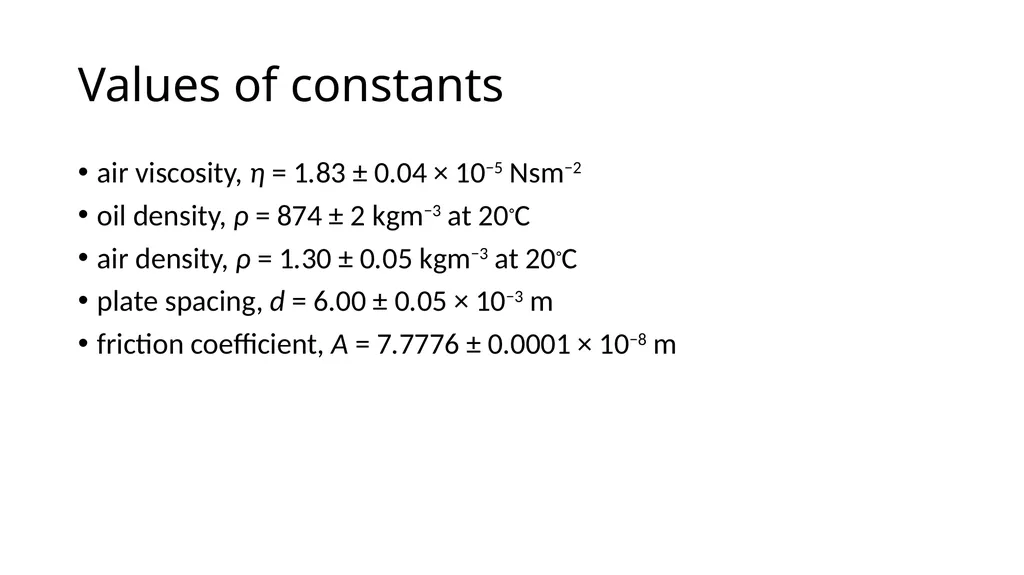
Values of constants air viscosity, η = 1.83 ± 0.04 × 10⁻⁵ Nsm−2
oil density, ρ = 874 ± 2 kgm−3 at 20◦C
air density, ρ = 1.30 ± 0.05 kgm−3 at 20◦C
plate spacing, d = 6.00 ± 0.05 × 10⁻³ m
friction coefficient, A = 7.7776 ± 0.0001 × 10⁻⁸ m<br>
21
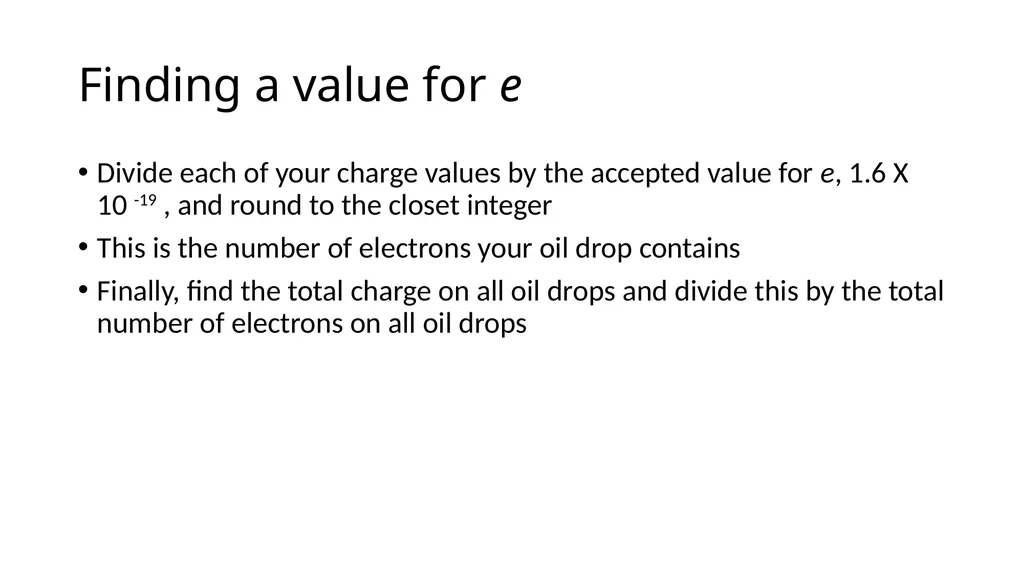
Finding a value for e Divide each of your charge values by the accepted value for e, 1.6 X 10 -19 , and round to the closet integer
This is the number of electrons your oil drop contains
Finally, find the total charge on all oil drops and divide this by the total number of electrons on all oil drops<br>
22
Conclusions Does your value agree within uncertainty with the expected value of e= 1.6 X 10 -19 c ?