
MMR Vaccination Programme Toolkit for improving
LV
Published · 35 slides · 0 views
1 / 1
Description
MMR Vaccination Programme Toolkit for improving uptake in Primary Care (Winter 20232024) https:www.england.nhs.uklondonour-workimmunis-team Aim of this toolkit Measles, Mumps and Rubella (MMR) toolkit Since the introduction of the
Related Topics
Share
Embed code
Download this presentation From Below
"MMR Vaccination Programme Toolkit for improving" is the property of its rightful owner. Permission is granted to download and print the materials on this website for personal, non-commercial use only, and to display it on your personal computer provided you do not modify the materials and that you retain all copyright notices contained in the materials. By downloading content from our website, you accept the terms of this agreement.
Presentation Transcript
01
MMR Vaccination Programme Toolkit for improving uptake in Primary Care (Winter 2023/2024) https://www.england.nhs.uk/london/our-work/immunis-team/<br>
02
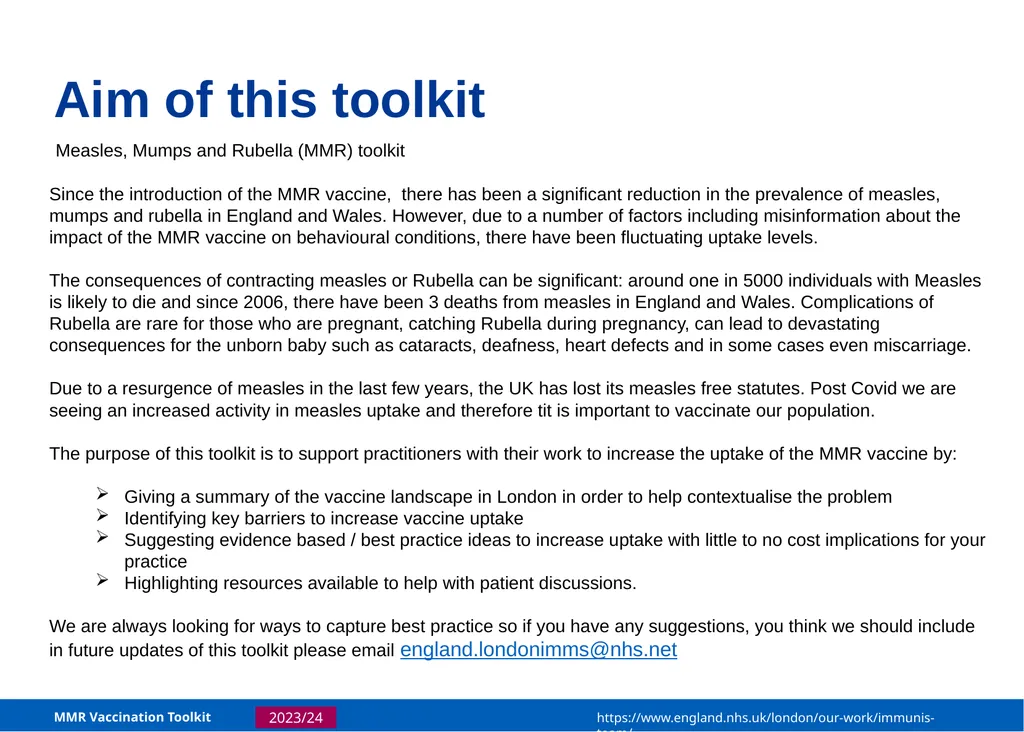
Aim of this toolkit Measles, Mumps and Rubella (MMR) toolkit
Since the introduction of the MMR vaccine, there has been a significant reduction in the prevalence of measles, mumps and rubella in England and Wales. However, due to a number of factors including misinformation about the impact of the MMR vaccine on behavioural conditions, there have been fluctuating uptake levels.
The consequences of contracting measles or Rubella can be significant: around one in 5000 individuals with Measles is likely to die and since 2006, there have been 3 deaths from measles in England and Wales. Complications of Rubella are rare for those who are pregnant, catching Rubella during pregnancy, can lead to devastating consequences for the unborn baby such as cataracts, deafness, heart defects and in some cases even miscarriage.
Due to a resurgence of measles in the last few years, the UK has lost its measles free statutes. Post Covid we are seeing an increased activity in measles uptake and therefore tit is important to vaccinate our population.
The purpose of this toolkit is to support practitioners with their work to increase the uptake of the MMR vaccine by:
Giving a summary of the vaccine landscape in London in order to help contextualise the problem
Identifying key barriers to increase vaccine uptake
Suggesting evidence based / best practice ideas to increase uptake with little to no cost implications for your practice
Highlighting resources available to help with patient discussions.
We are always looking for ways to capture best practice so if you have any suggestions, you think we should include in future updates of this toolkit please email england.londonimms@nhs.net<br>
Since the introduction of the MMR vaccine, there has been a significant reduction in the prevalence of measles, mumps and rubella in England and Wales. However, due to a number of factors including misinformation about the impact of the MMR vaccine on behavioural conditions, there have been fluctuating uptake levels.
The consequences of contracting measles or Rubella can be significant: around one in 5000 individuals with Measles is likely to die and since 2006, there have been 3 deaths from measles in England and Wales. Complications of Rubella are rare for those who are pregnant, catching Rubella during pregnancy, can lead to devastating consequences for the unborn baby such as cataracts, deafness, heart defects and in some cases even miscarriage.
Due to a resurgence of measles in the last few years, the UK has lost its measles free statutes. Post Covid we are seeing an increased activity in measles uptake and therefore tit is important to vaccinate our population.
The purpose of this toolkit is to support practitioners with their work to increase the uptake of the MMR vaccine by:
Giving a summary of the vaccine landscape in London in order to help contextualise the problem
Identifying key barriers to increase vaccine uptake
Suggesting evidence based / best practice ideas to increase uptake with little to no cost implications for your practice
Highlighting resources available to help with patient discussions.
We are always looking for ways to capture best practice so if you have any suggestions, you think we should include in future updates of this toolkit please email england.londonimms@nhs.net<br>
03
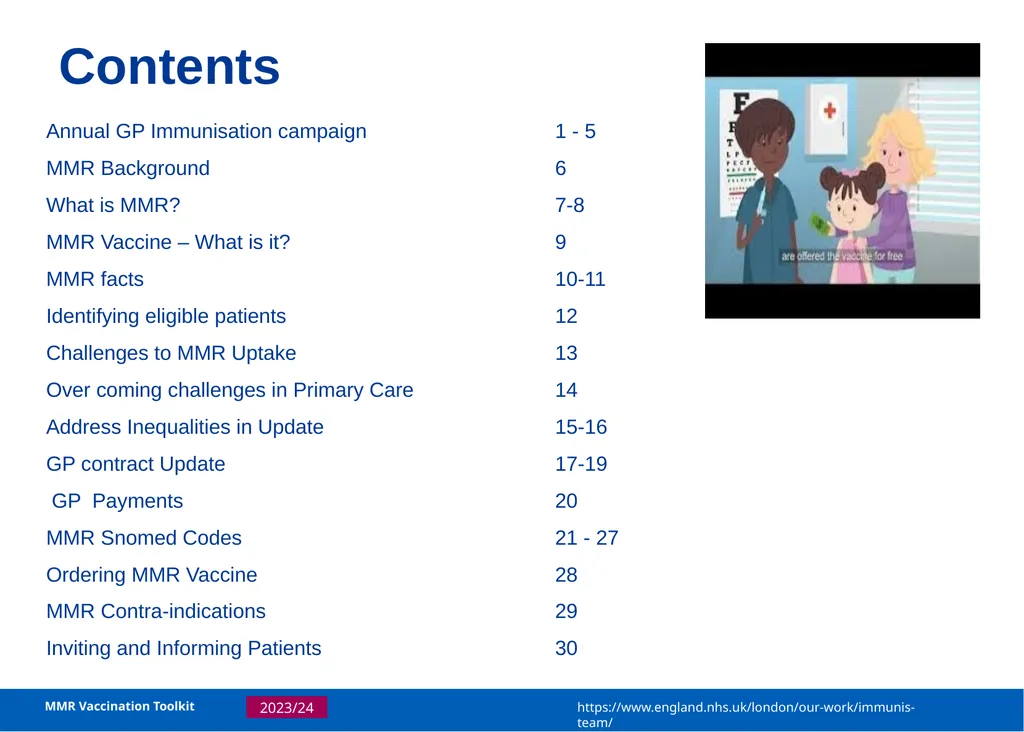
Contents Annual GP Immunisation campaign 1 - 5
MMR Background 6
What is MMR? 7-8
MMR Vaccine – What is it? 9
MMR facts 10-11
Identifying eligible patients 12
Challenges to MMR Uptake 13
Over coming challenges in Primary Care 14
Address Inequalities in Update 15-16
GP contract Update 17-19
GP Payments 20
MMR Snomed Codes 21 - 27
Ordering MMR Vaccine 28
MMR Contra-indications 29
Inviting and Informing Patients 30<br>
MMR Background 6
What is MMR? 7-8
MMR Vaccine – What is it? 9
MMR facts 10-11
Identifying eligible patients 12
Challenges to MMR Uptake 13
Over coming challenges in Primary Care 14
Address Inequalities in Update 15-16
GP contract Update 17-19
GP Payments 20
MMR Snomed Codes 21 - 27
Ordering MMR Vaccine 28
MMR Contra-indications 29
Inviting and Informing Patients 30<br>
04
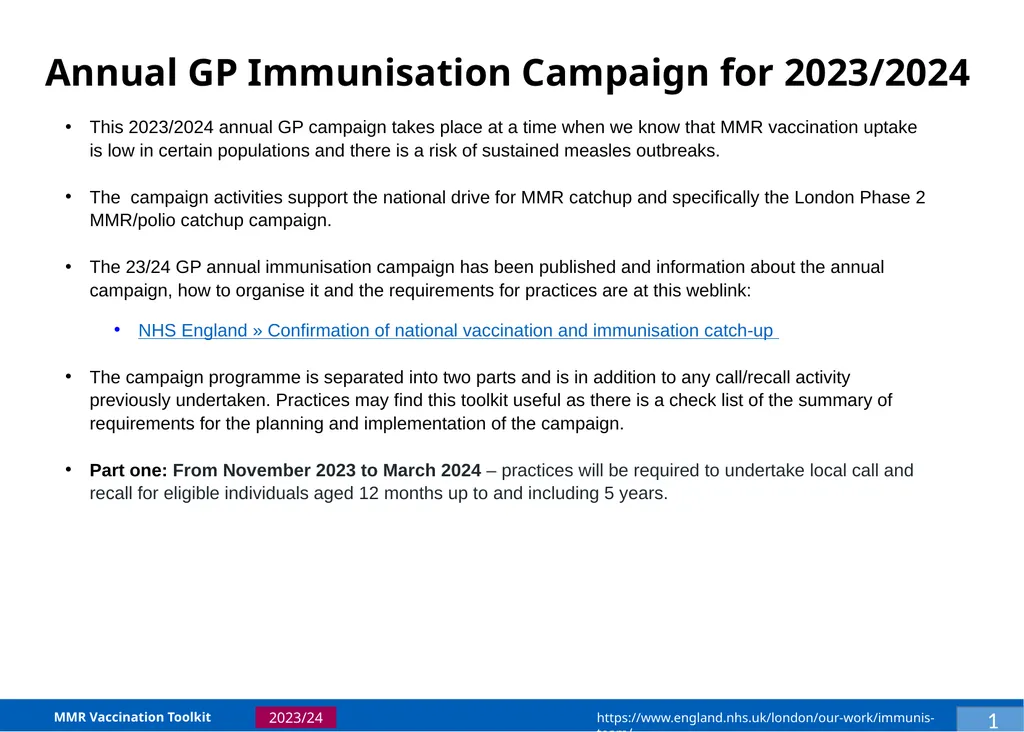
Annual GP Immunisation Campaign for 2023/2024 This 2023/2024 annual GP campaign takes place at a time when we know that MMR vaccination uptake is low in certain populations and there is a risk of sustained measles outbreaks.
The campaign activities support the national drive for MMR catchup and specifically the London Phase 2 MMR/polio catchup campaign.
The 23/24 GP annual immunisation campaign has been published and information about the annual campaign, how to organise it and the requirements for practices are at this weblink:
NHS England » Confirmation of national vaccination and immunisation catch-up
The campaign programme is separated into two parts and is in addition to any call/recall activity previously undertaken. Practices may find this toolkit useful as there is a check list of the summary of requirements for the planning and implementation of the campaign.
Part one: From November 2023 to March 2024 – practices will be required to undertake local call and recall for eligible individuals aged 12 months up to and including 5 years. 1<br>
The campaign activities support the national drive for MMR catchup and specifically the London Phase 2 MMR/polio catchup campaign.
The 23/24 GP annual immunisation campaign has been published and information about the annual campaign, how to organise it and the requirements for practices are at this weblink:
NHS England » Confirmation of national vaccination and immunisation catch-up
The campaign programme is separated into two parts and is in addition to any call/recall activity previously undertaken. Practices may find this toolkit useful as there is a check list of the summary of requirements for the planning and implementation of the campaign.
Part one: From November 2023 to March 2024 – practices will be required to undertake local call and recall for eligible individuals aged 12 months up to and including 5 years. 1<br>
05
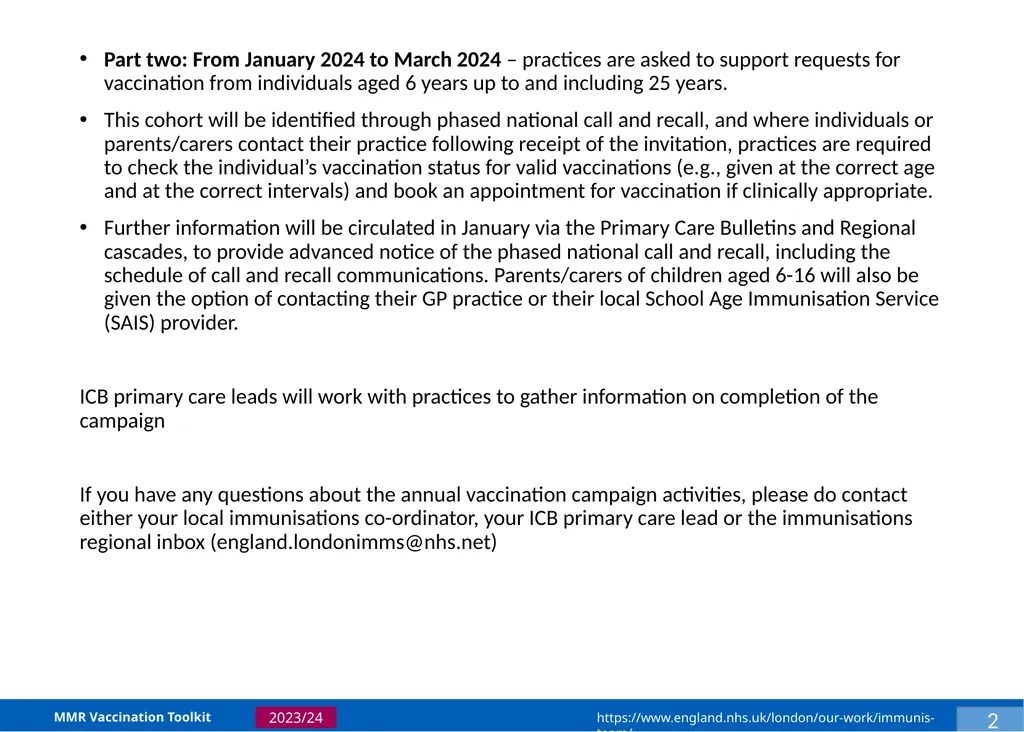
Part two: From January 2024 to March 2024 – practices are asked to support requests for vaccination from individuals aged 6 years up to and including 25 years.
This cohort will be identified through phased national call and recall, and where individuals or parents/carers contact their practice following receipt of the invitation, practices are required to check the individual’s vaccination status for valid vaccinations (e.g., given at the correct age and at the correct intervals) and book an appointment for vaccination if clinically appropriate.
Further information will be circulated in January via the Primary Care Bulletins and Regional cascades, to provide advanced notice of the phased national call and recall, including the schedule of call and recall communications. Parents/carers of children aged 6-16 will also be given the option of contacting their GP practice or their local School Age Immunisation Service (SAIS) provider.
ICB primary care leads will work with practices to gather information on completion of the campaign
If you have any questions about the annual vaccination campaign activities, please do contact either your local immunisations co-ordinator, your ICB primary care lead or the immunisations regional inbox (england.londonimms@nhs.net) 2<br>
This cohort will be identified through phased national call and recall, and where individuals or parents/carers contact their practice following receipt of the invitation, practices are required to check the individual’s vaccination status for valid vaccinations (e.g., given at the correct age and at the correct intervals) and book an appointment for vaccination if clinically appropriate.
Further information will be circulated in January via the Primary Care Bulletins and Regional cascades, to provide advanced notice of the phased national call and recall, including the schedule of call and recall communications. Parents/carers of children aged 6-16 will also be given the option of contacting their GP practice or their local School Age Immunisation Service (SAIS) provider.
ICB primary care leads will work with practices to gather information on completion of the campaign
If you have any questions about the annual vaccination campaign activities, please do contact either your local immunisations co-ordinator, your ICB primary care lead or the immunisations regional inbox (england.londonimms@nhs.net) 2<br>
06
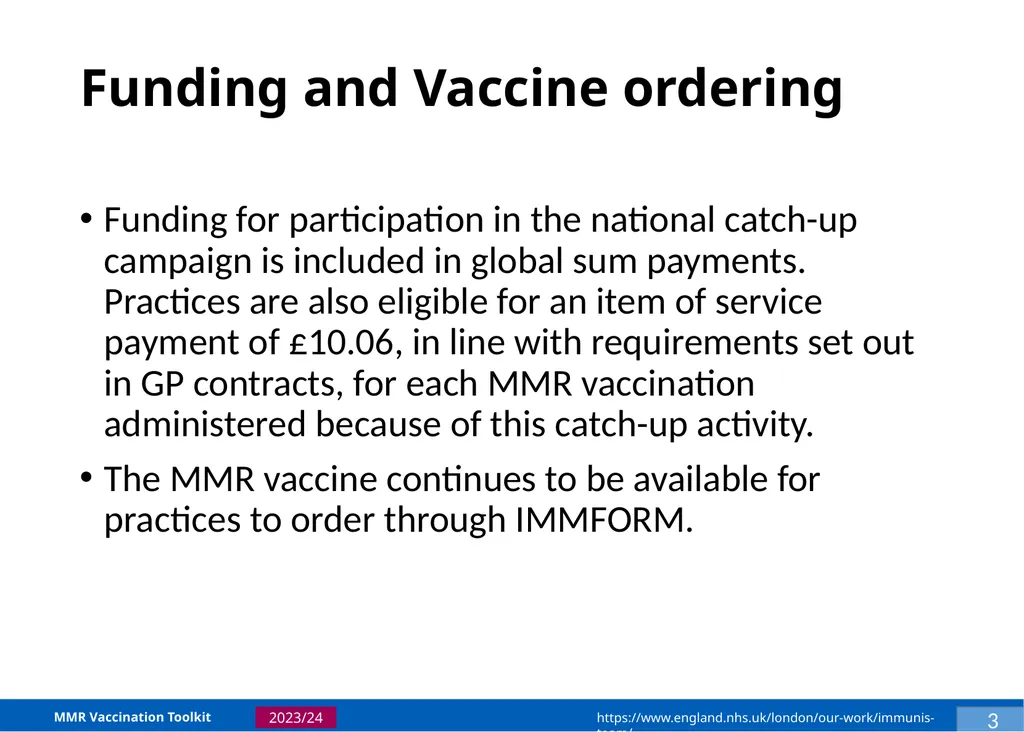
Funding and Vaccine ordering Funding for participation in the national catch-up campaign is included in global sum payments. Practices are also eligible for an item of service payment of £10.06, in line with requirements set out in GP contracts, for each MMR vaccination administered because of this catch-up activity.
The MMR vaccine continues to be available for practices to order through IMMFORM. 3<br>
The MMR vaccine continues to be available for practices to order through IMMFORM. 3<br>
07
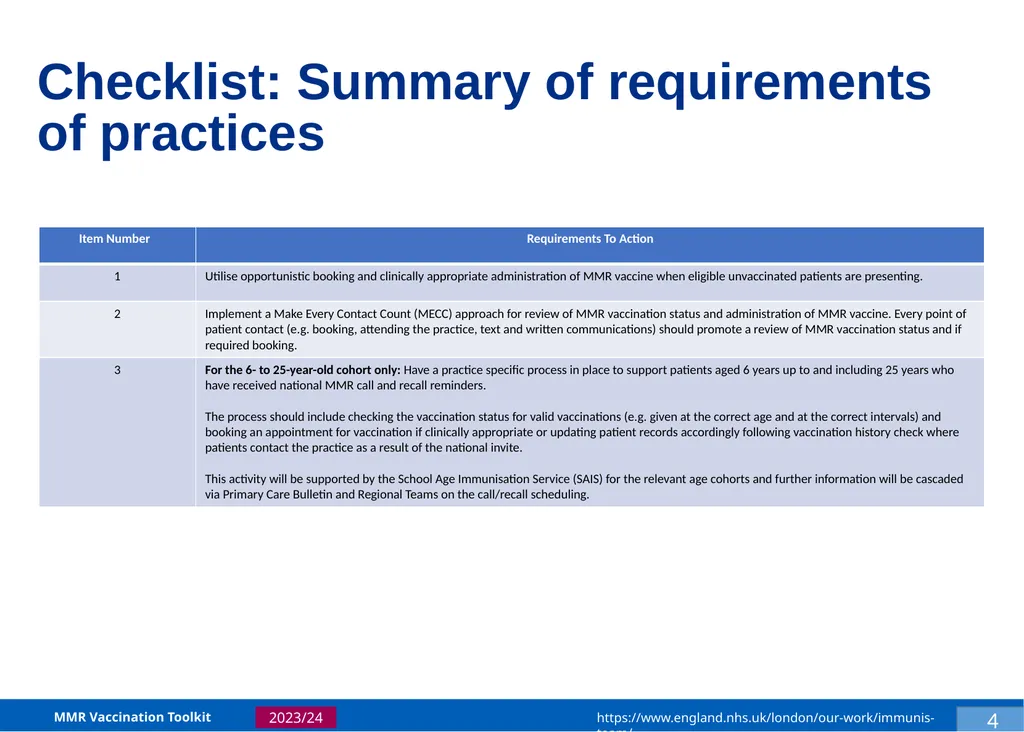
4 Checklist: Summary of requirements of practices<br>
08
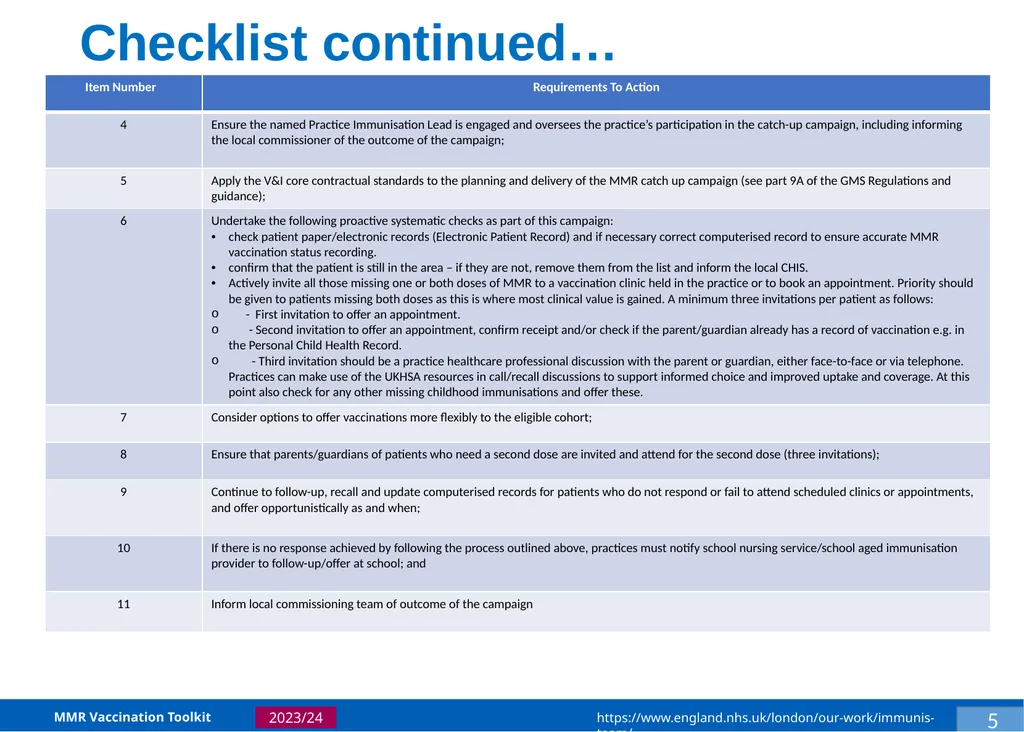
5 Checklist continued…<br>
09
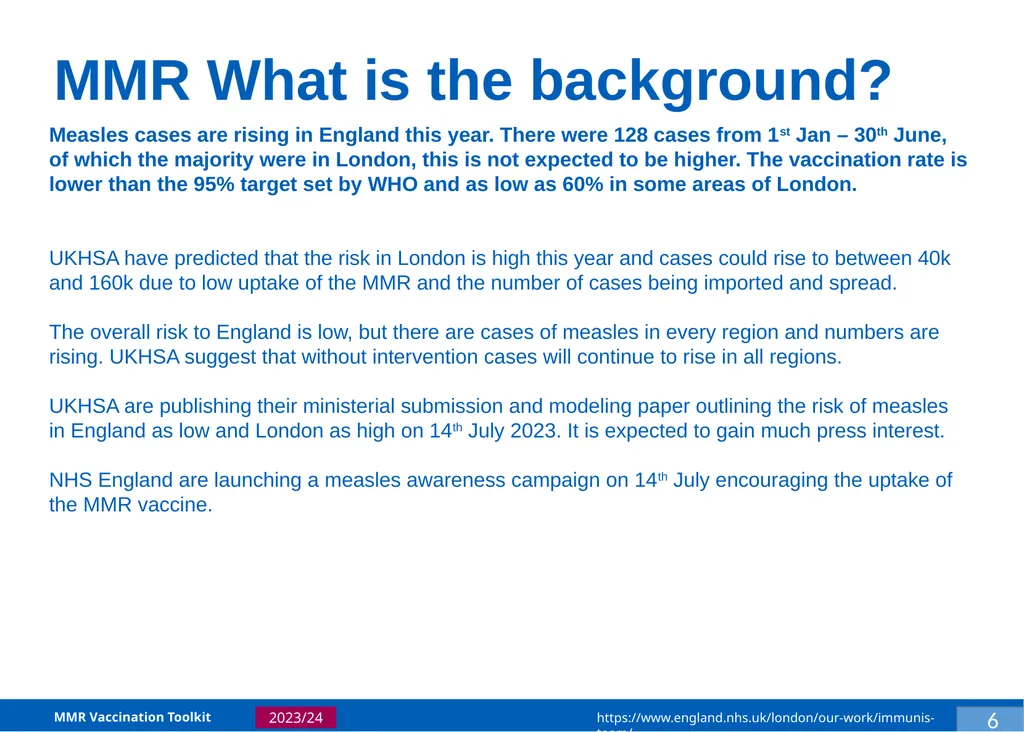
MMR What is the background? Measles cases are rising in England this year. There were 128 cases from 1st Jan – 30th June, of which the majority were in London, this is not expected to be higher. The vaccination rate is lower than the 95% target set by WHO and as low as 60% in some areas of London.
UKHSA have predicted that the risk in London is high this year and cases could rise to between 40k and 160k due to low uptake of the MMR and the number of cases being imported and spread.
The overall risk to England is low, but there are cases of measles in every region and numbers are rising. UKHSA suggest that without intervention cases will continue to rise in all regions.
UKHSA are publishing their ministerial submission and modeling paper outlining the risk of measles in England as low and London as high on 14th July 2023. It is expected to gain much press interest.
NHS England are launching a measles awareness campaign on 14th July encouraging the uptake of the MMR vaccine. 6<br>
UKHSA have predicted that the risk in London is high this year and cases could rise to between 40k and 160k due to low uptake of the MMR and the number of cases being imported and spread.
The overall risk to England is low, but there are cases of measles in every region and numbers are rising. UKHSA suggest that without intervention cases will continue to rise in all regions.
UKHSA are publishing their ministerial submission and modeling paper outlining the risk of measles in England as low and London as high on 14th July 2023. It is expected to gain much press interest.
NHS England are launching a measles awareness campaign on 14th July encouraging the uptake of the MMR vaccine. 6<br>
10
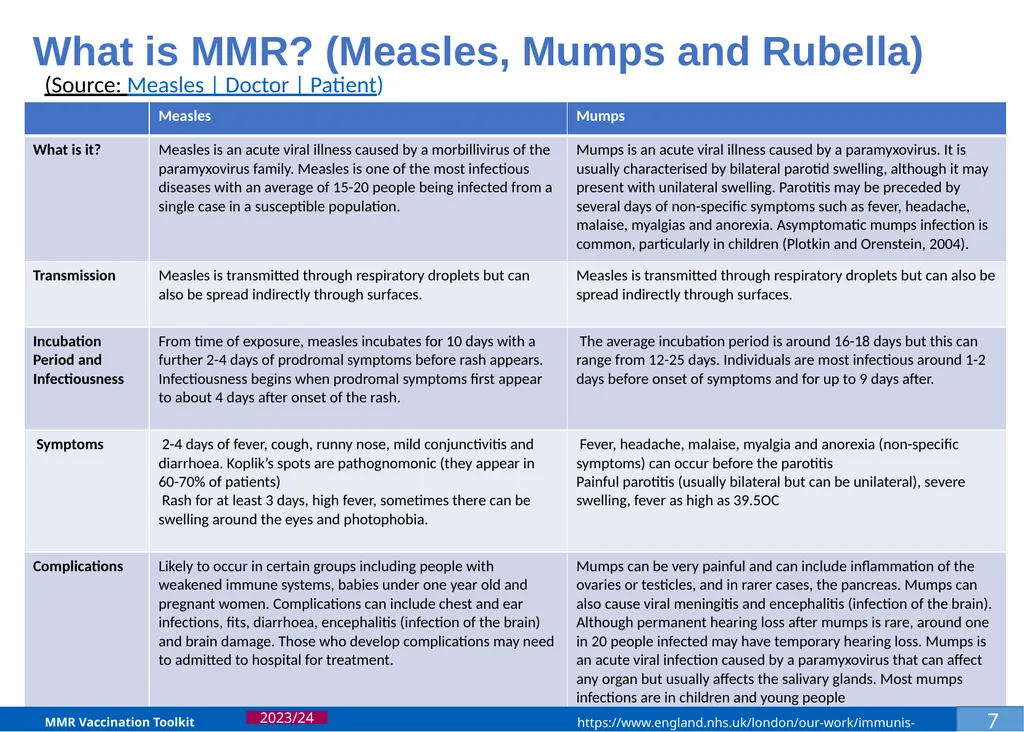
What is MMR? (Measles, Mumps and Rubella) 7 (Source: Measles | Doctor | Patient)<br>
11
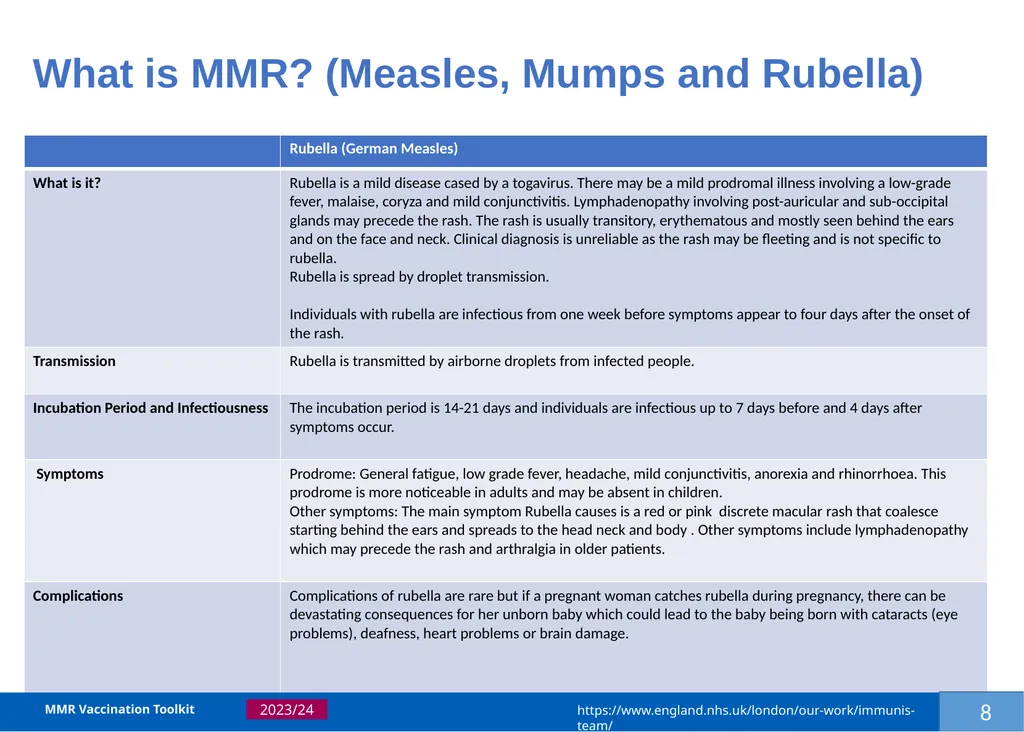
What is MMR? (Measles, Mumps and Rubella) 8<br>
12
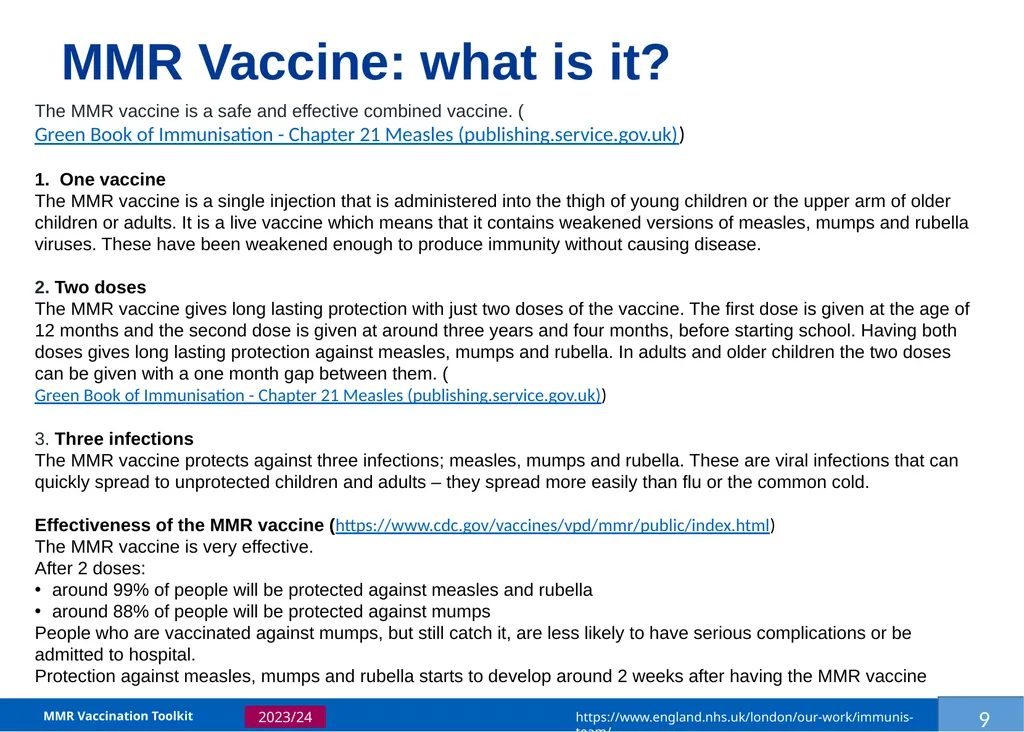
1 MMR Vaccine: what is it? Introduction Introduction Introduction Introduction Introduction Introduction The MMR vaccine is a safe and effective combined vaccine. ( Green Book of Immunisation - Chapter 21 Measles (publishing.service.gov.uk))
1. One vaccine
The MMR vaccine is a single injection that is administered into the thigh of young children or the upper arm of older children or adults. It is a live vaccine which means that it contains weakened versions of measles, mumps and rubella viruses. These have been weakened enough to produce immunity without causing disease.
2. Two doses
The MMR vaccine gives long lasting protection with just two doses of the vaccine. The first dose is given at the age of 12 months and the second dose is given at around three years and four months, before starting school. Having both doses gives long lasting protection against measles, mumps and rubella. In adults and older children the two doses can be given with a one month gap between them. ( Green Book of Immunisation - Chapter 21 Measles (publishing.service.gov.uk))
3. Three infections
The MMR vaccine protects against three infections; measles, mumps and rubella. These are viral infections that can quickly spread to unprotected children and adults – they spread more easily than flu or the common cold.
Effectiveness of the MMR vaccine (https://www.cdc.gov/vaccines/vpd/mmr/public/index.html)
The MMR vaccine is very effective.
After 2 doses:
around 99% of people will be protected against measles and rubella
around 88% of people will be protected against mumps
People who are vaccinated against mumps, but still catch it, are less likely to have serious complications or be admitted to hospital.
Protection against measles, mumps and rubella starts to develop around 2 weeks after having the MMR vaccine 9<br>
1. One vaccine
The MMR vaccine is a single injection that is administered into the thigh of young children or the upper arm of older children or adults. It is a live vaccine which means that it contains weakened versions of measles, mumps and rubella viruses. These have been weakened enough to produce immunity without causing disease.
2. Two doses
The MMR vaccine gives long lasting protection with just two doses of the vaccine. The first dose is given at the age of 12 months and the second dose is given at around three years and four months, before starting school. Having both doses gives long lasting protection against measles, mumps and rubella. In adults and older children the two doses can be given with a one month gap between them. ( Green Book of Immunisation - Chapter 21 Measles (publishing.service.gov.uk))
3. Three infections
The MMR vaccine protects against three infections; measles, mumps and rubella. These are viral infections that can quickly spread to unprotected children and adults – they spread more easily than flu or the common cold.
Effectiveness of the MMR vaccine (https://www.cdc.gov/vaccines/vpd/mmr/public/index.html)
The MMR vaccine is very effective.
After 2 doses:
around 99% of people will be protected against measles and rubella
around 88% of people will be protected against mumps
People who are vaccinated against mumps, but still catch it, are less likely to have serious complications or be admitted to hospital.
Protection against measles, mumps and rubella starts to develop around 2 weeks after having the MMR vaccine 9<br>
13
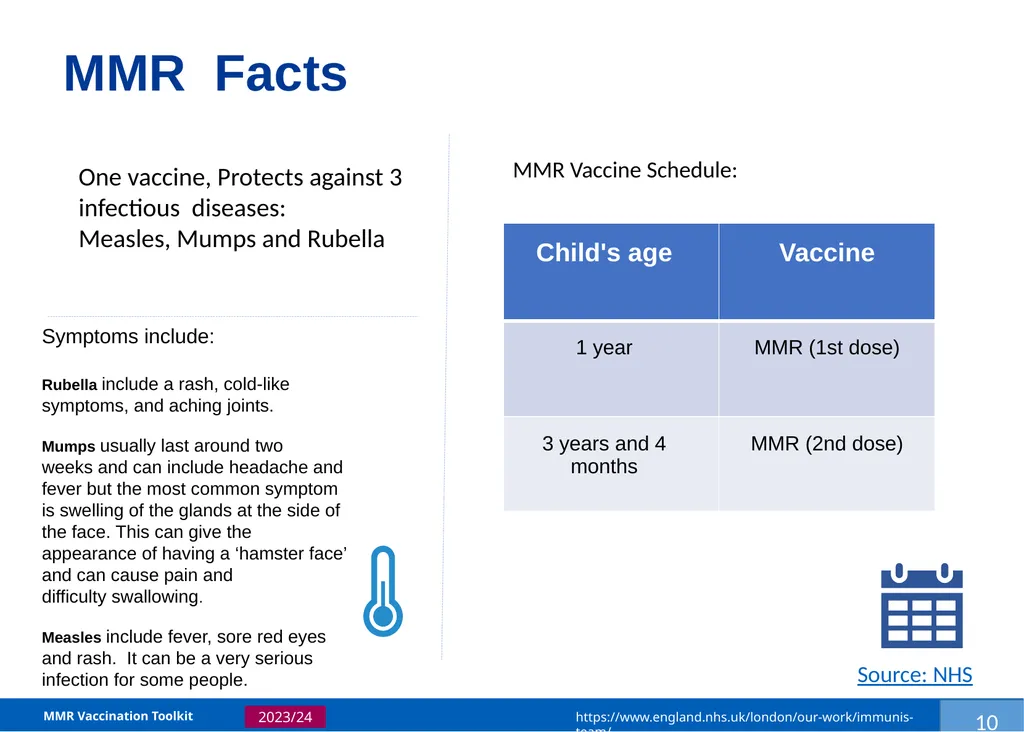
2 Introduction Introduction Introduction Introduction Introduction Introduction MMR Facts Symptoms include:
Rubella include a rash, cold-like symptoms, and aching joints.
Mumps usually last around two weeks and can include headache and fever but the most common symptom is swelling of the glands at the side of the face. This can give the appearance of having a ‘hamster face’ and can cause pain and difficulty swallowing.
Measles include fever, sore red eyes and rash. It can be a very serious infection for some people. MMR Vaccine Schedule: 10 Source: NHS<br>
Rubella include a rash, cold-like symptoms, and aching joints.
Mumps usually last around two weeks and can include headache and fever but the most common symptom is swelling of the glands at the side of the face. This can give the appearance of having a ‘hamster face’ and can cause pain and difficulty swallowing.
Measles include fever, sore red eyes and rash. It can be a very serious infection for some people. MMR Vaccine Schedule: 10 Source: NHS<br>
14
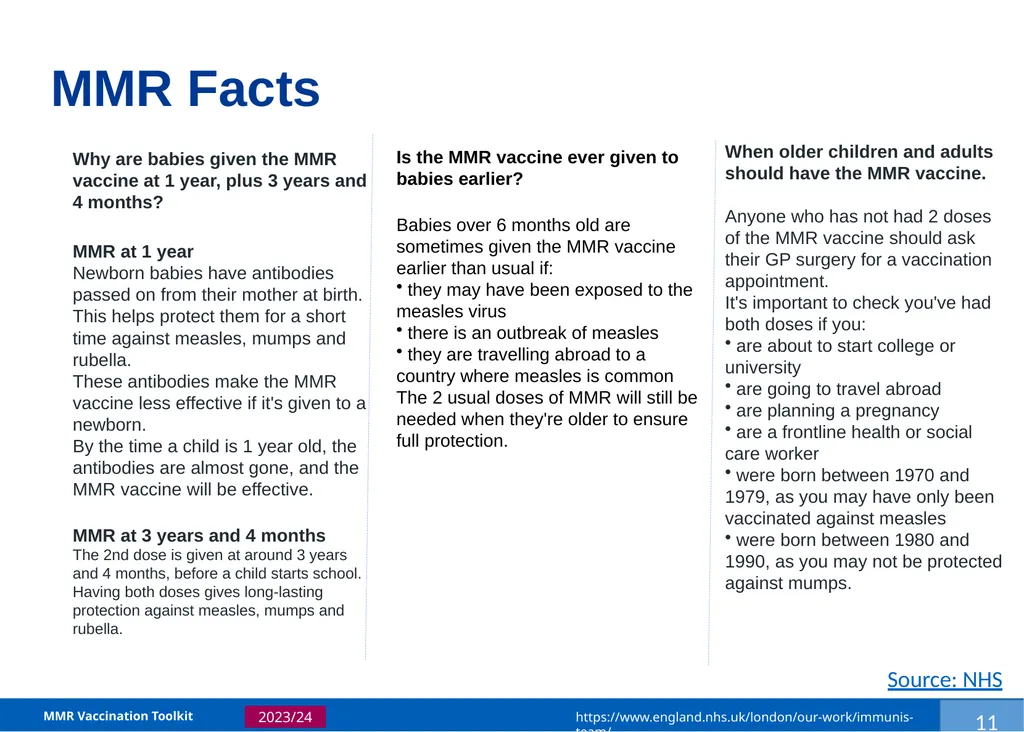
2 Introduction Introduction Introduction Introduction Introduction Introduction MMR Facts Why are babies given the MMR vaccine at 1 year, plus 3 years and 4 months?
MMR at 1 year
Newborn babies have antibodies passed on from their mother at birth. This helps protect them for a short time against measles, mumps and rubella.
These antibodies make the MMR vaccine less effective if it's given to a newborn.
By the time a child is 1 year old, the antibodies are almost gone, and the MMR vaccine will be effective.
MMR at 3 years and 4 months
The 2nd dose is given at around 3 years and 4 months, before a child starts school.
Having both doses gives long-lasting protection against measles, mumps and rubella. Is the MMR vaccine ever given to babies earlier?
Babies over 6 months old are sometimes given the MMR vaccine earlier than usual if:
they may have been exposed to the measles virus
there is an outbreak of measles
they are travelling abroad to a country where measles is common
The 2 usual doses of MMR will still be needed when they're older to ensure full protection. When older children and adults should have the MMR vaccine.
Anyone who has not had 2 doses of the MMR vaccine should ask their GP surgery for a vaccination appointment.
It's important to check you've had both doses if you:
are about to start college or university
are going to travel abroad
are planning a pregnancy
are a frontline health or social care worker
were born between 1970 and 1979, as you may have only been vaccinated against measles
were born between 1980 and 1990, as you may not be protected against mumps. Source: NHS 11<br>
MMR at 1 year
Newborn babies have antibodies passed on from their mother at birth. This helps protect them for a short time against measles, mumps and rubella.
These antibodies make the MMR vaccine less effective if it's given to a newborn.
By the time a child is 1 year old, the antibodies are almost gone, and the MMR vaccine will be effective.
MMR at 3 years and 4 months
The 2nd dose is given at around 3 years and 4 months, before a child starts school.
Having both doses gives long-lasting protection against measles, mumps and rubella. Is the MMR vaccine ever given to babies earlier?
Babies over 6 months old are sometimes given the MMR vaccine earlier than usual if:
they may have been exposed to the measles virus
there is an outbreak of measles
they are travelling abroad to a country where measles is common
The 2 usual doses of MMR will still be needed when they're older to ensure full protection. When older children and adults should have the MMR vaccine.
Anyone who has not had 2 doses of the MMR vaccine should ask their GP surgery for a vaccination appointment.
It's important to check you've had both doses if you:
are about to start college or university
are going to travel abroad
are planning a pregnancy
are a frontline health or social care worker
were born between 1970 and 1979, as you may have only been vaccinated against measles
were born between 1980 and 1990, as you may not be protected against mumps. Source: NHS 11<br>
15
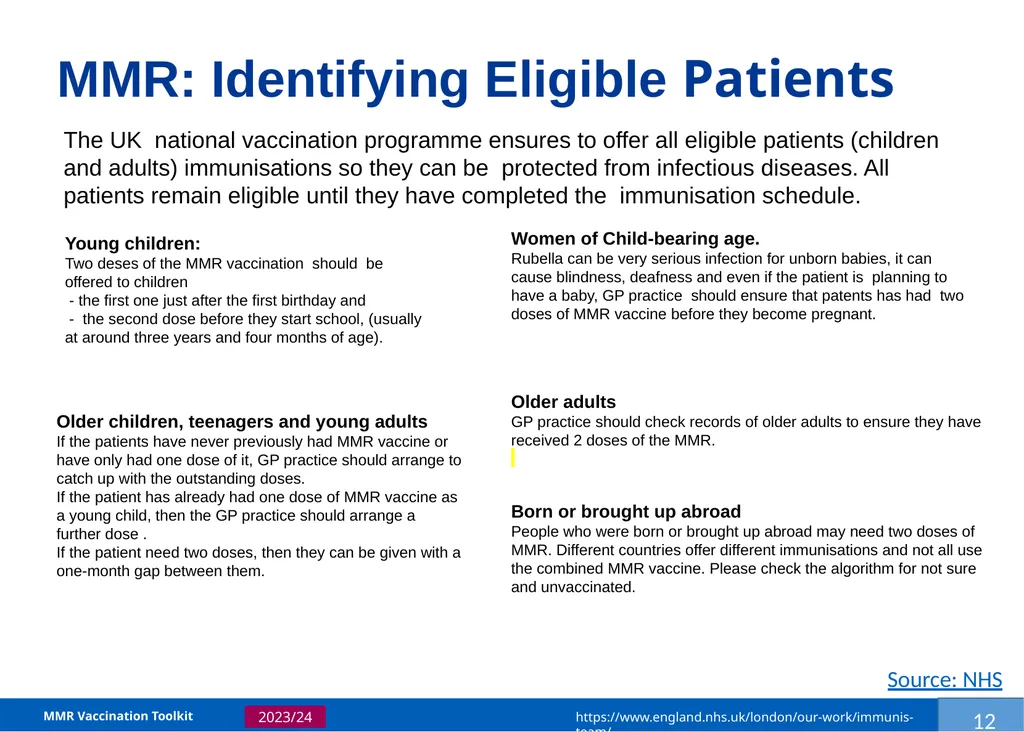
3 MMR: Identifying Eligible Patients Introduction Introduction Introduction Introduction Introduction Introduction Young children:
Two deses of the MMR vaccination should be offered to children
- the first one just after the first birthday and
- the second dose before they start school, (usually at around three years and four months of age). Older children, teenagers and young adults
If the patients have never previously had MMR vaccine or have only had one dose of it, GP practice should arrange to catch up with the outstanding doses.
If the patient has already had one dose of MMR vaccine as a young child, then the GP practice should arrange a further dose .
If the patient need two doses, then they can be given with a one-month gap between them. Older adults
GP practice should check records of older adults to ensure they have received 2 doses of the MMR. Born or brought up abroad
People who were born or brought up abroad may need two doses of MMR. Different countries offer different immunisations and not all use the combined MMR vaccine. Please check the algorithm for not sure and unvaccinated. Women of Child-bearing age.
Rubella can be very serious infection for unborn babies, it can cause blindness, deafness and even if the patient is planning to have a baby, GP practice should ensure that patents has had two doses of MMR vaccine before they become pregnant. 12 The UK national vaccination programme ensures to offer all eligible patients (children and adults) immunisations so they can be protected from infectious diseases. All patients remain eligible until they have completed the immunisation schedule. Source: NHS<br>
Two deses of the MMR vaccination should be offered to children
- the first one just after the first birthday and
- the second dose before they start school, (usually at around three years and four months of age). Older children, teenagers and young adults
If the patients have never previously had MMR vaccine or have only had one dose of it, GP practice should arrange to catch up with the outstanding doses.
If the patient has already had one dose of MMR vaccine as a young child, then the GP practice should arrange a further dose .
If the patient need two doses, then they can be given with a one-month gap between them. Older adults
GP practice should check records of older adults to ensure they have received 2 doses of the MMR. Born or brought up abroad
People who were born or brought up abroad may need two doses of MMR. Different countries offer different immunisations and not all use the combined MMR vaccine. Please check the algorithm for not sure and unvaccinated. Women of Child-bearing age.
Rubella can be very serious infection for unborn babies, it can cause blindness, deafness and even if the patient is planning to have a baby, GP practice should ensure that patents has had two doses of MMR vaccine before they become pregnant. 12 The UK national vaccination programme ensures to offer all eligible patients (children and adults) immunisations so they can be protected from infectious diseases. All patients remain eligible until they have completed the immunisation schedule. Source: NHS<br>
16
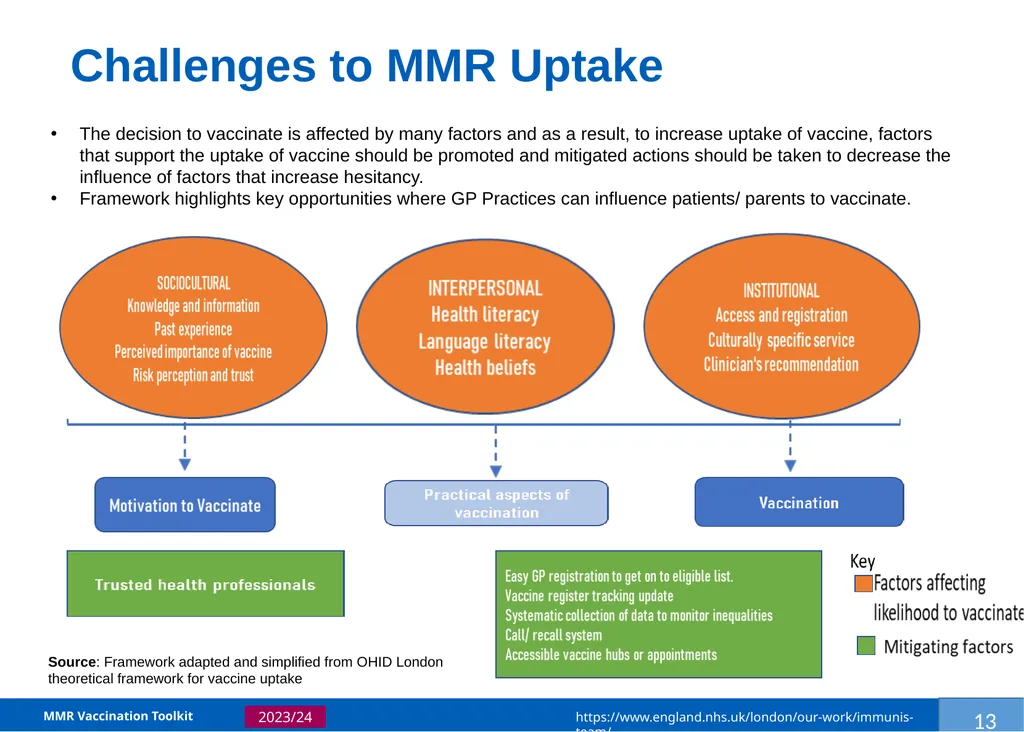
3 Introduction Introduction Introduction Introduction Introduction Introduction Challenges to MMR Uptake 13 The decision to vaccinate is affected by many factors and as a result, to increase uptake of vaccine, factors that support the uptake of vaccine should be promoted and mitigated actions should be taken to decrease the influence of factors that increase hesitancy.
Framework highlights key opportunities where GP Practices can influence patients/ parents to vaccinate. Source: Framework adapted and simplified from OHID London theoretical framework for vaccine uptake<br>
Framework highlights key opportunities where GP Practices can influence patients/ parents to vaccinate. Source: Framework adapted and simplified from OHID London theoretical framework for vaccine uptake<br>
17
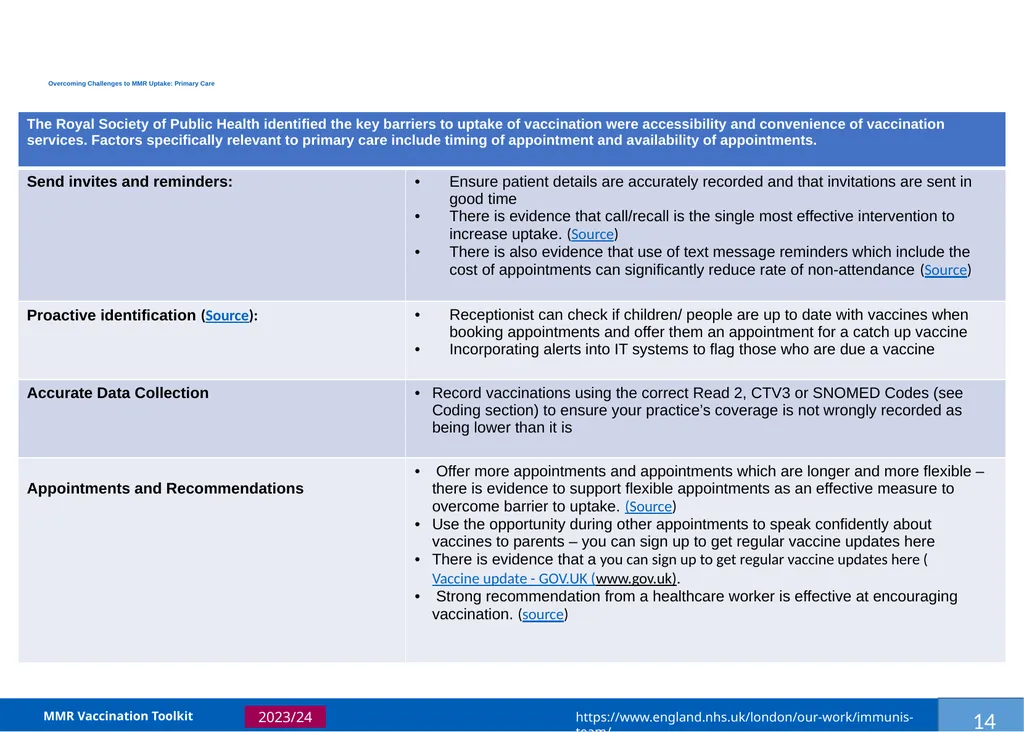
Overcoming Challenges to MMR Uptake: Primary Care 14<br>
18
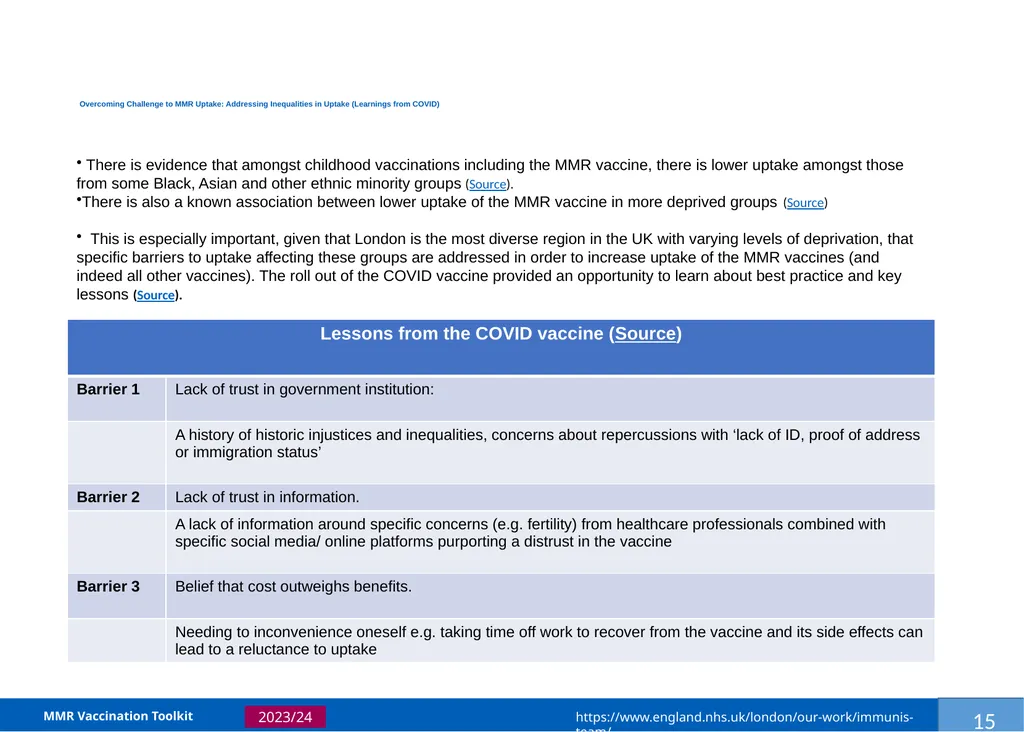
Overcoming Challenge to MMR Uptake: Addressing Inequalities in Uptake (Learnings from COVID) There is evidence that amongst childhood vaccinations including the MMR vaccine, there is lower uptake amongst those from some Black, Asian and other ethnic minority groups (Source).
There is also a known association between lower uptake of the MMR vaccine in more deprived groups (Source)
This is especially important, given that London is the most diverse region in the UK with varying levels of deprivation, that specific barriers to uptake affecting these groups are addressed in order to increase uptake of the MMR vaccines (and indeed all other vaccines). The roll out of the COVID vaccine provided an opportunity to learn about best practice and key lessons (Source). 15<br>
There is also a known association between lower uptake of the MMR vaccine in more deprived groups (Source)
This is especially important, given that London is the most diverse region in the UK with varying levels of deprivation, that specific barriers to uptake affecting these groups are addressed in order to increase uptake of the MMR vaccines (and indeed all other vaccines). The roll out of the COVID vaccine provided an opportunity to learn about best practice and key lessons (Source). 15<br>
19
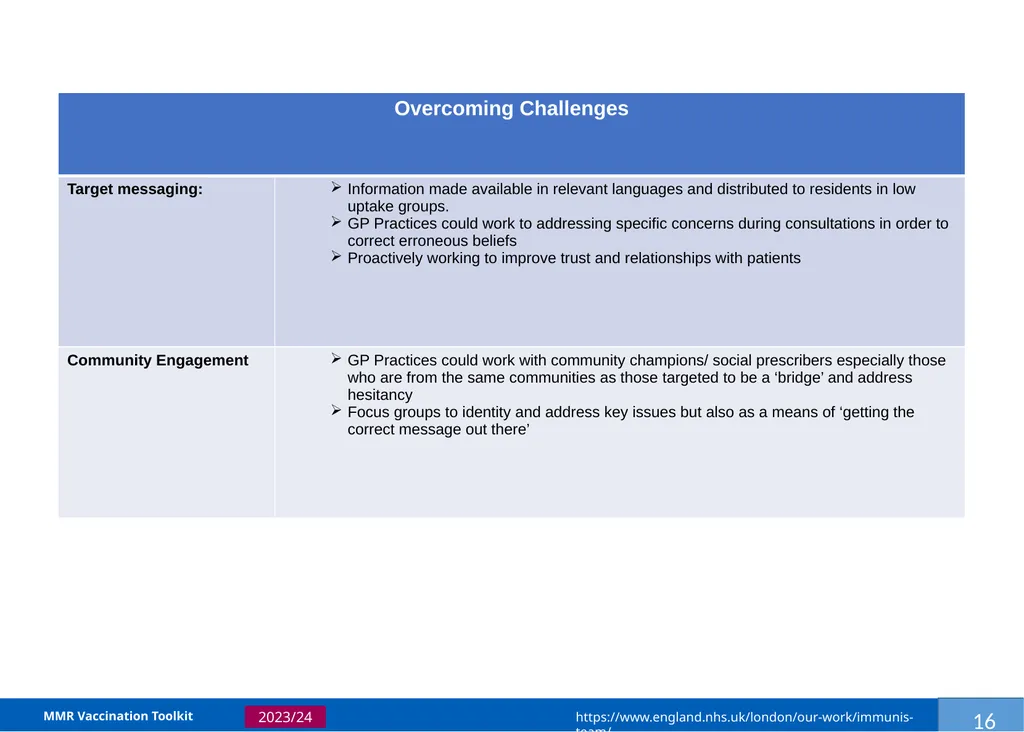
16<br>
20
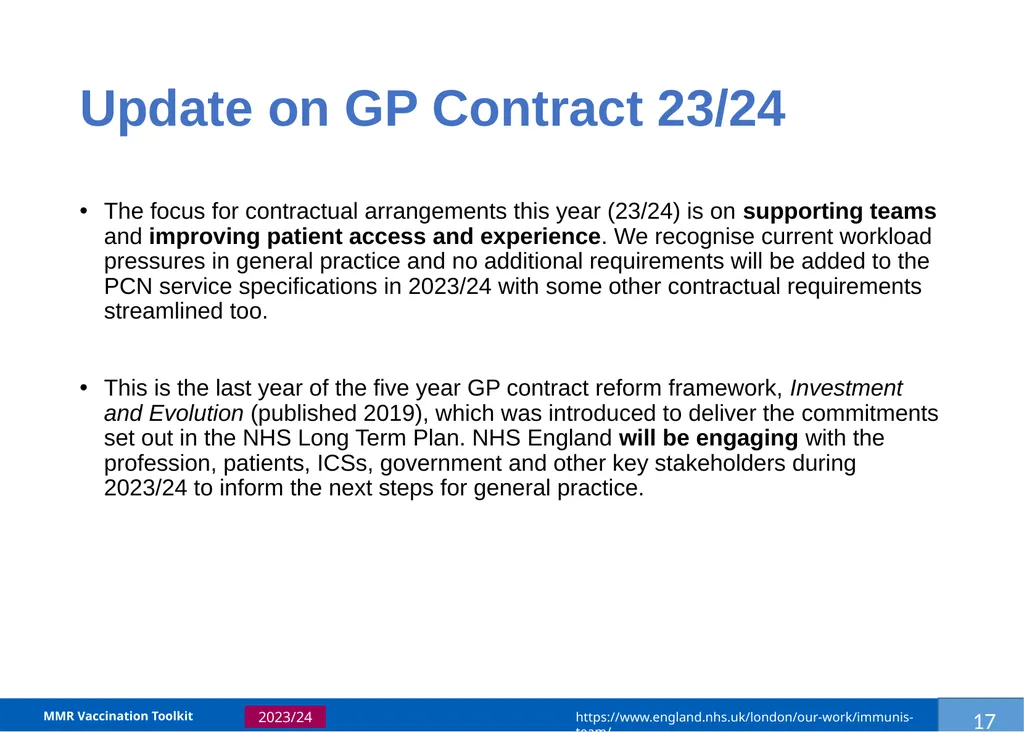
Update on GP Contract 23/24 The focus for contractual arrangements this year (23/24) is on supporting teams and improving patient access and experience. We recognise current workload pressures in general practice and no additional requirements will be added to the PCN service specifications in 2023/24 with some other contractual requirements streamlined too.
This is the last year of the five year GP contract reform framework, Investment and Evolution (published 2019), which was introduced to deliver the commitments set out in the NHS Long Term Plan. NHS England will be engaging with the profession, patients, ICSs, government and other key stakeholders during 2023/24 to inform the next steps for general practice. 17<br>
This is the last year of the five year GP contract reform framework, Investment and Evolution (published 2019), which was introduced to deliver the commitments set out in the NHS Long Term Plan. NHS England will be engaging with the profession, patients, ICSs, government and other key stakeholders during 2023/24 to inform the next steps for general practice. 17<br>
21
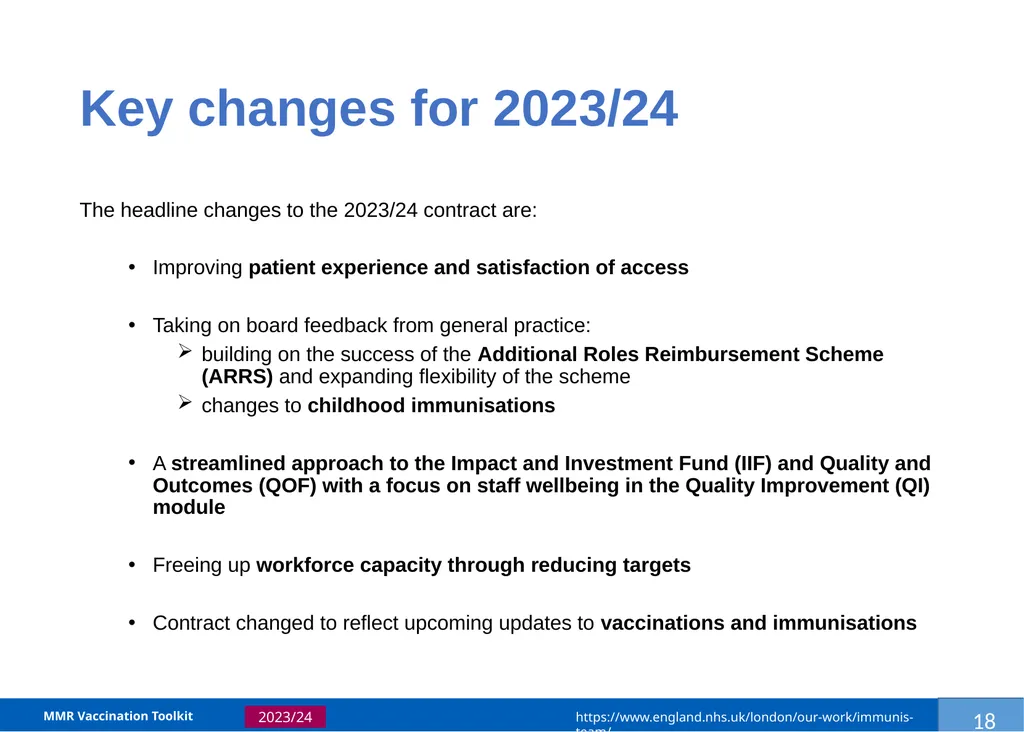
Key changes for 2023/24 The headline changes to the 2023/24 contract are:
Improving patient experience and satisfaction of access
Taking on board feedback from general practice:
building on the success of the Additional Roles Reimbursement Scheme (ARRS) and expanding flexibility of the scheme
changes to childhood immunisations
A streamlined approach to the Impact and Investment Fund (IIF) and Quality and Outcomes (QOF) with a focus on staff wellbeing in the Quality Improvement (QI) module
Freeing up workforce capacity through reducing targets
Contract changed to reflect upcoming updates to vaccinations and immunisations 18<br>
Improving patient experience and satisfaction of access
Taking on board feedback from general practice:
building on the success of the Additional Roles Reimbursement Scheme (ARRS) and expanding flexibility of the scheme
changes to childhood immunisations
A streamlined approach to the Impact and Investment Fund (IIF) and Quality and Outcomes (QOF) with a focus on staff wellbeing in the Quality Improvement (QI) module
Freeing up workforce capacity through reducing targets
Contract changed to reflect upcoming updates to vaccinations and immunisations 18<br>
22
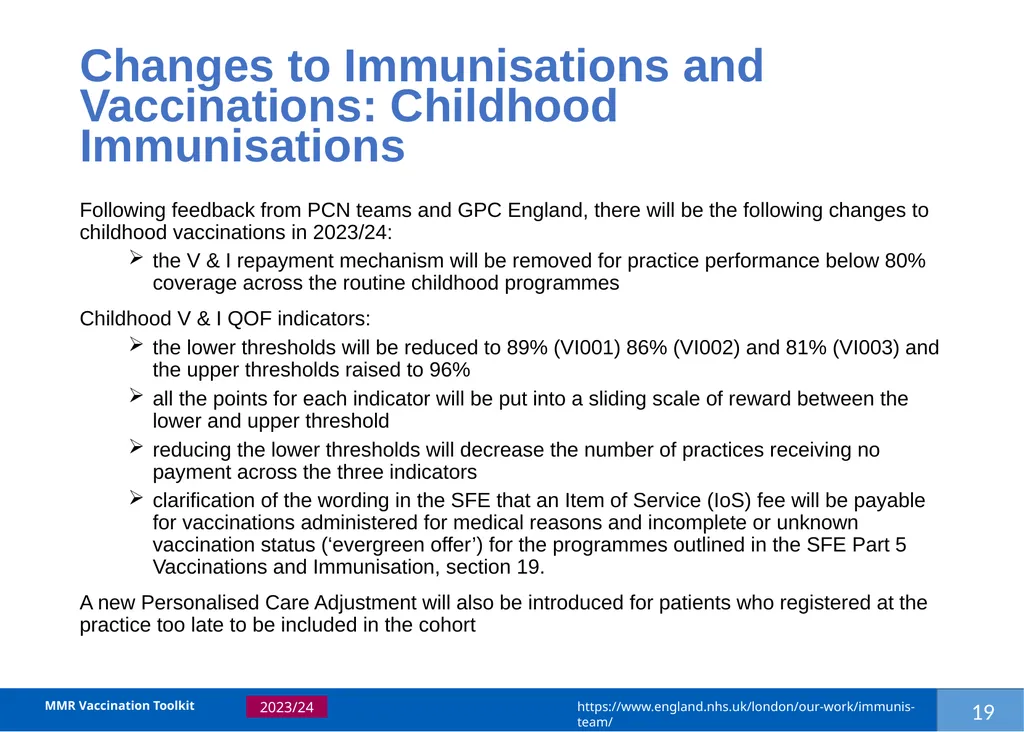
Changes to Immunisations and Vaccinations: Childhood Immunisations Following feedback from PCN teams and GPC England, there will be the following changes to childhood vaccinations in 2023/24:
the V & I repayment mechanism will be removed for practice performance below 80% coverage across the routine childhood programmes
Childhood V & I QOF indicators:
the lower thresholds will be reduced to 89% (VI001) 86% (VI002) and 81% (VI003) and the upper thresholds raised to 96%
all the points for each indicator will be put into a sliding scale of reward between the lower and upper threshold
reducing the lower thresholds will decrease the number of practices receiving no payment across the three indicators
clarification of the wording in the SFE that an Item of Service (IoS) fee will be payable for vaccinations administered for medical reasons and incomplete or unknown vaccination status (‘evergreen offer’) for the programmes outlined in the SFE Part 5 Vaccinations and Immunisation, section 19.
A new Personalised Care Adjustment will also be introduced for patients who registered at the practice too late to be included in the cohort 19<br>
the V & I repayment mechanism will be removed for practice performance below 80% coverage across the routine childhood programmes
Childhood V & I QOF indicators:
the lower thresholds will be reduced to 89% (VI001) 86% (VI002) and 81% (VI003) and the upper thresholds raised to 96%
all the points for each indicator will be put into a sliding scale of reward between the lower and upper threshold
reducing the lower thresholds will decrease the number of practices receiving no payment across the three indicators
clarification of the wording in the SFE that an Item of Service (IoS) fee will be payable for vaccinations administered for medical reasons and incomplete or unknown vaccination status (‘evergreen offer’) for the programmes outlined in the SFE Part 5 Vaccinations and Immunisation, section 19.
A new Personalised Care Adjustment will also be introduced for patients who registered at the practice too late to be included in the cohort 19<br>
23
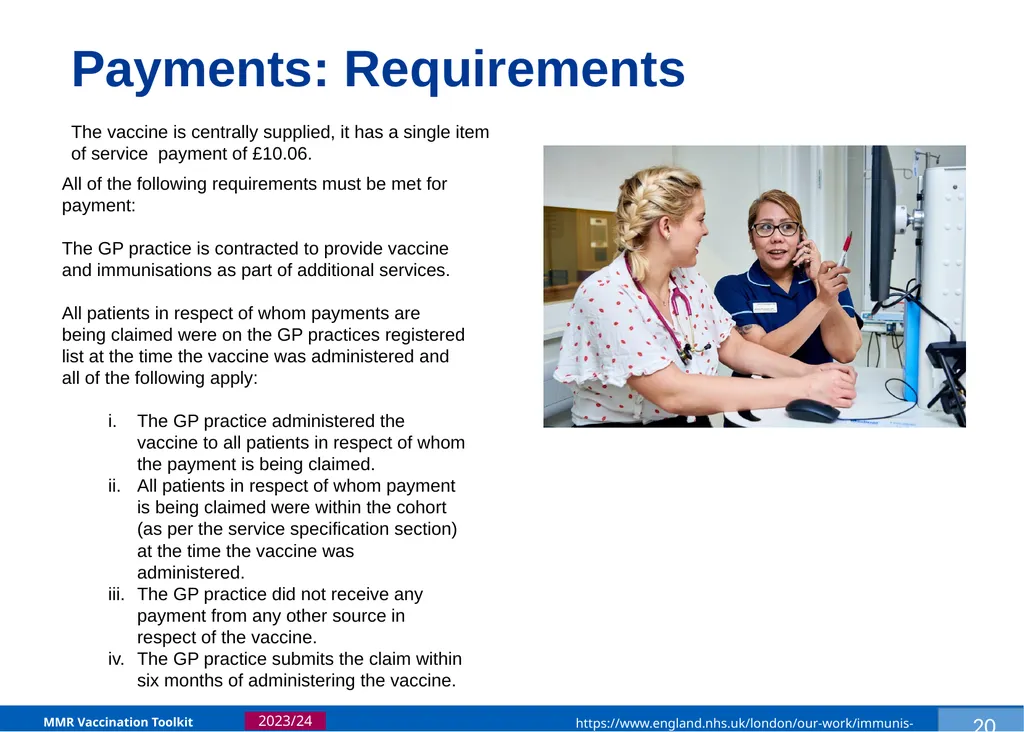
Payments: Requirements Introduction Introduction Introduction Introduction Introduction Introduction The vaccine is centrally supplied, it has a single item of service payment of £10.06. All of the following requirements must be met for payment:
The GP practice is contracted to provide vaccine and immunisations as part of additional services.
All patients in respect of whom payments are being claimed were on the GP practices registered list at the time the vaccine was administered and all of the following apply:
The GP practice administered the vaccine to all patients in respect of whom the payment is being claimed.
All patients in respect of whom payment is being claimed were within the cohort (as per the service specification section) at the time the vaccine was administered.
The GP practice did not receive any payment from any other source in respect of the vaccine.
The GP practice submits the claim within six months of administering the vaccine. 10 20<br>
The GP practice is contracted to provide vaccine and immunisations as part of additional services.
All patients in respect of whom payments are being claimed were on the GP practices registered list at the time the vaccine was administered and all of the following apply:
The GP practice administered the vaccine to all patients in respect of whom the payment is being claimed.
All patients in respect of whom payment is being claimed were within the cohort (as per the service specification section) at the time the vaccine was administered.
The GP practice did not receive any payment from any other source in respect of the vaccine.
The GP practice submits the claim within six months of administering the vaccine. 10 20<br>
24
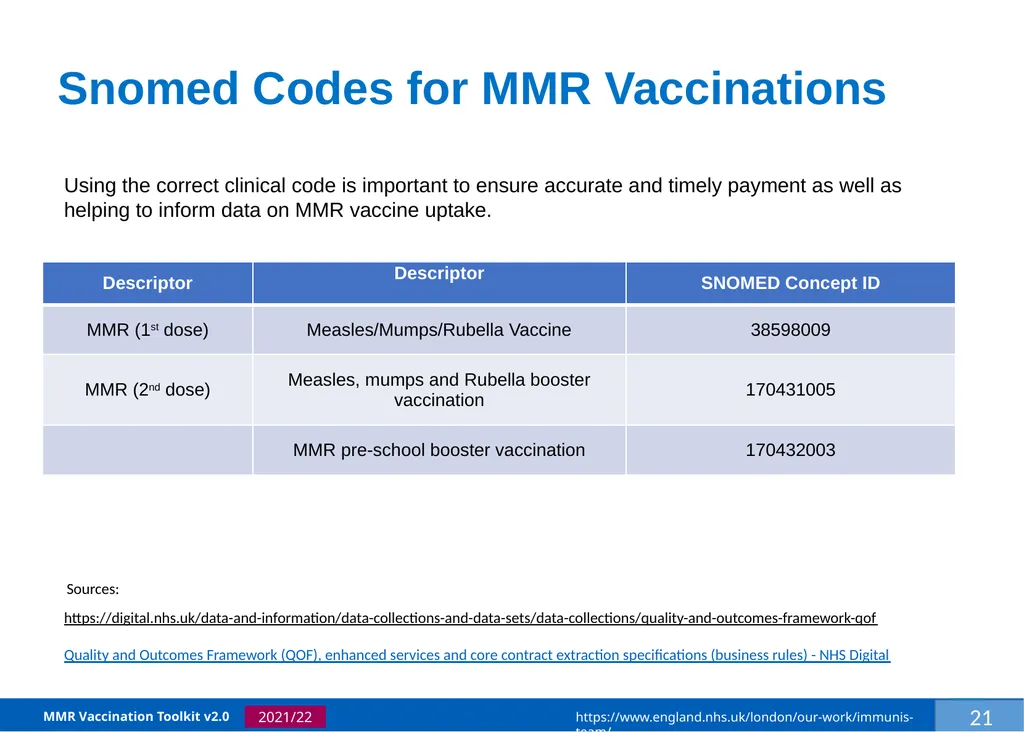
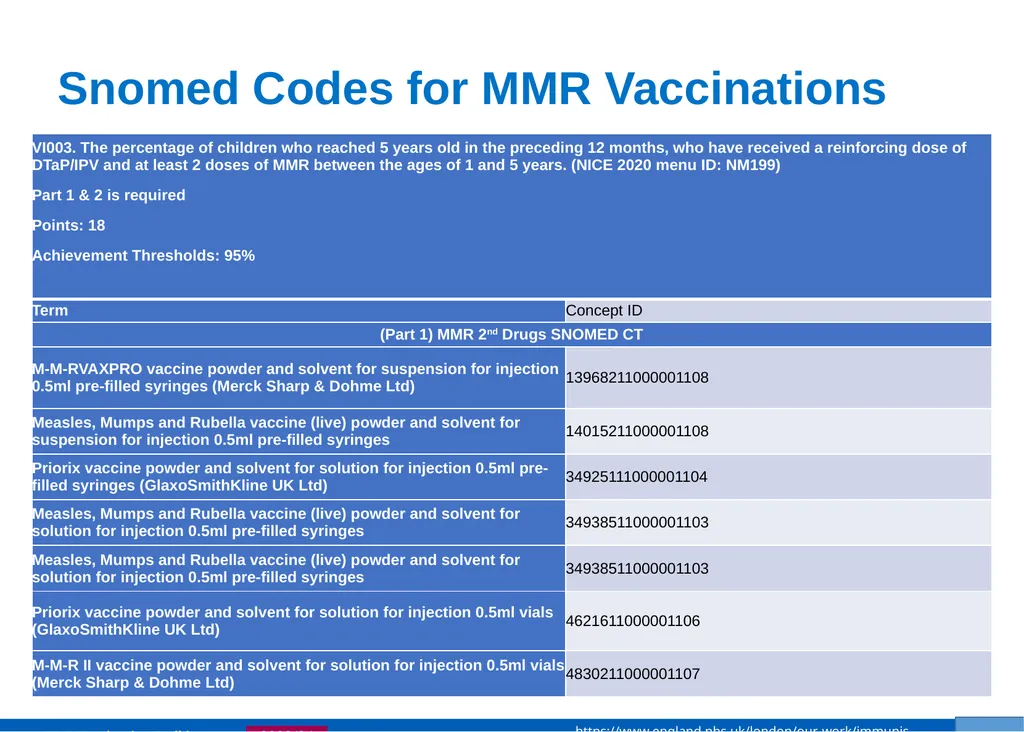
3 Introduction Introduction Introduction Introduction Introduction Introduction Snomed Codes for MMR Vaccinations Using the correct clinical code is important to ensure accurate and timely payment as well as helping to inform data on MMR vaccine uptake. https://digital.nhs.uk/data-and-information/data-collections-and-data-sets/data-collections/quality-and-outcomes-framework-qof
Quality and Outcomes Framework (QOF), enhanced services and core contract extraction specifications (business rules) - NHS Digital Sources: 21<br>
Quality and Outcomes Framework (QOF), enhanced services and core contract extraction specifications (business rules) - NHS Digital Sources: 21<br>
25
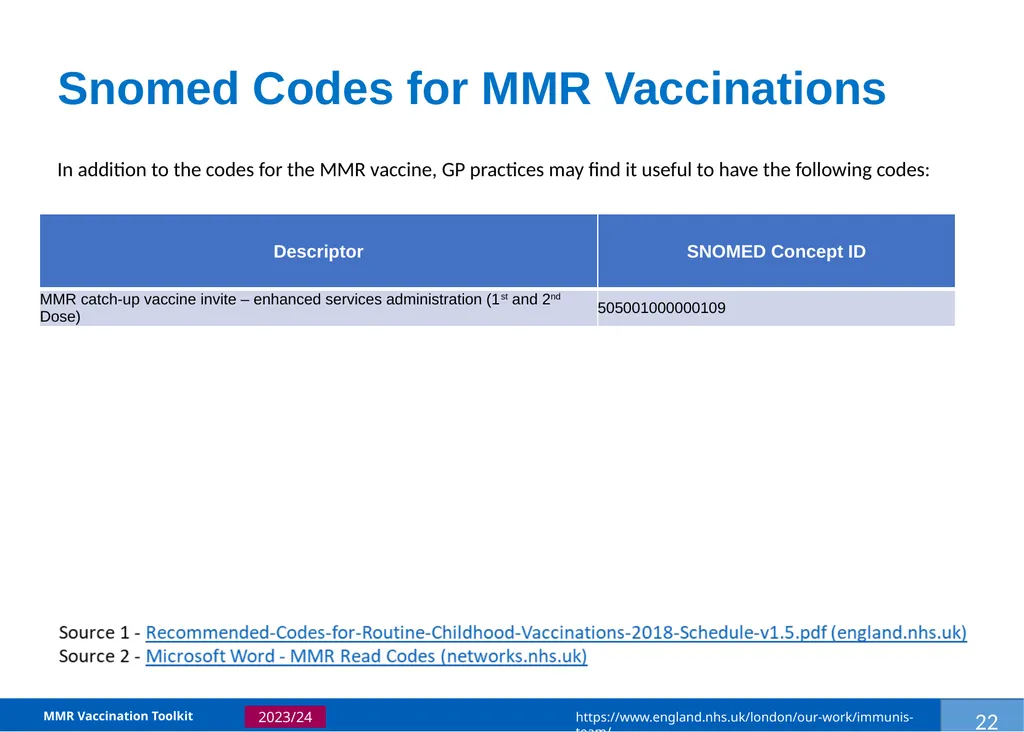
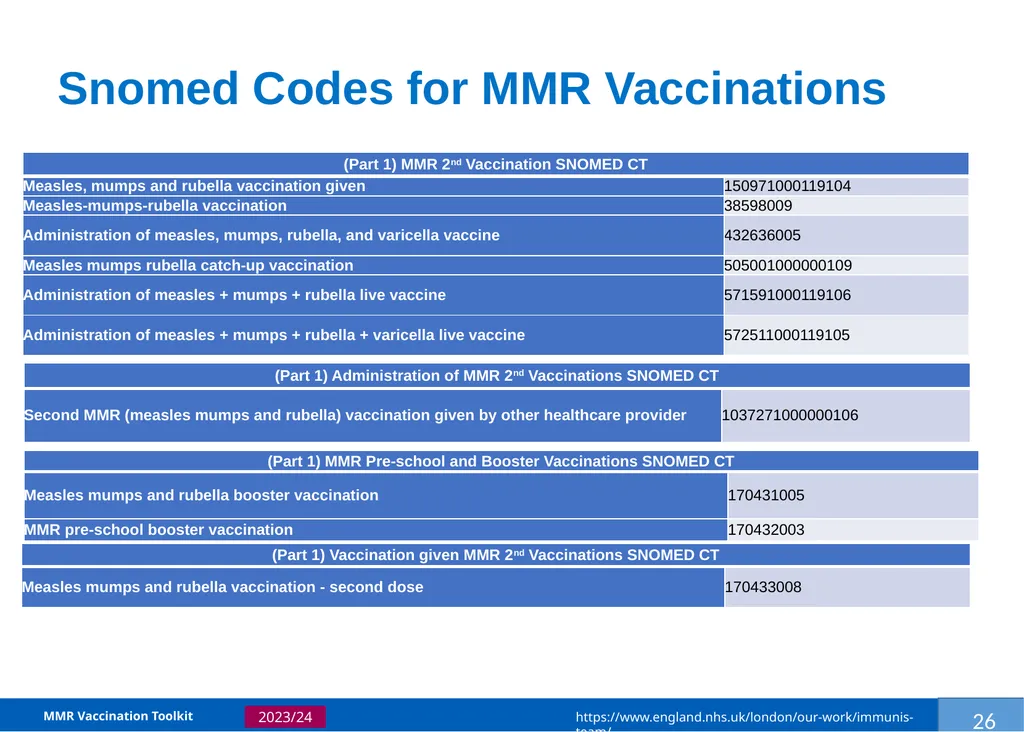
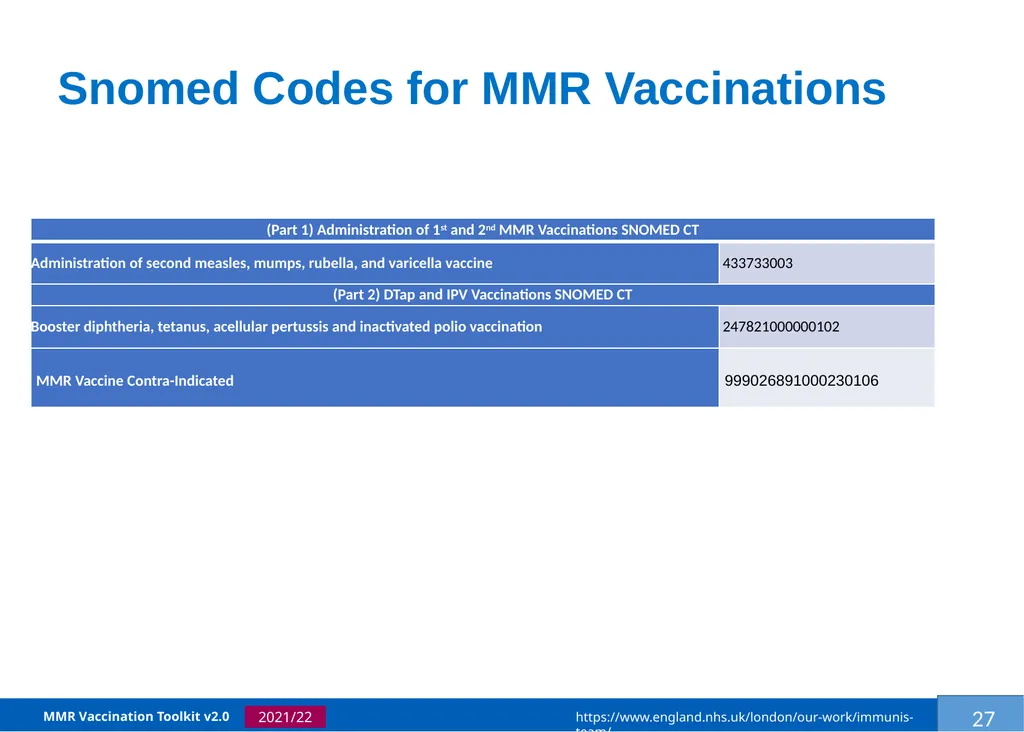
3 Introduction Introduction Introduction Introduction Introduction Introduction Snomed Codes for MMR Vaccinations In addition to the codes for the MMR vaccine, GP practices may find it useful to have the following codes: 22<br>
26
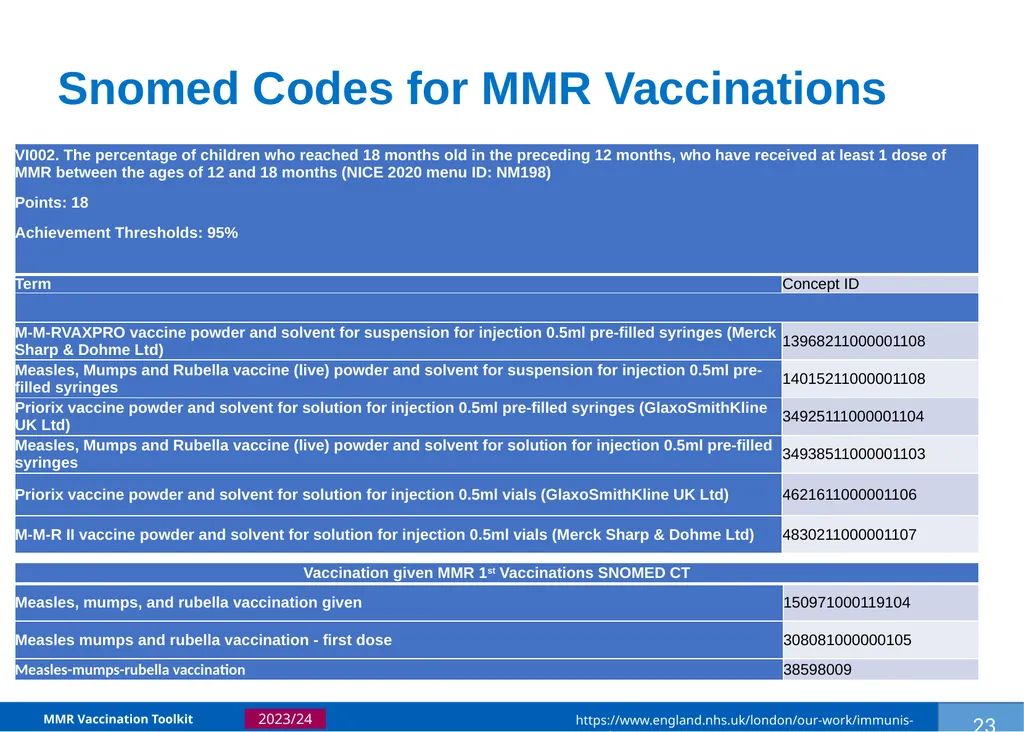
3 Introduction Introduction Introduction Introduction Introduction Introduction Snomed Codes for MMR Vaccinations 23<br>
27
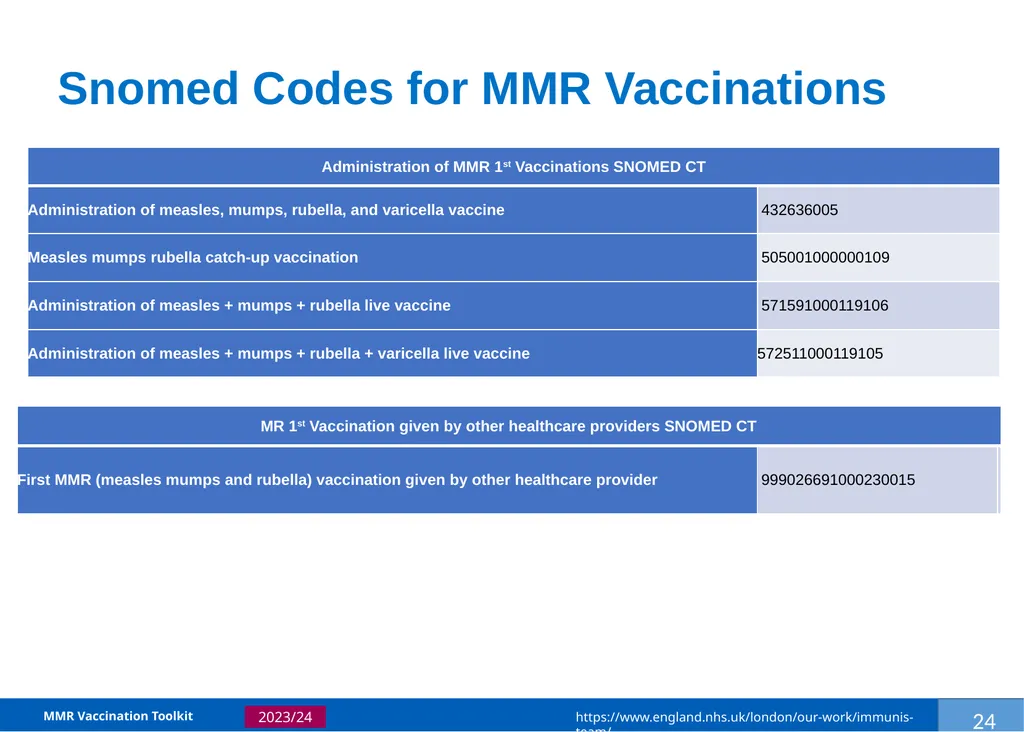
3 Introduction Introduction Introduction Introduction Introduction Introduction Snomed Codes for MMR Vaccinations 24<br>
28
3 Introduction Introduction Introduction Introduction Introduction Introduction Snomed Codes for MMR Vaccinations 25<br>
29
3 Introduction Introduction Introduction Introduction Introduction Introduction Snomed Codes for MMR Vaccinations 26<br>
30
3 Introduction Introduction Introduction Introduction Introduction Introduction Snomed Codes for MMR Vaccinations 27<br>
31
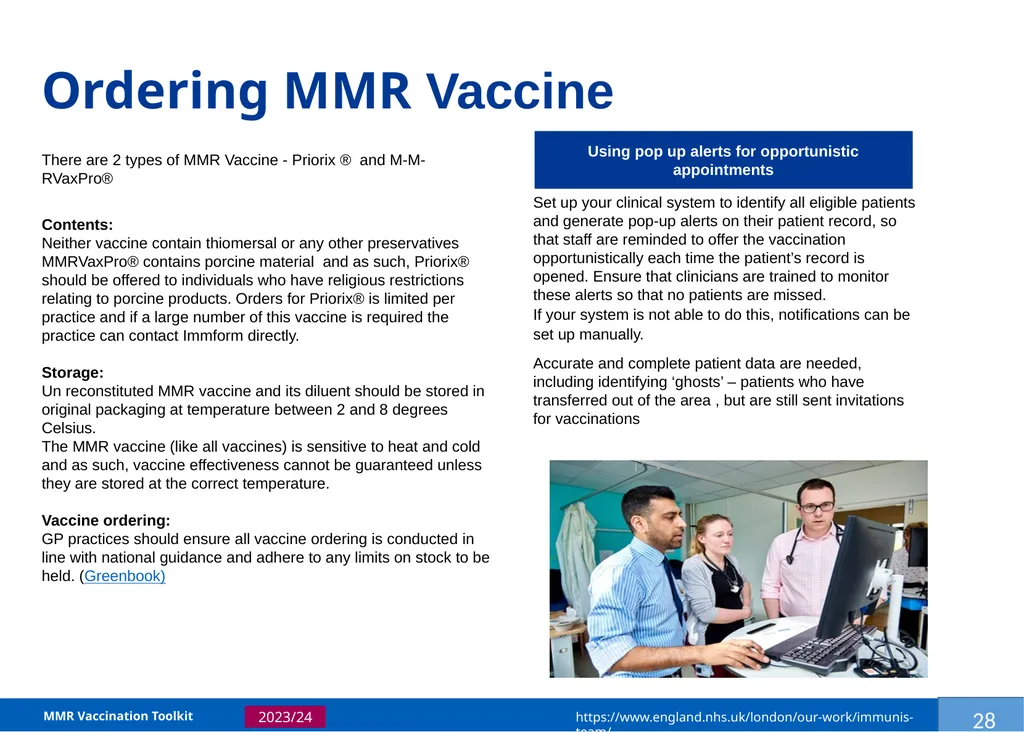
4 Ordering MMR Vaccine Introduction Introduction Introduction Introduction Introduction Introduction There are 2 types of MMR Vaccine - Priorix ® and M-M-RVaxPro®
Contents:
Neither vaccine contain thiomersal or any other preservatives
MMRVaxPro® contains porcine material and as such, Priorix® should be offered to individuals who have religious restrictions relating to porcine products. Orders for Priorix® is limited per practice and if a large number of this vaccine is required the practice can contact Immform directly.
Storage:
Un reconstituted MMR vaccine and its diluent should be stored in original packaging at temperature between 2 and 8 degrees Celsius.
The MMR vaccine (like all vaccines) is sensitive to heat and cold and as such, vaccine effectiveness cannot be guaranteed unless they are stored at the correct temperature.
Vaccine ordering:
GP practices should ensure all vaccine ordering is conducted in line with national guidance and adhere to any limits on stock to be held. (Greenbook) 28<br>
Contents:
Neither vaccine contain thiomersal or any other preservatives
MMRVaxPro® contains porcine material and as such, Priorix® should be offered to individuals who have religious restrictions relating to porcine products. Orders for Priorix® is limited per practice and if a large number of this vaccine is required the practice can contact Immform directly.
Storage:
Un reconstituted MMR vaccine and its diluent should be stored in original packaging at temperature between 2 and 8 degrees Celsius.
The MMR vaccine (like all vaccines) is sensitive to heat and cold and as such, vaccine effectiveness cannot be guaranteed unless they are stored at the correct temperature.
Vaccine ordering:
GP practices should ensure all vaccine ordering is conducted in line with national guidance and adhere to any limits on stock to be held. (Greenbook) 28<br>
32
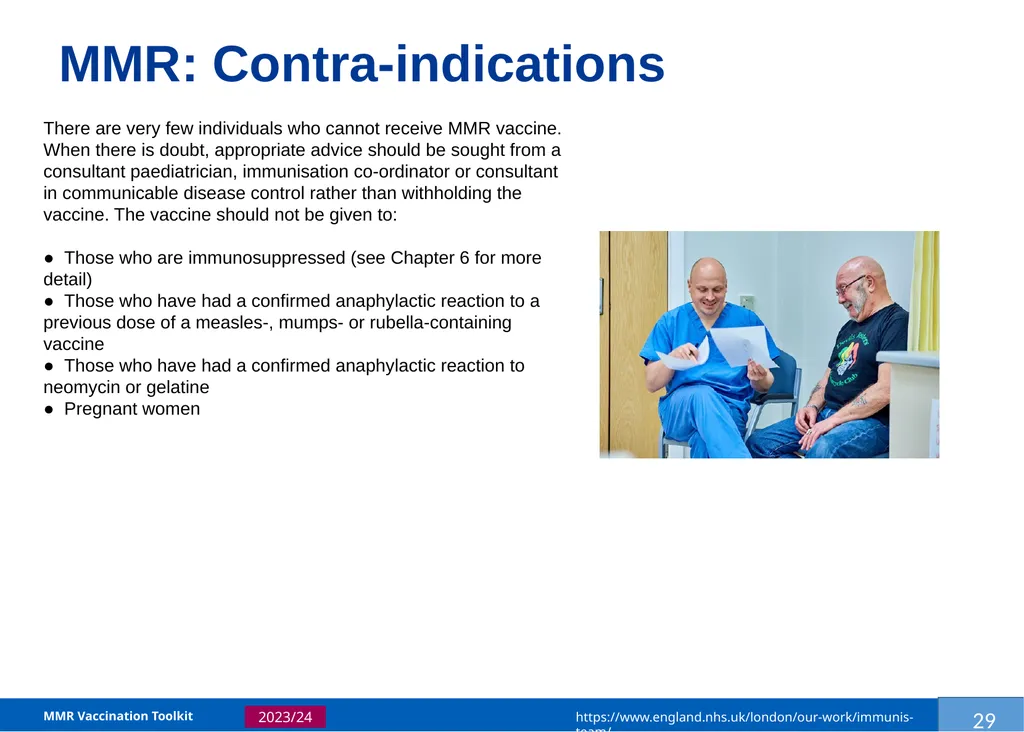
5 There are very few individuals who cannot receive MMR vaccine. When there is doubt, appropriate advice should be sought from a consultant paediatrician, immunisation co-ordinator or consultant in communicable disease control rather than withholding the vaccine. The vaccine should not be given to:
● Those who are immunosuppressed (see Chapter 6 for more detail)
● Those who have had a confirmed anaphylactic reaction to a previous dose of a measles-, mumps- or rubella-containing vaccine
● Those who have had a confirmed anaphylactic reaction to neomycin or gelatine
● Pregnant women MMR: Contra-indications Introduction Introduction Introduction Introduction Introduction Introduction 29<br>
● Those who are immunosuppressed (see Chapter 6 for more detail)
● Those who have had a confirmed anaphylactic reaction to a previous dose of a measles-, mumps- or rubella-containing vaccine
● Those who have had a confirmed anaphylactic reaction to neomycin or gelatine
● Pregnant women MMR: Contra-indications Introduction Introduction Introduction Introduction Introduction Introduction 29<br>
33
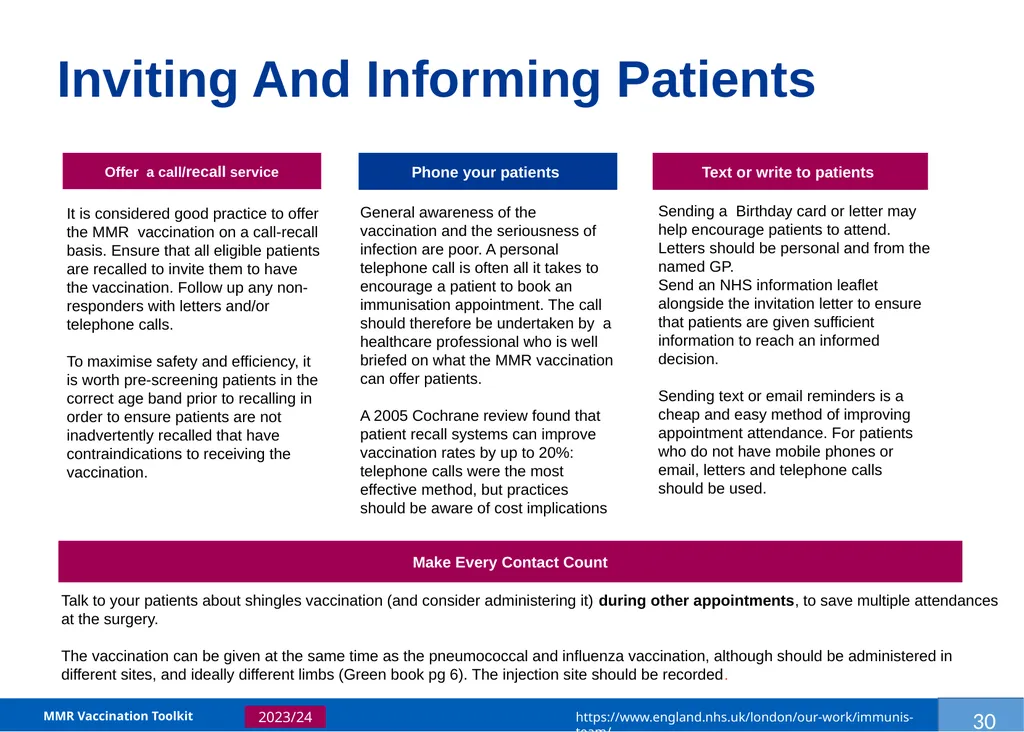
6 Inviting And Informing Patients Introduction Introduction Introduction Introduction Introduction Introduction 30<br>
34
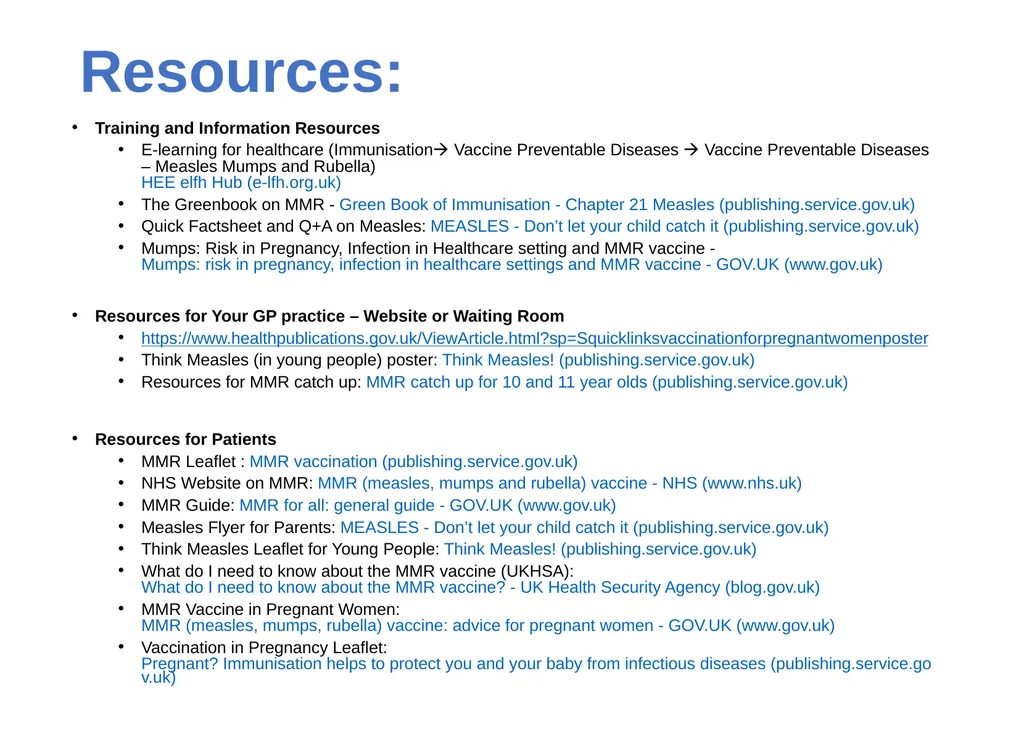
Resources: Training and Information Resources
E-learning for healthcare (Immunisation Vaccine Preventable Diseases Vaccine Preventable Diseases – Measles Mumps and Rubella) HEE elfh Hub (e-lfh.org.uk)
The Greenbook on MMR - Green Book of Immunisation - Chapter 21 Measles (publishing.service.gov.uk)
Quick Factsheet and Q+A on Measles: MEASLES - Don’t let your child catch it (publishing.service.gov.uk)
Mumps: Risk in Pregnancy, Infection in Healthcare setting and MMR vaccine - Mumps: risk in pregnancy, infection in healthcare settings and MMR vaccine - GOV.UK (www.gov.uk)
Resources for Your GP practice – Website or Waiting Room
https://www.healthpublications.gov.uk/ViewArticle.html?sp=Squicklinksvaccinationforpregnantwomenposter
Think Measles (in young people) poster: Think Measles! (publishing.service.gov.uk)
Resources for MMR catch up: MMR catch up for 10 and 11 year olds (publishing.service.gov.uk)
Resources for Patients
MMR Leaflet : MMR vaccination (publishing.service.gov.uk)
NHS Website on MMR: MMR (measles, mumps and rubella) vaccine - NHS (www.nhs.uk)
MMR Guide: MMR for all: general guide - GOV.UK (www.gov.uk)
Measles Flyer for Parents: MEASLES - Don’t let your child catch it (publishing.service.gov.uk)
Think Measles Leaflet for Young People: Think Measles! (publishing.service.gov.uk)
What do I need to know about the MMR vaccine (UKHSA): What do I need to know about the MMR vaccine? - UK Health Security Agency (blog.gov.uk)
MMR Vaccine in Pregnant Women: MMR (measles, mumps, rubella) vaccine: advice for pregnant women - GOV.UK (www.gov.uk)
Vaccination in Pregnancy Leaflet: Pregnant? Immunisation helps to protect you and your baby from infectious diseases (publishing.service.gov.uk)<br>
E-learning for healthcare (Immunisation Vaccine Preventable Diseases Vaccine Preventable Diseases – Measles Mumps and Rubella) HEE elfh Hub (e-lfh.org.uk)
The Greenbook on MMR - Green Book of Immunisation - Chapter 21 Measles (publishing.service.gov.uk)
Quick Factsheet and Q+A on Measles: MEASLES - Don’t let your child catch it (publishing.service.gov.uk)
Mumps: Risk in Pregnancy, Infection in Healthcare setting and MMR vaccine - Mumps: risk in pregnancy, infection in healthcare settings and MMR vaccine - GOV.UK (www.gov.uk)
Resources for Your GP practice – Website or Waiting Room
https://www.healthpublications.gov.uk/ViewArticle.html?sp=Squicklinksvaccinationforpregnantwomenposter
Think Measles (in young people) poster: Think Measles! (publishing.service.gov.uk)
Resources for MMR catch up: MMR catch up for 10 and 11 year olds (publishing.service.gov.uk)
Resources for Patients
MMR Leaflet : MMR vaccination (publishing.service.gov.uk)
NHS Website on MMR: MMR (measles, mumps and rubella) vaccine - NHS (www.nhs.uk)
MMR Guide: MMR for all: general guide - GOV.UK (www.gov.uk)
Measles Flyer for Parents: MEASLES - Don’t let your child catch it (publishing.service.gov.uk)
Think Measles Leaflet for Young People: Think Measles! (publishing.service.gov.uk)
What do I need to know about the MMR vaccine (UKHSA): What do I need to know about the MMR vaccine? - UK Health Security Agency (blog.gov.uk)
MMR Vaccine in Pregnant Women: MMR (measles, mumps, rubella) vaccine: advice for pregnant women - GOV.UK (www.gov.uk)
Vaccination in Pregnancy Leaflet: Pregnant? Immunisation helps to protect you and your baby from infectious diseases (publishing.service.gov.uk)<br>
35
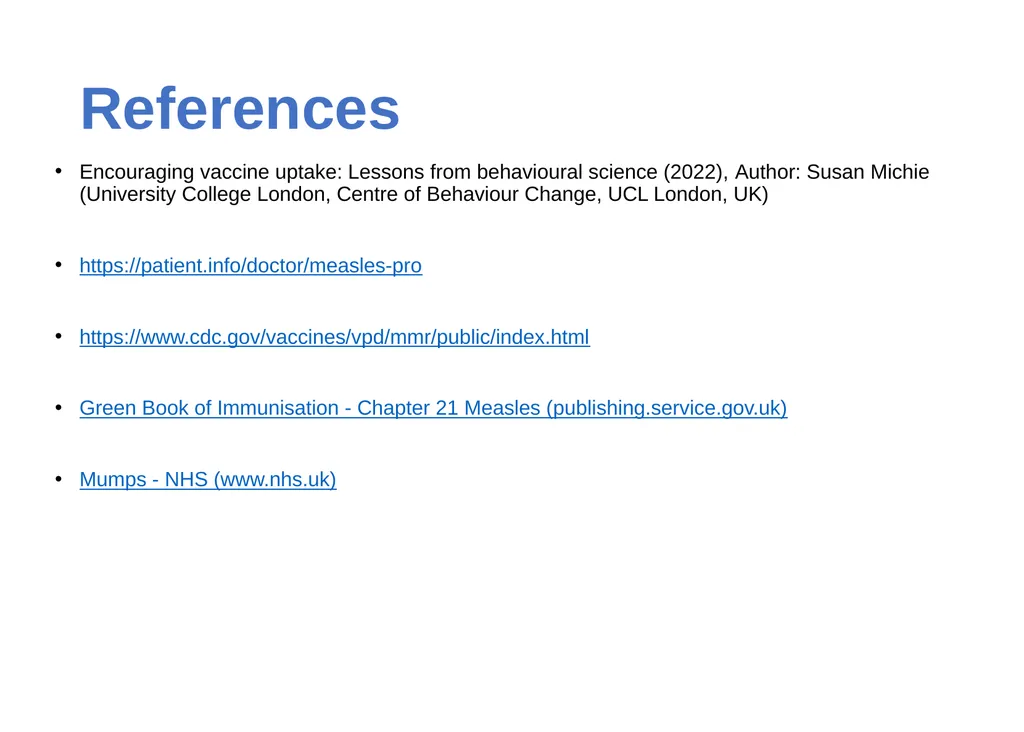
References Encouraging vaccine uptake: Lessons from behavioural science (2022), Author: Susan Michie (University College London, Centre of Behaviour Change, UCL London, UK)
https://patient.info/doctor/measles-pro
https://www.cdc.gov/vaccines/vpd/mmr/public/index.html
Green Book of Immunisation - Chapter 21 Measles (publishing.service.gov.uk)
Mumps - NHS (www.nhs.uk)<br>
https://patient.info/doctor/measles-pro
https://www.cdc.gov/vaccines/vpd/mmr/public/index.html
Green Book of Immunisation - Chapter 21 Measles (publishing.service.gov.uk)
Mumps - NHS (www.nhs.uk)<br>