Modern network servers Example network service: dk-hostmaster.dk Small country. Small amount of traffic. representative ccTLD deployment. 19th March 2018 Modern network servers 2 Traffic as of December 2016 Per unicast server: 1,000 qps
"Modern network servers Example network service:" is the property of its rightful owner. Permission is granted to
download and print the materials on this website for personal, non-commercial use only, and to display it
on your personal computer provided you do not modify the materials and that you retain all copyright
notices contained in the materials. By downloading content from our website, you accept the terms of this
agreement.
Presentation Transcript
01
Modern network servers<br>
02
Example network service: dk-hostmaster.dk Small country. Small amount of traffic.
representative ccTLD deployment. 19th March 2018 Modern network servers 2<br>
03
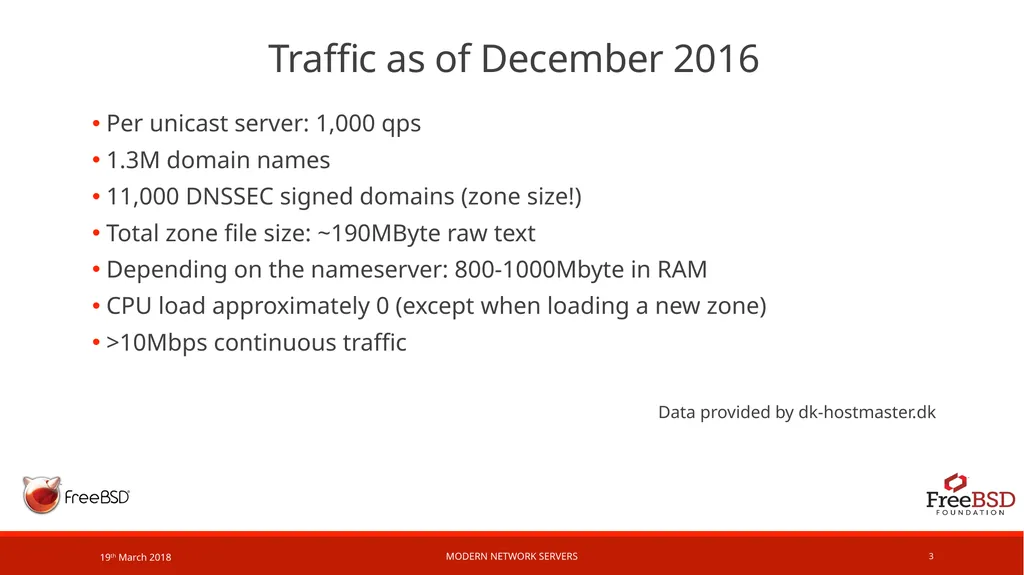
Traffic as of December 2016 Per unicast server: 1,000 qps
1.3M domain names
11,000 DNSSEC signed domains (zone size!)
Total zone file size: ~190MByte raw text
Depending on the nameserver: 800-1000Mbyte in RAM
CPU load approximately 0 (except when loading a new zone)
>10Mbps continuous traffic
Data provided by dk-hostmaster.dk 19th March 2018 Modern network servers 3<br>
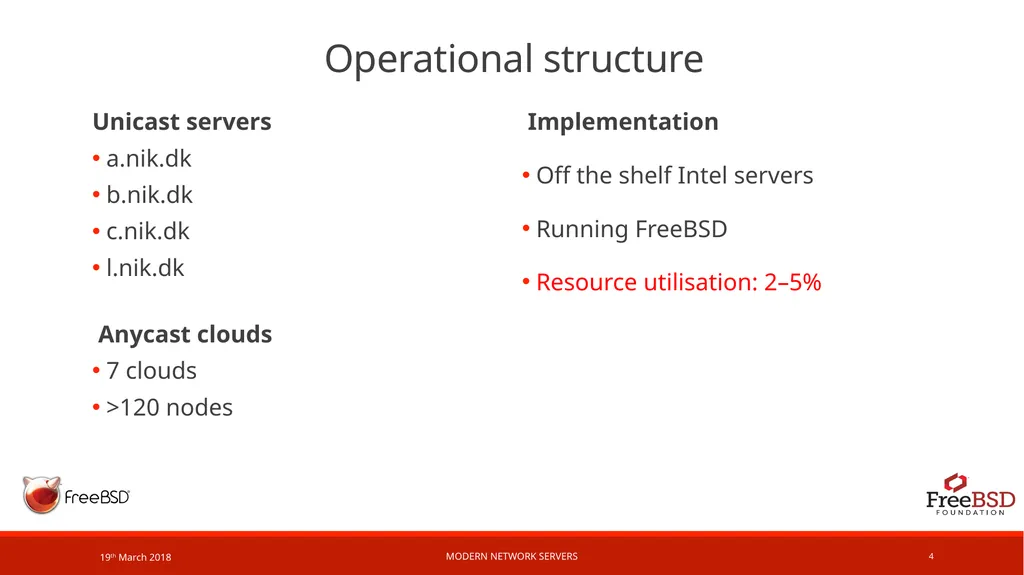
Anycast clouds
7 clouds
>120 nodes Implementation
Off the shelf Intel servers
Running FreeBSD
Resource utilisation: 2–5% 19th March 2018 Modern network servers 4 Operational structure<br>
05
Network servers hardware considerations for network servers vs. generic-purpose servers 19th March 2018 Modern network servers 5<br>
06
Resources network servers care about CPU: lots of trivial operations running in parallel
Memory and bus bandwidth
Network
Disk I/O 19th March 2018 Modern network servers 6<br>
07
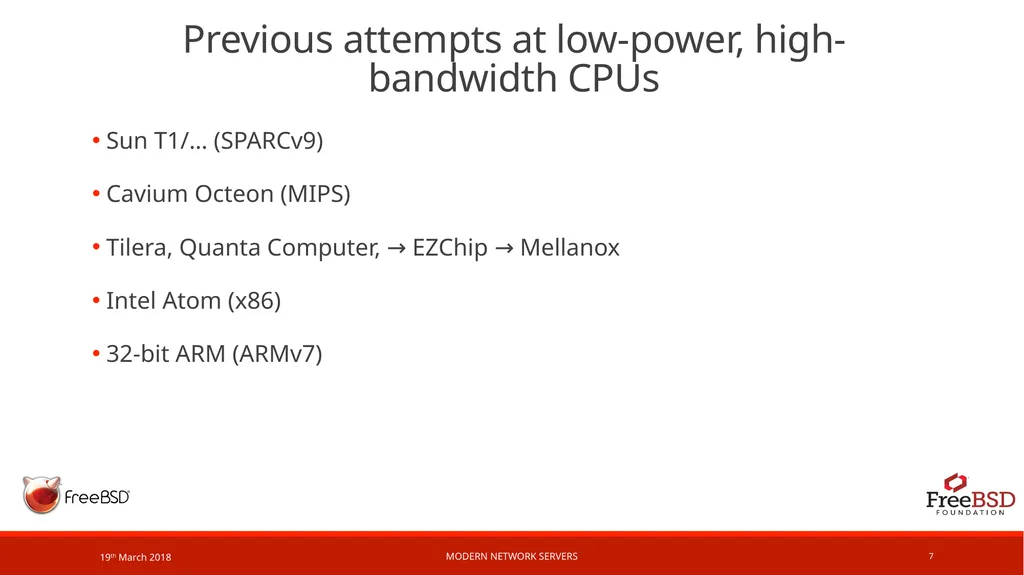
Previous attempts at low-power, high-bandwidth CPUs Sun T1/… (SPARCv9)
Cavium Octeon (MIPS)
Tilera, Quanta Computer, → EZChip → Mellanox
Intel Atom (x86)
32-bit ARM (ARMv7) 19th March 2018 Modern network servers 7<br>
08
ARM64 A new attempt at a server-grade architecture 19th March 2018 Modern network servers 8<br>
09
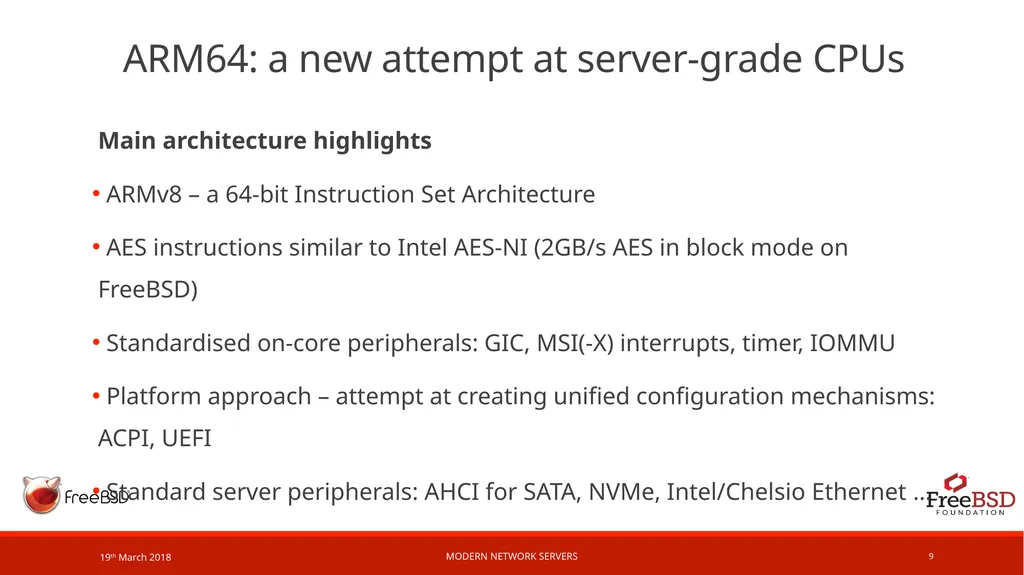
ARM64: a new attempt at server-grade CPUs Main architecture highlights
ARMv8 – a 64-bit Instruction Set Architecture
AES instructions similar to Intel AES-NI (2GB/s AES in block mode on FreeBSD)
Standardised on-core peripherals: GIC, MSI(-X) interrupts, timer, IOMMU
Platform approach – attempt at creating unified configuration mechanisms: ACPI, UEFI
Standard server peripherals: AHCI for SATA, NVMe, Intel/Chelsio Ethernet … 19th March 2018 Modern network servers 9<br>
10
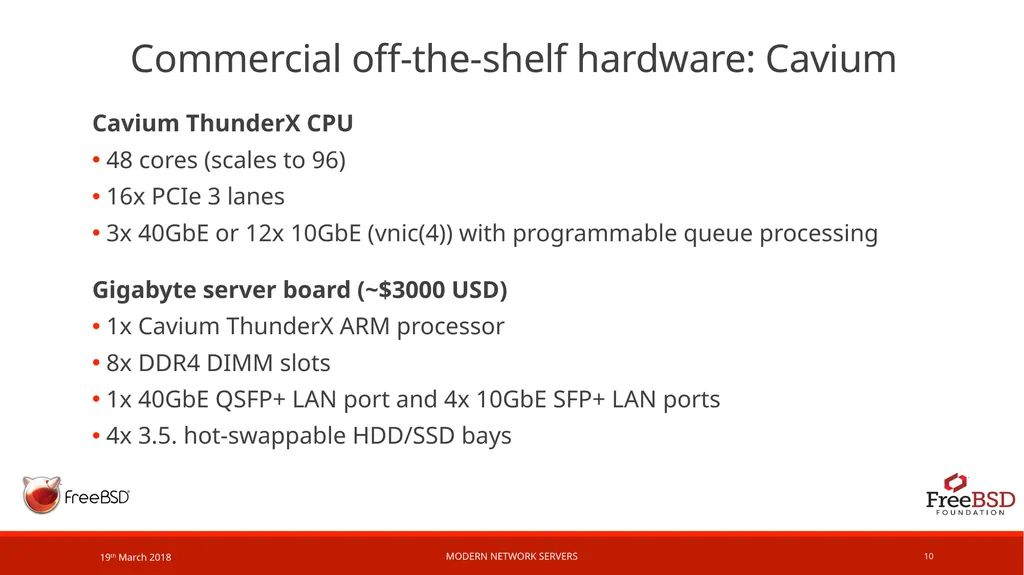
Commercial off-the-shelf hardware: Cavium Cavium ThunderX CPU
48 cores (scales to 96)
16x PCIe 3 lanes
3x 40GbE or 12x 10GbE (vnic(4)) with programmable queue processing
Gigabyte server board (~$3000 USD)
1x Cavium ThunderX ARM processor
8x DDR4 DIMM slots
1x 40GbE QSFP+ LAN port and 4x 10GbE SFP+ LAN ports
4x 3.5. hot-swappable HDD/SSD bays 19th March 2018 Modern network servers 10<br>
11
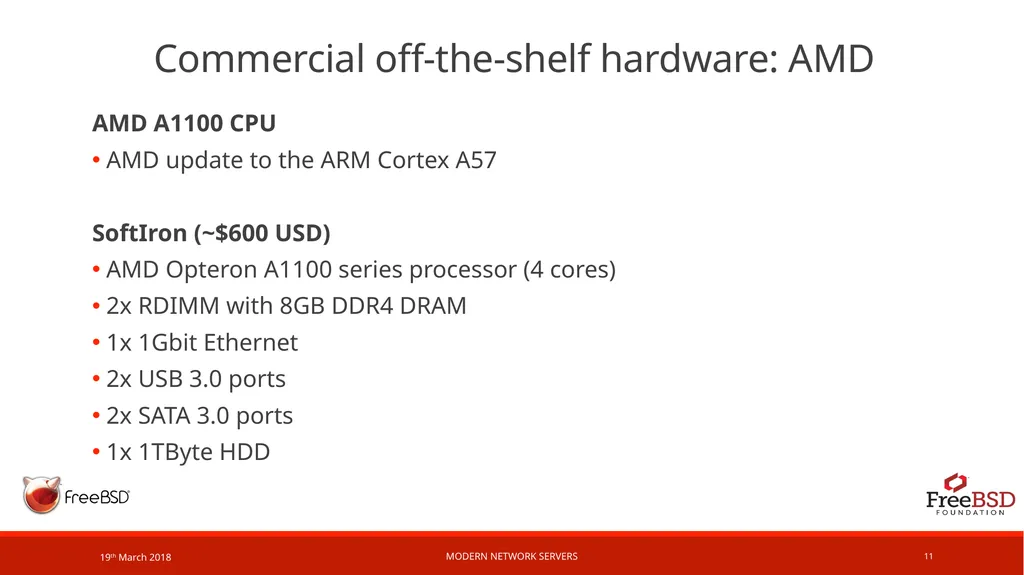
Commercial off-the-shelf hardware: AMD AMD A1100 CPU
AMD update to the ARM Cortex A57
SoftIron (~$600 USD)
AMD Opteron A1100 series processor (4 cores)
2x RDIMM with 8GB DDR4 DRAM
1x 1Gbit Ethernet
2x USB 3.0 ports
2x SATA 3.0 ports
1x 1TByte HDD 19th March 2018 Modern network servers 11<br>
12
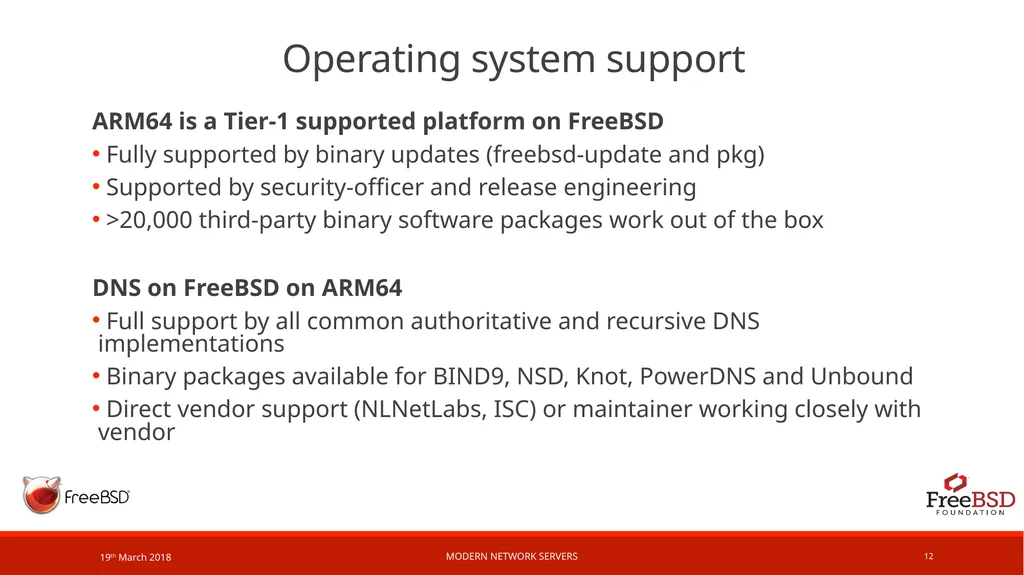
Operating system support ARM64 is a Tier-1 supported platform on FreeBSD
Fully supported by binary updates (freebsd-update and pkg)
Supported by security-officer and release engineering
>20,000 third-party binary software packages work out of the box
DNS on FreeBSD on ARM64
Full support by all common authoritative and recursive DNS implementations
Binary packages available for BIND9, NSD, Knot, PowerDNS and Unbound
Direct vendor support (NLNetLabs, ISC) or maintainer working closely with vendor 19th March 2018 Modern network servers 12<br>
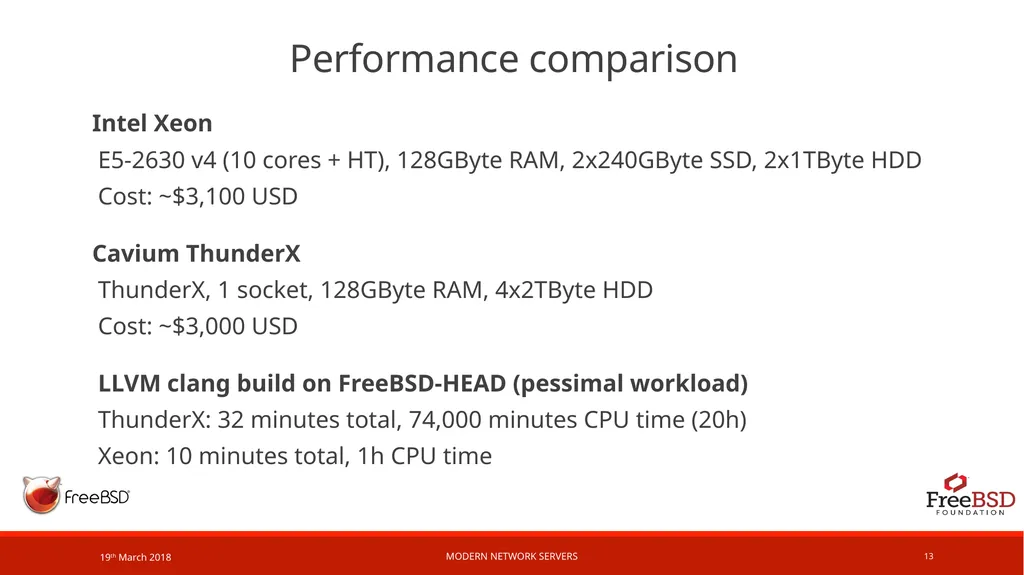
LLVM clang build on FreeBSD-HEAD (pessimal workload)
ThunderX: 32 minutes total, 74,000 minutes CPU time (20h)
Xeon: 10 minutes total, 1h CPU time 19th March 2018 Modern network servers 13<br>
14
DNS servers spend very little timing compiling LLVM build workload
Lots of continuous disk I/O
Gigantic memory footprint and churn
CPU load can only be parallelised to a limited extent
Authoritative DNS workload
Modest amount of disk I/O when loading zone files
Entire working data set fits in memory (true for most ccTLDs and nTLDs)
Easy to parallelise CPU load 19th March 2018 Modern network servers 14<br>
15
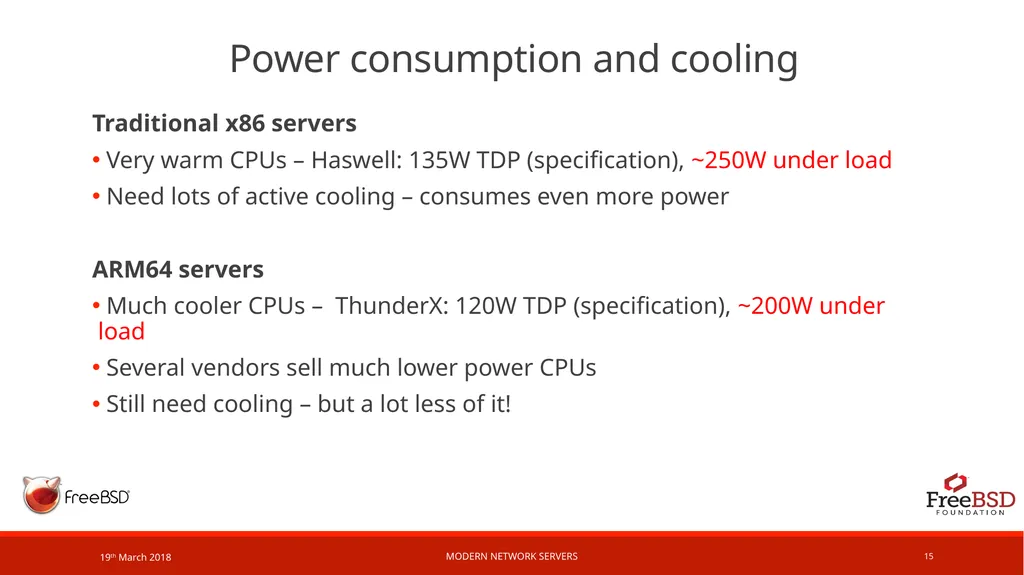
Power consumption and cooling Traditional x86 servers
Very warm CPUs – Haswell: 135W TDP (specification), ~250W under load
Need lots of active cooling – consumes even more power
ARM64 servers
Much cooler CPUs – ThunderX: 120W TDP (specification), ~200W under load
Several vendors sell much lower power CPUs
Still need cooling – but a lot less of it! 19th March 2018 Modern network servers 15<br>
16
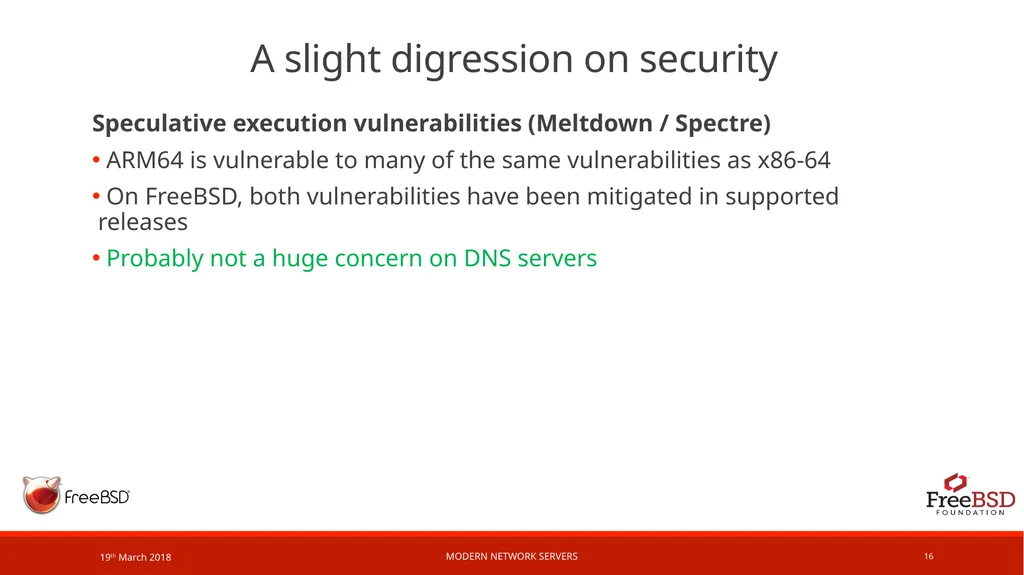
A slight digression on security Speculative execution vulnerabilities (Meltdown / Spectre)
ARM64 is vulnerable to many of the same vulnerabilities as x86-64
On FreeBSD, both vulnerabilities have been mitigated in supported releases
Probably not a huge concern on DNS servers 19th March 2018 Modern network servers 16<br>
17
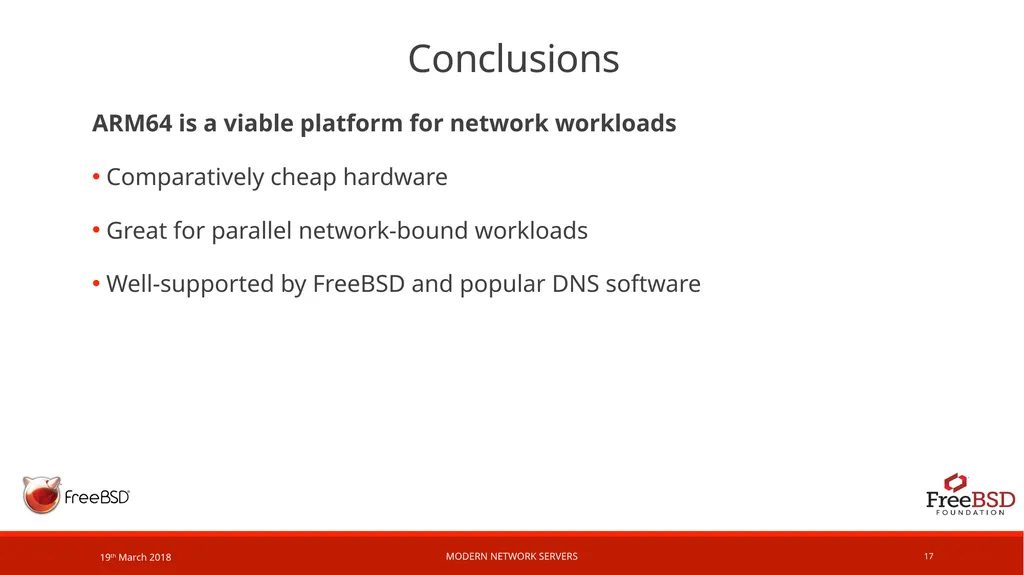
Conclusions ARM64 is a viable platform for network workloads
Comparatively cheap hardware
Great for parallel network-bound workloads
Well-supported by FreeBSD and popular DNS software 19th March 2018 Modern network servers 17<br>