
Modular Vehicle Combinations Informal Working
CM
Published · 28 slides · 0 views
1 / 1

Description
Modular Vehicle Combinations Informal Working Group (MVC IWG) Skype meeting 3 Content Introduction Scope (2 steps approach) Parking list for step 2 Technical principles and open issues Status of the work Introduction Current UN R13
Related Topics
Share
Embed code
Download this presentation From Below
"Modular Vehicle Combinations Informal Working" is the property of its rightful owner. Permission is granted to download and print the materials on this website for personal, non-commercial use only, and to display it on your personal computer provided you do not modify the materials and that you retain all copyright notices contained in the materials. By downloading content from our website, you accept the terms of this agreement.
Presentation Transcript
01
Modular Vehicle Combinations
Informal Working Group
(MVC IWG) Skype meeting #3<br>
02
Content Introduction
Scope (2 steps approach)
“Parking list” for step 2
Technical principles and open issues
Status of the work<br>
Scope (2 steps approach)
“Parking list” for step 2
Technical principles and open issues
Status of the work<br>
03
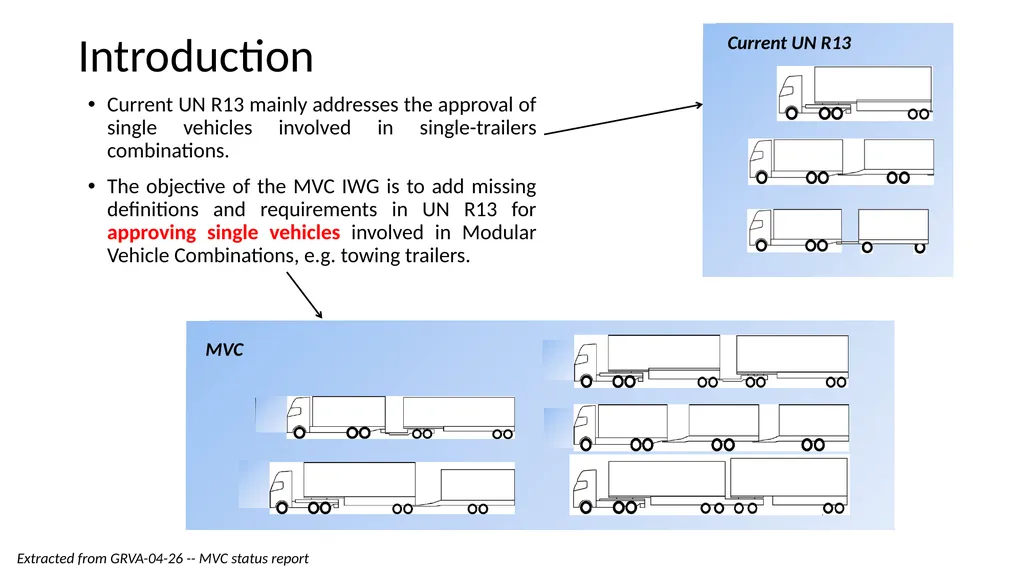
Introduction Current UN R13 mainly addresses the approval of single vehicles involved in single-trailers combinations.
The objective of the MVC IWG is to add missing definitions and requirements in UN R13 for approving single vehicles involved in Modular Vehicle Combinations, e.g. towing trailers. MVC Extracted from GRVA-04-26 -- MVC status report<br>
The objective of the MVC IWG is to add missing definitions and requirements in UN R13 for approving single vehicles involved in Modular Vehicle Combinations, e.g. towing trailers. MVC Extracted from GRVA-04-26 -- MVC status report<br>
04
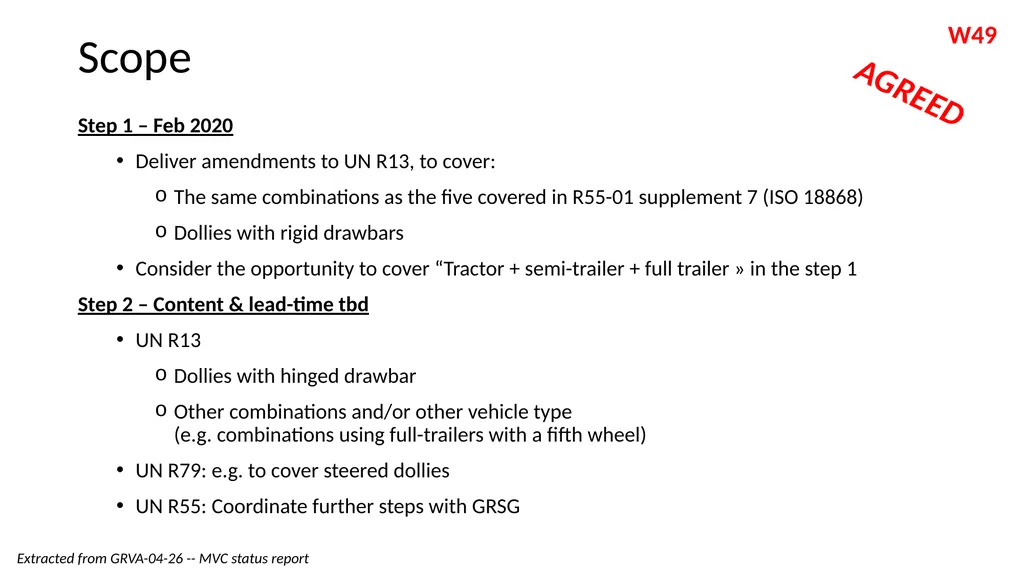
Scope Step 1 – Feb 2020
Deliver amendments to UN R13, to cover:
The same combinations as the five covered in R55-01 supplement 7 (ISO 18868)
Dollies with rigid drawbars
Consider the opportunity to cover “Tractor + semi-trailer + full trailer » in the step 1
Step 2 – Content & lead-time tbd
UN R13
Dollies with hinged drawbar
Other combinations and/or other vehicle type (e.g. combinations using full-trailers with a fifth wheel)
UN R79: e.g. to cover steered dollies
UN R55: Coordinate further steps with GRSG Extracted from GRVA-04-26 -- MVC status report W49 AGREED<br>
Deliver amendments to UN R13, to cover:
The same combinations as the five covered in R55-01 supplement 7 (ISO 18868)
Dollies with rigid drawbars
Consider the opportunity to cover “Tractor + semi-trailer + full trailer » in the step 1
Step 2 – Content & lead-time tbd
UN R13
Dollies with hinged drawbar
Other combinations and/or other vehicle type (e.g. combinations using full-trailers with a fifth wheel)
UN R79: e.g. to cover steered dollies
UN R55: Coordinate further steps with GRSG Extracted from GRVA-04-26 -- MVC status report W49 AGREED<br>
05
“Parking list” for step 2 Ball bearings on fifth wheel (is this about steering and/or coupling?)
Steered dollies W50<br>
Steered dollies W50<br>
06
Technical principles and open issues<br>
07
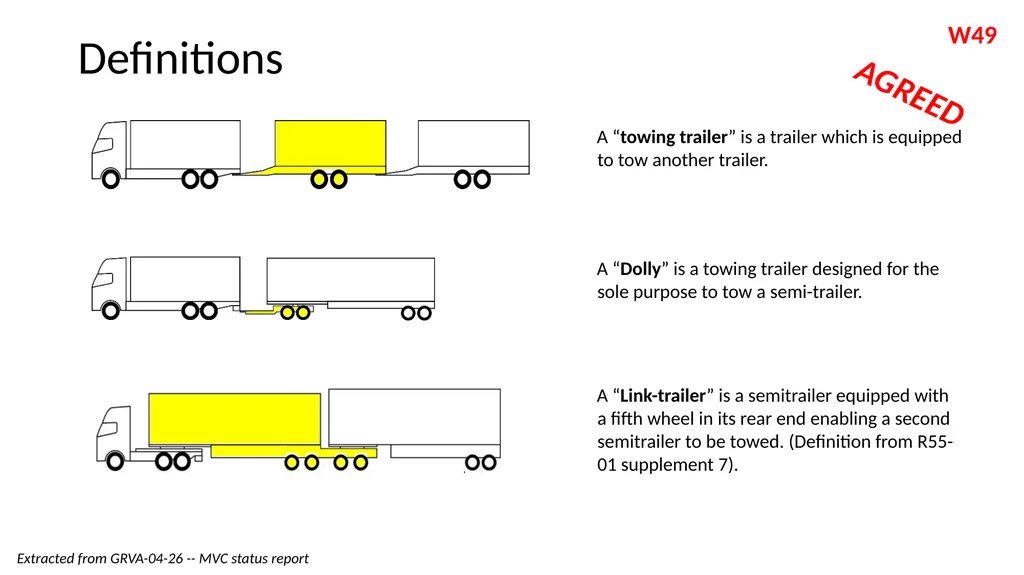
Definitions A “towing trailer” is a trailer which is equipped to tow another trailer. A “Dolly” is a towing trailer designed for the sole purpose to tow a semi-trailer. A “Link-trailer” is a semitrailer equipped with a fifth wheel in its rear end enabling a second semitrailer to be towed. (Definition from R55-01 supplement 7). Extracted from GRVA-04-26 -- MVC status report W49 AGREED<br>
08
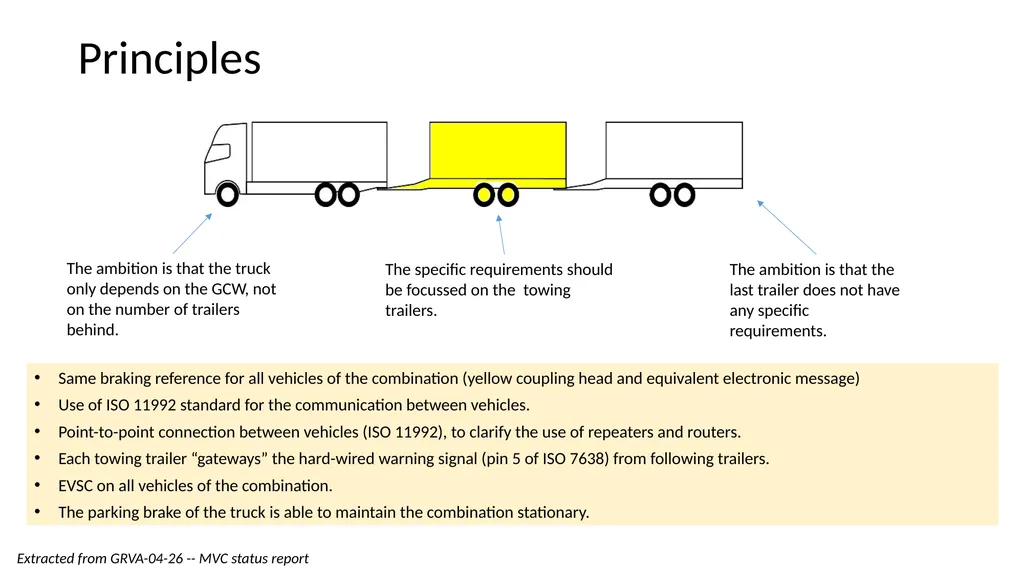
Principles The ambition is that the truck only depends on the GCW, not on the number of trailers behind. The ambition is that the last trailer does not have any specific requirements. The specific requirements should be focussed on the towing trailers. Same braking reference for all vehicles of the combination (yellow coupling head and equivalent electronic message)
Use of ISO 11992 standard for the communication between vehicles.
Point-to-point connection between vehicles (ISO 11992), to clarify the use of repeaters and routers.
Each towing trailer “gateways” the hard-wired warning signal (pin 5 of ISO 7638) from following trailers.
EVSC on all vehicles of the combination.
The parking brake of the truck is able to maintain the combination stationary. Extracted from GRVA-04-26 -- MVC status report<br>
Use of ISO 11992 standard for the communication between vehicles.
Point-to-point connection between vehicles (ISO 11992), to clarify the use of repeaters and routers.
Each towing trailer “gateways” the hard-wired warning signal (pin 5 of ISO 7638) from following trailers.
EVSC on all vehicles of the combination.
The parking brake of the truck is able to maintain the combination stationary. Extracted from GRVA-04-26 -- MVC status report<br>
09
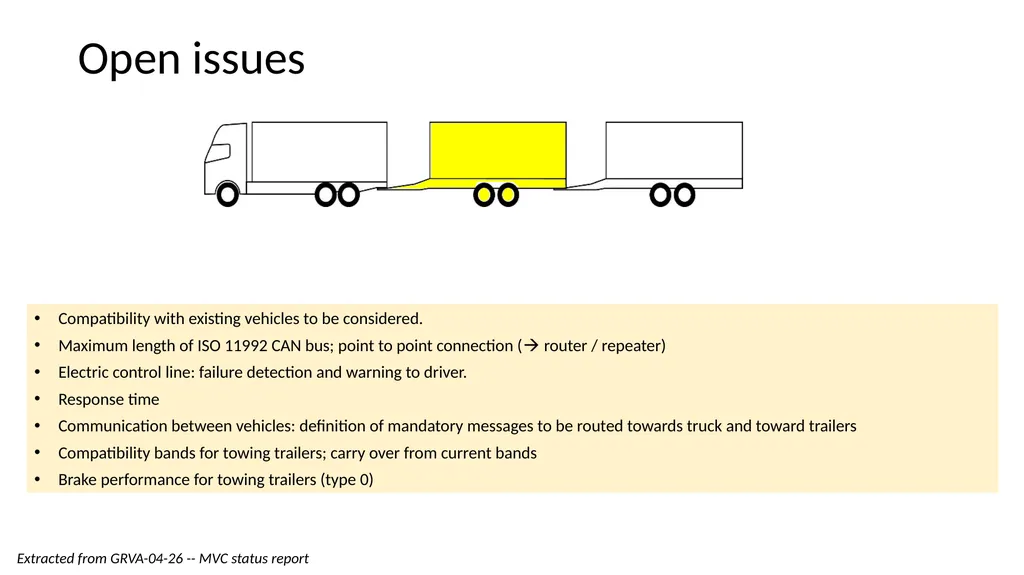
Open issues Compatibility with existing vehicles to be considered.
Maximum length of ISO 11992 CAN bus; point to point connection ( router / repeater)
Electric control line: failure detection and warning to driver.
Response time
Communication between vehicles: definition of mandatory messages to be routed towards truck and toward trailers
Compatibility bands for towing trailers; carry over from current bands
Brake performance for towing trailers (type 0) Extracted from GRVA-04-26 -- MVC status report<br>
Maximum length of ISO 11992 CAN bus; point to point connection ( router / repeater)
Electric control line: failure detection and warning to driver.
Response time
Communication between vehicles: definition of mandatory messages to be routed towards truck and toward trailers
Compatibility bands for towing trailers; carry over from current bands
Brake performance for towing trailers (type 0) Extracted from GRVA-04-26 -- MVC status report<br>
10
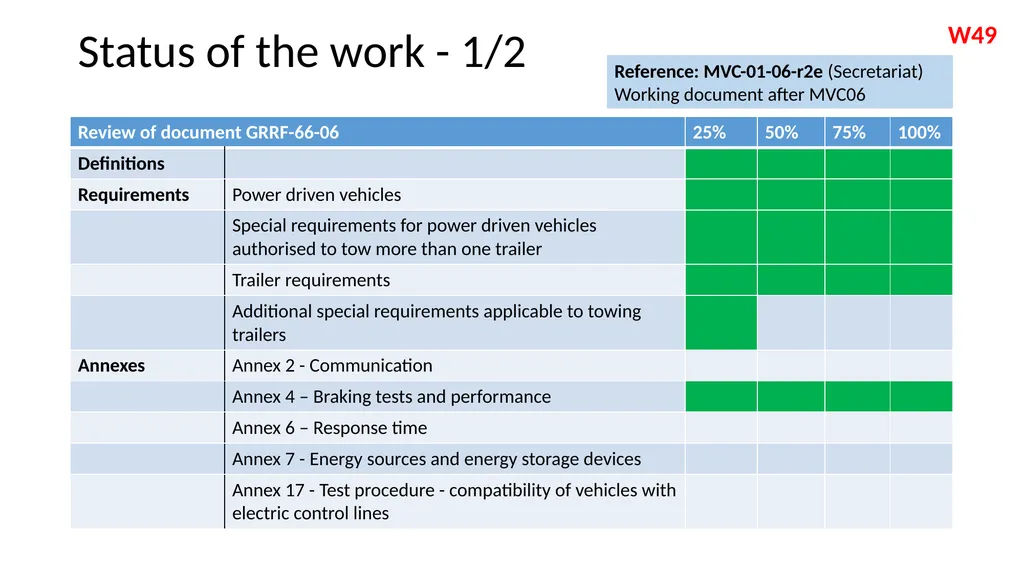
Status of the work - 1/2 Reference: MVC-01-06-r2e (Secretariat) Working document after MVC06 W49<br>
11
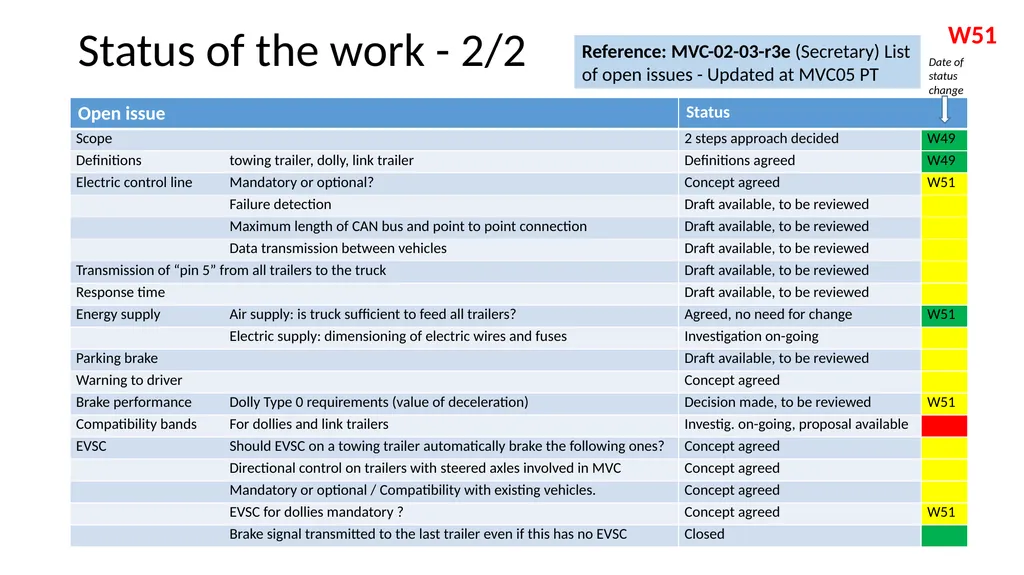
Status of the work - 2/2 Reference: MVC-02-03-r3e (Secretary) List of open issues - Updated at MVC05 PT W51 Date of status change<br>
12
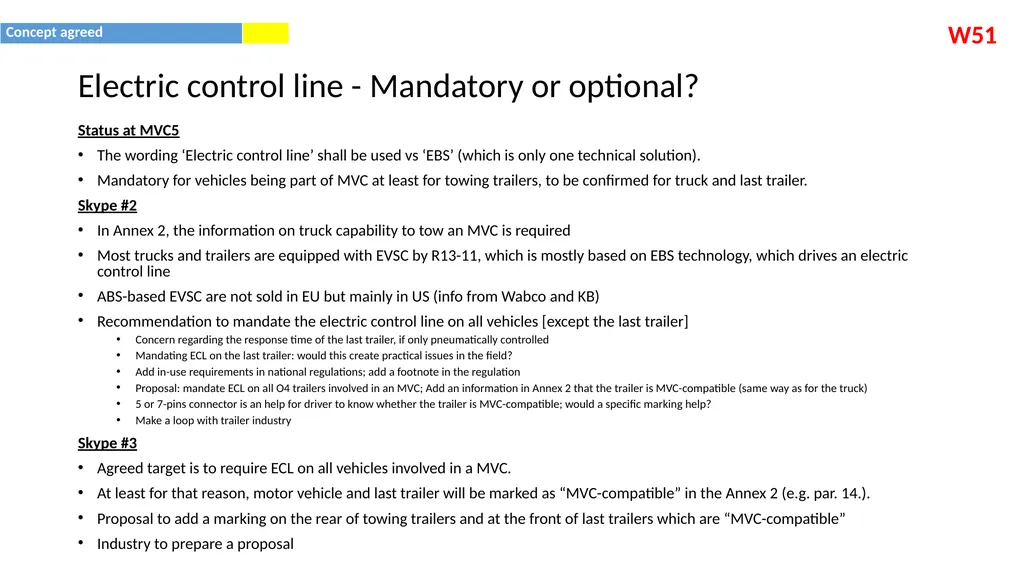
W51 Electric control line - Mandatory or optional? Status at MVC5
The wording ‘Electric control line’ shall be used vs ‘EBS’ (which is only one technical solution).
Mandatory for vehicles being part of MVC at least for towing trailers, to be confirmed for truck and last trailer.
Skype #2
In Annex 2, the information on truck capability to tow an MVC is required
Most trucks and trailers are equipped with EVSC by R13-11, which is mostly based on EBS technology, which drives an electric control line
ABS-based EVSC are not sold in EU but mainly in US (info from Wabco and KB)
Recommendation to mandate the electric control line on all vehicles [except the last trailer]
Concern regarding the response time of the last trailer, if only pneumatically controlled
Mandating ECL on the last trailer: would this create practical issues in the field?
Add in-use requirements in national regulations; add a footnote in the regulation
Proposal: mandate ECL on all O4 trailers involved in an MVC; Add an information in Annex 2 that the trailer is MVC-compatible (same way as for the truck)
5 or 7-pins connector is an help for driver to know whether the trailer is MVC-compatible; would a specific marking help?
Make a loop with trailer industry
Skype #3
Agreed target is to require ECL on all vehicles involved in a MVC.
At least for that reason, motor vehicle and last trailer will be marked as “MVC-compatible” in the Annex 2 (e.g. par. 14.).
Proposal to add a marking on the rear of towing trailers and at the front of last trailers which are “MVC-compatible”
Industry to prepare a proposal<br>
The wording ‘Electric control line’ shall be used vs ‘EBS’ (which is only one technical solution).
Mandatory for vehicles being part of MVC at least for towing trailers, to be confirmed for truck and last trailer.
Skype #2
In Annex 2, the information on truck capability to tow an MVC is required
Most trucks and trailers are equipped with EVSC by R13-11, which is mostly based on EBS technology, which drives an electric control line
ABS-based EVSC are not sold in EU but mainly in US (info from Wabco and KB)
Recommendation to mandate the electric control line on all vehicles [except the last trailer]
Concern regarding the response time of the last trailer, if only pneumatically controlled
Mandating ECL on the last trailer: would this create practical issues in the field?
Add in-use requirements in national regulations; add a footnote in the regulation
Proposal: mandate ECL on all O4 trailers involved in an MVC; Add an information in Annex 2 that the trailer is MVC-compatible (same way as for the truck)
5 or 7-pins connector is an help for driver to know whether the trailer is MVC-compatible; would a specific marking help?
Make a loop with trailer industry
Skype #3
Agreed target is to require ECL on all vehicles involved in a MVC.
At least for that reason, motor vehicle and last trailer will be marked as “MVC-compatible” in the Annex 2 (e.g. par. 14.).
Proposal to add a marking on the rear of towing trailers and at the front of last trailers which are “MVC-compatible”
Industry to prepare a proposal<br>
13
W50 Electric control line - Failure detection Balance between Failure detection and in-use requirements
Skype #2
CLEPA will prepare a short presentation on how failure handling is done, over the combination<br>
Skype #2
CLEPA will prepare a short presentation on how failure handling is done, over the combination<br>
14
W51 Maximum length of CAN bus and point to point connection Status at MVC6
MVC-06-xx - Indusrty input about Electric control line - v2.pptx
MVC-06-02 (CLEPA) Installation of router and repeater.docx
Revised-Proposal to amend ECE R 13 to introduce the installation of router and repeater.docx
Skype #2
DK mentions about special transport, where very long trailers are used, justifying the use of a repeater function
Next steps:
All to review CLEPA proposal as reviewed at MVC-06 for next Skype meeting
Insert the proposal in the working document
Skype #3
Proposal was reviewed, CLEPA to draft a text for “pin 5 routing” and clean up the proposed text.<br>
MVC-06-xx - Indusrty input about Electric control line - v2.pptx
MVC-06-02 (CLEPA) Installation of router and repeater.docx
Revised-Proposal to amend ECE R 13 to introduce the installation of router and repeater.docx
Skype #2
DK mentions about special transport, where very long trailers are used, justifying the use of a repeater function
Next steps:
All to review CLEPA proposal as reviewed at MVC-06 for next Skype meeting
Insert the proposal in the working document
Skype #3
Proposal was reviewed, CLEPA to draft a text for “pin 5 routing” and clean up the proposed text.<br>
15
W50 Data transmission between vehicles Status at MVC5
Technical principle: Point to point ISO 11992 connection between two successive vehicles in the combination.
Prescribing a router should be avoided, this is a technical solution. The requirement should be a functional one, open to any technical design
Christoph Adam will lead a small group to:
Confirm the technical approach above
Check/define what messages shall be transmitted forward and backward along the combination
Skype #2
Routing function is referred in the CLEPA proposal (and not router)
ISO 11992 is the base for the proposal
CLEPA will prepare a short presentation of the different messages between vehicles (which one are mandatory, optional, must be supported by truck if available etc.)
NW: EU directive about on-board weighting function (DG MOVE); add this item in the parking list for step 2 for further investigation<br>
Technical principle: Point to point ISO 11992 connection between two successive vehicles in the combination.
Prescribing a router should be avoided, this is a technical solution. The requirement should be a functional one, open to any technical design
Christoph Adam will lead a small group to:
Confirm the technical approach above
Check/define what messages shall be transmitted forward and backward along the combination
Skype #2
Routing function is referred in the CLEPA proposal (and not router)
ISO 11992 is the base for the proposal
CLEPA will prepare a short presentation of the different messages between vehicles (which one are mandatory, optional, must be supported by truck if available etc.)
NW: EU directive about on-board weighting function (DG MOVE); add this item in the parking list for step 2 for further investigation<br>
16
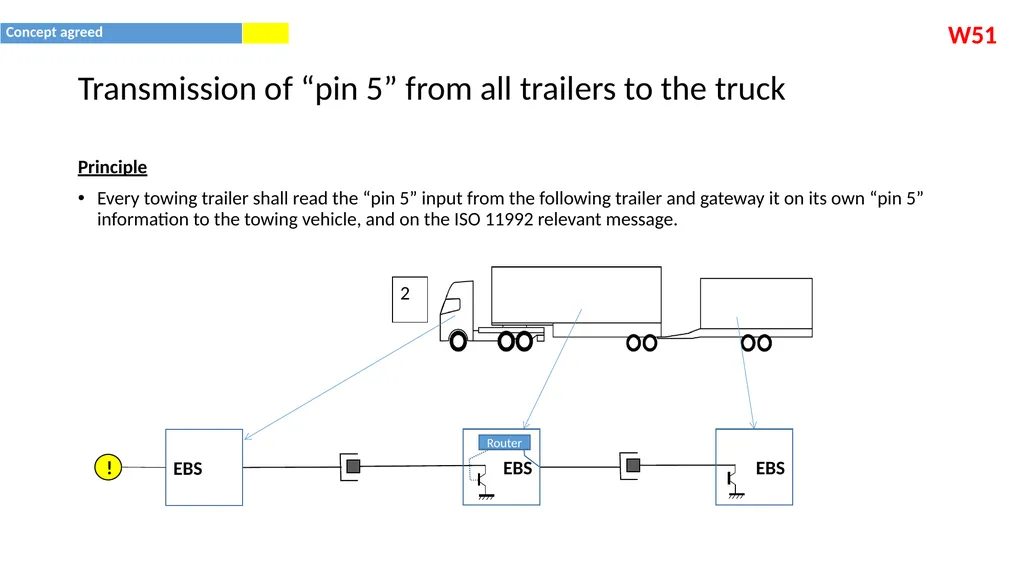
W51 Transmission of “pin 5” from all trailers to the truck Principle
Every towing trailer shall read the “pin 5” input from the following trailer and gateway it on its own “pin 5” information to the towing vehicle, and on the ISO 11992 relevant message. EBS EBS EBS ! Router<br>
Every towing trailer shall read the “pin 5” input from the following trailer and gateway it on its own “pin 5” information to the towing vehicle, and on the ISO 11992 relevant message. EBS EBS EBS ! Router<br>
17
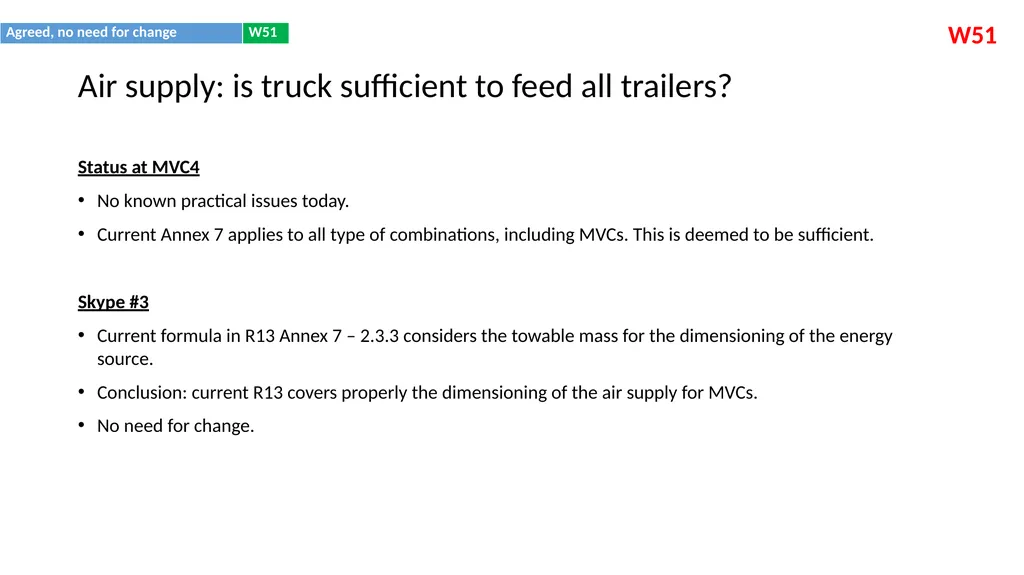
W51 Air supply: is truck sufficient to feed all trailers? Status at MVC4
No known practical issues today.
Current Annex 7 applies to all type of combinations, including MVCs. This is deemed to be sufficient.
Skype #3
Current formula in R13 Annex 7 – 2.3.3 considers the towable mass for the dimensioning of the energy source.
Conclusion: current R13 covers properly the dimensioning of the air supply for MVCs.
No need for change.<br>
No known practical issues today.
Current Annex 7 applies to all type of combinations, including MVCs. This is deemed to be sufficient.
Skype #3
Current formula in R13 Annex 7 – 2.3.3 considers the towable mass for the dimensioning of the energy source.
Conclusion: current R13 covers properly the dimensioning of the air supply for MVCs.
No need for change.<br>
18
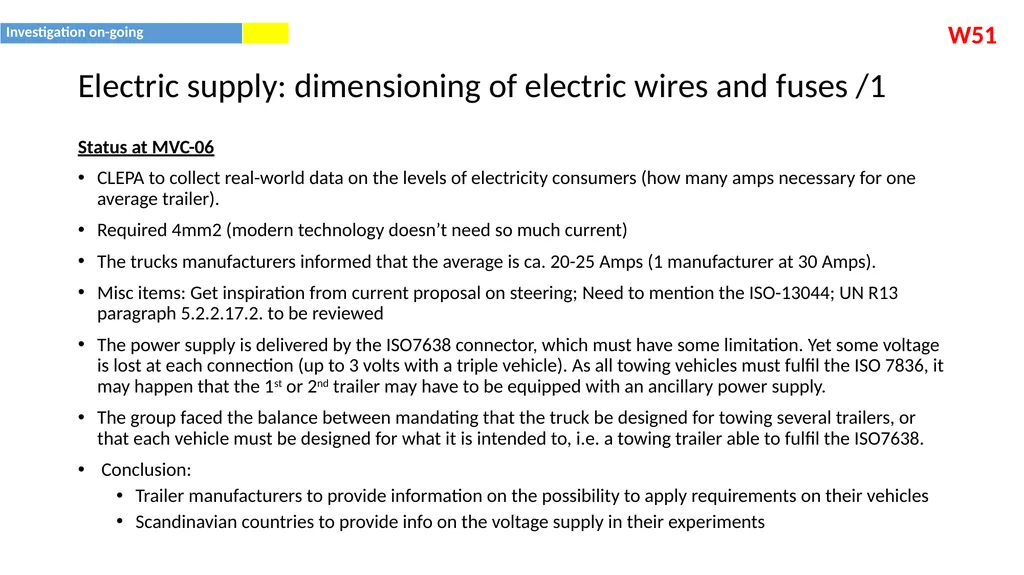
W51 Electric supply: dimensioning of electric wires and fuses /1 Status at MVC-06
CLEPA to collect real-world data on the levels of electricity consumers (how many amps necessary for one average trailer).
Required 4mm2 (modern technology doesn’t need so much current)
The trucks manufacturers informed that the average is ca. 20-25 Amps (1 manufacturer at 30 Amps).
Misc items: Get inspiration from current proposal on steering; Need to mention the ISO-13044; UN R13 paragraph 5.2.2.17.2. to be reviewed
The power supply is delivered by the ISO7638 connector, which must have some limitation. Yet some voltage is lost at each connection (up to 3 volts with a triple vehicle). As all towing vehicles must fulfil the ISO 7836, it may happen that the 1st or 2nd trailer may have to be equipped with an ancillary power supply.
The group faced the balance between mandating that the truck be designed for towing several trailers, or that each vehicle must be designed for what it is intended to, i.e. a towing trailer able to fulfil the ISO7638.
Conclusion:
Trailer manufacturers to provide information on the possibility to apply requirements on their vehicles
Scandinavian countries to provide info on the voltage supply in their experiments<br>
CLEPA to collect real-world data on the levels of electricity consumers (how many amps necessary for one average trailer).
Required 4mm2 (modern technology doesn’t need so much current)
The trucks manufacturers informed that the average is ca. 20-25 Amps (1 manufacturer at 30 Amps).
Misc items: Get inspiration from current proposal on steering; Need to mention the ISO-13044; UN R13 paragraph 5.2.2.17.2. to be reviewed
The power supply is delivered by the ISO7638 connector, which must have some limitation. Yet some voltage is lost at each connection (up to 3 volts with a triple vehicle). As all towing vehicles must fulfil the ISO 7836, it may happen that the 1st or 2nd trailer may have to be equipped with an ancillary power supply.
The group faced the balance between mandating that the truck be designed for towing several trailers, or that each vehicle must be designed for what it is intended to, i.e. a towing trailer able to fulfil the ISO7638.
Conclusion:
Trailer manufacturers to provide information on the possibility to apply requirements on their vehicles
Scandinavian countries to provide info on the voltage supply in their experiments<br>
19
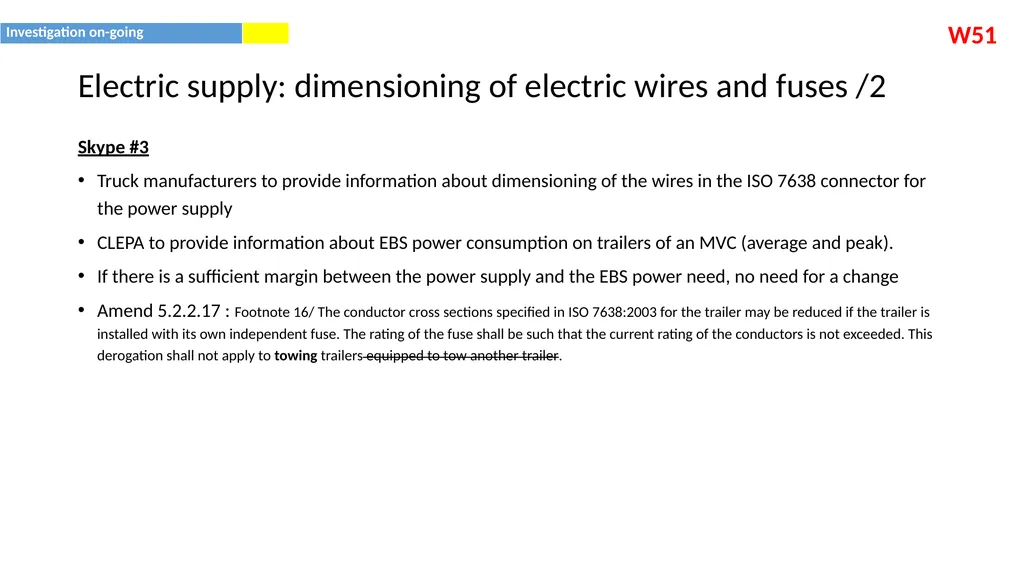
W51 Electric supply: dimensioning of electric wires and fuses /2 Skype #3
Truck manufacturers to provide information about dimensioning of the wires in the ISO 7638 connector for the power supply
CLEPA to provide information about EBS power consumption on trailers of an MVC (average and peak).
If there is a sufficient margin between the power supply and the EBS power need, no need for a change
Amend 5.2.2.17 : Footnote 16/ The conductor cross sections specified in ISO 7638:2003 for the trailer may be reduced if the trailer is installed with its own independent fuse. The rating of the fuse shall be such that the current rating of the conductors is not exceeded. This derogation shall not apply to towing trailers equipped to tow another trailer.<br>
Truck manufacturers to provide information about dimensioning of the wires in the ISO 7638 connector for the power supply
CLEPA to provide information about EBS power consumption on trailers of an MVC (average and peak).
If there is a sufficient margin between the power supply and the EBS power need, no need for a change
Amend 5.2.2.17 : Footnote 16/ The conductor cross sections specified in ISO 7638:2003 for the trailer may be reduced if the trailer is installed with its own independent fuse. The rating of the fuse shall be such that the current rating of the conductors is not exceeded. This derogation shall not apply to towing trailers equipped to tow another trailer.<br>
20
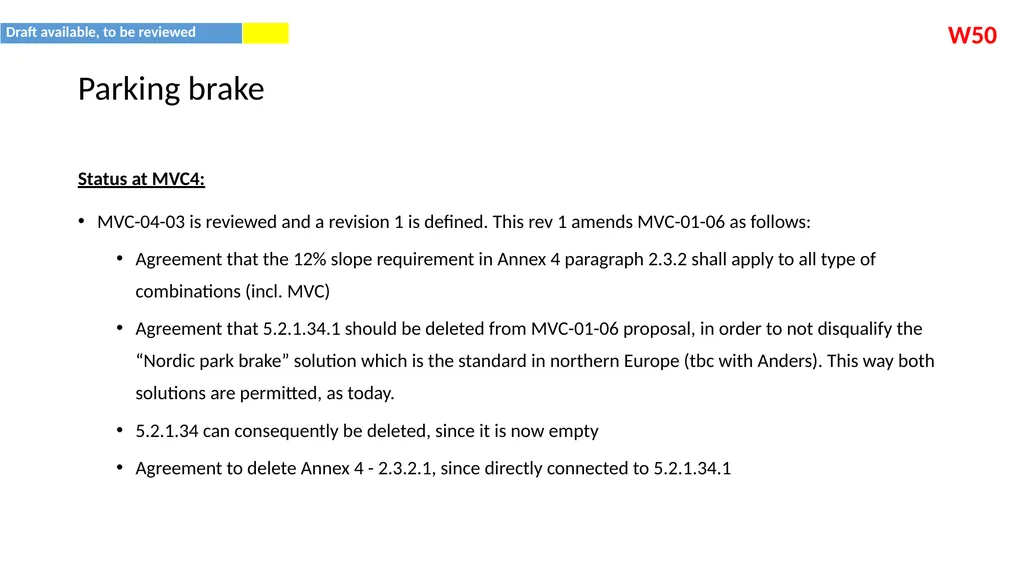
W50 Parking brake Status at MVC4:
MVC-04-03 is reviewed and a revision 1 is defined. This rev 1 amends MVC-01-06 as follows:
Agreement that the 12% slope requirement in Annex 4 paragraph 2.3.2 shall apply to all type of combinations (incl. MVC)
Agreement that 5.2.1.34.1 should be deleted from MVC-01-06 proposal, in order to not disqualify the “Nordic park brake” solution which is the standard in northern Europe (tbc with Anders). This way both solutions are permitted, as today.
5.2.1.34 can consequently be deleted, since it is now empty
Agreement to delete Annex 4 - 2.3.2.1, since directly connected to 5.2.1.34.1<br>
MVC-04-03 is reviewed and a revision 1 is defined. This rev 1 amends MVC-01-06 as follows:
Agreement that the 12% slope requirement in Annex 4 paragraph 2.3.2 shall apply to all type of combinations (incl. MVC)
Agreement that 5.2.1.34.1 should be deleted from MVC-01-06 proposal, in order to not disqualify the “Nordic park brake” solution which is the standard in northern Europe (tbc with Anders). This way both solutions are permitted, as today.
5.2.1.34 can consequently be deleted, since it is now empty
Agreement to delete Annex 4 - 2.3.2.1, since directly connected to 5.2.1.34.1<br>
21
W51 Warning to driver Status at MVC4
Driver only needs to know that one trailer is intervening (EVSC) and that one trailer is failing; no need to know which trailer (this is a diagnostic matter for workshops)
ISO 11992 protocol as required in MVC-01-06 permits the motor vehicle to know which trailer fails. However this information is confirmed not necessary for the driver.
Skype #2
The information on which trailer fails is anyway available on the ISO 11992
The question is rather what should be displayed to the driver, for the sake of safety
For in-use, it is a demand from the drivers to know which trailer fails, but does it have to be regulated?
For EVSC information, we confirm no need to differentiate between different trailers
Conclusion:
From a safety standpoint: driver only needs to know that one trailer is intervening (EVSC) and that one trailer is failing; no need to know which trailer (this is a diagnostic matter for workshops)
The information on which trailer fails will anyway be practically available from the ISO 11992 implementation
Open question on which version of ISO 11992 should be used for MVCs; and whether R13 should be updated; CLEPA confirms ISO 11992-2:2003 already includes multiple trailers; should the reference in R13 be replaced by version from 2014? CLEPA and OICA to confirm
Skype #3
CLEPA confirms the current reference to ISO 11992-2003 in R13 is compatible and sufficient for MVCs.<br>
Driver only needs to know that one trailer is intervening (EVSC) and that one trailer is failing; no need to know which trailer (this is a diagnostic matter for workshops)
ISO 11992 protocol as required in MVC-01-06 permits the motor vehicle to know which trailer fails. However this information is confirmed not necessary for the driver.
Skype #2
The information on which trailer fails is anyway available on the ISO 11992
The question is rather what should be displayed to the driver, for the sake of safety
For in-use, it is a demand from the drivers to know which trailer fails, but does it have to be regulated?
For EVSC information, we confirm no need to differentiate between different trailers
Conclusion:
From a safety standpoint: driver only needs to know that one trailer is intervening (EVSC) and that one trailer is failing; no need to know which trailer (this is a diagnostic matter for workshops)
The information on which trailer fails will anyway be practically available from the ISO 11992 implementation
Open question on which version of ISO 11992 should be used for MVCs; and whether R13 should be updated; CLEPA confirms ISO 11992-2:2003 already includes multiple trailers; should the reference in R13 be replaced by version from 2014? CLEPA and OICA to confirm
Skype #3
CLEPA confirms the current reference to ISO 11992-2003 in R13 is compatible and sufficient for MVCs.<br>
22
W51 Dolly Type 0 requirements (value of deceleration) Status at MVC-06
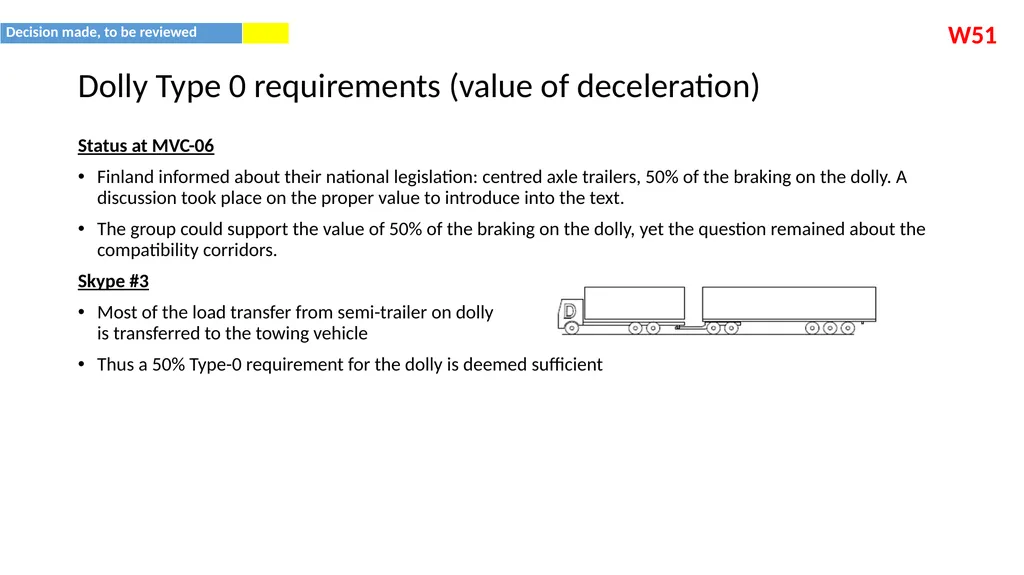
Finland informed about their national legislation: centred axle trailers, 50% of the braking on the dolly. A discussion took place on the proper value to introduce into the text.
The group could support the value of 50% of the braking on the dolly, yet the question remained about the compatibility corridors.
Skype #3
Most of the load transfer from semi-trailer on dolly is transferred to the towing vehicle
Thus a 50% Type-0 requirement for the dolly is deemed sufficient<br>
Finland informed about their national legislation: centred axle trailers, 50% of the braking on the dolly. A discussion took place on the proper value to introduce into the text.
The group could support the value of 50% of the braking on the dolly, yet the question remained about the compatibility corridors.
Skype #3
Most of the load transfer from semi-trailer on dolly is transferred to the towing vehicle
Thus a 50% Type-0 requirement for the dolly is deemed sufficient<br>
23
W51 Compatibility bands For dollies and link trailers Skype meeting #1
Agreement to have a pragmatic approach (Supported by SWE, FIN, NW and other industry experts)
Start from the state of the art to draft the requirements
Get experience and make a review of the regulation after [2 years]
Sten provides information about State of the art in Sweden (which seem to be confirmed by Finland and Norway):
Dolly calculated at CAT
B-Link calculated as a semi-trailer
Bolennarth will provide some theoretical input based on Eindhoven university study
Skype #2
Bolennarth presented some technical input (file: Comments concerning load transfer for dollies.docx)
CLEPA will prepare some examples of calculations
This item should be dealt during our live meeting MVC-7 in January
Skype #3
Pierre presented calculations based on Eidhoven university simulations (calculations - draft 1.1.xlsx)
These simulations shows that most of the load transfer from semi-trailer on dolly is transferred to the towing vehicle, which supports the view that a dolly can be considered as a CAT.
However, the group should assess whether these conclusions can be used for other dolly geometry (e.g. 3 axles dollies).
For the meeting in Paris:
Bolennarth will prepare some input, based for example on a New Zealand standard.
Geir will also prepare some practical examples of 25,25m dolly combination in Norway.<br>
Agreement to have a pragmatic approach (Supported by SWE, FIN, NW and other industry experts)
Start from the state of the art to draft the requirements
Get experience and make a review of the regulation after [2 years]
Sten provides information about State of the art in Sweden (which seem to be confirmed by Finland and Norway):
Dolly calculated at CAT
B-Link calculated as a semi-trailer
Bolennarth will provide some theoretical input based on Eindhoven university study
Skype #2
Bolennarth presented some technical input (file: Comments concerning load transfer for dollies.docx)
CLEPA will prepare some examples of calculations
This item should be dealt during our live meeting MVC-7 in January
Skype #3
Pierre presented calculations based on Eidhoven university simulations (calculations - draft 1.1.xlsx)
These simulations shows that most of the load transfer from semi-trailer on dolly is transferred to the towing vehicle, which supports the view that a dolly can be considered as a CAT.
However, the group should assess whether these conclusions can be used for other dolly geometry (e.g. 3 axles dollies).
For the meeting in Paris:
Bolennarth will prepare some input, based for example on a New Zealand standard.
Geir will also prepare some practical examples of 25,25m dolly combination in Norway.<br>
24
W51 Should EVSC on a towing trailer automatically brake the following ones? Status at MVC4
In case of EVSC intervention on a towing trailer, should trailer behind be automatically braked (via pneumatic and electric control)?
EVSC intervention on a towing trailer shall activate brakes of following trailers, e.g. to prevent creating jacknifing situations.
Technical impact and feasibility on trailers to be documented system manufacturers
Skype #3
Positive answer is confirmed.
EVSC intervention on a towing trailer shall activate brakes of following trailers, both via the pneumatic and the electric control line, e.g. to prevent creating jacknifing situations and to improve stability by stretching the combination.
Current text proposal is already implementing this technical measure.<br>
In case of EVSC intervention on a towing trailer, should trailer behind be automatically braked (via pneumatic and electric control)?
EVSC intervention on a towing trailer shall activate brakes of following trailers, e.g. to prevent creating jacknifing situations.
Technical impact and feasibility on trailers to be documented system manufacturers
Skype #3
Positive answer is confirmed.
EVSC intervention on a towing trailer shall activate brakes of following trailers, both via the pneumatic and the electric control line, e.g. to prevent creating jacknifing situations and to improve stability by stretching the combination.
Current text proposal is already implementing this technical measure.<br>
25
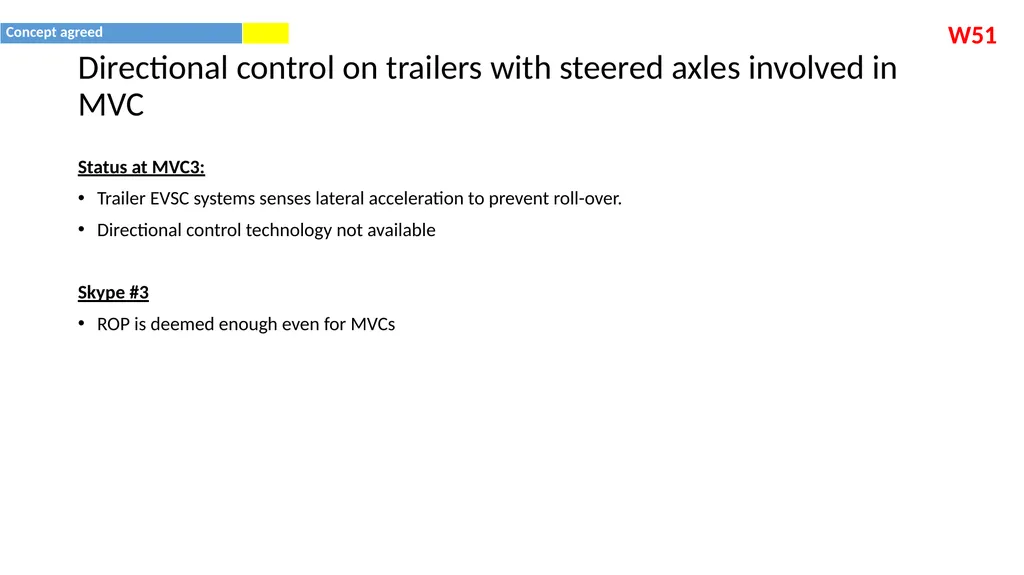
W51 Directional control on trailers with steered axles involved in MVC Status at MVC3:
Trailer EVSC systems senses lateral acceleration to prevent roll-over.
Directional control technology not available
Skype #3
ROP is deemed enough even for MVCs<br>
Trailer EVSC systems senses lateral acceleration to prevent roll-over.
Directional control technology not available
Skype #3
ROP is deemed enough even for MVCs<br>
26
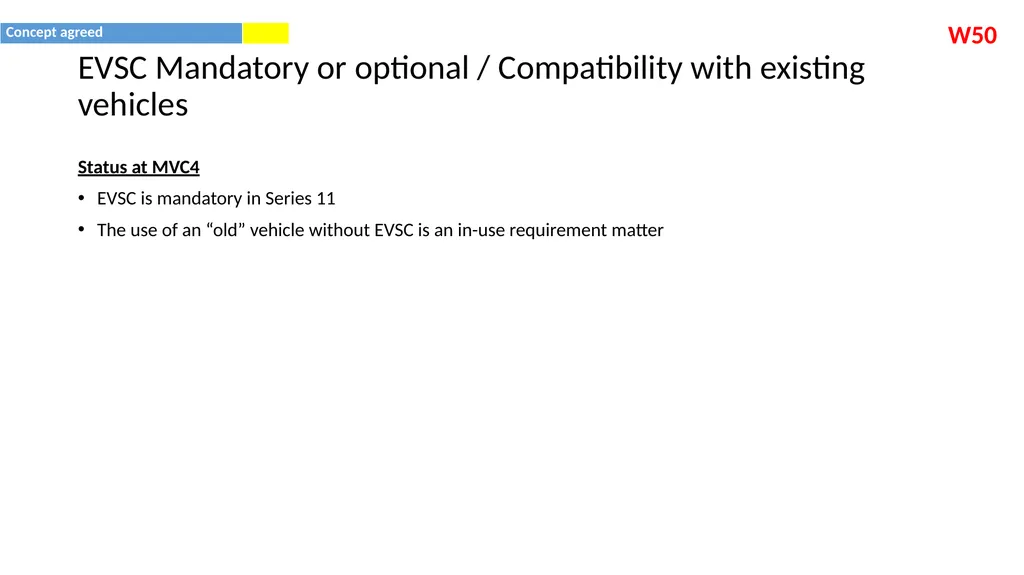
W50 EVSC Mandatory or optional / Compatibility with existing vehicles Status at MVC4
EVSC is mandatory in Series 11
The use of an “old” vehicle without EVSC is an in-use requirement matter<br>
EVSC is mandatory in Series 11
The use of an “old” vehicle without EVSC is an in-use requirement matter<br>
27
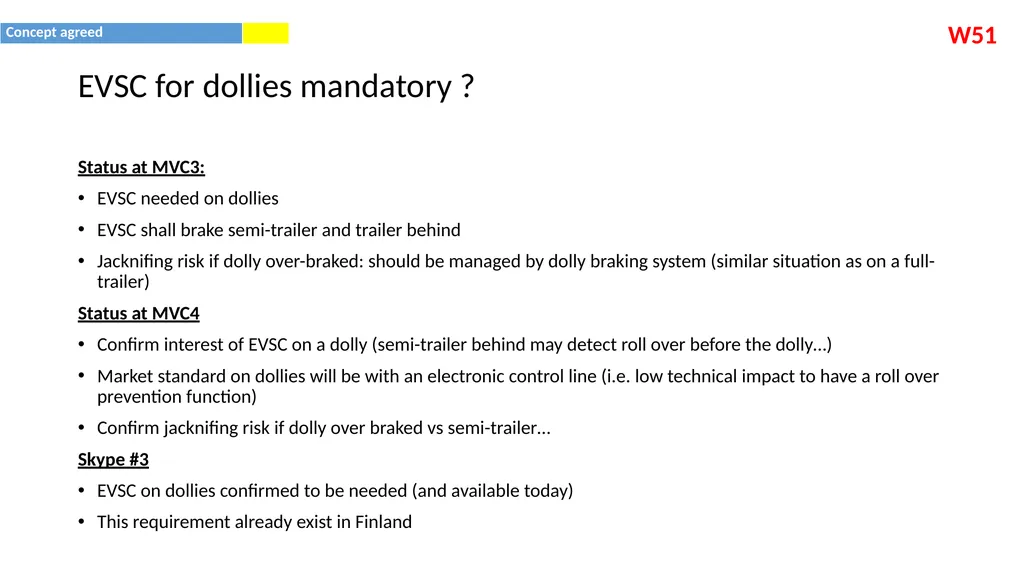
W51 EVSC for dollies mandatory ? Status at MVC3:
EVSC needed on dollies
EVSC shall brake semi-trailer and trailer behind
Jacknifing risk if dolly over-braked: should be managed by dolly braking system (similar situation as on a full-trailer)
Status at MVC4
Confirm interest of EVSC on a dolly (semi-trailer behind may detect roll over before the dolly…)
Market standard on dollies will be with an electronic control line (i.e. low technical impact to have a roll over prevention function)
Confirm jacknifing risk if dolly over braked vs semi-trailer…
Skype #3
EVSC on dollies confirmed to be needed (and available today)
This requirement already exist in Finland<br>
EVSC needed on dollies
EVSC shall brake semi-trailer and trailer behind
Jacknifing risk if dolly over-braked: should be managed by dolly braking system (similar situation as on a full-trailer)
Status at MVC4
Confirm interest of EVSC on a dolly (semi-trailer behind may detect roll over before the dolly…)
Market standard on dollies will be with an electronic control line (i.e. low technical impact to have a roll over prevention function)
Confirm jacknifing risk if dolly over braked vs semi-trailer…
Skype #3
EVSC on dollies confirmed to be needed (and available today)
This requirement already exist in Finland<br>
28
W50 EVSC - Brake signal transmitted to the last trailer even if it has no EVSC Status at MVC5
Yes, braking signal generated ahead is transmitted to the last trailer.<br>
Yes, braking signal generated ahead is transmitted to the last trailer.<br>