
Module 1 Introduction to maternal and neonatal
LV
Published · 38 slides · 0 views

1 / 1








Description
Module 1 Introduction to maternal and neonatal infections and to infection prevention and control Learning objectives On completion of this session the participant should be able to: define a health care-associated infection (HAI) and
Related Topics
Share
Embed code
Download this presentation From Below
"Module 1 Introduction to maternal and neonatal" is the property of its rightful owner. Permission is granted to download and print the materials on this website for personal, non-commercial use only, and to display it on your personal computer provided you do not modify the materials and that you retain all copyright notices contained in the materials. By downloading content from our website, you accept the terms of this agreement.
Presentation Transcript
01
Module 1 Introduction to maternal and neonatal infections and to infection prevention and control<br>
02
Learning objectives On completion of this session the participant should be able to:
define a “health care-associated infection” (HAI) and describe the global burden of HAIs and the epidemiology of maternal and neonatal infection/sepsis
describe why infection prevention and control (IPC) is important in health care and in particular for maternal and neonatal care
describe the chain of transmission and how IPC precautions can break it
list the key preventive strategies<br>
define a “health care-associated infection” (HAI) and describe the global burden of HAIs and the epidemiology of maternal and neonatal infection/sepsis
describe why infection prevention and control (IPC) is important in health care and in particular for maternal and neonatal care
describe the chain of transmission and how IPC precautions can break it
list the key preventive strategies<br>
03
Core competencies At the end of this session the participant should:
recognize the importance of HAIs and understand how this relates to the WHO quality of care standards in maternal and neonatal health
demonstrate the understanding of the key principles for the prevention of maternal and neonatal health according to risk assessment<br>
recognize the importance of HAIs and understand how this relates to the WHO quality of care standards in maternal and neonatal health
demonstrate the understanding of the key principles for the prevention of maternal and neonatal health according to risk assessment<br>
04
Epidemiology of maternal and neonatal infection/sepsis<br>
05
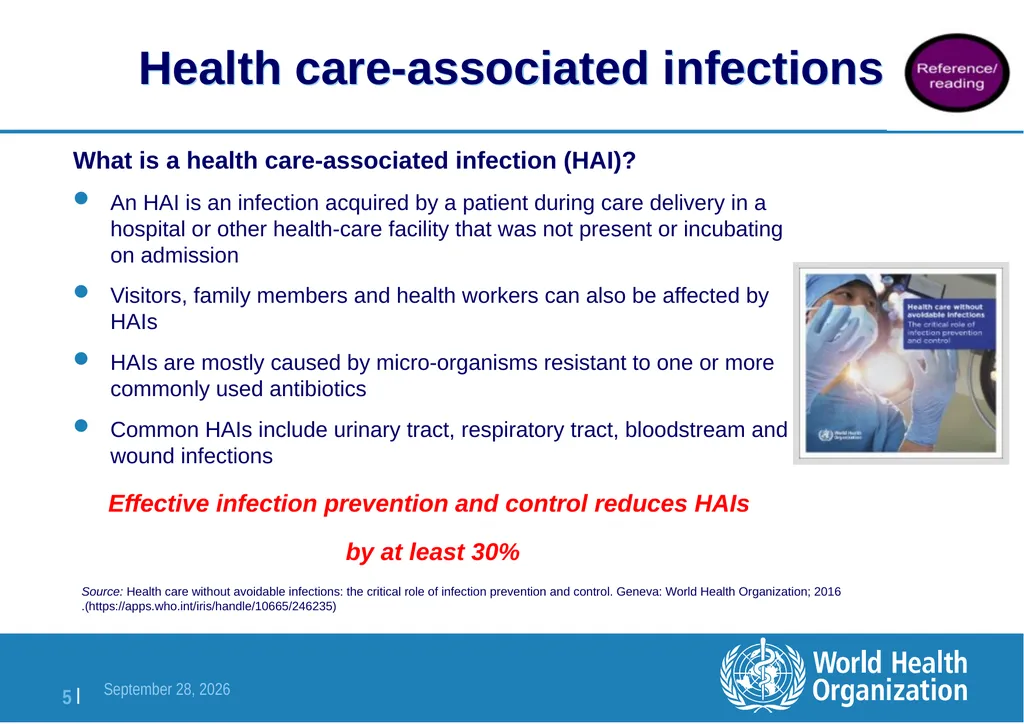
Health care-associated infections What is a health care-associated infection (HAI)?
An HAI is an infection acquired by a patient during care delivery in a hospital or other health-care facility that was not present or incubating on admission
Visitors, family members and health workers can also be affected by HAIs
HAIs are mostly caused by micro-organisms resistant to one or more commonly used antibiotics
Common HAIs include urinary tract, respiratory tract, bloodstream and wound infections
Effective infection prevention and control reduces HAIs
by at least 30% Source: Health care without avoidable infections: the critical role of infection prevention and control. Geneva: World Health Organization; 2016 (https://apps.who.int/iris/handle/10665/246235).<br>
An HAI is an infection acquired by a patient during care delivery in a hospital or other health-care facility that was not present or incubating on admission
Visitors, family members and health workers can also be affected by HAIs
HAIs are mostly caused by micro-organisms resistant to one or more commonly used antibiotics
Common HAIs include urinary tract, respiratory tract, bloodstream and wound infections
Effective infection prevention and control reduces HAIs
by at least 30% Source: Health care without avoidable infections: the critical role of infection prevention and control. Geneva: World Health Organization; 2016 (https://apps.who.int/iris/handle/10665/246235).<br>
06
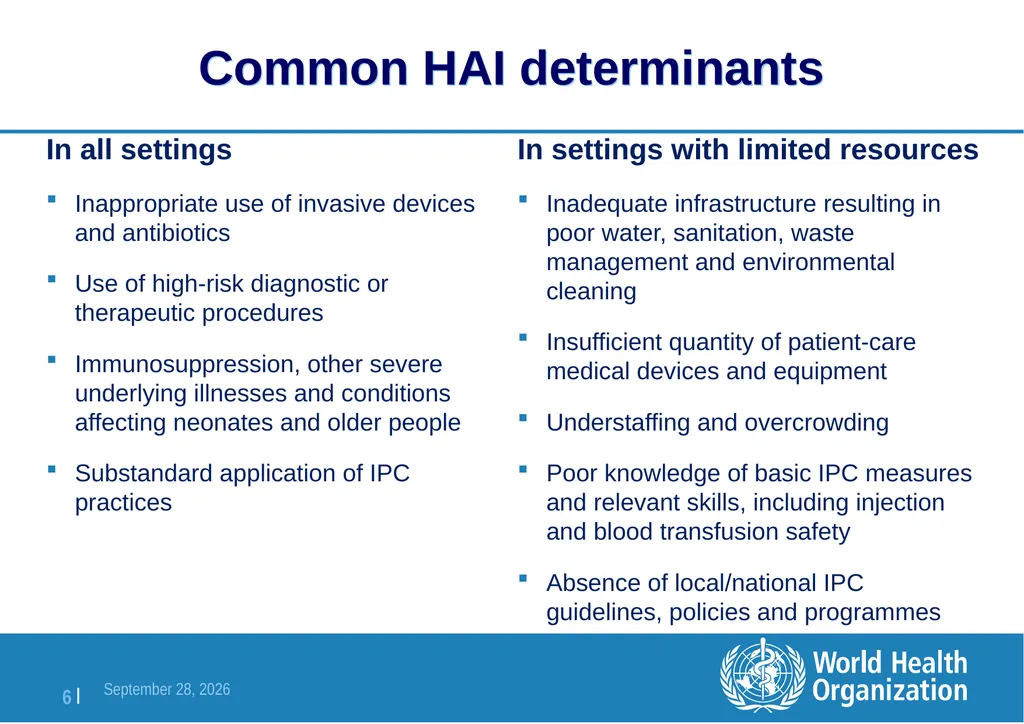
Common HAI determinants In all settings
Inappropriate use of invasive devices and antibiotics
Use of high-risk diagnostic or therapeutic procedures
Immunosuppression, other severe underlying illnesses and conditions affecting neonates and older people
Substandard application of IPC practices In settings with limited resources
Inadequate infrastructure resulting in poor water, sanitation, waste management and environmental cleaning
Insufficient quantity of patient-care medical devices and equipment
Understaffing and overcrowding
Poor knowledge of basic IPC measures and relevant skills, including injection and blood transfusion safety
Absence of local/national IPC guidelines, policies and programmes<br>
Inappropriate use of invasive devices and antibiotics
Use of high-risk diagnostic or therapeutic procedures
Immunosuppression, other severe underlying illnesses and conditions affecting neonates and older people
Substandard application of IPC practices In settings with limited resources
Inadequate infrastructure resulting in poor water, sanitation, waste management and environmental cleaning
Insufficient quantity of patient-care medical devices and equipment
Understaffing and overcrowding
Poor knowledge of basic IPC measures and relevant skills, including injection and blood transfusion safety
Absence of local/national IPC guidelines, policies and programmes<br>
07
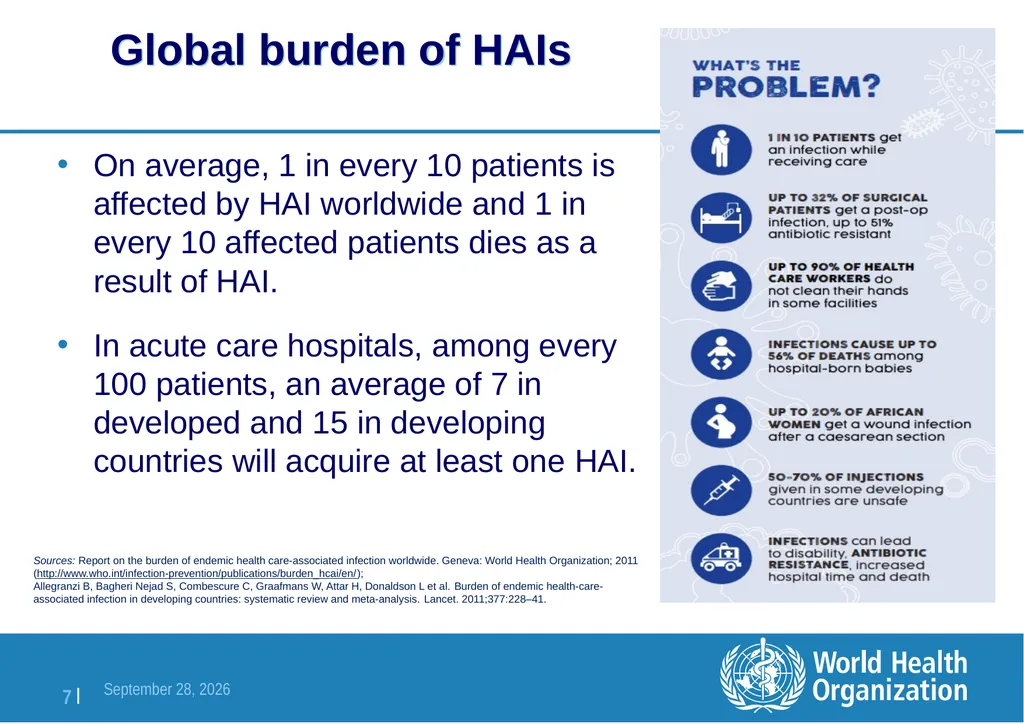
On average, 1 in every 10 patients is affected by HAI worldwide and 1 in every 10 affected patients dies as a result of HAI.
In acute care hospitals, among every 100 patients, an average of 7 in developed and 15 in developing countries will acquire at least one HAI. Sources: Report on the burden of endemic health care-associated infection worldwide. Geneva: World Health Organization; 2011 (http://www.who.int/infection-prevention/publications/burden_hcai/en/);
Allegranzi B, Bagheri Nejad S, Combescure C, Graafmans W, Attar H, Donaldson L et al. Burden of endemic health-care-associated infection in developing countries: systematic review and meta-analysis. Lancet. 2011;377:228–41. Global burden of HAIs<br>
In acute care hospitals, among every 100 patients, an average of 7 in developed and 15 in developing countries will acquire at least one HAI. Sources: Report on the burden of endemic health care-associated infection worldwide. Geneva: World Health Organization; 2011 (http://www.who.int/infection-prevention/publications/burden_hcai/en/);
Allegranzi B, Bagheri Nejad S, Combescure C, Graafmans W, Attar H, Donaldson L et al. Burden of endemic health-care-associated infection in developing countries: systematic review and meta-analysis. Lancet. 2011;377:228–41. Global burden of HAIs<br>
08
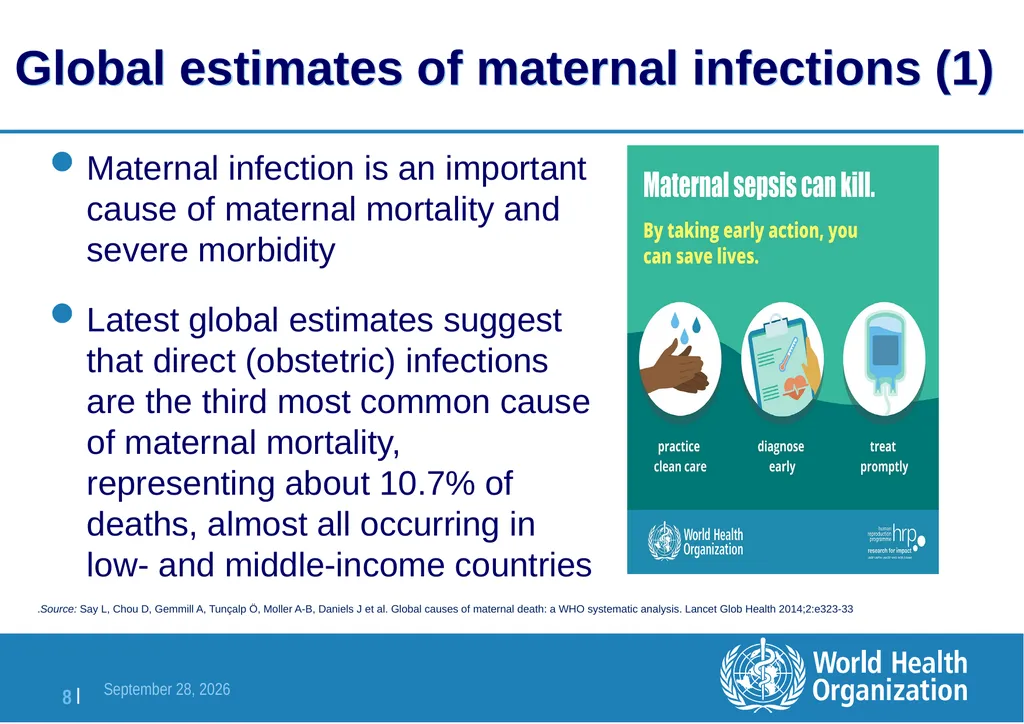
Global estimates of maternal infections (1) Maternal infection is an important cause of maternal mortality and severe morbidity
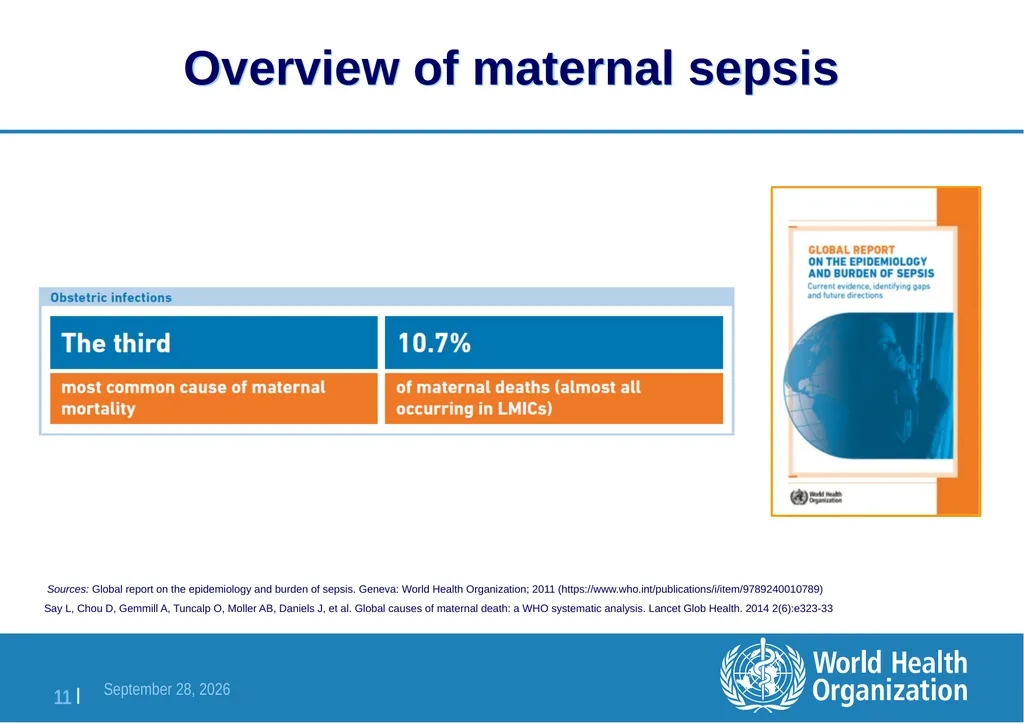
Latest global estimates suggest that direct (obstetric) infections are the third most common cause of maternal mortality, representing about 10.7% of deaths, almost all occurring in low- and middle-income countries Source: Say L, Chou D, Gemmill A, Tunçalp Ö, Moller A-B, Daniels J et al. Global causes of maternal death: a WHO systematic analysis. Lancet Glob Health 2014;2:e323-33.<br>
Latest global estimates suggest that direct (obstetric) infections are the third most common cause of maternal mortality, representing about 10.7% of deaths, almost all occurring in low- and middle-income countries Source: Say L, Chou D, Gemmill A, Tunçalp Ö, Moller A-B, Daniels J et al. Global causes of maternal death: a WHO systematic analysis. Lancet Glob Health 2014;2:e323-33.<br>
09
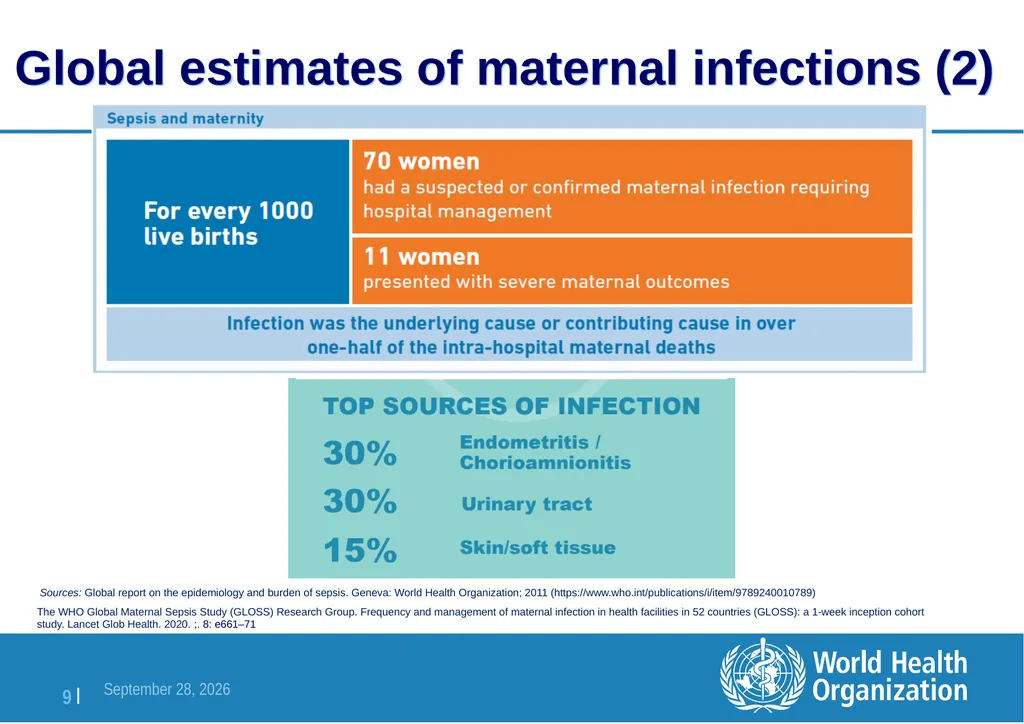
Sources: Global report on the epidemiology and burden of sepsis. Geneva: World Health Organization; 2011 (https://www.who.int/publications/i/item/9789240010789)
The WHO Global Maternal Sepsis Study (GLOSS) Research Group. Frequency and management of maternal infection in health facilities in 52 countries (GLOSS): a 1-week inception cohort study. Lancet Glob Health. 2020. ;. 8: e661–71 Global estimates of maternal infections (2)<br>
The WHO Global Maternal Sepsis Study (GLOSS) Research Group. Frequency and management of maternal infection in health facilities in 52 countries (GLOSS): a 1-week inception cohort study. Lancet Glob Health. 2020. ;. 8: e661–71 Global estimates of maternal infections (2)<br>
10
Regional disparities in intrahospital maternal infection Sources: Global report on the epidemiology and burden of sepsis. Geneva: World Health Organization; 2011 (https://www.who.int/publications/i/item/9789240010789)
Bonet M, Souza JP, Abalos E, Fawole B, Knight M, Kouanda S, et al. The global maternal sepsis study and awareness campaign (GLOSS): study protocol. Reprod Health 2018;15, 16.
The WHO Global Maternal Sepsis Study (GLOSS) Research Group. Frequency and management of maternal infection in health facilities in 52 countries (GLOSS): a 1-week inception cohort study. Lancet Glob Health. 2020;. 8: e661–71 HICs: high-income countries; LICs: low-income countries; LMICs: low middle-income; UMICs: upper middle-income countries; SMO: serious maternal outcome<br>
Bonet M, Souza JP, Abalos E, Fawole B, Knight M, Kouanda S, et al. The global maternal sepsis study and awareness campaign (GLOSS): study protocol. Reprod Health 2018;15, 16.
The WHO Global Maternal Sepsis Study (GLOSS) Research Group. Frequency and management of maternal infection in health facilities in 52 countries (GLOSS): a 1-week inception cohort study. Lancet Glob Health. 2020;. 8: e661–71 HICs: high-income countries; LICs: low-income countries; LMICs: low middle-income; UMICs: upper middle-income countries; SMO: serious maternal outcome<br>
11
Overview of maternal sepsis Sources: Global report on the epidemiology and burden of sepsis. Geneva: World Health Organization; 2011 (https://www.who.int/publications/i/item/9789240010789)
Say L, Chou D, Gemmill A, Tuncalp O, Moller AB, Daniels J, et al. Global causes of maternal death: a WHO systematic analysis. Lancet Glob Health. 2014 2(6):e323-33<br>
Say L, Chou D, Gemmill A, Tuncalp O, Moller AB, Daniels J, et al. Global causes of maternal death: a WHO systematic analysis. Lancet Glob Health. 2014 2(6):e323-33<br>
12
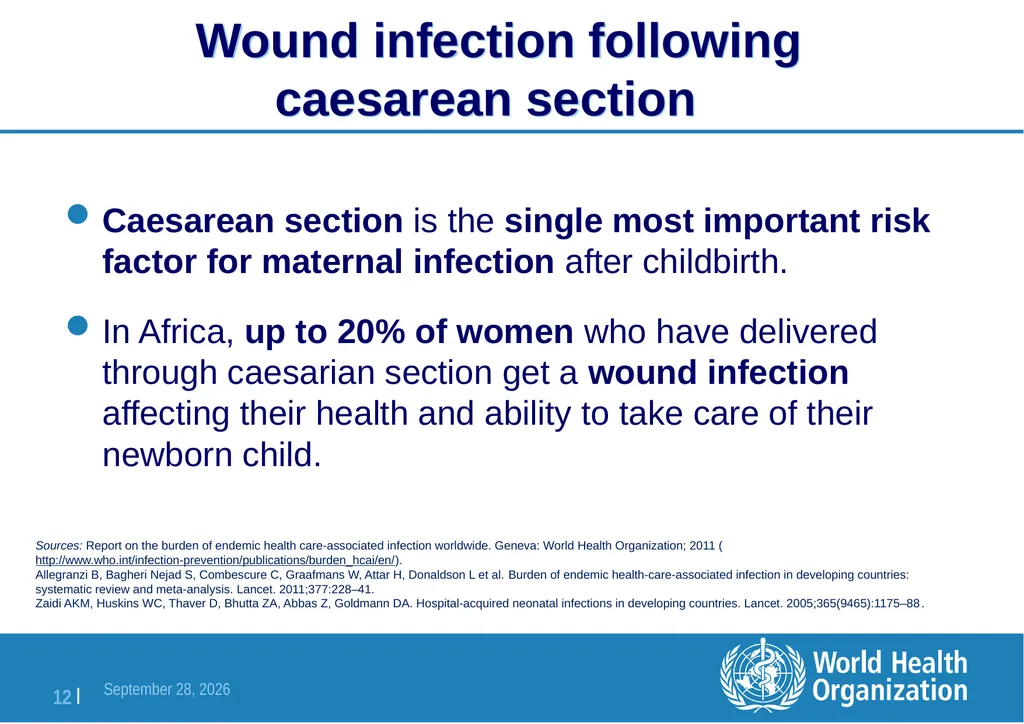
Caesarean section is the single most important risk factor for maternal infection after childbirth.
In Africa, up to 20% of women who have delivered through caesarian section get a wound infection affecting their health and ability to take care of their newborn child. Wound infection following caesarean section Sources: Report on the burden of endemic health care-associated infection worldwide. Geneva: World Health Organization; 2011 (http://www.who.int/infection-prevention/publications/burden_hcai/en/).
Allegranzi B, Bagheri Nejad S, Combescure C, Graafmans W, Attar H, Donaldson L et al. Burden of endemic health-care-associated infection in developing countries: systematic review and meta-analysis. Lancet. 2011;377:228–41.
Zaidi AKM, Huskins WC, Thaver D, Bhutta ZA, Abbas Z, Goldmann DA. Hospital-acquired neonatal infections in developing countries. Lancet. 2005;365(9465):1175–88.<br>
In Africa, up to 20% of women who have delivered through caesarian section get a wound infection affecting their health and ability to take care of their newborn child. Wound infection following caesarean section Sources: Report on the burden of endemic health care-associated infection worldwide. Geneva: World Health Organization; 2011 (http://www.who.int/infection-prevention/publications/burden_hcai/en/).
Allegranzi B, Bagheri Nejad S, Combescure C, Graafmans W, Attar H, Donaldson L et al. Burden of endemic health-care-associated infection in developing countries: systematic review and meta-analysis. Lancet. 2011;377:228–41.
Zaidi AKM, Huskins WC, Thaver D, Bhutta ZA, Abbas Z, Goldmann DA. Hospital-acquired neonatal infections in developing countries. Lancet. 2005;365(9465):1175–88.<br>
13
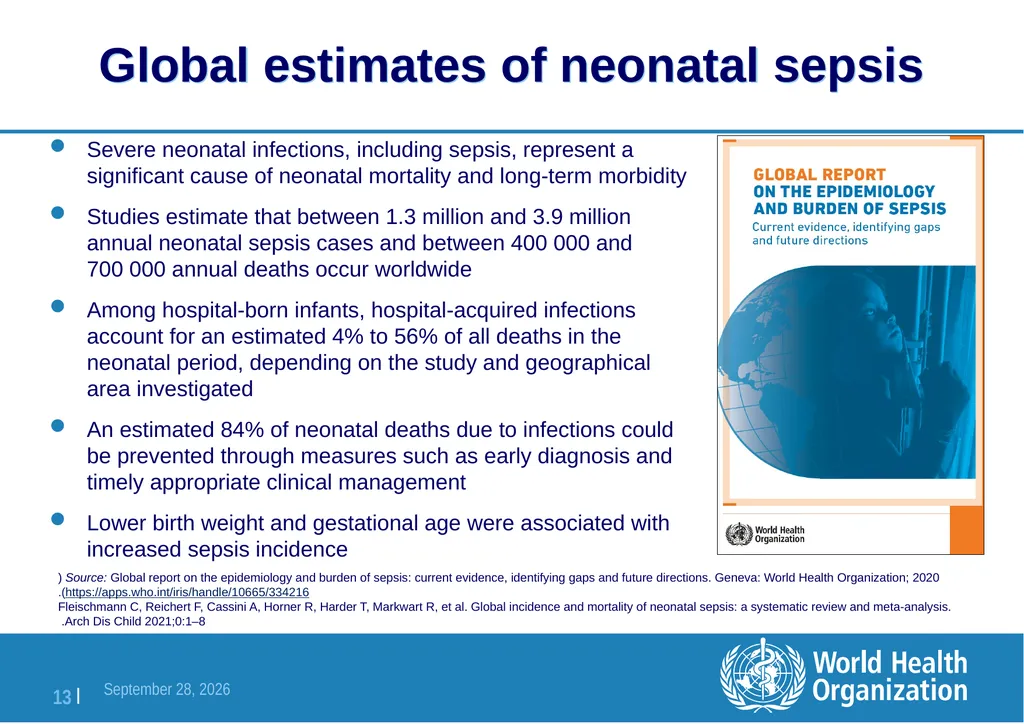
Global estimates of neonatal sepsis Severe neonatal infections, including sepsis, represent a significant cause of neonatal mortality and long-term morbidity
Studies estimate that between 1.3 million and 3.9 million annual neonatal sepsis cases and between 400 000 and 700 000 annual deaths occur worldwide
Among hospital-born infants, hospital-acquired infections account for an estimated 4% to 56% of all deaths in the neonatal period, depending on the study and geographical area investigated
An estimated 84% of neonatal deaths due to infections could be prevented through measures such as early diagnosis and timely appropriate clinical management
Lower birth weight and gestational age were associated with increased sepsis incidence Source: Global report on the epidemiology and burden of sepsis: current evidence, identifying gaps and future directions. Geneva: World Health Organization; 2020 (https://apps.who.int/iris/handle/10665/334216).
Fleischmann C, Reichert F, Cassini A, Horner R, Harder T, Markwart R, et al. Global incidence and mortality of neonatal sepsis: a systematic review and meta-analysis. Arch Dis Child 2021;0:1–8.<br>
Studies estimate that between 1.3 million and 3.9 million annual neonatal sepsis cases and between 400 000 and 700 000 annual deaths occur worldwide
Among hospital-born infants, hospital-acquired infections account for an estimated 4% to 56% of all deaths in the neonatal period, depending on the study and geographical area investigated
An estimated 84% of neonatal deaths due to infections could be prevented through measures such as early diagnosis and timely appropriate clinical management
Lower birth weight and gestational age were associated with increased sepsis incidence Source: Global report on the epidemiology and burden of sepsis: current evidence, identifying gaps and future directions. Geneva: World Health Organization; 2020 (https://apps.who.int/iris/handle/10665/334216).
Fleischmann C, Reichert F, Cassini A, Horner R, Harder T, Markwart R, et al. Global incidence and mortality of neonatal sepsis: a systematic review and meta-analysis. Arch Dis Child 2021;0:1–8.<br>
14
Higher incidence rates were found in at-risk groups of neonates and in LMICs.
Lower birth weight and gestational age were associated with an increased sepsis incidence.
Early-onset sepsis (EOS) was 2.6-fold more common than late-onset sepsis (LOS).
Survival of preterm, small (low birthweight) and sick infants has improved over time. However, this population often requires hospital care, which exposes them to a new set of infectious risks in the form of hospital-acquired infections and late onset sepsis. Global estimates of neonatal sepsis Source: Global report on the epidemiology and burden of sepsis: current evidence, identifying gaps and future directions. Geneva: World Health Organization; 2020 (https://apps.who.int/iris/handle/10665/334216).<br>
Lower birth weight and gestational age were associated with an increased sepsis incidence.
Early-onset sepsis (EOS) was 2.6-fold more common than late-onset sepsis (LOS).
Survival of preterm, small (low birthweight) and sick infants has improved over time. However, this population often requires hospital care, which exposes them to a new set of infectious risks in the form of hospital-acquired infections and late onset sepsis. Global estimates of neonatal sepsis Source: Global report on the epidemiology and burden of sepsis: current evidence, identifying gaps and future directions. Geneva: World Health Organization; 2020 (https://apps.who.int/iris/handle/10665/334216).<br>
15
Early-onset neonatal sepsis Causes around 8% of all neonatal deaths, is indicative of underlying issues of quality of care, such as infrastructure constraints for the care of pregnant women and neonates, inconsistent use of preventive measures, such as detection of infection in the mother and preventive treatment of the neonate, delayed diagnosis, and poor management of infection and its complications in mothers and neonates.
With approximately 21 million pregnant women colonized with Group B Streptococcus worldwide (estimation based on a global colonization of 18% of pregnant women), this pathogen represents the leading cause of neonatal sepsis, although E. coli has also recently emerged as a major threat. Together, they account for approximately 70% of cases of all EOS (early onset sepsis). Although less common, Listeria monocytogenes is also associated with invasive infections in preterm neonates. Source: Global report on the epidemiology and burden of sepsis: current evidence, identifying gaps and future directions. Geneva: World Health Organization; 2020 (https://apps.who.int/iris/handle/10665/334216).<br>
With approximately 21 million pregnant women colonized with Group B Streptococcus worldwide (estimation based on a global colonization of 18% of pregnant women), this pathogen represents the leading cause of neonatal sepsis, although E. coli has also recently emerged as a major threat. Together, they account for approximately 70% of cases of all EOS (early onset sepsis). Although less common, Listeria monocytogenes is also associated with invasive infections in preterm neonates. Source: Global report on the epidemiology and burden of sepsis: current evidence, identifying gaps and future directions. Geneva: World Health Organization; 2020 (https://apps.who.int/iris/handle/10665/334216).<br>
16
Late-onset neonatal sepsis LOS occurs 3 to 90 days after birth.
Many late neonatal infections are acquired in hospitals as a result of:
Low compliance with hand hygiene practices
Contaminated equipment and supplies
Poor aseptic technique when inserting and accessing medical devices
Lack of trained IPC professionals and limited opportunities for staff training
Inadequate cleaning and storing of patient care equipment
Overcrowding and understaffing
Limited resources for isolation or cohorting (grouping babies with the same condition together) Source: Global report on the epidemiology and burden of sepsis: current evidence, identifying gaps and future directions. Geneva: World Health Organization; 2020 (https://apps.who.int/iris/handle/10665/334216).<br>
Many late neonatal infections are acquired in hospitals as a result of:
Low compliance with hand hygiene practices
Contaminated equipment and supplies
Poor aseptic technique when inserting and accessing medical devices
Lack of trained IPC professionals and limited opportunities for staff training
Inadequate cleaning and storing of patient care equipment
Overcrowding and understaffing
Limited resources for isolation or cohorting (grouping babies with the same condition together) Source: Global report on the epidemiology and burden of sepsis: current evidence, identifying gaps and future directions. Geneva: World Health Organization; 2020 (https://apps.who.int/iris/handle/10665/334216).<br>
17
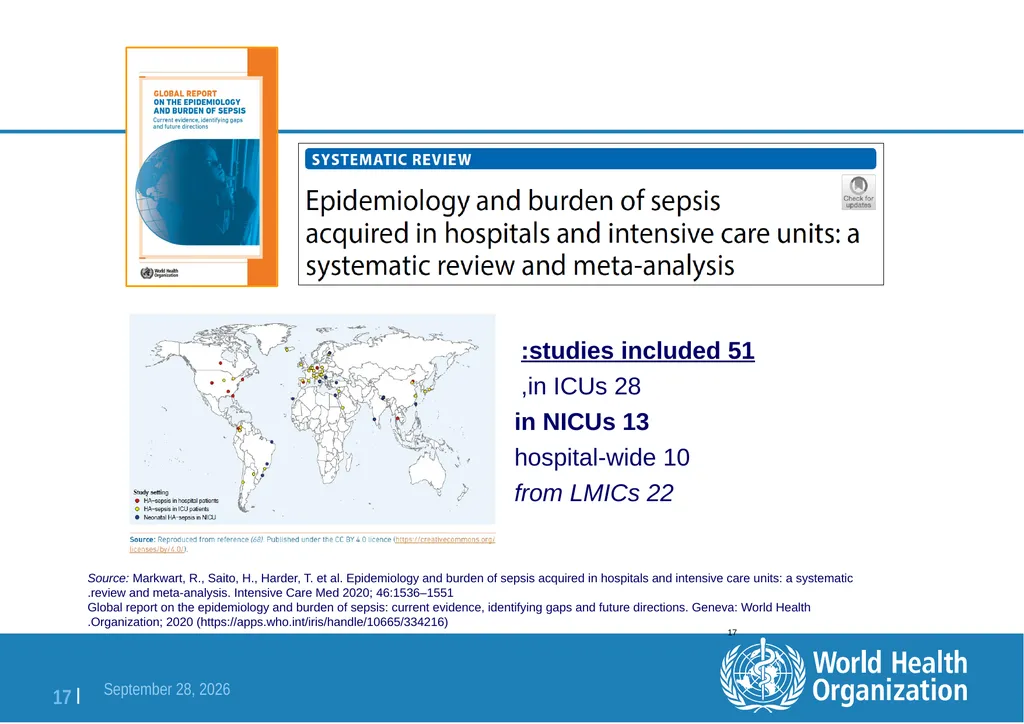
17 51 studies included:
28 in ICUs,
13 in NICUs
10 hospital-wide
22 from LMICs Source: Markwart, R., Saito, H., Harder, T. et al. Epidemiology and burden of sepsis acquired in hospitals and intensive care units: a systematic review and meta-analysis. Intensive Care Med 2020; 46:1536–1551.
Global report on the epidemiology and burden of sepsis: current evidence, identifying gaps and future directions. Geneva: World Health Organization; 2020 (https://apps.who.int/iris/handle/10665/334216).<br>
28 in ICUs,
13 in NICUs
10 hospital-wide
22 from LMICs Source: Markwart, R., Saito, H., Harder, T. et al. Epidemiology and burden of sepsis acquired in hospitals and intensive care units: a systematic review and meta-analysis. Intensive Care Med 2020; 46:1536–1551.
Global report on the epidemiology and burden of sepsis: current evidence, identifying gaps and future directions. Geneva: World Health Organization; 2020 (https://apps.who.int/iris/handle/10665/334216).<br>
18
HA sepsis among all hospital-treated sepsis: 23.6% (95% CI 17–31.8%)
Pooled incidence of HA sepsis per 1000 patients
15.4 (95% CI 9.2–25.7) in adults
112.9 cases (95% CI 64.2–191.1%) in neonates
56.6% of all types of HAIs were neonatal HA-sepsis
Among hospital-born infants, hospital-acquired infections account for an estimated 4% to 56% of all deaths in the neonatal period, depending on the study and geographical area.
The highest neonatal sepsis incidence rates are in LMICs, particularly in the African region. Health care-associated (HA) sepsis<br>
Pooled incidence of HA sepsis per 1000 patients
15.4 (95% CI 9.2–25.7) in adults
112.9 cases (95% CI 64.2–191.1%) in neonates
56.6% of all types of HAIs were neonatal HA-sepsis
Among hospital-born infants, hospital-acquired infections account for an estimated 4% to 56% of all deaths in the neonatal period, depending on the study and geographical area.
The highest neonatal sepsis incidence rates are in LMICs, particularly in the African region. Health care-associated (HA) sepsis<br>
19
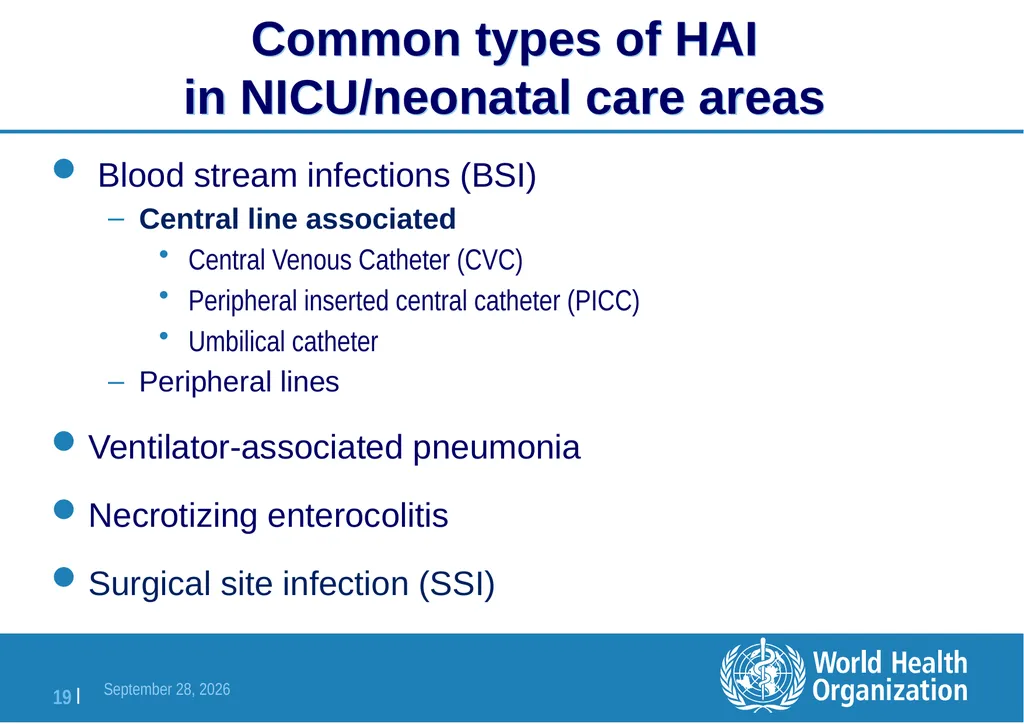
Common types of HAI
in NICU/neonatal care areas Blood stream infections (BSI)
Central line associated
Central Venous Catheter (CVC)
Peripheral inserted central catheter (PICC)
Umbilical catheter
Peripheral lines
Ventilator-associated pneumonia
Necrotizing enterocolitis
Surgical site infection (SSI)<br>
Central line associated
Central Venous Catheter (CVC)
Peripheral inserted central catheter (PICC)
Umbilical catheter
Peripheral lines
Ventilator-associated pneumonia
Necrotizing enterocolitis
Surgical site infection (SSI)<br>
20
Introduction to IPC 20<br>
21
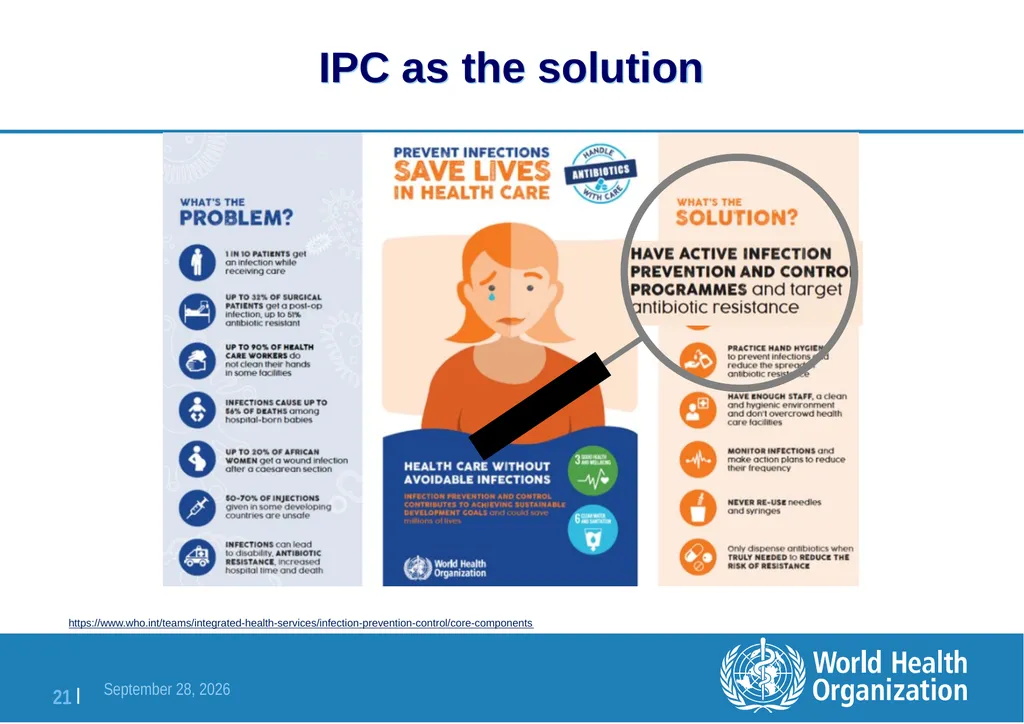
https://www.who.int/teams/integrated-health-services/infection-prevention-control/core-components IPC as the solution<br>
22
Preventing HAIs and sepsis in health care Here are two short videos showing the importance of IPC for patient safety and how to prevent sepsis (in community and health-care settings)
“Health care without avoidable infections - peoples' lives depend on”
https://www.youtube.com/watch?v=K-2XWtEjfl8
Prevent sepsis in health care
https://www.youtube.com/watch?v=GKRQm0i5JdI<br>
“Health care without avoidable infections - peoples' lives depend on”
https://www.youtube.com/watch?v=K-2XWtEjfl8
Prevent sepsis in health care
https://www.youtube.com/watch?v=GKRQm0i5JdI<br>
23
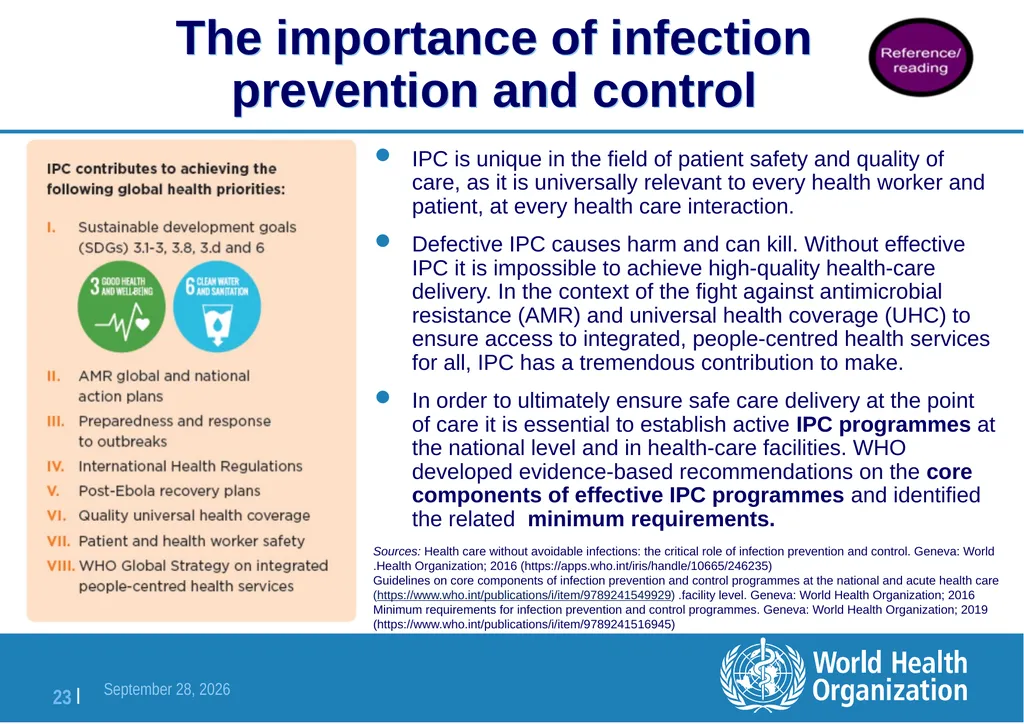
IPC is unique in the field of patient safety and quality of care, as it is universally relevant to every health worker and patient, at every health care interaction.
Defective IPC causes harm and can kill. Without effective IPC it is impossible to achieve high-quality health-care delivery. In the context of the fight against antimicrobial resistance (AMR) and universal health coverage (UHC) to ensure access to integrated, people-centred health services for all, IPC has a tremendous contribution to make.
In order to ultimately ensure safe care delivery at the point of care it is essential to establish active IPC programmes at the national level and in health-care facilities. WHO developed evidence-based recommendations on the core components of effective IPC programmes and identified the related minimum requirements. The importance of infection prevention and control Sources: Health care without avoidable infections: the critical role of infection prevention and control. Geneva: World Health Organization; 2016 (https://apps.who.int/iris/handle/10665/246235).
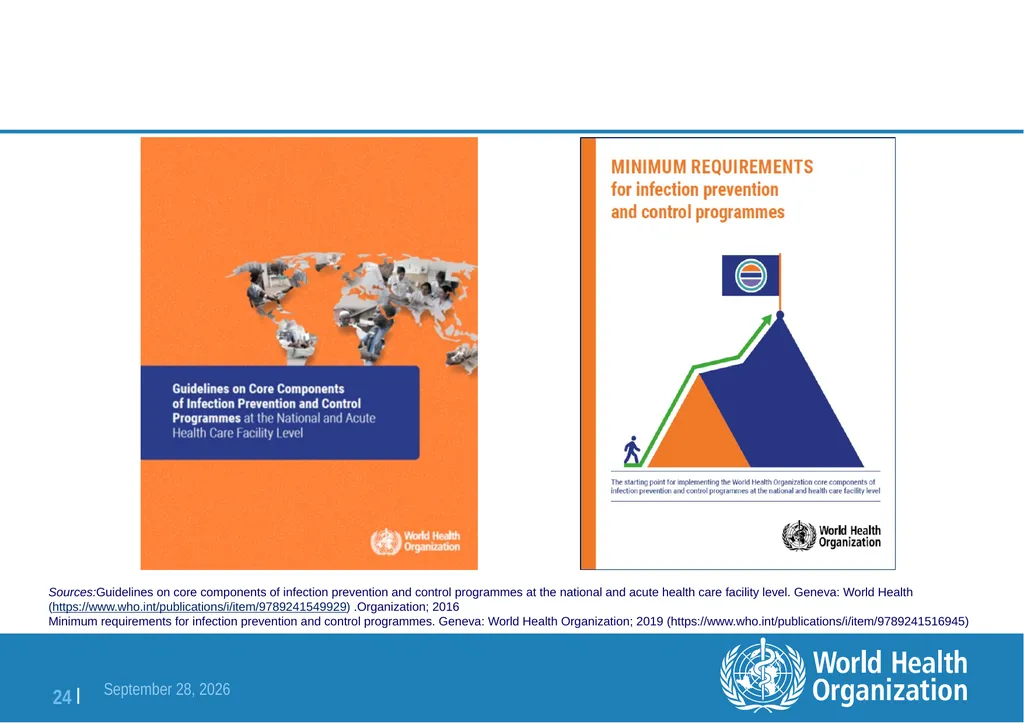
Guidelines on core components of infection prevention and control programmes at the national and acute health care facility level. Geneva: World Health Organization; 2016. (https://www.who.int/publications/i/item/9789241549929)
Minimum requirements for infection prevention and control programmes. Geneva: World Health Organization; 2019 (https://www.who.int/publications/i/item/9789241516945)<br>
Defective IPC causes harm and can kill. Without effective IPC it is impossible to achieve high-quality health-care delivery. In the context of the fight against antimicrobial resistance (AMR) and universal health coverage (UHC) to ensure access to integrated, people-centred health services for all, IPC has a tremendous contribution to make.
In order to ultimately ensure safe care delivery at the point of care it is essential to establish active IPC programmes at the national level and in health-care facilities. WHO developed evidence-based recommendations on the core components of effective IPC programmes and identified the related minimum requirements. The importance of infection prevention and control Sources: Health care without avoidable infections: the critical role of infection prevention and control. Geneva: World Health Organization; 2016 (https://apps.who.int/iris/handle/10665/246235).
Guidelines on core components of infection prevention and control programmes at the national and acute health care facility level. Geneva: World Health Organization; 2016. (https://www.who.int/publications/i/item/9789241549929)
Minimum requirements for infection prevention and control programmes. Geneva: World Health Organization; 2019 (https://www.who.int/publications/i/item/9789241516945)<br>
24
Sources:Guidelines on core components of infection prevention and control programmes at the national and acute health care facility level. Geneva: World Health Organization; 2016. (https://www.who.int/publications/i/item/9789241549929)
Minimum requirements for infection prevention and control programmes. Geneva: World Health Organization; 2019 (https://www.who.int/publications/i/item/9789241516945)<br>
Minimum requirements for infection prevention and control programmes. Geneva: World Health Organization; 2019 (https://www.who.int/publications/i/item/9789241516945)<br>
25
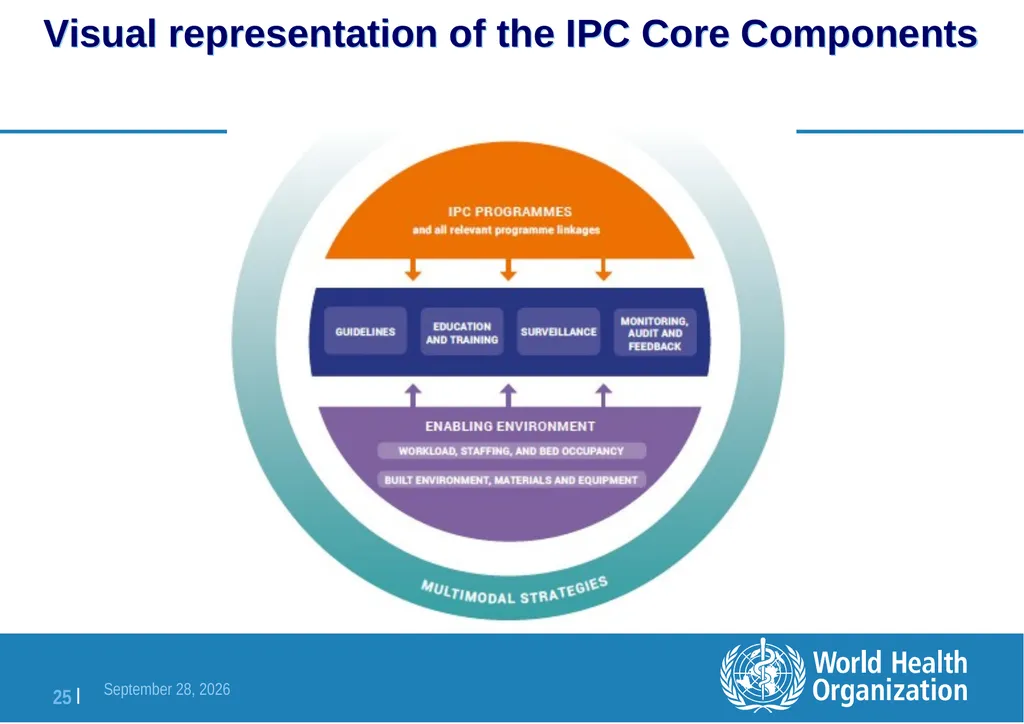
Visual representation of the IPC Core Components<br>
26
WHO’s core components for effective IPC programmes https://www.youtube.com/watch?v=LZapz2L6J1Q&feature=youtu.be%2C 26<br>
27
Water, sanitation and hygiene infrastructure Water, sanitation and hygiene (WASH) infrastructure is essential for effective infection prevention
Factors to be assessed:
access to running or flowing water from a high-quality source
sanitation services
toileting facilities, including menstrual hygiene requirements in maternity areas
hand hygiene resources like soap and alcohol-based handrub
safe health-care waste disposal facilities
Tools such as WHO WASHFIT can help to assess and monitor WASH infrastructure Source: Water and Sanitation for Health Facility Improvement Tool (WASH FIT). Geneva: World Health Organization; 2017 (https://apps.who.int/iris/handle/10665/25491.0).<br>
Factors to be assessed:
access to running or flowing water from a high-quality source
sanitation services
toileting facilities, including menstrual hygiene requirements in maternity areas
hand hygiene resources like soap and alcohol-based handrub
safe health-care waste disposal facilities
Tools such as WHO WASHFIT can help to assess and monitor WASH infrastructure Source: Water and Sanitation for Health Facility Improvement Tool (WASH FIT). Geneva: World Health Organization; 2017 (https://apps.who.int/iris/handle/10665/25491.0).<br>
28
Modes of organism transmission:
chain of infection (1) To reduce the risk of harmful micro-organisms, it is important to understand how different HAIs can spread. Micro-organisms are found in air, soil and water, and in our bodies. Some micro-organisms are helpful; others can be harmful and cause infections.
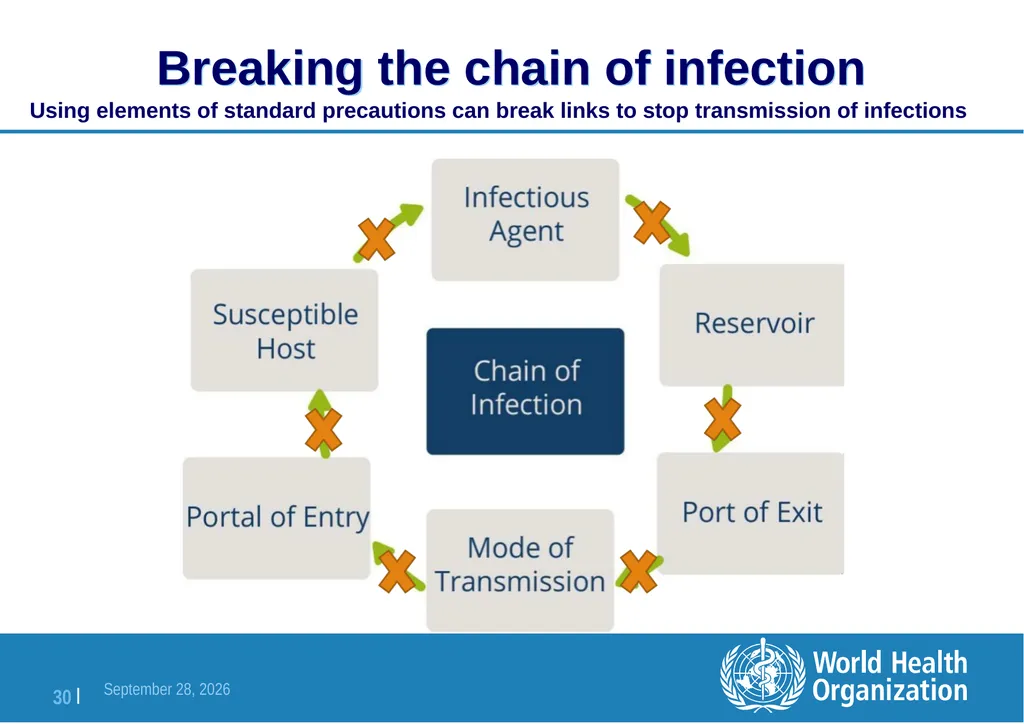
The diagram on the next slide represents the chain of infection. For an infection to spread, all steps in the chain must occur. The key to stopping the spread of infection is to break at least one link in the chain.
In a health-care setting, the chain of infection refers to the numerous opportunities for pathogens to spread among patients, health-care workers and the environment. Effective IPC aims to break the chain.<br>
The diagram on the next slide represents the chain of infection. For an infection to spread, all steps in the chain must occur. The key to stopping the spread of infection is to break at least one link in the chain.
In a health-care setting, the chain of infection refers to the numerous opportunities for pathogens to spread among patients, health-care workers and the environment. Effective IPC aims to break the chain.<br>
29
Modes of organism transmission:
chain of infection (2) For an infection to spread, all links must be connected<br>
30
Breaking the chain of infection Using elements of standard precautions can break links to stop transmission of infections<br>
31
Standard precautions Standard precautions are the basic practices that apply to all patient care, regardless of the patient’s suspected or confirmed infectious status
They apply to all settings where care is delivered
These practices protect health-care personnel and prevent health workers and the environment transmitting infections to patients<br>
They apply to all settings where care is delivered
These practices protect health-care personnel and prevent health workers and the environment transmitting infections to patients<br>
32
Breaking the chain of infection and standard precautions Standard precautions are used to break the chain of infection and are used in conjunction with transmission-based precautions
They are designed to interrupt infection transmission when used during all patient-care activities on all patients, regardless of their suspected or confirmed infectious status
Standard precautions aim to protect patients, health-care workers and visitors from contact with infectious agents from recognized and unrecognized sources, and to prevent contamination of the health-care environment<br>
They are designed to interrupt infection transmission when used during all patient-care activities on all patients, regardless of their suspected or confirmed infectious status
Standard precautions aim to protect patients, health-care workers and visitors from contact with infectious agents from recognized and unrecognized sources, and to prevent contamination of the health-care environment<br>
33
Care provision that includes
standard precautions WHO quality statement: all women and newborns should receive care that includes standard precautions to prevent hospital-acquired infections
Rationale: hospital-acquired infections increase morbidity and mortality, the cost of care and the duration of stay in hospital. Standard precautions are essential to prevent hospital-acquired infections
What this looks like in practice: standard precautions are the basic IPC practices that apply to all patient-care activities, in any setting where health care is delivered
Health-care providers should apply standard precautions and other IPC practices when caring for the woman, fetus and newborn Source: Standards for improving quality of maternal and newborn care in health facilities. Geneva: World Health Organization; 2016 (https://apps.who.int/iris/handle/10665/249155).<br>
Rationale: hospital-acquired infections increase morbidity and mortality, the cost of care and the duration of stay in hospital. Standard precautions are essential to prevent hospital-acquired infections
What this looks like in practice: standard precautions are the basic IPC practices that apply to all patient-care activities, in any setting where health care is delivered
Health-care providers should apply standard precautions and other IPC practices when caring for the woman, fetus and newborn Source: Standards for improving quality of maternal and newborn care in health facilities. Geneva: World Health Organization; 2016 (https://apps.who.int/iris/handle/10665/249155).<br>
34
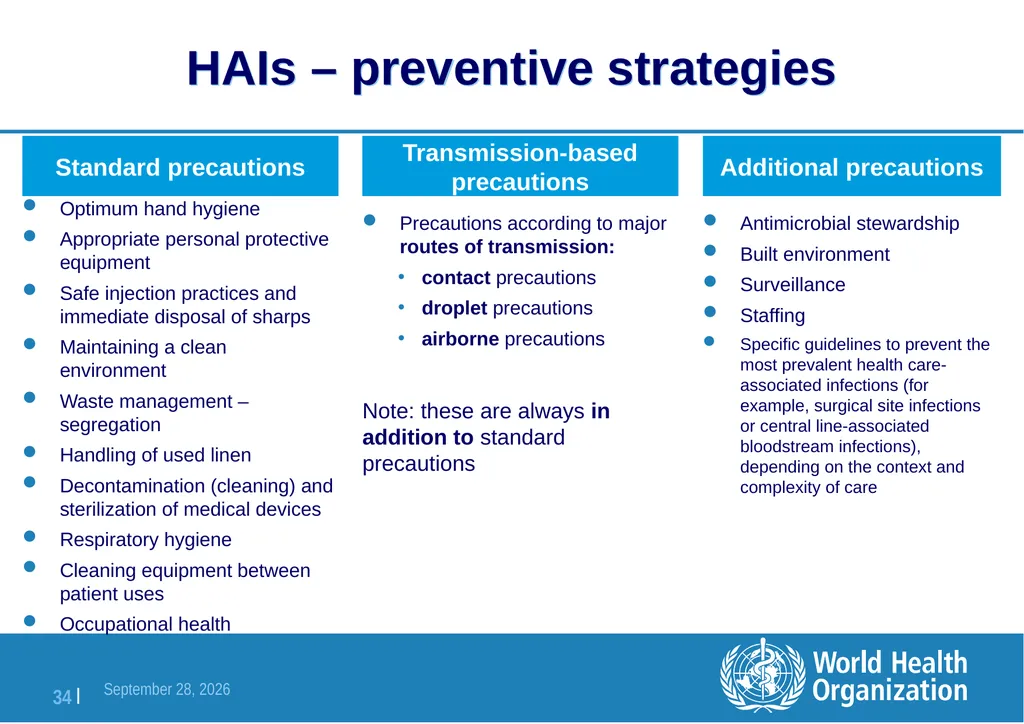
HAIs – preventive strategies Optimum hand hygiene
Appropriate personal protective equipment
Safe injection practices and immediate disposal of sharps
Maintaining a clean environment
Waste management – segregation
Handling of used linen
Decontamination (cleaning) and sterilization of medical devices
Respiratory hygiene
Cleaning equipment between patient uses
Occupational health Standard precautions Precautions according to major routes of transmission:
contact precautions
droplet precautions
airborne precautions
Note: these are always in addition to standard precautions Transmission-based precautions Antimicrobial stewardship
Built environment
Surveillance
Staffing
Specific guidelines to prevent the most prevalent health care-associated infections (for example, surgical site infections or central line-associated bloodstream infections), depending on the context and complexity of care Additional precautions<br>
Appropriate personal protective equipment
Safe injection practices and immediate disposal of sharps
Maintaining a clean environment
Waste management – segregation
Handling of used linen
Decontamination (cleaning) and sterilization of medical devices
Respiratory hygiene
Cleaning equipment between patient uses
Occupational health Standard precautions Precautions according to major routes of transmission:
contact precautions
droplet precautions
airborne precautions
Note: these are always in addition to standard precautions Transmission-based precautions Antimicrobial stewardship
Built environment
Surveillance
Staffing
Specific guidelines to prevent the most prevalent health care-associated infections (for example, surgical site infections or central line-associated bloodstream infections), depending on the context and complexity of care Additional precautions<br>
35
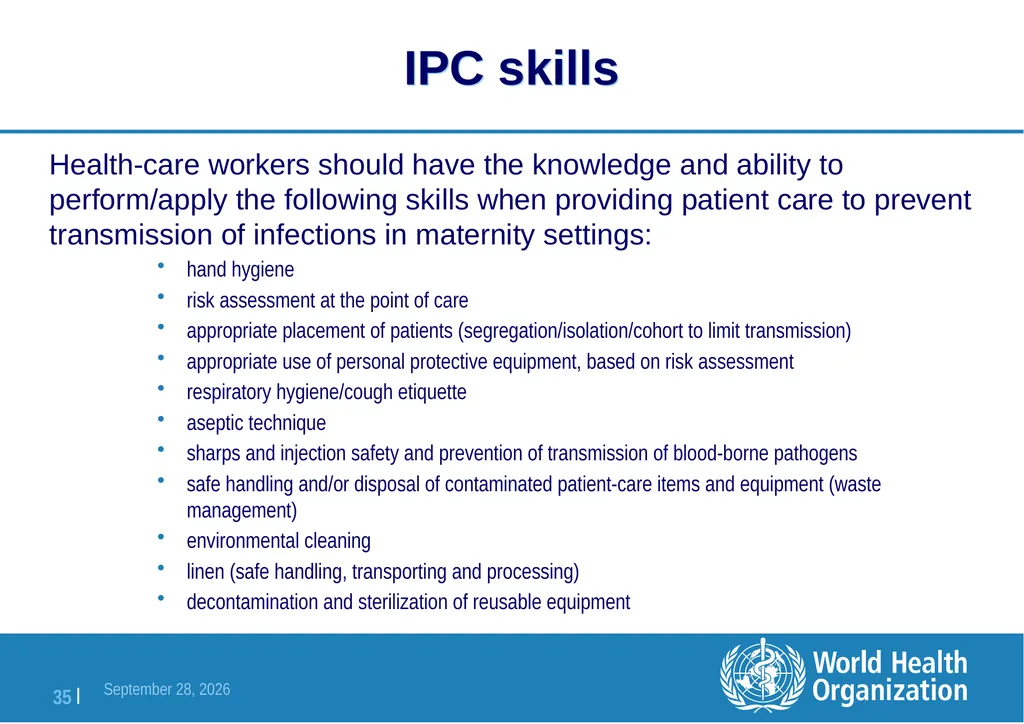
IPC skills Health-care workers should have the knowledge and ability to perform/apply the following skills when providing patient care to prevent transmission of infections in maternity settings:
hand hygiene
risk assessment at the point of care
appropriate placement of patients (segregation/isolation/cohort to limit transmission)
appropriate use of personal protective equipment, based on risk assessment
respiratory hygiene/cough etiquette
aseptic technique
sharps and injection safety and prevention of transmission of blood-borne pathogens
safe handling and/or disposal of contaminated patient-care items and equipment (waste management)
environmental cleaning
linen (safe handling, transporting and processing)
decontamination and sterilization of reusable equipment<br>
hand hygiene
risk assessment at the point of care
appropriate placement of patients (segregation/isolation/cohort to limit transmission)
appropriate use of personal protective equipment, based on risk assessment
respiratory hygiene/cough etiquette
aseptic technique
sharps and injection safety and prevention of transmission of blood-borne pathogens
safe handling and/or disposal of contaminated patient-care items and equipment (waste management)
environmental cleaning
linen (safe handling, transporting and processing)
decontamination and sterilization of reusable equipment<br>
36
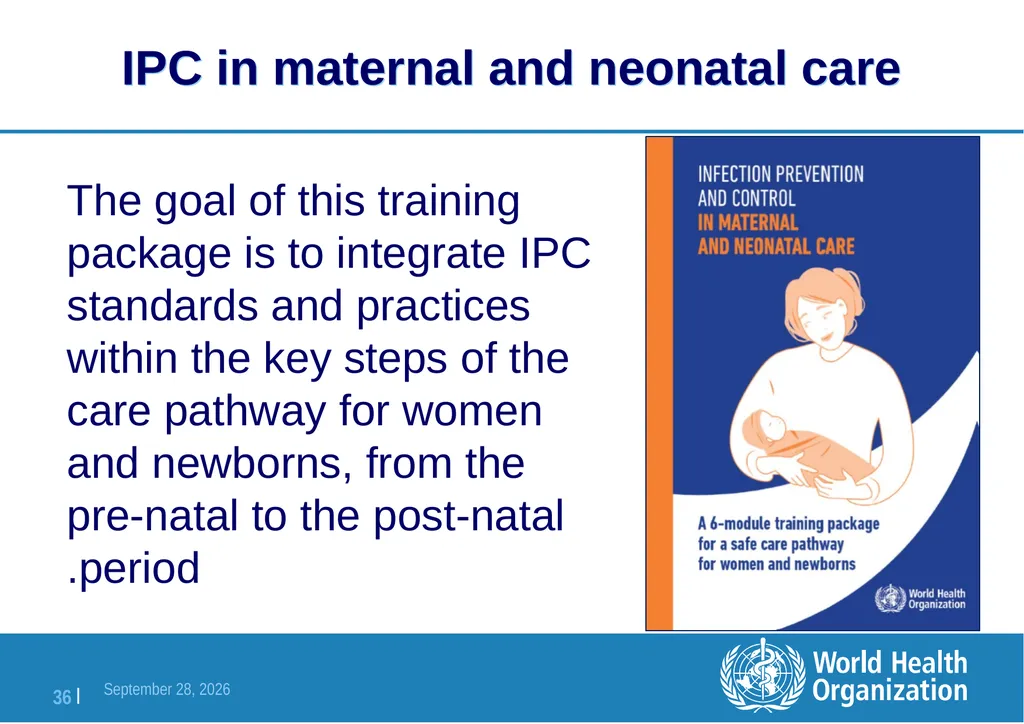
The goal of this training package is to integrate IPC standards and practices within the key steps of the care pathway for women and newborns, from the pre-natal to the post-natal period. IPC in maternal and neonatal care<br>
37
All relevant maternal and
neonatal clinical settings Antenatal clinic
Antenatal ward
Emergency setting
Labour ward
Theatre Post-natal wards:
nursery
special newborn care unit
kangaroo mother care (KMC) units/rooms
neonatal intensive care unit (NICU)<br>
Antenatal ward
Emergency setting
Labour ward
Theatre Post-natal wards:
nursery
special newborn care unit
kangaroo mother care (KMC) units/rooms
neonatal intensive care unit (NICU)<br>
38
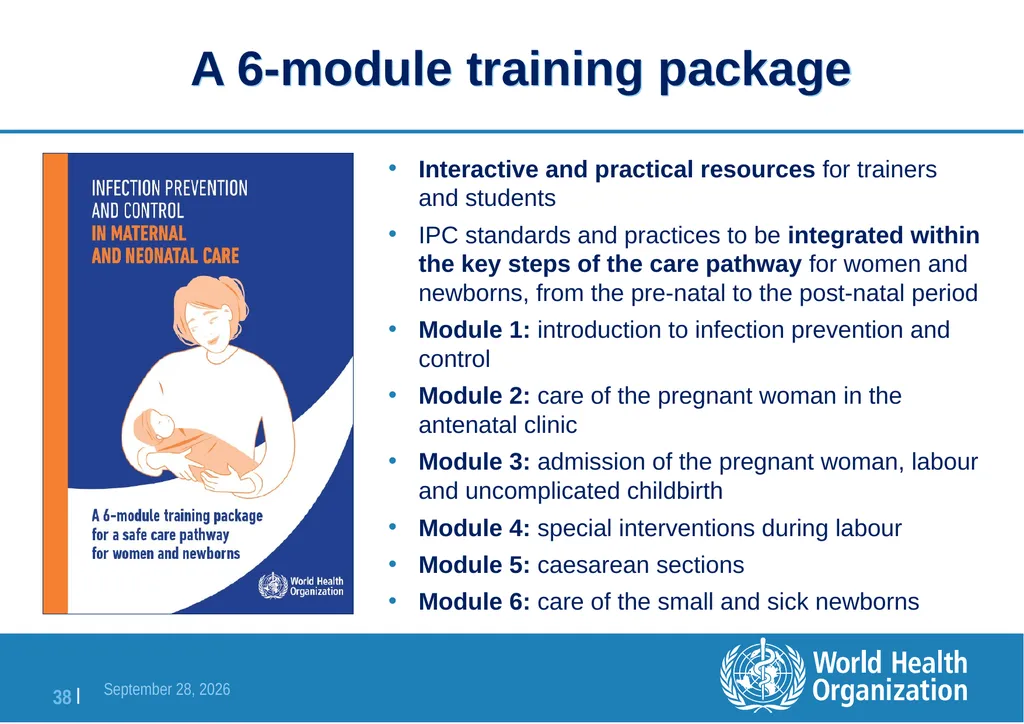
Interactive and practical resources for trainers and students
IPC standards and practices to be integrated within the key steps of the care pathway for women and newborns, from the pre-natal to the post-natal period
Module 1: introduction to infection prevention and control
Module 2: care of the pregnant woman in the antenatal clinic
Module 3: admission of the pregnant woman, labour and uncomplicated childbirth
Module 4: special interventions during labour
Module 5: caesarean sections
Module 6: care of the small and sick newborns A 6-module training package<br>
IPC standards and practices to be integrated within the key steps of the care pathway for women and newborns, from the pre-natal to the post-natal period
Module 1: introduction to infection prevention and control
Module 2: care of the pregnant woman in the antenatal clinic
Module 3: admission of the pregnant woman, labour and uncomplicated childbirth
Module 4: special interventions during labour
Module 5: caesarean sections
Module 6: care of the small and sick newborns A 6-module training package<br>