
Module 2: Pre-Filing Considerations Pro Bono
LS
Published · 63 slides · 0 views
1 / 1













Description
Module 2: Pre-Filing Considerations Pro Bono Bankruptcy Training Program Material This presentation has been prepared by the National Consumer Law Center, Inc. (NCLC). For more information about NCLC, go to www.consumerlaw.org. Copyright
Related Topics
Share
Embed code
Download this presentation From Below
"Module 2: Pre-Filing Considerations Pro Bono" is the property of its rightful owner. Permission is granted to download and print the materials on this website for personal, non-commercial use only, and to display it on your personal computer provided you do not modify the materials and that you retain all copyright notices contained in the materials. By downloading content from our website, you accept the terms of this agreement.
Presentation Transcript
01
Module 2:
Pre-Filing Considerations<br>
02
Pro Bono Bankruptcy Training Program Material This presentation has been prepared by the National Consumer Law Center, Inc. (NCLC). For more information about NCLC, go to www.consumerlaw.org.
Copyright © 2015 by National Consumer Law Center, Inc. National Consumer Law Center and NCLC are registered trademarks of National Consumer Law Center, Inc. All Rights Reserved 2<br>
Copyright © 2015 by National Consumer Law Center, Inc. National Consumer Law Center and NCLC are registered trademarks of National Consumer Law Center, Inc. All Rights Reserved 2<br>
03
Gathering Information<br>
04
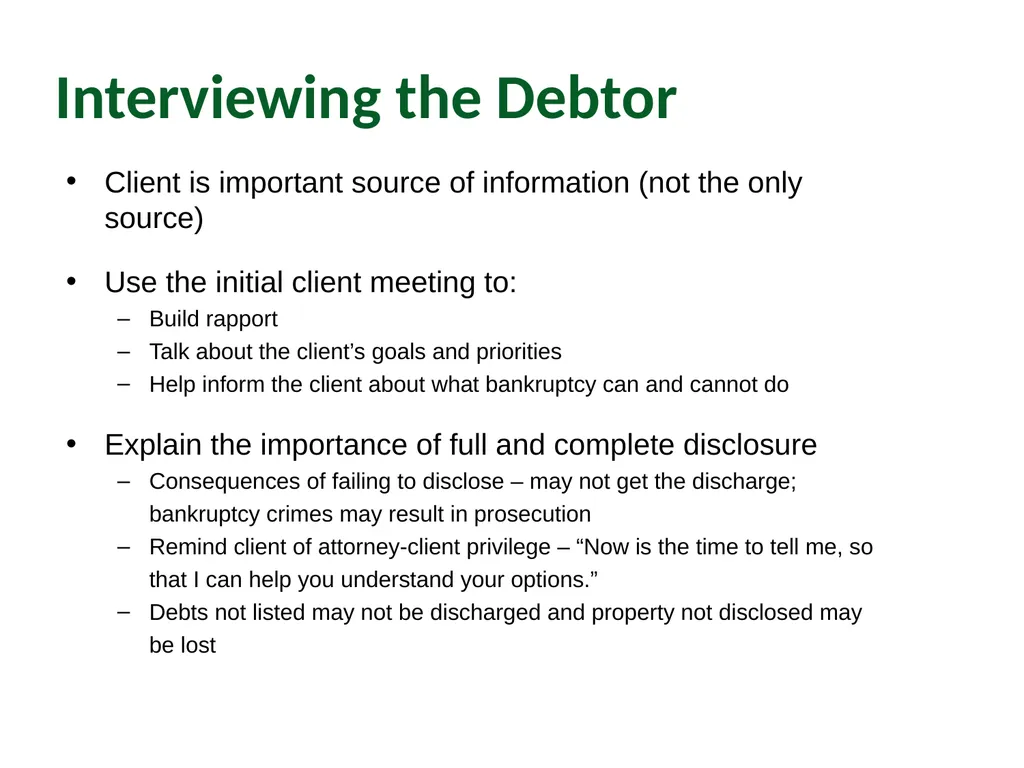
Interviewing the Debtor Client is important source of information (not the only source)
Use the initial client meeting to:
Build rapport
Talk about the client’s goals and priorities
Help inform the client about what bankruptcy can and cannot do
Explain the importance of full and complete disclosure
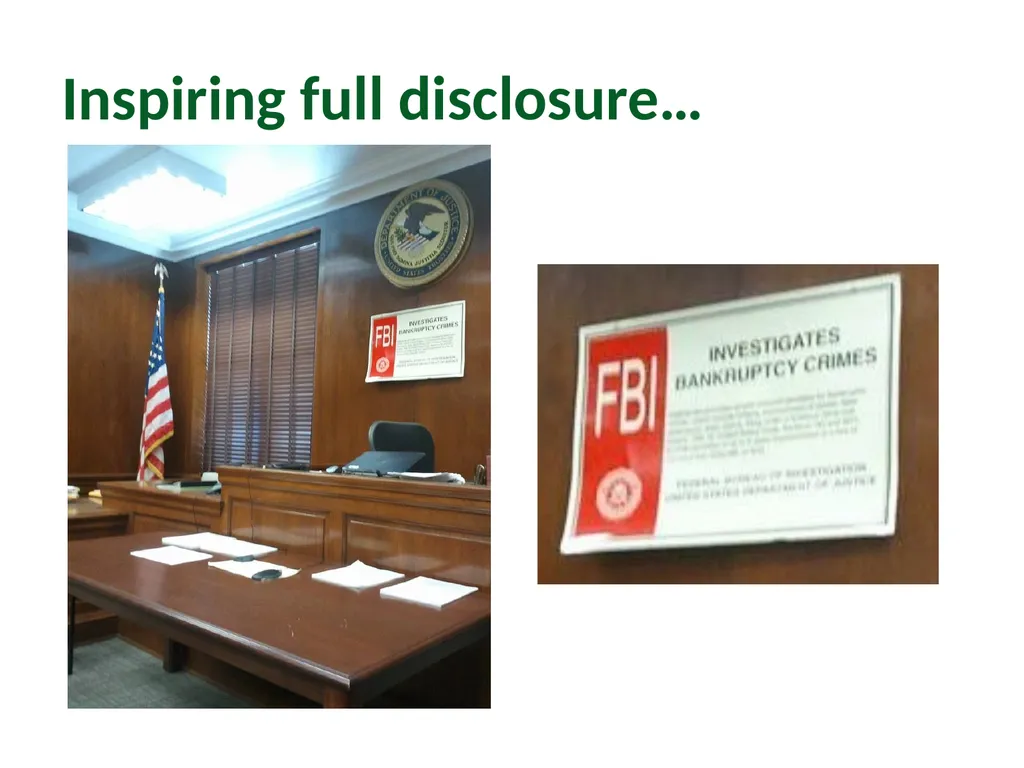
Consequences of failing to disclose – may not get the discharge; bankruptcy crimes may result in prosecution
Remind client of attorney-client privilege – “Now is the time to tell me, so that I can help you understand your options.”
Debts not listed may not be discharged and property not disclosed may be lost<br>
Use the initial client meeting to:
Build rapport
Talk about the client’s goals and priorities
Help inform the client about what bankruptcy can and cannot do
Explain the importance of full and complete disclosure
Consequences of failing to disclose – may not get the discharge; bankruptcy crimes may result in prosecution
Remind client of attorney-client privilege – “Now is the time to tell me, so that I can help you understand your options.”
Debts not listed may not be discharged and property not disclosed may be lost<br>
05
Inspiring full disclosure…<br>
06
Interviewing the Debtor Key questions to ask during the first meeting:
What types of debt are causing the most trouble?
How and when were the debts incurred and are they secured?
What significant assets does the client have?
What is the debtor’s monthly income and what type of income is it (employment, public benefits, Social Security, and so forth)? Does debtor expect any changes?
What does the debtor estimate his or her monthly expenses to be? Does debtor expect any changes?
How imminent is creditor action which may limit the client’s options?
Has the debtor filed bankruptcy before and, if so, when and what type of case?
Has the debtor moved from one state to another within the preceding two and a half years?<br>
What types of debt are causing the most trouble?
How and when were the debts incurred and are they secured?
What significant assets does the client have?
What is the debtor’s monthly income and what type of income is it (employment, public benefits, Social Security, and so forth)? Does debtor expect any changes?
What does the debtor estimate his or her monthly expenses to be? Does debtor expect any changes?
How imminent is creditor action which may limit the client’s options?
Has the debtor filed bankruptcy before and, if so, when and what type of case?
Has the debtor moved from one state to another within the preceding two and a half years?<br>
07
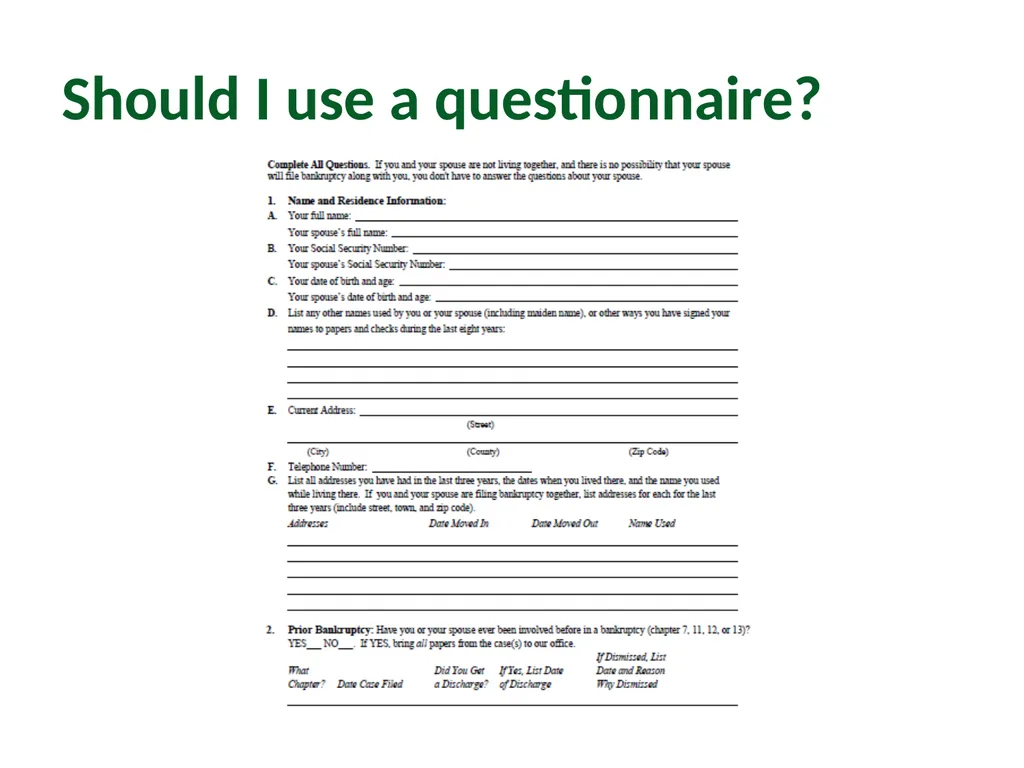
Should I use a questionnaire?<br>
08
Why you shouldn’t rely just on a questionnaire Lawyer: Have you made sales of property, mortgages, gifts, or transfers of any substantial property or cash within the last four years?
Client: No.
Lawyer: So, just to be clear, you haven’t transferred anything valuable to anyone else?
Client: Anything?
Lawyer: Right, like a car, or something you inherited, or –
Client: Oh, a car! I thought you meant property, like land. Well, I did have a car that I put in my son’s name. It’s always been his car, but I helped him get the loan. Does that have to go into the bankruptcy?<br>
Client: No.
Lawyer: So, just to be clear, you haven’t transferred anything valuable to anyone else?
Client: Anything?
Lawyer: Right, like a car, or something you inherited, or –
Client: Oh, a car! I thought you meant property, like land. Well, I did have a car that I put in my son’s name. It’s always been his car, but I helped him get the loan. Does that have to go into the bankruptcy?<br>
09
Explain that nothing “stays out” of the bankruptcy Debtors often have the impression that they can pick and choose what “goes in” the bankruptcy
They might say, “I want to keep my car loan out of the bankruptcy. I’m current on the loan. Is that ok?”
The response:
“No. Everything – every debt and every asset – must be listed in the bankruptcy.”
“You can keep paying secured debts, so the bankruptcy might not have much of an effect, but we have to disclose it.”<br>
They might say, “I want to keep my car loan out of the bankruptcy. I’m current on the loan. Is that ok?”
The response:
“No. Everything – every debt and every asset – must be listed in the bankruptcy.”
“You can keep paying secured debts, so the bankruptcy might not have much of an effect, but we have to disclose it.”<br>
10
Full disclosure includes: Debts you owe to family members or friends
Debts that family or friends owe you (this is an asset)
Debts to the doctor you really like and want to keep going to (explain that it’s likely the doctor will not stop seeing you because you discharged a debt in bankruptcy)
Debts you want to pay/feel morally obligated to pay (although not advisable, debtor can voluntarily pay discharged debts without signing reaffirmation)<br>
Debts that family or friends owe you (this is an asset)
Debts to the doctor you really like and want to keep going to (explain that it’s likely the doctor will not stop seeing you because you discharged a debt in bankruptcy)
Debts you want to pay/feel morally obligated to pay (although not advisable, debtor can voluntarily pay discharged debts without signing reaffirmation)<br>
11
Trustee looks for undisclosed assets Trustee may go after:
Undisclosed property of the estate
Legal claims the debtor may have that are not fully exempt
Fraudulent transfers within the 2 years prior to filing (or longer under state statutes)- 11 U.S.C. §§ 544 and 548
Any transfer with intent to hinder, delay or defraud a creditor
Any transfer for less than reasonably equivalent value, while insolvent<br>
Undisclosed property of the estate
Legal claims the debtor may have that are not fully exempt
Fraudulent transfers within the 2 years prior to filing (or longer under state statutes)- 11 U.S.C. §§ 544 and 548
Any transfer with intent to hinder, delay or defraud a creditor
Any transfer for less than reasonably equivalent value, while insolvent<br>
12
Voidable Preferences Voidable preferences: payments made to a creditor totaling $600 or more within 90 days prior to the filing of the petition, if the transfer enables the creditor to get more than it otherwise would have gotten.
One-year look-back period if transfer made to insider (such as relative or business partner)
Applies even if involuntary (garnishment)
No preference if certain exemptions apply
11 U.S.C. § 547<br>
One-year look-back period if transfer made to insider (such as relative or business partner)
Applies even if involuntary (garnishment)
No preference if certain exemptions apply
11 U.S.C. § 547<br>
13
Commonly Missed Assets Tax refunds (when?)
Alimony or support arrearages
Security deposits
Deposits in dormant savings accounts
Pledged goods at pawnbrokers
Any possible legal claims (slip and fall, car accident, employment discrimination), even if no lawsuit has been filed
Cash value in whole life insurance policies
Pension plans
Burial plots
Inherited real estate/heir property
Cars being driven by someone else
Voidable preferences (payments to creditors past 90 days)<br>
Alimony or support arrearages
Security deposits
Deposits in dormant savings accounts
Pledged goods at pawnbrokers
Any possible legal claims (slip and fall, car accident, employment discrimination), even if no lawsuit has been filed
Cash value in whole life insurance policies
Pension plans
Burial plots
Inherited real estate/heir property
Cars being driven by someone else
Voidable preferences (payments to creditors past 90 days)<br>
14
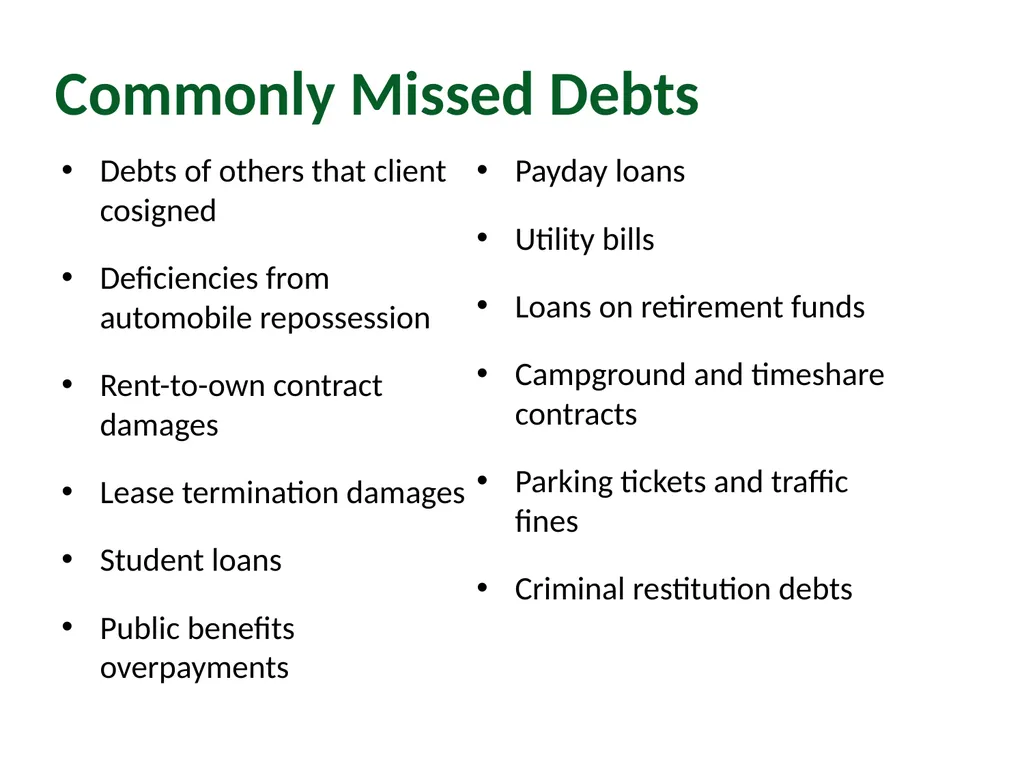
Commonly Missed Debts Debts of others that client cosigned
Deficiencies from automobile repossession
Rent-to-own contract damages
Lease termination damages
Student loans
Public benefits overpayments
Payday loans
Utility bills
Loans on retirement funds
Campground and timeshare contracts
Parking tickets and traffic fines
Criminal restitution debts<br>
Deficiencies from automobile repossession
Rent-to-own contract damages
Lease termination damages
Student loans
Public benefits overpayments
Payday loans
Utility bills
Loans on retirement funds
Campground and timeshare contracts
Parking tickets and traffic fines
Criminal restitution debts<br>
15
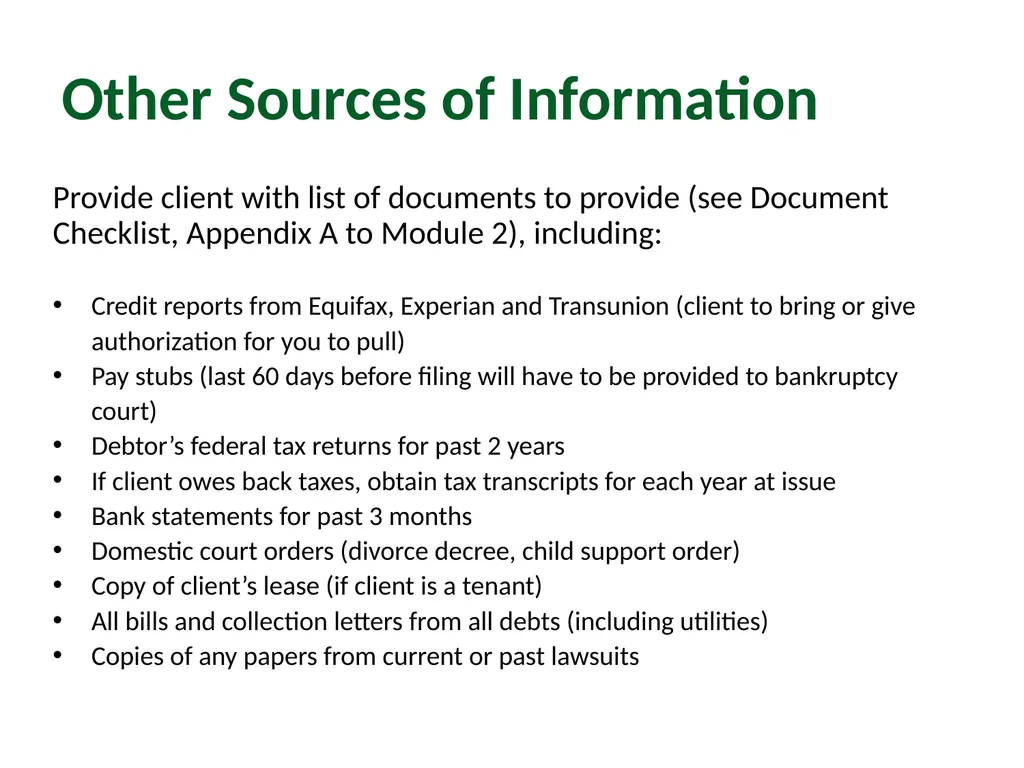
Other Sources of Information Provide client with list of documents to provide (see Document Checklist, Appendix A to Module 2), including:
Credit reports from Equifax, Experian and Transunion (client to bring or give authorization for you to pull)
Pay stubs (last 60 days before filing will have to be provided to bankruptcy court)
Debtor’s federal tax returns for past 2 years
If client owes back taxes, obtain tax transcripts for each year at issue
Bank statements for past 3 months
Domestic court orders (divorce decree, child support order)
Copy of client’s lease (if client is a tenant)
All bills and collection letters from all debts (including utilities)
Copies of any papers from current or past lawsuits<br>
Credit reports from Equifax, Experian and Transunion (client to bring or give authorization for you to pull)
Pay stubs (last 60 days before filing will have to be provided to bankruptcy court)
Debtor’s federal tax returns for past 2 years
If client owes back taxes, obtain tax transcripts for each year at issue
Bank statements for past 3 months
Domestic court orders (divorce decree, child support order)
Copy of client’s lease (if client is a tenant)
All bills and collection letters from all debts (including utilities)
Copies of any papers from current or past lawsuits<br>
16
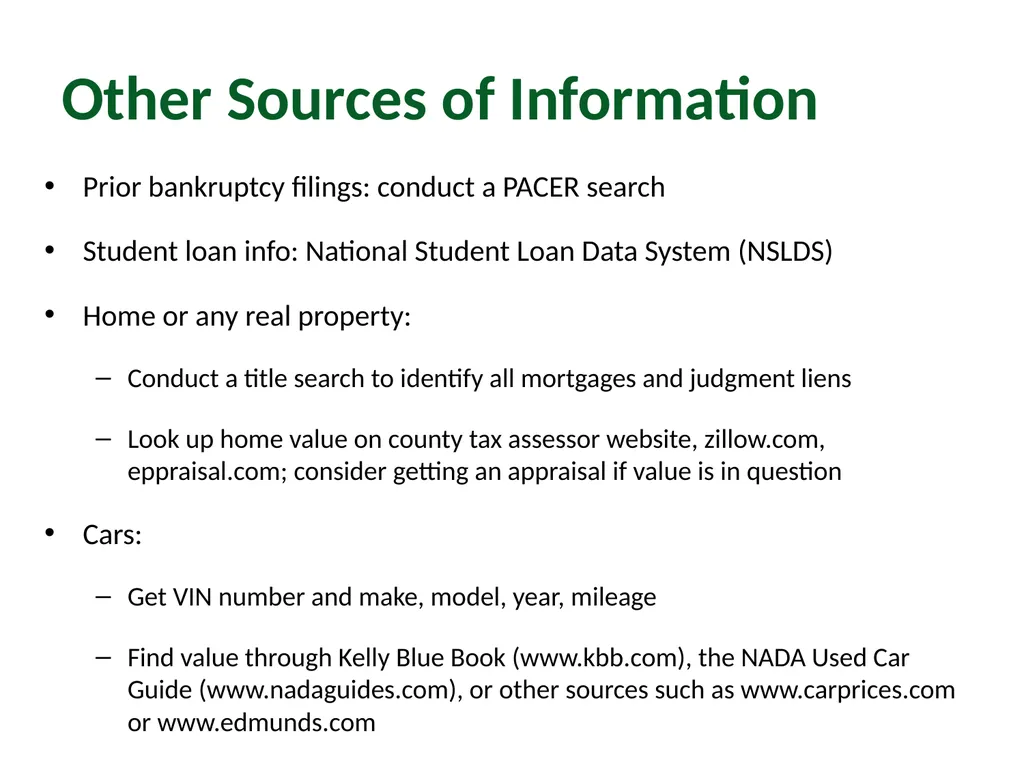
Other Sources of Information Prior bankruptcy filings: conduct a PACER search
Student loan info: National Student Loan Data System (NSLDS)
Home or any real property:
Conduct a title search to identify all mortgages and judgment liens
Look up home value on county tax assessor website, zillow.com, eppraisal.com; consider getting an appraisal if value is in question
Cars:
Get VIN number and make, model, year, mileage
Find value through Kelly Blue Book (www.kbb.com), the NADA Used Car Guide (www.nadaguides.com), or other sources such as www.carprices.com or www.edmunds.com<br>
Student loan info: National Student Loan Data System (NSLDS)
Home or any real property:
Conduct a title search to identify all mortgages and judgment liens
Look up home value on county tax assessor website, zillow.com, eppraisal.com; consider getting an appraisal if value is in question
Cars:
Get VIN number and make, model, year, mileage
Find value through Kelly Blue Book (www.kbb.com), the NADA Used Car Guide (www.nadaguides.com), or other sources such as www.carprices.com or www.edmunds.com<br>
17
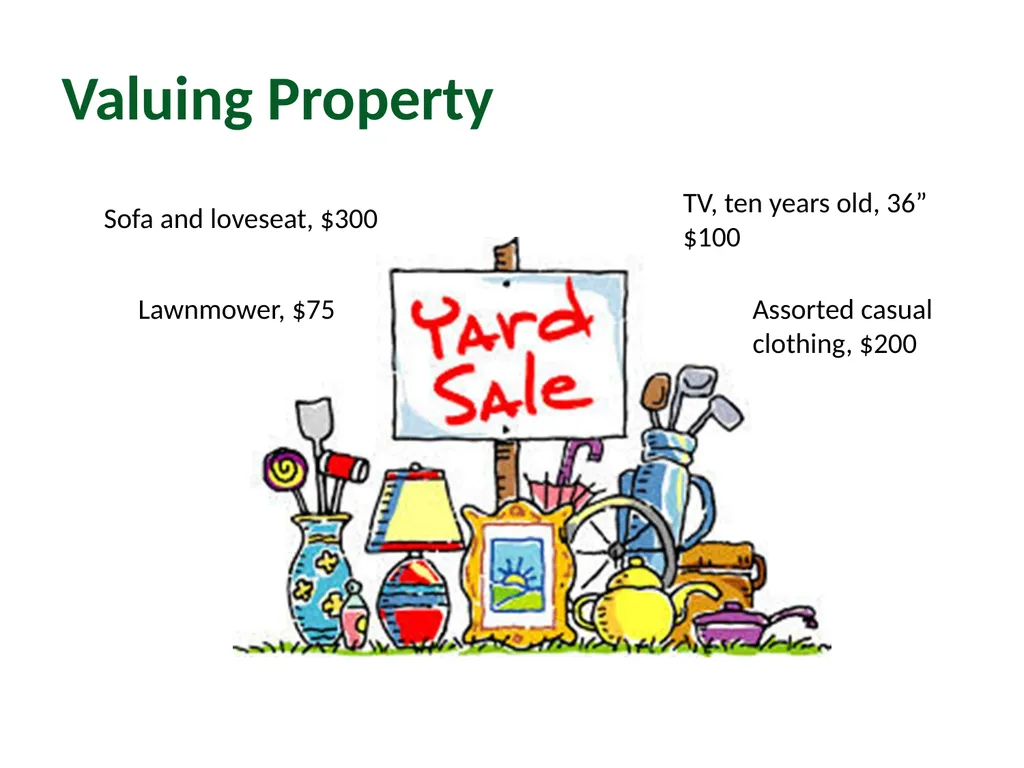
Valuing Property Sofa and loveseat, $300 Lawnmower, $75 TV, ten years old, 36” $100 Assorted casual clothing, $200<br>
18
Application of the
Means Test<br>
19
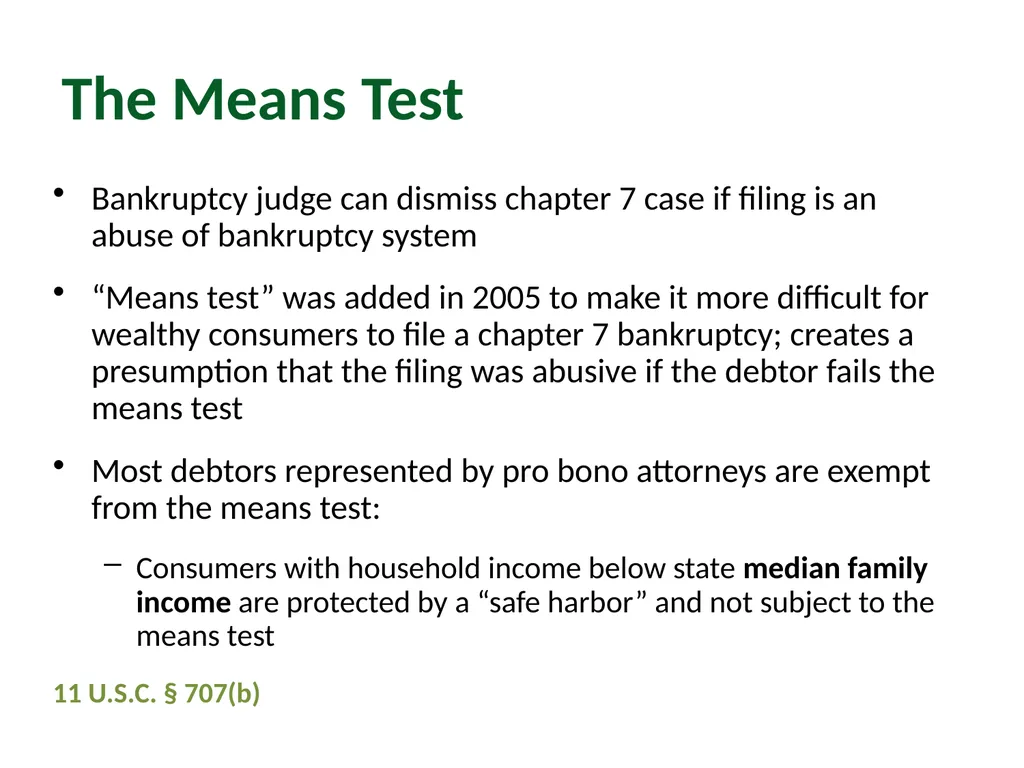
The Means Test Bankruptcy judge can dismiss chapter 7 case if filing is an abuse of bankruptcy system
“Means test” was added in 2005 to make it more difficult for wealthy consumers to file a chapter 7 bankruptcy; creates a presumption that the filing was abusive if the debtor fails the means test
Most debtors represented by pro bono attorneys are exempt from the means test:
Consumers with household income below state median family income are protected by a “safe harbor” and not subject to the means test
11 U.S.C. § 707(b)<br>
“Means test” was added in 2005 to make it more difficult for wealthy consumers to file a chapter 7 bankruptcy; creates a presumption that the filing was abusive if the debtor fails the means test
Most debtors represented by pro bono attorneys are exempt from the means test:
Consumers with household income below state median family income are protected by a “safe harbor” and not subject to the means test
11 U.S.C. § 707(b)<br>
20
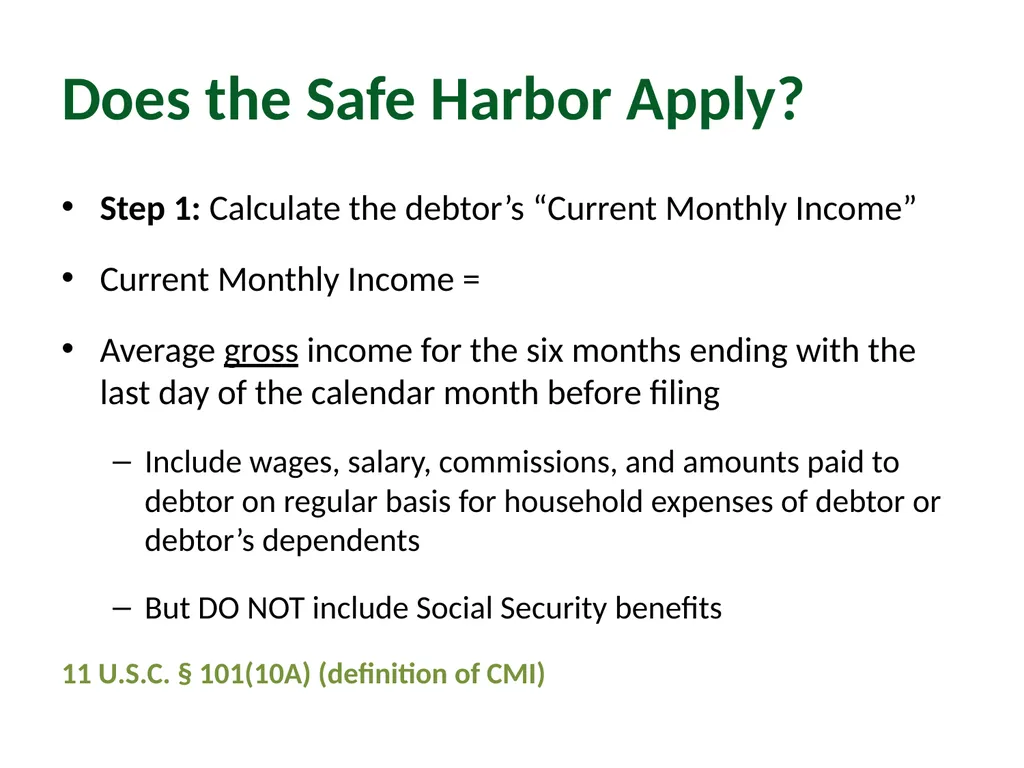
Does the Safe Harbor Apply? Step 1: Calculate the debtor’s “Current Monthly Income”
Current Monthly Income =
Average gross income for the six months ending with the last day of the calendar month before filing
Include wages, salary, commissions, and amounts paid to debtor on regular basis for household expenses of debtor or debtor’s dependents
But DO NOT include Social Security benefits
11 U.S.C. § 101(10A) (definition of CMI)<br>
Current Monthly Income =
Average gross income for the six months ending with the last day of the calendar month before filing
Include wages, salary, commissions, and amounts paid to debtor on regular basis for household expenses of debtor or debtor’s dependents
But DO NOT include Social Security benefits
11 U.S.C. § 101(10A) (definition of CMI)<br>
21
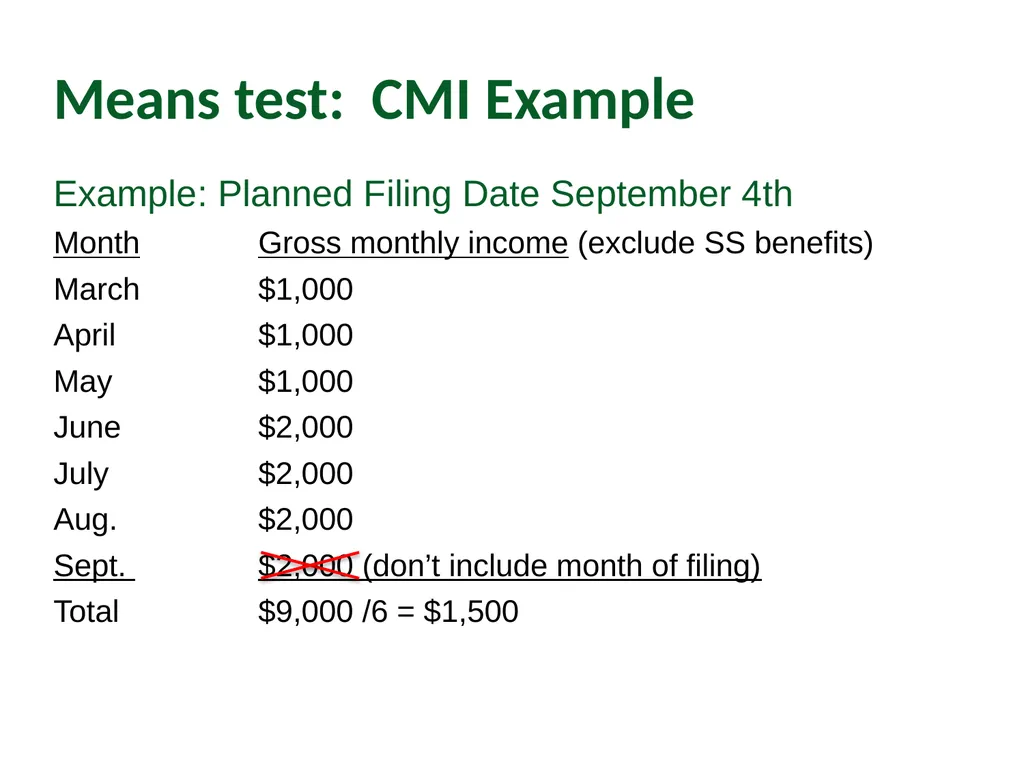
Means test: CMI Example Example: Planned Filing Date September 4th
Month Gross monthly income (exclude SS benefits)
March $1,000
April $1,000
May $1,000
June $2,000
July $2,000
Aug. $2,000
Sept. $2,000 (don’t include month of filing)
Total $9,000 /6 = $1,500<br>
Month Gross monthly income (exclude SS benefits)
March $1,000
April $1,000
May $1,000
June $2,000
July $2,000
Aug. $2,000
Sept. $2,000 (don’t include month of filing)
Total $9,000 /6 = $1,500<br>
22
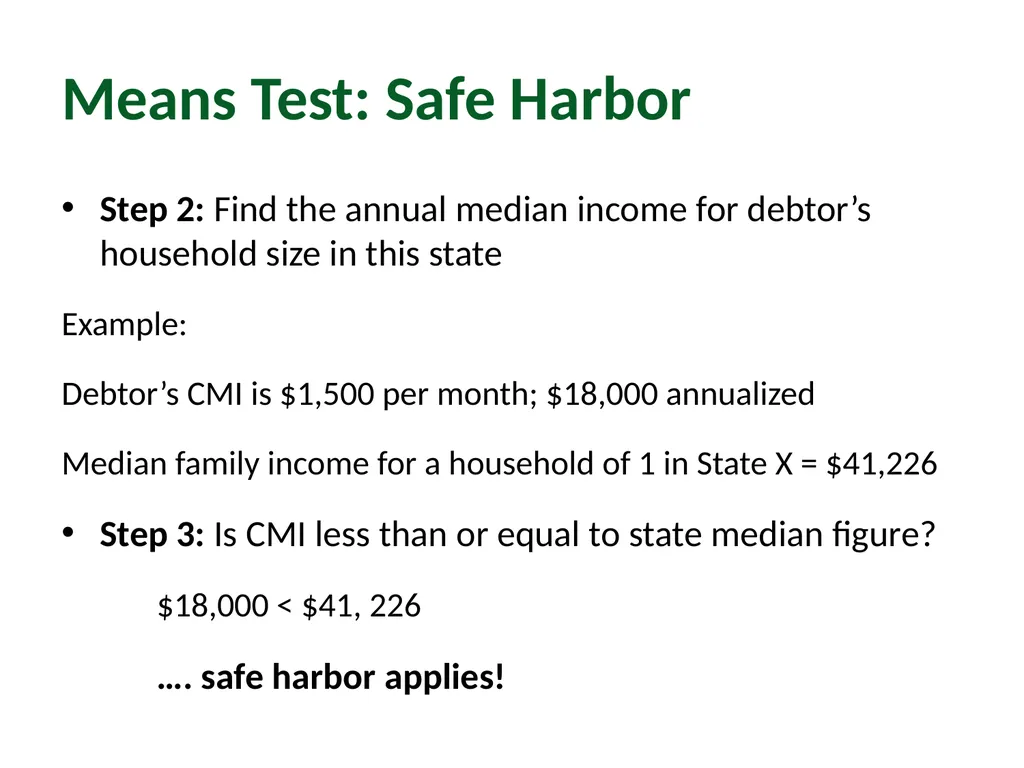
Means Test: Safe Harbor Step 2: Find the annual median income for debtor’s household size in this state
Example:
Debtor’s CMI is $1,500 per month; $18,000 annualized
Median family income for a household of 1 in State X = $41,226
Step 3: Is CMI less than or equal to state median figure?
$18,000 < $41, 226
…. safe harbor applies!<br>
Example:
Debtor’s CMI is $1,500 per month; $18,000 annualized
Median family income for a household of 1 in State X = $41,226
Step 3: Is CMI less than or equal to state median figure?
$18,000 < $41, 226
…. safe harbor applies!<br>
23
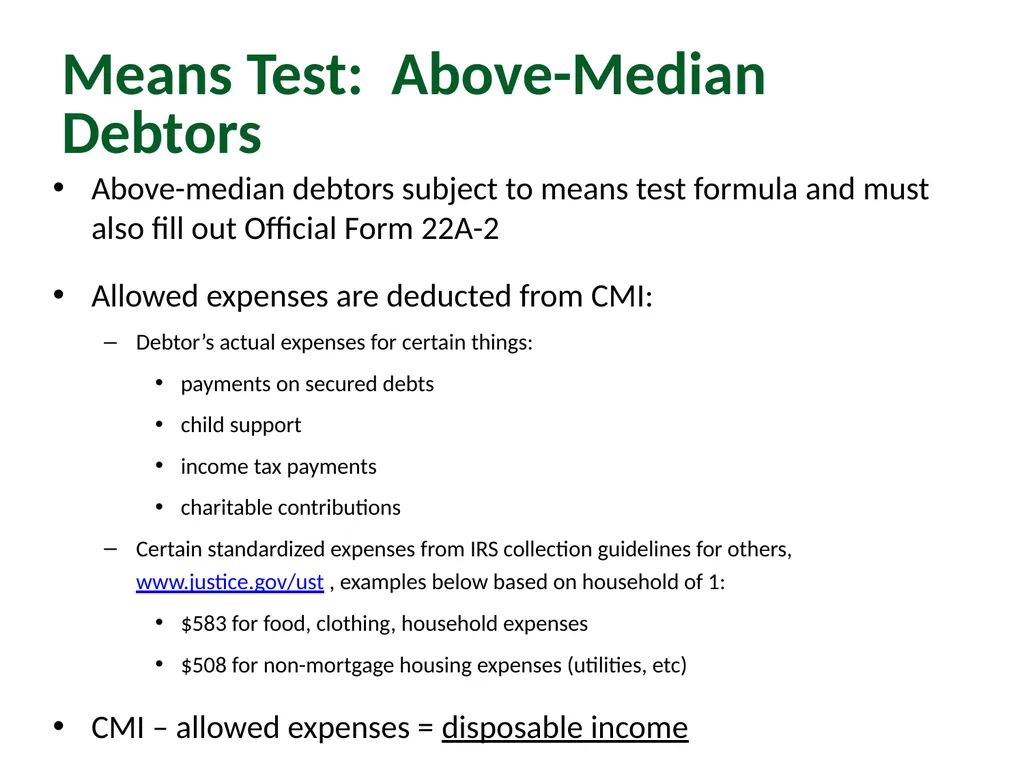
Means Test: Above-Median Debtors Above-median debtors subject to means test formula and must also fill out Official Form 22A-2
Allowed expenses are deducted from CMI:
Debtor’s actual expenses for certain things:
payments on secured debts
child support
income tax payments
charitable contributions
Certain standardized expenses from IRS collection guidelines for others, www.justice.gov/ust , examples below based on household of 1:
$583 for food, clothing, household expenses
$508 for non-mortgage housing expenses (utilities, etc)
CMI – allowed expenses = disposable income<br>
Allowed expenses are deducted from CMI:
Debtor’s actual expenses for certain things:
payments on secured debts
child support
income tax payments
charitable contributions
Certain standardized expenses from IRS collection guidelines for others, www.justice.gov/ust , examples below based on household of 1:
$583 for food, clothing, household expenses
$508 for non-mortgage housing expenses (utilities, etc)
CMI – allowed expenses = disposable income<br>
24
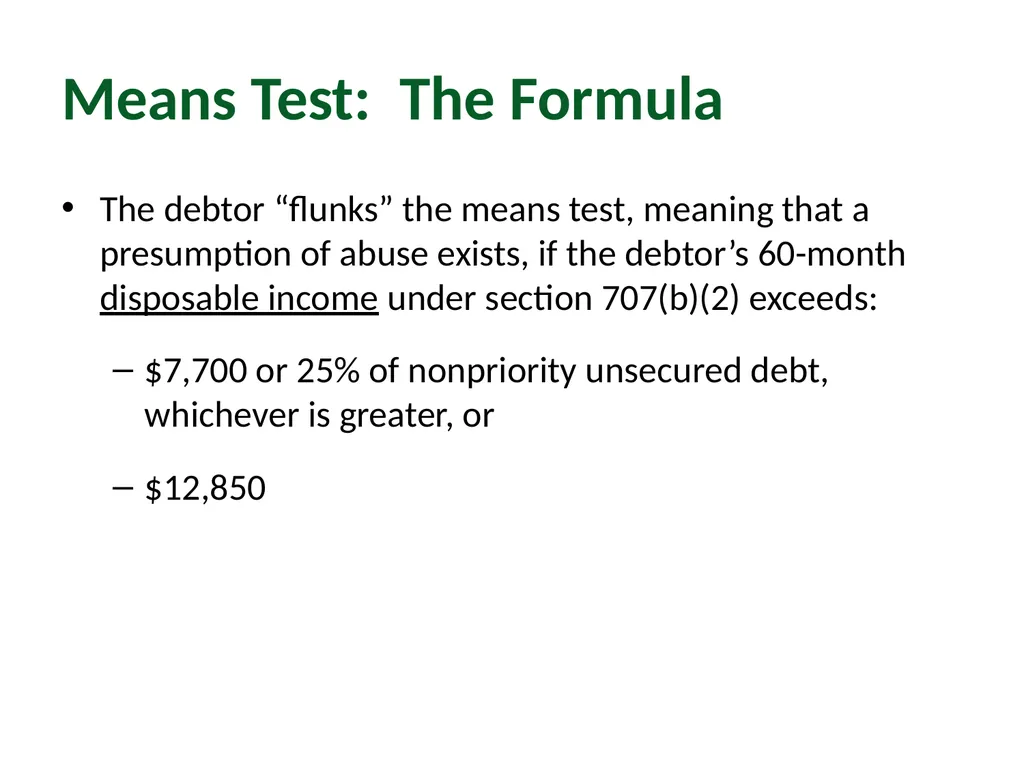
Means Test: The Formula The debtor “flunks” the means test, meaning that a presumption of abuse exists, if the debtor’s 60-month disposable income under section 707(b)(2) exceeds:
$7,700 or 25% of nonpriority unsecured debt, whichever is greater, or
$12,850<br>
$7,700 or 25% of nonpriority unsecured debt, whichever is greater, or
$12,850<br>
25
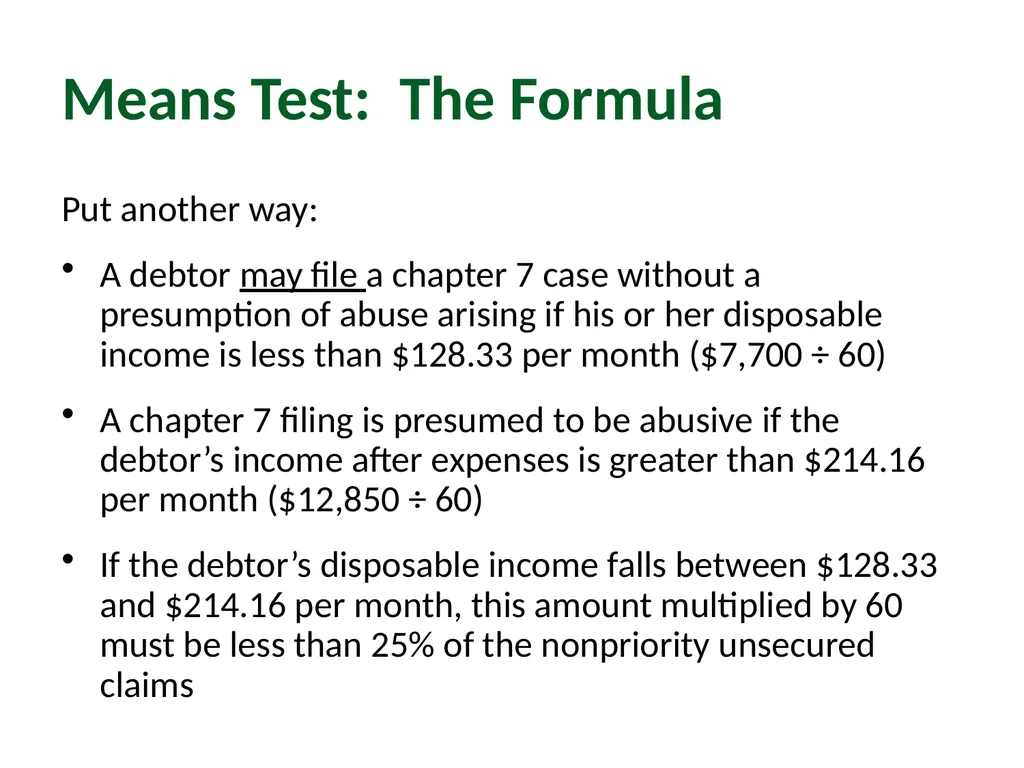
Means Test: The Formula Put another way:
A debtor may file a chapter 7 case without a presumption of abuse arising if his or her disposable income is less than $128.33 per month ($7,700 ÷ 60)
A chapter 7 filing is presumed to be abusive if the debtor’s income after expenses is greater than $214.16 per month ($12,850 ÷ 60)
If the debtor’s disposable income falls between $128.33 and $214.16 per month, this amount multiplied by 60 must be less than 25% of the nonpriority unsecured claims<br>
A debtor may file a chapter 7 case without a presumption of abuse arising if his or her disposable income is less than $128.33 per month ($7,700 ÷ 60)
A chapter 7 filing is presumed to be abusive if the debtor’s income after expenses is greater than $214.16 per month ($12,850 ÷ 60)
If the debtor’s disposable income falls between $128.33 and $214.16 per month, this amount multiplied by 60 must be less than 25% of the nonpriority unsecured claims<br>
26
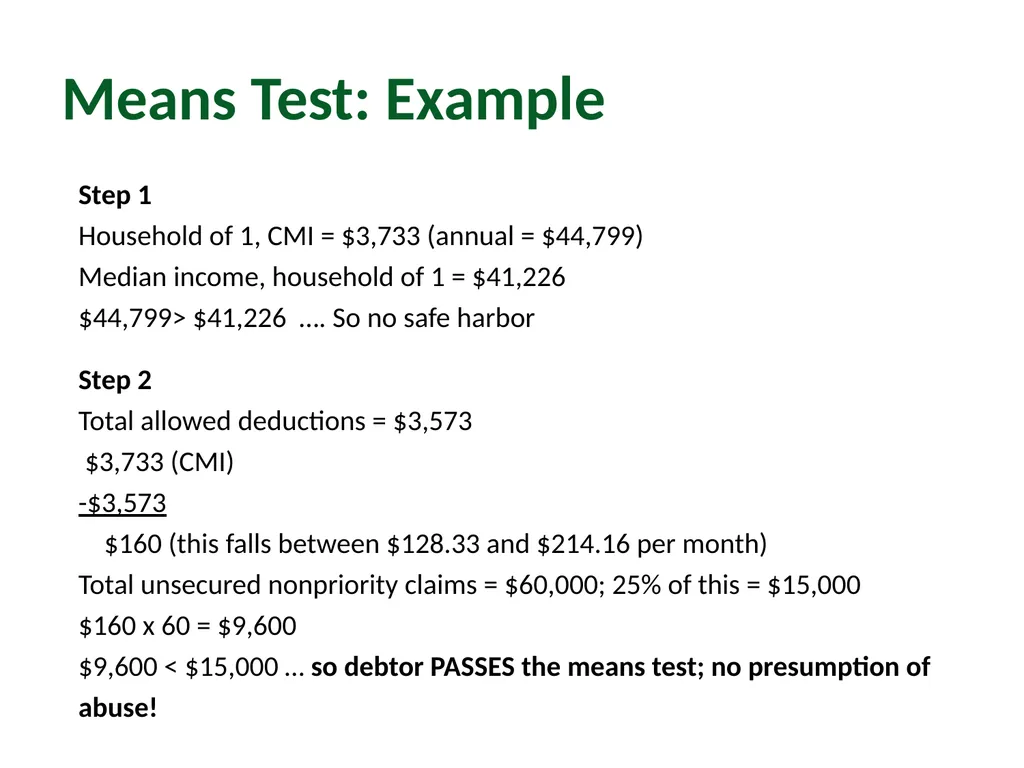
Means Test: Example Step 1
Household of 1, CMI = $3,733 (annual = $44,799)
Median income, household of 1 = $41,226
$44,799> $41,226 …. So no safe harbor
Step 2
Total allowed deductions = $3,573
$3,733 (CMI)
-$3,573
$160 (this falls between $128.33 and $214.16 per month)
Total unsecured nonpriority claims = $60,000; 25% of this = $15,000
$160 x 60 = $9,600
$9,600 < $15,000 … so debtor PASSES the means test; no presumption of abuse!<br>
Household of 1, CMI = $3,733 (annual = $44,799)
Median income, household of 1 = $41,226
$44,799> $41,226 …. So no safe harbor
Step 2
Total allowed deductions = $3,573
$3,733 (CMI)
-$3,573
$160 (this falls between $128.33 and $214.16 per month)
Total unsecured nonpriority claims = $60,000; 25% of this = $15,000
$160 x 60 = $9,600
$9,600 < $15,000 … so debtor PASSES the means test; no presumption of abuse!<br>
27
Choosing the Type of Bankruptcy<br>
28
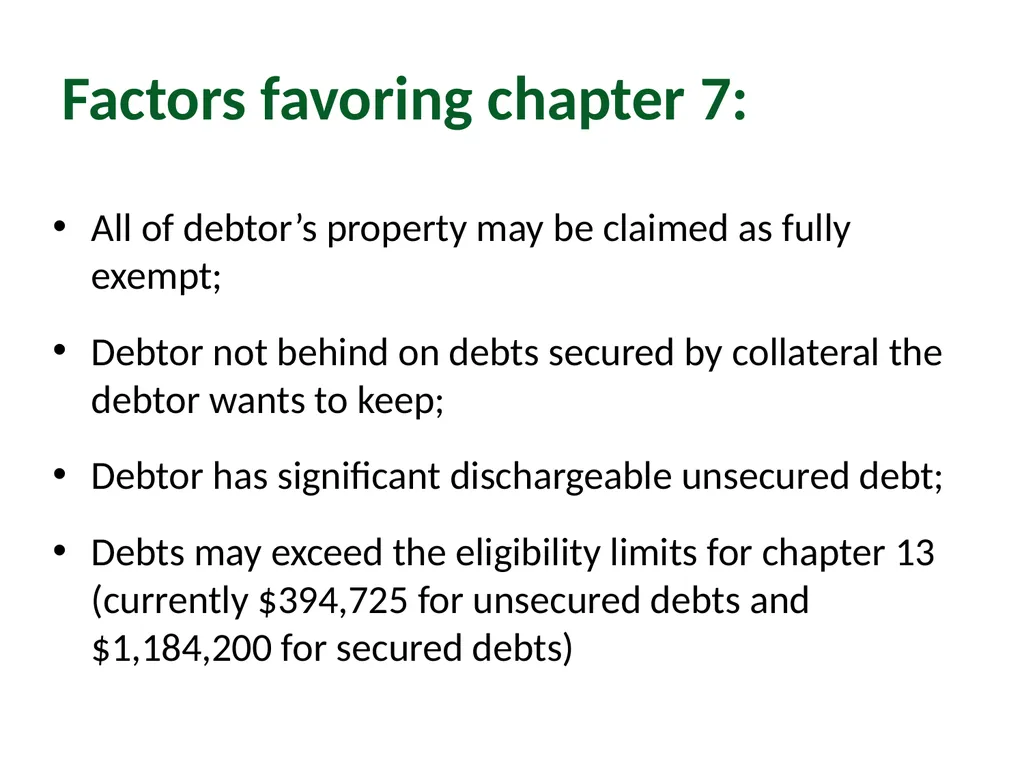
Factors favoring chapter 7: All of debtor’s property may be claimed as fully exempt;
Debtor not behind on debts secured by collateral the debtor wants to keep;
Debtor has significant dischargeable unsecured debt;
Debts may exceed the eligibility limits for chapter 13 (currently $394,725 for unsecured debts and $1,184,200 for secured debts)<br>
Debtor not behind on debts secured by collateral the debtor wants to keep;
Debtor has significant dischargeable unsecured debt;
Debts may exceed the eligibility limits for chapter 13 (currently $394,725 for unsecured debts and $1,184,200 for secured debts)<br>
29
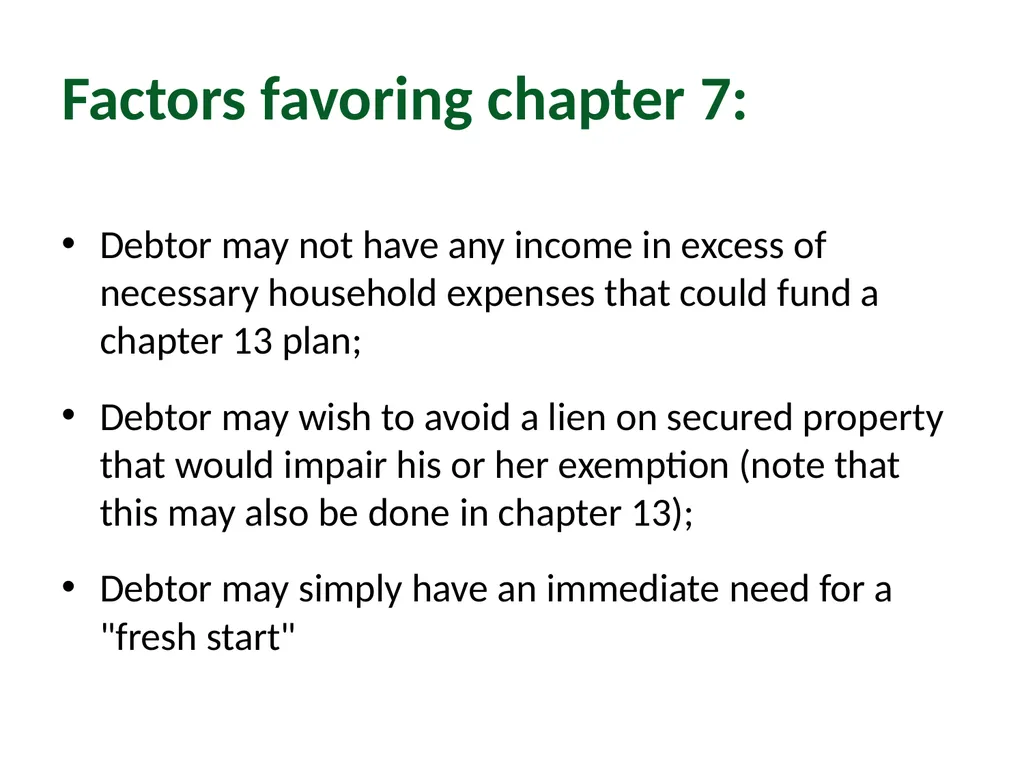
Factors favoring chapter 7: Debtor may not have any income in excess of necessary household expenses that could fund a chapter 13 plan;
Debtor may wish to avoid a lien on secured property that would impair his or her exemption (note that this may also be done in chapter 13);
Debtor may simply have an immediate need for a "fresh start"<br>
Debtor may wish to avoid a lien on secured property that would impair his or her exemption (note that this may also be done in chapter 13);
Debtor may simply have an immediate need for a "fresh start"<br>
30
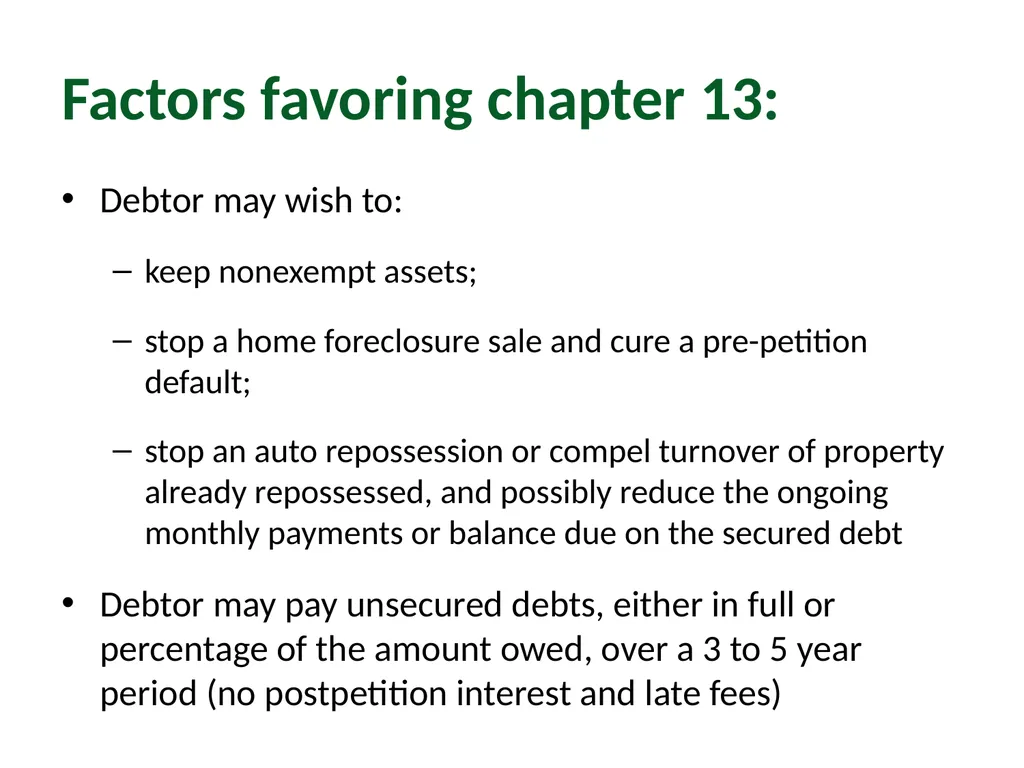
Factors favoring chapter 13: Debtor may wish to:
keep nonexempt assets;
stop a home foreclosure sale and cure a pre-petition default;
stop an auto repossession or compel turnover of property already repossessed, and possibly reduce the ongoing monthly payments or balance due on the secured debt
Debtor may pay unsecured debts, either in full or percentage of the amount owed, over a 3 to 5 year period (no postpetition interest and late fees)<br>
keep nonexempt assets;
stop a home foreclosure sale and cure a pre-petition default;
stop an auto repossession or compel turnover of property already repossessed, and possibly reduce the ongoing monthly payments or balance due on the secured debt
Debtor may pay unsecured debts, either in full or percentage of the amount owed, over a 3 to 5 year period (no postpetition interest and late fees)<br>
31
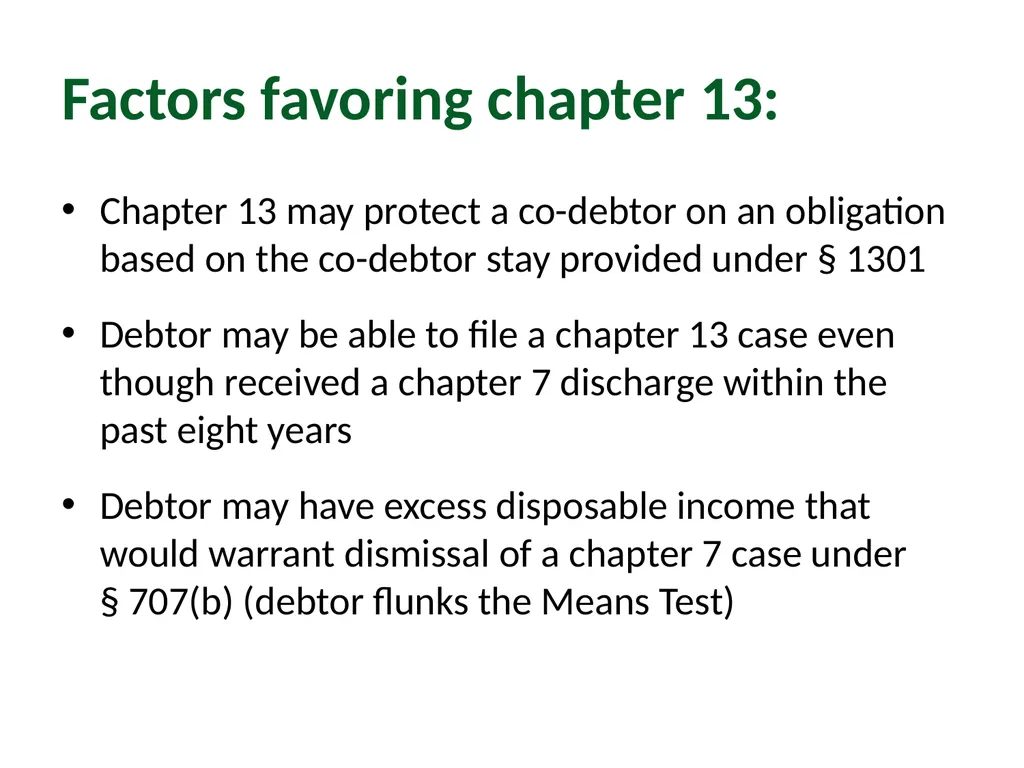
Factors favoring chapter 13: Chapter 13 may protect a co-debtor on an obligation based on the co-debtor stay provided under § 1301
Debtor may be able to file a chapter 13 case even though received a chapter 7 discharge within the past eight years
Debtor may have excess disposable income that would warrant dismissal of a chapter 7 case under § 707(b) (debtor flunks the Means Test)<br>
Debtor may be able to file a chapter 13 case even though received a chapter 7 discharge within the past eight years
Debtor may have excess disposable income that would warrant dismissal of a chapter 7 case under § 707(b) (debtor flunks the Means Test)<br>
32
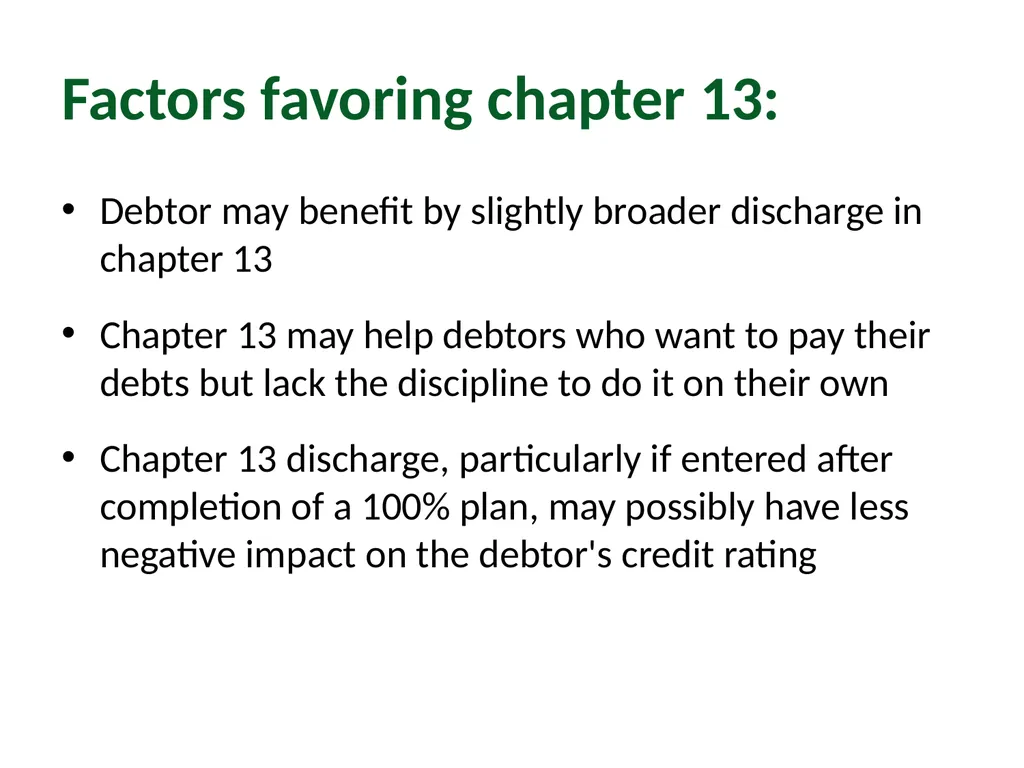
Factors favoring chapter 13: Debtor may benefit by slightly broader discharge in chapter 13
Chapter 13 may help debtors who want to pay their debts but lack the discipline to do it on their own
Chapter 13 discharge, particularly if entered after completion of a 100% plan, may possibly have less negative impact on the debtor's credit rating<br>
Chapter 13 may help debtors who want to pay their debts but lack the discipline to do it on their own
Chapter 13 discharge, particularly if entered after completion of a 100% plan, may possibly have less negative impact on the debtor's credit rating<br>
33
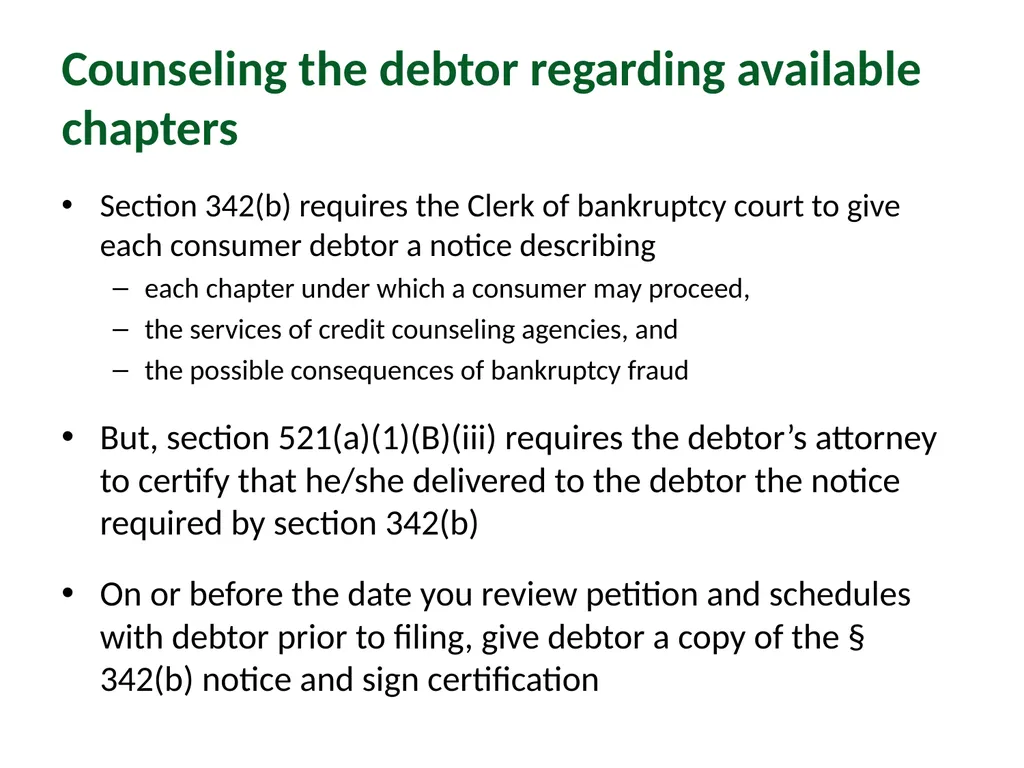
Counseling the debtor regarding available chapters Section 342(b) requires the Clerk of bankruptcy court to give each consumer debtor a notice describing
each chapter under which a consumer may proceed,
the services of credit counseling agencies, and
the possible consequences of bankruptcy fraud
But, section 521(a)(1)(B)(iii) requires the debtor’s attorney to certify that he/she delivered to the debtor the notice required by section 342(b)
On or before the date you review petition and schedules with debtor prior to filing, give debtor a copy of the § 342(b) notice and sign certification<br>
each chapter under which a consumer may proceed,
the services of credit counseling agencies, and
the possible consequences of bankruptcy fraud
But, section 521(a)(1)(B)(iii) requires the debtor’s attorney to certify that he/she delivered to the debtor the notice required by section 342(b)
On or before the date you review petition and schedules with debtor prior to filing, give debtor a copy of the § 342(b) notice and sign certification<br>
34
Timing Considerations<br>
35
Reasons to wait: Has the debt peaked?<br>
36
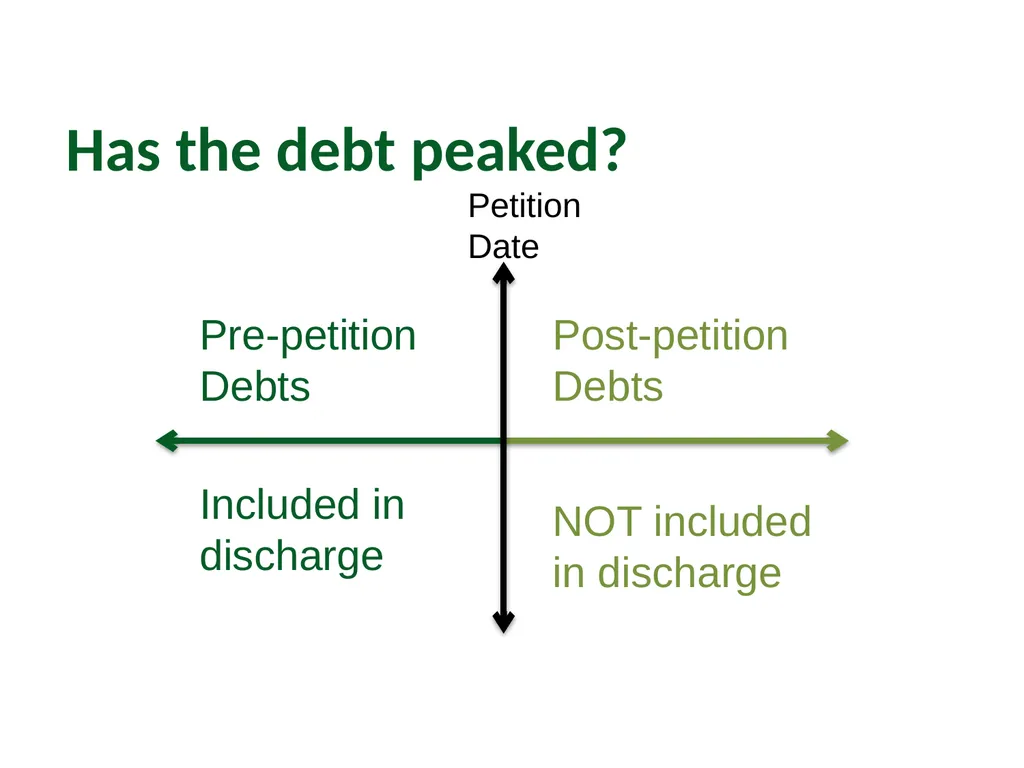
Has the debt peaked? Pre-petition Debts Post-petition Debts Included in discharge NOT included in discharge Petition Date<br>
37
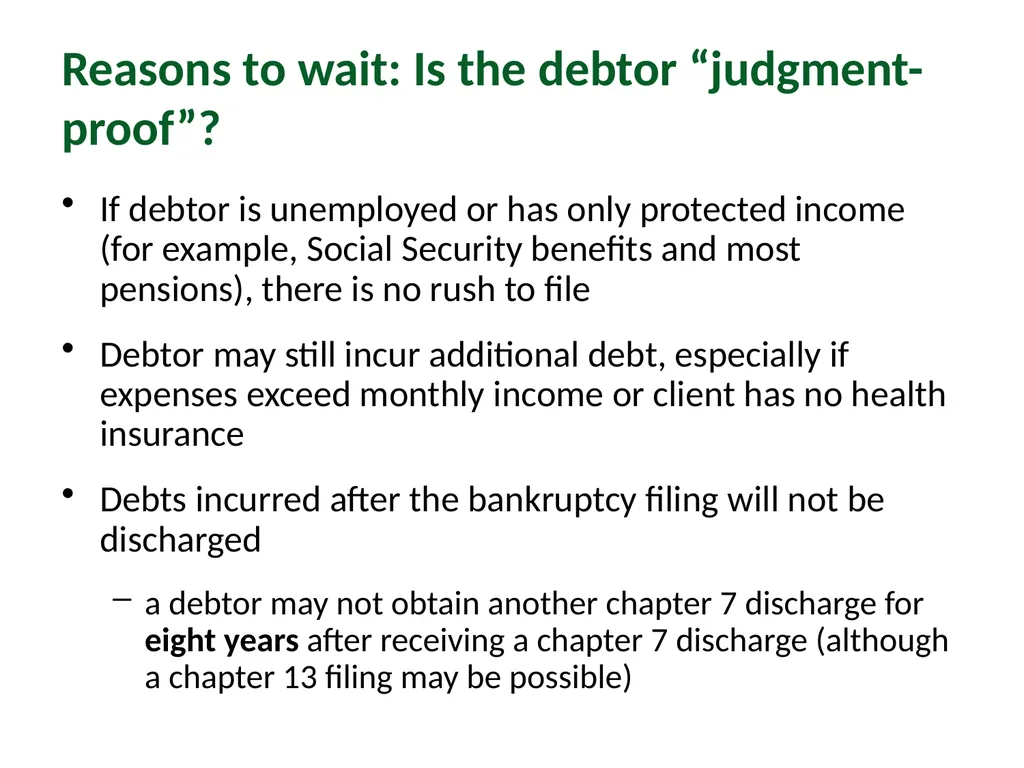
Reasons to wait: Is the debtor “judgment-proof”? If debtor is unemployed or has only protected income (for example, Social Security benefits and most pensions), there is no rush to file
Debtor may still incur additional debt, especially if expenses exceed monthly income or client has no health insurance
Debts incurred after the bankruptcy filing will not be discharged
a debtor may not obtain another chapter 7 discharge for eight years after receiving a chapter 7 discharge (although a chapter 13 filing may be possible)<br>
Debtor may still incur additional debt, especially if expenses exceed monthly income or client has no health insurance
Debts incurred after the bankruptcy filing will not be discharged
a debtor may not obtain another chapter 7 discharge for eight years after receiving a chapter 7 discharge (although a chapter 13 filing may be possible)<br>
38
Other reasons to wait Tax debts that may become dischargeable
Different state exemptions may apply if debtor has moved recently
Ability to use nonexempt assets prior to filing
Dismissal of one or more prior bankruptcy case(s) within past year (resulting in a limit on the automatic stay)<br>
Different state exemptions may apply if debtor has moved recently
Ability to use nonexempt assets prior to filing
Dismissal of one or more prior bankruptcy case(s) within past year (resulting in a limit on the automatic stay)<br>
39
Other reasons to wait Gift or transfer of property within past 2 years (or longer, depending on state fraudulent transfer statute)
Debtor’s “CMI” will be lower, resulting in safe harbor (debtor’s income has gone down)
*If you advise client to wait, make sure to explain that the debtor should not incur debts she has no intention to pay – may be declared nondischargeable!<br>
Debtor’s “CMI” will be lower, resulting in safe harbor (debtor’s income has gone down)
*If you advise client to wait, make sure to explain that the debtor should not incur debts she has no intention to pay – may be declared nondischargeable!<br>
40
Other reasons to wait Consider waiting if debtor has within past 90 days:
made payments to an unsecured creditor totaling more than $600 that would be preference under section 547
Consider waiting if debtor has within past 1 year:
made payments to insider totaling more than $600 that would be preference under section 547
Consider waiting if debtor has within past 2 years (or longer under state statutes):
transferred property when debtor was insolvent and did not receive reasonably equivalent value for the transfer
transferred property with intent to hinder, delay, or defraud a creditor
11 U.S.C. §§ 544, 547 and 548<br>
made payments to an unsecured creditor totaling more than $600 that would be preference under section 547
Consider waiting if debtor has within past 1 year:
made payments to insider totaling more than $600 that would be preference under section 547
Consider waiting if debtor has within past 2 years (or longer under state statutes):
transferred property when debtor was insolvent and did not receive reasonably equivalent value for the transfer
transferred property with intent to hinder, delay, or defraud a creditor
11 U.S.C. §§ 544, 547 and 548<br>
41
Reasons to file quickly Stop a foreclosure
Stop a car repossession
Stop a garnishment (and possibly get back funds garnished within past 90 days)
Avoid loss of redemption rights and expiration of statute of limitations
CMI will be higher if you wait, creating a Means Test problem (debtor’s income is going up)<br>
Stop a car repossession
Stop a garnishment (and possibly get back funds garnished within past 90 days)
Avoid loss of redemption rights and expiration of statute of limitations
CMI will be higher if you wait, creating a Means Test problem (debtor’s income is going up)<br>
42
Timing: income tax refunds The right to receive an income tax refund is an asset, and thus property of the bankruptcy estate
Trustee may try to go after the amount of the refund that has been earned as of the petition date (dividing total refund by 12, multiply by number of months prior to filing)
Can the debtor fully exempt the expected refund?
If not, it might be better to wait until debtor can receive the money and spend it before filing on ordinary expenses and exempt property<br>
Trustee may try to go after the amount of the refund that has been earned as of the petition date (dividing total refund by 12, multiply by number of months prior to filing)
Can the debtor fully exempt the expected refund?
If not, it might be better to wait until debtor can receive the money and spend it before filing on ordinary expenses and exempt property<br>
43
Income taxes: Can you discharge them? Taxes owed for a particular tax year may be discharged if ALL three of the following conditions apply:
1) Three-Year “Due Date” Rule: A return for the tax year in question was last due more than three years before the bankruptcy filing date. 11 U.S.C. § 507(a)(8)(A)(i)
Date is usually April 15 of year following year in question (unless debtor obtained an extension to file the return or due date was extended by IRS based on natural disaster, etc.)
Example: return for 2013 was last due April 15, 2014
2) Two-Year “Filing Date” Rule: A return for the tax year in question was filed more than two years before the bankruptcy filing date. 11 U.S.C. § 523(a)(1)(B)(ii) and § 1328(a)(2)<br>
1) Three-Year “Due Date” Rule: A return for the tax year in question was last due more than three years before the bankruptcy filing date. 11 U.S.C. § 507(a)(8)(A)(i)
Date is usually April 15 of year following year in question (unless debtor obtained an extension to file the return or due date was extended by IRS based on natural disaster, etc.)
Example: return for 2013 was last due April 15, 2014
2) Two-Year “Filing Date” Rule: A return for the tax year in question was filed more than two years before the bankruptcy filing date. 11 U.S.C. § 523(a)(1)(B)(ii) and § 1328(a)(2)<br>
44
Income taxes: Can you discharge them? 3) 240-Day “Assessment” Rule: The tax was assessed more than 240 days before the bankruptcy filing date. 11 U.S.C. § 507(a)(8)(A)(ii)
Certain events may extend this 240-day period:
Any time during which an offer in compromise with respect to the tax was pending or in effect, plus 30 days, is not counted towards the 240-day period.
Any time during which collection of the tax was stayed by a prior bankruptcy case or a request for an IRS due-process hearing, plus 90 days, is also not counted towards the 240-day period (and this 90-day tolling period also applies to the three-year rule).
The assessment date is typically noted on the IRS tax transcript. If an amended tax return is filed, a new 240-day period begins for any additional taxes assessed.<br>
Certain events may extend this 240-day period:
Any time during which an offer in compromise with respect to the tax was pending or in effect, plus 30 days, is not counted towards the 240-day period.
Any time during which collection of the tax was stayed by a prior bankruptcy case or a request for an IRS due-process hearing, plus 90 days, is also not counted towards the 240-day period (and this 90-day tolling period also applies to the three-year rule).
The assessment date is typically noted on the IRS tax transcript. If an amended tax return is filed, a new 240-day period begins for any additional taxes assessed.<br>
45
Income taxes: Can you discharge them? Finally, taxes are still not dischargeable (even if you pass the 3-prong test) if:
Fraudulent Return. The debtor filed a fraudulent return for the year in question. 11 U.S.C. § 523(a)(1)(C) and § 1328(a)(2)
Willful Tax Evasion. The debtor willfully attempted to defeat or evade the tax. 11 U.S.C. § 523(a)(1)(C) and § 1328(a)(2)
Even if dischargeable, are they secured?? Check for a tax lien!
Are they a priority debt? (If so, they must be fully paid in the plan if debtor is filing under chapter 13)<br>
Fraudulent Return. The debtor filed a fraudulent return for the year in question. 11 U.S.C. § 523(a)(1)(C) and § 1328(a)(2)
Willful Tax Evasion. The debtor willfully attempted to defeat or evade the tax. 11 U.S.C. § 523(a)(1)(C) and § 1328(a)(2)
Even if dischargeable, are they secured?? Check for a tax lien!
Are they a priority debt? (If so, they must be fully paid in the plan if debtor is filing under chapter 13)<br>
46
Emergency filing Sometimes a client comes to you on the eve of foreclosure, garnishment, or repossession, and you may have to file quickly<br>
47
Emergency filing Debtor can initiate the bankruptcy case with a “skeletal filing,” including:
Petition and Exhibit D (credit counseling completed)
Creditor matrix
Statement of SS #
Filing fee (or request for waiver/motion to pay in installments)
Even in an emergency, ask the client the basic questions first, so that you can advise client about whether the bankruptcy filing is in the client’s best interest (and check for prior filings)
Bankruptcy Rule 1007(c)<br>
Petition and Exhibit D (credit counseling completed)
Creditor matrix
Statement of SS #
Filing fee (or request for waiver/motion to pay in installments)
Even in an emergency, ask the client the basic questions first, so that you can advise client about whether the bankruptcy filing is in the client’s best interest (and check for prior filings)
Bankruptcy Rule 1007(c)<br>
48
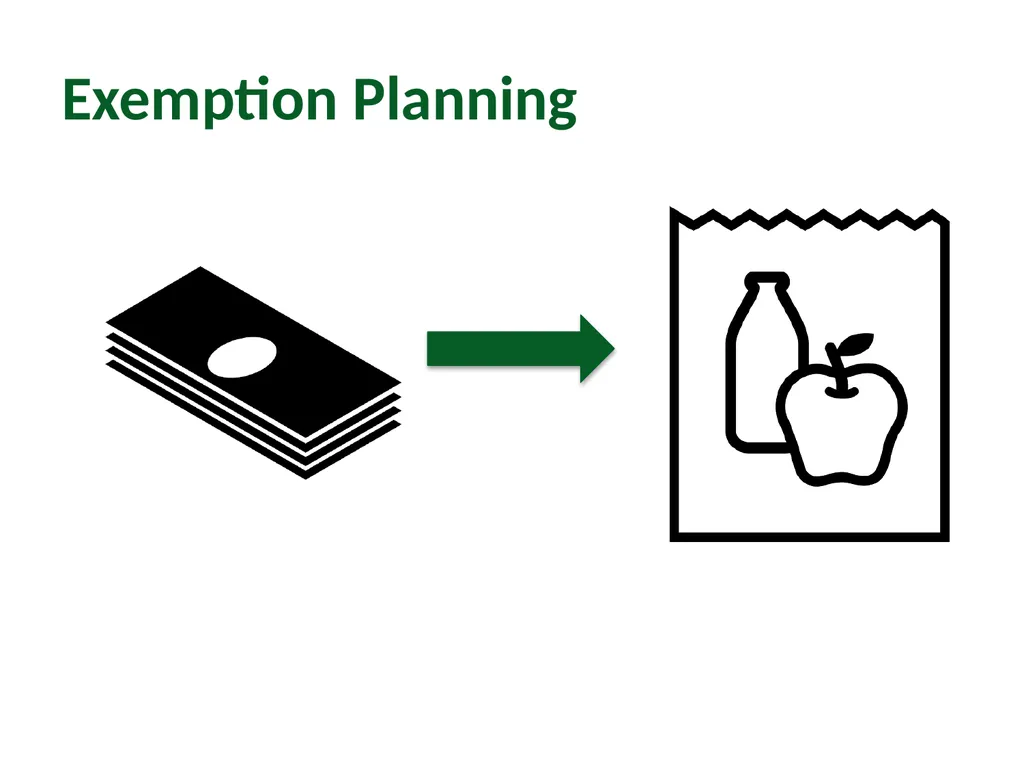
Exemption Planning<br>
49
Counseling and Bankruptcy
Filing Fees<br>
50
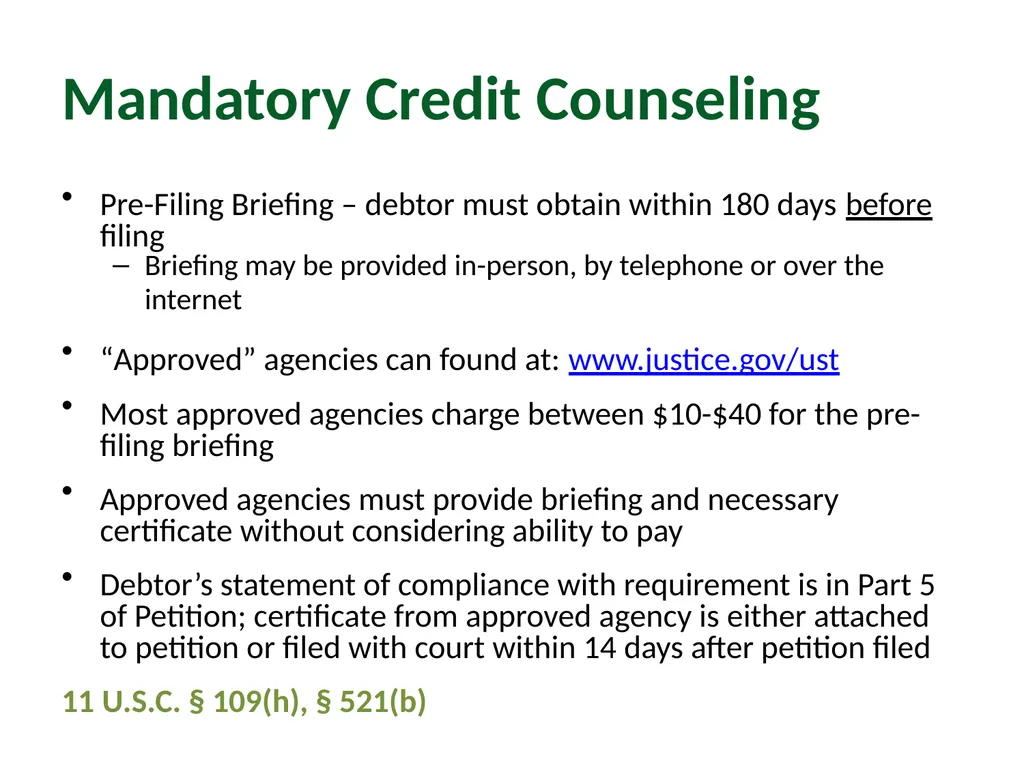
Mandatory Credit Counseling Pre-Filing Briefing – debtor must obtain within 180 days before filing
Briefing may be provided in-person, by telephone or over the internet
“Approved” agencies can found at: www.justice.gov/ust
Most approved agencies charge between $10-$40 for the pre-filing briefing
Approved agencies must provide briefing and necessary certificate without considering ability to pay
Debtor’s statement of compliance with requirement is in Part 5 of Petition; certificate from approved agency is either attached to petition or filed with court within 14 days after petition filed
11 U.S.C. § 109(h), § 521(b)<br>
Briefing may be provided in-person, by telephone or over the internet
“Approved” agencies can found at: www.justice.gov/ust
Most approved agencies charge between $10-$40 for the pre-filing briefing
Approved agencies must provide briefing and necessary certificate without considering ability to pay
Debtor’s statement of compliance with requirement is in Part 5 of Petition; certificate from approved agency is either attached to petition or filed with court within 14 days after petition filed
11 U.S.C. § 109(h), § 521(b)<br>
51
Waiver of counseling – limited! Waiver motion may be granted if debtor is
disabled,
incapacitated, or
on active military duty in combat zone
Incapacity and disability narrowly defined:
incapacity - “...incapable of realizing and making rational decisions with respect to his financial responsibilities”
disability - “...debtor is so physically impaired as to be unable, after reasonable effort, to participate in ... briefing”
Risky - if denied, case will be dismissed!
11 U.S.C. § 109(h)(3)<br>
disabled,
incapacitated, or
on active military duty in combat zone
Incapacity and disability narrowly defined:
incapacity - “...incapable of realizing and making rational decisions with respect to his financial responsibilities”
disability - “...debtor is so physically impaired as to be unable, after reasonable effort, to participate in ... briefing”
Risky - if denied, case will be dismissed!
11 U.S.C. § 109(h)(3)<br>
52
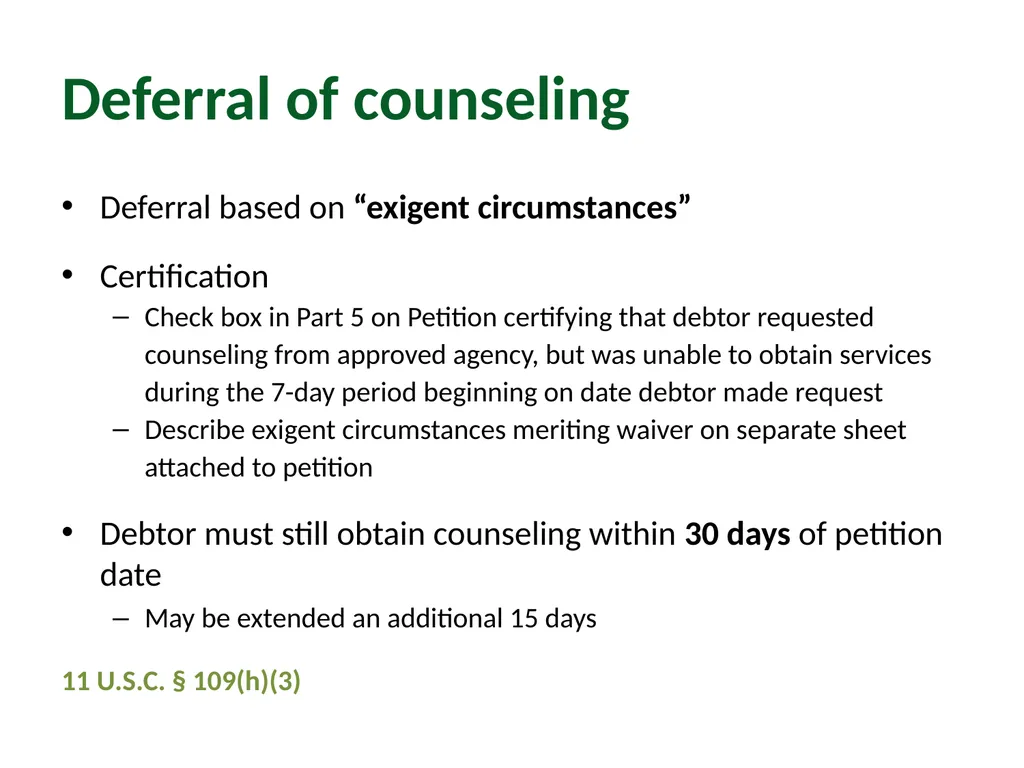
Deferral of counseling Deferral based on “exigent circumstances”
Certification
Check box in Part 5 on Petition certifying that debtor requested counseling from approved agency, but was unable to obtain services during the 7-day period beginning on date debtor made request
Describe exigent circumstances meriting waiver on separate sheet attached to petition
Debtor must still obtain counseling within 30 days of petition date
May be extended an additional 15 days
11 U.S.C. § 109(h)(3)<br>
Certification
Check box in Part 5 on Petition certifying that debtor requested counseling from approved agency, but was unable to obtain services during the 7-day period beginning on date debtor made request
Describe exigent circumstances meriting waiver on separate sheet attached to petition
Debtor must still obtain counseling within 30 days of petition date
May be extended an additional 15 days
11 U.S.C. § 109(h)(3)<br>
53
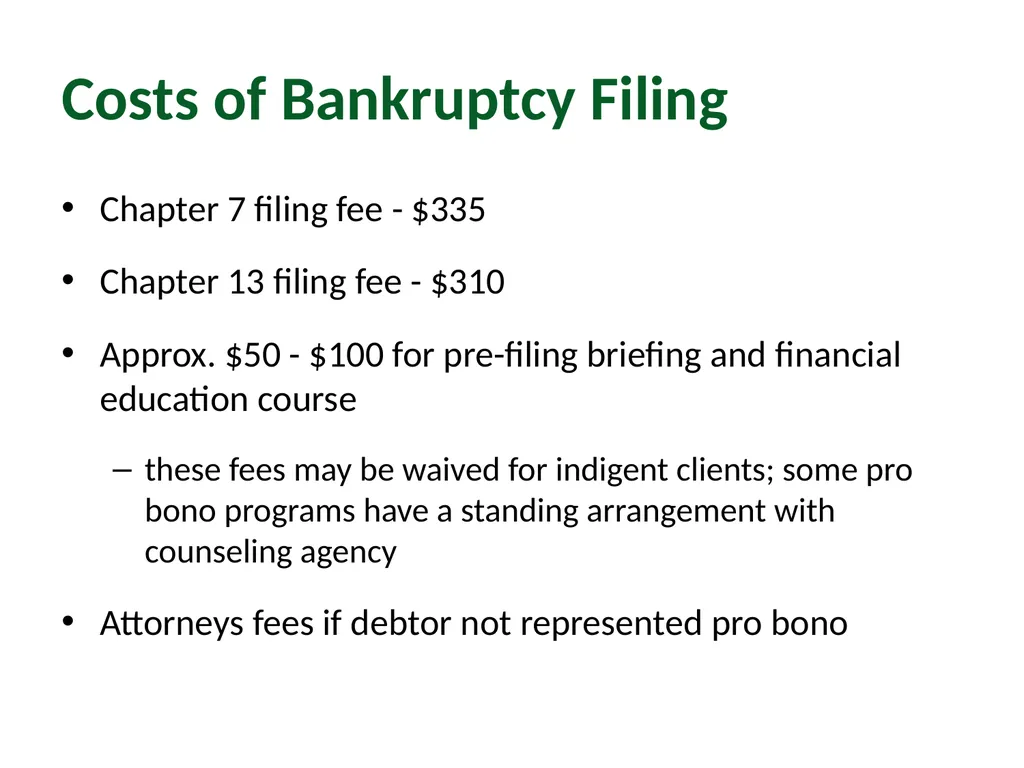
Costs of Bankruptcy Filing Chapter 7 filing fee - $335
Chapter 13 filing fee - $310
Approx. $50 - $100 for pre-filing briefing and financial education course
these fees may be waived for indigent clients; some pro bono programs have a standing arrangement with counseling agency
Attorneys fees if debtor not represented pro bono<br>
Chapter 13 filing fee - $310
Approx. $50 - $100 for pre-filing briefing and financial education course
these fees may be waived for indigent clients; some pro bono programs have a standing arrangement with counseling agency
Attorneys fees if debtor not represented pro bono<br>
54
Other bankruptcy costs Additional court fees after case is filed:
such as for motion to add creditors, convert chapter 13 case to chapter 7
but no filing fee for debtor to file complaint in an adversary proceeding
See Bankruptcy Court Miscellaneous Fee Schedule (online)
Chapter 13 trustee gets commission of up to 10% of the payments disbursed under the plan
Utility deposits:
debtor may have to provide “adequate assurance of future payments” within 20 days after the bankruptcy case is filed in order to continue service
usually in the form of a deposit, in an amount that is twice the average monthly bill
11 U.S.C. § 366<br>
such as for motion to add creditors, convert chapter 13 case to chapter 7
but no filing fee for debtor to file complaint in an adversary proceeding
See Bankruptcy Court Miscellaneous Fee Schedule (online)
Chapter 13 trustee gets commission of up to 10% of the payments disbursed under the plan
Utility deposits:
debtor may have to provide “adequate assurance of future payments” within 20 days after the bankruptcy case is filed in order to continue service
usually in the form of a deposit, in an amount that is twice the average monthly bill
11 U.S.C. § 366<br>
55
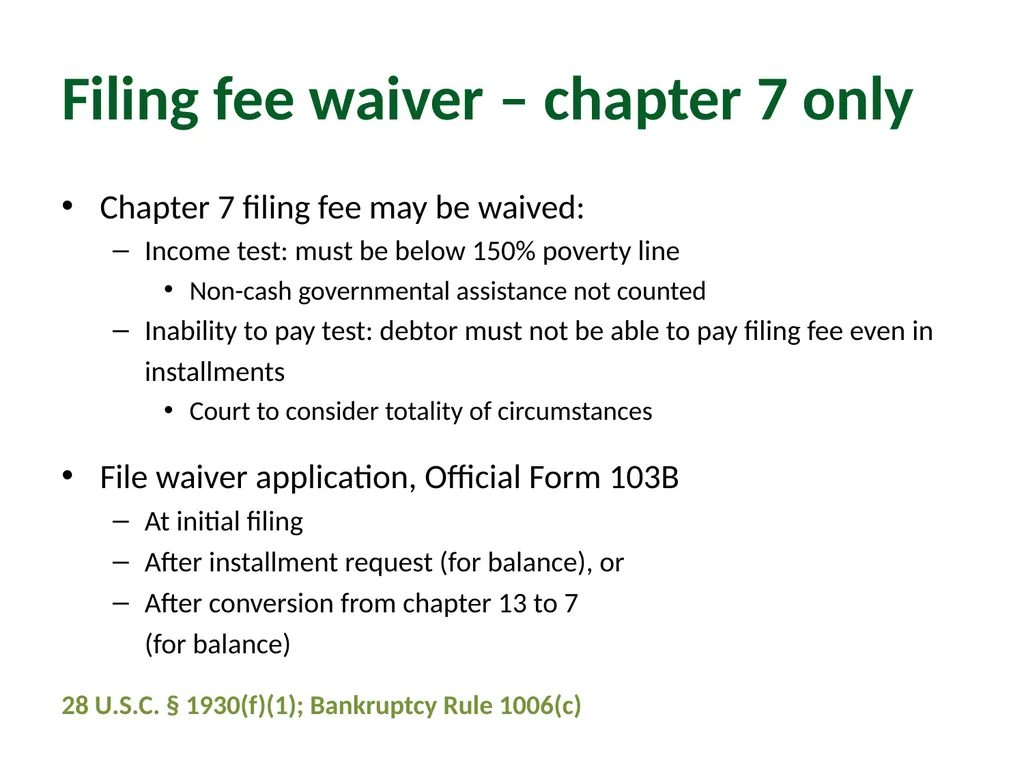
Filing fee waiver – chapter 7 only Chapter 7 filing fee may be waived:
Income test: must be below 150% poverty line
Non-cash governmental assistance not counted
Inability to pay test: debtor must not be able to pay filing fee even in installments
Court to consider totality of circumstances
File waiver application, Official Form 103B
At initial filing
After installment request (for balance), or
After conversion from chapter 13 to 7 (for balance)
28 U.S.C. § 1930(f)(1); Bankruptcy Rule 1006(c)<br>
Income test: must be below 150% poverty line
Non-cash governmental assistance not counted
Inability to pay test: debtor must not be able to pay filing fee even in installments
Court to consider totality of circumstances
File waiver application, Official Form 103B
At initial filing
After installment request (for balance), or
After conversion from chapter 13 to 7 (for balance)
28 U.S.C. § 1930(f)(1); Bankruptcy Rule 1006(c)<br>
56
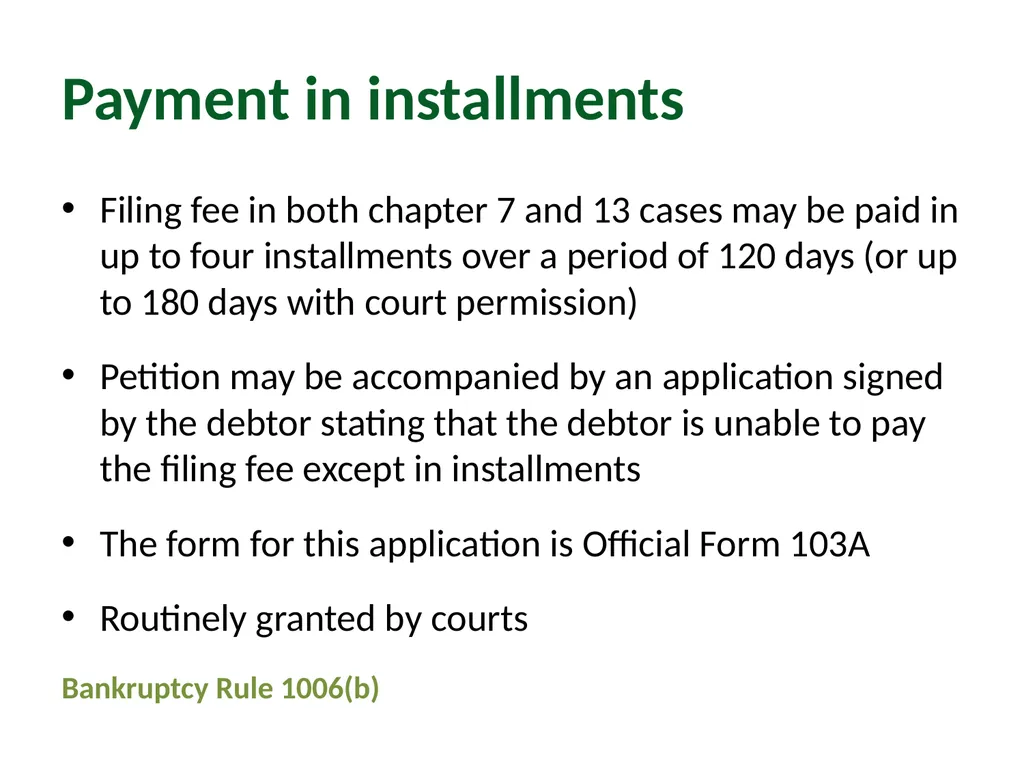
Payment in installments Filing fee in both chapter 7 and 13 cases may be paid in up to four installments over a period of 120 days (or up to 180 days with court permission)
Petition may be accompanied by an application signed by the debtor stating that the debtor is unable to pay the filing fee except in installments
The form for this application is Official Form 103A
Routinely granted by courts
Bankruptcy Rule 1006(b)<br>
Petition may be accompanied by an application signed by the debtor stating that the debtor is unable to pay the filing fee except in installments
The form for this application is Official Form 103A
Routinely granted by courts
Bankruptcy Rule 1006(b)<br>
57
Attorney-Client Relationship<br>
58
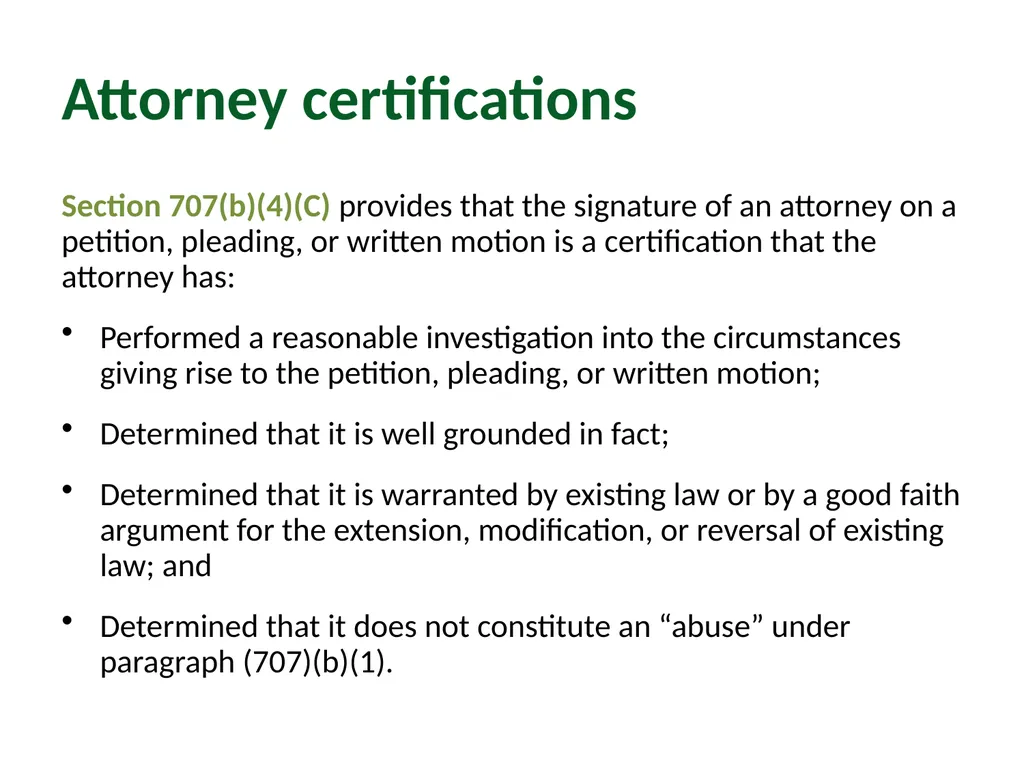
Attorney certifications Section 707(b)(4)(C) provides that the signature of an attorney on a petition, pleading, or written motion is a certification that the attorney has:
Performed a reasonable investigation into the circumstances giving rise to the petition, pleading, or written motion;
Determined that it is well grounded in fact;
Determined that it is warranted by existing law or by a good faith argument for the extension, modification, or reversal of existing law; and
Determined that it does not constitute an “abuse” under paragraph (707)(b)(1).<br>
Performed a reasonable investigation into the circumstances giving rise to the petition, pleading, or written motion;
Determined that it is well grounded in fact;
Determined that it is warranted by existing law or by a good faith argument for the extension, modification, or reversal of existing law; and
Determined that it does not constitute an “abuse” under paragraph (707)(b)(1).<br>
59
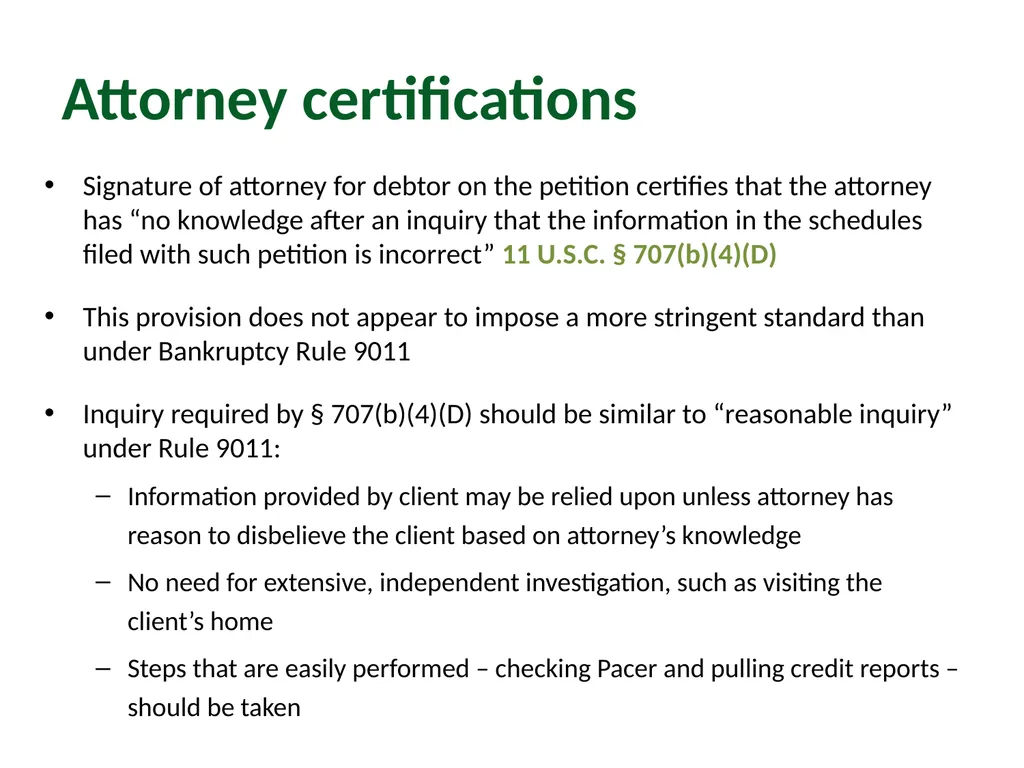
Attorney certifications Signature of attorney for debtor on the petition certifies that the attorney has “no knowledge after an inquiry that the information in the schedules filed with such petition is incorrect” 11 U.S.C. § 707(b)(4)(D)
This provision does not appear to impose a more stringent standard than under Bankruptcy Rule 9011
Inquiry required by § 707(b)(4)(D) should be similar to “reasonable inquiry” under Rule 9011:
Information provided by client may be relied upon unless attorney has reason to disbelieve the client based on attorney’s knowledge
No need for extensive, independent investigation, such as visiting the client’s home
Steps that are easily performed – checking Pacer and pulling credit reports – should be taken<br>
This provision does not appear to impose a more stringent standard than under Bankruptcy Rule 9011
Inquiry required by § 707(b)(4)(D) should be similar to “reasonable inquiry” under Rule 9011:
Information provided by client may be relied upon unless attorney has reason to disbelieve the client based on attorney’s knowledge
No need for extensive, independent investigation, such as visiting the client’s home
Steps that are easily performed – checking Pacer and pulling credit reports – should be taken<br>
60
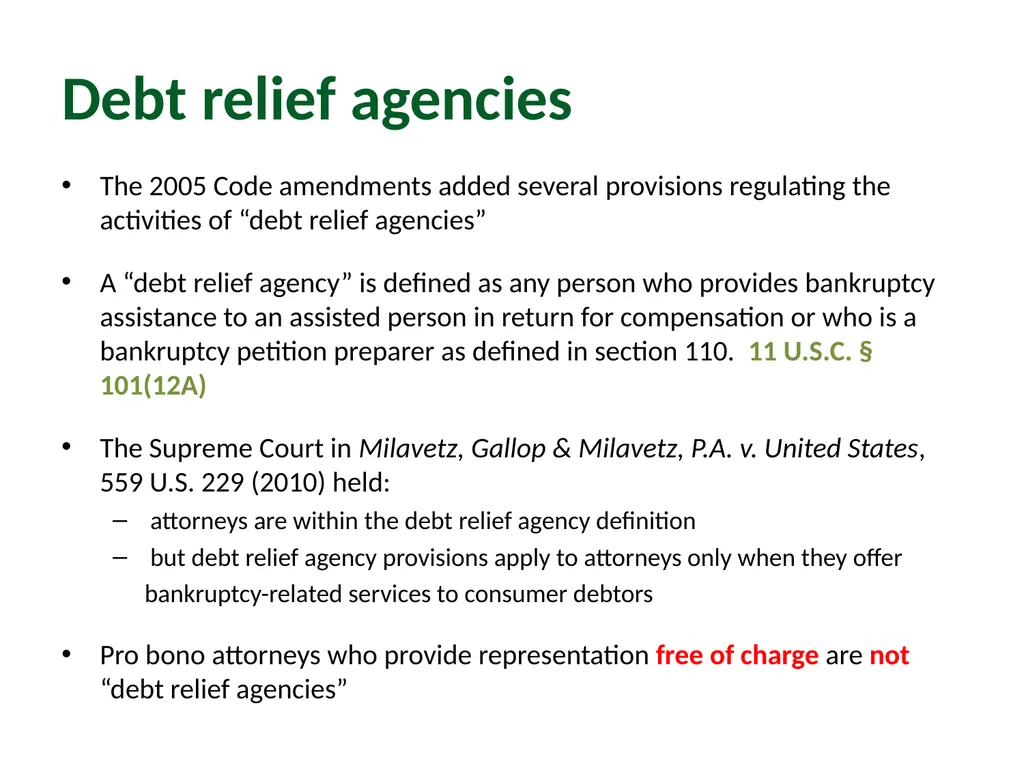
Debt relief agencies The 2005 Code amendments added several provisions regulating the activities of “debt relief agencies”
A “debt relief agency” is defined as any person who provides bankruptcy assistance to an assisted person in return for compensation or who is a bankruptcy petition preparer as defined in section 110. 11 U.S.C. § 101(12A)
The Supreme Court in Milavetz, Gallop & Milavetz, P.A. v. United States, 559 U.S. 229 (2010) held:
attorneys are within the debt relief agency definition
but debt relief agency provisions apply to attorneys only when they offer bankruptcy-related services to consumer debtors
Pro bono attorneys who provide representation free of charge are not “debt relief agencies”<br>
A “debt relief agency” is defined as any person who provides bankruptcy assistance to an assisted person in return for compensation or who is a bankruptcy petition preparer as defined in section 110. 11 U.S.C. § 101(12A)
The Supreme Court in Milavetz, Gallop & Milavetz, P.A. v. United States, 559 U.S. 229 (2010) held:
attorneys are within the debt relief agency definition
but debt relief agency provisions apply to attorneys only when they offer bankruptcy-related services to consumer debtors
Pro bono attorneys who provide representation free of charge are not “debt relief agencies”<br>
61
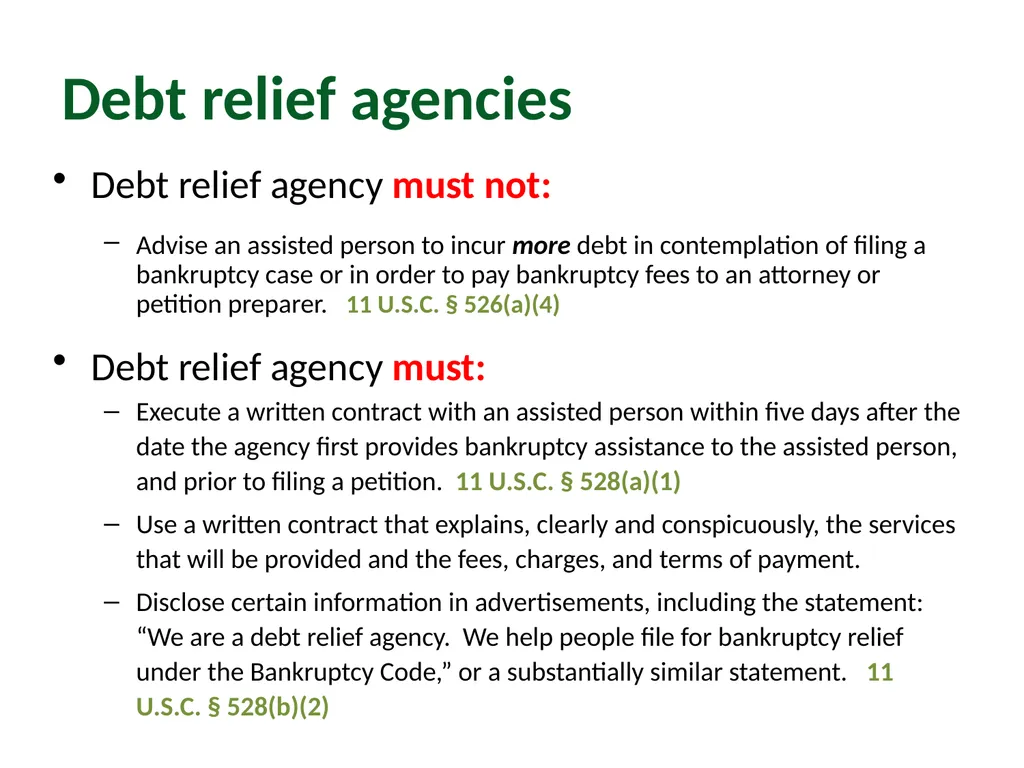
Debt relief agencies Debt relief agency must not:
Advise an assisted person to incur more debt in contemplation of filing a bankruptcy case or in order to pay bankruptcy fees to an attorney or petition preparer. 11 U.S.C. § 526(a)(4)
Debt relief agency must:
Execute a written contract with an assisted person within five days after the date the agency first provides bankruptcy assistance to the assisted person, and prior to filing a petition. 11 U.S.C. § 528(a)(1)
Use a written contract that explains, clearly and conspicuously, the services that will be provided and the fees, charges, and terms of payment.
Disclose certain information in advertisements, including the statement: “We are a debt relief agency. We help people file for bankruptcy relief under the Bankruptcy Code,” or a substantially similar statement. 11 U.S.C. § 528(b)(2)<br>
Advise an assisted person to incur more debt in contemplation of filing a bankruptcy case or in order to pay bankruptcy fees to an attorney or petition preparer. 11 U.S.C. § 526(a)(4)
Debt relief agency must:
Execute a written contract with an assisted person within five days after the date the agency first provides bankruptcy assistance to the assisted person, and prior to filing a petition. 11 U.S.C. § 528(a)(1)
Use a written contract that explains, clearly and conspicuously, the services that will be provided and the fees, charges, and terms of payment.
Disclose certain information in advertisements, including the statement: “We are a debt relief agency. We help people file for bankruptcy relief under the Bankruptcy Code,” or a substantially similar statement. 11 U.S.C. § 528(b)(2)<br>
62
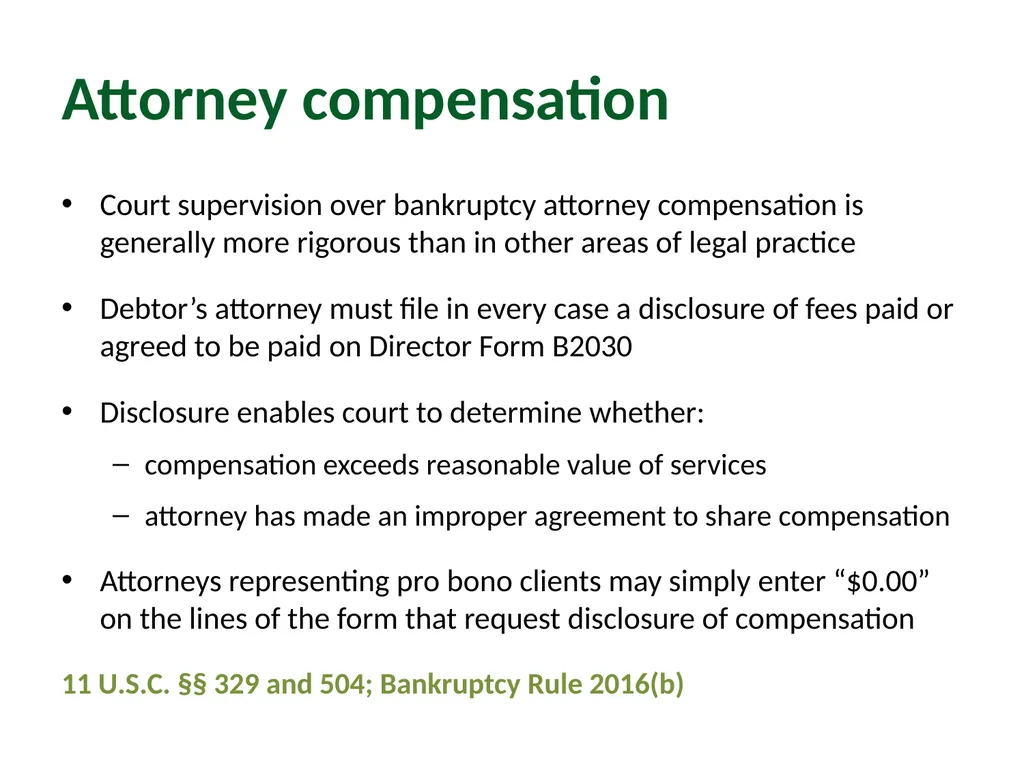
Attorney compensation Court supervision over bankruptcy attorney compensation is generally more rigorous than in other areas of legal practice
Debtor’s attorney must file in every case a disclosure of fees paid or agreed to be paid on Director Form B2030
Disclosure enables court to determine whether:
compensation exceeds reasonable value of services
attorney has made an improper agreement to share compensation
Attorneys representing pro bono clients may simply enter “$0.00” on the lines of the form that request disclosure of compensation
11 U.S.C. §§ 329 and 504; Bankruptcy Rule 2016(b)<br>
Debtor’s attorney must file in every case a disclosure of fees paid or agreed to be paid on Director Form B2030
Disclosure enables court to determine whether:
compensation exceeds reasonable value of services
attorney has made an improper agreement to share compensation
Attorneys representing pro bono clients may simply enter “$0.00” on the lines of the form that request disclosure of compensation
11 U.S.C. §§ 329 and 504; Bankruptcy Rule 2016(b)<br>
63
Managing client expectations Remember to set boundaries on the representation
Clear retainer agreement
This is very rewarding work – huge benefit to the client in a short time!<br>
Clear retainer agreement
This is very rewarding work – huge benefit to the client in a short time!<br>