Module 3 - Part 3 Abstract Classes Introduction Inheritance major advantage Reusing proven and debugged high-quality software. Some methods are not implemented in the parent But in the child subclass(es) These methods are called Abstract
"Module 3 - Part 3 Abstract Classes Introduction" is the property of its rightful owner. Permission is granted to
download and print the materials on this website for personal, non-commercial use only, and to display it
on your personal computer provided you do not modify the materials and that you retain all copyright
notices contained in the materials. By downloading content from our website, you accept the terms of this
agreement.
Presentation Transcript
01
Module 3 - Part 3 Abstract Classes<br>
02
Introduction Inheritance major advantage
Reusing proven and debugged high-quality software.
Some methods are not implemented in the parent
But in the child / subclass(es)
These methods are called Abstract<br>
03
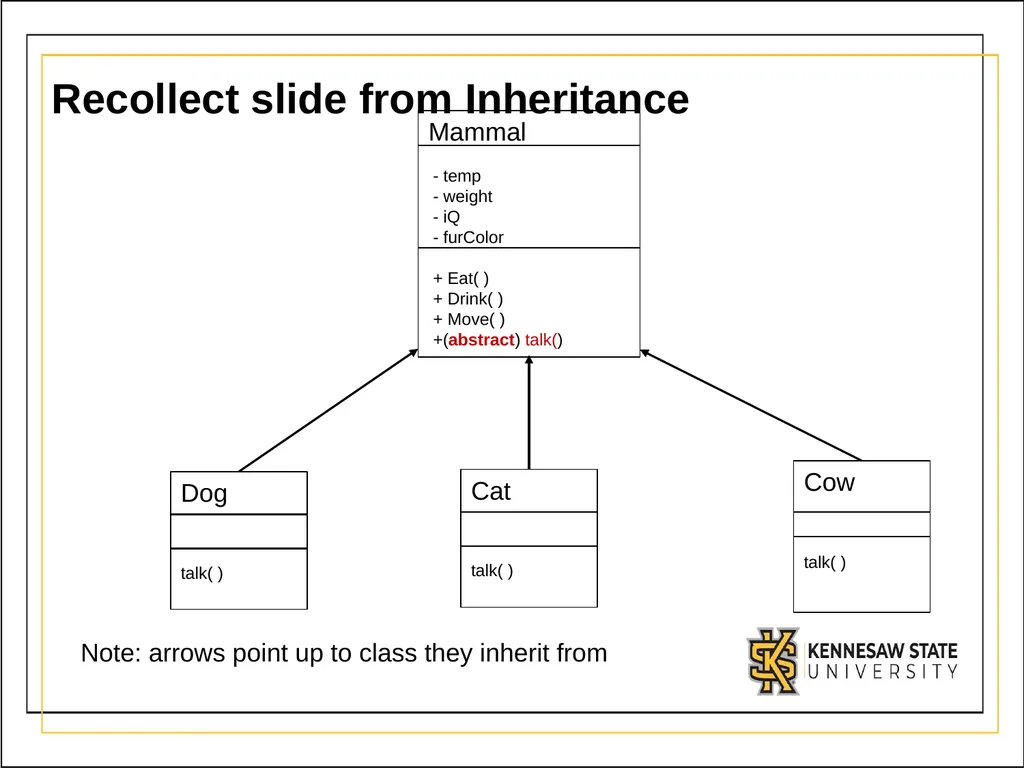
Mammals Talking We’ve seen with inheritance that children classes “learn” how to do things from their parents.
In the last presentation we spoke about Mammal and it’s children Dog, Cat and Cow.
If we think about these for a moment, they all speak differently. Dogs say “woof”, Cats say “meow” and Cows “moo”.
So what should the talk method in Mammal say?
It doesn’t really make sense for it to say anything, since each child will do their own thing.
However, it does make sense for there to be a placeholder in mammal, because most mammals can talk.
This is where you’d use an abstract method.
It’s a placeholder which guarantees that all children will have a talk method
But it doesn’t have any code, since we don’t know what each child will do.
public talk();
Note: No {}’s with a body.<br>
04
Recollect slide from Inheritance Note: arrows point up to class they inherit from<br>
05
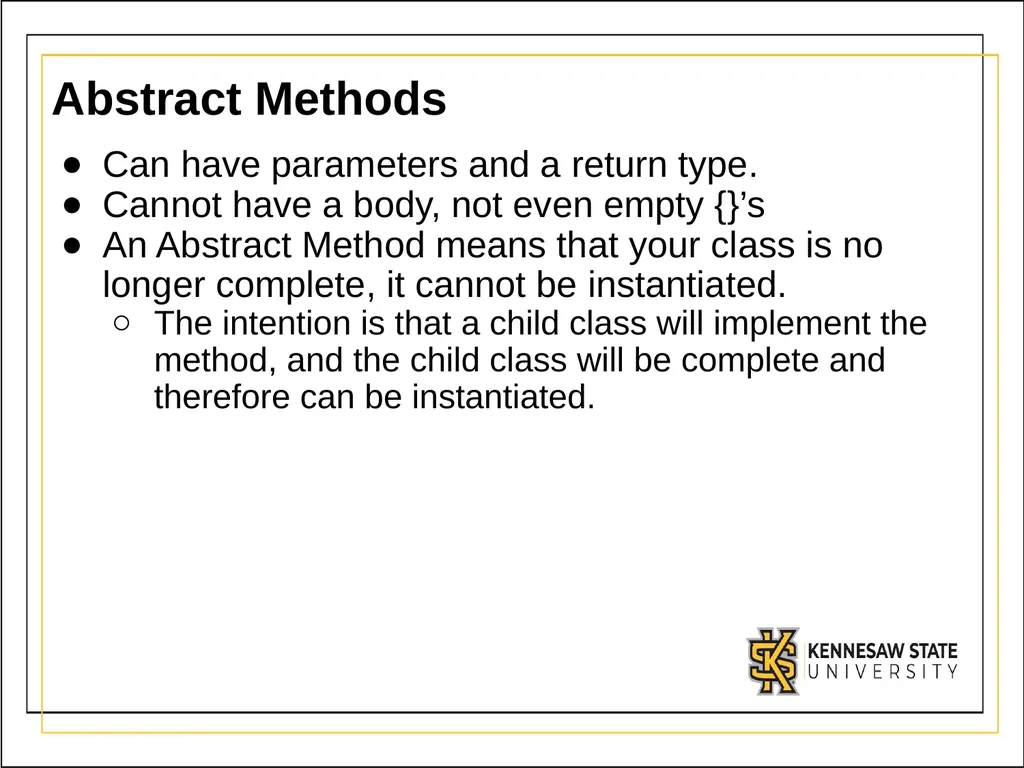
Abstract Methods Can have parameters and a return type.
Cannot have a body, not even empty {}’s
An Abstract Method means that your class is no longer complete, it cannot be instantiated.
The intention is that a child class will implement the method, and the child class will be complete and therefore can be instantiated.<br>
06
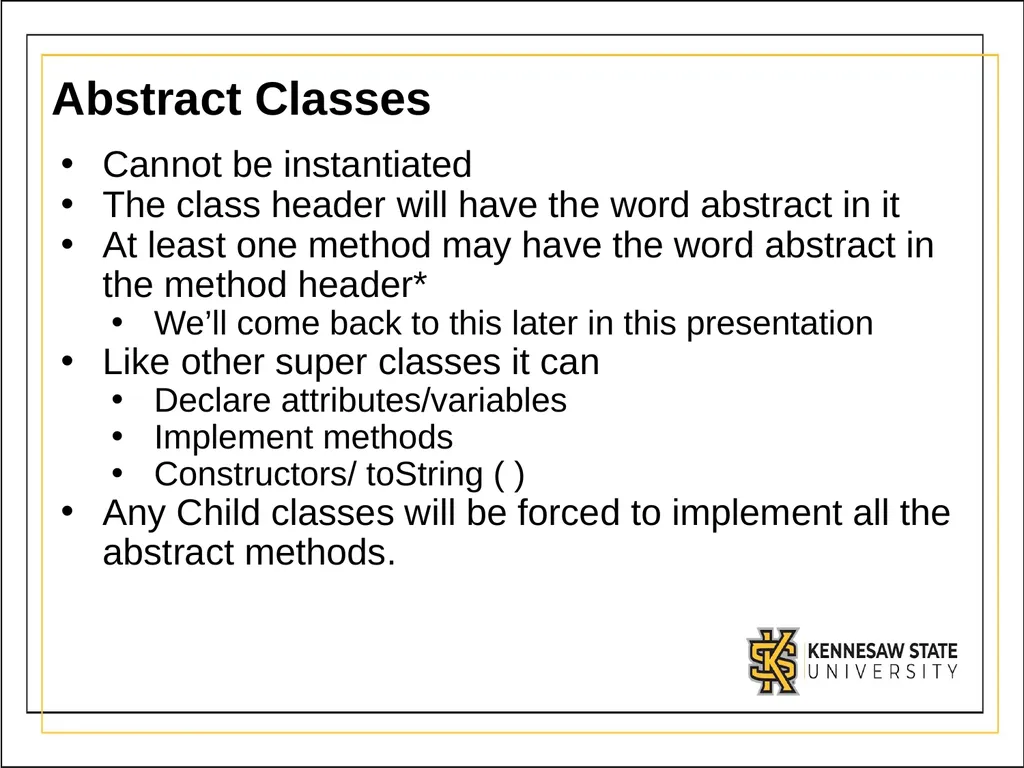
Abstract Classes Cannot be instantiated
The class header will have the word abstract in it
At least one method may have the word abstract in the method header*
We’ll come back to this later in this presentation
Like other super classes it can
Declare attributes/variables
Implement methods
Constructors/ toString ( )
Any Child classes will be forced to implement all the abstract methods.<br>
07
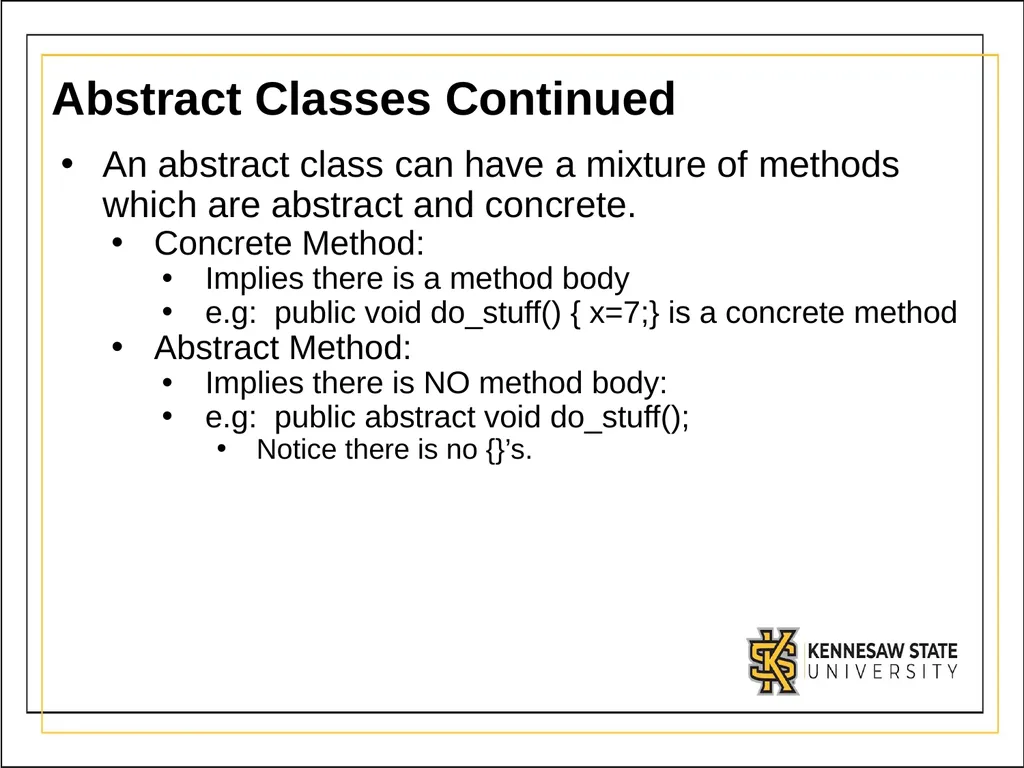
Abstract Classes Continued An abstract class can have a mixture of methods which are abstract and concrete.
Concrete Method:
Implies there is a method body
e.g: public void do_stuff() { x=7;} is a concrete method
Abstract Method:
Implies there is NO method body:
e.g: public abstract void do_stuff();
Notice there is no {}’s.<br>
08
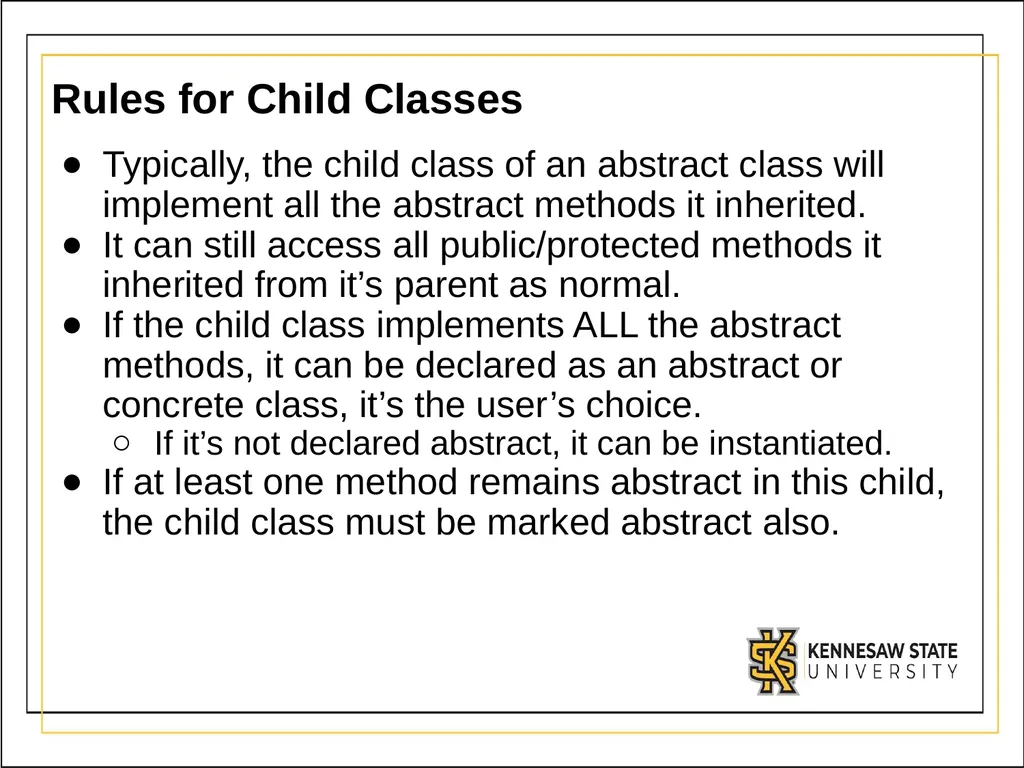
Rules for Child Classes Typically, the child class of an abstract class will implement all the abstract methods it inherited.
It can still access all public/protected methods it inherited from it’s parent as normal.
If the child class implements ALL the abstract methods, it can be declared as an abstract or concrete class, it’s the user’s choice.
If it’s not declared abstract, it can be instantiated.
If at least one method remains abstract in this child, the child class must be marked abstract also.<br>
09
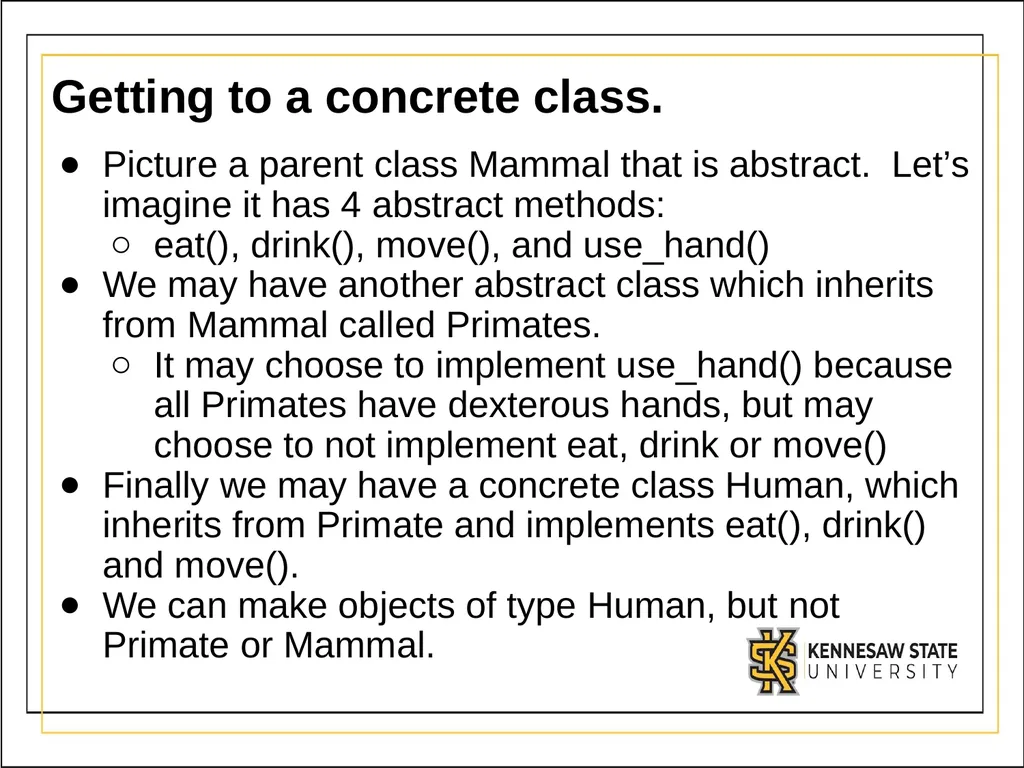
Getting to a concrete class. Picture a parent class Mammal that is abstract. Let’s imagine it has 4 abstract methods:
eat(), drink(), move(), and use_hand()
We may have another abstract class which inherits from Mammal called Primates.
It may choose to implement use_hand() because all Primates have dexterous hands, but may choose to not implement eat, drink or move()
Finally we may have a concrete class Human, which inherits from Primate and implements eat(), drink() and move().
We can make objects of type Human, but not Primate or Mammal.<br>
10
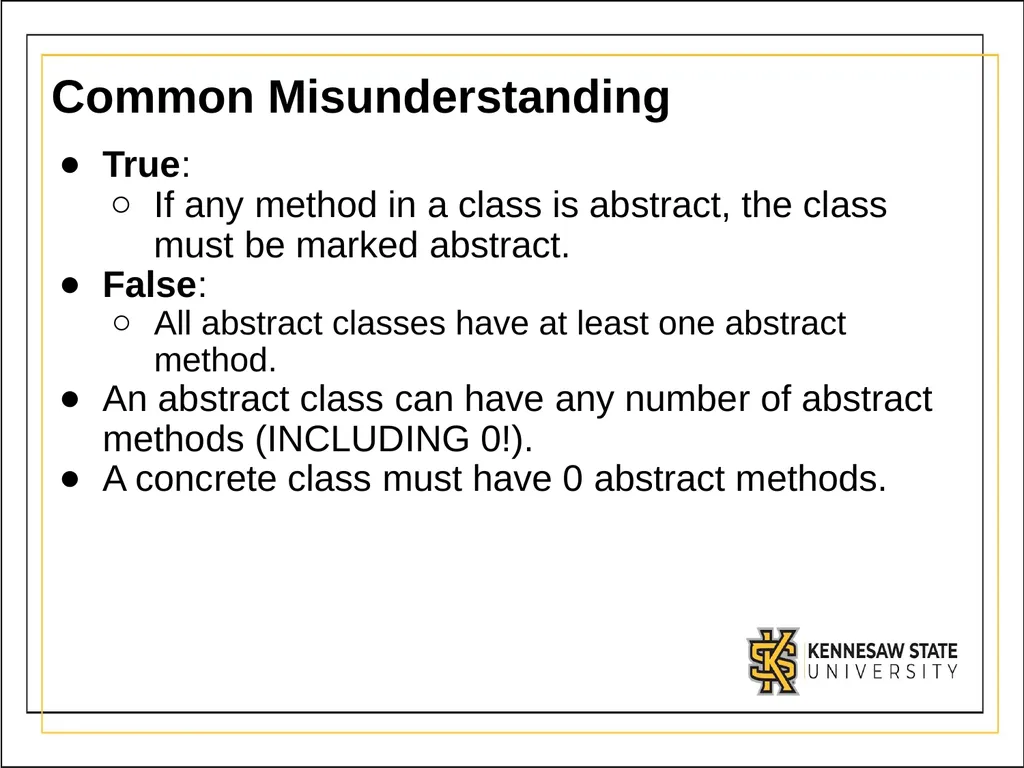
Common Misunderstanding True:
If any method in a class is abstract, the class must be marked abstract.
False:
All abstract classes have at least one abstract method.
An abstract class can have any number of abstract methods (INCLUDING 0!).
A concrete class must have 0 abstract methods.<br>
11
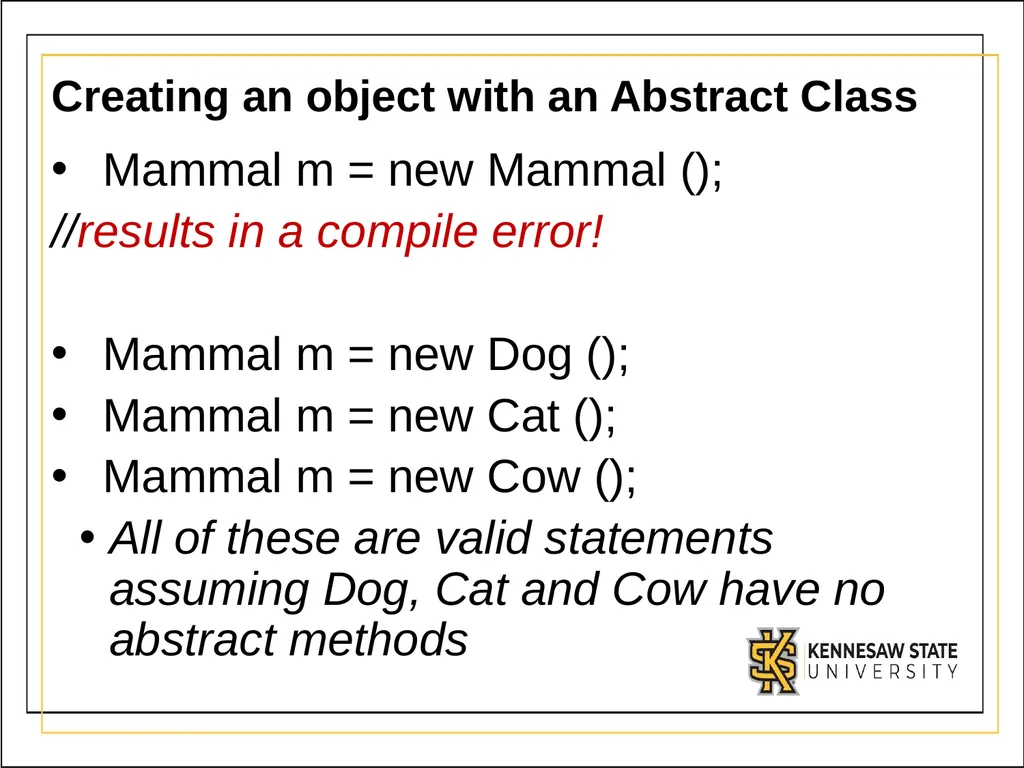
Creating an object with an Abstract Class Mammal m = new Mammal ();
//results in a compile error!
Mammal m = new Dog ();
Mammal m = new Cat ();
Mammal m = new Cow ();
All of these are valid statements assuming Dog, Cat and Cow have no abstract methods<br>
12
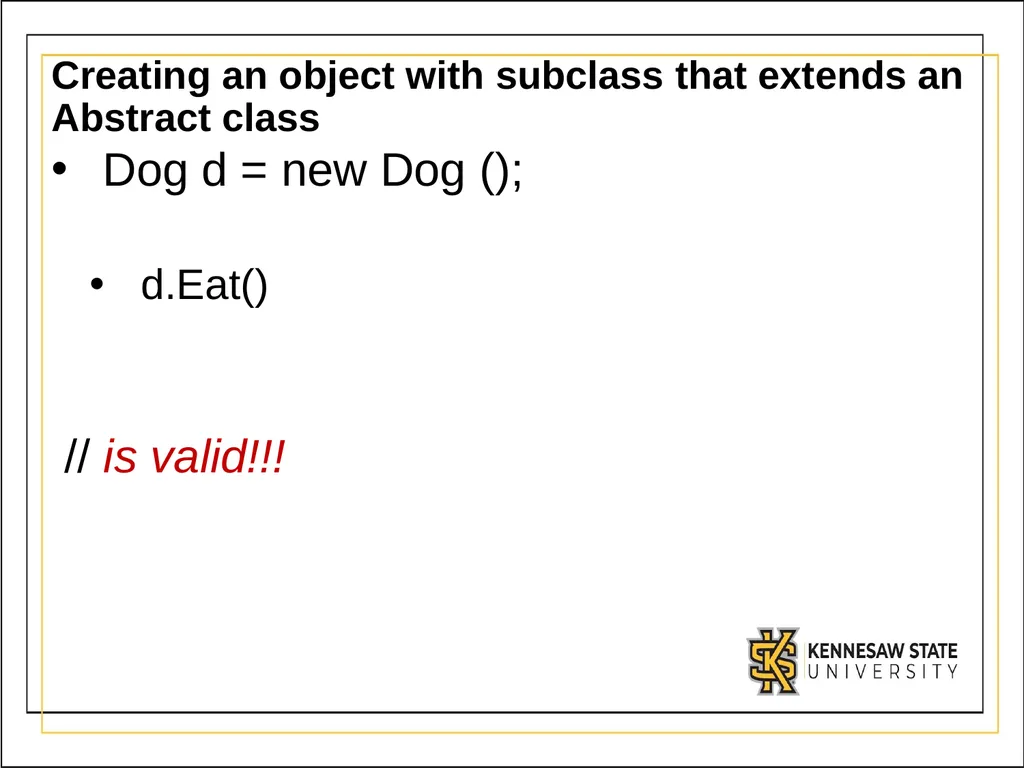
Creating an object with subclass that extends an Abstract class Dog d = new Dog ();
d.Eat()
// is valid!!!<br>
13
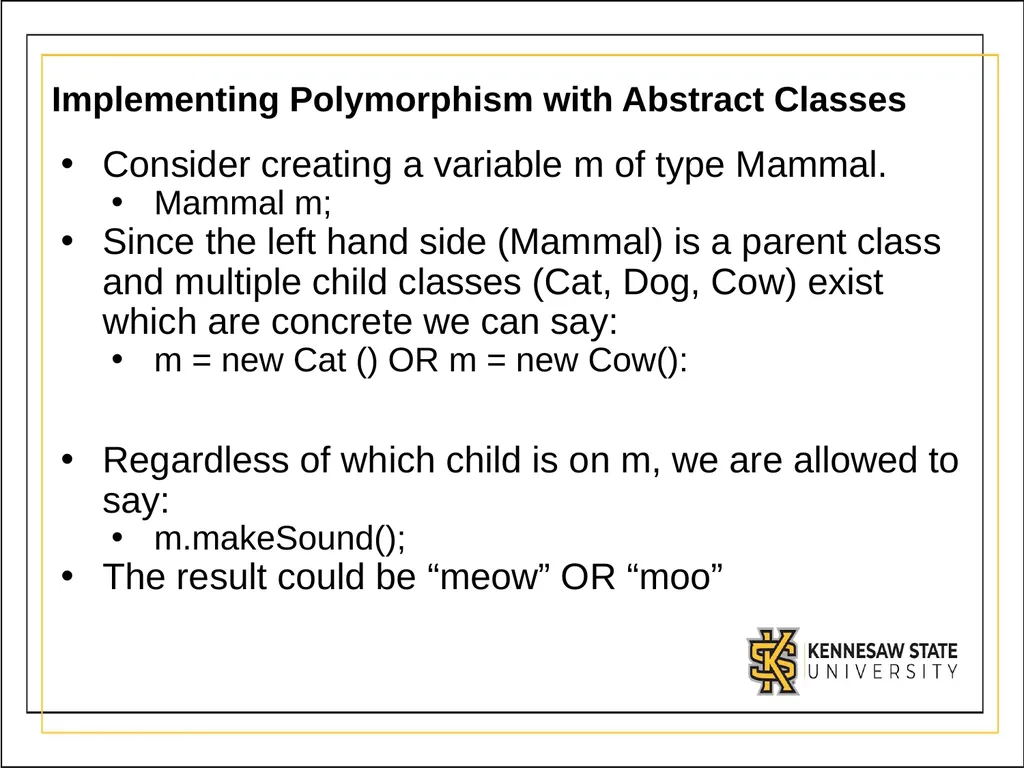
Implementing Polymorphism with Abstract Classes Consider creating a variable m of type Mammal.
Mammal m;
Since the left hand side (Mammal) is a parent class and multiple child classes (Cat, Dog, Cow) exist which are concrete we can say:
m = new Cat () OR m = new Cow():
Regardless of which child is on m, we are allowed to say:
m.makeSound();
The result could be “meow” OR “moo”<br>
14
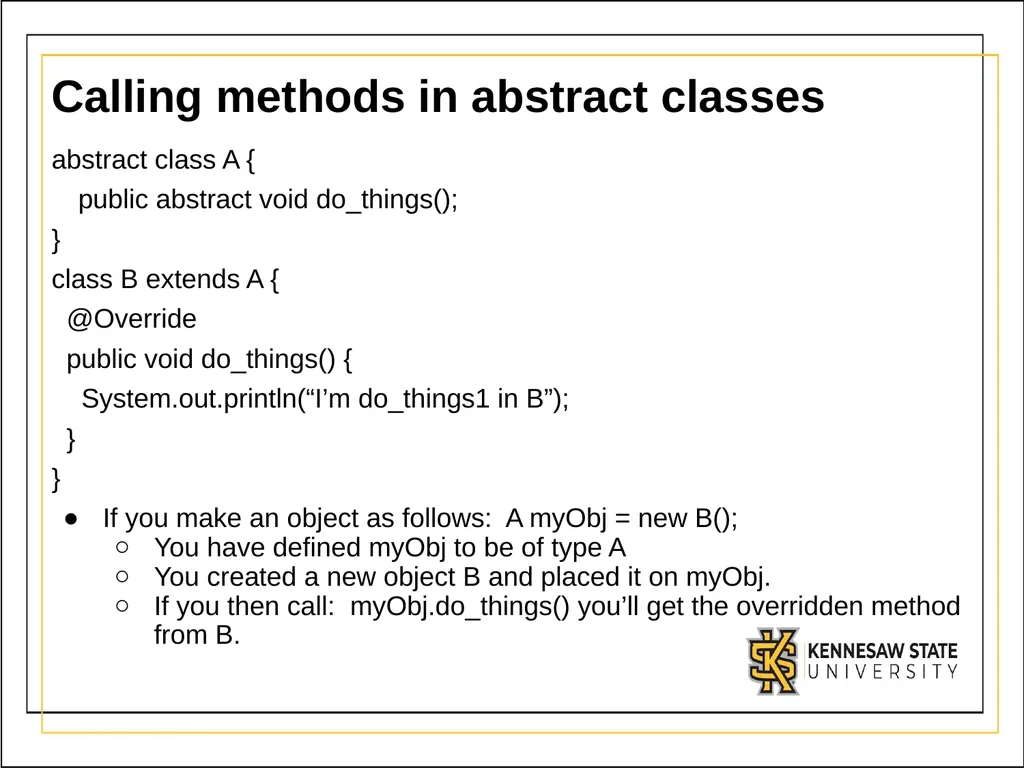
Calling methods in abstract classes abstract class A {
public abstract void do_things();
}
class B extends A {
@Override
public void do_things() {
System.out.println(“I’m do_things1 in B”);
}
}
If you make an object as follows: A myObj = new B();
You have defined myObj to be of type A
You created a new object B and placed it on myObj.
If you then call: myObj.do_things() you’ll get the overridden method from B.<br>
15
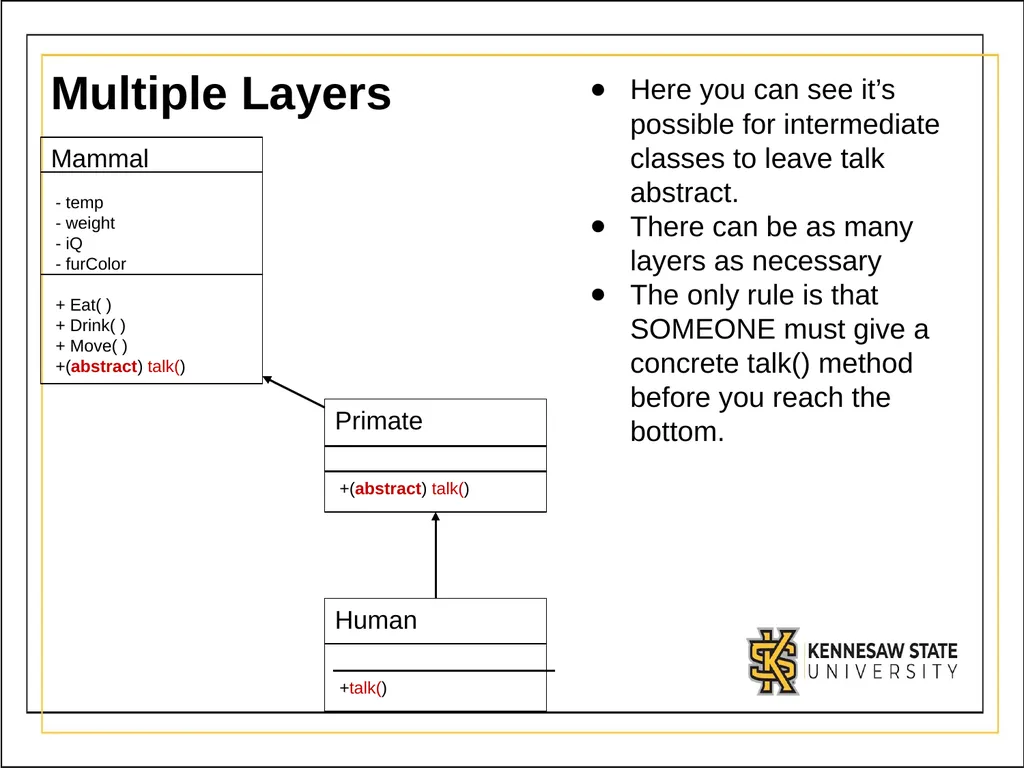
Multiple Layers Here you can see it’s possible for intermediate classes to leave talk abstract.
There can be as many layers as necessary
The only rule is that SOMEONE must give a concrete talk() method before you reach the bottom.<br>
16
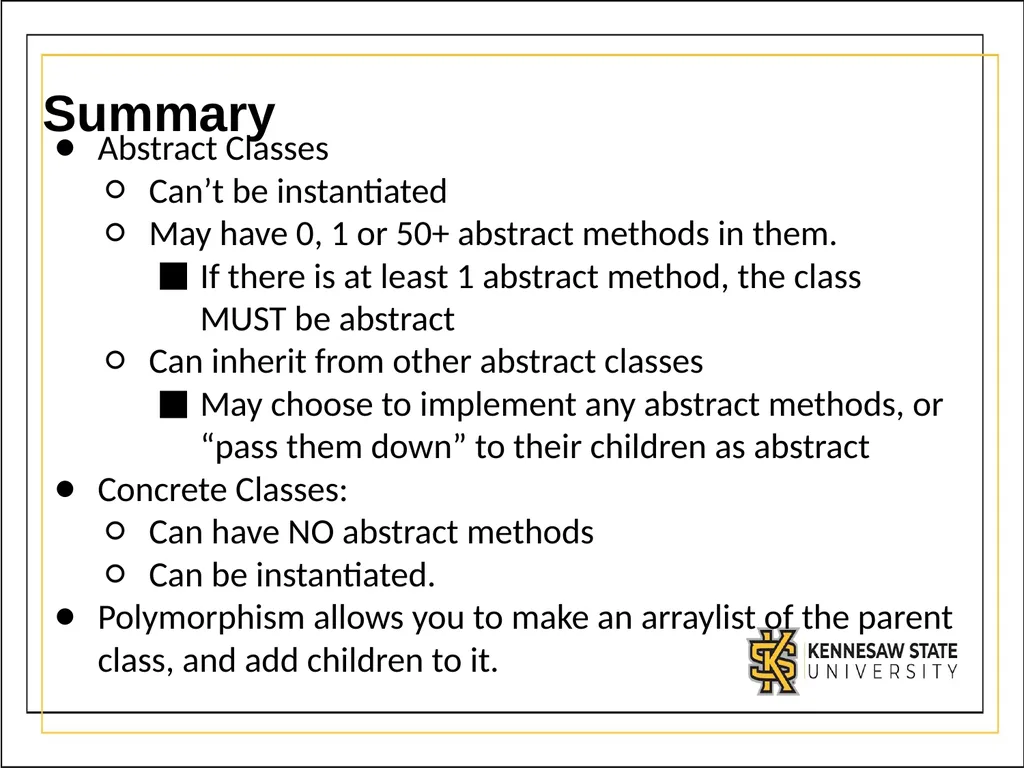
Summary Abstract Classes
Can’t be instantiated
May have 0, 1 or 50+ abstract methods in them.
If there is at least 1 abstract method, the class MUST be abstract
Can inherit from other abstract classes
May choose to implement any abstract methods, or “pass them down” to their children as abstract
Concrete Classes:
Can have NO abstract methods
Can be instantiated.
Polymorphism allows you to make an arraylist of the parent class, and add children to it.<br>