
Module 4: Trauma and Victim Responses:
TD
Published · 32 slides · 0 views
1 / 1





Description
Module 4: Trauma and Victim Responses: Considerations for the Investigative Process Notice of Federal Funding Disclaimer This project was supported by Grant No. 2010-RP-BX-K001 and updated by Grant No. 2019-RP-BX-K002, awarded by the
Related Topics
Share
Embed code
Download this presentation From Below
"Module 4: Trauma and Victim Responses:" is the property of its rightful owner. Permission is granted to download and print the materials on this website for personal, non-commercial use only, and to display it on your personal computer provided you do not modify the materials and that you retain all copyright notices contained in the materials. By downloading content from our website, you accept the terms of this agreement.
Presentation Transcript
01
Module 4:
Trauma and Victim Responses:
Considerations for the Investigative Process Notice of Federal Funding Disclaimer – This project was supported by Grant No. 2010-RP-BX-K001 and updated by Grant No. 2019-RP-BX-K002, awarded by the Bureau of Justice Assistance. The Bureau of Justice Assistance is a component of the Office of Justice Programs, which also includes the Bureau of Justice Statistics, the National Institute of Justice, the Office of Juvenile Justice and Delinquency Prevention, the Office for Victims of Crime, and the Office of Sex Offender Sentencing, Monitoring, Apprehending, Registering, and Tracking. Points of view or opinions in this document are those of the author and do not necessarily represent the official position or policies of the U.S. Department of Justice nor those of Impact Justice (IJ), which administers the National PREA Resource Center through a cooperative agreement with the Bureau of Justice Assistance.<br>
Considerations for the Investigative Process Notice of Federal Funding Disclaimer – This project was supported by Grant No. 2010-RP-BX-K001 and updated by Grant No. 2019-RP-BX-K002, awarded by the Bureau of Justice Assistance. The Bureau of Justice Assistance is a component of the Office of Justice Programs, which also includes the Bureau of Justice Statistics, the National Institute of Justice, the Office of Juvenile Justice and Delinquency Prevention, the Office for Victims of Crime, and the Office of Sex Offender Sentencing, Monitoring, Apprehending, Registering, and Tracking. Points of view or opinions in this document are those of the author and do not necessarily represent the official position or policies of the U.S. Department of Justice nor those of Impact Justice (IJ), which administers the National PREA Resource Center through a cooperative agreement with the Bureau of Justice Assistance.<br>
02
Module 4: Objectives Understand the short and long term impact of trauma on victims
Identify how trauma can affect a victim’s cooperation in an investigation.
Learn how an investigator can facilitate a victim’s willingness to cooperate with an investigation.<br>
Identify how trauma can affect a victim’s cooperation in an investigation.
Learn how an investigator can facilitate a victim’s willingness to cooperate with an investigation.<br>
03
Being trauma-informed is being sensitive to the impact of trauma, and to the needs of people suffering from trauma.
SOURCE: Pamela S. Hyde,
Administrator, Substance Abuse
and Mental Health Services Administration What Does Being “Trauma Informed” Mean? 3<br>
SOURCE: Pamela S. Hyde,
Administrator, Substance Abuse
and Mental Health Services Administration What Does Being “Trauma Informed” Mean? 3<br>
04
Serious, short- and long-term impacts on mental and physical health
Impacts reporting and interactions with investigators.
A high percentage of inmates/residents have experienced trauma in their lives prior to incarceration
Investigators working in corrections need to be aware of the impact of trauma on the current mental and physical health of trauma survivors to be able to understand and work with them safely and effectively. Why Does Trauma Matter? 4<br>
Impacts reporting and interactions with investigators.
A high percentage of inmates/residents have experienced trauma in their lives prior to incarceration
Investigators working in corrections need to be aware of the impact of trauma on the current mental and physical health of trauma survivors to be able to understand and work with them safely and effectively. Why Does Trauma Matter? 4<br>
05
Why Does Trauma Matter?<br>
06
Trauma has been proven to have significant and very real effects on the victims and their brain functioning
Disrupts the stress-hormone system that is regulated by the brain
Stays “stuck” in the brain’s subconscious (limbic system, brain stem, etc.) where they are inaccessible by the conscious areas (frontal lobe, etc.)
Can result in Post Traumatic Stress Disorder Neurobiology of Trauma<br>
Disrupts the stress-hormone system that is regulated by the brain
Stays “stuck” in the brain’s subconscious (limbic system, brain stem, etc.) where they are inaccessible by the conscious areas (frontal lobe, etc.)
Can result in Post Traumatic Stress Disorder Neurobiology of Trauma<br>
07
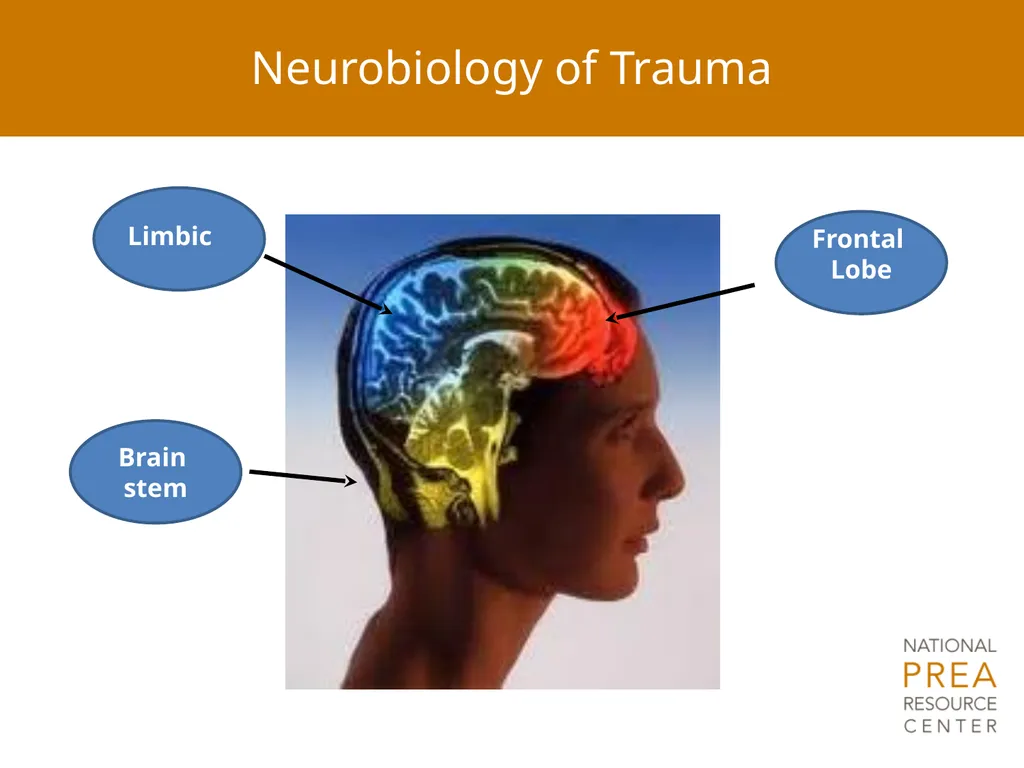
Brain
stem Limbic Frontal
Lobe Neurobiology of Trauma<br>
stem Limbic Frontal
Lobe Neurobiology of Trauma<br>
08
Frontal lobe: seat of conscious memory, chronological information
Limbic system: controls emotion, fear response, sensory memories
Brain stem: controls instinctive reactions (fight/flight/freeze) Trauma and the Brain<br>
Limbic system: controls emotion, fear response, sensory memories
Brain stem: controls instinctive reactions (fight/flight/freeze) Trauma and the Brain<br>
09
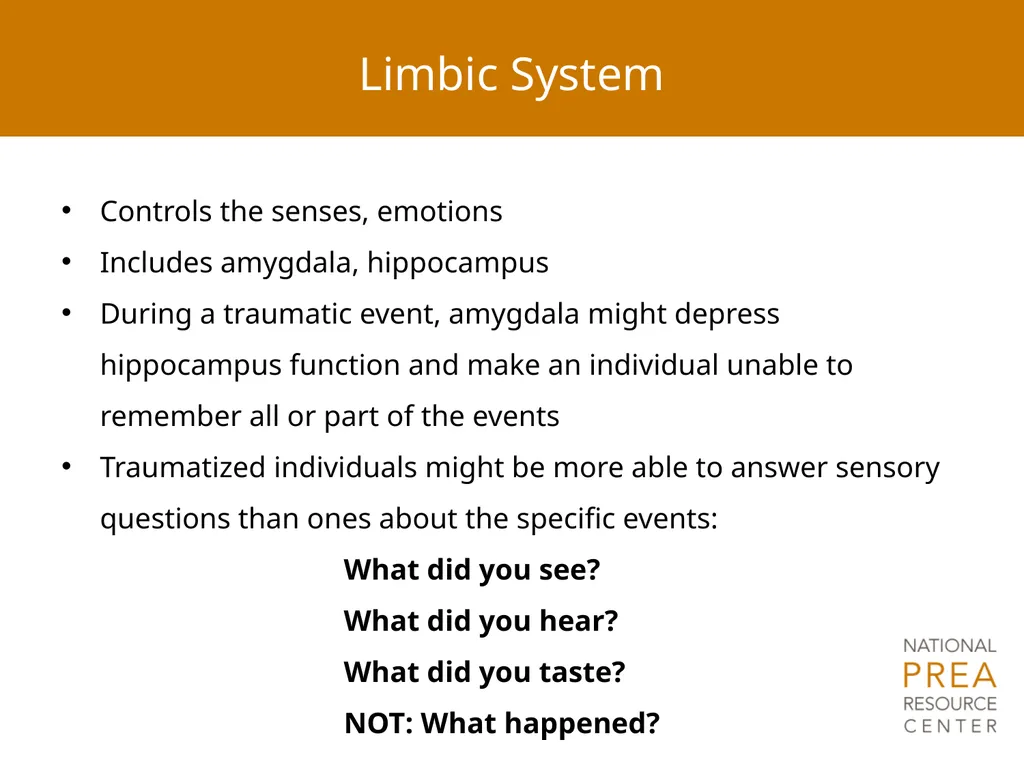
Controls the senses, emotions
Includes amygdala, hippocampus
During a traumatic event, amygdala might depress hippocampus function and make an individual unable to remember all or part of the events
Traumatized individuals might be more able to answer sensory questions than ones about the specific events:
What did you see?
What did you hear?
What did you taste?
NOT: What happened? Limbic System<br>
Includes amygdala, hippocampus
During a traumatic event, amygdala might depress hippocampus function and make an individual unable to remember all or part of the events
Traumatized individuals might be more able to answer sensory questions than ones about the specific events:
What did you see?
What did you hear?
What did you taste?
NOT: What happened? Limbic System<br>
10
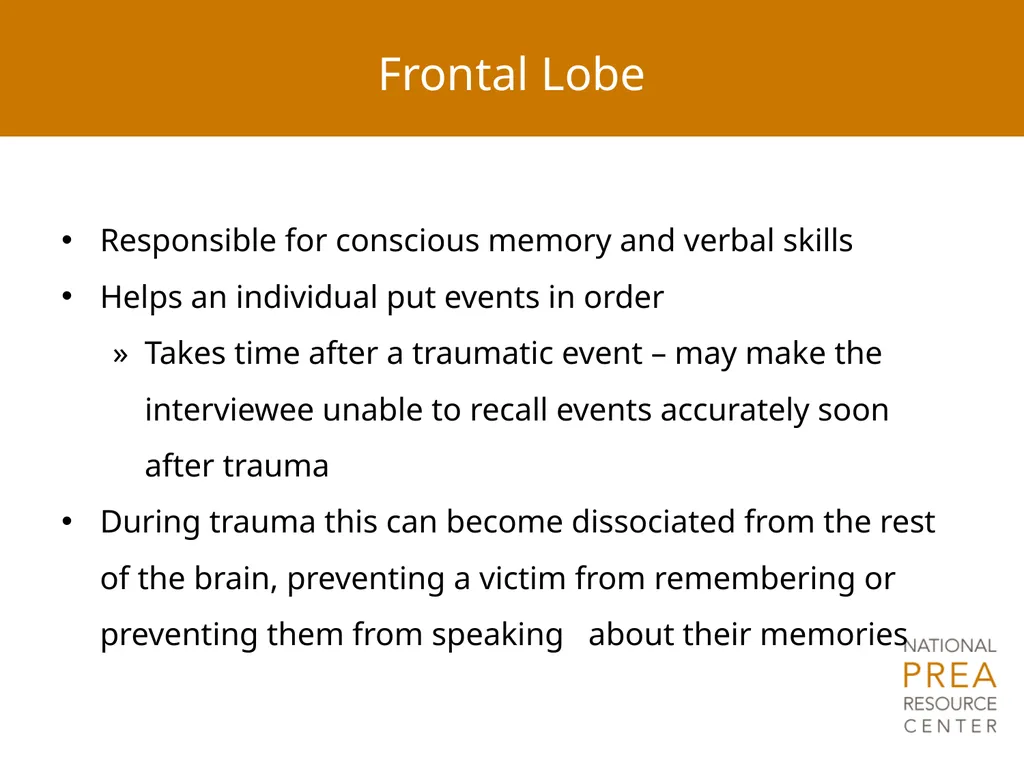
Responsible for conscious memory and verbal skills
Helps an individual put events in order
Takes time after a traumatic event – may make the interviewee unable to recall events accurately soon after trauma
During trauma this can become dissociated from the rest of the brain, preventing a victim from remembering or preventing them from speaking about their memories Frontal Lobe<br>
Helps an individual put events in order
Takes time after a traumatic event – may make the interviewee unable to recall events accurately soon after trauma
During trauma this can become dissociated from the rest of the brain, preventing a victim from remembering or preventing them from speaking about their memories Frontal Lobe<br>
11
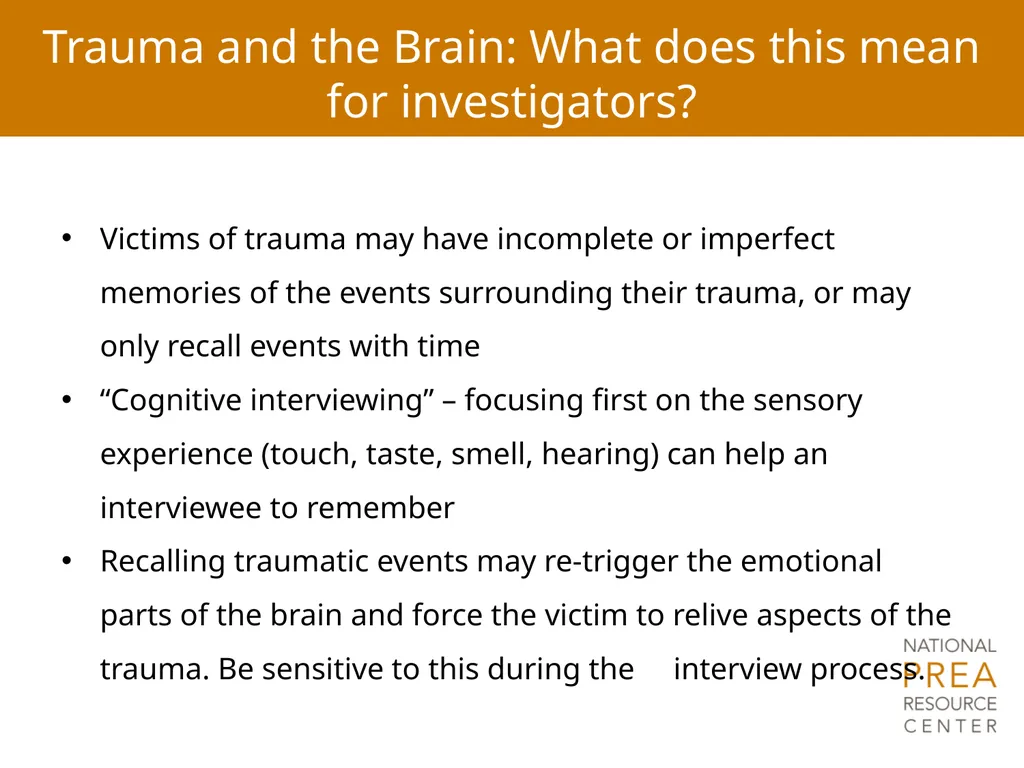
Victims of trauma may have incomplete or imperfect memories of the events surrounding their trauma, or may only recall events with time
“Cognitive interviewing” – focusing first on the sensory experience (touch, taste, smell, hearing) can help an interviewee to remember
Recalling traumatic events may re-trigger the emotional parts of the brain and force the victim to relive aspects of the trauma. Be sensitive to this during the interview process. Trauma and the Brain: What does this mean for investigators?<br>
“Cognitive interviewing” – focusing first on the sensory experience (touch, taste, smell, hearing) can help an interviewee to remember
Recalling traumatic events may re-trigger the emotional parts of the brain and force the victim to relive aspects of the trauma. Be sensitive to this during the interview process. Trauma and the Brain: What does this mean for investigators?<br>
12
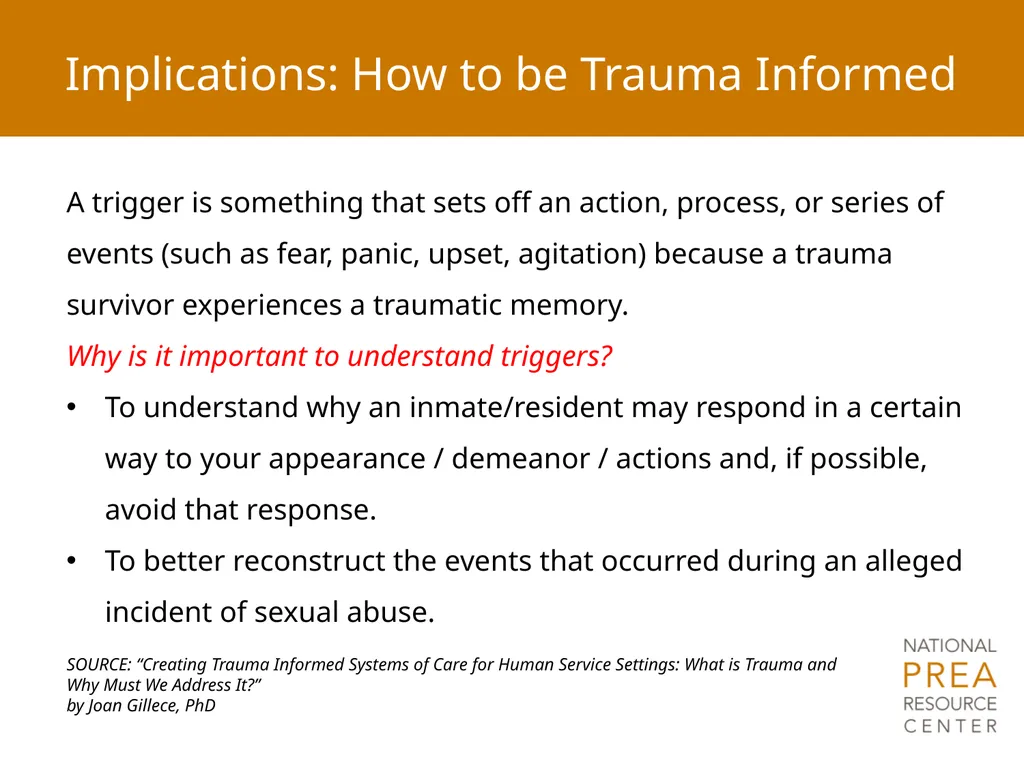
A trigger is something that sets off an action, process, or series of events (such as fear, panic, upset, agitation) because a trauma survivor experiences a traumatic memory.
Why is it important to understand triggers?
To understand why an inmate/resident may respond in a certain way to your appearance / demeanor / actions and, if possible, avoid that response.
To better reconstruct the events that occurred during an alleged incident of sexual abuse. Implications: How to be Trauma Informed SOURCE: “Creating Trauma Informed Systems of Care for Human Service Settings: What is Trauma and Why Must We Address It?”
by Joan Gillece, PhD<br>
Why is it important to understand triggers?
To understand why an inmate/resident may respond in a certain way to your appearance / demeanor / actions and, if possible, avoid that response.
To better reconstruct the events that occurred during an alleged incident of sexual abuse. Implications: How to be Trauma Informed SOURCE: “Creating Trauma Informed Systems of Care for Human Service Settings: What is Trauma and Why Must We Address It?”
by Joan Gillece, PhD<br>
13
Childhood Trauma and the Brain<br>
14
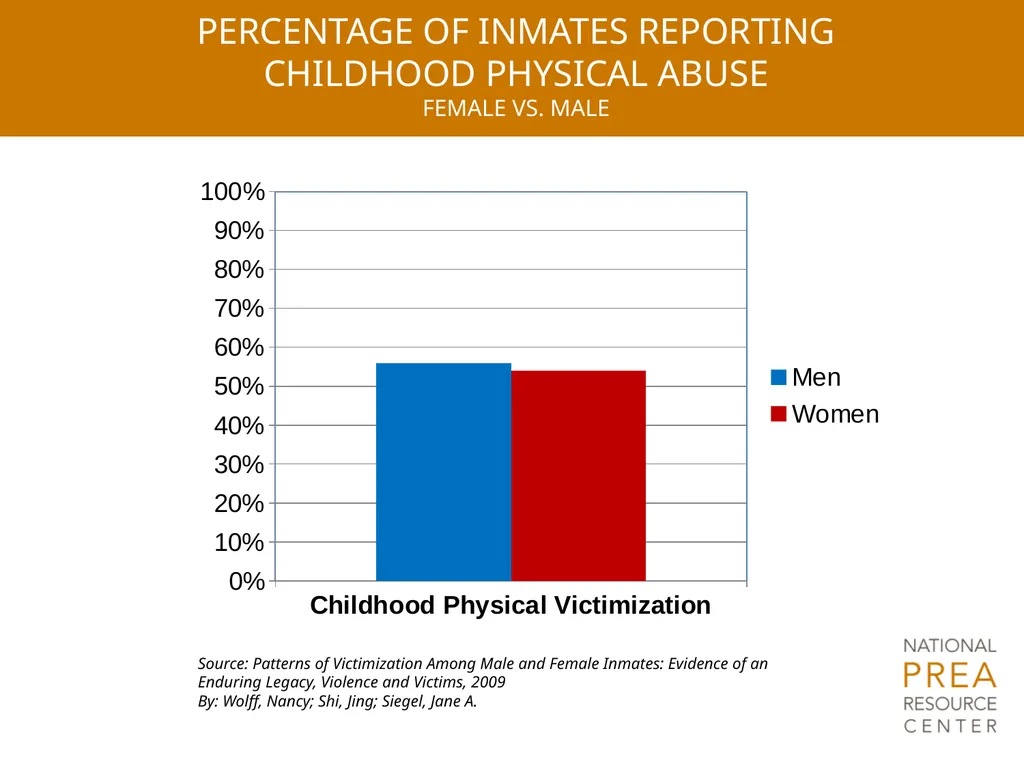
PERCENTAGE OF INMATES REPORTING CHILDHOOD PHYSICAL ABUSE
FEMALE VS. MALE Source: Patterns of Victimization Among Male and Female Inmates: Evidence of an Enduring Legacy, Violence and Victims, 2009
By: Wolff, Nancy; Shi, Jing; Siegel, Jane A.<br>
FEMALE VS. MALE Source: Patterns of Victimization Among Male and Female Inmates: Evidence of an Enduring Legacy, Violence and Victims, 2009
By: Wolff, Nancy; Shi, Jing; Siegel, Jane A.<br>
15
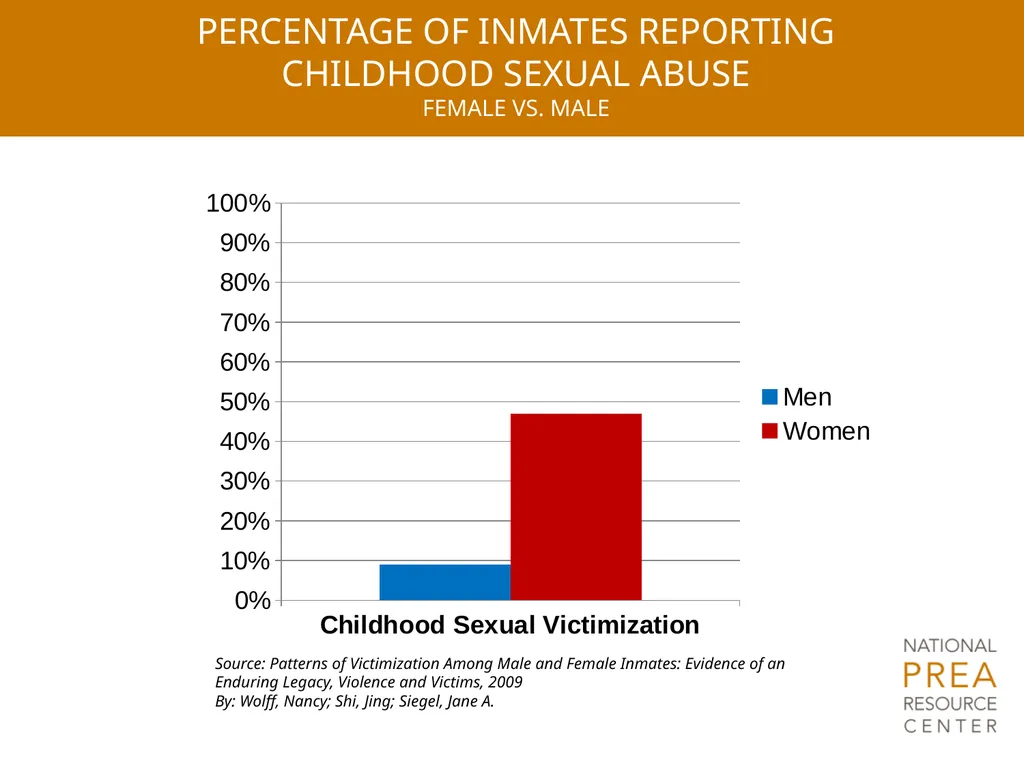
PERCENTAGE OF INMATES REPORTING CHILDHOOD SEXUAL ABUSE
FEMALE VS. MALE Source: Patterns of Victimization Among Male and Female Inmates: Evidence of an Enduring Legacy, Violence and Victims, 2009
By: Wolff, Nancy; Shi, Jing; Siegel, Jane A.<br>
FEMALE VS. MALE Source: Patterns of Victimization Among Male and Female Inmates: Evidence of an Enduring Legacy, Violence and Victims, 2009
By: Wolff, Nancy; Shi, Jing; Siegel, Jane A.<br>
16
Incidents of sexual abuse are destructive, catastrophic, life-changing events. While each victim responds uniquely, victims are likely to experience problems that are:
physical
emotional
cognitive
psychological
social
sexual Impact of Sexual Abuse SOURCE: Dumond, R.W. & Dumond, D.A. (2007a). Managing prison sexual violence: A guide to effective victim services. Building Blocks for Institutional Safety. Denver, CO: Colorado Department of Public Safety, Division of Criminal Justice, Office of Research & Statistics.<br>
physical
emotional
cognitive
psychological
social
sexual Impact of Sexual Abuse SOURCE: Dumond, R.W. & Dumond, D.A. (2007a). Managing prison sexual violence: A guide to effective victim services. Building Blocks for Institutional Safety. Denver, CO: Colorado Department of Public Safety, Division of Criminal Justice, Office of Research & Statistics.<br>
17
What you may see from the victim -- within hours of abuse:
Being very expressive:
Appearing hysterical and/or verbalizing feelings of sadness or anger.
Displaying a range of feelings, including crying, sobbing, smiling, restlessness, tenseness, & joking.
Appearing distraught or anxious; expressing rage or hostility against those attempting to care for them.
Remaining controlled, numb, in shock & disbelief:
Masking or hiding feelings behind a calm, composed, or subdued effect.
Presenting themselves in a flat affect, quiet, reserved manner.
Having difficulties expressing themselves. Impact of Sexual Abuse . SOURCE: Dumond, R.W. & Dumond, D.A. (2007a). Managing prison sexual violence: A guide to effective victim services. Building Blocks for Institutional Safety. Denver, CO: Colorado Department of Public Safety, Division of Criminal Justice, Office of Research & Statistics.<br>
Being very expressive:
Appearing hysterical and/or verbalizing feelings of sadness or anger.
Displaying a range of feelings, including crying, sobbing, smiling, restlessness, tenseness, & joking.
Appearing distraught or anxious; expressing rage or hostility against those attempting to care for them.
Remaining controlled, numb, in shock & disbelief:
Masking or hiding feelings behind a calm, composed, or subdued effect.
Presenting themselves in a flat affect, quiet, reserved manner.
Having difficulties expressing themselves. Impact of Sexual Abuse . SOURCE: Dumond, R.W. & Dumond, D.A. (2007a). Managing prison sexual violence: A guide to effective victim services. Building Blocks for Institutional Safety. Denver, CO: Colorado Department of Public Safety, Division of Criminal Justice, Office of Research & Statistics.<br>
18
What you may see from the victim – short-term:
Phobias -- preoccupation with personal safety, reluctance to leave room/home, fear of being alone, withdrawal from activities or relationships Mood swings -- happy to angry, anxiety, sense of helplessness, irritability or outburst of anger, difficulty concentrating, crying frequently hyper vigilance, exaggerated startle reactions.
Denial -- efforts to deny abuse took place and/or minimize impact, avoiding thoughts or activities associated with trauma.
Hesitation in forming new relationships.
Flashbacks -- intense psychological or physiological distress at exposure to cues associated with the traumatic event. Impact of Sexual Abuse SOURCE: Dumond, R.W. & Dumond, D.A. (2007a). Managing prison sexual violence: A guide to effective victim services. Building Blocks for Institutional Safety. Denver, CO: Colorado Department of Public Safety, Division of Criminal Justice, Office of Research & Statistics.<br>
Phobias -- preoccupation with personal safety, reluctance to leave room/home, fear of being alone, withdrawal from activities or relationships Mood swings -- happy to angry, anxiety, sense of helplessness, irritability or outburst of anger, difficulty concentrating, crying frequently hyper vigilance, exaggerated startle reactions.
Denial -- efforts to deny abuse took place and/or minimize impact, avoiding thoughts or activities associated with trauma.
Hesitation in forming new relationships.
Flashbacks -- intense psychological or physiological distress at exposure to cues associated with the traumatic event. Impact of Sexual Abuse SOURCE: Dumond, R.W. & Dumond, D.A. (2007a). Managing prison sexual violence: A guide to effective victim services. Building Blocks for Institutional Safety. Denver, CO: Colorado Department of Public Safety, Division of Criminal Justice, Office of Research & Statistics.<br>
19
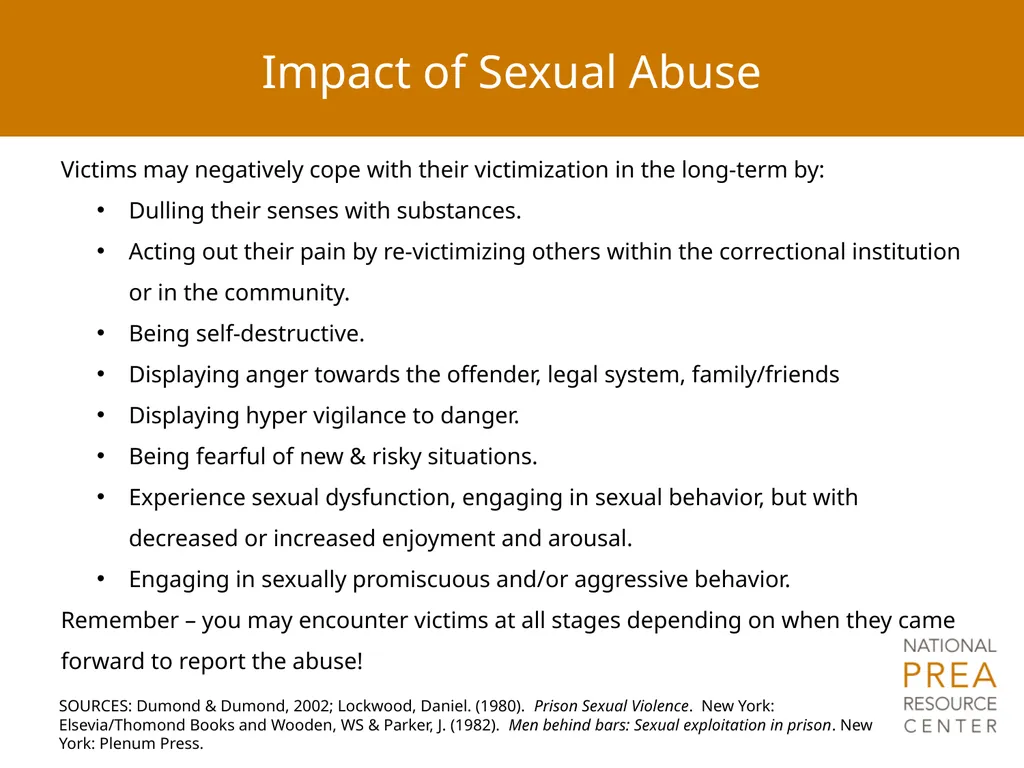
Victims may negatively cope with their victimization in the long-term by:
Dulling their senses with substances.
Acting out their pain by re-victimizing others within the correctional institution or in the community.
Being self-destructive.
Displaying anger towards the offender, legal system, family/friends
Displaying hyper vigilance to danger.
Being fearful of new & risky situations.
Experience sexual dysfunction, engaging in sexual behavior, but with decreased or increased enjoyment and arousal.
Engaging in sexually promiscuous and/or aggressive behavior.
Remember – you may encounter victims at all stages depending on when they came forward to report the abuse! Impact of Sexual Abuse SOURCES: Dumond & Dumond, 2002; Lockwood, Daniel. (1980). Prison Sexual Violence. New York: Elsevia/Thomond Books and Wooden, WS & Parker, J. (1982). Men behind bars: Sexual exploitation in prison. New York: Plenum Press.<br>
Dulling their senses with substances.
Acting out their pain by re-victimizing others within the correctional institution or in the community.
Being self-destructive.
Displaying anger towards the offender, legal system, family/friends
Displaying hyper vigilance to danger.
Being fearful of new & risky situations.
Experience sexual dysfunction, engaging in sexual behavior, but with decreased or increased enjoyment and arousal.
Engaging in sexually promiscuous and/or aggressive behavior.
Remember – you may encounter victims at all stages depending on when they came forward to report the abuse! Impact of Sexual Abuse SOURCES: Dumond & Dumond, 2002; Lockwood, Daniel. (1980). Prison Sexual Violence. New York: Elsevia/Thomond Books and Wooden, WS & Parker, J. (1982). Men behind bars: Sexual exploitation in prison. New York: Plenum Press.<br>
20
Incarcerated sexual abuse victims:
May experience repetitive assaults by multiple assailants over a period of time.
This may lead to:
Ongoing physical and psychological trauma,
A more debilitating form of PTSD.
Incarcerated victims may also experience:
A loss of social status, and
Increased vulnerability within the jail or prison,
Additional feelings of betrayal, alienation and violation, which increases pain and suffering in cases of staff sexual misconduct. Impact of Sexual Abuse: Corrections SOURCE: A Guide to An Effective Medical Response to Prisoner Sexual Violence
{Monograph for Colorado Department of Public Safety – Dumond & Dumond, 2007}<br>
May experience repetitive assaults by multiple assailants over a period of time.
This may lead to:
Ongoing physical and psychological trauma,
A more debilitating form of PTSD.
Incarcerated victims may also experience:
A loss of social status, and
Increased vulnerability within the jail or prison,
Additional feelings of betrayal, alienation and violation, which increases pain and suffering in cases of staff sexual misconduct. Impact of Sexual Abuse: Corrections SOURCE: A Guide to An Effective Medical Response to Prisoner Sexual Violence
{Monograph for Colorado Department of Public Safety – Dumond & Dumond, 2007}<br>
21
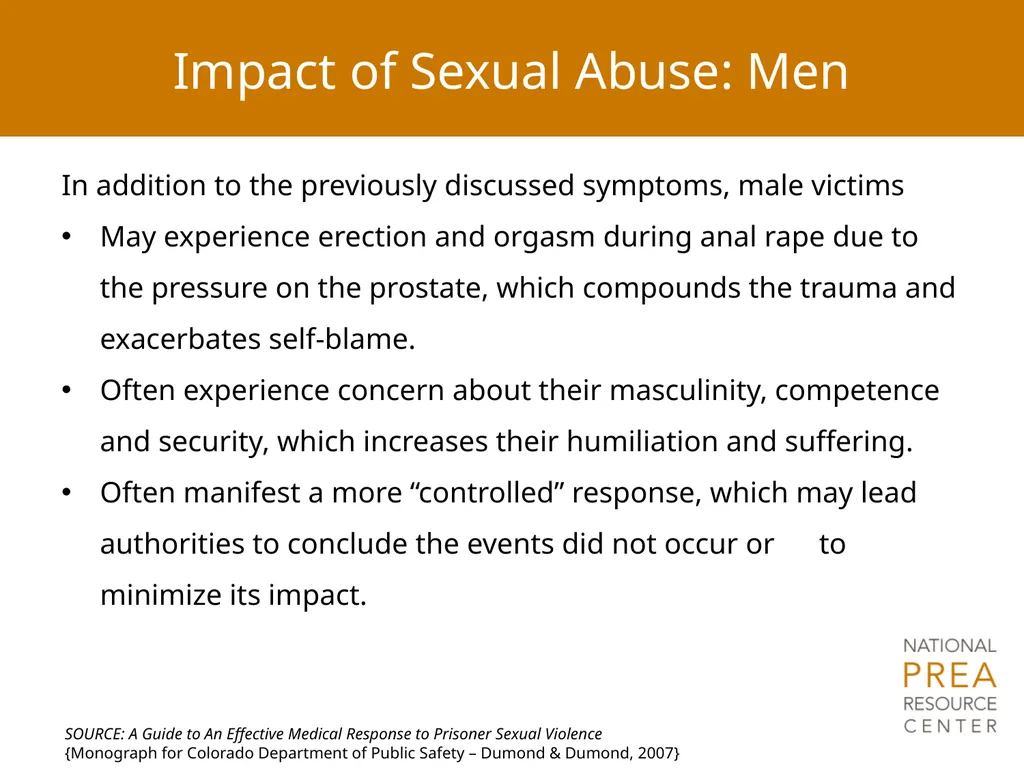
In addition to the previously discussed symptoms, male victims
May experience erection and orgasm during anal rape due to the pressure on the prostate, which compounds the trauma and exacerbates self-blame.
Often experience concern about their masculinity, competence and security, which increases their humiliation and suffering.
Often manifest a more “controlled” response, which may lead authorities to conclude the events did not occur or to minimize its impact. Impact of Sexual Abuse: Men SOURCE: A Guide to An Effective Medical Response to Prisoner Sexual Violence
{Monograph for Colorado Department of Public Safety – Dumond & Dumond, 2007}<br>
May experience erection and orgasm during anal rape due to the pressure on the prostate, which compounds the trauma and exacerbates self-blame.
Often experience concern about their masculinity, competence and security, which increases their humiliation and suffering.
Often manifest a more “controlled” response, which may lead authorities to conclude the events did not occur or to minimize its impact. Impact of Sexual Abuse: Men SOURCE: A Guide to An Effective Medical Response to Prisoner Sexual Violence
{Monograph for Colorado Department of Public Safety – Dumond & Dumond, 2007}<br>
22
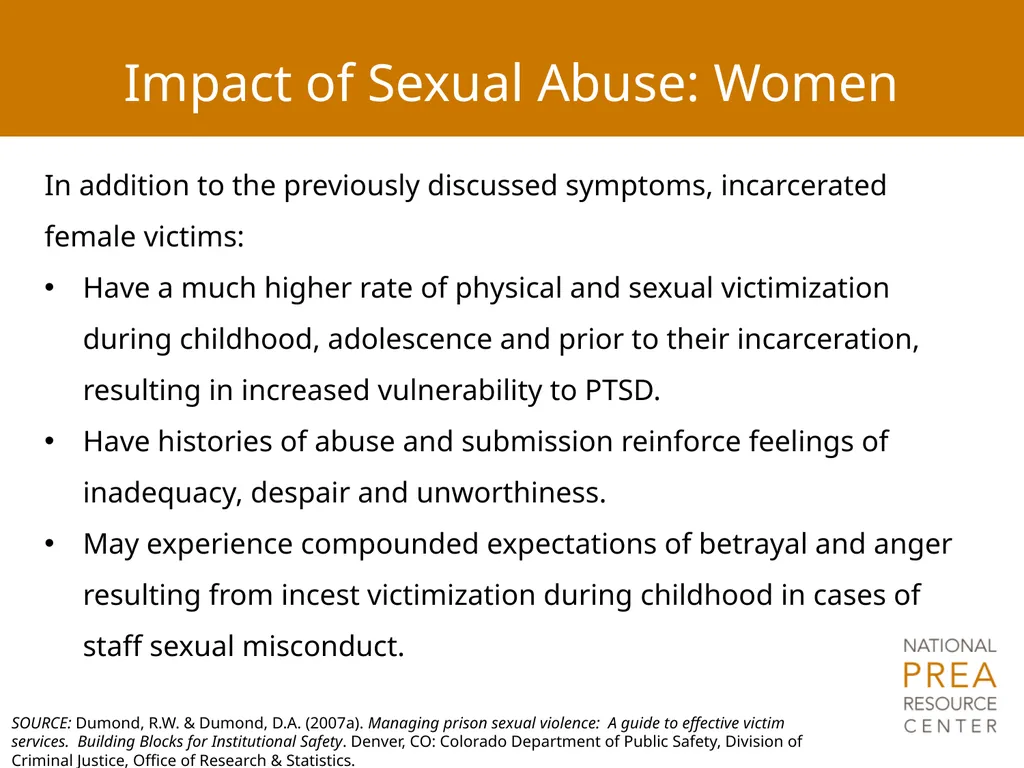
In addition to the previously discussed symptoms, incarcerated female victims:
Have a much higher rate of physical and sexual victimization during childhood, adolescence and prior to their incarceration, resulting in increased vulnerability to PTSD.
Have histories of abuse and submission reinforce feelings of inadequacy, despair and unworthiness.
May experience compounded expectations of betrayal and anger resulting from incest victimization during childhood in cases of staff sexual misconduct. Impact of Sexual Abuse: Women SOURCE: Dumond, R.W. & Dumond, D.A. (2007a). Managing prison sexual violence: A guide to effective victim services. Building Blocks for Institutional Safety. Denver, CO: Colorado Department of Public Safety, Division of Criminal Justice, Office of Research & Statistics.<br>
Have a much higher rate of physical and sexual victimization during childhood, adolescence and prior to their incarceration, resulting in increased vulnerability to PTSD.
Have histories of abuse and submission reinforce feelings of inadequacy, despair and unworthiness.
May experience compounded expectations of betrayal and anger resulting from incest victimization during childhood in cases of staff sexual misconduct. Impact of Sexual Abuse: Women SOURCE: Dumond, R.W. & Dumond, D.A. (2007a). Managing prison sexual violence: A guide to effective victim services. Building Blocks for Institutional Safety. Denver, CO: Colorado Department of Public Safety, Division of Criminal Justice, Office of Research & Statistics.<br>
23
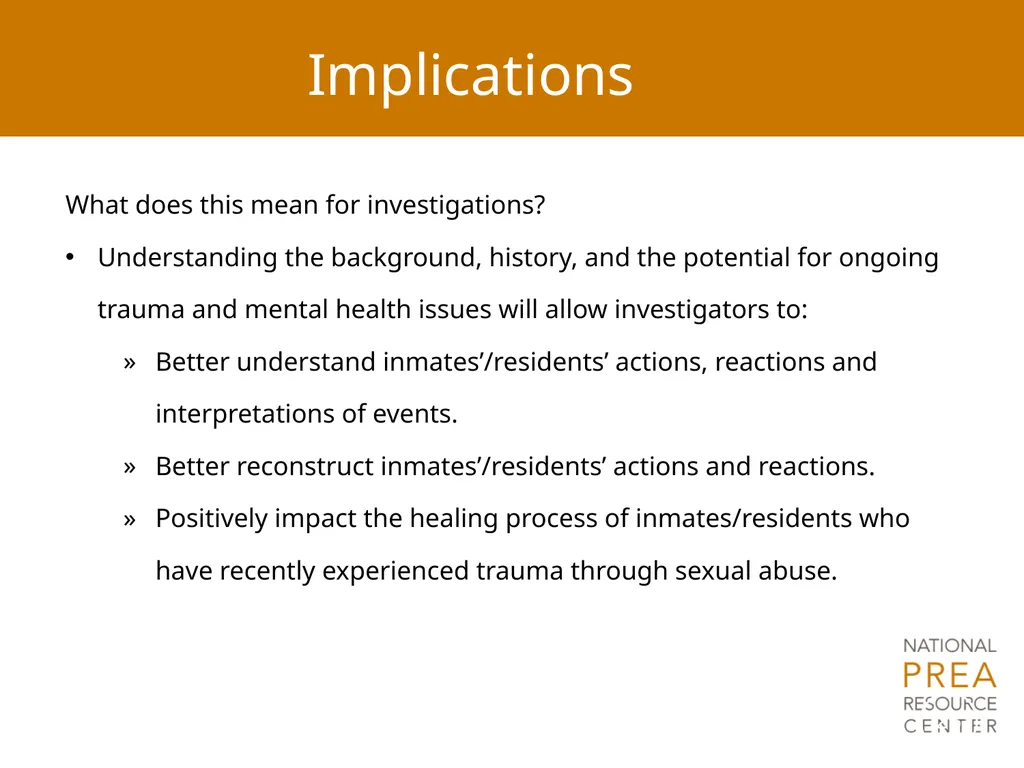
What does this mean for investigations?
Understanding the background, history, and the potential for ongoing trauma and mental health issues will allow investigators to:
Better understand inmates’/residents’ actions, reactions and interpretations of events.
Better reconstruct inmates’/residents’ actions and reactions.
Positively impact the healing process of inmates/residents who have recently experienced trauma through sexual abuse. Implications 23<br>
Understanding the background, history, and the potential for ongoing trauma and mental health issues will allow investigators to:
Better understand inmates’/residents’ actions, reactions and interpretations of events.
Better reconstruct inmates’/residents’ actions and reactions.
Positively impact the healing process of inmates/residents who have recently experienced trauma through sexual abuse. Implications 23<br>
24
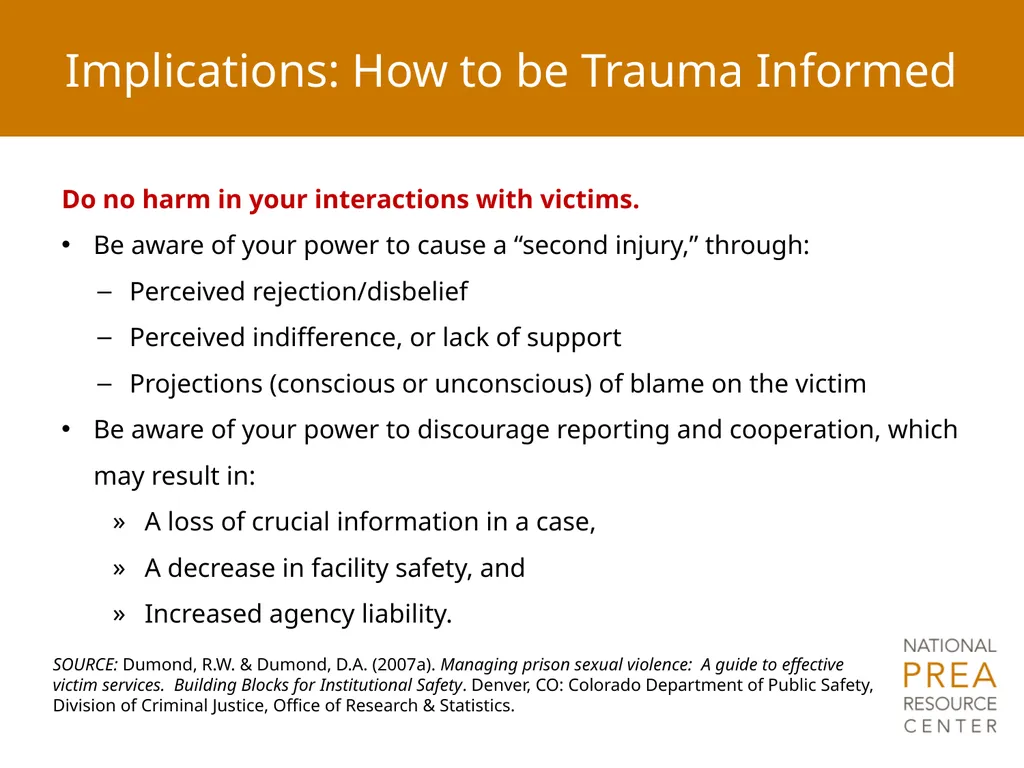
Do no harm in your interactions with victims.
Be aware of your power to cause a “second injury,” through:
Perceived rejection/disbelief
Perceived indifference, or lack of support
Projections (conscious or unconscious) of blame on the victim
Be aware of your power to discourage reporting and cooperation, which may result in:
A loss of crucial information in a case,
A decrease in facility safety, and
Increased agency liability. Implications: How to be Trauma Informed SOURCE: Dumond, R.W. & Dumond, D.A. (2007a). Managing prison sexual violence: A guide to effective victim services. Building Blocks for Institutional Safety. Denver, CO: Colorado Department of Public Safety, Division of Criminal Justice, Office of Research & Statistics.<br>
Be aware of your power to cause a “second injury,” through:
Perceived rejection/disbelief
Perceived indifference, or lack of support
Projections (conscious or unconscious) of blame on the victim
Be aware of your power to discourage reporting and cooperation, which may result in:
A loss of crucial information in a case,
A decrease in facility safety, and
Increased agency liability. Implications: How to be Trauma Informed SOURCE: Dumond, R.W. & Dumond, D.A. (2007a). Managing prison sexual violence: A guide to effective victim services. Building Blocks for Institutional Safety. Denver, CO: Colorado Department of Public Safety, Division of Criminal Justice, Office of Research & Statistics.<br>
25
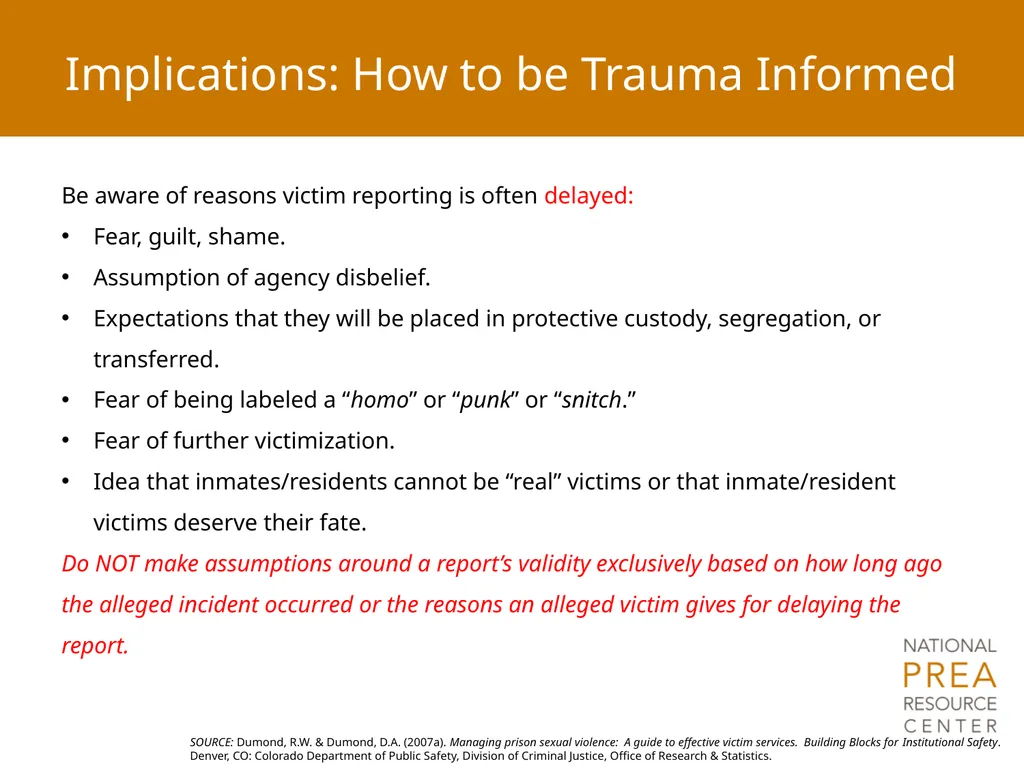
Be aware of reasons victim reporting is often delayed:
Fear, guilt, shame.
Assumption of agency disbelief.
Expectations that they will be placed in protective custody, segregation, or transferred.
Fear of being labeled a “homo” or “punk” or “snitch.”
Fear of further victimization.
Idea that inmates/residents cannot be “real” victims or that inmate/resident victims deserve their fate.
Do NOT make assumptions around a report’s validity exclusively based on how long ago the alleged incident occurred or the reasons an alleged victim gives for delaying the report. Implications: How to be Trauma Informed SOURCE: Dumond, R.W. & Dumond, D.A. (2007a). Managing prison sexual violence: A guide to effective victim services. Building Blocks for Institutional Safety. Denver, CO: Colorado Department of Public Safety, Division of Criminal Justice, Office of Research & Statistics.<br>
Fear, guilt, shame.
Assumption of agency disbelief.
Expectations that they will be placed in protective custody, segregation, or transferred.
Fear of being labeled a “homo” or “punk” or “snitch.”
Fear of further victimization.
Idea that inmates/residents cannot be “real” victims or that inmate/resident victims deserve their fate.
Do NOT make assumptions around a report’s validity exclusively based on how long ago the alleged incident occurred or the reasons an alleged victim gives for delaying the report. Implications: How to be Trauma Informed SOURCE: Dumond, R.W. & Dumond, D.A. (2007a). Managing prison sexual violence: A guide to effective victim services. Building Blocks for Institutional Safety. Denver, CO: Colorado Department of Public Safety, Division of Criminal Justice, Office of Research & Statistics.<br>
26
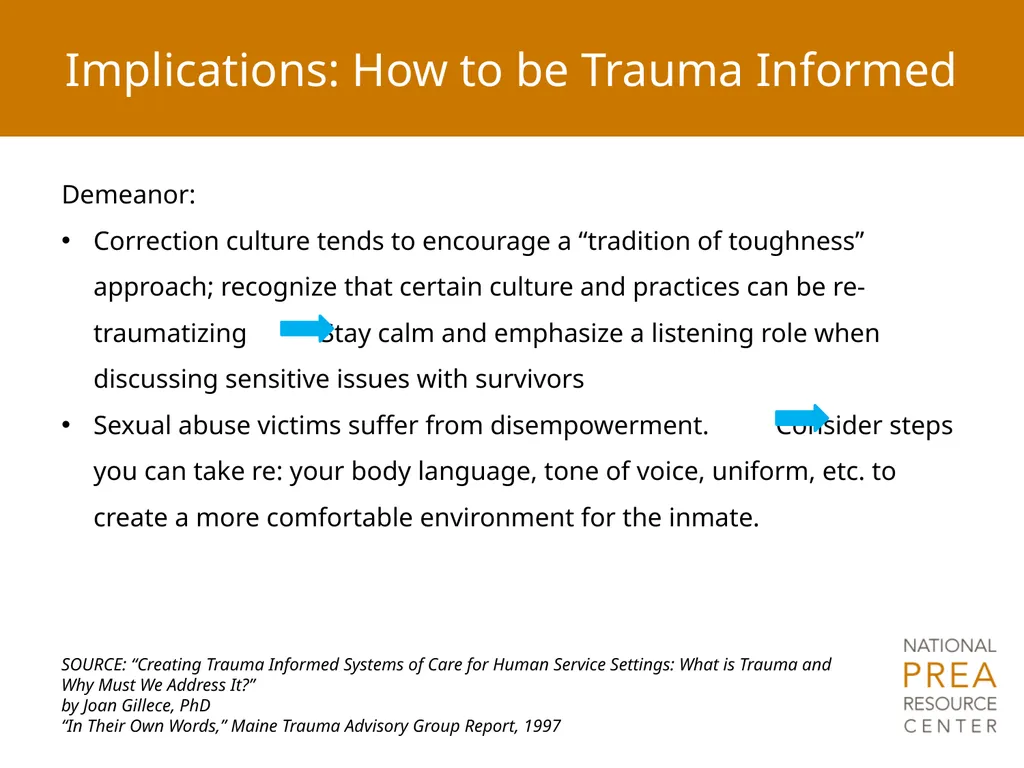
Demeanor:
Correction culture tends to encourage a “tradition of toughness” approach; recognize that certain culture and practices can be re-traumatizing Stay calm and emphasize a listening role when discussing sensitive issues with survivors
Sexual abuse victims suffer from disempowerment. Consider steps you can take re: your body language, tone of voice, uniform, etc. to create a more comfortable environment for the inmate. Implications: How to be Trauma Informed SOURCE: “Creating Trauma Informed Systems of Care for Human Service Settings: What is Trauma and Why Must We Address It?”
by Joan Gillece, PhD
“In Their Own Words,” Maine Trauma Advisory Group Report, 1997<br>
Correction culture tends to encourage a “tradition of toughness” approach; recognize that certain culture and practices can be re-traumatizing Stay calm and emphasize a listening role when discussing sensitive issues with survivors
Sexual abuse victims suffer from disempowerment. Consider steps you can take re: your body language, tone of voice, uniform, etc. to create a more comfortable environment for the inmate. Implications: How to be Trauma Informed SOURCE: “Creating Trauma Informed Systems of Care for Human Service Settings: What is Trauma and Why Must We Address It?”
by Joan Gillece, PhD
“In Their Own Words,” Maine Trauma Advisory Group Report, 1997<br>
27
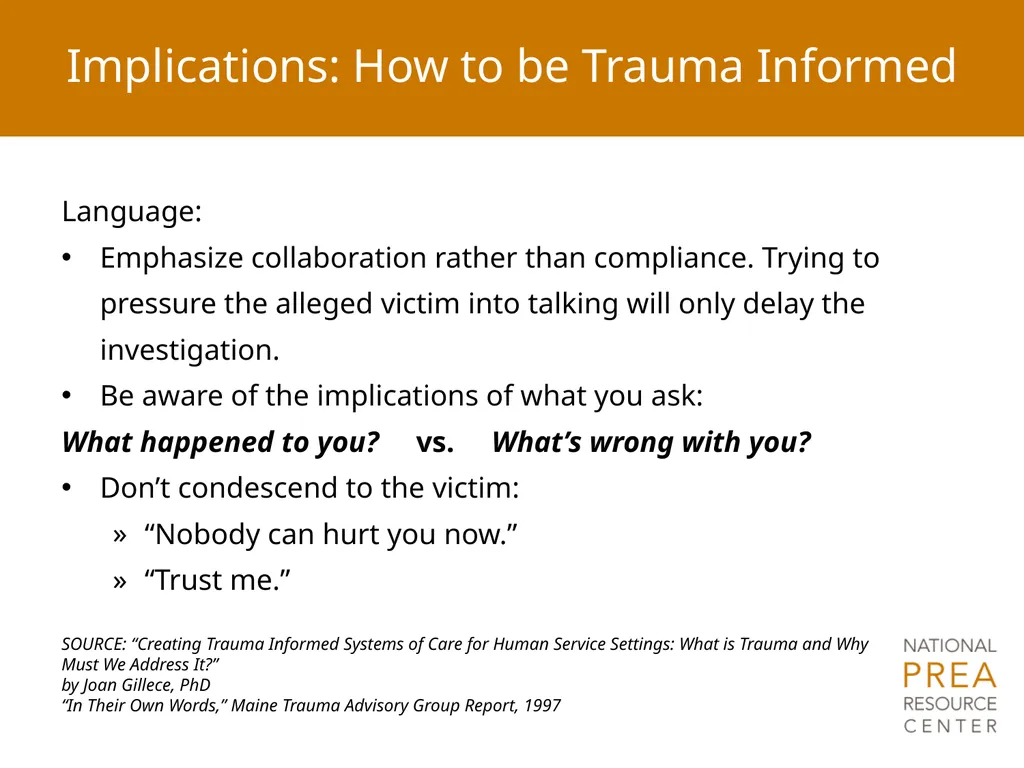
Language:
Emphasize collaboration rather than compliance. Trying to pressure the alleged victim into talking will only delay the investigation.
Be aware of the implications of what you ask:
What happened to you? vs. What’s wrong with you?
Don’t condescend to the victim:
“Nobody can hurt you now.”
“Trust me.” Implications: How to be Trauma Informed SOURCE: “Creating Trauma Informed Systems of Care for Human Service Settings: What is Trauma and Why Must We Address It?”
by Joan Gillece, PhD
“In Their Own Words,” Maine Trauma Advisory Group Report, 1997<br>
Emphasize collaboration rather than compliance. Trying to pressure the alleged victim into talking will only delay the investigation.
Be aware of the implications of what you ask:
What happened to you? vs. What’s wrong with you?
Don’t condescend to the victim:
“Nobody can hurt you now.”
“Trust me.” Implications: How to be Trauma Informed SOURCE: “Creating Trauma Informed Systems of Care for Human Service Settings: What is Trauma and Why Must We Address It?”
by Joan Gillece, PhD
“In Their Own Words,” Maine Trauma Advisory Group Report, 1997<br>
28
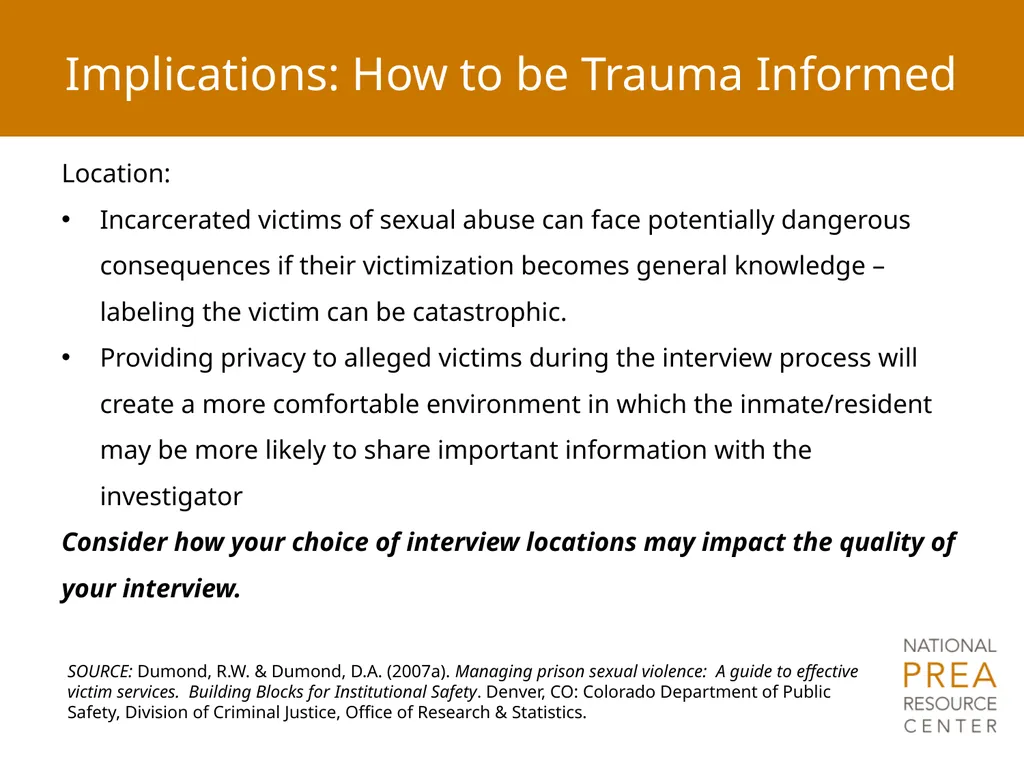
Location:
Incarcerated victims of sexual abuse can face potentially dangerous consequences if their victimization becomes general knowledge – labeling the victim can be catastrophic.
Providing privacy to alleged victims during the interview process will create a more comfortable environment in which the inmate/resident may be more likely to share important information with the investigator
Consider how your choice of interview locations may impact the quality of your interview. Implications: How to be Trauma Informed SOURCE: Dumond, R.W. & Dumond, D.A. (2007a). Managing prison sexual violence: A guide to effective victim services. Building Blocks for Institutional Safety. Denver, CO: Colorado Department of Public Safety, Division of Criminal Justice, Office of Research & Statistics.<br>
Incarcerated victims of sexual abuse can face potentially dangerous consequences if their victimization becomes general knowledge – labeling the victim can be catastrophic.
Providing privacy to alleged victims during the interview process will create a more comfortable environment in which the inmate/resident may be more likely to share important information with the investigator
Consider how your choice of interview locations may impact the quality of your interview. Implications: How to be Trauma Informed SOURCE: Dumond, R.W. & Dumond, D.A. (2007a). Managing prison sexual violence: A guide to effective victim services. Building Blocks for Institutional Safety. Denver, CO: Colorado Department of Public Safety, Division of Criminal Justice, Office of Research & Statistics.<br>
29
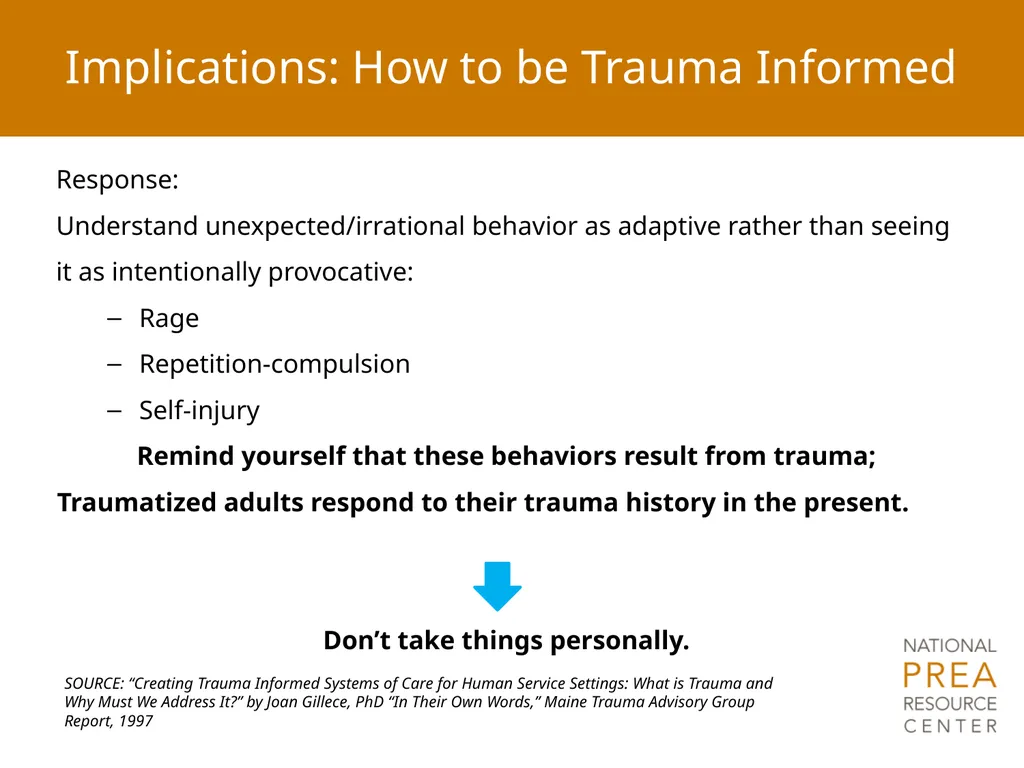
Response:
Understand unexpected/irrational behavior as adaptive rather than seeing it as intentionally provocative:
Rage
Repetition-compulsion
Self-injury
Remind yourself that these behaviors result from trauma; Traumatized adults respond to their trauma history in the present.
Don’t take things personally. Implications: How to be Trauma Informed SOURCE: “Creating Trauma Informed Systems of Care for Human Service Settings: What is Trauma and Why Must We Address It?” by Joan Gillece, PhD “In Their Own Words,” Maine Trauma Advisory Group Report, 1997<br>
Understand unexpected/irrational behavior as adaptive rather than seeing it as intentionally provocative:
Rage
Repetition-compulsion
Self-injury
Remind yourself that these behaviors result from trauma; Traumatized adults respond to their trauma history in the present.
Don’t take things personally. Implications: How to be Trauma Informed SOURCE: “Creating Trauma Informed Systems of Care for Human Service Settings: What is Trauma and Why Must We Address It?” by Joan Gillece, PhD “In Their Own Words,” Maine Trauma Advisory Group Report, 1997<br>
30
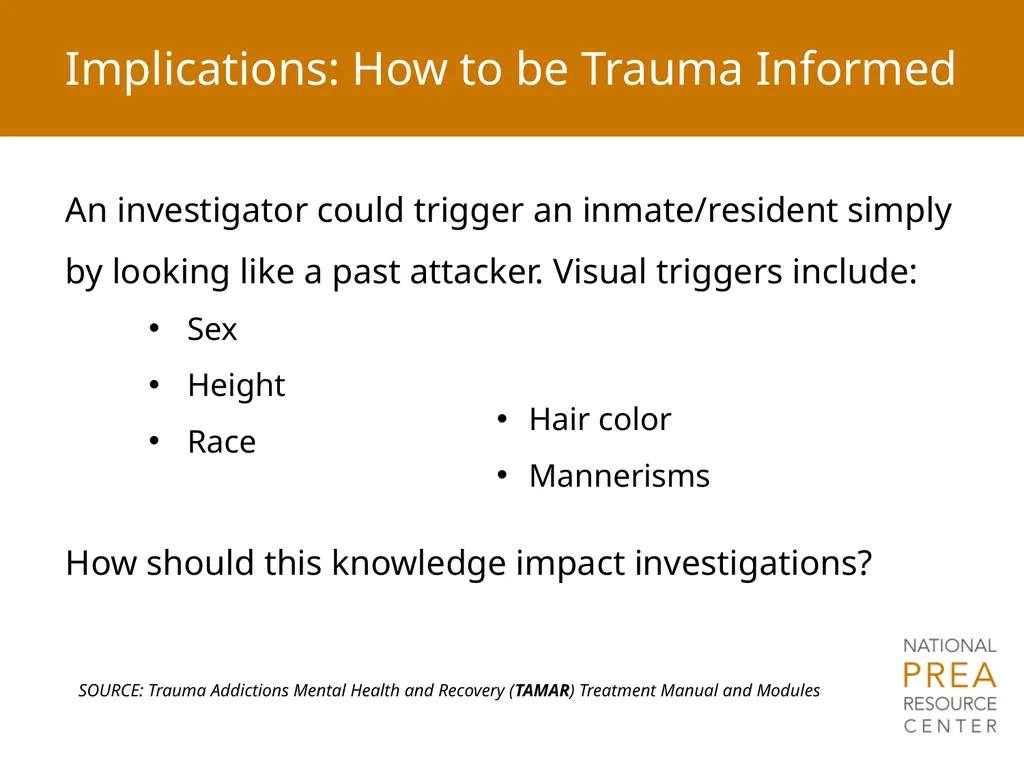
An investigator could trigger an inmate/resident simply by looking like a past attacker. Visual triggers include:
Sex
Height
Race
How should this knowledge impact investigations? Implications: How to be Trauma Informed SOURCE: Trauma Addictions Mental Health and Recovery (TAMAR) Treatment Manual and Modules Hair color
Mannerisms<br>
Sex
Height
Race
How should this knowledge impact investigations? Implications: How to be Trauma Informed SOURCE: Trauma Addictions Mental Health and Recovery (TAMAR) Treatment Manual and Modules Hair color
Mannerisms<br>
31
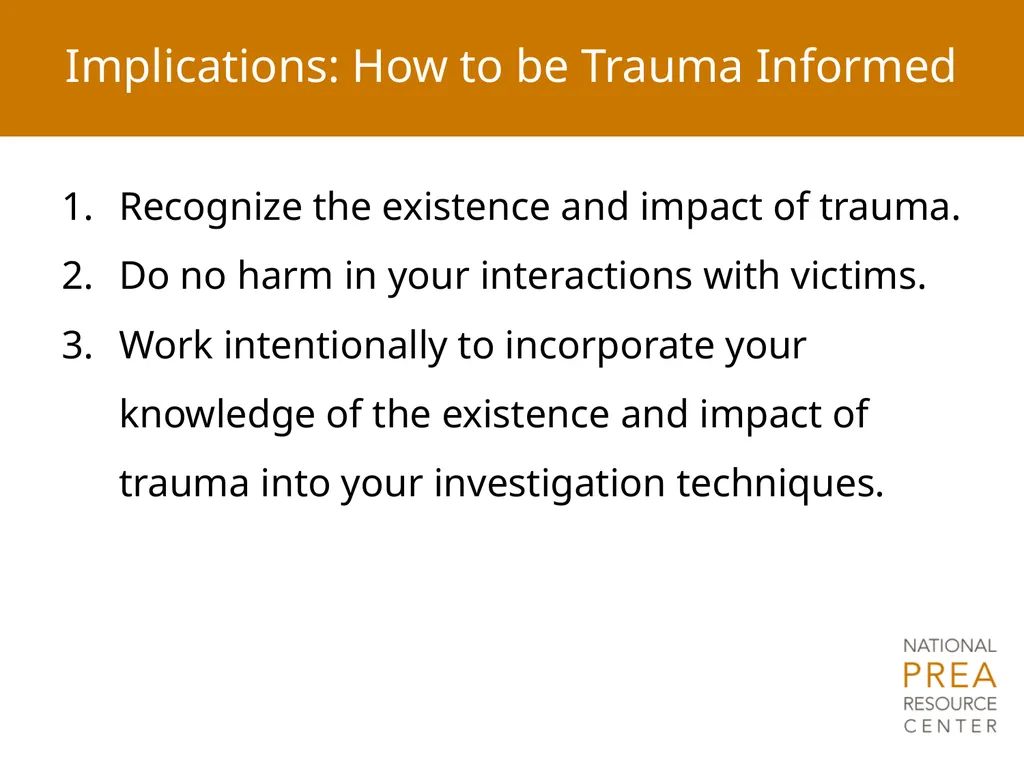
Recognize the existence and impact of trauma.
Do no harm in your interactions with victims.
Work intentionally to incorporate your knowledge of the existence and impact of trauma into your investigation techniques. Implications: How to be Trauma Informed<br>
Do no harm in your interactions with victims.
Work intentionally to incorporate your knowledge of the existence and impact of trauma into your investigation techniques. Implications: How to be Trauma Informed<br>
32
Questions?<br>