
Module 7 Family Engagement Standard - Exploration
TG
Published · 67 slides · 0 views

1 / 1

Description
Module 7 Family Engagement Standard - Exploration Agenda 7.1: Overview of Exploration 7.2: Scaling Caregiver Protective Capacities 7.3: Assessing and Ensuring Child Well-being 7:4: Danger Statement, Family Goal and Motivation for Change
Related Topics
Share
Embed code
Download this presentation From Below
"Module 7 Family Engagement Standard - Exploration" is the property of its rightful owner. Permission is granted to download and print the materials on this website for personal, non-commercial use only, and to display it on your personal computer provided you do not modify the materials and that you retain all copyright notices contained in the materials. By downloading content from our website, you accept the terms of this agreement.
Presentation Transcript
01
Module 7 Family Engagement Standard - Exploration<br>
02
Agenda 7.1: Overview of Exploration
7.2: Scaling Caregiver Protective Capacities
7.3: Assessing and Ensuring Child Well-being
7:4: Danger Statement, Family Goal and Motivation for Change
7.5: Information Collection/Domains Pre-Service CM Specialty Module 7.0.2<br>
7.2: Scaling Caregiver Protective Capacities
7.3: Assessing and Ensuring Child Well-being
7:4: Danger Statement, Family Goal and Motivation for Change
7.5: Information Collection/Domains Pre-Service CM Specialty Module 7.0.2<br>
03
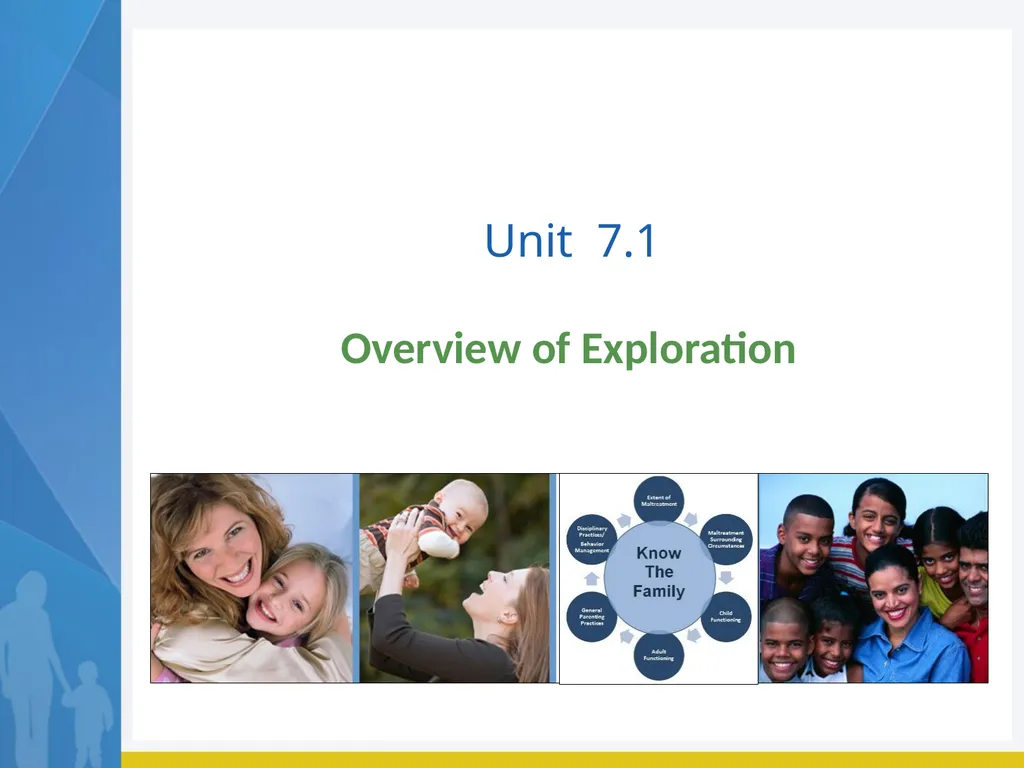
Unit 7.1 Overview of Exploration<br>
04
Learning Objectives Pre-Service CM Specialty Module 7.1.2 Explain the purpose of the Exploration Stage and why it is important in the FFA-Ongoing process.<br>
05
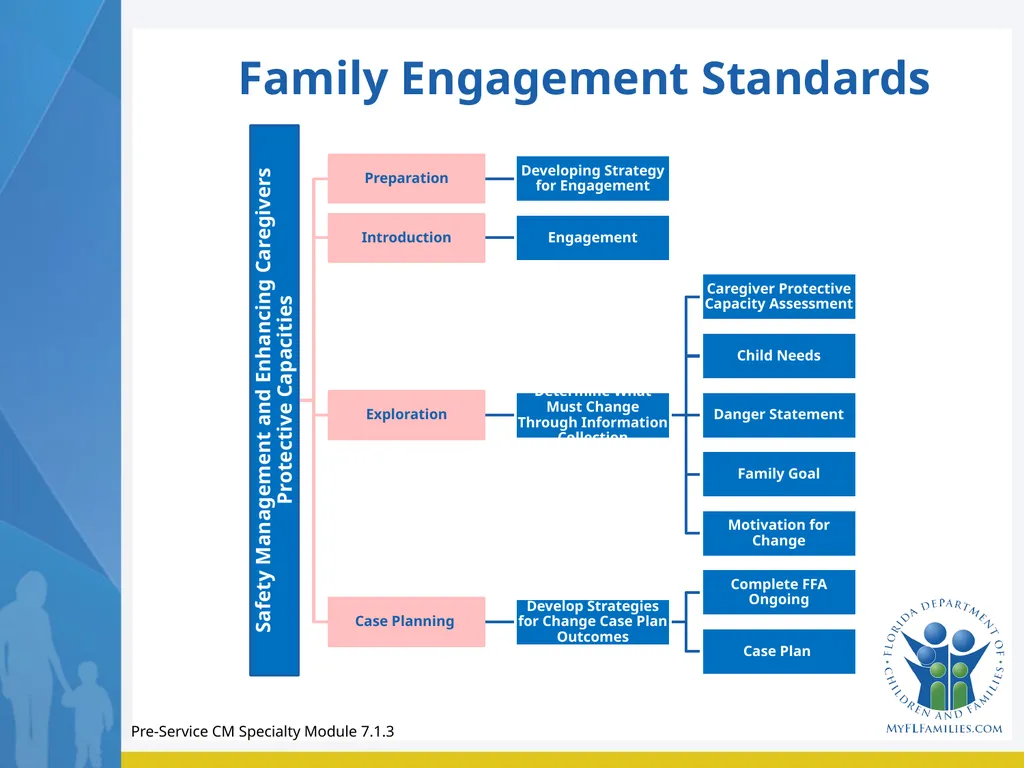
Family Engagement Standards Pre-Service CM Specialty Module 7.1.3<br>
06
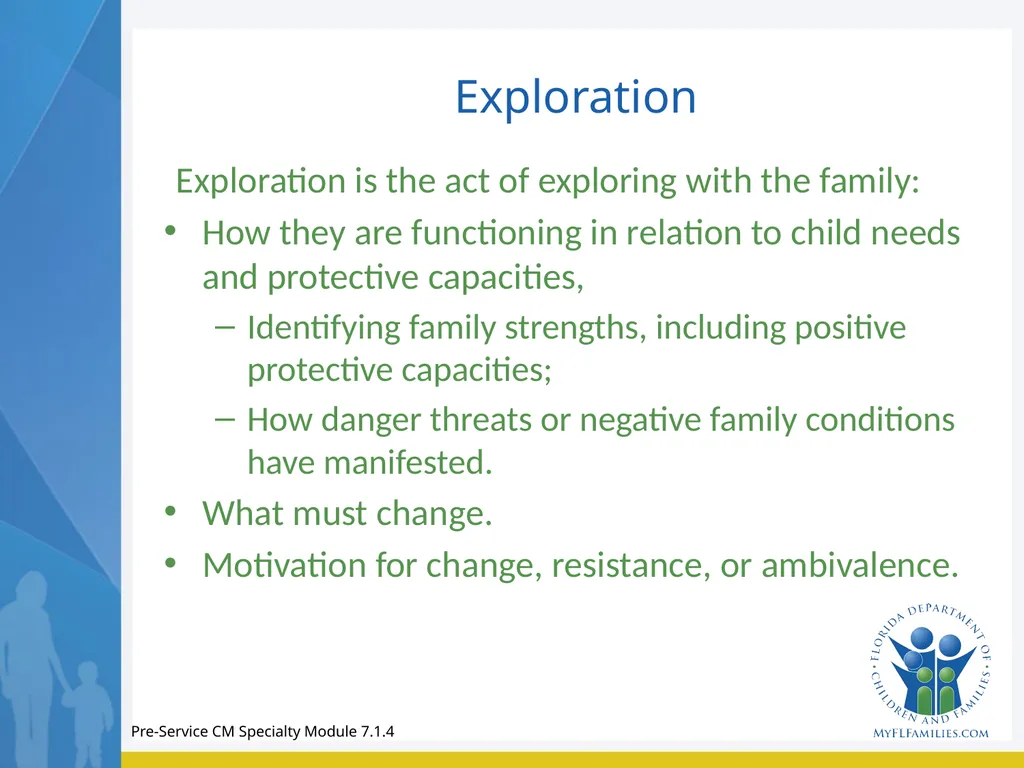
Exploration Exploration is the act of exploring with the family:
How they are functioning in relation to child needs and protective capacities,
Identifying family strengths, including positive protective capacities;
How danger threats or negative family conditions have manifested.
What must change.
Motivation for change, resistance, or ambivalence. Pre-Service CM Specialty Module 7.1.4<br>
How they are functioning in relation to child needs and protective capacities,
Identifying family strengths, including positive protective capacities;
How danger threats or negative family conditions have manifested.
What must change.
Motivation for change, resistance, or ambivalence. Pre-Service CM Specialty Module 7.1.4<br>
07
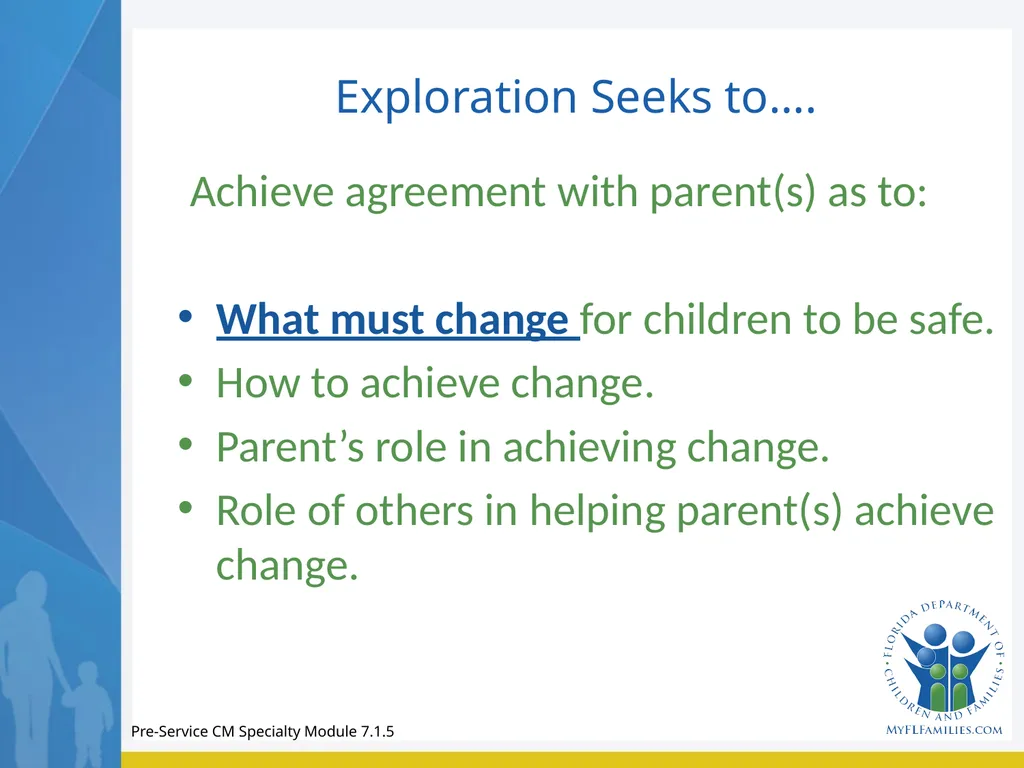
Exploration Seeks to…. Achieve agreement with parent(s) as to:
What must change for children to be safe.
How to achieve change.
Parent’s role in achieving change.
Role of others in helping parent(s) achieve change. Pre-Service CM Specialty Module 7.1.5<br>
What must change for children to be safe.
How to achieve change.
Parent’s role in achieving change.
Role of others in helping parent(s) achieve change. Pre-Service CM Specialty Module 7.1.5<br>
08
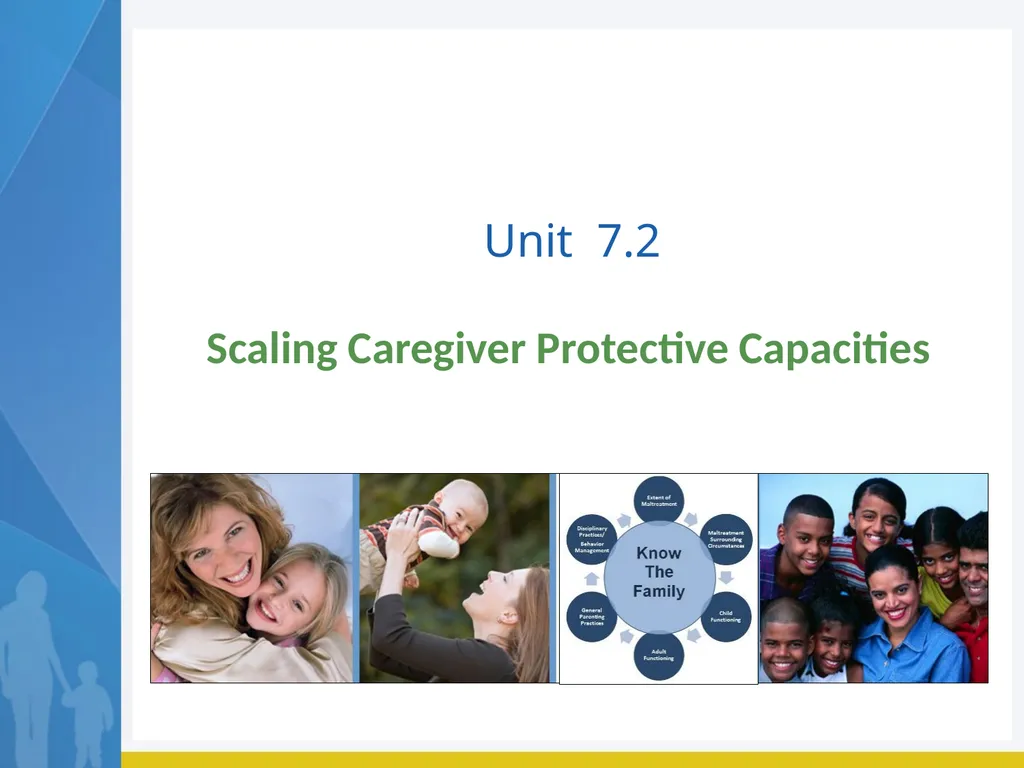
Unit 7.2 Scaling Caregiver Protective Capacities<br>
09
Learning Objectives Define the concept of scaling caregiver capacities.
Demonstrate the ability to scale caregiver protective capacities using a case example. Pre-Service CM Specialty Module 7.2.2<br>
Demonstrate the ability to scale caregiver protective capacities using a case example. Pre-Service CM Specialty Module 7.2.2<br>
10
Caregiver
Protective Capacities Pre-Service CM Specialty Module 7.2.3<br>
11
Caregiver protective capacities are personal and caregiving behavioral, cognitive and emotional characteristics that can be specifically and directly associated with being protective of one’s young.
Caregiver protective capacities are personal qualities or characteristics that contribute to vigilant child protection. Definition: Caregiver Protective Capacities Pre-Service CM Specialty Module 7.2.4<br>
Caregiver protective capacities are personal qualities or characteristics that contribute to vigilant child protection. Definition: Caregiver Protective Capacities Pre-Service CM Specialty Module 7.2.4<br>
12
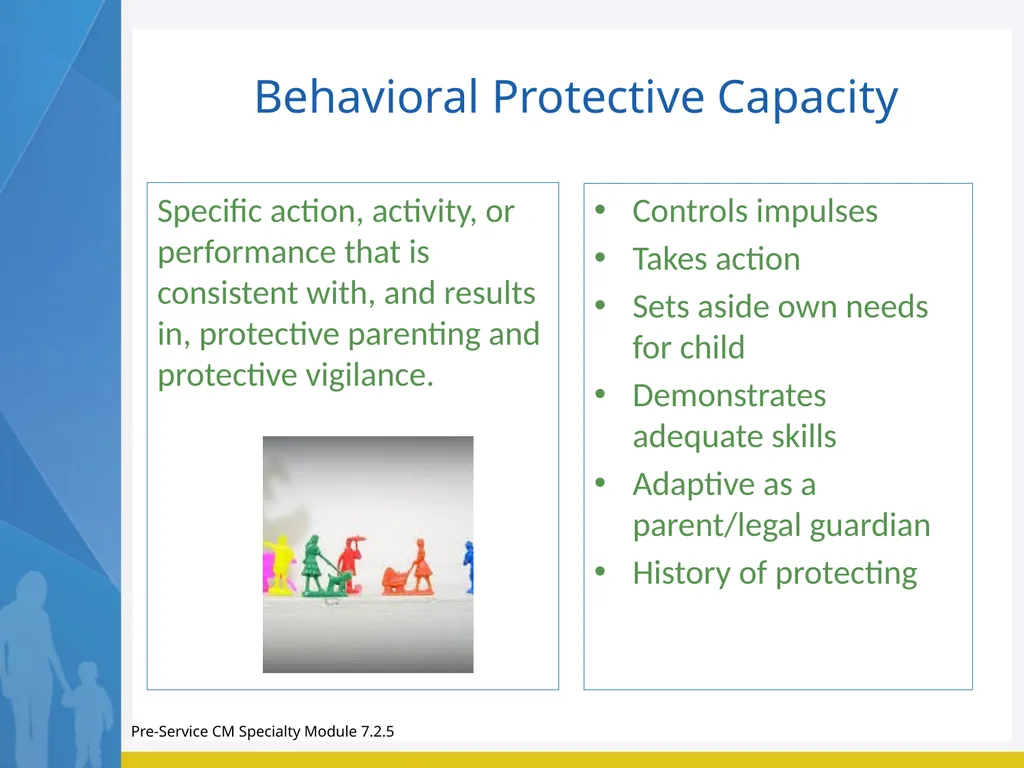
Specific action, activity, or performance that is consistent with, and results in, protective parenting and protective vigilance. Behavioral Protective Capacity Pre-Service CM Specialty Module 7.2.5 Controls impulses
Takes action
Sets aside own needs for child
Demonstrates adequate skills
Adaptive as a parent/legal guardian
History of protecting<br>
Takes action
Sets aside own needs for child
Demonstrates adequate skills
Adaptive as a parent/legal guardian
History of protecting<br>
13
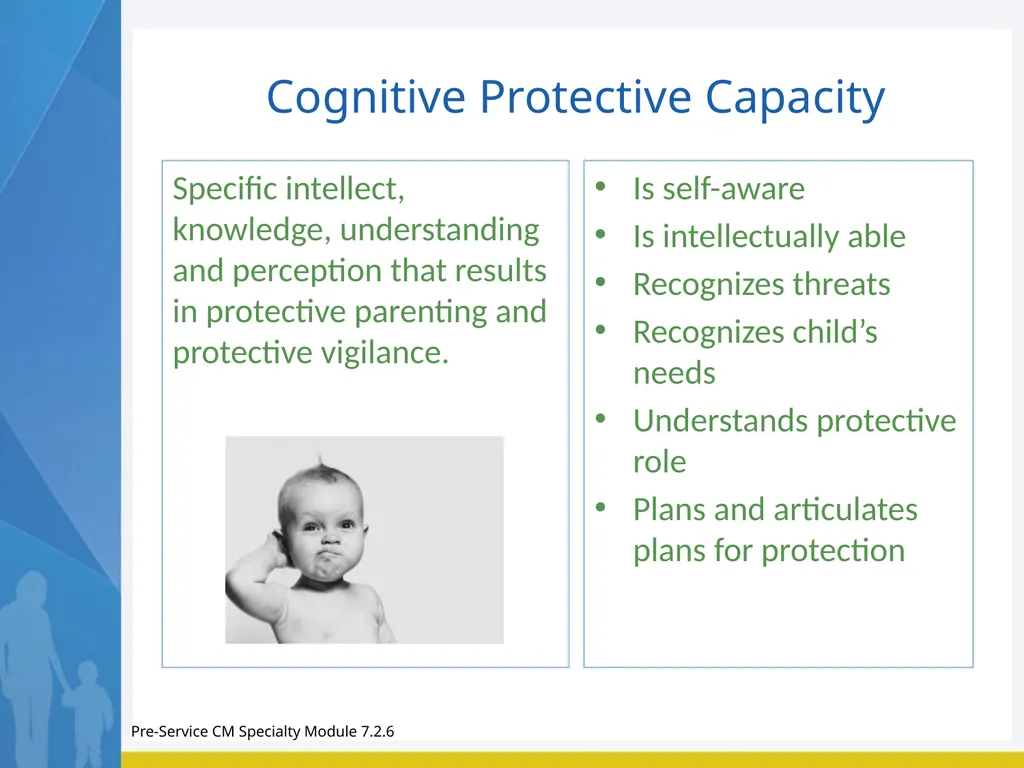
Specific intellect, knowledge, understanding and perception that results in protective parenting and protective vigilance. Cognitive Protective Capacity Pre-Service CM Specialty Module 7.2.6 Is self-aware
Is intellectually able
Recognizes threats
Recognizes child’s needs
Understands protective role
Plans and articulates plans for protection<br>
Is intellectually able
Recognizes threats
Recognizes child’s needs
Understands protective role
Plans and articulates plans for protection<br>
14
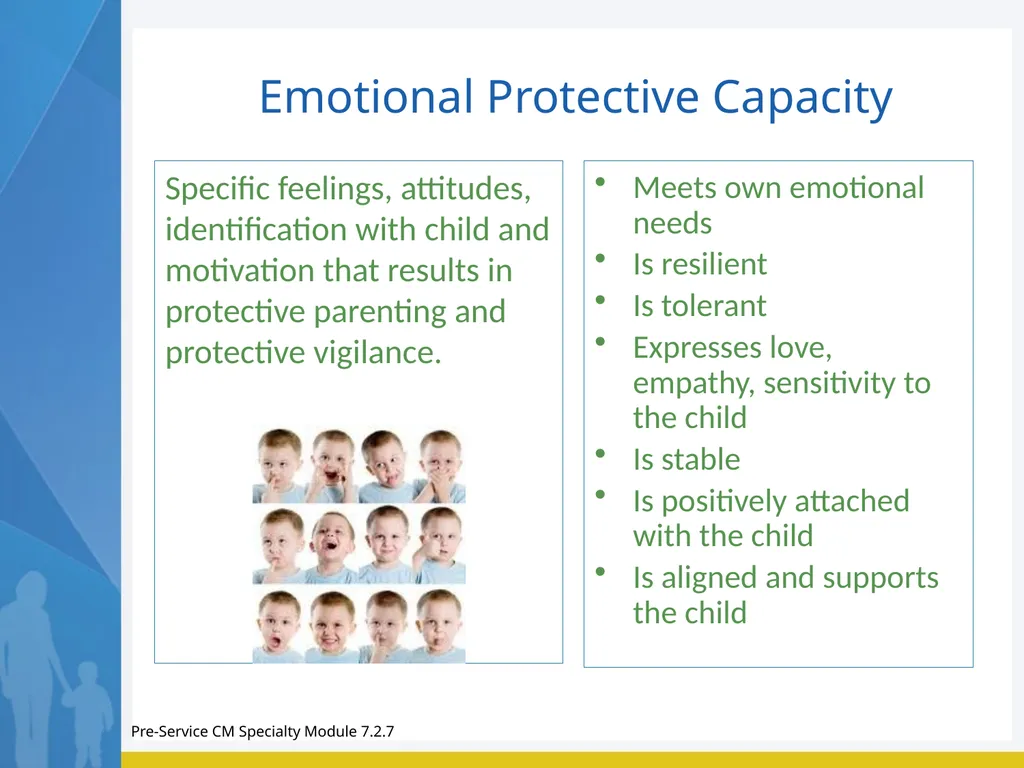
Specific feelings, attitudes, identification with child and motivation that results in protective parenting and protective vigilance. Emotional Protective Capacity Pre-Service CM Specialty Module 7.2.7 Meets own emotional needs
Is resilient
Is tolerant
Expresses love, empathy, sensitivity to the child
Is stable
Is positively attached with the child
Is aligned and supports the child<br>
Is resilient
Is tolerant
Expresses love, empathy, sensitivity to the child
Is stable
Is positively attached with the child
Is aligned and supports the child<br>
15
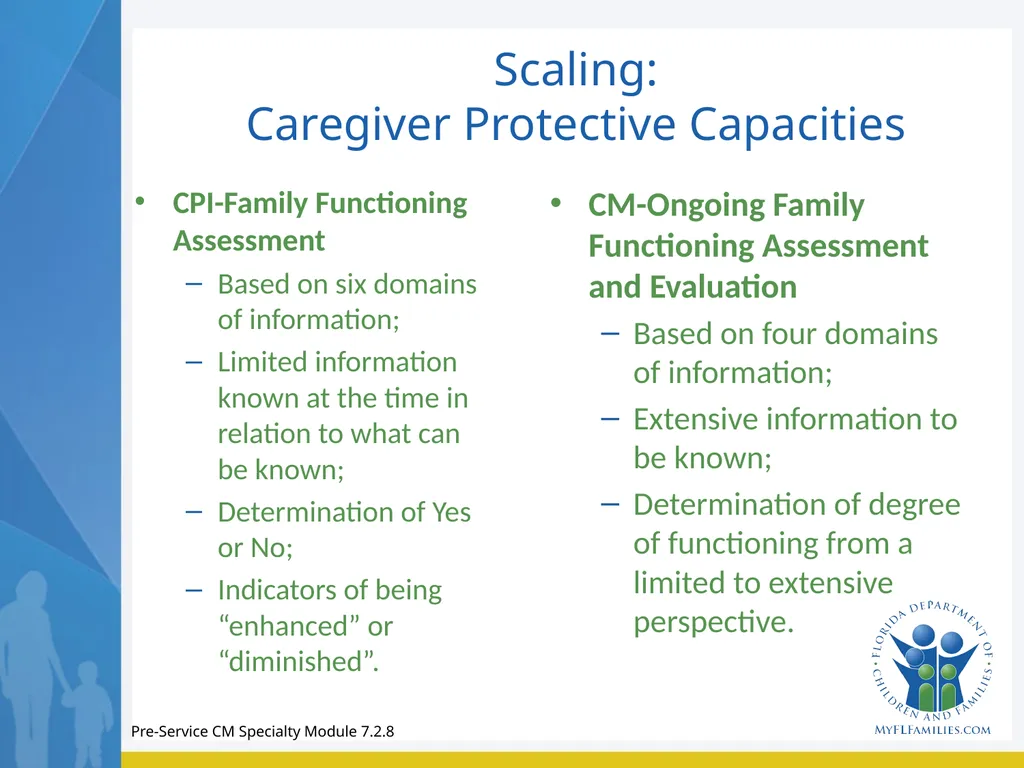
CPI-Family Functioning Assessment
Based on six domains of information;
Limited information known at the time in relation to what can be known;
Determination of Yes or No;
Indicators of being “enhanced” or “diminished”. CM-Ongoing Family Functioning Assessment and Evaluation
Based on four domains of information;
Extensive information to be known;
Determination of degree of functioning from a limited to extensive perspective. Scaling: Caregiver Protective Capacities Pre-Service CM Specialty Module 7.2.8<br>
Based on six domains of information;
Limited information known at the time in relation to what can be known;
Determination of Yes or No;
Indicators of being “enhanced” or “diminished”. CM-Ongoing Family Functioning Assessment and Evaluation
Based on four domains of information;
Extensive information to be known;
Determination of degree of functioning from a limited to extensive perspective. Scaling: Caregiver Protective Capacities Pre-Service CM Specialty Module 7.2.8<br>
16
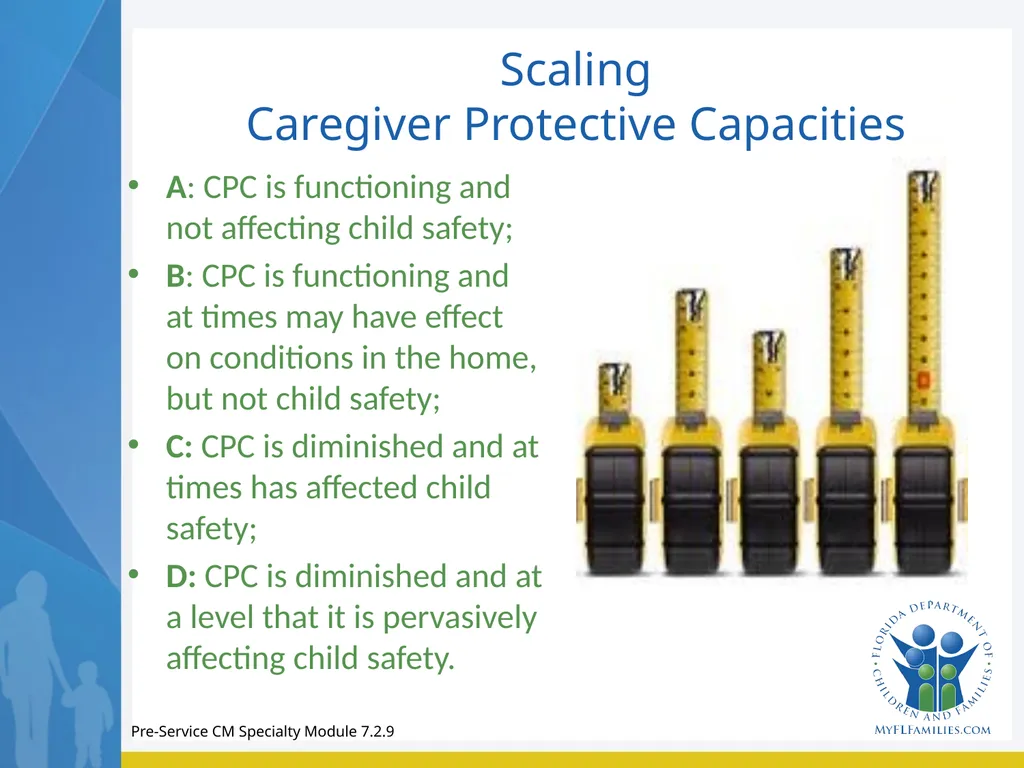
A: CPC is functioning and not affecting child safety;
B: CPC is functioning and at times may have effect on conditions in the home, but not child safety;
C: CPC is diminished and at times has affected child safety;
D: CPC is diminished and at a level that it is pervasively affecting child safety. Scaling Caregiver Protective Capacities Pre-Service CM Specialty Module 7.2.9<br>
B: CPC is functioning and at times may have effect on conditions in the home, but not child safety;
C: CPC is diminished and at times has affected child safety;
D: CPC is diminished and at a level that it is pervasively affecting child safety. Scaling Caregiver Protective Capacities Pre-Service CM Specialty Module 7.2.9<br>
17
Activity A:
Scaling Caregiver Protective Capacities Instructions:
Working individually, read the scenarios and using your Caregiver Protective Capacity Definition, scale the capacity as an A, B, C, or D. Pre-Service CM Specialty Module 7.2.10<br>
Working individually, read the scenarios and using your Caregiver Protective Capacity Definition, scale the capacity as an A, B, C, or D. Pre-Service CM Specialty Module 7.2.10<br>
18
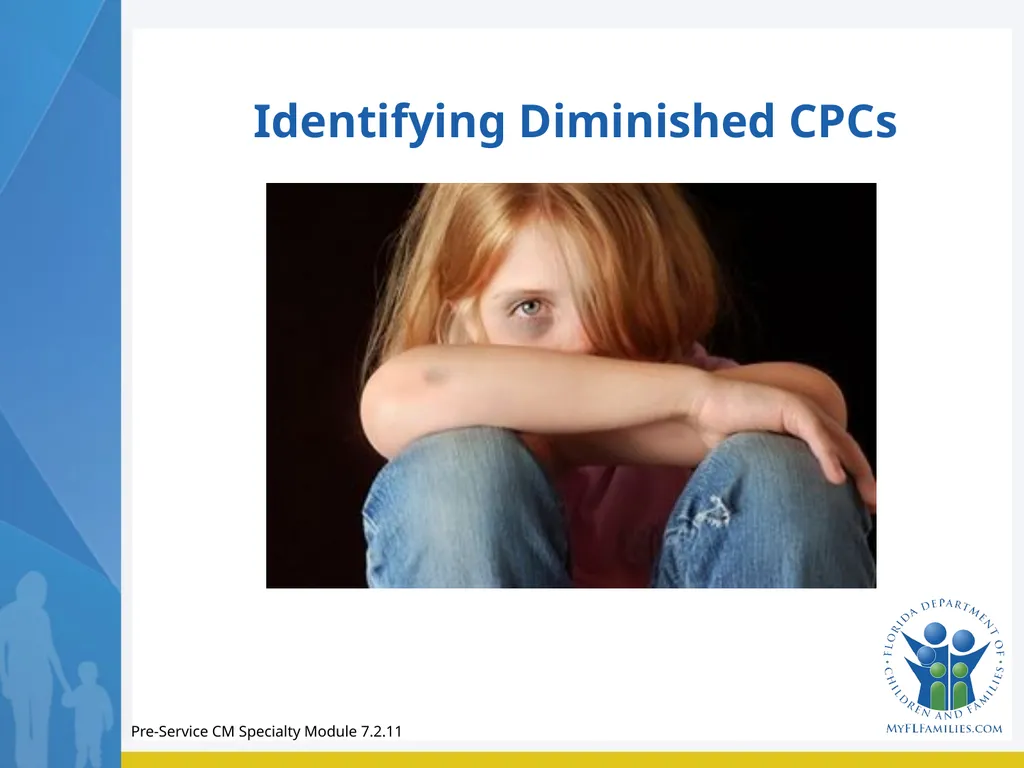
Identifying Diminished CPCs Pre-Service CM Specialty Module 7.2.11<br>
19
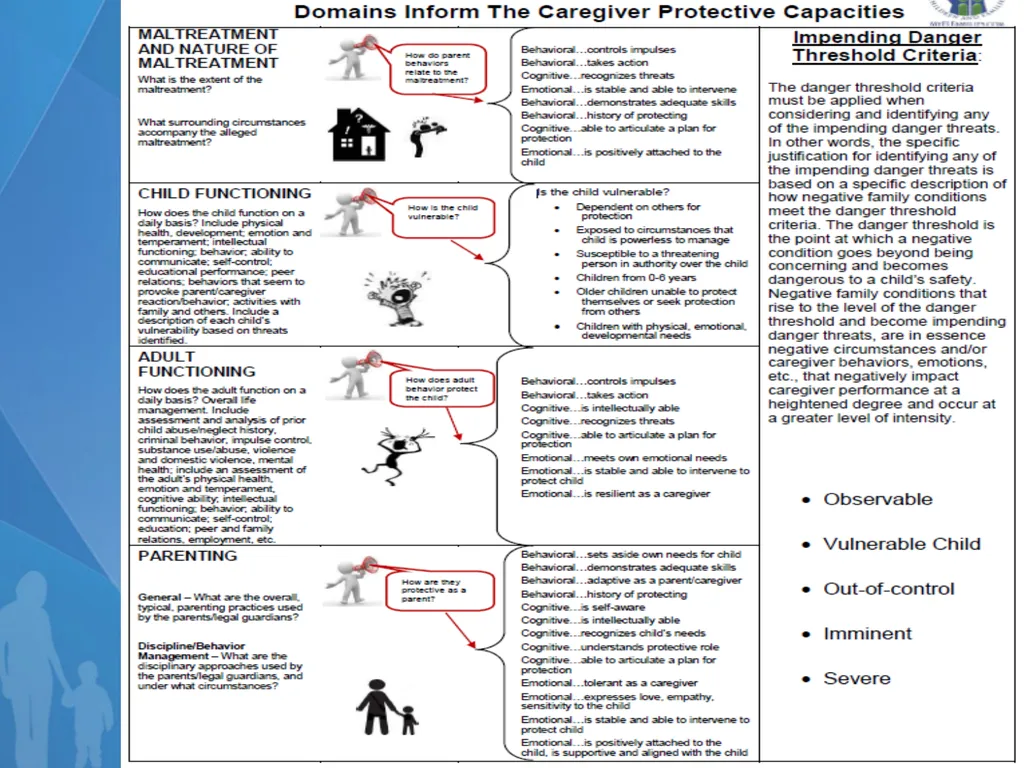
Pre-Service CM Specialty Module 7.2.12<br>
20
Exploration Overview of Exploration.
Existing Caregiver. Protective Capacities.
Diminished Caregiver Protective Capacities.
Determining what must change. Pre-Service CM Specialty Module 7.2.13<br>
Existing Caregiver. Protective Capacities.
Diminished Caregiver Protective Capacities.
Determining what must change. Pre-Service CM Specialty Module 7.2.13<br>
21
Activity B:
Observation of
Exploration Stage Interviews Instructions:
Watch the two videos of Angela Russell and her interaction with Brandy, the Case Manager.
Read the overview of the Russell family.
Answer the questions on the worksheet.
Be prepared to discuss. Pre-Service CM Specialty Module 7.2.14<br>
Watch the two videos of Angela Russell and her interaction with Brandy, the Case Manager.
Read the overview of the Russell family.
Answer the questions on the worksheet.
Be prepared to discuss. Pre-Service CM Specialty Module 7.2.14<br>
22
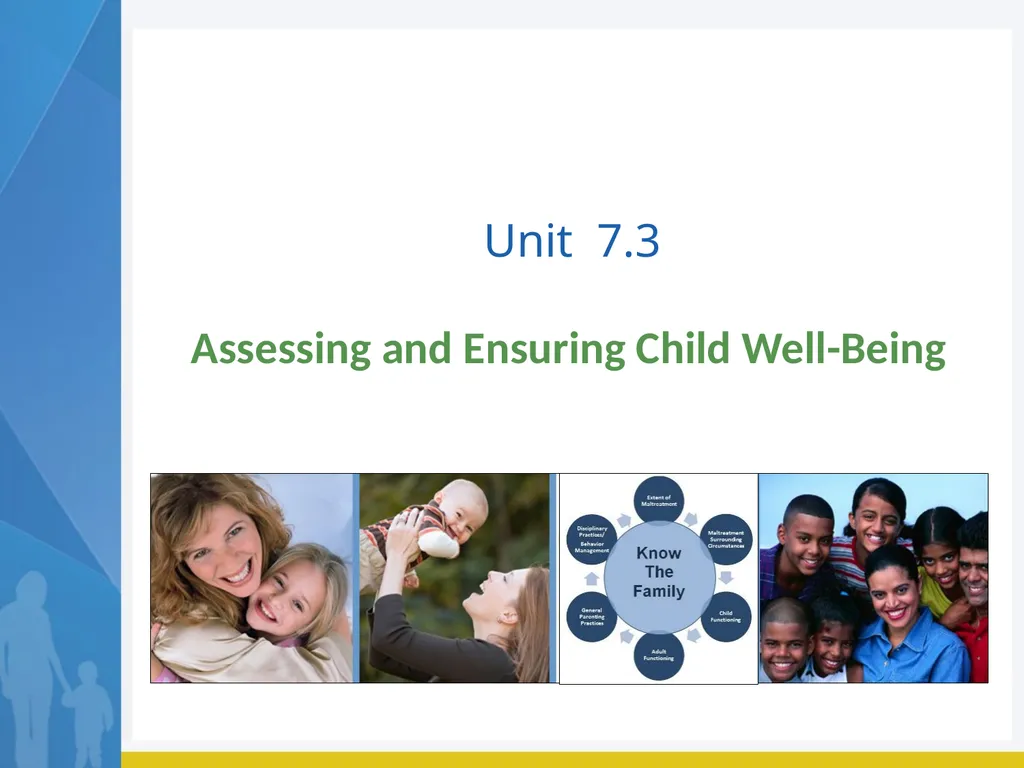
Unit 7.3 Assessing and Ensuring Child Well-Being<br>
23
Learning Objectives Define the different child strengths and needs indicators.
Scale the child strengths and needs. Pre-Service CM Specialty Module 7.3.2<br>
Scale the child strengths and needs. Pre-Service CM Specialty Module 7.3.2<br>
24
Child Strengths and Needs Set of indicators directly related to a child’s well-being and success.
Each indicator is rated based upon information that is provided in the narrative description of child functioning.
The ratings provide a way for the case manager to identify areas that need attention in the case plan and to measure changes over time. Pre-Service CM Specialty Module 7.3.3<br>
Each indicator is rated based upon information that is provided in the narrative description of child functioning.
The ratings provide a way for the case manager to identify areas that need attention in the case plan and to measure changes over time. Pre-Service CM Specialty Module 7.3.3<br>
25
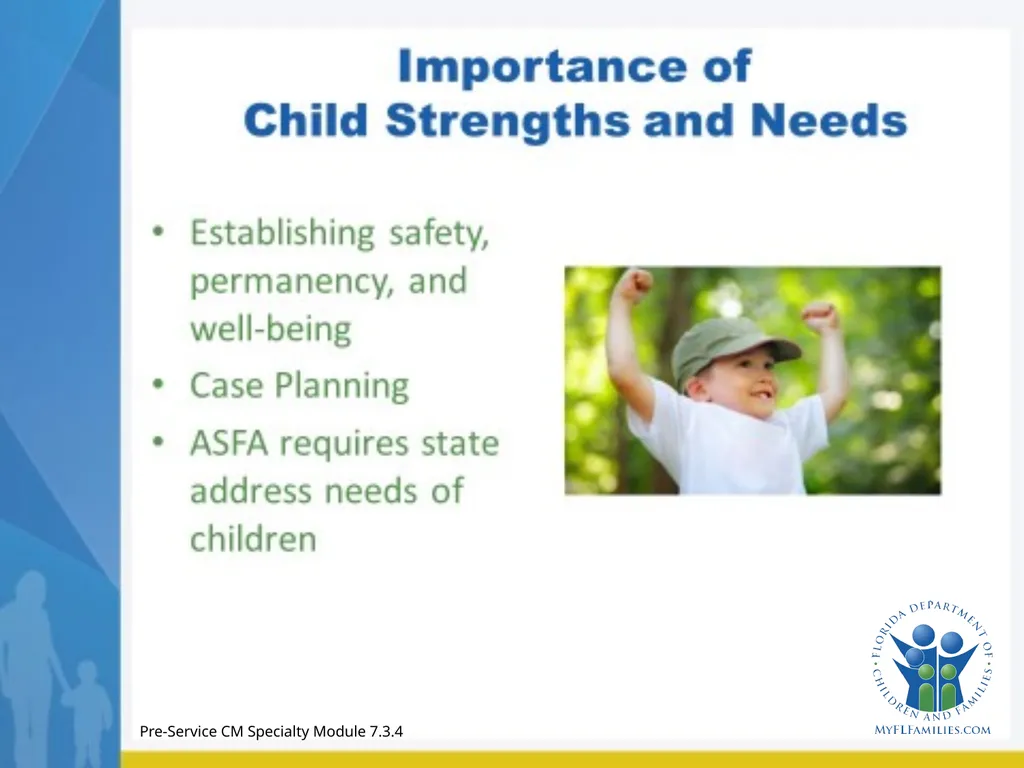
Pre-Service CM Specialty Module 7.3.4<br>
26
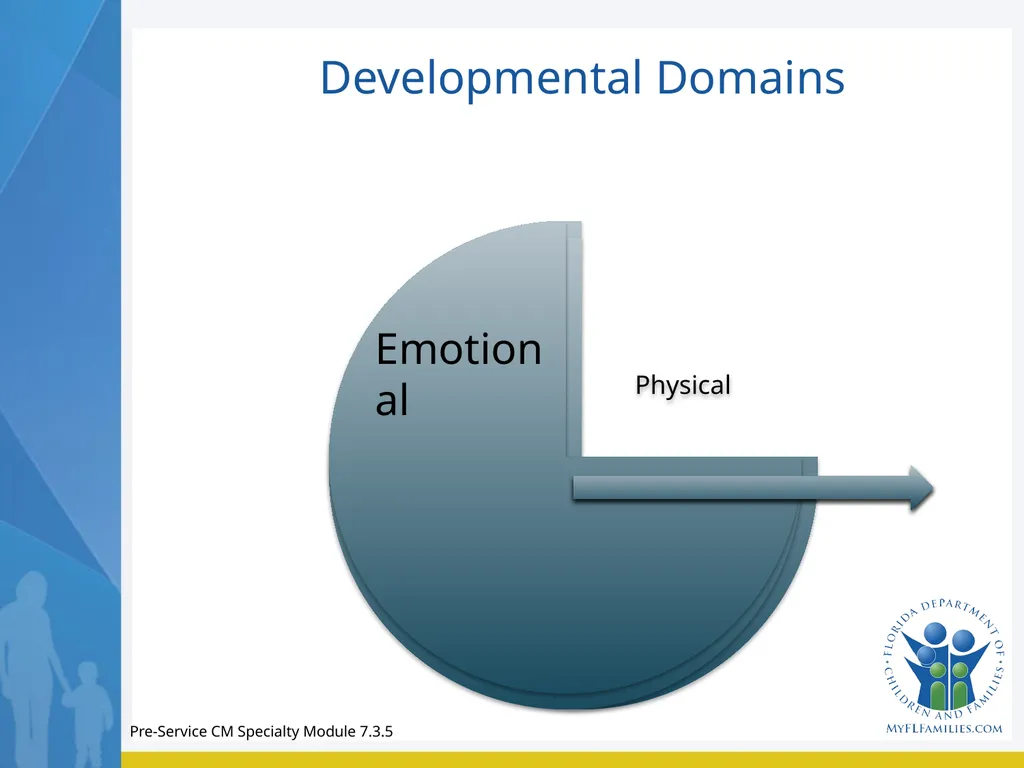
Emotional Developmental Domains Pre-Service CM Specialty Module 7.3.5<br>
27
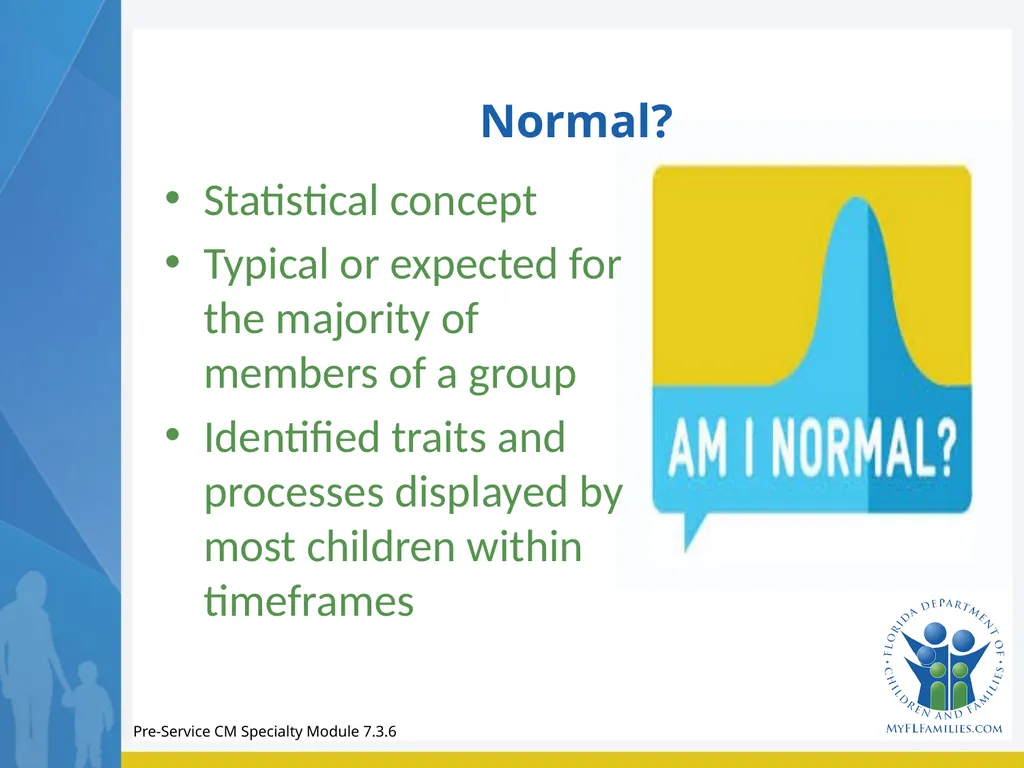
Normal? Statistical concept
Typical or expected for the majority of members of a group
Identified traits and processes displayed by most children within timeframes Pre-Service CM Specialty Module 7.3.6<br>
Typical or expected for the majority of members of a group
Identified traits and processes displayed by most children within timeframes Pre-Service CM Specialty Module 7.3.6<br>
28
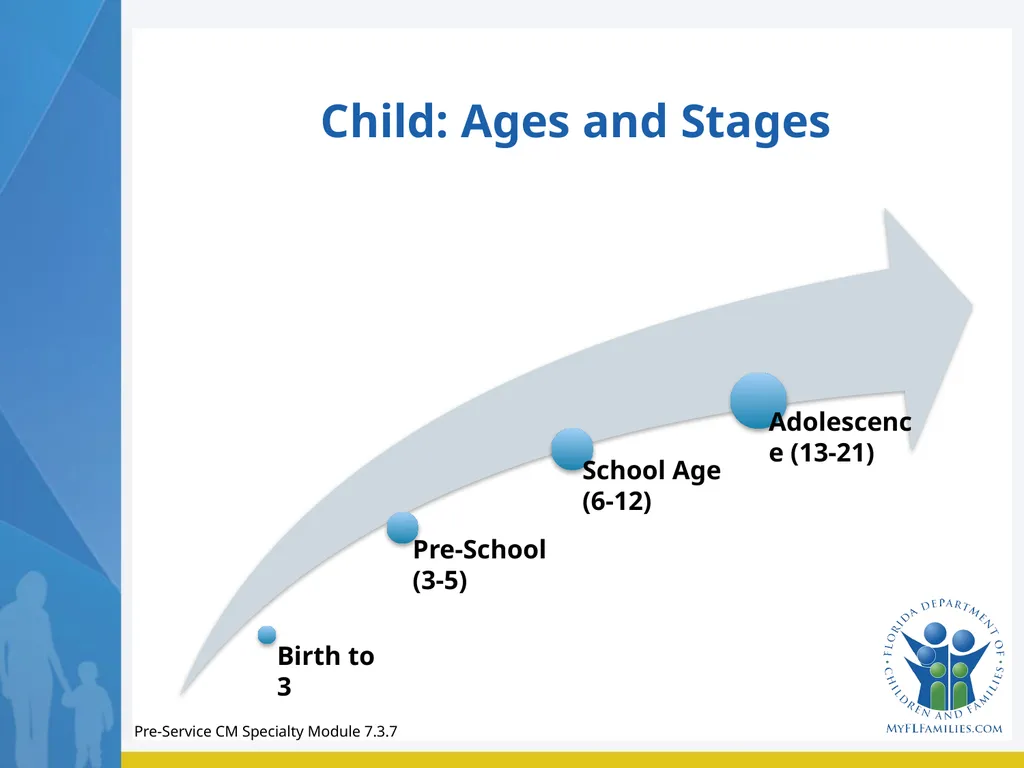
Child: Ages and Stages Pre-Service CM Specialty Module 7.3.7<br>
29
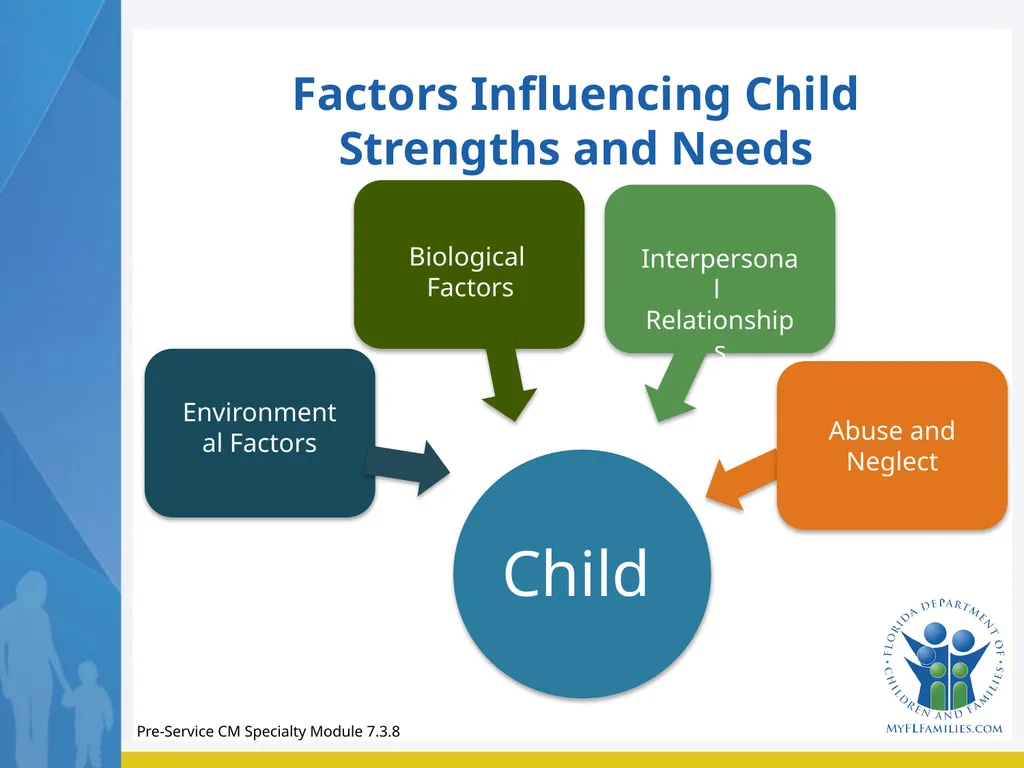
Factors Influencing Child Strengths and Needs Child Environmental Factors Biological
Factors Interpersonal
Relationships Abuse and
Neglect Pre-Service CM Specialty Module 7.3.8<br>
Factors Interpersonal
Relationships Abuse and
Neglect Pre-Service CM Specialty Module 7.3.8<br>
30
Child Strengths and Needs
Assessment Part of the FFA-Ongoing and Progress Updates
Measure extent certain desired conditions are present in a child’s life
Includes scaling of 10 defined child strengths and needs Pre-Service CM Specialty Module 7.3.9<br>
Measure extent certain desired conditions are present in a child’s life
Includes scaling of 10 defined child strengths and needs Pre-Service CM Specialty Module 7.3.9<br>
31
Scaling of Child Needs:
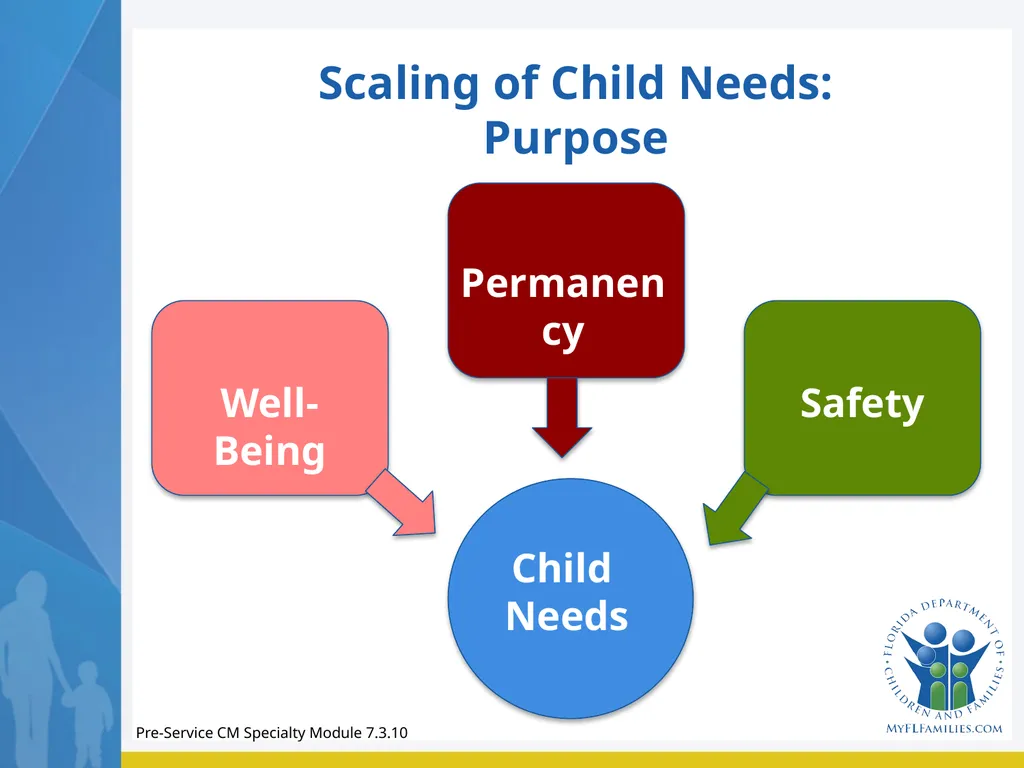
Purpose Well-Being Permanency Safety Child
Needs Pre-Service CM Specialty Module 7.3.10<br>
Needs Pre-Service CM Specialty Module 7.3.10<br>
32
Scaling Child Needs:
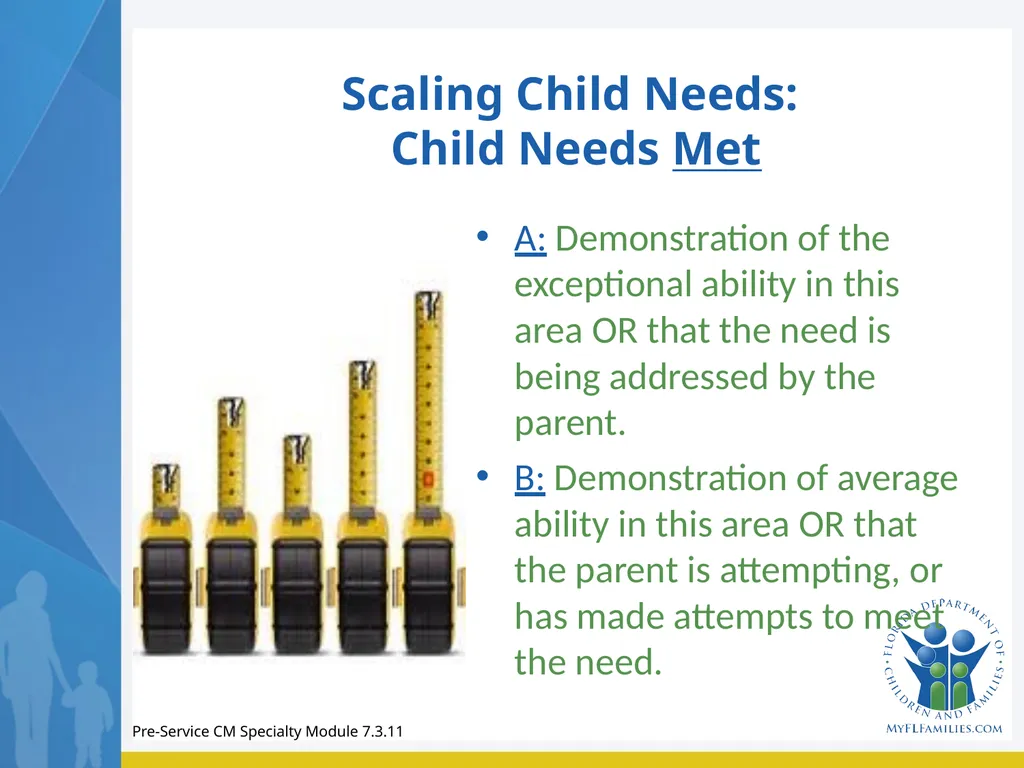
Child Needs Met A: Demonstration of the exceptional ability in this area OR that the need is being addressed by the parent.
B: Demonstration of average ability in this area OR that the parent is attempting, or has made attempts to meet the need. Pre-Service CM Specialty Module 7.3.11<br>
B: Demonstration of average ability in this area OR that the parent is attempting, or has made attempts to meet the need. Pre-Service CM Specialty Module 7.3.11<br>
33
Scaling Child Needs:
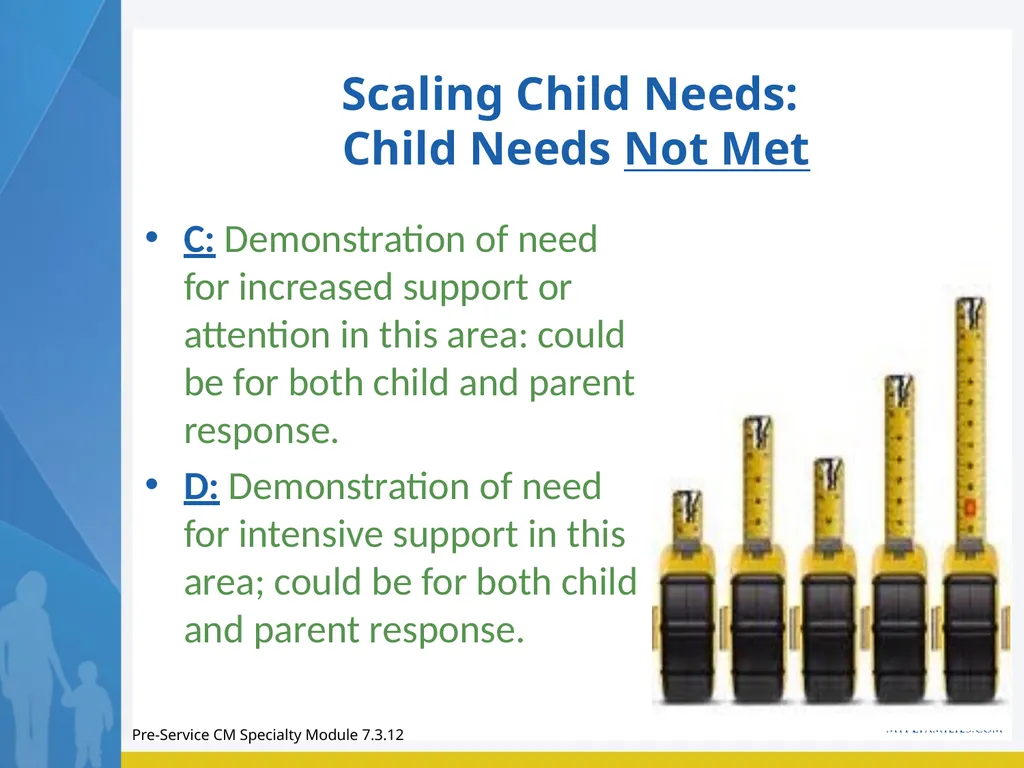
Child Needs Not Met C: Demonstration of need for increased support or attention in this area: could be for both child and parent response.
D: Demonstration of need for intensive support in this area; could be for both child and parent response. Pre-Service CM Specialty Module 7.3.12<br>
D: Demonstration of need for intensive support in this area; could be for both child and parent response. Pre-Service CM Specialty Module 7.3.12<br>
34
Activity C:
Identifying Indicators of
Child Strengths and Needs Instructions:
Working within your groups, review child needs and scaling in your CFOP as you complete the worksheet.
For each child need, identify behavioral examples of how the child need may manifest with children they are working with.
Remember, assessments are to observe both the strengths and needs of children, so please consider both the strengths and needs for children when identifying your examples. Pre-Service CM Specialty Module 7.3.13<br>
Working within your groups, review child needs and scaling in your CFOP as you complete the worksheet.
For each child need, identify behavioral examples of how the child need may manifest with children they are working with.
Remember, assessments are to observe both the strengths and needs of children, so please consider both the strengths and needs for children when identifying your examples. Pre-Service CM Specialty Module 7.3.13<br>
35
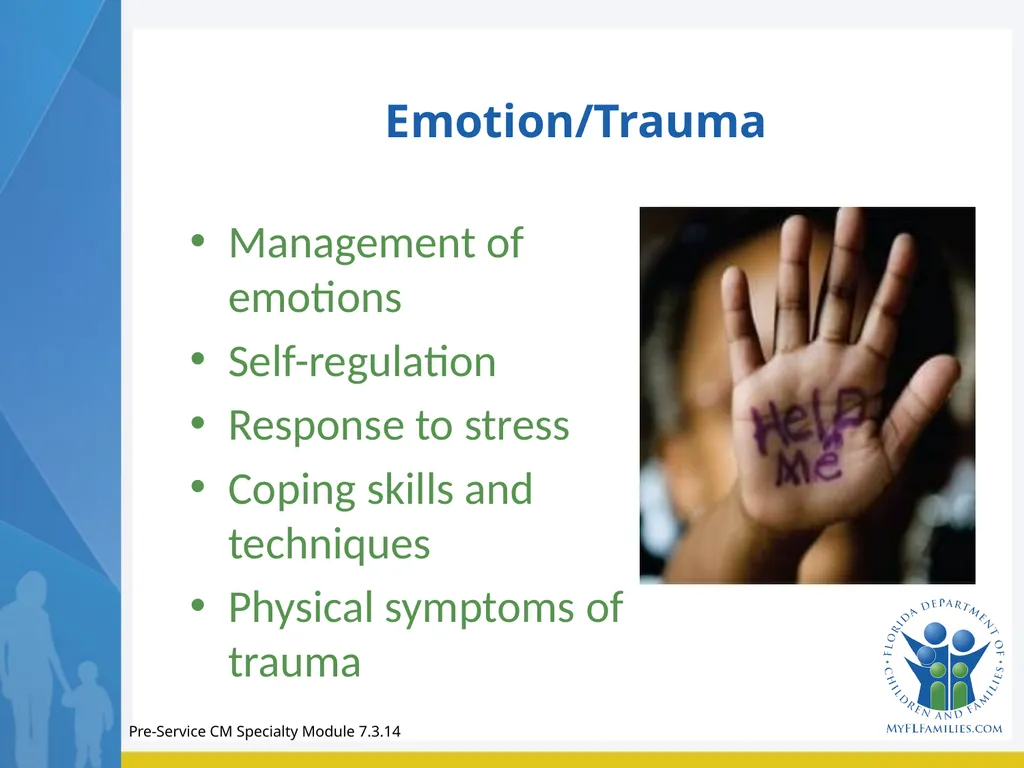
Emotion/Trauma Management of emotions
Self-regulation
Response to stress
Coping skills and techniques
Physical symptoms of trauma Pre-Service CM Specialty Module 7.3.14<br>
Self-regulation
Response to stress
Coping skills and techniques
Physical symptoms of trauma Pre-Service CM Specialty Module 7.3.14<br>
36
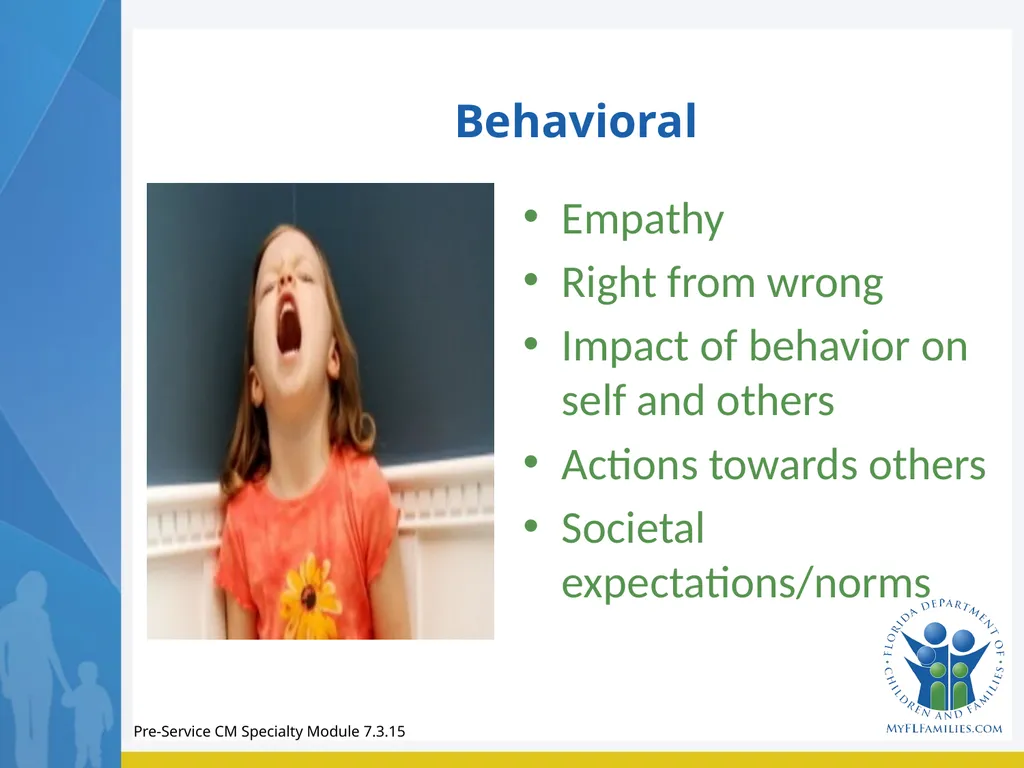
Behavioral Empathy
Right from wrong
Impact of behavior on self and others
Actions towards others
Societal expectations/norms Pre-Service CM Specialty Module 7.3.15<br>
Right from wrong
Impact of behavior on self and others
Actions towards others
Societal expectations/norms Pre-Service CM Specialty Module 7.3.15<br>
37
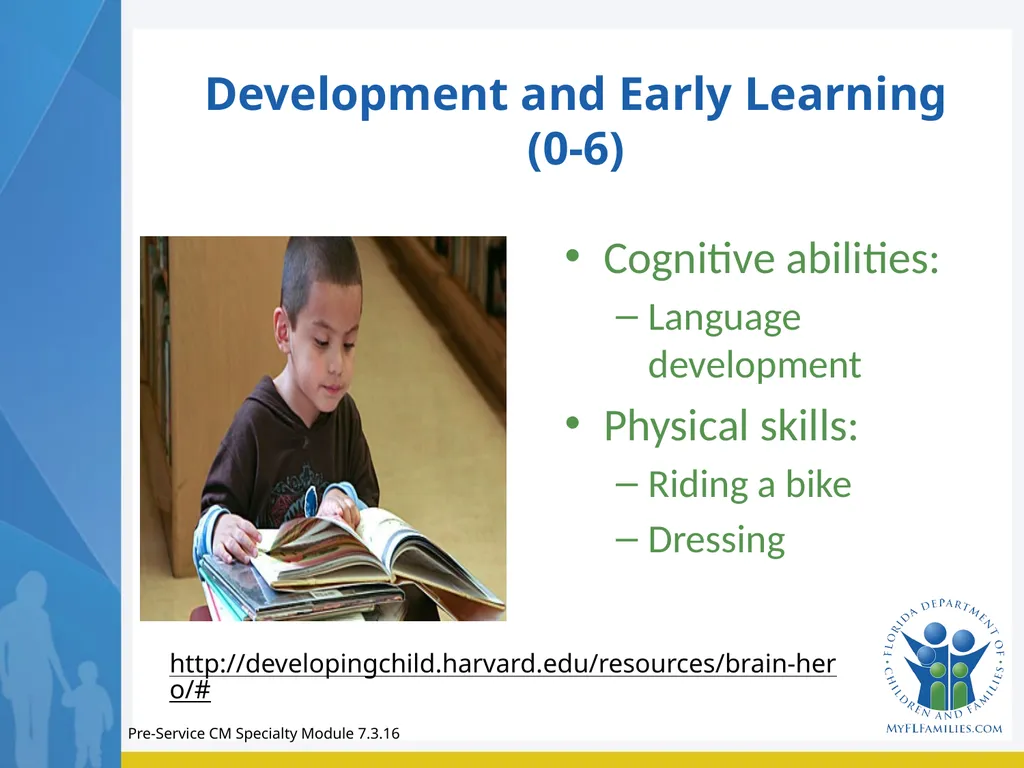
Development and Early Learning (0-6) Cognitive abilities:
Language development
Physical skills:
Riding a bike
Dressing Pre-Service CM Specialty Module 7.3.16 http://developingchild.harvard.edu/resources/brain-hero/#<br>
Language development
Physical skills:
Riding a bike
Dressing Pre-Service CM Specialty Module 7.3.16 http://developingchild.harvard.edu/resources/brain-hero/#<br>
38
Early Development Resources Opportunities Children’s Medical Services
Florida Early Steps Program
County Health Departments
Healthy Families Florida
Head Start
Voluntary Prekindergarten (VPK)
Florida Quality Child Care Programs Pre-Service CM Specialty Module 7.3.17<br>
Florida Early Steps Program
County Health Departments
Healthy Families Florida
Head Start
Voluntary Prekindergarten (VPK)
Florida Quality Child Care Programs Pre-Service CM Specialty Module 7.3.17<br>
39
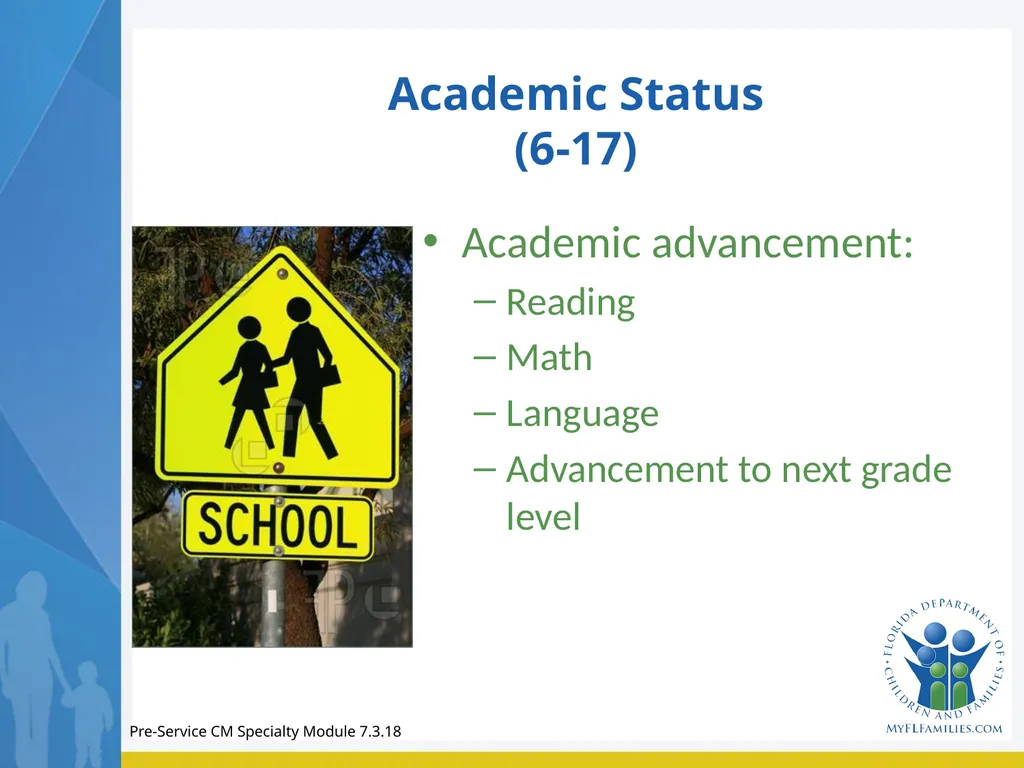
Academic Status
(6-17) Academic advancement:
Reading
Math
Language
Advancement to next grade level Pre-Service CM Specialty Module 7.3.18<br>
Reading
Math
Language
Advancement to next grade level Pre-Service CM Specialty Module 7.3.18<br>
40
Skills to Access Educational Resources & Advocate Pre-Service CM Specialty Module 7.3.19<br>
41
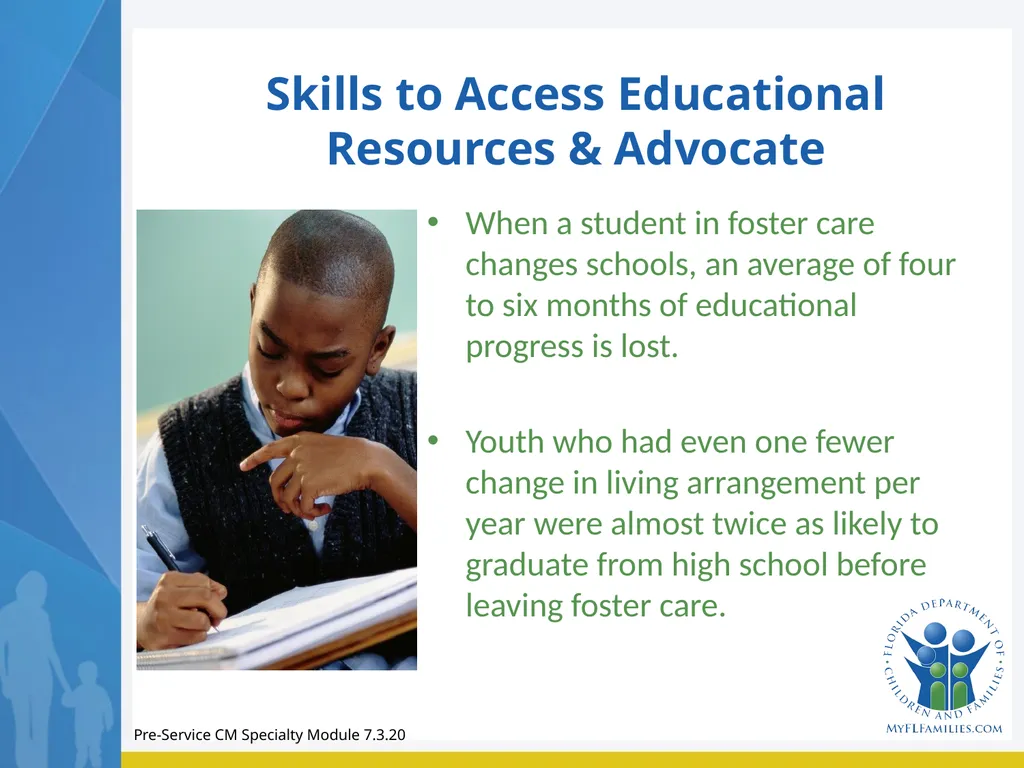
Skills to Access Educational Resources & Advocate When a student in foster care changes schools, an average of four to six months of educational progress is lost.
Youth who had even one fewer change in living arrangement per year were almost twice as likely to graduate from high school before leaving foster care. Pre-Service CM Specialty Module 7.3.20<br>
Youth who had even one fewer change in living arrangement per year were almost twice as likely to graduate from high school before leaving foster care. Pre-Service CM Specialty Module 7.3.20<br>
42
Case Managers and
a Child’s Academic Success Case Managers need to:
Have a basic understanding of how to work within the school system
Advocate for placement and school stability, needed educational services, and participation in school activities
Provide the child with a feeling of normalcy and well being Pre-Service CM Specialty Module 7.3.21<br>
Have a basic understanding of how to work within the school system
Advocate for placement and school stability, needed educational services, and participation in school activities
Provide the child with a feeling of normalcy and well being Pre-Service CM Specialty Module 7.3.21<br>
43
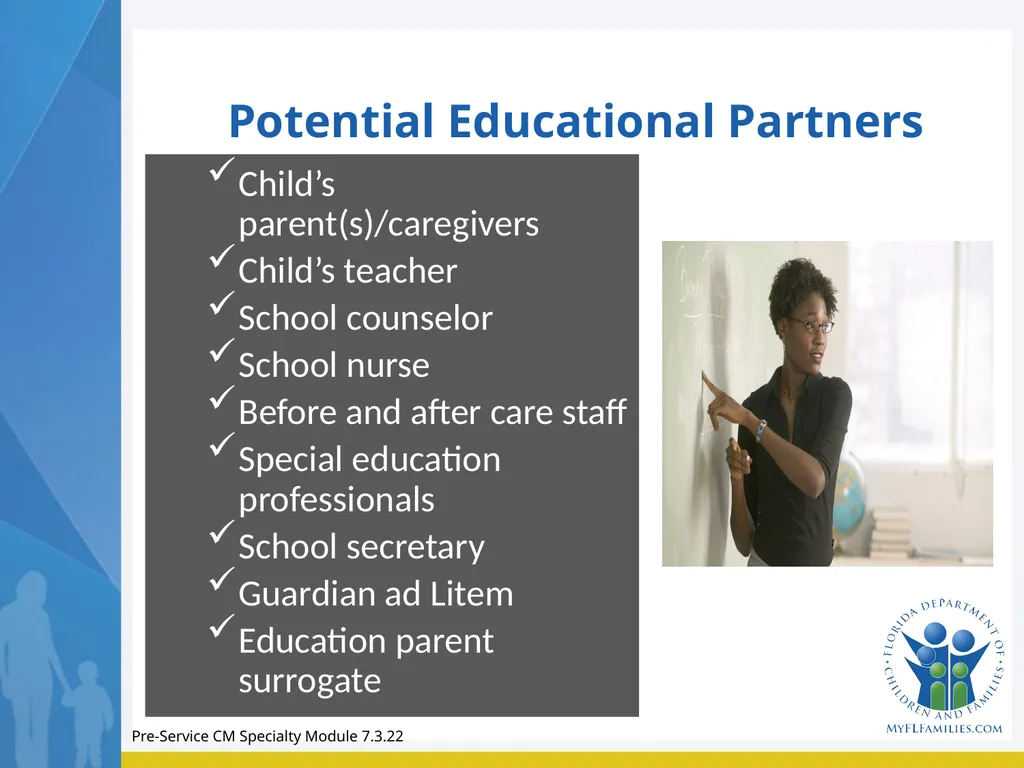
Potential Educational Partners Child’s parent(s)/caregivers
Child’s teacher
School counselor
School nurse
Before and after care staff
Special education professionals
School secretary
Guardian ad Litem
Education parent surrogate Pre-Service CM Specialty Module 7.3.22<br>
Child’s teacher
School counselor
School nurse
Before and after care staff
Special education professionals
School secretary
Guardian ad Litem
Education parent surrogate Pre-Service CM Specialty Module 7.3.22<br>
44
Educational Questions Is child:
Performing on grade level?
Passing all subjects?
Displaying any behavioral issues?
Does child:
Have friends at school?
Have needs that require a 504 plan or IEP?
Have parental involvement in school success? Pre-Service CM Specialty Module 7.3.23<br>
Performing on grade level?
Passing all subjects?
Displaying any behavioral issues?
Does child:
Have friends at school?
Have needs that require a 504 plan or IEP?
Have parental involvement in school success? Pre-Service CM Specialty Module 7.3.23<br>
45
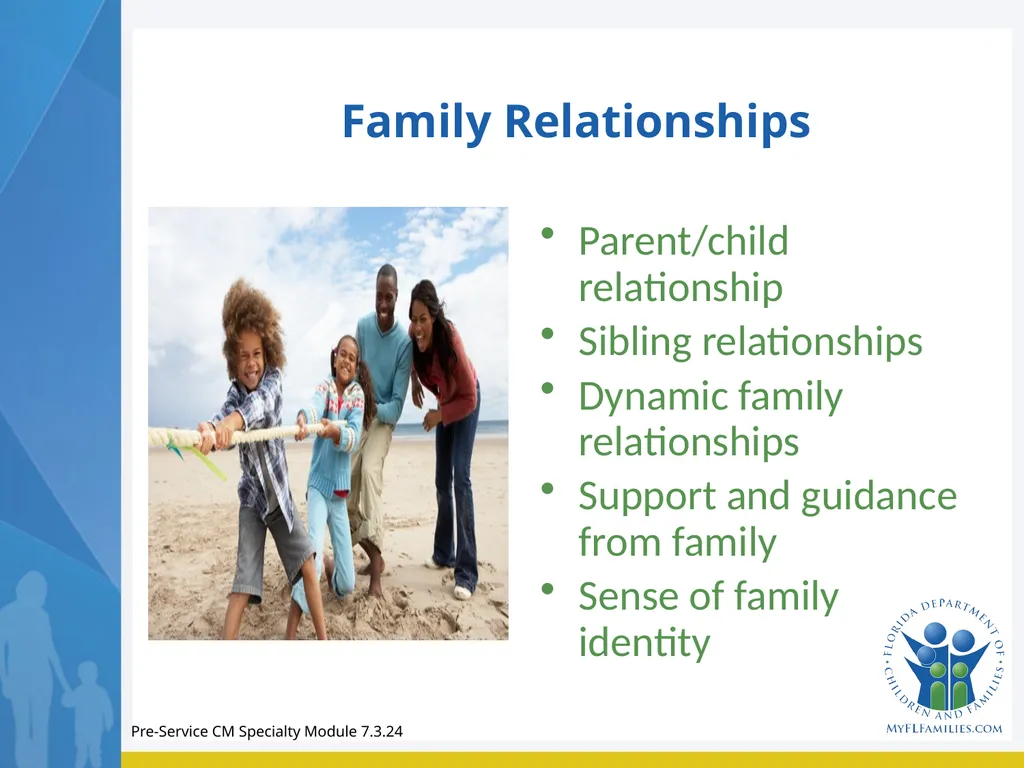
Family Relationships Parent/child relationship
Sibling relationships
Dynamic family relationships
Support and guidance from family
Sense of family identity Pre-Service CM Specialty Module 7.3.24<br>
Sibling relationships
Dynamic family relationships
Support and guidance from family
Sense of family identity Pre-Service CM Specialty Module 7.3.24<br>
46
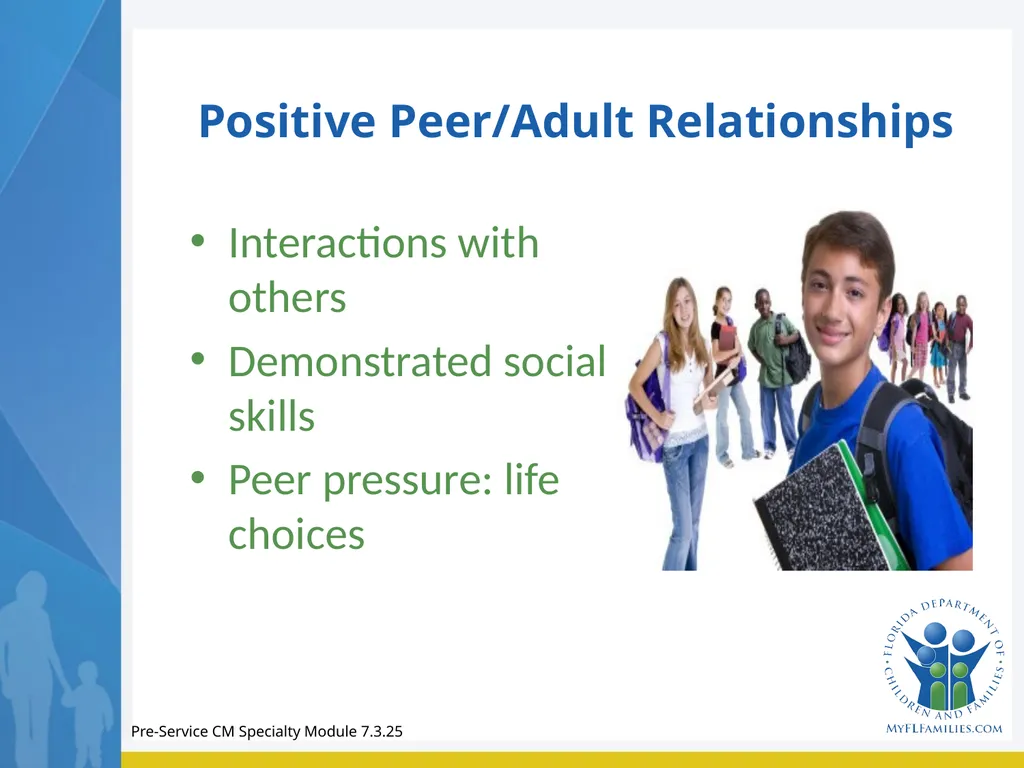
Positive Peer/Adult Relationships Interactions with others
Demonstrated social skills
Peer pressure: life choices Pre-Service CM Specialty Module 7.3.25<br>
Demonstrated social skills
Peer pressure: life choices Pre-Service CM Specialty Module 7.3.25<br>
47
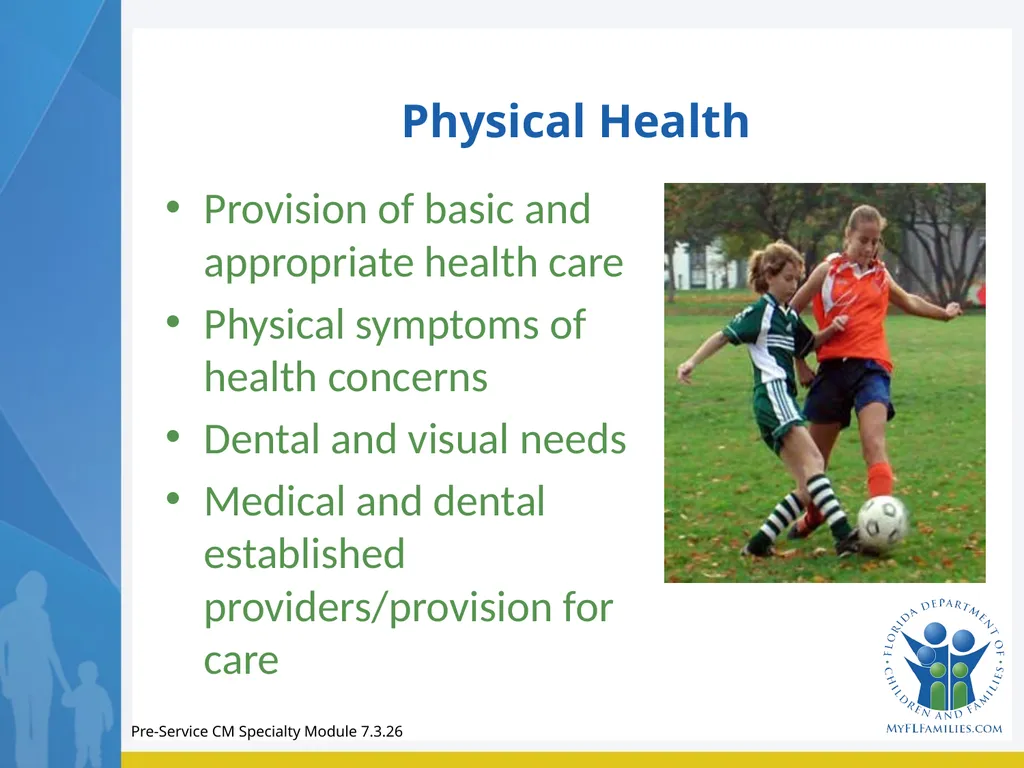
Physical Health Provision of basic and appropriate health care
Physical symptoms of health concerns
Dental and visual needs
Medical and dental established providers/provision for care Pre-Service CM Specialty Module 7.3.26<br>
Physical symptoms of health concerns
Dental and visual needs
Medical and dental established providers/provision for care Pre-Service CM Specialty Module 7.3.26<br>
48
Cultural Identity Race
Class
Ethnicity
Religion
LGBTQ
Identified cultural identity
Sense of cultural identity
Desire for cultural identity Pre-Service CM Specialty Module 7.3.27<br>
Class
Ethnicity
Religion
LGBTQ
Identified cultural identity
Sense of cultural identity
Desire for cultural identity Pre-Service CM Specialty Module 7.3.27<br>
49
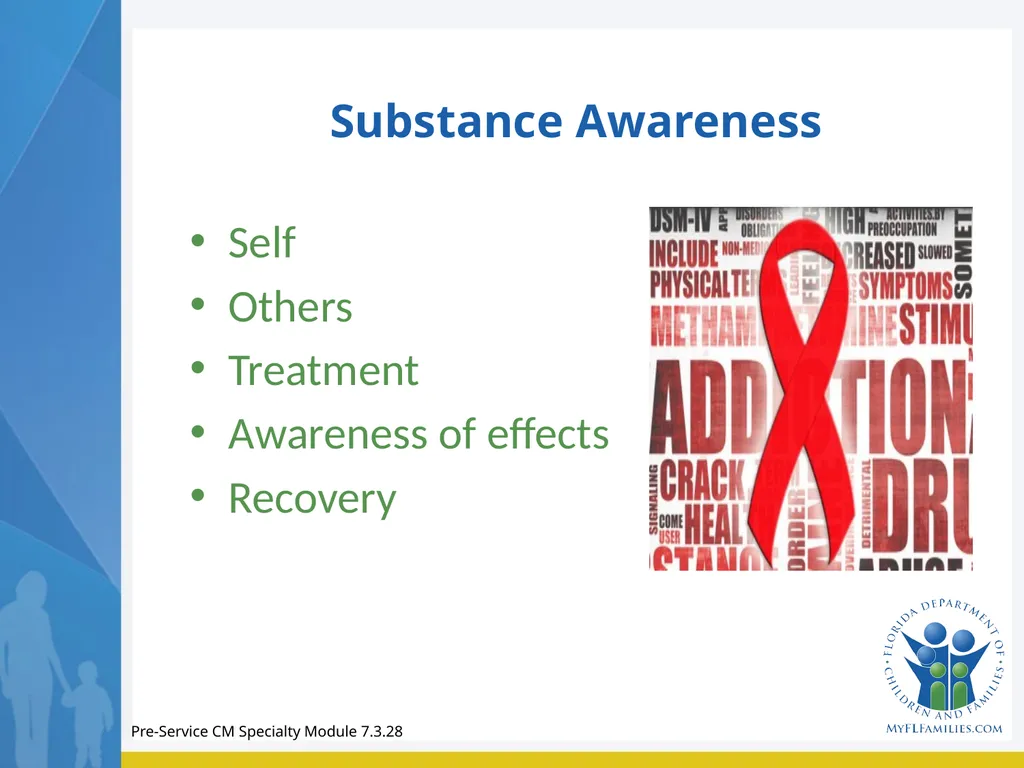
Substance Awareness Self
Others
Treatment
Awareness of effects
Recovery Pre-Service CM Specialty Module 7.3.28<br>
Others
Treatment
Awareness of effects
Recovery Pre-Service CM Specialty Module 7.3.28<br>
50
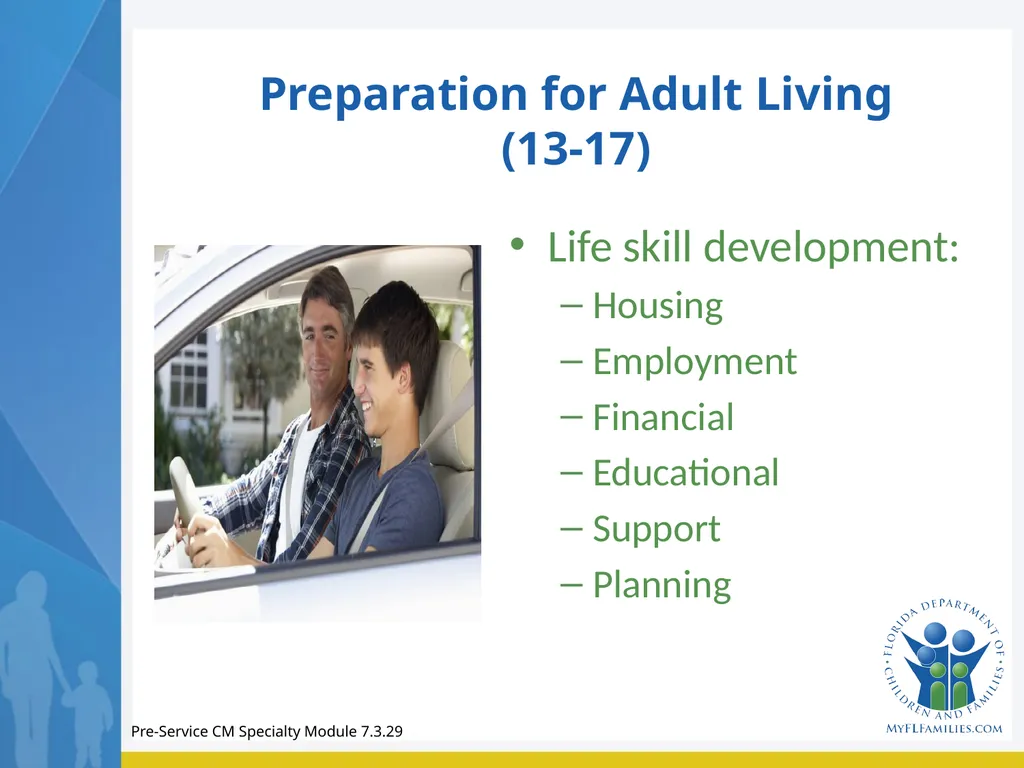
Preparation for Adult Living
(13-17) Life skill development:
Housing
Employment
Financial
Educational
Support
Planning Pre-Service CM Specialty Module 7.3.29<br>
Housing
Employment
Financial
Educational
Support
Planning Pre-Service CM Specialty Module 7.3.29<br>
51
Activity D:
Scaling Child
Strengths and Needs Instructions:
Working alone, read the scenarios and identify the appropriate category the scenario belongs to and what rating you would give each child.
Be prepared to discuss as a class. Pre-Service CM Specialty Module 7.3.30<br>
Working alone, read the scenarios and identify the appropriate category the scenario belongs to and what rating you would give each child.
Be prepared to discuss as a class. Pre-Service CM Specialty Module 7.3.30<br>
52
Becoming Allies to
Address Child Needs Pre-Service CM Specialty Module 7.3.31<br>
53
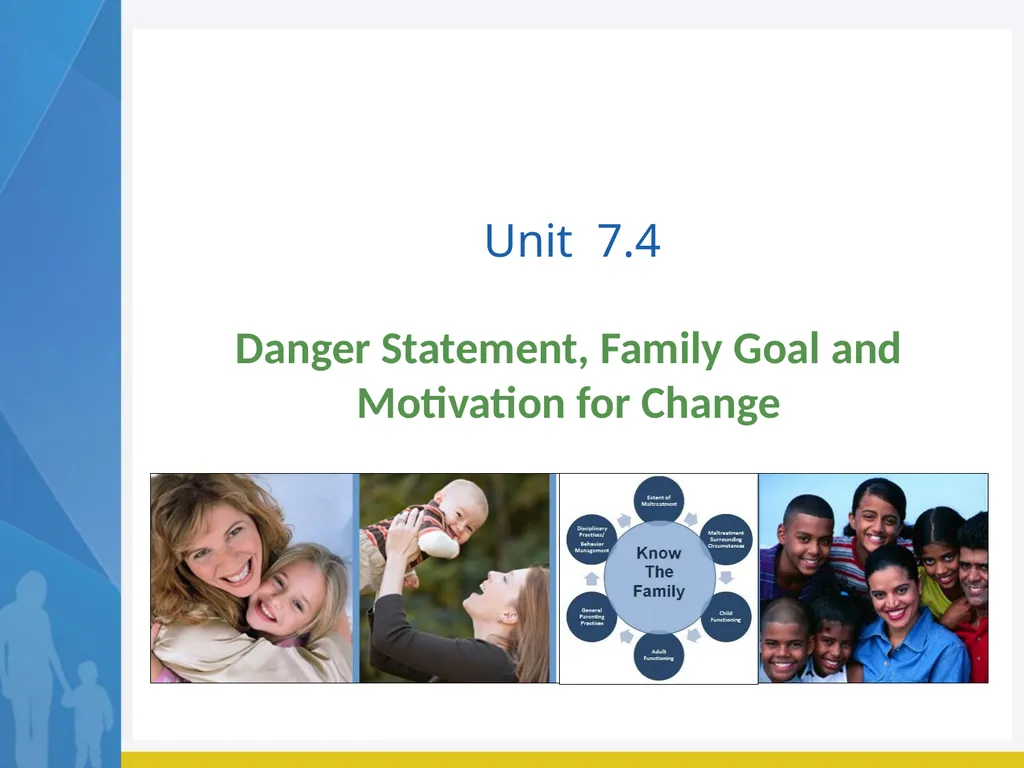
Unit 7.4 Danger Statement, Family Goal and Motivation for Change<br>
54
Learning Objectives Describe what a danger statement is and how to develop one.
Describe what a family goal is and how to develop one.
Identify how to develop a family change strategy using the danger statement, family goal and motivation for change. Pre-Service CM Specialty Module 7.4.2<br>
Describe what a family goal is and how to develop one.
Identify how to develop a family change strategy using the danger statement, family goal and motivation for change. Pre-Service CM Specialty Module 7.4.2<br>
55
Purpose:
Danger Statement and
Family Goal Danger Statement: To understand what must be different for parents in order for intervention to cease.
Family Goal: To identify and verbalize how the family will be functioning when all the children are safe, including consideration of barriers, support, and ideas for intervention. Pre-Service CM Specialty Module 7.4.3<br>
Family Goal: To identify and verbalize how the family will be functioning when all the children are safe, including consideration of barriers, support, and ideas for intervention. Pre-Service CM Specialty Module 7.4.3<br>
56
Activity E:
The “WHAT” Questions That Formulate The Danger Statement Instructions:
Watch the two video segments.
Once the videos are completed, write a danger statement for the Russell family. Pre-Service CM Specialty Module 7.4.4<br>
Watch the two video segments.
Once the videos are completed, write a danger statement for the Russell family. Pre-Service CM Specialty Module 7.4.4<br>
57
The “WHAT” Questions That Formulate The Family Goal What must be different?
What can the parents do?
What are the parents willing to do?
What will the family “look” like for the agency to not be involved? Pre-Service CM Specialty Module 7.4.5<br>
What can the parents do?
What are the parents willing to do?
What will the family “look” like for the agency to not be involved? Pre-Service CM Specialty Module 7.4.5<br>
58
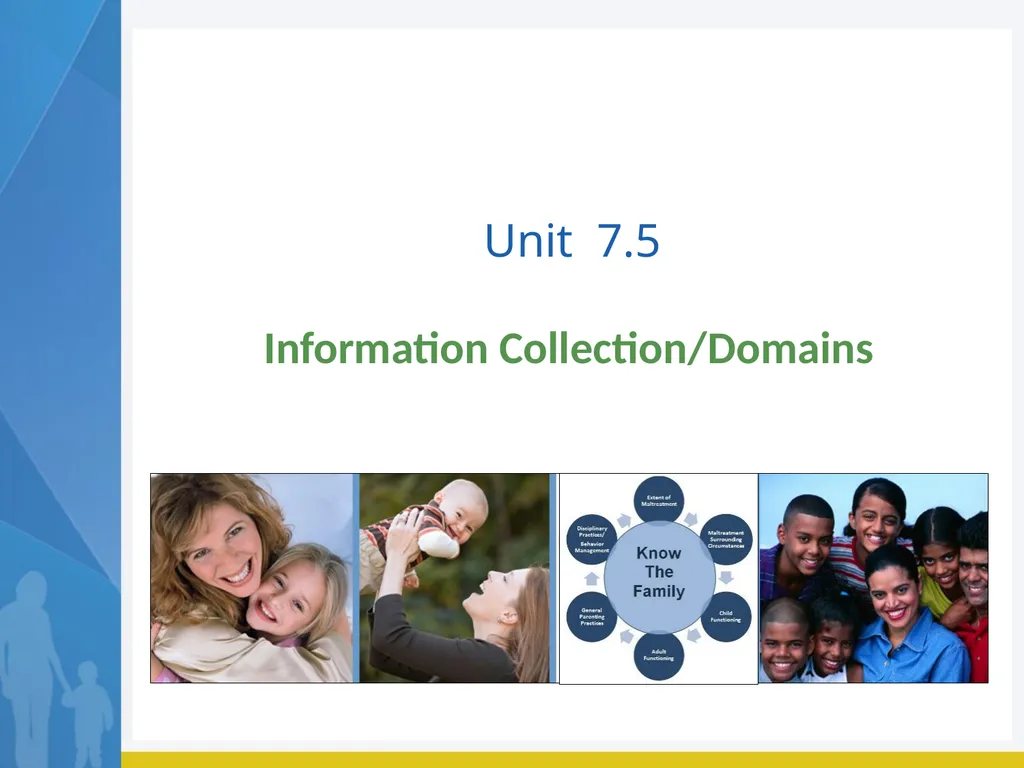
Unit 7.5 Information Collection/Domains<br>
59
Learning Objectives Pre-Service CM Specialty Module 7.5.2 1. Explain how the five worker competencies affect information collection.
2. Demonstrate documentation of the FFA-Ongoing domains.<br>
2. Demonstrate documentation of the FFA-Ongoing domains.<br>
60
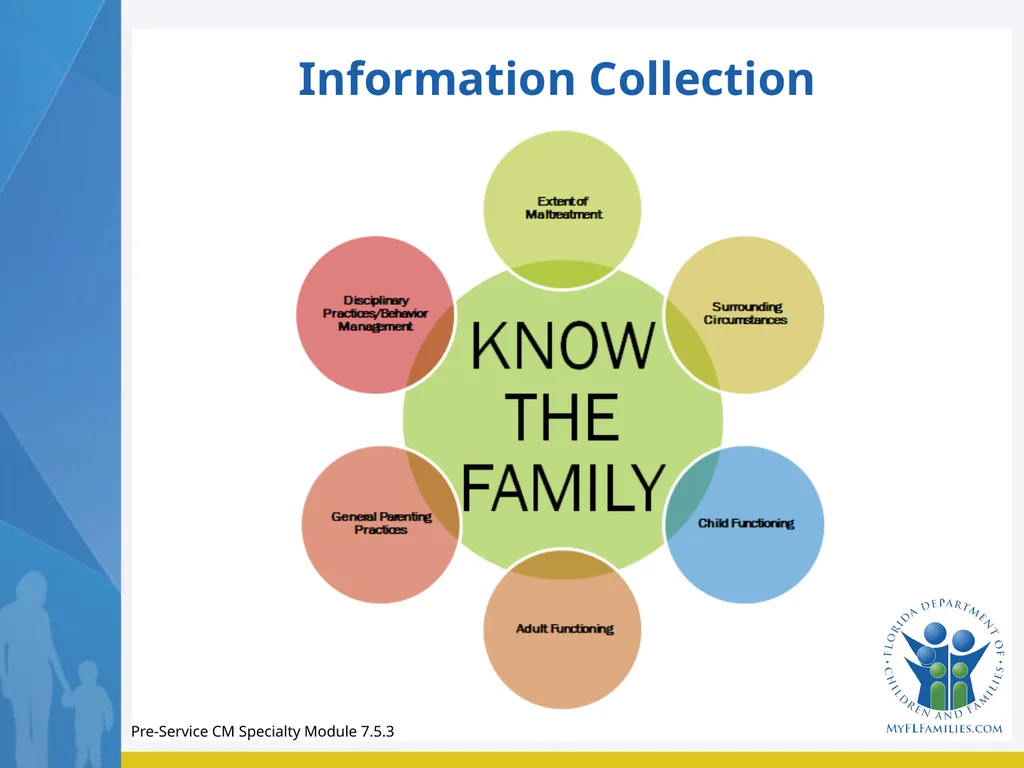
Information Collection Pre-Service CM Specialty Module 7.5.3<br>
61
Information Collection
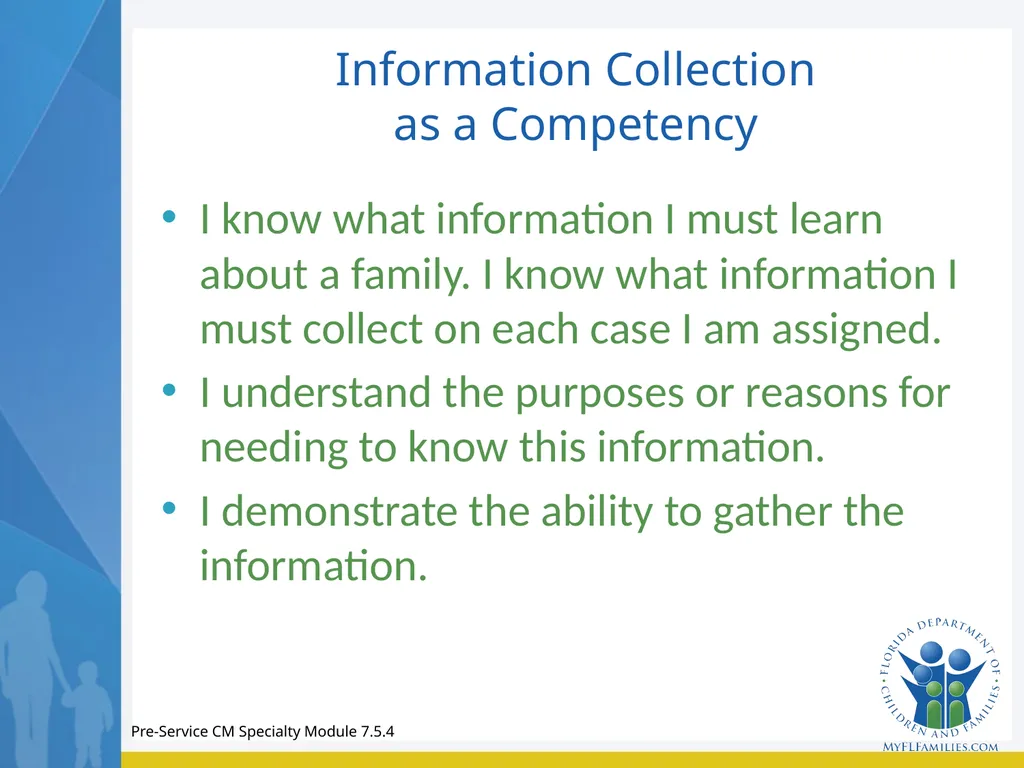
as a Competency I know what information I must learn about a family. I know what information I must collect on each case I am assigned.
I understand the purposes or reasons for needing to know this information.
I demonstrate the ability to gather the information. Pre-Service CM Specialty Module 7.5.4<br>
I understand the purposes or reasons for needing to know this information.
I demonstrate the ability to gather the information. Pre-Service CM Specialty Module 7.5.4<br>
62
Information Collection
as a Competency I demonstrate awareness that everything I do to reconcile and validate information influences the overall quality of the information.
I can discuss and write about the information I collected logically, succinctly, and in a way that justifies my conclusions. Pre-Service CM Specialty Module 7.5.5<br>
I can discuss and write about the information I collected logically, succinctly, and in a way that justifies my conclusions. Pre-Service CM Specialty Module 7.5.5<br>
63
Documenting the Six Information Collection Domains Professional Judgment:
Accurate Reflection – Positive and Negative
Objective and Neutral
On the “record” of information and decision making
Reconciled to provide clarity Pre-Service CM Specialty Module 7.5.6<br>
Accurate Reflection – Positive and Negative
Objective and Neutral
On the “record” of information and decision making
Reconciled to provide clarity Pre-Service CM Specialty Module 7.5.6<br>
64
Activity F:
Domain Information for the
Sandler/Braun Family Instructions:
Read exploration notes for Sandler-Braun Family
Based on this information and information you already know about the family complete domain information on the Sandler-Braun FFA- Ongoing. This includes the following sections:
Section II: Additional Ongoing Information
Section III: Child Functioning
Section IV: Adult Functioning
Section V: Parenting Pre-Service CM Specialty Module 7.5.7<br>
Read exploration notes for Sandler-Braun Family
Based on this information and information you already know about the family complete domain information on the Sandler-Braun FFA- Ongoing. This includes the following sections:
Section II: Additional Ongoing Information
Section III: Child Functioning
Section IV: Adult Functioning
Section V: Parenting Pre-Service CM Specialty Module 7.5.7<br>
65
Activity G:
Scaling Caregiver Protective Capacities for the Sandler/Braun Case Instructions:
Review the domain information on the FFA-Ongoing.
Rate each protective capacity for Melanie and Bruce, using Sander/Braun FFA-Ongoing. Pre-Service CM Specialty Module 7.5.8<br>
Review the domain information on the FFA-Ongoing.
Rate each protective capacity for Melanie and Bruce, using Sander/Braun FFA-Ongoing. Pre-Service CM Specialty Module 7.5.8<br>
66
Activity H:
Child Strengths and Needs: Sandler/Braun Children Instructions:
Scale each of the Child Strengths and Needs for the Sandler/Braun children using Sandler/Braun FFA-Ongoing.
If there are any Child Strengths and Needs you need more information on in order to scale them please indicate the additional information you need and where you can obtain this information. Pre-Service CM Specialty Module 7.5.9<br>
Scale each of the Child Strengths and Needs for the Sandler/Braun children using Sandler/Braun FFA-Ongoing.
If there are any Child Strengths and Needs you need more information on in order to scale them please indicate the additional information you need and where you can obtain this information. Pre-Service CM Specialty Module 7.5.9<br>
67
Activity I:
Formulating the Danger Statement, Family Change Strategy, and Determining Motivation for Change Instructions:
Complete the following sections of your Sandler/Braun FFA-Ongoing:
VI. Reasons for Ongoing Involvement Danger Statement
VII. Family Change Strategy
XII. Motivation for Change
XIV. Current Safety Plan Assessment for Sufficiency
Be prepared to discuss. Pre-Service CM Specialty Module 7.5.10<br>
Complete the following sections of your Sandler/Braun FFA-Ongoing:
VI. Reasons for Ongoing Involvement Danger Statement
VII. Family Change Strategy
XII. Motivation for Change
XIV. Current Safety Plan Assessment for Sufficiency
Be prepared to discuss. Pre-Service CM Specialty Module 7.5.10<br>