
MODULE I UNITS AND DIMENSIONS COURSE OUTCOME : To
PC
Published · 33 slides · 0 views

1 / 1






Description
MODULE I UNITS AND DIMENSIONS COURSE OUTCOME : To understand the basic units and unit operations in chemical engineering. Specific Outcome 1.1.1 Explain the various systems of units 1.1.2 Explain the difference between fundamental and
Related Topics
Download this presentation From Below
"MODULE I UNITS AND DIMENSIONS COURSE OUTCOME : To" is the property of its rightful owner. Permission is granted to download and print the materials on this website for personal, non-commercial use only, and to display it on your personal computer provided you do not modify the materials and that you retain all copyright notices contained in the materials. By downloading content from our website, you accept the terms of this agreement.
Share
Embed code
Presentation Transcript
01
MODULE I UNITS AND DIMENSIONS COURSE OUTCOME :
To understand the basic units and unit operations in chemical engineering.<br>
To understand the basic units and unit operations in chemical engineering.<br>
02
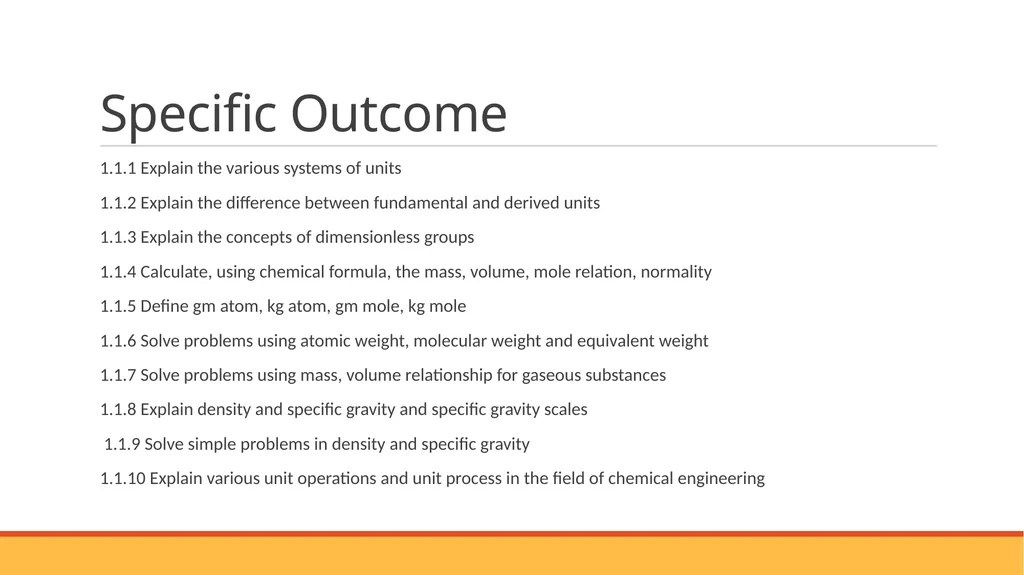
Specific Outcome 1.1.1 Explain the various systems of units
1.1.2 Explain the difference between fundamental and derived units
1.1.3 Explain the concepts of dimensionless groups
1.1.4 Calculate, using chemical formula, the mass, volume, mole relation, normality
1.1.5 Define gm atom, kg atom, gm mole, kg mole
1.1.6 Solve problems using atomic weight, molecular weight and equivalent weight
1.1.7 Solve problems using mass, volume relationship for gaseous substances
1.1.8 Explain density and specific gravity and specific gravity scales
1.1.9 Solve simple problems in density and specific gravity
1.1.10 Explain various unit operations and unit process in the field of chemical engineering<br>
1.1.2 Explain the difference between fundamental and derived units
1.1.3 Explain the concepts of dimensionless groups
1.1.4 Calculate, using chemical formula, the mass, volume, mole relation, normality
1.1.5 Define gm atom, kg atom, gm mole, kg mole
1.1.6 Solve problems using atomic weight, molecular weight and equivalent weight
1.1.7 Solve problems using mass, volume relationship for gaseous substances
1.1.8 Explain density and specific gravity and specific gravity scales
1.1.9 Solve simple problems in density and specific gravity
1.1.10 Explain various unit operations and unit process in the field of chemical engineering<br>
03
Chemical Engineering Chemical engineers translate processes developed in the lab into practical applications for the commercial production of products and then work to maintain and improve those processes.
Apply the principles of chemistry, biology, physics, and math to solve problems.
Main role of chemical engineers is to design and troubleshoot processes for the production of chemicals, fuels, foods, pharmaceuticals, and biological etc.<br>
Apply the principles of chemistry, biology, physics, and math to solve problems.
Main role of chemical engineers is to design and troubleshoot processes for the production of chemicals, fuels, foods, pharmaceuticals, and biological etc.<br>
04
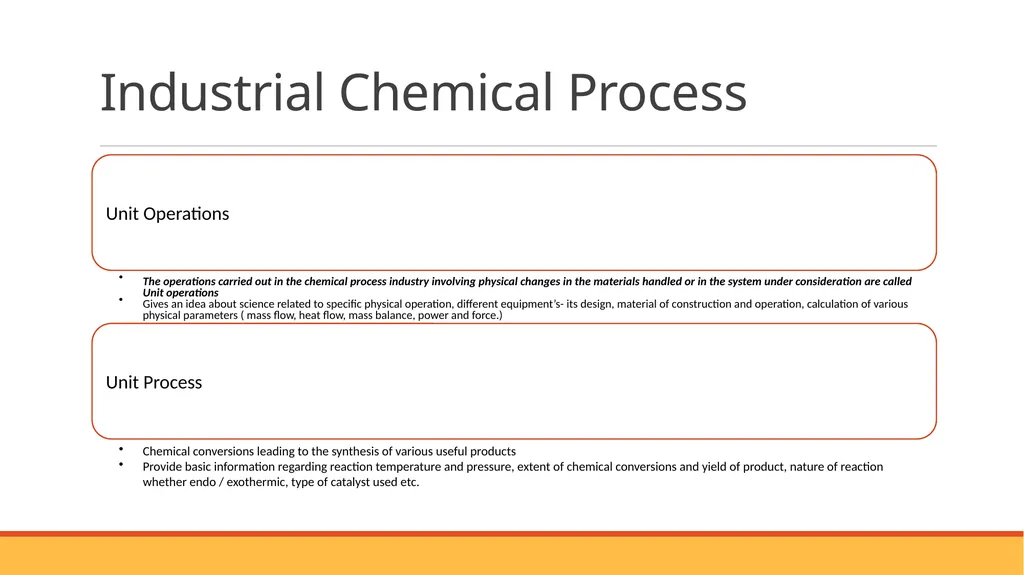
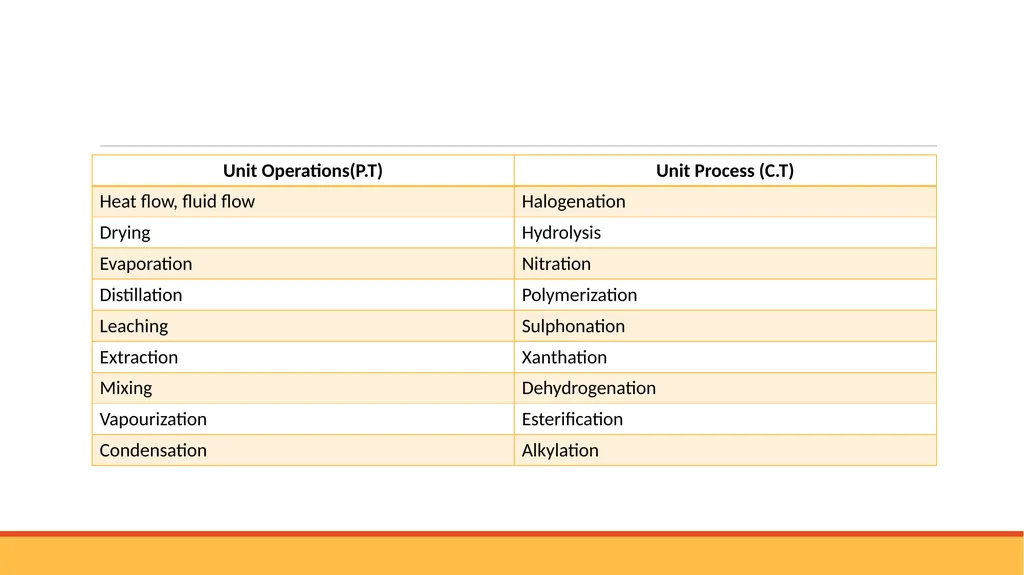
Industrial Chemical Process<br>
05
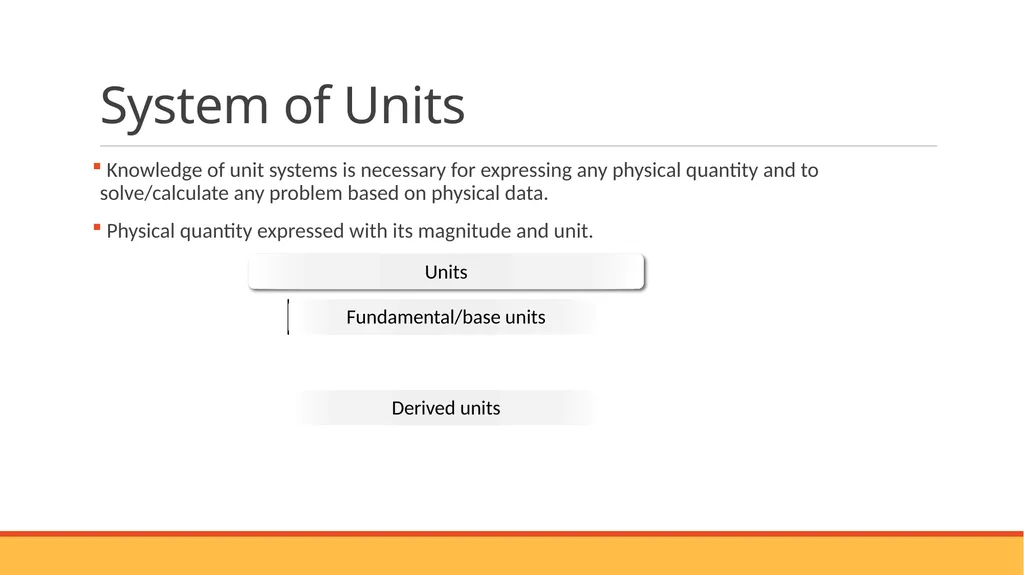
System of Units Knowledge of unit systems is necessary for expressing any physical quantity and to solve/calculate any problem based on physical data.
Physical quantity expressed with its magnitude and unit.<br>
Physical quantity expressed with its magnitude and unit.<br>
06
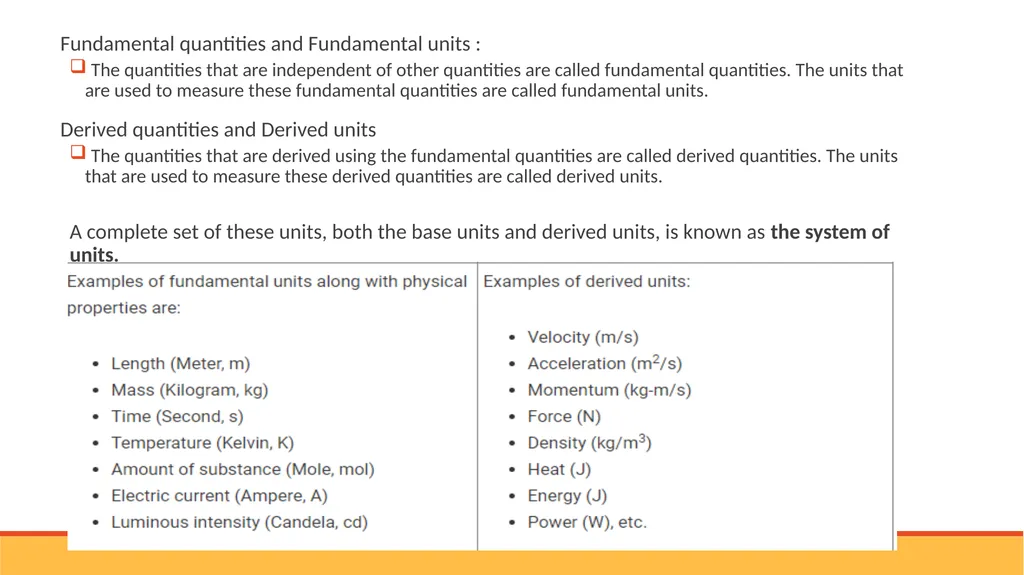
Fundamental quantities and Fundamental units :
The quantities that are independent of other quantities are called fundamental quantities. The units that are used to measure these fundamental quantities are called fundamental units.
Derived quantities and Derived units
The quantities that are derived using the fundamental quantities are called derived quantities. The units that are used to measure these derived quantities are called derived units.
A complete set of these units, both the base units and derived units, is known as the system of units.<br>
The quantities that are independent of other quantities are called fundamental quantities. The units that are used to measure these fundamental quantities are called fundamental units.
Derived quantities and Derived units
The quantities that are derived using the fundamental quantities are called derived quantities. The units that are used to measure these derived quantities are called derived units.
A complete set of these units, both the base units and derived units, is known as the system of units.<br>
07
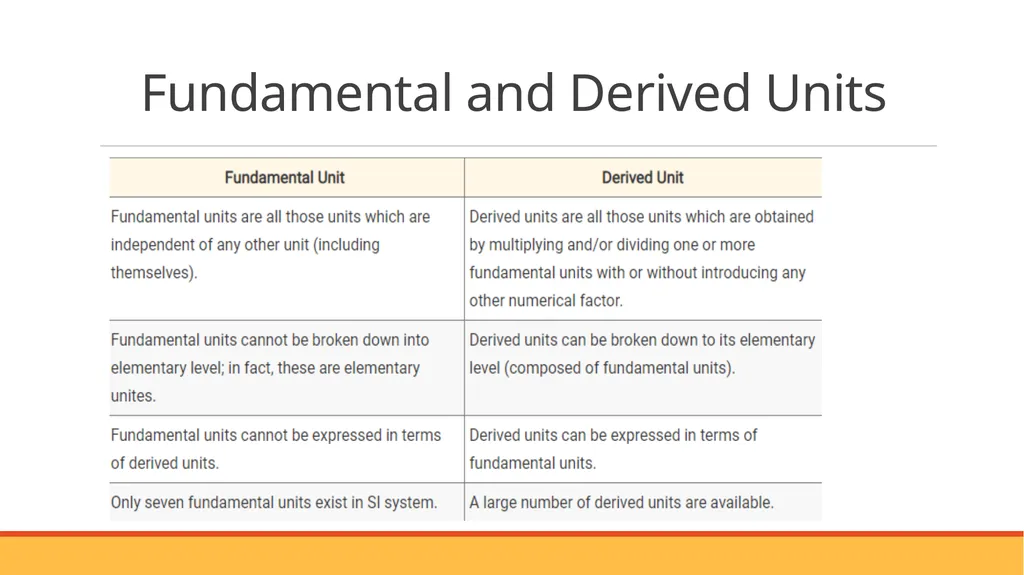
Fundamental and Derived Units<br>
08
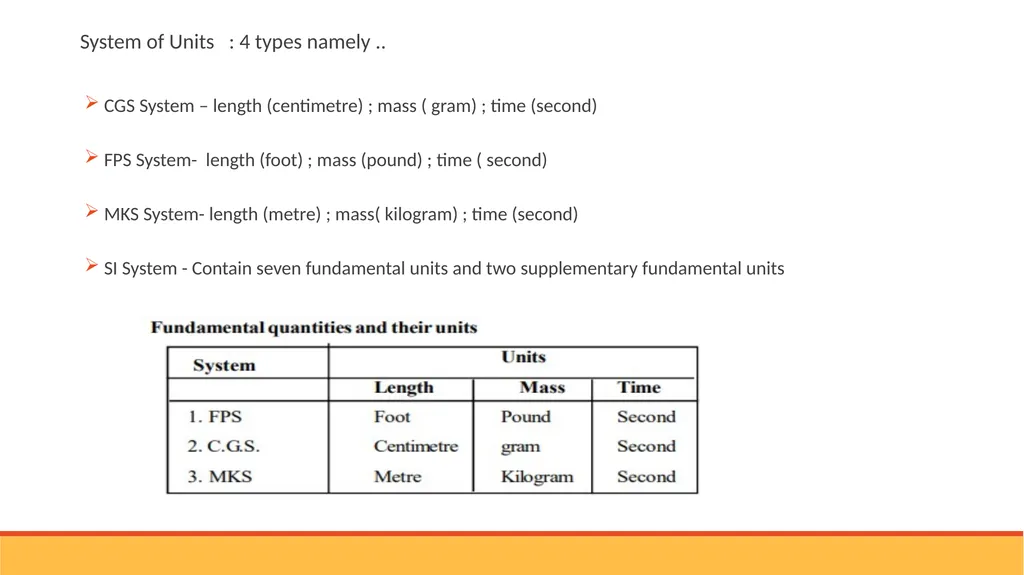
System of Units : 4 types namely ..
CGS System – length (centimetre) ; mass ( gram) ; time (second)
FPS System- length (foot) ; mass (pound) ; time ( second)
MKS System- length (metre) ; mass( kilogram) ; time (second)
SI System - Contain seven fundamental units and two supplementary fundamental units<br>
CGS System – length (centimetre) ; mass ( gram) ; time (second)
FPS System- length (foot) ; mass (pound) ; time ( second)
MKS System- length (metre) ; mass( kilogram) ; time (second)
SI System - Contain seven fundamental units and two supplementary fundamental units<br>
09
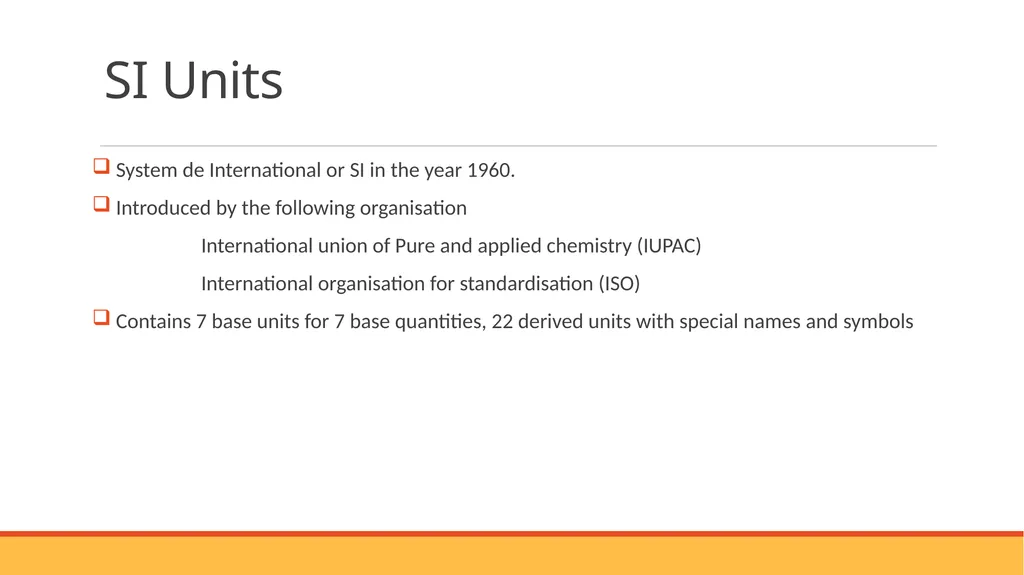
SI Units System de International or SI in the year 1960.
Introduced by the following organisation
International union of Pure and applied chemistry (IUPAC)
International organisation for standardisation (ISO)
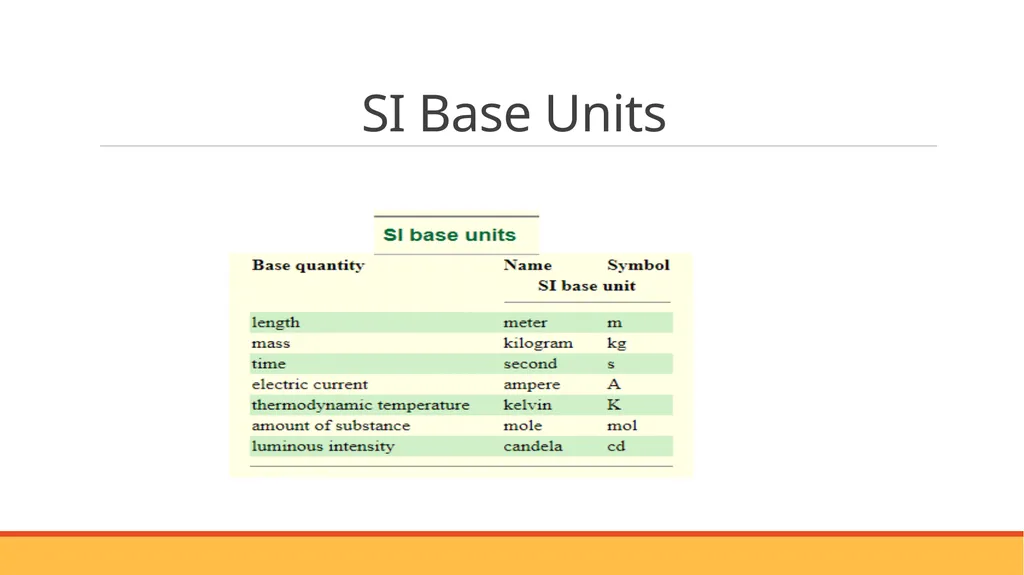
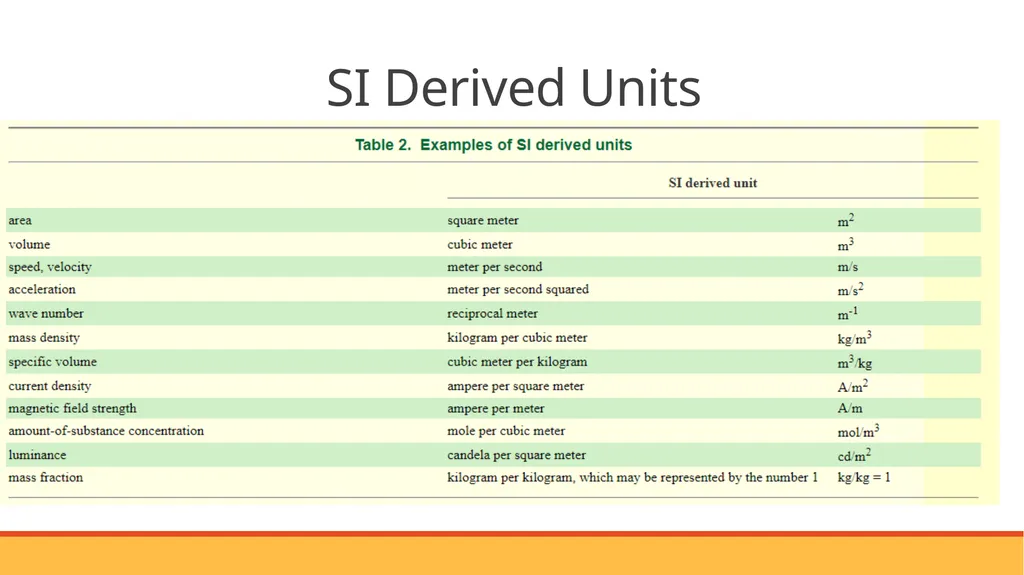
Contains 7 base units for 7 base quantities, 22 derived units with special names and symbols<br>
Introduced by the following organisation
International union of Pure and applied chemistry (IUPAC)
International organisation for standardisation (ISO)
Contains 7 base units for 7 base quantities, 22 derived units with special names and symbols<br>
10
SI Base Units<br>
11
SI Derived Units<br>
12
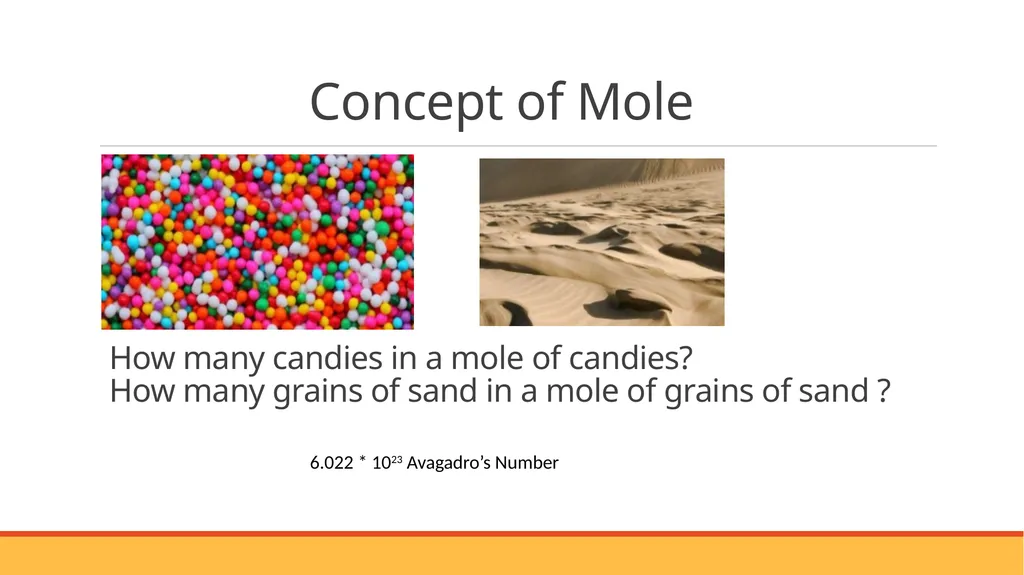
How many candies in a mole of candies?
How many grains of sand in a mole of grains of sand ? 6.022 * 1023 Avagadro’s Number Concept of Mole<br>
13
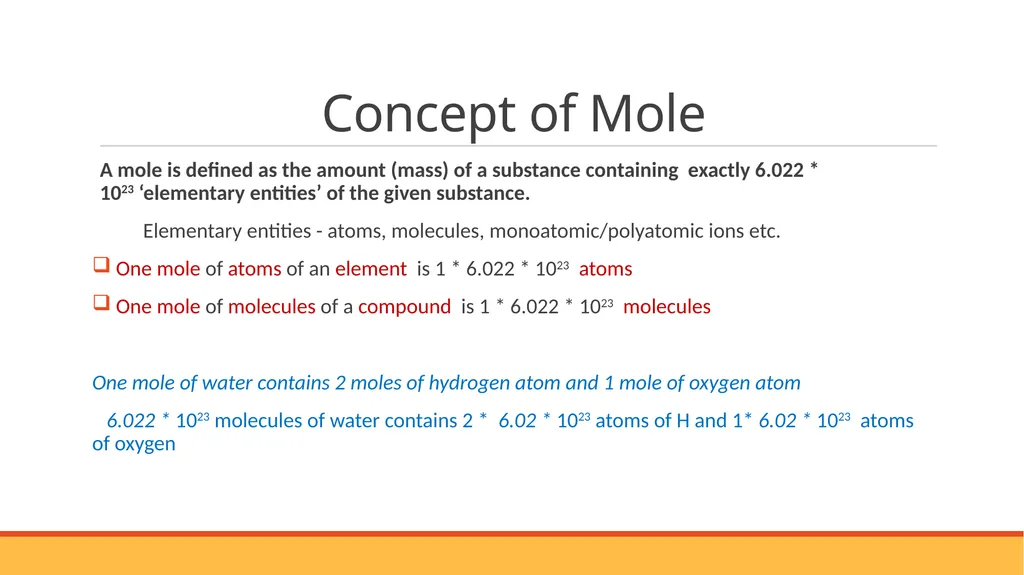
Concept of Mole A mole is defined as the amount (mass) of a substance containing exactly 6.022 * 1023 ‘elementary entities’ of the given substance.
Elementary entities - atoms, molecules, monoatomic/polyatomic ions etc.
One mole of atoms of an element is 1 * 6.022 * 1023 atoms
One mole of molecules of a compound is 1 * 6.022 * 1023 molecules
One mole of water contains 2 moles of hydrogen atom and 1 mole of oxygen atom
6.022 * 1023 molecules of water contains 2 * 6.02 * 1023 atoms of H and 1* 6.02 * 1023 atoms of oxygen<br>
Elementary entities - atoms, molecules, monoatomic/polyatomic ions etc.
One mole of atoms of an element is 1 * 6.022 * 1023 atoms
One mole of molecules of a compound is 1 * 6.022 * 1023 molecules
One mole of water contains 2 moles of hydrogen atom and 1 mole of oxygen atom
6.022 * 1023 molecules of water contains 2 * 6.02 * 1023 atoms of H and 1* 6.02 * 1023 atoms of oxygen<br>
14
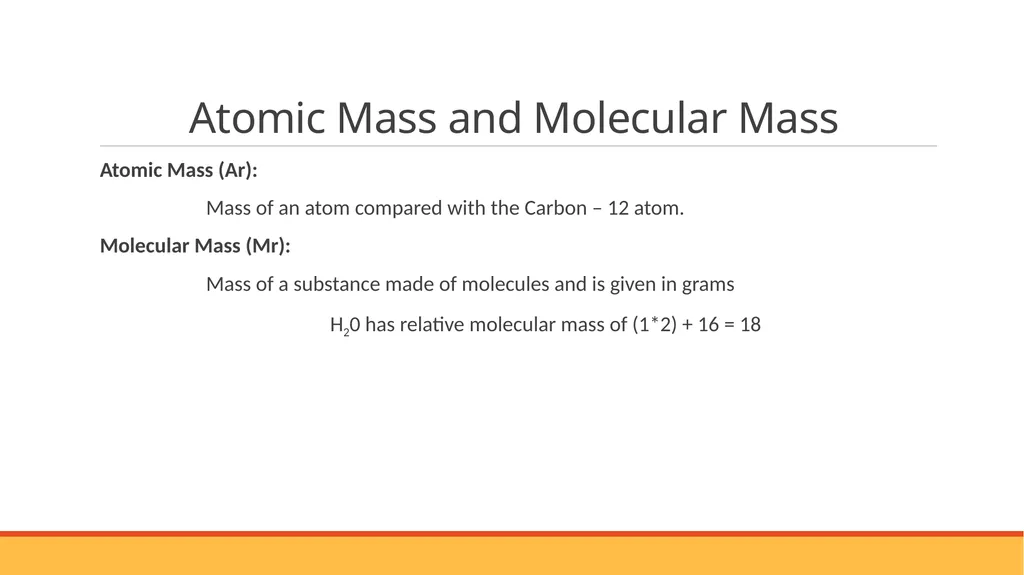
Atomic Mass and Molecular Mass Atomic Mass (Ar):
Mass of an atom compared with the Carbon – 12 atom.
Molecular Mass (Mr):
Mass of a substance made of molecules and is given in grams
H20 has relative molecular mass of (1*2) + 16 = 18<br>
Mass of an atom compared with the Carbon – 12 atom.
Molecular Mass (Mr):
Mass of a substance made of molecules and is given in grams
H20 has relative molecular mass of (1*2) + 16 = 18<br>
15
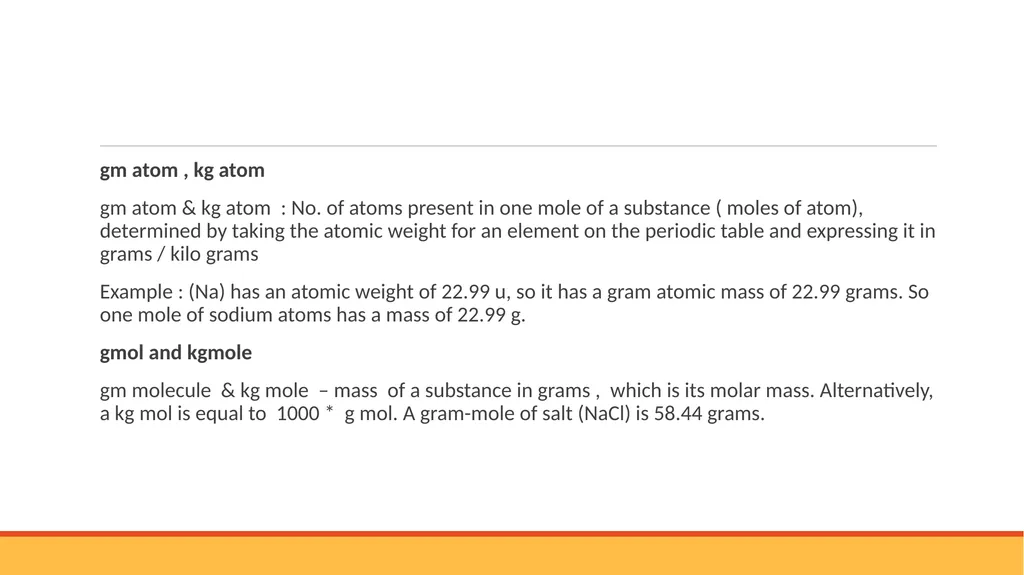
gm atom , kg atom
gm atom & kg atom : No. of atoms present in one mole of a substance ( moles of atom), determined by taking the atomic weight for an element on the periodic table and expressing it in grams / kilo grams
Example : (Na) has an atomic weight of 22.99 u, so it has a gram atomic mass of 22.99 grams. So one mole of sodium atoms has a mass of 22.99 g.
gmol and kgmole
gm molecule & kg mole – mass of a substance in grams , which is its molar mass. Alternatively, a kg mol is equal to 1000 * g mol. A gram-mole of salt (NaCl) is 58.44 grams.<br>
gm atom & kg atom : No. of atoms present in one mole of a substance ( moles of atom), determined by taking the atomic weight for an element on the periodic table and expressing it in grams / kilo grams
Example : (Na) has an atomic weight of 22.99 u, so it has a gram atomic mass of 22.99 grams. So one mole of sodium atoms has a mass of 22.99 g.
gmol and kgmole
gm molecule & kg mole – mass of a substance in grams , which is its molar mass. Alternatively, a kg mol is equal to 1000 * g mol. A gram-mole of salt (NaCl) is 58.44 grams.<br>
16
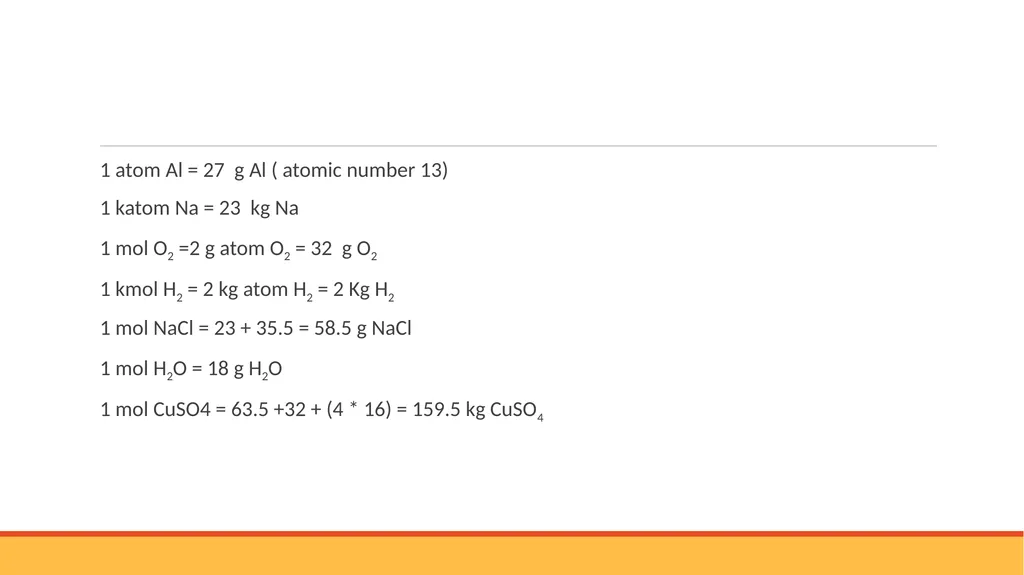
1 atom Al = 27 g Al ( atomic number 13)
1 katom Na = 23 kg Na
1 mol O2 =2 g atom O2 = 32 g O2
1 kmol H2 = 2 kg atom H2 = 2 Kg H2
1 mol NaCl = 23 + 35.5 = 58.5 g NaCl
1 mol H2O = 18 g H2O
1 mol CuSO4 = 63.5 +32 + (4 * 16) = 159.5 kg CuSO4<br>
1 katom Na = 23 kg Na
1 mol O2 =2 g atom O2 = 32 g O2
1 kmol H2 = 2 kg atom H2 = 2 Kg H2
1 mol NaCl = 23 + 35.5 = 58.5 g NaCl
1 mol H2O = 18 g H2O
1 mol CuSO4 = 63.5 +32 + (4 * 16) = 159.5 kg CuSO4<br>
17
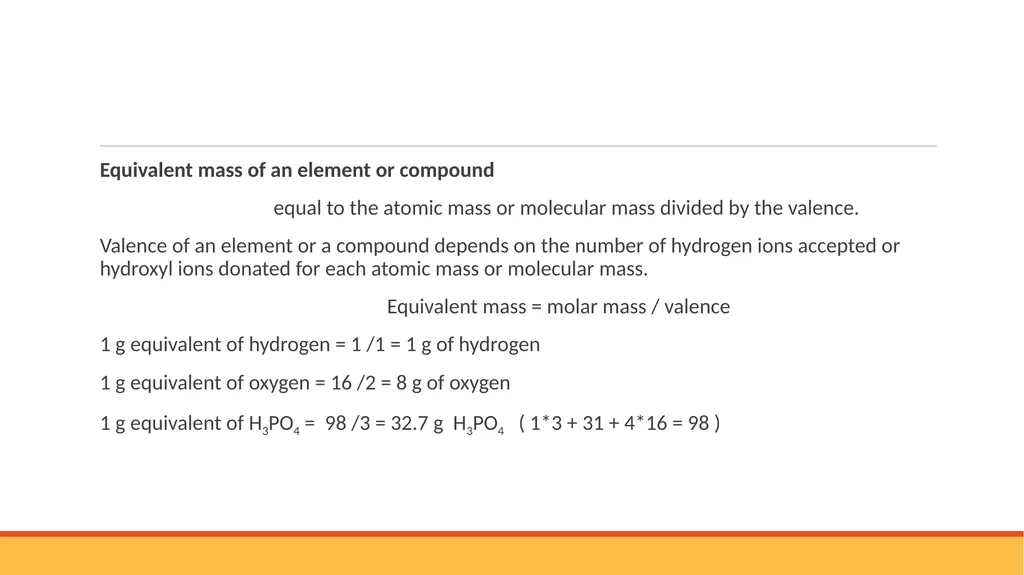
Equivalent mass of an element or compound
equal to the atomic mass or molecular mass divided by the valence.
Valence of an element or a compound depends on the number of hydrogen ions accepted or hydroxyl ions donated for each atomic mass or molecular mass.
Equivalent mass = molar mass / valence
1 g equivalent of hydrogen = 1 /1 = 1 g of hydrogen
1 g equivalent of oxygen = 16 /2 = 8 g of oxygen
1 g equivalent of H3PO4 = 98 /3 = 32.7 g H3PO4 ( 1*3 + 31 + 4*16 = 98 )<br>
equal to the atomic mass or molecular mass divided by the valence.
Valence of an element or a compound depends on the number of hydrogen ions accepted or hydroxyl ions donated for each atomic mass or molecular mass.
Equivalent mass = molar mass / valence
1 g equivalent of hydrogen = 1 /1 = 1 g of hydrogen
1 g equivalent of oxygen = 16 /2 = 8 g of oxygen
1 g equivalent of H3PO4 = 98 /3 = 32.7 g H3PO4 ( 1*3 + 31 + 4*16 = 98 )<br>
18
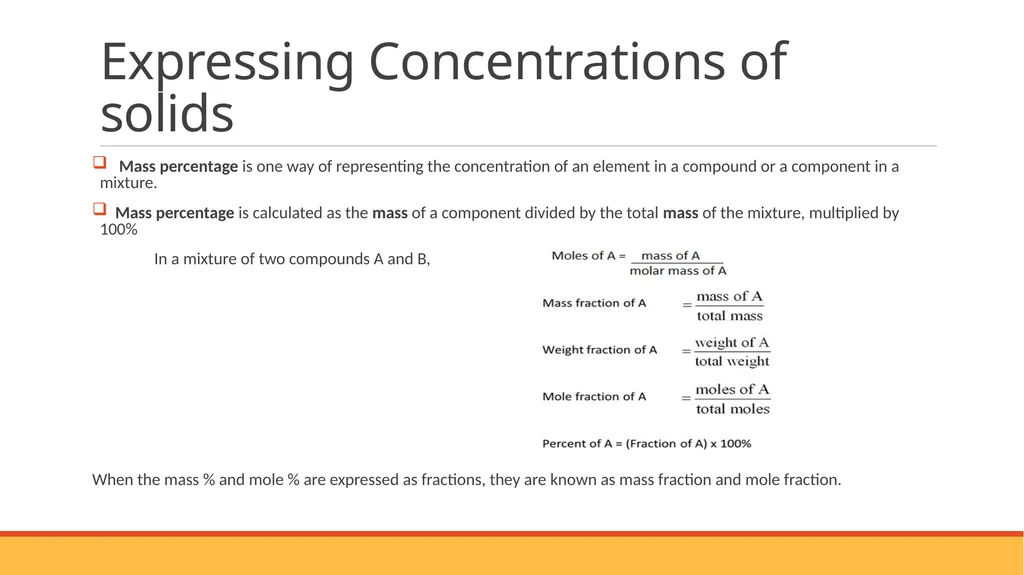
Expressing Concentrations of solids Mass percentage is one way of representing the concentration of an element in a compound or a component in a mixture.
Mass percentage is calculated as the mass of a component divided by the total mass of the mixture, multiplied by 100%
In a mixture of two compounds A and B,
When the mass % and mole % are expressed as fractions, they are known as mass fraction and mole fraction.<br>
Mass percentage is calculated as the mass of a component divided by the total mass of the mixture, multiplied by 100%
In a mixture of two compounds A and B,
When the mass % and mole % are expressed as fractions, they are known as mass fraction and mole fraction.<br>
19
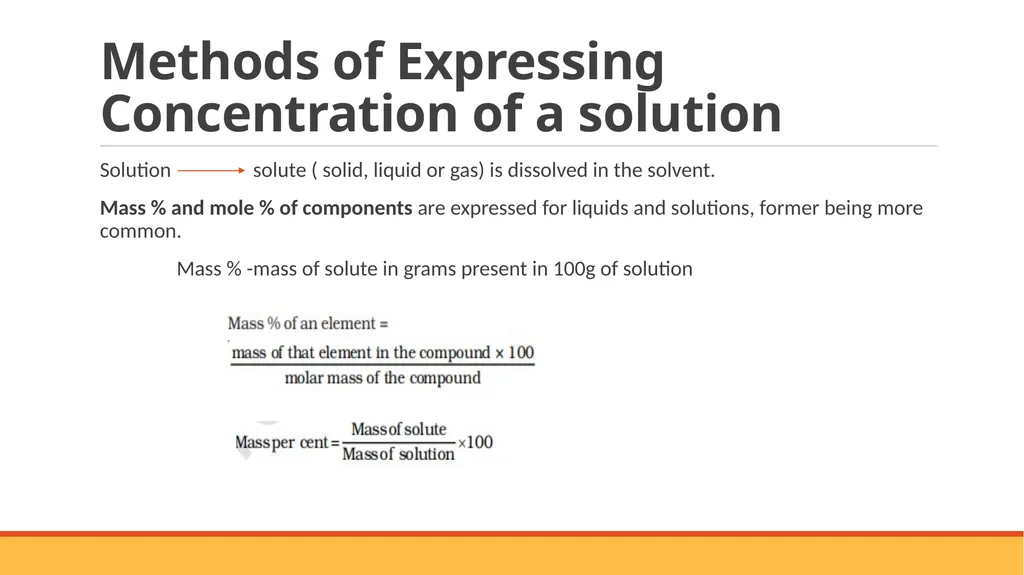
Methods of Expressing Concentration of a solution Solution solute ( solid, liquid or gas) is dissolved in the solvent.
Mass % and mole % of components are expressed for liquids and solutions, former being more common.
Mass % -mass of solute in grams present in 100g of solution<br>
Mass % and mole % of components are expressed for liquids and solutions, former being more common.
Mass % -mass of solute in grams present in 100g of solution<br>
20
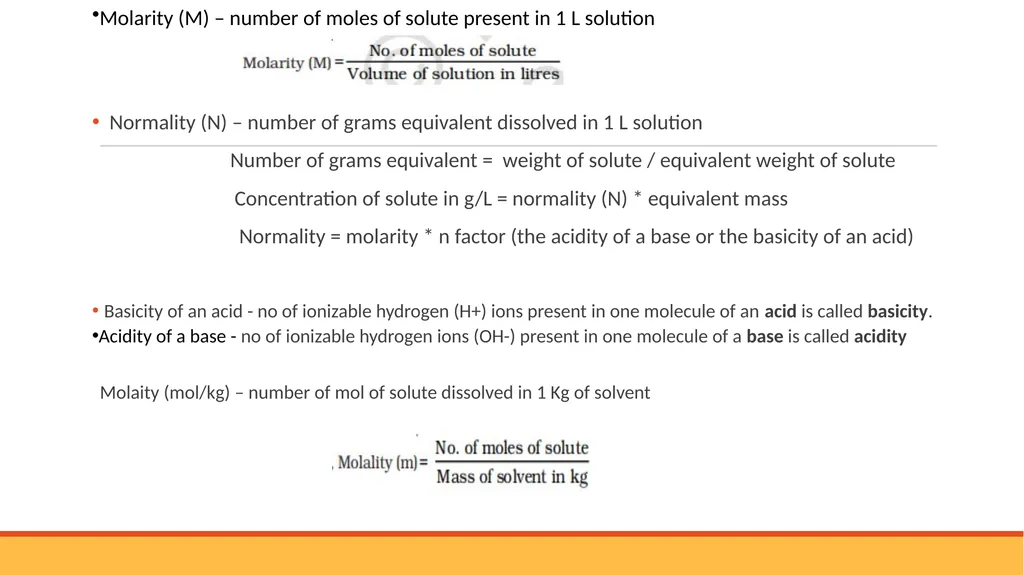
Molarity (M) – number of moles of solute present in 1 L solution
Normality (N) – number of grams equivalent dissolved in 1 L solution
Number of grams equivalent = weight of solute / equivalent weight of solute
Concentration of solute in g/L = normality (N) * equivalent mass
Normality = molarity * n factor (the acidity of a base or the basicity of an acid)
Basicity of an acid - no of ionizable hydrogen (H+) ions present in one molecule of an acid is called basicity.
Acidity of a base - no of ionizable hydrogen ions (OH-) present in one molecule of a base is called acidity
Molaity (mol/kg) – number of mol of solute dissolved in 1 Kg of solvent<br>
Normality (N) – number of grams equivalent dissolved in 1 L solution
Number of grams equivalent = weight of solute / equivalent weight of solute
Concentration of solute in g/L = normality (N) * equivalent mass
Normality = molarity * n factor (the acidity of a base or the basicity of an acid)
Basicity of an acid - no of ionizable hydrogen (H+) ions present in one molecule of an acid is called basicity.
Acidity of a base - no of ionizable hydrogen ions (OH-) present in one molecule of a base is called acidity
Molaity (mol/kg) – number of mol of solute dissolved in 1 Kg of solvent<br>
21
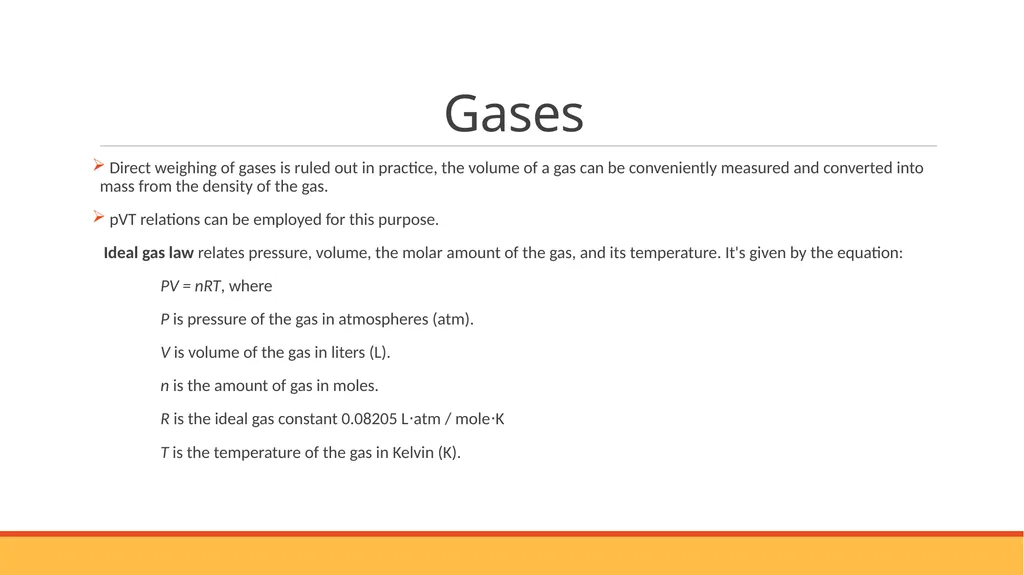
Gases Direct weighing of gases is ruled out in practice, the volume of a gas can be conveniently measured and converted into mass from the density of the gas.
pVT relations can be employed for this purpose.
Ideal gas law relates pressure, volume, the molar amount of the gas, and its temperature. It's given by the equation:
PV = nRT, where
P is pressure of the gas in atmospheres (atm).
V is volume of the gas in liters (L).
n is the amount of gas in moles.
R is the ideal gas constant 0.08205 L⋅atm / mole⋅K
T is the temperature of the gas in Kelvin (K).<br>
pVT relations can be employed for this purpose.
Ideal gas law relates pressure, volume, the molar amount of the gas, and its temperature. It's given by the equation:
PV = nRT, where
P is pressure of the gas in atmospheres (atm).
V is volume of the gas in liters (L).
n is the amount of gas in moles.
R is the ideal gas constant 0.08205 L⋅atm / mole⋅K
T is the temperature of the gas in Kelvin (K).<br>
22
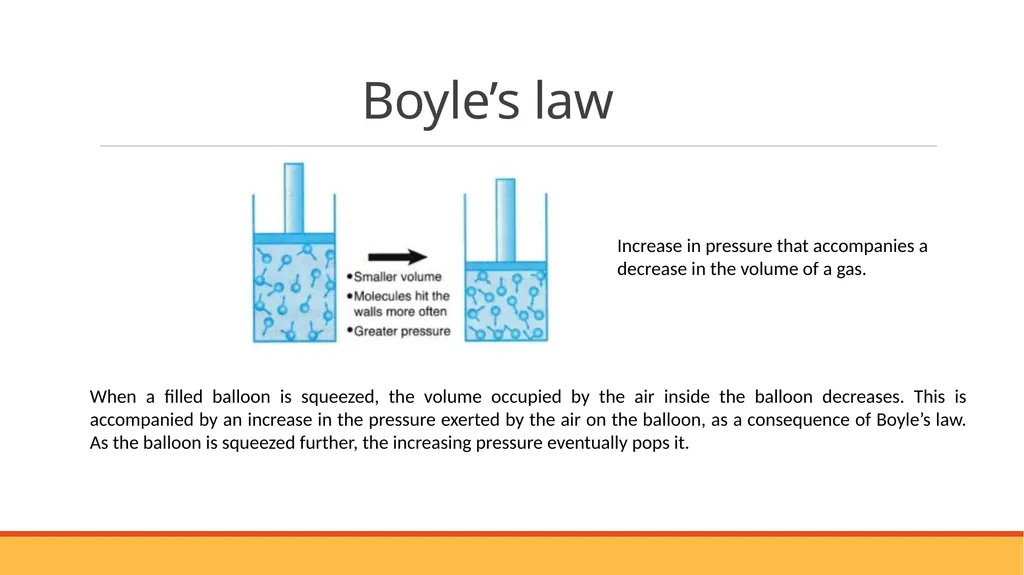
Boyle’s law Increase in pressure that accompanies a decrease in the volume of a gas. When a filled balloon is squeezed, the volume occupied by the air inside the balloon decreases. This is accompanied by an increase in the pressure exerted by the air on the balloon, as a consequence of Boyle’s law. As the balloon is squeezed further, the increasing pressure eventually pops it.<br>
23
Boyle's law, a relation concerning the compression and expansion of a gas at constant temperature.
Boyle's law or the pressure-volume law states that the volume of a given amount of gas held at constant temperature varies inversely with the applied pressure when the temperature and mass are constant. As volume decreases, pressure increases P ∝ (1/V) (PV = constant)<br>
Boyle's law or the pressure-volume law states that the volume of a given amount of gas held at constant temperature varies inversely with the applied pressure when the temperature and mass are constant. As volume decreases, pressure increases P ∝ (1/V) (PV = constant)<br>
24
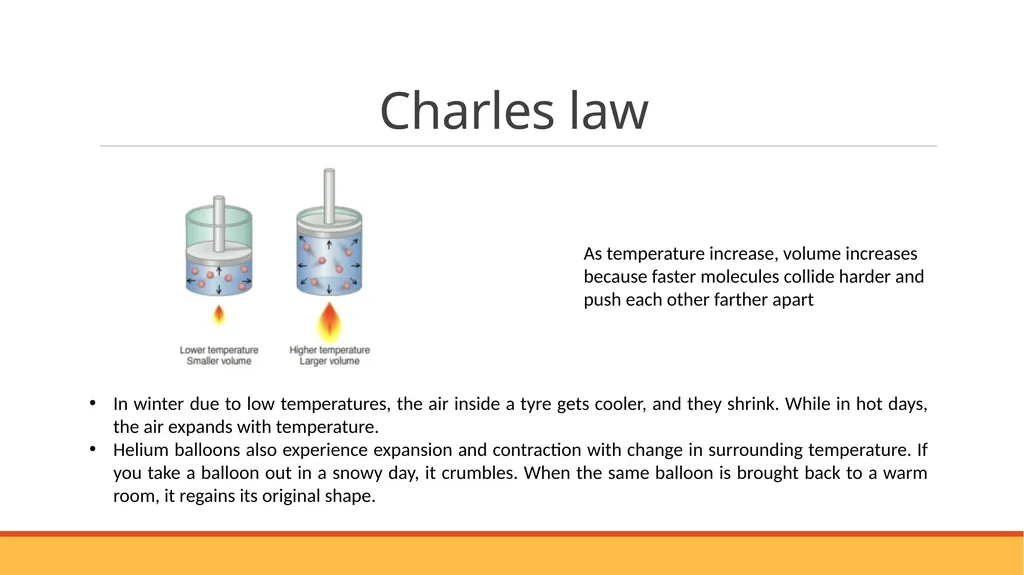
Charles law As temperature increase, volume increases because faster molecules collide harder and push each other farther apart In winter due to low temperatures, the air inside a tyre gets cooler, and they shrink. While in hot days, the air expands with temperature.
Helium balloons also experience expansion and contraction with change in surrounding temperature. If you take a balloon out in a snowy day, it crumbles. When the same balloon is brought back to a warm room, it regains its original shape.<br>
Helium balloons also experience expansion and contraction with change in surrounding temperature. If you take a balloon out in a snowy day, it crumbles. When the same balloon is brought back to a warm room, it regains its original shape.<br>
25
Charles's law is an experimental gas law that describes how gases tend to expand when heated.
This law states that the volume of a given amount of gas held at constant pressure is directly proportional to the Kelvin temperature.
V α T, V / T = constant
As the volume goes up, the temperature also goes up, and vice-versa.<br>
This law states that the volume of a given amount of gas held at constant pressure is directly proportional to the Kelvin temperature.
V α T, V / T = constant
As the volume goes up, the temperature also goes up, and vice-versa.<br>
26
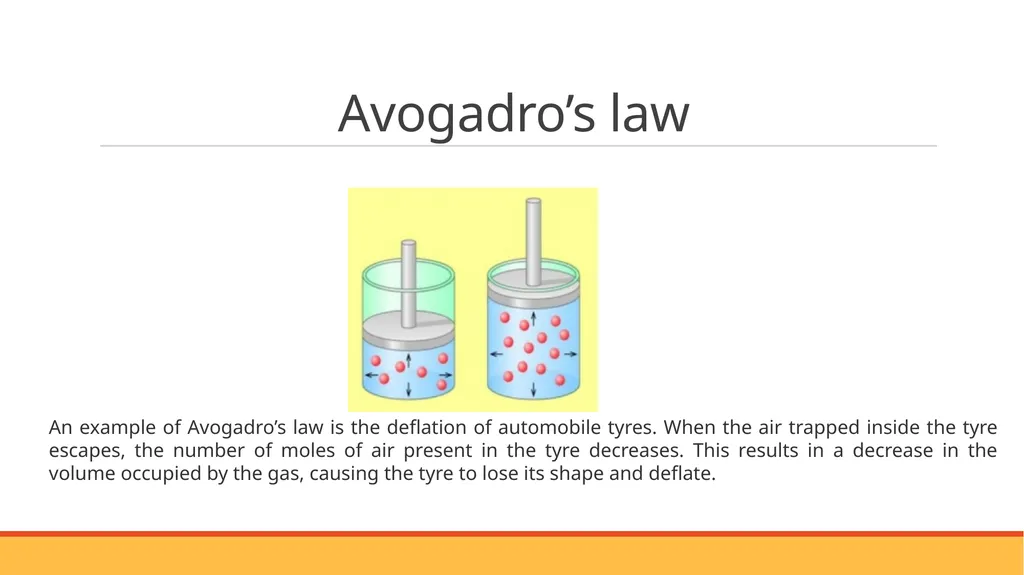
Avogadro’s law An example of Avogadro’s law is the deflation of automobile tyres. When the air trapped inside the tyre escapes, the number of moles of air present in the tyre decreases. This results in a decrease in the volume occupied by the gas, causing the tyre to lose its shape and deflate.<br>
27
Avogadro's law is an experimental gas law relating the volume of a gas to the amount of substance of gas present.
This law states that the total number of atoms/molecules of a gas (i.e. the amount of gaseous substance) is directly proportional to the volume occupied by the gas at constant temperature and pressure.
(V/n = constant)
As the number of moles decreases, the volume decreases<br>
This law states that the total number of atoms/molecules of a gas (i.e. the amount of gaseous substance) is directly proportional to the volume occupied by the gas at constant temperature and pressure.
(V/n = constant)
As the number of moles decreases, the volume decreases<br>
28
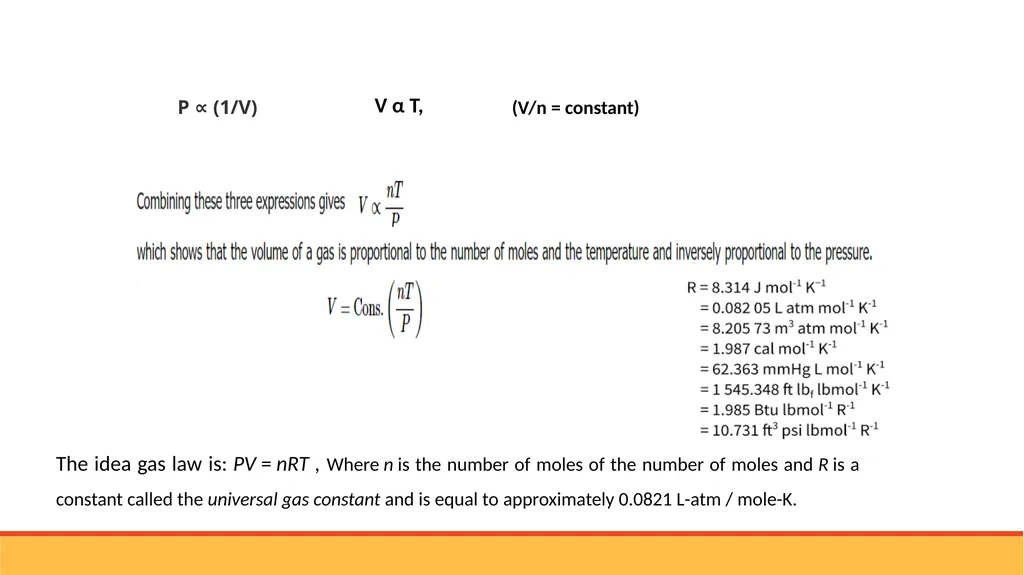
P ∝ (1/V) V α T, (V/n = constant) The idea gas law is: PV = nRT , Where n is the number of moles of the number of moles and R is a constant called the universal gas constant and is equal to approximately 0.0821 L-atm / mole-K.<br>
29
The left side has the units of moles per unit volume (mol/L).
Number of moles of a substance = mass/ molar mass (grams per mole)
Substituting this expression for n The distance between particles in gases is large compared to the size of the particles, so their densities are much lower than the densities of liquids and solids. Consequently, gas density is usually measured in grams per liter (g/L) rather than grams per milliliter (g/mL). Calculating Gas densities and Molar masses using Ideal gas law<br>
Number of moles of a substance = mass/ molar mass (grams per mole)
Substituting this expression for n The distance between particles in gases is large compared to the size of the particles, so their densities are much lower than the densities of liquids and solids. Consequently, gas density is usually measured in grams per liter (g/L) rather than grams per milliliter (g/mL). Calculating Gas densities and Molar masses using Ideal gas law<br>
30
Density and Specific gravity
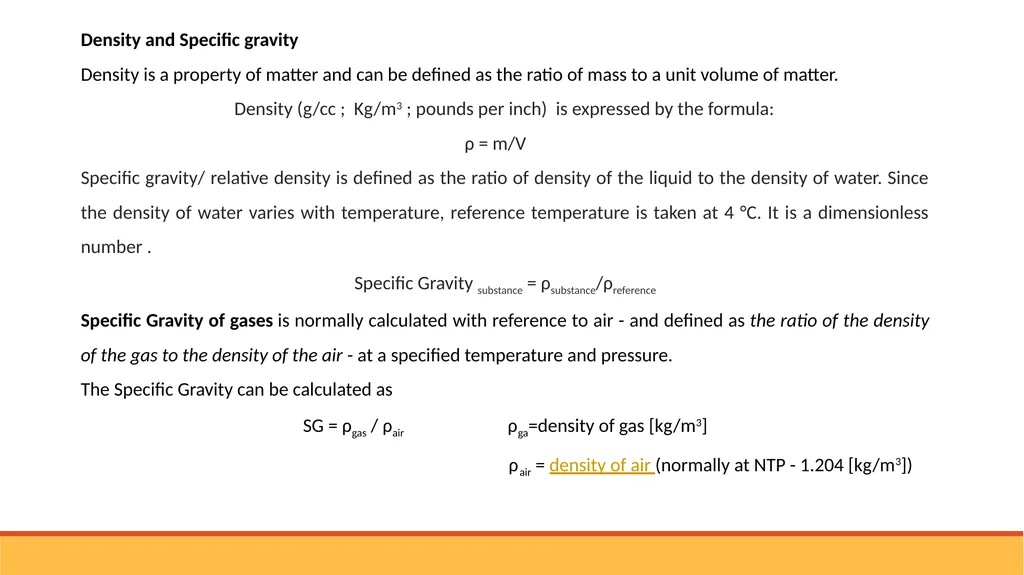
Density is a property of matter and can be defined as the ratio of mass to a unit volume of matter.
Density (g/cc ; Kg/m3 ; pounds per inch) is expressed by the formula:
ρ = m/V
Specific gravity/ relative density is defined as the ratio of density of the liquid to the density of water. Since the density of water varies with temperature, reference temperature is taken at 4 °C. It is a dimensionless number .
Specific Gravity substance = ρsubstance/ρreference
Specific Gravity of gases is normally calculated with reference to air - and defined as the ratio of the density of the gas to the density of the air - at a specified temperature and pressure.
The Specific Gravity can be calculated as
SG = ρgas / ρair ρga=density of gas [kg/m3] ρair = density of air (normally at NTP - 1.204 [kg/m3])<br>
Density is a property of matter and can be defined as the ratio of mass to a unit volume of matter.
Density (g/cc ; Kg/m3 ; pounds per inch) is expressed by the formula:
ρ = m/V
Specific gravity/ relative density is defined as the ratio of density of the liquid to the density of water. Since the density of water varies with temperature, reference temperature is taken at 4 °C. It is a dimensionless number .
Specific Gravity substance = ρsubstance/ρreference
Specific Gravity of gases is normally calculated with reference to air - and defined as the ratio of the density of the gas to the density of the air - at a specified temperature and pressure.
The Specific Gravity can be calculated as
SG = ρgas / ρair ρga=density of gas [kg/m3] ρair = density of air (normally at NTP - 1.204 [kg/m3])<br>
31
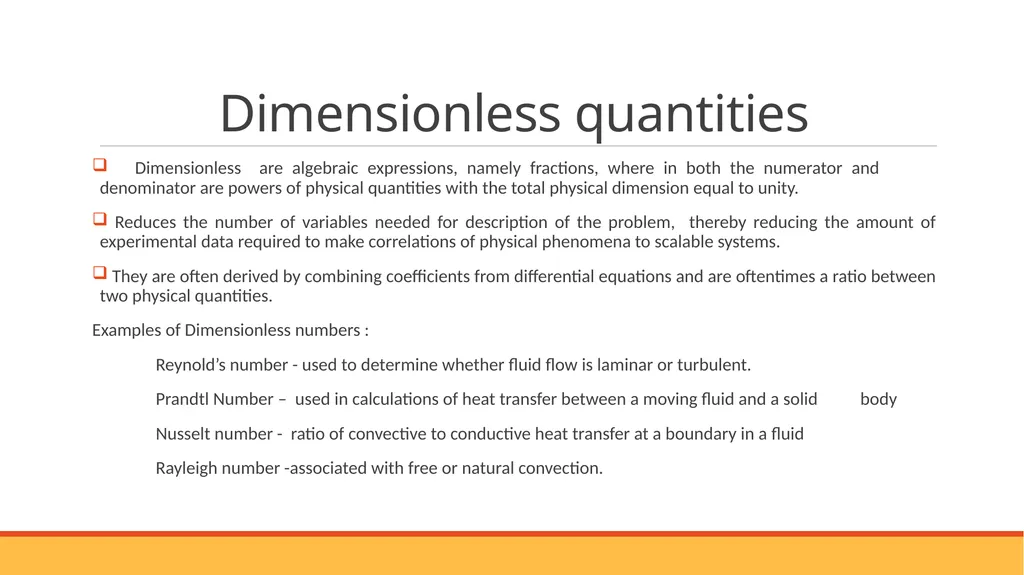
Dimensionless quantities Dimensionless are algebraic expressions, namely fractions, where in both the numerator and denominator are powers of physical quantities with the total physical dimension equal to unity.
Reduces the number of variables needed for description of the problem, thereby reducing the amount of experimental data required to make correlations of physical phenomena to scalable systems.
They are often derived by combining coefficients from differential equations and are oftentimes a ratio between two physical quantities.
Examples of Dimensionless numbers :
Reynold’s number - used to determine whether fluid flow is laminar or turbulent.
Prandtl Number – used in calculations of heat transfer between a moving fluid and a solid body
Nusselt number - ratio of convective to conductive heat transfer at a boundary in a fluid
Rayleigh number -associated with free or natural convection.<br>
Reduces the number of variables needed for description of the problem, thereby reducing the amount of experimental data required to make correlations of physical phenomena to scalable systems.
They are often derived by combining coefficients from differential equations and are oftentimes a ratio between two physical quantities.
Examples of Dimensionless numbers :
Reynold’s number - used to determine whether fluid flow is laminar or turbulent.
Prandtl Number – used in calculations of heat transfer between a moving fluid and a solid body
Nusselt number - ratio of convective to conductive heat transfer at a boundary in a fluid
Rayleigh number -associated with free or natural convection.<br>