
Module XVIII - Decommissioning Ferenc Adorjan
MJ
Published · 64 slides · 0 views

1 / 1

Description
Module XVIII - Decommissioning Ferenc Adorjan Expert in nuclear safety (Hungary) ferencadorjangmail.com Module XVIII - Decommissioning Module XVIII - Decommissioning 2 Lerning objectives After completing this Module, the trainee will be
Related Topics
Share
Embed code
Download this presentation From Below
"Module XVIII - Decommissioning Ferenc Adorjan" is the property of its rightful owner. Permission is granted to download and print the materials on this website for personal, non-commercial use only, and to display it on your personal computer provided you do not modify the materials and that you retain all copyright notices contained in the materials. By downloading content from our website, you accept the terms of this agreement.
Presentation Transcript
01
Module XVIII - Decommissioning Ferenc Adorjan
Expert in nuclear safety (Hungary)
ferencadorjan@gmail.com<br>
Expert in nuclear safety (Hungary)
ferencadorjan@gmail.com<br>
02
Module XVIII - Decommissioning Module XVIII - Decommissioning 2 Lerning objectives After completing this Module, the trainee will
be able to:
Define decommissioning.
List the aspects of decommissioning.
List the strategies for decommissioning.
State the main IAEA Standards relating to decommissioning.<br>
Define decommissioning.
List the aspects of decommissioning.
List the strategies for decommissioning.
State the main IAEA Standards relating to decommissioning.<br>
03
Module XVIII - Decommissioning 3 Contents Decommissioning Process
Planning of Decommissioning
Conduct of Decommissioning
Completion of Decommissioning
Management 3<br>
Planning of Decommissioning
Conduct of Decommissioning
Completion of Decommissioning
Management 3<br>
04
Module XVIII - Decommissioning INTRODUCTION Decommissioning: administrative and technical actions taken to allow the removal of some or all of the regulatory controls from a facility.<br>
05
Module XVIII - Decommissioning INTRODUCTION Aspects of decommissioning typically include:
Planning for decommissioning,
Conducting decommissioning actions and
Terminating the authorization.
Aspects of decommissioning have to be considered throughout all five major stages of the lifetime of a nuclear facility (siting, construction, commissioning, operation and decommissioning).<br>
Planning for decommissioning,
Conducting decommissioning actions and
Terminating the authorization.
Aspects of decommissioning have to be considered throughout all five major stages of the lifetime of a nuclear facility (siting, construction, commissioning, operation and decommissioning).<br>
06
Module XVIII - Decommissioning INTRODUCTION Decommissioning actions
Activities as described in the final decommissioning plan (decontamination, dismantlement, waste management and clean-up).
Completed when the approved end state has been reached.
End state - the release of the facility from regulatory control.
Strategies for decommissioning:
Immediate dismantling or
Deferred dismantling or
Entombment<br>
Activities as described in the final decommissioning plan (decontamination, dismantlement, waste management and clean-up).
Completed when the approved end state has been reached.
End state - the release of the facility from regulatory control.
Strategies for decommissioning:
Immediate dismantling or
Deferred dismantling or
Entombment<br>
07
Module XVIII - Decommissioning IAEA Standards Decommissioning of Facilities,
IAEA General Safety Requirements No. GSR Part 6
Requirements related to:
Protection of people and protection of environment,
Responsibilities associated with decommissioning,
Management of decommissioning,
Decommissioning strategy,
Financing,
Planning of decommissioning during the lifetime of the facility,
Conduct of decommissioning actions and
Completion of decommissioning actions.<br>
Requirements related to:
Protection of people and protection of environment,
Responsibilities associated with decommissioning,
Management of decommissioning,
Decommissioning strategy,
Financing,
Planning of decommissioning during the lifetime of the facility,
Conduct of decommissioning actions and
Completion of decommissioning actions.<br>
08
Module XVIII - Decommissioning IAEA Standards Safety Guides regarding the decommissioning of specific types of facility:
SSG-47 Decommissioning of Nuclear Power Plants, Research Reactors and Other Nuclear Fuel Cycle Facilities (revision of WS-G-2.1 and 2.4);
Decommissioning of Medical, Industrial and Research Facilities, IAEA Safety Guide WS-G-2.2 (1999. Under revision).
General Safety Requirements and Guides also includes issues on decommissioning.<br>
SSG-47 Decommissioning of Nuclear Power Plants, Research Reactors and Other Nuclear Fuel Cycle Facilities (revision of WS-G-2.1 and 2.4);
Decommissioning of Medical, Industrial and Research Facilities, IAEA Safety Guide WS-G-2.2 (1999. Under revision).
General Safety Requirements and Guides also includes issues on decommissioning.<br>
09
Module XVIII - Decommissioning IAEA Standards Safety Guides addressing important aspects of decommissioning, that are of interest of all types of facilities are:
Safety Assessment for the Decommissioning of Facilities Using Radioactive Material, IAEA Safety Standards Series No. WS-G-5.2;
Release of Sites from Regulatory Control on Termination of Practices, IAEA Safety Standards Series No. WS-G-5.1;
Application of the Concepts of Exclusion, Exemption and Clearance, IAEA Safety Standards Series No. RS-G-1.7.<br>
Safety Assessment for the Decommissioning of Facilities Using Radioactive Material, IAEA Safety Standards Series No. WS-G-5.2;
Release of Sites from Regulatory Control on Termination of Practices, IAEA Safety Standards Series No. WS-G-5.1;
Application of the Concepts of Exclusion, Exemption and Clearance, IAEA Safety Standards Series No. RS-G-1.7.<br>
10
Module XVIII - Decommissioning DECOMMISSIONING PROCESS - Learning objectives Describe the protection of people and the environment.
List the responsibilities of the government, the regulatory body, the licensee.
Describe the decommissioning option.
Define the immediate and deferred dismantling.
Describe the facilitating decommissioning.<br>
List the responsibilities of the government, the regulatory body, the licensee.
Describe the decommissioning option.
Define the immediate and deferred dismantling.
Describe the facilitating decommissioning.<br>
11
Module XVIII - Decommissioning DECOMMISSIONING PROCESS Time period of decommissioning stage may range from a few years to decades
Nuclear installation or its remaining prats may also be considered decommissioned if incorporated into a new or existing facility
Decommissioning of a nuclear installation on a multifacility site.
Radiation protection of both workers and members of the public should be provided
During decommissioning and further use of the site.<br>
Nuclear installation or its remaining prats may also be considered decommissioned if incorporated into a new or existing facility
Decommissioning of a nuclear installation on a multifacility site.
Radiation protection of both workers and members of the public should be provided
During decommissioning and further use of the site.<br>
12
Module XVIII - Decommissioning Protection of people and environment Graded approach used for all aspects of decommissioning in determining the scope and level of detail for any particular facility. In consistency with the magnitude of the possible radiation risks.
The final decommissioning plan is supported by a safety assessment addressing the planned decommissioning actions and incidents that may occur or situations that may arise during decommissioning.<br>
The final decommissioning plan is supported by a safety assessment addressing the planned decommissioning actions and incidents that may occur or situations that may arise during decommissioning.<br>
13
Module XVIII - Decommissioning Responsibilities Nuclear facility taken out of service → responsibility may be transferred to a different organization (recommended)
Operating organization of the installation undergoing decommissioning is ultimately responsible for the safety.
Responsibilities of the government – To establish and maintain a governmental, legal and regulatory framework for all aspects of decommissioning.<br>
Operating organization of the installation undergoing decommissioning is ultimately responsible for the safety.
Responsibilities of the government – To establish and maintain a governmental, legal and regulatory framework for all aspects of decommissioning.<br>
14
Module XVIII - Decommissioning Responsibilities Responsibilities of the regulatory body
Authorise and oversight of decommissioning;
Needs to establish safety requirements, adopt regulations and guides, including management of the resulting radioactive waste, and takes actions to ensure that the regulatory requirements are met.
Responsibilities of the licensee
Implements planning for decommissioning, carries out the decommissioning actions;
The licensee is responsible for all aspects of safety, radiation and environmental protection during decommissioning.<br>
Authorise and oversight of decommissioning;
Needs to establish safety requirements, adopt regulations and guides, including management of the resulting radioactive waste, and takes actions to ensure that the regulatory requirements are met.
Responsibilities of the licensee
Implements planning for decommissioning, carries out the decommissioning actions;
The licensee is responsible for all aspects of safety, radiation and environmental protection during decommissioning.<br>
15
Module XVIII - Decommissioning Decommissioning strategy Immediate dismantling - removal of all radioactive materials from the site (allowing unrestricted release);
Decommissioning actions begin shortly after the permanent shutdown.
Equipment, structures, systems and components of a facility containing radioactive material are removed and/or decontaminated.
Deferred dismantling - when dismantling is postponed;
All or part of a facility containing radioactive material is either processed or placed in such a condition that it can be put in safe storage and the facility maintained until it is subsequently decontaminated and/or dismantled.
Facility containing radioactive material is either processed or placed in such a condition that it can be put in safe storage.<br>
Decommissioning actions begin shortly after the permanent shutdown.
Equipment, structures, systems and components of a facility containing radioactive material are removed and/or decontaminated.
Deferred dismantling - when dismantling is postponed;
All or part of a facility containing radioactive material is either processed or placed in such a condition that it can be put in safe storage and the facility maintained until it is subsequently decontaminated and/or dismantled.
Facility containing radioactive material is either processed or placed in such a condition that it can be put in safe storage.<br>
16
Module XVIII - Decommissioning Decommissioning strategy Selection of a normal decommissioning strategy is justified by the licensee (legislation, safety, resources, site use, etc).
Licensee and Regulator should also consider:
Sudden shutdown – Decommissioning strategy reviewed to determine of revision of strategy is required.
Shutdown caused by an accident – Before approved decommissioning plan is implemented, facility needs to be brought to a safe configuration.<br>
Licensee and Regulator should also consider:
Sudden shutdown – Decommissioning strategy reviewed to determine of revision of strategy is required.
Shutdown caused by an accident – Before approved decommissioning plan is implemented, facility needs to be brought to a safe configuration.<br>
17
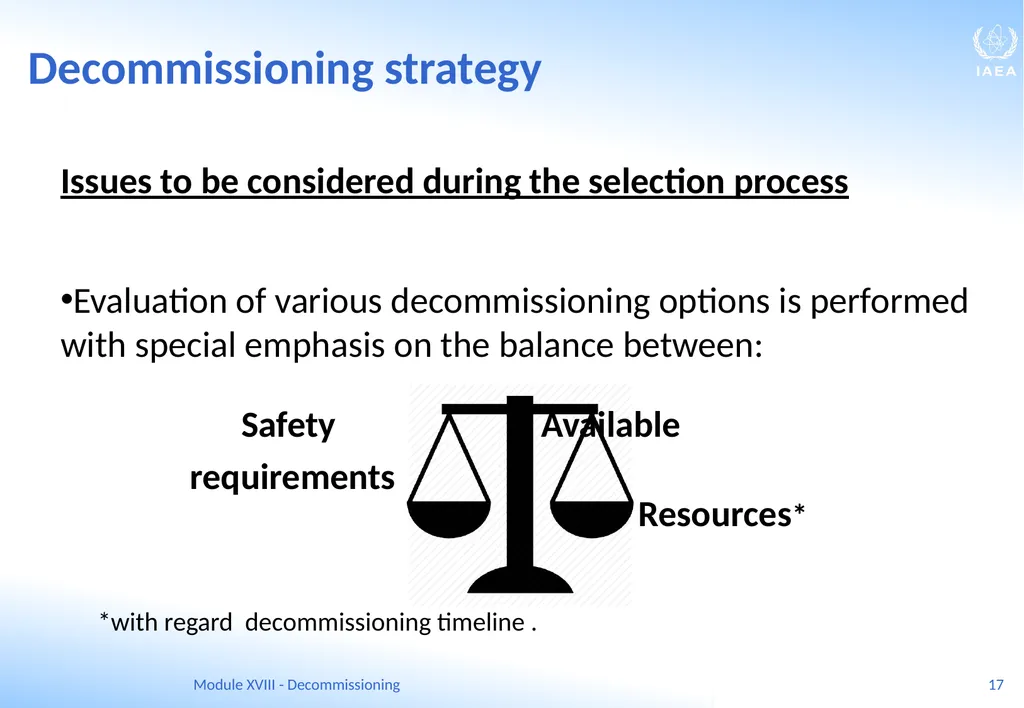
Module XVIII - Decommissioning Decommissioning strategy Issues to be considered during the selection process
Evaluation of various decommissioning options is performed with special emphasis on the balance between:
*with regard decommissioning timeline .<br>
Evaluation of various decommissioning options is performed with special emphasis on the balance between:
*with regard decommissioning timeline .<br>
18
Module XVIII - Decommissioning Safety Radiological and non-radiological hazards are identified in a formal safety assessment;
To provide appropriate protective measures to ensure safety of workers and the public and protection of the environment.
Decommissioning may involve operations that may not be normal during the operation of the installation;
Significance of non-radiological hazards may be increased,
Problem of ageing of the reactor’s components becomes important when deferred decommissioning is being considered.
Safety assessment helps to ensure safety of the decommissioning process.<br>
To provide appropriate protective measures to ensure safety of workers and the public and protection of the environment.
Decommissioning may involve operations that may not be normal during the operation of the installation;
Significance of non-radiological hazards may be increased,
Problem of ageing of the reactor’s components becomes important when deferred decommissioning is being considered.
Safety assessment helps to ensure safety of the decommissioning process.<br>
19
Module XVIII - Decommissioning Financing Responsibilities in respect of financial provisions for decommissioning are set out in national legislation.
To provide and ensure that adequate financial resources are available when needed to ensure safe decommissioning.
All activities described in the decommissioning plan are included in the estimation of the cost for decommissioning.
The cost estimate is updated on the basis of the periodic update of the initial or final decommissioning plan.
Decommissioned facility is released with restrictions on its future use – financial resources are available for monitoring, surveillance and control of the facility throughout the necessary time period.<br>
To provide and ensure that adequate financial resources are available when needed to ensure safe decommissioning.
All activities described in the decommissioning plan are included in the estimation of the cost for decommissioning.
The cost estimate is updated on the basis of the periodic update of the initial or final decommissioning plan.
Decommissioned facility is released with restrictions on its future use – financial resources are available for monitoring, surveillance and control of the facility throughout the necessary time period.<br>
20
Module XVIII - Decommissioning Availability of existing expertise The availability and utilization of facility specific expertise is highly important for efficient and safe operations during decommissioning.
Expertise could:
Decrease the potential for events such as industrial accidents or overexposures and
May help to reduce problems associated with loss of a corporate memory, and retraining or recruiting of new personnel.<br>
Expertise could:
Decrease the potential for events such as industrial accidents or overexposures and
May help to reduce problems associated with loss of a corporate memory, and retraining or recruiting of new personnel.<br>
21
Module XVIII - Decommissioning Considerations relating to the public Issue of public concerns surrounding decommissioning is largely centred on the concern of waste disposal.
Public opinion is also influenced by other factors like:
Local factors, including the anticipated development and use of land after decommissioning;
Local employment considerations after cessation of facility operation and during decommissioning; and
Visual impact and the public attitude.<br>
Public opinion is also influenced by other factors like:
Local factors, including the anticipated development and use of land after decommissioning;
Local employment considerations after cessation of facility operation and during decommissioning; and
Visual impact and the public attitude.<br>
22
Module XVIII - Decommissioning Facilitating decommissioning Requirements for decommissioning are considered:
At the design stage for a new reactor installation or
As soon as possible for existing installations.
Considerations at the design and construction phase
A baseline background radiological characterization of the site for the proposed facility and the facility itself need to be undertaken.
Design features that need to be considered for decommissioning:
Careful selection of materials and optimization of the facility’s design, layout and access routes.<br>
At the design stage for a new reactor installation or
As soon as possible for existing installations.
Considerations at the design and construction phase
A baseline background radiological characterization of the site for the proposed facility and the facility itself need to be undertaken.
Design features that need to be considered for decommissioning:
Careful selection of materials and optimization of the facility’s design, layout and access routes.<br>
23
Module XVIII - Decommissioning Facilitating decommissioning Considerations during facility operation
Accurate and relevant records.
Records are configured so that those relevant to decommissioning may be readily identified.
In addition to drawings and diagrams, photographic records of the construction and operational phases of the reactor lifetime are kept.
During operations, consideration is given to minimizing the extent of contamination of structures and surfaces, segregation of different categories of wastes, and avoidance and prompt clean-up of spillages and leaks.<br>
Accurate and relevant records.
Records are configured so that those relevant to decommissioning may be readily identified.
In addition to drawings and diagrams, photographic records of the construction and operational phases of the reactor lifetime are kept.
During operations, consideration is given to minimizing the extent of contamination of structures and surfaces, segregation of different categories of wastes, and avoidance and prompt clean-up of spillages and leaks.<br>
24
Module XVIII - Decommissioning PLANNING OF DECOMMISSIONING- Learning objectives The planning of decommissioning.
The objectives and steps of a safety assessment.
The hazards during decommissioning.
The results of regulatory review of a safety assessment.<br>
The objectives and steps of a safety assessment.
The hazards during decommissioning.
The results of regulatory review of a safety assessment.<br>
25
Module XVIII - Decommissioning PLANNING OF DECOMMISSIONING A decommissioning plan is prepared by licensee for each nuclear facility.
The operating organization plans for adequate financial resources to ensure the decommissioning of a nuclear facility.
Three stages of planning are envisaged: initial, ongoing and final;
Degree of detail will increase from the initial to the final decommissioning plan.
Information on type of safety related documents needed are provided in IAEA Safety Report Standard Format and Content for Safety Related Decommissioning Documents.<br>
The operating organization plans for adequate financial resources to ensure the decommissioning of a nuclear facility.
Three stages of planning are envisaged: initial, ongoing and final;
Degree of detail will increase from the initial to the final decommissioning plan.
Information on type of safety related documents needed are provided in IAEA Safety Report Standard Format and Content for Safety Related Decommissioning Documents.<br>
26
Module XVIII - Decommissioning Initial planning of decommissioning Initial decommissioning plan is submitted with the application for authorization to operate the facility;
To demonstrate the feasibility of decommissioning.
Initial plan is updated as necessary with:
Operational experience gained,
Lessons learned from the decommissioning of similar facilities,
New or revised safety requirements, or
Technological developments relevant to the selected decommissioning strategy.<br>
To demonstrate the feasibility of decommissioning.
Initial plan is updated as necessary with:
Operational experience gained,
Lessons learned from the decommissioning of similar facilities,
New or revised safety requirements, or
Technological developments relevant to the selected decommissioning strategy.<br>
27
Module XVIII - Decommissioning Final Planning of decommissioning Licensee informs regulatory body about planned shutdown, when time of the permanent shutdown of a facility is known.
Updates of the final decommissioning plan include:
Experience gained in decommissioning,
New or revised safety requirements, or
New or revised national regulations. Prior to the conduct of decommissioning actions, a final decommissioning plan shall be approved by the regulatory body<br>
Updates of the final decommissioning plan include:
Experience gained in decommissioning,
New or revised safety requirements, or
New or revised national regulations. Prior to the conduct of decommissioning actions, a final decommissioning plan shall be approved by the regulatory body<br>
28
Module XVIII - Decommissioning Safety assessment Objectives of safety assessment are:
To support the selection of the decommissioning strategy, the development of a decommissioning plan and associated specific decommissioning activities;
To demonstrate that exposures of workers and of the public are as low as reasonably achievable (ALARA) and do not exceed the relevant limits or constraints.
Safety assessment:
Forms an integral part of the decommissioning plan,
Must be commensurate with the complexity and potential hazard of the installation,
Need to be consistent with the decommissioning plan and with other relevant national and site specific strategies and requirements.<br>
To support the selection of the decommissioning strategy, the development of a decommissioning plan and associated specific decommissioning activities;
To demonstrate that exposures of workers and of the public are as low as reasonably achievable (ALARA) and do not exceed the relevant limits or constraints.
Safety assessment:
Forms an integral part of the decommissioning plan,
Must be commensurate with the complexity and potential hazard of the installation,
Need to be consistent with the decommissioning plan and with other relevant national and site specific strategies and requirements.<br>
29
Module XVIII - Decommissioning Safety assessment - General considerations In development and review of safety assessment graded approach is applied – a process by which the level of analysis, the documentation and the actions necessary to comply with the safety requirements and criteria are commensurate with the following factors:
Purpose and scope of the safety assessment;
Uncertainty issues, radiological hazards and likelihood of hazards;
Complexity, safety requirements and availability of applicable safety assessment.<br>
Purpose and scope of the safety assessment;
Uncertainty issues, radiological hazards and likelihood of hazards;
Complexity, safety requirements and availability of applicable safety assessment.<br>
30
Module XVIII - Decommissioning Safety assessment content Description of the installations/facilities and of the decommissioning activities
Description of the installations/facilities include:
Site and local infrastructure – dose and/or risk calculations,
Installations/facilities – safety functions and their associated SSCs,
Inventory of radioactive material – relevant radionuclides and calculated and measured activity; the radionuclide distribution and the dose rate distribution,
Operational history – operational records, post-operational on-site and off-site surveys and information from ongoing decommissioning activities.<br>
Description of the installations/facilities include:
Site and local infrastructure – dose and/or risk calculations,
Installations/facilities – safety functions and their associated SSCs,
Inventory of radioactive material – relevant radionuclides and calculated and measured activity; the radionuclide distribution and the dose rate distribution,
Operational history – operational records, post-operational on-site and off-site surveys and information from ongoing decommissioning activities.<br>
31
Module XVIII - Decommissioning Safety assessment - Hazards during decommissioning All relevant hazards to workers, public and the environment are included in decommissioning safety assessment:
Radiation exposures,
Toxic and other dangerous exposures,
Industrial hazards.
Initiating events includes those arising internally from the decommissioning activities, arising externally and human induced;
Initiating event – meaning an identified event that leads to anticipated operational occurrences or accident conditions and that challenges safety functions.<br>
Radiation exposures,
Toxic and other dangerous exposures,
Industrial hazards.
Initiating events includes those arising internally from the decommissioning activities, arising externally and human induced;
Initiating event – meaning an identified event that leads to anticipated operational occurrences or accident conditions and that challenges safety functions.<br>
32
Module XVIII - Decommissioning Safety assessment - Defence-in-depth Defence-in-depth principle used to:
Prevent escalation of anticipated operational occurrences and
Maintain effectiveness of physical barriers.
This include:
Operational limits, controls and conditions to prevent adverse consequences;
Protective measures which ensure that any accidents will not result in significant harm to workers, the public or the environment; and
Mitigate the consequences of accidents that could occur.<br>
Prevent escalation of anticipated operational occurrences and
Maintain effectiveness of physical barriers.
This include:
Operational limits, controls and conditions to prevent adverse consequences;
Protective measures which ensure that any accidents will not result in significant harm to workers, the public or the environment; and
Mitigate the consequences of accidents that could occur.<br>
33
Module XVIII - Decommissioning Safety assessment - Safety functions Safety functions should not be compromised during decommissioning:
Control of reactivity,
Cooling of radioactive material,
Confinement of radioactive material,
Shielding,
Radiation detection and actuation of alarms,
Fire suppression and ventilation.<br>
Control of reactivity,
Cooling of radioactive material,
Confinement of radioactive material,
Shielding,
Radiation detection and actuation of alarms,
Fire suppression and ventilation.<br>
34
Module XVIII - Decommissioning Safety assessment - Long term safety Decommissioning should not not impose unacceptable hazards or undue burdens on future generations.
For deferred dismantling safety assessment demonstrate that installation/facilities will:
Meet relevant safety requirements and criteria in dismantling period and
Can be safely decommissioned in future.<br>
For deferred dismantling safety assessment demonstrate that installation/facilities will:
Meet relevant safety requirements and criteria in dismantling period and
Can be safely decommissioned in future.<br>
35
Module XVIII - Decommissioning Safety assessment – managing of Uncertainties All known uncertainties should be taken into account;
Quality, reliability and availability of information from the characterization of the installations/facilities may be limited;
Clean-up activities may not be well defined; and
Scenarios and the stages in the decommissioning plan may need to be revised on the basis of knowledge gained from previous stages in the process or from other similar activities at other facilities or sites.
Where uncertainties are significant, the safety assessment considers applying a phased approach to the safety assessment for decommissioning.
Addressing individual phases and/or stages of the decommissioning plan so as to reduce the uncertainties as decommissioning progresses.<br>
Quality, reliability and availability of information from the characterization of the installations/facilities may be limited;
Clean-up activities may not be well defined; and
Scenarios and the stages in the decommissioning plan may need to be revised on the basis of knowledge gained from previous stages in the process or from other similar activities at other facilities or sites.
Where uncertainties are significant, the safety assessment considers applying a phased approach to the safety assessment for decommissioning.
Addressing individual phases and/or stages of the decommissioning plan so as to reduce the uncertainties as decommissioning progresses.<br>
36
Module XVIII - Decommissioning Safety assessment Results of safety assessments – demonstrate compliance with regulatory requirements and criteria expressed in terms of effective dose or in terms of risk.
Safety measures (engineered and procedural) must be commensurate with the likelihood of the occurrence of accidents and their possible radiological consequences.<br>
Safety measures (engineered and procedural) must be commensurate with the likelihood of the occurrence of accidents and their possible radiological consequences.<br>
37
Module XVIII - Decommissioning Regulatory review of the safety assessment The principal objectives of regulatory reviews of safety assessment are:
To consider whether the safety assessment provides an appropriate basis to support the proposed decommissioning strategy, plan and activities;
To support the authorization process for the decommissioning strategy, plan and activities by confirming that all relevant safety requirements and criteria have been met;
To identify any regulatory limits and conditions that will need to be applied during decommissioning or before decommissioning activities may be commenced; and
To provide an input into the process of releasing the site from regulatory control.<br>
To consider whether the safety assessment provides an appropriate basis to support the proposed decommissioning strategy, plan and activities;
To support the authorization process for the decommissioning strategy, plan and activities by confirming that all relevant safety requirements and criteria have been met;
To identify any regulatory limits and conditions that will need to be applied during decommissioning or before decommissioning activities may be commenced; and
To provide an input into the process of releasing the site from regulatory control.<br>
38
Module XVIII - Decommissioning Regulatory review of the safety assessment The results of the review of the safety assessment demonstrate:
The safety assessment is consistent with the decommissioning plan and other related safety assessments;
Decommissioning activities are optimized with due regard to dose and risk constraints for planned activities;
Suitable and sufficient safety measures (procedural measures and engineered safety features) will be in place so that the decommissioning activities can be carried out safely and in accordance with all relevant safety requirements and criteria, and in an optimized manner;
Surveillance measures and maintenance measures are adequate to ensure safety;
Emergency planning and preparedness during decommissioning are adequate; and
Good engineering practice has been used in developing the proposals for decommissioning.<br>
The safety assessment is consistent with the decommissioning plan and other related safety assessments;
Decommissioning activities are optimized with due regard to dose and risk constraints for planned activities;
Suitable and sufficient safety measures (procedural measures and engineered safety features) will be in place so that the decommissioning activities can be carried out safely and in accordance with all relevant safety requirements and criteria, and in an optimized manner;
Surveillance measures and maintenance measures are adequate to ensure safety;
Emergency planning and preparedness during decommissioning are adequate; and
Good engineering practice has been used in developing the proposals for decommissioning.<br>
39
Module XVIII - Decommissioning CONDUCT OF DECOMMISSIONING - Learning objectives Critical tasks of decommissioning.
State the concerns with fuel removal.
The importance of containment regarding the decommissioning.
The decontamination.
The final radiological survey.<br>
State the concerns with fuel removal.
The importance of containment regarding the decommissioning.
The decontamination.
The final radiological survey.<br>
40
Module XVIII - Decommissioning CONDUCT OF DECOMMISSIONING Decommissioning techniques shall be selected such that:
Protection of workers, the public and the environment are optimized,
Generation of waste is minimized, and
Potential negative impact on storage and disposal of waste is minimized.
As decommissioning actions progress (decontamination, cutting and handling of large components) new hazards may arise.
Impact of these actions on safety shall be assessed and managed. The licensee shall implement the final decommissioning plan, including management of radioactive waste, in compliance with national regulations.<br>
Protection of workers, the public and the environment are optimized,
Generation of waste is minimized, and
Potential negative impact on storage and disposal of waste is minimized.
As decommissioning actions progress (decontamination, cutting and handling of large components) new hazards may arise.
Impact of these actions on safety shall be assessed and managed. The licensee shall implement the final decommissioning plan, including management of radioactive waste, in compliance with national regulations.<br>
41
Module XVIII - Decommissioning Critical tasks of decommissioning Initial characterization of decommissioning
Survey of radiological an non-radiological hazards:
Important input for safety assessment,
Input for implementing a safe approach during the work,
Conducted to identify the inventory and location of radioactive and other hazardous materials.
Radiation and contamination maps are prepared with adequate number of radiation and contamination surveys.
Inventory of all hazardous chemicals present in the installation should be conducted.<br>
Survey of radiological an non-radiological hazards:
Important input for safety assessment,
Input for implementing a safe approach during the work,
Conducted to identify the inventory and location of radioactive and other hazardous materials.
Radiation and contamination maps are prepared with adequate number of radiation and contamination surveys.
Inventory of all hazardous chemicals present in the installation should be conducted.<br>
42
Module XVIII - Decommissioning Critical tasks of decommissioning Fuel removal from reactors
Fuel should be removed prior to conduct of decommissioning actions;
Spent fuel removal from reactor at the end of its operational lifetime is part of operation.
Procedures for the removal, storage and shipment of fuel are the same as those used during normal operation.
On-site interim storage facilities for spent fuel – care is taken with respect to possible interference with future decommissioning activities at the reactor installation.<br>
Fuel should be removed prior to conduct of decommissioning actions;
Spent fuel removal from reactor at the end of its operational lifetime is part of operation.
Procedures for the removal, storage and shipment of fuel are the same as those used during normal operation.
On-site interim storage facilities for spent fuel – care is taken with respect to possible interference with future decommissioning activities at the reactor installation.<br>
43
Module XVIII - Decommissioning Critical tasks of decommissioning Containment maintenance and modification
Containment systems should be retain as long as necessary and feasible;
Containment is important element of defence-in-depth to prevent the movement of residual radionuclides.
Adequate containment is planned and demonstrated when the airborne contamination may be raised:
Containment related barriers or devices are removed or altered,
Cutting and dismantling operations are carried out.<br>
Containment systems should be retain as long as necessary and feasible;
Containment is important element of defence-in-depth to prevent the movement of residual radionuclides.
Adequate containment is planned and demonstrated when the airborne contamination may be raised:
Containment related barriers or devices are removed or altered,
Cutting and dismantling operations are carried out.<br>
44
Module XVIII - Decommissioning Critical tasks of decommissioning Decontamination
Decontamination are activities directed to the removal or reduction of radioactive contamination.
Decontamination may be applied to:
Internal or external surfaces of components and systems,
Structural surfaces, and
Tools employed in decommissioning.
Decontamination can be conducted before, during or after dismantling.<br>
Decontamination are activities directed to the removal or reduction of radioactive contamination.
Decontamination may be applied to:
Internal or external surfaces of components and systems,
Structural surfaces, and
Tools employed in decommissioning.
Decontamination can be conducted before, during or after dismantling.<br>
45
Module XVIII - Decommissioning Critical tasks of decommissioning Decontamination
The objectives of decontamination include:
Reduction of exposures during decommissioning activities;
Minimization of the volume of the categories of material to be classified or disposed of as solid radioactive waste; and
Increase of the possibility of recycle and reuse of equipment, materials or premises.
Important to exchange information and experience;
Especially for smaller facilities, where development of new and optimised techniques is less feasible.<br>
The objectives of decontamination include:
Reduction of exposures during decommissioning activities;
Minimization of the volume of the categories of material to be classified or disposed of as solid radioactive waste; and
Increase of the possibility of recycle and reuse of equipment, materials or premises.
Important to exchange information and experience;
Especially for smaller facilities, where development of new and optimised techniques is less feasible.<br>
46
Module XVIII - Decommissioning Critical tasks of decommissioning Dismantling
Special tools and devices may be needed during dismantling – tools and devices should be tested before their use.
Considerations for determining most effective and safe dismantling:
Equipment is simple to operate, decontaminate and maintain;
Effective methods for controlling airborne radionuclides implemented;
Effective control of discharges to the environment;
Underwater dismantling and cutting – water processing to ensure good visibility and assist in effluent treatment;
Effect of each task on adjacent systems and structures are evaluated;
Waste containers, handling systems and routes are defined in advance.<br>
Special tools and devices may be needed during dismantling – tools and devices should be tested before their use.
Considerations for determining most effective and safe dismantling:
Equipment is simple to operate, decontaminate and maintain;
Effective methods for controlling airborne radionuclides implemented;
Effective control of discharges to the environment;
Underwater dismantling and cutting – water processing to ensure good visibility and assist in effluent treatment;
Effect of each task on adjacent systems and structures are evaluated;
Waste containers, handling systems and routes are defined in advance.<br>
47
Module XVIII - Decommissioning Critical tasks of decommissioning Final radiological survey
Survey of the residual radionuclides at the facility site must be performed after completion of decommissioning;
To demonstrate that the residual activity complies with the criteria set by the national regulatory authority and the decommissioning objectives have been fulfilled.
Final survey report includes:
Criteria used;
Methods and procedures to ensure that the criteria were met; and
Measurement data, including appropriate statistical analysis and systematic approaches used.<br>
Survey of the residual radionuclides at the facility site must be performed after completion of decommissioning;
To demonstrate that the residual activity complies with the criteria set by the national regulatory authority and the decommissioning objectives have been fulfilled.
Final survey report includes:
Criteria used;
Methods and procedures to ensure that the criteria were met; and
Measurement data, including appropriate statistical analysis and systematic approaches used.<br>
48
Module XVIII - Decommissioning Additional aspects of decommissioning actions Radiation protection
The radiation protection programme ensures that radiation protection is optimized and that doses are kept within appropriate limits.
During decommissioning special situations may need to be considered, which may require:
Use of specialized equipment and
Implementation of certain non-routine procedures.<br>
The radiation protection programme ensures that radiation protection is optimized and that doses are kept within appropriate limits.
During decommissioning special situations may need to be considered, which may require:
Use of specialized equipment and
Implementation of certain non-routine procedures.<br>
49
Module XVIII - Decommissioning Radiation protection
The radiation protection programme should be clearly set out in the decommissioning plan.
Involved in its execution properly trained and have access to appropriate equipment for carrying out radiation surveys.
Decommissioning work should be planned and carried out using work order procedures and radiation work permits, with adequate involvement of radiation protection expertise. Additional aspects of decommissioning actions<br>
The radiation protection programme should be clearly set out in the decommissioning plan.
Involved in its execution properly trained and have access to appropriate equipment for carrying out radiation surveys.
Decommissioning work should be planned and carried out using work order procedures and radiation work permits, with adequate involvement of radiation protection expertise. Additional aspects of decommissioning actions<br>
50
Module XVIII - Decommissioning Additional aspects of decommissioning actions Material management
Material management is considered in the decommissioning plan and the safety assessment to ensure radiological protection.
Radiological consequences are assessed from:
The management of material arising from decommissioning, including metal, building rubble, liquids and other material destined for release from regulatory control; and
The management of radioactive waste on the site, including any processing, handling and storage of the waste.
The safety assessment for decommissioning need to be consistent with relevant site and national strategies and regulatory requirements for the management of material and radioactive waste.<br>
Material management is considered in the decommissioning plan and the safety assessment to ensure radiological protection.
Radiological consequences are assessed from:
The management of material arising from decommissioning, including metal, building rubble, liquids and other material destined for release from regulatory control; and
The management of radioactive waste on the site, including any processing, handling and storage of the waste.
The safety assessment for decommissioning need to be consistent with relevant site and national strategies and regulatory requirements for the management of material and radioactive waste.<br>
51
Module XVIII - Decommissioning Additional aspects of decommissioning actions Waste management
A waste management plan – considers the different categories of waste produced during decommissioning and aim at the safe management of such wastes.
Optimizing waste management and minimizing cross-contamination and secondary waste generation.
Reductions in volumes of radioactive waste can be achieved through:
Decontamination programmes
Controlled dismantling techniques
Contamination control<br>
A waste management plan – considers the different categories of waste produced during decommissioning and aim at the safe management of such wastes.
Optimizing waste management and minimizing cross-contamination and secondary waste generation.
Reductions in volumes of radioactive waste can be achieved through:
Decontamination programmes
Controlled dismantling techniques
Contamination control<br>
52
Module XVIII - Decommissioning Additional aspects of decommissioning actions Waste management
Sorting of waste materials,
Effective processing,
Reuse and recycle strategies, and
Release of low activity materials from regulatory control.
Integrated approach to balance waste minimization goals and radiation exposures as low as reasonably achievable.
Considered disposal with no suitable waste disposal sites available:
Preparing and maintaining the installation in safe enclosure;
Dismantling the installation and storing the generated waste in appropriate temporary waste storage facilities<br>
Sorting of waste materials,
Effective processing,
Reuse and recycle strategies, and
Release of low activity materials from regulatory control.
Integrated approach to balance waste minimization goals and radiation exposures as low as reasonably achievable.
Considered disposal with no suitable waste disposal sites available:
Preparing and maintaining the installation in safe enclosure;
Dismantling the installation and storing the generated waste in appropriate temporary waste storage facilities<br>
53
Module XVIII - Decommissioning Additional aspects of decommissioning actions Emergency planning
Develop, implement and maintain procedures to cope with abnormal occurrences.
Personnel must be trained in contingency procedures.
Physical protection and safeguards
Physical protection and surveillance of the reactor site must be maintained during decommissioning.<br>
Develop, implement and maintain procedures to cope with abnormal occurrences.
Personnel must be trained in contingency procedures.
Physical protection and safeguards
Physical protection and surveillance of the reactor site must be maintained during decommissioning.<br>
54
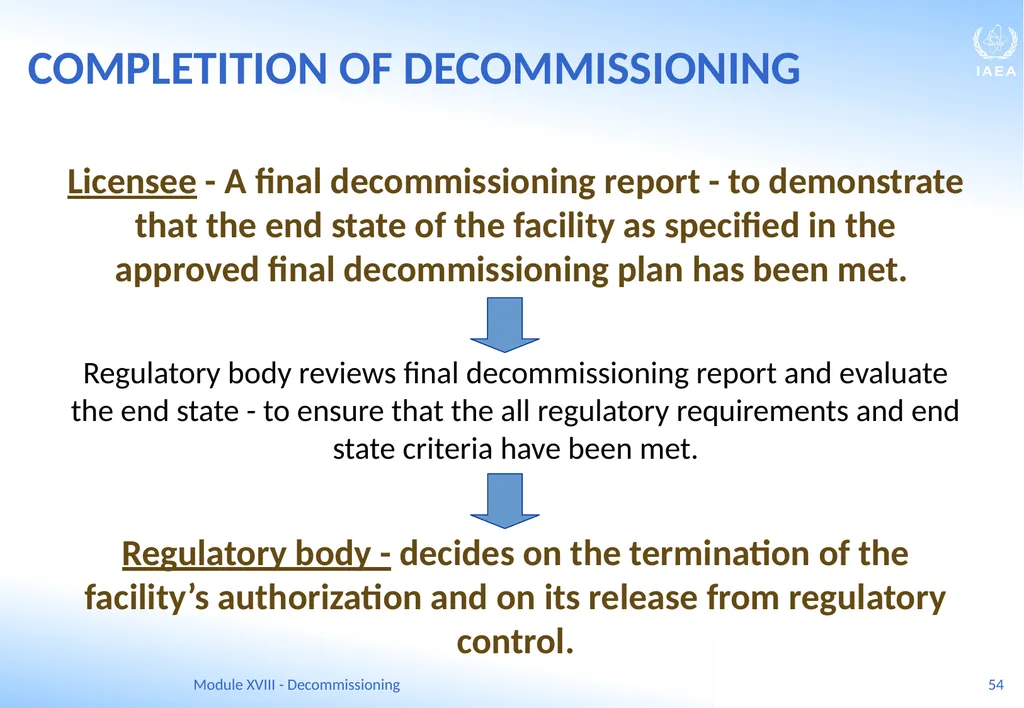
Module XVIII - Decommissioning COMPLETITION OF DECOMMISSIONING Licensee - A final decommissioning report - to demonstrate that the end state of the facility as specified in the approved final decommissioning plan has been met.
Regulatory body reviews final decommissioning report and evaluate the end state - to ensure that the all regulatory requirements and end state criteria have been met.
Regulatory body - decides on the termination of the facility’s authorization and on its release from regulatory control.<br>
Regulatory body reviews final decommissioning report and evaluate the end state - to ensure that the all regulatory requirements and end state criteria have been met.
Regulatory body - decides on the termination of the facility’s authorization and on its release from regulatory control.<br>
55
Module XVIII - Decommissioning COMPLETITION OF DECOMMISSIONING Approved end state is termination of decommissioning authorization with restrictions on future use of the remaining structures;
Controls and programmes for monitoring and surveillance should be maintained to ensure optimization of protection and safety.
Separate authorization should be issued:
When radioactive waste is stored on the site and
For partial release of the site.<br>
Controls and programmes for monitoring and surveillance should be maintained to ensure optimization of protection and safety.
Separate authorization should be issued:
When radioactive waste is stored on the site and
For partial release of the site.<br>
56
Module XVIII - Decommissioning MANAGEMENT - Learning objectives Describe staffing and training for decommissioning.
Describe the organization and administrative control of decommissioning.
Describe the integrated management system for decommissioning.<br>
Describe the organization and administrative control of decommissioning.
Describe the integrated management system for decommissioning.<br>
57
Module XVIII - Decommissioning MANAGEMENT Prime responsibility for safety remains with the licensee.
Individuals made responsible for performing decommissioning actions;
Need to have the necessary skills, expertise and training to perform decommissioning safely;
Have the responsibility to inform the decommissioning management of any concerns about safety.
Decommissioning must be controlled through the use of written procedures.<br>
Individuals made responsible for performing decommissioning actions;
Need to have the necessary skills, expertise and training to perform decommissioning safely;
Have the responsibility to inform the decommissioning management of any concerns about safety.
Decommissioning must be controlled through the use of written procedures.<br>
58
Module XVIII - Decommissioning Staffing and training The operating organization should have competent staff and specialized expertise (where needed).
Contractors may be used to carry out all or some aspects of decommissioning – appropriate level of control, supervision and training need to be provided to ensure safety.
Persons involved in decommissioning activities:
Are familiar with facility and safety procedures,
Have specialized trainings,
Use of mock-up and models in training.<br>
Contractors may be used to carry out all or some aspects of decommissioning – appropriate level of control, supervision and training need to be provided to ensure safety.
Persons involved in decommissioning activities:
Are familiar with facility and safety procedures,
Have specialized trainings,
Use of mock-up and models in training.<br>
59
Module XVIII - Decommissioning Organization and administrative control Organizational structure – clear delineation of authorities and responsibilities among various units.
Operational administrative measures may be relevant during decommissioning;
Reviewed and modified to be appropriate to the decommissioning;
Administrative control measures must be endorsed by the regulatory body.
Decommissioning specialist and appropriate site personnel manage the decommissioning plan;
New competence may be required;
Retention of key personnel, familiar with installation during its operation.<br>
Operational administrative measures may be relevant during decommissioning;
Reviewed and modified to be appropriate to the decommissioning;
Administrative control measures must be endorsed by the regulatory body.
Decommissioning specialist and appropriate site personnel manage the decommissioning plan;
New competence may be required;
Retention of key personnel, familiar with installation during its operation.<br>
60
Module XVIII - Decommissioning Integrated management system Should be applied throughout the entire process of decommissioning until the final decision is made on compliance with the release criteria.
The aim is to ensure integration of all aspect of managing facility and decommissioning activities.
System for archiving, retrieving and amending records should be maintained to document the decommissioning activities.
This system should be commensurate with the size, complexity and hazard potential of the site to be released from regulatory control.<br>
The aim is to ensure integration of all aspect of managing facility and decommissioning activities.
System for archiving, retrieving and amending records should be maintained to document the decommissioning activities.
This system should be commensurate with the size, complexity and hazard potential of the site to be released from regulatory control.<br>
61
Module XVIII - Decommissioning Module XVIII - Decommissioning REFERENCES GSR Part 5 Predisposal Management of Radioactive Waste (2009)
GSR Part 6 Decommissioning of Facilities (2014)
SSG-47 Decommissioning of Nuclear Power Plants, Research Reactors and Other Nuclear Fuel Cycle Facilities (revision of WS-G-2.1 and 2.4);
Decommissioning of Medical, Industrial and Research Facilities, IAEA Safety Guide WS-G-2.2 (1999. Under revision).
Decommissioning strategies for facilities using radioactive material. Safety Reports Series No. 50, IAEA, Vienna (2007).
Standard Format and Content for Safety Related Decommissioning Documents, Safety Reports Series No. 45, IAEA, Vienna (2005).
Radiological characterization of shut down nuclear reactors for decommissioning purposes, Technical Reports Series No. 389, IAEA, Vienna (1998).
State-of-the-art Technology for Decontamination and Dismantling of Nuclear Facilities, Technical Reports Series No. 395, IAEA, Vienna (1999).
Innovative and Adaptive Technologies in Decommissioning Of Nuclear Facilities, IAEA-TECDOC-1602, IAEA, Vienna (2008).
Selection of Decommissioning Strategies: Issues and Factors, IAEA-TECDOC-1478, IAEA, Vienna (2005).<br>
GSR Part 6 Decommissioning of Facilities (2014)
SSG-47 Decommissioning of Nuclear Power Plants, Research Reactors and Other Nuclear Fuel Cycle Facilities (revision of WS-G-2.1 and 2.4);
Decommissioning of Medical, Industrial and Research Facilities, IAEA Safety Guide WS-G-2.2 (1999. Under revision).
Decommissioning strategies for facilities using radioactive material. Safety Reports Series No. 50, IAEA, Vienna (2007).
Standard Format and Content for Safety Related Decommissioning Documents, Safety Reports Series No. 45, IAEA, Vienna (2005).
Radiological characterization of shut down nuclear reactors for decommissioning purposes, Technical Reports Series No. 389, IAEA, Vienna (1998).
State-of-the-art Technology for Decontamination and Dismantling of Nuclear Facilities, Technical Reports Series No. 395, IAEA, Vienna (1999).
Innovative and Adaptive Technologies in Decommissioning Of Nuclear Facilities, IAEA-TECDOC-1602, IAEA, Vienna (2008).
Selection of Decommissioning Strategies: Issues and Factors, IAEA-TECDOC-1478, IAEA, Vienna (2005).<br>
62
Module XVIII - Decommissioning Module XVIII - Decommissioning 62 Summary The following issues were discussed
Content of decommissioning actions
Responsibility for decommissioning
Safety aspects of decommissioning.
Strategies for decommissioning.
IAEA standards on decommissioning.<br>
Content of decommissioning actions
Responsibility for decommissioning
Safety aspects of decommissioning.
Strategies for decommissioning.
IAEA standards on decommissioning.<br>
63
Module XVIII - Decommissioning Module XVIII - Decommissioning 63 Decommission as a part of a life cycle should be considered at feasibility study stage.
A decommissioning strategy and draft plan should be developed at the constriction stage
Availability of resources for decommissioning should be concerned with regard the long term of the process 63 Key points<br>
A decommissioning strategy and draft plan should be developed at the constriction stage
Availability of resources for decommissioning should be concerned with regard the long term of the process 63 Key points<br>
64
Thank you!<br>