Moisture Assessment WEATHERIZATION ENERGY AUDITOR SINGLE FAMILY WEATHERIZATION ASSISTANCE PROGRAM STANDARDIZED CURRICULUM December 2012 By attending this session, participants will be able to: Analyze the symptoms of moisture problems in
"Moisture Assessment WEATHERIZATION ENERGY AUDITOR" is the property of its rightful owner. Permission is granted to
download and print the materials on this website for personal, non-commercial use only, and to display it
on your personal computer provided you do not modify the materials and that you retain all copyright
notices contained in the materials. By downloading content from our website, you accept the terms of this
agreement.
Presentation Transcript
01
Moisture Assessment WEATHERIZATION ENERGY AUDITOR SINGLE FAMILY WEATHERIZATION ASSISTANCE PROGRAM STANDARDIZED CURRICULUM – December 2012<br>
02
By attending this session, participants will be able to:
Analyze the symptoms of moisture problems in houses.
Identify moisture sources.
Explain moisture terms and concepts.
Demonstrate how to measure relative humidity.
Demonstrate how to use a psychrometric chart.
Apply moisture control strategies.
Use moisture assessment tools. Learning Objectives Moisture Assessment<br>
03
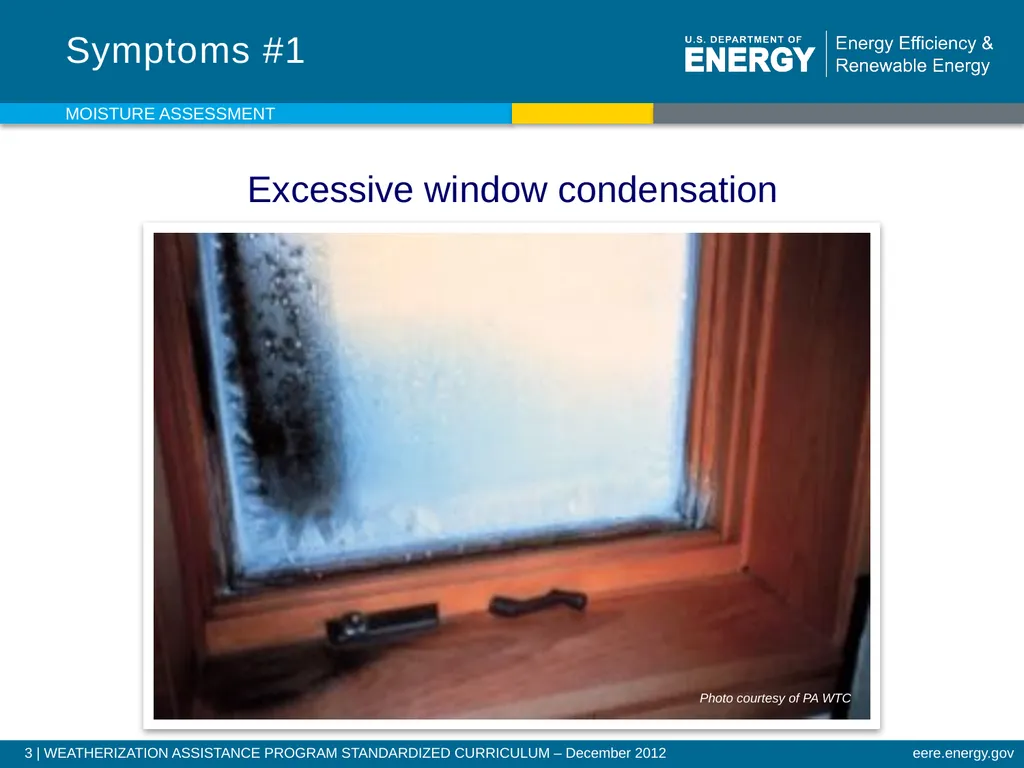
Symptoms #1 Excessive window condensation Photo courtesy of PA WTC Moisture Assessment<br>
04
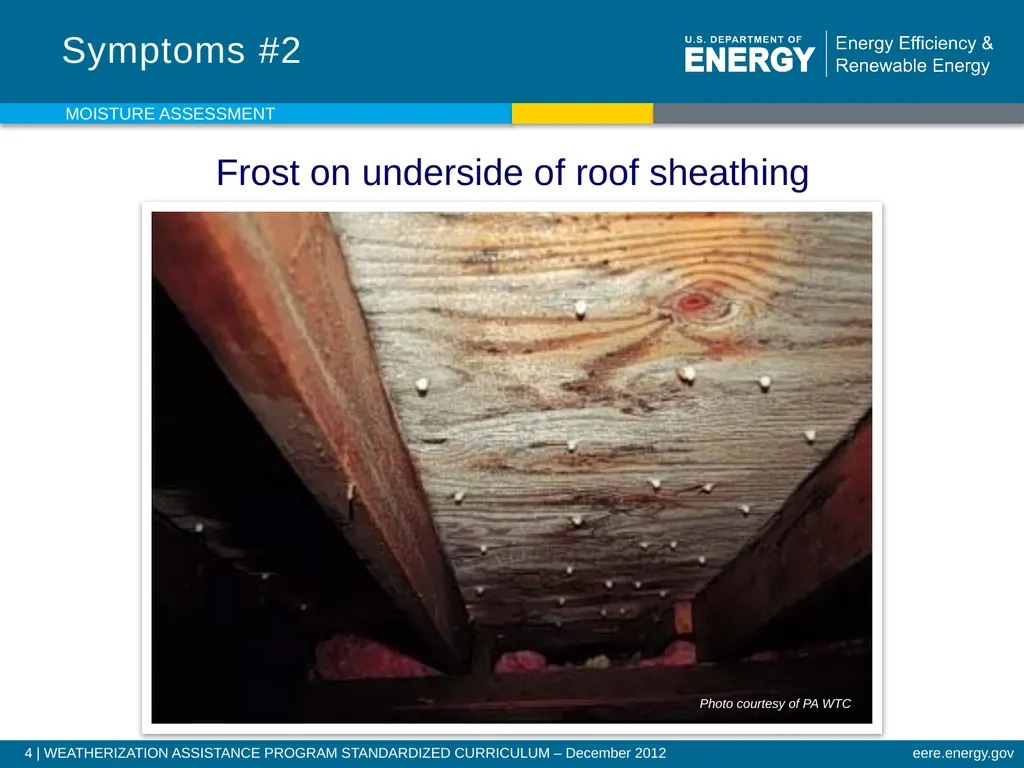
Symptoms #2 Frost on underside of roof sheathing Moisture Assessment Photo courtesy of PA WTC<br>
05
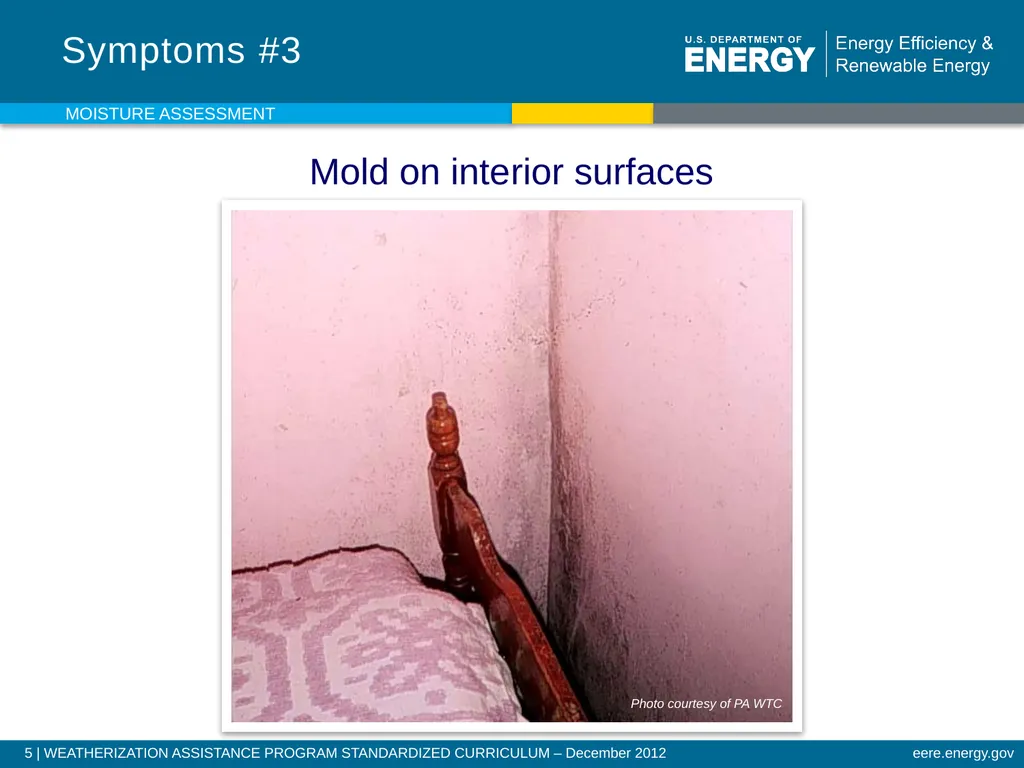
Symptoms #3 Mold on interior surfaces Photo source: PA WTC Photo Moisture Assessment Photo courtesy of PA WTC<br>
06
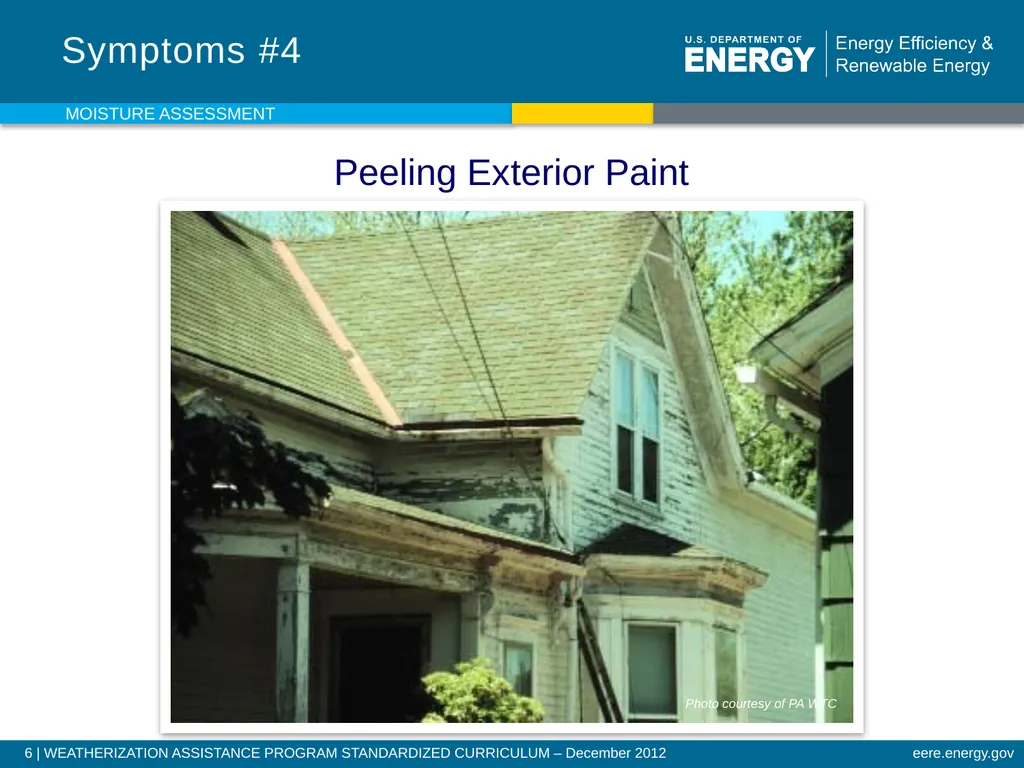
Symptoms #4 Peeling Exterior Paint Moisture Assessment Photo courtesy of PA WTC<br>
07
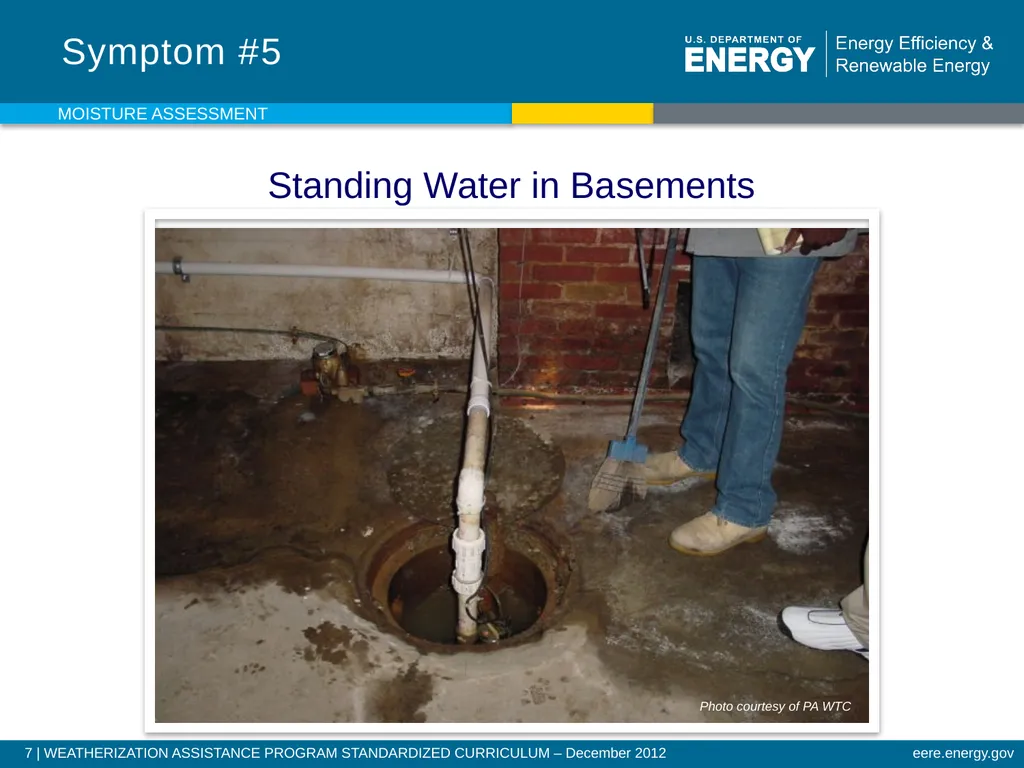
Standing Water in Basements Moisture Assessment Photo courtesy of PA WTC Symptom #5<br>
08
Foundations
Unvented space heaters
Unvented dryers
Disconnected ventilation fans
Drying wood indoors
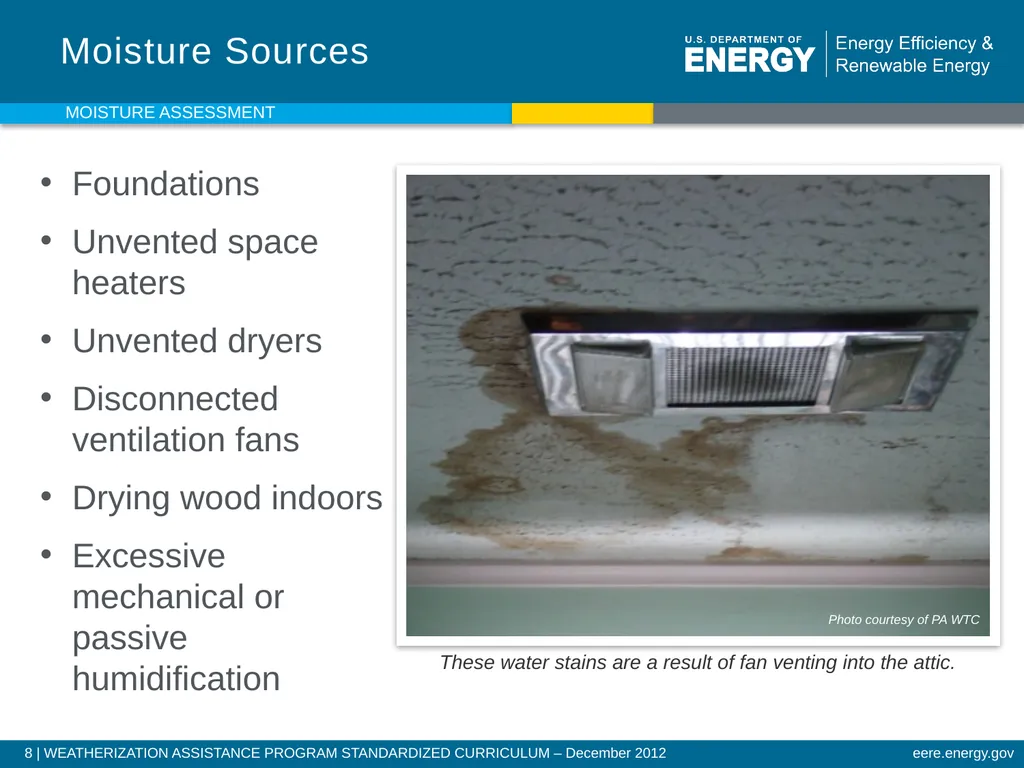
Excessive mechanical or passive humidification Moisture Sources These water stains are a result of fan venting into the attic. Moisture Assessment Photo courtesy of PA WTC<br>
09
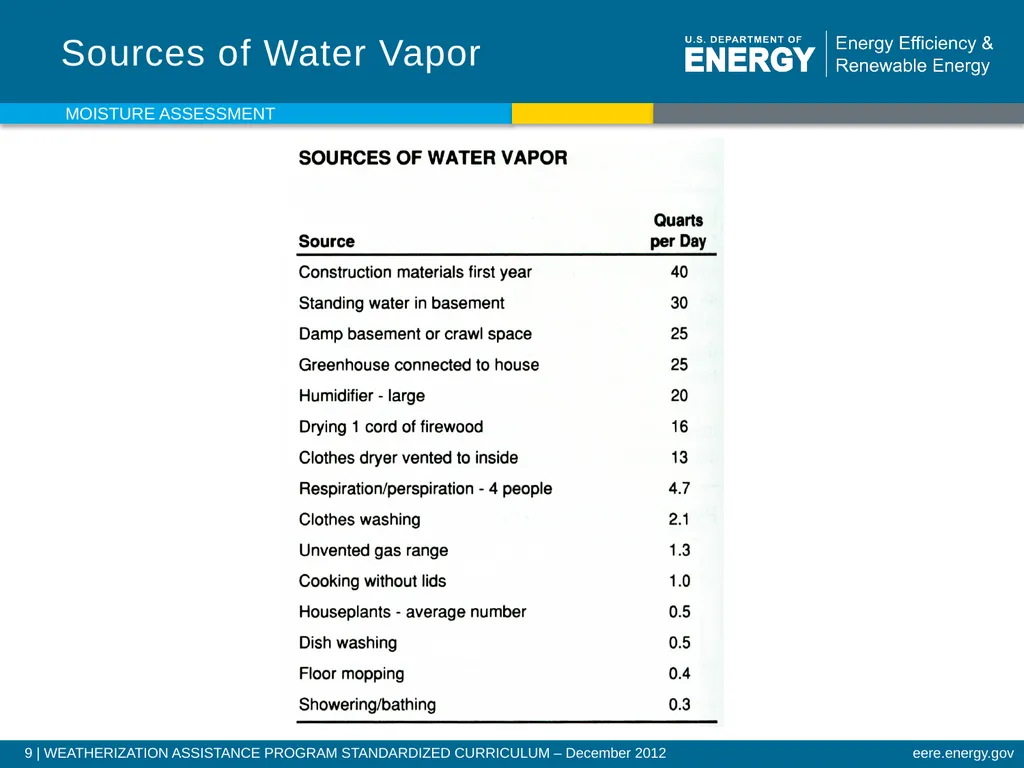
Sources of Water Vapor Moisture Assessment<br>
10
Condensation: water vapor transformed to liquid water
Evaporation: liquid water transformed to water vapor
Absolute humidity (vapor pressure): the ratio of water vapor to a given volume of air
Relative humidity (RH): the ratio of the amount of moisture in the air compared to amount of moisture that the air can hold
Dew point: the temperature at which condensation occurs Important Terms and Concepts Moisture Assessment<br>
11
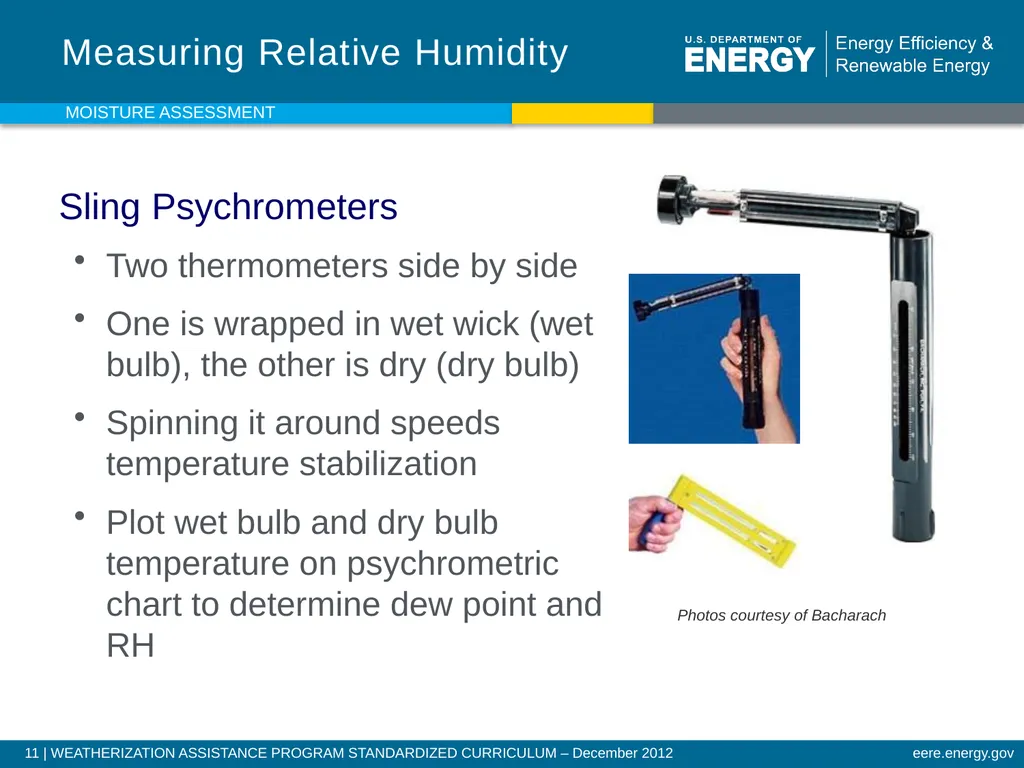
Measuring Relative Humidity Sling Psychrometers
Two thermometers side by side
One is wrapped in wet wick (wet bulb), the other is dry (dry bulb)
Spinning it around speeds temperature stabilization
Plot wet bulb and dry bulb temperature on psychrometric chart to determine dew point and RH Photos courtesy of Bacharach Moisture Assessment<br>
12
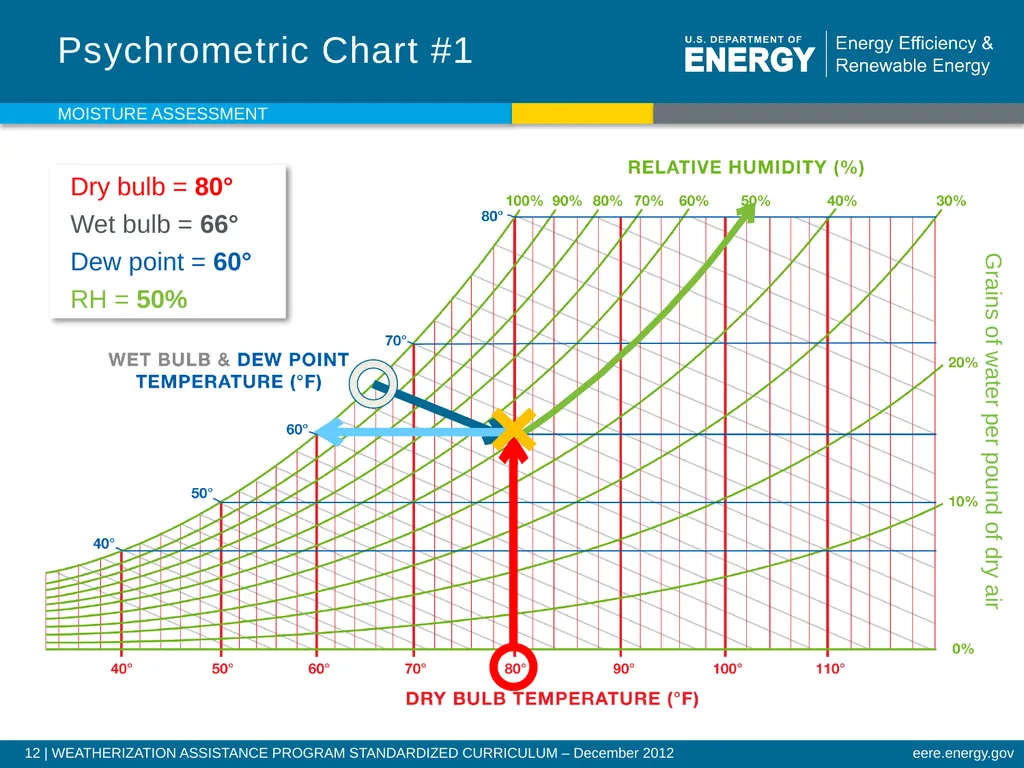
Dry bulb = 80°
Wet bulb = 66°
Dew point = 60°
RH = 50% Grains of water per pound of dry air Moisture Assessment Psychrometric Chart #1<br>
13
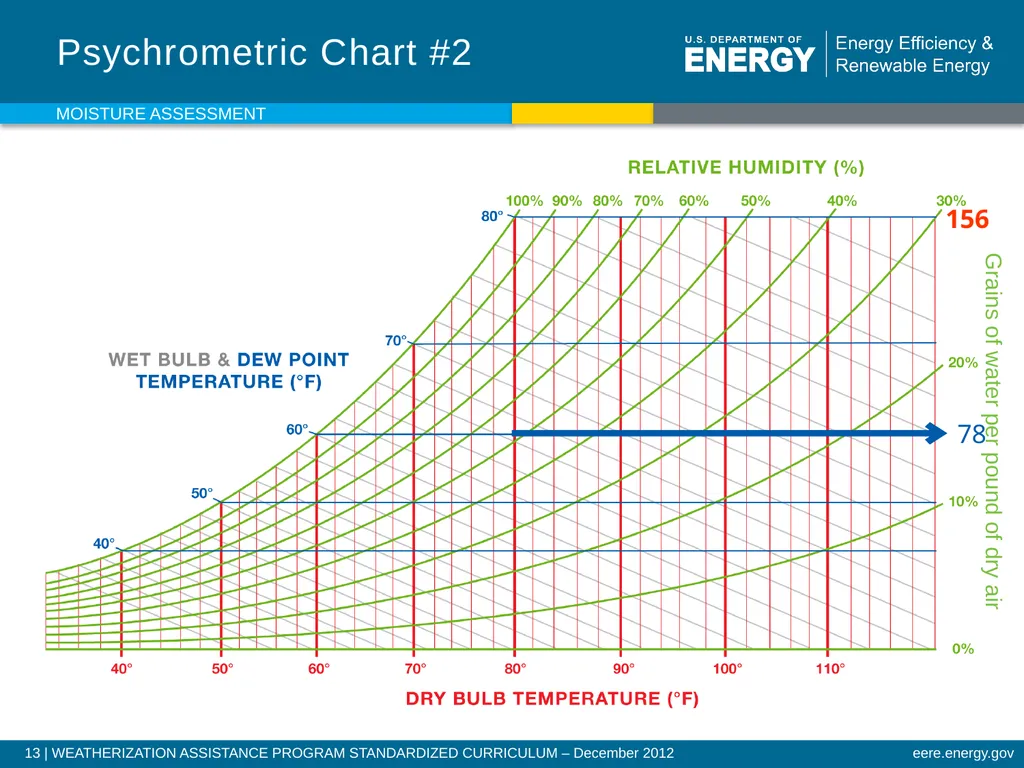
156 Psychrometric Chart #2 78 Grains of water per pound of dry air Moisture Assessment<br>
14
Grains of water per pound of dry air Moisture Assessment Psychrometric Chart #3<br>
15
Grains of water per pound of dry air Moisture Assessment Psychrometric Chart #4<br>
16
Grains of water per pound of dry air Moisture Assessment Psychrometric Chart #5<br>
17
Warm, wet air contacting cold surfaces creates condensation instantly.
Cold winter air typically contains very little moisture and therefore has a low RH. When that air is heated, the RH drops even lower.
RH below 15% can lead to respiratory problems, failure of furniture glue and other problems. RH: Things to Remember Moisture Assessment<br>
18
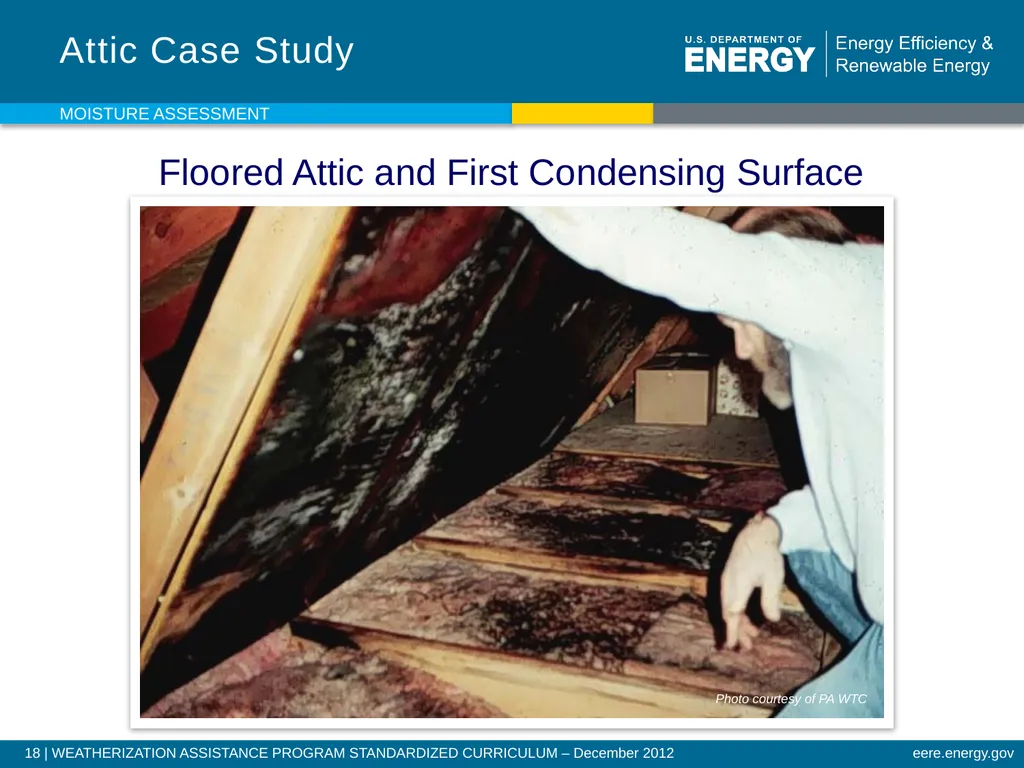
Attic Case Study Floored Attic and First Condensing Surface Moisture Assessment Photo courtesy of PA WTC<br>
19
Possible Causes
Moderate to high interior moisture source
Attic surface temps are below the dew point of the indoor air
Air leaks to attic
Control Strategies
Source control
Air seal the attic Attic Case – Causes & Solutions Moisture Assessment<br>
20
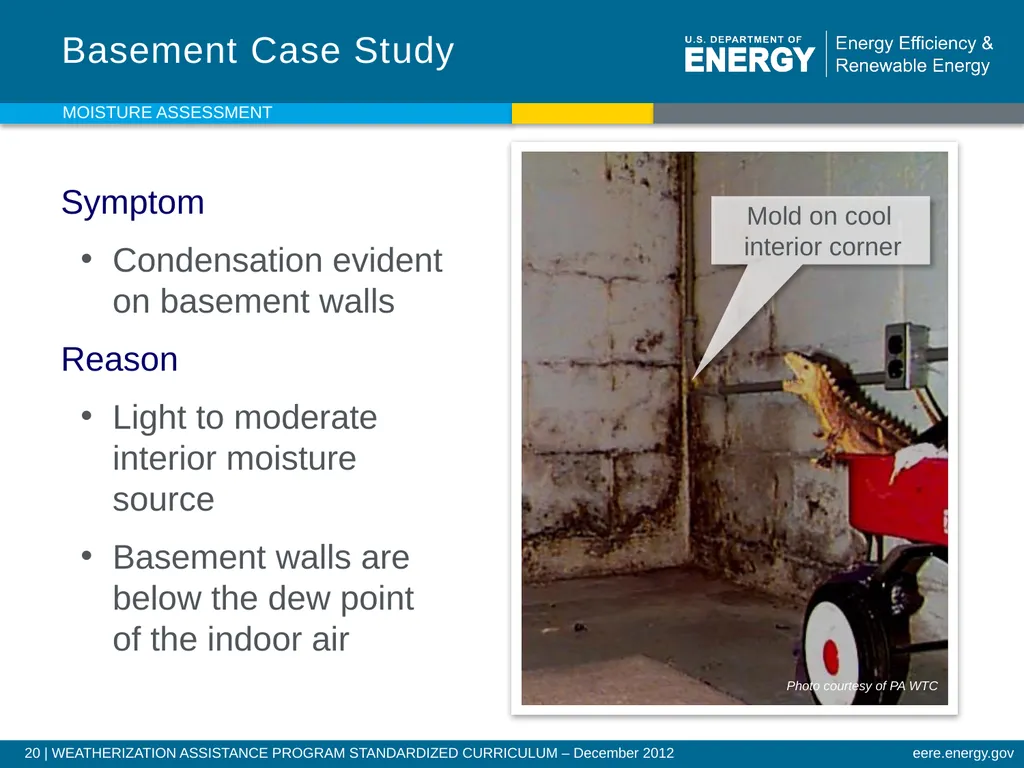
Basement Case Study Mold on cool interior corner Symptom
Condensation evident on basement walls
Reason
Light to moderate interior moisture source
Basement walls are below the dew point of the indoor air Moisture Assessment Photo courtesy of PA WTC<br>
21
Control moisture sources.
Remove susceptible materials.
Educate occupants to:
Mechanically dehumidify.
Increase air flow in basement (fans).
Close basement openings during hot humid periods. Basement Case Study Solutions Moisture Assessment<br>
22
Symptoms
Wet wood
Condensation on foundation surfaces
Possible Reasons
High ground moisture source
Warm humid air entering vents from outside
Crawl space surfaces are below the dew point of the outside air Crawl Space Case Study Water droplets of condensation on AC ducts. Moisture Assessment Photo courtesy of PA WTC<br>
23
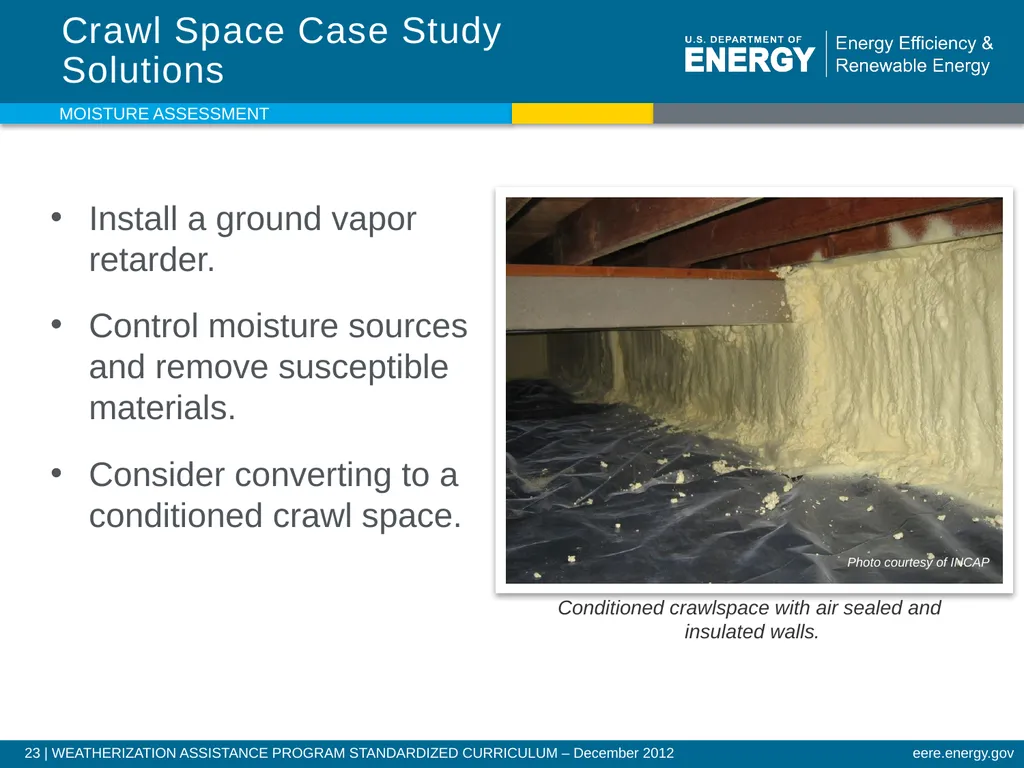
Install a ground vapor retarder.
Control moisture sources and remove susceptible materials.
Consider converting to a conditioned crawl space. Crawl Space Case Study Solutions Conditioned crawlspace with air sealed and insulated walls. Moisture Assessment Photo courtesy of INCAP<br>
24
Clear understanding of moisture management principles.
Senses - Visual inspection
Evidence of condensation
Evidence of mold
Communication Skills
Know what questions to ask
Documentation is vital
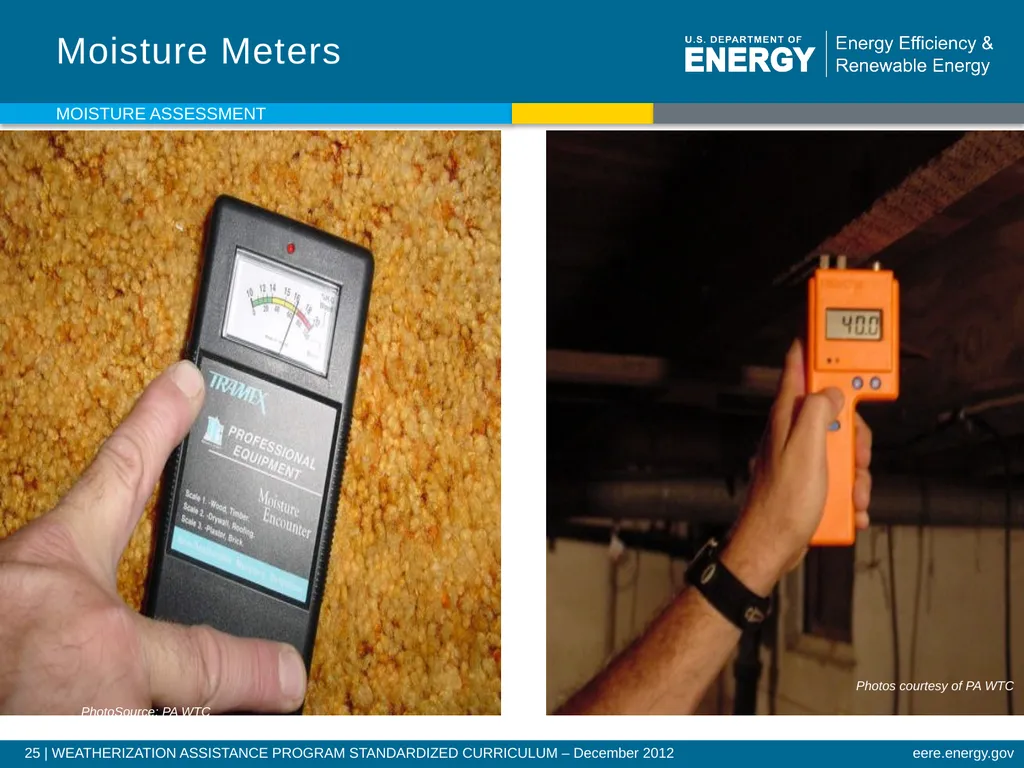
Wood Moisture Meter
To make quantitative assessments on wood moisture content
Psychrometer
To determine real time RH levels
Digital Camera Tools of the Trade Moisture Assessment<br>
25
PhotoSource: PA WTC Moisture Assessment Moisture Meters Photos courtesy of PA WTC<br>
26
The first step in doing a moisture assessment is to look for visible signs of moisture and moisture sources in the house.
Plotting the wet bulb and dry bulb temperatures on a psychrometric chart gives dew point and relative humidity.
Understanding the effects of temperature and vapor pressure on RH can help identify solutions.
Source control, air sealing, ventilation, and thermal improvements are important moisture mitigation strategies.
Photos and diagnostic equipment help document existing conditions. Summary Moisture Assessment<br>