Moles and Solutions - Concentrations Learning Objectives: Calculate the amount of substance in moles, using solution volume and concentration Describe a solutions concentration using the terms concentrated and dilute. Key Words: Solution,
"Moles and Solutions - Concentrations Learning" is the property of its rightful owner. Permission is granted to
download and print the materials on this website for personal, non-commercial use only, and to display it
on your personal computer provided you do not modify the materials and that you retain all copyright
notices contained in the materials. By downloading content from our website, you accept the terms of this
agreement.
Presentation Transcript
01
Moles and Solutions -
Concentrations Learning Objectives:
Calculate the amount of substance in moles, using solution volume and concentration
Describe a solution’s concentration using the terms concentrated and dilute.
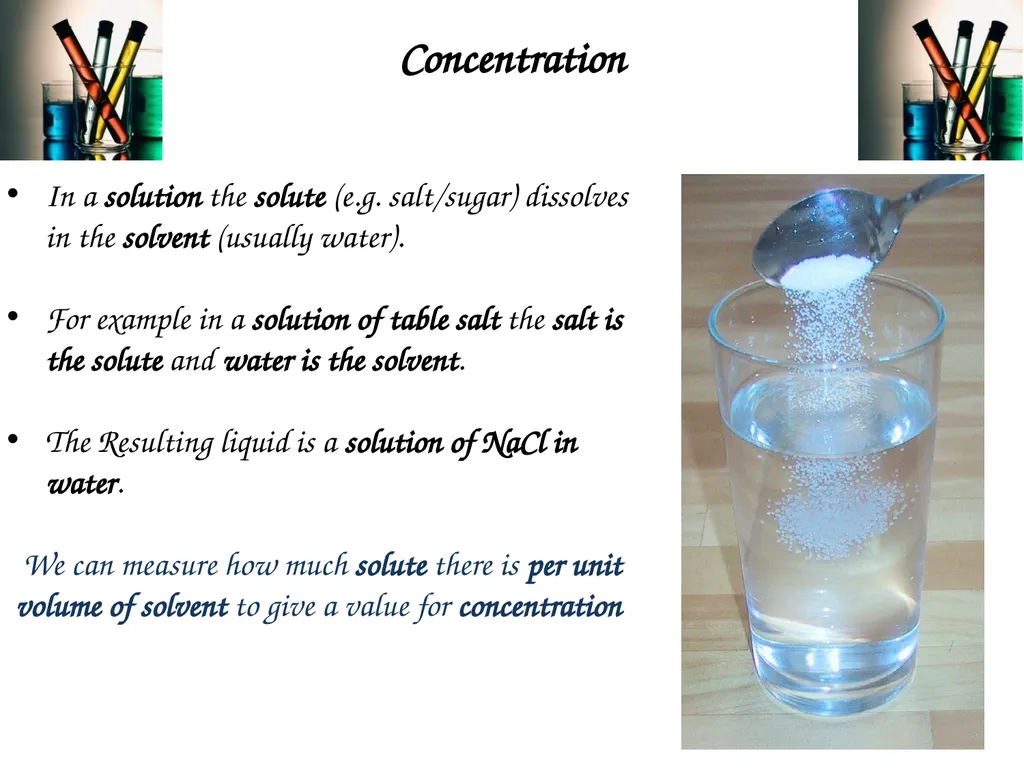
Concentration In a solution the solute (e.g. salt/sugar) dissolves in the solvent (usually water).
For example in a solution of table salt the salt is the solute and water is the solvent.
The Resulting liquid is a solution of NaCl in water.
We can measure how much solute there is per unit volume of solvent to give a value for concentration<br>
03
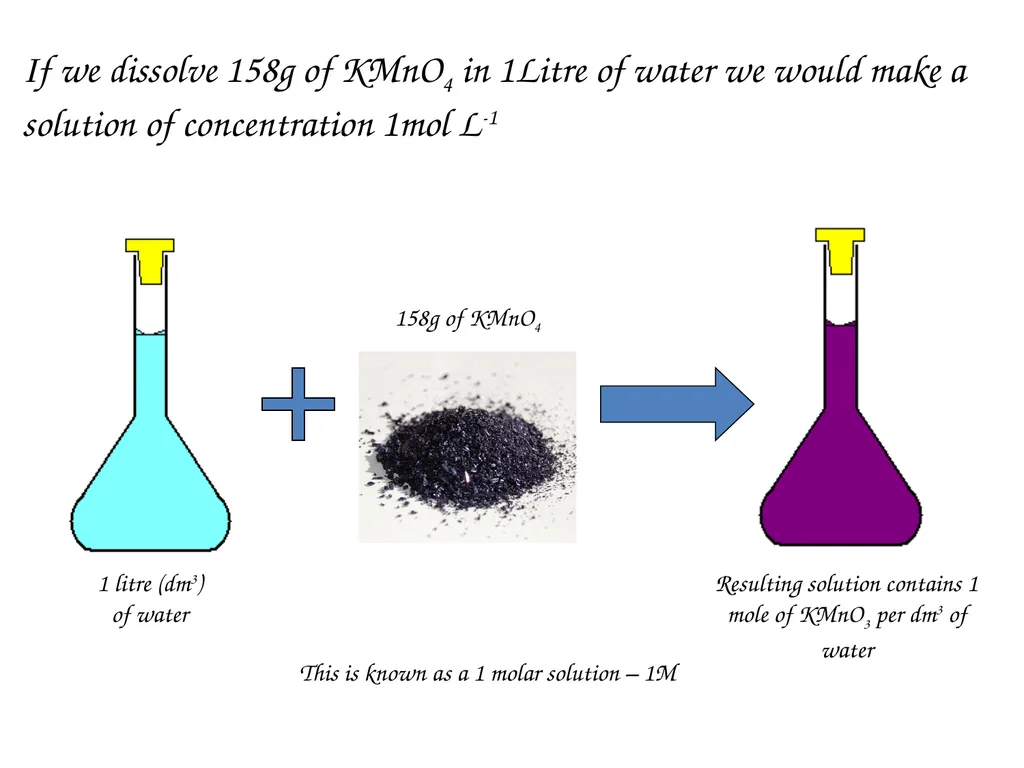
If we dissolve 158g of KMnO4 in 1Litre of water we would make a solution of concentration 1mol L-1 158g of KMnO4 1 litre (dm3)
of water Resulting solution contains 1 mole of KMnO3 per dm3 of water This is known as a 1 molar solution – 1M<br>
04
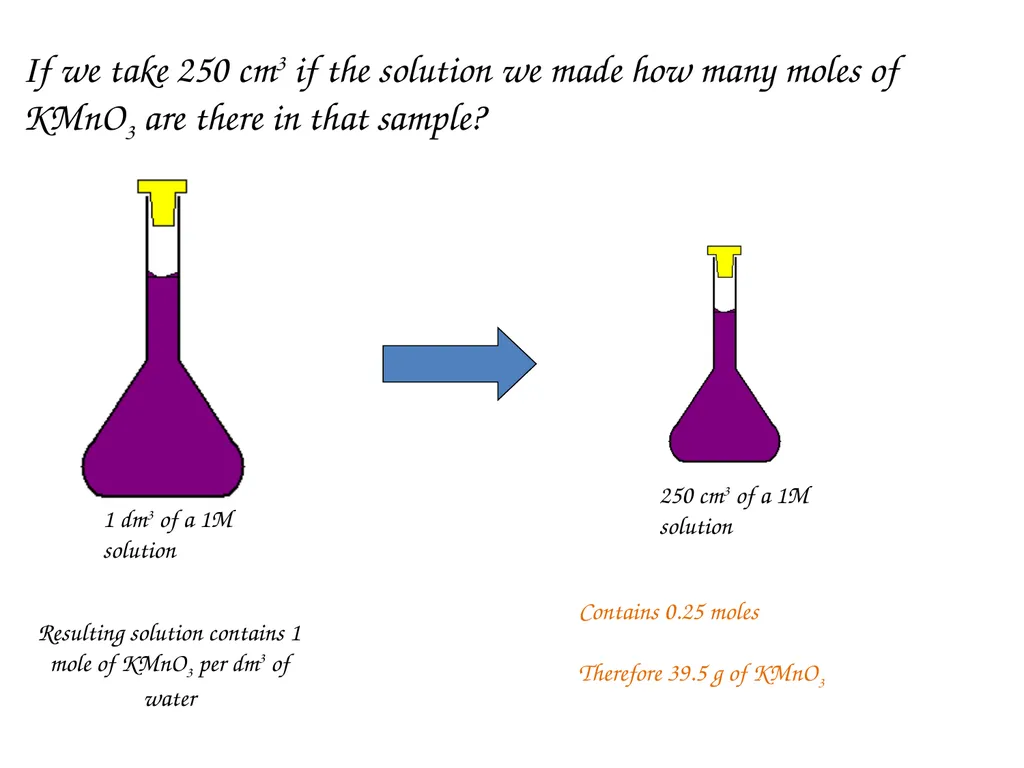
If we take 250 cm3 if the solution we made how many moles of KMnO3 are there in that sample? Resulting solution contains 1 mole of KMnO3 per dm3 of water 1 dm3 of a 1M solution 250 cm3 of a 1M solution Contains 0.25 moles
Therefore 39.5 g of KMnO3<br>
05
How to Calculate
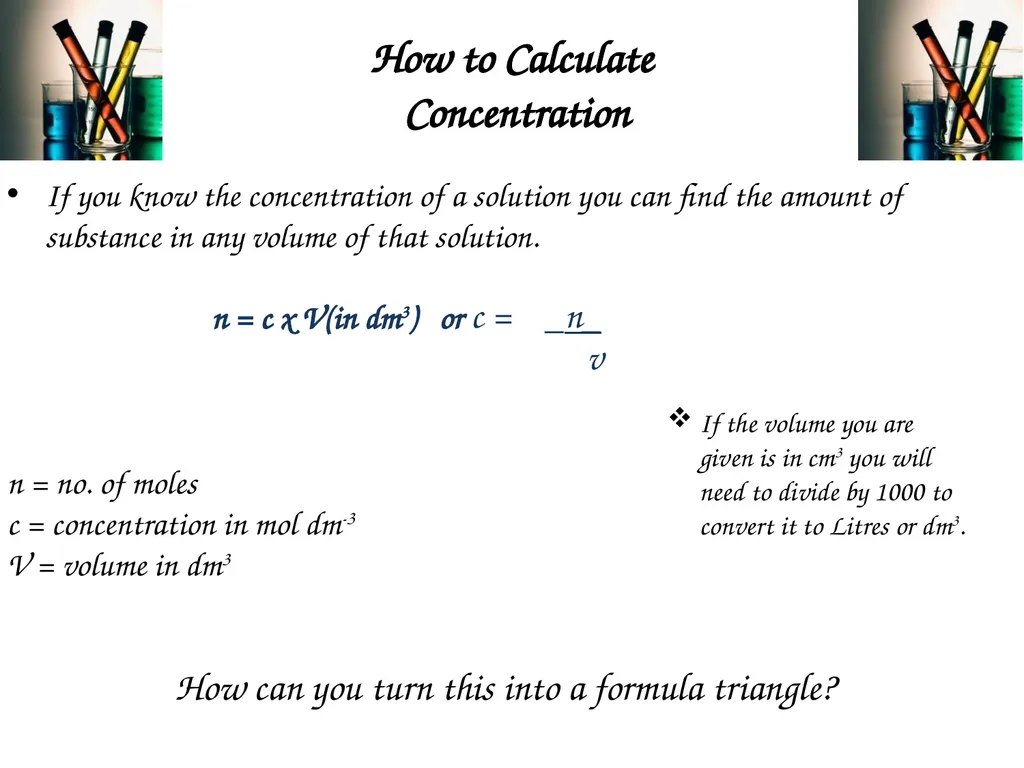
Concentration If you know the concentration of a solution you can find the amount of substance in any volume of that solution.
n = c x V(in dm3) or c = _n_
v
n = no. of moles
c = concentration in mol dm-3
V = volume in dm3 How can you turn this into a formula triangle? If the volume you are given is in cm3 you will need to divide by 1000 to convert it to Litres or dm3.<br>
06
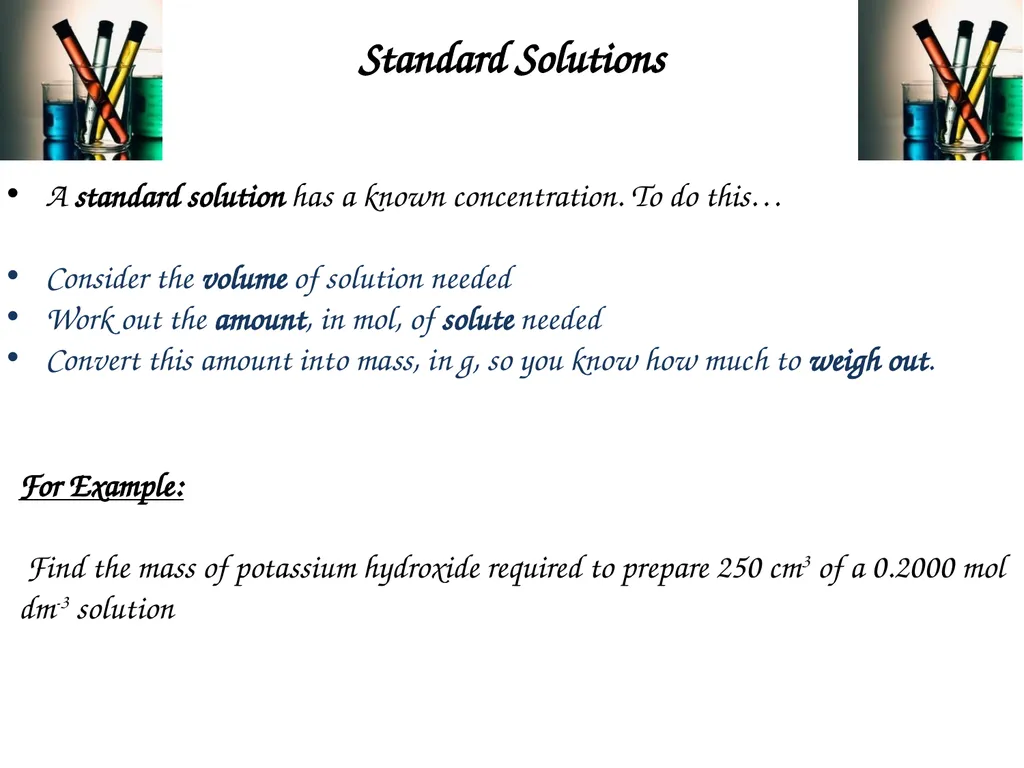
Standard Solutions A standard solution has a known concentration. To do this…
Consider the volume of solution needed
Work out the amount, in mol, of solute needed
Convert this amount into mass, in g, so you know how much to weigh out. For Example:
Find the mass of potassium hydroxide required to prepare 250 cm3 of a 0.2000 mol dm-3 solution<br>
07
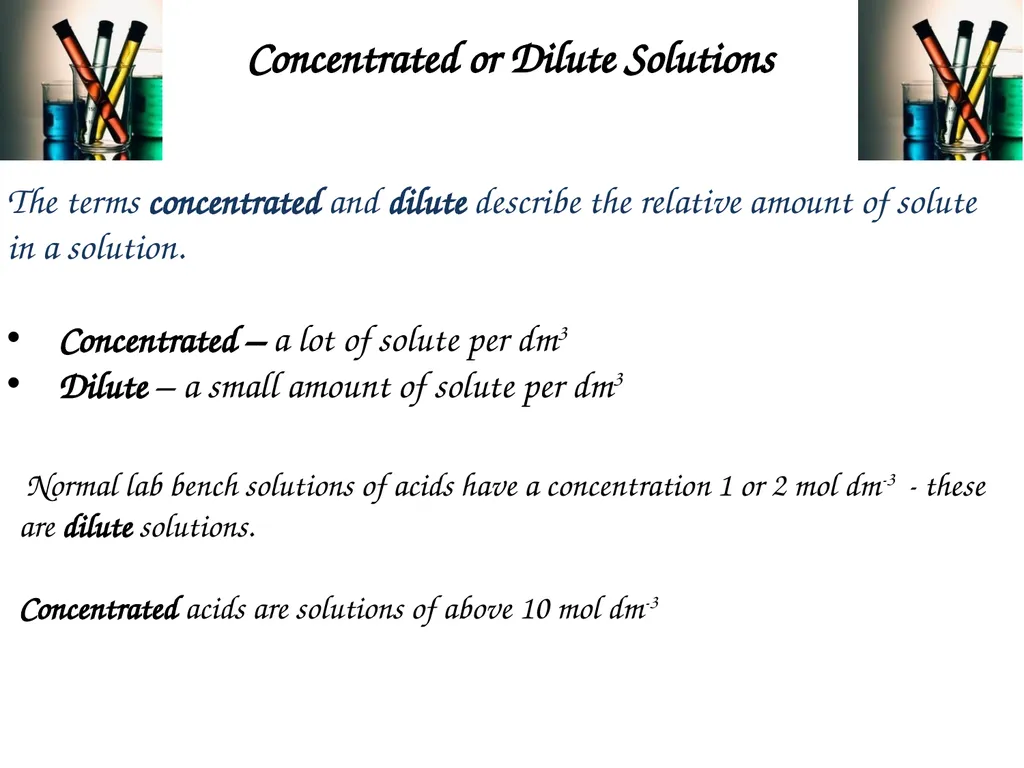
Concentrated or Dilute Solutions The terms concentrated and dilute describe the relative amount of solute in a solution.
Concentrated – a lot of solute per dm3
Dilute – a small amount of solute per dm3 Normal lab bench solutions of acids have a concentration 1 or 2 mol dm-3 - these are dilute solutions.
Concentrated acids are solutions of above 10 mol dm-3<br>
08
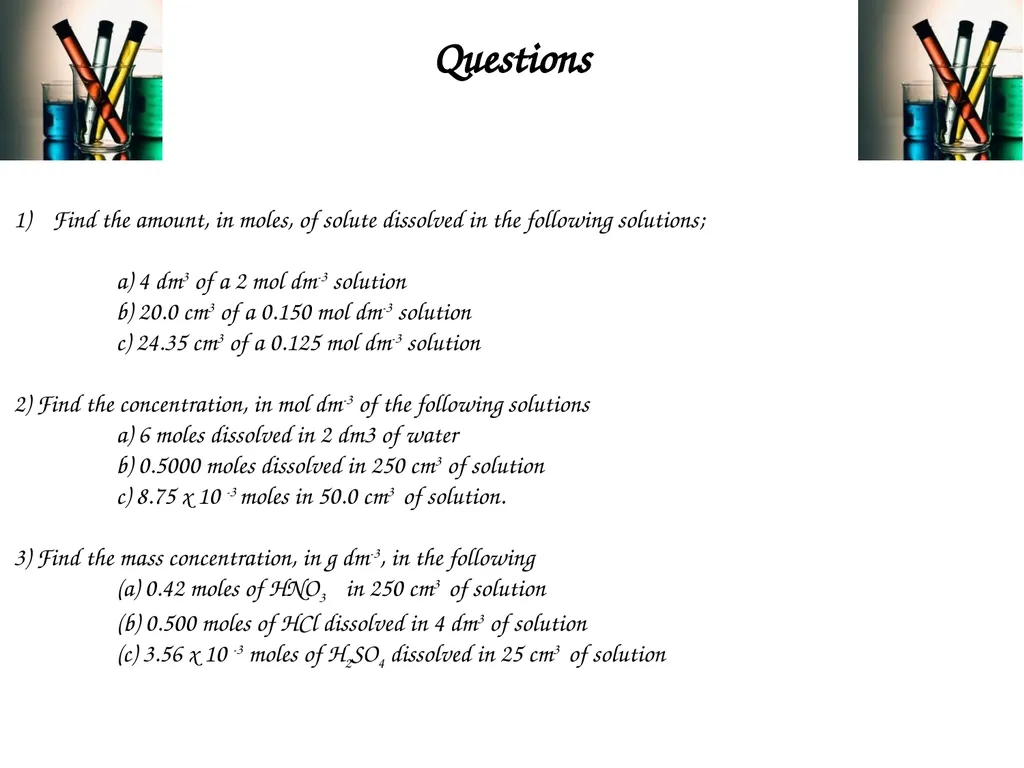
Questions Find the amount, in moles, of solute dissolved in the following solutions;
a) 4 dm3 of a 2 mol dm-3 solution
b) 20.0 cm3 of a 0.150 mol dm-3 solution
c) 24.35 cm3 of a 0.125 mol dm-3 solution
2) Find the concentration, in mol dm-3 of the following solutions
a) 6 moles dissolved in 2 dm3 of water
b) 0.5000 moles dissolved in 250 cm3 of solution
c) 8.75 x 10 -3 moles in 50.0 cm3 of solution.
3) Find the mass concentration, in g dm-3, in the following
(a) 0.42 moles of HNO3 in 250 cm3 of solution
(b) 0.500 moles of HCl dissolved in 4 dm3 of solution
(c) 3.56 x 10 -3 moles of H2SO4 dissolved in 25 cm3 of solution<br>