
Monetary Non-Neutrality in a Multi-Sector Menu

Description: Monetary Non-Neutrality in a Multi-Sector Menu Cost Model By Emi Nakamura Jón Steinsson Presenter---Ethan Zhang Representative agent model---price adjusts immediately, so money is neutral. The Dynamics of Monetary Economics NKPCPrice
Related Topics
Download Presentation
"Monetary Non-Neutrality in a Multi-Sector Menu" is the property of its rightful owner. Permission is granted to download and print the materials on this website for personal, non-commercial use only, and to display it on your personal computer provided you do not modify the materials and that you retain all copyright notices contained in the materials. By downloading content from our website, you accept the terms of this agreement.
Presentation Transcript
slide1. Monetary Non-Neutrality in a Multi-Sector Menu Cost Model By Emi Nakamura & Jón Steinsson
Presenter---Ethan Zhang<br>
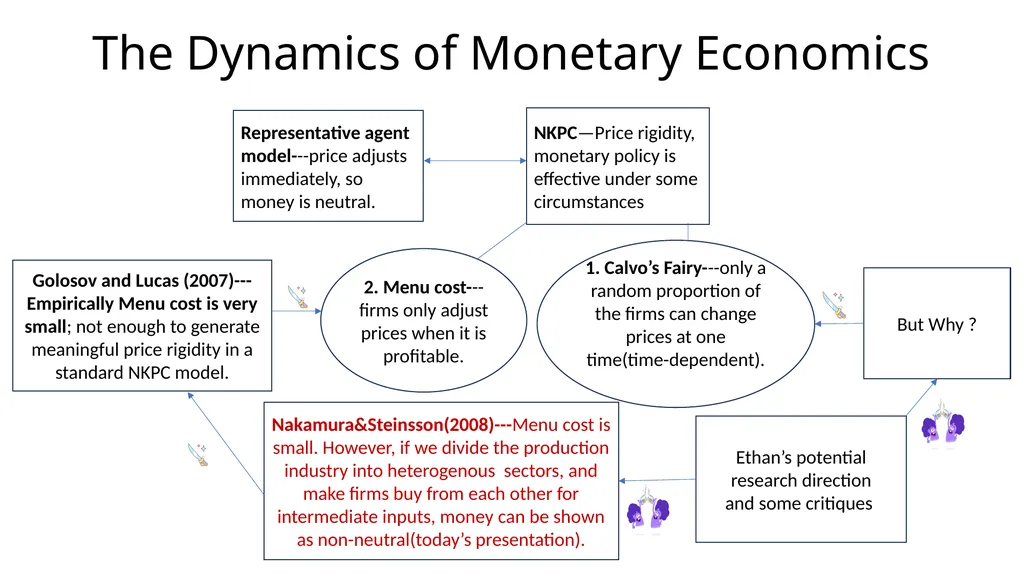
slide2. Representative agent model---price adjusts immediately, so money is neutral. The Dynamics of Monetary Economics NKPC—Price rigidity, monetary policy is effective under some circumstances 2. Menu cost---firms only adjust prices when it is profitable. 1. Calvo’s Fairy---only a random proportion of the firms can change prices at one time(time-dependent). Golosov and Lucas (2007)--- Empirically Menu cost is very small; not enough to generate meaningful price rigidity in a standard NKPC model. But Why ? Nakamura&Steinsson(2008)---Menu cost is small. However, if we divide the production industry into heterogenous sectors, and make firms buy from each other for intermediate inputs, money can be shown as non-neutral(today’s presentation). Ethan’s potential research direction
and some critiques<br>
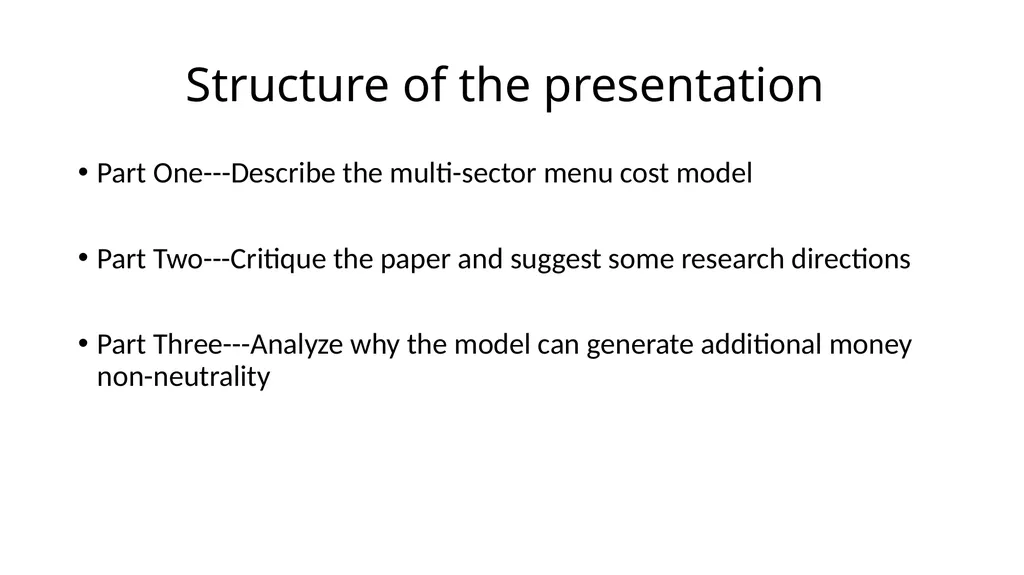
slide3. Structure of the presentation Part One---Describe the multi-sector menu cost model
Part Two---Critique the paper and suggest some research directions
Part Three---Analyze why the model can generate additional money non-neutrality<br>
slide4. Part One--- Multi-Sector Menu Cost Model<br>
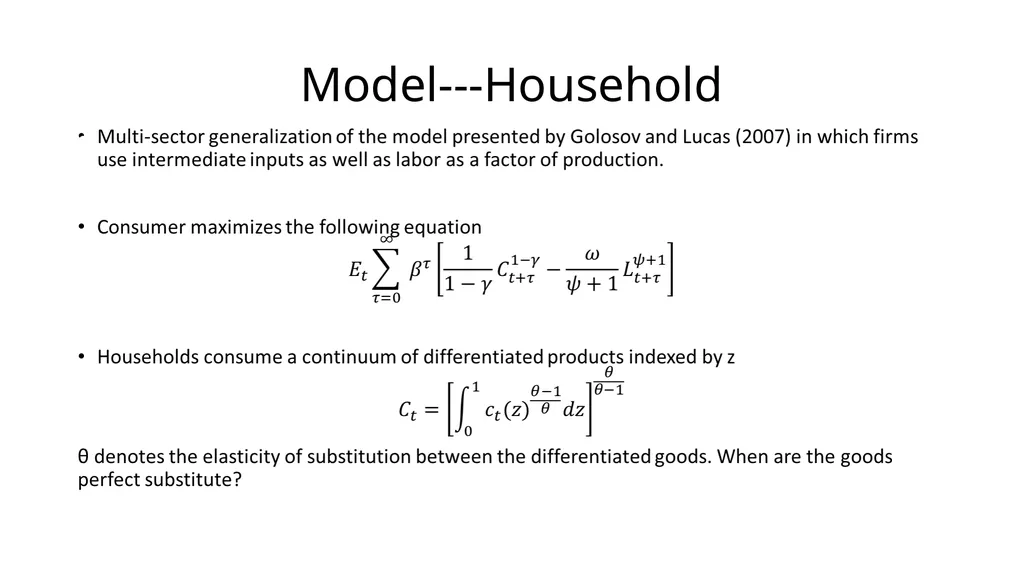
slide5. Model---Household<br>
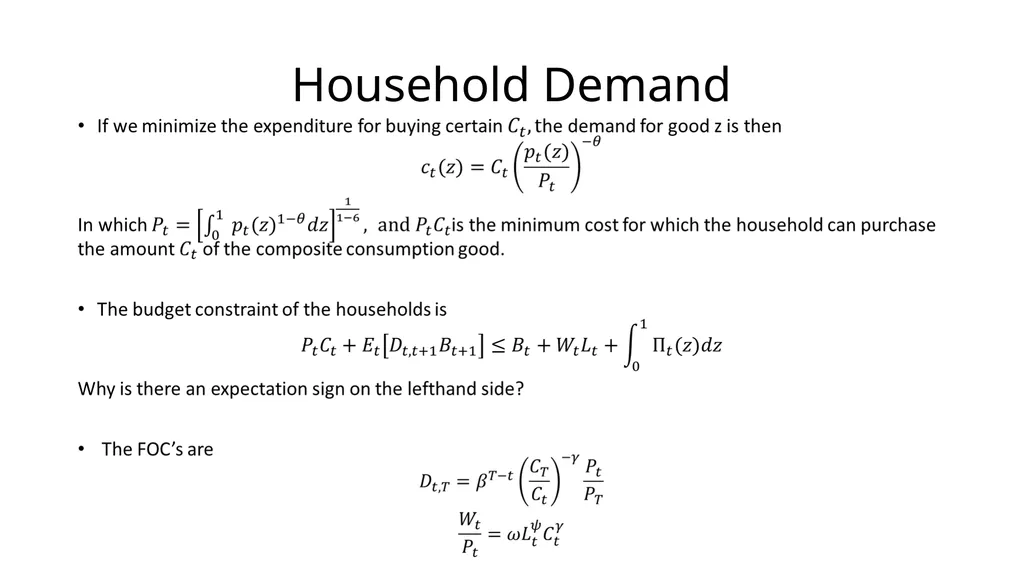
slide6. Household Demand<br>
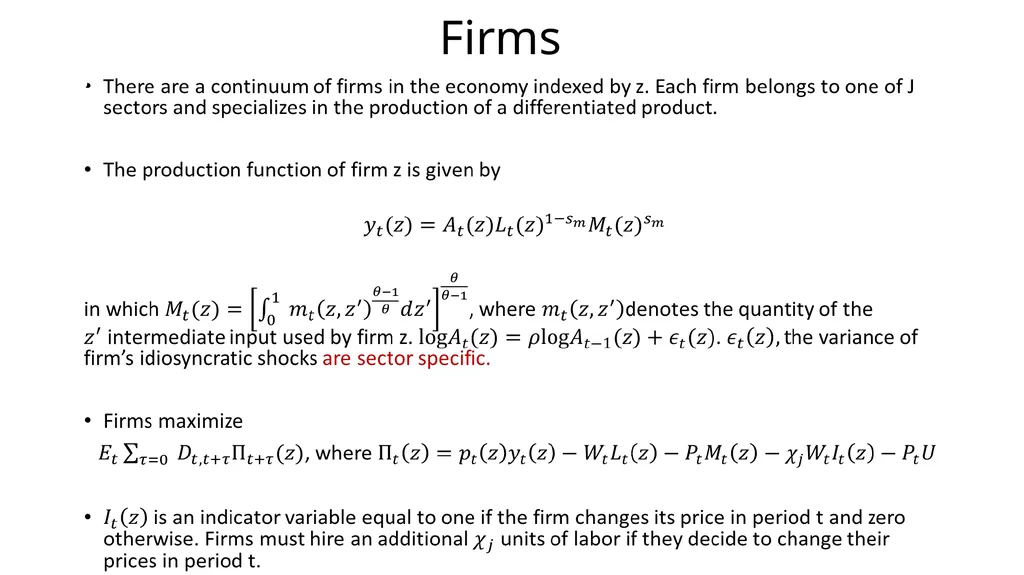
slide7. Firms<br>
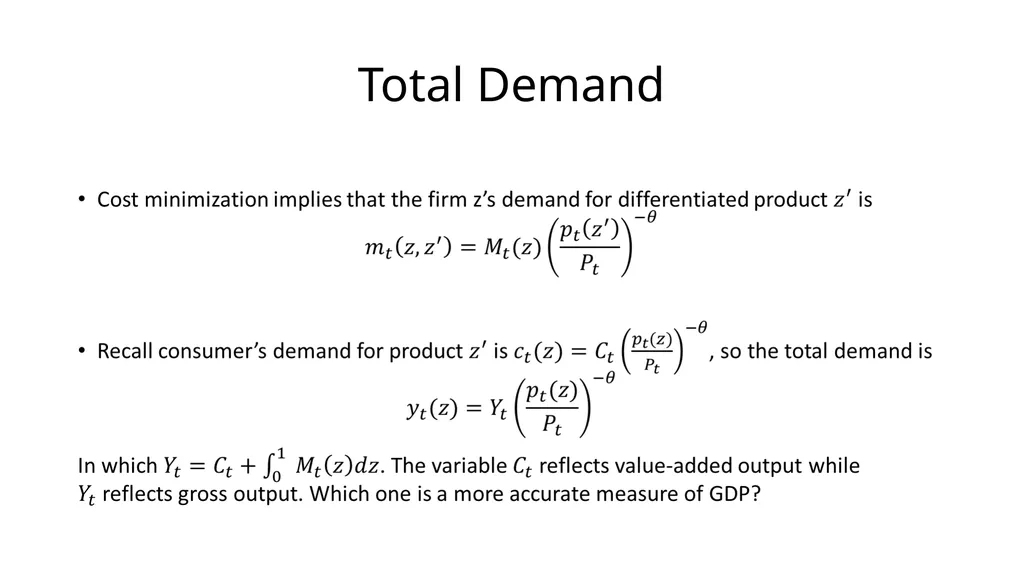
slide8. Total Demand<br>
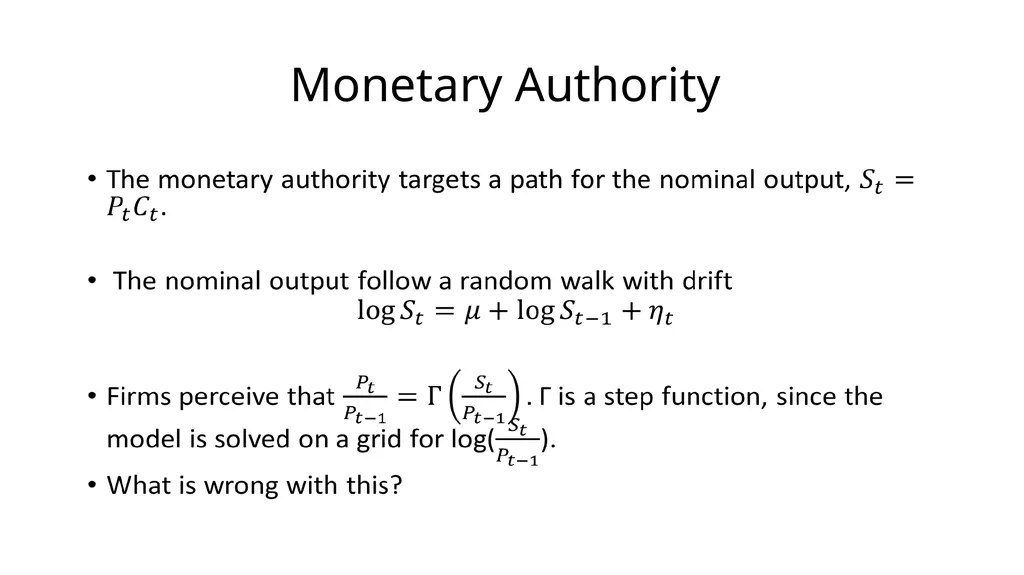
slide9. Monetary Authority<br>
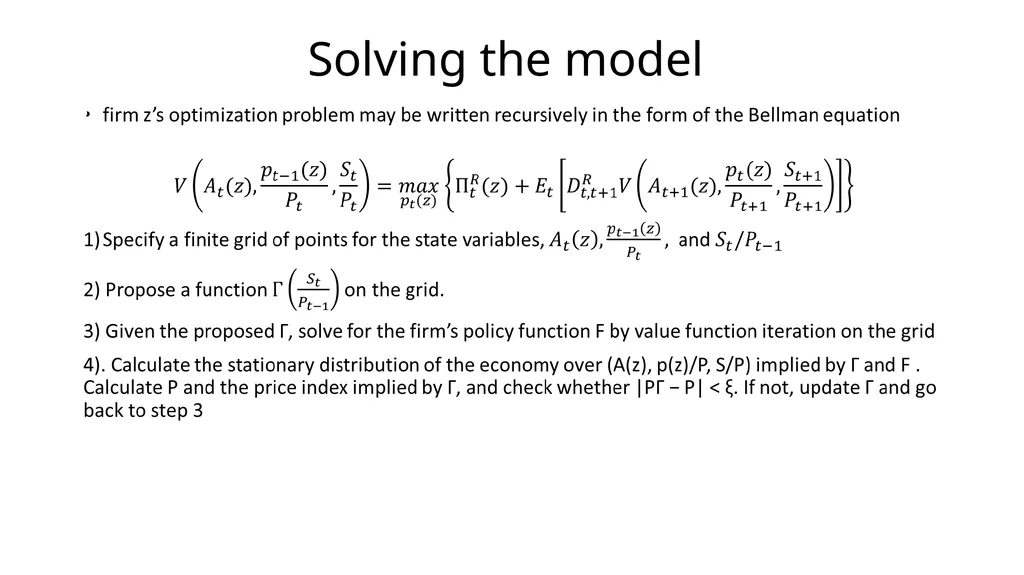
slide10. Solving the model<br>
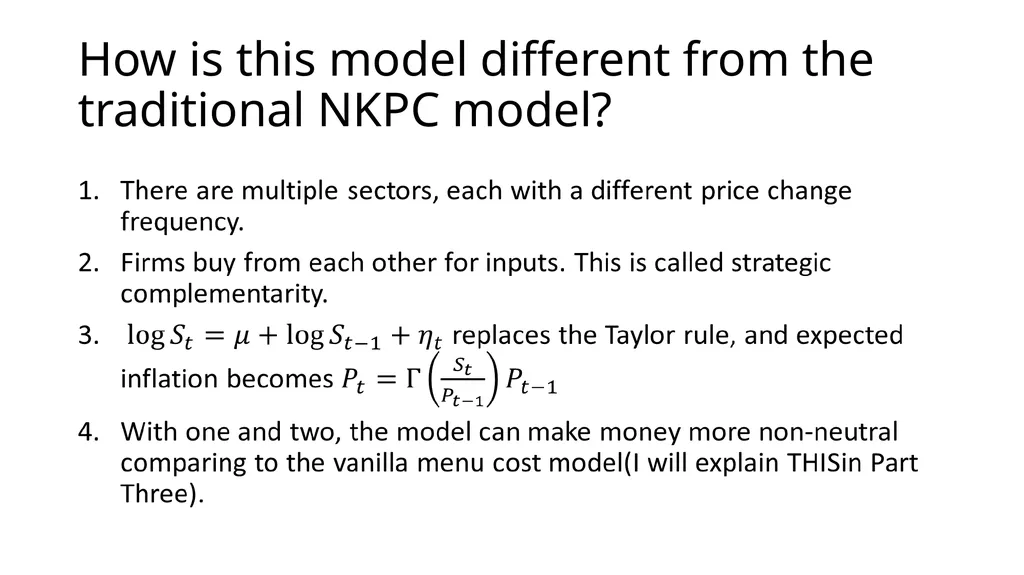
slide11. How is this model different from the traditional NKPC model?<br>
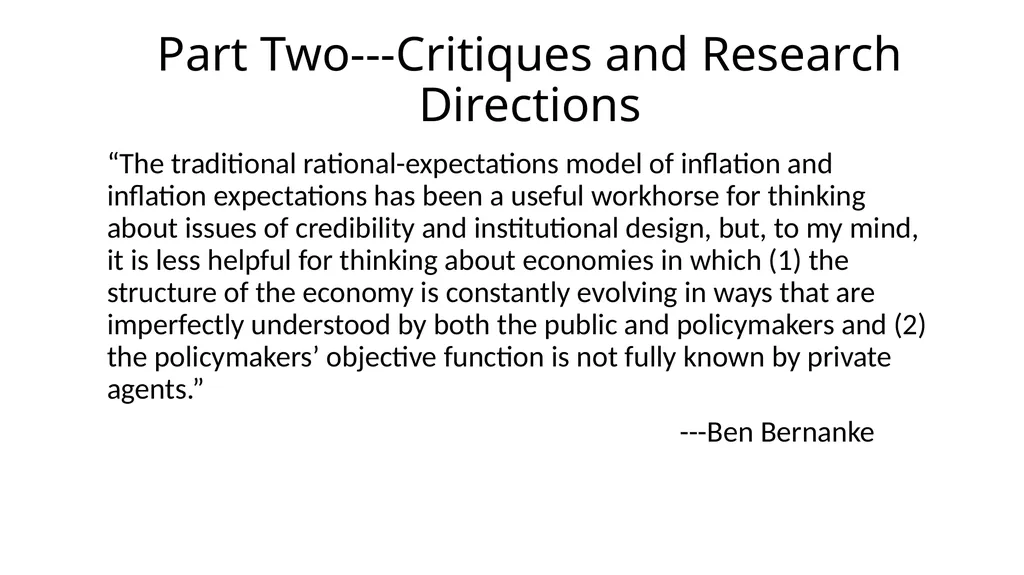
slide12. Part Two---Critiques and Research Directions “The traditional rational-expectations model of inflation and inflation expectations has been a useful workhorse for thinking about issues of credibility and institutional design, but, to my mind, it is less helpful for thinking about economies in which (1) the structure of the economy is constantly evolving in ways that are imperfectly understood by both the public and policymakers and (2) the policymakers’ objective function is not fully known by private agents.”
---Ben Bernanke<br>
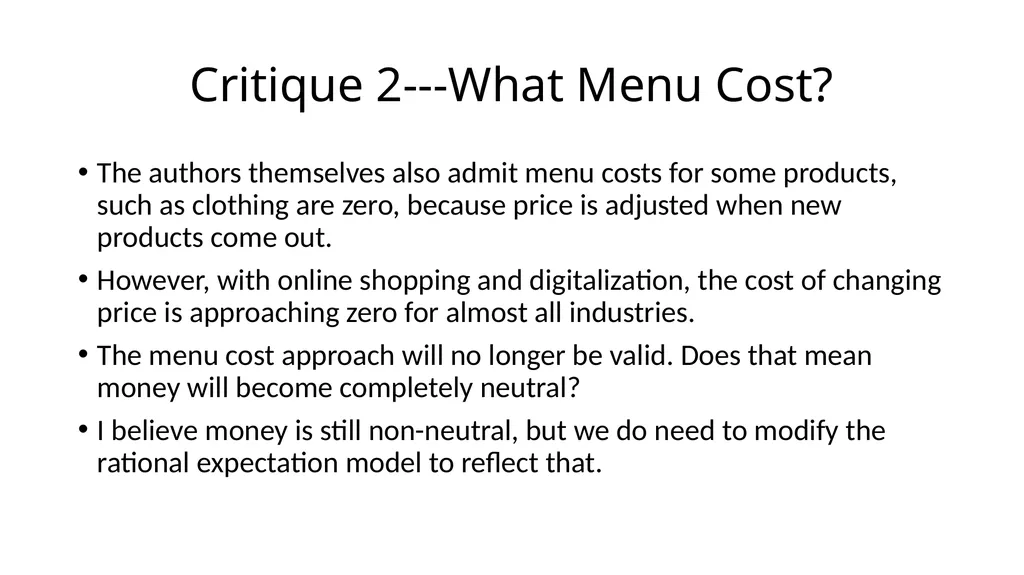
slide15. Critique 2---What Menu Cost? The authors themselves also admit menu costs for some products, such as clothing are zero, because price is adjusted when new products come out.
However, with online shopping and digitalization, the cost of changing price is approaching zero for almost all industries.
The menu cost approach will no longer be valid. Does that mean money will become completely neutral?
I believe money is still non-neutral, but we do need to modify the rational expectation model to reflect that.<br>
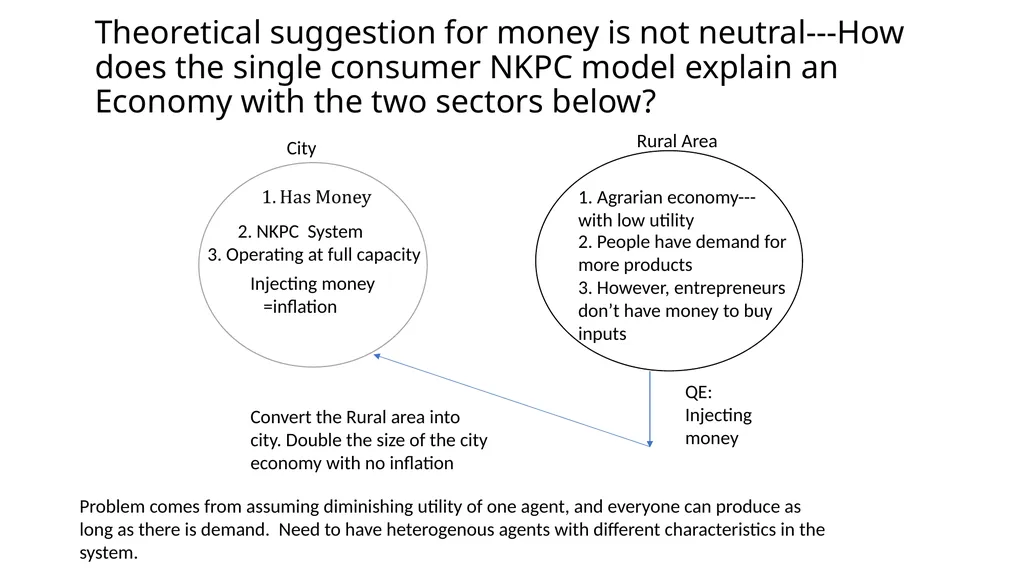
slide16. Theoretical suggestion for money is not neutral---How does the single consumer NKPC model explain an Economy with the two sectors below? City 2. NKPC System
3. Operating at full capacity Rural Area 2. People have demand for more products
3. However, entrepreneurs don’t have money to buy inputs 1. Agrarian economy---with low utility QE: Injecting money Convert the Rural area into city. Double the size of the city economy with no inflation Problem comes from assuming diminishing utility of one agent, and everyone can produce as long as there is demand. Need to have heterogenous agents with different characteristics in the system. Injecting money
=inflation<br>
slide17. Empirical evidence for money is not neutral --Is China an export-led or inflation-led economy? When trading companies in China sell their products abroad, they need to give the foreign currency to the central bank in exchange for Chinese RMB. Of course, the central bank needs to print more RMB each time this happens.
However, the government does not use much of the foreign currency to import things. It normally uses the money to purchase US bonds. Even though the amount of RMB increases, there is no additional goods in the system to make up for that.
The system is isomorphic to a scenario in which the government purchases export goods from domestic firms by printing money first, and then uses the goods to trade for US bonds.
Step 1 is completely inflationary. Although inflation in China has indeed been very high, if money were neutral, the economy would not grow at all.<br>
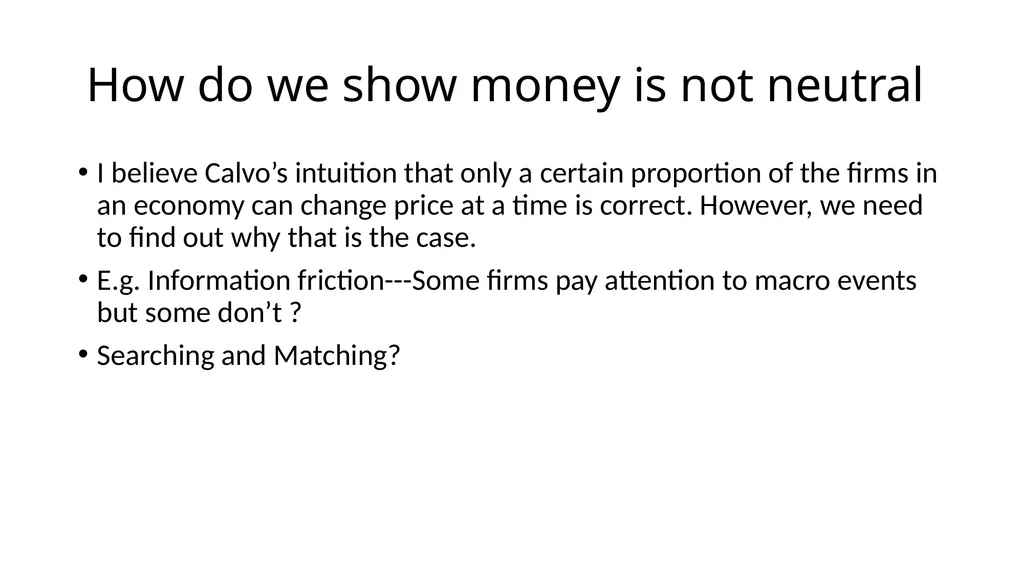
slide18. How do we show money is not neutral I believe Calvo’s intuition that only a certain proportion of the firms in an economy can change price at a time is correct. However, we need to find out why that is the case.
E.g. Information friction---Some firms pay attention to macro events but some don’t ?
Searching and Matching?<br>
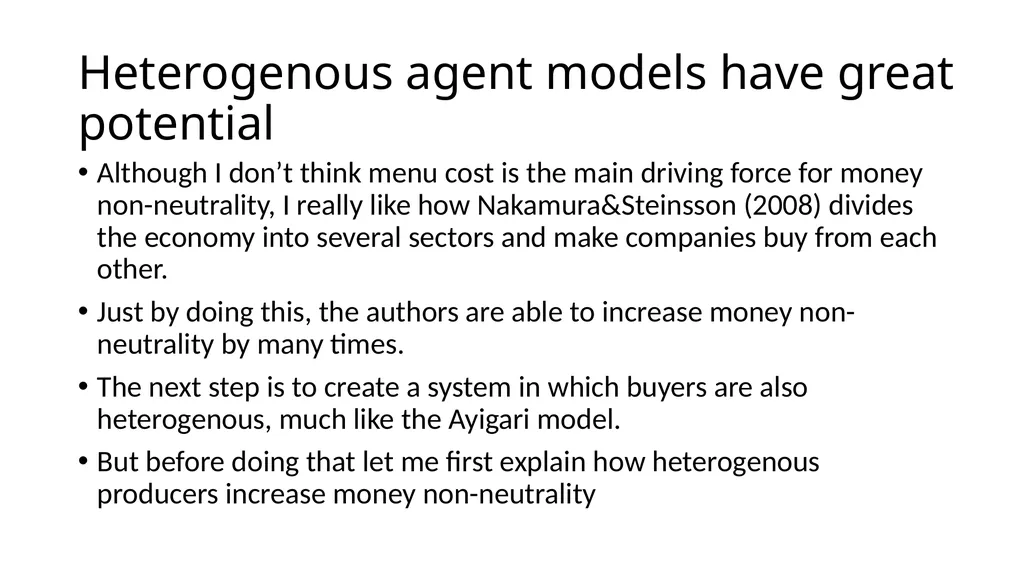
slide19. Heterogenous agent models have great potential Although I don’t think menu cost is the main driving force for money non-neutrality, I really like how Nakamura&Steinsson (2008) divides the economy into several sectors and make companies buy from each other.
Just by doing this, the authors are able to increase money non- neutrality by many times.
The next step is to create a system in which buyers are also heterogenous, much like the Ayigari model.
But before doing that let me first explain how heterogenous producers increase money non-neutrality<br>
slide20. Part Three---why the model can generate additional money non-neutrality<br>
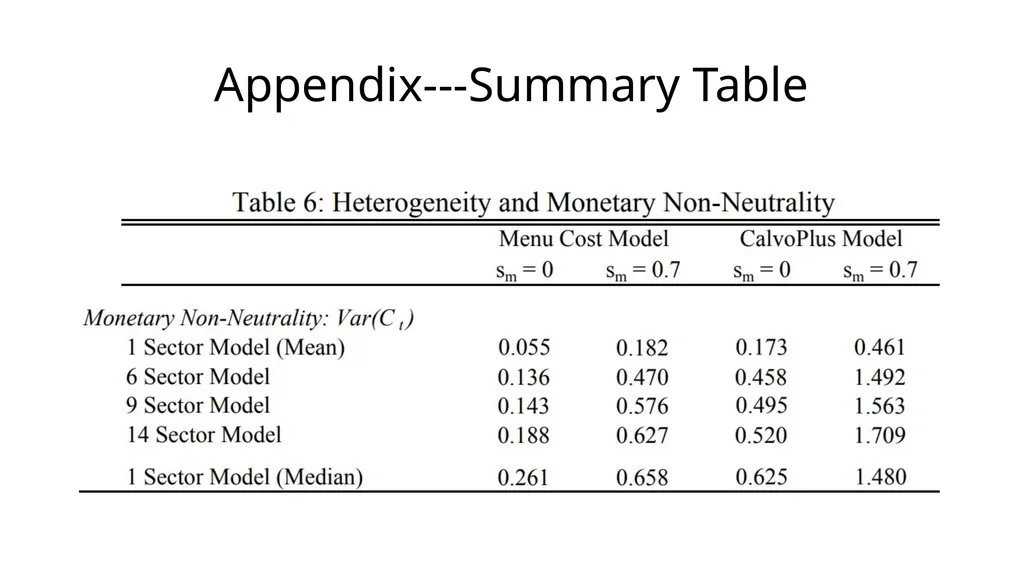
slide21. Heterogeneous frequency of Price Change The degree of monetary non-neutrality is measured by the variance of real output when the model is simulated with nominal aggregate shocks(Impulse response).
The authors group goods with similar price change characteristics(frequency and size) into 6 sectors, 9 sectors and 14.
The degree of monetary non-neutrality is sharply increasing in the number of sectors. The 14 sector model generates roughly three times as much monetary non-neutrality as the single-sector model.<br>
slide22. Why does heterogeneity amplify the degree of non-neutrality? The degree of monetary non-neutrality in the economy is approximately a weighted average of the monetary non-neutrality in each sector.
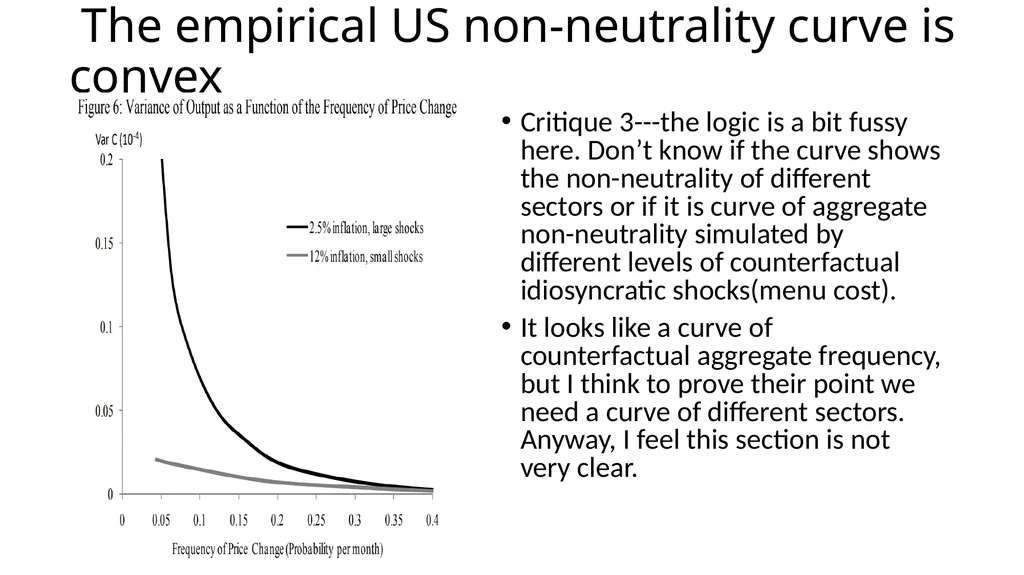
Monetary non-neutrality is a convex function of the frequency of price change.
Weighted average of the monetary non-neutrality from each sector is larger than the monetary non-neutrality generated by the average frequency of price change(Jensen inequality).
Why is monetary non-neutrality a convex function of the frequency of price change?<br>
slide23. Convexity in the Calvo model In a Calvo model, if the frequency of price change of a firm is high, it means the company gets to change its price a lot within a certain amount of time. However, only the 1st adjustment affects a company’s output after a shock. All the ensuing changes are nominal.
When the frequency increases from a low level, the additional opportunity of price change is more likely to fall on a firm that has not changed the price yet. However, when the frequency increases from a high level, it is more likely for a firm that has already changed the price to be given this additional opportunity. In the extreme case, when all the firms have already changed their price once, the increase in frequency will have no effect at all.
Therefore, monetary neutrality is a convex function of price change frequency in the Calvo model.<br>
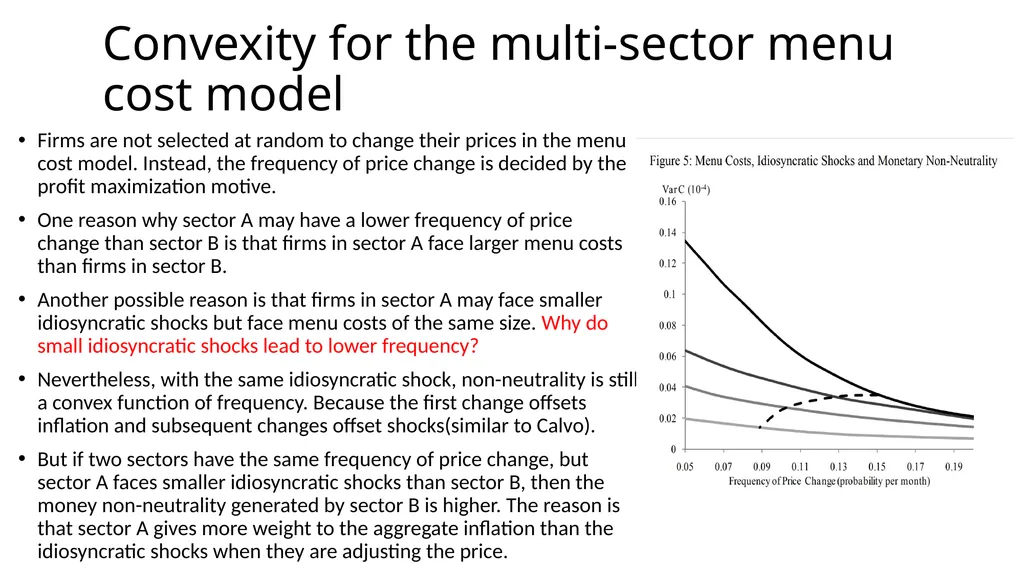
slide24. Convexity for the multi-sector menu cost model Firms are not selected at random to change their prices in the menu cost model. Instead, the frequency of price change is decided by the profit maximization motive.
One reason why sector A may have a lower frequency of price change than sector B is that firms in sector A face larger menu costs than firms in sector B.
Another possible reason is that firms in sector A may face smaller idiosyncratic shocks but face menu costs of the same size. Why do small idiosyncratic shocks lead to lower frequency?
Nevertheless, with the same idiosyncratic shock, non-neutrality is still a convex function of frequency. Because the first change offsets inflation and subsequent changes offset shocks(similar to Calvo).
But if two sectors have the same frequency of price change, but sector A faces smaller idiosyncratic shocks than sector B, then the money non-neutrality generated by sector B is higher. The reason is that sector A gives more weight to the aggregate inflation than the idiosyncratic shocks when they are adjusting the price.<br>
slide25. The empirical US non-neutrality curve is convex Critique 3---the logic is a bit fussy here. Don’t know if the curve shows the non-neutrality of different sectors or if it is curve of aggregate non-neutrality simulated by different levels of counterfactual idiosyncratic shocks(menu cost).
It looks like a curve of counterfactual aggregate frequency, but I think to prove their point we need a curve of different sectors. Anyway, I feel this section is not very clear.<br>
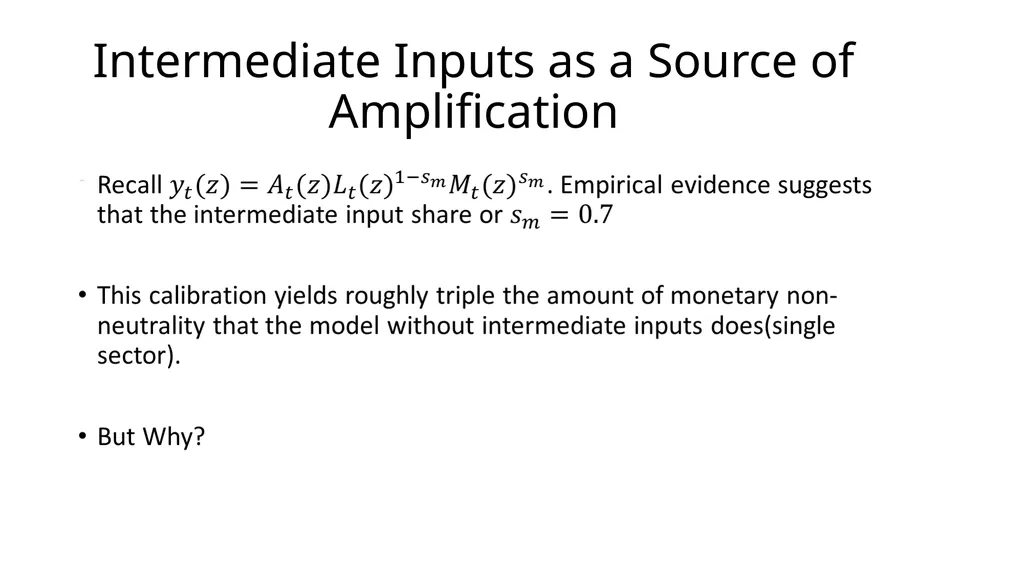
slide26. Intermediate Inputs as a Source of Amplification<br>
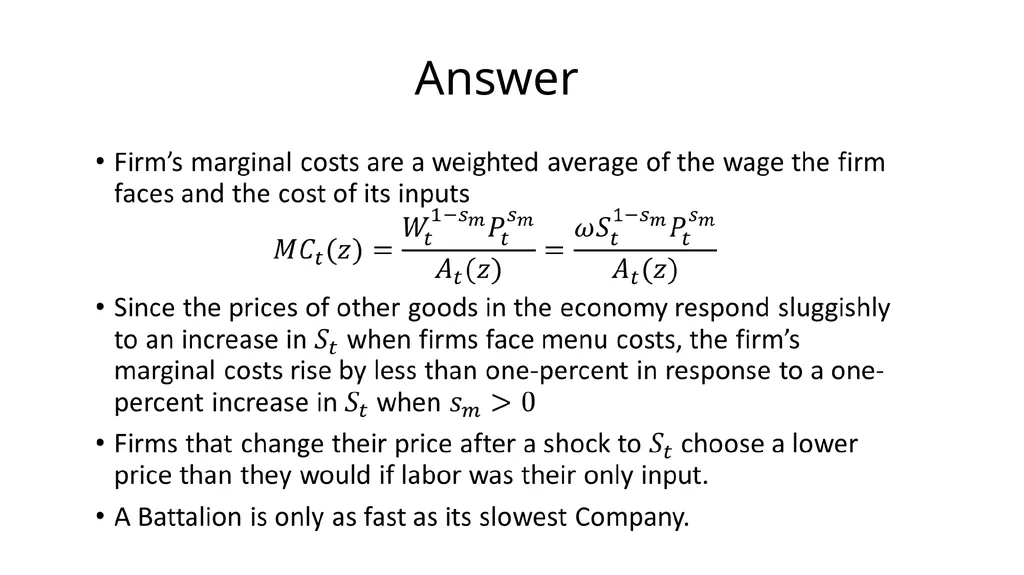
slide27. Answer<br>
slide28. Appendix---Summary Table<br>
Presenter---Ethan Zhang<br>
slide2. Representative agent model---price adjusts immediately, so money is neutral. The Dynamics of Monetary Economics NKPC—Price rigidity, monetary policy is effective under some circumstances 2. Menu cost---firms only adjust prices when it is profitable. 1. Calvo’s Fairy---only a random proportion of the firms can change prices at one time(time-dependent). Golosov and Lucas (2007)--- Empirically Menu cost is very small; not enough to generate meaningful price rigidity in a standard NKPC model. But Why ? Nakamura&Steinsson(2008)---Menu cost is small. However, if we divide the production industry into heterogenous sectors, and make firms buy from each other for intermediate inputs, money can be shown as non-neutral(today’s presentation). Ethan’s potential research direction
and some critiques<br>
slide3. Structure of the presentation Part One---Describe the multi-sector menu cost model
Part Two---Critique the paper and suggest some research directions
Part Three---Analyze why the model can generate additional money non-neutrality<br>
slide4. Part One--- Multi-Sector Menu Cost Model<br>
slide5. Model---Household<br>
slide6. Household Demand<br>
slide7. Firms<br>
slide8. Total Demand<br>
slide9. Monetary Authority<br>
slide10. Solving the model<br>
slide11. How is this model different from the traditional NKPC model?<br>
slide12. Part Two---Critiques and Research Directions “The traditional rational-expectations model of inflation and inflation expectations has been a useful workhorse for thinking about issues of credibility and institutional design, but, to my mind, it is less helpful for thinking about economies in which (1) the structure of the economy is constantly evolving in ways that are imperfectly understood by both the public and policymakers and (2) the policymakers’ objective function is not fully known by private agents.”
---Ben Bernanke<br>
slide15. Critique 2---What Menu Cost? The authors themselves also admit menu costs for some products, such as clothing are zero, because price is adjusted when new products come out.
However, with online shopping and digitalization, the cost of changing price is approaching zero for almost all industries.
The menu cost approach will no longer be valid. Does that mean money will become completely neutral?
I believe money is still non-neutral, but we do need to modify the rational expectation model to reflect that.<br>
slide16. Theoretical suggestion for money is not neutral---How does the single consumer NKPC model explain an Economy with the two sectors below? City 2. NKPC System
3. Operating at full capacity Rural Area 2. People have demand for more products
3. However, entrepreneurs don’t have money to buy inputs 1. Agrarian economy---with low utility QE: Injecting money Convert the Rural area into city. Double the size of the city economy with no inflation Problem comes from assuming diminishing utility of one agent, and everyone can produce as long as there is demand. Need to have heterogenous agents with different characteristics in the system. Injecting money
=inflation<br>
slide17. Empirical evidence for money is not neutral --Is China an export-led or inflation-led economy? When trading companies in China sell their products abroad, they need to give the foreign currency to the central bank in exchange for Chinese RMB. Of course, the central bank needs to print more RMB each time this happens.
However, the government does not use much of the foreign currency to import things. It normally uses the money to purchase US bonds. Even though the amount of RMB increases, there is no additional goods in the system to make up for that.
The system is isomorphic to a scenario in which the government purchases export goods from domestic firms by printing money first, and then uses the goods to trade for US bonds.
Step 1 is completely inflationary. Although inflation in China has indeed been very high, if money were neutral, the economy would not grow at all.<br>
slide18. How do we show money is not neutral I believe Calvo’s intuition that only a certain proportion of the firms in an economy can change price at a time is correct. However, we need to find out why that is the case.
E.g. Information friction---Some firms pay attention to macro events but some don’t ?
Searching and Matching?<br>
slide19. Heterogenous agent models have great potential Although I don’t think menu cost is the main driving force for money non-neutrality, I really like how Nakamura&Steinsson (2008) divides the economy into several sectors and make companies buy from each other.
Just by doing this, the authors are able to increase money non- neutrality by many times.
The next step is to create a system in which buyers are also heterogenous, much like the Ayigari model.
But before doing that let me first explain how heterogenous producers increase money non-neutrality<br>
slide20. Part Three---why the model can generate additional money non-neutrality<br>
slide21. Heterogeneous frequency of Price Change The degree of monetary non-neutrality is measured by the variance of real output when the model is simulated with nominal aggregate shocks(Impulse response).
The authors group goods with similar price change characteristics(frequency and size) into 6 sectors, 9 sectors and 14.
The degree of monetary non-neutrality is sharply increasing in the number of sectors. The 14 sector model generates roughly three times as much monetary non-neutrality as the single-sector model.<br>
slide22. Why does heterogeneity amplify the degree of non-neutrality? The degree of monetary non-neutrality in the economy is approximately a weighted average of the monetary non-neutrality in each sector.
Monetary non-neutrality is a convex function of the frequency of price change.
Weighted average of the monetary non-neutrality from each sector is larger than the monetary non-neutrality generated by the average frequency of price change(Jensen inequality).
Why is monetary non-neutrality a convex function of the frequency of price change?<br>
slide23. Convexity in the Calvo model In a Calvo model, if the frequency of price change of a firm is high, it means the company gets to change its price a lot within a certain amount of time. However, only the 1st adjustment affects a company’s output after a shock. All the ensuing changes are nominal.
When the frequency increases from a low level, the additional opportunity of price change is more likely to fall on a firm that has not changed the price yet. However, when the frequency increases from a high level, it is more likely for a firm that has already changed the price to be given this additional opportunity. In the extreme case, when all the firms have already changed their price once, the increase in frequency will have no effect at all.
Therefore, monetary neutrality is a convex function of price change frequency in the Calvo model.<br>
slide24. Convexity for the multi-sector menu cost model Firms are not selected at random to change their prices in the menu cost model. Instead, the frequency of price change is decided by the profit maximization motive.
One reason why sector A may have a lower frequency of price change than sector B is that firms in sector A face larger menu costs than firms in sector B.
Another possible reason is that firms in sector A may face smaller idiosyncratic shocks but face menu costs of the same size. Why do small idiosyncratic shocks lead to lower frequency?
Nevertheless, with the same idiosyncratic shock, non-neutrality is still a convex function of frequency. Because the first change offsets inflation and subsequent changes offset shocks(similar to Calvo).
But if two sectors have the same frequency of price change, but sector A faces smaller idiosyncratic shocks than sector B, then the money non-neutrality generated by sector B is higher. The reason is that sector A gives more weight to the aggregate inflation than the idiosyncratic shocks when they are adjusting the price.<br>
slide25. The empirical US non-neutrality curve is convex Critique 3---the logic is a bit fussy here. Don’t know if the curve shows the non-neutrality of different sectors or if it is curve of aggregate non-neutrality simulated by different levels of counterfactual idiosyncratic shocks(menu cost).
It looks like a curve of counterfactual aggregate frequency, but I think to prove their point we need a curve of different sectors. Anyway, I feel this section is not very clear.<br>
slide26. Intermediate Inputs as a Source of Amplification<br>
slide27. Answer<br>
slide28. Appendix---Summary Table<br>