
Monitoring-based System for E2E Security Auditing
JO
Published · 61 slides · 0 views

1 / 1







Description
Monitoring-based System for E2E Security Auditing and Enforcement in Trusted and Untrusted SOA Northrop Grumman Cybersecurity Research Consortium (NGCRC) Spring 2015 Symposium 2930 April 2015 PI: Prof. Bharat Bhargava Purdue University
Related Topics
Share
Embed code
Download this presentation From Below
"Monitoring-based System for E2E Security Auditing" is the property of its rightful owner. Permission is granted to download and print the materials on this website for personal, non-commercial use only, and to display it on your personal computer provided you do not modify the materials and that you retain all copyright notices contained in the materials. By downloading content from our website, you accept the terms of this agreement.
Presentation Transcript
01
Monitoring-based System for E2E Security Auditing and Enforcement in Trusted and Untrusted SOA Northrop Grumman Cybersecurity
Research Consortium (NGCRC)
Spring 2015 Symposium 29/30 April 2015 PI: Prof. Bharat Bhargava Purdue University Technical Champion(s): Dr. Sunil Lingayat<br>
02
Project Participants Prof. Bharat Bhargava
Dr. Pelin Angin
Rohit Ranchal, PhD student
Denis Ulybyshev, PhD student
Prof. Leszek Lilien
Dr. Lotfi ben Othmane 2<br>
Dr. Pelin Angin
Rohit Ranchal, PhD student
Denis Ulybyshev, PhD student
Prof. Leszek Lilien
Dr. Lotfi ben Othmane 2<br>
03
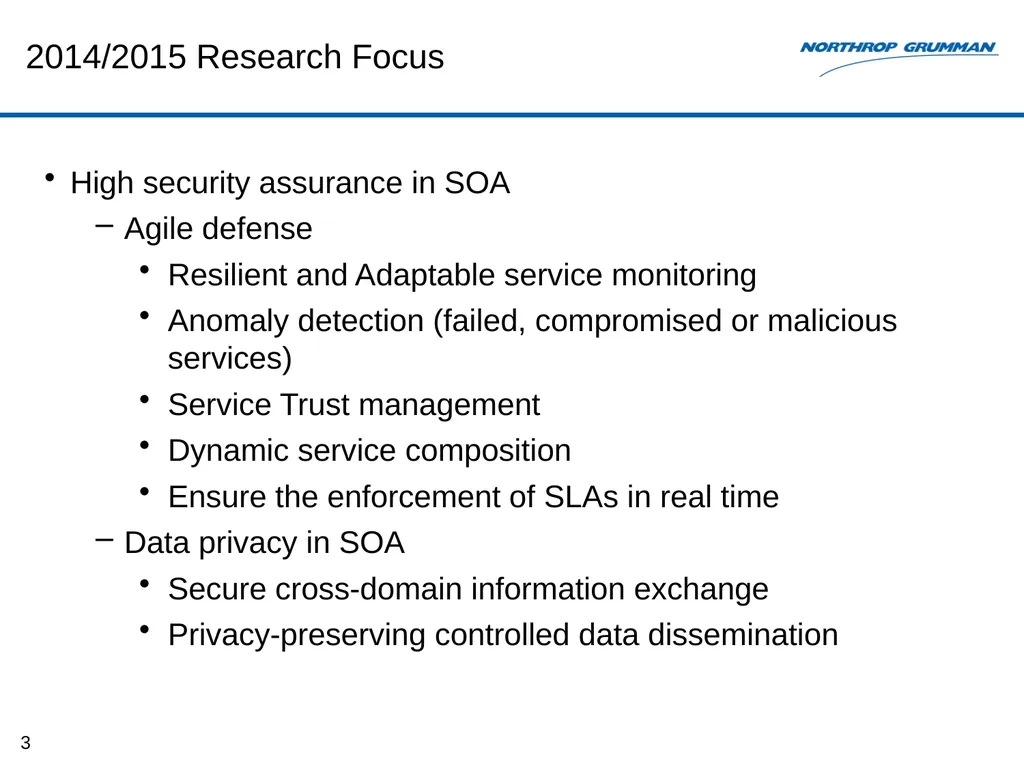
2014/2015 Research Focus High security assurance in SOA
Agile defense
Resilient and Adaptable service monitoring
Anomaly detection (failed, compromised or malicious services)
Service Trust management
Dynamic service composition
Ensure the enforcement of SLAs in real time
Data privacy in SOA
Secure cross-domain information exchange
Privacy-preserving controlled data dissemination 3<br>
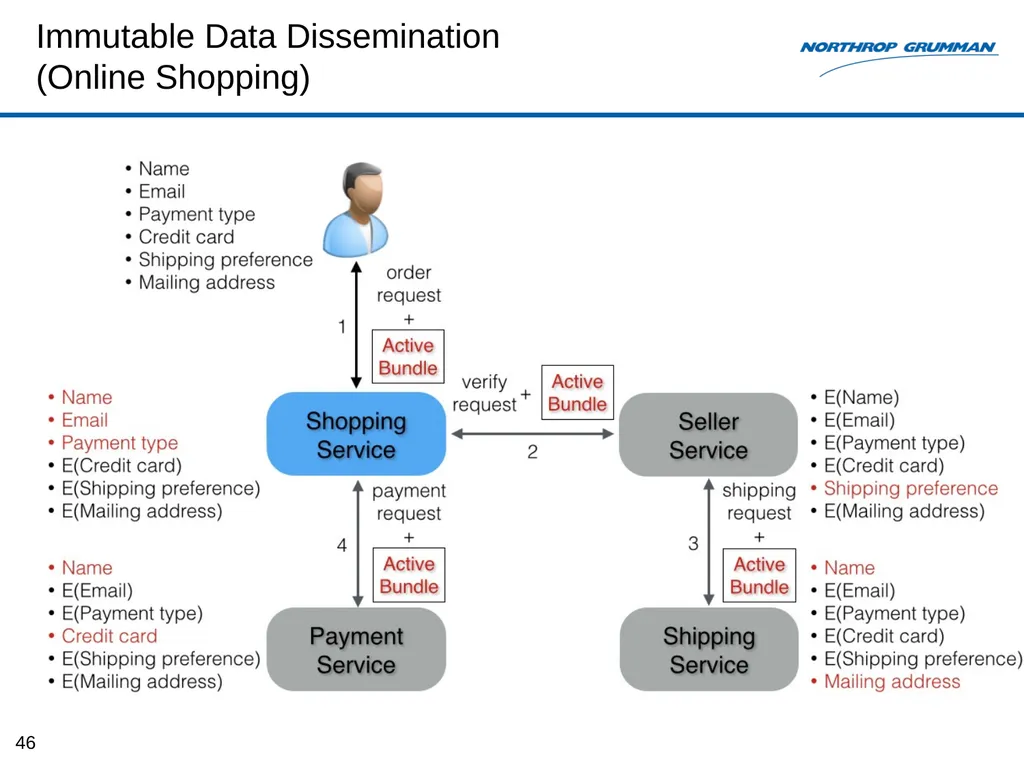
Agile defense
Resilient and Adaptable service monitoring
Anomaly detection (failed, compromised or malicious services)
Service Trust management
Dynamic service composition
Ensure the enforcement of SLAs in real time
Data privacy in SOA
Secure cross-domain information exchange
Privacy-preserving controlled data dissemination 3<br>
04
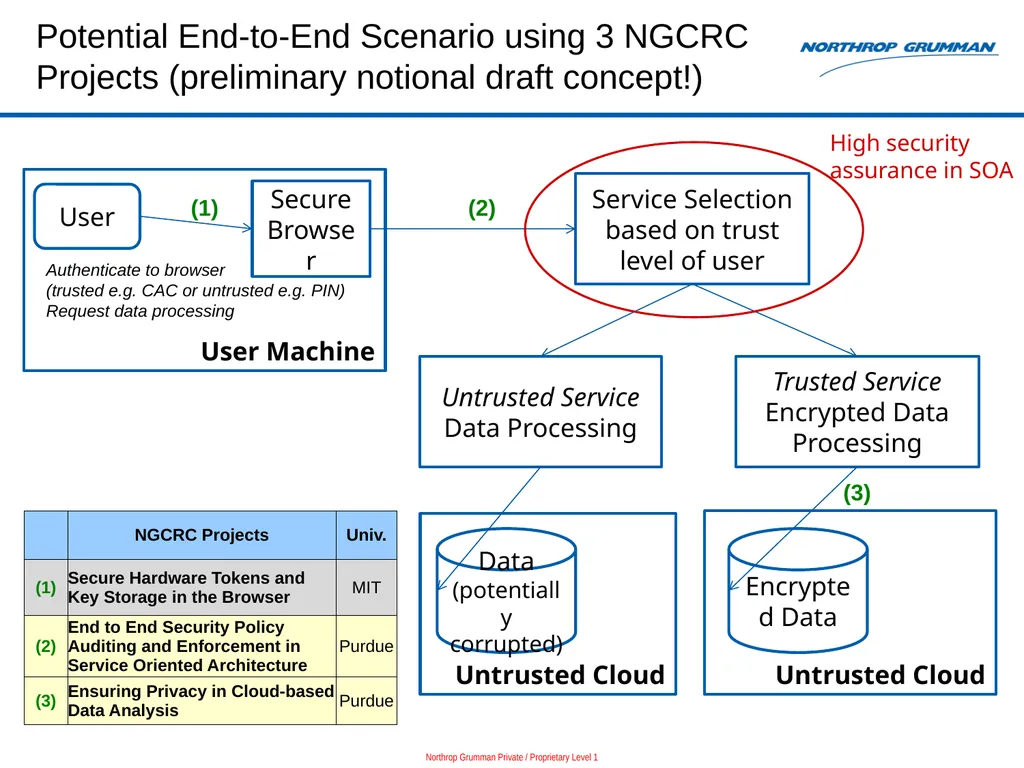
Potential End-to-End Scenario using 3 NGCRC Projects (preliminary notional draft concept!) Northrop Grumman Private / Proprietary Level 1 Encrypted Data Trusted Service
Encrypted Data Processing Secure Browser User Machine Untrusted Cloud User Authenticate to browser
(trusted e.g. CAC or untrusted e.g. PIN)
Request data processing Data (potentially corrupted) Untrusted Service
Data Processing Untrusted Cloud Service Selection based on trust level of user (1) (2) (3) High security
assurance in SOA<br>
assurance in SOA<br>
05
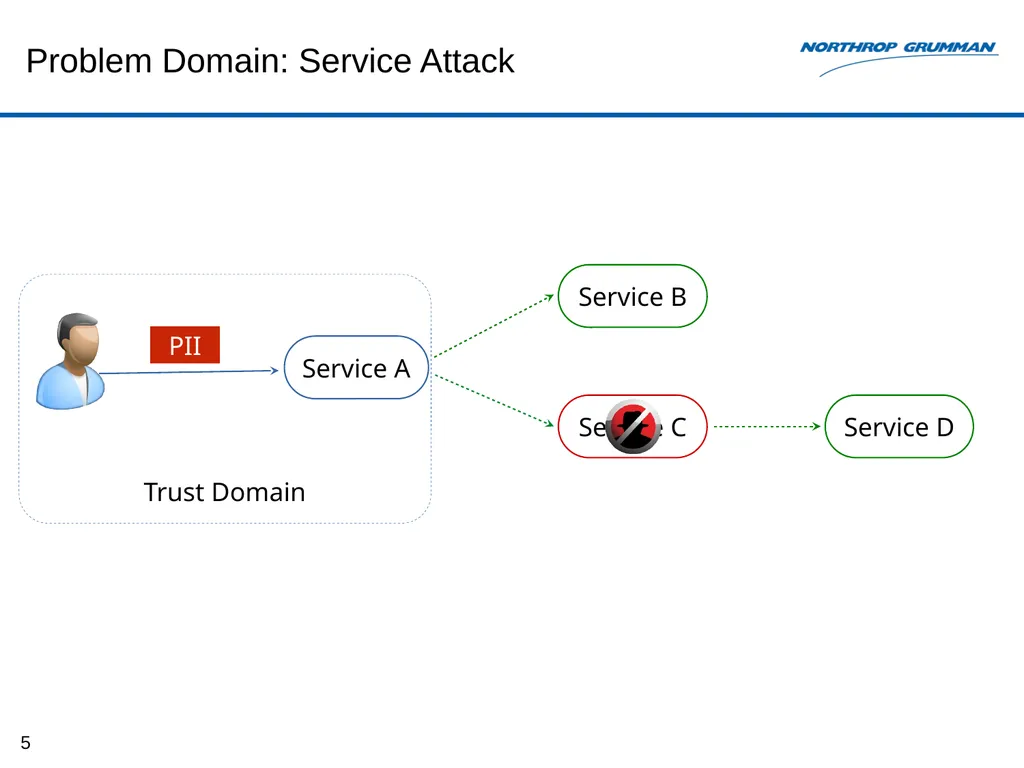
Trust Domain PII Service A Service B Service C Service D Problem Domain: Service Attack 5<br>
06
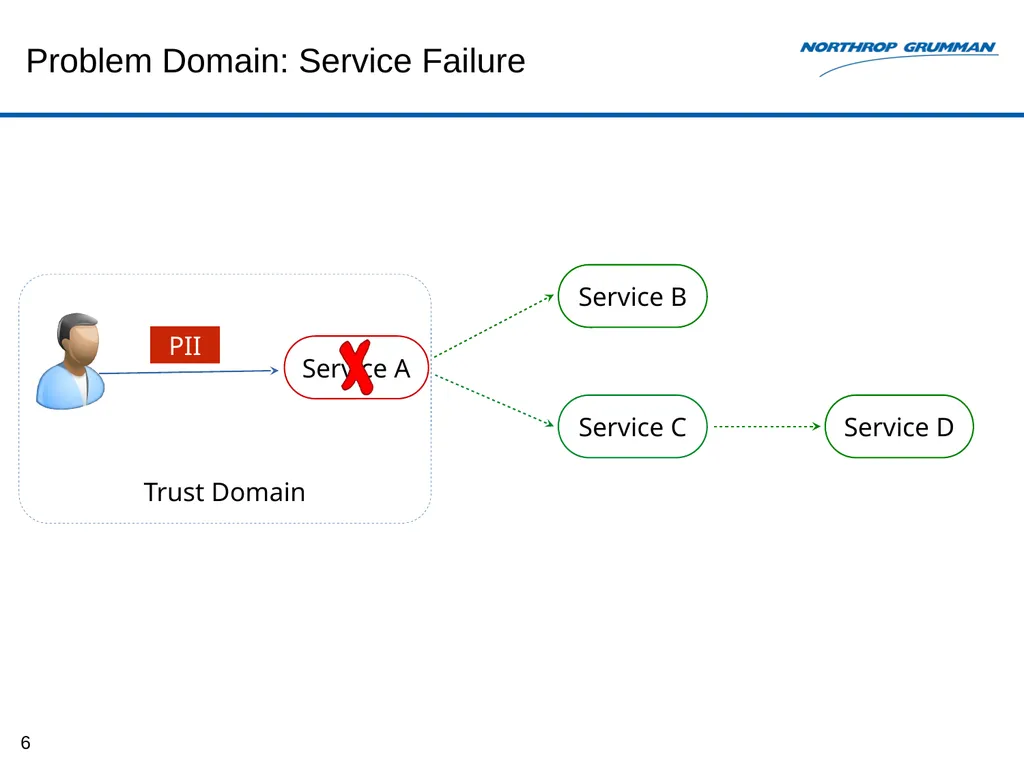
Trust Domain PII Service A Service B Service C Service D Problem Domain: Service Failure 6<br>
07
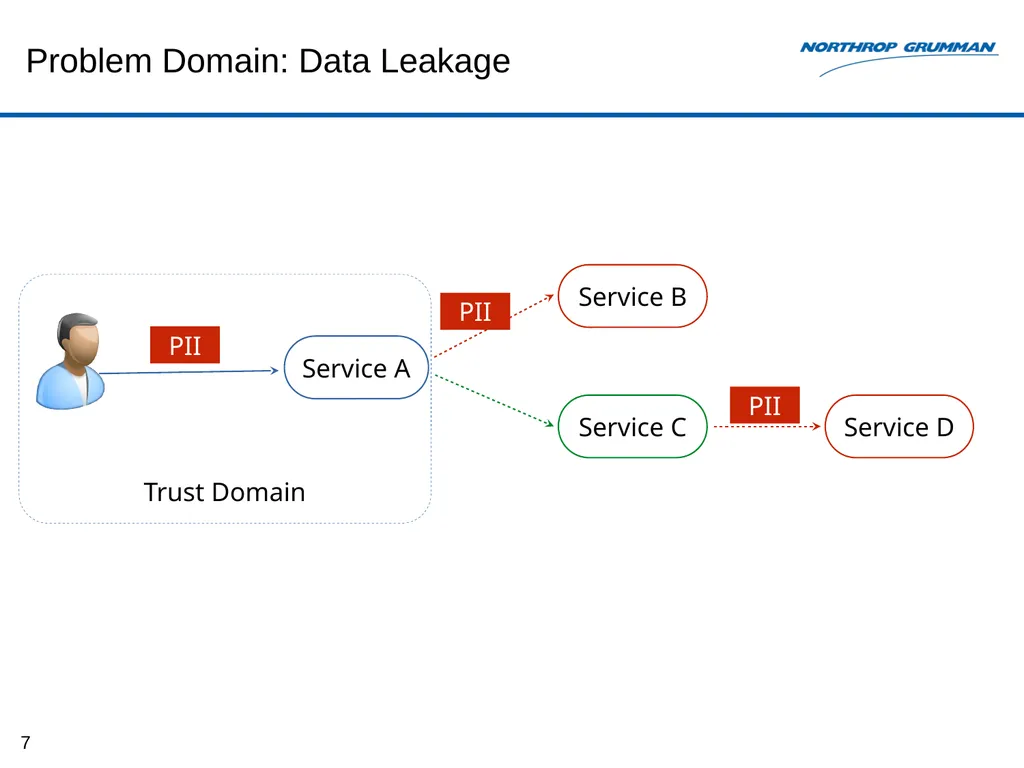
Trust Domain PII PII Service A Service B Service C PII Service D Problem Domain: Data Leakage 7<br>
08
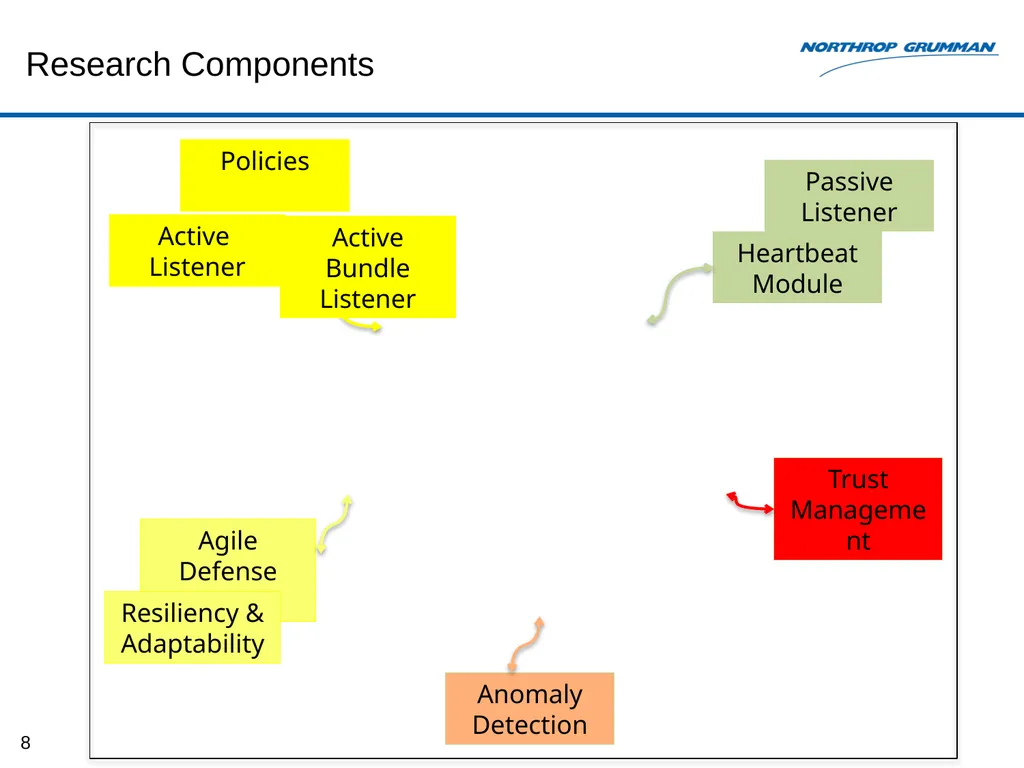
Research Components Policies Active
Listener Passive Listener Heartbeat Module Trust Management Anomaly Detection Agile Defense Active Bundle
Listener Resiliency & Adaptability 8<br>
Listener Passive Listener Heartbeat Module Trust Management Anomaly Detection Agile Defense Active Bundle
Listener Resiliency & Adaptability 8<br>
09
Agile Defense in SOA 9<br>
10
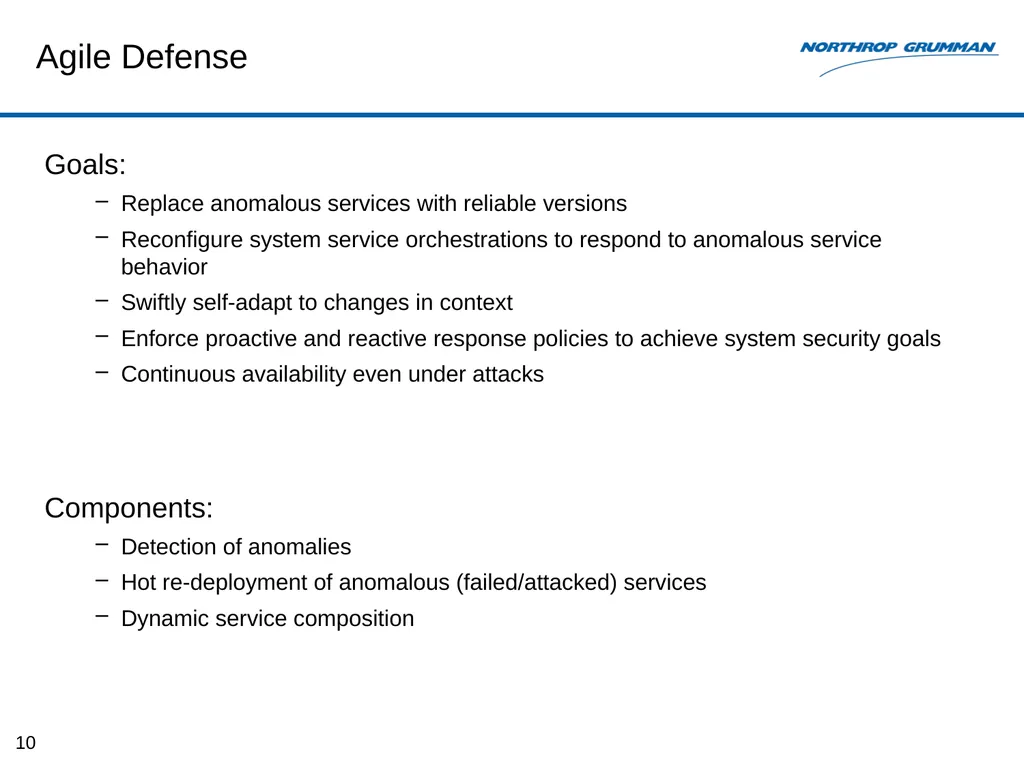
Agile Defense Goals:
Replace anomalous services with reliable versions
Reconfigure system service orchestrations to respond to anomalous service behavior
Swiftly self-adapt to changes in context
Enforce proactive and reactive response policies to achieve system security goals
Continuous availability even under attacks
Components:
Detection of anomalies
Hot re-deployment of anomalous (failed/attacked) services
Dynamic service composition 10<br>
Replace anomalous services with reliable versions
Reconfigure system service orchestrations to respond to anomalous service behavior
Swiftly self-adapt to changes in context
Enforce proactive and reactive response policies to achieve system security goals
Continuous availability even under attacks
Components:
Detection of anomalies
Hot re-deployment of anomalous (failed/attacked) services
Dynamic service composition 10<br>
11
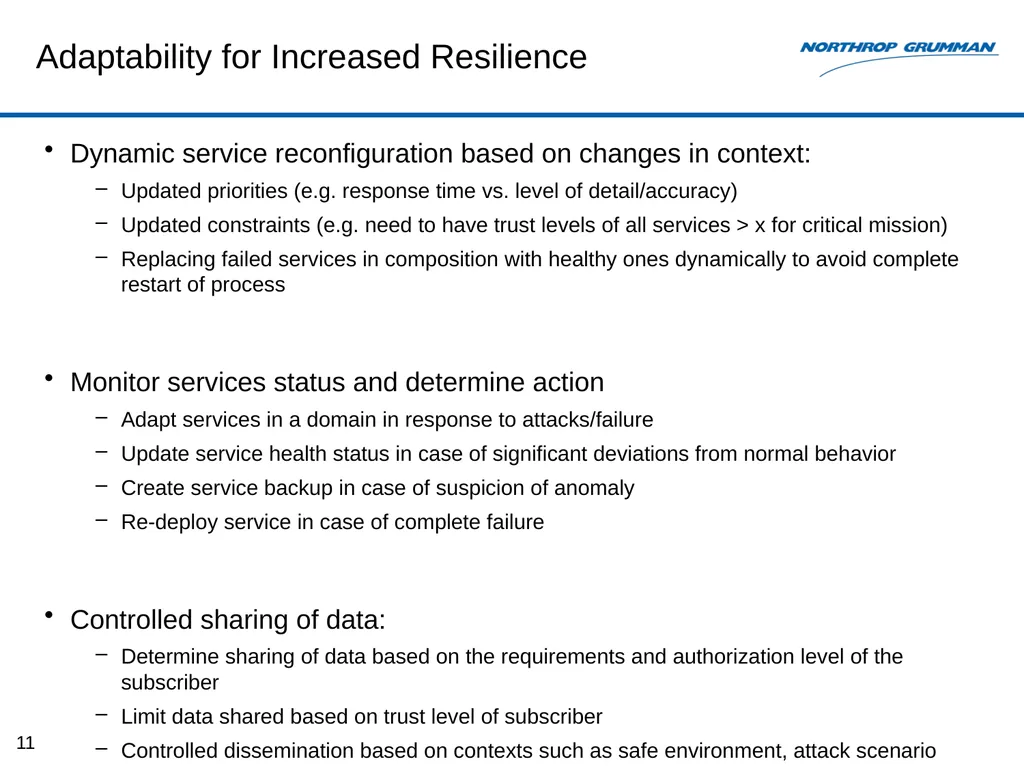
Adaptability for Increased Resilience Dynamic service reconfiguration based on changes in context:
Updated priorities (e.g. response time vs. level of detail/accuracy)
Updated constraints (e.g. need to have trust levels of all services > x for critical mission)
Replacing failed services in composition with healthy ones dynamically to avoid complete restart of process
Monitor services status and determine action
Adapt services in a domain in response to attacks/failure
Update service health status in case of significant deviations from normal behavior
Create service backup in case of suspicion of anomaly
Re-deploy service in case of complete failure
Controlled sharing of data:
Determine sharing of data based on the requirements and authorization level of the subscriber
Limit data shared based on trust level of subscriber
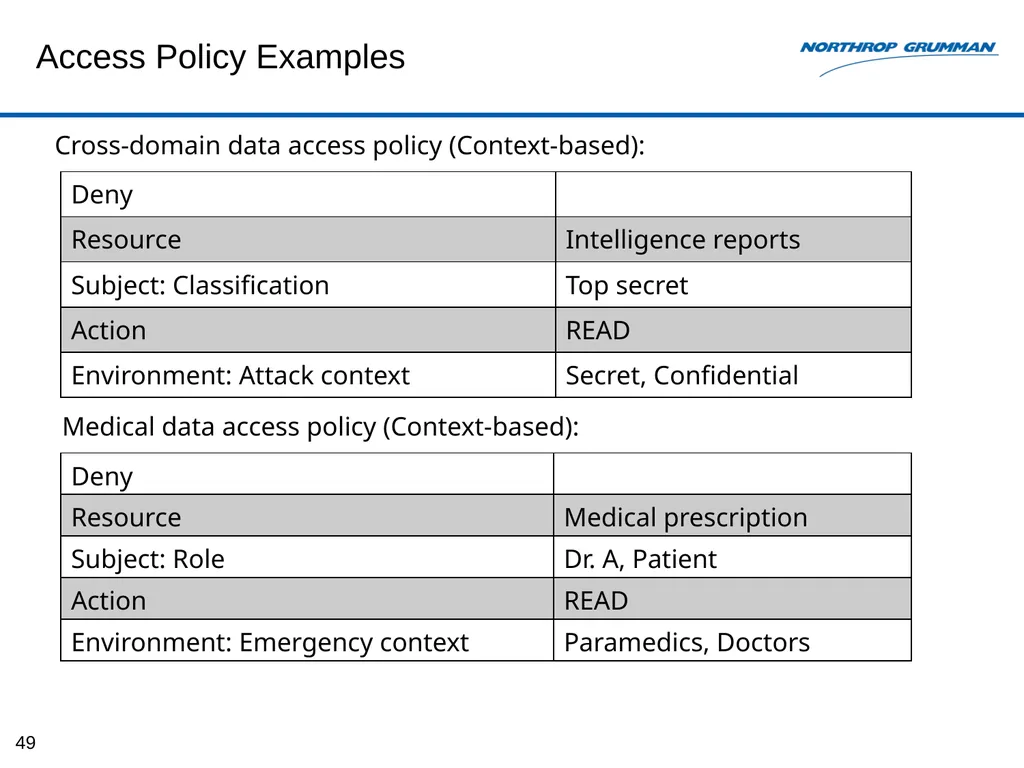
Controlled dissemination based on contexts such as safe environment, attack scenario 11<br>
Updated priorities (e.g. response time vs. level of detail/accuracy)
Updated constraints (e.g. need to have trust levels of all services > x for critical mission)
Replacing failed services in composition with healthy ones dynamically to avoid complete restart of process
Monitor services status and determine action
Adapt services in a domain in response to attacks/failure
Update service health status in case of significant deviations from normal behavior
Create service backup in case of suspicion of anomaly
Re-deploy service in case of complete failure
Controlled sharing of data:
Determine sharing of data based on the requirements and authorization level of the subscriber
Limit data shared based on trust level of subscriber
Controlled dissemination based on contexts such as safe environment, attack scenario 11<br>
12
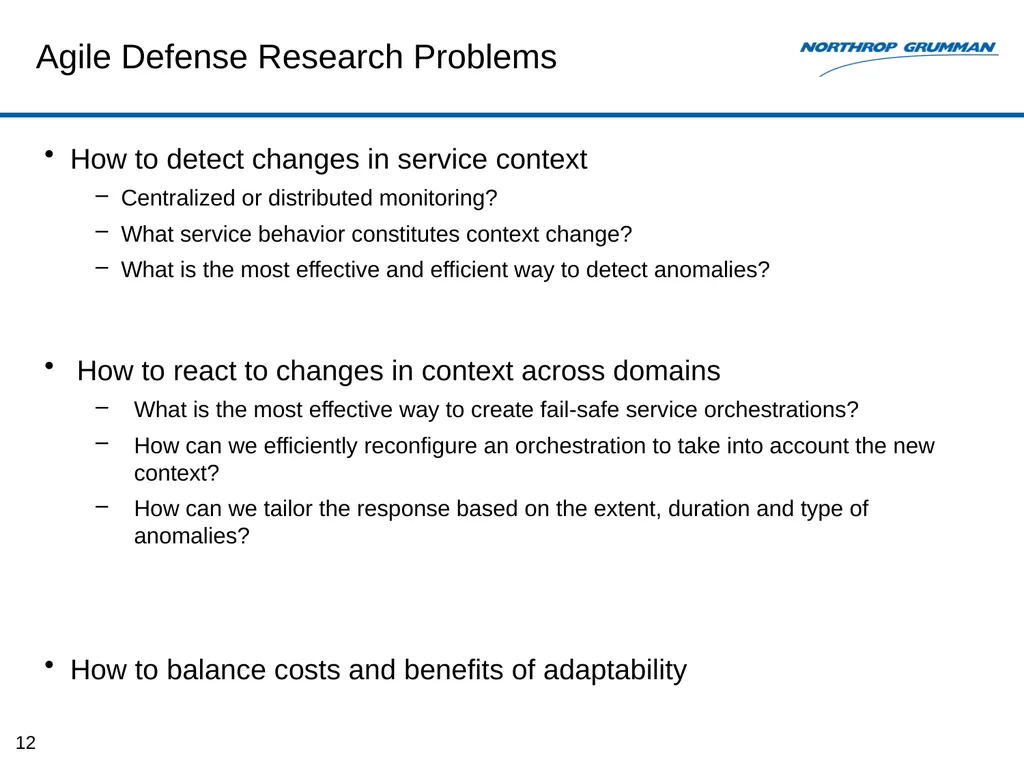
Agile Defense Research Problems How to detect changes in service context
Centralized or distributed monitoring?
What service behavior constitutes context change?
What is the most effective and efficient way to detect anomalies?
How to react to changes in context across domains
What is the most effective way to create fail-safe service orchestrations?
How can we efficiently reconfigure an orchestration to take into account the new context?
How can we tailor the response based on the extent, duration and type of anomalies?
How to balance costs and benefits of adaptability 12<br>
Centralized or distributed monitoring?
What service behavior constitutes context change?
What is the most effective and efficient way to detect anomalies?
How to react to changes in context across domains
What is the most effective way to create fail-safe service orchestrations?
How can we efficiently reconfigure an orchestration to take into account the new context?
How can we tailor the response based on the extent, duration and type of anomalies?
How to balance costs and benefits of adaptability 12<br>
13
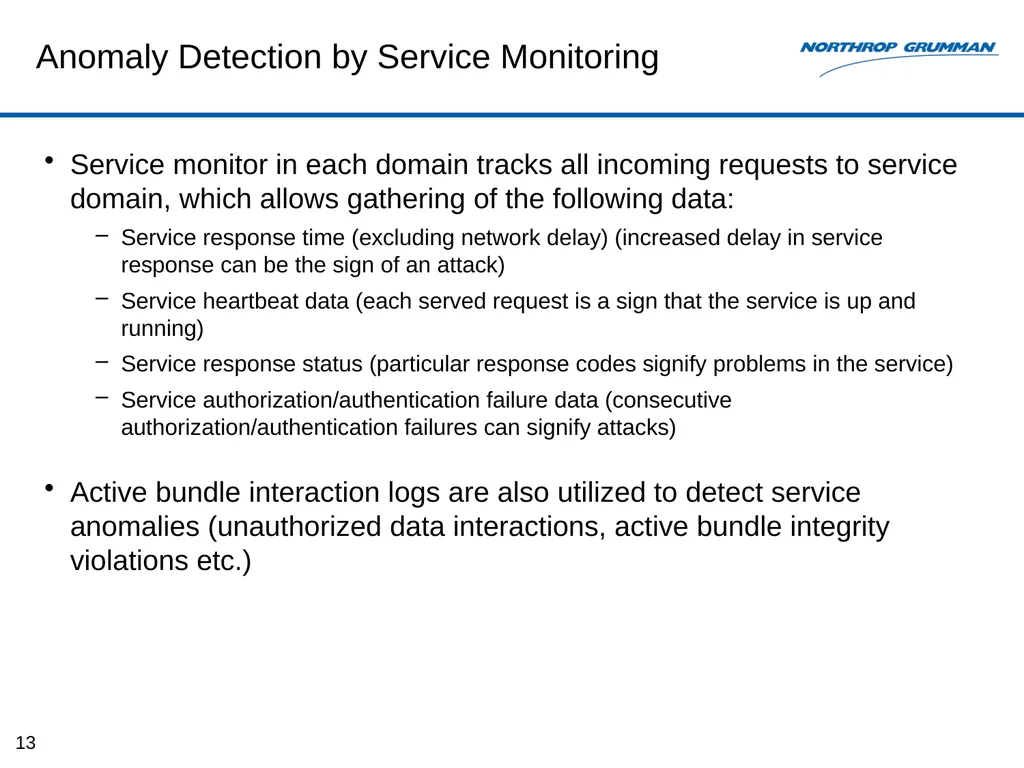
Anomaly Detection by Service Monitoring Service monitor in each domain tracks all incoming requests to service domain, which allows gathering of the following data:
Service response time (excluding network delay) (increased delay in service response can be the sign of an attack)
Service heartbeat data (each served request is a sign that the service is up and running)
Service response status (particular response codes signify problems in the service)
Service authorization/authentication failure data (consecutive authorization/authentication failures can signify attacks)
Active bundle interaction logs are also utilized to detect service anomalies (unauthorized data interactions, active bundle integrity violations etc.) 13<br>
Service response time (excluding network delay) (increased delay in service response can be the sign of an attack)
Service heartbeat data (each served request is a sign that the service is up and running)
Service response status (particular response codes signify problems in the service)
Service authorization/authentication failure data (consecutive authorization/authentication failures can signify attacks)
Active bundle interaction logs are also utilized to detect service anomalies (unauthorized data interactions, active bundle integrity violations etc.) 13<br>
14
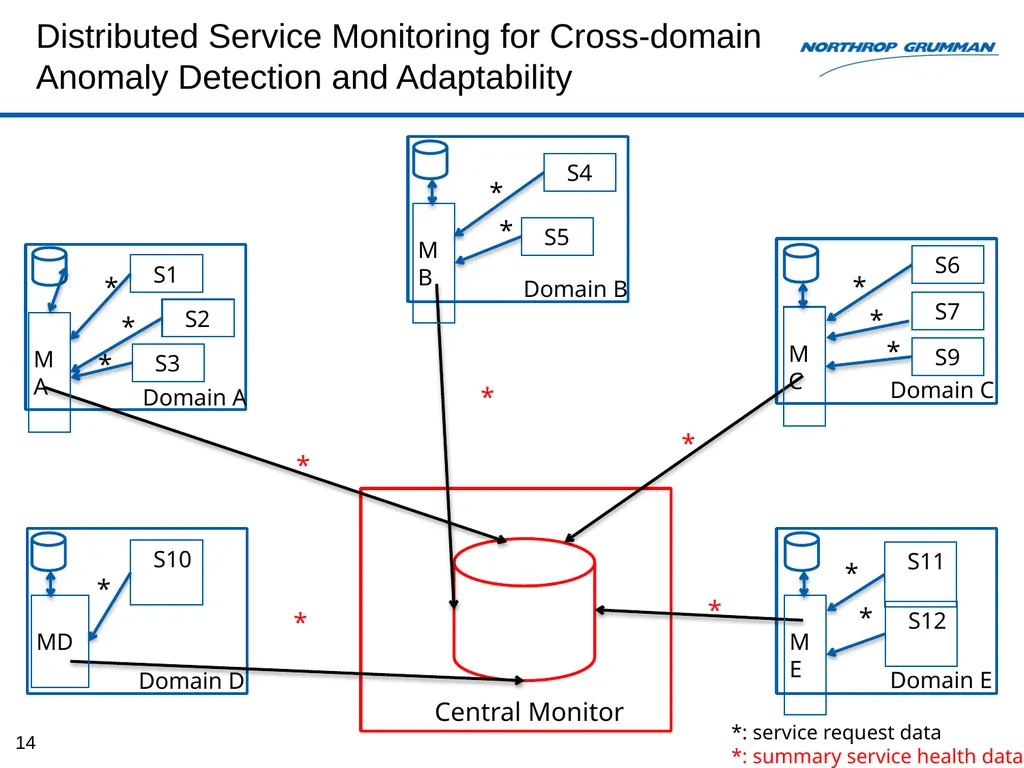
Distributed Service Monitoring for Cross-domain Anomaly Detection and Adaptability Central Monitor Domain A Domain B Domain C Domain D Domain E S1 S2 S3 S4 S5 S6 S7 S9 S10 S11 S12 * * * MA MB ME MC MD * * * * * * * * *: service request data
*: summary service health data * * * * * 14<br>
*: summary service health data * * * * * 14<br>
15
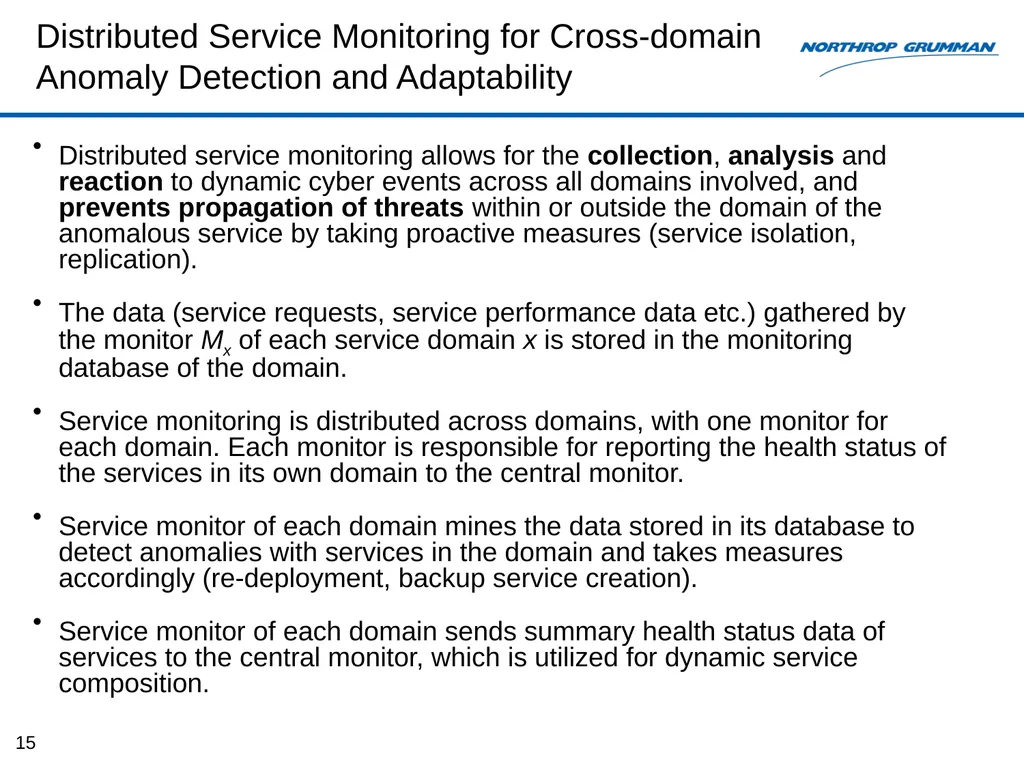
Distributed Service Monitoring for Cross-domain Anomaly Detection and Adaptability Distributed service monitoring allows for the collection, analysis and reaction to dynamic cyber events across all domains involved, and prevents propagation of threats within or outside the domain of the anomalous service by taking proactive measures (service isolation, replication).
The data (service requests, service performance data etc.) gathered by the monitor Mx of each service domain x is stored in the monitoring database of the domain.
Service monitoring is distributed across domains, with one monitor for each domain. Each monitor is responsible for reporting the health status of the services in its own domain to the central monitor.
Service monitor of each domain mines the data stored in its database to detect anomalies with services in the domain and takes measures accordingly (re-deployment, backup service creation).
Service monitor of each domain sends summary health status data of services to the central monitor, which is utilized for dynamic service composition. 15<br>
The data (service requests, service performance data etc.) gathered by the monitor Mx of each service domain x is stored in the monitoring database of the domain.
Service monitoring is distributed across domains, with one monitor for each domain. Each monitor is responsible for reporting the health status of the services in its own domain to the central monitor.
Service monitor of each domain mines the data stored in its database to detect anomalies with services in the domain and takes measures accordingly (re-deployment, backup service creation).
Service monitor of each domain sends summary health status data of services to the central monitor, which is utilized for dynamic service composition. 15<br>
16
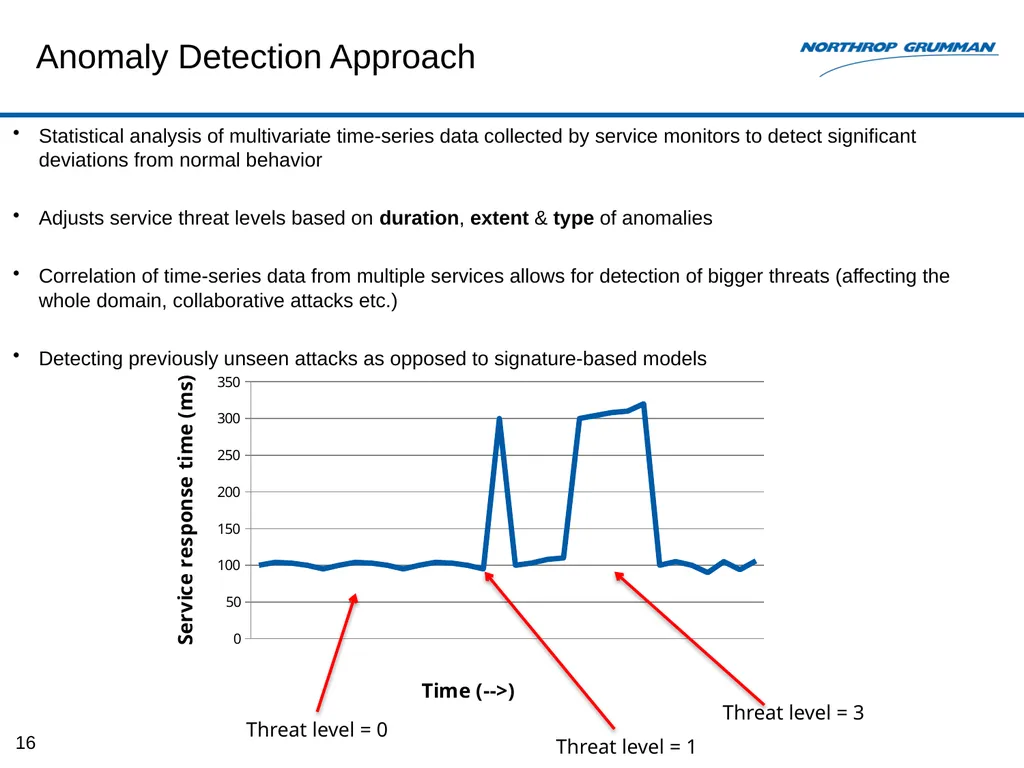
Anomaly Detection Approach Statistical analysis of multivariate time-series data collected by service monitors to detect significant deviations from normal behavior
Adjusts service threat levels based on duration, extent & type of anomalies
Correlation of time-series data from multiple services allows for detection of bigger threats (affecting the whole domain, collaborative attacks etc.)
Detecting previously unseen attacks as opposed to signature-based models Threat level = 0 Threat level = 1 Threat level = 3 16<br>
Adjusts service threat levels based on duration, extent & type of anomalies
Correlation of time-series data from multiple services allows for detection of bigger threats (affecting the whole domain, collaborative attacks etc.)
Detecting previously unseen attacks as opposed to signature-based models Threat level = 0 Threat level = 1 Threat level = 3 16<br>
17
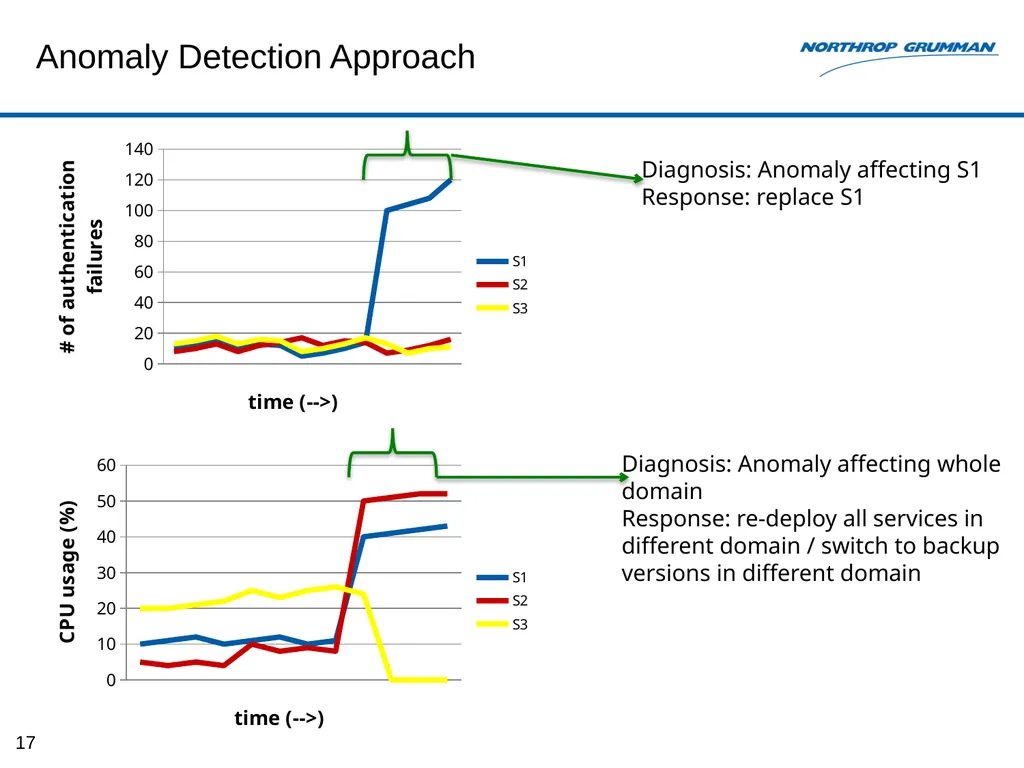
Anomaly Detection Approach Diagnosis: Anomaly affecting S1
Response: replace S1 Diagnosis: Anomaly affecting whole
domain
Response: re-deploy all services in
different domain / switch to backup
versions in different domain 17<br>
Response: replace S1 Diagnosis: Anomaly affecting whole
domain
Response: re-deploy all services in
different domain / switch to backup
versions in different domain 17<br>
18
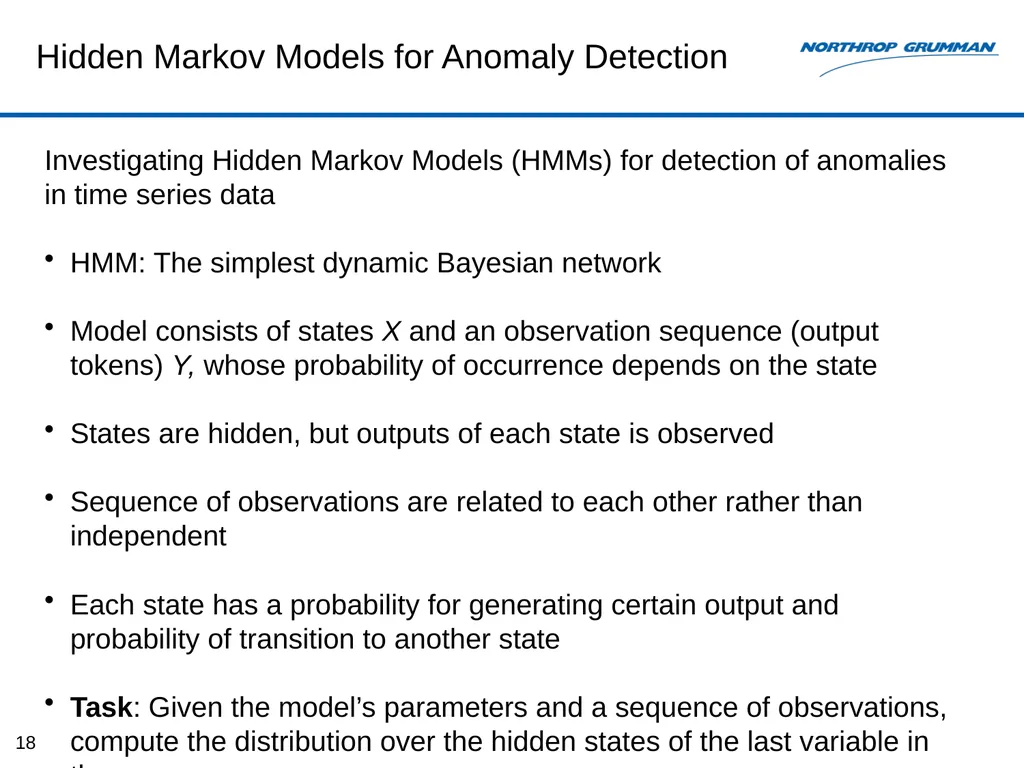
Hidden Markov Models for Anomaly Detection Investigating Hidden Markov Models (HMMs) for detection of anomalies in time series data
HMM: The simplest dynamic Bayesian network
Model consists of states X and an observation sequence (output tokens) Y, whose probability of occurrence depends on the state
States are hidden, but outputs of each state is observed
Sequence of observations are related to each other rather than independent
Each state has a probability for generating certain output and probability of transition to another state
Task: Given the model’s parameters and a sequence of observations, compute the distribution over the hidden states of the last variable in the sequence 18<br>
HMM: The simplest dynamic Bayesian network
Model consists of states X and an observation sequence (output tokens) Y, whose probability of occurrence depends on the state
States are hidden, but outputs of each state is observed
Sequence of observations are related to each other rather than independent
Each state has a probability for generating certain output and probability of transition to another state
Task: Given the model’s parameters and a sequence of observations, compute the distribution over the hidden states of the last variable in the sequence 18<br>
19
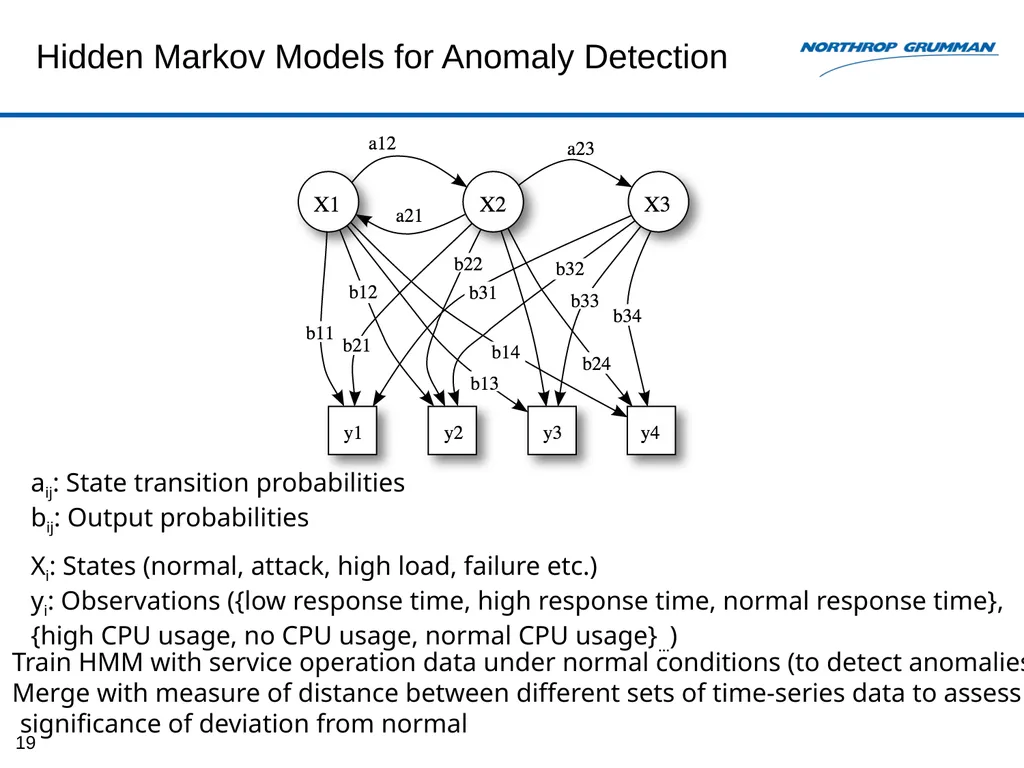
Hidden Markov Models for Anomaly Detection aij: State transition probabilities
bij: Output probabilities
Xi: States (normal, attack, high load, failure etc.)
yi: Observations ({low response time, high response time, normal response time},
{high CPU usage, no CPU usage, normal CPU usage}…) Train HMM with service operation data under normal conditions (to detect anomalies)
Merge with measure of distance between different sets of time-series data to assess
significance of deviation from normal 19<br>
bij: Output probabilities
Xi: States (normal, attack, high load, failure etc.)
yi: Observations ({low response time, high response time, normal response time},
{high CPU usage, no CPU usage, normal CPU usage}…) Train HMM with service operation data under normal conditions (to detect anomalies)
Merge with measure of distance between different sets of time-series data to assess
significance of deviation from normal 19<br>
20
Hot Re-deployment of Failed/Compromised Services The service monitor of each domain stores a copy of each service implementation in its domain in a repository, so they can be re-deployed in case of failure.
Problems in the request of a failed service are also detected by the service monitor, which can redirect the request to a backup service with the same capability if one exists (otherwise re-deployment process is initiated)
Services in “failed” status (upon detection by the monitor) are replaced with a fresh copy from the repository, and their “deployment time” field in the database is updated to the time of deployment.
In case of detection of a possible service anomaly, the service monitor can initiate a backup service deployment in the same domain or in another domain (such as a cloud application server).
Service deployment takes place through copying the service bundle from the repository into the target service domain.
Upon service deployment, all relevant information about the new service is logged in the service monitor’s database. The dynamic service composition module utilizes this data to determine whether the service will be part of a specific orchestration. 20<br>
Problems in the request of a failed service are also detected by the service monitor, which can redirect the request to a backup service with the same capability if one exists (otherwise re-deployment process is initiated)
Services in “failed” status (upon detection by the monitor) are replaced with a fresh copy from the repository, and their “deployment time” field in the database is updated to the time of deployment.
In case of detection of a possible service anomaly, the service monitor can initiate a backup service deployment in the same domain or in another domain (such as a cloud application server).
Service deployment takes place through copying the service bundle from the repository into the target service domain.
Upon service deployment, all relevant information about the new service is logged in the service monitor’s database. The dynamic service composition module utilizes this data to determine whether the service will be part of a specific orchestration. 20<br>
21
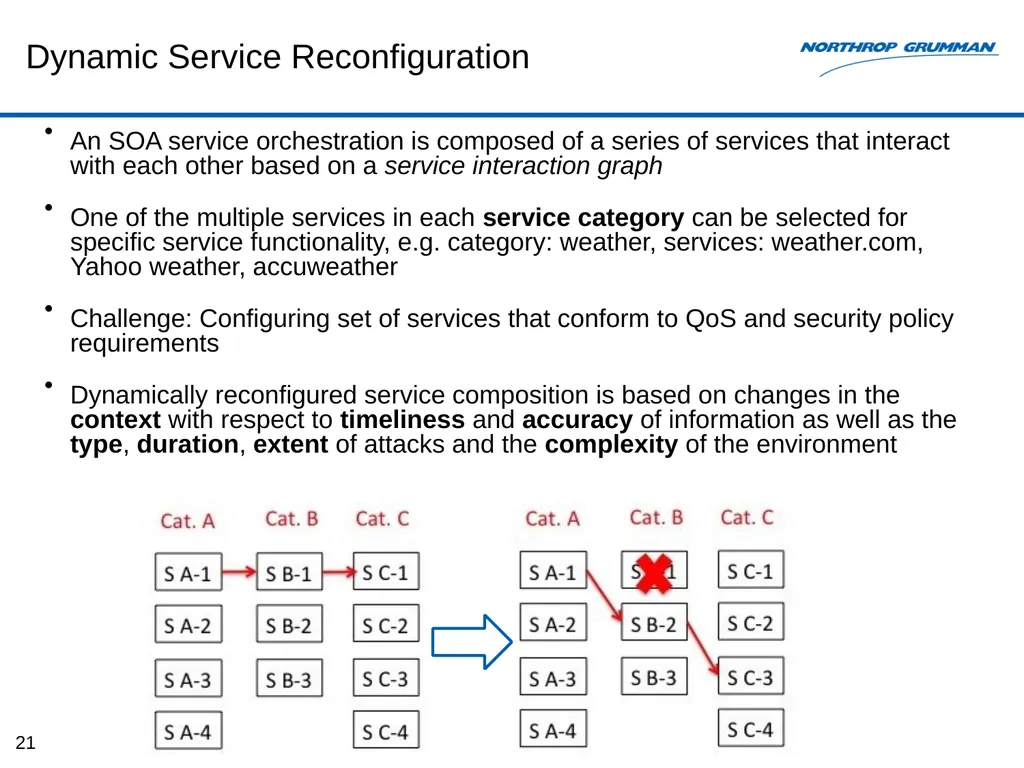
Dynamic Service Reconfiguration An SOA service orchestration is composed of a series of services that interact with each other based on a service interaction graph
One of the multiple services in each service category can be selected for specific service functionality, e.g. category: weather, services: weather.com, Yahoo weather, accuweather
Challenge: Configuring set of services that conform to QoS and security policy requirements
Dynamically reconfigured service composition is based on changes in the context with respect to timeliness and accuracy of information as well as the type, duration, extent of attacks and the complexity of the environment 21<br>
One of the multiple services in each service category can be selected for specific service functionality, e.g. category: weather, services: weather.com, Yahoo weather, accuweather
Challenge: Configuring set of services that conform to QoS and security policy requirements
Dynamically reconfigured service composition is based on changes in the context with respect to timeliness and accuracy of information as well as the type, duration, extent of attacks and the complexity of the environment 21<br>
22
Dynamic Service Reconfiguration Developed a module that dynamically determines the service endpoints involved in a specific composition
Given the description of a business process (service composition) including the categories of the services involved in the process, the dynamic service composition module updates the process with specific service endpoints to be utilized in that process.
The dynamic service composition mechanism allows services meeting specific requirements to be included in a composition
Utilizes service and interaction data logged in the central database to create the best possible composition given a service request with policy specifications
Enables the dynamic replacement of failed services in a composition with services of equivalent capability to prevent interruption of tasks
Dynamic replacement of service endpoints implemented in compliance with the BPEL standard for service composition, using dynamic partner links
Apache ODE engine used for the deployment of the composed processes 22<br>
Given the description of a business process (service composition) including the categories of the services involved in the process, the dynamic service composition module updates the process with specific service endpoints to be utilized in that process.
The dynamic service composition mechanism allows services meeting specific requirements to be included in a composition
Utilizes service and interaction data logged in the central database to create the best possible composition given a service request with policy specifications
Enables the dynamic replacement of failed services in a composition with services of equivalent capability to prevent interruption of tasks
Dynamic replacement of service endpoints implemented in compliance with the BPEL standard for service composition, using dynamic partner links
Apache ODE engine used for the deployment of the composed processes 22<br>
23
Dynamic Service Composition Approach The problem is an instance of the multiple-choice multiply-constrained knapsack problem (MMKP):
tij: utility of service j in category i
xij: indicator for participation in a service composition (of service j in category i)
cijk: value of service j in category i for constraint category k
Ck: threshold value for constraint category k
Si: set of services in category i p: number of constraints m: number of service categories
MMKP is NP-hard, therefore we use a greedy heuristic-based approach to find near-optimal solutions 23<br>
tij: utility of service j in category i
xij: indicator for participation in a service composition (of service j in category i)
cijk: value of service j in category i for constraint category k
Ck: threshold value for constraint category k
Si: set of services in category i p: number of constraints m: number of service categories
MMKP is NP-hard, therefore we use a greedy heuristic-based approach to find near-optimal solutions 23<br>
24
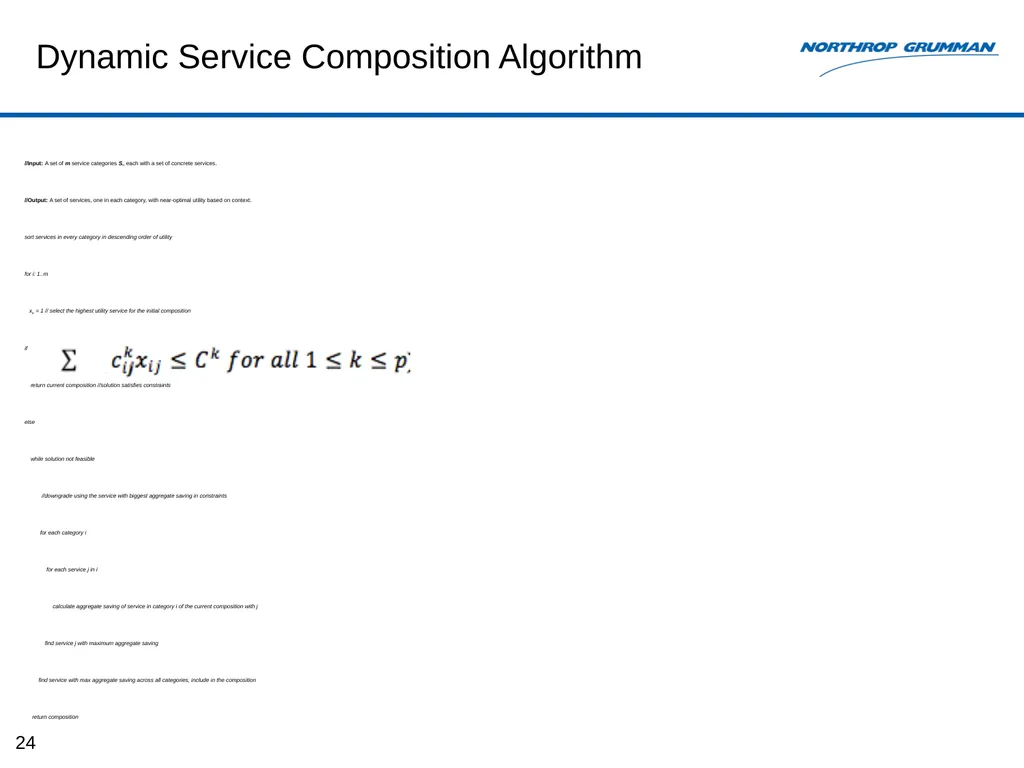
Dynamic Service Composition Algorithm //Input: A set of m service categories Si, each with a set of concrete services.
//Output: A set of services, one in each category, with near-optimal utility based on context.
sort services in every category in descending order of utility
for i: 1..m
xi1 = 1 // select the highest utility service for the initial composition
if
return current composition //solution satisfies constraints
else
while solution not feasible
//downgrade using the service with biggest aggregate saving in constraints
for each category i
for each service j in i
calculate aggregate saving of service in category i of the current composition with j
find service j with maximum aggregate saving
find service with max aggregate saving across all categories, include in the composition
return composition 24<br>
//Output: A set of services, one in each category, with near-optimal utility based on context.
sort services in every category in descending order of utility
for i: 1..m
xi1 = 1 // select the highest utility service for the initial composition
if
return current composition //solution satisfies constraints
else
while solution not feasible
//downgrade using the service with biggest aggregate saving in constraints
for each category i
for each service j in i
calculate aggregate saving of service in category i of the current composition with j
find service j with maximum aggregate saving
find service with max aggregate saving across all categories, include in the composition
return composition 24<br>
25
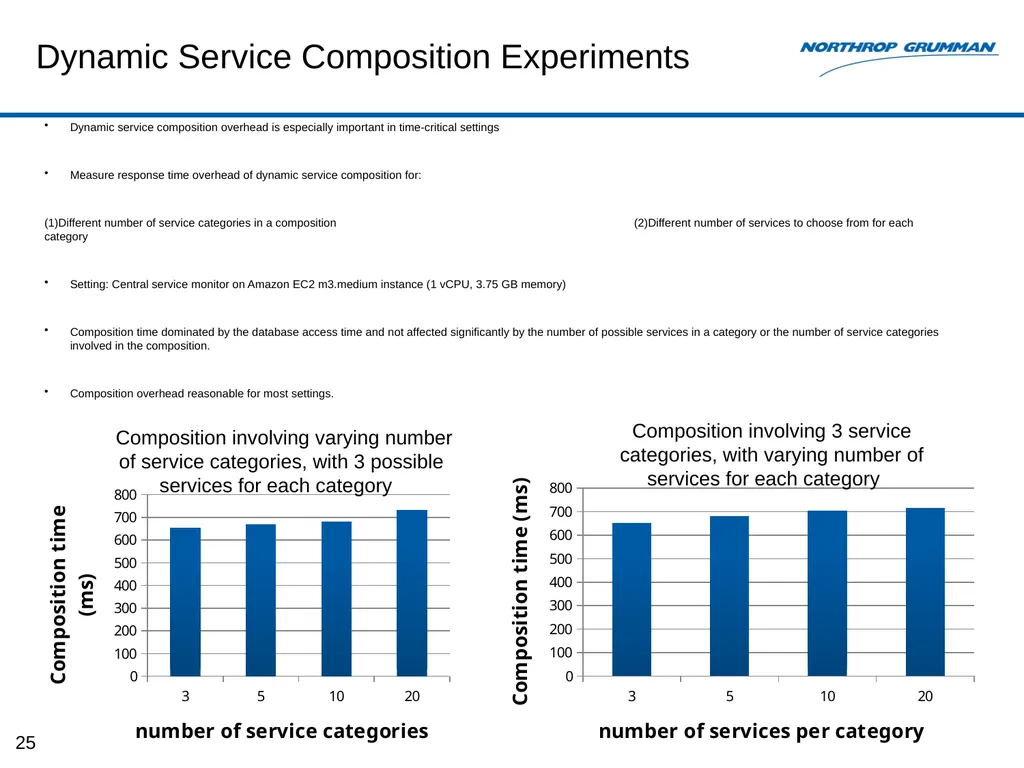
Dynamic Service Composition Experiments Dynamic service composition overhead is especially important in time-critical settings
Measure response time overhead of dynamic service composition for:
(1)Different number of service categories in a composition (2)Different number of services to choose from for each category
Setting: Central service monitor on Amazon EC2 m3.medium instance (1 vCPU, 3.75 GB memory)
Composition time dominated by the database access time and not affected significantly by the number of possible services in a category or the number of service categories involved in the composition.
Composition overhead reasonable for most settings. Composition involving varying number
of service categories, with 3 possible
services for each category Composition involving 3 service categories, with varying number of
services for each category 25<br>
Measure response time overhead of dynamic service composition for:
(1)Different number of service categories in a composition (2)Different number of services to choose from for each category
Setting: Central service monitor on Amazon EC2 m3.medium instance (1 vCPU, 3.75 GB memory)
Composition time dominated by the database access time and not affected significantly by the number of possible services in a category or the number of service categories involved in the composition.
Composition overhead reasonable for most settings. Composition involving varying number
of service categories, with 3 possible
services for each category Composition involving 3 service categories, with varying number of
services for each category 25<br>
26
Adaptability Cost and Benefit Consideration Benefits:
Increased availability of services (measured by up-time and throughput)
Increased performance by obviating the need to restart invocations of service compositions with failed/attacked services (measured by total response time)
Increased security and flexibility in service composition based on priorities and constraints in a specific environment (measured by success of avoiding attacks)
Costs:
Dynamic service composition time cost
Cost to maintain central service monitor
Service response delay due to monitoring
Increased resource usage in service domain
Overhead of re-deploying service in same/different domain 26<br>
Increased availability of services (measured by up-time and throughput)
Increased performance by obviating the need to restart invocations of service compositions with failed/attacked services (measured by total response time)
Increased security and flexibility in service composition based on priorities and constraints in a specific environment (measured by success of avoiding attacks)
Costs:
Dynamic service composition time cost
Cost to maintain central service monitor
Service response delay due to monitoring
Increased resource usage in service domain
Overhead of re-deploying service in same/different domain 26<br>
27
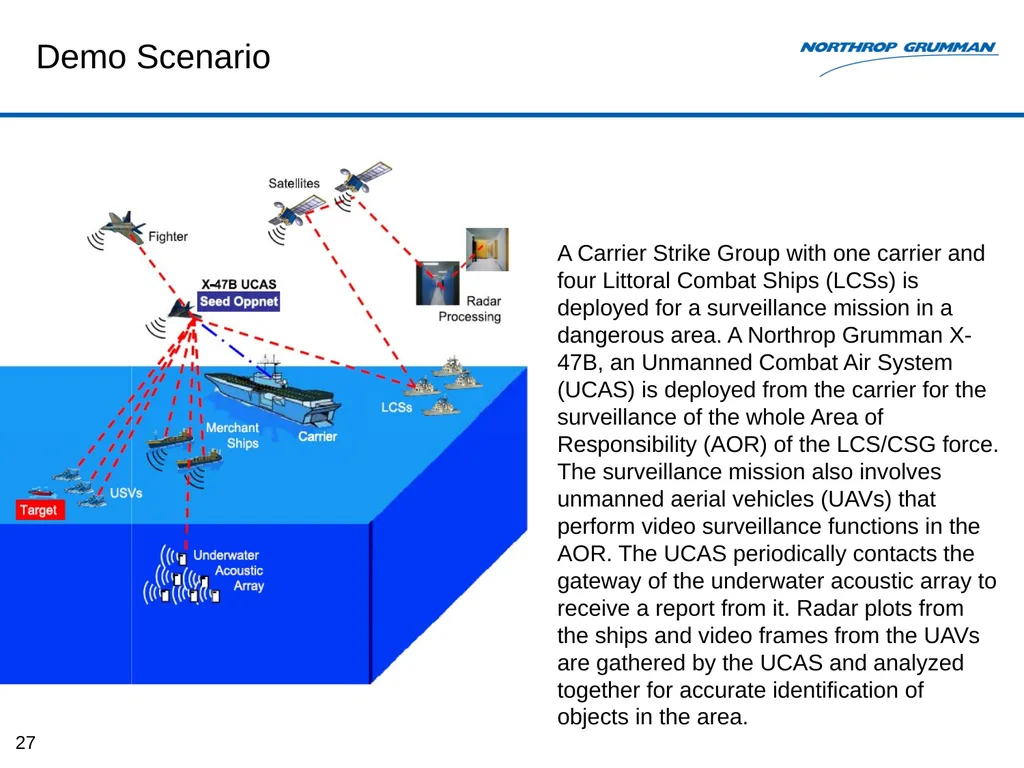
Demo Scenario A Carrier Strike Group with one carrier and four Littoral Combat Ships (LCSs) is deployed for a surveillance mission in a dangerous area. A Northrop Grumman X-47B, an Unmanned Combat Air System (UCAS) is deployed from the carrier for the surveillance of the whole Area of Responsibility (AOR) of the LCS/CSG force. The surveillance mission also involves unmanned aerial vehicles (UAVs) that perform video surveillance functions in the AOR. The UCAS periodically contacts the gateway of the underwater acoustic array to receive a report from it. Radar plots from the ships and video frames from the UAVs are gathered by the UCAS and analyzed together for accurate identification of objects in the area. 27<br>
28
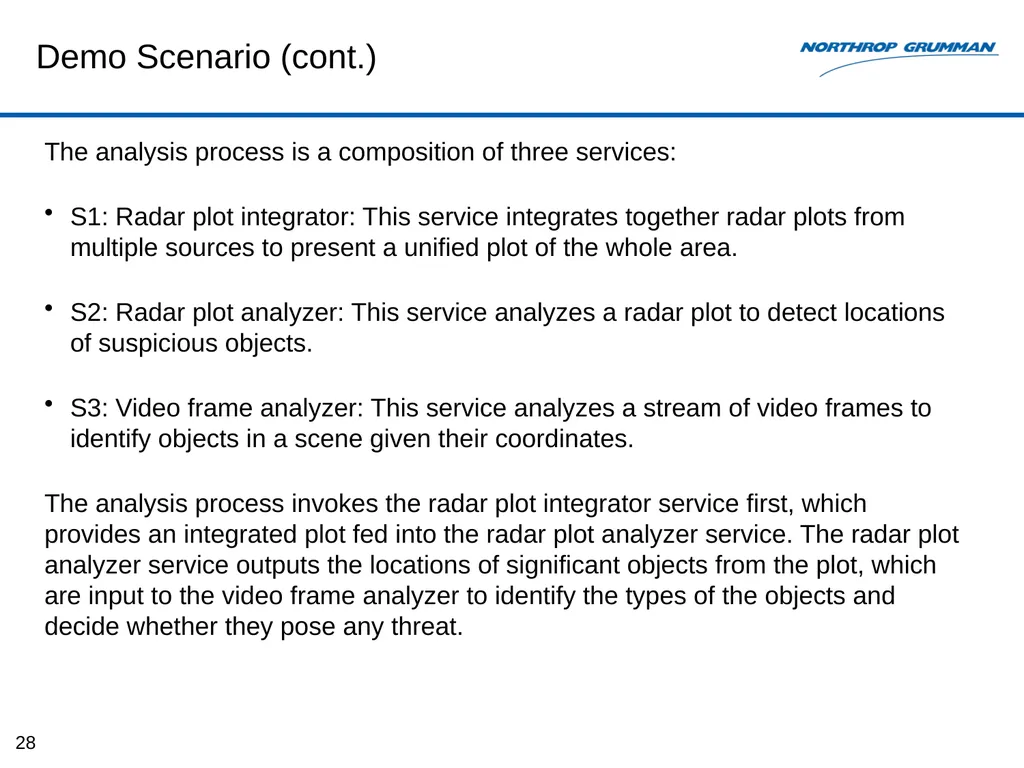
Demo Scenario (cont.) The analysis process is a composition of three services:
S1: Radar plot integrator: This service integrates together radar plots from multiple sources to present a unified plot of the whole area.
S2: Radar plot analyzer: This service analyzes a radar plot to detect locations of suspicious objects.
S3: Video frame analyzer: This service analyzes a stream of video frames to identify objects in a scene given their coordinates.
The analysis process invokes the radar plot integrator service first, which provides an integrated plot fed into the radar plot analyzer service. The radar plot analyzer service outputs the locations of significant objects from the plot, which are input to the video frame analyzer to identify the types of the objects and decide whether they pose any threat. 28<br>
S1: Radar plot integrator: This service integrates together radar plots from multiple sources to present a unified plot of the whole area.
S2: Radar plot analyzer: This service analyzes a radar plot to detect locations of suspicious objects.
S3: Video frame analyzer: This service analyzes a stream of video frames to identify objects in a scene given their coordinates.
The analysis process invokes the radar plot integrator service first, which provides an integrated plot fed into the radar plot analyzer service. The radar plot analyzer service outputs the locations of significant objects from the plot, which are input to the video frame analyzer to identify the types of the objects and decide whether they pose any threat. 28<br>
29
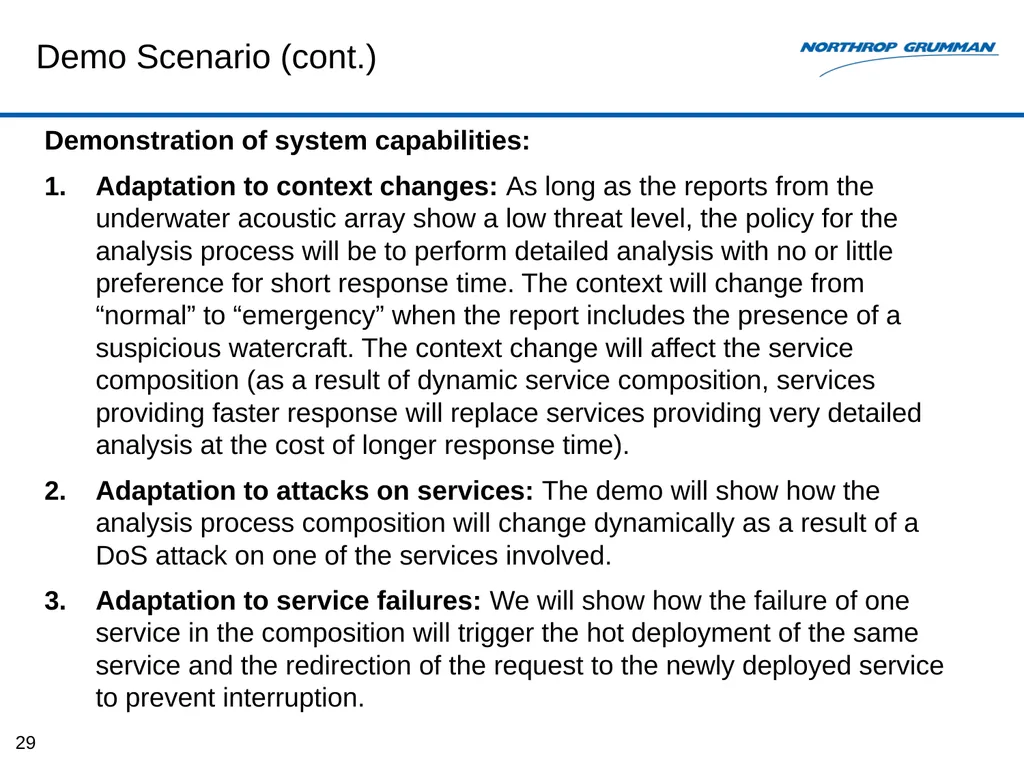
Demo Scenario (cont.) Demonstration of system capabilities:
Adaptation to context changes: As long as the reports from the underwater acoustic array show a low threat level, the policy for the analysis process will be to perform detailed analysis with no or little preference for short response time. The context will change from “normal” to “emergency” when the report includes the presence of a suspicious watercraft. The context change will affect the service composition (as a result of dynamic service composition, services providing faster response will replace services providing very detailed analysis at the cost of longer response time).
Adaptation to attacks on services: The demo will show how the analysis process composition will change dynamically as a result of a DoS attack on one of the services involved.
Adaptation to service failures: We will show how the failure of one service in the composition will trigger the hot deployment of the same service and the redirection of the request to the newly deployed service to prevent interruption. 29<br>
Adaptation to context changes: As long as the reports from the underwater acoustic array show a low threat level, the policy for the analysis process will be to perform detailed analysis with no or little preference for short response time. The context will change from “normal” to “emergency” when the report includes the presence of a suspicious watercraft. The context change will affect the service composition (as a result of dynamic service composition, services providing faster response will replace services providing very detailed analysis at the cost of longer response time).
Adaptation to attacks on services: The demo will show how the analysis process composition will change dynamically as a result of a DoS attack on one of the services involved.
Adaptation to service failures: We will show how the failure of one service in the composition will trigger the hot deployment of the same service and the redirection of the request to the newly deployed service to prevent interruption. 29<br>
30
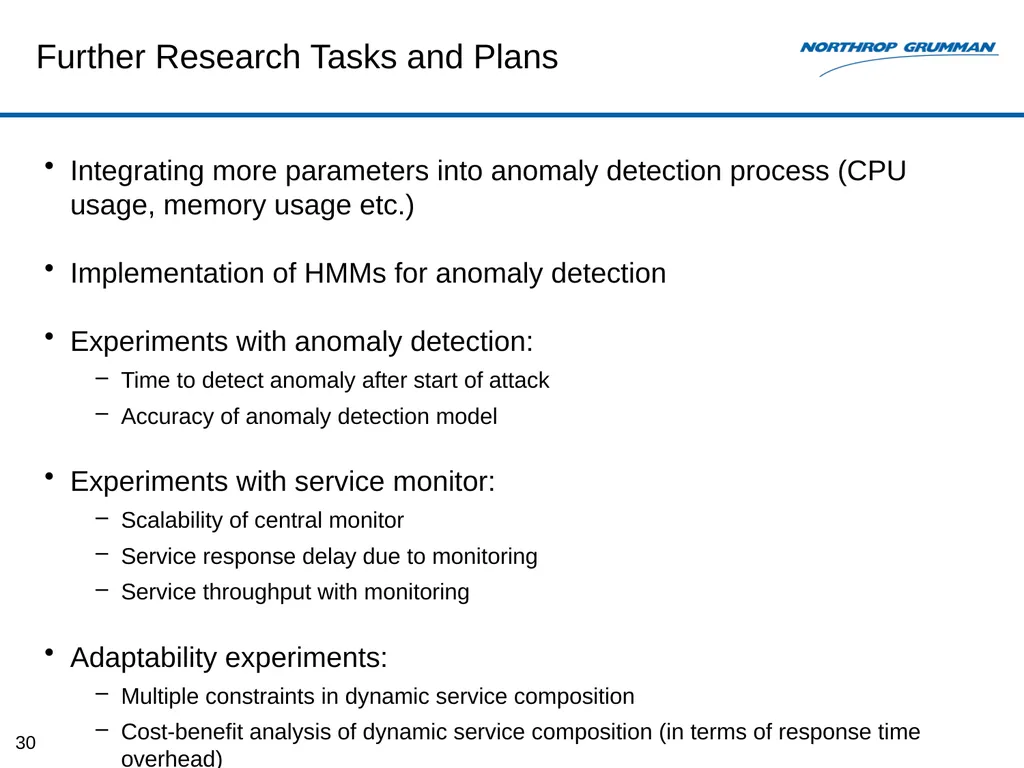
Further Research Tasks and Plans Integrating more parameters into anomaly detection process (CPU usage, memory usage etc.)
Implementation of HMMs for anomaly detection
Experiments with anomaly detection:
Time to detect anomaly after start of attack
Accuracy of anomaly detection model
Experiments with service monitor:
Scalability of central monitor
Service response delay due to monitoring
Service throughput with monitoring
Adaptability experiments:
Multiple constraints in dynamic service composition
Cost-benefit analysis of dynamic service composition (in terms of response time overhead)
Overhead of re-deploying service in same/different domain 30<br>
Implementation of HMMs for anomaly detection
Experiments with anomaly detection:
Time to detect anomaly after start of attack
Accuracy of anomaly detection model
Experiments with service monitor:
Scalability of central monitor
Service response delay due to monitoring
Service throughput with monitoring
Adaptability experiments:
Multiple constraints in dynamic service composition
Cost-benefit analysis of dynamic service composition (in terms of response time overhead)
Overhead of re-deploying service in same/different domain 30<br>
31
Privacy Preserving
Data Dissemination
in SOA 31<br>
Data Dissemination
in SOA 31<br>
32
Problem Statement Composite Web services
Loosely coupled independent RESTful services composed to accomplish a task
A composite service invocation translates into multiple interactions that may share user data
Opaque data sharing across unknown endpoints beyond primary service
Undetected privacy violations due to data sharing with unauthorized services
Lack of policy infrastructure
Inability of owner to specify data access policies for secondary services authorization
Policy definition, communication, evaluation and enforcement
Message-based security mechanisms (HTTPS) are not applicable
Provides point-to-point secure communication
Unable to provide protection in remote domains 32<br>
Loosely coupled independent RESTful services composed to accomplish a task
A composite service invocation translates into multiple interactions that may share user data
Opaque data sharing across unknown endpoints beyond primary service
Undetected privacy violations due to data sharing with unauthorized services
Lack of policy infrastructure
Inability of owner to specify data access policies for secondary services authorization
Policy definition, communication, evaluation and enforcement
Message-based security mechanisms (HTTPS) are not applicable
Provides point-to-point secure communication
Unable to provide protection in remote domains 32<br>
33
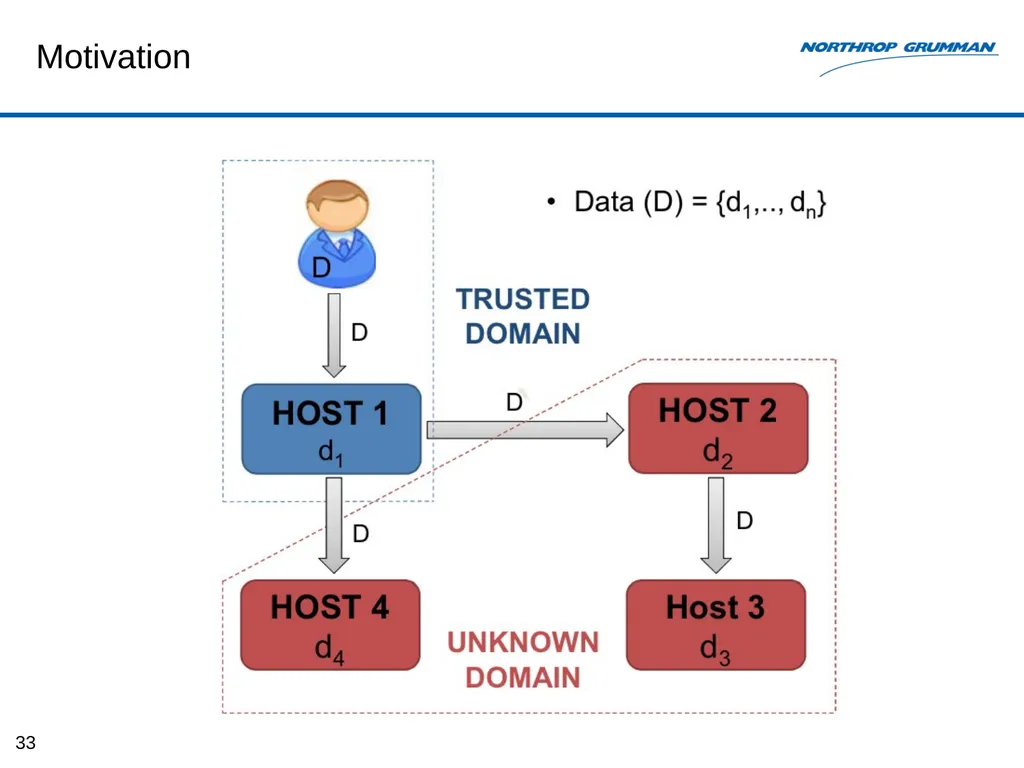
Motivation 33<br>
34
Research Objectives Demonstrate policy-based distributed data dissemination
Demonstrate distributed policy communication, evaluation and enforcement framework
Demonstrate scenarios for controlled cross-domain information exchange under various anomalies and attacks 34<br>
Demonstrate distributed policy communication, evaluation and enforcement framework
Demonstrate scenarios for controlled cross-domain information exchange under various anomalies and attacks 34<br>
35
Research Tasks How to ensure that each authorized subscriber service only accesses the data for which it is authorized
How to prohibit data dissemination to an unauthorized subscriber service
Demonstrate applications (such as Electronic Healthcare Records, UAVs) under different data dissemination models:
Publish-Subscribe
Peer-to-Peer
Mutable (interacting services can update data and policies in Active Bundle)
Immutable
Demonstrate compatibility with existing service infrastructure such as RESTful services (HTTP) 35<br>
How to prohibit data dissemination to an unauthorized subscriber service
Demonstrate applications (such as Electronic Healthcare Records, UAVs) under different data dissemination models:
Publish-Subscribe
Peer-to-Peer
Mutable (interacting services can update data and policies in Active Bundle)
Immutable
Demonstrate compatibility with existing service infrastructure such as RESTful services (HTTP) 35<br>
36
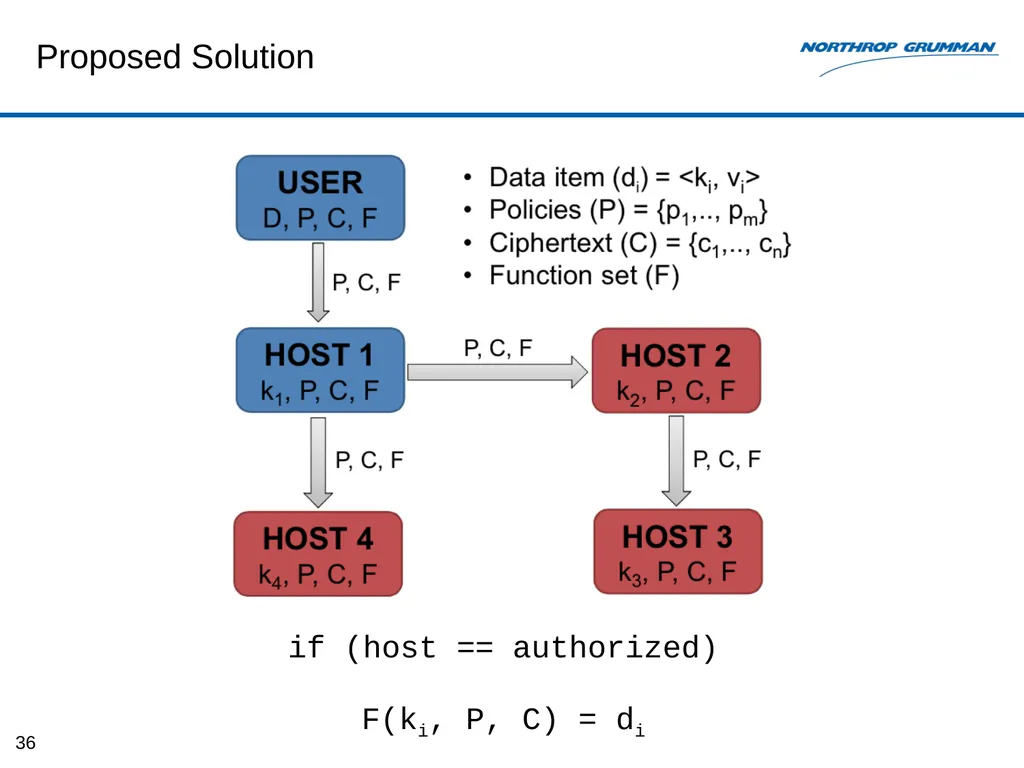
Proposed Solution if (host == authorized)
F(ki, P, C) = di 36<br>
F(ki, P, C) = di 36<br>
37
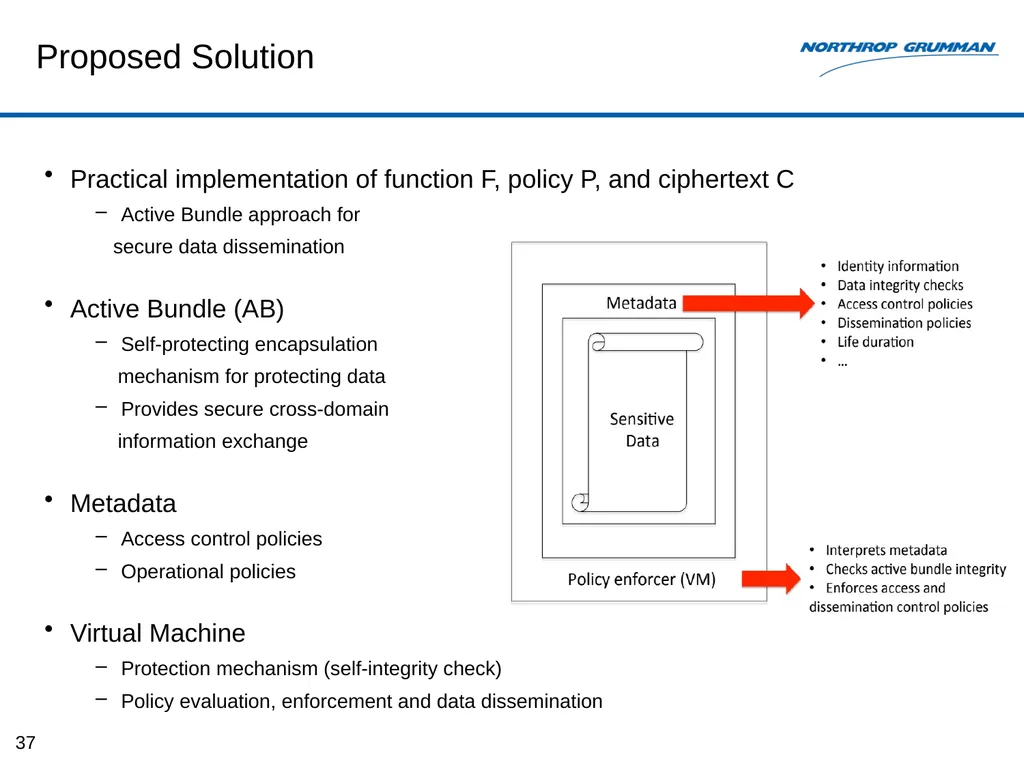
Proposed Solution Practical implementation of function F, policy P, and ciphertext C
Active Bundle approach for
secure data dissemination
Active Bundle (AB)
Self-protecting encapsulation
mechanism for protecting data
Provides secure cross-domain
information exchange
Metadata
Access control policies
Operational policies
Virtual Machine
Protection mechanism (self-integrity check)
Policy evaluation, enforcement and data dissemination 37<br>
Active Bundle approach for
secure data dissemination
Active Bundle (AB)
Self-protecting encapsulation
mechanism for protecting data
Provides secure cross-domain
information exchange
Metadata
Access control policies
Operational policies
Virtual Machine
Protection mechanism (self-integrity check)
Policy evaluation, enforcement and data dissemination 37<br>
38
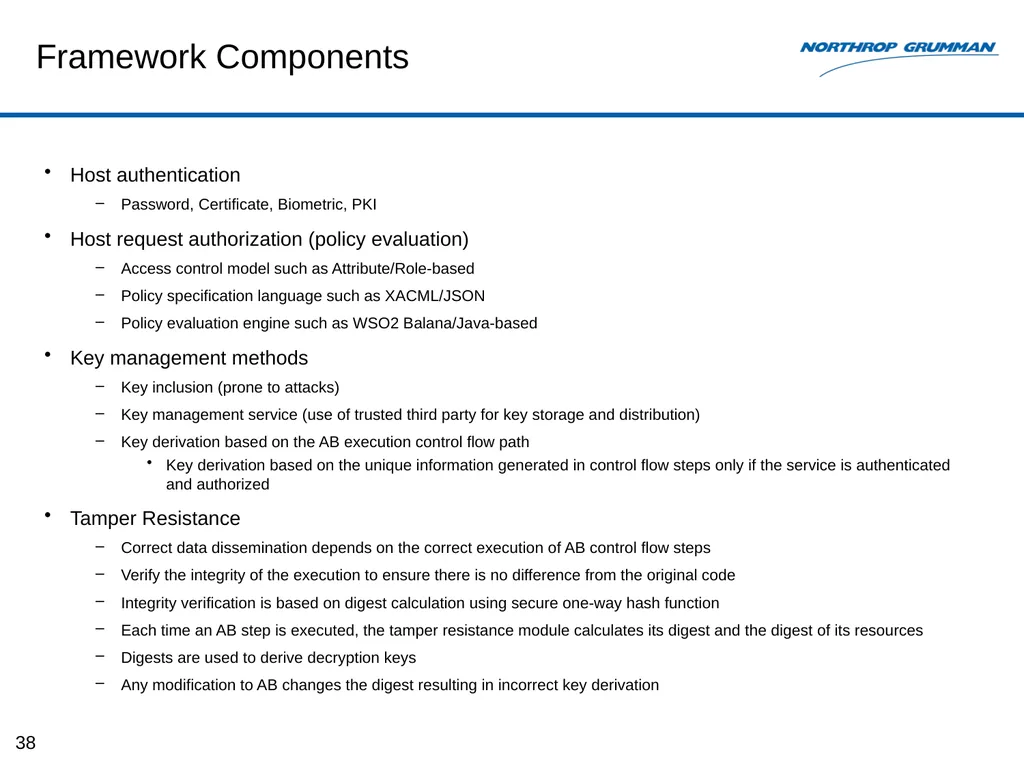
Framework Components Host authentication
Password, Certificate, Biometric, PKI
Host request authorization (policy evaluation)
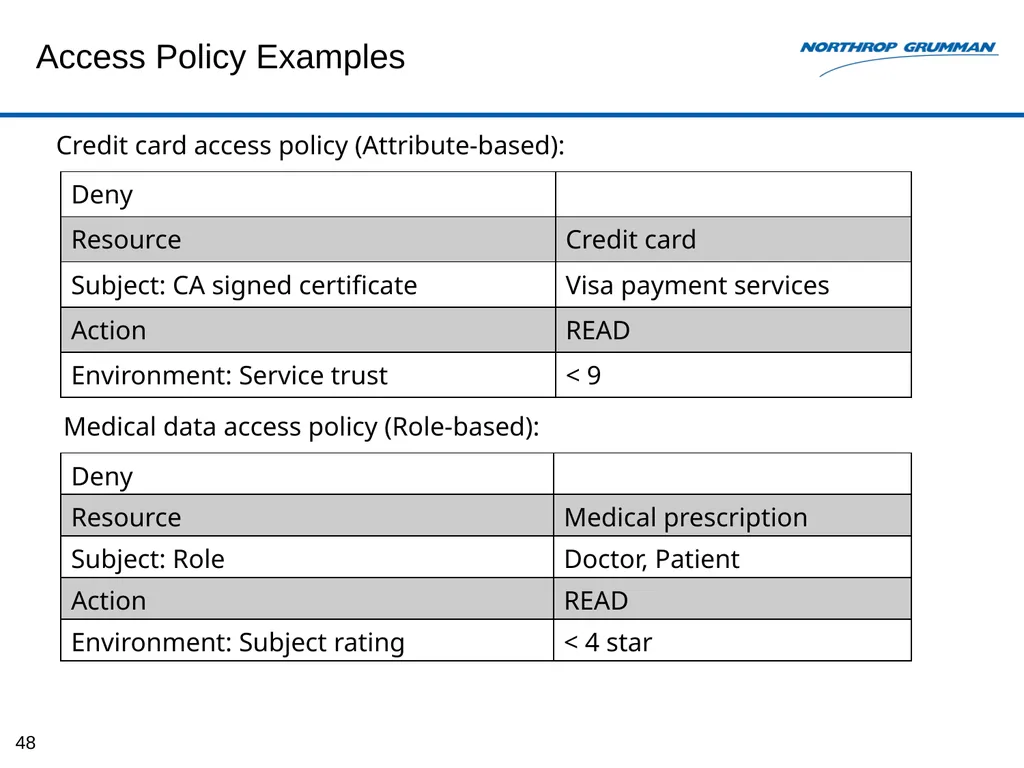
Access control model such as Attribute/Role-based
Policy specification language such as XACML/JSON
Policy evaluation engine such as WSO2 Balana/Java-based
Key management methods
Key inclusion (prone to attacks)
Key management service (use of trusted third party for key storage and distribution)
Key derivation based on the AB execution control flow path
Key derivation based on the unique information generated in control flow steps only if the service is authenticated and authorized
Tamper Resistance
Correct data dissemination depends on the correct execution of AB control flow steps
Verify the integrity of the execution to ensure there is no difference from the original code
Integrity verification is based on digest calculation using secure one-way hash function
Each time an AB step is executed, the tamper resistance module calculates its digest and the digest of its resources
Digests are used to derive decryption keys
Any modification to AB changes the digest resulting in incorrect key derivation 38<br>
Password, Certificate, Biometric, PKI
Host request authorization (policy evaluation)
Access control model such as Attribute/Role-based
Policy specification language such as XACML/JSON
Policy evaluation engine such as WSO2 Balana/Java-based
Key management methods
Key inclusion (prone to attacks)
Key management service (use of trusted third party for key storage and distribution)
Key derivation based on the AB execution control flow path
Key derivation based on the unique information generated in control flow steps only if the service is authenticated and authorized
Tamper Resistance
Correct data dissemination depends on the correct execution of AB control flow steps
Verify the integrity of the execution to ensure there is no difference from the original code
Integrity verification is based on digest calculation using secure one-way hash function
Each time an AB step is executed, the tamper resistance module calculates its digest and the digest of its resources
Digests are used to derive decryption keys
Any modification to AB changes the digest resulting in incorrect key derivation 38<br>
39
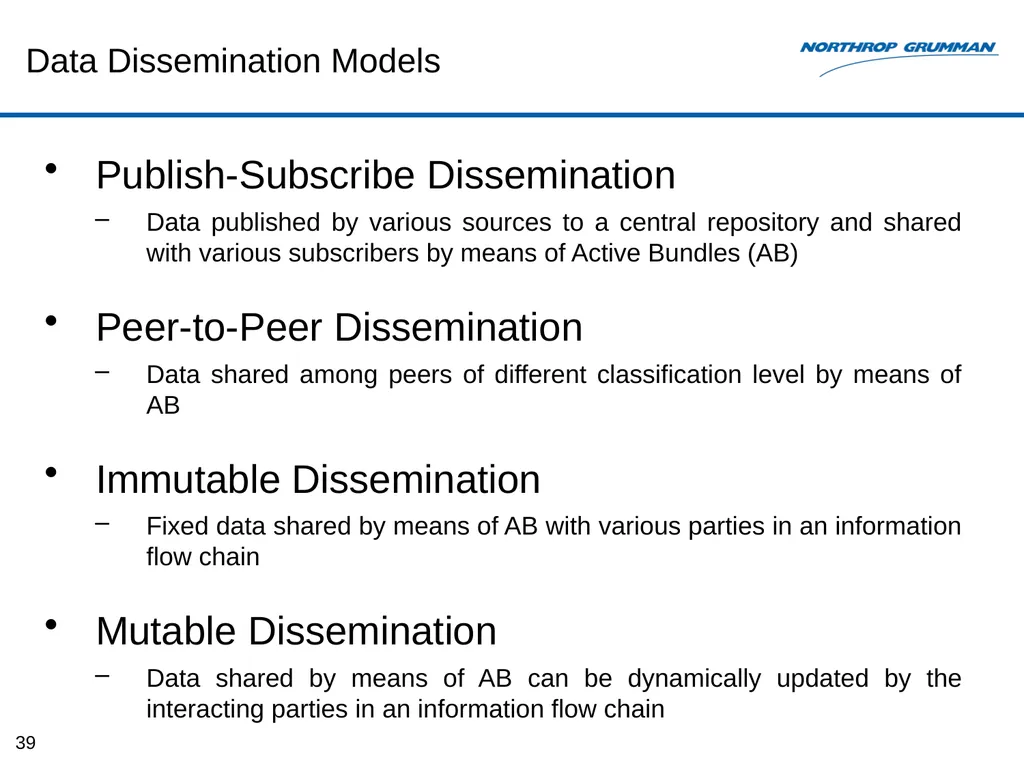
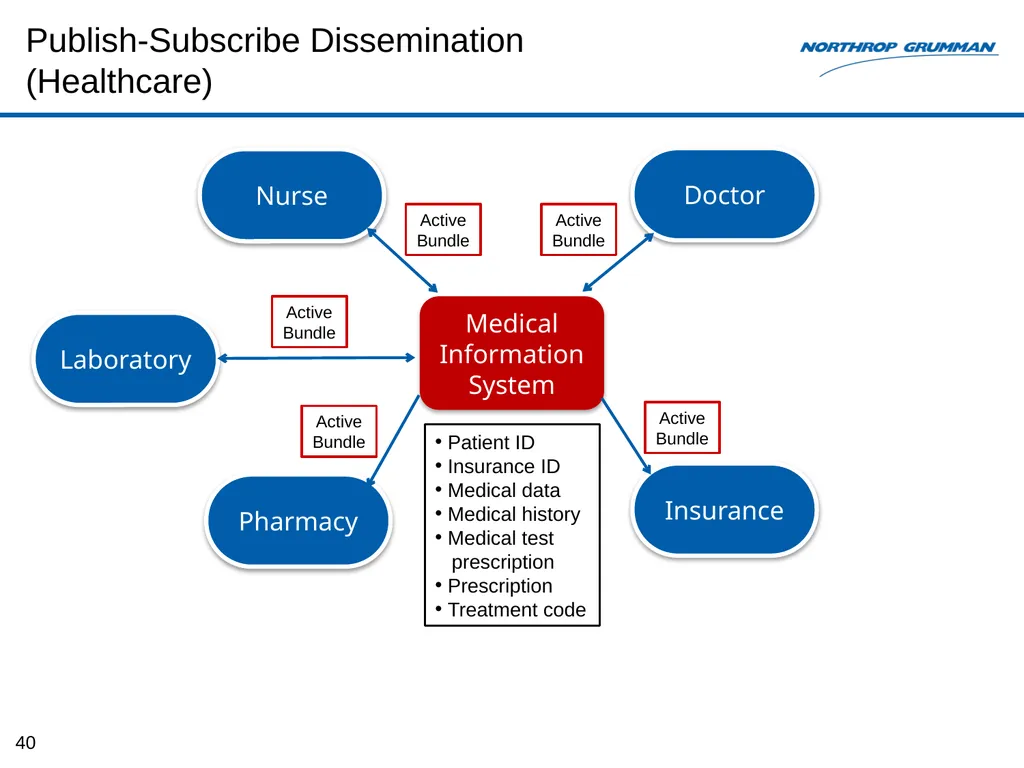
Data Dissemination Models Publish-Subscribe Dissemination
Data published by various sources to a central repository and shared with various subscribers by means of Active Bundles (AB)
Peer-to-Peer Dissemination
Data shared among peers of different classification level by means of AB
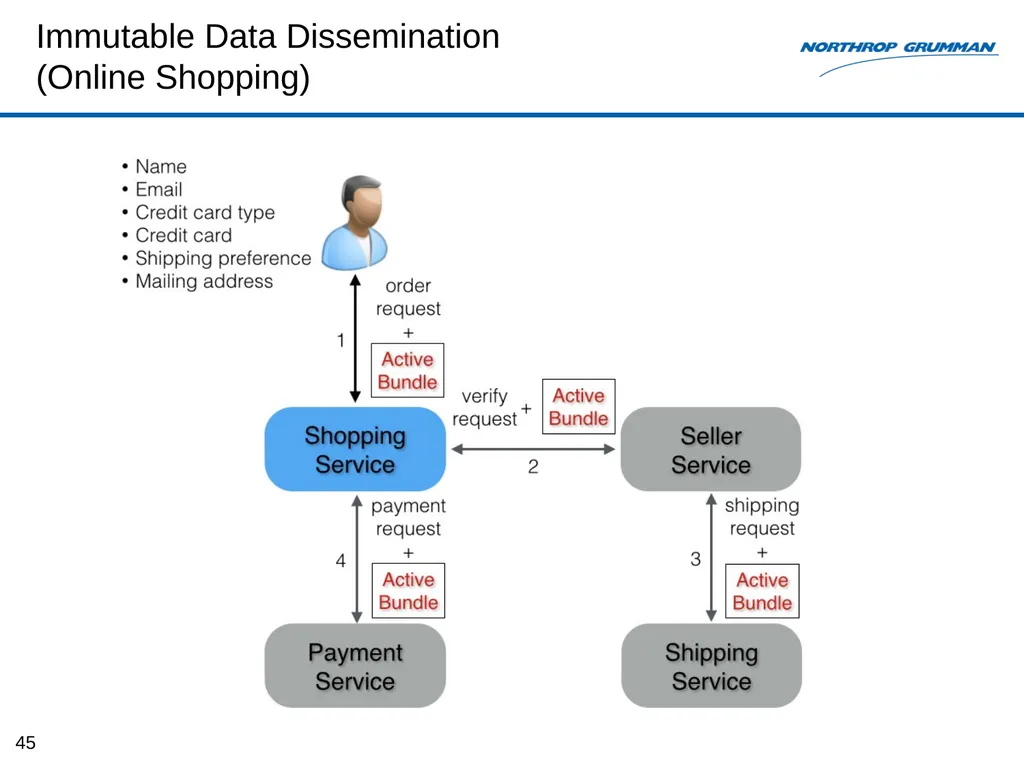
Immutable Dissemination
Fixed data shared by means of AB with various parties in an information flow chain
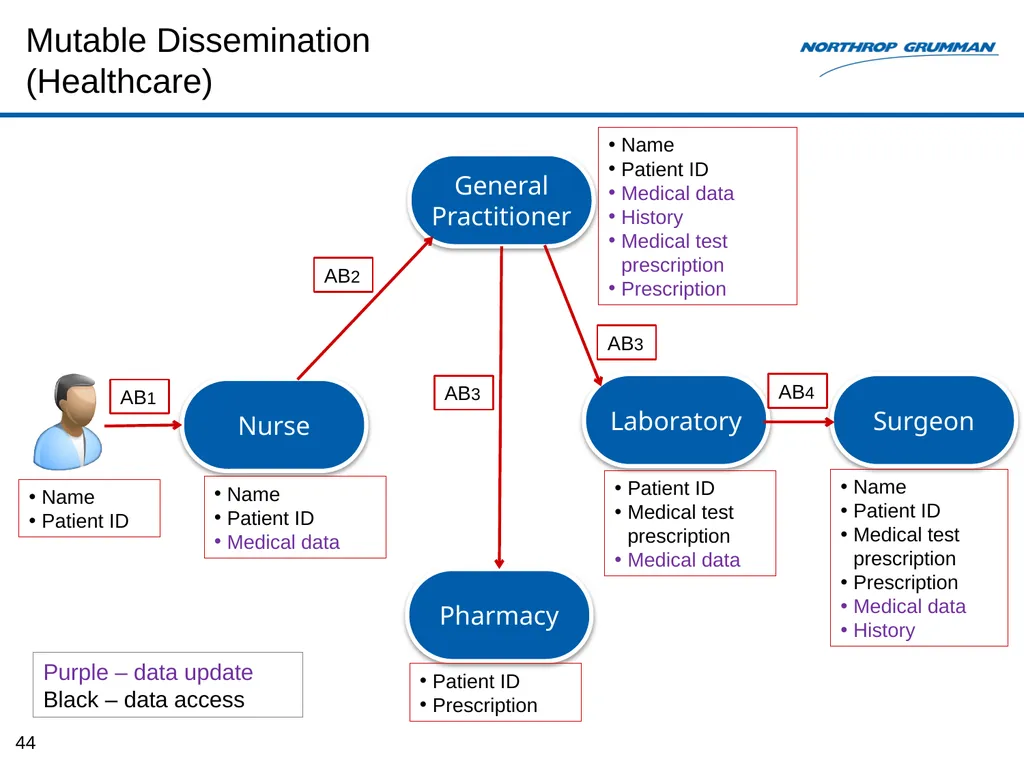
Mutable Dissemination
Data shared by means of AB can be dynamically updated by the interacting parties in an information flow chain 39<br>
Data published by various sources to a central repository and shared with various subscribers by means of Active Bundles (AB)
Peer-to-Peer Dissemination
Data shared among peers of different classification level by means of AB
Immutable Dissemination
Fixed data shared by means of AB with various parties in an information flow chain
Mutable Dissemination
Data shared by means of AB can be dynamically updated by the interacting parties in an information flow chain 39<br>
40
Publish-Subscribe Dissemination
(Healthcare) Pharmacy Insurance Doctor Nurse Laboratory Medical
Information
System Active
Bundle Patient ID
Insurance ID
Medical data
Medical history
Medical test
prescription
Prescription
Treatment code Active
Bundle Active
Bundle Active
Bundle Active
Bundle 40<br>
Information
System Active
Bundle Patient ID
Insurance ID
Medical data
Medical history
Medical test
prescription
Prescription
Treatment code Active
Bundle Active
Bundle Active
Bundle Active
Bundle 40<br>
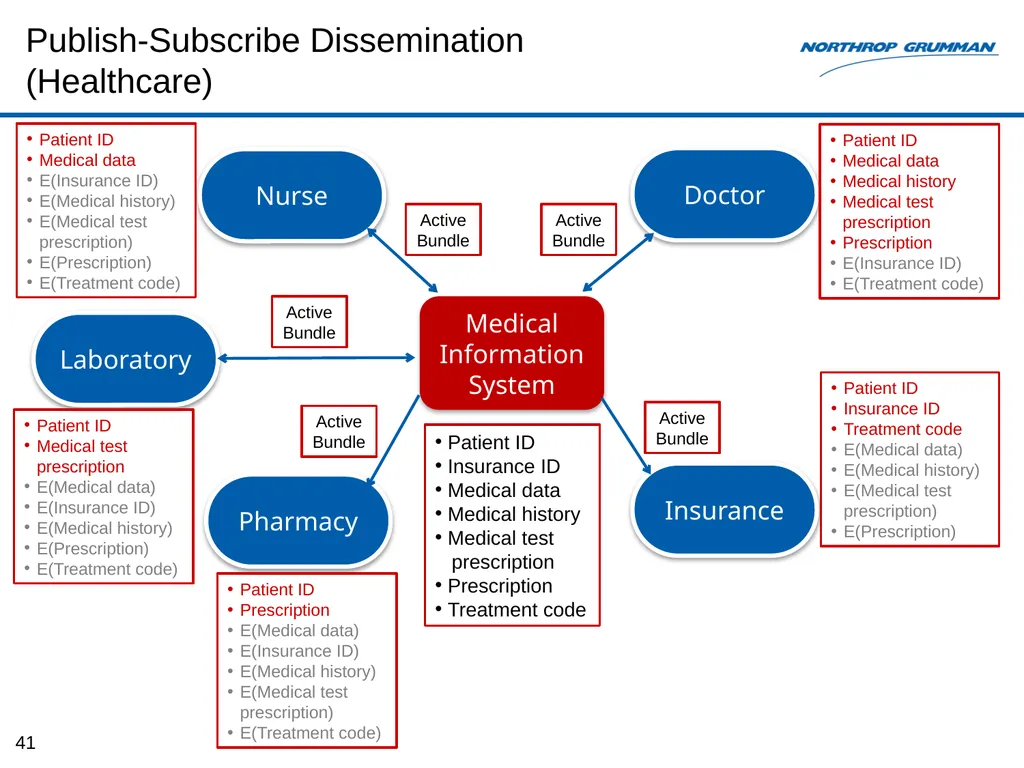
41
Publish-Subscribe Dissemination
(Healthcare) Pharmacy Insurance Doctor Nurse Laboratory Medical
Information
System Active
Bundle Patient ID
Insurance ID
Medical data
Medical history
Medical test
prescription
Prescription
Treatment code Active
Bundle Active
Bundle Active
Bundle Active
Bundle Patient ID
Medical data
E(Insurance ID)
E(Medical history)
E(Medical test prescription)
E(Prescription)
E(Treatment code) Patient ID
Medical data
Medical history
Medical test prescription
Prescription
E(Insurance ID)
E(Treatment code) Patient ID
Medical test prescription
E(Medical data)
E(Insurance ID)
E(Medical history)
E(Prescription)
E(Treatment code) Patient ID
Prescription
E(Medical data)
E(Insurance ID)
E(Medical history)
E(Medical test prescription)
E(Treatment code) Patient ID
Insurance ID
Treatment code
E(Medical data)
E(Medical history)
E(Medical test prescription)
E(Prescription) 41<br>
Information
System Active
Bundle Patient ID
Insurance ID
Medical data
Medical history
Medical test
prescription
Prescription
Treatment code Active
Bundle Active
Bundle Active
Bundle Active
Bundle Patient ID
Medical data
E(Insurance ID)
E(Medical history)
E(Medical test prescription)
E(Prescription)
E(Treatment code) Patient ID
Medical data
Medical history
Medical test prescription
Prescription
E(Insurance ID)
E(Treatment code) Patient ID
Medical test prescription
E(Medical data)
E(Insurance ID)
E(Medical history)
E(Prescription)
E(Treatment code) Patient ID
Prescription
E(Medical data)
E(Insurance ID)
E(Medical history)
E(Medical test prescription)
E(Treatment code) Patient ID
Insurance ID
Treatment code
E(Medical data)
E(Medical history)
E(Medical test prescription)
E(Prescription) 41<br>
42
Peer-to-Peer Dissemination
(UAVs) UAV 2 UAV 3 UAV 1 Command
& Control Top Secret Secret Confidential Unclassified Time period
Deployed personnel
Target locations
Intelligence reports
Mission expenses
Deployed weapons
Casualties
Press Release 42<br>
& Control Top Secret Secret Confidential Unclassified Time period
Deployed personnel
Target locations
Intelligence reports
Mission expenses
Deployed weapons
Casualties
Press Release 42<br>
43
Peer-to-Peer Dissemination
(UAVs) UAV 2 UAV 3 UAV 1 Command
& Control Top Secret Secret Confidential Unclassified Time period
Deployed personnel
Target locations
Intelligence reports
Mission expenses
Deployed weapons
Casualties
Press Release Time period
Deployed personnel
Target locations
Intelligence reports
Mission expenses
Deployed weapons
Casualties
Press Release Press Release Mission expenses
Press Release Target locations
Intelligence reports
Mission expenses
Deployed weapons
Press Release Infrared imagery
Location coordinates Multispectral imagery
Location coordinates 43<br>
& Control Top Secret Secret Confidential Unclassified Time period
Deployed personnel
Target locations
Intelligence reports
Mission expenses
Deployed weapons
Casualties
Press Release Time period
Deployed personnel
Target locations
Intelligence reports
Mission expenses
Deployed weapons
Casualties
Press Release Press Release Mission expenses
Press Release Target locations
Intelligence reports
Mission expenses
Deployed weapons
Press Release Infrared imagery
Location coordinates Multispectral imagery
Location coordinates 43<br>
44
Pharmacy Mutable Dissemination
(Healthcare) Surgeon General Practitioner Nurse Laboratory AB1 AB2 Name
Patient ID
Medical data Name
Patient ID Name
Patient ID
Medical data
History
Medical test prescription
Prescription Patient ID
Prescription AB3 AB3 Patient ID
Medical test prescription
Medical data AB4 Name
Patient ID
Medical test prescription
Prescription
Medical data
History Purple – data update
Black – data access 44<br>
Patient ID
Medical data Name
Patient ID Name
Patient ID
Medical data
History
Medical test prescription
Prescription Patient ID
Prescription AB3 AB3 Patient ID
Medical test prescription
Medical data AB4 Name
Patient ID
Medical test prescription
Prescription
Medical data
History Purple – data update
Black – data access 44<br>
45
Immutable Data Dissemination
(Online Shopping) 45<br>
46
Immutable Data Dissemination
(Online Shopping) 46<br>
47
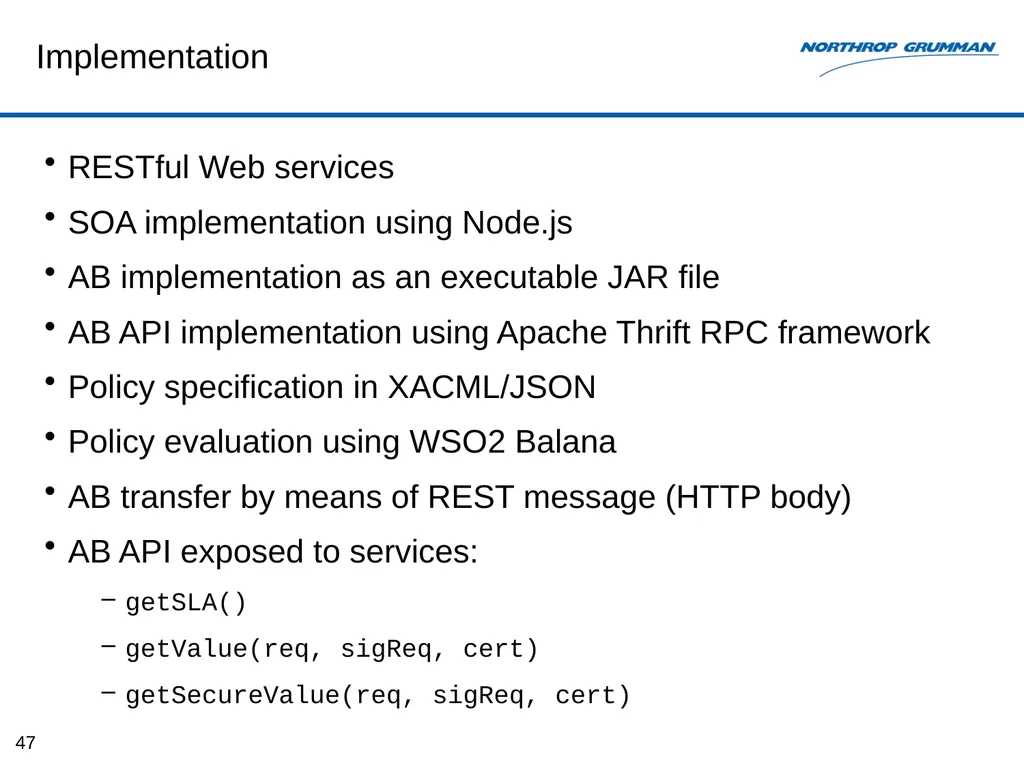
Implementation RESTful Web services
SOA implementation using Node.js
AB implementation as an executable JAR file
AB API implementation using Apache Thrift RPC framework
Policy specification in XACML/JSON
Policy evaluation using WSO2 Balana
AB transfer by means of REST message (HTTP body)
AB API exposed to services:
getSLA()
getValue(req, sigReq, cert)
getSecureValue(req, sigReq, cert) 47<br>
SOA implementation using Node.js
AB implementation as an executable JAR file
AB API implementation using Apache Thrift RPC framework
Policy specification in XACML/JSON
Policy evaluation using WSO2 Balana
AB transfer by means of REST message (HTTP body)
AB API exposed to services:
getSLA()
getValue(req, sigReq, cert)
getSecureValue(req, sigReq, cert) 47<br>
48
Access Policy Examples Credit card access policy (Attribute-based): Medical data access policy (Role-based): 48<br>
49
Access Policy Examples Cross-domain data access policy (Context-based): Medical data access policy (Context-based): 49<br>
50
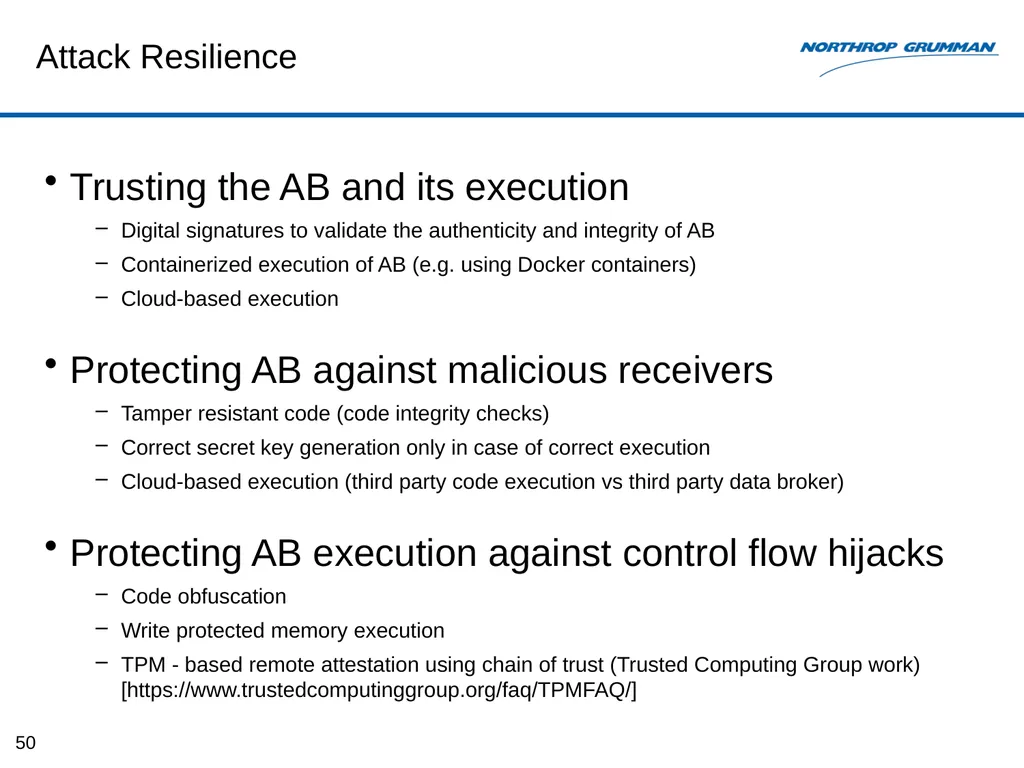
Attack Resilience Trusting the AB and its execution
Digital signatures to validate the authenticity and integrity of AB
Containerized execution of AB (e.g. using Docker containers)
Cloud-based execution
Protecting AB against malicious receivers
Tamper resistant code (code integrity checks)
Correct secret key generation only in case of correct execution
Cloud-based execution (third party code execution vs third party data broker)
Protecting AB execution against control flow hijacks
Code obfuscation
Write protected memory execution
TPM - based remote attestation using chain of trust (Trusted Computing Group work) [https://www.trustedcomputinggroup.org/faq/TPMFAQ/] 50<br>
Digital signatures to validate the authenticity and integrity of AB
Containerized execution of AB (e.g. using Docker containers)
Cloud-based execution
Protecting AB against malicious receivers
Tamper resistant code (code integrity checks)
Correct secret key generation only in case of correct execution
Cloud-based execution (third party code execution vs third party data broker)
Protecting AB execution against control flow hijacks
Code obfuscation
Write protected memory execution
TPM - based remote attestation using chain of trust (Trusted Computing Group work) [https://www.trustedcomputinggroup.org/faq/TPMFAQ/] 50<br>
51
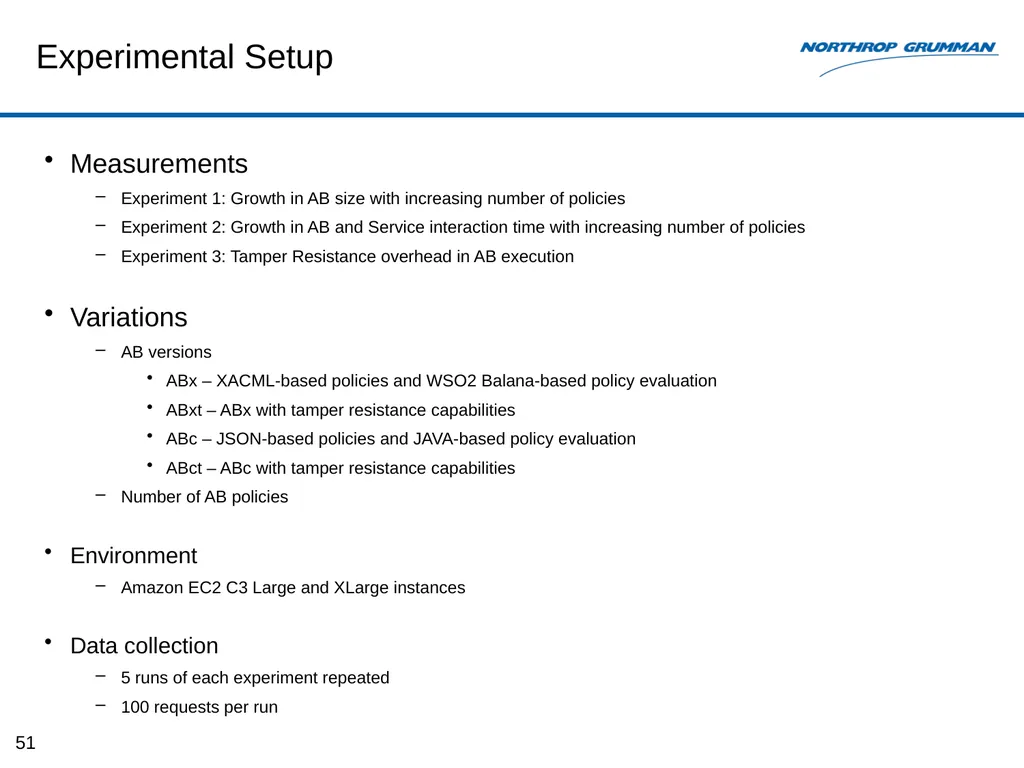
Experimental Setup Measurements
Experiment 1: Growth in AB size with increasing number of policies
Experiment 2: Growth in AB and Service interaction time with increasing number of policies
Experiment 3: Tamper Resistance overhead in AB execution
Variations
AB versions
ABx – XACML-based policies and WSO2 Balana-based policy evaluation
ABxt – ABx with tamper resistance capabilities
ABc – JSON-based policies and JAVA-based policy evaluation
ABct – ABc with tamper resistance capabilities
Number of AB policies
Environment
Amazon EC2 C3 Large and XLarge instances
Data collection
5 runs of each experiment repeated
100 requests per run 51<br>
Experiment 1: Growth in AB size with increasing number of policies
Experiment 2: Growth in AB and Service interaction time with increasing number of policies
Experiment 3: Tamper Resistance overhead in AB execution
Variations
AB versions
ABx – XACML-based policies and WSO2 Balana-based policy evaluation
ABxt – ABx with tamper resistance capabilities
ABc – JSON-based policies and JAVA-based policy evaluation
ABct – ABc with tamper resistance capabilities
Number of AB policies
Environment
Amazon EC2 C3 Large and XLarge instances
Data collection
5 runs of each experiment repeated
100 requests per run 51<br>
52
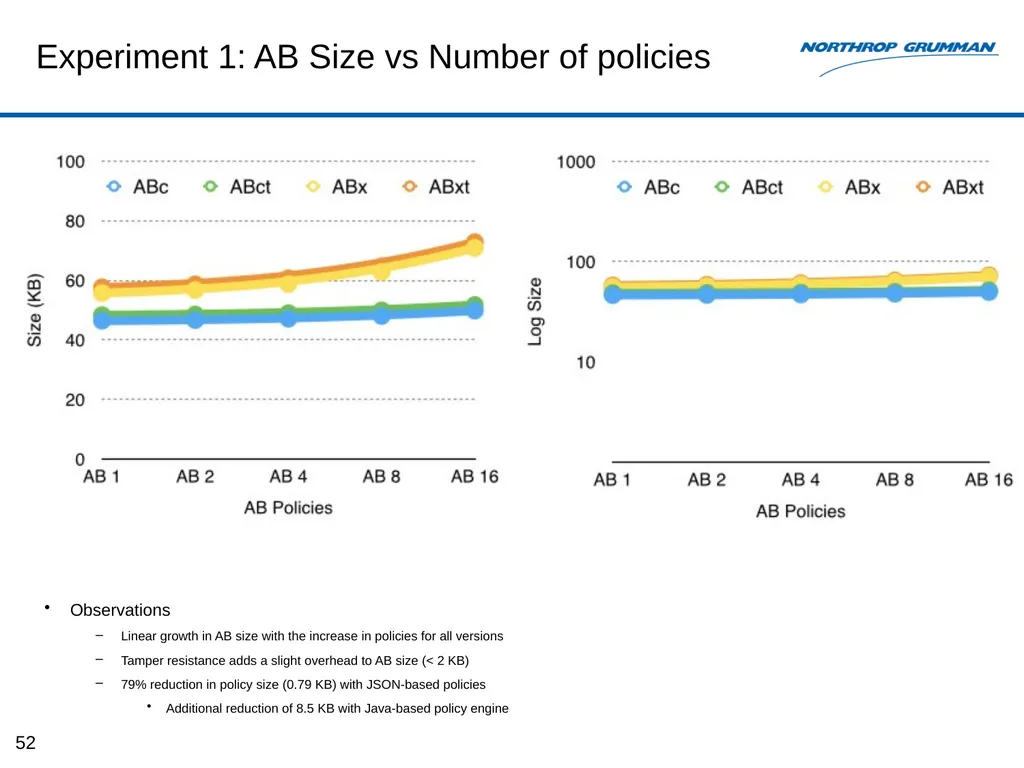
Experiment 1: AB Size vs Number of policies Observations
Linear growth in AB size with the increase in policies for all versions
Tamper resistance adds a slight overhead to AB size (< 2 KB)
79% reduction in policy size (0.79 KB) with JSON-based policies
Additional reduction of 8.5 KB with Java-based policy engine 52<br>
Linear growth in AB size with the increase in policies for all versions
Tamper resistance adds a slight overhead to AB size (< 2 KB)
79% reduction in policy size (0.79 KB) with JSON-based policies
Additional reduction of 8.5 KB with Java-based policy engine 52<br>
53
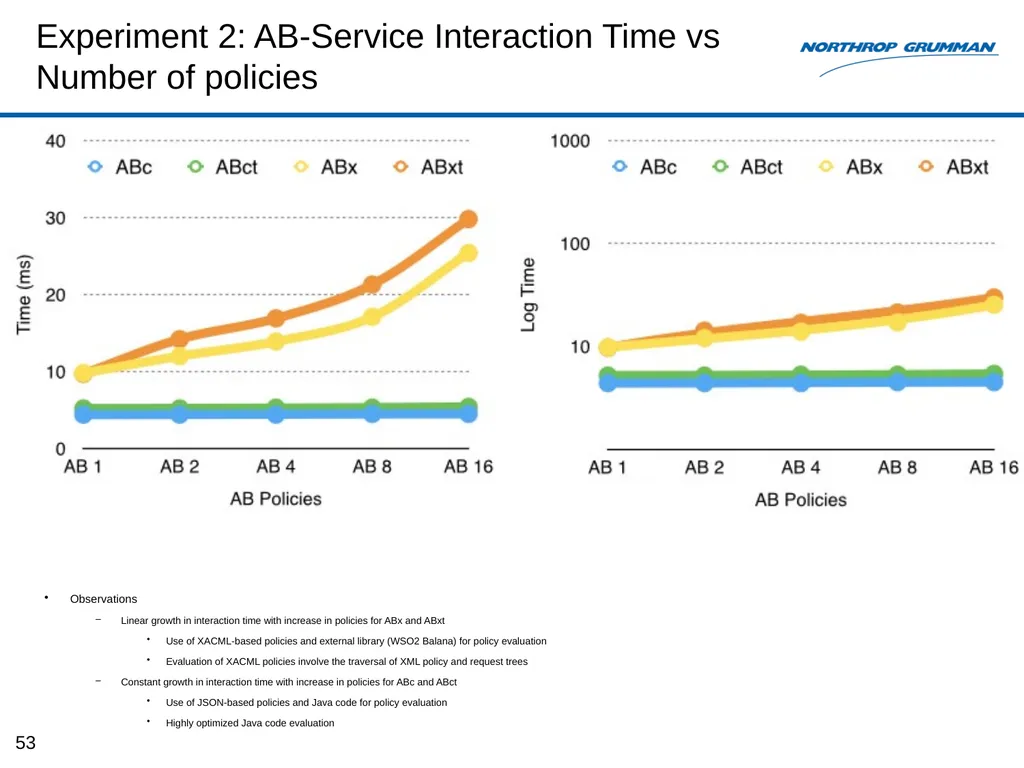
Experiment 2: AB-Service Interaction Time vs Number of policies growth in interaction time with
Observations
Linear growth in interaction time with increase in policies for ABx and ABxt
Use of XACML-based policies and external library (WSO2 Balana) for policy evaluation
Evaluation of XACML policies involve the traversal of XML policy and request trees
Constant growth in interaction time with increase in policies for ABc and ABct
Use of JSON-based policies and Java code for policy evaluation
Highly optimized Java code evaluation 53<br>
Observations
Linear growth in interaction time with increase in policies for ABx and ABxt
Use of XACML-based policies and external library (WSO2 Balana) for policy evaluation
Evaluation of XACML policies involve the traversal of XML policy and request trees
Constant growth in interaction time with increase in policies for ABc and ABct
Use of JSON-based policies and Java code for policy evaluation
Highly optimized Java code evaluation 53<br>
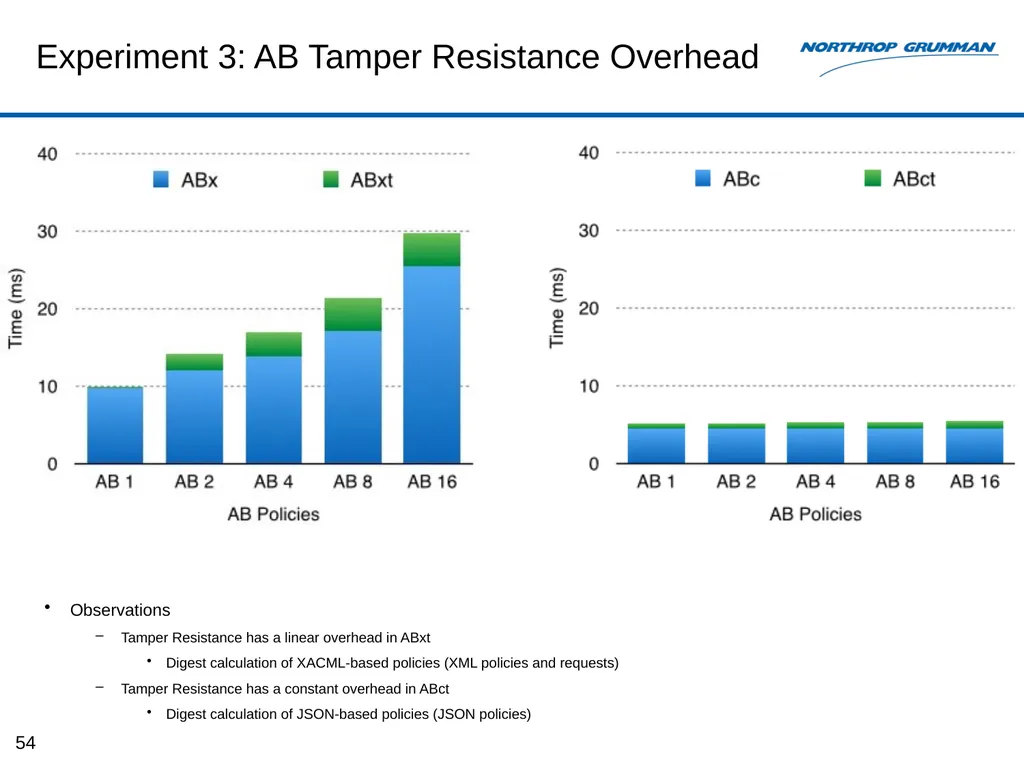
54
Experiment 3: AB Tamper Resistance Overhead Observations
Tamper Resistance has a linear overhead in ABxt
Digest calculation of XACML-based policies (XML policies and requests)
Tamper Resistance has a constant overhead in ABct
Digest calculation of JSON-based policies (JSON policies) 54<br>
Tamper Resistance has a linear overhead in ABxt
Digest calculation of XACML-based policies (XML policies and requests)
Tamper Resistance has a constant overhead in ABct
Digest calculation of JSON-based policies (JSON policies) 54<br>
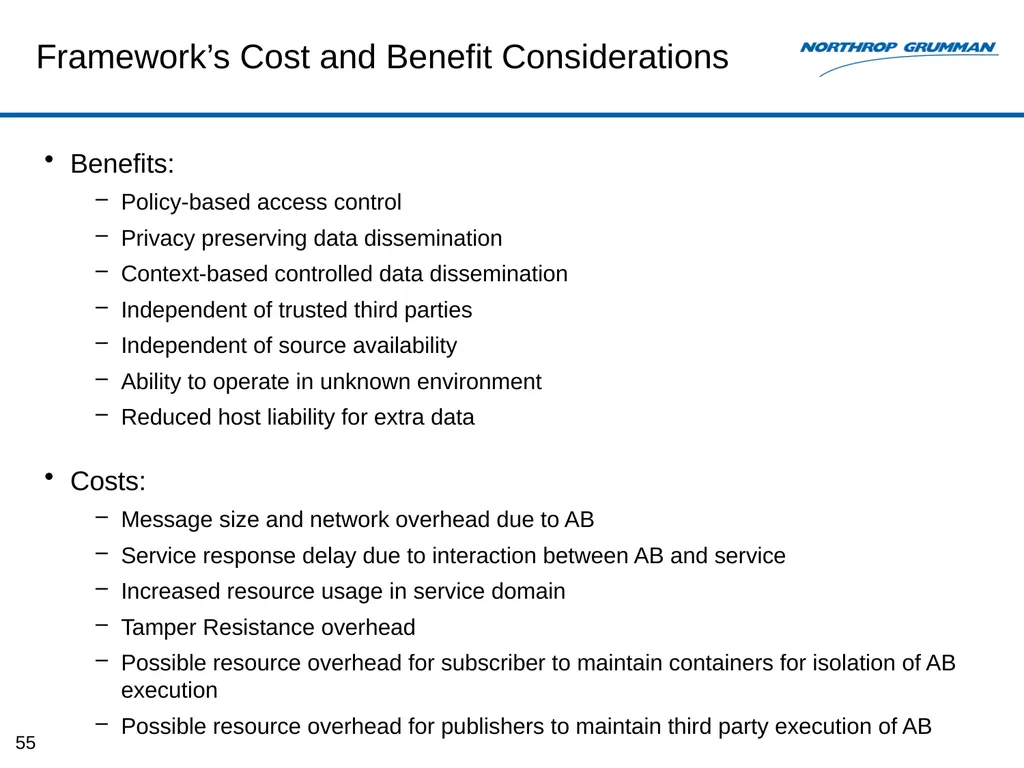
55
Framework’s Cost and Benefit Considerations Benefits:
Policy-based access control
Privacy preserving data dissemination
Context-based controlled data dissemination
Independent of trusted third parties
Independent of source availability
Ability to operate in unknown environment
Reduced host liability for extra data
Costs:
Message size and network overhead due to AB
Service response delay due to interaction between AB and service
Increased resource usage in service domain
Tamper Resistance overhead
Possible resource overhead for subscriber to maintain containers for isolation of AB execution
Possible resource overhead for publishers to maintain third party execution of AB 55<br>
Policy-based access control
Privacy preserving data dissemination
Context-based controlled data dissemination
Independent of trusted third parties
Independent of source availability
Ability to operate in unknown environment
Reduced host liability for extra data
Costs:
Message size and network overhead due to AB
Service response delay due to interaction between AB and service
Increased resource usage in service domain
Tamper Resistance overhead
Possible resource overhead for subscriber to maintain containers for isolation of AB execution
Possible resource overhead for publishers to maintain third party execution of AB 55<br>
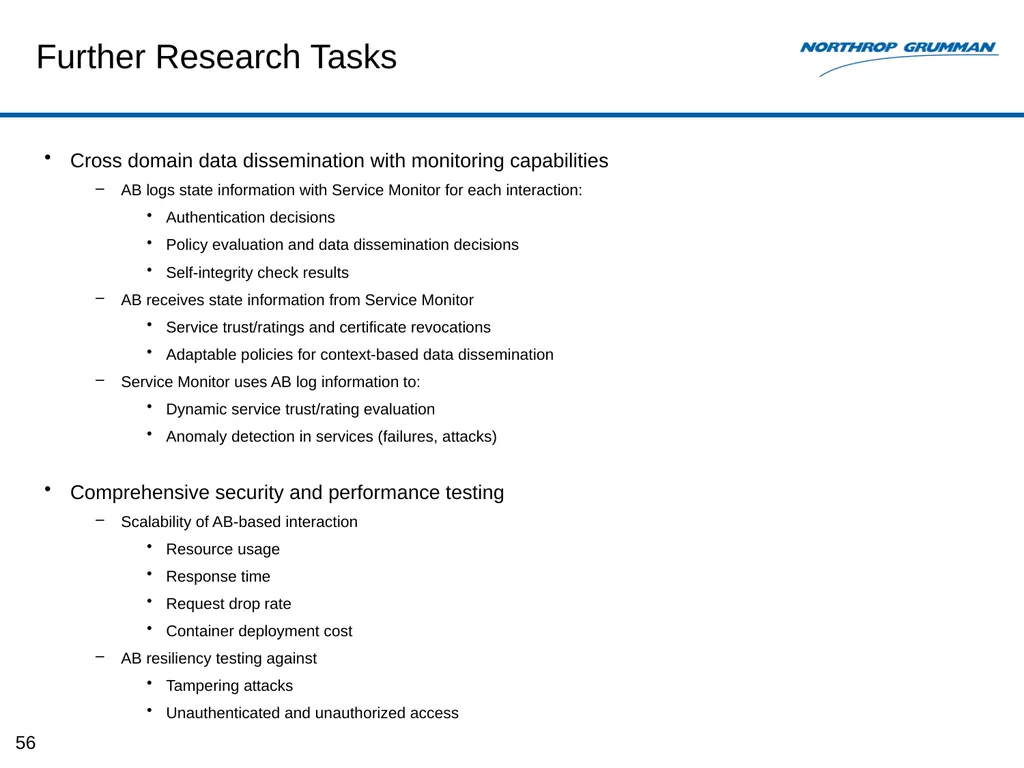
56
Further Research Tasks Cross domain data dissemination with monitoring capabilities
AB logs state information with Service Monitor for each interaction:
Authentication decisions
Policy evaluation and data dissemination decisions
Self-integrity check results
AB receives state information from Service Monitor
Service trust/ratings and certificate revocations
Adaptable policies for context-based data dissemination
Service Monitor uses AB log information to:
Dynamic service trust/rating evaluation
Anomaly detection in services (failures, attacks)
Comprehensive security and performance testing
Scalability of AB-based interaction
Resource usage
Response time
Request drop rate
Container deployment cost
AB resiliency testing against
Tampering attacks
Unauthenticated and unauthorized access 56<br>
AB logs state information with Service Monitor for each interaction:
Authentication decisions
Policy evaluation and data dissemination decisions
Self-integrity check results
AB receives state information from Service Monitor
Service trust/ratings and certificate revocations
Adaptable policies for context-based data dissemination
Service Monitor uses AB log information to:
Dynamic service trust/rating evaluation
Anomaly detection in services (failures, attacks)
Comprehensive security and performance testing
Scalability of AB-based interaction
Resource usage
Response time
Request drop rate
Container deployment cost
AB resiliency testing against
Tampering attacks
Unauthenticated and unauthorized access 56<br>
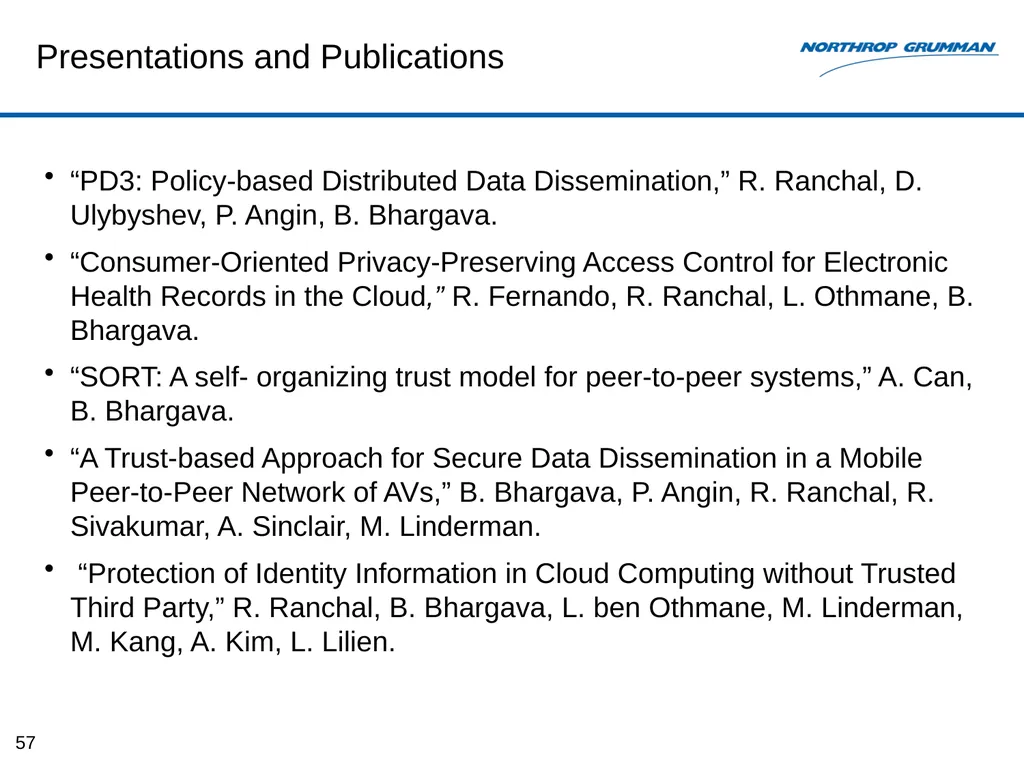
57
Presentations and Publications “PD3: Policy-based Distributed Data Dissemination,” R. Ranchal, D. Ulybyshev, P. Angin, B. Bhargava.
“Consumer-Oriented Privacy-Preserving Access Control for Electronic Health Records in the Cloud,” R. Fernando, R. Ranchal, L. Othmane, B. Bhargava.
“SORT: A self- organizing trust model for peer-to-peer systems,” A. Can, B. Bhargava.
“A Trust-based Approach for Secure Data Dissemination in a Mobile Peer-to-Peer Network of AVs,” B. Bhargava, P. Angin, R. Ranchal, R. Sivakumar, A. Sinclair, M. Linderman.
“Protection of Identity Information in Cloud Computing without Trusted Third Party,” R. Ranchal, B. Bhargava, L. ben Othmane, M. Linderman, M. Kang, A. Kim, L. Lilien. 57<br>
“Consumer-Oriented Privacy-Preserving Access Control for Electronic Health Records in the Cloud,” R. Fernando, R. Ranchal, L. Othmane, B. Bhargava.
“SORT: A self- organizing trust model for peer-to-peer systems,” A. Can, B. Bhargava.
“A Trust-based Approach for Secure Data Dissemination in a Mobile Peer-to-Peer Network of AVs,” B. Bhargava, P. Angin, R. Ranchal, R. Sivakumar, A. Sinclair, M. Linderman.
“Protection of Identity Information in Cloud Computing without Trusted Third Party,” R. Ranchal, B. Bhargava, L. ben Othmane, M. Linderman, M. Kang, A. Kim, L. Lilien. 57<br>
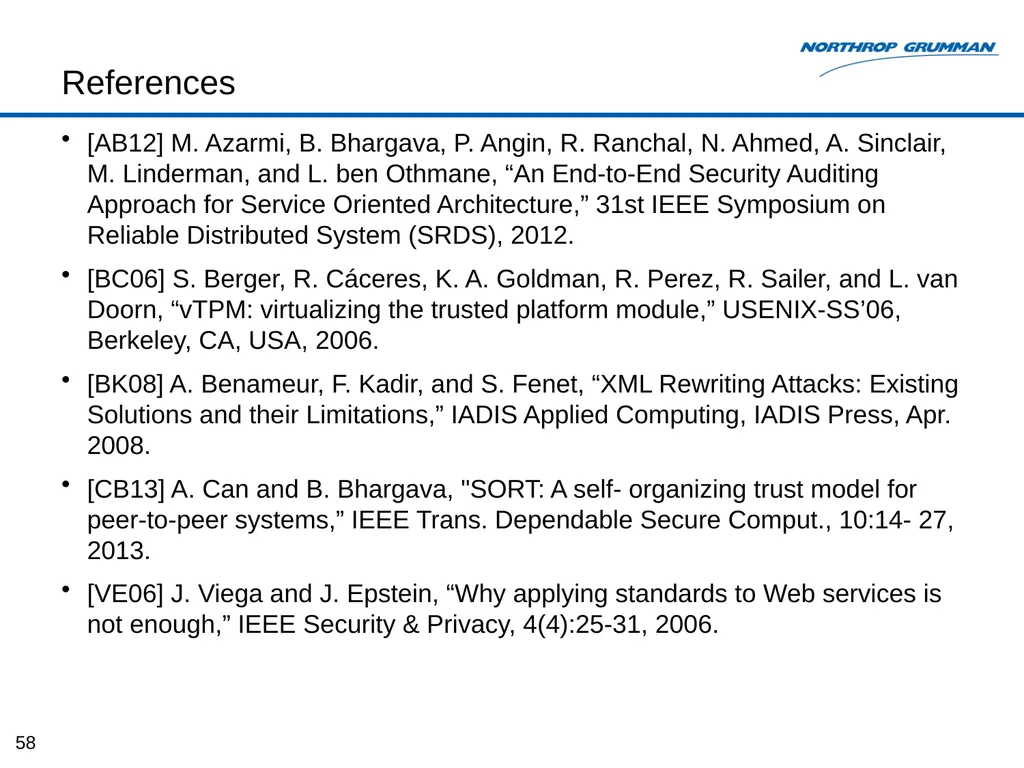
58
58 References [AB12] M. Azarmi, B. Bhargava, P. Angin, R. Ranchal, N. Ahmed, A. Sinclair, M. Linderman, and L. ben Othmane, “An End-to-End Security Auditing Approach for Service Oriented Architecture,” 31st IEEE Symposium on Reliable Distributed System (SRDS), 2012.
[BC06] S. Berger, R. Cáceres, K. A. Goldman, R. Perez, R. Sailer, and L. van Doorn, “vTPM: virtualizing the trusted platform module,” USENIX-SS’06, Berkeley, CA, USA, 2006.
[BK08] A. Benameur, F. Kadir, and S. Fenet, “XML Rewriting Attacks: Existing Solutions and their Limitations,” IADIS Applied Computing, IADIS Press, Apr. 2008.
[CB13] A. Can and B. Bhargava, "SORT: A self- organizing trust model for peer-to-peer systems,” IEEE Trans. Dependable Secure Comput., 10:14- 27, 2013.
[VE06] J. Viega and J. Epstein, “Why applying standards to Web services is not enough,” IEEE Security & Privacy, 4(4):25-31, 2006.<br>
[BC06] S. Berger, R. Cáceres, K. A. Goldman, R. Perez, R. Sailer, and L. van Doorn, “vTPM: virtualizing the trusted platform module,” USENIX-SS’06, Berkeley, CA, USA, 2006.
[BK08] A. Benameur, F. Kadir, and S. Fenet, “XML Rewriting Attacks: Existing Solutions and their Limitations,” IADIS Applied Computing, IADIS Press, Apr. 2008.
[CB13] A. Can and B. Bhargava, "SORT: A self- organizing trust model for peer-to-peer systems,” IEEE Trans. Dependable Secure Comput., 10:14- 27, 2013.
[VE06] J. Viega and J. Epstein, “Why applying standards to Web services is not enough,” IEEE Security & Privacy, 4(4):25-31, 2006.<br>
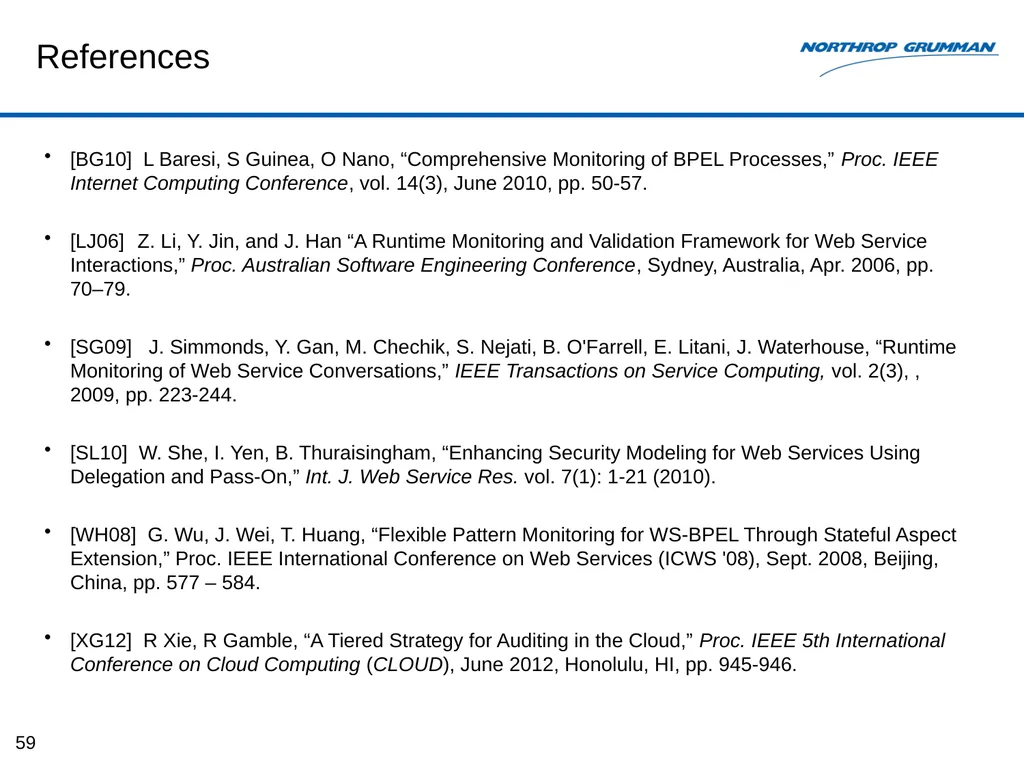
59
References [BG10] L Baresi, S Guinea, O Nano, “Comprehensive Monitoring of BPEL Processes,” Proc. IEEE Internet Computing Conference, vol. 14(3), June 2010, pp. 50-57.
[LJ06] Z. Li, Y. Jin, and J. Han “A Runtime Monitoring and Validation Framework for Web Service Interactions,” Proc. Australian Software Engineering Conference, Sydney, Australia, Apr. 2006, pp. 70–79.
[SG09] J. Simmonds, Y. Gan, M. Chechik, S. Nejati, B. O'Farrell, E. Litani, J. Waterhouse, “Runtime Monitoring of Web Service Conversations,” IEEE Transactions on Service Computing, vol. 2(3), , 2009, pp. 223-244.
[SL10] W. She, I. Yen, B. Thuraisingham, “Enhancing Security Modeling for Web Services Using Delegation and Pass-On,” Int. J. Web Service Res. vol. 7(1): 1-21 (2010).
[WH08] G. Wu, J. Wei, T. Huang, “Flexible Pattern Monitoring for WS-BPEL Through Stateful Aspect Extension,” Proc. IEEE International Conference on Web Services (ICWS '08), Sept. 2008, Beijing, China, pp. 577 – 584.
[XG12] R Xie, R Gamble, “A Tiered Strategy for Auditing in the Cloud,” Proc. IEEE 5th International Conference on Cloud Computing (CLOUD), June 2012, Honolulu, HI, pp. 945-946. 59<br>
[LJ06] Z. Li, Y. Jin, and J. Han “A Runtime Monitoring and Validation Framework for Web Service Interactions,” Proc. Australian Software Engineering Conference, Sydney, Australia, Apr. 2006, pp. 70–79.
[SG09] J. Simmonds, Y. Gan, M. Chechik, S. Nejati, B. O'Farrell, E. Litani, J. Waterhouse, “Runtime Monitoring of Web Service Conversations,” IEEE Transactions on Service Computing, vol. 2(3), , 2009, pp. 223-244.
[SL10] W. She, I. Yen, B. Thuraisingham, “Enhancing Security Modeling for Web Services Using Delegation and Pass-On,” Int. J. Web Service Res. vol. 7(1): 1-21 (2010).
[WH08] G. Wu, J. Wei, T. Huang, “Flexible Pattern Monitoring for WS-BPEL Through Stateful Aspect Extension,” Proc. IEEE International Conference on Web Services (ICWS '08), Sept. 2008, Beijing, China, pp. 577 – 584.
[XG12] R Xie, R Gamble, “A Tiered Strategy for Auditing in the Cloud,” Proc. IEEE 5th International Conference on Cloud Computing (CLOUD), June 2012, Honolulu, HI, pp. 945-946. 59<br>
60
Thank you for your attention.
Any questions?<br>