Monopoly Monopolistic Competition Lecture 24 Dr. Jennifer P. Wissink 2023 Jennifer P. Wissink, all rights reserved. May 1, 2023 Announcements Due TONIGHT! Quiz11 Worth 100 points Final Exam Information See Canvas This includes extra
"Monopoly & Monopolistic Competition Lecture 24 Dr." is the property of its rightful owner. Permission is granted to
download and print the materials on this website for personal, non-commercial use only, and to display it
on your personal computer provided you do not modify the materials and that you retain all copyright
notices contained in the materials. By downloading content from our website, you accept the terms of this
agreement.
Announcements Due TONIGHT! Quiz#11
Worth 100 points
Final Exam Information – See Canvas
This includes extra time information
This includes makeup final information
Section&Office Hour Information – See Canvas Home Page for link.<br>
03
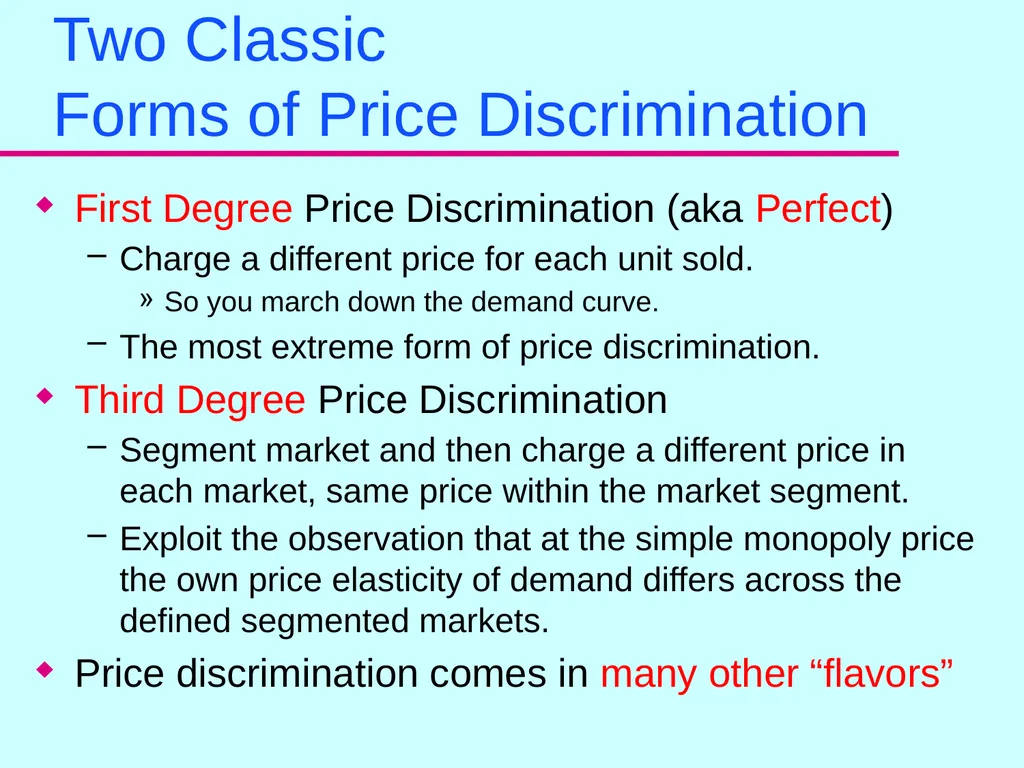
Two Classic Forms of Price Discrimination First Degree Price Discrimination (aka Perfect)
Charge a different price for each unit sold.
So you march down the demand curve.
The most extreme form of price discrimination.
Third Degree Price Discrimination
Segment market and then charge a different price in each market, same price within the market segment.
Exploit the observation that at the simple monopoly price the own price elasticity of demand differs across the defined segmented markets.
Price discrimination comes in many other “flavors”<br>
04
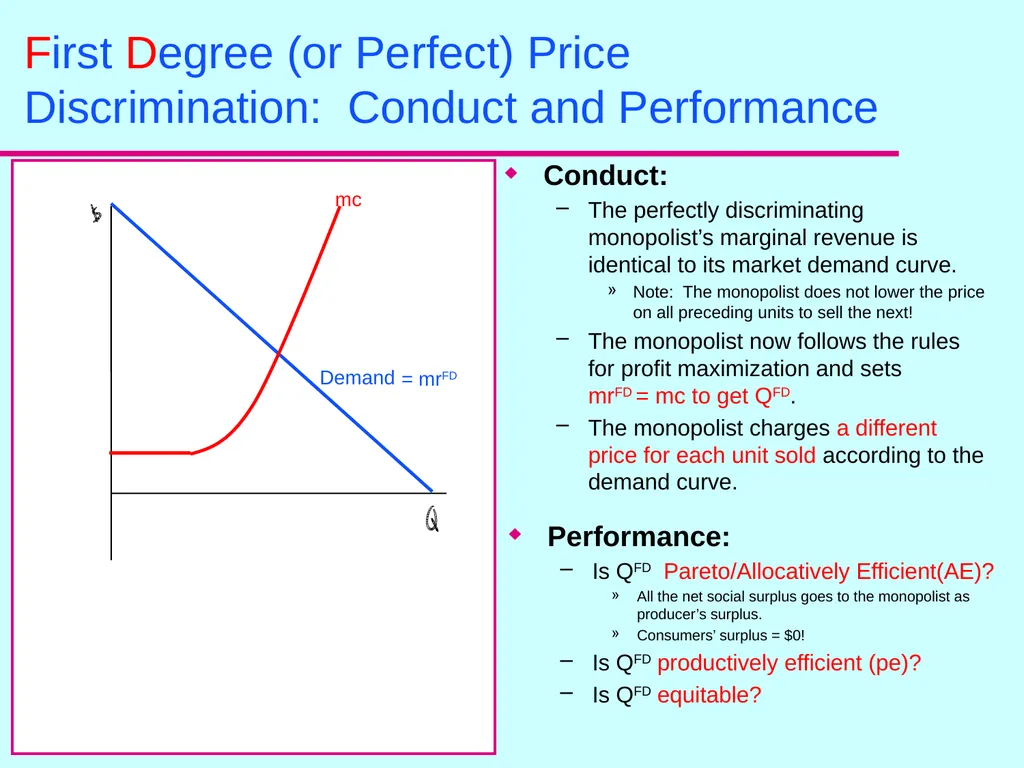
First Degree (or Perfect) Price Discrimination: Conduct and Performance Conduct:
The perfectly discriminating monopolist’s marginal revenue is identical to its market demand curve.
Note: The monopolist does not lower the price on all preceding units to sell the next!
The monopolist now follows the rules for profit maximization and sets mrFD = mc to get QFD.
The monopolist charges a different price for each unit sold according to the demand curve. Performance:
Is QFD Pareto/Allocatively Efficient(AE)?
All the net social surplus goes to the monopolist as producer’s surplus.
Consumers’ surplus = $0!
Is QFD productively efficient (pe)?
Is QFD equitable? mc = mrFD<br>
05
Third Degree Price Discrimination: Conduct and Performance The monopolist separates his market into “segments.”
by age
by gender
by income
by zip code
by attitudes
by anything that will work!
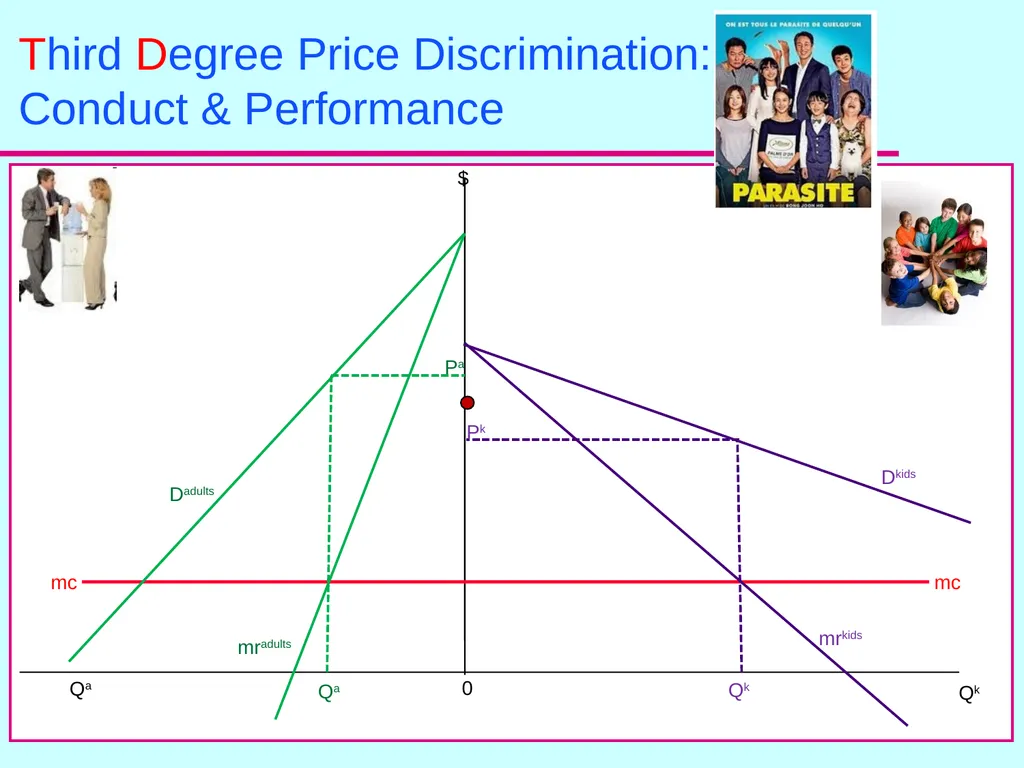
The monopolist charges a different price to each segment.
The monopolist charges the same price on all units sold WITHIN the same segment.
This type of discrimination will yield MORE profits than under simple monopoly when the own price elasticities of demand DIFFER across the different segments when you charge everyone the same simple monopoly price.<br>
06
Third Degree Price Discrimination: Conduct & Performance Dkids Dadults mrkids mradults mc mc Pa Pk Qk Qa Qk $ Qa 0<br>
07
Believe It Or Not When: early 1990’s
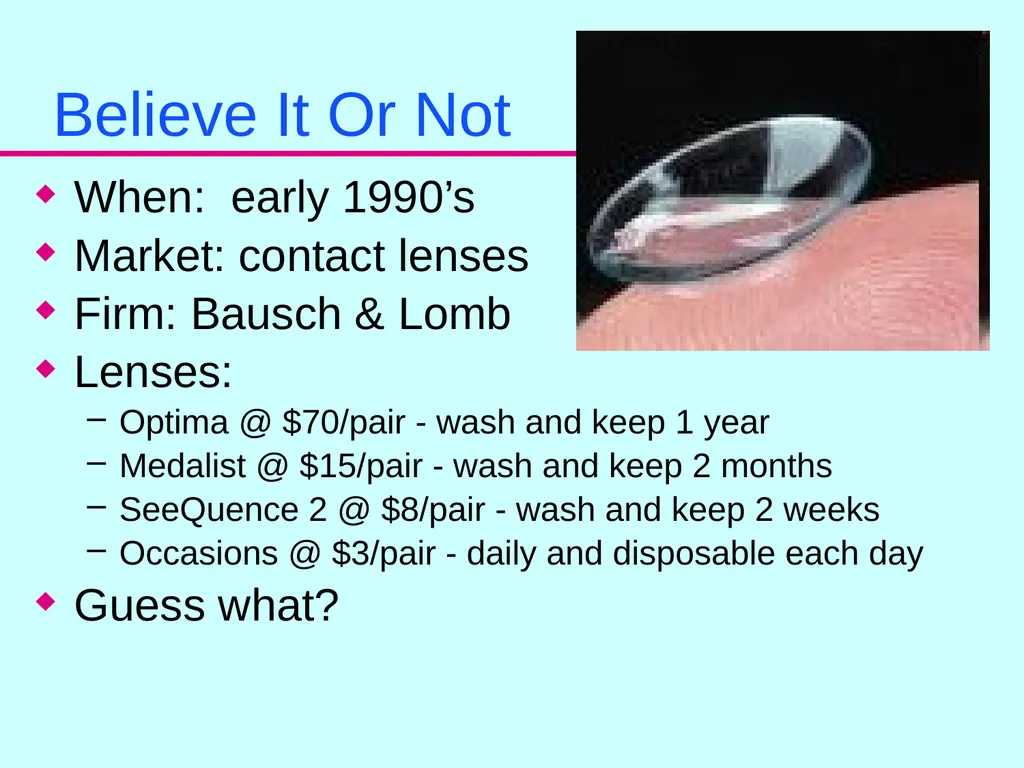
Market: contact lenses
Firm: Bausch & Lomb
Lenses:
Optima @ $70/pair - wash and keep 1 year
Medalist @ $15/pair - wash and keep 2 months
SeeQuence 2 @ $8/pair - wash and keep 2 weeks
Occasions @ $3/pair - daily and disposable each day
Guess what?<br>
08
Believe It Or Not They were all the same lenses!
Just packaged differently!
What would you pay for a year?
Optima = $70/pair - wash and keep 1 year
Medalist = $15x6=$90 (last 2 months)
SeeQuence 2 = $8x26=$208 (last 2 weeks)
Occasions = $3x365 = $1095
What would I do?
Buy the Occasions
Wash and wear until my eyes hurt.
Class action suits were eventually settled.<br>
09
More Ways To Discriminate Information or Knowledge
Local versus tourist
Time and/or Flexibility
Business versus Leisure
New versus Repeat Customer
Interesting Read: The adult-book premium
http://www.economist.com/blogs/freeexchange/2011/11/price-discrimination
THANKS TO Brit G!
My favorite....
Examining Differences in Drug Prices
http://www.nytimes.com/2000/09/21/business/examining-differences-in-drug-prices.html<br>
10
Using Multiple Two-Part Tariffs to Price Discriminate Suppose two types of cell phone users: identical old ladies and identical college kids
Assume college kids get loads more consumers’ surplus from using their minutes than old ladies do.
Consider cell phone plans
Perfect/1st degree price discrimination via a multiple two-part tariff pricing scheme
Set monthly fee to college kids: $FeeCK = $CSCK.
Set monthly fee for old ladies: $FeeOL=$CSOL.
Note: $FeeCK > $FeeOL
Now set one common price/per minute = $P.
Best case scenario for monopolist.
Would be equivalent to perfect/1st degree price discrimination, but a heck of a lot easier to implement.
But... will it work?<br>
11
But....Perfect Price Discrimination FAILS.
College kids will want to “pretend” they are old ladies. Using Multiple Two-Part Tariffs to Price Discriminate<br>
12
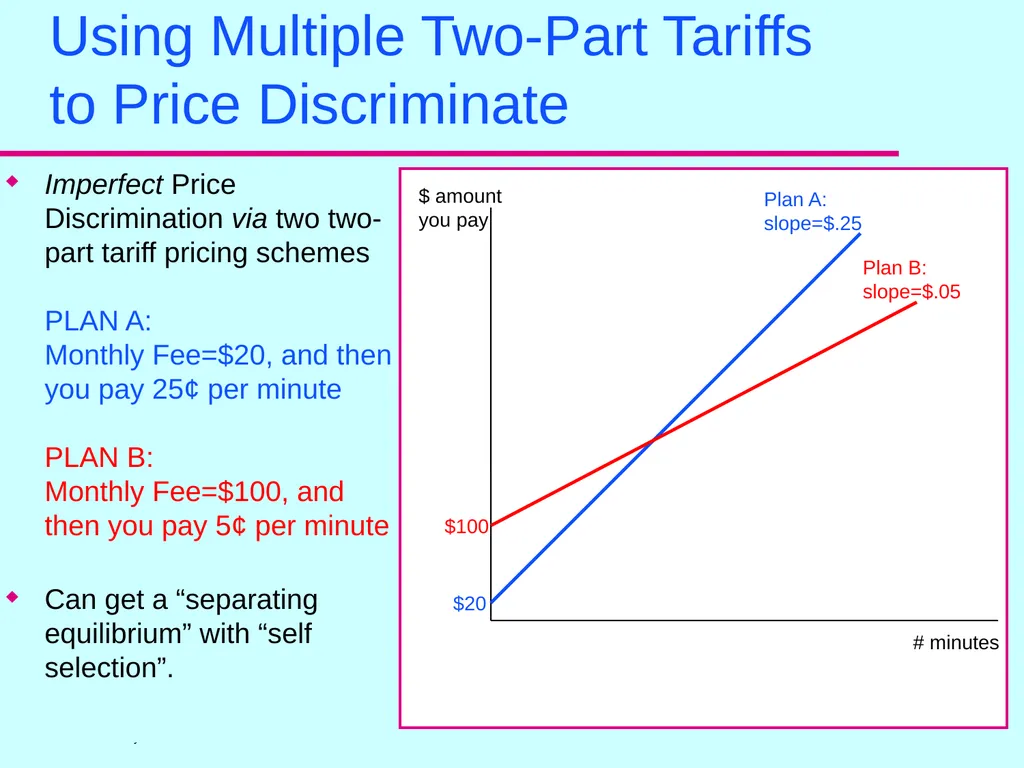
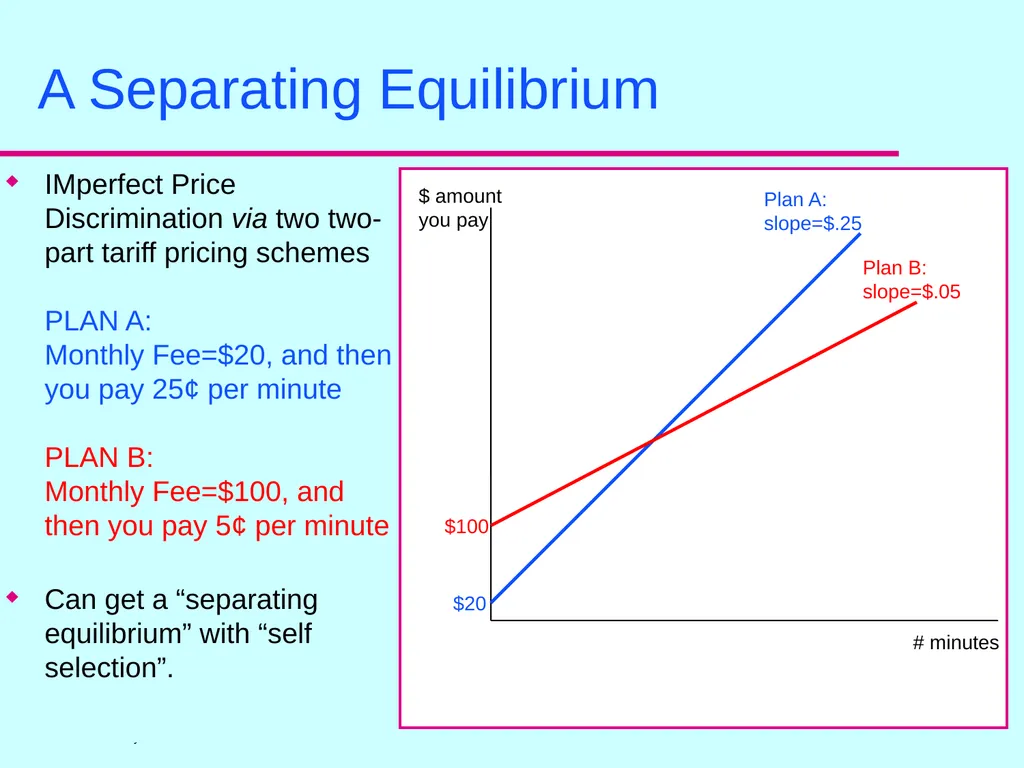
Imperfect Price Discrimination via two two-part tariff pricing schemes PLAN A: Monthly Fee=$20, and then you pay 25¢ per minute PLAN B: Monthly Fee=$100, and then you pay 5¢ per minute
Can get a “separating equilibrium” with “self selection”. $ amount you pay # minutes Plan A: slope=$.25 $20 Plan B: slope=$.05 $100 Using Multiple Two-Part Tariffs to Price Discriminate<br>
13
IMperfect Price Discrimination via two two-part tariff pricing schemes PLAN A: Monthly Fee=$20, and then you pay 25¢ per minute PLAN B: Monthly Fee=$100, and then you pay 5¢ per minute
Can get a “separating equilibrium” with “self selection”. $ amount you pay # minutes Plan A: slope=$.25 $20 Plan B: slope=$.05 $100 A Separating Equilibrium<br>
14
Up Next: Monopolistic Competition<br>
15
Monopolistic Competition: Structure Structure:
Several firms in the market.
Firms produce differentiated products.
“Free” entry and exit.
Full and symmetric information.
Re: Differentiated Products
Actual: taste, color, location, service, etc.
Perceived: Frame™ jeans vs. Wranglers™
Intellectual “Parents”
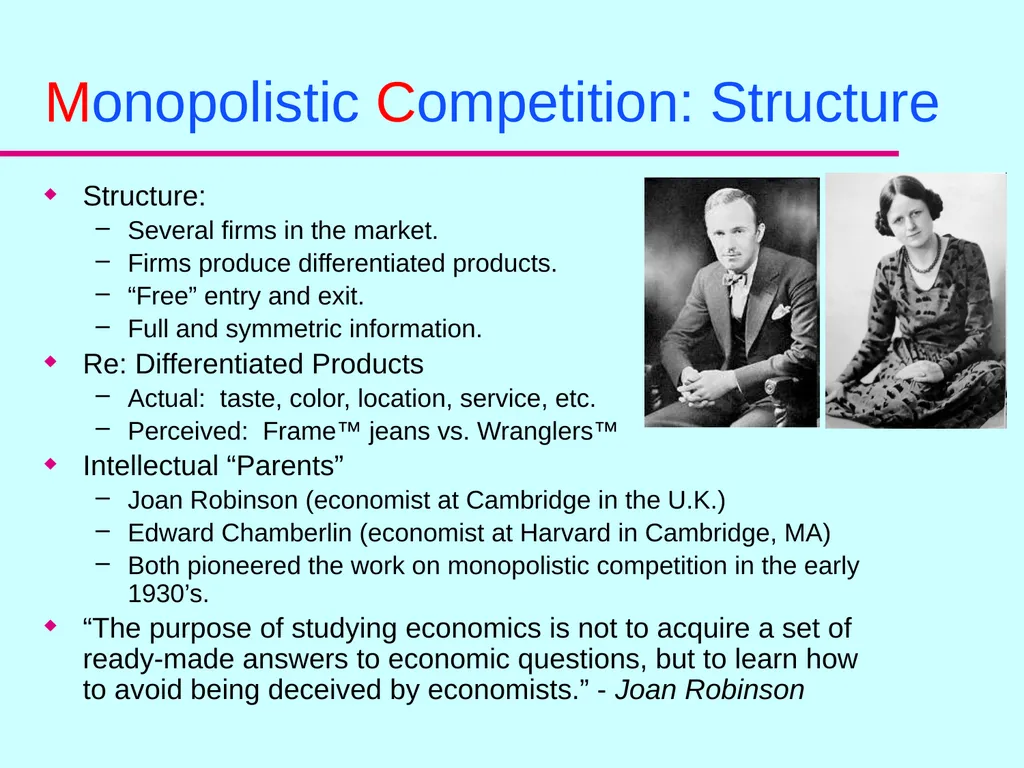
Joan Robinson (economist at Cambridge in the U.K.)
Edward Chamberlin (economist at Harvard in Cambridge, MA)
Both pioneered the work on monopolistic competition in the early 1930’s.
“The purpose of studying economics is not to acquire a set of ready-made answers to economic questions, but to learn how to avoid being deceived by economists.” - Joan Robinson<br>
16
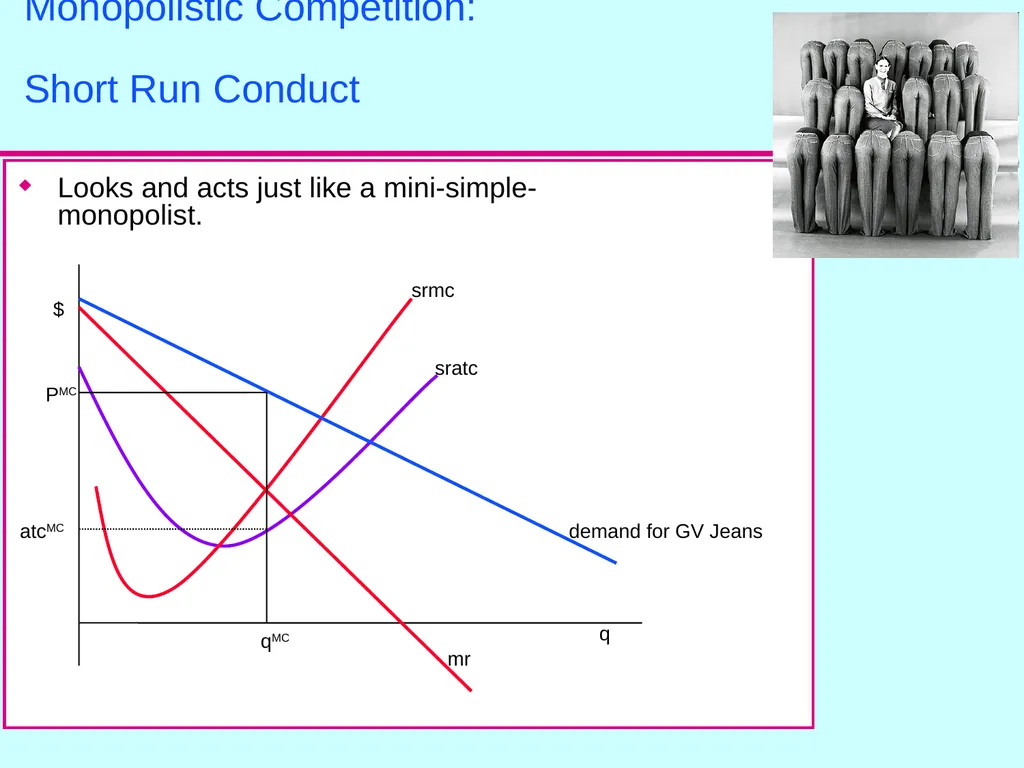
Monopolistic Competition: Short Run Conduct Looks and acts just like a mini-simple-monopolist. atcMC demand for GV Jeans mr sratc srmc qMC PMC $ q<br>
17
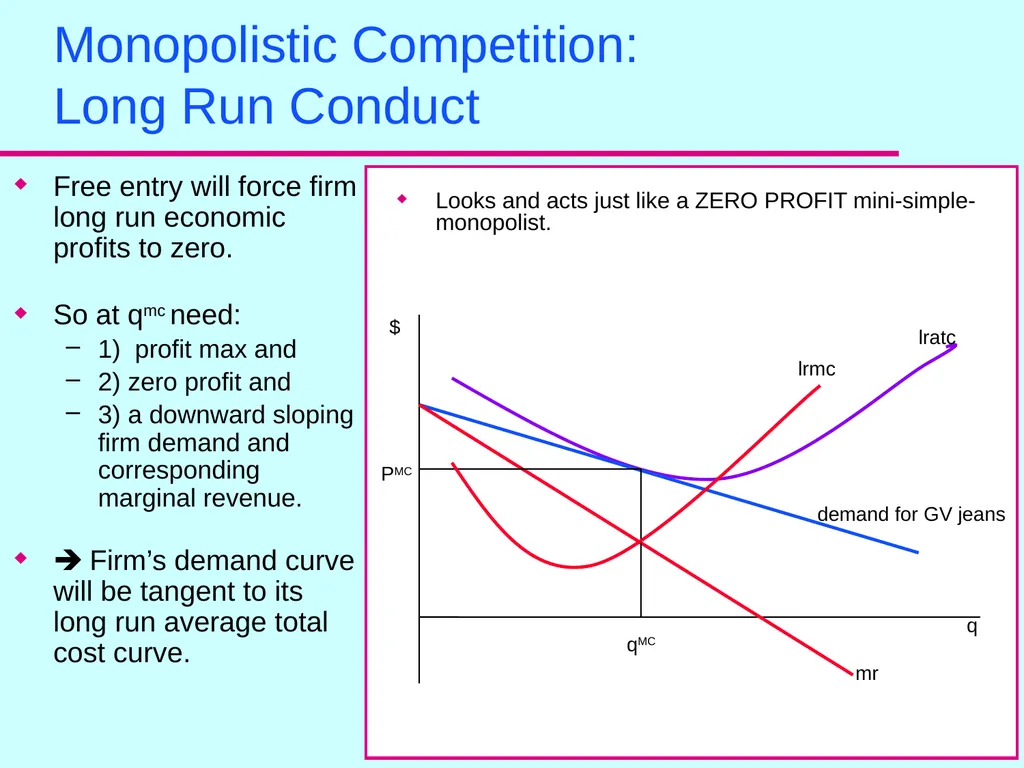
Monopolistic Competition: Long Run Conduct Free entry will force firm long run economic profits to zero.
So at qmc need:
1) profit max and
2) zero profit and
3) a downward sloping firm demand and corresponding marginal revenue.
Firm’s demand curve will be tangent to its long run average total cost curve. qMC PMC lratc lrmc demand for GV jeans mr $ q Looks and acts just like a ZERO PROFIT mini-simple-monopolist.<br>