
MONTANA COMMUNITY CHOICE SCHOOLS Assessment
MS
Published · 16 slides · 0 views

1 / 1

Description
MONTANA COMMUNITY CHOICE SCHOOLS Assessment Recommendations Report Presented to the Community Choice Schools Commission February 2026 Introductions Presenters Joe Marr Bill Sullivan Co-Founders Solomon Research Analytics Commission
Related Topics
Share
Embed code
Download this presentation From Below
"MONTANA COMMUNITY CHOICE SCHOOLS Assessment" is the property of its rightful owner. Permission is granted to download and print the materials on this website for personal, non-commercial use only, and to display it on your personal computer provided you do not modify the materials and that you retain all copyright notices contained in the materials. By downloading content from our website, you accept the terms of this agreement.
Presentation Transcript
01
MONTANA COMMUNITY
CHOICE SCHOOLS Assessment Recommendations Report Presented to the Community Choice Schools Commission February 2026<br>
CHOICE SCHOOLS Assessment Recommendations Report Presented to the Community Choice Schools Commission February 2026<br>
02
Introductions Presenters Joe Marr & Bill Sullivan
Co-Founders
Solomon Research & Analytics Commission Members Montana Community Choice
Schools Commission Montana Community Choice Schools | Assessment Recommendations 1<br>
Co-Founders
Solomon Research & Analytics Commission Members Montana Community Choice
Schools Commission Montana Community Choice Schools | Assessment Recommendations 1<br>
03
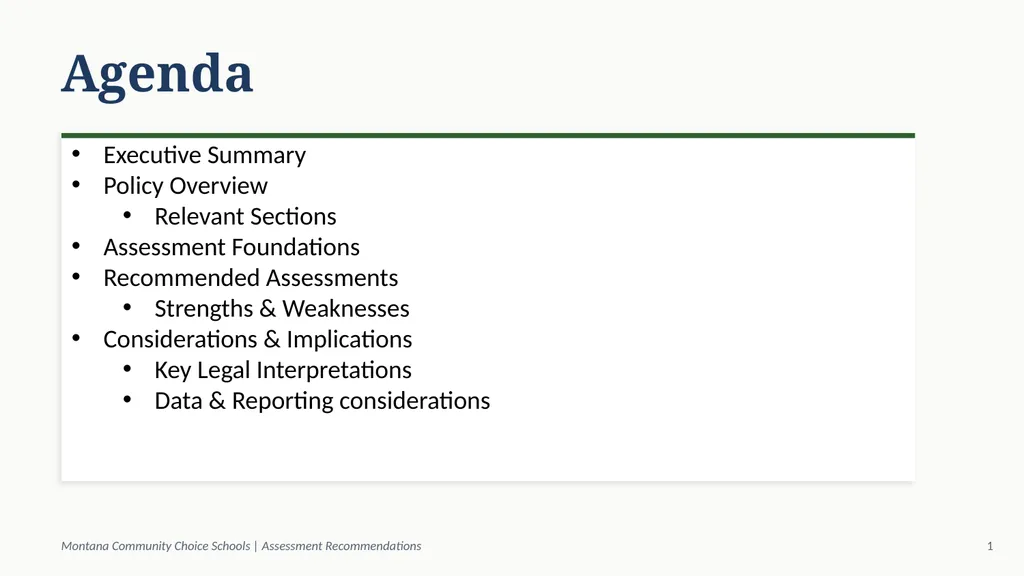
Agenda Executive Summary
Policy Overview
Relevant Sections
Assessment Foundations
Recommended Assessments
Strengths & Weaknesses
Considerations & Implications
Key Legal Interpretations
Data & Reporting considerations Montana Community Choice Schools | Assessment Recommendations 1<br>
Policy Overview
Relevant Sections
Assessment Foundations
Recommended Assessments
Strengths & Weaknesses
Considerations & Implications
Key Legal Interpretations
Data & Reporting considerations Montana Community Choice Schools | Assessment Recommendations 1<br>
04
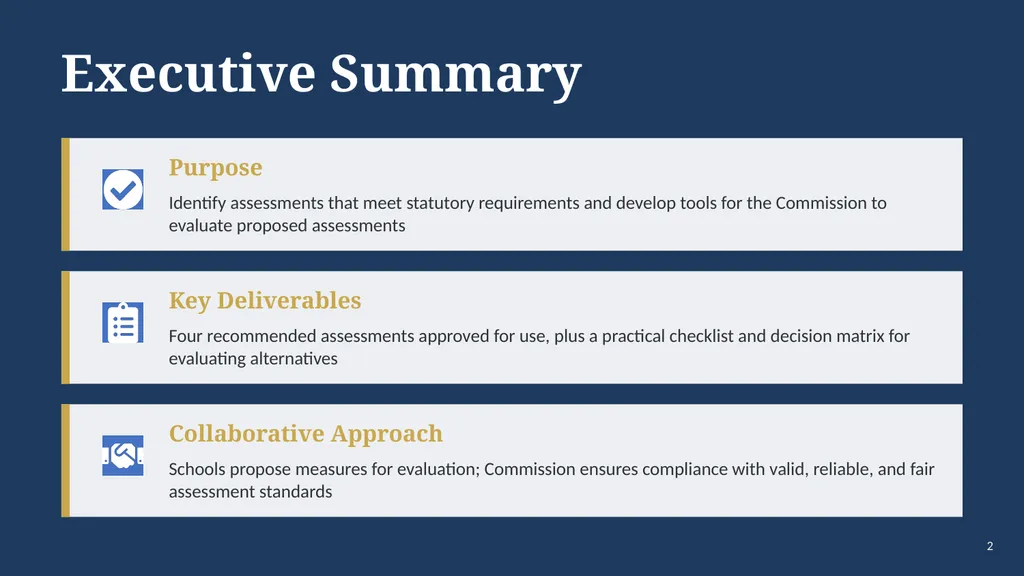
Executive Summary Purpose Identify assessments that meet statutory requirements and develop tools for the Commission to evaluate proposed assessments Key Deliverables Four recommended assessments approved for use, plus a practical checklist and decision matrix for evaluating alternatives Collaborative Approach Schools propose measures for evaluation; Commission ensures compliance with valid, reliable, and fair assessment standards 2<br>
05
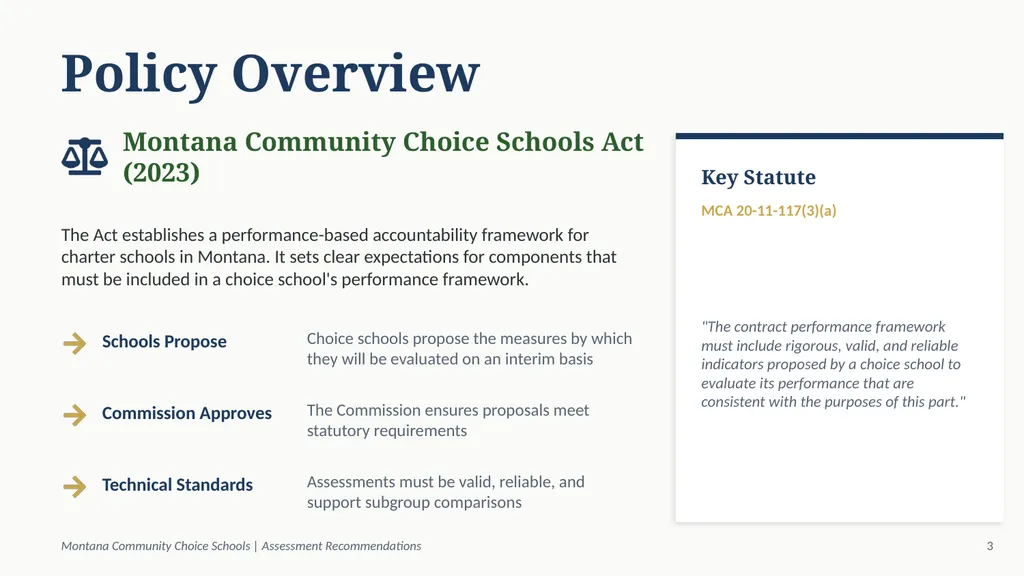
Policy Overview Montana Community Choice Schools Act (2023) The Act establishes a performance-based accountability framework for charter schools in Montana. It sets clear expectations for components that must be included in a choice school's performance framework. Schools Propose Choice schools propose the measures by which they will be evaluated on an interim basis Commission Approves The Commission ensures proposals meet statutory requirements Technical Standards Assessments must be valid, reliable, and support subgroup comparisons Key Statute MCA 20-11-117(3)(a) "The contract performance framework must include rigorous, valid, and reliable indicators proposed by a choice school to evaluate its performance that are consistent with the purposes of this part." Montana Community Choice Schools | Assessment Recommendations 3<br>
06
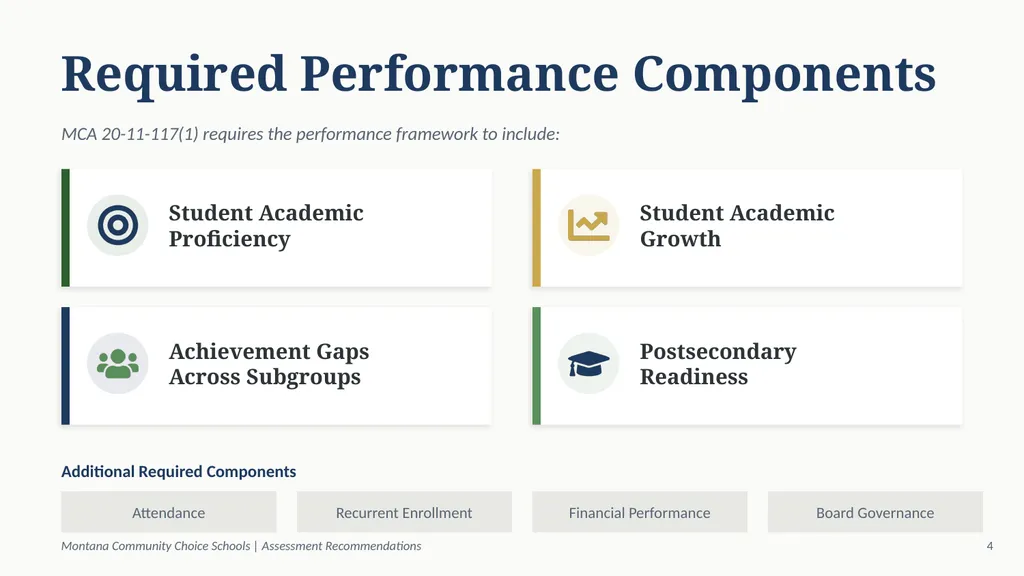
Required Performance Components MCA 20-11-117(1) requires the performance framework to include: Student Academic
Proficiency Student Academic
Growth Achievement Gaps
Across Subgroups Postsecondary
Readiness Additional Required Components Attendance Recurrent Enrollment Financial Performance Board Governance Montana Community Choice Schools | Assessment Recommendations 4<br>
Proficiency Student Academic
Growth Achievement Gaps
Across Subgroups Postsecondary
Readiness Additional Required Components Attendance Recurrent Enrollment Financial Performance Board Governance Montana Community Choice Schools | Assessment Recommendations 4<br>
07
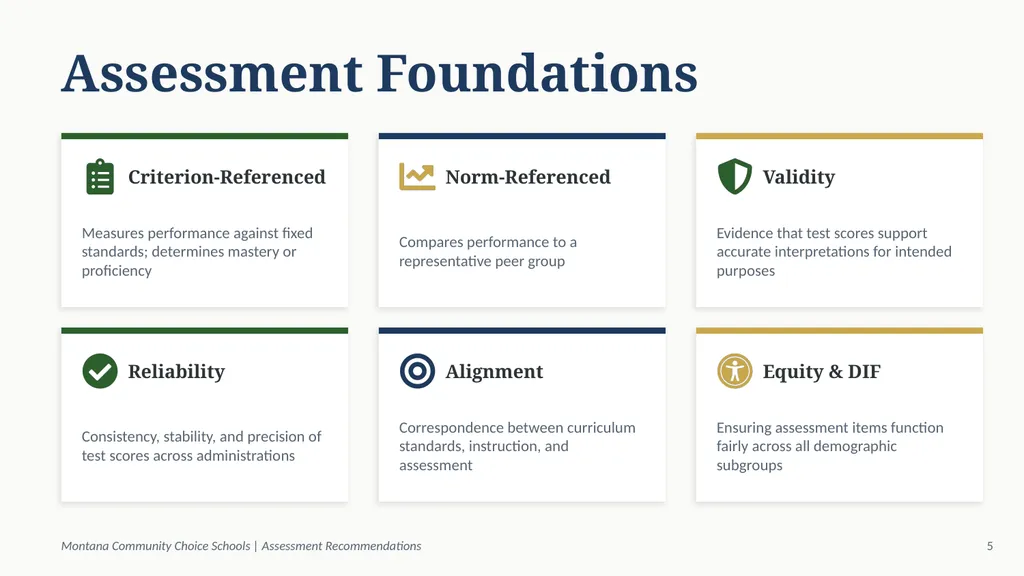
Assessment Foundations Criterion-Referenced Measures performance against fixed standards; determines mastery or proficiency Norm-Referenced Compares performance to a representative peer group Validity Evidence that test scores support accurate interpretations for intended purposes Reliability Consistency, stability, and precision of test scores across administrations Alignment Correspondence between curriculum standards, instruction, and assessment Equity & DIF Ensuring assessment items function fairly across all demographic subgroups Montana Community Choice Schools | Assessment Recommendations 5<br>
08
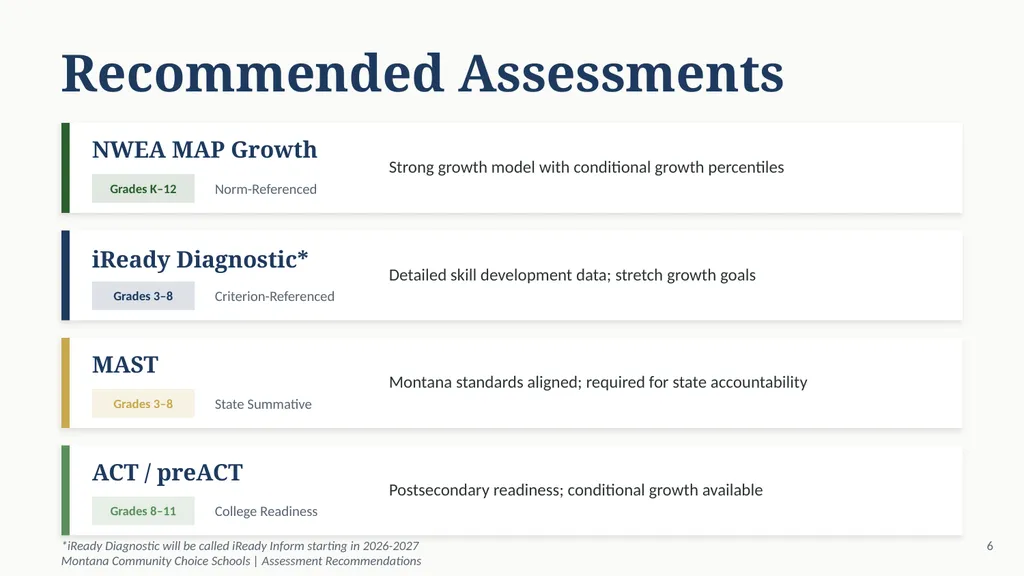
Recommended Assessments NWEA MAP Growth Grades K–12 Norm-Referenced Strong growth model with conditional growth percentiles iReady Diagnostic* Grades 3–8 Criterion-Referenced Detailed skill development data; stretch growth goals MAST Grades 3–8 State Summative Montana standards aligned; required for state accountability ACT / preACT Grades 8–11 College Readiness Postsecondary readiness; conditional growth available *iReady Diagnostic will be called iReady Inform starting in 2026-2027
Montana Community Choice Schools | Assessment Recommendations 6<br>
Montana Community Choice Schools | Assessment Recommendations 6<br>
09
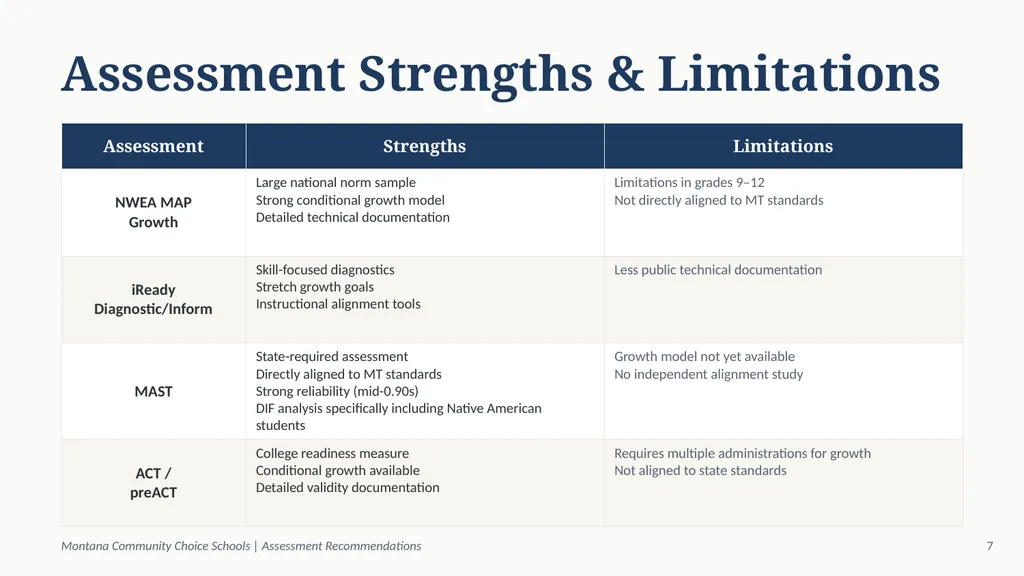
Assessment Strengths & Limitations Montana Community Choice Schools | Assessment Recommendations 7<br>
10
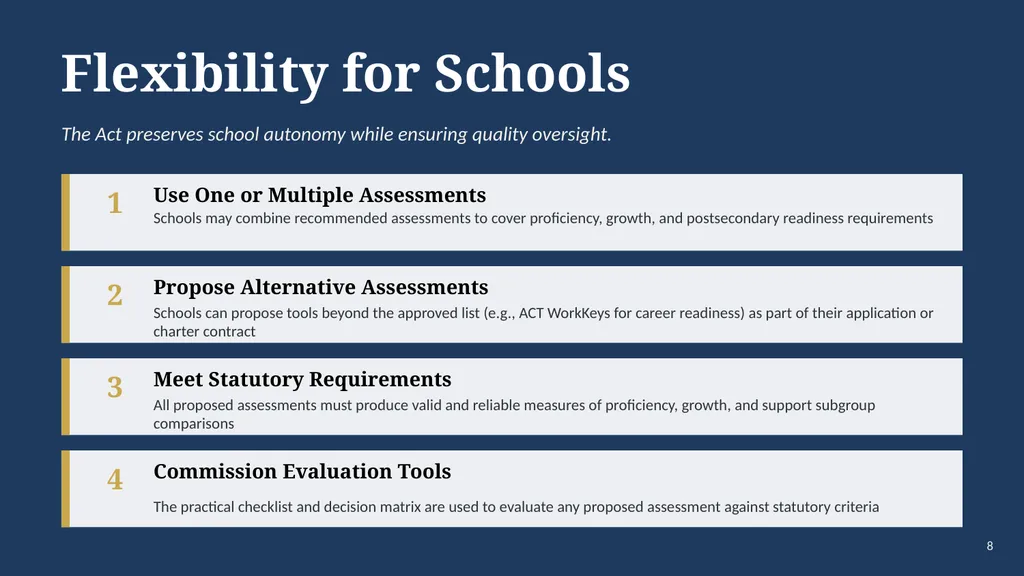
Flexibility for Schools The Act preserves school autonomy while ensuring quality oversight. 1 Use One or Multiple Assessments Schools may combine recommended assessments to cover proficiency, growth, and postsecondary readiness requirements 2 Propose Alternative Assessments Schools can propose tools beyond the approved list (e.g., ACT WorkKeys for career readiness) as part of their application or charter contract 3 Meet Statutory Requirements All proposed assessments must produce valid and reliable measures of proficiency, growth, and support subgroup comparisons 4 Commission Evaluation Tools The practical checklist and decision matrix are used to evaluate any proposed assessment against statutory criteria 8<br>
11
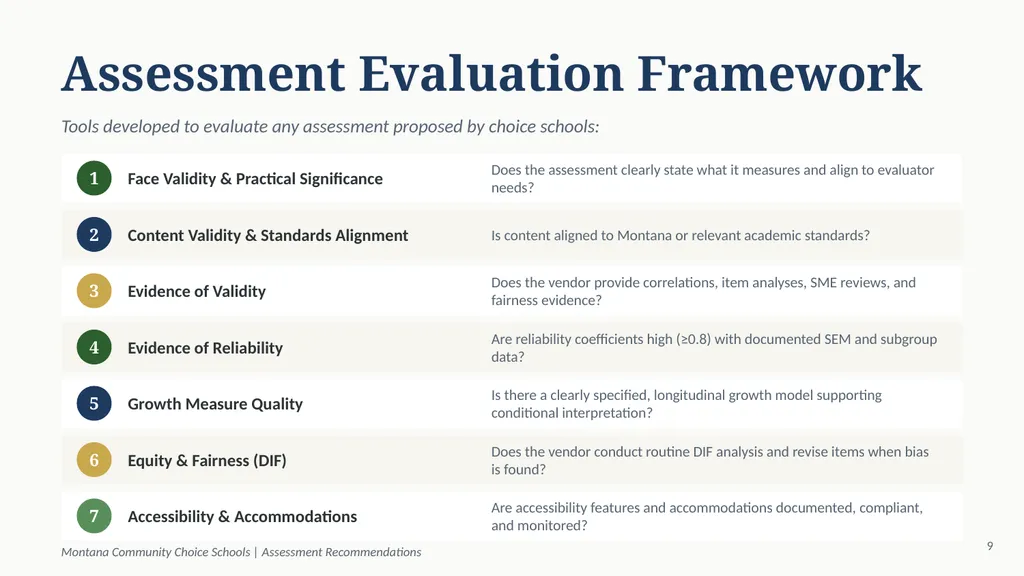
Assessment Evaluation Framework Tools developed to evaluate any assessment proposed by choice schools: 1 Face Validity & Practical Significance Does the assessment clearly state what it measures and align to evaluator needs? 2 Content Validity & Standards Alignment Is content aligned to Montana or relevant academic standards? 3 Evidence of Validity Does the vendor provide correlations, item analyses, SME reviews, and fairness evidence? 4 Evidence of Reliability Are reliability coefficients high (≥0.8) with documented SEM and subgroup data? 5 Growth Measure Quality Is there a clearly specified, longitudinal growth model supporting conditional interpretation? 6 Equity & Fairness (DIF) Does the vendor conduct routine DIF analysis and revise items when bias is found? 7 Accessibility & Accommodations Are accessibility features and accommodations documented, compliant, and monitored? Montana Community Choice Schools | Assessment Recommendations 9<br>
12
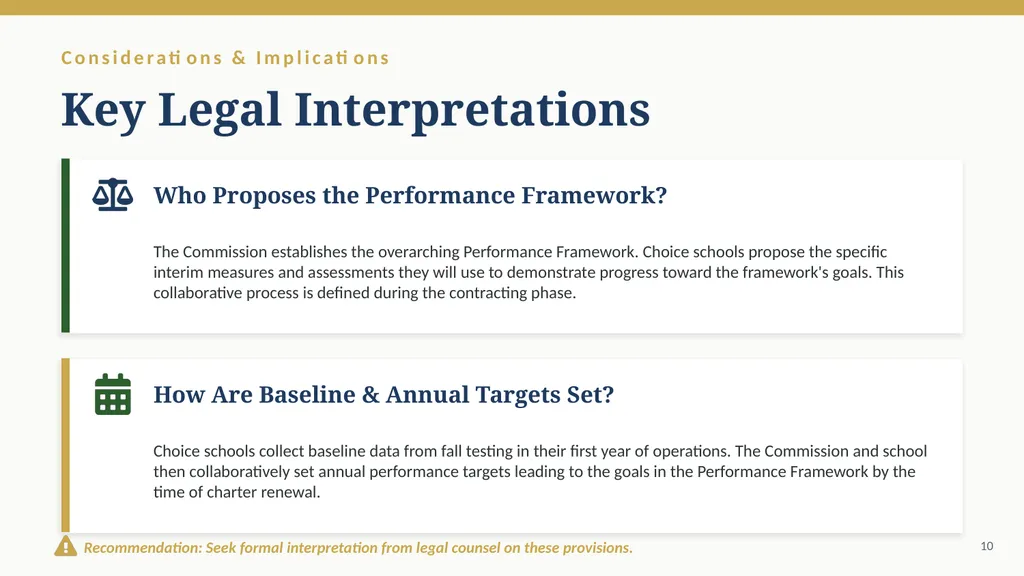
Considerations & Implications Key Legal Interpretations Who Proposes the Performance Framework? The Commission establishes the overarching Performance Framework. Choice schools propose the specific interim measures and assessments they will use to demonstrate progress toward the framework's goals. This collaborative process is defined during the contracting phase. How Are Baseline & Annual Targets Set? Choice schools collect baseline data from fall testing in their first year of operations. The Commission and school then collaboratively set annual performance targets leading to the goals in the Performance Framework by the time of charter renewal. Recommendation: Seek formal interpretation from legal counsel on these provisions. 10<br>
13
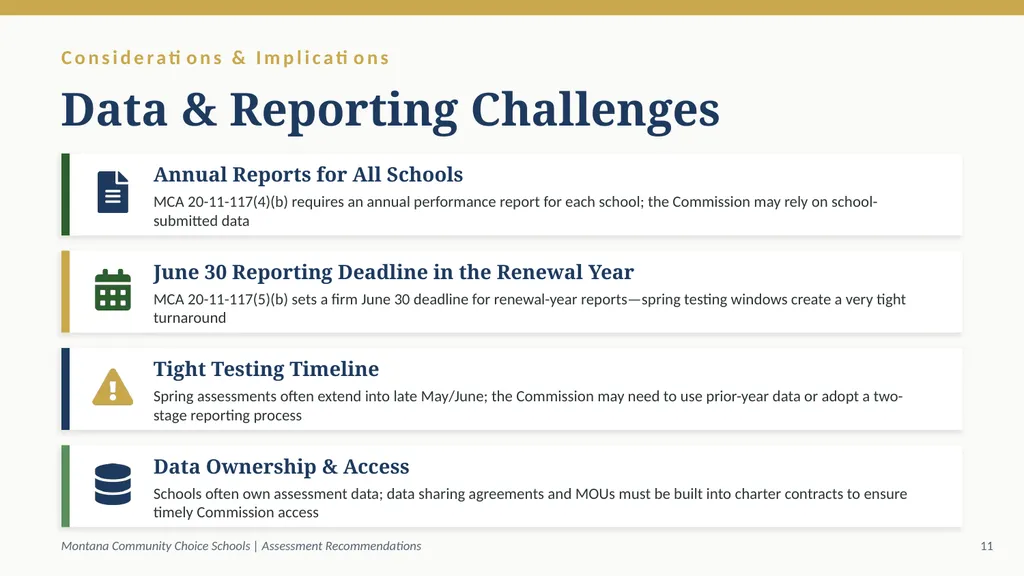
Considerations & Implications Data & Reporting Challenges Annual Reports for All Schools MCA 20-11-117(4)(b) requires an annual performance report for each school; the Commission may rely on school-submitted data June 30 Reporting Deadline in the Renewal Year MCA 20-11-117(5)(b) sets a firm June 30 deadline for renewal-year reports—spring testing windows create a very tight turnaround Tight Testing Timeline Spring assessments often extend into late May/June; the Commission may need to use prior-year data or adopt a two-stage reporting process Data Ownership & Access Schools often own assessment data; data sharing agreements and MOUs must be built into charter contracts to ensure timely Commission access Montana Community Choice Schools | Assessment Recommendations 11<br>
14
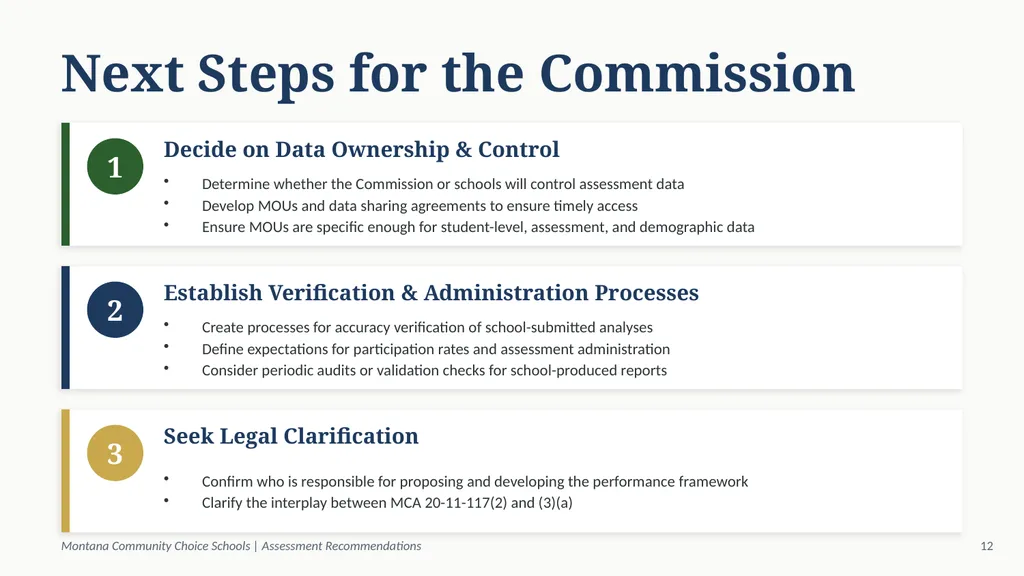
Next Steps for the Commission 1 Decide on Data Ownership & Control Determine whether the Commission or schools will control assessment data
Develop MOUs and data sharing agreements to ensure timely access
Ensure MOUs are specific enough for student-level, assessment, and demographic data 2 Establish Verification & Administration Processes Create processes for accuracy verification of school-submitted analyses
Define expectations for participation rates and assessment administration
Consider periodic audits or validation checks for school-produced reports 3 Seek Legal Clarification Confirm who is responsible for proposing and developing the performance framework
Clarify the interplay between MCA 20-11-117(2) and (3)(a) Montana Community Choice Schools | Assessment Recommendations 12<br>
Develop MOUs and data sharing agreements to ensure timely access
Ensure MOUs are specific enough for student-level, assessment, and demographic data 2 Establish Verification & Administration Processes Create processes for accuracy verification of school-submitted analyses
Define expectations for participation rates and assessment administration
Consider periodic audits or validation checks for school-produced reports 3 Seek Legal Clarification Confirm who is responsible for proposing and developing the performance framework
Clarify the interplay between MCA 20-11-117(2) and (3)(a) Montana Community Choice Schools | Assessment Recommendations 12<br>
15
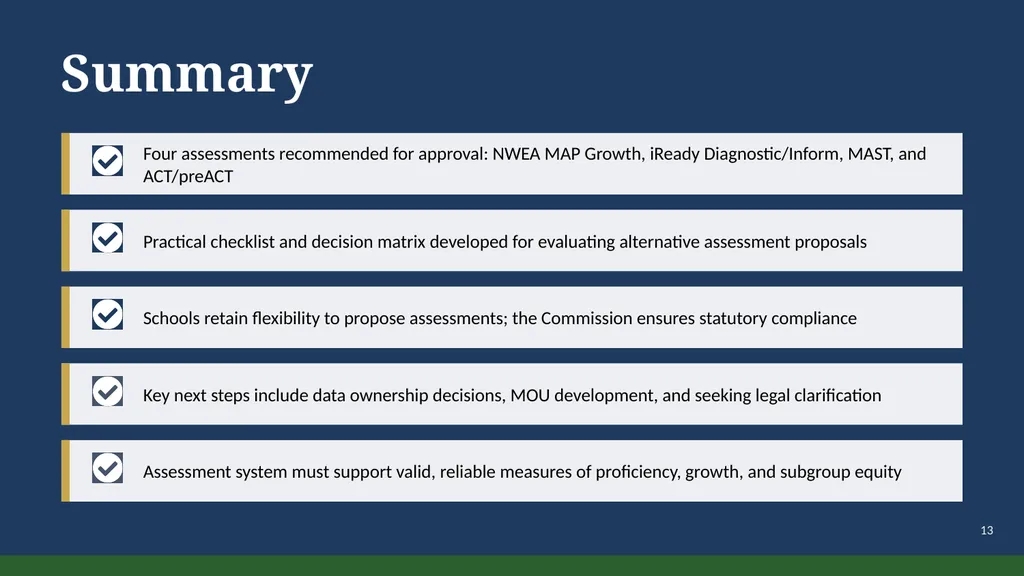
Summary Four assessments recommended for approval: NWEA MAP Growth, iReady Diagnostic/Inform, MAST, and ACT/preACT Practical checklist and decision matrix developed for evaluating alternative assessment proposals Schools retain flexibility to propose assessments; the Commission ensures statutory compliance Key next steps include data ownership decisions, MOU development, and seeking legal clarification Assessment system must support valid, reliable measures of proficiency, growth, and subgroup equity 13<br>
16
Questions &
Discussion Montana Community Choice Schools Commission
Assessment Recommendations Report<br>
Discussion Montana Community Choice Schools Commission
Assessment Recommendations Report<br>