More Americans Seek Wildlife Interactions and Education According to data from the Association of Zoos Aquariums, accredited zoos and aquariums generated 22.5 billion during 2016, served more than 195 million visitors and supported
"More Americans Seek Wildlife Interactions and" is the property of its rightful owner. Permission is granted to
download and print the materials on this website for personal, non-commercial use only, and to display it
on your personal computer provided you do not modify the materials and that you retain all copyright
notices contained in the materials. By downloading content from our website, you accept the terms of this
agreement.
Presentation Transcript
01
More Americans Seek Wildlife Interactions and Education According to data from the Association of Zoos & Aquariums, accredited zoos and aquariums generated $22.5 billion during 2016, served more than 195 million visitors and supported 208,000 jobs.
Attendance at zoos and aquariums increased 6.6% from 2016’s 183 million. Two-thirds of adults visited a zoo with a child and half of adults visited an aquarium with a child. The duration of the average visit was four hours.
As of October 2017, there were 214 accredited zoos and aquariums in the US across 45 states and the District of Columbia, one less than during 2016.<br>
02
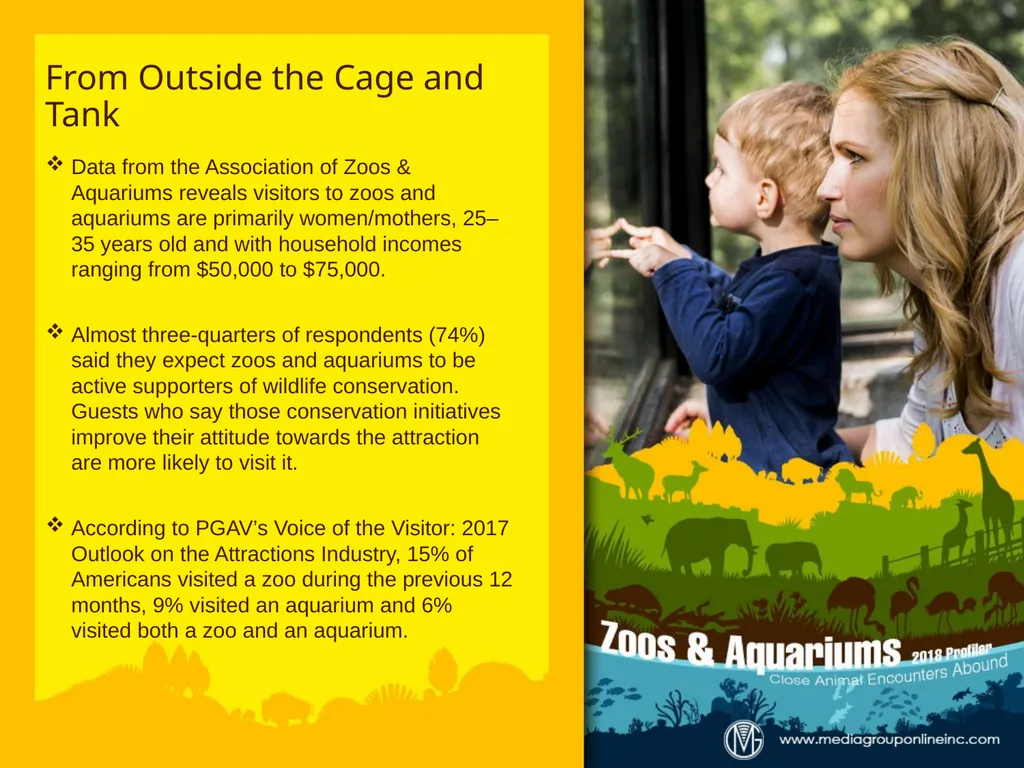
From Outside the Cage and Tank Data from the Association of Zoos & Aquariums reveals visitors to zoos and aquariums are primarily women/mothers, 25–35 years old and with household incomes ranging from $50,000 to $75,000.
Almost three-quarters of respondents (74%) said they expect zoos and aquariums to be active supporters of wildlife conservation. Guests who say those conservation initiatives improve their attitude towards the attraction are more likely to visit it.
According to PGAV’s Voice of the Visitor: 2017 Outlook on the Attractions Industry, 15% of Americans visited a zoo during the previous 12 months, 9% visited an aquarium and 6% visited both a zoo and an aquarium.<br>
03
Zoos: Softer Membership Trends Voice of the Visitor reported that zoos were Millennials’ top 2016 attraction, at 55%, followed by museums at 49% and theme parks at 48%. For 2017, 59% of Millennials were most likely to visit a zoo.
One-percent fewer people reported they visited a zoo during 2017 than during 2016. Zoos ranked highest on intent to return to the same attraction during 2017, scoring 4.30 on a 5-point scale.
Although 3% more visitors had a membership or season pass at an attraction across all attraction categories, season passes/memberships at zoos decreased 4% during 2016 while passes/memberships increased 6% at aquariums.<br>
04
After Tough Year, Aquariums No Longer Tanking Aquariums, as well as theme parks and family entertainment centers, are among the attractions expected to realize the largest increases in attendance during 2017, with incremental attendance of 3% or more.
On the negative side, aquariums had 30% fewer repeat visitors during 2016 than 2015, most likely because of bad publicity about the deaths of killer whales at aquariums.
Several aquariums are debuting new features during 2018, including the New York Aquarium’s 500,000-gallon tank with more than 40 sharks. The Pacific Seas Aquarium will have exhibit areas with different ecosystems.<br>
05
Animal Welfare Issues Pushback from animal rights groups, such as PETA, and more understanding of animals’ emotional lives have challenged zoos and aquariums. The Philadelphia Zoo has removed its elephants and a new Florida bill would ban orca shows and breeding.
To address the challenge, innovative zoos have designed exhibits to mimic more closely animals’ habitats, including multiple specimens of animals living in groups. Humans can view the animals in habitats where animals have the space to roam.
Visitors feel that zoo and aquarium’s top priority (80% and 78%, respectively) should be caring for their animals, followed by educating the public about conservation, 62% and 64%, and providing expert training for keepers and other staff, 60% and 53%.<br>
06
Advertising Strategies Since families with young children are a major customer segment, zoos should maximize outreach to local schools by bringing animals to classrooms and educating students about conservation efforts.
To address concerns about animal welfare, promote the opportunities in marketing/advertising messages for visitors to participate in animal care or watch animals being tended, entertained and fed “behind-the-scenes.”
Highlight the institution’s conservation efforts and life-like exhibit areas.<br>
07
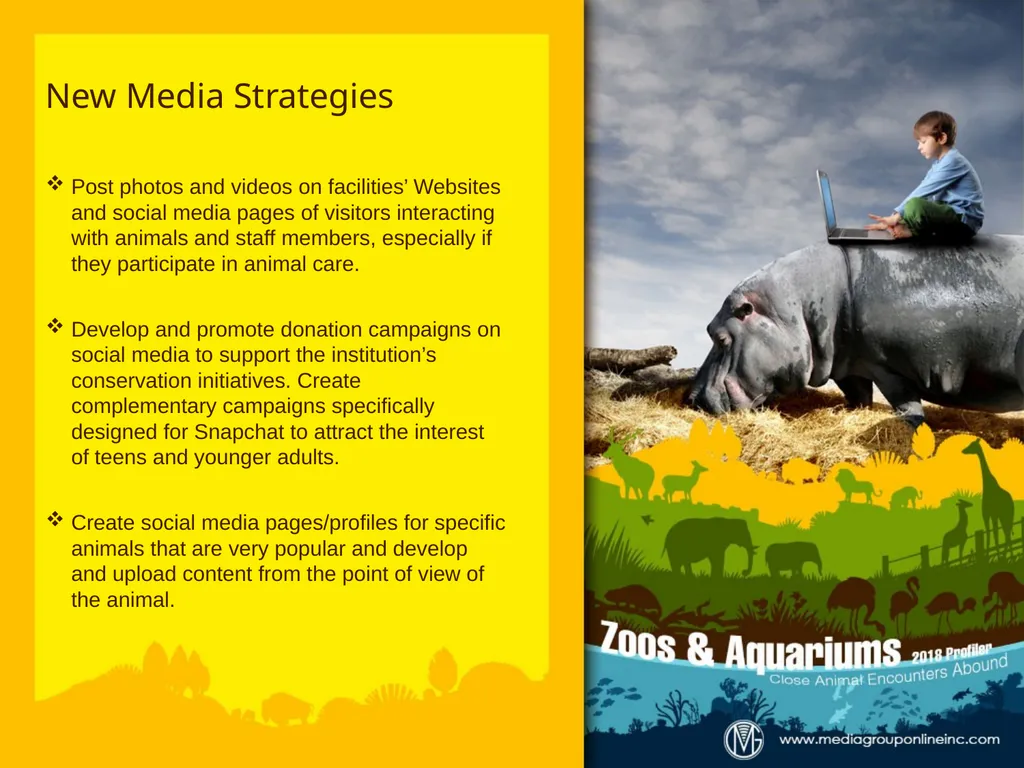
New Media Strategies Post photos and videos on facilities’ Websites and social media pages of visitors interacting with animals and staff members, especially if they participate in animal care.
Develop and promote donation campaigns on social media to support the institution’s conservation initiatives. Create complementary campaigns specifically designed for Snapchat to attract the interest of teens and younger adults.
Create social media pages/profiles for specific animals that are very popular and develop and upload content from the point of view of the animal.<br>