
Mountaineering Refresher Brian Hendrickson MITOC
Description: Mountaineering Refresher Brian Hendrickson MITOC Technical Review Session February 27th, 2012 A very incomplete list A Few Essentials Crampon Techniques Self-Arrest Roping Up Moving as a Team A still incomplete list More Essentials for
Related Topics
Download Presentation
"Mountaineering Refresher Brian Hendrickson MITOC" is the property of its rightful owner. Permission is granted to download and print the materials on this website for personal, non-commercial use only, and to display it on your personal computer provided you do not modify the materials and that you retain all copyright notices contained in the materials. By downloading content from our website, you accept the terms of this agreement.
Presentation Transcript
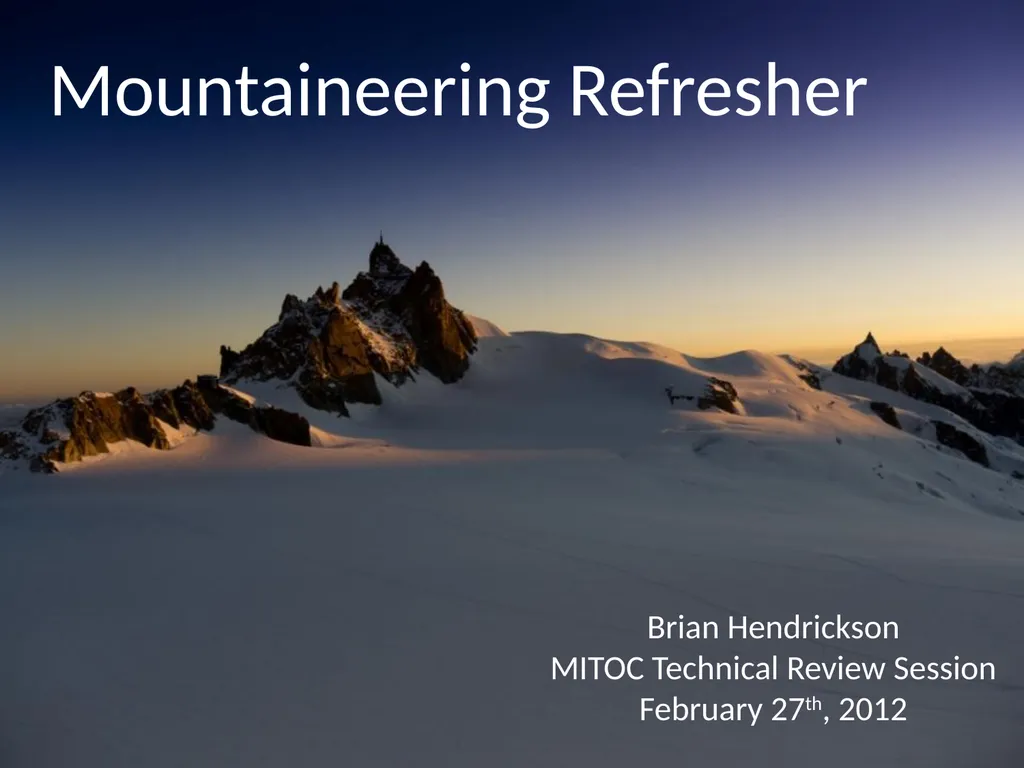
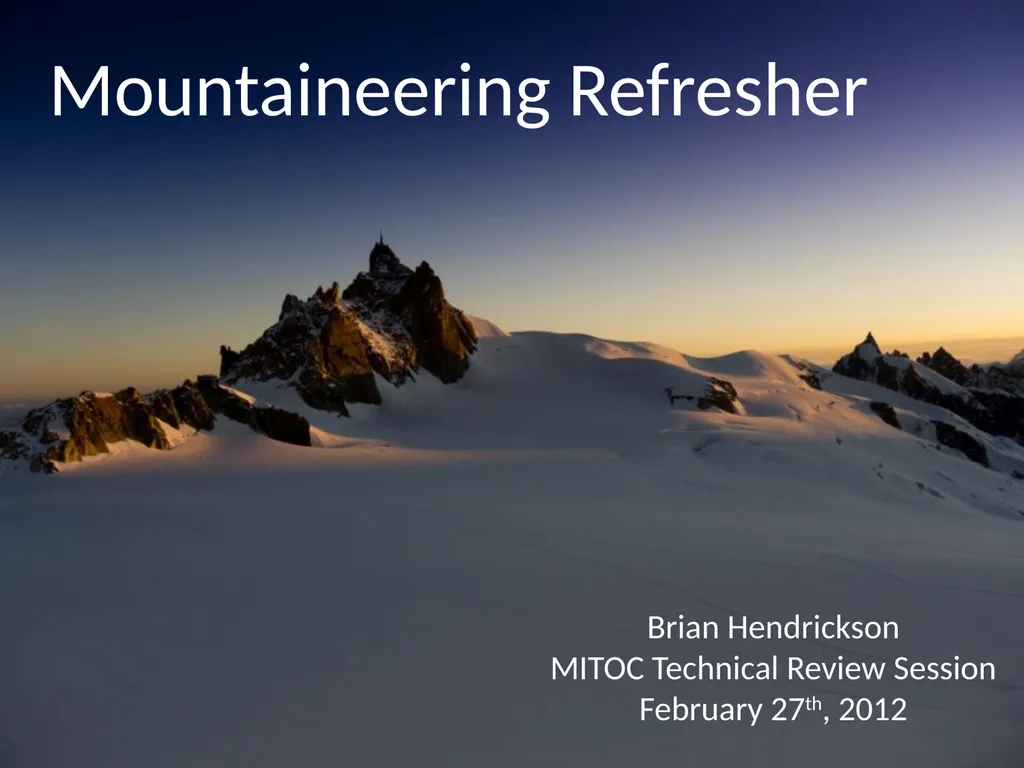
slide1. Mountaineering Refresher Brian Hendrickson
MITOC Technical Review Session
February 27th, 2012<br>
slide2. *A very incomplete list A Few Essentials* Crampon Techniques
Self-Arrest
Roping Up
Moving as a Team<br>
slide3. *A still incomplete list More Essentials for Another Time* Knots and Multi-Point Gear Anchors
Transitions Management (simul-climbing, pitched climbing, rapping)
Protection (deadman, pickets, bollards, screws, v-threads, natural)
Navigation (compass, resistance assessment based on terrain and maps)
Down-Climbing Techniques (facing in vs out, footwork, balling prevention)
Alternative Belay and Rappel Techniques (Dulfersitz, single-strand, simul-rapping)
Hazard Assessment (rock/ice fall, crevasse, avy, weather, team condition)
Bivouacs (gear, safety, eating, sleeping)
Camp Management (fortifying, kitchen-building, latrines)
Trip Planning (route selection, expedition vs alpine, timing, pacing, logistics)
Nutrition (mountain physiology, cooking, hydrating)
Weather (evaluating clouds, typical cycles, local patterns)
Training (cardiovascular, strength endurance vs power, periodization)
Rescue (escaping belay, line ascension, hauling systems)
Wilderness Medicine (patient assessment, long-term treatment, evacuation)<br>
slide4. Requisite Disclaimer Mountaineering requires improvisation and real-time assessment of trade-offs. It demands both conceptual knowledge and deep first-hand experience. This review is not the definitive guide to mountaineering. Respect its limits and yours.<br>
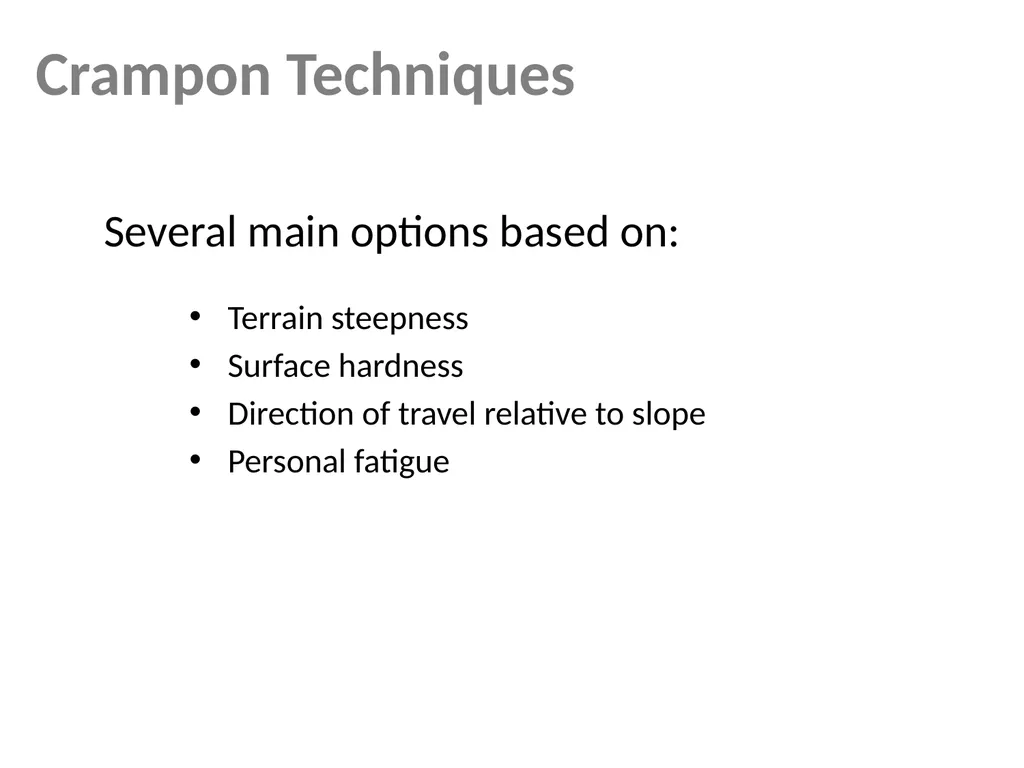
slide5. Crampon Techniques Several main options based on: Terrain steepness
Surface hardness
Direction of travel relative to slope
Personal fatigue<br>
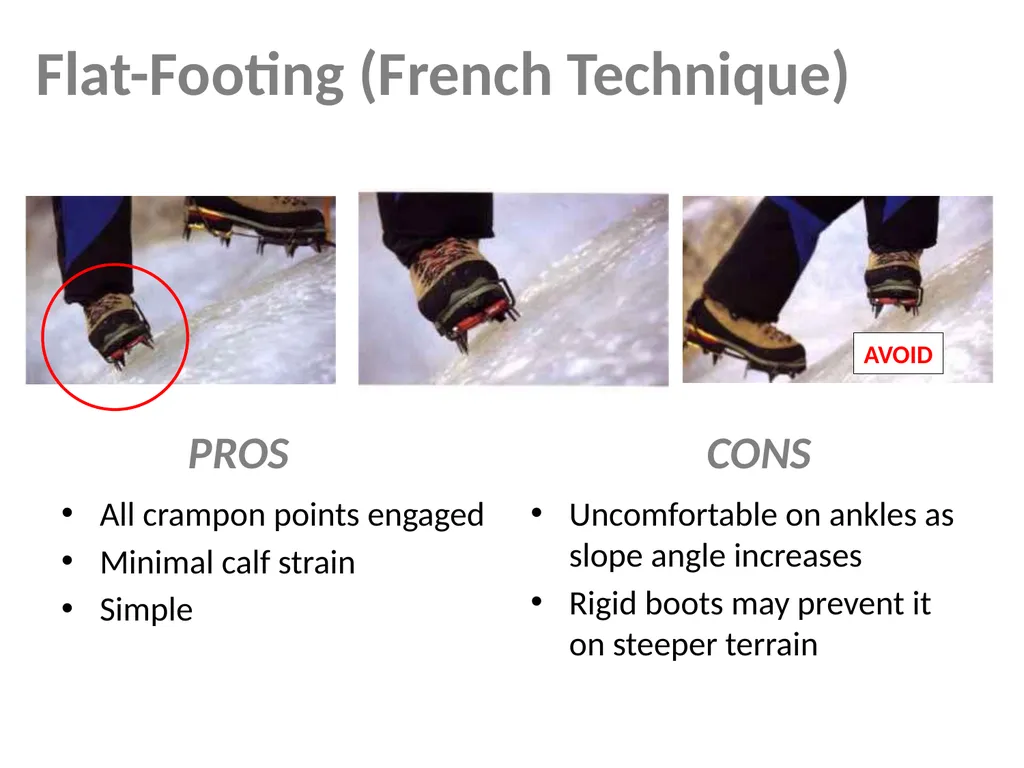
slide6. Flat-Footing (French Technique) All crampon points engaged
Minimal calf strain
Simple Uncomfortable on ankles as slope angle increases
Rigid boots may prevent it on steeper terrain CONS PROS AVOID<br>
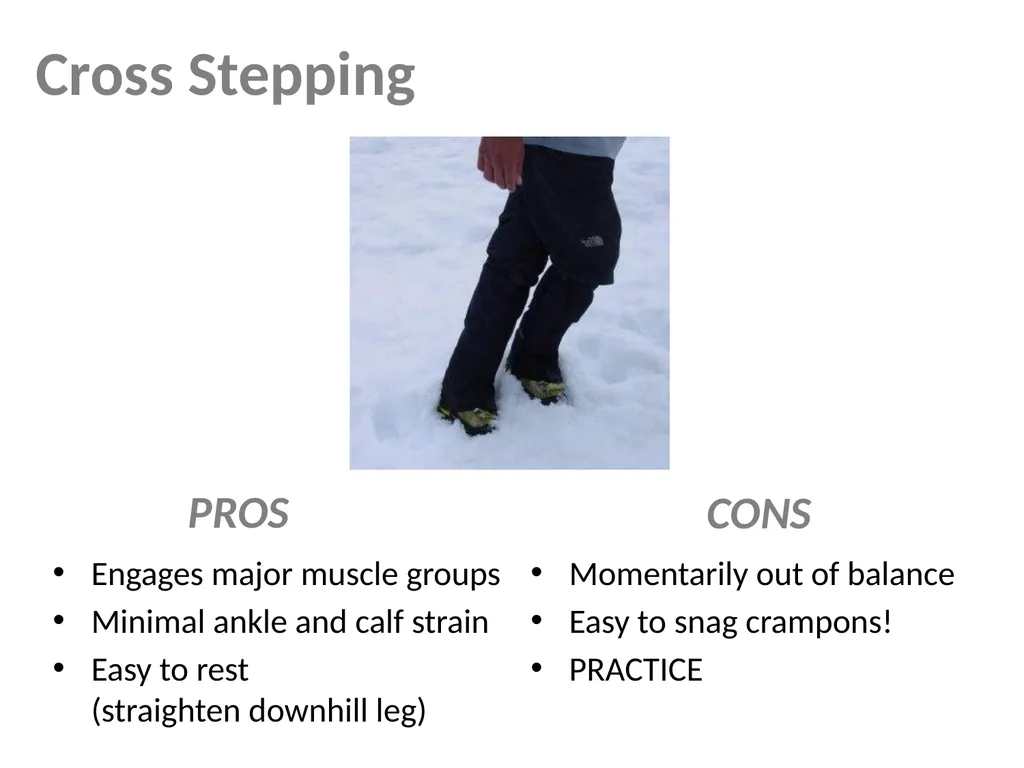
slide7. Cross Stepping Engages major muscle groups
Minimal ankle and calf strain
Easy to rest (straighten downhill leg) Momentarily out of balance
Easy to snag crampons!
PRACTICE CONS PROS<br>
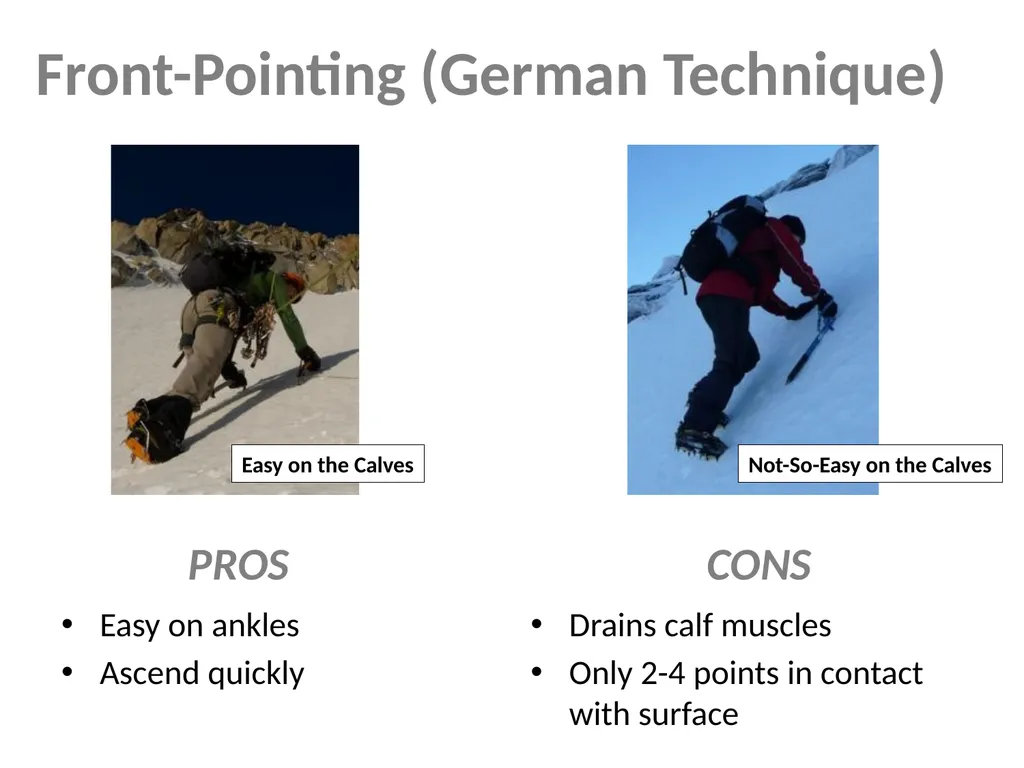
slide8. Front-Pointing (German Technique) Easy on ankles
Ascend quickly Drains calf muscles
Only 2-4 points in contact with surface CONS PROS Easy on the Calves Not-So-Easy on the Calves<br>
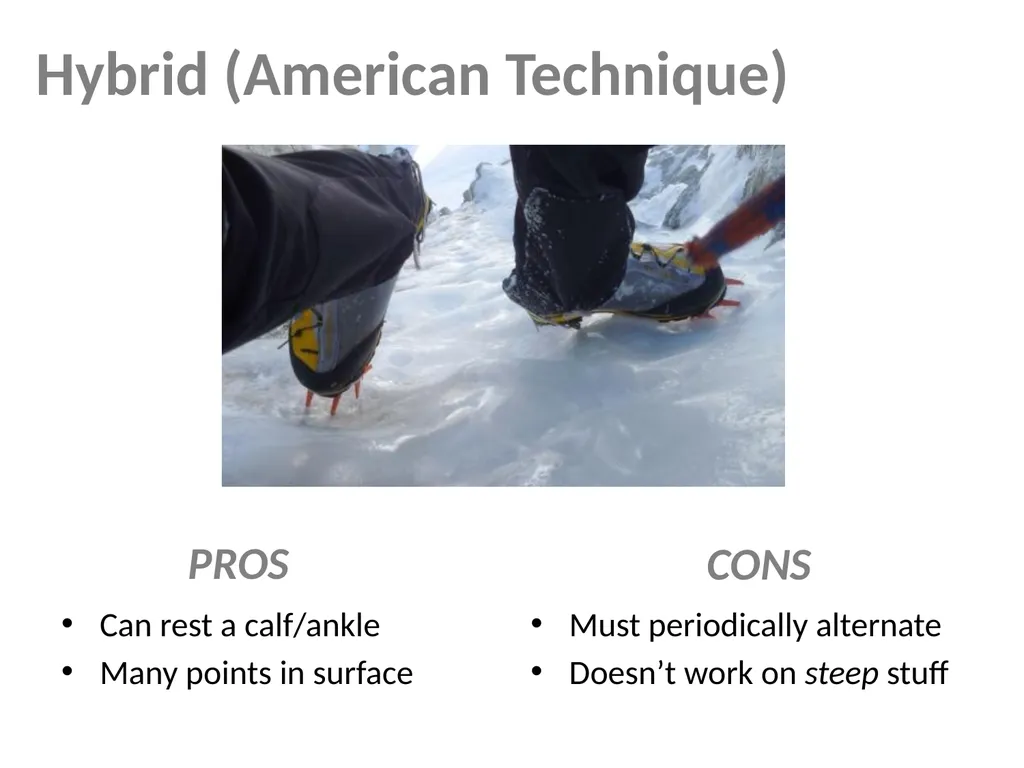
slide9. Hybrid (American Technique) Can rest a calf/ankle
Many points in surface Must periodically alternate
Doesn’t work on steep stuff CONS PROS<br>
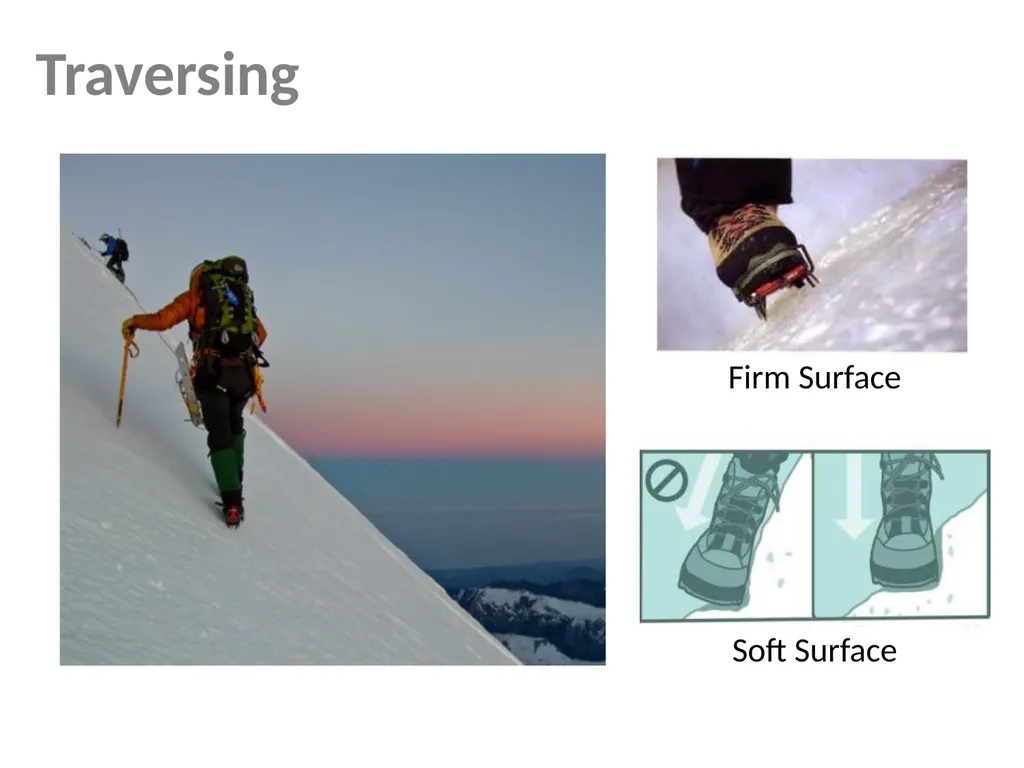
slide10. Traversing PROS Firm Surface Soft Surface<br>
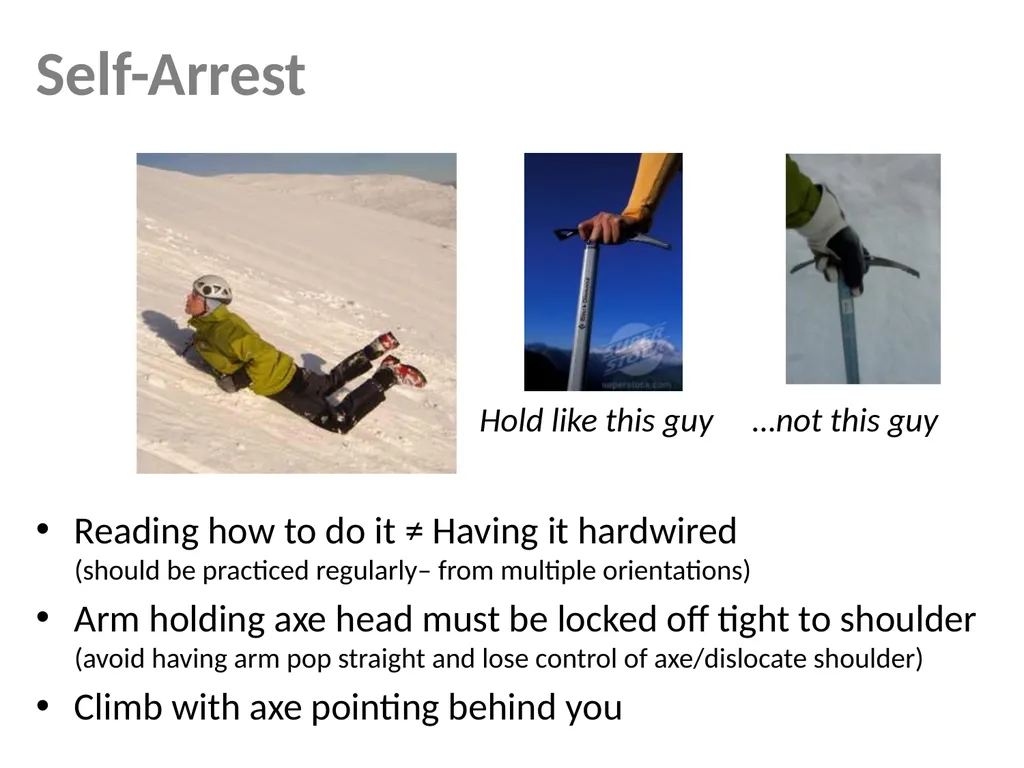
slide11. Self-Arrest Reading how to do it ≠ Having it hardwired (should be practiced regularly– from multiple orientations)
Arm holding axe head must be locked off tight to shoulder (avoid having arm pop straight and lose control of axe/dislocate shoulder)
Climb with axe pointing behind you Hold like this guy …not this guy<br>
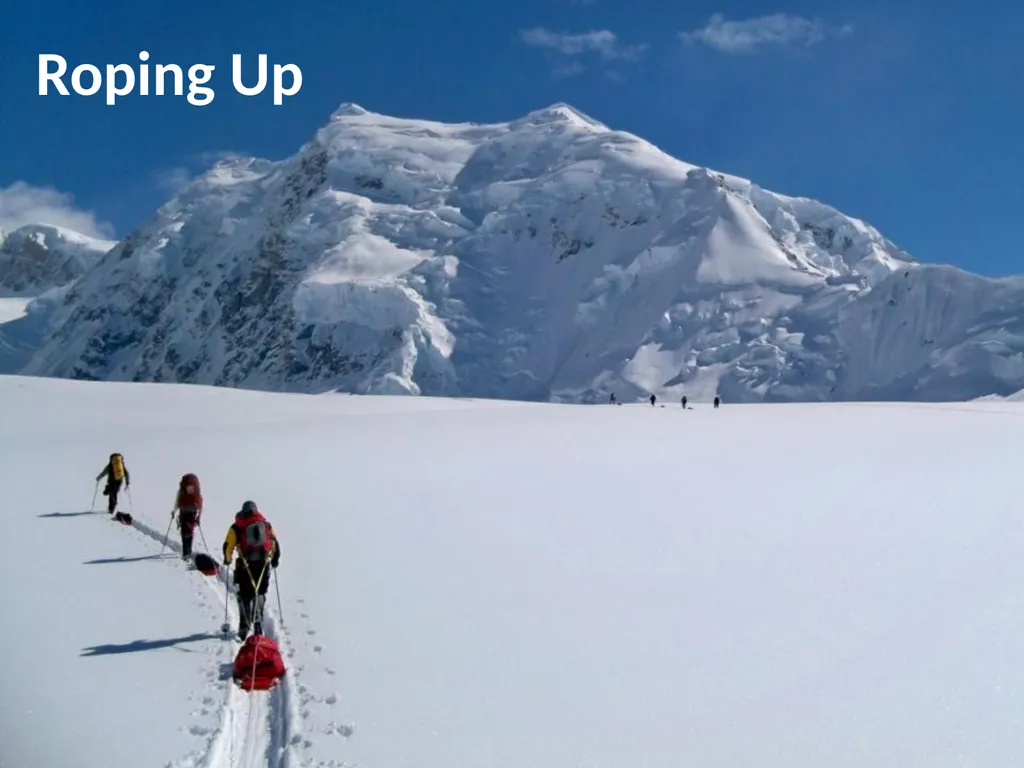
slide12. Roping Up<br>
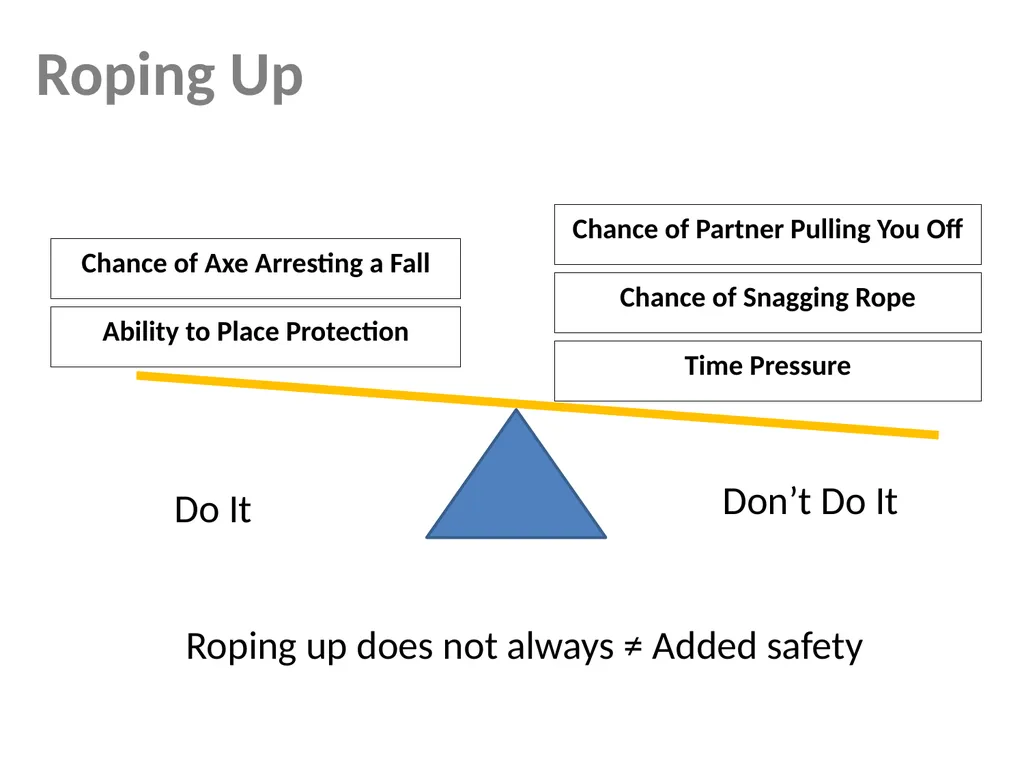
slide13. Roping Up Roping up does not always ≠ Added safety Ability to Place Protection Chance of Snagging Rope Chance of Partner Pulling You Off Chance of Axe Arresting a Fall Time Pressure Do It Don’t Do It<br>
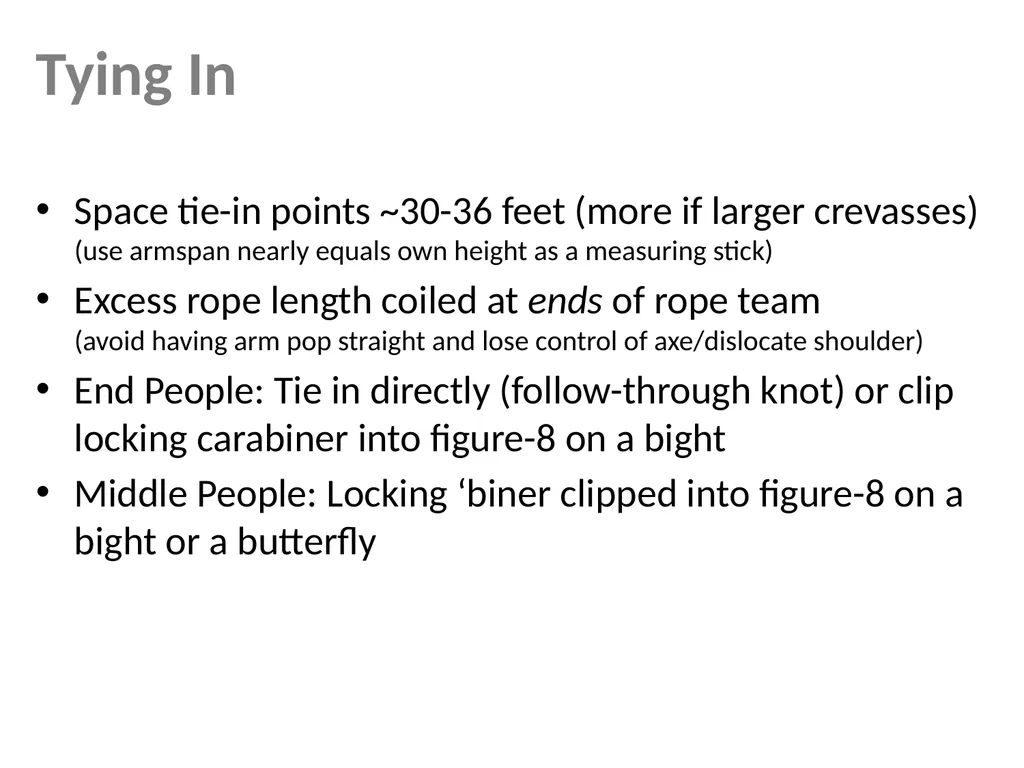
slide15. Tying In Space tie-in points ~30-36 feet (more if larger crevasses) (use armspan nearly equals own height as a measuring stick)
Excess rope length coiled at ends of rope team (avoid having arm pop straight and lose control of axe/dislocate shoulder)
End People: Tie in directly (follow-through knot) or clip locking carabiner into figure-8 on a bight
Middle People: Locking ‘biner clipped into figure-8 on a bight or a butterfly<br>
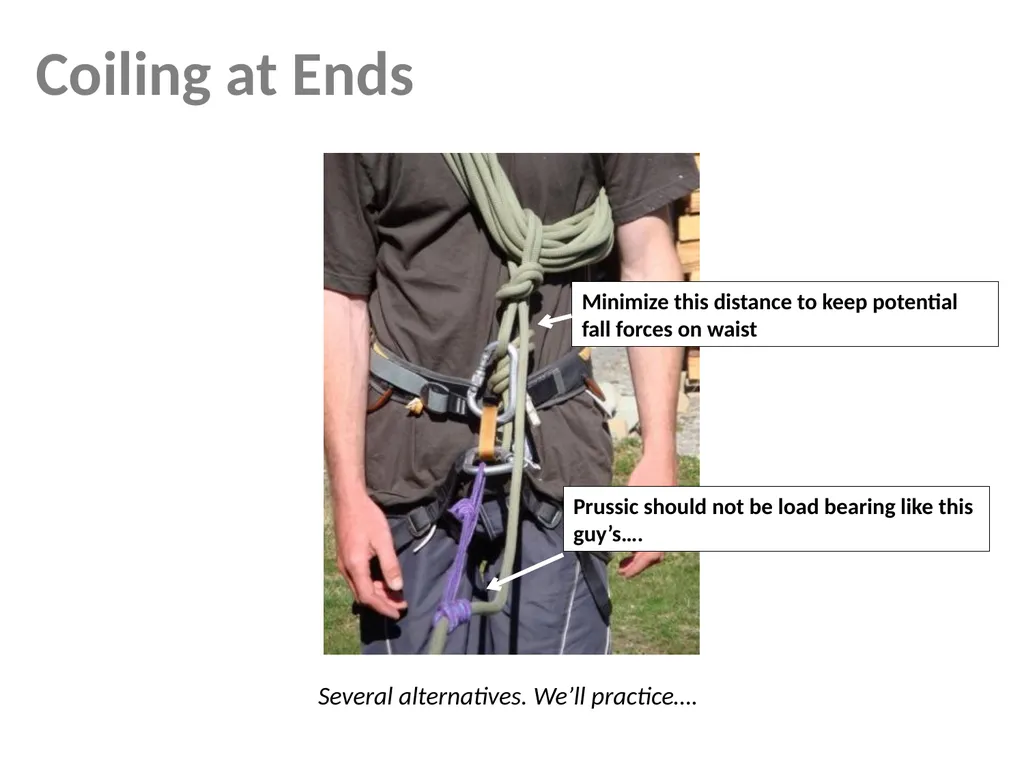
slide16. Coiling at Ends Prussic should not be load bearing like this guy’s…. Minimize this distance to keep potential fall forces on waist Several alternatives. We’ll practice….<br>
slide17. Moving as a Team Keep slack to a minimum
Keep rope perpendicular to crevasses
Keep rope downhill to avoid stepping on it
Remember that just because you have reached an easy/fast section, your partner(s) may still be in a slow section!<br>
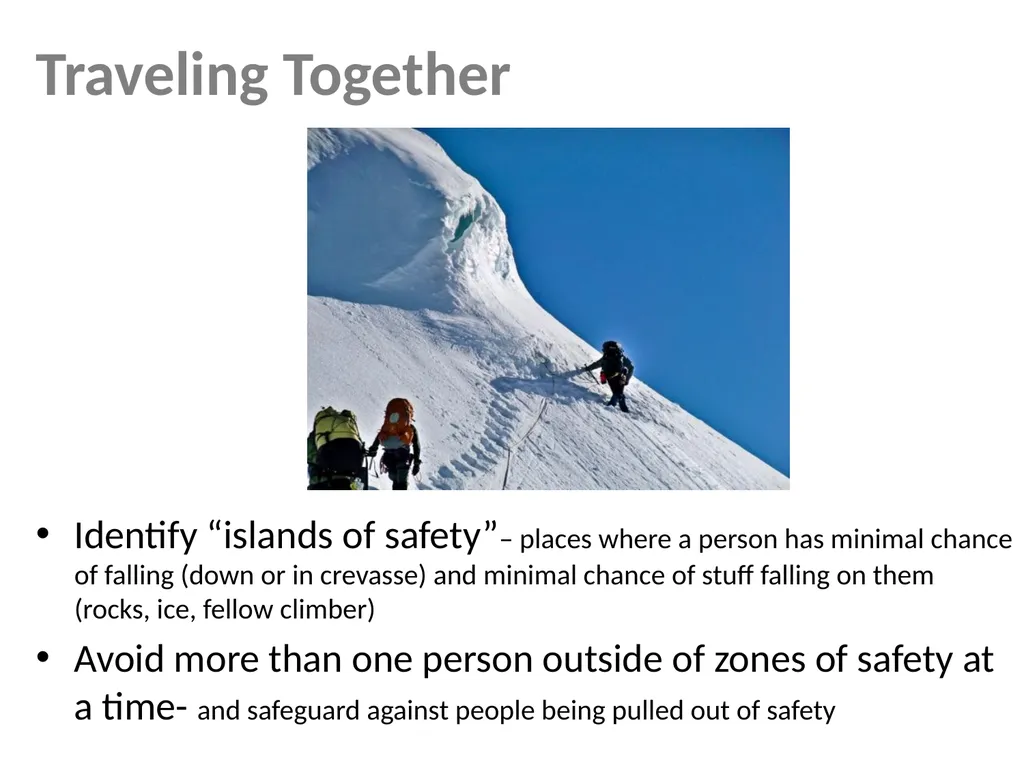
slide18. Traveling Together Identify “islands of safety”– places where a person has minimal chance of falling (down or in crevasse) and minimal chance of stuff falling on them (rocks, ice, fellow climber)
Avoid more than one person outside of zones of safety at a time- and safeguard against people being pulled out of safety<br>
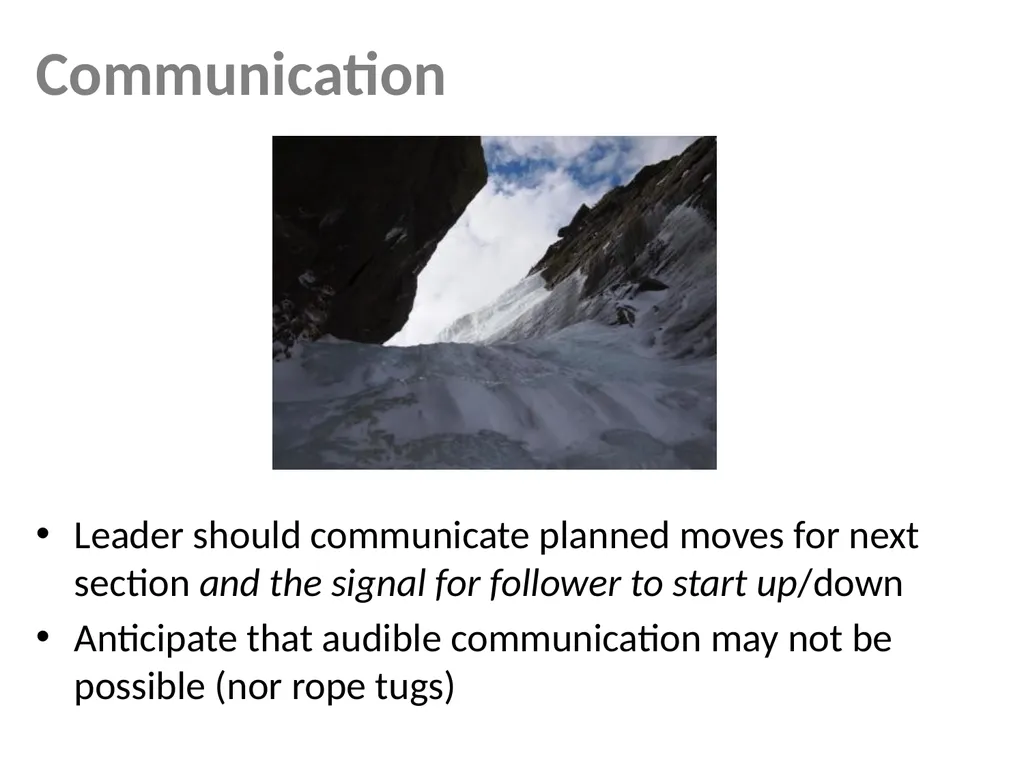
slide19. Communication Leader should communicate planned moves for next section and the signal for follower to start up/down
Anticipate that audible communication may not be possible (nor rope tugs)<br>
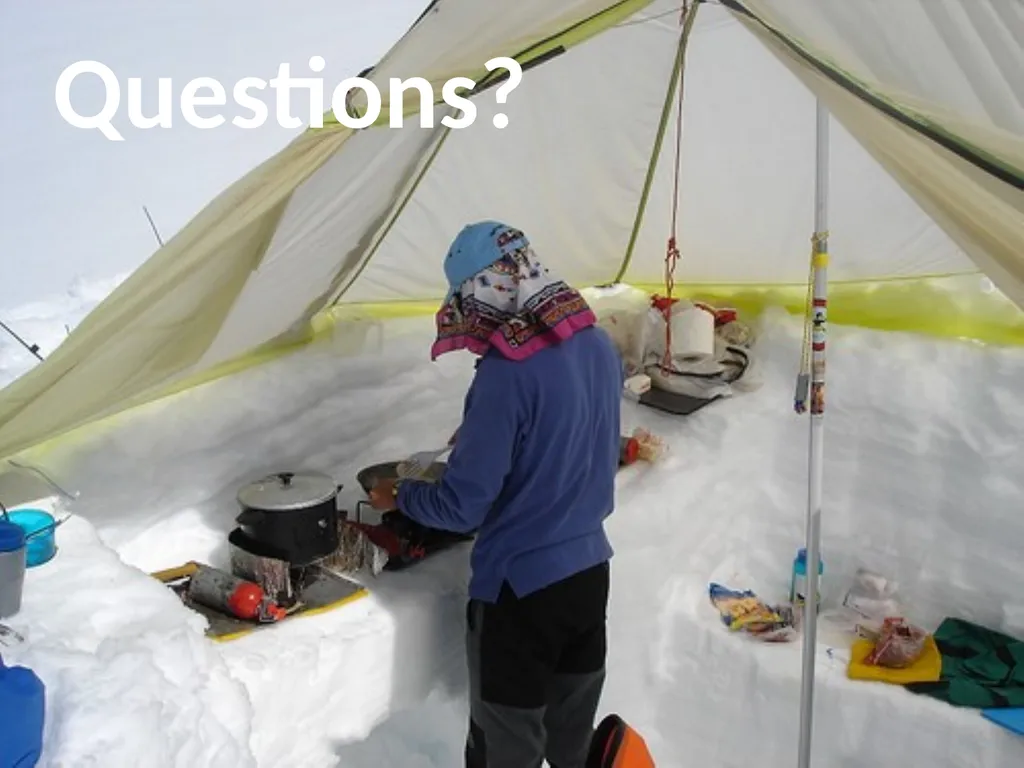
slide20. Questions?<br>
MITOC Technical Review Session
February 27th, 2012<br>
slide2. *A very incomplete list A Few Essentials* Crampon Techniques
Self-Arrest
Roping Up
Moving as a Team<br>
slide3. *A still incomplete list More Essentials for Another Time* Knots and Multi-Point Gear Anchors
Transitions Management (simul-climbing, pitched climbing, rapping)
Protection (deadman, pickets, bollards, screws, v-threads, natural)
Navigation (compass, resistance assessment based on terrain and maps)
Down-Climbing Techniques (facing in vs out, footwork, balling prevention)
Alternative Belay and Rappel Techniques (Dulfersitz, single-strand, simul-rapping)
Hazard Assessment (rock/ice fall, crevasse, avy, weather, team condition)
Bivouacs (gear, safety, eating, sleeping)
Camp Management (fortifying, kitchen-building, latrines)
Trip Planning (route selection, expedition vs alpine, timing, pacing, logistics)
Nutrition (mountain physiology, cooking, hydrating)
Weather (evaluating clouds, typical cycles, local patterns)
Training (cardiovascular, strength endurance vs power, periodization)
Rescue (escaping belay, line ascension, hauling systems)
Wilderness Medicine (patient assessment, long-term treatment, evacuation)<br>
slide4. Requisite Disclaimer Mountaineering requires improvisation and real-time assessment of trade-offs. It demands both conceptual knowledge and deep first-hand experience. This review is not the definitive guide to mountaineering. Respect its limits and yours.<br>
slide5. Crampon Techniques Several main options based on: Terrain steepness
Surface hardness
Direction of travel relative to slope
Personal fatigue<br>
slide6. Flat-Footing (French Technique) All crampon points engaged
Minimal calf strain
Simple Uncomfortable on ankles as slope angle increases
Rigid boots may prevent it on steeper terrain CONS PROS AVOID<br>
slide7. Cross Stepping Engages major muscle groups
Minimal ankle and calf strain
Easy to rest (straighten downhill leg) Momentarily out of balance
Easy to snag crampons!
PRACTICE CONS PROS<br>
slide8. Front-Pointing (German Technique) Easy on ankles
Ascend quickly Drains calf muscles
Only 2-4 points in contact with surface CONS PROS Easy on the Calves Not-So-Easy on the Calves<br>
slide9. Hybrid (American Technique) Can rest a calf/ankle
Many points in surface Must periodically alternate
Doesn’t work on steep stuff CONS PROS<br>
slide10. Traversing PROS Firm Surface Soft Surface<br>
slide11. Self-Arrest Reading how to do it ≠ Having it hardwired (should be practiced regularly– from multiple orientations)
Arm holding axe head must be locked off tight to shoulder (avoid having arm pop straight and lose control of axe/dislocate shoulder)
Climb with axe pointing behind you Hold like this guy …not this guy<br>
slide12. Roping Up<br>
slide13. Roping Up Roping up does not always ≠ Added safety Ability to Place Protection Chance of Snagging Rope Chance of Partner Pulling You Off Chance of Axe Arresting a Fall Time Pressure Do It Don’t Do It<br>
slide15. Tying In Space tie-in points ~30-36 feet (more if larger crevasses) (use armspan nearly equals own height as a measuring stick)
Excess rope length coiled at ends of rope team (avoid having arm pop straight and lose control of axe/dislocate shoulder)
End People: Tie in directly (follow-through knot) or clip locking carabiner into figure-8 on a bight
Middle People: Locking ‘biner clipped into figure-8 on a bight or a butterfly<br>
slide16. Coiling at Ends Prussic should not be load bearing like this guy’s…. Minimize this distance to keep potential fall forces on waist Several alternatives. We’ll practice….<br>
slide17. Moving as a Team Keep slack to a minimum
Keep rope perpendicular to crevasses
Keep rope downhill to avoid stepping on it
Remember that just because you have reached an easy/fast section, your partner(s) may still be in a slow section!<br>
slide18. Traveling Together Identify “islands of safety”– places where a person has minimal chance of falling (down or in crevasse) and minimal chance of stuff falling on them (rocks, ice, fellow climber)
Avoid more than one person outside of zones of safety at a time- and safeguard against people being pulled out of safety<br>
slide19. Communication Leader should communicate planned moves for next section and the signal for follower to start up/down
Anticipate that audible communication may not be possible (nor rope tugs)<br>
slide20. Questions?<br>