
Moving from Cisco Jabber to team messaging mode?
SN
Published · 12 slides · 0 views

1 / 1
Description
Moving from Cisco Jabber to team messaging mode? Great idea. Were here to help. CUSTOMER Use this handy PPT to create a successful adoption plan. It will help you keep track of goals, activities owners. Thank you for choosing Cisco
Related Topics
Share
Embed code
Download this presentation From Below
"Moving from Cisco Jabber to team messaging mode?" is the property of its rightful owner. Permission is granted to download and print the materials on this website for personal, non-commercial use only, and to display it on your personal computer provided you do not modify the materials and that you retain all copyright notices contained in the materials. By downloading content from our website, you accept the terms of this agreement.
Presentation Transcript
01
Moving from Cisco Jabber to team messaging mode? Great idea. We’re here to help. CUSTOMER Use this handy PPT to create a successful adoption plan.
It will help you keep track of goals, activities & owners.<br>
It will help you keep track of goals, activities & owners.<br>
02
Thank you
for choosing Cisco Collaboration<br>
03
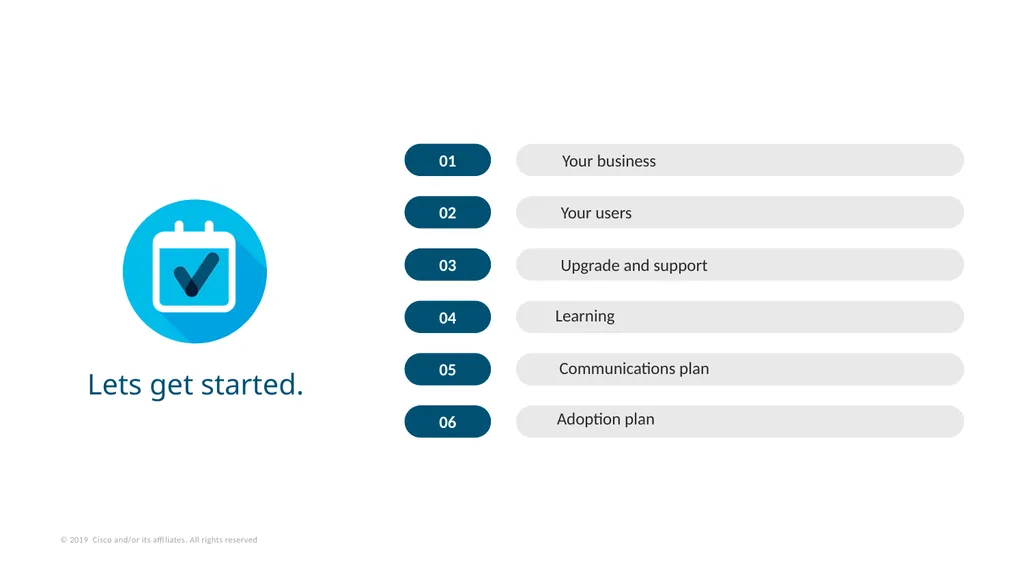
Lets get started. Your business Your users Upgrade and support Learning Communications plan Adoption plan 01 02 03 04 05 06 07<br>
04
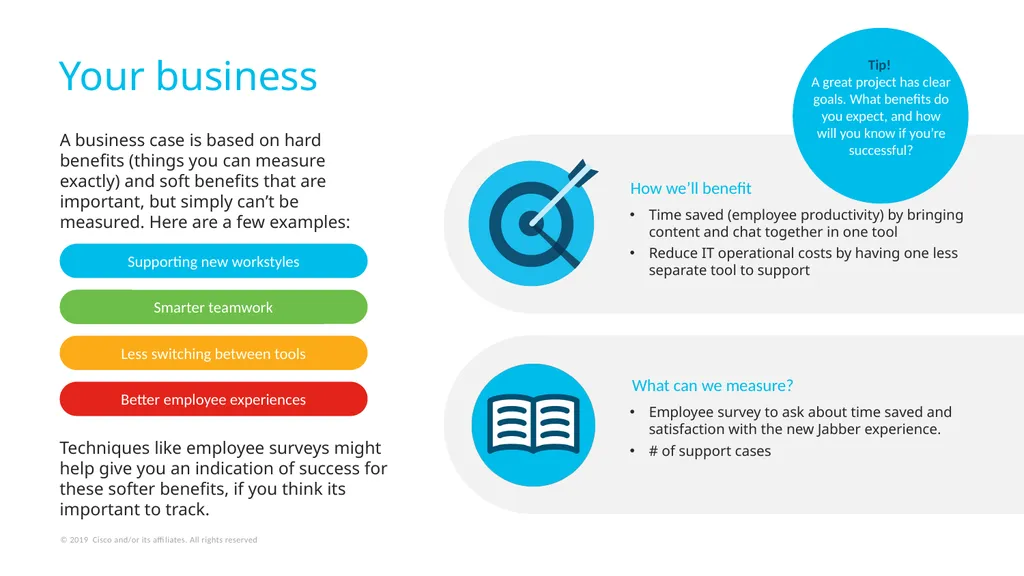
Your business A business case is based on hard benefits (things you can measure exactly) and soft benefits that are important, but simply can’t be measured. Here are a few examples: Techniques like employee surveys might help give you an indication of success for these softer benefits, if you think its important to track. Tip!
A great project has clear goals. What benefits do you expect, and how will you know if you’re successful?<br>
A great project has clear goals. What benefits do you expect, and how will you know if you’re successful?<br>
05
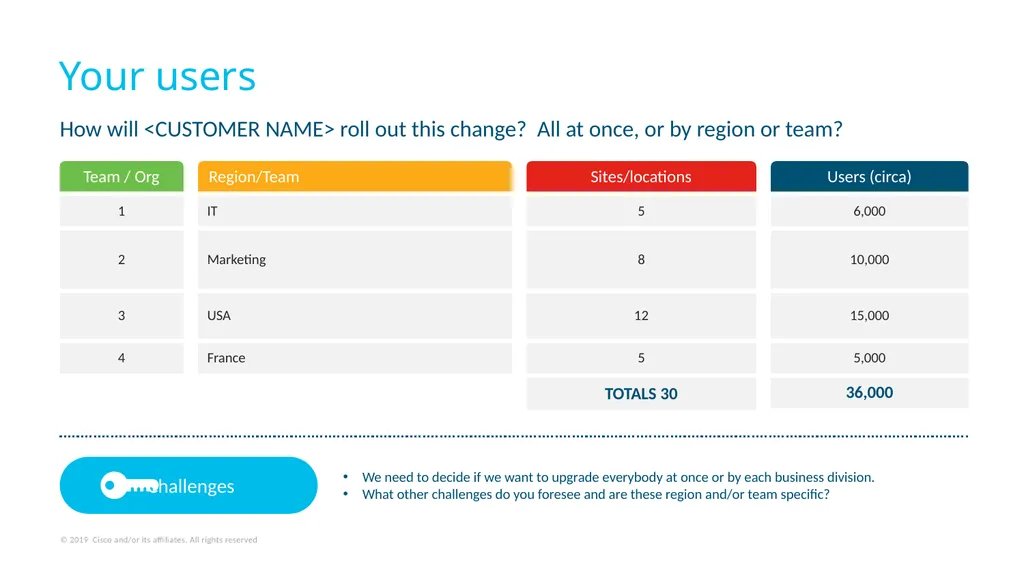
Your users How will <CUSTOMER NAME> roll out this change? All at once, or by region or team? Team / Org Region/Team Sites/locations Users (circa) IT 1 5 6,000 Marketing 2 8 10,000 USA 3 12 15,000 France 4 5 5,000 TOTALS 30 36,000 We need to decide if we want to upgrade everybody at once or by each business division.
What other challenges do you foresee and are these region and/or team specific?<br>
What other challenges do you foresee and are these region and/or team specific?<br>
06
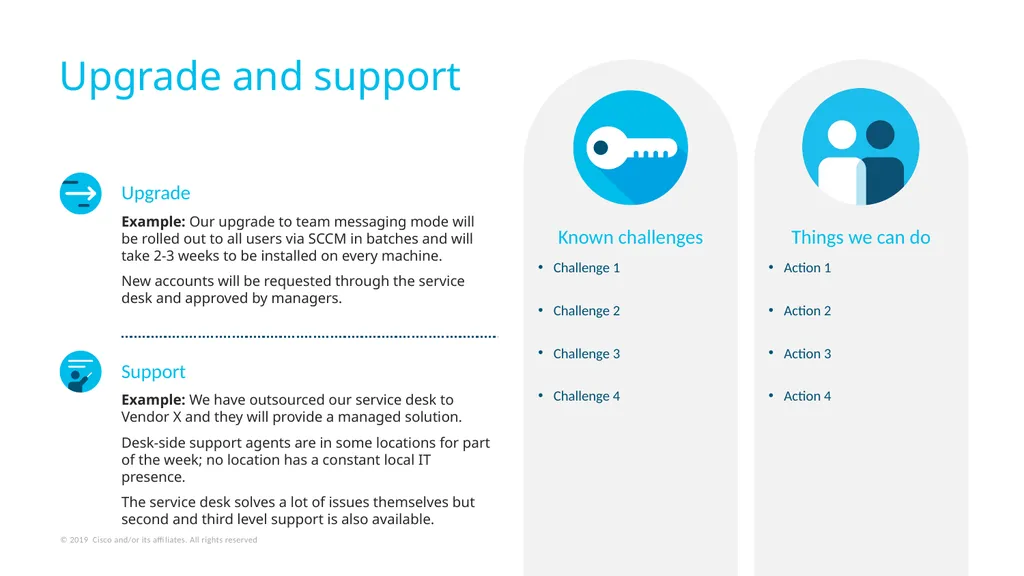
Upgrade and support Known challenges Challenge 1
Challenge 2
Challenge 3
Challenge 4 Things we can do Action 1
Action 2
Action 3
Action 4 Upgrade
Example: Our upgrade to team messaging mode will be rolled out to all users via SCCM in batches and will take 2-3 weeks to be installed on every machine.
New accounts will be requested through the service desk and approved by managers. Support
Example: We have outsourced our service desk to Vendor X and they will provide a managed solution.
Desk-side support agents are in some locations for part of the week; no location has a constant local IT presence.
The service desk solves a lot of issues themselves but second and third level support is also available.<br>
Challenge 2
Challenge 3
Challenge 4 Things we can do Action 1
Action 2
Action 3
Action 4 Upgrade
Example: Our upgrade to team messaging mode will be rolled out to all users via SCCM in batches and will take 2-3 weeks to be installed on every machine.
New accounts will be requested through the service desk and approved by managers. Support
Example: We have outsourced our service desk to Vendor X and they will provide a managed solution.
Desk-side support agents are in some locations for part of the week; no location has a constant local IT presence.
The service desk solves a lot of issues themselves but second and third level support is also available.<br>
07
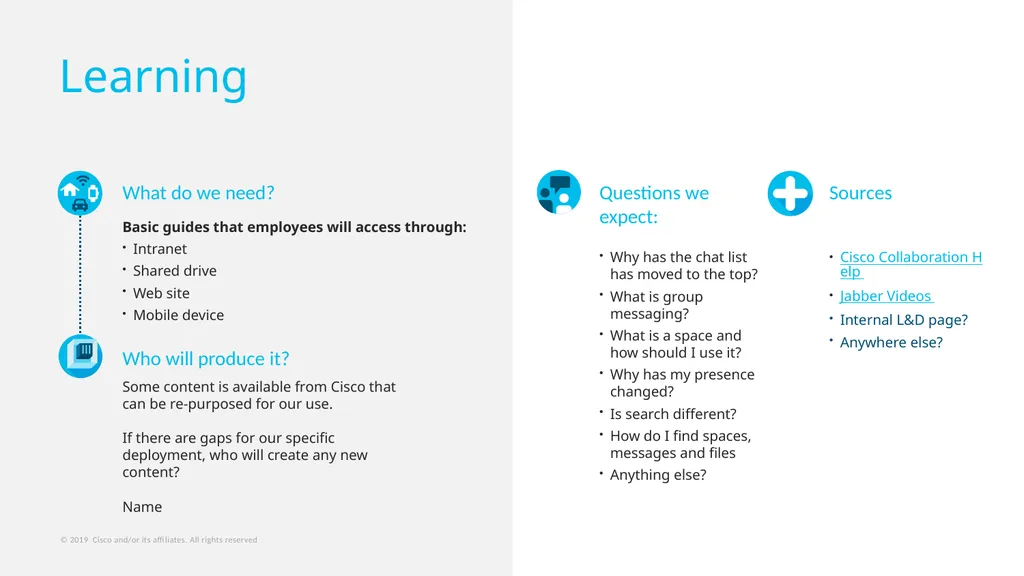
Learning What do we need? Basic guides that employees will access through:
Intranet
Shared drive
Web site
Mobile device Who will produce it? Some content is available from Cisco that can be re-purposed for our use.
If there are gaps for our specific deployment, who will create any new content?
Name Questions we expect: Why has the chat list has moved to the top?
What is group messaging?
What is a space and how should I use it?
Why has my presence changed?
Is search different?
How do I find spaces, messages and files
Anything else? Cisco Collaboration Help
Jabber Videos
Internal L&D page?
Anywhere else? Sources<br>
Intranet
Shared drive
Web site
Mobile device Who will produce it? Some content is available from Cisco that can be re-purposed for our use.
If there are gaps for our specific deployment, who will create any new content?
Name Questions we expect: Why has the chat list has moved to the top?
What is group messaging?
What is a space and how should I use it?
Why has my presence changed?
Is search different?
How do I find spaces, messages and files
Anything else? Cisco Collaboration Help
Jabber Videos
Internal L&D page?
Anywhere else? Sources<br>
08
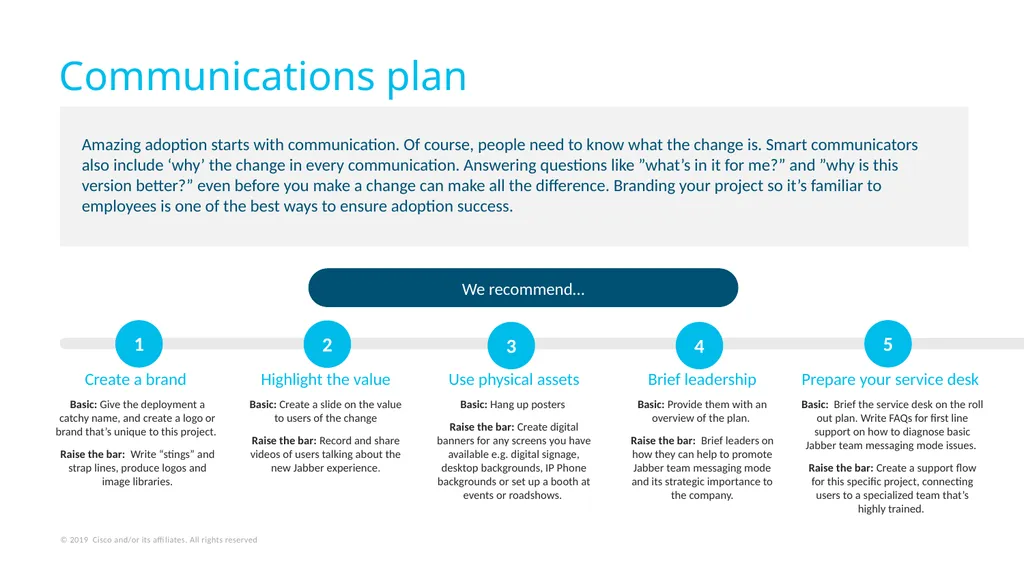
Communications plan Amazing adoption starts with communication. Of course, people need to know what the change is. Smart communicators also include ‘why’ the change in every communication. Answering questions like ”what’s in it for me?” and ”why is this version better?” even before you make a change can make all the difference. Branding your project so it’s familiar to employees is one of the best ways to ensure adoption success. Create a brand
Basic: Give the deployment a catchy name, and create a logo or brand that’s unique to this project.
Raise the bar: Write “stings” and strap lines, produce logos and image libraries. Highlight the value
Basic: Create a slide on the value to users of the change
Raise the bar: Record and share videos of users talking about the new Jabber experience. Use physical assets
Basic: Hang up posters
Raise the bar: Create digital banners for any screens you have available e.g. digital signage, desktop backgrounds, IP Phone backgrounds or set up a booth at events or roadshows. Brief leadership
Basic: Provide them with an overview of the plan.
Raise the bar: Brief leaders on how they can help to promote Jabber team messaging mode and its strategic importance to the company. Prepare your service desk
Basic: Brief the service desk on the roll out plan. Write FAQs for first line support on how to diagnose basic Jabber team messaging mode issues.
Raise the bar: Create a support flow for this specific project, connecting users to a specialized team that’s highly trained. 1 2 3 4 5<br>
Basic: Give the deployment a catchy name, and create a logo or brand that’s unique to this project.
Raise the bar: Write “stings” and strap lines, produce logos and image libraries. Highlight the value
Basic: Create a slide on the value to users of the change
Raise the bar: Record and share videos of users talking about the new Jabber experience. Use physical assets
Basic: Hang up posters
Raise the bar: Create digital banners for any screens you have available e.g. digital signage, desktop backgrounds, IP Phone backgrounds or set up a booth at events or roadshows. Brief leadership
Basic: Provide them with an overview of the plan.
Raise the bar: Brief leaders on how they can help to promote Jabber team messaging mode and its strategic importance to the company. Prepare your service desk
Basic: Brief the service desk on the roll out plan. Write FAQs for first line support on how to diagnose basic Jabber team messaging mode issues.
Raise the bar: Create a support flow for this specific project, connecting users to a specialized team that’s highly trained. 1 2 3 4 5<br>
09
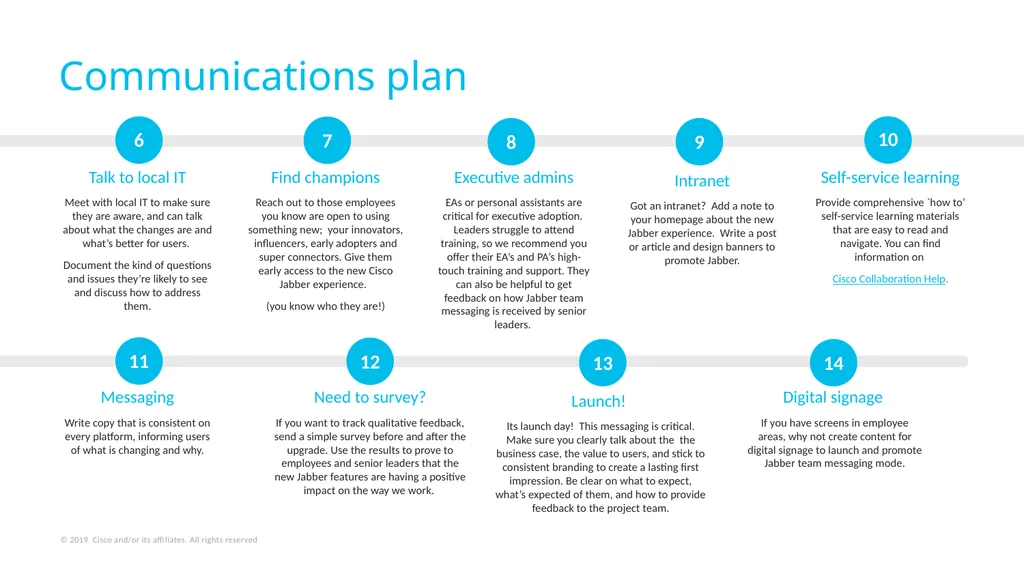
Communications plan Talk to local IT
Meet with local IT to make sure they are aware, and can talk about what the changes are and what’s better for users.
Document the kind of questions and issues they’re likely to see and discuss how to address them. Executive admins
EAs or personal assistants are critical for executive adoption. Leaders struggle to attend training, so we recommend you offer their EA’s and PA’s high-touch training and support. They can also be helpful to get feedback on how Jabber team messaging is received by senior leaders. Self-service learning
Provide comprehensive `how to’ self-service learning materials that are easy to read and navigate. You can find information on
Cisco Collaboration Help. Find champions
Reach out to those employees you know are open to using something new; your innovators, influencers, early adopters and super connectors. Give them early access to the new Cisco Jabber experience.
(you know who they are!) Intranet
Got an intranet? Add a note to your homepage about the new Jabber experience. Write a post or article and design banners to promote Jabber. Messaging
Write copy that is consistent on every platform, informing users of what is changing and why. Need to survey?
If you want to track qualitative feedback, send a simple survey before and after the upgrade. Use the results to prove to employees and senior leaders that the new Jabber features are having a positive impact on the way we work. Digital signage
If you have screens in employee areas, why not create content for digital signage to launch and promote Jabber team messaging mode. Launch!
Its launch day! This messaging is critical. Make sure you clearly talk about the the business case, the value to users, and stick to consistent branding to create a lasting first impression. Be clear on what to expect, what’s expected of them, and how to provide feedback to the project team. 6 7 8 9 10 11 12 13 14<br>
Meet with local IT to make sure they are aware, and can talk about what the changes are and what’s better for users.
Document the kind of questions and issues they’re likely to see and discuss how to address them. Executive admins
EAs or personal assistants are critical for executive adoption. Leaders struggle to attend training, so we recommend you offer their EA’s and PA’s high-touch training and support. They can also be helpful to get feedback on how Jabber team messaging is received by senior leaders. Self-service learning
Provide comprehensive `how to’ self-service learning materials that are easy to read and navigate. You can find information on
Cisco Collaboration Help. Find champions
Reach out to those employees you know are open to using something new; your innovators, influencers, early adopters and super connectors. Give them early access to the new Cisco Jabber experience.
(you know who they are!) Intranet
Got an intranet? Add a note to your homepage about the new Jabber experience. Write a post or article and design banners to promote Jabber. Messaging
Write copy that is consistent on every platform, informing users of what is changing and why. Need to survey?
If you want to track qualitative feedback, send a simple survey before and after the upgrade. Use the results to prove to employees and senior leaders that the new Jabber features are having a positive impact on the way we work. Digital signage
If you have screens in employee areas, why not create content for digital signage to launch and promote Jabber team messaging mode. Launch!
Its launch day! This messaging is critical. Make sure you clearly talk about the the business case, the value to users, and stick to consistent branding to create a lasting first impression. Be clear on what to expect, what’s expected of them, and how to provide feedback to the project team. 6 7 8 9 10 11 12 13 14<br>
10
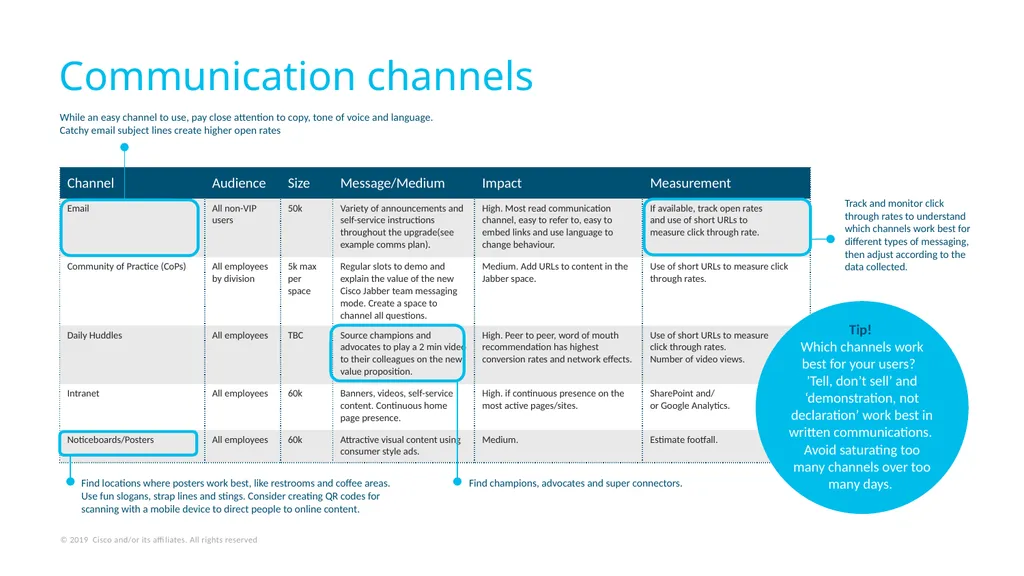
While an easy channel to use, pay close attention to copy, tone of voice and language.
Catchy email subject lines create higher open rates Find champions, advocates and super connectors. Track and monitor click through rates to understand which channels work best for different types of messaging, then adjust according to the data collected. Find locations where posters work best, like restrooms and coffee areas. Use fun slogans, strap lines and stings. Consider creating QR codes for scanning with a mobile device to direct people to online content. Communication channels Tip!
Which channels work best for your users?
'Tell, don’t sell’ and ‘demonstration, not declaration’ work best in written communications. Avoid saturating too many channels over too many days.<br>
Catchy email subject lines create higher open rates Find champions, advocates and super connectors. Track and monitor click through rates to understand which channels work best for different types of messaging, then adjust according to the data collected. Find locations where posters work best, like restrooms and coffee areas. Use fun slogans, strap lines and stings. Consider creating QR codes for scanning with a mobile device to direct people to online content. Communication channels Tip!
Which channels work best for your users?
'Tell, don’t sell’ and ‘demonstration, not declaration’ work best in written communications. Avoid saturating too many channels over too many days.<br>
11
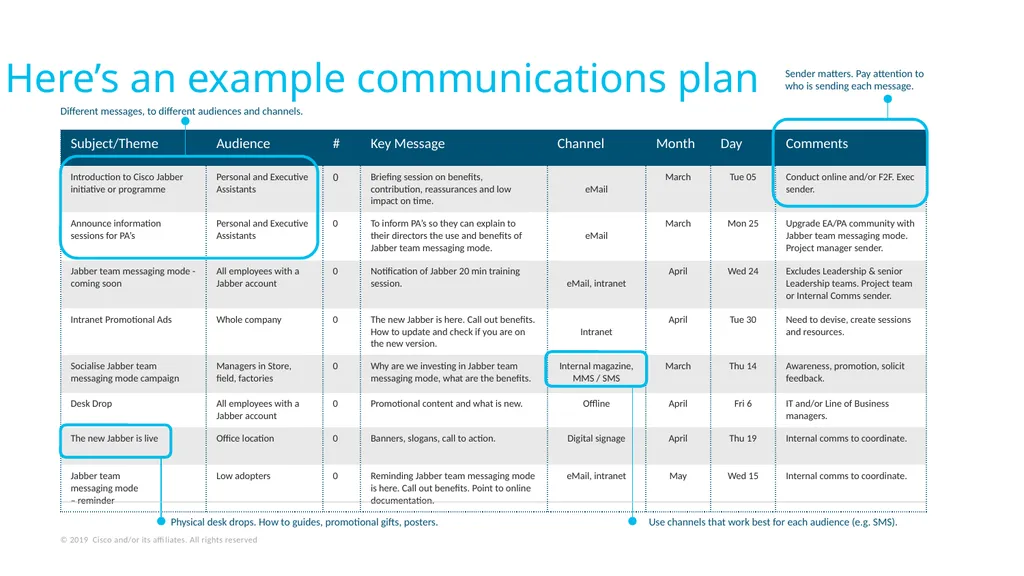
Different messages, to different audiences and channels. Use channels that work best for each audience (e.g. SMS). Physical desk drops. How to guides, promotional gifts, posters. Sender matters. Pay attention to who is sending each message. Here’s an example communications plan<br>
12
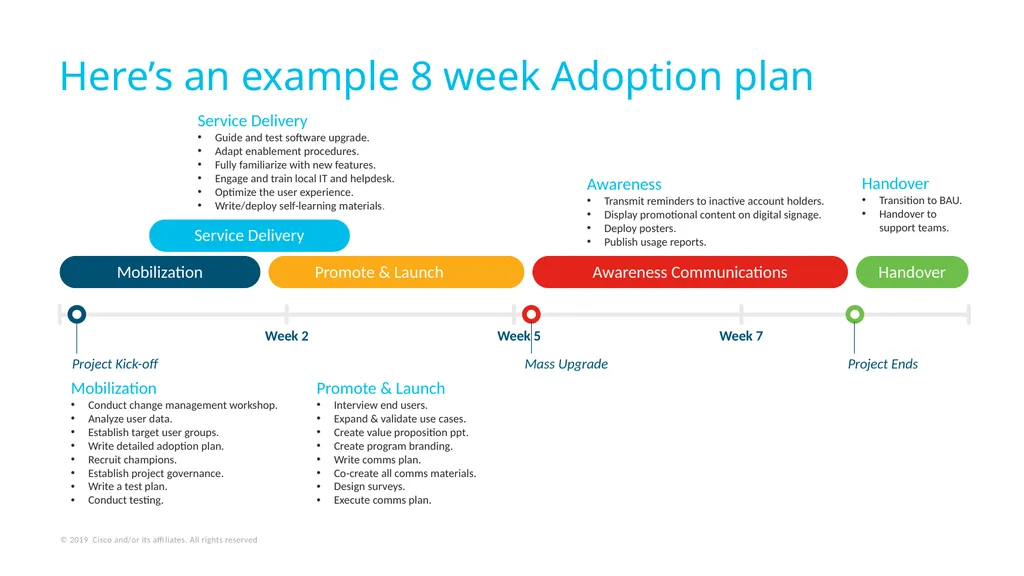
Week 2 Week 5 Week 7 Mobilization Promote & Launch Awareness Communications Handover Service Delivery Project Kick-off Mass Upgrade Project Ends Mobilization
Conduct change management workshop.
Analyze user data.
Establish target user groups.
Write detailed adoption plan.
Recruit champions.
Establish project governance.
Write a test plan.
Conduct testing. Promote & Launch
Interview end users.
Expand & validate use cases.
Create value proposition ppt.
Create program branding.
Write comms plan.
Co-create all comms materials.
Design surveys.
Execute comms plan. Service Delivery
Guide and test software upgrade.
Adapt enablement procedures.
Fully familiarize with new features.
Engage and train local IT and helpdesk.
Optimize the user experience.
Write/deploy self-learning materials. Awareness
Transmit reminders to inactive account holders.
Display promotional content on digital signage.
Deploy posters.
Publish usage reports. Handover
Transition to BAU.
Handover to support teams. Here’s an example 8 week Adoption plan<br>
Conduct change management workshop.
Analyze user data.
Establish target user groups.
Write detailed adoption plan.
Recruit champions.
Establish project governance.
Write a test plan.
Conduct testing. Promote & Launch
Interview end users.
Expand & validate use cases.
Create value proposition ppt.
Create program branding.
Write comms plan.
Co-create all comms materials.
Design surveys.
Execute comms plan. Service Delivery
Guide and test software upgrade.
Adapt enablement procedures.
Fully familiarize with new features.
Engage and train local IT and helpdesk.
Optimize the user experience.
Write/deploy self-learning materials. Awareness
Transmit reminders to inactive account holders.
Display promotional content on digital signage.
Deploy posters.
Publish usage reports. Handover
Transition to BAU.
Handover to support teams. Here’s an example 8 week Adoption plan<br>