
Mrs. Reena Vincent Professor JMCON IN-SERVICE
YM
Published · 76 slides · 0 views
1 / 1

Description
Mrs. Reena Vincent Professor JMCON IN-SERVICE EDUCATION Central objective At the end of the class students in-service education and able to describe and apply while working in the clinical and educational setting Specific objectives At the
Related Topics
Share
Embed code
Download this presentation From Below
"Mrs. Reena Vincent Professor JMCON IN-SERVICE" is the property of its rightful owner. Permission is granted to download and print the materials on this website for personal, non-commercial use only, and to display it on your personal computer provided you do not modify the materials and that you retain all copyright notices contained in the materials. By downloading content from our website, you accept the terms of this agreement.
Presentation Transcript
01
Mrs. Reena Vincent
Professor
JMCON IN-SERVICE EDUCATION<br>
Professor
JMCON IN-SERVICE EDUCATION<br>
02
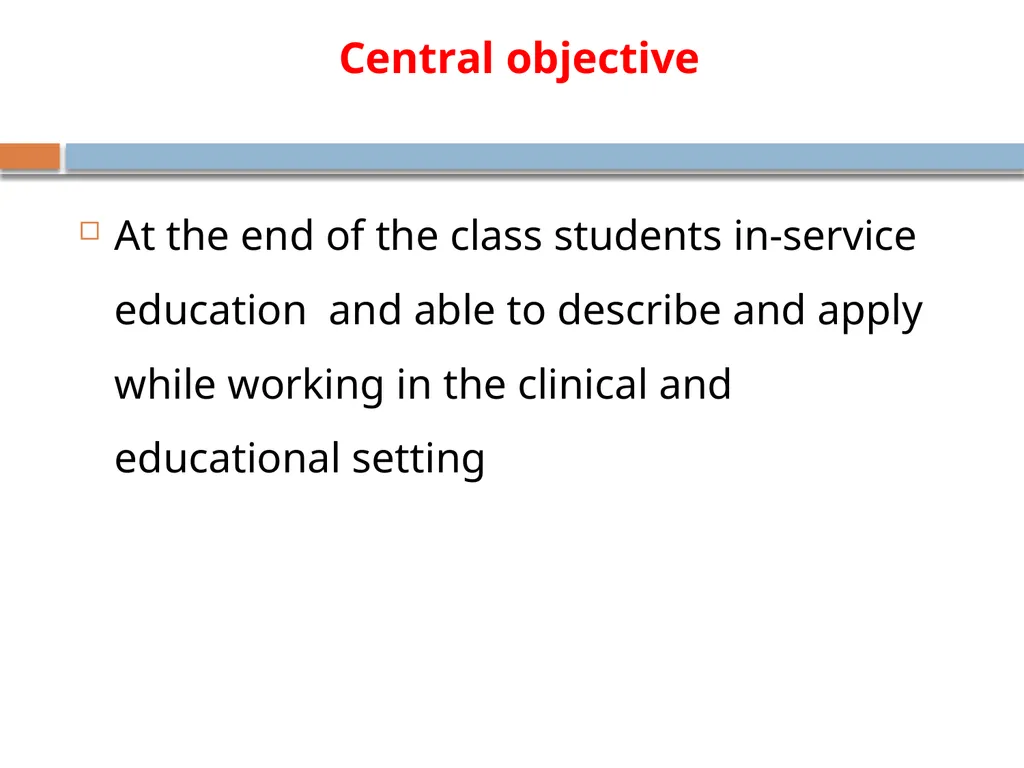
Central objective At the end of the class students in-service education and able to describe and apply while working in the clinical and educational setting<br>
03
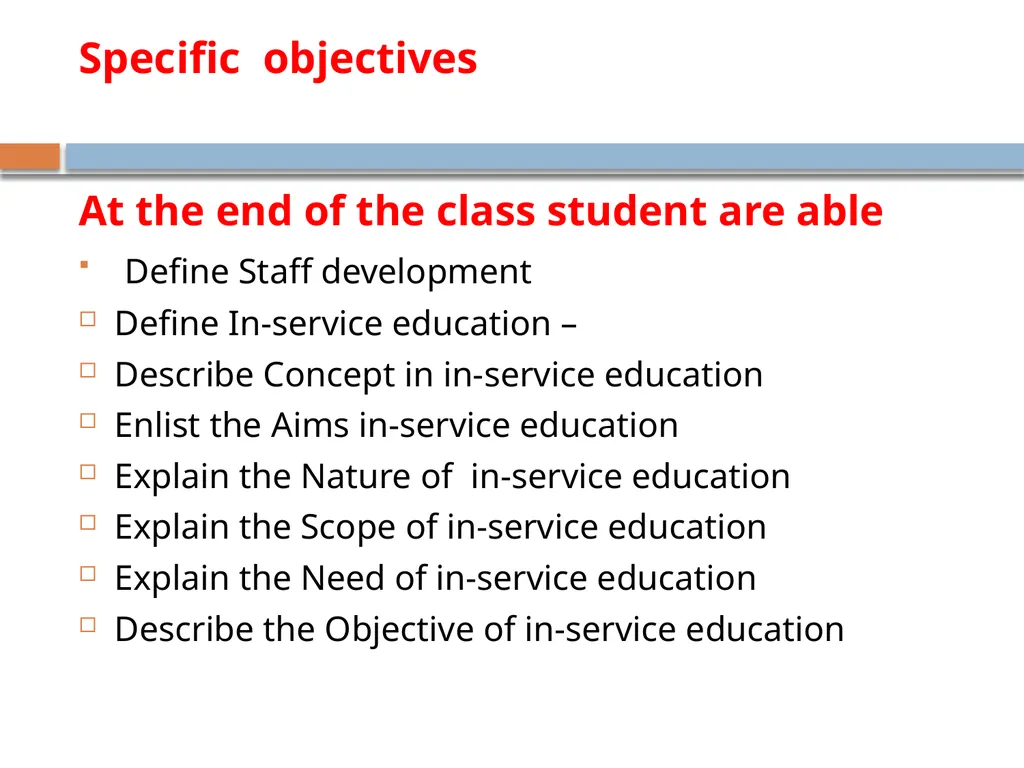
Specific objectives At the end of the class student are able
Define Staff development
Define In-service education –
Describe Concept in in-service education
Enlist the Aims in-service education
Explain the Nature of in-service education
Explain the Scope of in-service education
Explain the Need of in-service education
Describe the Objective of in-service education<br>
Define Staff development
Define In-service education –
Describe Concept in in-service education
Enlist the Aims in-service education
Explain the Nature of in-service education
Explain the Scope of in-service education
Explain the Need of in-service education
Describe the Objective of in-service education<br>
04
Principles of in-service education
characteristics in-service education
Approaches in-service education
Factors influencing in-service education
Principles in adult learning
Planning for in-service education Steps /Evaluation methods
Problems in in-service education
Benefits of in-service education
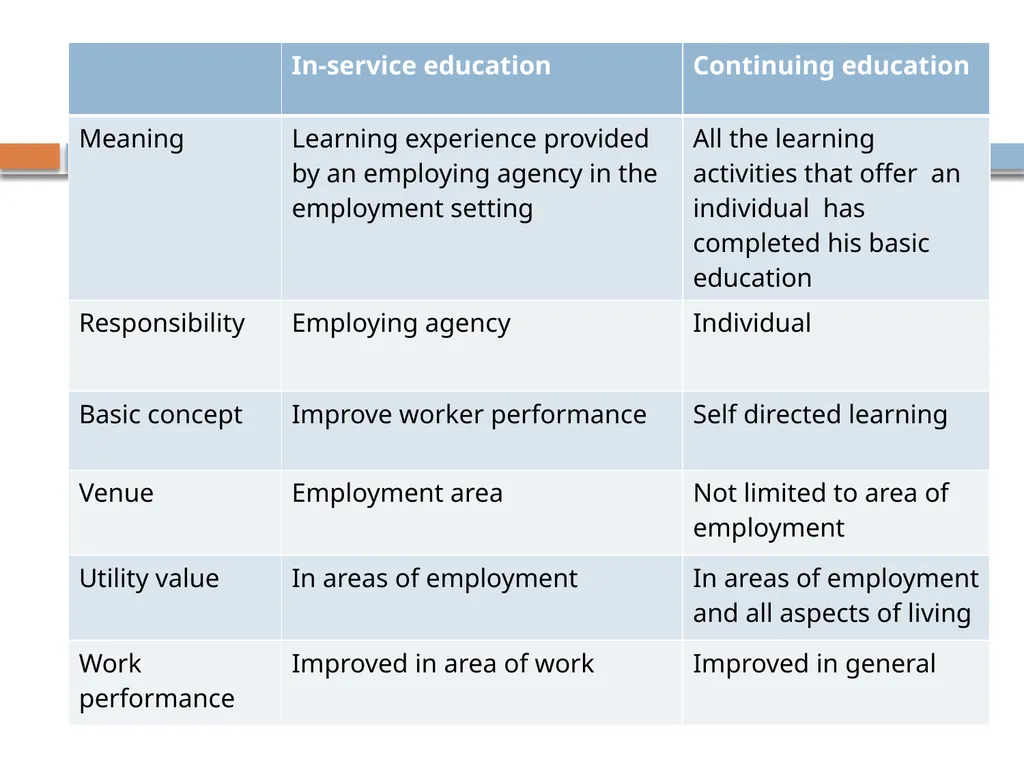
Difference between in-service education and continuing education<br>
characteristics in-service education
Approaches in-service education
Factors influencing in-service education
Principles in adult learning
Planning for in-service education Steps /Evaluation methods
Problems in in-service education
Benefits of in-service education
Difference between in-service education and continuing education<br>
05
Let us never consider ourselves finished nurses
Florence Nightingale<br>
Florence Nightingale<br>
06
Definition:
Staff development refers to all training and education provided by an employer to improve the occupational and personal knowledge, skills and attitude of vested employees<br>
Staff development refers to all training and education provided by an employer to improve the occupational and personal knowledge, skills and attitude of vested employees<br>
07
In-service education<br>
08
Definition
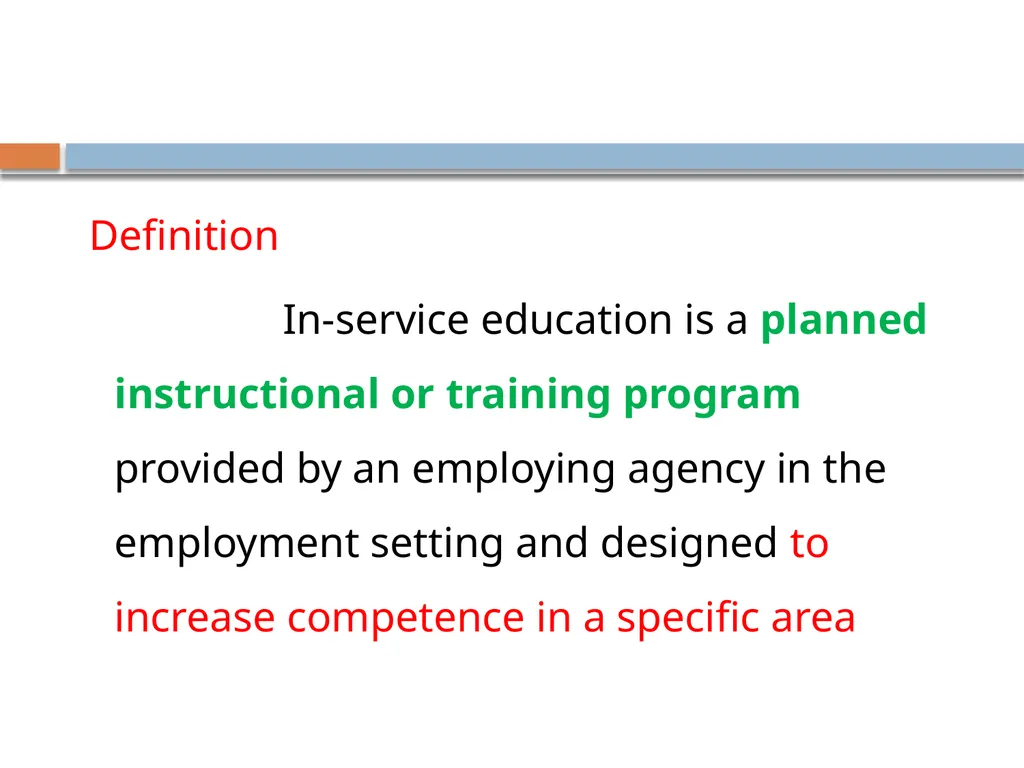
In-service education is a planned instructional or training program provided by an employing agency in the employment setting and designed to increase competence in a specific area<br>
In-service education is a planned instructional or training program provided by an employing agency in the employment setting and designed to increase competence in a specific area<br>
09
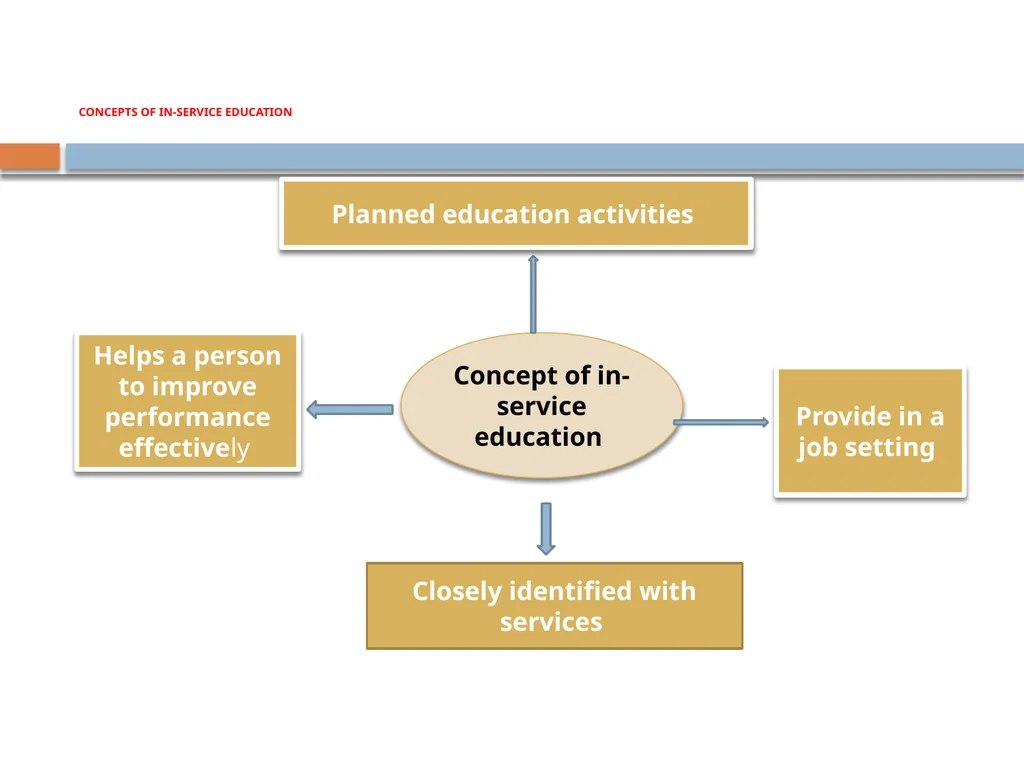
CONCEPTS OF IN-SERVICE EDUCATION Concept of in-service education Planned education activities Provide in a job setting Closely identified with services Helps a person to improve performance effectively<br>
10
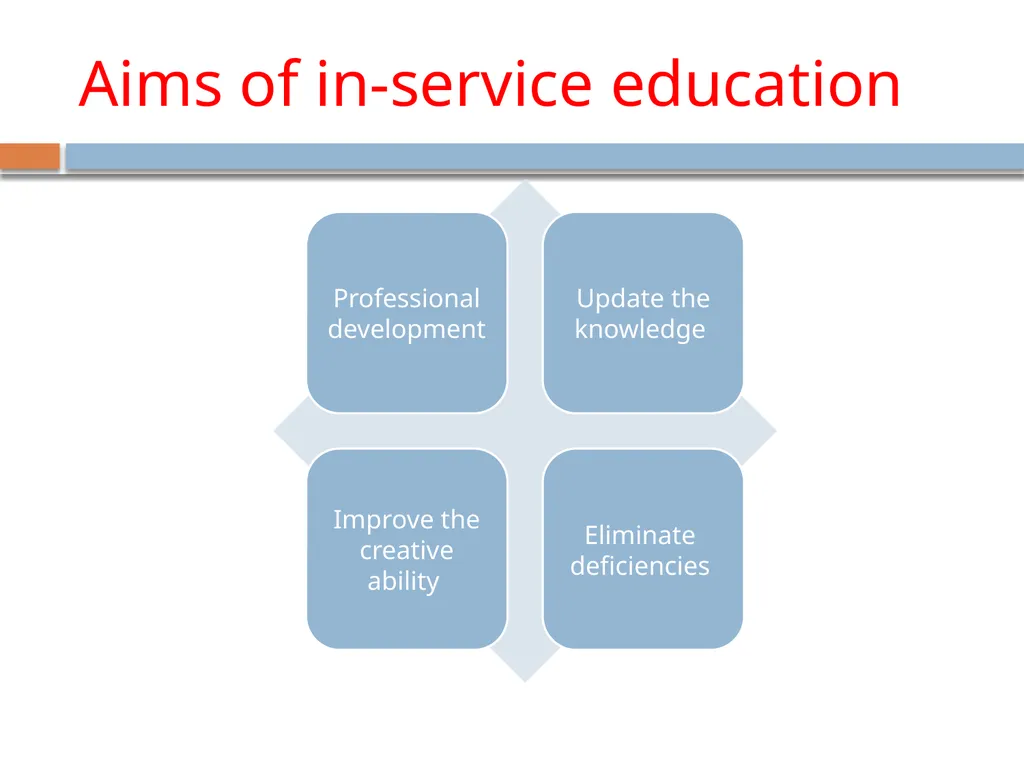
Aims of in-service education<br>
11
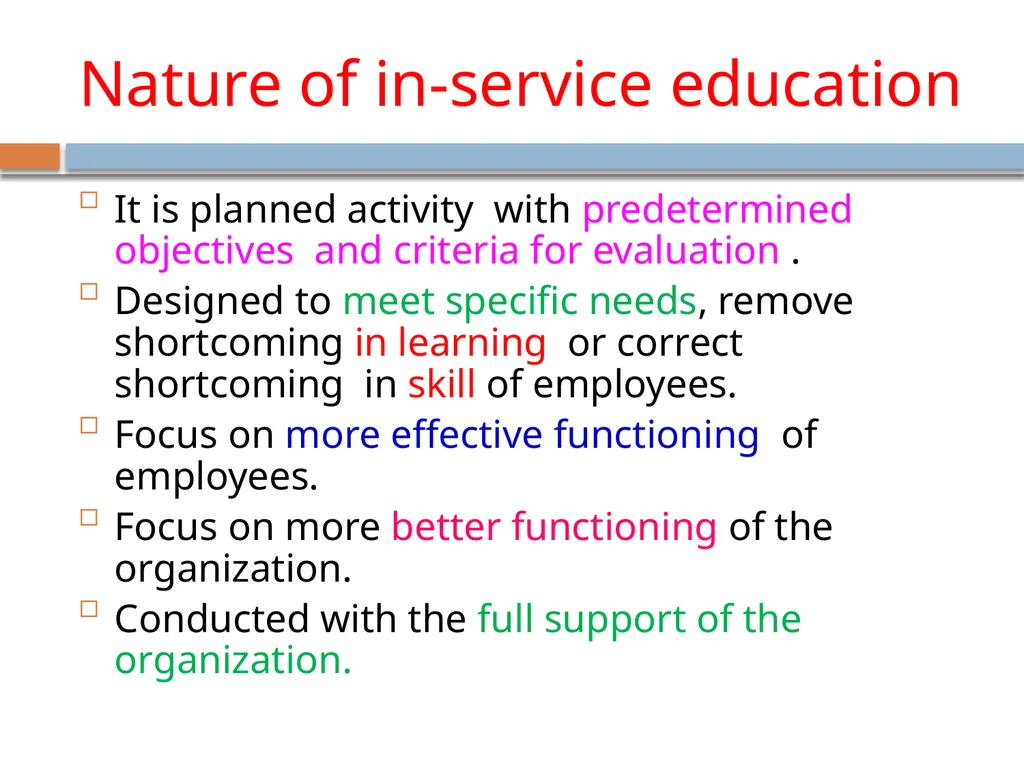
Nature of in-service education It is planned activity with predetermined objectives and criteria for evaluation .
Designed to meet specific needs, remove shortcoming in learning or correct shortcoming in skill of employees.
Focus on more effective functioning of employees.
Focus on more better functioning of the organization.
Conducted with the full support of the organization.<br>
Designed to meet specific needs, remove shortcoming in learning or correct shortcoming in skill of employees.
Focus on more effective functioning of employees.
Focus on more better functioning of the organization.
Conducted with the full support of the organization.<br>
12
Adult teaching principles are taken into consideration.
General educational principles are also taken into consideration.
The philosophy and objectives of in-service education program is in line with the goals of the health care organization.<br>
General educational principles are also taken into consideration.
The philosophy and objectives of in-service education program is in line with the goals of the health care organization.<br>
13
Scope of in-service education It helps to meet the needs of the specific health care organization .
It enhances the knowledge ,skill and attitude for improving the performance of present job .
Provide credit points to nurses essential for renewing their nursing license by the state nursing council.
Helps in standardizing methods and procedures.<br>
It enhances the knowledge ,skill and attitude for improving the performance of present job .
Provide credit points to nurses essential for renewing their nursing license by the state nursing council.
Helps in standardizing methods and procedures.<br>
14
Improve the quality and efficiency of patient care
Help to establish high standard of nursing care to patient care.
Improve communication skills and thereby team work among nurses.
Provide training for special functions such as management, team building etc.
Improve morale of employees.<br>
Help to establish high standard of nursing care to patient care.
Improve communication skills and thereby team work among nurses.
Provide training for special functions such as management, team building etc.
Improve morale of employees.<br>
15
Need Social changes and scientific advancement
Changes and advancement in the field of service
Increased the demand of nursing services , quality care .
Rapid changes in medical and nursing practice.
Nurses to function at her highest potential as quickly as possible
Health care delivery system become more complex<br>
Changes and advancement in the field of service
Increased the demand of nursing services , quality care .
Rapid changes in medical and nursing practice.
Nurses to function at her highest potential as quickly as possible
Health care delivery system become more complex<br>
16
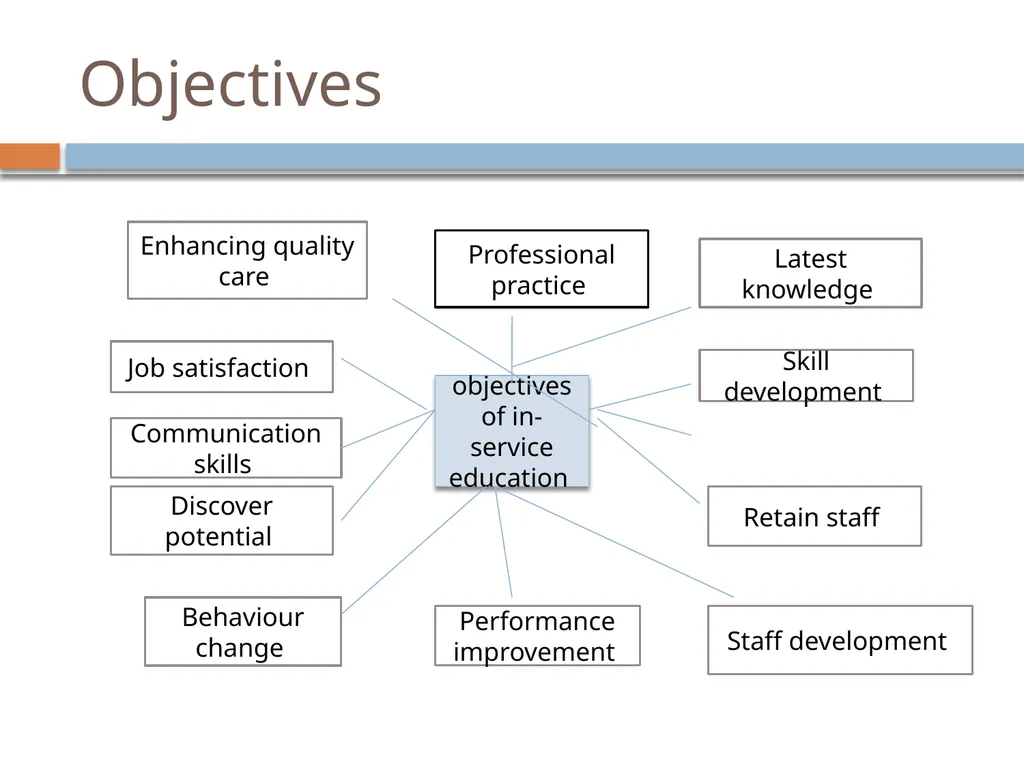
Objectives objectives of in-service education Latest knowledge Enhancing quality care Professional practice Job satisfaction Communication skills Discover potential Skill development Retain staff Behaviour change Performance improvement Staff development<br>
17
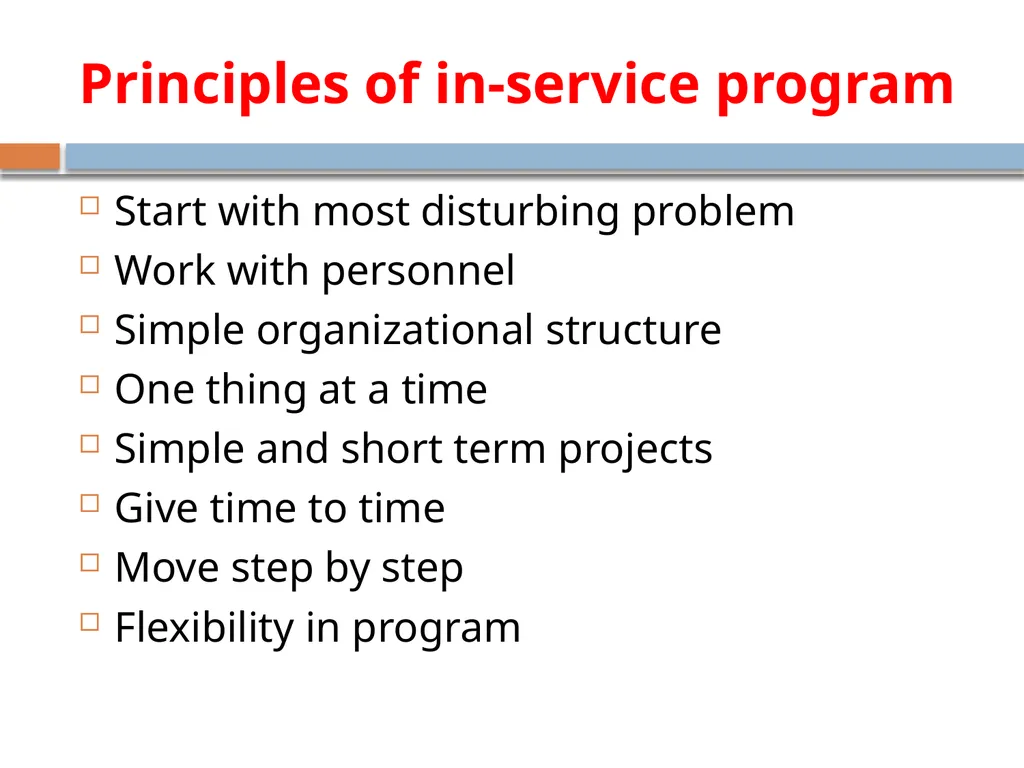
Principles of in-service program Start with most disturbing problem
Work with personnel
Simple organizational structure
One thing at a time
Simple and short term projects
Give time to time
Move step by step
Flexibility in program<br>
Work with personnel
Simple organizational structure
One thing at a time
Simple and short term projects
Give time to time
Move step by step
Flexibility in program<br>
18
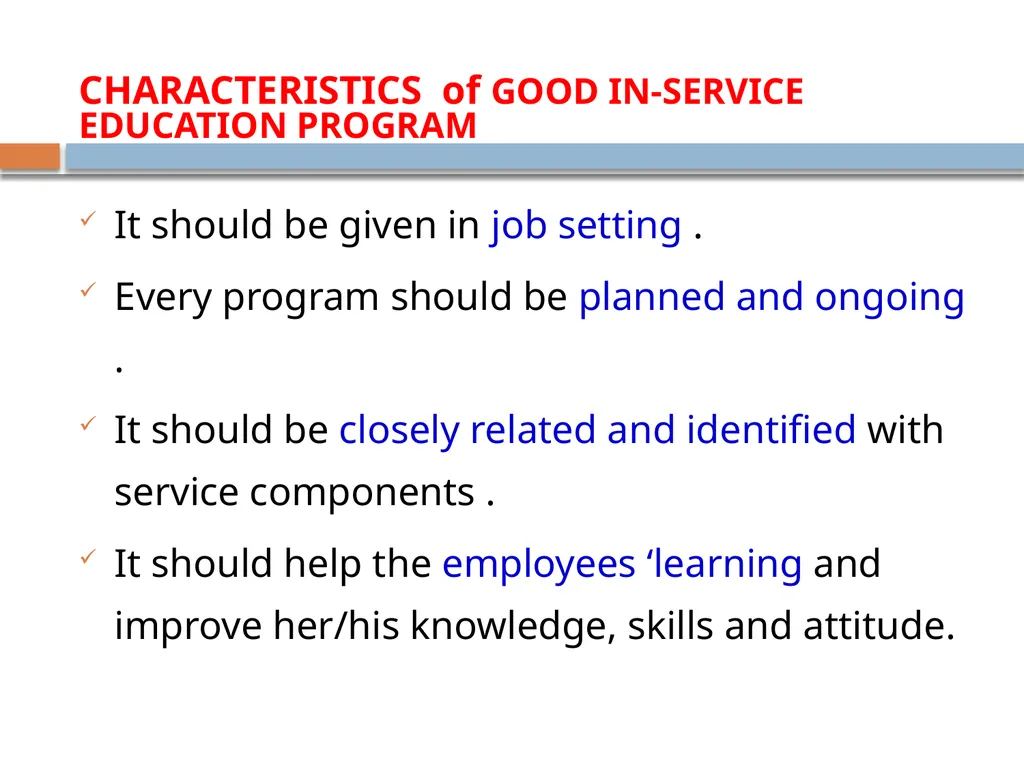
It should be given in job setting .
Every program should be planned and ongoing .
It should be closely related and identified with service components .
It should help the employees ‘learning and improve her/his knowledge, skills and attitude. CHARACTERISTICS of GOOD IN-SERVICE EDUCATION PROGRAM<br>
Every program should be planned and ongoing .
It should be closely related and identified with service components .
It should help the employees ‘learning and improve her/his knowledge, skills and attitude. CHARACTERISTICS of GOOD IN-SERVICE EDUCATION PROGRAM<br>
19
Approaches of in-service education programe<br>
20
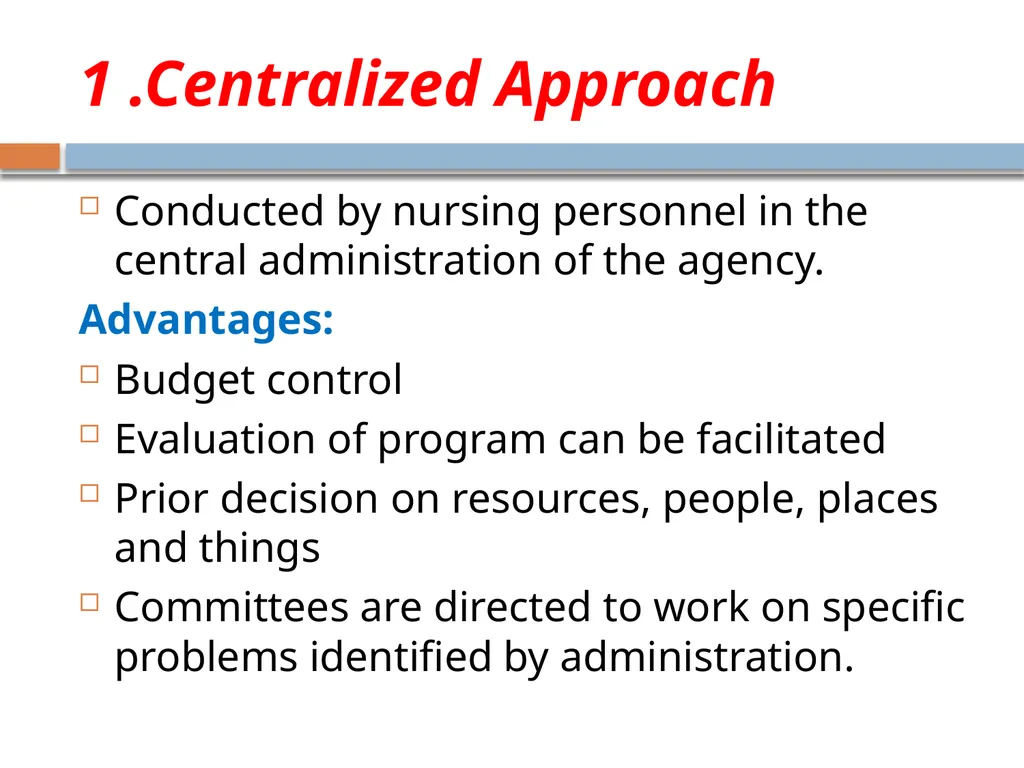
1 .Centralized Approach Conducted by nursing personnel in the central administration of the agency.
Advantages:
Budget control
Evaluation of program can be facilitated
Prior decision on resources, people, places and things
Committees are directed to work on specific problems identified by administration.<br>
Advantages:
Budget control
Evaluation of program can be facilitated
Prior decision on resources, people, places and things
Committees are directed to work on specific problems identified by administration.<br>
21
Disadvantages
It may lead to in reducing spontaneous, interested participation and enthusiasm of learners.<br>
22
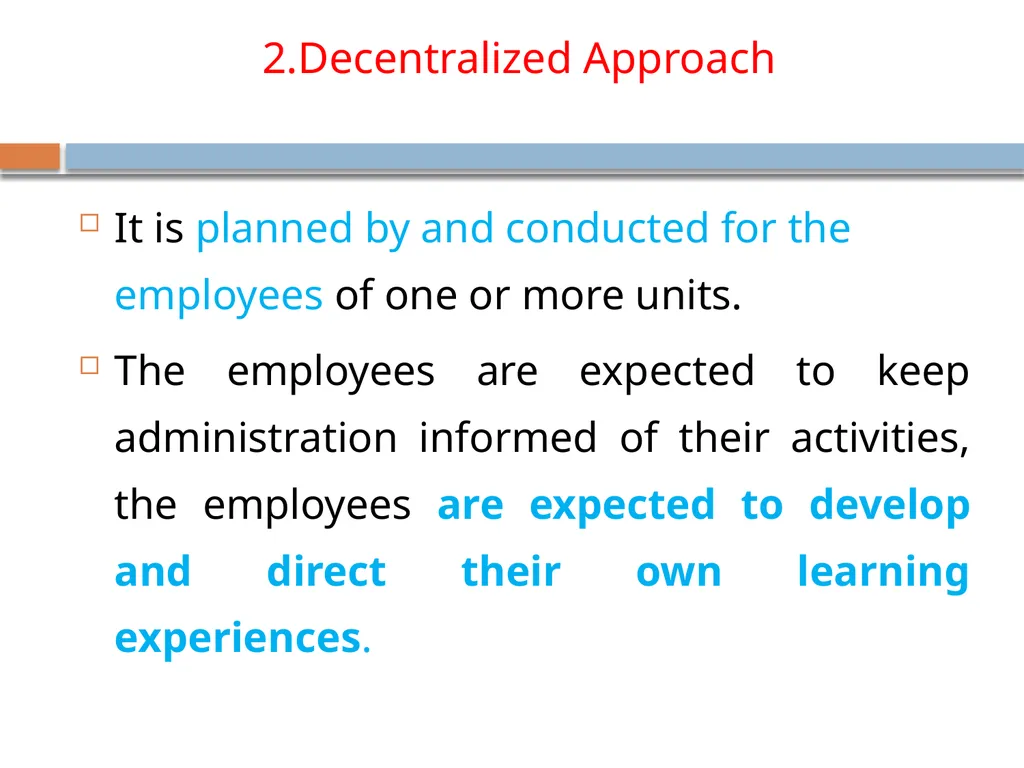
2.Decentralized Approach It is planned by and conducted for the employees of one or more units.
The employees are expected to keep administration informed of their activities, the employees are expected to develop and direct their own learning experiences.<br>
The employees are expected to keep administration informed of their activities, the employees are expected to develop and direct their own learning experiences.<br>
23
In this approach, control in planning for a
in-service is a responsibility of employees.<br>
in-service is a responsibility of employees.<br>
24
Advantages:
Individuals are working in the same unit and confront problems are common
Share the responsibilities for meeting the in-service needs
Proper contribution of the participants is expected<br>
Individuals are working in the same unit and confront problems are common
Share the responsibilities for meeting the in-service needs
Proper contribution of the participants is expected<br>
25
Disadvantages:
Lack of leadership
Conflicts
Inefficiency
Less or no budget<br>
Lack of leadership
Conflicts
Inefficiency
Less or no budget<br>
26
It is a compromise between the centralized and decentralized patterns .
This approach involves both nursing administrators and practitioners in complementary way. 3 .Co-ordinated Approach<br>
This approach involves both nursing administrators and practitioners in complementary way. 3 .Co-ordinated Approach<br>
27
ADVANTAGES
Mutual co-ordination and assistance to central administration is improved
Duplication is avoided
Unity of efforts is maintain<br>
Mutual co-ordination and assistance to central administration is improved
Duplication is avoided
Unity of efforts is maintain<br>
28
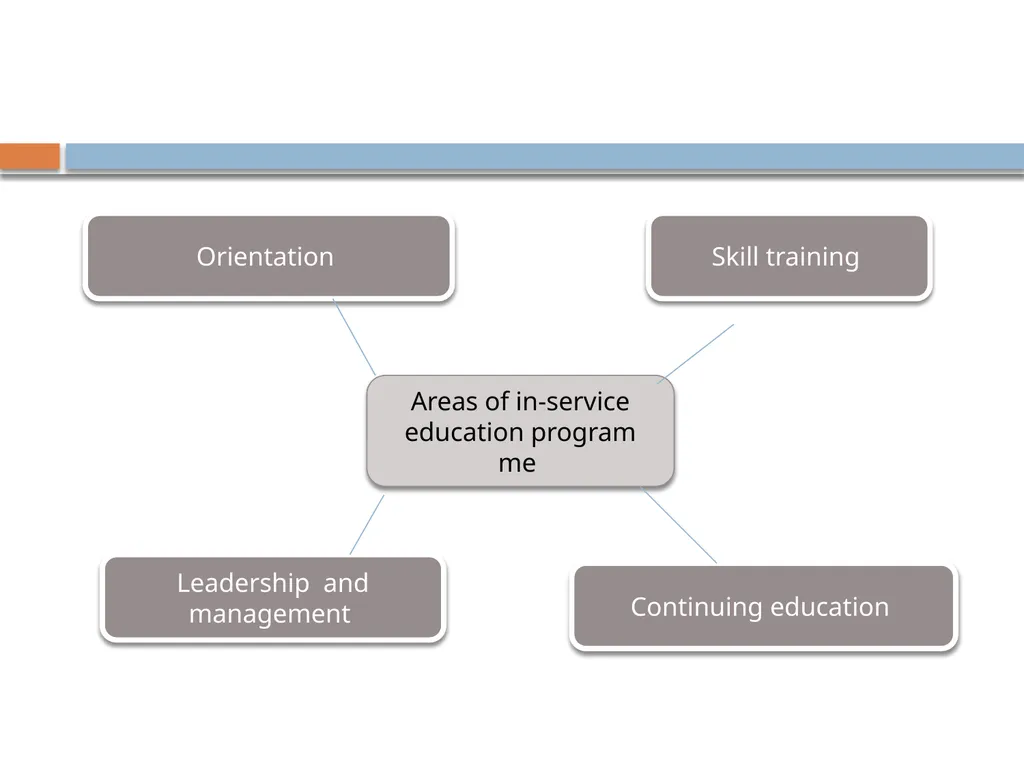
Areas of in-service education program me Skill training Orientation Leadership and management Continuing education<br>
29
1 ORIENTATION Is the process of acquiting a new staff with the existing work environment so that he/she can relate quickly to his/ her new surroundings.
Types of orientation
Two types
General orientation
Specific orientation<br>
Types of orientation
Two types
General orientation
Specific orientation<br>
30
Importance Provides essential ,relevant and necessary information
Helps employee to gain confidence .
Lessen the time for the employee to learn about new situations related to job settings
Helps the new employee to develop a sense of belonging her.<br>
Helps employee to gain confidence .
Lessen the time for the employee to learn about new situations related to job settings
Helps the new employee to develop a sense of belonging her.<br>
31
Help new employees in solving initial problems and adjust the new situations /environment .
Acquaints her with personnel services readily with in the institution /community.<br>
Acquaints her with personnel services readily with in the institution /community.<br>
32
It eliminates
Learning by trial and error
Passing of incorrect information by old employees and peers
Reduces misinterpretation
Mistakes and confusion
Apprehension<br>
Learning by trial and error
Passing of incorrect information by old employees and peers
Reduces misinterpretation
Mistakes and confusion
Apprehension<br>
33
The duration of orientation varies according to areas usually 3 stage processes.-
Orientation to overall organization, to the specific department and to the specific job<br>
Orientation to overall organization, to the specific department and to the specific job<br>
34
The organization information includes history, philosophy, mission,goals,objectives,organizational structure etc.
Under personnel information personnel policies, procedures, compensation issues, benefits, physical facilities etc.<br>
Under personnel information personnel policies, procedures, compensation issues, benefits, physical facilities etc.<br>
35
The important aspects of the orientation of department includes departmental functions, activities, policies, rules and regulations, introduction to staff members of the department .<br>
36
Regarding the orientation to the job
Job description, responsibilities, records and reports, performance standards, supervision practices, instruction on use of equipments, monitors, regarding supplies materials and routines.<br>
Job description, responsibilities, records and reports, performance standards, supervision practices, instruction on use of equipments, monitors, regarding supplies materials and routines.<br>
37
Advantages Adjust to work
Be strongly motivated to learn
Able to function effectively
Feel wanted and needed by co-workers and supervisors.<br>
Be strongly motivated to learn
Able to function effectively
Feel wanted and needed by co-workers and supervisors.<br>
38
2 Skill Training Program Skill training may be a manual or technical skill of doing for people
It provides the nursing staff with the skills and attitude required for job and to keep them abreast of changing methods and new techniques.
Often it is the continuation of the orientation program.
It is designed to new and older staff.<br>
It provides the nursing staff with the skills and attitude required for job and to keep them abreast of changing methods and new techniques.
Often it is the continuation of the orientation program.
It is designed to new and older staff.<br>
39
OBJECTIVES To help the nursing personnel to perform correct methods and procedure with understanding .
Establishing standards and quality of services .
Procedure to skill nurses to skilled nurses.<br>
Establishing standards and quality of services .
Procedure to skill nurses to skilled nurses.<br>
40
TYPES OF SKILLS Psychomotor skill
Cognitive skill
Teaching skill
Affective skill
Communication skill
Supervisory skill<br>
Cognitive skill
Teaching skill
Affective skill
Communication skill
Supervisory skill<br>
41
Training principles The trainee must be motivated to learn
Learning must be reinforced
Materials must be meaningful and communicated
Multiple senses learning should be applied
The material taught must be transferred to the job situation
Feedback is must to achieve required and appropriate learning .<br>
Learning must be reinforced
Materials must be meaningful and communicated
Multiple senses learning should be applied
The material taught must be transferred to the job situation
Feedback is must to achieve required and appropriate learning .<br>
42
3 .Leadership and management development To improve the managerial abilities of persons at every management level as well as potential managers to produce the greatest degree of organizational progress.
Need can identified by incident reports, turnover rates, patient audits and quality control reports.<br>
Need can identified by incident reports, turnover rates, patient audits and quality control reports.<br>
43
Objectives De centralize leadership management competency
Permit increased delegation of authority
Promote good morals among administrative personnel
Reducing turn over in top positions<br>
Permit increased delegation of authority
Promote good morals among administrative personnel
Reducing turn over in top positions<br>
44
The areas of leadership and management
Self confidence
Communication skills
Leadership skills
Mentoring hiring and training employees
Developing esteem from peers and direct reports
Eliminating public speaking fear<br>
Self confidence
Communication skills
Leadership skills
Mentoring hiring and training employees
Developing esteem from peers and direct reports
Eliminating public speaking fear<br>
45
4 .Continuing education Continuing education is all the learning activities that offer an individual has completed his basic education.
cooper<br>
cooper<br>
46
Aim of continuing education Improvement of professional practice .
To motivate the staff to seek the latest knowledge.
To keep the nurses with the latest development of technologies .
It develops interest ,job satisfaction, and confidence.<br>
To motivate the staff to seek the latest knowledge.
To keep the nurses with the latest development of technologies .
It develops interest ,job satisfaction, and confidence.<br>
47
Need for continuing education To develop employee by updating the knowledge
It helps employee to respond effectively to the challenges of current social changes
It helps to improve the health care economic and educational opportunities
It helps to improve the new health pattern of healthcare
Enable to provide excellence service
Ensures professional development
Aids in career advancement<br>
It helps employee to respond effectively to the challenges of current social changes
It helps to improve the health care economic and educational opportunities
It helps to improve the new health pattern of healthcare
Enable to provide excellence service
Ensures professional development
Aids in career advancement<br>
48
Extramural education It is a community based continuing education directed towards meeting job related learning and other personnel
example conferences seminars etc<br>
example conferences seminars etc<br>
49
FACTORS INFLUENCING IN-SERVICE EDUCATION Cost of healthcare –it adds additional expenditure on health care delivery system.
Manpower need qualified human resources, leads to increase human resources.
Changes in nursing practices – it leads to frequent changes in the program.
Standards :–very important to maintain the highest standards of nursing practice.<br>
Manpower need qualified human resources, leads to increase human resources.
Changes in nursing practices – it leads to frequent changes in the program.
Standards :–very important to maintain the highest standards of nursing practice.<br>
50
Principles of adult learning 1 Need assessment –what is to be learned .
2 Safety in the environment &the process –context for learning made safe .
3 Sound relationship- between teacher and learner among learners .
4 Sequence of context and reinforcement.
5 Learning by doing .
6 Respect for learners as decision makers .<br>
2 Safety in the environment &the process –context for learning made safe .
3 Sound relationship- between teacher and learner among learners .
4 Sequence of context and reinforcement.
5 Learning by doing .
6 Respect for learners as decision makers .<br>
51
7 Involve cognitive ,effective and psychomotor aspects of learning .
8 Immediacy of the learning .
9 Clear roles and role development.
10 Team work and use of small groups.
11 Engagement of learner in what he/she is learning.<br>
8 Immediacy of the learning .
9 Clear roles and role development.
10 Team work and use of small groups.
11 Engagement of learner in what he/she is learning.<br>
52
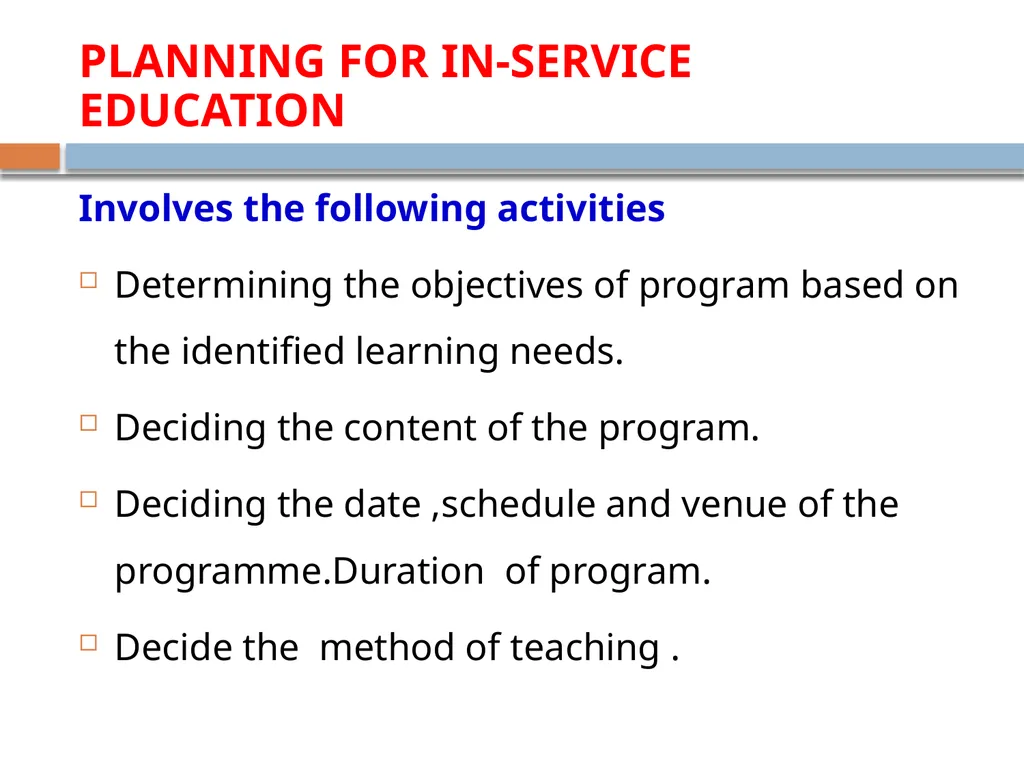
PLANNING FOR IN-SERVICE EDUCATION Involves the following activities
Determining the objectives of program based on the identified learning needs.
Deciding the content of the program.
Deciding the date ,schedule and venue of the programme.Duration of program.
Decide the method of teaching .<br>
Determining the objectives of program based on the identified learning needs.
Deciding the content of the program.
Deciding the date ,schedule and venue of the programme.Duration of program.
Decide the method of teaching .<br>
53
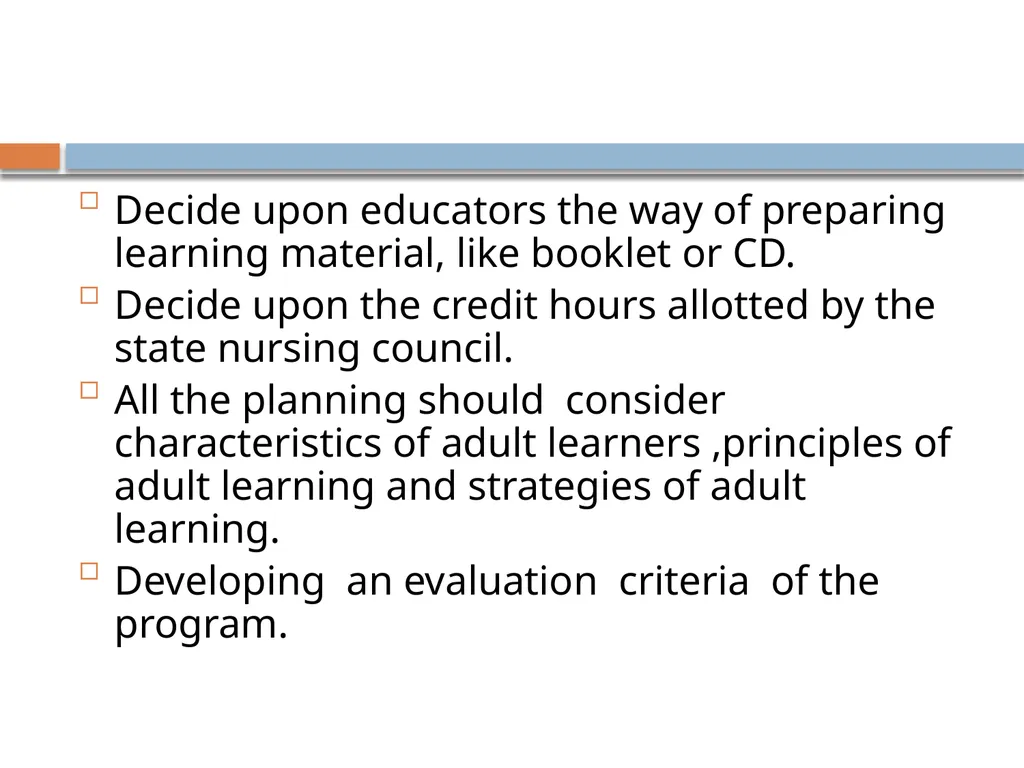
Decide upon educators the way of preparing learning material, like booklet or CD.
Decide upon the credit hours allotted by the state nursing council.
All the planning should consider characteristics of adult learners ,principles of adult learning and strategies of adult learning.
Developing an evaluation criteria of the program.<br>
Decide upon the credit hours allotted by the state nursing council.
All the planning should consider characteristics of adult learners ,principles of adult learning and strategies of adult learning.
Developing an evaluation criteria of the program.<br>
54
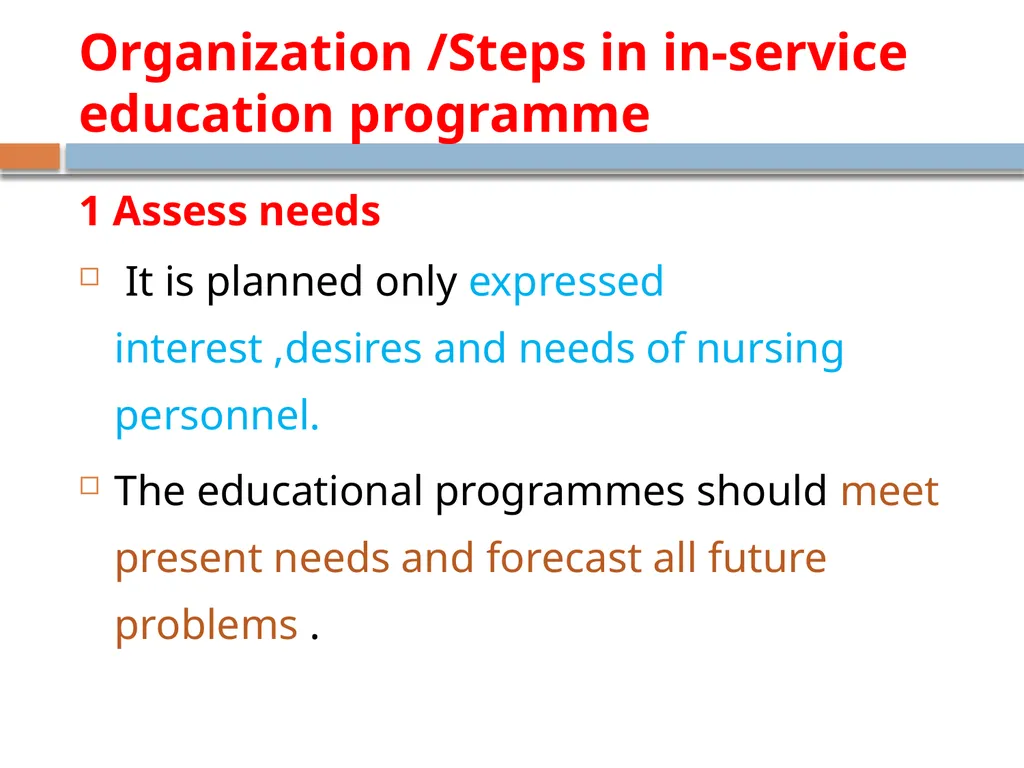
Organization /Steps in in-service education programme 1 Assess needs
It is planned only expressed interest ,desires and needs of nursing personnel.
The educational programmes should meet present needs and forecast all future problems .<br>
It is planned only expressed interest ,desires and needs of nursing personnel.
The educational programmes should meet present needs and forecast all future problems .<br>
55
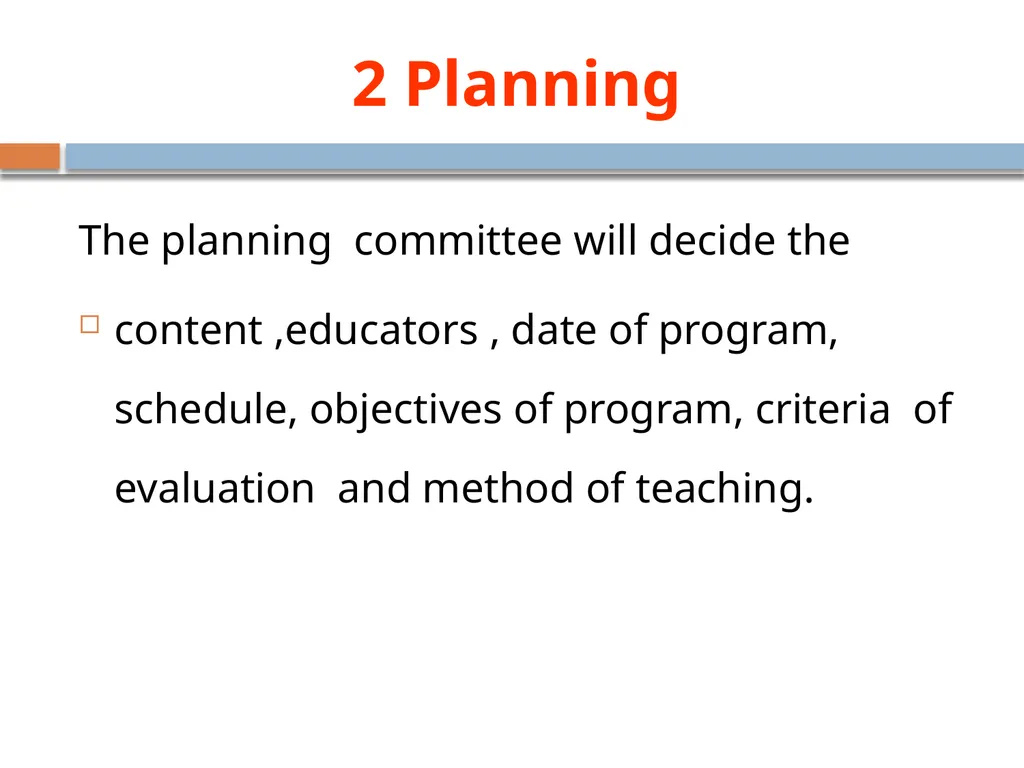
2 Planning The planning committee will decide the
content ,educators , date of program, schedule, objectives of program, criteria of evaluation and method of teaching.<br>
content ,educators , date of program, schedule, objectives of program, criteria of evaluation and method of teaching.<br>
56
3. Implement phase It is the conduct of in-service education program.
it is conducted by effective utilization of resources with special emphasis to principles of adult learning and general principles of education.<br>
it is conducted by effective utilization of resources with special emphasis to principles of adult learning and general principles of education.<br>
57
4 .Evaluate program It is the process of determining the effectiveness of the in-service education program me in terms of cost effectiveness, achievement of objectives ,extent of transferring learning from the learning situation to actual use on the unit .<br>
58
EVALUATION METHODS A Evaluation methods
Are used to asses the reaction, behaviour of learning of participants.
B. Steering committee
Formed with 3or 4 members of trained participants, these members interact with other participants informally.
The views of participants then complied and to be given to the program coordinator .<br>
Are used to asses the reaction, behaviour of learning of participants.
B. Steering committee
Formed with 3or 4 members of trained participants, these members interact with other participants informally.
The views of participants then complied and to be given to the program coordinator .<br>
59
c.Trainees diaries
The participants are given diary at the beginning of the program they are asked to write their views and opinions on it every day otherwise 15 mts given at the end of the program to write the views.
The diaries are collected at the end of the total program .<br>
The participants are given diary at the beginning of the program they are asked to write their views and opinions on it every day otherwise 15 mts given at the end of the program to write the views.
The diaries are collected at the end of the total program .<br>
60
Evaluation of trainees Done in four areas
Trainees performance evaluation
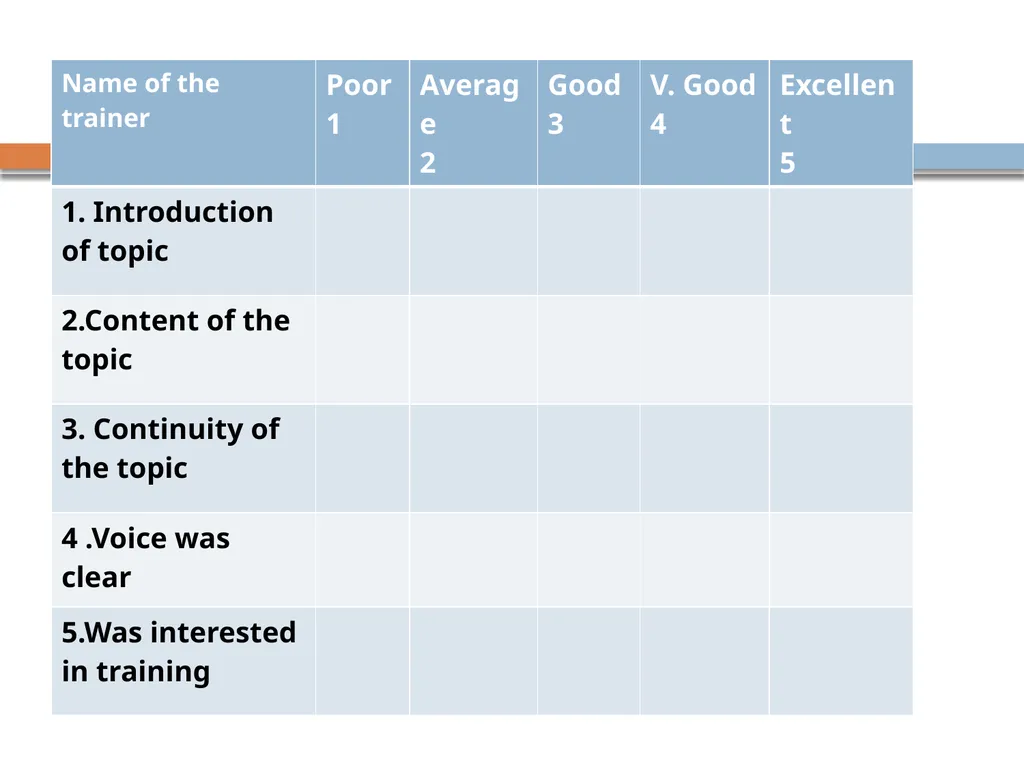
Questionnaire is to be developed and give to the participants<br>
Trainees performance evaluation
Questionnaire is to be developed and give to the participants<br>
61
Preparation of the report The report should be prepared with the following elements
Date and duration of education program
The group of individuals ,with basic qualification and No of individuals in group
Planning components of in -service education
Coordinator of the program and resource persons available
Purpose and topic of the program<br>
Date and duration of education program
The group of individuals ,with basic qualification and No of individuals in group
Planning components of in -service education
Coordinator of the program and resource persons available
Purpose and topic of the program<br>
62
Evaluation tools used –knowledge ,skill
Evaluation report related to change in knowledge and skills, attitudes and performances based on education program.
A brief summary of all areas to be recorded and submitted to concerned authority.<br>
Evaluation report related to change in knowledge and skills, attitudes and performances based on education program.
A brief summary of all areas to be recorded and submitted to concerned authority.<br>
63
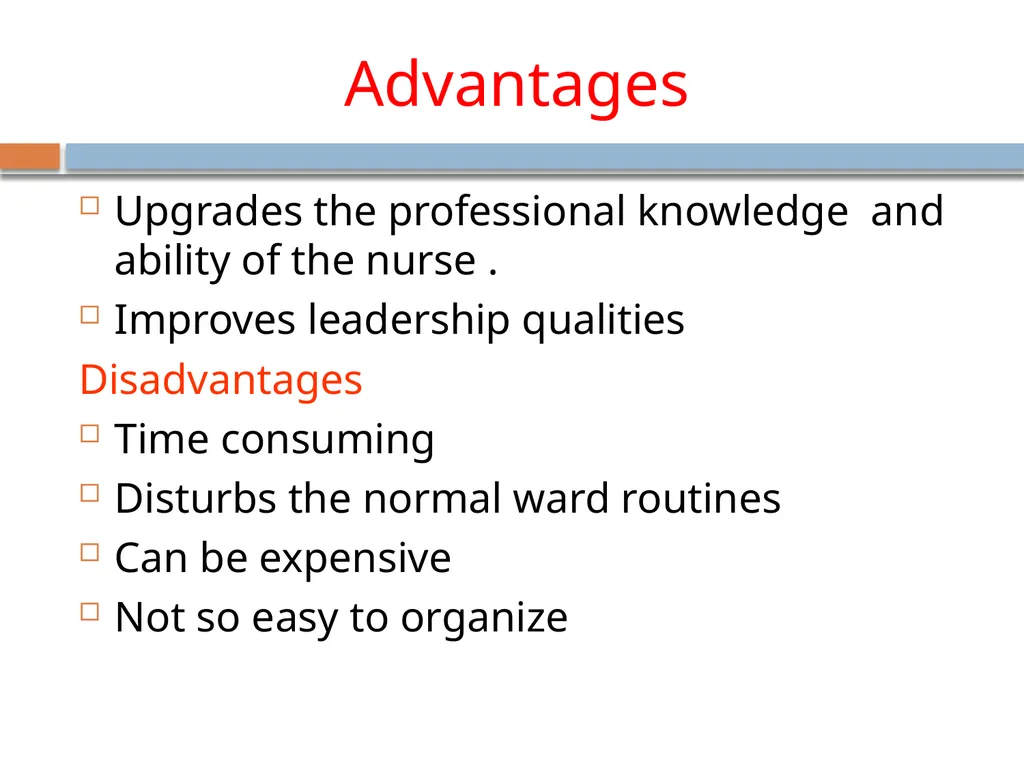
Advantages Upgrades the professional knowledge and ability of the nurse .
Improves leadership qualities
Disadvantages
Time consuming
Disturbs the normal ward routines
Can be expensive
Not so easy to organize<br>
Improves leadership qualities
Disadvantages
Time consuming
Disturbs the normal ward routines
Can be expensive
Not so easy to organize<br>
64
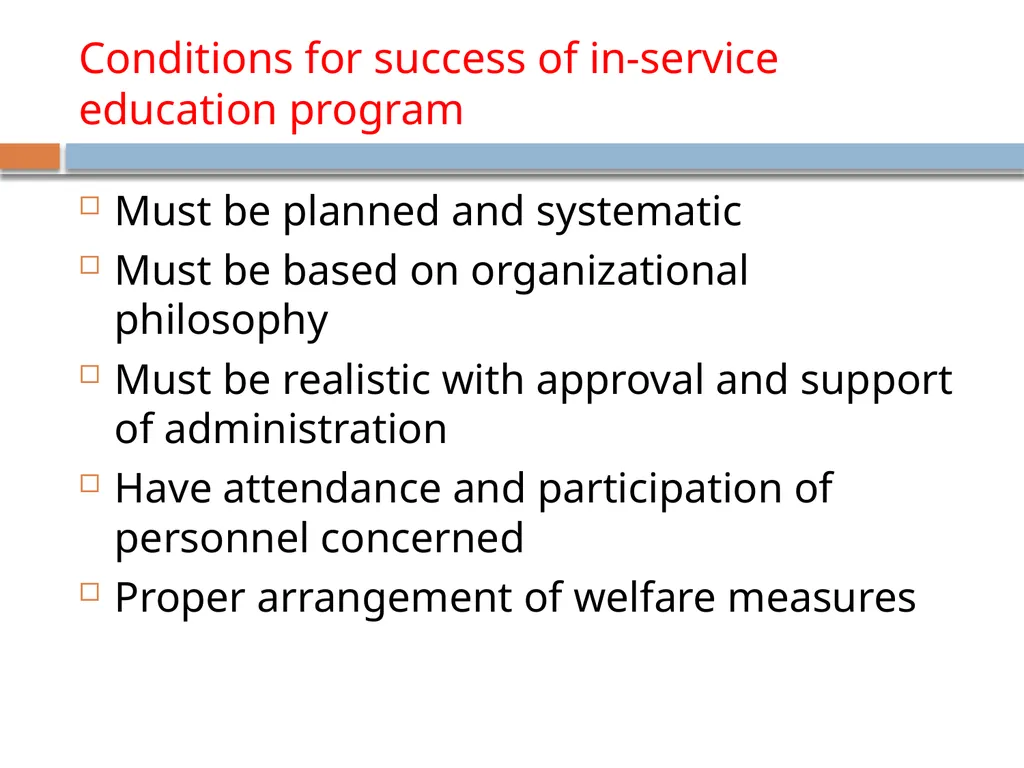
Conditions for success of in-service education program Must be planned and systematic
Must be based on organizational philosophy
Must be realistic with approval and support of administration
Have attendance and participation of personnel concerned
Proper arrangement of welfare measures<br>
Must be based on organizational philosophy
Must be realistic with approval and support of administration
Have attendance and participation of personnel concerned
Proper arrangement of welfare measures<br>
65
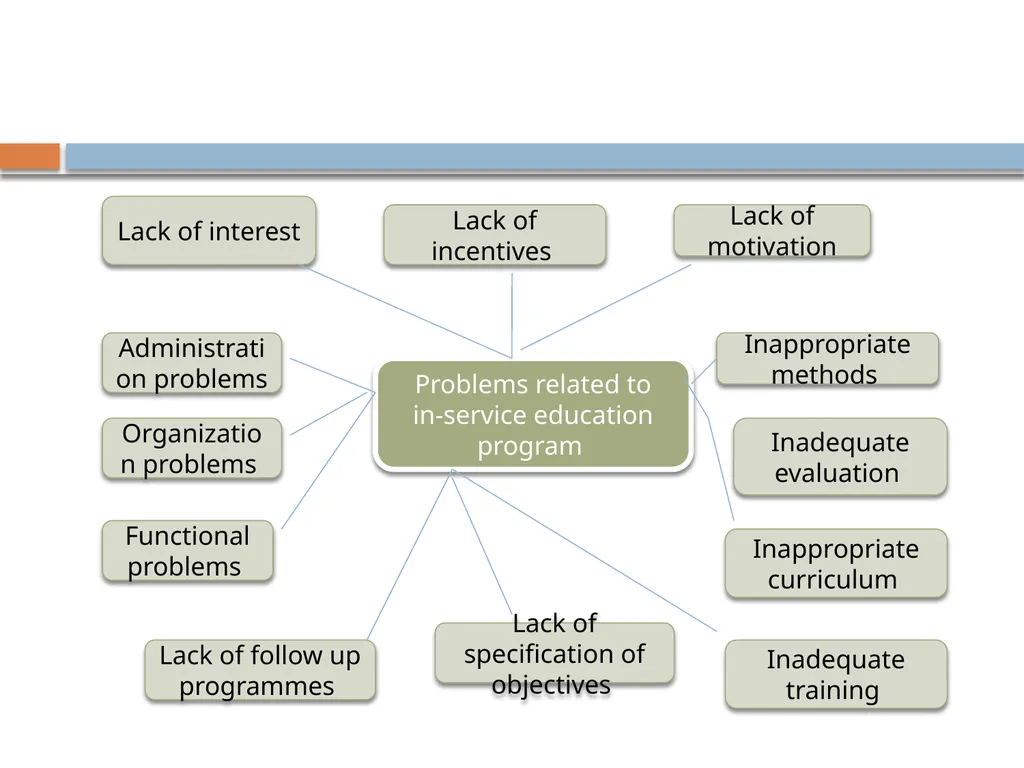
Problems related to
in-service education program Lack of interest Lack of incentives Lack of motivation Administration problems Organization problems Functional problems Inappropriate methods Inadequate evaluation Inappropriate curriculum Lack of follow up programmes Lack of specification of objectives Inadequate training<br>
in-service education program Lack of interest Lack of incentives Lack of motivation Administration problems Organization problems Functional problems Inappropriate methods Inadequate evaluation Inappropriate curriculum Lack of follow up programmes Lack of specification of objectives Inadequate training<br>
66
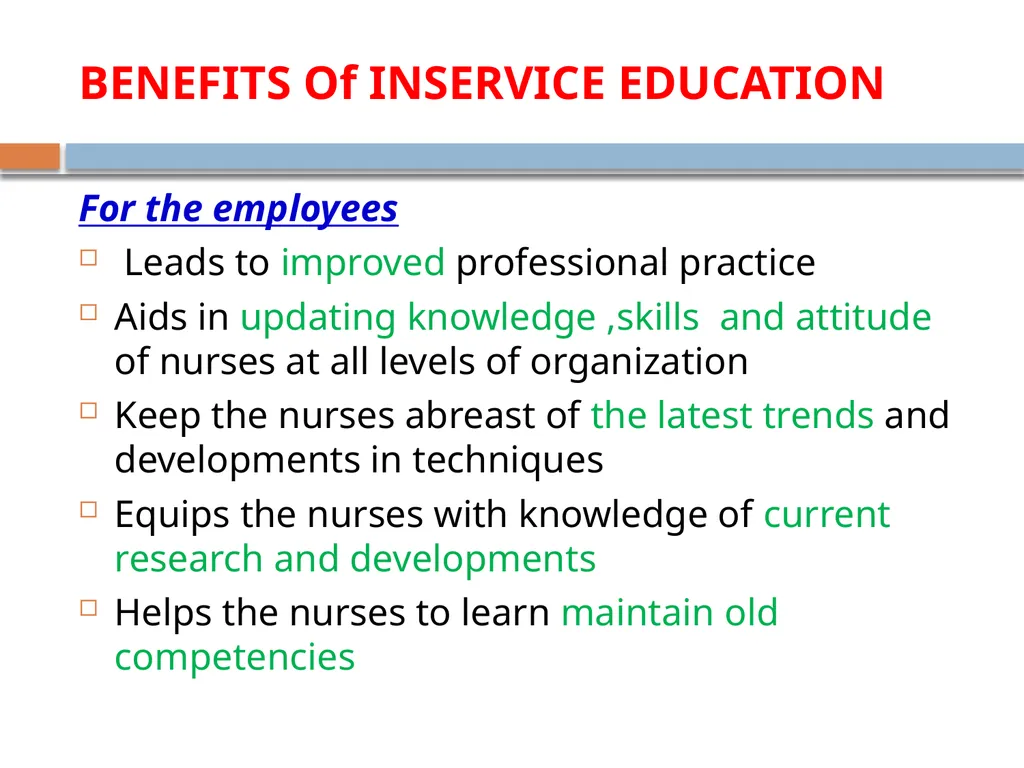
BENEFITS Of INSERVICE EDUCATION For the employees
Leads to improved professional practice
Aids in updating knowledge ,skills and attitude of nurses at all levels of organization
Keep the nurses abreast of the latest trends and developments in techniques
Equips the nurses with knowledge of current research and developments
Helps the nurses to learn maintain old competencies<br>
Leads to improved professional practice
Aids in updating knowledge ,skills and attitude of nurses at all levels of organization
Keep the nurses abreast of the latest trends and developments in techniques
Equips the nurses with knowledge of current research and developments
Helps the nurses to learn maintain old competencies<br>
67
FOR THE ORGANIZATIONS/EMPLOYER
Keeps the nursing staff enthusiastic in their learning .
Develop interest and job satisfaction among the staffs
Develops the sense of responsibilities for being competent and knowledgeable.
Creates an appropriate environment and sound decisions as well as using effective problem solving techniques .<br>
Keeps the nursing staff enthusiastic in their learning .
Develop interest and job satisfaction among the staffs
Develops the sense of responsibilities for being competent and knowledgeable.
Creates an appropriate environment and sound decisions as well as using effective problem solving techniques .<br>
68
Helps the nurse to adjust to change .
Aids in developing leadership skills, motivation and better attitudes .
Aids in encouraging and achieving self development and self confidence.
Makes the organization a better place to worker .<br>
Aids in developing leadership skills, motivation and better attitudes .
Aids in encouraging and achieving self development and self confidence.
Makes the organization a better place to worker .<br>
69
ROLES OF ADMINISTRATOR IN
INSERVICE EDUCATION Applies adult learning principles when helping employees learn new skills or information
Uses teaching techniques that empower staff .
Sensitive to the learning deficits of the staff and creatively minimize these difficulties .
Prepare employees readily regarding knowledge and skill deficits.
Actively seeks out teaching opportunities .
Frequently assess learning needs of the unit .<br>
Uses teaching techniques that empower staff .
Sensitive to the learning deficits of the staff and creatively minimize these difficulties .
Prepare employees readily regarding knowledge and skill deficits.
Actively seeks out teaching opportunities .
Frequently assess learning needs of the unit .<br>
70
Ensures that all staff are competent for roles assigned.
Ensure that there are adequate resources for staff development
Assumes responsibility for quality and fiscal control of staff development.
Provides input in formulating staff development policies.<br>
Ensure that there are adequate resources for staff development
Assumes responsibility for quality and fiscal control of staff development.
Provides input in formulating staff development policies.<br>
71
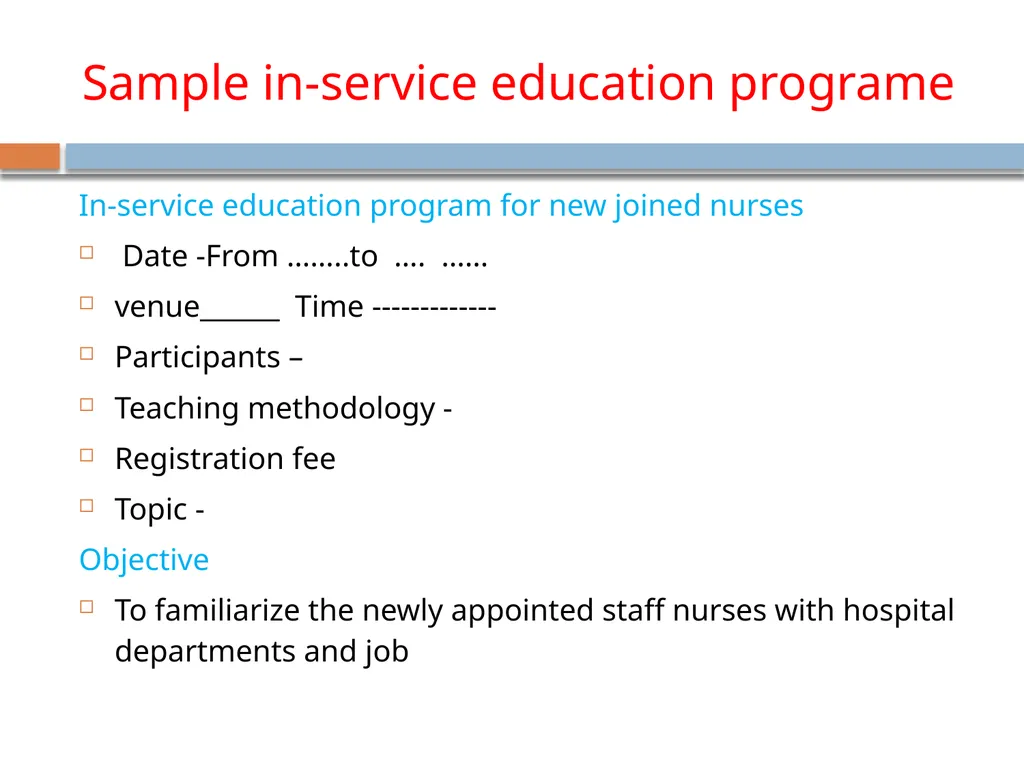
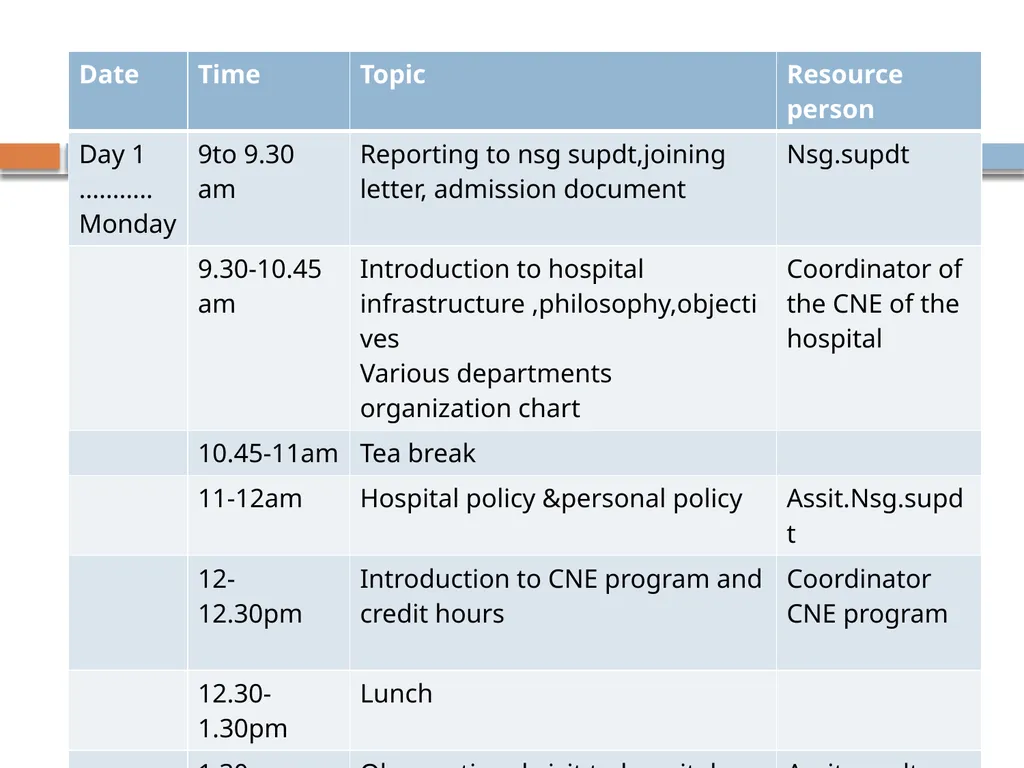
Sample in-service education programe In-service education program for new joined nurses
Date -From ……..to …. ……
venue______ Time -------------
Participants –
Teaching methodology -
Registration fee
Topic -
Objective
To familiarize the newly appointed staff nurses with hospital departments and job<br>
Date -From ……..to …. ……
venue______ Time -------------
Participants –
Teaching methodology -
Registration fee
Topic -
Objective
To familiarize the newly appointed staff nurses with hospital departments and job<br>
72
References Vati J. Principles and practice of nursing management and administration .Ist ed ,Jaypee publishers . New Delhi 2019.
Venkataraman .A.New Trends In Management Of Nursing Service And Education. The health science publisher .New Delhi,I ed.2017
C.Verghese. The nurse administrator .Ist ed.New age international limited publishers, 2016.
MR Beena, GL Harikrishana&JC Kiruba .text book of management of nursing service and education 1st ed.CBS publishers 2022<br>
Venkataraman .A.New Trends In Management Of Nursing Service And Education. The health science publisher .New Delhi,I ed.2017
C.Verghese. The nurse administrator .Ist ed.New age international limited publishers, 2016.
MR Beena, GL Harikrishana&JC Kiruba .text book of management of nursing service and education 1st ed.CBS publishers 2022<br>
73
Thank you<br>