
Ms Deasy Othello' – Act 5 Act 5, Scene 1
MY
Published · 20 slides · 0 views

1 / 1



Description
Ms Deasy Othello Act 5 Act 5, Scene 1 Summary The busy movement of this scene contrasts with the quiet passivity of the previous one. Iago has now arrived at the critical point in his fortunes (the night that either makes me, or fordoes
Related Topics
Download this presentation From Below
"Ms Deasy Othello' – Act 5 Act 5, Scene 1" is the property of its rightful owner. Permission is granted to download and print the materials on this website for personal, non-commercial use only, and to display it on your personal computer provided you do not modify the materials and that you retain all copyright notices contained in the materials. By downloading content from our website, you accept the terms of this agreement.
Share
Embed code
Presentation Transcript
01
Ms Deasy Othello' – Act 5<br>
02
Act 5, Scene 1 Summary The busy movement of this scene contrasts with the quiet passivity of the previous one. Iago has now arrived at the critical point in his fortunes (‘the night that either makes me, or fordoes me quite’). The drawn swords and the conspiratorial activity of Iago and Roderigo in the midnight street take our minds back to the opening scene of the play. Iago knows that he cannot keep Roderigo at bay much longer, while Cassio, alive, is a permanent risk to the success of his scheme against Othello and Desdemona.<br>
03
What he now has in mind, particularly if ‘each do kill the other’, may dispose of all his problems at a stroke. As things fall out, Iago’s plot almost succeeds. Roderigo is wounded but does not harm Cassio; Iago, however, wounds him, and rushes off. He then returns, in response to Cassio’s call for help, and kills Roderigo. Othello comes momentarily on the scene and sees the wounded Cassio.<br>
04
He is deeply impressed by what he takes to be Iago’s zeal on his behalf: this inspires him to hurry off and complete his act of vengeance on Desdemona. Iago’s mind is busy all the time. When Bianca arrives, he tries to attribute to her some of the responsibility for what has happened, and she is taken away for questioning. Cassio is not mortally wounded, and his survival ensures Iago’s ruin, even without Emilia’s evidence.<br>
05
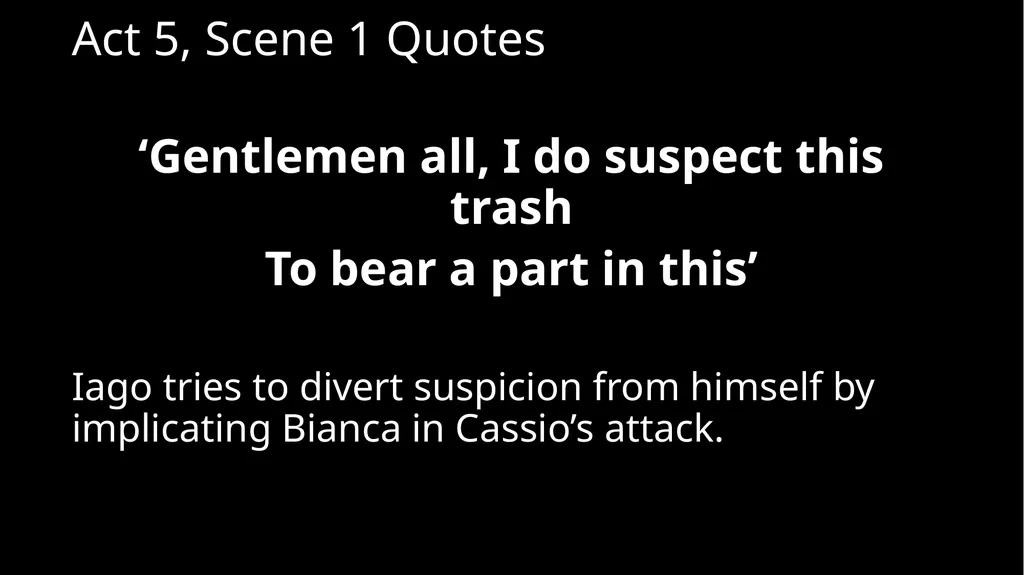
Act 5, Scene 1 Quotes ‘Gentlemen all, I do suspect this trash
To bear a part in this’
Iago tries to divert suspicion from himself by implicating Bianca in Cassio’s attack.<br>
To bear a part in this’
Iago tries to divert suspicion from himself by implicating Bianca in Cassio’s attack.<br>
06
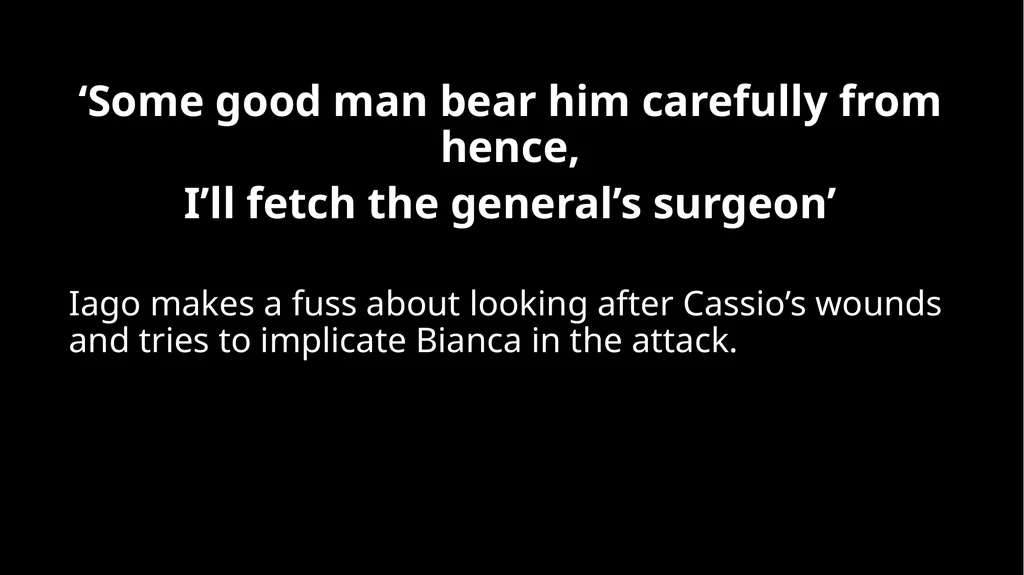
‘Some good man bear him carefully from hence,
I’ll fetch the general’s surgeon’
Iago makes a fuss about looking after Cassio’s wounds and tries to implicate Bianca in the attack.<br>
I’ll fetch the general’s surgeon’
Iago makes a fuss about looking after Cassio’s wounds and tries to implicate Bianca in the attack.<br>
07
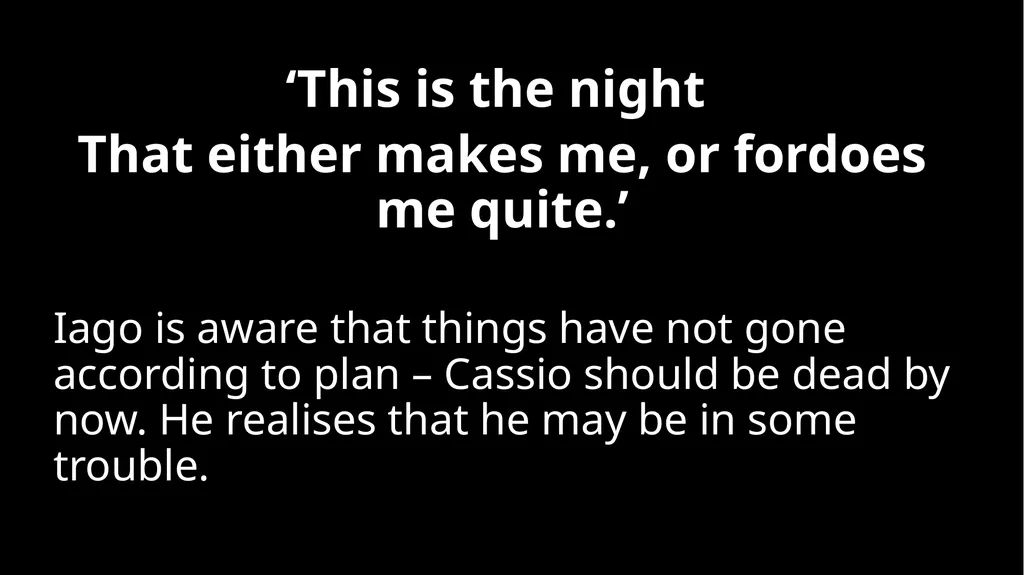
‘This is the night
That either makes me, or fordoes me quite.’
Iago is aware that things have not gone according to plan – Cassio should be dead by now. He realises that he may be in some trouble.<br>
That either makes me, or fordoes me quite.’
Iago is aware that things have not gone according to plan – Cassio should be dead by now. He realises that he may be in some trouble.<br>
08
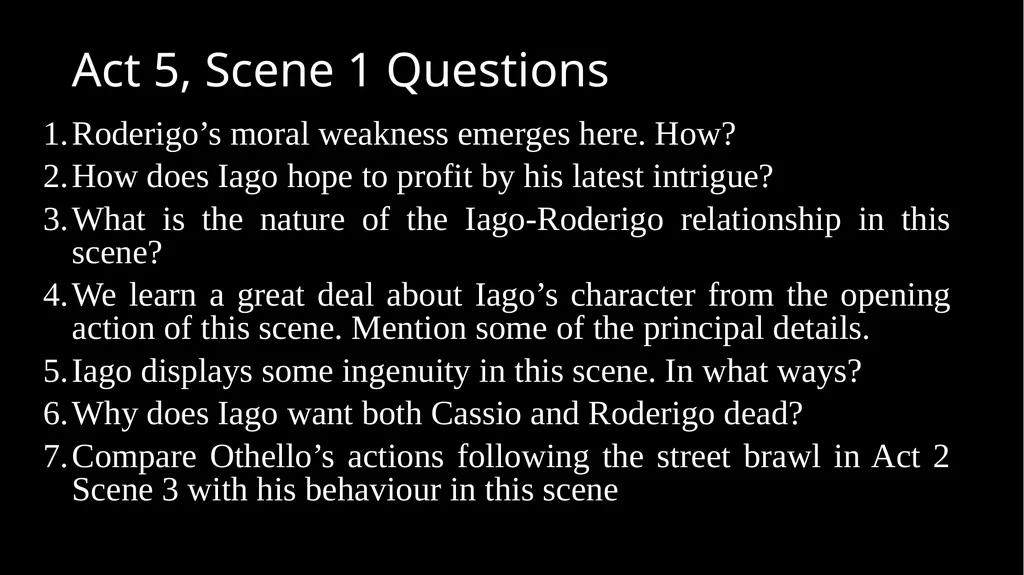
Act 5, Scene 1 Questions Roderigo’s moral weakness emerges here. How?
How does Iago hope to profit by his latest intrigue?
What is the nature of the Iago-Roderigo relationship in this scene?
We learn a great deal about Iago’s character from the opening action of this scene. Mention some of the principal details.
Iago displays some ingenuity in this scene. In what ways?
Why does Iago want both Cassio and Roderigo dead?
Compare Othello’s actions following the street brawl in Act 2 Scene 3 with his behaviour in this scene<br>
How does Iago hope to profit by his latest intrigue?
What is the nature of the Iago-Roderigo relationship in this scene?
We learn a great deal about Iago’s character from the opening action of this scene. Mention some of the principal details.
Iago displays some ingenuity in this scene. In what ways?
Why does Iago want both Cassio and Roderigo dead?
Compare Othello’s actions following the street brawl in Act 2 Scene 3 with his behaviour in this scene<br>
09
Act 5, Scene 2 Summary This is one of the finest scenes in all Shakespearean tragedy. Othello looks at the sleeping Desdemona. He is moved by her innocent beauty, and troubled by what he sees as the shocking contrast between her heavenly appearance and her sinful soul. He has to steel himself to a deed that will violate his deepest instincts. The only way he can bring himself to kill her is to see himself not as a bloody avenger seeking personal satisfaction for a wrong done to him, but as an instrument of justice, acting for the general good (‘else she’ll betray more men’).<br>
10
His opening speech reflects a mind torn by conflicting feelings. He beauty (‘thou cunning pattern of excelling nature’) and her ‘balmy breath’ momentarily shake his resolution to kill her, however necessary and right this course of action now appears to him. He sheds involuntary tears, but, as the self-appointed instrument of heavenly justice, he feels compelled to lay aside his human reactions, and strike the one he loves. His assumed role of heaven’s agent requires him to ask the awakened Desdemona to pray for her own soul: he will not be the agent of her eternal damnation (‘I would not kill thy soul’).<br>
11
His interrogation f her takes the form of a legal process in which he is judge, counsel for the prosecution, and jury, all at once. The language of this part of the scene is that of the courtroom, with overtones of the confessional (‘be think yourself of any crime . . . take heed of perjury . . . confess thee freely. For to deny each article with oath . . . thou art to die . . . O perjured woman . . . He has confess’d’). The awakened Desdemona is also confronted by the frightening spectacle of her husband in ‘a bloody passion’ as he knaws his ‘nether lip’.<br>
12
She meets Othello’s charges against her with a straightforward denial. His patience begins to give way. Her unconcealed grief at his mention of Cassio’s death (‘Weep’st thou for him to my face?’) destroys his self-control and seals her fate. He will not now give her time to pray, and in a blind rage he kills her, not, after all, as an agent of justice, but as a provoked husband taking a purely personal revenge.<br>
13
As he strangles Desdemona, Emilia knocks at the door. When, after some delay, Othello lets Emilia in, she gives him the false news that Cassio has killed Roderigo. Desdemona’s dying cries attract Emilia’s attention. The murdered wife expires with words of love for her husband, and a pathetic attempt to free him from responsibility for her death. Now it is Emilia’s turn to act as interrogator. She courageously defies Othello (‘Thou dost belie her and thou art a devil’), and curses her husband’s villainy (‘may his pernicious soul / Rot half a grain a day’). She shouts for help, and Montano, Gratiano and Iago arrive.<br>
14
Now begins the process leading to Iago’s undoing. For the first time he has to face in public someone who knows the truth about his schemes. Emilia defies Iago’s attempts to evade her exposure of his villainy. She presses home her case with convincing urgency. Iago betrays himself in a futile display of murderous violence, stabs Emilia to death, and then tries to escape. When he is brought back, Othello wounds him. Lodovico now produces evidence implicating both Iago and Roderigo in the attempt on Cassio’s life. Othello is relieved of his ‘power and command’ in Cyprus, and Cassio is appointed in his place. The truth about what he has done has dawned on Othello, and, recovering something of his lost dignity, he dies by his own hand.<br>
15
Act 5, Scene 2 Quotes ‘Put out the light, and then put out the light’
In a significant dramatic echo, we see Othello enter from the darkness with a light, just as did Iago in the last scene. The connection between these two characters is that the will of one has come to rule the heart of the other.<br>
In a significant dramatic echo, we see Othello enter from the darkness with a light, just as did Iago in the last scene. The connection between these two characters is that the will of one has come to rule the heart of the other.<br>
16
‘O perjured woman, thou dost stone my heart
And mak’st me call what I intend to do
A murder, which I thought a sacrifice.’
These lines are spoken by Othello just before he murders Desdemona. The quotation can be used to show how Othello feels that killing Desdemona is a sacrifice that he must make in the name of justice.<br>
And mak’st me call what I intend to do
A murder, which I thought a sacrifice.’
These lines are spoken by Othello just before he murders Desdemona. The quotation can be used to show how Othello feels that killing Desdemona is a sacrifice that he must make in the name of justice.<br>
17
‘Good gentlemen, let me have leave to speak,
Tis proper I should obey him, but not now’
Emilia insists on being allowed to speak, in spite of her husband’s attempts to quieten her. By her actions here, Emilia reveals that she is an honest character not without moral standards. She realises that Iago has until now relied on her unthinking obedience as a shield and out of a sense of shock and horror, he vigorously exposes his lies.<br>
Tis proper I should obey him, but not now’
Emilia insists on being allowed to speak, in spite of her husband’s attempts to quieten her. By her actions here, Emilia reveals that she is an honest character not without moral standards. She realises that Iago has until now relied on her unthinking obedience as a shield and out of a sense of shock and horror, he vigorously exposes his lies.<br>
18
‘I look down towards his feet, but that’s a fable –
If that thou be’st a devil, I cannot kill thee.’
Othello emphasises the idea which runs through the play that Iago is the personification of the devil himself.<br>
If that thou be’st a devil, I cannot kill thee.’
Othello emphasises the idea which runs through the play that Iago is the personification of the devil himself.<br>
19
‘I kiss’d thee ere I kill’d thee – no way but this,
Killing myself, to die upon a kiss.’
In his death Othello seems to regain some of his earlier nobility. He regains a clearer and saner perspective on the world only when it is too late. Othello dies declaring his love for Desdemona with a kiss.<br>
Killing myself, to die upon a kiss.’
In his death Othello seems to regain some of his earlier nobility. He regains a clearer and saner perspective on the world only when it is too late. Othello dies declaring his love for Desdemona with a kiss.<br>
20
Act 5, Scene 2 Questions In what frame of mind does Othello approach the murder of Desdemona?
In what frame of mind does he commit the murder?
Othello sounds like a trial judge as he confronts Desdemona. Explain.
Desdemona unwittingly helps to bring about her own destruction. How?
Emilia has a vital role in this scene. What is her importance?
This scene reveals a new Emilia. Explain.
Iago is destroyed by his oversights and by accidental circumstances. Elaborate on this.
Comment of the significance of the imagery of heaven and hell in this scene.
As his death approaches, Othello recovers some of his earlier nobility. What are indications of this?<br>
In what frame of mind does he commit the murder?
Othello sounds like a trial judge as he confronts Desdemona. Explain.
Desdemona unwittingly helps to bring about her own destruction. How?
Emilia has a vital role in this scene. What is her importance?
This scene reveals a new Emilia. Explain.
Iago is destroyed by his oversights and by accidental circumstances. Elaborate on this.
Comment of the significance of the imagery of heaven and hell in this scene.
As his death approaches, Othello recovers some of his earlier nobility. What are indications of this?<br>