
MTC Partnership Summit - background May 2023 ©
KB
Published · 53 slides · 0 views
1 / 1



Description
MTC Partnership Summit - background May 2023 Multistate tax commission 2023 All rights Reserved 1 Notice about The Summit and these materials Many state tax agencies are dealing with difficult issues involved in the taxation of
Related Topics
Share
Embed code
Download this presentation From Below
"MTC Partnership Summit - background May 2023 ©" is the property of its rightful owner. Permission is granted to download and print the materials on this website for personal, non-commercial use only, and to display it on your personal computer provided you do not modify the materials and that you retain all copyright notices contained in the materials. By downloading content from our website, you accept the terms of this agreement.
Presentation Transcript
01
MTC Partnership Summit - background May 2023 © Multistate tax commission – 2023 – All rights Reserved 1<br>
02
Notice – about The Summit and these materials Many state tax agencies are dealing with difficult issues involved in the taxation of income from multistate partnerships—including tax reporting and administration, nexus and audit issues, technology support, employee training, and policy development. As states work to develop processes, procedures, and expertise in all these areas, we believe they would benefit from sharing their experiences with each other and that the staff of the Multistate Tax Commission would also benefit from information to help us better assist with state efforts—whether by providing technical research, training resources, coordination with the IRS or other groups, etc.
While the summit is open only to states, and is a training and information sharing session under the MTC's Public Participation Policy, we advise the states not to share confidential taxpayer information in the context of the summit.
These materials were prepared by and belong to the Multistate Tax Commission. These materials are for discussion purposes only. They do not represent the official position of the MTC or any state.
These materials are copyrighted to the MTC and may contain proprietary or privileged information. The MTC reserves all rights to these materials and no person can reproduce or make any other use of the materials without the express permission of the MTC. © Multistate tax commission – 2023 – All rights Reserved 2<br>
While the summit is open only to states, and is a training and information sharing session under the MTC's Public Participation Policy, we advise the states not to share confidential taxpayer information in the context of the summit.
These materials were prepared by and belong to the Multistate Tax Commission. These materials are for discussion purposes only. They do not represent the official position of the MTC or any state.
These materials are copyrighted to the MTC and may contain proprietary or privileged information. The MTC reserves all rights to these materials and no person can reproduce or make any other use of the materials without the express permission of the MTC. © Multistate tax commission – 2023 – All rights Reserved 2<br>
03
© Multistate tax commission – 2023 – All rights Reserved 3 Join at slido.com
#1568736 ⓘ Start presenting to display the joining instructions on this slide.<br>
04
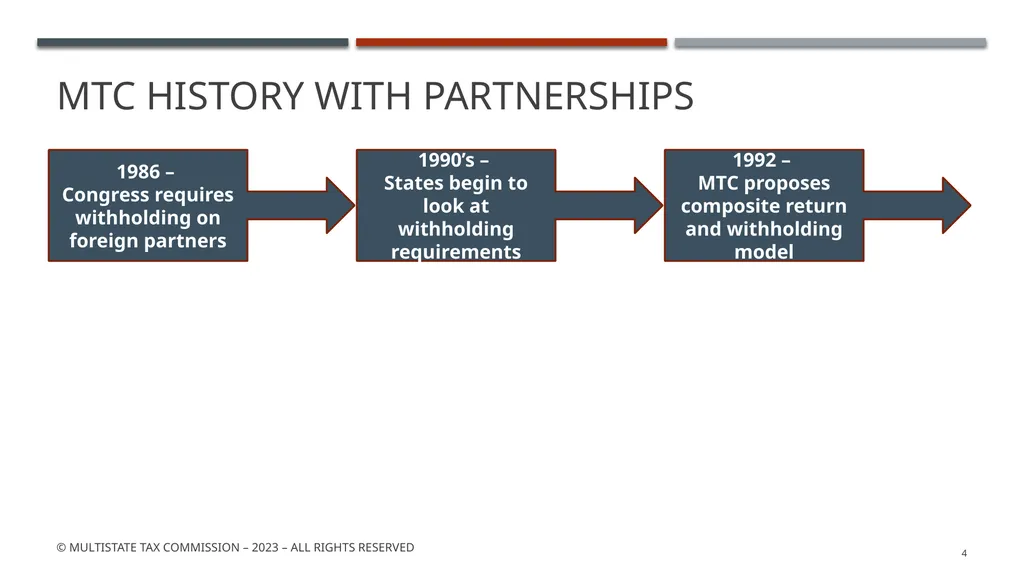
MTC History With Partnerships 1986 –
Congress requires withholding on foreign partners 1990’s –
States begin to look at withholding requirements 1992 –
MTC proposes composite return and withholding model © Multistate tax commission – 2023 – All rights Reserved 4<br>
Congress requires withholding on foreign partners 1990’s –
States begin to look at withholding requirements 1992 –
MTC proposes composite return and withholding model © Multistate tax commission – 2023 – All rights Reserved 4<br>
05
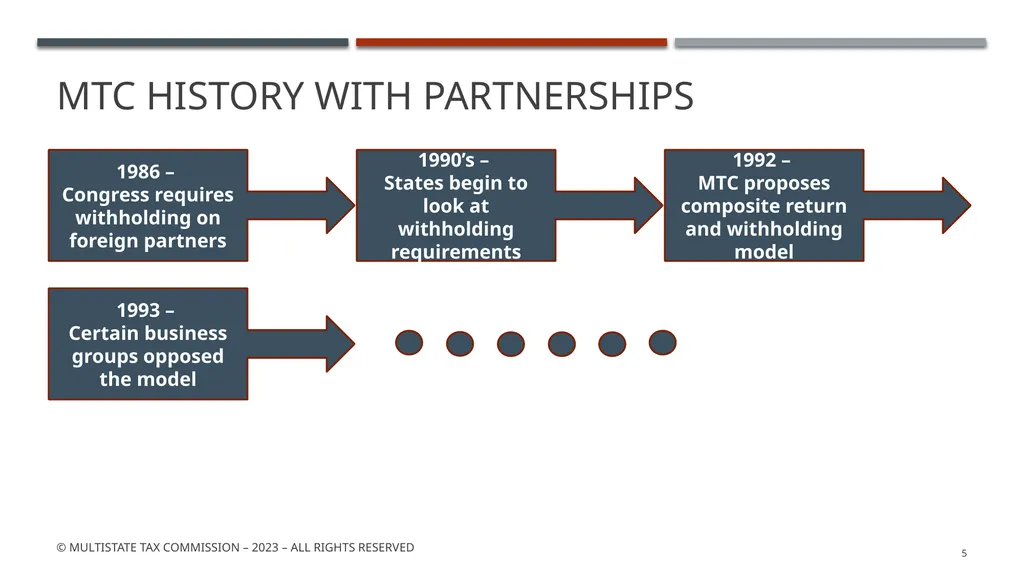
MTC History With Partnerships 1986 –
Congress requires withholding on foreign partners 1990’s –
States begin to look at withholding requirements 1992 –
MTC proposes composite return and withholding model 1993 –
Certain business groups opposed the model © Multistate tax commission – 2023 – All rights Reserved 5<br>
Congress requires withholding on foreign partners 1990’s –
States begin to look at withholding requirements 1992 –
MTC proposes composite return and withholding model 1993 –
Certain business groups opposed the model © Multistate tax commission – 2023 – All rights Reserved 5<br>
06
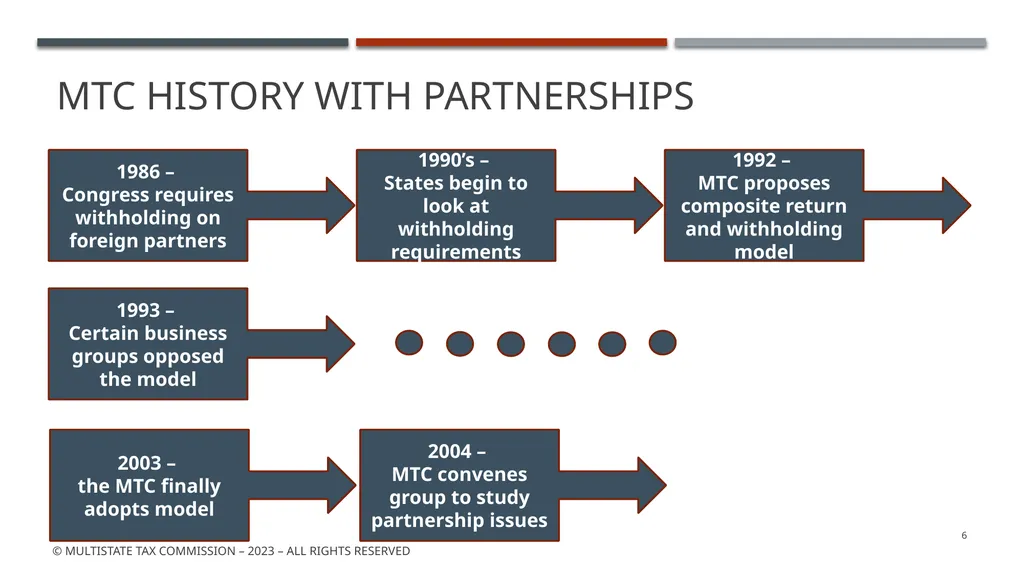
MTC History With Partnerships 1986 –
Congress requires withholding on foreign partners 1990’s –
States begin to look at withholding requirements 1992 –
MTC proposes composite return and withholding model 1993 –
Certain business groups opposed the model 2003 –
the MTC finally adopts model 2004 –
MTC convenes group to study partnership issues © Multistate tax commission – 2023 – All rights Reserved 6<br>
Congress requires withholding on foreign partners 1990’s –
States begin to look at withholding requirements 1992 –
MTC proposes composite return and withholding model 1993 –
Certain business groups opposed the model 2003 –
the MTC finally adopts model 2004 –
MTC convenes group to study partnership issues © Multistate tax commission – 2023 – All rights Reserved 6<br>
07
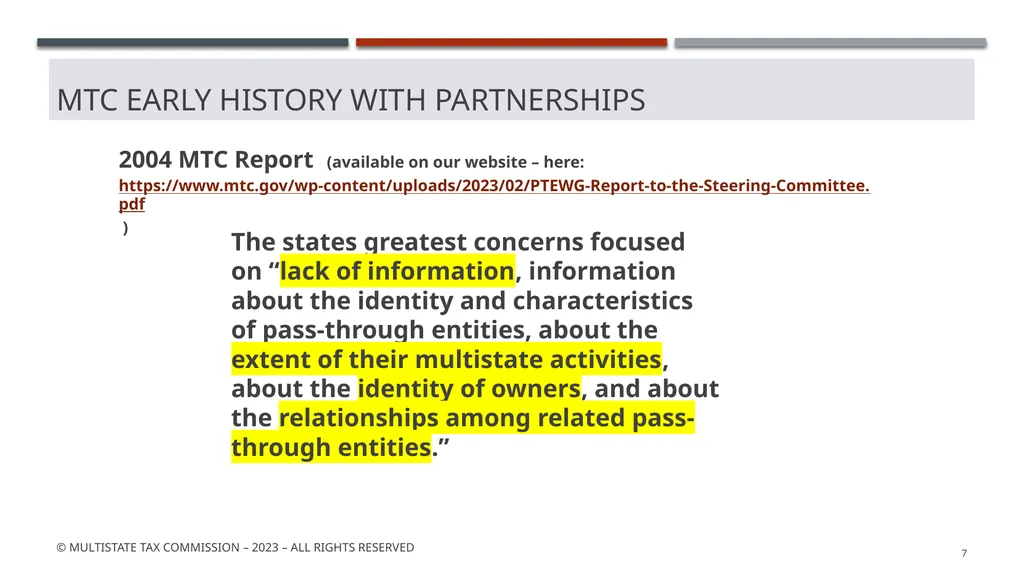
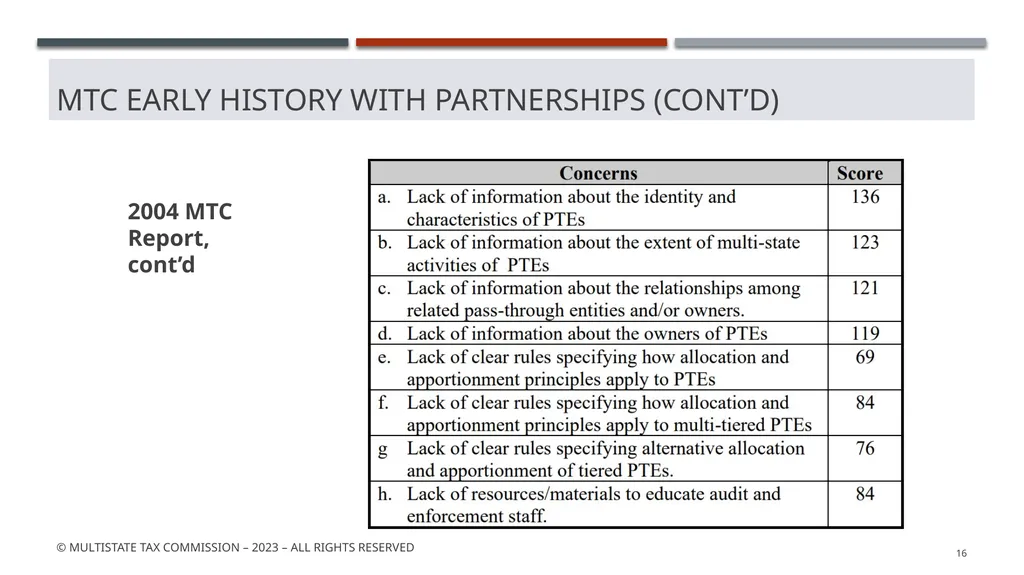
The states greatest concerns focused on “lack of information, information about the identity and characteristics of pass-through entities, about the extent of their multistate activities, about the identity of owners, and about the relationships among related pass-through entities.” MTC Early History With Partnerships © Multistate tax commission – 2023 – All rights Reserved 7 2004 MTC Report (available on our website – here: https://www.mtc.gov/wp-content/uploads/2023/02/PTEWG-Report-to-the-Steering-Committee.pdf )<br>
08
“The initiatives identified as most likely to be effective were mandatory withholding, IRS databases and tracking software, other common databases, a centralized filing system and technical training.” MTC Early History With Partnerships © Multistate tax commission – 2023 – All rights Reserved 8 2004 MTC Report, cont’d<br>
09
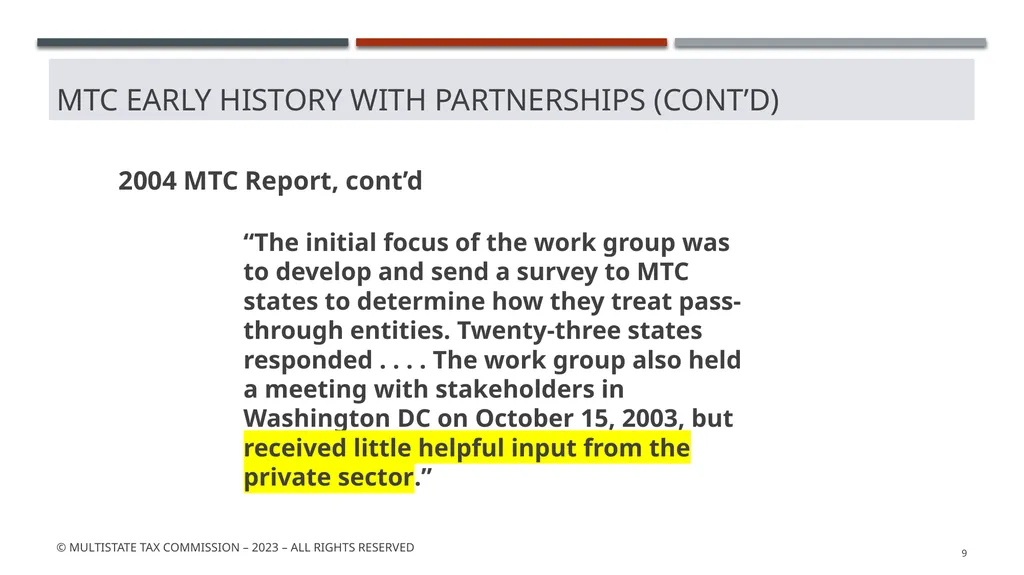
“The initial focus of the work group was to develop and send a survey to MTC states to determine how they treat pass-through entities. Twenty-three states responded . . . . The work group also held a meeting with stakeholders in Washington DC on October 15, 2003, but received little helpful input from the private sector.” MTC Early History With Partnerships (cont’d) © Multistate tax commission – 2023 – All rights Reserved 9 2004 MTC Report, cont’d<br>
10
“The work group developed and issued a RFI to information technology companies for possible solutions for state compliance in tracking income of pass-through entities. The intent of the RFI was to gather information for use by states in individual state compliance efforts rather than a multistate solution. We received four responses, two of which described potentially beneficial compliance tools.” MTC Early History With Partnerships (cont’d) © Multistate tax commission – 2023 – All rights Reserved 10 2004 MTC Report, cont’d<br>
11
The work group met with the IRS and reported: “A significant part of the IRS effort has been a matching program with data from Schedule K-1s. The IRS advised that revenue being reported from flow through entities is growing at the rate of 13% annually . . .. They are also seeing a growth in the complexity of pass-through entity structures, especially in the number of tiers being used.” MTC Early History With Partnerships (cont’d) © Multistate tax commission – 2023 – All rights Reserved 11 2004 MTC Report, cont’d<br>
12
“An artificial intelligence modeling system has been developed to identify those passthrough entities that IRS believes are high compliance risks and thus have high revenue potential. IRS has launched a compliance research initiative feeding off the information provided by this new model.” MTC Early History With Partnerships (cont’d) © Multistate tax commission – 2023 – All rights Reserved 12 2004 MTC Report, cont’d<br>
13
“The work group learned . . . a few states, particularly California, New York and Pennsylvania, have taken a lead role in developing outstanding technology-based compliance efforts. A significant part of those efforts is the creation of data warehouses that contain information on pass-though entities and their owners, often their many tiers of ownership.” MTC Early History With Partnerships (cont’d) © Multistate tax commission – 2023 – All rights Reserved 13 2004 MTC Report, cont’d<br>
14
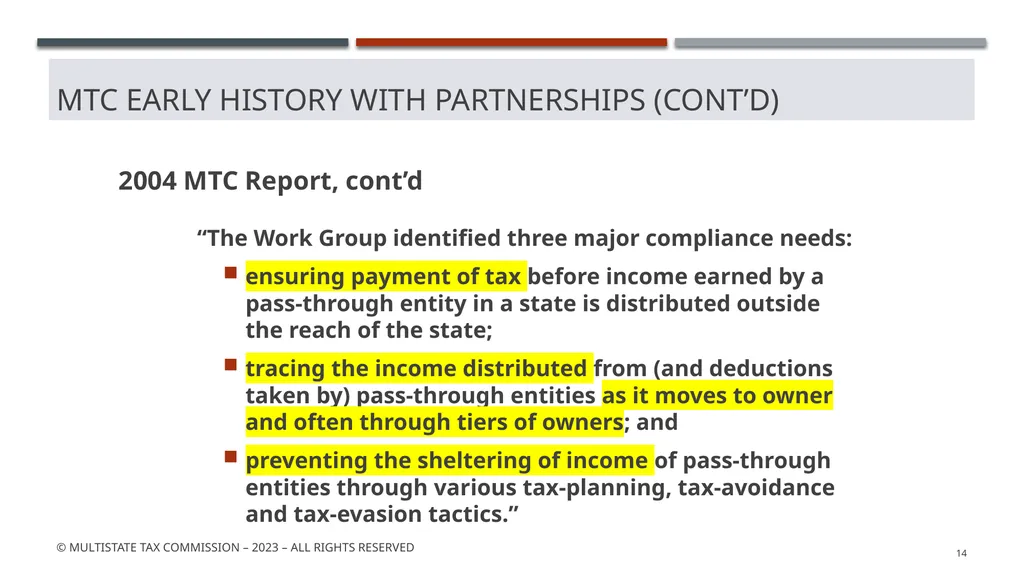
“The Work Group identified three major compliance needs:
ensuring payment of tax before income earned by a pass-through entity in a state is distributed outside the reach of the state;
tracing the income distributed from (and deductions taken by) pass-through entities as it moves to owner and often through tiers of owners; and
preventing the sheltering of income of pass-through entities through various tax-planning, tax-avoidance and tax-evasion tactics.” MTC Early History With Partnerships (cont’d) © Multistate tax commission – 2023 – All rights Reserved 14 2004 MTC Report, cont’d<br>
ensuring payment of tax before income earned by a pass-through entity in a state is distributed outside the reach of the state;
tracing the income distributed from (and deductions taken by) pass-through entities as it moves to owner and often through tiers of owners; and
preventing the sheltering of income of pass-through entities through various tax-planning, tax-avoidance and tax-evasion tactics.” MTC Early History With Partnerships (cont’d) © Multistate tax commission – 2023 – All rights Reserved 14 2004 MTC Report, cont’d<br>
15
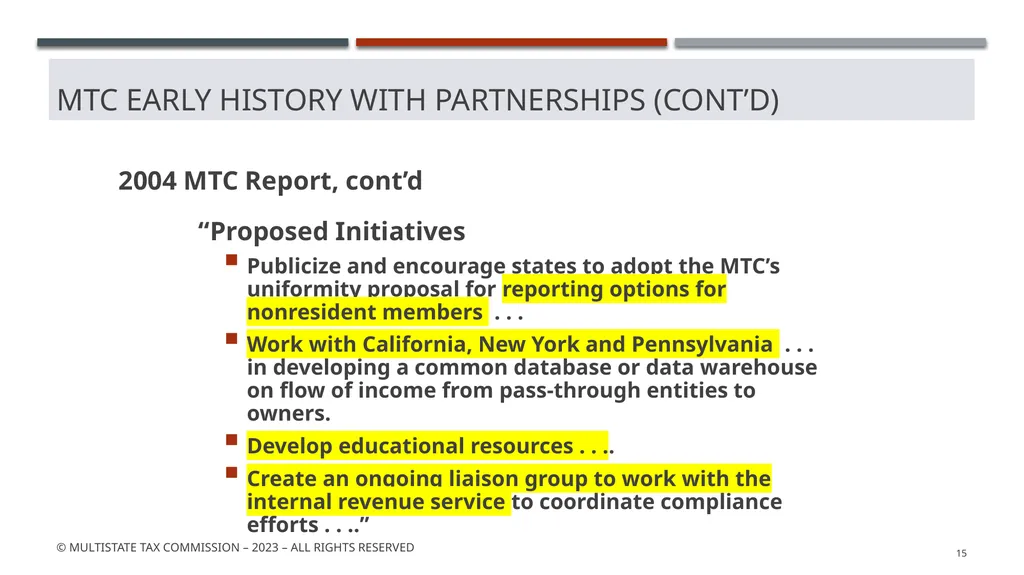
“Proposed Initiatives
Publicize and encourage states to adopt the MTC’s uniformity proposal for reporting options for nonresident members . . .
Work with California, New York and Pennsylvania . . . in developing a common database or data warehouse on flow of income from pass-through entities to owners.
Develop educational resources . . ..
Create an ongoing liaison group to work with the internal revenue service to coordinate compliance efforts . . ..” MTC Early History With Partnerships (cont’d) © Multistate tax commission – 2023 – All rights Reserved 15 2004 MTC Report, cont’d<br>
Publicize and encourage states to adopt the MTC’s uniformity proposal for reporting options for nonresident members . . .
Work with California, New York and Pennsylvania . . . in developing a common database or data warehouse on flow of income from pass-through entities to owners.
Develop educational resources . . ..
Create an ongoing liaison group to work with the internal revenue service to coordinate compliance efforts . . ..” MTC Early History With Partnerships (cont’d) © Multistate tax commission – 2023 – All rights Reserved 15 2004 MTC Report, cont’d<br>
16
MTC Early History With Partnerships (cont’d) © Multistate tax commission – 2023 – All rights Reserved 16 2004 MTC Report, cont’d<br>
17
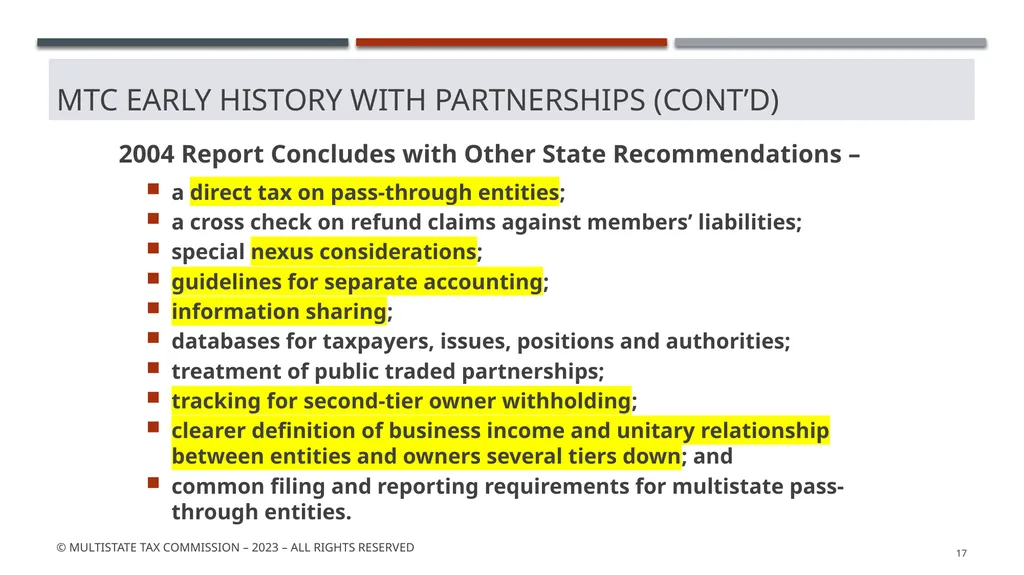
2004 Report Concludes with Other State Recommendations –
a direct tax on pass-through entities;
a cross check on refund claims against members’ liabilities;
special nexus considerations;
guidelines for separate accounting;
information sharing;
databases for taxpayers, issues, positions and authorities;
treatment of public traded partnerships;
tracking for second-tier owner withholding;
clearer definition of business income and unitary relationship between entities and owners several tiers down; and
common filing and reporting requirements for multistate pass-through entities. MTC Early History With Partnerships (cont’d) © Multistate tax commission – 2023 – All rights Reserved 17<br>
a direct tax on pass-through entities;
a cross check on refund claims against members’ liabilities;
special nexus considerations;
guidelines for separate accounting;
information sharing;
databases for taxpayers, issues, positions and authorities;
treatment of public traded partnerships;
tracking for second-tier owner withholding;
clearer definition of business income and unitary relationship between entities and owners several tiers down; and
common filing and reporting requirements for multistate pass-through entities. MTC Early History With Partnerships (cont’d) © Multistate tax commission – 2023 – All rights Reserved 17<br>
18
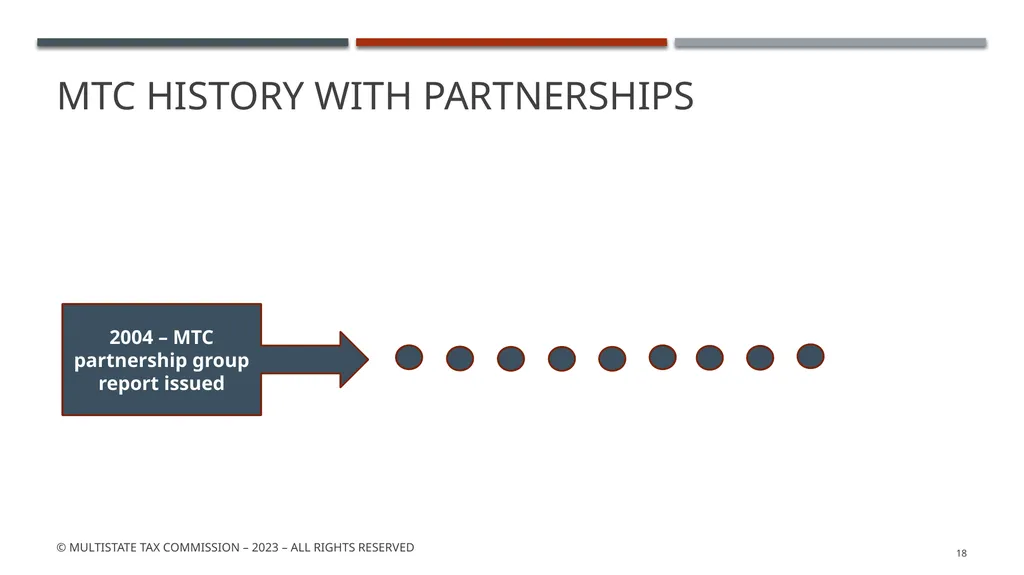
MTC History With Partnerships 2004 – MTC partnership group report issued © Multistate tax commission – 2023 – All rights Reserved 18<br>
19
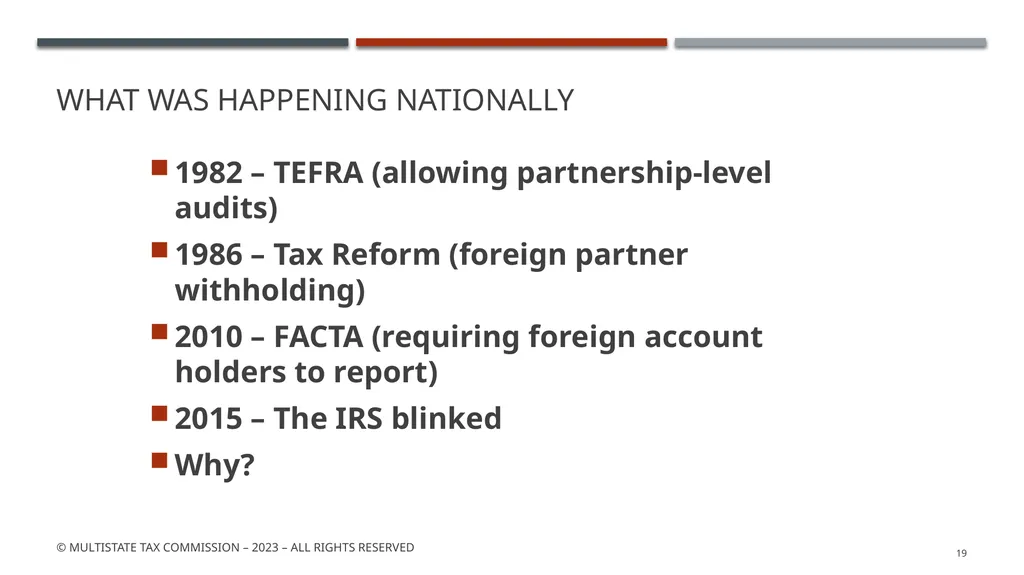
What was happening Nationally 1982 – TEFRA (allowing partnership-level audits)
1986 – Tax Reform (foreign partner withholding)
2010 – FACTA (requiring foreign account holders to report)
2015 – The IRS blinked
Why? © Multistate tax commission – 2023 – All rights Reserved 19<br>
1986 – Tax Reform (foreign partner withholding)
2010 – FACTA (requiring foreign account holders to report)
2015 – The IRS blinked
Why? © Multistate tax commission – 2023 – All rights Reserved 19<br>
20
© Multistate tax commission – 2023 – All rights Reserved 20<br>
21
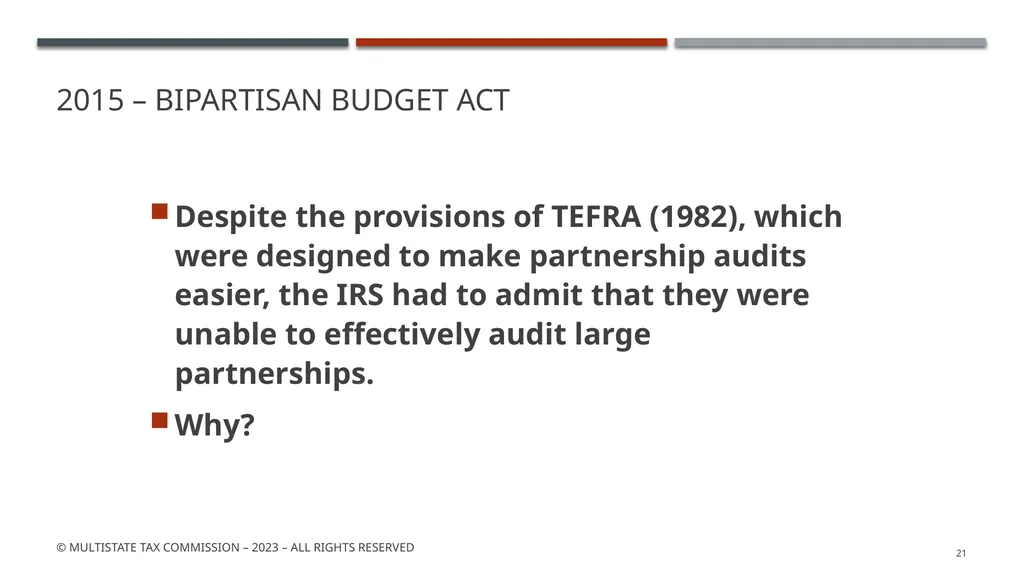
2015 – Bipartisan Budget Act Despite the provisions of TEFRA (1982), which were designed to make partnership audits easier, the IRS had to admit that they were unable to effectively audit large partnerships.
Why? © Multistate tax commission – 2023 – All rights Reserved 21<br>
Why? © Multistate tax commission – 2023 – All rights Reserved 21<br>
22
© Multistate tax commission – 2023 – All rights Reserved 22<br>
23
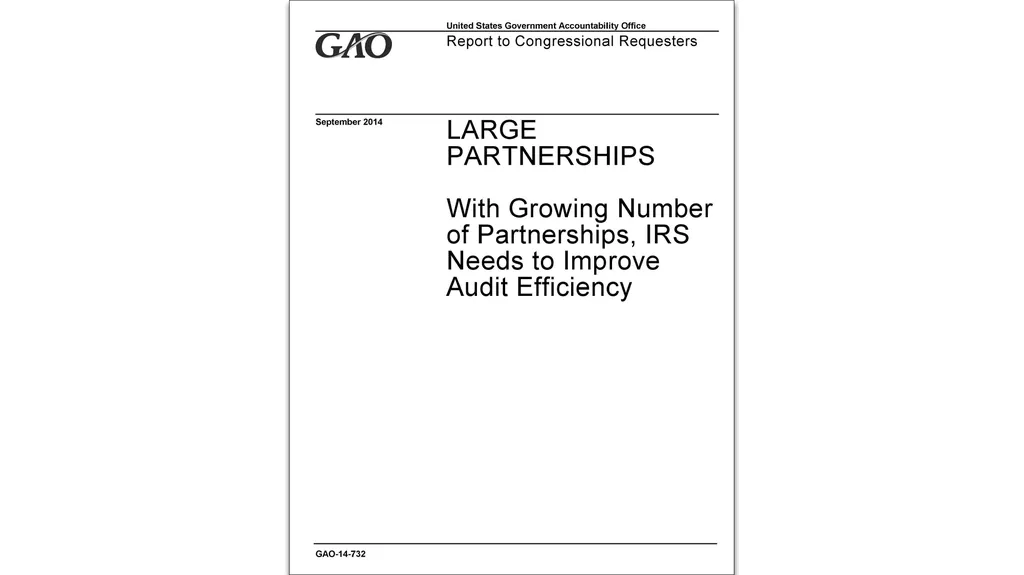
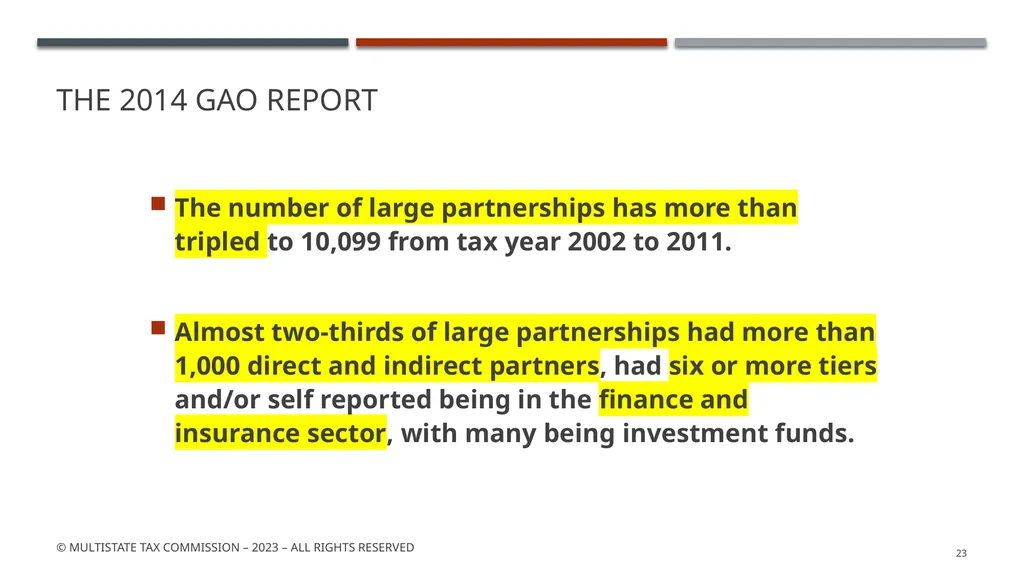
The 2014 GAO Report The number of large partnerships has more than tripled to 10,099 from tax year 2002 to 2011.
Almost two-thirds of large partnerships had more than 1,000 direct and indirect partners, had six or more tiers and/or self reported being in the finance and insurance sector, with many being investment funds. © Multistate tax commission – 2023 – All rights Reserved 23<br>
Almost two-thirds of large partnerships had more than 1,000 direct and indirect partners, had six or more tiers and/or self reported being in the finance and insurance sector, with many being investment funds. © Multistate tax commission – 2023 – All rights Reserved 23<br>
24
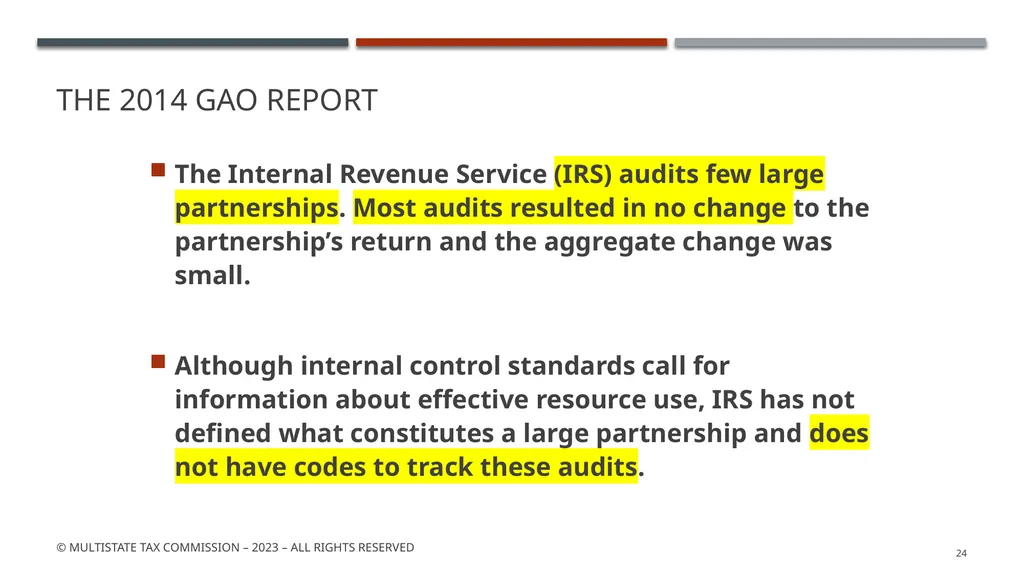
The 2014 GAO Report The Internal Revenue Service (IRS) audits few large partnerships. Most audits resulted in no change to the partnership’s return and the aggregate change was small.
Although internal control standards call for information about effective resource use, IRS has not defined what constitutes a large partnership and does not have codes to track these audits. © Multistate tax commission – 2023 – All rights Reserved 24<br>
Although internal control standards call for information about effective resource use, IRS has not defined what constitutes a large partnership and does not have codes to track these audits. © Multistate tax commission – 2023 – All rights Reserved 24<br>
25
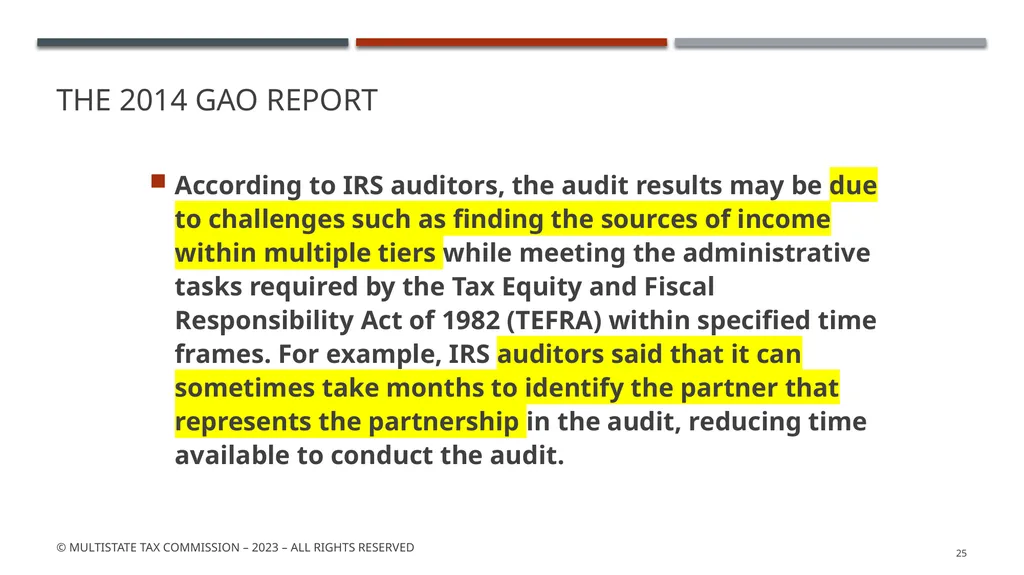
The 2014 GAO Report According to IRS auditors, the audit results may be due to challenges such as finding the sources of income within multiple tiers while meeting the administrative tasks required by the Tax Equity and Fiscal Responsibility Act of 1982 (TEFRA) within specified time frames. For example, IRS auditors said that it can sometimes take months to identify the partner that represents the partnership in the audit, reducing time available to conduct the audit. © Multistate tax commission – 2023 – All rights Reserved 25<br>
26
The 2014 GAO Report TEFRA does not require large partnerships to identify this partner on tax returns. Also under TEFRA, unless the partnership elects to be taxed at the entity level (which few do), IRS must pass audit adjustments through to the ultimate partners. © Multistate tax commission – 2023 – All rights Reserved 26<br>
27
The 2014 GAO Report IRS has initiated three projects—one of which is under development—to make large partnership audit procedures more efficient, such as identifying higher risk returns to audit. However, the two projects implemented were not developed in line with project planning principles. For example, they do not have clear and measurable goals or a method for determining results. As a consequence, IRS may not be able to tell whether the projects succeed in increasing audit efficiency. © Multistate tax commission – 2023 – All rights Reserved 27<br>
28
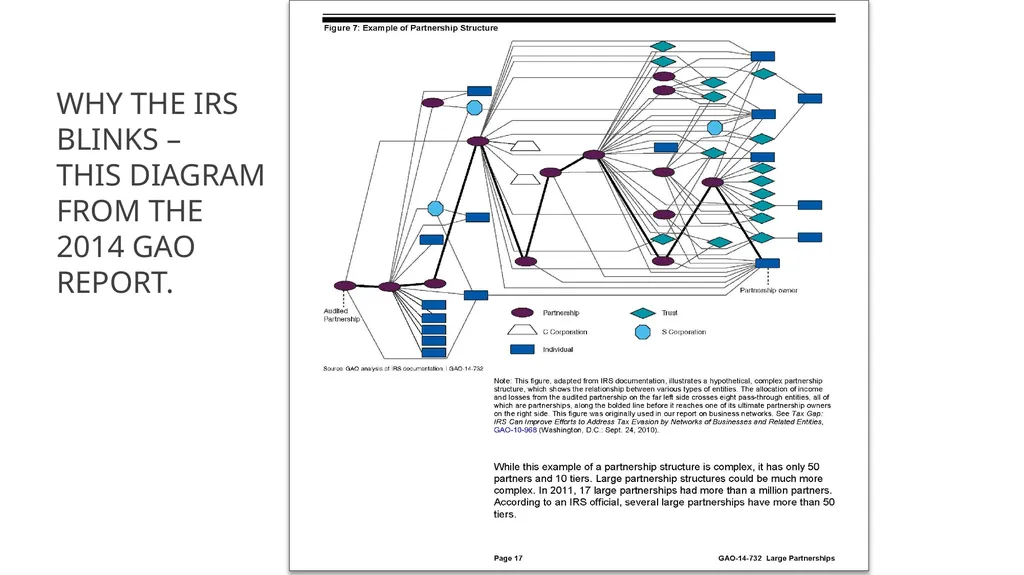
Why the IRS Blinks –
This Diagram from the 2014 GAO Report. 28<br>
29
2016 – Treasury issues its own study (Available on our website – Here: https://www.mtc.gov/wp-content/uploads/2023/02/NYU-2016-Business-in-US-Analysis-of-tax-paid.pdf) One of the authors presented to Uniformity Committee that same year.
Findings:
“(1) Relative to traditional business income, pass-through business income is substantially more concentrated among high-earners.
(2) Partnership ownership is opaque: 20% of the income goes to unclassifiable partners, and 15% of the income is earned in circularly owned partnerships.” © Multistate tax commission – 2023 – All rights Reserved 29<br>
Findings:
“(1) Relative to traditional business income, pass-through business income is substantially more concentrated among high-earners.
(2) Partnership ownership is opaque: 20% of the income goes to unclassifiable partners, and 15% of the income is earned in circularly owned partnerships.” © Multistate tax commission – 2023 – All rights Reserved 29<br>
30
2016 – Treasury issues its own study (Available on our website – Here: https://www.mtc.gov/wp-content/uploads/2023/02/NYU-2016-Business-in-US-Analysis-of-tax-paid.pdf) Findings (cont’d):
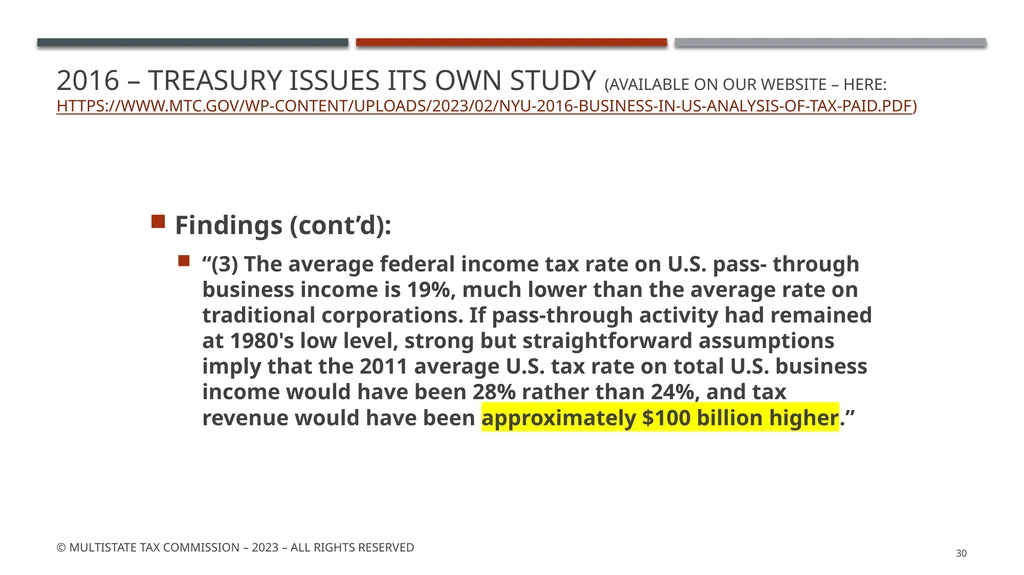
“(3) The average federal income tax rate on U.S. pass- through business income is 19%, much lower than the average rate on traditional corporations. If pass-through activity had remained at 1980's low level, strong but straightforward assumptions imply that the 2011 average U.S. tax rate on total U.S. business income would have been 28% rather than 24%, and tax revenue would have been approximately $100 billion higher.” © Multistate tax commission – 2023 – All rights Reserved 30<br>
“(3) The average federal income tax rate on U.S. pass- through business income is 19%, much lower than the average rate on traditional corporations. If pass-through activity had remained at 1980's low level, strong but straightforward assumptions imply that the 2011 average U.S. tax rate on total U.S. business income would have been 28% rather than 24%, and tax revenue would have been approximately $100 billion higher.” © Multistate tax commission – 2023 – All rights Reserved 30<br>
31
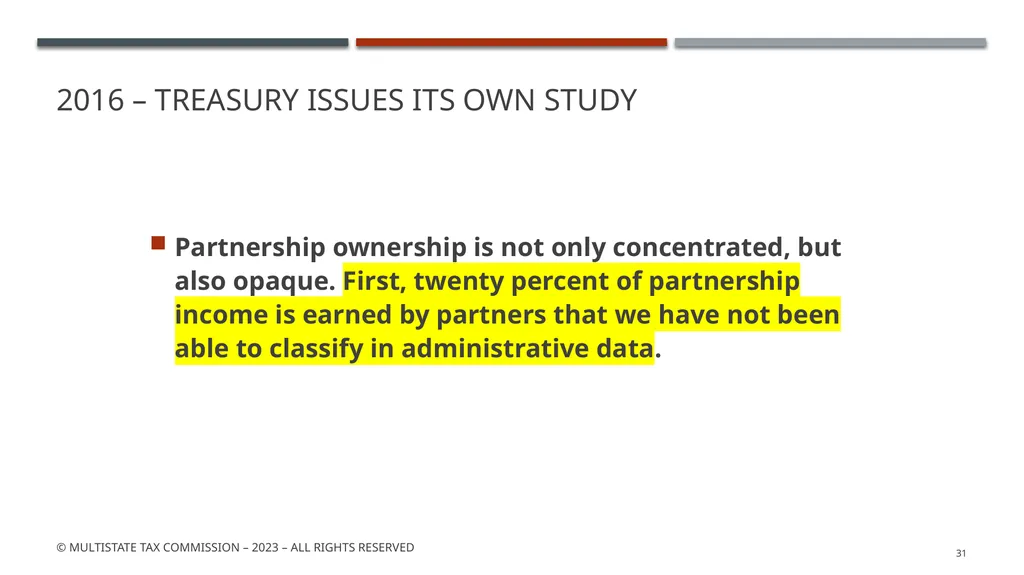
2016 – Treasury issues its own study Partnership ownership is not only concentrated, but also opaque. First, twenty percent of partnership income is earned by partners that we have not been able to classify in administrative data. © Multistate tax commission – 2023 – All rights Reserved 31<br>
32
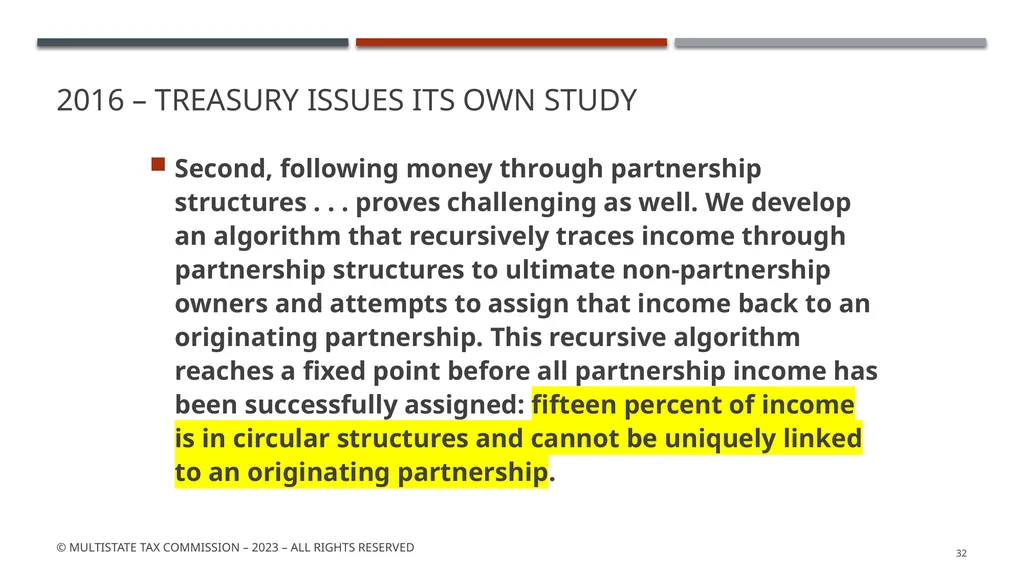
2016 – Treasury issues its own study Second, following money through partnership structures . . . proves challenging as well. We develop an algorithm that recursively traces income through partnership structures to ultimate non-partnership owners and attempts to assign that income back to an originating partnership. This recursive algorithm reaches a fixed point before all partnership income has been successfully assigned: fifteen percent of income is in circular structures and cannot be uniquely linked to an originating partnership. © Multistate tax commission – 2023 – All rights Reserved 32<br>
33
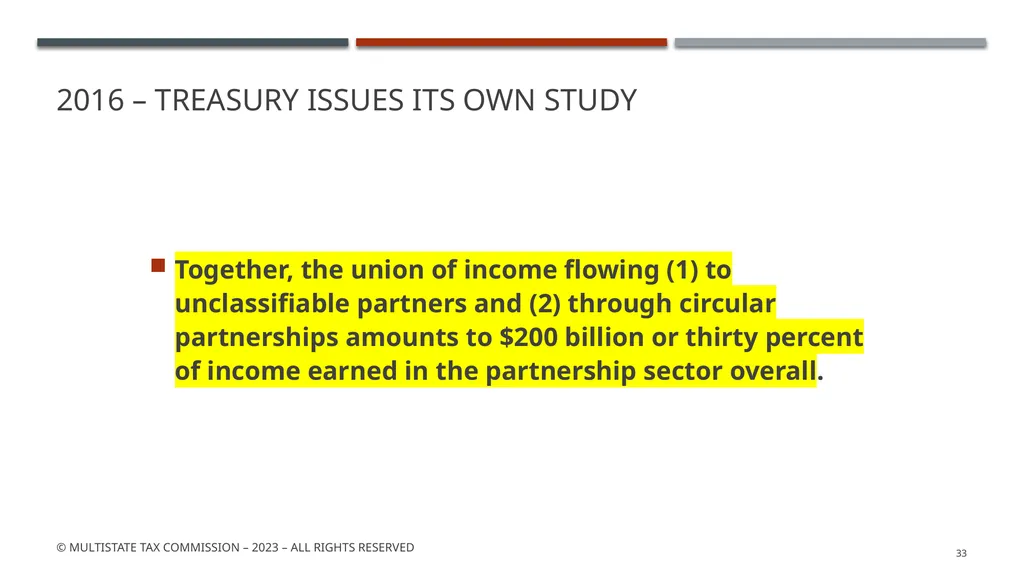
2016 – Treasury issues its own study Together, the union of income flowing (1) to unclassifiable partners and (2) through circular partnerships amounts to $200 billion or thirty percent of income earned in the partnership sector overall. © Multistate tax commission – 2023 – All rights Reserved 33<br>
34
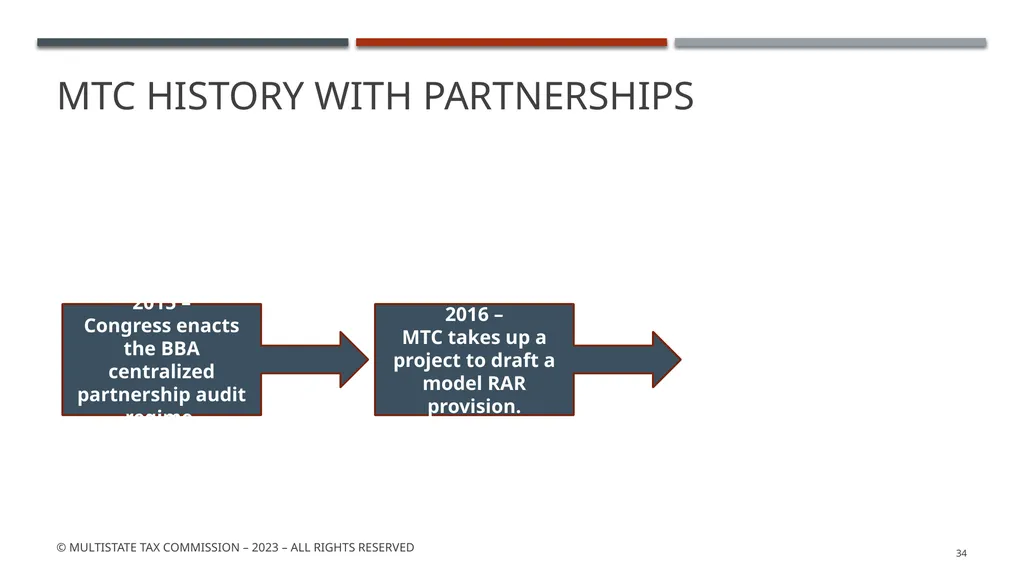
MTC History With Partnerships 2015 –
Congress enacts the BBA centralized partnership audit regime. © Multistate tax commission – 2023 – All rights Reserved 34 2016 –
MTC takes up a project to draft a model RAR provision.<br>
Congress enacts the BBA centralized partnership audit regime. © Multistate tax commission – 2023 – All rights Reserved 34 2016 –
MTC takes up a project to draft a model RAR provision.<br>
35
2016 – MTC Takes up the Partnership/RAR Project The MTC had a model for reporting and assessing state tax when taxpayers have federal adjustments.
Under the BBA – the partners might not have any adjustment themselves.
States needed a way to assess the partnership or require partners to file amended state returns.
AICPA, ABA, and others cooperate in the process. © Multistate tax commission – 2023 – All rights Reserved 35<br>
Under the BBA – the partners might not have any adjustment themselves.
States needed a way to assess the partnership or require partners to file amended state returns.
AICPA, ABA, and others cooperate in the process. © Multistate tax commission – 2023 – All rights Reserved 35<br>
36
2016 – MTC Takes up the Partnership/RAR Project Congress and IRS tweak BBA rules as implementation proceeds
2019 – MTC issues model with support of interested parties
2020 – MTC makes minor technical corrections to the model © Multistate tax commission – 2023 – All rights Reserved 36<br>
2019 – MTC issues model with support of interested parties
2020 – MTC makes minor technical corrections to the model © Multistate tax commission – 2023 – All rights Reserved 36<br>
37
2016 – MTC Takes up the Partnership/RAR Project Another thing happened during this project . . . an MTC state suggested publicly at the March 2017 uniformity committee meeting that we consider an entity-level tax in lieu of a tax on pass-through entity owners.
This suggestion was met with strong opposition from the interested parties participating in the project.
More on this in a moment . . . © Multistate tax commission – 2023 – All rights Reserved 37<br>
This suggestion was met with strong opposition from the interested parties participating in the project.
More on this in a moment . . . © Multistate tax commission – 2023 – All rights Reserved 37<br>
38
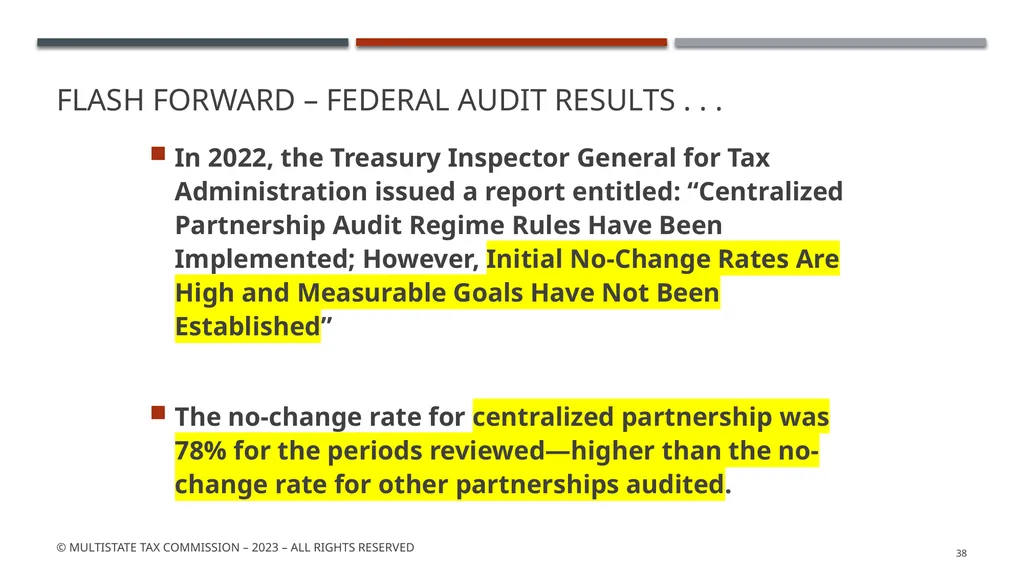
Flash forward – Federal audit results . . . In 2022, the Treasury Inspector General for Tax Administration issued a report entitled: “Centralized Partnership Audit Regime Rules Have Been Implemented; However, Initial No-Change Rates Are High and Measurable Goals Have Not Been Established”
The no-change rate for centralized partnership was 78% for the periods reviewed—higher than the no-change rate for other partnerships audited. © Multistate tax commission – 2023 – All rights Reserved 38<br>
The no-change rate for centralized partnership was 78% for the periods reviewed—higher than the no-change rate for other partnerships audited. © Multistate tax commission – 2023 – All rights Reserved 38<br>
39
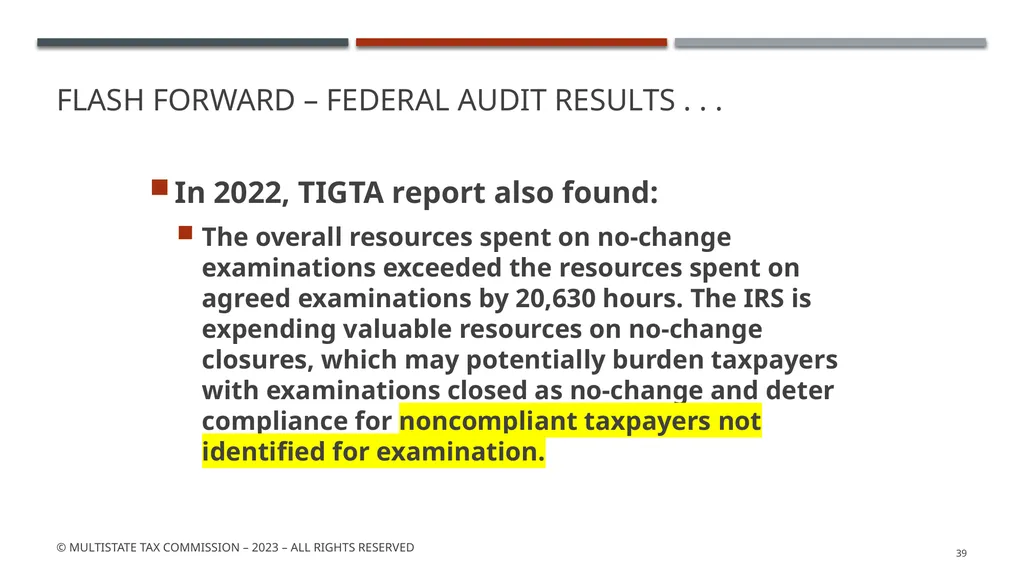
Flash forward – Federal audit results . . . In 2022, TIGTA report also found:
The overall resources spent on no-change examinations exceeded the resources spent on agreed examinations by 20,630 hours. The IRS is expending valuable resources on no-change closures, which may potentially burden taxpayers with examinations closed as no-change and deter compliance for noncompliant taxpayers not identified for examination. © Multistate tax commission – 2023 – All rights Reserved 39<br>
The overall resources spent on no-change examinations exceeded the resources spent on agreed examinations by 20,630 hours. The IRS is expending valuable resources on no-change closures, which may potentially burden taxpayers with examinations closed as no-change and deter compliance for noncompliant taxpayers not identified for examination. © Multistate tax commission – 2023 – All rights Reserved 39<br>
40
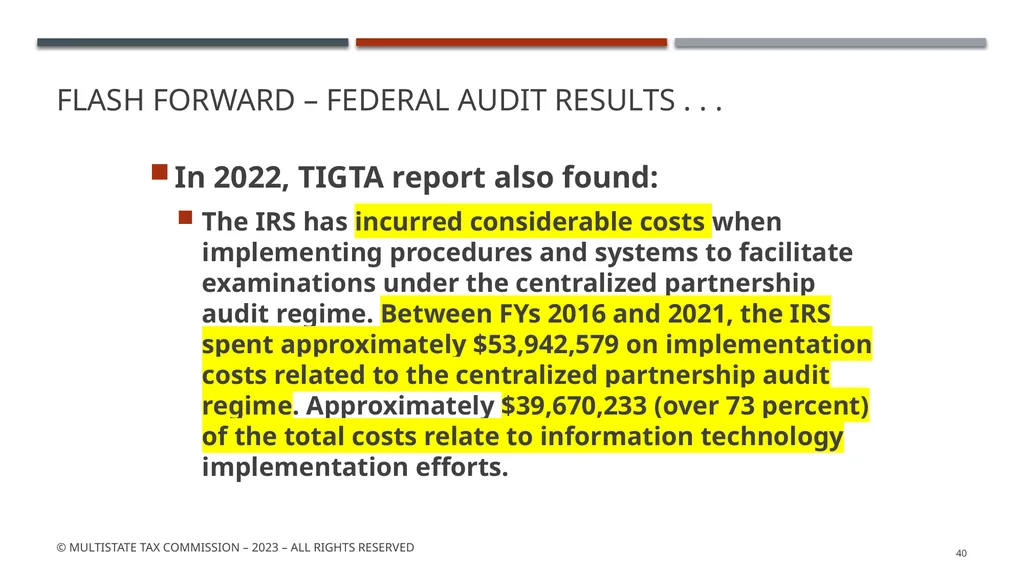
Flash forward – Federal audit results . . . In 2022, TIGTA report also found:
The IRS has incurred considerable costs when implementing procedures and systems to facilitate examinations under the centralized partnership audit regime. Between FYs 2016 and 2021, the IRS spent approximately $53,942,579 on implementation costs related to the centralized partnership audit regime. Approximately $39,670,233 (over 73 percent) of the total costs relate to information technology implementation efforts. © Multistate tax commission – 2023 – All rights Reserved 40<br>
The IRS has incurred considerable costs when implementing procedures and systems to facilitate examinations under the centralized partnership audit regime. Between FYs 2016 and 2021, the IRS spent approximately $53,942,579 on implementation costs related to the centralized partnership audit regime. Approximately $39,670,233 (over 73 percent) of the total costs relate to information technology implementation efforts. © Multistate tax commission – 2023 – All rights Reserved 40<br>
41
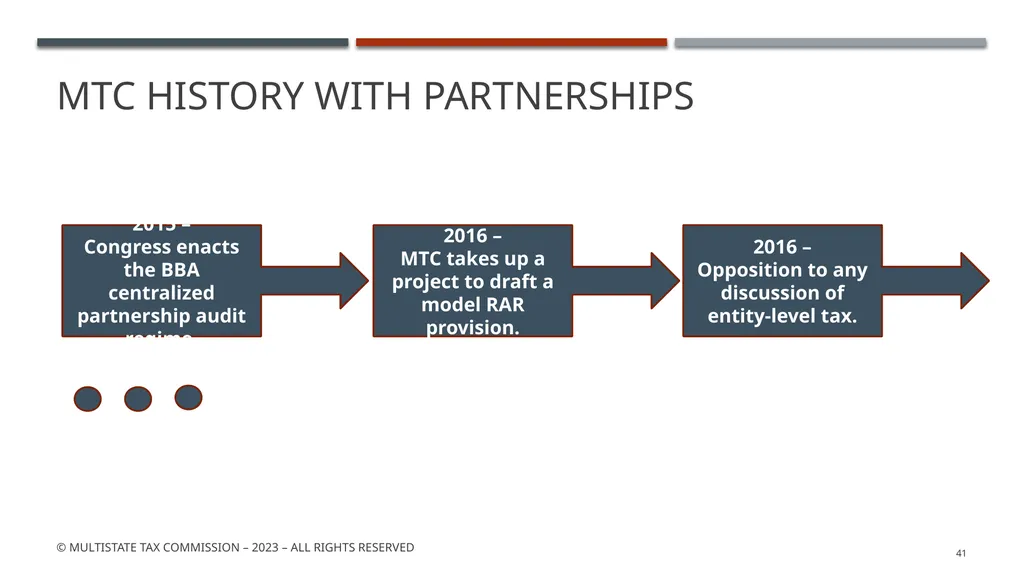
MTC History With Partnerships 2015 –
Congress enacts the BBA centralized partnership audit regime. © Multistate tax commission – 2023 – All rights Reserved 41 2016 –
MTC takes up a project to draft a model RAR provision. 2016 –
Opposition to any discussion of entity-level tax.<br>
Congress enacts the BBA centralized partnership audit regime. © Multistate tax commission – 2023 – All rights Reserved 41 2016 –
MTC takes up a project to draft a model RAR provision. 2016 –
Opposition to any discussion of entity-level tax.<br>
42
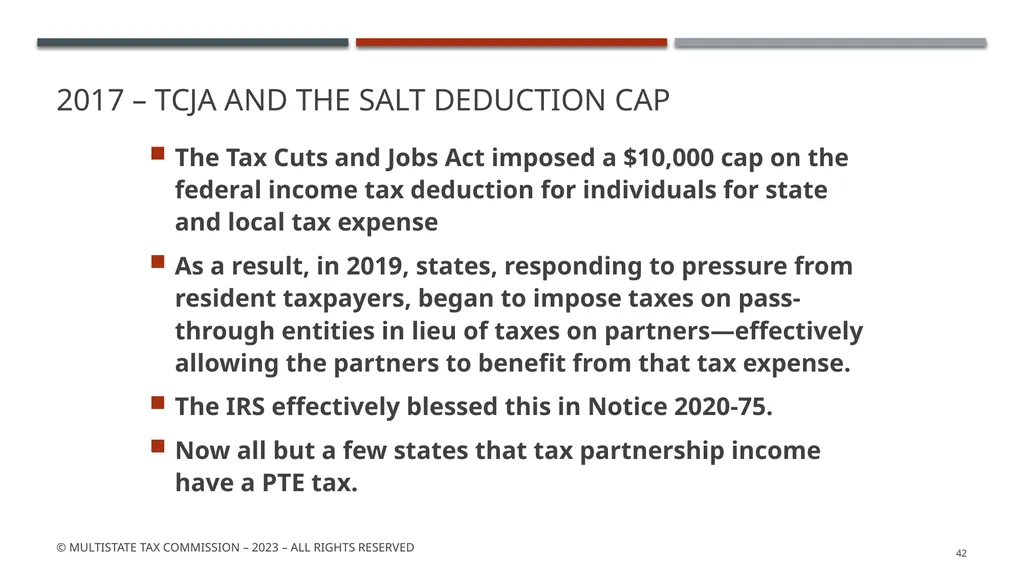
2017 – TCJA and the SALT deduction Cap The Tax Cuts and Jobs Act imposed a $10,000 cap on the federal income tax deduction for individuals for state and local tax expense
As a result, in 2019, states, responding to pressure from resident taxpayers, began to impose taxes on pass-through entities in lieu of taxes on partners—effectively allowing the partners to benefit from that tax expense.
The IRS effectively blessed this in Notice 2020-75.
Now all but a few states that tax partnership income have a PTE tax. © Multistate tax commission – 2023 – All rights Reserved 42<br>
As a result, in 2019, states, responding to pressure from resident taxpayers, began to impose taxes on pass-through entities in lieu of taxes on partners—effectively allowing the partners to benefit from that tax expense.
The IRS effectively blessed this in Notice 2020-75.
Now all but a few states that tax partnership income have a PTE tax. © Multistate tax commission – 2023 – All rights Reserved 42<br>
43
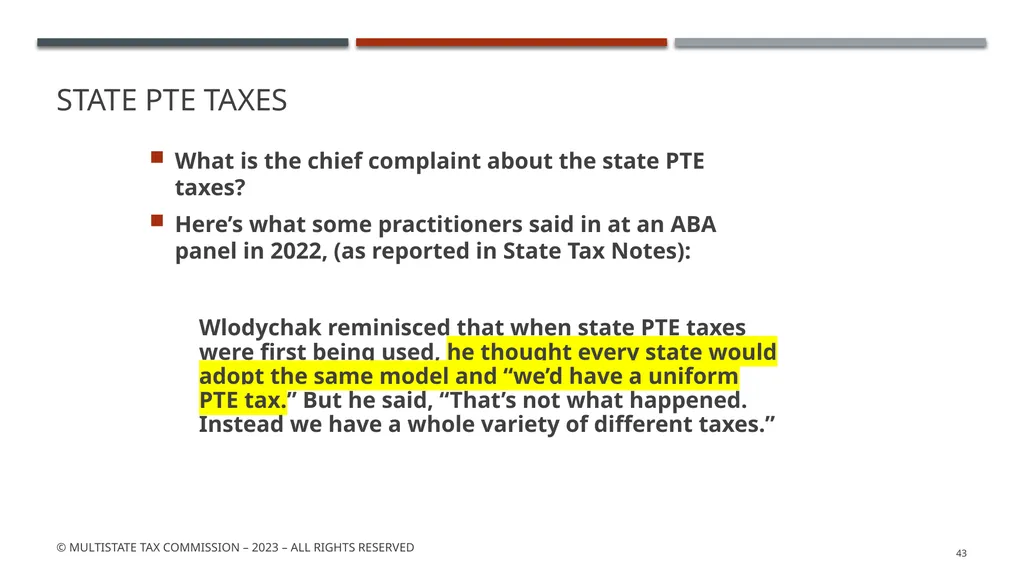
State PTE Taxes What is the chief complaint about the state PTE taxes?
Here’s what some practitioners said in at an ABA panel in 2022, (as reported in State Tax Notes):
Wlodychak reminisced that when state PTE taxes were first being used, he thought every state would adopt the same model and “we’d have a uniform PTE tax.” But he said, “That’s not what happened. Instead we have a whole variety of different taxes.” © Multistate tax commission – 2023 – All rights Reserved 43<br>
Here’s what some practitioners said in at an ABA panel in 2022, (as reported in State Tax Notes):
Wlodychak reminisced that when state PTE taxes were first being used, he thought every state would adopt the same model and “we’d have a uniform PTE tax.” But he said, “That’s not what happened. Instead we have a whole variety of different taxes.” © Multistate tax commission – 2023 – All rights Reserved 43<br>
44
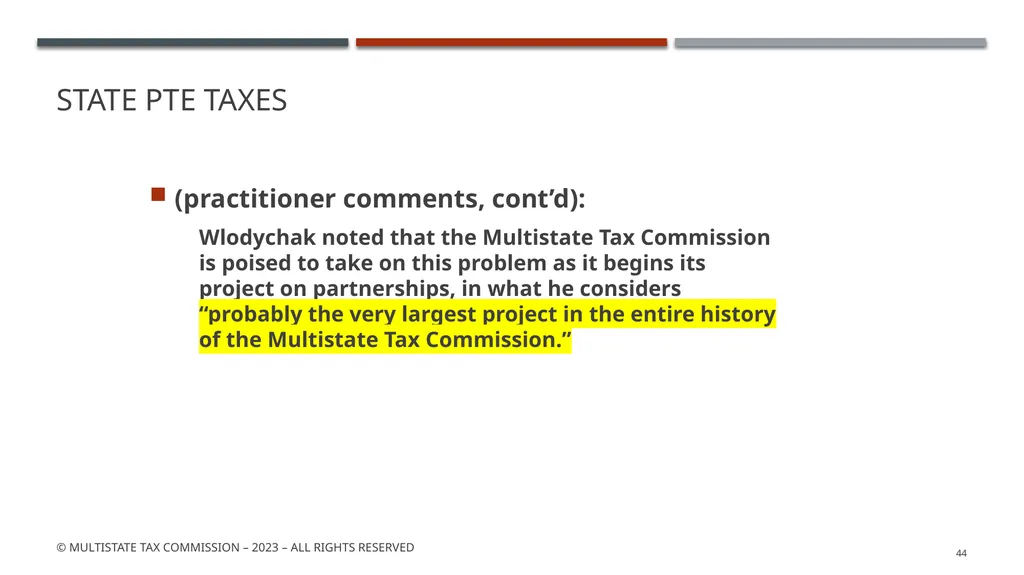
STATE PTE TAXES (practitioner comments, cont’d):
Wlodychak noted that the Multistate Tax Commission is poised to take on this problem as it begins its project on partnerships, in what he considers “probably the very largest project in the entire history of the Multistate Tax Commission.” © Multistate tax commission – 2023 – All rights Reserved 44<br>
Wlodychak noted that the Multistate Tax Commission is poised to take on this problem as it begins its project on partnerships, in what he considers “probably the very largest project in the entire history of the Multistate Tax Commission.” © Multistate tax commission – 2023 – All rights Reserved 44<br>
45
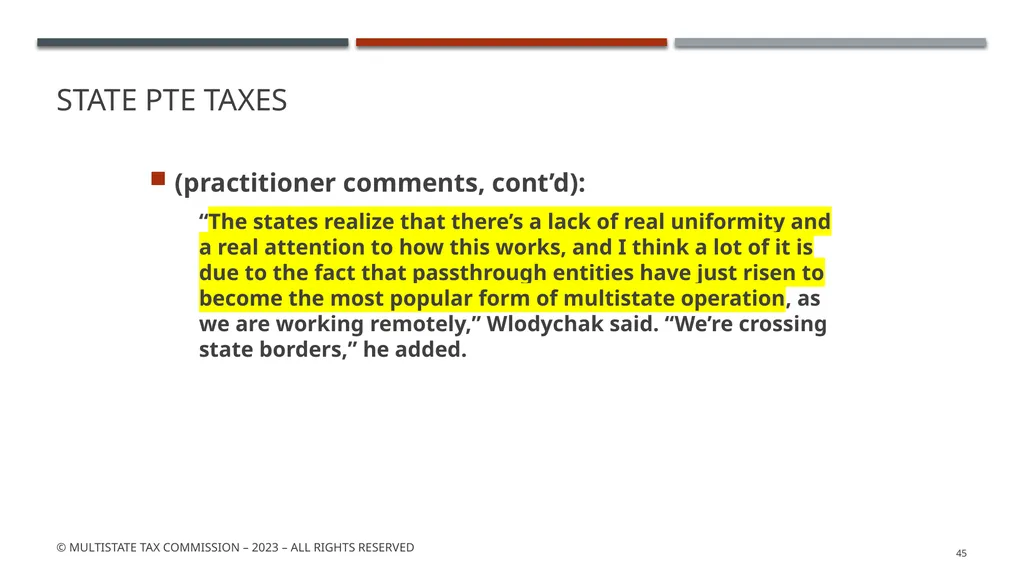
STATE PTE TAXES (practitioner comments, cont’d):
“The states realize that there’s a lack of real uniformity and a real attention to how this works, and I think a lot of it is due to the fact that passthrough entities have just risen to become the most popular form of multistate operation, as we are working remotely,” Wlodychak said. “We’re crossing state borders,” he added. © Multistate tax commission – 2023 – All rights Reserved 45<br>
“The states realize that there’s a lack of real uniformity and a real attention to how this works, and I think a lot of it is due to the fact that passthrough entities have just risen to become the most popular form of multistate operation, as we are working remotely,” Wlodychak said. “We’re crossing state borders,” he added. © Multistate tax commission – 2023 – All rights Reserved 45<br>
46
STATE PTE TAXES (practitioner comments, cont’d):
Wlodychak acknowledged that the MTC faces a daunting task, and that it could take five or six years before the commission even releases a proposal. “This could be a lifetime project,” he said, adding that it’s “a huge deal.” © Multistate tax commission – 2023 – All rights Reserved 46<br>
Wlodychak acknowledged that the MTC faces a daunting task, and that it could take five or six years before the commission even releases a proposal. “This could be a lifetime project,” he said, adding that it’s “a huge deal.” © Multistate tax commission – 2023 – All rights Reserved 46<br>
47
A word about PTE Taxes Why doesn’t the federal government apply an entity-level tax?
Answer: The character of the items of income, expense, gain, and loss and the tax attributes of the ultimate taxpaying partners are too important, given the higher federal tax rates, and so have to be accounted for when calculating the tax.
Example—a partnership may have ordinary income and capital losses—which could affect different partners differently.
These effects matter less at lower effective tax rates—like those imposed by most states. © Multistate tax commission – 2023 – All rights Reserved 47<br>
Answer: The character of the items of income, expense, gain, and loss and the tax attributes of the ultimate taxpaying partners are too important, given the higher federal tax rates, and so have to be accounted for when calculating the tax.
Example—a partnership may have ordinary income and capital losses—which could affect different partners differently.
These effects matter less at lower effective tax rates—like those imposed by most states. © Multistate tax commission – 2023 – All rights Reserved 47<br>
48
2017 – TCJA and the Sale of a Partnership Interest 1991 – IRS issued Rev. Rul. 91-32 – stating that a sale of a partnership interest by a foreign partner was U.S. income to the extent of the partnership’s assets/business in the U.S.
2012 – IRS assessed Grecian Magnesite for failure to pay tax on sale of interest in a U.S. LLC.
2019 – D.C. Circuit found for the plaintiff that the tax was not due.
But by that time – Congress, under the TCJA, had changed the law, making it clear that tax applied. © Multistate tax commission – 2023 – All rights Reserved 48<br>
2012 – IRS assessed Grecian Magnesite for failure to pay tax on sale of interest in a U.S. LLC.
2019 – D.C. Circuit found for the plaintiff that the tax was not due.
But by that time – Congress, under the TCJA, had changed the law, making it clear that tax applied. © Multistate tax commission – 2023 – All rights Reserved 48<br>
49
2017 – TCJA and the Sale of a Partnership Interest TCJA –
Amended IRC § 864(c)(8) to explicitly provide gain or loss from the sale of a partnership interest is sourced to the U.S. to the same extent as if the partnership had sold all of its assets for their fair market value as of the date of sale.
Enacted new § 1446(f), which requires the buyer to withhold 10% of the “amount realized” if the seller does not provide a certification of non-foreign status. It also provides that in the event the buyer fails to withhold, the partnership shall deduct and withhold from distributions to the buyer an amount equal to the tax that the buyer failed to withhold. The “amount realized” includes the seller’s share of partnership liabilities. © Multistate tax commission – 2023 – All rights Reserved 49<br>
Amended IRC § 864(c)(8) to explicitly provide gain or loss from the sale of a partnership interest is sourced to the U.S. to the same extent as if the partnership had sold all of its assets for their fair market value as of the date of sale.
Enacted new § 1446(f), which requires the buyer to withhold 10% of the “amount realized” if the seller does not provide a certification of non-foreign status. It also provides that in the event the buyer fails to withhold, the partnership shall deduct and withhold from distributions to the buyer an amount equal to the tax that the buyer failed to withhold. The “amount realized” includes the seller’s share of partnership liabilities. © Multistate tax commission – 2023 – All rights Reserved 49<br>
50
2017 – TCJA and the Sale of a Partnership Interest Aftermath – use of blocker corporations
It has been and is growing more common for foreign investors to use blocker corporations which hold interests in U.S. partnerships.
Either the blocker corporation sells the interest, pays the tax, and distributes the net proceeds in liquidation, tax free, OR
The foreign investors sell the blocker corporation stock and the buyer, if it then liquidates the corporation, pays tax on the gain from the value of the partnership interest distributed. © Multistate tax commission – 2023 – All rights Reserved 50<br>
It has been and is growing more common for foreign investors to use blocker corporations which hold interests in U.S. partnerships.
Either the blocker corporation sells the interest, pays the tax, and distributes the net proceeds in liquidation, tax free, OR
The foreign investors sell the blocker corporation stock and the buyer, if it then liquidates the corporation, pays tax on the gain from the value of the partnership interest distributed. © Multistate tax commission – 2023 – All rights Reserved 50<br>
51
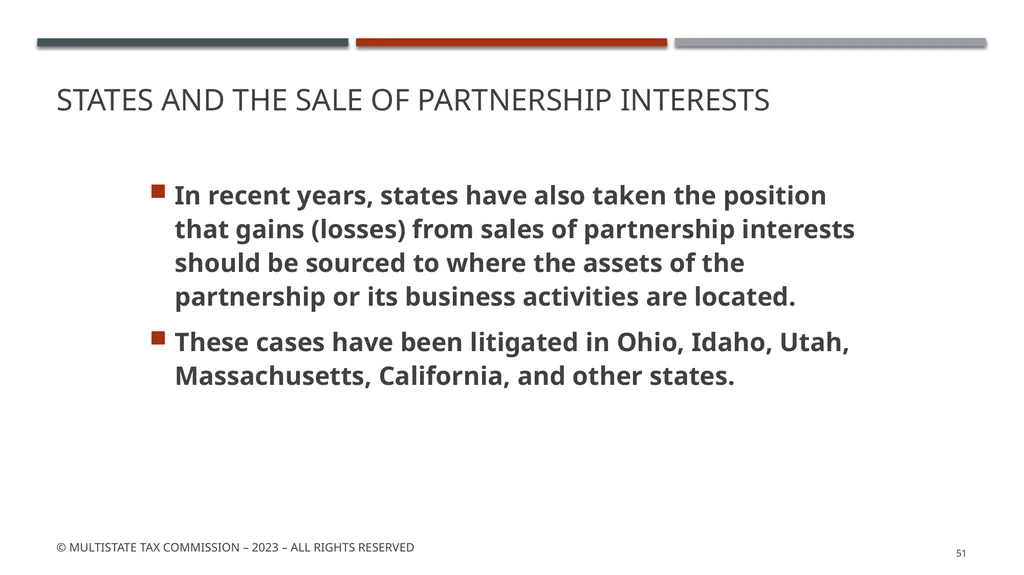
States and the Sale of partnership Interests In recent years, states have also taken the position that gains (losses) from sales of partnership interests should be sourced to where the assets of the partnership or its business activities are located.
These cases have been litigated in Ohio, Idaho, Utah, Massachusetts, California, and other states. © Multistate tax commission – 2023 – All rights Reserved 51<br>
These cases have been litigated in Ohio, Idaho, Utah, Massachusetts, California, and other states. © Multistate tax commission – 2023 – All rights Reserved 51<br>
52
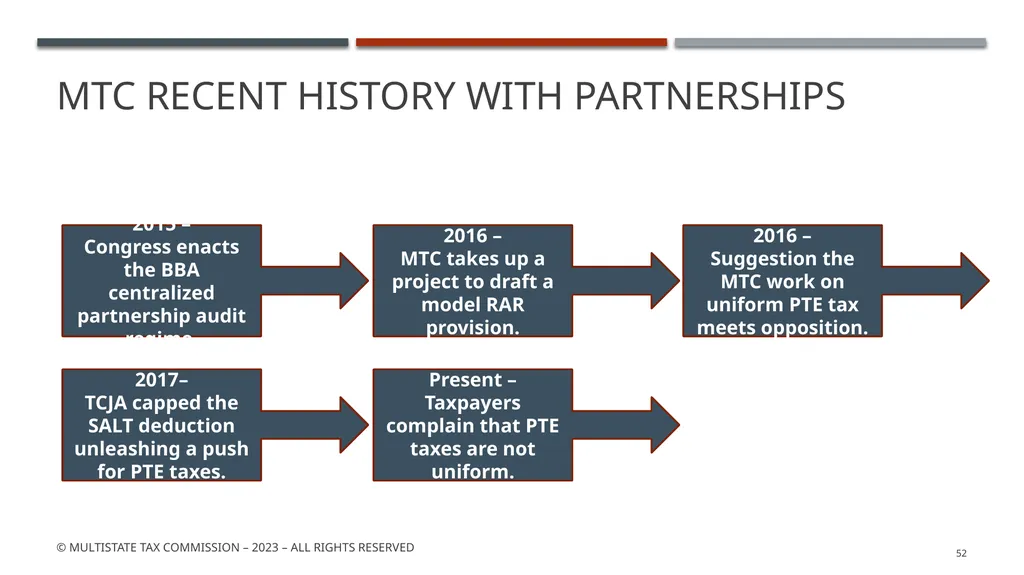
MTC Recent History With Partnerships 2015 –
Congress enacts the BBA centralized partnership audit regime. © Multistate tax commission – 2023 – All rights Reserved 52 2016 –
MTC takes up a project to draft a model RAR provision. 2016 –
Suggestion the MTC work on uniform PTE tax meets opposition. 2017–
TCJA capped the SALT deduction unleashing a push for PTE taxes. Present –
Taxpayers complain that PTE taxes are not uniform.<br>
Congress enacts the BBA centralized partnership audit regime. © Multistate tax commission – 2023 – All rights Reserved 52 2016 –
MTC takes up a project to draft a model RAR provision. 2016 –
Suggestion the MTC work on uniform PTE tax meets opposition. 2017–
TCJA capped the SALT deduction unleashing a push for PTE taxes. Present –
Taxpayers complain that PTE taxes are not uniform.<br>
53
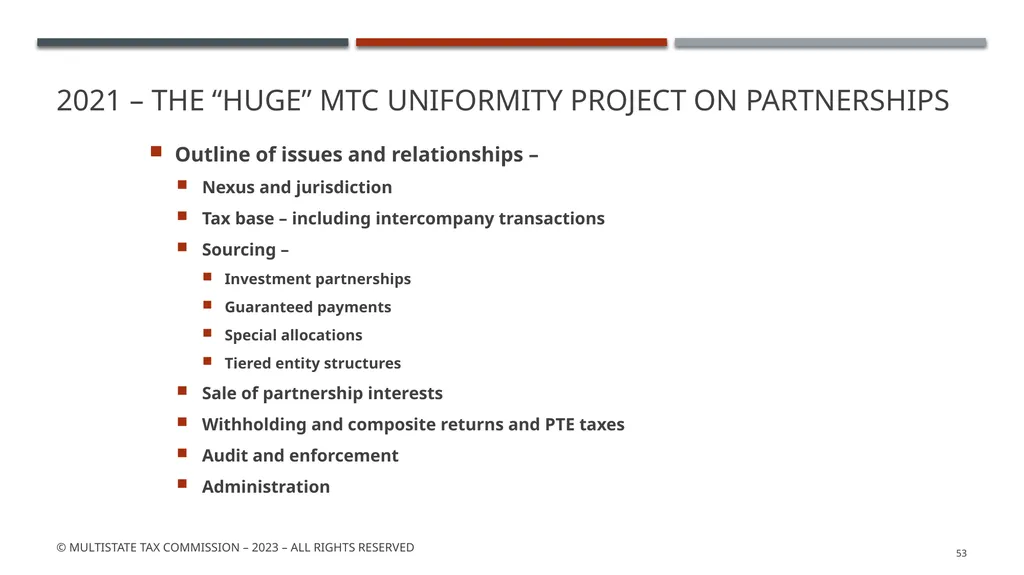
2021 – The “HUGE” MTC Uniformity Project on Partnerships Outline of issues and relationships –
Nexus and jurisdiction
Tax base – including intercompany transactions
Sourcing –
Investment partnerships
Guaranteed payments
Special allocations
Tiered entity structures
Sale of partnership interests
Withholding and composite returns and PTE taxes
Audit and enforcement
Administration © Multistate tax commission – 2023 – All rights Reserved 53<br>
Nexus and jurisdiction
Tax base – including intercompany transactions
Sourcing –
Investment partnerships
Guaranteed payments
Special allocations
Tiered entity structures
Sale of partnership interests
Withholding and composite returns and PTE taxes
Audit and enforcement
Administration © Multistate tax commission – 2023 – All rights Reserved 53<br>